Introduction
In their famous book Tensions of empire, Frederick Cooper and Ann Laura Stoler wonder about the circulation of colonial knowledge between different empires. They call for further research on the issue, asking:
To what extent – and by what processes – did the knowledge of individual empires become a collective imperial knowledge, shared among colonizing powers? Was there ever a language of domination, crossing the distinct metropolitan politics and linguistics barriers of French, English, Spanish, German, and Dutch? Should we be looking toward a “modular” model of colonialism as Benedict Anderson has suggested for the origin of nationalism?Footnote 1
In this article, I try to answer these questions with regard to the issue of labour mobilization in the field of export agriculture, a problem at the core of colonial policies. A number of authors have addressed the question of inter-colonial exchanges around the issue of labour, in particular by studying the activities of the League of Nations and the International Labour Organization.Footnote 2 However, as Cooper himself underlines, the debates that took place within these organizations remained very formal. Locked in ‘the framework of the anti-slavery ideology of the late nineteenth century’, they were unable to examine the ‘social and political context of colonial labour’.Footnote 3
To overcome these limitations, this article considers the activities and debates that took place within the International Colonial Institute (ICI), a learned association rather than an international organization. Located in Brussels, the ICI was created in 1894 as an international scientific association, aiming to compile a comparative study of colonial regulations. It was conceived by a European group of ‘colonial intellectuals’, notably Fransen van de Putte (former Dutch minister of colonies), Dr A. P. van der Lith, (professor of colonial law at the University of Leiden), Lord Reay (former governor of Bombay and under-secretary of state for India), Major Thys (director of Belgian companies in the Congo), and Camille Janssen (honorary governor-general of the Congo Free State). Their leader was Joseph Chailley-Bert, a major figure in French colonial circles, who was the general secretary of the Union Coloniale Française for over twenty years and who edited La quinzaine coloniale from 1897 to 1914.
The ICI’s membership was always limited, rising from a maximum of 70 at the beginning of the twentieth century to some 150 in the 1920s, and it was selected with a view to obtaining a fair representation of the different colonial powers. Important figures and high-ranking officials were members, among them many former governors and colonial ministers: Maurice Delafosse, Lord Lugard, Bernhard Dernburg (former German state secretary of colonies), Camille Janssen (former governor of the Congo Free State), and Friedrich von Lindequist (former governor of German South-West Africa and former colonial sub-secretary).
In practical terms, the ICI undertook two main activities. On the one hand, it organized periodic meetings, every year or every other year, dealing with various topics related to colonial administration and laws. On the other hand, it published a series of reports and studies entitled La bibliothèque coloniale internationale, which aimed at collecting and disseminating laws, regulations, treaties, and other official documents that were likely to be of interest to the different colonies. The ICI survived the First World War, despite the absence of energetic German representatives, but its activities decreased progressively through the 1930s, owing to increasing tensions in Europe. Its final session was held in 1939, without the French representatives and in the presence of only two British representatives.Footnote 4
The International Colonial Institute has been poorly studied, although its existence has been frequently mentioned.Footnote 5 To my knowledge, no in-depth analysis has yet been published of its activities, publications, and influence. In this article, I propose to analyse how the issue of labour mobilization for agriculture was discussed in the ICI between 1895 and 1930. The topic was of great importance to the ICI, for the first three volumes of the Bibliothèque coloniale internationale were dedicated to it.
Trying to answer Cooper and Stoler’s question regarding the circulation of ideas between European colonial powers, I first argue that, between 1895 and 1930, the ICI offered a place and a process to transform the ‘knowledge of individual empires into collective imperial knowledge’ on the issue of agricultural labour. Second, I show that three phases can be distinguished regarding the content of these debates, and these are discussed in turn in this article. From 1895 to 1905, the focus was on the recruitment of Asian indentured labour; from 1905 to 1918, the emphasis shifted to the means of recruiting indigenous peoples as paid labour; from 1918 to 1930, the mobilization of peasant agriculture came to the fore. Third and finally, I point to a growing discrepancy between ICI debates and colonial practices, in terms of how labour was actually employed in export agriculture. The focus of the analysis lies on tropical Africa, because the timing of colonization and the importance of European settlement differed greatly in North and South Africa. However, the question of Asian workers opened up discussions in geographical terms to India and China, and members of the ICI regularly drew on experiences in parts of the colonial world elsewhere in the tropics.
Producing in Africa without Africans: in search of the Asian ‘coolie’
Labour issues dominated the early years of the ICI. An initial debate took place during the opening session, held in The Hague in 1895, with the theme of ‘Labour and work contracts in the colonies’. Reports giving an account of the legislation in force in the French, German, and Dutch colonies were presented, followed by a provisional general report and a debate.
Van der Lith presented the general report, which was based on a distinction between ‘colonies with a sufficient native population’, and ‘colonies with an insufficient native population’. For the first category, he supported the introduction of a legal framework protecting the interests of workers and planters, with a strong emphasis on the ‘obligation to work’ of the indigenous population and the establishment of legal sanctions to guarantee compliance with workers’ commitments. The case of colonies with an insufficient indigenous population occupied twice as much space in the report. Van der Lith began the second part of his presentation by emphasizing the fact that insufficient labour could also be observed in densely populated colonies where local people were ‘reluctant to do any form of work’, citing the example of New Guinea.
The debate that followed focused on the employment of Asian ‘coolies’. The first element of the discussion was the role to be played by states in their recruitment. A clear consensus emerged concerning the need for a regulatory action, both on departure and arrival, to protect the interests of the workers and to avoid ‘excesses’, which could give rise to the prohibition of migration. The issue of the signing of an international treaty was raised in connection with China, which was considered a ‘half-civilized’ country with an unreliable government. This was followed by a discussion on the means of transforming indentured labourers, or at least some of them, into permanent colonists.
The 1897 meeting, held in Berlin, provided an opportunity to review the problem of indentured labourers. An international treaty, linking countries with a labour surplus to those with a labour deficit, was deemed to be necessary. The idea emerged after Elout van Soeterwoude, a doctor of law in the Netherlands, suggested that the following question be examined: ‘What are the means of peopling the colonies, in particular the Western colonies, where the abolition of slavery has eliminated the labour supply?’Footnote 6 Karl von der Heydt, president of the German East Africa Company and member of the Colonial Council, asserted that a ‘major conflict of interest’ existed between the colonizing states with a surplus labour supply and those with insufficient labour. The ICI should therefore draft an international agreement facilitating migration. The participants present at this session decided unanimously to appoint van der Lith as general reporter, supported by von der Heydt as assistant reporter, to make progress on this project, with a view to examining it at the subsequent session.
It was therefore during the 1899 session that the main discussions took place concerning an international treaty on indentured labour. As agreed during the 1897 session, the debates were introduced by a report prepared by van der Lith and von der Heydt, entitled ‘Report for the preparation of a draft international agreement facilitating the engagement of workers destined for colonies with insufficient labour’. In their introduction to the report, the authors specified that the draft agreement only concerned inter-colonial migration. It did not concern migrants who, in their own words, came from ‘countries inhabited by savages, still independent with no regular government and not submitting to the law of nations as it has been developed in European nations’.Footnote 7 Furthermore, the authors considered that China, while enjoying a regular government, presented a special case, resulting from the lack of concern on the part of its government for these matters.
Far from being a pre-draft agreement, the document was presented as a series of questions, which members of the ICI were invited to debate: on what conditions could the country of enlistment limit the recruitment of ‘coolies’? Who should conduct the enlistment? What role should the governments of the two concerned countries play? Should the agreement deal with the transport of workers? Which court of law should handle deviant behaviour on the part of either ‘coolies’ or planters?
The subsequent discussion took a strange turn. In the absence of the two reporters, detained in their own countries for medical reasons, the dossier was taken up by a certain Chevalier Descamps, a Belgian senator. He came out very quickly with doubts concerning the feasibility of such an agreement, and suggested that the organization of the report in the form of a questionnaire indicated that the reporters felt similar doubts. Descamps claimed that no country would agree to sign a convention limiting its freedom to restrict or prohibit emigration. Instead of an international treaty, the Belgian senator proposed discussing ‘a draft standard regulation concerning the use of foreign labour in the colonies’. The idea was to put forward a regulatory model, or, to quote one of the participants, a set of ‘specifications’, which each country could adapt and adopt in the form of a law. This shift in objective was quickly and unanimously approved.
Descamps then submitted to the members of the ICI a draft standard regulation drawn up on the basis of existing treaties between Britain and France, and between Britain and the Netherlands. Descamps’ project proposed to submit the recruitment of labourers in a given colony to the prior authorization of the government of that colony. The authorization would specify the terms and conditions of recruitment: places, times, duration, and personnel. The project then proposed creating enlistment managers, approved by the authorities of the two countries concerned, and endowed with permits defining recruitment zones, recruitment periods, and conditions of recruitment offered to workers. It proposed that recruitment should always be governed by a contract specifying the duration of the indenture, the financial and material conditions, the means of repatriation, and so forth. Finally it proposed appointing inspectors to supervise the rights and interests of the labourers in each country of indenture.
The Berlin session ended by agreeing to a ‘Draft regulation adopted by the ICI with a view to using exotic labour in the colonies’. This followed an initial discussion concerning the choice of the title and the status of the document. There was then a long debate about the role of the involvement of government in the recruitment of indentured labourers, the fate of the wives and children of indentured labourers, the existence and level of bonuses for the renewal of indentures, and, finally, healthcare.
These initial debates on indentured labour reflected the influence of the French in the young ICI, and, in France, the burdensome influence of the ‘old colonies’, Réunion, Martinique, Guadeloupe, and French Guiana. Indeed, the different works published in France on this theme in the last decade of the nineteenth century went no further than the analyses that Paul Leroy-Beaulieu had published twenty-five years earlier.Footnote 8 According to Leroy-Beaulieu, three types of colonies could be identified: commercial colonies, or comptoirs; agricultural colonies intended for population by European settlers and the creation of self-sufficient economies; and finally colonies with ‘facilities for the production of export commodities including tropical lands supplying sugar, coffee or cocoa’. To prosper, this third type of colony required ‘an artificial labour system – slavery, indentured immigration, such as coolies from India or China or indentured servants in the sixteenth and seventeenth centuries, or the deportation of criminals and the assignment of convicts’.Footnote 9
For authors writing about the situation of the new African colonies at the end of the nineteenth century, the usual model was the plantation colony. Madagascar, together with New Caledonia, were considered to be exceptions, as they could be settled by French people.Footnote 10 These authors mention the three forms of labour listed by Leroy-Beaulieu: slaves, indentured workers, and prisoners. However, at the end of the nineteenth century trafficking had been prohibited, slavery had been abolished in the old colonies, and the European powers were officially fighting slavery across Africa.Footnote 11 As the number of convicts was limited, Asian indentured labour was seen as the solution to the problem of labour on European plantations. For advocates of a recourse to indentured labour, especially the French, this ‘solution’ had allowed some of the old colonial possessions specializing in plantations to be ‘saved’. The best demonstration of this was the comparison between British Mauritius and French Réunion. Between 1840 and 1860, Mauritius benefited by importing almost half the total of indentured labourers sent abroad.Footnote 12 This influx enabled it to outdistance its rival island by far, despite the fact that Réunion, benefiting from a delay of ten years in the abolition of slavery, had almost succeeded in reaching the same level of production as its neighbour by the end of the 1830s.Footnote 13
Access to Asian labour was nevertheless regulated, and often hampered, by the introduction of restrictive measures concerning the departure of indentured labourers. The British authorities adopted a highly interventionist stance with regard to the migration of Indian workers. Ten years after the first departures for Mauritius in 1829, the government of India prohibited emigration for the first time.Footnote 14 It was authorized again in 1843 for Mauritius, and in 1845 for the West Indies, under the supervision of government officials.
In 1860 and 1862, in the wake of several scandals concerning African slaves thinly disguised as indentured labourers, France signed two treaties with the United Kingdom, giving the French colonies the possibility to recruit in British India. In return, the French government undertook to stop imports of African labour, and to put an end to the practice of the monetary ‘redemption’ of slaves.Footnote 15 It also granted British agents the right to check the regularity of recruitment and transport operations, obliging commercial firms to sign service contracts in India, rather than upon arrival in the colonies. Finally, it required an inspection of the boats transporting the indentured labourers, conducted by a commission including a British consular official.Footnote 16
These treaties, which authorized the British government to prohibit migration to certain destinations if the conditions were suspected to be sub-standard, only temporarily stabilized flows to French colonies. In 1868, citing the excessively high rate of mortality in French Guiana, the Indian government suspended migration to this destination, and cancelled it completely in 1876. The same year, following an investigation conducted by an international commission, the same government demanded a number of measures guaranteeing the welfare of Indian migrants to Réunion, on pain of prohibiting migration to the island. Despite several years of negotiation, planters in Réunion never agreed to grant the English consul the right to visit the plantations and veto re-recruitment contracts. The British government carried out its threat and, in 1882, effectively prohibited migration to Réunion, before extending this ban to the French West Indies in 1888.
In reality, the ‘draft regulation adopted by the ICI with a view to using exotic labour in the colonies’ had no significant influence on regulations regarding indentured labour, even in the case of the restrictive emigration policy adopted by the Government of India. It is true that a new agreement was negotiated between France and Britain in 1897, but it was never ratified, owing to a radical difference of opinion concerning the nationality of the descendants of indentured labourers and their obligations in terms of military service.Footnote 17 Repeated attempts by the French government to re-establish Indian migration to Réunion met a final refusal from the British government in 1911. The next year, the German government, in search of labour for its colony in German South-West Africa, suffered the same setback.Footnote 18
Indeed, the ICI’s deliberations regarding indentured labour suffered from an inherent weakness – the near absence of British colonials in the debate. Surprisingly, nobody mentioned Britain during ICI debates, in either the presentation of the problem or in the proposed solutions, even though the issue was dependent on London’s decisions. Indeed, the ICI enjoyed very little success in generating interest in its work among British participants, despite the best efforts of its secretary general. Lord Reay was the only Briton to participate in the Brussels session. This absence of British participation certainly facilitated the achievement of a consensus on a ‘draft regulation’ within the ICI, but it meant that the draft was of no value.
In defence of the ICI, it must be said that the question of employing foreign or alien labour was a recurrent one in the history of plantations, and was largely independent of the size of the existing populations in regions where plantations were established. In effect, reliance on foreign workers was intrinsically linked to the model of labour management. European plantations in the tropics were initially founded on the employment of slave labour, with a work discipline based on surveillance and constraint. To limit the possibilities for flight, planters prevented relations, contacts, and links with the local population and local resources. From this standpoint, characterizing ‘native’ populations as being unfit for work was not specific to the colonial situation in Africa. The same form of disqualification could be observed in numerous other colonial contexts. It was a ‘major fault’ of any population in its own location, which forms of migration were supposed to eliminate. Once the slave trade had been banned, and once slavery itself had been abolished, the immigration of indentured labourers seemed to offer a solution to ensure the survival and expansion of European plantations in the former colonies of the Atlantic and Indian Ocean during the second half of the nineteenth century.
However, by focusing on indentured labour, the ICI was clearly fighting a rearguard action. At the time of the creation of the ICI, Indian indentured labour was almost dead already, at least as a source of labour for non-British colonies. Moreover, the combined opposition of migrants of European origin in Australia and South Africa to imports of ‘coolies’, and of Indian nationalists to the emigration of workers, led to the system being dismantled even in the British empire. Increasingly restrictive measures concerning indentured labourers, introduced to satisfy European settlers, simultaneously increased protests by Indian nationalists. According to David Northrup, 255,000 indentured labourers were ‘imported into Africa, primarily between 1890 and 1910’.Footnote 19 This represented about 12% of the indentured labourers employed around the world between 1830 and 1920. Among them, 152,000 came from India and were, in their vast majority, employed in sugar production in Natal. In addition, political pressures in China reduced the flow from there. Asian indentured labour was thus not a solution for the European plantations of colonial Africa.
The gradual disappearance of access to the reservoir of Indian and Chinese labour rarely called into question the presupposition that production should be organized on large European-owned plantations. It was merely clear that labour could only be provided locally, or, in other words, that each colony should find the workforce necessary to the expansion of plantations within its own borders. Between 1890 and 1900, competition between colonies provoked the implementation of policy measures restricting the emigration of natives from many colonial territories (Cameroun 1887, Côte d’Ivoire 1894, Senegal 1895, Congo 1899, Madagascar 1897, Togo 1891). The paper presented by A. Duchêne, head of the African Department in the French Ministry of Colonies, to the 1900 Congress of the ICI exemplified this situation:
There is an obviously striking fact: native immigration grows more and more limited and scarce, to such a point that it will soon become impossible. Obstacles do not arise only between Powers any more, each of them willing to save, for its own possessions’ development, the workforce available in the territories that they have conquered. This phenomenon now occurs between the colonies belonging to the same Power; it is acute enough to make us consider as fanciful what we once called, as a possible solution to the labour problem, inter-colonial assistance … Colonies have to take good account of it and rely on themselves from now on. Immigration and its sophisticated rules will soon become a faded memory.Footnote 20
Transforming African Natives into wage workers for European plantations
At the turn of the twentieth century, entrepreneurs and colonial officials progressively realized that they had to find ways to recruit and retain local labourers for European plantations, and that the use of physical constraint appeared to be essential to solve the problem.Footnote 21 A muted debate on the use of constraint to mobilize ‘native’ labour was first observed within the ICI as early as 1895, and it continued during the two subsequent sessions, in 1897 and 1899.
The first point of debate concerned the best means of encouraging people to come to work on plantations. This meant making work on plantations essential to the survival of the labourers, and possibly even of their families. The debates surveyed different methods. Recruitment from far away, if the territory was sufficiently large and heterogeneous (both socially and ecologically), limited the possibilities of escaping to a life of self-sufficiency. This was a kind of internal indenture. Major Thys, director of many Belgian companies in the Congo, often reiterated the lessons learned from building the railway in the Congo Free State.Footnote 22 Another method was land expropriation, accompanied or not by the creation of reservations, although this was more typical of settler Africa. It was possible to prohibit the cultivation of food crops, or even to destroy them, as reported by van der Lith with regard to Surinam.Footnote 23 Chiefs could be intermediaries, a practice described with regard to recruitment for a plantation in the Congo Free State by Diderrich, former head of the Department of Agriculture, in a very direct manner: ‘Recruitment was absolutely free on the part of the natives with regard to us, although it was imposed by the chiefs. The entire policy of the Congo state consists in recognizing the supremacy of the chief.’ He added a little later: ‘We resorted to a labour tax; the chiefs accepted it in good faith and when they gave us this labour in compliance with their right, we accepted the means they used.’Footnote 24 Taxation, the least coercive method, was presented by Count von Göetzen, lieutenant in the 2nd Uhlan of the guard in Berlin, during the 1899 session. Established per hut or per head, it could be paid in labour, produce, or money. This tax was ‘a humane and very fair solution because part of the tax would be used to the benefit of the natives’.Footnote 25
A second set of questions pivoted around how to prevent labourers from leaving plantations, and the criminalization of breaches of contract was the main question debated during the 1895 session. The question was: ‘Does a breach of contract represent an offence?’ The answer was a unanimous ‘yes’, if occasionally in a somewhat roundabout way. Recourse to penal sanctions was justified, since work was redemptive. More narrowly, ‘natives’ were not subject to general jurisdiction, thereby making a civil trial impossible. Alternatively, they had no possessions, thereby excluding the payment of damages and interests to the employer.
The debate on the use of constraint in the management of labourer on plantations only re-emerged in 1912, this time with a totally new tone. The 1912 Brussels session of the ICI included a long discussion on the ‘Regulation of natives’ work in the colonies’, which was introduced by the representation of a report written by Camille Janssen, who had been the secretary general of the ICI since its creation.Footnote 26 More importantly, he had been general administrator, and then governor-general, of the Congo Free State from 1887 to 1891.
Janssen, who conducted a review of the different laws relating to the employment of ‘natives’, emphasized the aspects ensuring the protection of workers, and drew from this a series of theses intended to guide labour regulations. Compared to the spirit of the debates held previously within the framework of the ICI, his position appeared to be resolutely progressive. Janssen wanted legislation to ensure that all forced recruitment was avoided. On this first point, he suggested abolishing the bonuses paid to recruiters in proportion to the number of individuals recruited. He also fought the involvement of governments in the process of recruitment, considering that this tended to give recruitment an obligatory nature, and he fought for the principle of a contract being signed at the place of recruitment. Furthermore, Janssen wanted workers to be able to break their contract, on condition that they covered their repatriation costs, and, in certain cases, provided the employer with compensation. Most importantly, he condemned the use of corporal punishment: ‘Corporal punishment must never be inflicted by the master, and it is also desirable that corporal punishment be entirely abolished in all colonies.’Footnote 27 He also rejected forced labour: ‘The natives cannot under any pretext be forced to work, and forced labour must be prohibited.’Footnote 28 Finally, he suggested the creation of arbitration councils, and the appointment of labour inspectors.
In the debate that followed Janssen’s introductory presentation, opposition was voiced to his views on coercion, notably concerning the use of corporal punishment and the obligation to work. Several German delegates were in this camp, including Dr Anton, professor at the University of Jena, Dernburg, and von Lindequist. They spoke in defence of the ‘moral obligation’ to work, the legitimacy of corporal punishment, and the efficiency of the administration’s involvement in the recruitment of labourers for private companies. They were supported by a Portuguese participant, the Count of Penha Garcia, who denounced the negative coverage of Portuguese colonial policy in press campaigns, and the actions of the Anti-slavery Society. Defence of the use of constraint also enjoyed the support of Hubert Jerningham, former governor of Mauritius and Trinidad.
Others supported Janssen. Diderrich, who had become a member of the Belgian Colonial Council, declared that the principles put forward by Janssen were the same as those adopted by the Belgian government in 1910, with a view to regulating native labour in Congo, and he argued the case for the immorality and inefficiency of coercion. He received the support of another Belgian, Colonel Thys, and two Dutch participants, including Abendanon, the former director of the Department of Public Education, Cults, and Industry in Batavia. The other Dutchman, Cremer, added to the criticisms levelled by Janssen against corporal punishment, emphasizing the danger that this represented for the mental health of those Europeans practising it. In the course of this debate, the French were surprisingly quiet. Chailley-Bert, usually so prominent, only intervened once, to defend the need for government involvement in recruiting Indian labour.
One of the particularities of the 1912 meeting was to shed light on major divergences in points of view, giving rise to verbal confrontations, the like of which had never before been witnessed within the ICI. As one of the participants stressed: ‘How deeply our minds have changed regarding our rights and duties towards the natives. We once all thought in the same and radical way and this makes people say the Institute had a doctrine. This is no longer the case today.’Footnote 29 The 1912 ICI session also revealed national divisions that were not previously so noticeable, with all the participants of a given country defending the same position.
Contributing to the 1912 debate on coercion was the shadow of an earlier colonial scandal, concerning the collection of wild rubber in the Congo Free State, ruled by King Leopold of the Belgians.Footnote 30 The policy of the forced delivery of rubber was the object of a long campaign of denunciation in Europe and the United States. It resulted in 1908 in the transformation of the Free State into a Belgian colony. Diderrich emphasized at the ICI session of 1912 that this event represented a ‘veritable revolution for the Belgian colonial milieu’. It also made the Congo a sort of laboratory in the field of ‘native policies’.
A second colonial scandal, relating to cocoa plantation in São Tomé and more broadly to conditions of recruiting and employing workers in Portuguese colonies, influenced the debates of 1912. Indeed, this scandal even led some to question the earlier consensus on the virtues of the European plantation model. During the early years of the century, several reports had shed light on the slavery practices observed in the recruitment and work conditions of Angolan and other labourers working on the island plantations of São Tomé and Príncipe.Footnote 31 A boycott was thus organized by English and German chocolate makers.Footnote 32 This led the Portuguese authorities to promulgate a number of reforms, especially once the Republican Revolution of 1910 had brought a new set of radical politicians to office. However, they remained defensive about their country’s earlier record, and were prepared to resort to importing forced labour into São Tomé from Mozambique and Angola.Footnote 33
Indeed, after more than fifteen years of work, the ICI remained far from producing any ‘modular model of colonialism’, at least regarding the mobilization of labour for export agriculture. A rapid examination of tropical Africa’s main agricultural exports reveals that diversity prevailed over homogeneity. At least six types of labour situation can be roughly distinguished. The first was forced collection from the wild, typified by the Congo’s ‘red rubber’ before 1908. Second, there were slave plantations, such as those growing cocoa in São Tomé up to 1910. Third, there were European plantations depending on indentured Asian labour, notably sugar estates in Natal and Mauritius. Fourth, there were European plantations using constraint extensively for the recruitment of local peoples, for example to grow sisal, cocoa, and coffee in German colonies. Fifth, there was administratively constrained indigenous farming, such as the first development or modernization schemes for cotton in the Sudan and in German East Africa. Finally, there was voluntary indigenous farming, with its roots in the legacy of legitimate trade (e.g. palm products in Nigeria, and groundnuts in Senegambia), which was most obvious along the new cocoa frontier in the Gold Coast (Ghana).
Viewed from the metropolitan angle, one can say that, just before First World War, the specific colonial histories of the different European nations involved in Africa clearly prevailed over any tentative harmonization process conducted by the ICI. Portugal was only just emerging from the times of slavery. France continued to dream of indentured labour for its plantation entrepreneurs. Britain, educated by its Indian experience, benefited from indigenous agricultural dynamism. Germany, a newcomer without colonial experience, used violence extensively. Belgium, from 1908, sought a peaceful approach to replace the traumas of the Congo Free State.
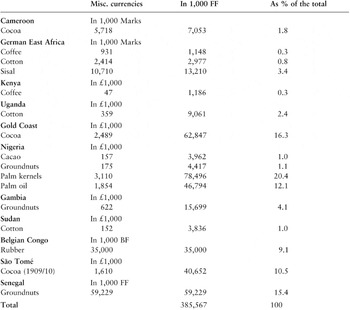
Table 1 shows how weak European production of agricultural commodities for world markets remained in 1913, after some thirty years of modern colonialism. In terms of plantations proper, only cocoa from São Tomé and Cameroun, and sisal from German East Africa, made up a significant part of tropical Africa’s agricultural exports. European-grown coffee was also of some significance in Kenya. However, the European stake was not limited to the plantation sector. There was also the rubber exported from the Congo (before 1908), and an emerging agro-industrial sector, consisting mostly of cotton exports from German East Africa, Uganda, and the Sudan. When added together, commodities produced under some form of European direction made up about 30% of African exports. Products from various activities stimulated by legitimate trade still represented over 54% of tropical Africa’s agricultural exports. Indeed, this sector is clearly underestimated in this calculation, as palm oil from Côte d’Ivoire and Dahomey (Benin), rubber from French Guinea and French Congo, and ivory and hides from eastern Africa should be added. Booming cocoa cultivation in the Gold Coast (Ghana) represented the final 16% of the total.
Main agricultural exports from African colonies in terms of value in 1913

Sources: Information for Cameroon, German East Africa, Kenya, Uganda, the Gold Coast, Nigeria, the Sudan, and the Belgian Congo taken from Mitchell, International historical statistics; information for the Gambia taken from Kenneth Swindell and Alieu Jeng, Migrants, credit and climate: the Gambian groundnut trade, 1834–1934, Leiden: Brill, 2006; information on São Tomé taken from Francis Mantero, Manual labour in San Thomé and Principe, Lisbon: Printing office of the Annuario Commercial, 1910; information on Senegal taken from James F. Searing, ‘God alone is king’: Islam and emancipation in Senegal: the Wolof kingdoms of Kajoor and Bawol, 1859–1914, Portsmouth, NH: J. Currey, 2002. Exchange rates taken from Institut National de la Statistique et des Etudes Economiques, Annuaire Statistique 1951, Paris: Imprimerie Nationale, 1952.
The European stake was not only weak but was also threatened. The two jewels of export agriculture in colonial Africa, São Tomé and the Congo, were under close scrutiny because of their extensive use of violence. São Tomé’s success story was more the swansong of the old Atlantic plantation complex than an illustration of the new European colonialism.Footnote 34 Congolese rubber was condemned not only by the opposition of the anti-slavery movement but also by the overexploitation of wild sources of latex, and by the looming threat from Southeast Asian plantations of Hevea brasiliensis.Footnote 35
On the eve of the First World War, the results of thirty years of attempts to create European plantations in Africa, and forcefully to mobilize natives as labourers on these plantations, were thus very disappointing. The performance of European plantations in sub-Saharan Africa appears even worse when compared to plantations located in Asia. According to Hugh Tinker, in 1913 the value of exports to England alone represented 105 million francs for Ceylon tea, almost 200 million francs for Indian tea, and about 280 million francs for natural rubber from Malaysia and Ceylon.Footnote 36 This compares with 65 million for all European plantations in Africa, including São Tomé! European plantations in sub-Saharan Africa were clearly no match for their Asian competitors, where production was soaring, thanks, among other things, to a huge influx of ‘coolies’ from India and China.
The ‘native agriculture turn’ and the new legitimacy of colonial constraint
The theme of native agriculture and its mobilization for export crops appeared very early in the discussions of the ICI. At the 1899 meeting, during which a long discussion was devoted to the issue of indentured labour, the following question was raised: ‘What are the most practical means to be adopted in order to encourage the introduction and development of new crops in the colonies?’ Diderrich mentioned bonuses given to ‘chiefs’ for planting cocoa trees.Footnote 37 Various other methods were discussed, such as the creation of experimental botanical gardens, the distribution of seeds, and visits by agricultural inspectors. Once again, however, debates focused on the use of constraint.
The issue of native agriculture then disappeared from the activities of the ICI for two decades, before returning in force to be debated throughout the 1920s. It was initially approached partially, and with caution, in the report presented to the 1921 session by Daniel Zolla, professor at the Institut National Agronomique and author of several books, one of which was entitled L’agriculture moderne, published in 1913. He was also secretary general of the French Comité d’Action Agricole Coloniale. Zolla examined the ‘Methods to be used to produce in the colonies the raw materials necessary for the homeland’. This was actively and directly debated during several meetings of the ICI.
In 1922, it was decided that, during the subsequent session of the ICI, a debate would be devoted more specifically to the ‘Extension of native agriculture in the tropical colonies’, based on a report by Émile De Wildeman. A Belgian, who worked from 1891 to 1931 at the National Botanic Garden, De Wildeman never travelled to Africa, but he was a promoter of the ‘native agricultural path’ for several years. In 1909 and 1910, he was a member of the Group of Colonial Study at the Solvay Institute (Brussels University), where he met and worked with Camille Janssen, and where he elaborated most of the ideas presented in his 1923 report. At the 1924 session of the ICI, held in Rome, he presented a report entitled ‘The intensive and rational extension of native agriculture’. The discussion continued during the following session, held in The Hague in 1927, based on a new report by De Wildeman. The decision was then taken to organize a vast survey concerning the actions introduced in the different colonies, the results of which were presented and discussed in depth at the 1929 session, held in Brussels.
A broad consensus first emerged on the relevance and interest of mobilizing indigenous agriculture for food production, which was intended for the local peoples themselves. The nutritional situation of African populations, perceived as being poor, was very often the trigger for the interest shown in indigenous agriculture. Malnutrition and depopulation were two reasons why food production by ‘natives’ had to be increased. Some associate the emergence of a protective vision regarding the indigenous population with the Mandate System of the League of Nations.Footnote 38 However, demographic arguments dated back to before the First World War in the ICI’s discussions. Numerous accounts and declarations expressed concern with population decline in various colonies and with the role of labour recruitment in this development. This was the case, for example, in the central part of German South-West Africa, ravaged by the consequences of the Herero War, as stated by Dernburg in the 1912 meeting of the ICI.Footnote 39 Colonial bio-politics were emerging in Africa. Jules Harmand, whose famous book Domination et colonisation was published in 1910, can be quoted here:
A conquering state policy is a production policy. It is exerted on both land and people. On land, to expand its reachable and economically valuable area through civil engineering, roads and railways, drains and irrigation canals, bridges and harbours, fast communications, agronomic surveys, geography, and a land registry. On people, to increase their number and activity by a fair, honest, domestic, and foresighted administration, through a good fiscal system, through education, aid, and public health too, which puts in its hands, along with microbiology and sanitation, powerful means of which our predecessors had no idea, and that are nowhere as promising as in tropical regions.Footnote 40
After 1918, demographic concerns grew deeper, as it appeared that the development of the colonies would not be possible without population growth, whatever the strategy adopted. European enterprises, too, needed more workers. To achieve this objective, it was absolutely essential to improve the nutritional situation of indigenous peoples. It was on the basis of these concerns that the question of native agriculture was first included on the agenda of the ICI.
While a consensus was quickly reached on the need to promote the involvement of ‘natives’ in food production, positions were much wider regarding their involvement in export agriculture. In various speeches, De Wildeman clearly defended a position favourable to indigenous farmers, going so far as to assert in the summary of the 1929 survey that ‘natives’ were ‘called on to become genuine producers’.Footnote 41 Numerous other Belgians took up this position in the context of ICI debates.Footnote 42 However, at the 1929 session of the ICI, arguments in favour of ‘native’ agriculture encountered strong opposition from supporters of French planters.Footnote 43 Portuguese representatives were of the same negative opinion.Footnote 44
Three types of argument were put forward against the involvement of ‘native’ smallholders in the production of export crops. The first and most traditional argument concerned the comparative technical performances of European and indigenous agriculture. In this domain, commentators cited output per hectare, quality, the regularity of supply to processing units of perishable materials such as sugar cane and palm fruit, and health-related risks. The second argument, also common, concerned the food security of ‘natives’. The development of export crops by the indigenous population would be reflected in a fall in the production of food and the need to import it, thereby threatening the nutritional status of the populations. Émile Baillaud demonstrated that the growth in West African groundnut production resulted in an increase in rice imports from Indochina, and thus argued in favour of European plantations.Footnote 45 The final argument concerned the exposure of natives to price instability and medium-term risk, which could lead to a sudden rejection of the marketing of crops, with serious consequences for supplies of raw materials.Footnote 46
For their part, the advocates of indigenous agriculture also developed three types of argument. The first concerned the lack of labour available to work on European plantations. Octave Louwers most explicitly defended this position. He asserted that it was not a question of
claiming that, from a technical point of view, native agriculture has the same value as European agriculture or is superior to it, rather that, taking all the elements of the problem into account, they are equally profitable for the colonies. Moreover, they have the advantage for many colonies of representing the type of value that is best suited to the current social status of the populations.Footnote 47
The second argument referred quite simply to success stories of native export agriculture. The cocoa industry of the Gold Coast was most frequently cited. Auguste Chevalier was one of the first to notice that something new was happening in this colony.Footnote 48 A paper written in 1909 by W. S. Tudhope, director of agriculture in the Gold Coast, gave further publicity to the native cocoa boom. He presented a report at the third International Congress of Tropical Agriculture, organized in London in 1914.Footnote 49 A French version was published in 1919 by the Comité d’Action Agricole Coloniale.Footnote 50 This was not the only success story. Cocoa and groundnuts in Nigeria, cotton in Uganda, and coffee in Tanganyika were often cited with regard to the British colonies. The example of smallholder rubber in the Dutch East Indies was also broadly discussed.Footnote 51 With regard to the French empire, the Senegalese groundnut industry was frequently cited as the perfect example of indigenous capacity to produce an export crop successfully, for example in a speech by Émile Baillaud at the 1929 session of the ICI. Even in Côte d’Ivoire, despite a policy broadly favourable to European plantations, the development of cocoa production by Africans, who largely dominated agriculture in this territory, was recognized and praised.Footnote 52
The third argument in favour of ‘native agriculture’ concerned the desire for imperial autarky and the protection of national interests. These objectives formed the basis of the report submitted in 1921 by Daniel Zolla under the title ‘Methods to be used to produce in the colonies the raw materials necessary for the homeland’. Zolla began his introductory speech at the 1921 ICI session by stating that ‘colonization is justified by the need of the homeland to obtain raw materials’, which was a standard statement in colonial debates. Zolla’s report cautiously suggested initiating an orientation toward indigenous agriculture. As a transition, and perhaps as a tactic for the discussion, sharecropping was promoted, with an explicit reference to the colonat paritaire of the French sugar island of Réunion. However, the debate provided the opportunity for positions more explicitly supportive of native agriculture to be expressed. Indeed, Zolla himself declared: ‘Native agriculture is the aim that we must achieve’, and his sentiments were echoed by Auguste Chevalier and Camille Janssen.Footnote 53
A link between curbing raw-material shortages and the promotion of indigenous agriculture had already been elaborated some years before, for it was first discussed in relation to the development of cotton farming in Africa. For several decades, the English, French, and German textile industries had been expressing increasing concerns regarding supplies of raw cotton. The suspension of American exports during the civil war in the 1860s, followed by the rapid growth of the textile industry in both the United States and Japan, suggested that supplies might decline, leading to competition over imports. In the UK, France, and Germany, associations were created to promote cotton farming in the colonies. In every association, a faction favourable to indigenous agriculture appeared, which found strong support in colonial administrations.Footnote 54
The link was once again discussed in France during the Congrès d’Agriculture Coloniale, held some months before the end of the First World War, in May 1918. The Congress was organized by the Union Coloniale Française, under the Presidency of Joseph Chailley-Bert and its proceedings were edited by Daniel Zolla.Footnote 55 Unlike previous French colonial congresses, this one included a session on native agriculture. Its reporter, Odet Denys, summarized the discussion by saying:
Financial difficulties created by the war, and that will outlive the war for several years, give us an urgent need to limit our foreign payments. A methodical, constant, and vigorous development of our colonial territories would help us considerably to reach this goal. This report aims to shed light on the role native agriculture could play in such a development, and to study the proper measures to make it thrive.Footnote 56
The arguments in favour of native agriculture gave rise to speeches in defence of strong public intervention. The survey conducted by De Wildeman in 1929 aimed at making an inventory of political measures needed to ‘develop native agriculture’, and its summary primarily consisted of a presentation of these measures. In conclusion, De Wildeman asserted that ‘Given the importance of agriculture, both capitalist and native, for the economic future of the colonies, and the particular need to promote the efforts of the native population called on to become genuine producers, an agrarian policy must be organized.’ This was followed by a long list of the administrative units to be created in both the motherland and the colonies, such as scientific, veterinary, forestry, and phytopathology departments. Among the actions to be undertaken were the issuing of individual property deeds, the creation of experimental units, the standardization of product quality, seed quality control, and support for cooperatives. This text made many references to the Dutch experience in Indonesia, which was presented as a model to be duplicated, and provided a rationale for public intervention, which was portrayed as essential to the development of ‘native’ agriculture.Footnote 57
Thus, the defence of indigenous farmers also, and perhaps above all, served to promote administrative action founded on science. In the final paragraph of his conclusion, De Wildeman asserted that: ‘Science here as everywhere is the foundation of the edifice to be built – with courage and perseverance – for the moral and economic welfare of both the colonized and the colonizer.’ This was despite the weak role played by official measures in the success stories emphasized by the very promoters of ‘native agriculture’, such as cocoa in the Gold Coast or groundnuts in Senegal. Nevertheless, public action was presented as essential by most of the supporters of ‘native agriculture’, mainly because, despite past results, they wanted to transform the sector into an ‘intensive and rational’ activity. According to De Wildeman: ‘An improved and intensified crop farmed by natives must be supervised – this is absolutely essential!’Footnote 58
Since the very first ICI debates on ‘native agriculture’, the use of constraint had been questioned. The 1899 session provided an opportunity for an in-depth discussion of Johannes van den Bosch’s Cultivation System in early nineteenth-century Java, leading to both objective evaluations of the advantages and disadvantages of the system, and to strong condemnations. Chailley-Bert, an expert on Java, excelled in this delicate operation. Asserting that most French colonial establishments recommended applying the Cultivation System, he emphasized his liberal convictions to better justify the use of coercion. The abundance of resources generated for the Netherlands, the allegedly prosperous situation of the Javanese at the end of the nineteenth century, and their supposed attachment to their ‘European chiefs’ were all cited as positive results. This enabled Chailley-Bert to conclude one of his speeches by saying:
All in all, this Van den Bosch system did not have any bad results for the natives. I do not defend it, I do not even think that it is to be recommended today, but it is a sign that the natives are sometimes incapable of taking certain initiatives alone and that, in certain cases, it is perhaps not a bad thing that the state replace them in the beginning.
In the light of a tendency to legitimize constraint at that time, the reservations and precautions adopted to discuss the Cultivation System were somewhat surprising. One might have expected a majority of speeches to be openly favourable to its introduction in the African colonies. Doubtless this situation should be interpreted in relation to the presence of Fransen van de Putte in the ICI’s founding group, and to the active participation in its activities of several other liberal politicians previously engaged in fighting the Cultivation System.Footnote 59
The 1920s saw the return of a much more explicit and active defence of constraint, in the form of forced cultivation. Officials would now oblige natives to grow specific crops in a defined area, and, sometimes, to apply specific technologies. The different sessions of the ICI devoted to native agriculture provided the opportunity for many eminent professors and high-ranking colonial civil servants to express their faith in ‘coercion’, the obligation to work’, and ‘administrative pressure’, as the best solutions for improving ‘native agriculture’.
Another important aspect of the evolution of the debate was the gradual and increasingly frequent appearance of the word paysan (peasant). The Belgians and the French were especially fond of this word, although in radically different ways. The former believed that the objective was to transform the ‘native’ into a peasant. This was a recurring idea in the speeches and writings of De Wildeman. One of the aims was the adoption of a sedentary lifestyle by populations perceived to be nomadic, whose agricultural practices destroyed forestry reserves and the value of the land. It was also a question, as stated by Louis Franck, a former Belgian colonial minister, ‘of little by little encouraging the men to work in the fields’, rather than leaving agriculture to women.Footnote 60 From the French point of view, however, ‘natives’ were already peasants, ‘black peasants’. As such, we can speak of the ‘invention of the African peasant’ by the colonial administration, peasants who predated colonization and who embodied the profound identity of the continent. Robert Delavignette and Henri Labouret played a central role in this process.Footnote 61 According to Monica van Beusekom, ‘they transformed Africans in the colonial rhetoric from natives into peasants … This re-conceptualization of Africans as peasants helped to situate Africans on a ladder of human development next to the peasants of Europe’s past.’Footnote 62
The category was indeed taken from European, and more specifically French and Belgian, agricultural debates, but what van Beusekom does not say is that this category was redefined in debates at the turn of the century. Previously a synonym for savage and uncivilized, the term was henceforth linked to positive values. Pierre Barral, a major historian in the field of French agrarianism, feels that a turning point in the use and meaning of the word can be identified around 1905.Footnote 63 This turning point was noticeable both in the discourse of the agricultural unions and political parties and in the accounts of writers. Where previously it had pejorative overtones, the word acquired a positive meaning. The role of peasants was linked to the defence of the country, and they were contrasted to people without roots, who invaded the suburbs. Contrary to the notions of Eugen Weber, who opposed peasants to Frenchmen, Barral and his successors argued that it was as peasants that the rural populations become part of the nation and the French Republic.Footnote 64 The practice of according value to the word ‘peasant’ increased after the First World War, with the expansion of agrarianism to milieus previously alien to it.Footnote 65 The peasant was supposed to possess all the virtues necessary for trench warfare, such as physical resistance, patience, and a love of the land.
Although colonial policies in tropical Africa were still far from having taken the ‘native agriculture turn’ in the 1920s, and policies promoting European plantations continued to be implemented in many places, ICI debates (with their repeated calls for state intervention, surveillance, and supervision) may be seen as an early form of what Low and Lonsdale called ‘the second colonial occupation’.Footnote 66 Besides, the use of the category of peasant to describe the actual rural population indicated an awareness of the limited resources of the colonial administration in relation to the indigenous sphere. For example, with regard to the actions undertaken by colonial agronomists and administrators to modernize groundnut farming in Senegal, Christophe Bonneuil clearly illustrates the gradual reduction of their ambitions and a joint process of rehabilitating African agency.Footnote 67 Anne Phillips demonstrates the same process with regard to British West Africa.Footnote 68 In the language of Foucault, we might say that, as with the category of ‘ethnic group’, the use of the categories of ‘peasantry’ and ‘peasant’ – and the accompanying production of knowledge – contributed to the form of governance exerted by colonial administrations. In sum, as early as the 1920s, the use of the ‘peasant’ category by Belgian and French colonialists illustrates a characteristic contradiction of colonial (and post-colonial) agricultural policies, with, on the one hand, high ambitions in term of population control and social and technical changes, and, on the other hand, limited means to realize these ambitions.
Conclusion
In this article I have examined the discussions that took place within a learned association, the International Colonial Institute. Throughout the period 1895–1930, there was active debate involving colonial intellectuals, administrators, and politicians. In three sub-periods, the stress was on three different methods of handling the issue of labour. In addition, each of these phases was characterized by a specific relation between the content of the ICI debates and concrete colonial practices on the ground.
During the entire period, the use of administrative constraint and its legitimacy appear as permanent features of ICI debates. Associated first with the management of European plantations, coercion became a means to mobilize native agriculture in accordance with the conception of colonial administrators regarding good agricultural practice. In addition, the ICI’s relation to colonial reality evolved from an out-of-date position during the first and second sub-periods to a precursory one during the third.
In the first phase (1895–1905), ICI debates remained deeply marked by the experience of the ‘old colonies’. The dominant theme was the perpetuation and regulation of flows of Asian indentured labourers intended for European plantations and perceived as being the best substitutes for African slaves. The debate culminated in 1899 with a session devoted to examining a draft international convention linking the countries exporting and importing ‘coolies’. However, this session also signalled the end of the debate on indentured labourers. The draft convention gave rise to nothing more than a list of specifications for regulating the work of indentured labourers within each colony. Restrictive measures for leaving India increased, while migrations outside empires declined. As a result, the ICI could only take note of the British government’s policy aimed at limiting the rise of Indian nationalism. This disconnected position of the ICI may be interpreted as an expression of the French influence within the organization, their position being itself deeply determined by the experience of the ‘old colonies’.
During the second phase (1905–1918), debates at the ICI were devoted to conditions of recruitment and employment of ‘native labour’ on European plantations. In the wake of scandals and international campaigns concerning slavery in the cocoa sector in São Tomé and the treatment of rubber collectors in the Congo, the use of coercion came under close scrutiny. Whereas force was broadly accepted with a view to obliging labourers to work, a reformist current, led by Belgians, wanted to prohibit it. However, ICI debates on the needs of European plantations were almost irrelevant to the realities of African agricultural exports. On the eve of the First World War, European plantations played a minor role in the production of agricultural commodities for world markets. Sectors created during the period of legitimate trade, together with dynamic new indigenous initiatives, such as cocoa farming in the Gold Coast, dominated the agricultural exports of tropical Africa.
Finally, in the third phase (1918–1930) following the First World War, the debate shifted towards the mobilization of native agriculture, first to produce food for the internal market and then to supply export products. The paucity of labour available to plantations, the success of indigenous smallholder agriculture, and the desire for a degree of imperial autarky explain this shift in the debate. The promotion of ‘native agriculture’ was accompanied by insistent calls for public intervention. Indigenous farming and agrarian policy were systematically linked. The supporters of ‘native agriculture’ generally wanted it to become ‘intensive and rational’. To this end, they argued in favour of large numbers of European civil servants enlightened by science. In parallel, the use of constraint within the framework of forced cultivation was back on the agenda, albeit adorned with new legitimacies: the welfare of ‘natives’ and imperial autarky. Paradoxically, the discourse of surveillance, supervision, and constraint was accompanied by an increasingly frequent use of the word ‘peasant’, particularly in Belgian and French circles, albeit with different meanings. While the Belgian objective was to transform the ‘native’ into a peasant, the French gave the appellation to existing rural populations, thereby crediting them with qualities worthy of respect.
Returning to Cooper and Stoler’s question regarding the circulation of ideas between European colonial powers, the ICI was indeed used for sharing knowledge on the mobilization of labour for export agriculture, but it was also a place where different visions confronted each other. These concerned both the best means of mobilization and the very identity of the individual to be mobilized in agricultural production. The ICI was initially very influenced by the French, as illustrated by the role of Chailley-Bert and the use of French as the institute’s working language. The Germans were also very active as budding colonialists seeking to learn methods and techniques, but they were also innovators, for example in the implementation of forms of constrained indigenous agriculture. With the abolition of the Congo Free State, Belgians took the lead, first defending a clear condemnation of the use of force in the recruitment of native labour, and later supporting indigenous farming. The Belgian Congo became a field of experimentation for the ‘native agriculture’ approach, including the use of forced cultivation, population resettlement, cooperatives, and agronomic research. The Belgians received support from the Dutch, who were still influenced by their own colonial scandal, the Cultivation System in Indonesia, dating back several decades.
In contrast, British members of the ICI seemed to be almost absent from the debates. During the first phase, when the ICI’s main objective was to draft an international convention on indentured labour, such absenteeism may be explained by not wishing to be involved in a process aimed at reducing Britain’s freedom of action in India. However, the British silence endured during the subsequent two phases. This could be seen as the expression of a more general attitude regarding international colonial debates. According to Andrew Roberts, ‘By and large, Britain’s imperial circles showed remarkably little interest in other colonial systems. The French and the Germans were less parochial.’Footnote 69