I. INTRODUCTION
Creep-strength-enhanced ferritic steels containing Cr (1–12 wt%) and Mo (0.5–1 wt%), such as 2.25Cr–1Mo steel and P91 steel, are extensively used in present day fossil fuel power plants.Reference Abe, Okada, Wanikawa, Tabuchi, Itagaki, Kimura, Yamaguchi, Igarashi, Lecoute-Beckers, Carton, Schubert and Ennis1–Reference Lundin, Liu and Cui4 A reduction of CO2 emissions and improvement in thermal efficiency can be achieved by increasing the operating temperature of power plants and increasing the pressure of boiler components.Reference Abe, Okada, Wanikawa, Tabuchi, Itagaki, Kimura, Yamaguchi, Igarashi, Lecoute-Beckers, Carton, Schubert and Ennis1, Reference Bhadeshia5 However, conventional Cr–Mo steels cannot be used at temperatures above 600 °C, because these steels do not possess the required creep strength and oxidation resistance under these conditions.Reference Knezevic, Sauthoff, Vilk, Inden, Schneider, Agamennone, Blum, Wang, Scholz, Berger, Ehlers and Singheiser6 Therefore, new high-Cr steels strengthened by the addition of tungsten (W), such as P92 and P122, have been developed around the world. In recent times, some of these steels have already been used in the boiler components of ultrasupercritical fossil power plants operating at around 625 °C.Reference Fujita7–Reference Yoshizawa, Igarashi, Moriguchi, Iseda, Armaki and Maruyama9
Power plant boiler components are often made of welded pipes. However, for Cr–Mo steels with high creep strength, the creep properties of the weld joints have been found to be inferior to that of both the base metal and the weld metal in many cases. During high temperature and low stress service, type IV cracking often occurs in the fine-grained heat-affected zone (FGHAZ) or intercritical heat-affected zone (ICHAZ), both of which are close to the base metal of the welded joint.Reference Shinozaki, Dejun Li, Harada, Ohishi and Sato10–Reference Budden14 It has been revealed that type IV cracking is related to the lower creep strength of the FGHAZ than those of the welded metal, base metal, and coarse-grained heat-affected zone (CGHAZ). Because the difference in the creep strengths of different zones in welded joints seems to be more for these new high-Cr steels such as P92 or P122, as compared to conventional Cr–Mo steels such as P91, type IV cracking becomes more significant in new advanced Cr steels. Furthermore, significant evidence that type IV cracking becomes a serious problem for new advanced Cr steels as the service temperature exceeds 600 °C has been reported.Reference Komai and Masuyama15 Type IV cracking results in a shorter creep life of the welded joints than that of the base metal, in which case the joints will not meet the required design life. For this reason, type IV cracking becomes the prevailing fracture mode for new high-Cr steels. Therefore, it is necessary to clarify the mechanisms of type IV cracking in P92 steels and point out the dominating factors that lead to the deterioration of the creep strength in the HAZ during creep.
A number of studies have investigated the causes of type IV cracking in welded joints of high-Cr heat-resistant ferritic steelsReference Sawada, Tabuchi, Hongo, Watanabe and Kimura16–Reference Hald18; however, the mechanisms of this cracking in P92 steels have not yet been fully understood. Furthermore, the distribution of creep voids and carbides and their relationship with type IV cracking have not been studied in detail. In this study, the change in the microstructure and the distribution of carbides and creep voids in the welded joints of P92 steel at 650 °C and 70 MPa during long-term creep tests are investigated.
II. EXPERIMENTAL
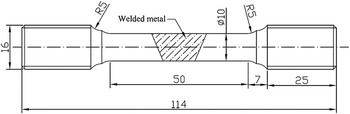
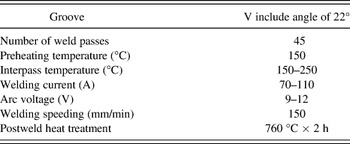
The material used was a 9Cr–1.8W–0.5Mo–NbV steel pipe (ASME P92 steel), having an inner diameter of 288 mm and thickness of 45 mm. This pipe was normalized at 1040 °C for 4 h and tempered at 760 °C for 11 h. The steel pipe was welded using gas tungsten arc welding. The chemical compositions of P92 steel, and the welding condition, together with the welding pass sequence, are shown in Tables I and II, respectively. Multilayer welding with 45 passes was carried out according to the pass sequence shown in Table II. Postweld heat treatment was then conducted at 760 °C for 2 h. Finally, a series of creep specimens were cut from the tube and machined to single pass weld specimens. Four uniaxial creep specimens, namely, a rod-shaped specimen having a cross-sectional diameter of 10 mm and a gauge length of 50 mm, were taken from the weldments with the center of each specimen placed at the welded metal. Figure 1 shows the uniaxial-type specimen used for the creep tests. These four specimens were subjected to creep testing at 650 °C and 70 MPa. Three creep tests were interrupted at specified times (3000 h, 4000 h, 7000 h, respectively) prior to rupture. The fourth test was crept until fracture, which occurred at 7026 h. The microstructural change and creep damage development of the samples during creep were investigated.
Creep specimen of P92 welded joint.

Chemical composition of P92 steels (wt%).

Welding conditions for P92 steel pipe.

Small specimens containing the HAZ, base metal, and welded metal were cut from the interrupted creep specimens, modeled into resin, polished, and finally etched to study the microstructure by optical microscopy (OM) and scanning electron microscopy (SEM). The microappearance of the creep cavities was observed using SEM. In addition, transmission electron microscopy (TEM) observations were carried out to investigate precipitations and subgrain structures. The microstructure observations were carried out by using thin foil specimens obtained from the HAZ of the specimens. The precipitates were identified using carbon extraction replicas.
III. RESULTS
A. OM observations
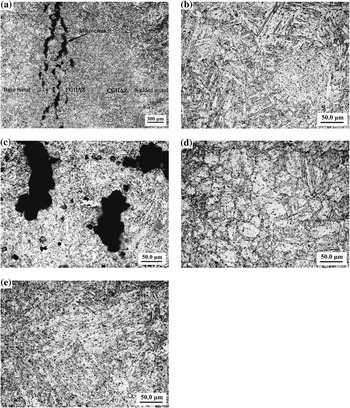
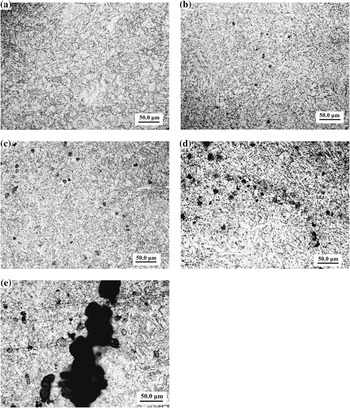
Figure 2 shows the optical microstructure of the fracture specimen, showing many polygonal hollows distributed around the microcracks. The microcracks and creep hollows are mainly present in the FGHAZ, close to the base metal, whereas a few or no voids can be observed in other zones of the welded joints. This is a typical microstructure of type IV cracking in the FGHAZ. In the damaged region, microcracks and hollows form zigzag lines. With an increase in creep time, the change in the optical microstructures in the FGHAZ is shown in Fig. 3. In this zone, a fine grain structure with creep voids can be observed. As the creep time increases, these voids grow and coalesce together; consequently, the microcracks are formed, and finally, type IV cracking occurs. The number of creep voids in the FGHAZ increases at an accelerating rate during creep. In the primary stage, no voids are observed in the welded joints. In the secondary stage, voids are visible in the FGHAZ; both the void size and the number of voids increase as the creep time increases, as shown in Figs. 3(b) and 3(c). With creep strain increasing, the size and density of the creep voids increase. This leads to a decrease in the net cross-sectional area and an increase in the true stress in the FGHAZ. As a result, the creep strain rate is accelerated, which in turn speeds up the development of creep voids. Therefore, in the tertiary stage, the density of the voids becomes much larger and the creep voids coalesce together to form the microcracks. Finally, fracture occurs in the FGHAZ.
Microstructure of fracture specimen (a) welded joint, (b) base metal, (c) FGHAZ, (d) CGHAZ, and (e) welded metal.

Microstructure of FGHAZ with various creep times (a) before creep, (b) creep for 3000 h, (c) creep for 4000 h, (d) creep for 7000 h, and (e) creep until fracture.

FGHAZ is located in a region away from the fusion boundary where the peak temperature is lower, but still above Ac3, during welding. It is known that the dwell time at the peak temperature is too short to allow for the complete dissolution of carbides during welding. Hence, austenite grain growth is limited by the incomplete dissolution of carbides. Thus, fine-grained austenite is formed, which subsequently transforms to fine martensite after welding. The creep strength is related to the microstructure of the material, and the fine grain can reduce the creep strength of the material. Therefore, the creep strength of the FGHAZ is lower than that of other zones in the welded joints. As a result, type IV cracking is likely to occur in the FGHAZ.
B. SEM observations
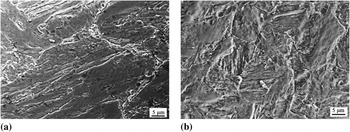
The local microstructure of the P92 weldment extracted from the samples before creeping is observed in Fig. 4. Figure 4(a) shows that the size of the prior austenite grains is ~40 μm, and Fig. 4(b) shows the grain size in the FGHAZ with fine lath martensite is about 10 μm, and the carbides are distributed in the grains or at the grain boundaries, which are consistent with the previous study.Reference Kim and Lim19
Microstructure of base metal and FGHAZ in the pre-creep P92 weldments (a) microstructure of base metal and (b) microstructure of FGHAZ.

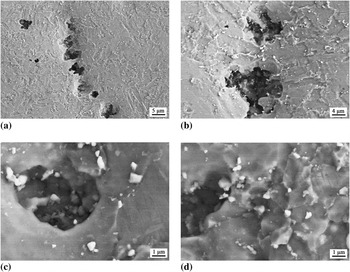
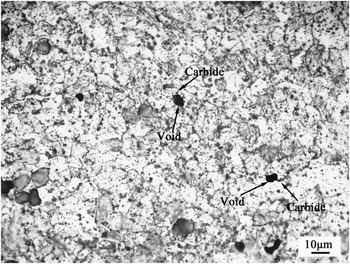
To analyze the microstructure of creep voids in the FGHAZ, the sample extracted from the fracture specimen was observed by SEM. Figure 5 shows the microstructure of creep voids and the distribution of carbides in creep hollows. Numerous precipitates can be seen at the boundaries of fine grains and hollows, but few can be seen inside the grains. It can also be seen that many carbides are located in the interior of the hollows. Through previous OM observation, it can also be found that small creep voids are located near carbides, as shown in Fig. 6; these phenomena strongly imply that carbides play an important role as the nucleation sites of creep voids. Goods et al.Reference Goods and Brown20 had found that cavities were usually associated with inclusions or second phase particles. Shinozaki et al.Reference Shinozaki, Li, Kuroki, Harada and Ohishi21 had found that precipitate was easy to induce the initiation of creep void by acting as a nucleation site in creep void occurrence using finite element simulation. Creep voids are mainly caused by the vacancy condensation at areas of high stress concentration. During creep, the applied stress can result in grain boundaries sliding. Grain boundaries sliding can lead to stress concentrations at triple points and hard particles such as carbides on the grain boundaries. Furthermore, carbides also can result in stress concentrations on application of a stress and increase vacancy condensations at a grain boundary, which can increase the grain boundary free energy and accelerate the nucleation of creep voids. Therefore, creep voids are likely to nucleate near carbides.
Micrographs of the damaged region observed at FGHAZ of the fracture specimen (a) microcracks, (b) hollows, (c) carbide in hollows, and (d) carbides near hollows.

Microstructure of creep voids located near carbides.

It is obvious that the outlines of the hollows are very similar to the appearances of fine grains. As shown in Figs. 5(a) and 5(b), the diameters of the hollows are ~10–15 μm and are almost the same as or 2–3 times those of fine grains with diameters of ~5–10 μm. These large hollows may be formed at the expense of several fine grains. As the creep time increases, the voids nucleate at the grain boundary or near the carbides and then grow and coalesce together. As a result, the bonding force between grain boundaries reduces. With the accumulation of creep damage, the creep voids connect with each other, separating the grains from the grain boundaries, and the separated grains become easy to drop out. During cutting and/or grinding in the sample fabrication process, the separated grains finally drop out and leave the hollows behind. Because these separated grain boundaries are located closely, creep voids can easily connect to form microcracks. Furthermore, some hardened carbides that are linked strongly to the matrix cannot be isolated from the matrix during the sample fabrication process. As a result, these carbides are still located in the hollows after the fabrication process. Therefore, some of the carbides can be seen in the interior of the hollows, as shown in Figs. 5(c) and 5(d). According to the microstructure illustrated previously, type IV cracking is caused by the accumulation of the creep damage in the FGHAZ during creep and by the carbides gathered and precipitated at the grain boundaries.
C. TEM observations
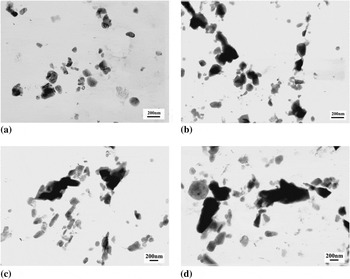
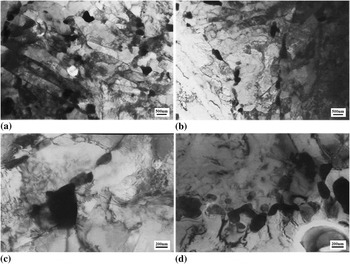
Figure 7 shows typical microstructures of precipitates extracted from the FGHAZ of creep specimens with different creep times. It can be seen that the density and size of carbides in FGHAZ increase as creep time increases. In the FGHAZ of fracture specimen, the largest carbide reaches to 1.5 μm, which is much coarser. Furthermore, the types of carbides become numerous. As shown in Fig. 7(a), in the HAZ of precreep specimens, only two types of carbides—cylindrical and spherical—are present. With increase in creep time, more types of carbides are formed, as shown in Figs. 7(b)–7(d). Carbides distribution in FGHAZ of specimen after creep for 4000 h is shown in Fig. 8. It can be seen that the carbides are mainly located at the grain boundaries. Dislocation densities inside the fine grains are very low. After creep, some of the carbides gather at grain boundaries and are even located at the intersection of three grain boundaries, as shown in Fig. 8(c), and some of the carbides are distributed along a grain boundary, as shown in Figs. 8(b) and 8(d). The mechanical properties of P92 steels are strengthened by solid solution strengthening and precipitation hardening of carbides. However, some of the carbides gather at the grain boundaries and become coarse during creep. This leads to the deterioration of the creep strength as a result of the reduced effects of solid solution strengthening and precipitation strengthening. Meanwhile, some of the carbides become coarse, and can weaken the bonding force between grain boundaries and the bonding force between the particle and the matrix. As a result, the creep voids probably nucleate during creep, which results in a further decline of the creep strength.
Carbides distribution of the specimens with various creep times in FGHAZ (a) original specimen, (b) specimen lasting for 3000 h, (c) specimen lasting for 4000 h, and (d) specimen until fracture.

Micrographs of the FGHAZ of creep specimen lasting for 4000 h.

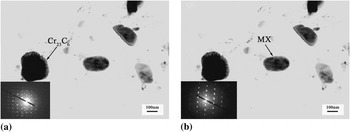
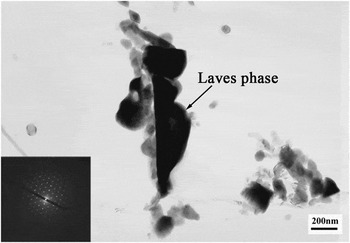
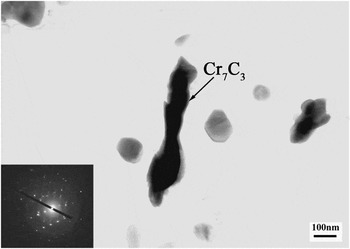
In addition to the coarsen carbides, some new carbides are precipitated during creep. As shown in Fig. 9, the carbides in the FGHAZ of original creep specimens are Cr23C6 and MX (M: V, Nb; X: C, N), according to the analyses of electron beam diffraction patterns. In the original specimen, these carbides dispersed in the grains can strengthen the matrix by the solid solution strengthening mechanism and the precipitation hardening mechanism, which ensures the high creep strength of the P92 steel. For example, Cr23C6 plays an important role in solid solution strengthening, and MX plays an important role in solid precipitation hardening. Analyses of electron beam diffraction patterns show that the newly precipitated carbides in the HAZ of creep specimens lasting for 7026 h are a coarse Laves phase (Fe2W) and Cr7C3, as shown in Figs. 10 and 11. These new precipitated carbides would cause creep instability in the steels because the solid solution strengthening effect of W would be lost. It is confirmed that the Laves phase tends to precipitate at the grain boundaries. The precipitation strengthening effect of the Laves phase is believed to be insignificant as the W elements are removed from the solution in the ferrite, thus offsetting any beneficial effects of the Laves phase through precipitation strengthening; this leads to a decline in the creep resistance.Reference Ennis, Zielinska-Lipiec, Wachter and Czyrska-Filemonowicz22 The Laves phase is also likely to promote the onset of tertiary creep over the long term. Meanwhile, both the Laves phase and Cr7C3 are coarse, and hence, they are likely to stimulate the nucleation of the creep voids, thereby accelerating the accumulation of the creep damage.
Carbide types of original specimens (a) apperance and electron diffraction diagrams of Cr23C6 and (b) appearance and electron diffraction diagrams of MX.

Appearance and electron diffraction diagrams of Laves phase.

Appearance and electron diffraction diagrams of Cr7C3.

IV. DISCUSSIONS
A. Mechanism of type IV cracking in P92 steel
Type IV cracking occurring in P92 steel for the long-term creep at high temperature and low stress is associated with the FGHAZ of the welded joints. This is the zone whose temperatures reach over Ac3 just inside the austenite phase field during the weld welding thermal cycle, but the temperatures do not remain there for a sufficiently long time to allow for the complete dissolution of the carbide precipitates. Austenite grains are limited by incomplete dissolution. As a result, these grains transform to fine martensite grains on rapid cooling. In contrast, the CGHAZ is the zone near the fusion boundary that reaches a temperature well above Ac3 and undergoes a long dwell time at the peak temperature during welding; as a result, all carbides in this zone dissolve completely, which reduces the obstacle to growth of the austenite grains and results in the formation of coarse austenite grains. These austenite grains transform into coarse martensite grains on cooling. The microstructures of the base metal and the welded metal are typical lath martensite. The grains of the FGHAZ are much finer compared to those of other zones in the welded joint. For one thing, the fine grains would cause an increase in the number of grain boundaries and also an increase in the dislocation pileups in the FGHAZ. Hence, the activation energy in the grains and concentration stress at grain boundaries increase, which can facilitate the nucleation and growth of creep voids in the FGHAZ during creep. For another, at low stress and high temperature the mechanism for creep is mainly controlled by diffusionReference Pérez-Prado and Kassner23; under the driving force of applied stress, atoms diffuse from the sides of the grains to the tops and bottoms, which elongate the grains along the stress axis. This process will be faster at high temperature as there are more vacancies. Diffusion creep has a strong dependence on grain size. Generally, the creep strain rate is proportional to d −n (where d is grain size, n is material constants).Reference Pérez-Prado and Kassner23 This shows that a fine grain leads to a considerable increase in creep strain rate. Hence, the creep strength of the FGHAZ is lower compared to that of other zones in the welded joint, which is consistent with the poor creep properties of a simulated, homogeneous FGHAZ in the welded joint by a weld simulator.Reference Albert, Matsui, Hongo, Watanabe, Kubo and Tabuchi24 As a result, nucleation and propagation of creep voids are likely to occur in the FGHAZ.
Furthermore, the martensite grains in the FGHAZ nucleate and grow near the undissolved carbides in the phase transformation; therefore, they absorb a large amount of carbon at high temperature, which leads to the formation of some fine martensite grains with high carbon content.Reference Tezuka and Sakurai25 In addition, although the austenite grains were transformed to fine grains during welding in the FGHAZ, certain prior austenite grain boundaries that were formed during the fabricated process of the P92 steel do not disappear and remain in the FGHAZ after the welding, which is also found in other Cr–Mo steels.Reference Tezuka and Sakurai25 Moreover, certain carbides may remain on the prior coarse austenite grain boundaries because of the rapid increase in temperature and short hold time at peak temperature during welding. By postweld heat treatment, these undissolved carbides coarsen with limited further precipitation and gather at the grain boundaries. These coarse carbides not only reduce the precipitation strengthening effect of the carbides but also accelerate the nucleation and development of creep voids, leading to the accumulation of creep damage and a further decline in the creep strength of the FGHAZ. Whereas, the high peak temperature and the long dwell time in the CGHAZ can avoid the formation of grains with high carbon content and remain as prior coarse austenite grain boundaries. As a result, the aggregation degree of carbides in the CGHAZ is lower and the size of carbides in the CGHAZ is smaller compared to those in the FGHAZ, which are in agreement with the microstructures observed in the simulated, homogenous FGHAZ and CGHAZ.Reference Albert, Matsui, Hongo, Watanabe, Kubo and Tabuchi24 This can suppress the nucleation and propagation of creep voids. Therefore, microcracks are likely to occur in the FGHAZ rather than in the CGHAZ at high temperature and low applied stress.
Some newly precipitated carbides during the long-term creep, such as the Laves phase and Cr7C3 (shown in Figs. 10 and 11), are coarse. They can reduce the creep strength of the FGHAZ by deteriorating the strengthening effect and can serve as the nucleation site of the creep voids, which accelerates the accumulation of creep damage in the FGHAZ. Besides causing the loss of strengthening mechanisms, impurities should also accelerate the formation of creep voids at the grain boundaries.Reference Albert, Matsui, Hongo, Watanabe, Kubo and Tabuchi24, Reference Sugesawa, Sakurai, Aoki and Fukushima26 As found by analysis in this study, the creep property of the FGHAZ is weaker than that of other zones in the welded joints and creep voids would probably accumulate in the FGHAZ. By the previous analyses, type IV cracking is likely to occur in the FGHAZ of P92 steel under high temperature and low stress service conditions.
B. Suggestion for suppressing type IV cracking of P92 welded joints
Because carbide has a large influence on the creep void nucleation, it can be thought that if creep void nucleation could be delayed or suppressed, the creep life time of structure could be expected to become longer. As mentioned previously, although the P92 steel was normalized at 1040 °C, which is above the Ac3 point before welding, some large carbides did not dissolve completely and still remained at prior austenite grain boundaries. Furthermore, these carbides absorbed a large amount of carbon and became coarse during welding and became the origin of the type IV cracking. As long as these carbides are dissolved completely before welding, fine grains with excess carbon and formation of coarse carbides would be avoided; as a result, type IV cracking would be suppressed.
The complete dissolution of the carbides can be ensured by adding a suitable number of normalizing treatments before welding with an unchanged dwell time. Although a longer normalizing time can result in complete dissolution of carbides, it would deteriorate the mechanical properties of the P92 steel. Increasing the number of normalizing treatments with the same dwell time as the present treatment can ensure the complete dissolution of the carbides before welding, without any degradation of the mechanical properties. These treatments would also suppress the precipitation of coarse carbides and the nucleation of creep voids; as a result, type IV cracking in P92 steel weldments can be suppressed. A similar treatment can be used for the suppression of type IV damage in other Cr–Mo steels such as the 2.25Cr–1Mo steel,Reference Tezuka and Sakurai25 P91 steel, and P122 steel.
V. CONCLUSION
The mechanism of type IV cracking in weldment of P92 steel was investigated by creep tests with various creep times and microstructure analyses. The following conclusions were drawn:
(1) Type IV cracking is observed at the FGHAZ of P92 welded joints at 650 °C and 70 MPa. The microcracks formed by creep voids have a zigzag appearance. The number of creep voids increases at an accelerating rate during creep. The maximum number of creep voids is formed in the FGHAZ. The creep strength in the FGHAZ is degraded by the welding thermal cycle of the low peak weld temperature.
(2) SEM observations reveal the presence of precipitates in creep hollows, which indicate that these precipitations are related to the nucleation of the creep voids.
(3) TEM observations show that carbides become coarse and their density increases during creep, which causes deterioration of the strengthening mechanism of the carbides. Coalescence of carbides at grain boundaries during creep reduces the binding energy between the particles and the matrix. Some new precipitates such as the Laves phase and Cr7C3 not only coarsen but also deteriorate the alloys’ strengthening effect, leading to a further decline of the creep strength.
(4) On the basis of the creep damage mechanism of the FGHAZ in P92 welded joints, it is suggested that the tendency of type IV cracking in P92 steel weldments can be suppressed by carrying out a suitable number of normalizing treatments before welding.
ACKNOWLEDGMENTS
The research work of this paper is supported by the National Nature Science Foundation of China (Contract No. 50805103), Tianjin Nature Science Foundation of China (Contract No. 08JCZDJC18100) and (Contract No. 08JCYBJC09100), the New Teacher Project in Specialized Research Fund for the Doctoral Program of Higher Education of China (Contract No. 20070056096), and Scientific Research Institute Technical Development Special Fund Project of the Ministry of Science and Technology of China (Ncste-2006-Jkzx-178).