Introduction
Previous research documents a significant increase in vocabulary size and speed of oral (or spoken) word recognition in monolinguals throughout the 2nd year of life. Moreover, there is a relation between these measures across English- and Spanish-speaking monolinguals, such that children with larger vocabularies demonstrate faster word recognition than children with smaller vocabularies (Fernald, Perfors & Marchman, Reference Fernald, Perfors and Marchman2006; Fernald, Pinto & Swingley, Reference Fernald, Pinto, Swingley, Weinbergy and McRoberts1998; Hurtado, Marchman & Fernald, Reference Hurtado, Marchman and Fernald2007). What's more, this relation becomes more robust from 18 to 24 months (Fernald, Marchman & Weisleder, Reference Fernald, Marchman and Weisleder2013). However, few studies have examined the development of speed in word processing in young bilinguals and whether improvements in word processing are related to vocabulary growth in both languages (Legacy, Zesiger, Friend & Poulin-Dubois, Reference Legacy, Zesiger, Friend and Poulin-Dubois2016; Marchman, Fernald & Hurtado, Reference Marchman, Fernald and Hurtado2010). The present investigation compares the developmental changes in spoken word processing and vocabulary growth between monolingual English, Spanish, and bilingual English–Spanish learners during the 2nd year.
The study of speed of word processing in bilinguals offers both applied and theoretical implications. From an applied perspective, it has been shown that both vocabulary size and speed of word processing predict later language development within monolingual populations (Marchman & Fernald, Reference Marchman and Fernald2008). Despite our rich understanding of the development of monolingual word processing and comprehension, it is estimated that a large majority of the world's population speaks more than one language, and this population is rapidly growing within the US (US Census Bureau, 2011). Therefore an understanding of language differences that result from culturally and linguistically diverse environments is essential to the practice of Speech-Language Pathologists who serve an increasingly diverse population (American Speech-Language-Hearing Association, 2007). To this end, researchers must first establish consensus in the literature with regard to the rate of development of early bilingual vocabulary knowledge and speed of processing in order to appropriately identify atypical deviations within the multilingual population. Further, it is important to establish whether models of monolingual language acquisition apply to multilingual learners. Toward this end, the present study aims to investigate the within- and cross-language associations between vocabulary size and speed of word recognition in early bilingual first language acquisition. We argue that examining within- and cross-language links sheds light on 1) the relation between vocabulary size and speed of processing, 2) how this relation extends to bilinguals, and 3) the importance of timing and language dominance on this relation.
Examining vocabulary size and speed of word recognition
Although monolingual children as young as 16 months demonstrate strong relations between vocabulary knowledge and speed of word recognition (Fernald et al., Reference Fernald, Perfors and Marchman2006; Fernald, Swingley & Pinto, Reference Fernald, Swingley and Pinto2001; Hendrickson, Mitsven, Poulin-Dubois, Zesiger & Friend, Reference Hendrickson, Mitsven, Poulin‐Dubois, Zesiger and Friend2015; Hurtado et al., Reference Hurtado, Marchman and Fernald2007; Legacy, Zesiger, Friend & Poulin-Dubois, Reference Legacy, Zesiger, Friend and Poulin-Dubois2015; Zangl, Klarman, Thal, Fernald & Bates, Reference Zangl, Klarman, Thal, Fernald and Bates2005), the nature and specificity of this relation is not well understood. There are three possible explanations for this relation. One hypothesis is that the relation between vocabulary size and word processing is based on experience within a language (language-specific hypothesis). In the case of bilinguals, this would mean that processing speed and vocabulary knowledge are dissociable across languages, such that processing speed in one language is related to within- and not cross-language vocabulary knowledge. Alternatively, it is possible that the relation between word processing and vocabulary does not rely on experience within a language, but instead, general language experience (general language hypothesis). That is, language skills broadly construed (e.g., auditory, phonological, lexical, semantic, and syntactic processes) subserve vocabulary across languages. From this view, processing speed and vocabulary size in bilinguals would be related both within and across languages. A final possibility is that the association between vocabulary knowledge and word processing speed is not mediated by language experience but instead by general cognitive efficiency (cognitive efficiency hypothesis). For example, general processing mechanisms (e.g., speed of processing, associative learning, etc.) influence the rate of vocabulary development. Thus, from a theoretical perspective, the study of lexical processing within bilinguals affords the opportunity to examine whether improvements in word processing are dissociable across languages within a single language learner (DeAnda, Poulin-Dubois, Zesgier & Friend, Reference DeAnda, Poulin-Dubois, Zesiger and Friend2016c).
One way to begin teasing apart these possibilities is to investigate the within- and cross-language associations between vocabulary size and speed of processing within bilinguals. That is, if within-language associations arise in the absence of cross-language associations, this would support the language-specific hypothesis. Alternatively, the existence of cross-language associations would support the general language and cognitive efficiency hypotheses. However, most studies to date have focused on the relation between vocabulary and speed of word processing within, as opposed to between, languages, leaving open the question of cross-language associations. From this work, it has been shown that processing speed and vocabulary size are related within the non-dominant language at 17 months in French–English bilinguals and in both languages by 22 months (Legacy et al., Reference Legacy, Zesiger, Friend and Poulin-Dubois2015, Reference Legacy, Zesiger, Friend and Poulin-Dubois2016). By 30 months, English–Spanish bilinguals show significant correlations between speed of word processing and vocabulary size within each language, but not across languages (Marchman, Fernald & Hurtado, Reference Marchman, Fernald and Hurtado2010). However, Marchman et al. (Reference Marchman, Fernald and Hurtado2010) reported a marginal association between total conceptual vocabulary and processing speed in Spanish and English, respectively, suggesting shared variance between languages in bilinguals. The present paper seeks to confirm and extend these findings by evaluating changes over time in the relation between vocabulary size and speed of word recognition in a longitudinal study of monolingual and bilingual children. Further, we examine this relation as a function of language dominance in bilinguals.
Vocabulary size and speed of word recognition in young bilinguals
Longitudinal cross-language associations between speed of processing and vocabulary size in early bilingual language acquisition can elucidate the extent to which these relations in bilinguals parallel those observed in monolingual children, the timing of these relations, and their dependence on language dominance. There is a dearth of literature on how word processing in bilinguals compares to the monolinguals’ case across the 2nd year of life. In the only study to date to compare lexical access across monolingual and bilingual toddlers, French–English bilinguals in Canada showed comparable speed of processing for words in both of their languages at 17 months of age, as well as comparable speed of processing relative to their French monolingual counterparts in Switzerland (Legacy et al., Reference Legacy, Zesiger, Friend and Poulin-Dubois2015). This is in contrast to adult findings that indicate differences in lexical processing in bilinguals versus monolinguals across picture naming and lexical decision tasks (Ivanova & Costa, Reference Ivanova and Costa2008; Gollan, Montoya, Fennema-Notestine & Morris, Reference Gollan, Montoya, Fennema-Notestine and Morris2005; Ransdell & Fischler, Reference Ransdell and Fischler1987).
The role of timing and language dominance
With regard to timing, it is unknown how cross-language associations develop over time in early language acquisition, and in particular at a time when young children are beginning to negotiate the semantic organization of words from two languages (i.e., 16 to 24 months; Arias-Trejo & Plunkett, Reference Arias-Trejo and Plunkett2009; Reference Arias-Trejo and Plunkett2013; Styles & Plunkett, Reference Styles and Plunkett2009; von Koss Torkildsen, Sannerud, Syversen, Thormodsen, Simonsen, Moen, Smith, & Lindgren, Reference von Koss Torkildsen, Sannerud, Syversen, Thormodsen, Simonsen, Moen, Smith and Lindgren2006; Willits, Wojcik, Seidenberg & Saffran, Reference Willits, Wojcik, Seidenberg and Saffran2013). Indeed, findings suggest that lexical-semantic organization follows a developmentally incremental process, such that 24-, but not 18-month-old, monolinguals demonstrate semantic priming between words with related word meanings (e.g., Arias-Trejo & Plunkett, Reference Arias-Trejo and Plunkett2009). Of interest is whether cross-language lexical associations in bilinguals demonstrate a similar developmental shift over the second year of life. That is, to what extent do cross-language relations in bilinguals develop on a similar developmental timetable to within-language associations in monolinguals?
To the extent that there is evidence of cross-language relations, it is important to evaluate the influence of language dominance on these associations. Prominent models of adult bilingual language organization posit differential effects of language dominance on processing (e.g., Kroll & Stewart, Reference Kroll and Stewart1994). For example, the Revised Hierarchical Model suggests that differences in language dominance (due to language proficiency and age of acquisition) can impact the connections between lexicons and the conceptual store (for a review see Kroll, van Hell, Tokowicz & Green, Reference Kroll, Van Hell, Tokowicz and Green2010). This leads to differences in both the efficiency and accuracy of translation production from L2 to L1 and from L1 back to L2. Recent evidence suggests that this may extend to young toddlers, as Mandarin–English bilinguals exhibit lexical priming from the dominant to the non-dominant language, but not from the non-dominant to the dominant language (Singh, Reference Singh2014). Similar effects of dominance have been found for syntactic priming in young children (Vasilyeva, Waterfall, Gámez, Gómez, Bowers & Shimpi, Reference Vasilyeva, Waterfall, Gámez, Gómez, Bowers and Shimpi2010; Yip & Matthews, Reference Yip and Matthews2000). Together these findings suggest that cross-language associations between processing speed and vocabulary size may also be modulated by language dominance in adults and children. The present study evaluates cross-language relations between speed of processing and vocabulary size and the effect of timing and language dominance on these relations. It does so by contrasting Spanish–English bilingual first language toddlers with monolinguals in each language, within the same geographic location and sociolinguistic strata longitudinally.
Study aims and hypotheses
The overall purpose of the present study is to compare speed of processing and vocabulary within bilinguals and monolinguals longitudinally throughout the 2nd year of life. Importantly, in an approach unique to this paper, bilingual speed of processing and vocabulary size will be compared to two monolingual samples (one for each of the bilingual sample's languages). The first aim is to evaluate changes in speed of word processing from 16 to 22 months within the dominant and non-dominant languages in bilinguals and to contrast this with monolingual processing in each language over the same period. We expect speed of processing to improve over time across all language groups, consistent with monolingual and bilingual findings (Hurtado et al., Reference Hurtado, Marchman and Fernald2007; Fernald et al., Reference Fernald, Perfors and Marchman2006). Of particular interest is whether a) dominance influences speed of word processing over time and b) speed of processing changes within bilinguals, relative to monolinguals, between 16 and 22 months.
It is important to note that the present study employs a haptic measure of speed of processing unlike the gaze responses employed in several studies (e.g., Fernald et al., Reference Fernald, Perfors and Marchman2006). We expected that haptic reaction times would be as sensitive to speed of processing as gaze responses for several reasons. First, previous work has shown that visual reaction time and haptic response are significantly correlated at 16 months of age (Hendrickson et al., Reference Hendrickson, Mitsven, Poulin‐Dubois, Zesiger and Friend2015). Further, several speed of processing findings using gaze as a measure have been replicated using a haptic measure. For example, Legacy et al. (Reference Legacy, Zesiger, Friend and Poulin-Dubois2015, Reference Legacy, Zesiger, Friend and Poulin-Dubois2016) demonstrated that speed of processing and vocabulary size are significantly correlated in monolinguals and bilinguals in the second year of life. Finally, haptically-assessed speed of processing becomes faster with age and vocabulary size, a finding consistent with the literature employing gaze measures. The benefit to using a haptic measure is that we were able to obtain estimates of both speed of processing and vocabulary size from the same behavioral measure, thus reducing the influence of method variance on our findings.
The second aim is to examine the relation between speed of word processing and vocabulary development in bilinguals in comparison to monolinguals over the same period. Following previous research, we hypothesize that within-language associations are present in monolingual and bilingual children at both 16- and 22-months of age. However, within bilinguals, we expected that cross-language associations between speed of word recognition and vocabulary size would not be evinced after controlling for within-language vocabulary. This hypothesis is contingent upon a strong within-language correspondence between lexical processing and vocabulary size. Finally, we anticipated that language dominance would modulate associations between processing speed and vocabulary size such that the relation between word recognition and vocabulary would be strongest in the dominant language relative to the non-dominant language at both 16 and 22 months.
Method
Participants
Participants were drawn from a larger longitudinal project assessing language comprehension in the 2nd year of life. Participants were obtained through a database of parent volunteers recruited through birth records, internet resources, and community events in a large metropolitan area in Southern California. All participants were full-term and had no diagnosed impairments in hearing, vision, language, and cognition. A final sample of 187 children was then divided into three groups based on language exposure as assessed on the Language Exposure Assessment Tool at 16 months (LEAT, DeAnda, Bosch, Poulin-Dubois, Zesiger & Friend, Reference DeAnda, Bosch, Poulin-Dubois, Zesiger and Friend2016b, see below for a description of the tool): English monolingual, Spanish monolingual, and Spanish–English bilingual toddlers. Exposure at 16 months was used for grouping participants at initial testing. Exposure remained remarkably stable between 16 and 22 months of age (M change in exposure = 2.47%, SD = 5.22%).
The final sample included 79 monolingual English-hearing toddlers (41 females, 38 males), 64 monolingual Spanish-hearing toddlers (31 female, 33 male), and 44 bilingual English–Spanish hearing toddlers (17 females, 28 males). Each participant was tested at 16-months (English: M = 16;20, range = 15;15 – 18;2; Spanish: M = 17;3, range = 15;15 – 20;21; Bilingual: M = 17;23, range = 14;23 – 19;21), and 22-months (English: M = 23;2, range = 21;6 – 25;12; Spanish: M = 23;21; range = 21;0 – 21;15; Bilingual: M = 24;15; range = 21;3 – 26;18). The average maternal education for the English monolinguals was approximately completion of a 4-year college degree (M = 15.45 years, SD = 2.08, range = 12 – 18). On average, mothers in the Spanish monolingual and bilingual group completed about one or two years of college (Spanish: M = 13.05 years, SD = 3.35, range = 6 – 18; Bilinguals: M = 14.62, SD = 2.32, range = 8 – 18). An ANOVA revealed that maternal education differed significantly across language groups (F(3, 460) = 20.95, p < .001). Therefore, we evaluated the effect of maternal education on latency in our analyses.
Apparatus
The study was conducted in a sound attenuated room. Stimuli were presented on a 51 cm 3M SCT3250EX touch capacitive wall-mounted monitor. An HD video camera was mounted above and behind the touch monitor to capture haptic response to the visual stimuli. Two audio speakers were positioned to the right and left of the touch monitor for the presentation of auditory reinforcers that aided in maintaining interest and compliance.
Measures
Language Exposure Assessment Tool (LEAT)
The LEAT (DeAnda et al., Reference DeAnda, Bosch, Poulin-Dubois, Zesiger and Friend2016b) provides estimates of daily language exposure derived from parent reports of the number of hours of language input by parents, relatives and other caregivers in contact with the child. Trained experimenters followed the LEAT manual to interview parents on the number of speakers who interacted with the child and the number of hours of exposure to each speaker over the course of the child's life.
The LEAT is separated into two major sections that together permit the calculation of relative language exposure. In the first section, parents list the people who interact with the child regularly (i.e., at least once a week), the language(s) they speak, and whether they are native speakers of the language(s). In the second section, the amount of time that the child spends hearing each of these conversational partners in each language is assessed. This information is broken down by day of the week and by age, thereby capturing exposure that happens on specific days of the week and at specific ages in the child's life (e.g., “At what age did the child start receiving language input from person A?”). Finally, parents estimate the amount of input children receive on an average day for each conversational partner.
Thus, the LEAT estimate reflects cumulative language exposure. Parents were not restricted in the number of hours of language input that they could report. Nevertheless, parents’ reports of language exposure fell within the expected range of waking hours per day. In the present sample, mean hours of exposure per day were 8.97 (SD = 3.18). Relative language exposure was estimated by calculating the proportion of time that the child heard English or Spanish relative to other language input. Proportions, rather than raw hours of exposure, were used to standardize the scale of measurement. This calculation was then used to categorize the three groups. English and Spanish monolinguals were those children with >80% exposure to English or Spanish, respectively. Bilinguals were those with ≤ 80% to the dominant language (English or Spanish) and at least 20% exposure to their non-dominant language (English or Spanish). This 80% cutoff is often the limit for inclusion of bilingual participants in a sample (Pearson, Fernandez, Lewedeg & Oller, Reference Pearson, Fernandez, Lewedeg and Oller1997; Byers-Heinlein, Reference Byers-Heinlein and Schwieter2015). On average, bilinguals had 63% exposure to their dominant language, and 37% to the non-dominant language. For most bilingual children, Spanish was the dominant language of exposure (Spanish-dominant: N = 26, English-dominant: N = 18). All but one child had exposure to two languages. One participant had exposure to three languages, but exposure was less than 12%. For our monolingual groups, children received native input primarily from caregivers in the home. For our bilingual group, in the dominant language, all but two children received native input primarily from caregivers in the home (N = 42). In the non-dominant language, input was from non-native or non-parent sources for 26 participants, with 18 children receiving non-dominant input from a native speaker in the home.
Computerized Comprehension Task (CCT)
The CCT is a behavioral measure that captures children's haptic response to assess early decontextualized receptive vocabulary. The CCT demonstrates strong internal consistency, converges with parent report on the MacArthur-Bates Communicative Development Inventory (MCDI, Fenson, Marchman, Thal, Dale, Reznick & Bates, Reference Fenson, Marchman, Thal, Dale, Reznick and Bates2006), and predicts subsequent language production (Friend et al., Reference Friend, Schmitt and Simpson2012). Additionally, responses on the CCT are nonrandom (Friend & Keplinger, Reference Friend and Keplinger2008) and this finding replicates across languages (Friend & Zesiger, Reference Friend and Zesiger2011) and across monolinguals and bilinguals (Poulin-Dubois et al., Reference Poulin-Dubois, Bialystok, Blaye, Polonia and Yott2012). Further, in the present sample, bilingual performance was stable across languages within participants, such that children with high scores in Spanish also achieved a high score in English (r(53) =.37, p < .01). Similarly, performance on the CCT was significantly and positively correlated with parent report of expressive vocabulary on the MCDI at 16 and 22 months of age (16 months: r(215) = .31, p <.001; 22 months: r(163) = .46, p <.001). The English and Spanish CCT have good test-retest reliability, excellent internal consistency, and predict expressive vocabulary size (e.g., Friend & Keplinger, Reference Friend and Keplinger2008; Friend, Schmitt & Simpson, Reference Friend, Schmitt and Simpson2012).
Participants are prompted to touch images on the monitor (e.g., “Where's the dog? Touch dog!”). A correct touch to the target image (e.g., the dog) elicits a reinforcing sound (e.g., the sound of a dog barking). The CCT presents 4 training trials and 41 test trials in a two-alternative forced-choice procedure. For each trial, two images (a target and distractor image) appeared simultaneously on the right and left side of the touch monitor. The side on which the target image appeared was presented in pseudo-random order across trials such that target images could not appear on the same side on more than two consecutive trials, and the target was presented with equal frequency on both sides of the screen (Hirsh-Pasek & Golinkoff, Reference Hirsh-Pasek, Golinkoff, McDaniel and McKee1996). All image pairs presented during training, testing, and reliability were matched for word difficulty (easy, medium, hard) based on MCDI norms (Dale & Fenson, Reference Dale and Fenson1996), part of speech (noun, adjective, verb), category (animal, human, object), and visual salience (color, size, luminance).
The CCT begins with a training phase to insure participants understand the nature of the task. During the training phase, participants were presented with early-acquired noun pairs (known by at least 80% of 16-month-olds; Dale & Fenson, Reference Dale and Fenson1996) and prompted by the experimenter to touch the target. If the child failed to touch the screen after repeated prompts, the experimenter touched the target image for them. If a participant failed to touch during all four training trials, the training trials were repeated once. Only participants who executed at least one correct touch during the training phase proceeded to the testing phase. All of the participants proceeded to the testing phase.
Each test trial ended when the child touched the screen or until seven seconds elapsed. When the child gaze was directed toward the touch monitor, the experimenter delivered the prompt in infant-directed speech and advanced each trial. The experimenter presented each pair of images as she uttered the target word in the first sentence prompt such that the onset of the target word occurred just prior to the onset of the visual stimuli.
Noun prompts
-
Where is the_____? Touch_____.
-
Donde esta el/la_____? Toca_____.
Verb prompts
-
Who is _____? Touch _____.
-
Quien esta _____? Toca _____.
Adjective prompts
-
Which one is _____? Touch _____.
-
Cual es_____? Toca _____.
Procedure
Participants completed testing at 16 months, and 6 months later at 22 months of age. Testing procedures were identical at both ages. English and Spanish monolingual participants were tested using the English or Spanish CCT, respectively. Spanish–English bilingual participants completed testing in both English and Spanish on separate days, approximately one week apart. The order in which each language was tested was counterbalanced.
Toddlers were seated on their caregiver's lap centered at approximately 30 cm from a touch sensitive monitor with the experimenter seated just to the right. Parents wore blackout glasses and noise-cancelling headphones to mitigate parental influence during the task. The assessment followed the protocol for the Spanish and English adaptations of the Computerized Comprehension Task (CCT; DeAnda, Arias-Trejo, Poulin-Dubois, Zesiger & Friend, Reference DeAnda, Arias-Trejo, Poulin-Dubois, Zesiger and Friend2016a; Friend & Keplinger, Reference Friend and Keplinger2003; Reference Friend and Keplinger2008; Hendrickson & Friend, Reference Hendrickson and Friend2013; Hendrickson et al., Reference Hendrickson, Mitsven, Poulin‐Dubois, Zesiger and Friend2015).
Coding
A waveform of the experimenter's prompts was extracted from the video recording (see Hendrickson et al., Reference Hendrickson, Mitsven, Poulin‐Dubois, Zesiger and Friend2015 for a similar coding procedure). Subsequently the video of participant's haptic responses and the waveform of the experiment's prompts were synced and used to code the onset of the visual stimuli, the onset and offset of the target word, and the frame in which the participant touched the screen for each trial using Eudico Linguistics Annotator (ELAN) (<http://tla.mpi.nl/tools/tla-tools/elan/>, Max Planck Institute for Psycholinguistics, The Language Archive, Nijmegen, The Netherlands; Lausberg & Sloetjes, Reference Lausberg and Sloetjes2009). Only trials in which the participant touched the prompted word (e.g., target) were included in the analyses of haptic reaction time. Haptic responses were coded over the course of the entire trial (maximum duration = 7 seconds). Trials with short latencies (< 400 ms) likely reflect haptic behavior that was planned prior to hearing the target word (Bailey & Plunkett, Reference Bailey and Plunkett2002; Ballem & Plunkett, Reference Ballem and Plunkett2005; Fernald, Zangl, Portillo & Marchman, Reference Fernald, Zangl, Portillo, Marchman, Sekerina, Fernandez and Clahsen2008; Poulin-Dubois et al., Reference Poulin-Dubois, Bialystok, Blaye, Polonia and Yott2012). For this reason, trials were included in subsequent analyses if the participant touched the screen with a latency > 400 ms. A total of 22 trials were removed with latencies <400 ms.
Coders completed extensive training to identify the characteristics of speech sounds within a waveform, both in isolation and in the presence of coarticulation. Because a finite set of target words always followed the same carrier phrases (e.g., “Where is the ____”, “Who is ___”, or “Which one is ____”?), training included identifying different vowel and consonant onsets after the words “the” and “is”. Coders were also trained to demarcate the onset of vowel-initial and nasal-initial words after a vowel-final word in continuous speech, which can be difficult using acoustic waveforms in isolation. Additionally, coders were required to practice on a set of files previously coded by the second author with supervision and then to code one video independently until correspondence with previously coded data was reached.
Coding for the haptic reaction time (RT) began at image onset, roughly 238 ms after target word onset, and prior to target word offset in the first sentence prompt. Inter-rater reliability coding was conducted for a random sample of 20% of the data for each sample (Monolingual English, Monolingual Spanish, Bilingual). Reliability was established within three frames for target word onset, offset, and touch onset. Reliability coding was completed for each measure with an inter-rater agreement of at least .90.
Results
Haptic RT was used as a measure of word processing speed and the number of target touches executed during the task was used as estimate of vocabulary size (DeAnda et al., Reference DeAnda, Arias-Trejo, Poulin-Dubois, Zesiger and Friend2016a; Friend & Keplinger, Reference Friend and Keplinger2003; Reference Friend and Keplinger2008; Poulin-Dubois et al., Reference Poulin-Dubois, Bialystok, Blaye, Polonia and Yott2012). Recall that vocabulary knowledge on the CCT converges with parent report on the MCDI and predicts subsequent language production (Friend et al., Reference Friend, Schmitt and Simpson2012).
Language dominance was determined based on exposure as measured on the LEAT. To assess the appropriateness of collapsing across languages to assess the relation between dominant language vocabulary size and RT, we conducted two t-tests: one to assess differences in vocabulary size across languages and one to assess differences in RT. There were no differences in total RT and vocabulary size between English-dominant and Spanish-dominant children (all ps >.11). This, in conjunction with the good psychometric properties of the CCT, provides support for our analytic approach.
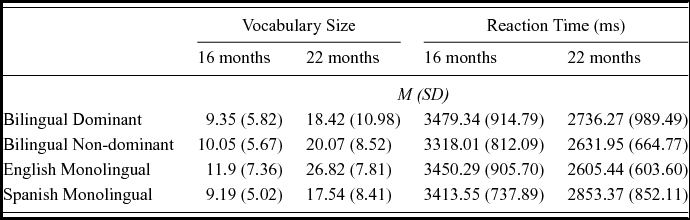
Table 1 provides descriptive statistics for vocabulary size and RT as a function of dominance for all three groups of participants. All analyses were conducted using R Studio (RStudio Team, 2015). To begin, an omnibus ANCOVA with haptic RT as the dependent variable was run to evaluate effects of maternal education and sex. Results revealed no effects of maternal education and sex (all n.s. p > .3). These variables were therefore dropped from subsequent analyses.
Descriptives for vocabulary size and haptic RT across groups at 16 and 22 months of age.

Development of speed of word processing and vocabulary size
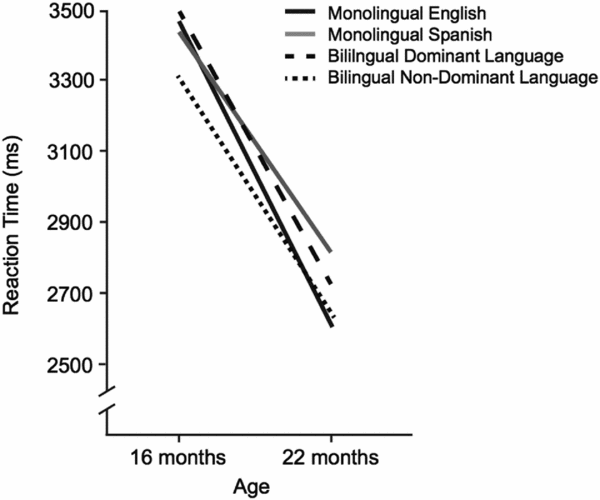
Our first aim was to evaluate changes in speed of word processing from 16 to 22 months within the dominant and non-dominant languages in bilinguals and compare this to monolinguals over the same period. Haptic RT's were the dependent measure in a 2x2 mixed-design ANOVA with one within-subjects variable, Age (16 or 22 months), and one between-subjects variable, Language Group (monolingual or bilingual). Results revealed a significant main effect of Age (F(1, 372) = 72.80, p < .001), but no significant main effect of Language Group, or significant Age X Language Group interaction (all n.s. p > .7), such that children show faster word processing at 22 than at 16 months of age across all groups. These results are presented in Figure 1.
Changes in haptic RT across all groups.

However, although children significantly increased speed (RT) as a group, there was no correlation between individual RT at 16 and 22 months of age. To explore this further, we evaluated individual difference scores between RT at 16 and 22 months of age (RT at 16 months minus RT at 22 months). A review of these scores revealed that most children (79% of participants) decreased in RT by an average of 1 second (M = 1,118.34 ms, SD = 764.07 ms). Further, there was a significant correlation between RT difference scores and RT at each age (RT at 16 months: r(144) = .70, p < .001; RT at 22 months: r(144) = -.64, p < .001). Thus, growth in RT over this 6-month period is associated with speed of processing at each age: children who were relatively slow at 16 months made greater gains than children who were relatively fast. Equally, children who evinced the greatest improvement in RT had the most rapid RT at 22 months.
Next we evaluated changes in vocabulary size in an analogous analysis with CCT vocabulary size as the dependent variable and Age (16 or 22 months) and Language Group (monolingual or bilingual) as independent variables. Once again, there was a significant main effect of Age (F(1, 370) = 232.44, p < .001) indicating a significant increase in vocabulary size across all groups. This pattern of results was consistent with the correlational results, such that children's vocabulary size on the CCT was significantly correlated between 16 and 22 months of age (r(170) = .45, p < .001). There was also a marginal main effect of Language Group (F(1, 370) = 195.6, p = .07) which reflects the fact that English monolinguals outperformed their bilingual peers when comparing performance in a single language consistent with previous work (e.g., Pearson et al., Reference Pearson, Fernandez and Oller1993). There was no significant interaction between Age and Group (p > .39).
To evaluate whether there were differences in processing speed in the dominant and non-dominant language within bilinguals we conducted an ANOVA in which Age (16 or 22 months) and Language (Dominant or Non-dominant) were the within-subjects variables and Haptic RT was the dependent measure. Once again there was a significant effect of Age (F(1, 121) = 20.16, p < .001) but no effect of Language and no significant Age X Language interaction (all n.s. p > .36).
To summarize, both speed of processing and vocabulary size show significant gains over the period from 16 to 22 months of age. These findings hold at both the group and individual level. Importantly, Language Group was a significant predictor of vocabulary size at both ages, with bilinguals demonstrating a smaller vocabulary size than their monolingual peers in a single language. However, there was no effect of Language Group on RT. We elucidate these findings and their implications in the discussion.
Relation between speed of word processing and vocabulary
We next examined the relation between speed of word processing and vocabulary within monolinguals and bilinguals, and whether this changed across 16 and 22 months of age.
Monolinguals
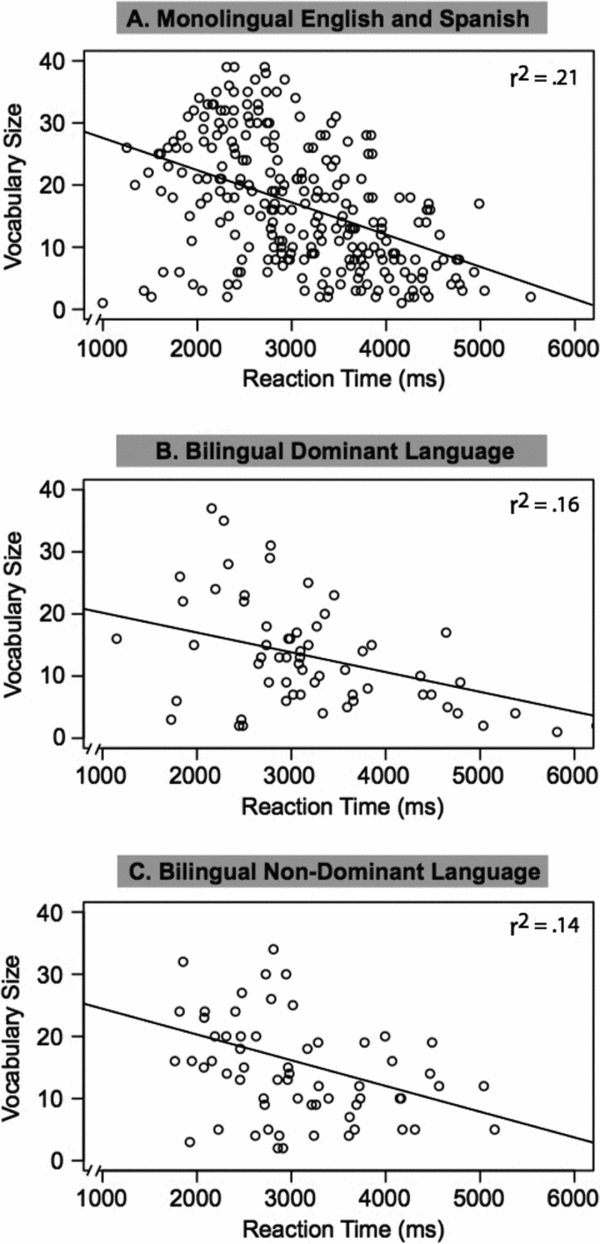
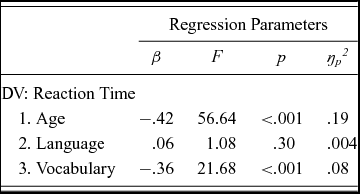
To replicate previous research, we first examined haptic RT and vocabulary size within monolinguals. A 2x2 ANOVA was run with haptic RT as the dependent variable and Age (16 or 22 months), Language (English or Spanish), and CCT Vocabulary within monolinguals. There was a significant main effect of Age (F(1, 243) = 56.64, p < .01) indicating that haptic RT decreases between 16 and 22 months within the monolingual groups as expected. In addition, there was a significant main effect of Vocabulary (F(1, 243) = 21.68, p < .001) on haptic RT (see Figure 2). Regression parameters are presented in Table 2. Finally, there was no main effect of Language, nor significant interactions between Age, Language, and Vocabulary (all n.s. p > .25).
Relation between vocabulary size (CCT) and haptic RT (latency) across groups.

Regression parameters for monolingual analysis.

Bilinguals
Lastly, we tested whether the relation between word processing and vocabulary size extended to bilinguals at both 16 and 22 months of age. We examined RT in the dominant and non-dominant language as a function of Age (16 or 22 months) and total vocabulary on the CCT across languages. Across the dominant and non-dominant language, total vocabulary was a significant predictor of RT (dominant language RT: F(1, 55) = 4.98, p = .03; non-dominant language RT: F(1,56) = 4.33, p = .04) replicating monolingual findings.
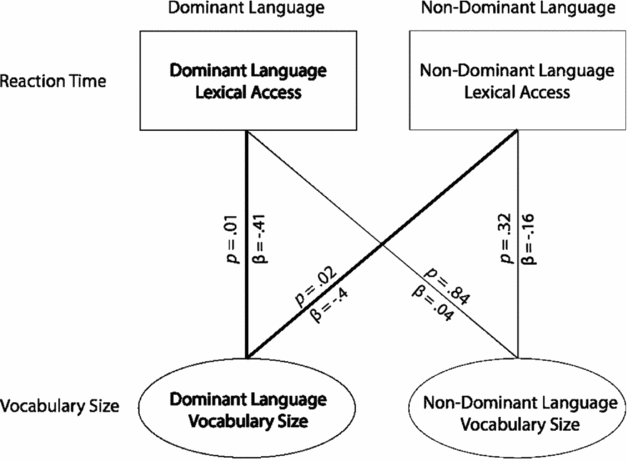
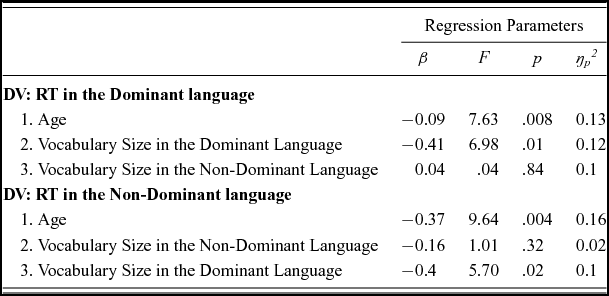
Next, we sought to examine within- and cross-language associations between vocabulary size and RT in each language. We began by examining haptic RT in the dominant language to evaluate cross-language relations between vocabulary and speed of processing after controlling for within-language associations in the dominant language. A hierarchical linear regression predicting haptic RT in the dominant language was conducted with Age (16 or 22 months) on the first step, Dominant Language Vocabulary on the second step, and Non-Dominant Language Vocabulary on the third step. Results revealed a significant main effect of Age (F(1, 51) = 7.63, p = .008), and a significant main effect of Dominant Language Vocabulary after controlling for Age (F(1, 51) = 6.98, p = .01), indicating a significant relation between vocabulary and speed of processing within the dominant language across 16 and 22 months of age. However, there was no significant effect of Non-Dominant Language Vocabulary after controlling for Dominant Language Vocabulary and Age. Further, no significant interactions were observed (all n.s. p >.3, see Figures 2 and 3). Regression parameters are presented in Table 3.
Regression results for within and cross-language relations between speed of processing and vocabulary size within bilinguals after controlling for age.

Regression parameters for bilingual analyses.

Correspondingly, we examined within- and cross-language associations between haptic RT and vocabulary size in the non-dominant language to evaluate cross-language relations between vocabulary and speed of processing after controlling for within-language associations in the non-dominant language. A hierarchical linear regression predicting haptic RT in the non-dominant language was evaluated with Age (16 or 22 months) on the first step, Non-Dominant Language Vocabulary size on the second step, and Dominant Language Vocabulary size on the third step. Age was a significant predictor of haptic RT in the non-dominant language (F(1, 52) = 9.64, p = .004). However, Non-Dominant Language Vocabulary did not predict within-language haptic RT after controlling for Age. Nevertheless, cross-language Dominant Language Vocabulary was a significant predictor (F(1, 52) = 5.7, p = .02, see Figures 2 and 3) even after controlling for Age and Non-Dominant Vocabulary. No interaction terms were significant (all n.s. p > .3). Results for vocabulary size and haptic RT across the dominant and non-dominant language are summarized in Figure 3. Regression parameters are presented in Table 3.
By-item analyses
Finally, to test whether the relation between vocabulary comprehension and RT held across items as well as across participants, we conducted two separate by-item analyses (for monolingual and bilingual groups, respectively) in which accuracy was collapsed across items rather than participants. Within monolinguals, an ANCOVA was performed to evaluate RT as a function of Age (16 or 22 months) and Language (English or Spanish), with Comprehension (proportion of participants who chose the target for each item) as the covariate. There were main effects of Comprehension (F(1, 147) = 53.17, p < .001), Age (F(1, 147) = 19.73, p < .001), and a significant Comprehension X Age interaction (F(1, 147) = 6.91, p = .009) such that the relation between word comprehension and RT became stronger with age (16 month r = -.07 and 22 month r = -.24). However, this effect was observed only in this analysis and not in the by-participant analyses or the bilingual by-item analyses. Within bilinguals, an ANCOVA was performed to evaluate RT as a function of Age (16 or 22 months) and Language Dominance (Dominant or Non-Dominant), with Comprehension (proportion of participants who chose the target for each item) as the covariate. There were main effects of Comprehension (F(1, 63) = 4.06, p = .04), and Age (F(1, 63) = 75.28, p < .001) and no significant interactions (all n.s. p > .35). These results, in conjunction with the by-participant analyses support the interpretation that increases in vocabulary size support faster RTs in monolingual and bilingual children across items and participants.
Discussion
In this study we examined speed of word processing and vocabulary within bilinguals and monolinguals longitudinally throughout the 2nd year of life. The first aim of the present study was to evaluate changes in speed of word processing from 16 to 22 months within the dominant and non-dominant languages in Spanish–English bilinguals, and compare this to Spanish and English monolinguals over the same period. Consistent with previous work in French–English bilinguals and French monolinguals, speed of word processing improves at a similar rate in Spanish–English bilinguals (in both the dominant and non-dominant language) and in English and Spanish monolinguals from 16 to 22 months of age (Legacy et al., Reference Legacy, Zesiger, Friend and Poulin-Dubois2015, Reference Legacy, Zesiger, Friend and Poulin-Dubois2016). Thus, speed of word processing appears similar across language groups (Bilingual, Monolingual) and across languages (Dominant and Non-Dominant) within diverse populations of bilinguals (Canadian English–French and United States English–Spanish). Further, vocabulary size was stable from 16 to 22 months across languages and language groups. In contrast, speed of processing at 16 months does not predict speed of processing at 22 months: instead it correlates with growth in RT over the 6-month time window. Children who were relatively slow at 16 months made greater gains than children who were relatively fast. Moreover, children who made the greatest gains also showed greater processing efficiency than their peers at 22 months. These findings are consistent with looking time measures that suggest that RT becomes more stable with age (Fernald et al., Reference Fernald, Perfors and Marchman2006).
The similarities in speed of word processing in bilinguals and monolinguals contrast with findings that show smaller vocabulary size in bilinguals versus monolinguals when comparing a single language (e.g., Core, Hoff, Rumiche & Señor, Reference Core, Hoff, Rumiche and Señor2013; DeAnda et al., Reference DeAnda, Arias-Trejo, Poulin-Dubois, Zesiger and Friend2016a; Legacy et al., Reference Legacy, Zesiger, Friend and Poulin-Dubois2015; Pearson et al., Reference Pearson, Fernandez and Oller1993; Thordardottir, Reference Thordardottir2011). Whereas these previous studies could be taken to suggest that bilingual children are slower in developing their languages, the speed of processing finding suggests that bilingual children are equivalent to monolingual children in their early language abilities. Notably, the majority of previous studies contrast bilinguals with monolinguals in only one of their languages but not both. However, it is important to note that, when the total conceptual vocabulary of bilingual children is measured across their two languages, their vocabulary size is comparable to that of monolingual children (Pearson, Fernandez & Oller, Reference Pearson, Fernandez and Oller1993). Our results with regard to speed of processing are best interpreted in this light. Speed of processing, like total conceptual vocabulary, is not influenced by single or dual language status.
The second aim of the present study was to examine the relation between speed of word processing and vocabulary development within and across languages in bilinguals, and compare this to monolinguals across 16 and 22 months of age. Within monolinguals, vocabulary size was related to speed of word processing, consistent with previous research (Fernald et al., Reference Fernald, Perfors and Marchman2006; Hurtado et al., Reference Hurtado, Marchman and Fernald2007; Legacy et al., Reference Legacy, Zesiger, Friend and Poulin-Dubois2015) and this relation held for monolingual and bilingual children across items as well as across participants. Nevertheless, there were some notable differences between language groups. For example, the by-item analyses revealed that the relation between vocabulary size and speed of processing strengthened over time, but only for monolinguals. It is possible that the disproportionately smaller vocabulary sizes within each language reduce variance and power to detect a similar trend within bilinguals. It is also possible that the relation between vocabulary size and speed of word processing is more complex in bilinguals, as the by-participant analyses revealed significant language dominance and cross-language effects. Specifically, a significant within-language relation was evinced only within the dominant language, such that vocabulary size was significantly related to speed of word processing within the dominant language. Conversely, vocabulary size and speed of word processing were not related in the non-dominant language. Further, cross-language associations were also observed, but these were unidirectional: vocabulary size in the dominant language explained significant variance in speed of processing in the non-dominant language after controlling for age and within-language non-dominant vocabulary. However, non-dominant vocabulary did not significantly predict speed of processing in the dominant language (see Figure 3).
The results of the present study have implications for existing models of bilingual language processing. Our results showed that only vocabulary size in children's dominant language explained significant variance in speed of word processing in both the dominant and non-dominant language. This result is consistent with some previous findings. Within Mandarin–English bilingual toddlers, lexico-semantic priming effects were observed only when the prime word was in the L1 (Singh, Reference Singh2014). That is, L1 words primed semantically related words in the L1 and in the L2, but L2 words did not prime L1 targets. This dissociation between languages as a function of dominance was also shown by Legacy et al. (Reference Legacy, Zesiger, Friend and Poulin-Dubois2015), although they found a significant within-language correlation between vocabulary size and speed of processing in the non-dominant language within French–English bilinguals in Canada that was not observed in the present group of Spanish–English learners in the US.
The most likely explanation for this disparity in findings across French–English and Spanish–English learners concerns the quality of input in L2. Poor quality input correlates with weaker speed of spoken word processing in young toddlers and weaker language proficiency (e.g., Hart & Risley, Reference Hart and Risley1995; Hurtado, Marchman & Fernald, Reference Hurtado, Marchman and Fernald2008; Place & Hoff, Reference Place and Hoff2011). Visual inspection of scatter plots demonstrated a weaker association between processing speed and vocabulary size in the non-dominant language in children for whom input was from non-native or non-parent sources (N = 26) relative to peers with native input from primary caregivers (N = 18). It appears that, for this reason, within-language associations for L2 in the present Spanish–English sample may be attenuated relative to the Legacy et al. (Reference Legacy, Zesiger, Friend and Poulin-Dubois2015) French–English sample. Indeed, both quantity and quality of language input seem to be important to the dissociation between the dominant and non-dominant language. That is, higher quality and quantity of input in the dominant language may lead to richer lexical-semantic associations that foster speed of processing across both languages such that vocabulary size in the stronger language predicts speed of word acquisition in the weaker language as in the present study. Associations from the non-dominant language to the dominant language may emerge at later ages when a sufficient level of language experience has been accumulated, following predictions from computational models of lexical development (Mayor & Plunkett, 2014; McClelland & Elman, 1986). Future research is needed to evaluate the influence of language exposure on speed of processing.
The within- and cross-language findings from the present study support the conclusions of Marchman et al. (Reference Marchman, Fernald and Hurtado2010) suggesting that children's speed of spoken word comprehension is associated with general language ability. That is, general language skills (e.g., auditory, phonological, lexical, semantic, and syntactic processes) subserve lexical knowledge across languages. The present study extends this finding by demonstrating independent yet interrelated linguistic systems in early simultaneous bilinguals that are influenced by language dominance. Specifically, the existence of cross-language relations between word processing and vocabulary size are inconsistent with a strictly within-language account that suggests that speed of word processing and vocabulary knowledge are entirely dissociable across languages. Instead we find these results more in line with an account in which the relation between word processing and vocabulary does not rely solely on experience within a single language, but also on general language experience. That is, language experience in the dominant language predicts additional variance in speed of processing in the non-dominant language, providing evidence against a strictly within-language account. Despite eliminating a language-specific account, this leaves open the possibility that the relation between speed of processing and vocabulary are explained by either general language experience or cognitive efficiency.
Further, although language dominance modulated the relation between vocabulary size and processing, there was no significant difference in speed of word processing between the dominant and non-dominant language, consistent with prior findings (Legacy et al., Reference Legacy, Zesiger, Friend and Poulin-Dubois2015, Reference Legacy, Zesiger, Friend and Poulin-Dubois2016; Marchman et al., Reference Marchman, Fernald and Hurtado2010). Given that weaker word knowledge is related to slower processing (e.g., Fernald et al., Reference Fernald, Perfors and Marchman2006; Hurtado et al., Reference Hurtado, Marchman and Fernald2007), one might expect the non-dominant language to show slower speed of word processing than the dominant language. However, the present study suggests that the dominant language may support processing in the non-dominant language, as there was a significant cross-language relation between languages from the dominant language to the non-dominant language. That is, despite the weak association between processing and vocabulary in the non-dominant language, the cross-language effects suggest that vocabulary in the dominant language may support processing in the less-proficient language. Indeed, findings within young sequential bilinguals show that L1 knowledge supports the weaker L2 (Uccelli & Páez, Reference Uccelli and Páez2007). These findings contrast with Marchman et al. (Reference Marchman, Fernald and Hurtado2010) who found no significant cross-language associations in young Spanish–English bilingual children at 30 months. However it is important to note that Marchman et al. did not assess the influence of language dominance on cross-language associations, which may account for this difference in findings. Still, our interpretation is consistent with Marchman et al., suggesting that general language knowledge supports speed of processing across languages.
The conclusion that languages within bilinguals are independent yet interrelated, and that language dominance influences processing is consistent with a recently proposed model of bilingual language representation: processing rich information from multidimensional interactive representations (PRIMIR; Curtin, Byers-Heinlein & Werker, Reference Curtin, Byers-Heinlein and Werker2011). Within this model of language acquisition and organization, bilingual children form language-specific representations that cluster together within languages, but representations also cluster based on shared semantics across languages. That is, languages are separable but interconnected. Further, PRIMIR posits that relations within and between languages are influenced by task demands. In the present study, processing in the dominant versus the non-dominant language influenced the links between vocabulary and speed of processing consistent with PRIMIR. This conclusion is also consistent with adult models of language representation, namely the Revised Hierarchical Model (RHM; Kroll & Stewart, Reference Kroll and Stewart1994). Although a model of adult language processing during second language acquisition, the model extends to the present study in that it suggests that language proficiency modulates cross-language links between the dominant and non-dominant language. Indeed, in the present study cross-language associations between the dominant and non-dominant language differed as function of language proficiency.
In addition to the theoretical applications above, the present findings inform clinical practices. The finding that the dominant language supports the non-dominant language is consistent with findings in school-age children showing that prior L1 knowledge predicts later L2 attainment (Lewis, Sandilos, Hammer, Sawyer & Méndez, Reference Lewis, Sandilos, Hammer, Sawyer and Méndez2015). From a clinical perspective, this supports the idea that bilingual children with language delays and impairments should receive treatment in both languages (e.g., Restrepo & Kruth, Reference Restrepo and Kruth2000). Indeed, a theoretical model that supports links within languages is in line with empirical findings demonstrating the effectiveness of dual language intervention in bilingual populations (Ebert, Kohnert, Pham, Disher & Payesteh, Reference Ebert, Kohnert, Pham, Disher and Payesteh2014).
Limitations and future directions
Although the present findings argue against a strict language-specific account on the relation between vocabulary size and speed of processing, it remains unknown whether general-language skill or cognitive efficiency drive this relation. Future work must attempt to disentangle the independent effect of cognitive skill on speed of auditory word processing in early language development. In addition, it is unclear whether the present set of findings would generalize to sequential bilinguals, who make up a significant population of young dual language learners. That is, it is unclear whether the cross-language associations within simultaneous bilinguals presented here extend to sequential bilinguals. Given some of the models reviewed previously, it is possible such cross-language associations would also arise in the case of sequential acquisition. Lastly, one limitation of the current study is that it tells us little about processing at the sentence level, as processing was assessed only at the level of single words. That is, it remains unknown how within and cross-language associations emerge within the grammatical domain.
Conclusion
What do these results reveal about the nature and specificity of the relation between speed of word processing and vocabulary size in young children more generally? The present study evaluated the changes in speed of processing in monolinguals and bilinguals across two critical time points within the second year of life. Speed of spoken word processing in young bilinguals was similar to their monolingual peers, suggesting that exposure to one or two languages does not influence the rate of word recognition. Indeed, despite learning two separate languages, young bilinguals demonstrate cross-language associations such that the dominant language may support processing in the non-dominant language. We find these cross-language relations between word processing and vocabulary size inconsistent with a strictly within-language account that suggests that speed of word processing and vocabulary knowledge are dissociable across languages. Instead we find these results more in line with an account in which the relation between word processing and vocabulary does not rely solely on experience within a language, but also on general language experience.