Introduction
Dementia care is one of the biggest challenges in gerontological nursing. In Taiwan, there are 43,000 new dementia cases every year, making dementia care an important issue in the long-term care of the elderly population (Tang, Reference Tang2006). The cost of dementia care accounts for 8.9% of the total medical costs of the National Health Insurance in Taiwan (Lee, Reference Lee2008). A family caregiver of an elderly relative with dementia spends an average of 70 hours a week caring for them (Kaufer et al., Reference Kaufer, Borson, Kershaw and Sadik2005). Such care frequently places great burdens on those family caregivers (Mahoney et al., Reference Mahoney, Ciaran, Cornelius and Gill2005), such as physical, psychological or emotional, social, and financial problems (Kaufer et al., Reference Kaufer, Borson, Kershaw and Sadik2005). The physical problems include sleep disturbances, stomach ulcers, headaches, and fatigue; the psychological or emotional problems include helplessness and inability to cope; the social problems include diminished social participation and fewer recreational activities; and the financial problems include out-of-pocket expenditures and medication costs (Kaufer et al., Reference Kaufer, Borson, Kershaw and Sadik2005; Lin and Pai, Reference Lin and Pai2006). The demands of dementia care cause some caregivers to take leave from work, or take early retirement, or quit their jobs (Lin and Pai, Reference Lin and Pai2006). When families are unable to provide the necessary care, sending their elderly relative to a long-term care facility has become a common option (Chen and Lee, Reference Chen and Lee2000).
According to Kemoun et al. (Reference Kemoun2010), too little stimulation and cognitive degradation correlate significantly with problem behaviors among elders with dementia. Appropriate physical exercise has been shown to improve the physical functions of elders and prevent disability (Rolland et al., Reference Rolland2007; Brataas et al., Reference Brataas, Bjugan, Wille and Hellzen2010). Researchers have found that structured daily activities have stimulated elders with dementia, slowed down their physical deterioration, improved their quality of sleep and daily living functions, and decreased their problem behaviors (such as wandering and depression). Exercise also improved their nutritional status, promoted body balance, reduced falls, and enhanced their self-expression and social interaction; in addition, it reduced the stress levels of their caregivers at the same time (Pulsford et al., Reference Pulsford, Rushforth and Connor2000; Rolland et al., Reference Rolland2007). However, these beneficial effects were primarily related to physical health, rather than mental health, which is an essential component of dementia care.
Yoga, one of the mind-body complementary/alternative therapies, is a low impact exercise that focuses not only on physical training but also on developing one's mind and spirit (Colette et al., Reference Colette and Herrick2000; Wu, Reference Wu2001). Through various physical postures, yoga exercises stretch and relax muscles; through yogic breathing (voluntary control of abdominal breathing) and meditation, yoga exercises balance the body and mind to reach a state of mind-body integration. Studies have shown that yoga has positive impacts on both the physical and mental health of elders. Physical effects include lowered blood pressure, lowered cholesterol, reduced heart rate, and lowered risk of coronary diseases (McCaffrey et al., Reference McCaffrey, Ruknui, Hatthakit and Kasetsomboon2005; Ramos-Jimenez et al., Reference Ramos-Jimenez, Hernandez-Torres, Wall-Medrano, Munoz-Daw, Torres-Duran and Juarez-Oropeza2009). Yoga also improved joint flexibility (DiBenedetto et al., Reference DiBenedetto2005; Chen et al., Reference Chen, Chen, Hong, Chao, Lin and Li2008) and reduced the risk of falling (Arlene et al., Reference Arlene, Marieke and David2010). Yogic breathing technique effectively improved pulmonary capacity, reduced the chance of asthma attacks, reduced the necessary doses of asthma medications, and promoted the asthma patient's quality of life (Candy et al., Reference Candy, Sheena and Dandona2009; Ramaprabhu et al., Reference Ramaprabhu, Ramesh and Kishore2009). Furthermore, the yogic relaxation techniques have been shown to improve the stability and harmony of one's mind (Anette et al., Reference Anette, Sven, Kajsa, Torsten and Fahri2007). Other mental health benefits included decreased depression and anxiety (Waelde and Thompson, Reference Waelde and Thompson2004), improved ability to cope with stress, reduced sleep disturbances, improved self-sufficiency, and increased quality of life (Lee et al., Reference Lee, Mancuso and Charlson2004; Oken et al., Reference Oken2006; Chen and Tseng, Reference Chen and Tseng2008).
The silver yoga (SY) exercise program is a form of yoga specifically designed for elderly people. It has been pilot tested and evaluated in a study of 204 community-dwelling elders resulting in significant health promotion effects (Chen et al., Reference Chen, Tseng, Ting and Huang2007; Chen and Tseng, Reference Chen and Tseng2008). The purpose of this study was to determine the effectiveness of the SY exercise program in improving the physical and mental health of elderly people with dementia living in long-term care facilities.
Methods
Study design
A quasi-experimental pretest–post-test design was used in which the design did not include controls to compensate for the absence of randomization, and the data were collected from research participants both before and after the introduction of an experimental intervention (Polit and Hungler, Reference Polit and Hungler1995). In this study, participants were recruited as a convenience sample and assigned to either an experimental group or a control group. The SY exercise program was the intervention of the study. Data were collected through structural questionnaires and physical measurements of the participants’ health status at two points in time: at baseline and after completion of the 12-week study. This scheme permits the researchers to examine which changes in dependent variables are produced as a result of the SY intervention, the independent variable of the study.
Setting and participants
This study was approved by the Institutional Review Board of the University. Using convenience sampling, a total of 68 elderly people with dementia, residing at seven long-term care facilities in Kaohsiung in southern Taiwan, were recruited. The inclusion criteria were: (1) aged 60 years and over; (2) diagnosed with dementia according to the definition in the Diagnostic and Statistical Manual of Mental Disorders, 4th edition (DSM-IV); (3) a Mini-Mental State Examination (MMSE) score of 18–23 (indicating mild dementia); (4) living in a long-term care facility for at least six months; and (5) have not participated in any kind of exercise sessions in the previous six months. An experimental group of 33 participants from three facilities and a control group of 35 participants from four facilities were selected from the pool of qualified volunteers. A total of 59 participants completed the 12-week study (experimental group n = 30; control group n = 29). No significant differences were found between the nine participants who withdrew from the study and the others who remained in the study.
Intervention
The SY exercise program developed by Chen et al. (Reference Chen, Tseng, Ting and Huang2007) was used as the intervention for this study. The SY has four phases (warm-up, hatha yoga, relaxation, and guided-imagery meditation) and takes 70 minutes to complete. However, because cognitive impairment is one of the characteristics of dementia, it is a challenge to guide the participants’ thoughts and so only the first three phases were included in this study: (1) warm-up (20 minutes): eight movements to loosen the body structure, and each movement was performed slowly and repeated 3–4 times; (2) hatha yoga (20 minutes): seven gentle, stretching postures to increase range of motion and progressive muscle relaxation, with special consideration for the physical abilities and tolerance of elderly people, with each posture being held for 4–5 seconds and repeated 4 times; and (3) relaxation (10 minutes): three activities to rest the body (Chen et al., Reference Chen, Tseng, Ting and Huang2007).
Group interventions were applied with 9 to 13 participants per group and were led by a team of two certified SY instructors: one instructor demonstrated the postures and the other instructor assisted and adjusted the participants’ postures. If any discomfort occurred during the exercise, the participant would stop exercising, rest, and seek medical attention, if needed. No symptoms of discomfort were reported during the intervention periods. The intervention was conducted three times per week, 55 minutes each time for 12 weeks. The average attendance rate of the participants was 95.46%;, with absences being due to doctor's appointments for chronic diseases.
Data collection
This study focused on testing the physical and mental health of elders with dementia. Physical health included body composition, cardiopulmonary functions, body flexibility, muscle strength and endurance, balance, and joints motion. Mental status was determined by measures of depression and the occurrence of problem behaviors. The data were collected by a researcher who was well acquainted with the design, purpose, and procedure of the study.
Body composition included body height, body weight, body fat, and body mass index (BMI). Body height was measured by fixing a measuring tape onto a wall, and having the participants back up to the tape while not wearing shoes or socks. Body weight and body fat were measured on a Tanita scale that was placed on a flat floor. BMI was calculated using the standard formula: BMI = weight (kg)/ height (m2).
Cardiopulmonary functions included blood pressure, pulse rate, respiration rate, breath-holding duration, vital capacity, and cardiopulmonary fitness. Blood pressure, pulse rate, and respiration rate were taken after the participants had rested for at least 15 minutes, and the Omron MX3 was used to take all three readings at the same time. For breath-holding duration, the participants were asked to take a deep-breath, hold the breath as long as they could and then exhale. The duration of breath-holding was recorded in seconds. Vital capacity was measured with a peak flow meter by first having participants take a deep-breath and blow air into the mouthpiece with their mouths completely covering the mouthpiece of the meter, and then the number displayed on the meter was recorded. Cardiopulmonary fitness was measured by using the two-minute step test in which on the signal “go” the participant began stepping (not running) in place as many times as possible for two minutes. The frequency of stepping was counted only when both knees were raised to the correct height (midway point between the kneecap and the front hip bone) (Rikli and Jones, Reference Rikli and Jones2001).
Body flexibility included sit-and-reach and arm-shoulder flexibility. The sit-and-reach test was taken by first having participants sit on the edge of a chair, stretch out their legs, and using their dominant hand and arm, reach for their toes. The distance between their middle finger and their big toe was then measured. Arm-shoulder flexibility was measured by first bringing the participants’ dominant arm down to the center of their back and the other arm up to the center of their back, and then measuring the distance between the two middle finger tips (Rikli and Jones, Reference Rikli and Jones2001).
Muscle strength and endurance included hand grip strength, upper limb muscle endurance, and lower limb muscle endurance. Hand-grip strength was measured using a digital handgrip dynamometer (TKK – 5141) with the dominant hand and recorded in kilograms. Upper limb muscle endurance was measured using the arm curl test (Rikli and Jones, Reference Rikli and Jones2001). Each participant sat on a chair with back straight and feet flat on the floor and with the dominant side of the body close to the edge of the seat. A dumbbell weight of eight pounds for men or five pounds for women was held down at the side, perpendicular to the floor, in the dominant hand using a handshake grip. From the down position, the weight was curled up with the palm gradually rotating to a facing-up position during flexion. The weight was then returned to the fully extended down position using the same handshake grip. The recorded score was the total number of arm curls executed in 30 seconds (Rikli and Jones, Reference Rikli and Jones2001). The chair-stand test was used to evaluate lower limb muscle endurance; participants were asked to stand up and sit down, with arms folded across their chest, using an armless chair. The number of chair stands executed during a 30-second interval was recorded.
Balance included a one-leg standing test and a 6-meter walking-speed test. The one-leg standing test measured how many seconds the participants were able to stand without shoes and socks with their dominant foot on a clean surface and with the other foot lifted from the ground. The 6-meter walking-speed test was conducted by taping a 300 cm × 60 cm area with red tape on a clean floor and having participants walk to the end and back quickly. The final measurement of physical function was the joints motion test which included the angle of flexion and abduction of both shoulder and hip joints measured with a protractor. The Intraclass Correlation Coefficient (ICC) values for these physical measurements were all above 0.90.
Mental health status included measuring depression and problem behaviors. The Cornell Scale for Depression in Dementia (CSDD) and the Clifton Assessment Procedures for the Elderly Behavior Rating Scale (CAPE-BRS) were used for these measurements. The CSDD included five aspects (mood-related signs, behavioral disturbances, physical signs, cycle functioning, and ideational disturbances) with a total of 19 questions. The score ranged from 0 to 38; the higher the vscore the more severe the depression (0–6 indicated normal, 7–9 meant mild depression, 10–17 warranted possible severe depression, and 18–38 confirmed severe depression (Alexopoulos et al., Reference Alexopoulos, Abrams, Young and Shamoian1988). The CSDD involved first talking to the caregiver, then meeting with the participants, after which researchers decided the final score. Cronbach's α for the CSDD in this study was 0.78.
The CAPE-BRS consisted of 18 items with four subscales, with the total score ranging from 1 to 36: subscale 1 = physical disability (0–12 points); 2 = apathy (0–10 points); 3 = communication difficulty (0–4 points); and 4 = social disturbance (0–10 points). The higher the point value the more serious the problem behaviors. In this study, the observation consisted of two parts: the researcher observed and recorded each participant's daily behavior, and the caregiver observed and recorded the participant's daily behavior. The researcher and caregiver then discussed their observations and assigned scores using the CAPE-BRS. Cronbach's α for the CAPE-BRS values in the study was 0.69.
Data analysis
The SPSS for Windows (version 10.0) software was used for the statistical analysis. Descriptive statistics such as frequency, percentage, mean, and standard deviation were used to describe the demographic characteristics of the participants in this study. The χ2 tests for the categorical variables and the independent t tests for the continuous variables were performed to compare the differences between the experimental group and the control group. The normal distribution assumption of the data was verified prior to the two groups’ comparisons. If the assumption was violated, the Wilcoxon-Mann-Whitney U-test, instead of the independent t test, was applied. Finally, the paired t-tests were used to compare the differences before and after the intervention within the groups (confidence interval 95%, p < 0.05).
Results
Demographic profiles and the baseline differences
A total of 59 participants completed the study (experimental group, n = 30; control group, n = 29). The average age of the participants was 75.15 ± 7.40 years. The majority of participants were female (59.3%), married (86.5%), and had a nine-year high school education or less (86.4%). The average MMSE score was 18.75 ± 2.26, indicating mild dementia. The average Barthel Index score of the participants was 91.95 ± 8.46, indicating mild dependence in self-care activities, such as bathing, eating, or toileting. Most participants (83.10%) had chronic illnesses with an average number of 1.08 ± 0.68. Either an independent t test, χ2 test, or Fisher's exact test was applied to compare the homogeneity of the two groups, and no significant differences in the demographic profiles of the participants were found (p > 0.05). Furthermore, results of the Wilcoxon-Mann-Whitney U-test and the t-test indicated that there were no significant differences between the experimental group and the control group participants in terms of their cognitive status (U = 296.50, p = 0.170), problem behaviors (t = −1.49, p = 0.142), and depression (t = −0.13, p = 0.900).
Effects on physical health status
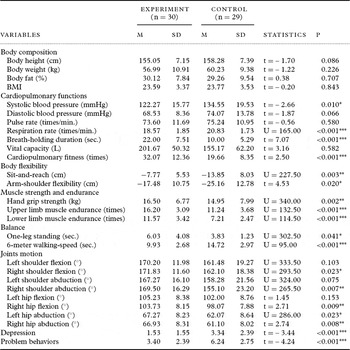
At the end of the 12-week study, there were significant differences between the experimental and control groups in most of the physical measurements: systolic blood pressure (t = −2.66, p = 0.010), respiration rate (U = 165.00, p < 0.001), breath−holding duration (t = 7.07, p < 0.001), cardiopulmonary fitness (t = 2.50, p < 0.001), sit-and-reach (U = 227.50, p = 0.003), arm-shoulder flexibility (t = 4.53, p = 0.020), hand grip strength (U = 340.00, p = 0.002), upper limb muscle endurance (U = 132.50, p < 0.001), lower limb muscle endurance (U = 114.50, p < 0.001), right shoulder flexion (U = 293.50, p = 0.023), right shoulder abduction (U = 265.50, p = 0.007), right hip flexion (t = 2.71, p = 0.009), left hip abduction (U = 286.00, p = 0.023), right hip abduction (t = 2.74, p = 0.008), one-leg standing balance (U = 302.50, p = 0.041), and 6-meter walking-speed (U = 95.00, p < 0.001) (Table 1).
Physical and mental health differences between experimental and control groups at the end of 12 weeks’ study

Note: * p < 0.05; ** p < 0.01; *** p < 0.001.
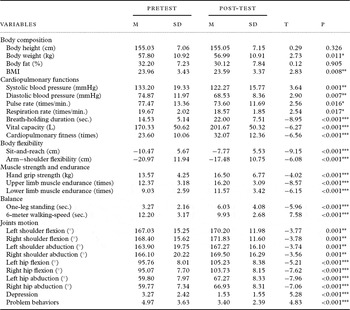
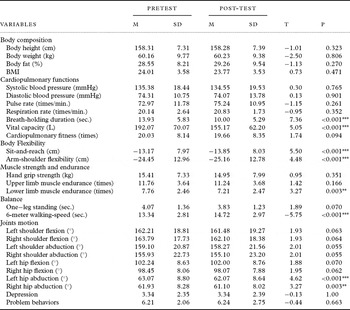
For the experimental group, after 12 weeks of intervention, all physical measurements, except body fat, were significantly improved (all p < 0.05) (Table 2). On the other hand, the control group only showed significant changes in the following variables, all of which indicated significant health deterioration: breath-holding duration (t = 7.36, p < 0.001), vital capacity (t = 5.05, p < 0.001), sit-and-reach (t = 5.50, p < 0.001), arm-shoulder flexibility (t = 4.48, p < 0.001), lower limb muscle endurance (t = 3.27, p = 0.003), left and right hip abduction (t = 4.62, p < 0.001; t = 3.27, p = 0.003), and 6-meter walking-speed (t = −5.75, p < 0.001) (Table 3).
Physical and mental health differences between pretest and post-test in the experimental group (n = 30)

Note: * p < 0.05; ** p < 0.01; *** p < 0.001.
Physical and mental health differences between pretest and post-test in the control group (n = 29)

Note: ** p < 0.01; *** p < 0.001.
Effects on mental health status
Comparing the two groups at the end of the 12-weeks study, significant differences were found in problem behaviors (t = −4.24, p < 0.001) and depression (t = −3.44, p < 0.001) (Table 1). For the experimental group, after 12 weeks of SY intervention, participants’ problem behaviors (t = 4.83, p < 0.001) and depression (t = 5.28, p < 0.001) had significantly reduced (Table 2). However, no significant changes were found in the control group (t = −0.44, p = 0.663; t = −0.13, p = 1.00) (Table 3).
Discussions
Our results indicate that the yoga training was effective in improving physical health, which is in agreement with previous studies (McCaffrey et al., Reference McCaffrey, Ruknui, Hatthakit and Kasetsomboon2005; Oken et al., Reference Oken2006; Rolland et al., Reference Rolland2007; Chen and Tseng, Reference Chen and Tseng2008; Chen et al., Reference Chen, Chen, Hong, Chao, Lin and Li2008; Ramos-Jimenez et al., Reference Ramos-Jimenez, Hernandez-Torres, Wall-Medrano, Munoz-Daw, Torres-Duran and Juarez-Oropeza2009; Arlene et al., Reference Arlene, Marieke and David2010). Possible explanations for these significant positive physical health outcomes are as follows. First, the SY exercise program involved whole body continuous exercise. Through slow and deep yogic breathing, the respiration rate was decreased and breath-holding duration was prolonged. Each breath became deeper and longer, which brought both lungs to maximum expansion to increase oxygen uptake, thereby strengthening cardiopulmonary function. Second, the slow and repeated (3–5 times for each movement) stretching of yoga postures massaged muscle groups and organs, and increased blood flow, which may lead to improved gland functioning, balanced hormones, stabilized heart rate, and lowered blood pressure (Ramaprabhu et al., Reference Ramaprabhu, Ramesh and Kishore2009). Third, the SY exercise program consisted of various postures in positions such as standing, sitting, squatting, supine, and prone. The stretching postures in these positions further trained the muscle strength and muscle endurance, which increased joint motion, body flexibility, and balance (DiBenedetto et al., Reference DiBenedetto2005; Chen et al., Reference Chen, Tseng, Ting and Huang2007). Fourth, in the last phase of the program, by lying flat on the floor and breathing slowly to relax the whole body, participants were able to decrease their muscle and vascular tension, lower blood pressure, increase attention span, boost metabolism, and increase body circulation (McCaffrey et al., Reference McCaffrey, Ruknui, Hatthakit and Kasetsomboon2005; Anette et al., Reference Anette, Sven, Kajsa, Torsten and Fahri2007). Owing to lack of exercise, the participants had significant tension in their bodies at the beginning of the study, but over the 12-week exercise training period, positive effects on their muscle and joint motions were manifested.
Furthermore, yoga is an exercise to regulate body, mind, and spirit; results of this study echoed the positive mental health outcomes found in the literature (e.g. Lee et al., Reference Lee, Mancuso and Charlson2004; Chen et al., Reference Chen, Tseng, Ting and Huang2007; Reference Chen, Chen, Hong, Chao, Lin and Li2008). During the course of this 12-week training, slow breathing and relaxation improved the inner stability and harmony of the participants, which led to a reduction in problem behaviors and depression. In addition to the statistically significant findings, the staff at the long-term care facilities stated that the experimental group participants wandered less and slept better at night. The participants also anticipated the scheduled exercise times, and took the initiative in greeting the instructors as early as the fourth week. Some of the participants even alerted other participants to the correct yoga postures during the exercise sessions. They learned from each other, encouraged each other, and manifested a reduction in the expression of negative emotions.
Limitations of the study and recommendations for further research
This study was constrained by a number of limitations. First, the participants were recruited from a convenience sample, and were assigned to either an experimental group or a control group based on the long-term care facilities where they resided. Random sampling and random assignment were not applied in this study. Although the homogeneity of the experimental and control groups was verified and no significant differences in demographic profiles and baseline data were found between the participants in the two groups, possible differences in characteristics might exist that were not captured in this study and a cluster effect might exist. Second, the study sample size was small, which limited the generalizability of the results. Third, the location for exercising was in a public area and was not separated from other activities. Therefore, participants might have been easily distracted by their surroundings which might have interrupted the administration of the SY interventions. Owing to these limitations, other possible explanations for the results may occur, and one must be cautious in interpreting and applying them to other situations.
It is recommended that a large random sample with random assignment of the participants to different groups could control the potential individual differences and should be considered in future study designs. Further, it would be interesting to investigate the differences between yoga and standard physical exercise in terms of the physical and mental health promotion effects on elderly participants with dementia. An experimental design with three groups (yoga group, standard exercise group, and control group) using pretest and post-test comparisons could be applied. Finally, a longitudinal study is recommended to assess the long-term maintenance effects of yoga on the health promotion of elderly people with dementia.
Conclusions
Exercise for older adults can improve physical function, prevent disability, and improve interpersonal relationships and social skills. The SY exercise program applied in this study does not require any yoga background, and any instructor can lead these exercises after some training. We recommend that staff or volunteers within long-term care facilities should lead the exercise and arrange this program as a regular set of activities in the facilities. Furthermore, activity scheduling in long-term care facilities has often not been designed specifically for older adults, especially older adults with limitations due to illnesses. We recommend integrating older adult exercise concepts into the schooling and continuing education of nursing staff so that they can use these exercise concepts to promote the physical and mental health of the older adults with whom they work.
Conflict of interest
None.
Description of authors' roles
K. M. Chen designed the study, supervised the data collection, and structured, edited, and revised the paper. J. T. Fan collected the data, analyzed the data, and prepared the draft of the paper.
Acknowledgments
Sincere appreciation is directed by our group to the staff of the long-term care facilities for their support and assistance, to the wonderful elderly residents for their generous participation, and to Professor Frank Belcastro for his superlative manuscript editing.