

Introduction
Growing concerns over climate change have led governments to focus on energy efficiency more generally and energy consumption of households specifically. In 2012, the European Union (EU) adopted the Energy Efficiency Directive with the goal of reducing primary energy consumption by 20% by the year 2020 (European Directive 2012/27/EU). The document includes the plan to implement smart meter technology as a way to accelerate energy savings. Smart meters are electronic devices that collect data on, for example, household energy consumption in real-time. Linked to an In-Home Display (IHD), a service app or other forms of (digital) communication, this data gives consumers the opportunity to monitor their energy consumption both locally and remotely. The idea behind the meters is that through feedback measures, consumers can be targeted with information on their consumption patterns which can ultimately change their behaviour. The EU aims to have an 80% rollout of smart meters throughout European member states by 2020. The EU further projects a 9% decrease in household energy consumption linked to this roll-out. Reports however warn that member states fall short of the targeted smart meter penetration rate in order to reach these goals (EC 2016). Latest numbers suggest that the EU will not reach the 80% penetration rate in EU Member States by 2020. This has been an ongoing issue. Kranz et al. (Reference Kranz, Gallenkamp and Picot2010) already note that “although the positive impact of smart meters on energy efficiency is widely recognised”; diffusion is lagging behind (Ibid, 2).
One reason for slow implementation is the cross-cutting character of smart meter implementation, which requires the involvement of various stakeholders. For example, technical and commercial interoperability as well as data privacy and security concerns call for the collaboration of national regulatory bodies, as well as energy companies, technology providers and consumers (O’Toole and Montjoy Reference O’Toole and Monnoy1984; EC 2014; Peters Reference Peters2018). The article frames this as a policy coordination challenge in which one organisation makes decisions that have consequences for another (Peters Reference Peters2018). Policy coordination is the idea that programs are effective when policies complement and reinforce each other (Peters Reference Peters2015, Reference Peters2018). In order to identify coordination challenges, the analysis looks specifically at the supply and demand dimension of smart meter implementation. This follows a recent trend in the literature to include the role of citizens and larger transformation processes in the energy sector for identifying obstacles to implementation (McDaniel and McLaughlin Reference McDaniel and McLaughlin2009; Darby Reference Darby2010; Torriti et al. Reference Torriti, Hassan and Leach2010; Mengolini and Vasiljevska Reference Mengolini and Vasiljevska2013; Verbong et al. Reference Verbong, Sengers and Beemsterboer2013; Heiskanen et al. Reference Heiskanen, Matschoss and Repo2015). The demand-side perspective looks at the adoption of technology by citizens based on trust in government (TIG) and in the technology (Bekkers and Homburg Reference Bekkers and Homburg2007; Belander and Carter Reference Belanger and Carter2008). The supply-side of coordination looks at the coevolution between technologies and institutions as well as the interactive nature between public and private sectors (Bergek et al. Reference Bergek, Jacobsson, Carlsson, Lindmark and Rickne2008; Martin et al. Reference Martin, Nightingale and Yegros-Yegros2012). Structuring the theoretical understanding of policy coordination in this way helps to separate challenges linked to push and pull factors in policy implementation while identifying the different governmental levels, administrative entities and actors involved. Along these lines, the analysis aims to answer the question how do policy coordination structures of demand and supply affect smart meter implementation? The goal is to elaborate on the specifics of the interdependence of governments, citizens and industry from a policy coordination perspective.
To explore the demand-supply policy coordination lens, the article analyses smart meter implementation in the United Kingdom (UK). The UK is a case of slow implementation with high levels of government commitment towards a full roll-out. The UK had several setbacks linked to the timing of regulation and the technology development that followed, as well as consumers raising concerns over functionality and privacy. This gives rich insights into the coherence and timing of policy coordination with challenges on the consumer and the company side of implementation. Information on the case is derived from EU, national and local government documents as well as publicly available reports by energy companies and independent groups assessing smart meter technology.
The article is structured as follows, the Theory section presents the conceptual framework integrating the demand- and supply-side of technology implementation into the policy coordination framework; followed by the Research methods part of the paper. ‘Smart meter implementation’ provides an overview and discussion of the UK case and the final section concludes the article.
Theory
Policy implementation and coordination
Policy implementation describes the effort, knowledge and resources devoted to translating policy decisions into action (Howlett et al. Reference Howlett, Ramesh and Perl2009). Looking at conditions for effective implementation, work by Sabatier and Mazmanian (Reference Sabatier and Mazmanian1979) and Pressman and Wildavsky (Reference Pressman and Wildavsky1973), point towards the obstacles that policymakers face during the implementation process, such as the congruence of policy objectives, the decisions of implementing agencies and the actual impacts of those decisions. Hence, policy implementation is essentially a problem of coordinating multiple agencies to work together towards a common policy product (O’Toole and Montjoy Reference O’Toole and Monnoy1984). The policy coordination framework thereby highlights the interdependencies among implementing agencies and the effect of action or inaction of one on the other, which results in slowed or stalled application. There are various ways to approach policy coordination. Economists focus on a game-theoretic set-up in which bargaining of national governments shapes the adjustment of policies (Oudiz and Sachs Reference Oudiz and Sachs1984; Kahler Reference Kahler1988). Political scientists address the institutional structures linked to regime analysis, especially in the context of complex policy problems, which require the integration of different sectors (Keohane Reference Keohane1986; Dovers Reference Dovers1997). Embedded in this logic of sectoral coordination among levels of government as well as policy departments, this analysis defines policy coordination as coordination across different types of (related) policies and different types of actors.
The goal of coordination is to minimise duplication and overlap, avoid inconsistencies, minimise conflict and aim for a comprehensive perspective of an issue (Scharpf Reference Scharpf1994; Magro et al. Reference Magro, Navarro and Zabala-Iturriagagoitia2014; Peters Reference Peters2018). A central challenge in policy coordination is specialisation and the division of governments along horizontal and vertical dimensions (Bouckaert et al. Reference Bouckaert, van Dooren, Verschuere, Voets and Wayenberg2010). Vertical coordination is defined as the “collaboration among a large variety of players and governmental agencies from different territorial levels,” whereas horizontal coordination is understood as “the cooperation among governmental units within a particular territory (i.e. one level)” (Magro et al. Reference Magro, Navarro and Zabala-Iturriagagoitia2014, 373). In short, horizontal coordination is the interplay of organisations on the same hierarchical tier, whereas vertical coordination refers to the dynamics between levels of government. Research however shows that the distinction between vertical and horizontal coordination is not always straightforward, since government proceedings are often a mix of both (Peters Reference Peters2018). This also applies to smart meter implementation where there is a combination of top-down coordination through regulatory frameworks as well as horizontal coordination efforts of streamlining data protection, technology development and energy infrastructure.
Hierarchies, networks and markets are a common typology for analysing government coordination efforts (Thompson et al. Reference Thompson, Frances, Levacic and Mitchell1991; O’Toole Reference O’Toole1997; Kaufmann et al. Reference Kaufmann, Majone and Ostrom1986).
Within hierarchical institutional arrangements the central pattern of interaction is authority, operationalised in administrative orders, rules and planning on the one hand, and dominance and authority as the basic control system on the other. Markets as coordinating institutions are based on competition, bargaining and exchange between actors… Coordination within networks takes the form of cooperation between actors whose interorganisational relations are ruled by the acknowledgement of mutual interdependencies, trust and the responsibilities of each actor (Bouckaert et al. Reference Bouckaert, van Dooren, Verschuere, Voets and Wayenberg2010, 35–36).
This article suggests a different theoretical perspective for policy coordination specifically tailored towards the implementation of innovative technology in which aspects of hierarchy, network and market are included. The current literature does not specifically distinguish between public and private adoption of an application. This however is a central aspect to slow implementation. The literature on technology adoption and systems of innovation suggests that for citizens to adopt a new technology, trust in the implementing agency, characteristics of the process or product and its perceived usefulness play a key role (Davis Reference Davis1989; Hall Reference Hall, Fagerberg, Mowery and Nelson2004; Belanger and Carter Reference Belanger and Carter2008; Stragier et al. Reference Stragier, Hauttekeerte and De Marez2010). For suppliers of the technology, the regulatory context further determines decisions to develop and sell certain products, such as legislation that protects new products (Gregersen Reference Gregersen and Lundvall2010; Wintjes Reference Wintjes2016). These can be categorised as demand and supply mechanisms in the context of policy coordination.
Demand- and supply-side of technology implementation
Traditionally, literature on technology looks at implementation from a technology acceptance perspective. This means that the level of trust in the agency implementing and characteristics of the technology play a role for its adoption. Three lines of research address this. The trust of the government (TOG) model shows that citizens need confidence in the agency providing a service before adopting a new technology. In the context of smart meter implementation, this primarily refers to the handling of private information of energy users and the handling of data being collected through the meter. Belanger and Carter (Reference Belanger and Carter2008) further make a direct link with the reputation of the public agency. Nonfraudulent interaction with service providers will enhance trust, whereas uncertainty about data regulation and the sharing of data with private companies or third parties can reduce trust levels (McKnight et al. Reference McKnight, Choudhury and Kacmar2002; Belanger and Carter Reference Belanger and Carter2008).
The diffusion of innovation (DOI) model focusses on the characteristics of the process or product, looking at its relative advantage, complexity, compatibility, triability and observability (Rogers Reference Rogers1995; Hall Reference Hall, Fagerberg, Mowery and Nelson2004; Carter and Belanger Reference Carter and Belanger2005). Finally, the technology acceptance model or TAM (Davis Reference Davis1989) highlights the perceived usefulness, attitude towards the technology, and perceived ease of use as factors for using a new technology (Zhang and Nuttall Reference Zhang and Nuttall2011). TAM is widely applied in the context of information technology, such as government websites, but increasingly scholars have widened its approach to other technologies, such as smart meters (Stragier et al. Reference Stragier, Hauttekeerte and De Marez2010). In short, the demand-side perspective emphasises the role of citizens’ perception for implementation linked to trust in government and the usefuleness and characteristics of the technology.
The system of innovation literature complements this demand-side perspective by including the overall function of developing, diffusing and utilising new products and processes (Carlsson and Stankiewicz Reference Carlsson and Stankiewicz1991; Bergek et al. Reference Bergek, Jacobsson, Carlsson, Lindmark and Rickne2008). Innovation systems describe how firms (suppliers) source knowledge and develop innovative activities, as well as how governments and institutional frameworks influence those activities. The analysis in this article focusses on the argument that the framework set by government matters for the supply-side of technological innovation. For example, support for R&D to create technological innovation and policies promoting the demand for innovation, such as subsidies (Wintjes Reference Wintjes2016). Further, legislative and regulatory procedures that protect and control new products and processes shape innovative activities (Gregersen Reference Gregersen and Lundvall2010). More recent work integrates the supply-side perspective into a “mutual shaping” debate, where demand, supply and technological capabilities interact and codevelop (Leydesdorff and Ivanova Reference Leydesdorff and Ivanova2016).
Thereby the initiatives and regulatory guidelines can be manifold, especially when policy domains overlap. In turn, the corporate response to these conditions can be complex. As Gregersen (Reference Gregersen and Lundvall2010) points out “the extent of necessary organisational, technical or economical changes and responses may be dependent on both the technical characteristics and the timing of standards and vice versa” (Ibid, 145). In this context, innovation studies have repeatedly highlighted the relevance of both the framework conditions set by government and the connection between user and supplier (Porter Reference Porter1990; Lundvall Reference Lundvall and Lundvall2010). This is a coordination problem where various stakeholders, institutionalised cooperation and market dynamics intersect. Another complication is that the regulatory framework is often not tailored towards the nature of the product – whether it is a material, component or a service (Lundvall Reference Lundvall and Lundvall2010; Gregersen Reference Gregersen and Lundvall2010).
These dimensions particularly speak to policy coordination, since they pick up on an implementation process that plays out in a collaboration of a large variety of players and governmental agencies from different territorial levels (Magro et al. Reference Magro, Navarro and Zabala-Iturriagagoitia2014). At the intersection of demand and supply is the idea that the development and provision of smart meter technology will change individual energy consumption behaviour. The topic of framing this as a behavioural incentive goes beyond this article; however, there has been a wide variety of research on the reduction of energy consumption through providing social comparison (see e.g. Arvola et al. Reference Arvola, Uutela and Anttila1993; Lehner et al. Reference Lehner, Mont and Heiskanen2016) or varying feedback mechanisms (see e.g. Fischer Reference Fischer2008; Delmas et al. Reference Delmas, Fischlein and Asensio2013).
Finally, research also points towards the timing as a challenge for coordinating implementation (Bouckaert et al. Reference Bouckaert, van Dooren, Verschuere, Voets and Wayenberg2010; Sartorius and Zundel Reference Sartorius and Zundel2005; Weber and Rohracher Reference Weber and Rohracher2012). Especially at the intersection of innovation and traditional policy domains, such as energy policy, multiple instruments and policymaking levels create tensions among policy areas (Taylor Reference Taylor and Henry2007; Borrás and Edquist Reference Borrás and Edquist2013; Giest and Mukherjee Reference Giest and Mukherjee2018).
Summary
The supply dimension of policy coordination includes the regulatory set-up and the market dynamics that shape energy company behaviour, such as regulations put in place to incentivise meter implementation. For example, specific privacy laws that apply to how the smart meter data is stored, as well as who is legally allowed to install the meters in households. The market dynamics include the way the energy market is structured and how that affects whether and how fast energy companies are willing to develop the technology and install it in households. As past research has shown, it is crucial to be timely with how new technology is regulated and that it is coherent with existing regulations (OECD 2015).
The demand dimension defines the trust in the implementing agency and the usability of the technology in accordance to citizen uptake. Since measuring the levels of trust of citizens towards public agencies with a specific focus on smart meters goes beyond the scope of this article, the research focusses particularly on inconsistencies in the message that is being given to consumers when it comes to relevant dimensions, such as costs of the meter (who pays?) and privacy concerns (how is the data protected?). Past research has shown that inconsistencies can lower the trust in public agencies when it comes to technology implementation (Carter and Bélanger Reference Carter and Belanger2005; Colesca Reference Colesca2009).
In this context, the article disentangles the following analytical categories of policy coordination. First the collaborative structure, which includes domains, levels, layers and stakeholders:
-
Domains: implementation coordination is specific to policy sectors (Steunenberg Reference Steunenberg2006). This not only accounts for policy specific factors within a domain, but also potential interaction of several policy fields in terms of timing or conflicting incentives.
-
Levels: the more governmental units are involved, the more challenging implementation becomes due to coordination issues among levels and administrative layers (Steunenberg Reference Steunenberg2006).
-
Layers: layers are the political dimension of priority setting and strategy formulation, an administrative layer where the implementation and management of particular programs takes place and the operational sphere, which involves organisations that are part of the translation of the political and administrative layer into concrete action (Magro et al. Reference Magro, Navarro and Zabala-Iturriagagoitia2014).
-
Stakeholders: stakeholders involved in implementation. These actors are not restricted to “formal” players in the process (Tsebelis Reference Tsebelis2002), but include policy-specific ones, which are defined as those who formally or informally affect reaching the policy goal (Steunenberg Reference Steunenberg2006).
Second, the technological characteristics contributing to the acceptance by consumers, such as privacy, as well as aspects relevant to implementing stakeholders, for example compliance with standards. Finally, timing of rules and regulations that affects the development of technology as well as coherent communication to consumers.
Research methods
In order to unpack smart meter implementation pace in Europe, the article maps coordination dynamics within the UK. According to Bouckaert et al. (Reference Bouckaert, van Dooren, Verschuere, Voets and Wayenberg2010), the mapping should include the institutional coordination structure. The article realises this by following the theoretical division of demand and supply perspectives in combination with looking at factors relevant to policy implementation, including the collaborative structure, technological characteristics and timing. For the mapping, a case study approach is chosen, due to the explanatory nature of the research question. Thereby, the dependent variable is the speed of smart meter roll-out. The independent variable is the demand- and supply-coordination structure.
The selection of the UK case is motivated by it being a typical case. Similar to a majority of other European Countries, the UK has mandated a full roll-out and is faced with a variety of electricity providers active in the market. The UK case further gives rich insights into the coherence and timing of policy coordination on the topic, due to the implementation timespan of so far 10 years. The mapping of coordination dynamics in the UK highlights some of these challenges linked to demand and supply in different places within government (levels and administrative units as well as policy domains) that prevent implementation to move forward. The findings further have relevance for understanding the temporality and complexity of smart meter implementation in the national context. Finally, the UK is a case of slow implementation with high levels of public commitment. This eliminates some of the reasons linked to slow implementation, such as low political support or a limited budget.
The article relies on policy documents by the British government (primary sources) as well as secondary sources by scholars that have published on smart meter implementation from technical, behavioural and policy perspectives. The documents are analysed based on the interview technique (O’Leary Reference O’Leary2014). This implies that the following key questions based on the mapping approach are asked for all documents that are part of the analysis:
-
What is the collaborative institutional structure of smart meter implementation?
-
Which technological guidelines for smart meters are in place?
-
How are smart meter (-related) regulations and initiatives scheduled?
The documents compiled consist of national level publications as well as local level and third sector organisation ones. They include reports published by the British Department of Energy and Climate Change (2015a, 2016), such as “Policy Conclusions: Early Learning Project and Small-scale Behaviour Trials, Smart Metering Implementation Programme” or “Smart Metering, A guide for local authorities and third sector organisations” as well as reports by local authorities (Greater London Authority 2016) involved in the policy implementation process. Public reports and energy company messages to consumers as well as media reports can highlight communication with the public about smart meters, such as “Public may end up paying for obsolete smart meters that save little, MPs warn” (Smithers Reference Smithers2014) or “Is your smart meter spying on you?” (Collinson Reference Collinson2017). There is further a range of scholars that have looked at smart meter implementation from technical, behavioural and policy angles. They provide important insights into the complexity of public use of a privately generated technology that is utilised to change behaviour among citizens (see e.g. Darby Reference Darby2010; Ehrhardt-Martinez et al. Reference Ehrhardt-Martinez, Donnelly and Laitner2010; Klopfert and Wallenborn Reference Klopfert and Wallenborn2011; Jenkins et al. Reference Jenkins, Long and Wu2015; Sovakool et al. Reference Sovakool, Kivimaa, Hielscher and Jenkins2017). These institutional coordination structures in combination with the number of coordinating units and actors are hypothesised to affect the speed of implementation, which is captured in the deployment rate available for each European Member State. Smart meter deployment is the roll-out rate within a country that is defined as the number of installed units (EC 2018).
With this analysis, the research in this article contributes to the field by incorporating the timing, coordination modes and mechanisms put in place by government that shape the demand and supply dynamics of smart meter implementation.
Smart meter implementation
The origin of the smart meter can be traced back to Directive 2006/32/EC, which addresses European End-Use Efficiency and Energy Services (Sovakool et al. Reference Sovakool, Kivimaa, Hielscher and Jenkins2017). The implementation is largely taken on by national governments in compliance with EU regulations, such as the Directive 2009/28/EC on renewables or the Directive 2003/87/EC that establishes the EU Emissions Trading System (ETS) (Zgajewski 2015). A “smart metering system” or “intelligent metering system” is defined by the EU Directive 2012/27 as “an electronic system that can measure energy consumption, providing more information than a conventional meter, and can transmit and receive data using a form of electronic communication” (European Directive 2012/27/EU, 11). Such a system is mostly tied to the general deployment of a “smart grid” that indicates an upgraded electricity network, which is able to provide digital communication among suppliers and consumers (Zgajewski 2015). Intelligent metering thereby forms an integral part of updating the grid system. However, the defining characteristics remain vague and thus offer a variety of implementation types in the member states.
United Kingdom
Latest statistics on the implementation of smart meters suggest that the UK is a case of a (for now) EU country that has shown high levels of (monetary) commitments towards smart meter implementation, but in contrast to that, the current program is years behind schedule. So far, 8.25 million meters have been installed as of November 2017 (BEIS 2017b; Sovakool et al. Reference Sovakool, Kivimaa, Hielscher and Jenkins2017). The full-scale rollout has been delayed several times and the number of installed meters makes up only 14.7% of the target number of 56 million (Sovakool et al. Reference Sovakool, Kivimaa, Hielscher and Jenkins2017). This could have wider implications for UK’s climate change targets, as the fifth carbon budget will fall short by 100 million tons (around 37.2%) (Committee on Climate Change 2016). This is surprising given that smart meters are presented as the UK’s “Flagship energy policy” and there is a marketing campaign that costs the government around 100 million pounds over a 5-year period (Barnett Reference Barnett2015; Sovakool et al. Reference Sovakool, Kivimaa, Hielscher and Jenkins2017). In short, the UK has shown high levels of commitment from the government-side, but implementation has been slow and disrupted with issues arising out of the coordination process.
Technological characteristics
The UK government put in place requirements for meters to qualify as “smart”. They have to comply with the Smart Meter Equipment Technical Specification (SMETS) and have the ability to transmit meter readings to energy suppliers and receive data remotely. However, due to the roll-out being led by energy companies, some have rolled out smart-type meters early without complying with the SMETS standard (DECC 2016). This means some meters will have to be replaced by energy companies in the coming 4 years. During the early phases of the roll-out, the smart meter technology was not transferrable among energy providers, which meant that each energy company had their own smart meter that needed to be installed when customers would switch providers. For the most recent plan, this issue has been addressed and there is one operating system for all meters (Palmer Reference Palmer2015). In 2016, the DCC also put in place a national communication infrastructure across Great Britain, which involves consultation on how to incorporate so-called first-generation smart meters (SMETS1) into the latest system (Department for Business, Energy & Industrial Strategy 2017a).
The European Council further formulated guidelines that apply to smart metering, such as consumers should be given access to their consumption data and electricity pricing tariffs without extra costs (European Directive 2009/72/EC). Smart meter systems further have to comply with safety standards outlined in Directive 2012/27/EU. “This requires proper regulation of the access to electricity consumption data (who can access it, what costs are associated with it, and so on) and its exchange between agents (who owns the data, who is obliged to share it and who should not be given access” (Alskaif and van Sark Reference Alskaif and van Sark2016, 5). The sim card inside each smart meter has the ability to switch off energy supply to a home, for example, if bills are not being paid. However, this also has been identified as a cyber-security weakness (Naughton Reference Naughton2013). In a public consultation on smart meters, citizens raised this aspect in particular and the UK government prepared a response, which mainly focusses on the collection and transfer of data (DECC 2012). Security nevertheless remains a topic in the discussion surrounding smart meters, especially because the implementation is outsourced to energy companies and subcontractors that make it difficult to control the installation process (Collinson Reference Collinson2017).
Collaborative structure
In the UK, the smart meter roll-out is supplier-led in which the suppliers are free to plan their own installation strategy (DECC 2016). The “big six” suppliers include British Gas, EDF Energy, npower, E.ON UK, Scottish Power and SSE. There are further regional differences in implementation and willingness to use the technology by consumers. Latest numbers suggest that the North East has the largest concentration of smart meters with nearly a quarter of citizens having a new meter installed. In contrast, only 8% of London residents have a smart meter. “The North West has the second highest concentration of smart meters with nearly a fifth of consumers confirming they have had a meter installed, while more than half plan to have a new meter installed in the future” (ECTA 2016, 9). These regional disparities point towards variations in the local government coordination of smart meter implementation and potentially energy company specific procedures. London, for example, is largely serviced by EDF, whereas the North West is covered by E.ON.
Owaineh et al. (Reference Owaineh, Leach, Guest and Wehrmeyer2015) further find that the UK government, specifically the DECC, has great indirect influence over smart grid projects, including the implementation of smart meters through policy and legislation. The energy regulator Ofgem funds and monitors specific demonstration projects in this field and offers funding schemes for innovation through, for example, the Low-Carbon Network Fund (LCNF). However, the biggest challenge identified by the ECC/Ofgem Smart Grid Forum (SGF), a platform for industry, government and other key stakeholders, is the coordination of consumer participation and establishing prerequisites for implementation. “From a policy perspective, developing an appropriate regulatory and institutional framework, maintaining clear strategic vision that can allow diverse actors to move broadly in the same direction are seen as the most important” (Owaineh et al. Reference Owaineh, Leach, Guest and Wehrmeyer2015, 12). The following section will zoom in on these aspects to identify implementation hurdles in the form of demand and supply coordination challenges.
The UK market shows that the biggest energy company has a share of 29.3% with 24 electricity providers being active in the retail market (ACER 2016). This creates a competitive setting, which also applies to smart meter implementation (EC 2016). The UK further has an incentive-based system for DSOs linked to smart meters, this means that pricing decisions are made at firm level and profit comes from cost reduction (Vogelsang Reference Vogelsang2002). Another issue for the supply-side are the In-Home Displays that connect to the smart meter in order to visualise energy consumption for the homeowner or tenant. In a 2015-consultation, the UK government concluded that for this technology to flourish, the licensing conditions for IHDs require updating. The discussion showed that such flexibility would allow suppliers to undertake trials of alternative energy use engagement tools instead of IHDs under the supervision of the Secretary of State approval (Department of Energy & Climate Change 2016). The motivation for this change is “enabling a more competitive market in energy supply and energy management” (Department of Energy and Climate Change 2016, 5).
On the consumer side, a survey by Smart Energy GB shows high awareness levels across the UK population: 97% of people say they heard of smart meters (Smart Energy GB 2015). However, only 21% percent of the population has a smart meter installed (Smart Energy GB 2018) and, in addition, BEIS recently conducted a survey of 2,015 households and found that 18.9% of consumers said that they did not look at their IHD once owning a smart meter, which is the main component for changing consumption behaviour (BEIS 2017c).
These obstacles are linked to the aspects highlighted in the supplier context: first, consumers had to change their smart meters if switching providers due to differences in the software, and, second, if consumers had a first-generation smart meter, this needed to be replaced by a newer version. This led to additional reluctance among citizens to adopt the technology. Since smart meters are not compulsory, citizens can refuse to install the technology or opt out of smart meters usage at a later stage. Currently, the costs for the meters and their maintenance are rolled into the energy bill. The incentive is that consumers will save energy costs, because usage can be calculated more accurately and off-peak consumption can be rewarded with lower tariffs – ultimately offsetting any smart meter costs.
The UK has a dedicated smart meter consumer engagement policy, which includes supplier obligations for example on IHDs, conduct of the installation visit and centralised engagement (by Smart Energy GB) (DECC 2015b). Connected to this is the expectation that consumers will have “greater convenience, financial savings from improved energy management and, in the longer-term, a more active consumer role in the energy system” (DECC 2015b, 5; DECC 2015a). The Data Guideline states the consumer can decide on:
-
How much data your energy supplier collects from your smart meter, for example monthly, daily or half-hourly meter reads;
-
Whether your supplier shares details about your energy consumption with other organisations;
-
Whether your supplier can use your meter reads for sales and marketing purposes;
-
How you can access information about your energy use and get the most benefit from it;
-
Once you have made your choice on any of these, you can change your mind at any time (Energy UK 2017, 1).
Smart Energy GB has also rolled out a national awareness campaign in June of 2017 with “Gaz & Leccy” as characters representing gas and electricity and giving tips on energy savings around the house and explaining the use of smart meter technology.
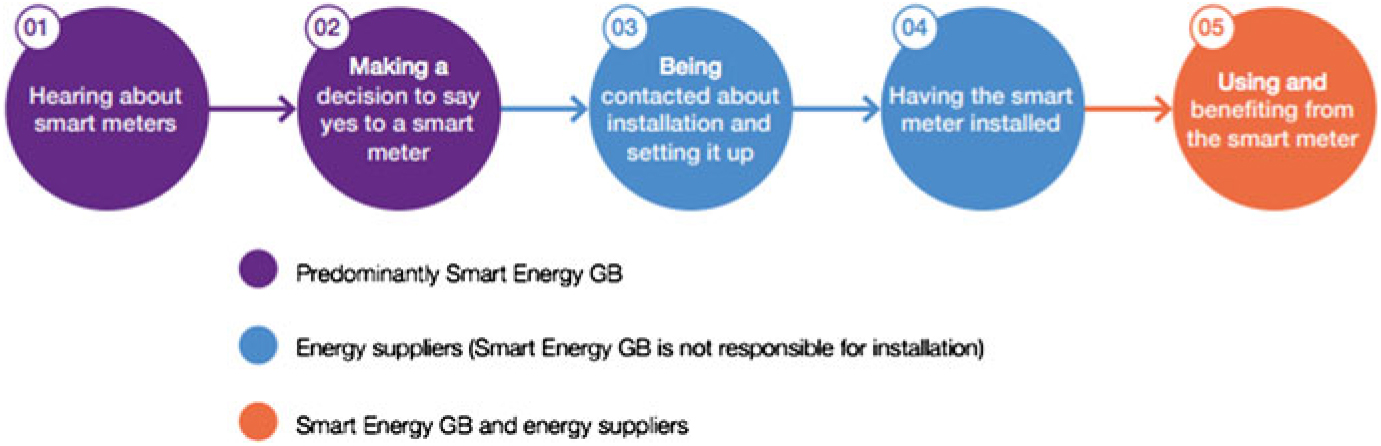
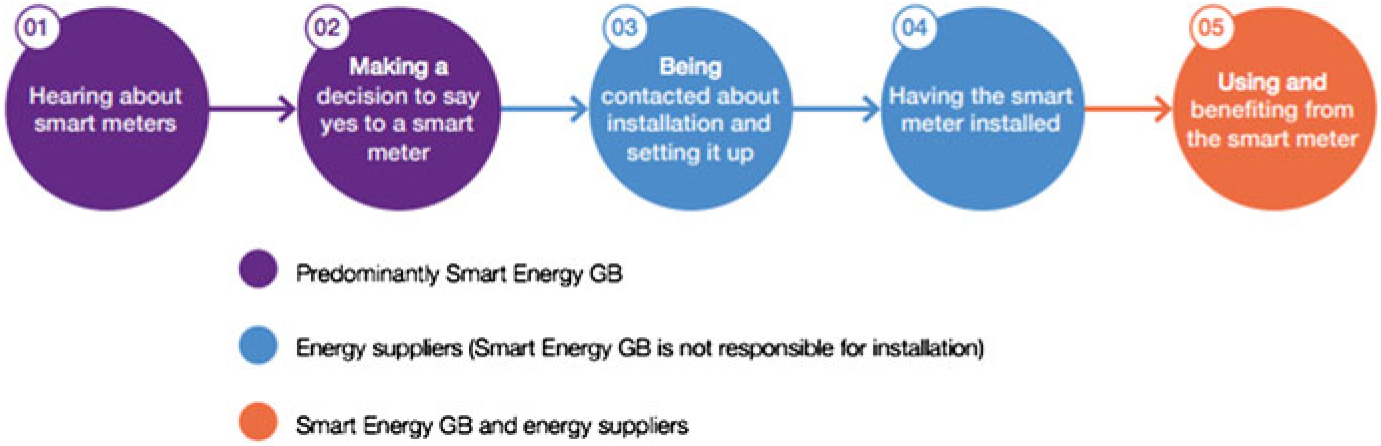
Figure 1 shows the linkages among Smart Energy GB, energy suppliers and the usage by consumers. Whereas Smart Energy GB is largely responsible for raising awareness and creating a positive image around the smart meter, the energy suppliers are in charge of installation and explaining the potential features to customers. What is not shown in the figure, but relevant to the regional disparities in England is the role of regional governments. They can provide local incentives, guidance and planning for implementation of the meters. At the local level, city governments are focussing on engaging citizens in using the new technology. The City of London, for example, calls on the different boroughs to “help build trust and confidence in using smart technology, such as smart meters and smart bins, to help increase their uptake” (Greater London Authority 2016, 5).
Smart meter implementation involvement (Smart Energy GB 2015, 8).
Domain
The UK focusses largely on the energy policy domain for smart meter implementation, but regulatory measures show that other aspects, such as data and privacy or science and technology standards, play a role. Changes in data protection affect what energy companies are able to do with the data that is being collected through the smart meters. Energy, environmental and cyber security policies are also directly related to smart meters. Coordination among these different domains challenges government to align energy security, environmental goals and privacy and integrity of consumers using smart meters. The very same data that is needed to reduce energy consumption is also creating cyber security risks.
The UK has made some efforts to integrate these issues in the “Smart meters: a guide” document, which combines several of the aspects in one document, such as licensing conditions for energy suppliers (DECC 2016), latest statistics on uptake by consumers (Smart Energy GB 2016a), the government engagement strategy based on behavioural insights (Smart Energy GB 2016b) and a cost-benefit analysis (BEIS 2016) as well as the communication infrastructure (BEIS 2017b).
Level
The level of policy coordination is largely the national one; however, this is impacted by European requirements, such as the Renewables Directive 2009/28/EC or the EU ETS Directive 2003/87/EC. Specifically for the UK, the government started implementation within the EU framework; however, Brexit negotiations might shift some of the priorities linked to climate change and smart meter targets. In addition, energy remains a centralised issue, whereas local governments might take on the role of facilitating the adoption of the technology by citizens. Local governments usually have easier access to local consumers and energy providers and thus could introduce different campaigns for changing the routines (this has started in the case of London) and could act as a mobiliser of different actor groups and mediator between national and local levels.
Over the years, there have been changes at the macro-, meso- and microlevel pertaining to UK smart meter implementation (Darby Reference Darby2010; Sovakool et al. Reference Sovakool, Kivimaa, Hielscher and Jenkins2017):
-
Macrochanges at the level of electricity and gas networks and decarbonisation;
-
Mesolevel changes in consumer relations, the DCC, DNOs and suppliers;
-
Local or microlevel changes in household decisions over appliances, IHDs, feedback, lifestyles and social practices.
Together they shape the larger implementation process, and, at the same time, can facilitate or hinder each other depending on their timing or coherence.
Layers
For the UK, all three layers of politics, strategy and administration play a role, whereas the administrative layer, including the energy companies carrying out smart meter installation and services, is crucial for the political one to reach its policy goal. The financial commitment of the UK government in connection with making smart meters the key element of the energy agenda shows that the technology is taking on a central role in priority setting and strategy formulation. The latest push for consumer-uptake through the media campaign organised by Smart Energy GB underlines this. The administrative and the organisational layer show some delay in implementing these strategic goals.
One example for this is how the opt-out models were communicated by the administrative layer, the trade association for the UK energy industry, Energy UK in collaboration with the Office of Gas and Electricity Markets and by individual energy companies. UK smart meter implementation is working with an opt-out model for both the meter itself and the type of data collection. Both the Data Guideline (2013) and the Code of Conduct for the Installation of smart meters (SMICOP 2017) however do not specifically address the opting out procedure. A British NGO filed a complaint with the Office of Gas and Electricity Markets, due to concerns over British Gas pushing customers to install the technology (Stop Smart Meters 2013). Similar issues arose over the last couple of years concerning discrepancies among decisions on government side that were communicated to customers differently or implemented not in line with the guidelines set (Smithers Reference Smithers2014). At the same time, policy documents also show constant updating, which means energy companies have to adjust.
Actors
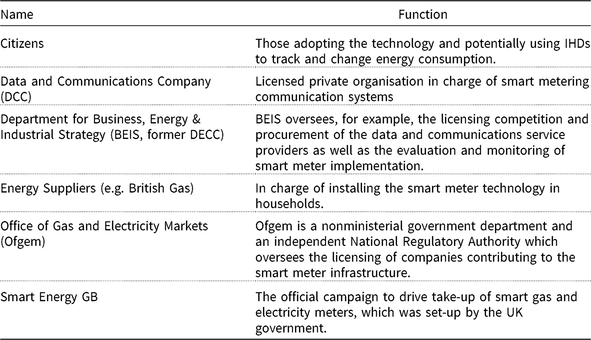
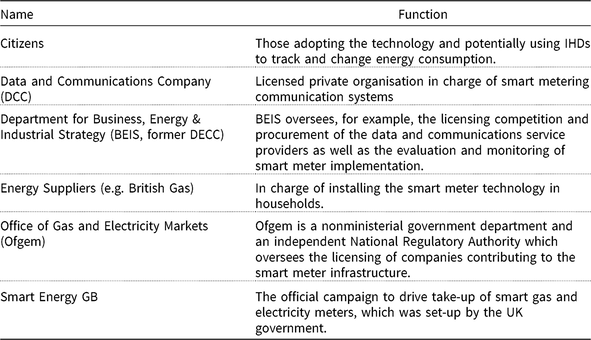
For both, demand and supply dimension, there is a mix of actors from the public and private sphere. This is complicated by the fact that these actors operate at different levels, whereas government is largely national and local, companies might operate European-wide. The main actors in the British case are the following (see Table 1).
Main actors in British smart meter implementation (based on Sovakool et al. Reference Sovakool, Kivimaa, Hielscher and Jenkins2017)
Timing
The UK smart metering program is being rolled out in two phases: the Foundation Stage, which began in 2011, focussed on engaging with the energy industry, consumer groups and other stakeholders in order to create commercial and regulatory frameworks for smart metering. This was followed by the main implementation stage, which began in November 2016 and will run till the end of 2020. In this stage, the actual installation takes place with the goal of a full rollout.
In this context, streamlining the implementation strategy for several stakeholders (see Table 1) poses a challenge as regulatory measures affect them differently at various points in time. The government decision to delay smart meter implementation, for example, is linked to a monetary burden for energy companies. “On top of the cost of providing meters and the technical skills to roll them out, the costs shouldered by the companies are twofold: they support the central body that collects and manages all the data from 50 million gas and electricity meters across the country and the organisation that promotes the roll-out to the public” (Ambrose Reference Ambrose2017). The timing of the mandatory roll-out and setting up the technical infrastructure through DCC is also a challenge. The later the communication structure for smart meters is published, the more pressure it puts on energy providers when it comes to fulfilling the roll-out in the given timeframe.
One example for this is the consultation on the communication infrastructure of smart meters that started in November 2016 and was closed in January 2017. Before the launch of this consultation, the smart meter infrastructure “developed organically without a unified communications standard and often independently” (DCC 2016). This led to smart meters not being compatible among each other and a meter could lose functionality upon switching energy providers. The consultation has recently concluded and the UK government agreed on an infrastructure format, which is carried out by the Data Communications Company. In turn, that means some energy companies have to replace or retrofit meters that do not comply with the standard.
Discussion: UK coordination structure for smart meter implementation
The UK started the smart meter implementation with a fairly open plan, in the sense that the functionalities, technology infrastructure and data handling were not clearly defined. This led energy companies to deploy and operate so-called first-generation smart meters. These early roll-out attempts in combination with installing not fully “smart” meters and the limitations on changing providers in earlier software versions led to increased levels of public skepticism towards the technology. It further raised questions for companies and consumers alike, about how privacy issues, such as billing data, are handled and who exactly is paying for the deployment and maintenance of the new meters. This put government into a position where it had to catch up with some of the developments unfolding and led to specifying the technology infrastructure, setting installation and opt-out (data) guidelines and putting in place a public engagement campaign in the last couple of months and years. The initiatives undertaken in the different areas further revealed the complexity of regulating an area, which is a moving target due to technological advancement and complex connections among market dynamics, consumer engagement and regulatory elements from the energy, environmental and innovation domain.
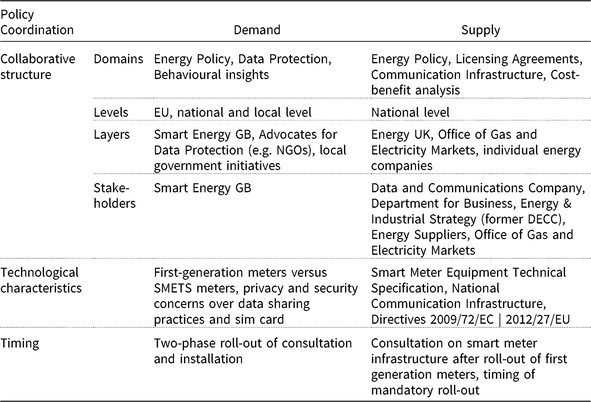
Table 2 summarises the UK findings and highlights three things: first, demand and supply are separate implementation aspects that require attention, since the supply-side is dependent on the technology and innovation framework, whereas the demand-side is impacted by the application of the technology and the privacy and data challenges that come with it. Also, while governmental levels and policy domains align on energy supply, technology and data, the administrative layers differ. The demand side requires targeted campaigns highlighting the safety and ease-of-use of the new technology as well as potential cost-savings features. For the supply-side, companies are looking for streamlined (data) regulation and a favourable set-up for technological development. This, secondly, points to two different sets of stakeholders that play a part in smart meter implementation. Whereas consumers are largely targeted by Smart Energy GB, companies require the involvement of the Data and Communications, Energy as well as Gas and Electricity Markets. Finally, while government has to facilitate demand and supply in different ways, they are dependent on each other. The more consumer-oriented services energy companies can offer, the more interest is raised on the side of consumers in adopting the technology. In junction with this, the more consumers adopt the technology; it becomes increasingly interesting for energy companies to competitively offer the best features. Thus, incentive structures stimulating demand and supply in an interrelated, timely manner are needed for successful implementation of smart meters.
Mapping policy coordination in the UK context
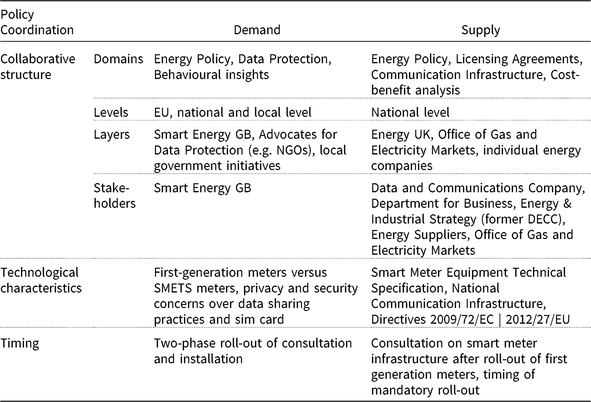
In short, the distinction between demand and supply can give additional input on how to coordinate smart meter implementation and differentiate among demand- and supply-driven issues. Government can thus raise more pointed questions as to whether it is a lack of trust that prevents the uptake of smart meters or the development of the technology itself, such as the IHDs.
Concluding remarks
The article maps the coordination structure of UK smart meter implementation by looking at the demand and supply dimensions to find obstacles for slow diffusion of the technology. Thereby, the UK serves as a case study for more general insights into European smart meter deployment, aiming to answer the question of how policy coordination structures of demand and supply affect implementation. The findings show that energy company supply and consumer adoption of smart meters raise separate challenges for policy coordination that are linked when it comes to updating communication or data standards.
Compared to other EU countries, these insights highlight that government needs to systematically address demand and supply obstacles in a comprehensive manner rather than dealing with some of the issues separately and consecutively. This can lead to incoherence in timing and mixed messages to consumers. In short, smart meter implementation requires addressing social acceptance of the technology as well as institutional and regulatory barriers. In fact, leading countries like Finland and Sweden have adopted more comprehensive policies for smart meter implementation, whereas laggards, such as Germany or The Netherlands, have not (Zhou and Brown Reference Zhou and Brown2017). By applying a policy coordination approach, the article is further able to highlight the different dimensions of smart meter implementation, which are portrayed as supply- and demand-side, and in more detail, the collaborative structure, technological characteristics and timing.
Taken together, this perspective reveals the complexity inherent to smart meter implementation and points towards future research questions. The UK case illustrates that coordination requires the alignment of several initiatives linked to smart meters. This raises the question of what kind of policy instrument mix is necessary to stimulate technology development, deployment and uptake by consumers. Specifically, how disruptive is a new technology to existing instruments and how timely government can coordinate implementation. Linked to this is the question of whether some countries emphasise one perspective over the other in implementation. For example, a focus on the market structure for innovative technology, but less on the social acceptance or the other way around and how that affects implementation speed down the line. Finally, if comprehensive steps are taken, how flexible the interconnected aspects are in adjusting to updated requirements, such as data protection or a new technology.
Author ORCIDs
Sarah Giest, 0000-0001-8201-6943
Acknowledgements
This article has benefited greatly from input by Dr. Elena Zukauskaite on innovation systems as well as from discussions with colleagues at the Institute of Public Administration. An earlier version of the manuscript was presented at EGPA 2016 in the e-government panel where valuable insights were given by participants for the theoretical section of the article.
Data Availability Statement
This study does not employ statistical methods and no replication materials are available.