1. Introduction
Einstein's name and fame occupy an almost unique place in the history of science. So much has been written about him and yet the fascination with his personal life and thought continues to this day.Footnote 1 Many standard biographies have stressed the heroic dimensions of his life, thereby reinforcing the prevailing image of him as a solitary genius and outspoken humanist. Given the natural tendency to accentuate the profundity of his novel ideas, such books are likely to leave the impression that the lavish attention accorded Einstein during his lifetime was merely his just due, the natural reaction of the public and mass media to the twentieth century's “new Copernicus.”Footnote 2 Yet Einstein's fame had many layers that accrued over a lifetime during which images of him varied both in time as well as within their respective cultural-political settings.
During the early 1920s, curiosity about his ideas, opinions, and personal habits created a marketplace for journalists and would-be science experts. Relativity had become a buzzword in popular culture, particularly in war-weary Germany where Einstein's unconventional political views and outspoken internationalist outlook made him a controversial figure. His theory of relativity thus carried extra-scientific associations that attracted some, repelled others, and generally polarized public opinion. Consequently, Einstein's name tended to trigger predictable political responses among the educated classes: he was either acclaimed as the inventor and supreme authority of a remarkable new theory of the cosmos or reviled as the leader of an iconoclastic scientific trend that everyone seemed to be talking about, but few really understood. His own reaction to this dramatic turn of events has often been described, but seldom scrutinized.Footnote 3
Initially, Einstein expressed puzzlement over his own worldly fame. At a dinner party in March 1922, he confessed to Count Harry Kessler that he could not comprehend why people were so intrigued by his theory of relativity: “When Copernicus dethroned the earth from its position at the focal point of creation, the excitement was understandable because a revolution in all man's ideas really did occur” (Kessler Reference Kessler1999, 157). Yet nothing remotely similar could be said about relativity. This theory, Einstein went on, “harmonizes with every possible outlook of philosophy and does not interfere with being an idealist or materialist, pragmatist or whatever else one likes” (ibid.). By around this time Einstein and his new wife, Elsa, were beginning to grow accustomed to his life as an exotic star within the galaxy of Weimar-era culture. Having returned to Berlin after his triumphal tour of the United States and England, he was now preparing to visit France in order to help improve relations between French and German scholars. As a proven diplomatic asset, he gained the support of Foreign Minister Walther Rathenau to undertake this journey (Rowe and Schulmann Reference Rowe and Schulmann2007, 95).
Yet despite such signs of public acclaim, Einstein still had deep misgivings when it came to stepping into the limelight. In fact, Elsa Einstein confided to Count Kessler that her husband sometimes “felt like a cheat, a confidence trickster who was failing to give [his admirers] whatever they hoped for” (Kessler Reference Kessler1999, 155). These remarks from 1922 reflect the burden of fame that was already weighing heavily on Einstein's personal life. Neither gregarious nor worldly, he was by temperament not well suited to play the part of a celebrity. Still, he accepted his status as a living legend and spent the final thirty-five years of his life in and out of the public eye. During much of this time he and his admirers helped shape standard images of the great physicist as part of an endeavor aimed at illuminating the man and his work. More recent accounts, however, have begun to analyze how Einstein's celebrity and notoriety were both heavily conditioned by social-psychological, cultural, and political currents that transformed him into a kind of cult figure (see Levenson Reference Levenson2003, 218–229; Goenner Reference Goenner2005; Hagner Reference Hagner2005; and Rowe Reference Rowe and Hendricks2006).
In this essay, I begin by reviewing some salient features of the biographical literature covering a period of over 70 years. Even a cursory synopsis of this work serves to establish a clear line of demarcation around the mid 1980s. Authors who wrote during the earlier period invariably paid homage to their subject, whereas many who took up their pens in the 1990s saw Einstein in a far more critical light. For present purposes, I focus on the singular importance of Einstein's own autobiographical essay from 1949, not only for what it tells us about its author, but also because of the way this thinly drawn self-portrait reinforced certain standard myths that have long pervaded Einstein scholarship. After this, I turn to examine some of the major forces and specific events that contributed to Einstein's early fame, both before and after his “canonization” by the English scientific community on 6 November 1919. This post-war period, I shall argue, holds the key to understanding his emergence as the twentieth century's great scientific sage.
In the tumultuous atmosphere of Weimar-era Berlin, politics and science became thickly entangled in unsuspected ways that forced Einstein to act and react when his instincts told him to withdraw to his “temple of science.”Footnote 4 By focusing closely on the portrayal of Einstein's theory of relativity in the contemporary scientific literature as well as in the popular press, we can better appreciate how relativity and its creator exerted a polarizing effect on public opinion in Germany. Much of the publicity that accompanied Einstein's rise to fame smacked of sensationalism. Journalists quickly discovered that the creator of relativity was an affable, fascinating, and above all, photogenic subject. Here was a German-Swiss Jew who combined scientific genius with outspoken views on matters far beyond his field of expertise.Footnote 5 In the era that saw the birth of photo-journalism, media moguls were quick to seize on the theme of a new scientific age symbolized by a brave new hero, thereby creating the first mass-marketed images of the celebrated Professor Einstein. Some form of backlash was well-nigh inevitable, but as it happened the situation quickly turned ugly and nearly led to an open scandal.
In August 1920 a handful of Einstein's opponents in the anti-relativist camp, some of whom had expressed longstanding scientific objections to the theory, decided to join forces with anti-Semitic elements to promote a decidedly political agenda. Einstein's claim to fame, they contended, was merely a fabrication of the “Jewish press,” part of a sinister plot to delude the German public. Although the heyday of this anti-relativist activity was brief, it left lasting scars both on Einstein as well as on the German physics community (see Beyerchen Reference Beyerchen1977). Thenceforth Einstein would forever be identified with an intellectual movement that sharply divided public opinion, particularly within Germany.Footnote 6 The relativity revolution, and the ensuing events that transpired during the early 1920s, not only affected his sense of personal identity but also the way in which he and his ideas would be perceived by others.
A striking reflection of this can be found in the pages of the biography written by a close personal associate, Rudolf Kayser, who was married to Einstein's older step-daughter and former secretary, Ilse Einstein née Löwenthal. As an editor of Neue Rundschau, Kayser was a well-known authority on European literature in Weimar Germany. Both he and Einstein shared a deep pride in the intellectual achievements of the German Jews, an emotional bond soon overshadowed by worries that their world was coming to a tragic end. Einstein's inner retreat began even before Hitler came to power, a shift that reflected not only the desperate state of the Weimar Republic but also his own slipping hopes for a democratic European political order. His bitterness in the wake of Nazi triumphs, the return to war, and the annihilation of European Jewry cast a dark shadow over the remaining years of his life.
2. Einstein as Seen by Others
Speaking at a memorial ceremony in 1965, J. Robert Oppenheimer began by alluding to the Einstein legend: “I thought that it might be useful, because I am sure that it is not too soon—and for our generation perhaps almost too late—to start to dispel the clouds of myth and to see the great mountain peak that these clouds hide. As always, the myth has its charms; but the truth is far more beautiful” (Oppenheimer Reference Oppenheimer and French1979, 44). The elderly Oppenheimer meant to speak about the Einstein he had known, the sage who left Europe forever after the Nazis came to power, choosing to weather the ensuing storm in the quiet environs of Princeton.Footnote 7 For most Americans, this famous Dr. Einstein was an eccentric, ivory-tower genius with a wacky sense of humor; yet insiders, like Oppie, knew him to be a deeply serious person who was constantly thinking about everything around him, including life's deepest problems. Behind the familiar face and unkempt hairdo lurked a keen, critical, and above all inquisitive mind. To his Swiss biographer Carl Seelig, a man whom he admired but never met, Einstein once wrote: “I have no special talents. I am only passionately curious” (Einstein to Seelig, 11 March 1952).Footnote 8 Oppenheimer confirmed that attribute, noting that he seemed to have a childlike ability to wonder about simple things, an intellectual innocence and naiveté.
Einstein speculated about all facets of life, not just physical phenomena, yet he wanted to be remembered for his fundamental contributions to physics; these alone, and nothing else. By the time he took up permanent residence in the United States, this now familiar image of Einstein as “philosopher-scientist” already loomed large in his own mind. In 1935 he told a Princeton cub reporter: “my life is a simple thing that would interest no one” (Calaprice Reference Calaprice2000, 13). All that mattered, in Einstein's opinion, could be summed up in a few key thoughts and the inspiration that led to them. Those visionary moments were what gave meaning to his life, sustaining his faith in what he called cosmic religion.Footnote 9 In “The World as I See It,” one of his best-known collections of writings, he revealed what this meant to him: “The most beautiful feeling we can experience is the sense of mystery. This is the fundamental emotion that stands at the cradle of true art and science. Whoever does not know it and can no longer wonder, can no longer marvel, is as good as dead” (Einstein Reference Einstein2001, 12).
Yet Einstein struck a very different note in 1952 when he first advised Carl Seelig about some key circumstances that had shaped his early life (Einstein to Seelig, 25 February 1952). He recalled how, as a boy, he gained inspiration from reading Ludwig Büchner's Kraft und Stoff (Seelig had edited the literary works of Georg Büchner, Ludwig's brother). Those vital formative years, he added, had been largely neglected by his friend Philipp Frank, whose biography (Frank Reference Frank1949) Einstein had, in fact, authorized.Footnote 10 Indeed, Frank's was the only account of his life he considered generally reliable. Taking direct aim at the unauthorized biography (Marianoff and Palma Reference Marianoff and Palma1944), co-authored by Margot Einstein's husband of short duration, Dimitri Marianoff, Einstein wrote that it mixed together “many factual untruths with sentimental blather.” Recounting the hardships he faced after graduating from the Zürich Polytechnic, he underscored to Seelig that anti-Semitism had not been a factor; he further recommended that Seelig make use of the recent Festschrift (Schilpp Reference Schilpp1949) containing his autobiographical essay (Einstein Reference Einstein1949). Delighted with this response, Seelig dutifully pored over Einstein's text, making heavy use of its contents, as he later freely acknowledged (Seelig Reference Seelig1952, 243).
This exchange, which marks the beginning of an uninterrupted correspondence that would last until shortly before the physicist's death, reveals an Einstein hardly indifferent to his legacy, if not his contemporary fame. Later that year, Seelig received a handwritten letter of thanks for his freshly printed book, Einstein und die Schweiz (Seelig Reference Seelig1952). Einstein's letter began: “I have otherwise always been determined to read nothing written about my person—the simplest means under the present circumstances to remain free from bias. But when a few days ago Miss Dukas [his secretary] read a few sentences to me in order to check them for accuracy, I was so fascinated that I asked her to keep reading, and so she went on for hours afterward. . . . From this documentary material you have managed to produce a truly masterful and vivid picture. I don't know which to admire more: the fine taste or the extraordinary sensitivity” (Einstein to Seelig, 2 November 1952). What he surely enjoyed most were the many testimonials Seelig had managed to extract from former friends and acquaintances, nearly all of whom related fond remembrances of their hero in his younger days.
One such living witness, the writer Max Brod, was then living in Israel. He had known Einstein during the latter's brief tenure in Prague, from 1911–1912 (Brod left the city in March 1939 on the last departing train). Seelig related how Brod and Einstein often met at the salon of Berta Fanta, where they enjoyed playing Mozart sonatas together (Seelig Reference Seelig1952, 118). Yet here, as elsewhere, Seelig's literary aspirations tended to play mischief with the documentary sources.Footnote 11 Beyond his portrayal of this music making in Fanta's home, he also hinted that Einstein had been drawn to Brod's small circle of Zionists. Led by Fanta's son-in-law, Hugo Bergmann, this group spent many hours reading heavy philosophical texts by Kant, Hegel, and Fichte until well past midnight. Brod remembered how Einstein took an active part in these discussions. “Most of the time,” Seelig wrote, “the philosophy professor Felix Weltsch was present along with the then hardly known master storyteller Franz Kafka, his friend and fellow literary aesthete, Max Brod, with his bride, as well as Philipp Frank together with his delightful wife” (ibid.). Einstein clearly admired Seelig's ability to capture such “vivid pictures,” but he also must have realized that such a contracted view ignored a well-known feature of reality (dear to historians), namely that events take place in space and time. So while it is conceivable that all those named above may have met Einstein during the course of his year in Prague, they surely never met together regularly in Berta Fanta's home, as Seelig described. Indeed, Frank, who as Einstein's successor was intimately acquainted with the cultural and political scene in Prague (described in detail in his biography of Einstein [Frank Reference Frank1949]), was teaching in Vienna at this time. He plainly states that he first came to Prague in the summer of 1912 when Einstein was already on his way back to Zürich (ibid., 145).
Frank also confirms that Einstein took no interest in Zionism during this period of his life (ibid., 150–151), leaving open to doubt whether his encounters with Jewish intellectuals in Prague had the significance Lewis Feuer later attributed to these relationships (Feuer Reference Feuer1989, xii-xvi). Indeed, much evidence has been amassed showing that Einstein's sympathies for the Zionist cause first awakened in Berlin soon after the war ended (Rowe and Schulmann Reference Rowe and Schulmann2007, 5–8, 136–155).Footnote 12 Only well after this turning point in his life did he reconnect with his former acquaintances from Prague; he then took up sporadic correspondence with several leading Zionists, including Bergmann, Weltsch, and Brod, all of whom eventually immigrated to Palestine. Whether or not he ever met Kafka, one must presume that any contact they might have had would have been only fleeting.Footnote 13 In the case of Max Brod, however, the story presents several other intriguing facets.
As the author of historical novels, Brod thought about retelling a dramatic story that had taken place in Prague some three centuries earlier. Set in the golden age of Rudolf II, the Holy Roman Emperor who became famous for his generous patronage of the arts, this tale concerned two famous astronomers whose lives became curiously entangled with profound consequences for European science. Shortly after arriving in Prague, the emperor's court astronomer, Tycho Brahe, hired a new assistant, a genial young man from Württemberg named Johannes Kepler. Their encounter sets the scene for Brod's novel, Tychos Brahes Weg zu Gott, in which a major turning point for the Copernican revolution finds expression in the clash between these famous historical figures, portrayed by Brod as two powerful, totally antithetical personalities.
Philipp Frank recalled the reaction in Prague after the book's publication in 1915, when rumors went round that Brod's Kepler was modelled on another well-known Swabian physicist named Albert Einstein (Frank Reference Frank1949, 151).Footnote 14 Frank, too, found this parallelism convincing, so much so that he allowed this fictitious figure to enter his own biography of Einstein. Bowing to Brod's artistic authority, he momentarily stepped aside as author, acknowledging that “the words of a poet are more impressive than the descriptions of a scientist” (ibid., 152). He then proceeded to cite lengthy passages from Brod's novel for the light they shed on how other scientists stood in awe of Einstein's genius. For Brahe, in the presence of Kepler, the reaction was much the same:
Thus the storm raged in Tycho's spirit. He took the greatest pains to keep his feelings for Kepler free from alloy. In actual fact he really did not envy Kepler his success. At the very most, the self-evident and in all respects becoming and worthy manner in which Kepler had achieved renown sometimes excited in him an emotion bordering on envy. But in general Kepler now inspired in him a feeling of awe. The tranquillity with which he applied himself to his labors and entirely ignored the warblings of flatterers was to Tycho almost superhuman. There was something incomprehensible in its absence of emotion, like a breath from a distant region of ice. He recalled that popular ballad in which a Landsknecht had sold his heart to the Devil and had received in exchange a bullet-proof coat of mail. Of such sort was Kepler. He had no heart and therefore nothing to fear from the world. He was not capable of emotion or of love. And for that reason he was naturally also secure against the aberration of feelings. (Ibid.)
This mid-century fascination with Einstein's person clearly reflected an era in which his presence was still deeply felt. Today, more than fifty years after his death, few who knew him personally remain among the living. Nevertheless, the last thirty years have witnessed a growing interest in both the man as well as his contributions to the theory of relativity. This may seem ironic given the extensive Einstein literature in print by 1979, the centennial of his birth. Yet with the exception of Ronald Clark's Einstein, the Life and Times (Clark Reference Clark1971), the early Einstein biographies were nearly all popular accounts written by friends and acquaintances (Moszkowski Reference Moszkowski1921; Reiser Reference Reiser1930; Reichinstein Reference Reichinstein1932; Vallentin Reference Vallentin1954; Seelig Reference Seelig1960; Hoffmann Reference Hoffmann1972).Footnote 15 These early portraits rarely delve deeply into his scientific work. They did much, however, to reinforce the personality cult that saw him as a saintly, lovable genius during the last thirty-five years of his life. Personal recollections of Einstein flooded the market for decades, leading John Stachel to observe in 1982 that “perhaps the most widespread myth about Einstein is that he was born old. His name calls to mind a white-haired, saintly figure, well advanced in years” (Stachel Reference Stachel2002, 3).Footnote 16 Hero worship often leads to hagiography, and yet how could it be otherwise with Einstein? Almost no one who knew him escaped the spell of his personality, not even the oft-irreverent Oppenheimer, who thought Einstein's quest for a unified field theory nothing more than a quixotic misadventure.
With respect to his scientific achievements, the genre of Einstein biography took a giant leap forward in 1982 with Abraham Pais's ‘Subtle is the Lord. . .’ (Pais Reference Pais1982), still today the most comprehensive account of his work. Like most earlier biographers, Pais knew Einstein personally and his book reflects the deep reverence in which he held him. In the American public imagination, Einstein was genius incarnate: the greatest scientist of his (or perhaps any) time. In all likelihood, Pais, who knew his scientific work like few others, would have agreed. Yet, for him, Einstein was much more: “He was . . . a highly gifted stylist of the German language, a lover of music, a student of philosophy. He was deeply concerned about the human condition. . . . He was a husband, a father, a stepfather. He was a Jew. And he is a legend” (ibid., vii). In ‘Subtle is the Lord. . .’ Pais provided numerous glimpses of these other aspects of Einstein's non-scientific life. Rarely, however, did he place his hero in a darker light. Instead, he sustained a tone of awe and adoration throughout, so that in this respect his portrait looks like all the others written by those who had the privilege of meeting the living legend face to face.
Pais's study was the last major biography to come from the circle of Einstein's personal acquaintances (his popular account, Einstein Lived Here (Pais Reference Pais1994), is little more than a collection of anecdotes). A similarly reverential quality also pervades some of the more recent biographies (e.g., Sayen Reference Sayen1985), to be sure, yet with the publication of the first two volumes of the Collected Papers of Albert Einstein (CPAE)Footnote 17 in the late 1980s a new wave of scholarly studies began. Since then the Einstein Papers Project has brought forth a wealth of new source material which helped spawn numerous books and articles as well as the series Einstein Studies. Persistent efforts on the part of Robert Schulmann eventually led to the recovery of 54 letters exchanged by Einstein and Mileva Marić, the woman who became his first wife and bore his two children. As Martin Klein put it, this collection of letters introduced us “to an Einstein we had not previously known,” a bright young man who expresses “his feelings about [Mileva], his family, and himself, and his thoughts about the life he sees around him and the life he wants to live with her” (Renn and Schulmann Reference Renn, Schulmann and Smith1992, ix). Only the scientific part of those early dreams was realized, however, raising numerous questions about the young Einstein and his personal odyssey.
By the early 1990s, the prolonged era of naïve hero worship had come to an abrupt end. Several more recent studies of Einstein's life have exposed sides of his character that he and his intimates had long kept out of the public eye. Perhaps the most irreverent of all the Einstein biographies appeared soon thereafter. The Private Lives of Albert Einstein (Highfield and Carter Reference Highfield and Carter1993) was aptly described by a cover blurb as “a hand grenade lobbed into the sacred temple.” Around the same time, Albrecht Fölsing published Albert Einstein: eine Biographie (Fölsing Reference Fölsing1993), a wide-ranging, critical and yet convincing portrait that captures the full panorama of Einstein's public and private lives.Footnote 18 Denis Brian's Einstein: A Life (Brian Reference Brian1996) accents his years in America, particularly his Princeton ties. More recently, Dennis Overbye has written an engaging book (Overbye Reference Overbye2000) about the “scientific romance” that brought Einstein and Mileva Marić together, and Thomas Levenson has portrayed his middle years against the background of Weimar era Berlin (Levenson Reference Levenson2003). Among other more recent biographical portraits, Jürgen Neffe offers a grandiose narrative (Neffe Reference Neffe2005) that leaves no stone unturned, whereas Hubert Goenner vividly weaves together a series of episodes that convey some of the more subtle contours in Einstein's life (Goenner Reference Goenner2005). Walter Isaacson's best-selling popular biography (Isaacson Reference Isaacson2007) takes advantage of much recent scholarship, yet largely overlooks the European ties that helped sustain him during his last years in the United States. Without this niche of friends – many of whom were, like him, Jews living in exile – he would have found life as an American citizen far less bearable. Like Neffe's book, but even more so, Isaacson's demonstrates how continued fascination with Einstein's life among the general public has become a cash cow for journalists. None of these more recent biographies, however, analyzes Einstein's work to the same extent as did Pais in ‘Subtle is the Lord. . .’, which remains the definitive scientific portrait, even though parts of it have now been superseded, in particular the complex story of the emergence of general relativity.Footnote 19
The transition from hero worship to critical reassessments of Einstein's life was preceded by some acrimonious infighting between the editors of the CPAE and the trustees of his estate.Footnote 20 As Roger Highfield and Paul Carter describe, two figures played a pivotal role as “keepers of the flame” after Einstein's death: Helen Dukas and Otto Nathan (Highfield and Carter Reference Highfield and Carter1993, 273–283). Both did their best to maintain Einstein's saintly image by blocking access to documents relating to his personal life while offering “glimpses from his archives” (Nathan and Norden Reference Nathan and Norden1960; Hoffmann and Dukas Reference Hoffmann and Dukas1979). Their actions, however, accorded completely with Einstein's own cherished desire for privacy once he became a public figure. Indeed, by 1930 he had already begun to take an active part in compartmentalizing the scientific, humanistic, and private parts of his life.Footnote 21 It thus behooves us to examine his role as a principal architect of the Einstein legend.
3. Einstein's Temple: the Myth of Solitary Genius
In the late 1940s, Einstein was approached by the philosopher Paul Schilpp, who coaxed him into writing the autobiographical sketch that the physicist dubbed his “own obituary.” It appeared as the crown jewel in the Festschrift entitled Albert Einstein: Philosopher-Scientist (Schilpp Reference Schilpp1949). Schilpp was naturally ecstatic about having obtained this contribution for his volume: “Everybody who knows Professor Einstein personally is all too well aware of his extreme shyness and his honest forthright humility.” Schilpp went on to say that had it not been for the unique nature of the volume (in which Einstein responded to the contributions by other authors), “I do not believe that there would have been one chance in ten thousand that the world would ever have secured an autobiography from the hand of Professor Einstein” (ibid., x). In fact, the famous physicist had been reciting at least parts of this story for some time and was probably grateful for the opportunity to put it into definitive form.Footnote 22
For an alleged autobiography, Einstein's “obituary” is remarkably impersonal, an effect created by the way he identifies his life with the development of theoretical physics after the turn of the century. Thus, while reminiscing about important scientific matters, he offers only scattered remarks about the people and events of his life. Einstein adopts a reference frame here that lends his narrative a transcendent quality, at once heroic, detached, and cosmic, the only exception being when he writes about his childhood and youth. For this innocent phase of his life he recounts a few vivid episodes that serve to illustrate his central theme: the role of pure thought in scientific investigations.Footnote 23 His intellectual journey thus began in a “kaleidoscope of particular situations” until his “major interest gradually disengaged itself to a considerable degree from the momentary and merely personal and turned to a striving to grasp things mentally.” Einstein saw these largely unconscious thought processes as the source of a creative struggle to understand the world at a stage prior to mature scientific thinking. This struggle, however, proceeds from an almost mystic sense of wonderment which, he writes, “seems to occur when an experience comes into conflict with a world of concepts . . . already sufficiently fixed within us. Whenever such a conflict is experienced hard and intensively it reacts upon our world of thought in a decisive way. The development of our thought world is, in a certain sense, a continuous flight from this ‘wonderment’” (Einstein Reference Einstein1949, 9).
These “psychoanalytical” musings set the tone for Einstein's autobiography, in which he confides that “the essential in the being of a man of my type lies precisely in what he thinks and how he thinks, not in what he does or suffers” (ibid., 33). What he describes as essential about his own style as a thinker, however, suggests a very narrow picture of his scientific activity. Indeed, his reflections on the preconditions for conceptual thought and the possibility of communicating ideas through language seem to take the latter for granted. For a “man of his type” social discourse on scientific matters may have been beneficial, but it was hardly the essential thing. Thus what Einstein conveys to us about his life is that the problems he struggled with were ones he essentially faced alone. Indeed, his “obituary” is remarkably devoid of references to those with whom he talked and corresponded regularly during his creative years: Michele Besso, Paul Ehrenfest, Marcel Grossmann, et al.Footnote 24 Instead, Einstein acknowledges his intellectual debt to famous forbears by acknowledging the importance of the ideas of Ernst Mach as well as the contributions of Faraday, Maxwell, Hertz, Lorentz, Planck, and numerous others. Indeed, the whole thrust of his narrative lends support to a central myth he hereby helped to construct: our image of Einstein as a lonely genius, struggling heroically in his study to solve the problems that his great forbears had bequeathed him.Footnote 25
This image squares perfectly with standard accounts of the young Einstein: we picture him brooding at his desk in the Bern Patent Office, quietly hatching the revolutionary ideas that he would eventually unveil in his famous 1905 paper “On the Electrodynamics of Moving Bodies” (Einstein Reference Einstein1905r). Biographers have often emphasized that this paper contains not a single reference to the published literature; instead, Einstein ended it with a cryptic word of thanks to his friend and colleague M. Besso for offering “several valuable suggestions.” Yet in Subtle is the Lord, Pais identified no fewer than thirty-one physicists and mathematicians who collaborated with Einstein, many of them all but forgotten today. Is it really credible to imagine that none contributed anything of significance to his work? Clearly, he did share his early ideas on relativity with his fellow student, lover, and later adoring wife, Mileva Marić (Renn and Schulmann Reference Renn, Schulmann and Smith1992), though her active role remains shrouded in mystery. Without doubt, the year 1905 represents a true watershed, yet Einstein's bold new approach to the principle of relativity was only part of the story; his concurrent paper on the quantum nature of light represented a far more radical departure from classical physics. So while his insights were clearly of fundamental importance, the emergence and reception of relativity theory also depended heavily on the contributions of figures like Lorentz, Poincaré, Minkowski, and Laue.Footnote 26
Nor should we imagine that the birth of relativity in 1905 was simply Einstein's triumphant insight into a deeper truth about physical reality that evaded all his older rivals (see Staley Reference Staley2008). When he made his move, he was not merely performing a gestalt-switch that established a new paradigm, while Lorentz, who still clung to a motionless ether hovering in absolute space, lost out due to his antiquated worldview. As Olivier Darrigol points out in Electrodynamics from Ampère to Einstein (Darrigol Reference Darrigol2000), nearly all the novel features in Einstein's 1905 paper had been anticipated by others. Moreover, those who were persuaded by Einstein's “Electrodynamics of Moving Bodies” regarded it primarily as a brilliant new approach to Lorentz's electron theory. Indeed, this was how one of Einstein's staunchest supporters, Max von Laue, presented relativity to the German physics community, and even Einstein had great respect for Laue's authoritative work (see Rowe Reference Rowe2008b).
The young Einstein was a genius, but hardly a lonely one; practically everywhere he went he was surrounded by others who shared at least some of his intellectual interests. After joining the faculty at the ETH, Einstein regularly attended the Zurich Colloquium, where he stood at the center of a diverse and talented group of 15 to 20 individuals. Boris Yavelov characterized them as follows:
Their ages ranged from twenty to sixty, though most of the group fell between twenty-five and thirty-five. The absence of those whom young Russian physicists used to call “generals” was conspicuous. There were no scientists who felt at home on the academic-administrative Olympus, who took their real service to science to be a state service and who bowed to the ossified academic hierarchy. All this was absent from the Zurich colloquium. It seems that the contrary was true: the circle professed non-conformism, democratic scientific and social views, open skepticism toward the “generals,” and indifference to ranks and honors. (Yavelov Reference Yavelov, Balashov and Vizgin2002, 267)Footnote 27
In Berlin, Einstein moved in a very different milieu, one that was dominated by several such “generals” and other high-ranking officers of Germany's scientific elite. Politically, he was decidedly to the left of his colleagues, yet throughout the Weimar years he remained on excellent terms with most of them, including Planck, Laue, Haber, Nernst, and Warburg. He regularly attended Heinrich Ruben's physics colloquium as well as meetings of the Berlin Academy, which published 47 of his papers between 1914 and 1932. Einstein was never a loner in Berlin, even when he was working at home in his turret study or relaxing at his vacation house outside the city in Caputh. Rudolf Kayser, who wrote under the pseudonym Anton Reiser, spent a good deal of time watching him in both places. Kayser observed that he was:
productive not only at [his] desk but above all in . . . conversation. When he is occupied with new problems, he finds it necessary to speak of them. And if he has been successful in his work and secured his results, his chosen form of communication is not the printed word, but discussion in the circle of his colleagues. (Reiser Reference Reiser1930, 117)
Alongside the distorted image of Einstein as a loner lies the myth that he was a man totally indifferent to his unique status and fame. While this may be an apt description of the elderly Einstein, it certainly does not apply to the ambitious and still fairly young physicist who joined the Berlin Academy in 1914. Nor was it true of the Einstein who stepped onto the world stage in November 1919. Granted, he always had an otherworldly side and even hated most forms of public adulation; that does not mean that he was “shy and humble” as Schilpp wrote and many others believed. If he cared little about the esteem of ordinary mortals this was largely because he saw himself as belonging to a tiny elite.
One finds intimations of this, for example, in “The World as I See It,” where he subscribes to the glorification of genius so typical in German academic circles:Footnote 28 “The really valuable thing in the pageant of human life seems to me . . . the creative, sentient individual, the personality; it alone creates the noble and the sublime, while the herd as such remains dull in thought and dull in feeling” (Einstein Reference Einstein2001, 12).Footnote 29 For Einstein, only a special elect truly worshiped in the “temple of science,” and he was proud to belong to that privileged group.Footnote 30 This was the worldview he shared with Max Planck of whom he wrote that his
longing to behold [Leibnizian] pre-established harmony is the source of the inexhaustible patience and perseverance with which Planck has devoted himself. . . to the most general problems of our science. . . The state of mind that enables him to do work of that kind is akin to that of the religious worshiper or the lover; the daily effort comes from no deliberate intention or program but rather from immediate necessity. (CPAE 7, Doc. 7)
Leaving religiosity aside, the language Einstein uses here evokes the familiar image of the immortals of science. Of course he never referred to himself in such a way, but several others close to him did, and without engendering anything like a protest from his lips. Judging from this, it seems Einstein was no more humble about his success than his great predecessor, Isaac Newton, who once asked posterity to believe that he had merely stood on the shoulders of giants. Even in Einstein's day, Newton stood at the apex of immortals within the temple of science. No one could easily have imagined another taking his place, certainly not Einstein, whose general theory of relativity caused barely a stir among physicists when he first unveiled a preliminary version of it in 1913.Footnote 31 Six years later, all that changed.
4. British Adulation
Einstein's initial ascent to stardom came about suddenly and almost by happenstance. Or, one might say it resulted from an unlikely set of circumstances that fortuitously converged, culminating in a spectacular space-time event. This occurred one day in early November 1919 when the British scientific community announced the results from two eclipse expeditions that sought to test a striking prediction of the general theory of relativity. Einstein had claimed since 1911 that a light ray passing near the surface of the sun will be slightly deflected by the solar gravitational field. It took eight long years, however, before this conjecture could be put to a test. The solar eclipse of 29 May 1919 provided an excellent opportunity, owing to the rich field of bright stars in the background (part of the Hyades) that could serve as a system of reference points.
Sir Frank Dyson, then Royal Astronomer at Greenwich, already began laying out plans to measure this tiny effect in 1917. Despite the wartime blockade and increasingly hostile scientific relations, Die Naturwissenschaften informed the German community about the British project in a detailed report written by the Potsdam astronomer Otto Birck (Birck Reference Birck1917). This described how one team of astronomers would be sent to Sobral in northern Brazil, whereas a second, headed by Arthur Eddington, would set up a temporary observatory on the Island of Principe off the coast of Western Africa. Five months after the eclipse sightings and amid much hoopla, Eddington and Crommelin presented their long-anticipated findings at a joint meeting of the London Royal Society and the Royal Astronomical Society on November 6, 1919. Following considerable discussion – for the data from Sobral was by no means consistent with that obtained at Principe – the experts decided it was high time to dethrone Newton and crown Einstein, or so at least was the impression conveyed in the press reports that followed.Footnote 32 As the British physicists performed the rites of “beatification and canonization” (Pais Reference Pais1982, 305), the English and American newspapers trumpeted the news in banner headlines: “Revolution in Science/ New Theory of the Universe / Newtonian Ideas Overthrown” (London Times, 7 November 1919) and “The Lights of the Heavens Askew” (New York Times, 10 November 1919).
News crossed the English Channel quickly, though the reaction in the German press was far more subdued. Still, Robert W. Lawson, a physicist at the Sheffield Institute of Technology, conveyed the sense of excitement in England to Arnold Berliner, editor of Die Naturwissenschaften:Footnote 33
Here the talk is practically of nothing but Einstein, and if he came over now I believe he would be celebrated like a victorious general. The fact that the theory of a German was confirmed by observations made by Englishmen has, as is becoming more obvious every day, brought the possibility of cooperation between these nations a lot nearer. Thus Einstein, quite apart from the high scientific value of his inspired theory, has done an inestimable service to humanity. (Nathan and Norden Reference Nathan and Norden1960, 27–29)
Lawson had been detained in Austria during the war, an experience that only served to strengthen his faith that scientific relations knew no national boundaries. He also helped promote Einstein's work in the English-speaking world by preparing English translations of his popular writings.Footnote 34
Einstein was anything but indifferent to the political opportunities afforded by these circumstances (Clarke Reference Clark1971, 296–298). Just before he learned of Lawson's letter from Berliner, he was approached by The Times (London) to write a brief popular account of the leading ideas behind his theory. He replied with a tactful article published under the title “Time, Space, and Gravitation” (Einstein Reference Einstein1919f) that began as follows:Footnote 35
I respond with pleasure to your Correspondent's request that I should write something for The Times on the Theory of Relativity. After the lamentable breach in the former international relations existing among men of science, it is with joy and gratefulness that I accept this opportunity of communication with English astronomers and physicists. It was in accordance with the high and proud tradition of English science that English scientific men should have given their time and labour, and that English institutions should have provided the material means, to test a theory that had been completed and published in the country of their enemies in the midst of war. (Einstein Reference Einstein1919f, 213)
This expression of gratitude was surely appreciated, but Einstein also knew that his reputation as a revolutionary thinker had caused a serious public relations problem. Furthermore, not everyone in tradition-conscious England was happy to hear that the great Newton's ideas had been overthrown. Some were even more dismayed to read that hardly any of the country's leading scientists fully comprehended Einstein's theory. It seemed high time that someone explained what the fuss was all about. Einstein was forewarned of this state of affairs by Frederick A. Lindemann, head of the Clarendon Laboratory, who informed him that “national feeling was wounded and the world moved to a state of alarm” by the reports on relativity in The Times.Footnote 36 Knowing this, Einstein did his best to find soothing words that might ease the minds of those concerned about the “downfall of Newton”:
No one must think that Newton's great creation can be overthrown in any real sense by this or any other theory. His clear and wide ideas will forever retain their significance as the foundation on which our modern conceptions of physics have been built. (Einstein Reference Einstein1919f, 214)
Even that brief homage to Newton's immortality was apparently not enough for The Times, however. For Einstein's article was immediately followed by a short notice entitled “Professor Eddington on Newton's Foresight,” in which Britain's leading relativist seemed to suggest that Sir Isaac had actually anticipated Einstein's result! An astute reporter found a quotation by Eddington that called attention to Query 1 in Newton's Opticks speculating that light should have weight. The bending of light was therefore consistent with Newtonian gravitational theory, leading Eddington to conclude that “were Newton alive he would be congratulating himself on his foresight” (Addendum to Einstein Reference Einstein1919f, in CPAE 7, 214). Perhaps the reporter who filed this story overlooked the original article in The Times from 7 November, which carried the subheading “Space Warped,” a prediction Eddington obviously did not attribute to Newton.
Aside from the difficulties he faced in explaining the gist of relativity to a lay audience, Einstein had to confront a less familiar problem. In a short note that appeared in The Times on 8 November, he was described as a Swiss Jew and ardent Zionist who favored the November Revolution. This report tossed Einstein's personal identity into the “relativity ruckus,” placing him in an awkward position, particularly with regard to the Jewish question which was then very much on his mind (Rowe and Schulmann Reference Rowe and Schulmann2007, chap. 3). In 1919, he had attached his name to a public appeal of support for the newly founded German Democratic Party, an organization whose fortunes were closely tied with those of Germany's established or upwardly mobile Jews. Late that year he wrote Paul Ehrenfest: “here [in Berlin] there is strong anti-Semitism and savage reaction, at least among the ‘cultivated’” (Einstein to Ehrenfest, 4 December 1919, CPAE 9, Doc. 189). This exposure to anti-Semitism helped push him toward the camp of the Zionists. He became sensitized to the plight of the eastern European Jews – his beleaguered kinsmen (Stammesgenossen) as he called them – and became increasingly critical of the well-heeled Berlin Jews who ignored or even despised their poor eastern brethren. At the same time he threw his name behind the ongoing plans to found a new university in Jerusalem.Footnote 37 To Besso he wrote: “I believe that this enterprise deserves keen support . . . my name, with its high currency after the English solar eclipse expedition, may be useful to the cause by encouraging lukewarm kinsmen” (Einstein to Besso, 12 December 1919, CPAE 9, Doc. 207).
All these swirling political issues were on Einstein's mind, but it would have been neither appropriate nor possible to sort such matters out for English readers. Still, he did not wish to ignore them altogether. So in his article for The Times he called the paper's characterization of him “an amusing feat of imagination on the part of the writer.” Preferring to play along with the author's description rather than bothering to clarify the record, he added his own little twist. “By an application of the theory of relativity to the taste of readers, to-day in Germany I am called a German man of science, and in England I am represented as a Swiss Jew. If I come to be regarded as a bête noire, the description will be reversed, and I shall become a Swiss Jew for the Germans and a German man of science for the English!” (Einstein Reference Einstein1919f, 214). This little joke was widely reported, but presumably many in Germany did not find it particularly amusing.Footnote 38 Einstein had largely kept his political views under wraps prior to November 1918, but afterward these had become increasingly visible, especially in Berlin. Reports of his statements in the Times were carried in German and other foreign newspapers, and Einstein's sudden fame was seen by many as a fabrication of the Anglo-American popular press which seemed to have launched his public career not only as the scientific genius of his day but also as a spokesman for humanity.
As an internationalist in an era of rampant nationalist hostilities, Einstein soon emerged as a moral voice covering a wide range of issues and causes, a role certainly unprecedented for any German scientist during the Imperial era. Many in Germany detested this, accusing Einstein of pandering to the masses, but few could have pointed to other signs of triumph and public acclamation on the eve of that dreaded era during which the Versailles Treaty took effect. Just as he was lionized by his admirers, so was he vilified by his enemies, of whom he had many. As Stachel has emphasized, the mythic image of the sage who was “the beloved of all humanity” overlooks the fact that not a few hated him “as a Jew, a pacifist, a democrat and civil libertarian, a radical and a socialist” (Stachel Reference Stachel2002, 4). Some also hated him as the perpetrator of the most controversial scientific hypothesis of the day: the theory of relativity, which few comprehended, but everyone talked about all the same. In Weimar-era Germany, fame was a two-edged sword.
5. Roots of the German Anti-Relativity Movement
Well before the German public had heard of Einstein's theory, general relativity already caused a considerable stir within scientific circles. In November 1915, Einstein published four brief announcements in the proceedings of the Prussian Academy containing the now famous generally covariant field equationsFootnote 39 as well as an argument accounting for the discrepancy in the shift of Mercury's perihelion (Einstein Reference Einstein1915f, Einstein Reference Einstein1915g, Einstein Reference Einstein1915h, and Einstein Reference Einstein1915i). Soon afterward, commentators and pseudo-experts began to make small waves in popular and semi-popular scientific publications. The retired Potsdam astronomer, Wilhelm Foerster,Footnote 40 called Einstein's attention to the confusion this was beginning to create: “You would do a great service in bringing peace of mind to many qualified people if in the near future you were able to find a way of addressing the German public to counteract the anxiety of large portions of it regarding doubts about previously held basic tenets of our knowledge of the world and to allay excessive skepticism” (Foerster to Einstein, 25 March 1916, CPAE 8, Doc. 204). Foerster surmised that the popular writings and recent newspaper articles written by Max Bernhard Weinstein had contributed to this state of affairs.Footnote 41 “You would not believe,” he wrote Einstein,
how much one is pestered now by inquiries and complaints about this from the most disparate social circles. This agitation is probably connected to the almost psychopathic state of the current, widely spread sentiments among the populace. For example, some are happy that you had put an end to the global confusion caused by the Englishman Newton, etc. Surely you will find words free of scholarly jargon to introduce the German public to a sound and sober-minded interpretation of your so extremely important ideas and problems; but there really is a need for this now. (Ibid.)
Presumably Einstein had already enough first-hand experience with cranks and fawning admirers to realize the merits of Foerster's proposal. At the same time, he felt that something more substantial than a short essay was needed, as he intimated to Michele Besso three months earlier: “The great success in gravitation pleases me immensely. I am seriously contemplating writing a book in the future on special and general relativity, although as with all things supported by a fervent wish, I am having difficulty getting started. But if I do not do so, the theory will not be understood, simple as it nevertheless fundamentally is” (Einstein to Besso, 3 January 1916, CPAE 8, Doc. 178).
He managed to dash off this booklet quickly once he got started, completing the manuscript by December 1916. Already by early 1917 Einstein's Über die spezielle und die allgemeine Relativitätstheorie (Gemeinverständlich) (1917a) was in the bookstores; a year later it went into a third edition, and after the war it emerged as a best-seller within the genre of semi-popular scientific literature, reaching its fourteenth edition by 1922. Einstein's booklet was not the first such publication on relativity: a year earlier Berliner's Die Naturwissenschaften had published two articles by Erwin Freundlich which then came out in booklet form (Freundlich Reference Freundlich1916).Footnote 42 Nor was it in any sense original. Still, numerous commentators cited arguments from it, including several outspoken anti-relativists. Experts could not have missed that, as usual, Einstein only mentioned the accomplishments of others sparingly. Moreover, he took almost no notice of the relevant work undertaken by experimental physicists while highlighting the importance of ideas introduced by the mathematicians Minkowski, Gauss, and Riemann. This left many readers with the faulty impression that relativity was primarily a mathematical theory.Footnote 43
Particularly influential were Einstein's discussions of space and time measurements involving an observer on a moving train who exchanges light signals with a second observer standing on a station platform.Footnote 44 By using this intuitive artifice over and again, Einstein could convey some of the fundamental motivating ideas and conclusions of relativity theory, including the relativity of simultaneity and the link between gravitation and inertia established by the equivalence principle. He did not, however, discuss any of the more controversial thought experiments on time dilation – the space-time paradoxes involving clocks or twins who age at different rates – that had caused considerable consternation among both physicists and lay readers. Nor did he introduce any technicalities that required knowledge of higher mathematics, this in keeping with what he had written to Besso about the “fundamental simplicity” of the theory. Einstein reinforced that claim by subtitling his booklet “generally understandable” (gemeinverständlich), thereby opening the door to countless other authors who afterward created a new literary genre with books on “relativity for the masses.”Footnote 45 Thus, Einstein's booklet helped set the stage for the tumult that soon followed. While trying to enlighten the widest possible audience, he left many in a state of confusion, thereby stoking public controversies that spread along with his own fame.Footnote 46
Within German scientific circles, storm clouds were gathering as well. Around the time he received Foerster's letter, Einstein had just completed his now classic account of the foundations of general relativity (Einstein Reference Einstein1916e). This technical article was published in Annalen der Physik, the leading outlet for contributions to theoretical physics in Germany. The Annalen's co-editor, Willy Wien, soon afterward received an odd kind of rebuttal from the Berlin experimental physicist Ernst Gehrcke bearing the title “On the Critique and History of Recent Gravitational Theories” (Gehrcke Reference Gehrcke1916). An old-fashioned ether-theorist, Gehrcke had been crusading against relativity theory since 1911.Footnote 47 As early as 1912 he called “classical relativity theory” an interesting case of “mass suggestion” in physics, likening the fuss over it with the furor caused in France around the turn of the century by the “discovery” of N-rays, a bogus form of radiation heralded by researchers in Nancy.Footnote 48
It was the historical rather than the critical part of Gehrcke's Reference Gehrcke1916 paper that would arouse the most interest among anti-relativists, however. For Gehrcke called attention to an obscure publication by a Gymnasium teacher named Paul Gerber, who sought to account for the slight deviation in the movement of Mercury's perihelion by treating gravitation as a force transmitted with the speed of light (Gerber Reference Gerber1898). Although Gerber's theory of gravitation was far simpler than Einstein's, he had managed to obtain – albeit through faulty reasoning – precisely the same end result, as Gehrcke demonstrated by comparing their two formulae.Footnote 49 Since the shift in Mercury's perihelion was the only new empirical argument Einstein could offer in 1916 in support of his theory, this priority claim on behalf of Gerber was potentially devastating. But Gehrcke went even further. He boldly asserted that Einstein must have known the discussion of Gerber's publication in Mach's Mechanik (Mach Reference Mach1904, 201), since he had “demonstrated his precise knowledge of the contents of this well-known book in his recent obituary of Mach” (Gehrcke Reference Gehrcke1916, 124). Up until this time, the relentless Gehrcke had propounded the view that relativity theory was akin to a scientific hoax; with this latest rejoinder he now called the leader of the relativity movement a plagiarist (see Wazeck Reference Wazeck2009, 337–342).
Einstein felt no reason to respond to this insult after he learned from Arnold Sommerfeld that the astronomer Hugo von Seeliger had spotted a mathematical error in Gerber's paper eighteen years earlier, a mistake so obvious Seeliger had not bothered to call attention to it in print. He quickly did so in (Seeliger Reference Seeliger1917), whereupon Max von Laue followed with the physical coup de grace (Laue Reference Laue1917). Einstein might have felt vindicated had the whole affair not smacked of farce. Writing to his friend Michele Besso, he noted that Gerber's paper began with “an already adventurous potential [function]” and went on to “give an erroneous derivation of the forces” (Einstein to Besso, 6 December 1916, CPAE 10, vol. 8, Doc. 283a). Soon afterward, however, Philipp Lenard felt the time had become ripe to enter this controversy.
A Nobel laureate, Lenard was universally regarded as one of the leading experimental physicists of the day. Yet like many experimentalists, he took a dim view of theoretical work that relied on speculative hypotheses or “thought experiments,” and therefore lacked a firm empirical foundation. In a manuscript submitted to Stark's journal, Jahrbuch für Radioaktivität und Elektronik, he therefore proposed an ether-based gravitational theory as an alternative to general relativity.Footnote 50 Unlike Gehrcke's numerous writings, Lenard's published text (Lenard Reference Lenard1918) was substantive and far less polemical. His main aims were, first, to demonstrate that the principle of relativity could not be generalized to arbitrarily chosen reference frames and, second, to show that ether physics offered a more plausible approach to gravitational theory. Lenard's latter contention was largely conjectural, but he later tried to make good on it by introducing a bi-fold ether, an ad hoc construction that found few followers aside from his own students (Lenard Reference Lenard1922).Footnote 51 His first point, on the other hand, raised one of the more vulnerable foundational issues in Einstein's theory, though Lenard approached it without much sophistication (see Rowe and Schulmann Reference Rowe and Schulmann2007, chap. 2).Footnote 52
In his popular book on relativity, Einstein began his discussion of gravitational fields by means of a thought experiment involving a train car that suddenly accelerated so that the objects inside it were thrown about (Einstein Reference Einstein1917a, 42). He then proceeded to argue that the car's passengers were not entitled to conclude that these effects were due to the train's motion in an absolute sense, since inertial and gravitational effects were essentially interchangeable. Accordingly, Einstein asserted that one could simulate precisely the same physical effects in a train car by shifting the surrounding landscape – perhaps by some kind of bizarre earthquake – while the train retained its original motion in an inertial frame. This line of argument had been resisted before, even by Hendrik Antoon Lorentz (Lorentz to Einstein, 1 January 1916, CPAE 8, Doc. 177). But Lenard tried simply to cut it to the ground by arguing that Einstein's thought experiment overlooked the distinction between real and fictive physical explanations. In Lenard's view, Einstein's whole theory hung in thin air because of his insistence on maintaining the principle of relativity even for non-inertial frames; this led him to adopt counterintuitive ideas that clearly violated “sound human reason” (gesunder Menschenverstand). Initially, Lenard wrote nothing about possible plagiarism, but he did enter a strong plea that Gerber's achievement receive due credit. By coupling this message with a lengthy critique of general relativity, he clearly intended to throw his weight behind Gehrcke's efforts to discredit Einstein's whole approach. Why, after all, should physicists take his speculations about Riemannian space-time geometry seriously if the very same formula for the precession of planetary perihelia had already been derived by Gerber in a straightforward fashion?
Einstein had managed to ignore such attacks in the past, even though Arnold Berliner had been pestering him to answer his critics. Finally, in late 1918, he decided to take the latter's advice, and so he dashed off an amusing rejoinder entitled “Dialogue on Arguments against Relativity Theory” (Einstein Reference Einstein1918k). The choice of genre brings to mind Galileo's far more ambitious Dialogue Concerning the Two Chief World Systems, and presumably Einstein hoped he could convey a similar sense of playful, open-minded scientific discourse, despite his less than impartial position (Rowe Reference Rowe and Hendricks2006, 248–251). Only two interlocutors enter this mini-debate: a persistent, but fair-minded Kritikus, who queries Relativist, clearly a thinly-disguised pseudonym for the author. Einstein's decision to invent this Kritikus and then reply to him, rather than to his real critics, may well have been prompted by his desire to avoid the fanatical Gehrcke. But fanatics are not easily discouraged, and Gehrcke was only beginning to warm up to the challenge. In the meantime, political events threatened to plunge Germany into a state of chaos. As the streets of Berlin were rocked by revolutionary and counter-revolutionary activity, a fragile new political order took form in the provincial city of Weimar. It was amid this atmosphere that Einstein's revolutionary ideas about space and time burst onto the public scene, and it was against this backdrop that his enemies plotted to destroy his reputation.
6. Einstein and the German Press
The birth of the Weimar Republic brought freedom of the press to Germany, and with it came a glut of new publications.Footnote 53 Many Berlin newspapers tried to carve out a niche by espousing representative political views of some particular segment of society. German public opinion after the war was torn between the push toward modernity and the pull of past imperial glory, issues that would play out over the course of the era. As old class structures crumbled, new opportunities arose and, along with them, new resentments and rivalries. Weimar Germany's varied constituencies spanned an exceedingly broad political spectrum; while extreme nationalists and communists occupied its outermost wings, Jewish intellectuals tended to favor moderate parties of the left and center. Democratic opinion received ample coverage in the pages of the Berliner Tageblatt, Vossische Zeitung and Frankfurter Zeitung, publications commonly referred to by their opponents as the “Jewish press” because they were owned by Jewish families. After 1918 all three were closely identified with the German Democratic Party, one of the new political parties that emerged immediately after the war. Two of its founding members, Rudolf Mosse and Theodor Wolff, were owner and editor, respectively, of the Berliner Tageblatt, the most liberal of Berlin's mainstream newspapers. The Einsteins were regular subscribers, and Elsa Einstein's nephew, Fritz Meyer, was the Tageblatt's economics editor until 1933 when he, Wolff, and many others were forced to resign and flee the country.
Einstein and his closest allies published articles about or in defense of relativity theory in all three of the prominent Jewish-owned newspapers, but especially in the two Berlin dailies. In fact, the very first article Einstein wrote when he arrived in Berlin was a piece on relativity for the Vossische Zeitung (Einstein Reference Einstein1914h) in which he addressed some of its most controversial points, including the status of the ether and the relativity of time measurements. Einstein had a few direct contacts with journalists who worked for the Berlin newspapers, one being Kurt Jöel, who wrote several pieces on relativity for the Vossische Zeitung. Jöel's nemesis was the staunch anti-relativist Dr. Johannes Riem, whose critiques often appeared in the ultra-right-wing Deutsche Zeitung.Footnote 54 Einstein was also on good terms with a free-lance journalist named Alexander Moszkowski, an elderly Jew with a love for purple prose who came to play a curious role in the story of Einstein's rise to fame.Footnote 55
On 22 September 1919, Lorentz sent Einstein a telegram containing Eddington's preliminary results from the British expeditions. In it he reported that the experts had found a value between .9 and 1.8 seconds of arc for the deflection of light in the neighbourhood of the sun. Einstein took this news as unofficial confirmation of his theory and passed the message on to Moszkowski, an irresistible scoop for any journalist. Earlier, on 29 May 1919, the day of the long-awaited solar eclipse, Kurt Jöel had published an article in the Vossische Zeitung entitled “Will the sun bring it forth on that day?” Taking this as his cue, Moszkowski answered in the Berliner Tageblatt on 8 October, one month before the official results were announced in London, with an article entitled: “The sun brought it forth on that day” (Moszkowski Reference Moszkowski1919). What exactly was observed on that day and why it confirmed Einstein's theory the author did not, surely could not, say. But no one could have waxed more enthusiastic than Moszkowski, who began by quoting Goethe and then went on to assert that Einstein's theory of general relativity had been proved beyond all doubt:
She was asked, she gave her answer, and the echo of her oracle will resound through the centuries. We people of today still stand too close to the event itself to measure its wide-reaching significance. . . . The astonishment over this message from the sun will have no end. . . . If some day a specific moment should be designated as a historical sign for the great change in human perception of the universe, many might choose this day [29 May 1919] as the most significant such date. And if someone names this date, he will add that on it a final truth was revealed – one that eluded Galileo, Newton, and Kant – confirmed by an oracle's message out of the depths of the heavens in a legible script of light. A chord was struck joining human research and the reality of the world system – “The sun brought it forth on that day!” (Moszkowski Reference Moszkowski1919)
Whether amused or distressed by this hyperbole, Einstein quickly dashed off a short notice to Berliner, who published it (Einstein Reference Einstein1919d) in Die Naturwissenschaften just two days after Moszkowski's piece appeared. The contrast between this sober and succinct note and Moszkowski's flowery paean could not have been greater. Einstein merely stated that the British expeditions had determined that light rays passing near the sun were deflected by somewhere between .9 and 1.8 seconds of arc, whereas the theory of general relativity predicted a result of 1.7 seconds. Two weeks later this news found its way into the daily papers.Footnote 56 Although Moszkowski's article prepared German readers for a scientific sensation, few seem to have taken notice. For when it arrived a month later – announced in the banner headlines of British and American newspapers – the German press paid scant attention to the story. It would take another five weeks before Einstein attained celebrity status in his native land. This time, however, the breakthrough came by way of a photographic image rather than splashy headlines.
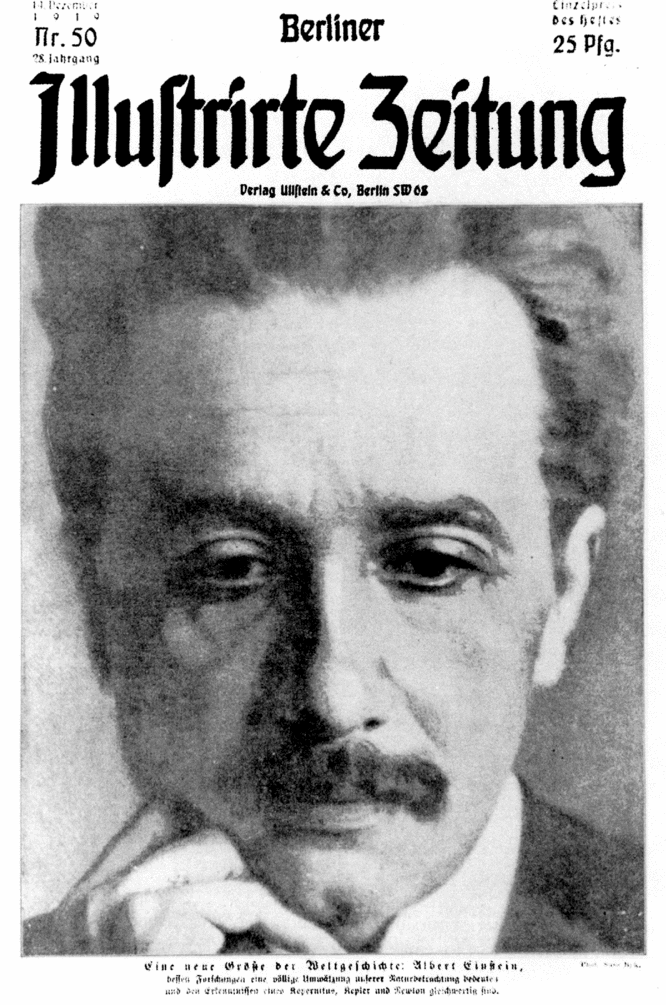
On 14 December 1919, the front page of the Berliner Illustrirter Zeitung (BIZ) carried a picture of a man in a contemplative pose, his face at once tranquil and yet transfixed in thought (fig. 1). Underneath the caption read: “A New Giant of World History: Albert Einstein, whose research signifies a complete overturning of our view of nature comparable to the insights of Copernicus, Kepler, and Newton.” Turning inside, the text seemed to pick up where Moszkowski had left off, offering readers a miniature history of cosmology from Copernicus to Einstein, two great revolutionary thinkers:
Our notions of space and time must be changed to accord with Einstein's theories, and just as before in Copernicus's time, a change in our image of the world has once again come about. A new epoch in human history has now arisen and it is indissolubly bound with the name of Albert Einstein. (Grundmann Reference Grundmann1998, 117)
Einstein as Modern-Day Copernicus: A Celebrity Emerges on the World Stage. From: Berliner Illustrierte Zeitung, December 1919.

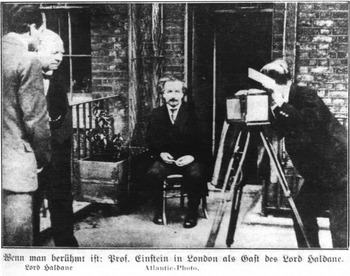
Einstein was unusually photogenic, which helps to account for why people were constantly taking snapshots of him (fig. 2). Some of these – like the one showing an elderly Einstein peering at the camera with outstretched tongue and a look of mock disdain – have become standard iconic images of lasting commercial value.Footnote 57 The title-page portrait for BIZ was the first such celebrity photograph of Einstein's now so familiar face, and it, too, managed to leave a lasting trace by capturing the 40-year-old physicist in a pose clearly intended to evoke a sense of awe and profundity. With this single image the publishers effectively piqued the curiosity of ordinary Germans about the ideas of their extraordinary countryman, thereby helping to launch Einstein's new-found public fame.
The Meta-photogenic Einstein: at the home of Lord Haldane in London. From: Berliner Illustrierte Zeitung, June 1921.

Berliner Illustrirter Zeitung was owned by the Ullstein Verlag, publishers of the Vossische Zeitung, and stood at the forefront of a new trend in journalism in which photography rather than the printed word dominated the page. Few remembered the stories, but the BIZ's images left a lasting impression on many of its million-plus subscribers, nearly three times that of Berliner Tageblatt.Footnote 58 Editor-in-chief Kurt Korff, who later helped launch Life magazine, recognized the camera's potential for conveying the dramatic events of the day, and the impact this had on popular culture in Germany was enormous. Korff's weekly not only made Einstein a scientific pop star, it also promoted the career of the modernist architect Erich Mendelsohn, whose “Einstein Tower” in Potsdam became an instant icon of Weimar culture (Hentschel Reference Hentschel and Hentschel1997). Einstein fully appreciated the fact that his life in Berlin changed after 14 December 1919, the day his face appeared on the cover of BIZ. We have this on the authority of his stepson-in-law, Rudolf Kayser, that: “Hundreds of thousands of people saw this face for the first time . . . heard for the first time the name of this Berlin professor of physics, learned for the first time, through the printed article, about the problems of the theory of relativity” (Reiser Reference Reiser1930, 160).
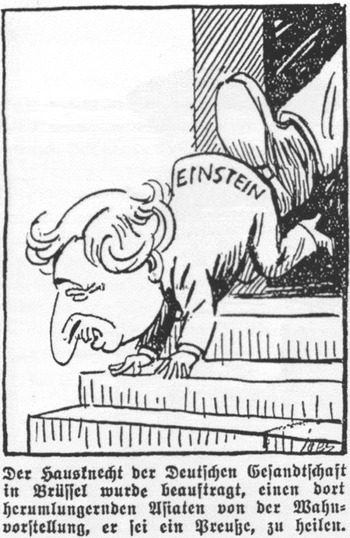
Two months later, Berlin newspapers reported on disruptions that took place during Einstein's lectures, some reports indicating that anti-Semitic elements had their hands in this affair.Footnote 59 Einstein later tried to downplay this aspect, but he admitted that certain remarks had such undertones. This incident came only a month after right-wing students staged a demonstration against Einstein's colleague and friend, Georg Nicolai, whose pacifism and internationalism they regarded as intolerable. The Berlin faculty senate agreed, suspending him from his post.Footnote 60 Nicolai's book Biologie des Krieges had been censored in Germany during the war. This tome, a passionate and richly documented argument for abolishing modern warfare, also contained the abortive counter-manifesto he had circulated in 1914 in response to the chauvinistic “Manifesto of the 93.” Nicolai managed to obtain all of three signatures, including Einstein's.Footnote 61 Little wonder that Einstein's outspoken support for pacifism, internationalism, and (soon afterward) Zionism strongly colored the reception of relativity in Weimar Germany. Photos and caricatures of the “New Copernicus” circulated widely, and the public could read about the scientific controversies surrounding relativity in the same newspapers that reported on the war-guilt clause in the Versailles Treaty or Hindenburg's claim that the German army was stabbed in the back by traitors.
As an outspoken democrat, Einstein quickly emerged as a diplomatic asset of considerable importance for the Weimar Republic.Footnote 62 He gladly played his part, even though he was well aware that such activity made him a target for political assassins.Footnote 63 At the urging of Foreign Minister Walther Rathenau, he accepted an invitation to visit France during the early spring of 1922. Shortly after his return, he and the Zionist leader Kurt Blumenfeld paid Rathenau a visit at the latter's villa in Grünewald. Both visitors hoped to persuade their host that he should resign from his office in view of the widespread anti-Semitism and violence. Arguing into the wee hours of the night, they nevertheless failed to persuade him that his allegiance to Germany and his faith in the German people were misplaced (Blumenfeld Reference Blumenfeld1962, 142). Two months later, on 24 June, Rathenau was gunned down in his car on the way to work. Einstein wisely broke off his lectures and quietly departed from Berlin (Fölsing Reference Fölsing1993, 595).
What made his situation especially precarious was not just the anti-Semitic atmosphere in Berlin, but also the fact that the theory of relativity had taken on political overtones reflecting clear lines of division within the German physics community (Rowe and Schulmann Reference Rowe and Schulmann2007, chap. 2). Several German anti-relativists had come to regard Einstein and his theory as distinctly un-German, whereas even prominent pro-relativists, like Arnold Sommerfeld, took strong exception to his political views.Footnote 64 One of the central and repeated charges raised by Einstein's critics was that he and his allies tried to promote relativity theory by encouraging popular accounts in books, magazines, and the press. Self-promotion, scientific sensationalism, even outright dishonesty – these were the kinds of charges that came to be thrown at Einstein's door, helping to make relativity theory the most contentious scientific theory since Darwinian evolution (see Wazeck Reference Wazeck2009). Yet while the scientific repercussions from the relativity revolution were felt around the world, the ensuing debates took on a highly charged political character in Germany during the early years of the Weimar Republic.
7. German Anti-Relativists on the March
Einstein's two most outspoken opponents, the physicists Ernst Gehrcke and Philipp Lenard, both felt the theory of relativity represented an unsavory influence on their discipline. Yet as much as these anti-relativists loathed Einstein's political views, they were reluctant to cross the threshold separating science and politics. Even Lenard, a vociferous enemy of the British scientific community,Footnote 65 had no wish to utter in public what he and others were expressing privately, namely that Einstein's theory was antithetical to good, sound German science: that relativity, like its author, was un-German. That fateful step was taken by one Paul Weyland, an engineer who gained notoriety after the war as a journalist and right-wing political demagogue (Kleinert Reference Kleinert1993).Footnote 66
Post-war Berlin was a breeding ground for political malcontents, so Weyland had plenty of company when he burst upon the scene in 1920. Still, his smear campaign surely never would have gotten off the ground had he not been able to enlist the support of Berlin's anti-relativists. In particular, he obtained a good deal of inside information from Gehrcke, who had been waging a lonely, up-hill battle against Einstein and relativity for nearly a decade.Footnote 67 Frustrated by Einstein's unwillingness to answer his criticisms, Gehrcke came to view this evasiveness as part of a sinister plot hatched by the “Einstein clique” to solidify its domination of German physics. By exploiting their network of contacts, so Gehrcke insinuated, influential members of this clique were intent on mounting a massive propaganda campaign for relativity theory in the scientific and popular press. Weyland needed to hear no more than this. Seizing on Gehrcke's theme of “Massensuggestion,” he created a bogus organization, made himself its head, and exploited this façade to launch vicious, politically motivated attacks on Einstein. He called his group the “Working Association of German Natural Scientists for the Preservation of Pure Science,” though its sole purpose was to wage a “counter-campaign” against Einstein and his allies.
Weyland learned about the opinions of Gehrcke's accomplice, Ludwig Glaser, an expert on the technical problems faced by astronomers who tried to test Einstein's predictions. According to Glaser, none of the claims of confirmation, including those put forth by Eddington and his British colleagues, could be regarded as scientifically sound (Glaser Reference Glaser1920). Weyland's informants thus confirmed that Einstein's theory was the scientific equivalent of Hans Christian Andersen's emperor without clothes. Such revelations were potential grist for the political mill of this unsavory rabble-rouser, who seemed to have stumbled upon a major conspiracy within the German scientific community. Weyland was convinced that this “relativity scandal,” once brought to light, would fill the German people with rage. Not surprisingly, his efforts focused on the role of a “certain press,” as nothing could have been more transparent to him than the parallel between this “Einstein conspiracy” in German science and the international network of Jewish interests that had brought about the nation's defeat and the overthrow of its monarchy. After stirring up attention for his cause in the right-wing press (Weyland Reference Weyland1920a), he began advertising a series of anti-relativity lectures in the main auditorium of the Berlin Philharmonic Hall. The first of these took place on 24 August 1920 when Weyland and Gehrcke stepped to the podium before a large crowd mainly comprised of curiosity seekers.Footnote 68
Just before the curtain went up on the anti-relativists’ first gathering, the Deutsche Zeitung published a new charge of plagiarism, claiming that Walter Ritz, who developed a ballistic theory of light that was inconsistent with relativity, had given a derivation for the perihelion of Mercury back in 1908 (Reinhardt Reference Reinhardt1920). Two days later the same paper published an article by Weyland entitled “New Proofs for the Fallacy of Einstein's Relativity Theory” (Weyland Reference Weyland1920c). This piece began as a more or less conventional newspaper article, but toward the end its frenzied purpose became transparent as Weyland repeated Gehrcke's plagiarism charge against Einstein.Footnote 69 After glibly noting that Glaser had refuted the experimental evidence for gravitational redshift, whereas Gehrcke had exposed the physical and epistemological errors in Einstein's theory, Weyland wrote: “The mathematical attack will now follow. In a series of lectures the Working Association of German Natural Scientists for the Preservation of Pure Science turns to the German public in order to prove how they have been taken in by the unconscionable Einstein press.” He then announced where and when that public should turn up in order to witness how “the Einsteinian phantasms will be totally plucked to pieces.”
The next evening Einstein joined the crowd at the Berlin Philharmonic Hall, where he heard Weyland accuse him of everything from plagiarism to scientific dadaism (Weyland Reference Weyland1920b; a copy of the original manuscript with corrections by Gehrcke is reproduced in Renn Reference Renn2005, 339–348). Outside in the foyer anti-Semitic literature was on sale along with swastika lapel pins.Footnote 70 Laue informed Sommerfeld that he found nothing new or surprising in Gehrcke's lecture; he “just warmed up the old coals” with Gerber, etc. (Max von Laue to Arnold Sommerfeld, 25 August 1920; Eckert and Märker Reference Eckert and Märker2004, 80). Still, he was shocked that a fellow physicist could take part in such a gathering. By then, at the latest, it had become clear to Einstein and his supporters that Gehrcke and other anti-relativists had joined forces with right-wing elements. But what remained unclear to them was whether this backlash would find broader support within the German physics community. Indeed, Laue warned Sommerfeld that Weyland's organization had plans for some twenty such meetings (ibid.).
Three days later, Einstein unleashed his fury in “My Response. On the Anti-Relativity Company, Ltd.”Footnote 71 published in the Berliner Tageblatt (Einstein Reference Einstein1920f). Referring to Weyland and Gehrcke, Einstein wrote: “I am fully aware that both speakers are unworthy of a reply from my pen; for I have good reason to believe that there are other motives behind this undertaking than the search for truth. (Were I a German national, whether bearing swastika or not, rather than a Jew of liberal international bent. . .). I only respond because I have received repeated requests from well-meaning quarters to have my views made known.” Some of his friends, however, reacted with dismay when they read these words. Yet, as Einstein explained to Paul Ehrenfest, he felt he had no choice but to defend himself against the steady stream of charges publicly levelled against him, including dishonest self-promotion, literary theft, and outright plagiarism: “I had to do this if I wanted to stay in Berlin, where every child knows me from the photographs. If one is a democrat, then one must grant the public this much right as well” (Einstein to Ehrenfest, before 9 September 1920, CPAE 10, Doc. 139). Thenceforth he was caught in a whirlwind of controversy that had him seriously contemplating permanent departure from Berlin.Footnote 72 He soon changed his mind, but confided to Sommerfeld that “what is bad is that the journalists try to make a business out of everything I say. I'll have really to hold my tongue” (Einstein to Sommerfeld, 6 September 1920, Einstein and Sommerfeld Reference Einstein and Sommerfeld1968, 84–85).
Einstein's choice of words in his scornful response to Gehrcke and Weyland was surely justified, but from a tactical standpoint he blundered by throwing down the gauntlet at the feet of the ultra-sensitive Philipp Lenard.Footnote 73 By challenging him and other anti-relativists to a public showdown at the forthcoming meeting of the Society of German Natural Scientists and Physicians in Bad Nauheim, a spa town just north of Frankfurt am Main, he only heightened the tensions (see van Dongen Reference van Dongen2007).Footnote 74 Sommerfeld pleaded with Lenard to forgive Einstein's transgression, but to no avail. This by now deeply personal conflict culminated a month later with the famous “Einstein-Lenard debate,” a media event of the first order. As it turned out, both men were intent on saving face, so they really had nothing new to say.Footnote 75 Afterward, Einstein and a few of his friends tried to mollify Lenard, but he refused to shake hands with his rival or to accept Einstein's public apology for attacking him in Berliner Tageblatt (Schönbeck Reference Schönbeck2003, 351–354). The press coverage of the confrontation was generally fair to both sides, though many reporters sensed that what they had witnessed was really a clash of worldviews rather than a scientific debate. Partisan reactions consequently prevailed. The mathematician Robert Fricke, who helped organize this special session on relativity with the hope that it would showcase recent German accomplishments in mathematical physics, was delighted by the outcome. Writing to his uncle, Felix Klein, he was certain that “even the lay people could feel Einstein's superiority over Lenard.”Footnote 76
Many of the anti-relativists, on the other hand, thought their side was never given a chance to express its views. Reporting for the Deutsche Zeitung, Paul Weyland accused Max Planck, who chaired the session, of having throttled the opposition. He called the relativity debate a sham with but one redeeming virtue: it revealed the deep division within the German physics community. On the one hand there were those who, “under the leadership of Lenard, rejected the rape of physics by mathematical dogmas, whereas the Einsteinophiles on the other side cling to their standpoint and try to climb the Parnassus of their rubbish of formulas . . . before they will fall precipitously from their icy heights.” As for “the art and manner of free research, as understood by the German Physical Society,” Weyland called it “a scandal without example in the history of German science,” and suggested that it was “high time that fresh air enter this rat's nest of scientific corruption” (Weyland Reference Weyland1920d). Just four days later the Vossische Zeitung, reporting on a rumour that Einstein would soon be hired by a leading British university, came to the crux of the matter: “German national pride obviously cannot accept the fact that the world's best mathematician [sic!] is a Jew, not just a pure and simple German” (Vossische Zeitung, 30 September 1920). Soon afterward, Weyland left the anti-relativity arena to pursue his crusade against other “Jewish influences” that he claimed were poisoning German culture.Footnote 77
Still, echoes from his notorious campaign continued to be heard. When Hanns Walter Kornblum produced an educational film on relativity theory that premiered at the Frankfurt Fair in April 1922, its program emphasized the revolutionary character of Einstein's ideas: “What accounts for the public fascination with Einstein's theory? He has shaken our customary perception and made us feel insecure on this spot of earth that seemed so firmly anchored. This insecurity explains the longing to understand these ideas that have overturned the world” (Grundmann Reference Grundmann1998, 118–119). Some critics reacted scornfully to such claims. In a review entitled “The Film of Physical Nihilism” (Wazeck Reference Wazeck2010), the message was reminiscent of Weyland's scurrilous brand of anti-relativism:
Einstein creates a universe using the imperfection of our sensory perception. He preaches to us: All of your perceptions are relative, therefore you must construct a relative universe following my formula. This is nothing but the most unproductive scientific nihilism and is in accordance with the political past of the professor, who belongs to political parties that intend to relativise the national sense of honour. . . . All Einsteinians with their comprehension-simulating Bolshevik-Zionist clique cannot deny the fact that time, space, and matter exist infinitely, and that, from a given centre, one can indeed develop an absolute worldview. (Quoted from Wazeck Reference Wazeck2010, 175)
Poster for the 1922 educational film Die Grundlagen der Einsteinschen Relativitätstheorie produced by Hanns Walter Kornblum for Colonna-Filmgesellschaft. From: Siegfried Grundmann: Einsteins Akte, Reference Grundmann1998, p. 120.

As conspiracy theories multiplied, some of the more active anti-relativists began to build their own international network whose members cited one another approvingly (see Wazeck Reference Wazeck2009, 294–378). In the United States, Henry Ford's Dearborn Independent became the leading outlet for tirades against Einsteinians and international Jewry in general.Footnote 78 Einstein saw a direct correlation between such opposition to his theory and various manifestations of anti-Semitism in Berlin. In 1921 he called attention to the contrast between the treatment of relativity in the British and German press, characterizing the former as objective and free of political influences while contending that the German papers colored their reports according to their political leanings (Einstein Reference Einstein1921h, 427).
By the mid 1920s the relativity rumble had largely run its course, but not without laying the groundwork for the physics movement that re-emerged full force with Hitler's ascension to power in January 1933. Two prominent anti-relativists, the Nobel laureates Lenard and Stark, went on to become leaders of that cause (Beyerchen Reference Beyerchen1977). By 1924, shortly after Hitler was sentenced to prison for leading the Munich Beer Hall Putsch, both came out in public support of the Nazi “drummer” and his ideology of racial supremacy. Even after the Nazis established their iron-fisted dictatorship, Lenard and Stark remained embittered about the role of certain “white Jews,” non-Jews like Einstein's former allies Planck and Laue, who typified undesirable “un-German influences” in the physics community.Footnote 79 As for Einstein, his encounters with German anti-relativists during the early 1920s left a lasting impression, one that reinforced both his personal identification with European Jewry as well as his commitment to Zionism. As he approached his fiftieth birthday in 1929, these emotional anchors merged with larger political themes that would shape the last quarter of his life.
8. Rudolf Kayser's Jewish Hero
Alongside the dominant image of Einstein as lonely scientific genius stands another: the familiar visage of the elderly humanist and pacifist (Nathan and Norden Reference Nathan and Norden1960). These two facets of his legacy – scientist and humanitarian – correspond with two fairly distinct periods in his career: his most creative period, from 1904–1919, and the longer thirty-five-year era of his public fame. For the latter years, countless reports bear witness to his selfless character and the sacrifices he made not only to promote general human progress but to aid powerless individuals who called on him for help. Einstein was seen by many as a man whose altruism and humanity put him on a par with Gandhi and Schweitzer. Yet as he turned outward, voicing warnings against the rise of fascism and militarism in the early 1930s, he also stepped back inside himself taking a Stoic view of life. Thus many of his writings from 1930 onward are filled with personal reflections on religious and ethical issues (Rowe and Schulmann Reference Rowe and Schulmann2007, 226–234). At this juncture in his life we can begin to discern a new layer of themes that would later color standard portraits of Einstein, the humanist.
On 14 March 1929 Einstein spent his fiftieth birthday surrounded only by a few intimate friends and family members. He had gone into hiding, occupying a pavilion on the palatial country estate owned by his personal physician, Janos Plesch, in order to avoid all the well-wishers. One of those present, Rudolf Kayser, wrote about how happy he was in those surroundings, “how little he cared that on this day all the newspapers of the world were printing articles about him and that the public was honouring him!” (Reiser Reference Reiser1930, 205). In the meantime, several baskets of birthday cards arrived at the Einsteins’ home, from “the Chancellor, and the German government, the Prussian government, universities and academies of all countries, scientific and humanitarian organizations, fellow scientists and scholars of all branches of science, and friends without number” (ibid., 206). Yet, Kayser assures us, “it was not the words of admiration and the famous names that made him happy, but the wishes of the many poor people who knew nothing of his work and who associated the name of Albert Einstein with a good, helpful, and great man” (ibid.).
Einstein was perhaps less happy about the birthday present Kayser himself had been preparing for this occasion: an intimate biography of the man he so admired, later published as Reiser Reference Reiser1930. Its contents were undoubtedly influenced by Einstein's own opinions, related in innumerable conversations between Kayser and Einstein and/or the latter's step-daughter, Ilse, whom Kayser married in 1924. From his vantage point within Berlin's vibrant literary scene, he saw Einstein not merely as a great scientist but as a symbol of Jewish contributions to German culture. Yet when he unveiled his plans for a biography to celebrate the physicist's fiftieth birthday, the image-conscious Einstein objected to its publication in Germany. So Kayser opted to publish his book under a pseudonym in the United States, an undertaking his stepfather-in-law even promoted by writing a short introduction. As usual, Einstein's endorsement of the credentials of “Anton Reiser” (the protagonist in an eighteenth-century novelFootnote 80 with whom Kayser identified) was both ironic and effective: “The author of this book,” he wrote, “is one who knows me rather intimately in my endeavour, thoughts, beliefs – in bedroom slippers” (Reiser Reference Reiser1930, viii). As for the book's contents, he could vouch that the facts were “duly accurate, and its characterization, throughout, as good as might be expected of one who is perforce himself, and can no more be another than I can” (ibid.).
Biography was not a genre Einstein particularly enjoyed; nor did he find much point in books that portrayed lives as outwardly uneventful as his own.Footnote 81 When approached by his former student, David Reichinstein, who eventually wrote the unauthorized biography (Reichinstein Reference Reichinstein1932), Einstein told him that he thought biographies of still living persons were in bad taste (Fölsing Reference Fölsing and Osers1997, 618).Footnote 82 On the other hand, he was keenly aware that the life and thought of Albert Einstein had appreciable commercial value, and conceded to Reichinstein that “the authors really . . . need to make money, and that they cannot be expected to wait until I am dead” (ibid.). Kayser's book was apparently not an impressive financial success, but it surely does represent the ultimate in Einstein hagiography. His detailed description, cited above, of the near life-size photo that appeared on the cover of the BIZ reveals Kayser's sense of awe and reverence for the man heralded as the greatest scientific genius of the day. Still, given that this was a fully authorized biography, its tone raises serious questions about Einstein's own self-image, particularly since much of the information in it had to have come straight from the horse's mouth.
Kayser's account also contains a long chapter on Einstein's fame that begins by describing how the term relativity had often been conflated with relativism, thereby linking Einstein's name with cultural trends he abhorred. “Ethical relativism,” he writes, “which denies all the generally obligatory moral norms, totally contradicts the high social idea which Einstein stands for and always follows” (Reiser Reference Reiser1930, 158). Here the “other Einstein” begins to emerge in his full mythic grandeur as a symbol of goodness and humanity. Yet, as befits a true saint, he continued to be victimized by those who “completely misrepresent his achievement and his personality.” To these naysayers Kayser replied:
Einstein's great fame is not only a fact which is justified by his incomparable achievement, but a fact which has become more and more a part of the consciousness of our times. This fact provokes thought and presents us with the problem of solving a mystery which cannot consist of misunderstandings only. The legend of a man, the immense popularity of a name in all parts of the world – these facts as they reappear in history from epoch to epoch, find explanation only in the one miracle of history and life, namely in the magic of a great personality. (Ibid., 159)
After recounting Einstein's world travels in considerable detail, Kayser asserted that through his trips and lectures he succeeded – “the miracle happened” (ibid., 168) – in overcoming national frictions between scientists. Yet while “the scientific circle of all European countries are again in close contact with each other . . . in Germany itself, the opponents of Einstein had not as yet been silenced” (ibid.). Their motives, according to Kayser, were to a large extent political and anti-Semitic, but he also saw in the anti-relativists a subgroup that was threatened by modernity and scientific progress. Amidst this opposition he recognized “the old, hoary, pedantic scholasticism which can endure no scientific revolution and refuses every new thought which might cause the traditional system of science to totter” (ibid.). Herein lay the deeper historical meaning behind Einstein's theory: for his enemies, the anti-relativists, symbolized those very same forces of darkness that had threatened to impede science and human progress in the past. For Kayser, Einstein was a modern-day Galileo facing the Inquisition, an image that gained considerable credibility after the Nazis came to power in Germany. Soon afterward, in September 1933, Max von Laue exploited this theme of martyrdom for science on a highly public occasion. As President of the German Physical Society, Laue delivered a plenary lecture on the three hundredth anniversary of Galileo's trial at the end of which he drew an unmistakable parallel between the case of Einstein and Galileo's persecution by the Inquisition (Laue Reference Laue1933).Footnote 83
In later years Einstein gradually adopted a diffident view of life; he also learned how to cope with his media stardom by shielding himself from public attention. He had always been fiercely independent, but by 1930 he became increasingly introspective. No longer in touch with the latest developments in fields like quantum theory and nuclear physics, he began to issue various philosophical pronouncements, some of a highly personal character. In “The World as I See It,” he set down a Stoic credo for his life that complements in a striking way Kayser's heroic image of the man. There he wrote: “It is an irony of fate that I myself have been the recipient of excessive admiration and reverence from my fellow-beings, through no fault or merit of my own” (Einstein Reference Einstein1954, 9).Footnote 84 That was an exaggeration, to be sure, but by the same token it also signified that he absolved himself of any responsibility for the publicity heaped upon him. People could write and say what they wanted; he would simply remain true to himself. Einstein saw himself as a world apart, freely admitting that his “passionate sense of social justice and social responsibility has always contrasted oddly with my pronounced lack of need for direct contact with other human beings and human communities” (ibid.).
It would be going too far to suggest that Kayser's views conformed altogether to Einstein's own; clearly this was not the case. Yet neither should one overlook the evident ties that bound these two friends together as latter-day humanists. Both shared a loathing for the machine age dominated by militarism and nationalism. As members of the German-Jewish intelligentsia, Kayser and Einstein deeply believed in the vitality of European culture, but they also fully recognized its tenuousness in the post-war era. The fragility of the new European political order also posed a threat to their very existence so long as the Jewish question remained unresolved. For Kayser, Einstein's name and fame were tied to a dream shared by everyone “who had preserved . . . faith in Europe and who was yearning for a new world order . . . permeated by a peaceful and humane spirit” (Reiser Reference Reiser1930, 134–135). Seen in this light, the theory of general relativity represented far more than just a new approach to gravitation. Indeed, like German Jewry, it symbolized a new era of intellectual and political freedom whose fate still hung in the balance when Kayser's biography of Einstein came out in 1930. Three years later both men were living in exile and would never return to Germany again.
Already a year before Hitler was appointed Chancellor, Kayser found himself looking for work, having been eased out of his job as editor of Neue Rundschau. His successor, Peter Suhrkamp, was a far more political figure, one who made no bones about his opposition to the Nazis, nor did he hide his disdain for those too weak-kneed to stand up against them. That same year, Kayser published a biography of Spinoza (Kayser Reference Kayser1932), whose difficult life provided ample scope for its author to expound on the persecution suffered by the Spanish and Portuguese Jews, but especially the plight of the Marranos who converted back to Judaism in the Netherlands. He would later write about the golden age of Jewish culture in Islamic Spain as exemplified in the life and work of Jehudah Halevi, whom he called “one of the mightiest religious poets any race and any century has ever produced” (Kayser 1949, 5).
Kayser's portrait of Spinoza, which ends with a dramatized version of his “spiritual hero's” encounter with the young Leibniz, reflects an astonishing lack of critical acumen.Footnote 85 Einstein nevertheless thought the book had its merits, at least for an American audience. As a great admirer of Spinoza, he was happy to write a preface for the 1946 English translation, which he recommended to “men of insight and sensitivity” seeking solace and inspiration in the face of the “frightful events of these times” (Kayser Reference Kayser1946, ix). Hiroshima and Nagasaki were then very much on his mind. His further reflections reveal the deep intellectual and emotional affinity Einstein felt not only for Spinoza's ideas but also for his ascetic lifestyle. Kayser could hardly have chosen a more appropriate vehicle for a sequel to his biography of Einstein, and all the more so considering how many had since come to regard the famous physicist as a modern-day Jewish saint.
9. Painful Exodus
Yet Kayser's role in the larger story of Einstein's legacy went far beyond his own soon-to-be-forgotten literary efforts. For it was he who succeeded in saving Einstein's library as well as his scientific manuscripts and personal correspondence from the Nazis, whisking these off to the French embassy in Berlin before Einstein's enemies had a chance to seize them (Fölsing Reference Fölsing1993, 750). Had he failed to carry out this mission, the scholarly world would surely have been deprived of most of the rich documentary evidence now preserved in the many volumes of the CPAE. Or to put it more starkly, had some local brown shirts noticed what he was doing, Helen Dukas, who devoted the last decades of her life to collecting, ordering, and transcribing Einstein's posthumous papers, would have faced a far easier and much less rewarding task.Footnote 86
Einstein as Symbol for the Fate of the German Jews in 1933: “The concierge of the German embassy in Brussels is authorized to cure an Asiatic [East European Jew] of the delusion that he is a Prussian.” From: Deutsche Tageszeitung, April 1, 1933, which the Nazi regime had proclaimed the “Day of the Jewish Boycott.”

Soon afterward Kayser immigrated to the Netherlands, where he took a job with the publisher A. W. Sitjhoff. There he contacted Fritz H. Landshoff, who like him had left Berlin to work for a Dutch publisher, Querido in Amsterdam. Its owner, Emanuel Querido, was descended from a family of Portuguese Jews who had sought refuge in that city. Under Landshoff's direction, the Querido firm would become the leading outpost for Germany's most distinguished exiled authors, publishing over a hundred of their works before the Nazis entered Holland in 1940 and closed down this operation (Querido and his wife managed to slip away into hiding, but they were later caught and put to death in 1943 at the Sobibor extermination camp).
In Amsterdam, Kayser struggled to eke out a living while his wife, Ilse, lay dying in a hospital near Paris (she succumbed to leukemia in 1934 at age 37) (ibid., 769). Together they had dealt with the problem of removing Einstein's papers from Berlin, so once everything had safely arrived in Paris Kayser faced the next hurdle: to make arrangements for their shipment to the United States. In the course of going through Einstein's handwritten documents, he apparently hit upon the idea of preparing a special collection of the great man's nonscientific writings, one that would include accounts of relativity and its meaning, but which would also send a clear moral message to the world. Knowing that Querido had no qualms about publishing the work of leftist writers like Heinrich Mann and Lion Feuchtwanger, he went to Landshoff to discuss this plan and quickly got his approval.
Several of the texts Kayser chose for this anthology were obscure writings; some were scarcely more than half-baked thoughts whose origins and purpose, if any, have remained shrouded in mystery to this day. Einstein seems to have taken no serious interest in Kayser's project, but since he was all too aware of Kayser's desperate financial straits, he voiced no objections. He may not even have bothered to read the writings collected in this now classic volume, entitled Mein Weltbild, which came out in 1934. Since then, numerous editions have appeared, including a revised and partially annotated version, prepared twenty years later by Carl Seelig and still in print today (Einstein Reference Einstein2001). Whether or not he read the original German edition, Einstein surely did cast his eyes over the English language version that came out under the title The World as I See It (Einstein Reference Einstein1934). In an anonymous preface, Kayser made sure that its readers understood the need for such a book, namely to defend Einstein from vicious slander: “This man,” he wrote, “is being drawn, contrary to his own intention, into the whirlpool of political passions and contemporary history. As a result, Einstein is experiencing the fate that so many of the great men of history experienced: his character and opinions are being exhibited to the world in an utterly distorted form. To forestall this fate is the real object of this book” (Rowe and Schulmann Reference Rowe and Schulmann2007, 291).
For his part, Einstein added a fiery, almost furious testimonial in “appreciation of the achievements of the German Jews . . . a body of people amounting, in numbers, to no more than the population of a moderate-sized town, who have held their own against a hundred times as many Germans, in spite of handicaps and prejudices, through the superiority of their ancient cultural traditions.” Recalling “in these days of the persecution of the German Jews” their contributions to Western culture and religion, while noting that it was Luther's translation of the Hebrew Bible “which brought about the refinement and perfection of the German language,” Einstein urged his people to hold their heads high: “Today the Jews of Germany find their fairest consolation in the thought of all they have produced and achieved for humanity by their efforts in modern times as well; and no oppression however brutal, no campaign of calumny however subtle will blind those who have eyes to see the intellectual and moral qualities inherent in this people” (ibid., 292).
Looking backward to the atmosphere in Berlin during the early Weimar years, one can easily appreciate why the Jewish question burned so deeply in Einstein's heart, even though he approached it with his usual calm rationality (see ibid., chaps. 3, 6, 7). Fritz Stern explored this theme in an essay on Fritz Haber and Einstein, two scientists whose lives reflect the deeply divided loyalties of German Jews during and after the First World War (Stern Reference Stern1999, 59–164). Despite holding diametrically opposite views about Prussian society and its value system, Haber and Einstein remained good friends. In Berlin's heated post-war atmosphere, when anti-Semitism was rising sharply, Einstein tried to persuade Haber that “the events of the last year [1920] . . . impel a self-esteeming Jew to take Jewish solidarity more seriously than would have appeared appropriate and natural in earlier times.” Einstein cited the activities of “the infamous Nauheim brigade, which only got rid of the fool [Weyland] for opportunistic reasons” (Einstein to Haber, 9 March 1921; Rowe and Schulmann Reference Rowe and Schulmann2007, 148). His affinities with the Zionist movement notwithstanding, Einstein empathized with the plight of proud Prussian Jews like Haber and Foreign Minister Walther Rathenau, probably because he understood their insecurities and psychic tensions. Discovering his own Jewish identity was a liberating experience, just as many of the events from the early 1920s – culminating with Rathenau's murder in June 1922 – left a deep scar.
Still, in his own mind Einstein had to reconcile Jewish nationalism with his decidedly internationalist beliefs, a dilemma he addressed in an essay for Jüdische Rundschau, published in early 1925. Therein he appealed to the loftier ideals of Zionism, which he believed could serve as a model for a better world: “[The Jews] must develop from within those virtues and that faith which are indispensable for one who wishes to serve all of humanity. Since, for the moment at least, the vanishing of Jewish nationality seems out of the question,” he wrote, “Jews must justify their existence. They must therefore, without being ridiculously arrogant about it, regain an awareness of the human values which they embody. Through the study of their past, through a better understanding of the spirit of their race, they must learn anew the mission they can accomplish” (Rowe and Schulmann Reference Rowe and Schulmann2007, 164).
This brand of cultural Zionism had great appeal for a younger generation of German Jews, many of whom, like Einstein, had been swayed by the arguments of Kurt Blumenfeld (Hackeschmidt Reference Hackeschmidt1997). Written just two years after he and his wife, Elsa, visited Palestine in February 1923, Einstein's essay reflects the lofty idealism and higher purpose he identified with the Zionist movement of the 1920s, which he saw as offering the Jewish people a new lease on life:
By recalling to memory a past filled with glory and sorrow and by opening their eyes to a healthier, dignified future, Zionism can teach them self-knowledge and instill courage. It restores the moral force, which allows them to live and act in dignity. It frees the soul from the unforgivable feeling of exaggerated modesty, which can only oppress and make them unproductive. Finally it reminds them that the centuries they have lived through in common sorrow enjoins upon them the duty of solidarity. (Ibid.)
As a secular Jew, Einstein felt deeply rooted in the cultural traditions of the European Enlightenment, and as a German Jew he took pride in the intellectual achievements described by Amos Elon in The Pity of It All (Elon Reference Elon2002), his moving portrait of the rise and sudden demise of that culture.
By the late 1930s, as Europe edged ever closer to the brink of war, Einstein saw nothing but a gloomy future. In a letter from 10 October 1938 to his friend Michele Besso, he vented his total disgust with the British policy of appeasement under Prime Minister Neville Chamberlain, who “sacrifices Eastern Europe in the hope that Hitler will expend his fury on Russia” (Rowe and Schulmann Reference Rowe and Schulmann2007, 311). Soon afterward, he received a request from Clifton Fadiman, book review editor for the New Yorker, for a sequel to his earlier essay, “What I Believe,” written in 1930. Einstein obliged, penning a painful retrospective that began with these reflections:
Reading once again the lines I wrote almost ten years ago to the volume Living Philosophies, I receive two strangely contrasting impressions. What I wrote then still seems essentially as true as ever; yet, it all seems curiously remote and strange. How can that be? Has the world changed so profoundly in ten years, or is it merely that I have grown ten years older, and my eyes see everything in a changed, dimmer light? What are ten years in the history of humanity? Must not all those forces that determine the life of man be regarded as constant compared with such a trifling interval? (Fadiman Reference Fadiman1939, 367–369)
What might look like an empty rhetorical exercise here – so what had changed: the messenger or the message? – had another purpose for Einstein, who habitually saw life as a series of problems, ones he struggled to solve. As the quintessential seeker of truth, he posed this series of questions about his former self (as author) and his present self (the reader) in all seriousness, and with the same keen intellectual enthusiasm so familiar to those who, like Oppenheimer, knew him in his later years. His inquisitive mind needed somehow to reconcile the cognitive dissonance he felt when rereading the articles of his personal faith he had expounded at age 50. So he first sounds a note of self-doubt: “Is my critical reason so susceptible that the physiological change in my body during those ten years has been able to influence my concept of life so deeply?” Not likely, nor does he think the explanation for his darker mood has anything to do with “external circumstances,” since “these have always played a subordinate part in my thoughts and emotions.” Having ruled out the purely personal, he proceeds to seek an explanation in the changes that had taken place during the decade of the 1930s: “In these ten years confidence in the stability, yes, even the very basis for existence, of human society has largely vanished. One senses not only a threat to man's cultural heritage, but also that a lower value is placed upon all that one would like to see defended at all costs” (ibid.).
Having reached this plateau of understanding, he proceeds to describe the preceding decades, which witnessed their share of sorrow, particularly during the First World War, “which had already shaken this feeling of security.” Still, the League of Nations offered reason for hope that a strong and viable system of collective security would eventually emerge. But then came the new fascist states, “attended by a series of broken pacts and undisguised acts of violence against humanity and against weaker nations,” after which everything collapsed “like a house of cards,” the result of “shortsighted selfishness in the democracies.” This brief analysis leads Einstein to the following assessment of what can only be described as a hopeless situation:
Things grew even worse than a pessimist of the deepest dye would have dared prophesy. In Europe to the east of the Rhine free exercise of the intellect exists no longer, the population is terrorized by gangsters who have seized power, and youth is poisoned by systematic lies. The pseudo-success of political adventurers has dazzled the rest of the world; it becomes apparent everywhere that this generation lacks the strength and force which enabled previous generations to win, in painful struggle and at great sacrifice, the political and individual freedom of man.
This devastating critique of the political and moral decay endemic in the Western democracies serves at the same time as an answer to Einstein's own sense of personal malaise:
Awareness of this state of affairs overshadows every hour of my present existence, while ten years ago it did not yet occupy my thoughts. It is this that I feel so strongly in rereading the words written in the past. And yet I know that, all in all, man changes but little, even though prevailing notions make him appear in a very different light at different times, and even though current trends like the present bring him unimaginable sorrow. Nothing of all that will remain but a few pitiful pages in the history books, briefly picturing to the youth of future generations the follies of its ancestors. (Ibid., 367–369)
This deeply pessimistic assessment, written as Europe stood on the brink of an unimaginable catastrophe, tells us much about the elderly Einstein. His trenchant analysis is both prescient and perplexing, reflecting two essentially different sides of his personality.Footnote 87 The scientist Einstein could feign aloofness from worldly affairs, retiring to his holy temple, where he could practice Spinoza's brand of cosmic religion. But the humanist Einstein could not forgive the Germans for the Holocaust, that momentous historical event that surely conjured up old memories of ugly incidents he experienced in Berlin. Events in Palestine only added to his sense of anguish.
After the Second World War, Einstein felt increasingly estranged by the Cold War atmosphere in the United States, just as he became increasingly ambivalent about the blessings of American democracy. As a late arrival, he took little interest in New World culture; he seems to have found life in Princeton easygoing, but dull. Most of the time he was surrounded by his extended kinfolk, who, like him, were newly arrived European Jews. So he spent the last decades of his life on a small cultural island, where he continued to remain baffled by the American public's interest in the mundane affairs of his personal life. Confronted with constant adulation from perfect strangers, he did his best to satisfy their curiosity. Yet as his life came to a close, he expressed misgivings about having done so. “In the past,” he confided to his future biographer, Carl Seelig, in 1953, “it never occurred to me that every casual remark of mine would be snatched up and recorded. Otherwise I would have crept further into my shell” (Einstein to Seelig, 25 October, 1953).
Acknowledgments
The author wishes to thank Leo Corry, Michel Janssen, Alexandre Métraux, Robert Schulmann, Marjorie Senechal, and Reinhard Siegmund-Schultze, all of whom read some version of this paper and offered helpful advice for improving the same. Errors of fact or shortcomings in judgment that may still remain fall on my shoulders alone.