Introduction
Head and neck squamous cell carcinoma (SCC) generally develops in the oral cavity, oropharynx, hypopharynx or larynx. The treatment of head and neck lesions is made difficult by the complexity of anatomy and function in this region. Free tissue transfer is the ‘gold standard’ for reconstruction of complex head and neck defects, and the majority of patients with advanced head and neck cancer benefit from free tissue transfer. Given the importance of the survival of free flap tissue, there have been evaluations of the associations between free flap compromise and several risk factors, such as age, tobacco use, systemic disease, poor nutritional status and obesity.Reference Bui, Cordeiro, Hu, Disa, Pusic and Mehrara 1 , Reference Eckardt and Fokas 2 Furthermore, despite overall improvements in surgical and medical management, clinical outcomes in patients with head and neck SCC have remained largely unchanged.Reference Siegel, Naishadham and Jemal 3
Body mass index (BMI) is a simple index that uses an individual's weight and height to classify underweight, overweight and obesity in adults. High BMI is associated with increased health problems around the world. In Southeast Asia, in 2014, the prevalence of overweight and obesity was 22.2 per cent and 5 per cent, respectively. 4 High BMI is associated with an increased incidence of, and mortality in, several cancers, such as oesophageal adenocarcinoma, breast cancer and colon cancer.Reference Renehan, Tyson, Egger, Heller and Zwahlen 5 , Reference Protani, Coory and Martin 6
However, there have been contradictory reports regarding the association between head and neck cancer survival and BMI.Reference Gaudet, Patel, Sun, Hildebrand, McCullough and Chen 7 High BMI may cause problems with regard to head and neck SCC treatment as well as free flap compromise. The rate of post-operative complications is higher in obese patients.Reference Deneuve, Tan, Eghiaian and Temam 8 These problems could negatively influence head and neck SCC survival, mortality and recurrence. In contrast, excessive neck fat may have a protective effect against the side effects of radiotherapy.Reference McRackan, Watkins, Herrin, Garrett-Mayer, Sharma and Day 9 This could lead to a better outcome in patients with high BMI. The present study aimed to determine whether pre-operative BMI is a predictor of post-operative complications and survival in patients undergoing microvascular reconstruction for head and neck SCC.
Materials and methods
A retrospective medical chart review was conducted of patients newly diagnosed with head and neck SCC, who underwent ablative surgery followed by free flap reconstruction at the Department of Otolaryngology – Head and Neck Surgery, at the Catholic University of Korea, Seoul, from October 1993 to December 2014. The Institutional Review Board of Seoul St Mary's Hospital approved this retrospective review of medical records and the use of archived tumour specimens.
All free flap reconstructions were performed by the same surgeon (last author). At the time of presentation, all patients had histologically proven head and neck SCC, and no radiological evidence of distant metastases. Patients were staged in terms of disease according to the 2002 American Joint Committee on Cancer staging system. All patients had been treated with curative intent.
The study cohort comprised 259 patients with head and neck SCC (229 men and 30 women), with a mean age of 56.8 years (range, 20–78 years). The tumour originated from the oral cavity, oropharynx, hypopharynx, nasal cavity and larynx in 99 (38.2 per cent), 83 (32.0 per cent), 62 (23.9 per cent), 13 (5.0 per cent) and 2 (0.8 per cent) cases, respectively. Flap donor sites included the radial forearm in 199 (76.8 per cent), anterolateral thigh in 48 (18.5 per cent), rectus abdominis in 7 (2.7 per cent), fibula in 3 (1.2 per cent) and lateral thigh in 2 (0.8 per cent) patients. There were 10 (3.9 per cent), 123 (47.5 per cent), 74 (28.6 per cent) and 52 (20.1 per cent) patients with pathological tumour (T) stage T1, T2, T3 and T4 cancers, respectively. There were 79 (30.5 per cent), 58 (22.4 per cent), 117 (45.2 per cent) and 5 (1.9 per cent) patients with nodal (N) disease stages N0, N1, N2 and N3, respectively. Salvage radical surgery after failed (chemo)radiotherapy was performed in 33 patients (12.7 per cent); the remaining 226 patients (87.3 per cent) underwent ablative surgery as a primary treatment.
Body mass index was calculated as weight (kg) divided by height (m2). The patients were separated into four groups: underweight (BMI of less than 18.5 kg/m2), normal weight (BMI of 18.5–22.9 kg/m2), overweight (BMI of 23.0–24.9 kg/m2) and obese (BMI of 25 kg/m2 or more), according to the World Health Organization (WHO) classification for Asian populations. 10
Statistics
Statistical analysis was performed using SPSS software, version 16.0 (SPSS, Chicago, Illinois, USA). The chi-square test, Fisher's exact test and correlation analysis were used, as appropriate, to determine statistically significant associations among the distribution of categorical values. Disease-specific survival was calculated using the Kaplan–Meier method. The Cox proportional hazards model with likelihood ratio statistics was used to identify variables significantly and independently related to survival. P values of less than 0.05 were considered statistically significant. Numerical data are expressed as means ± standard deviations.
Results
Patient characteristics
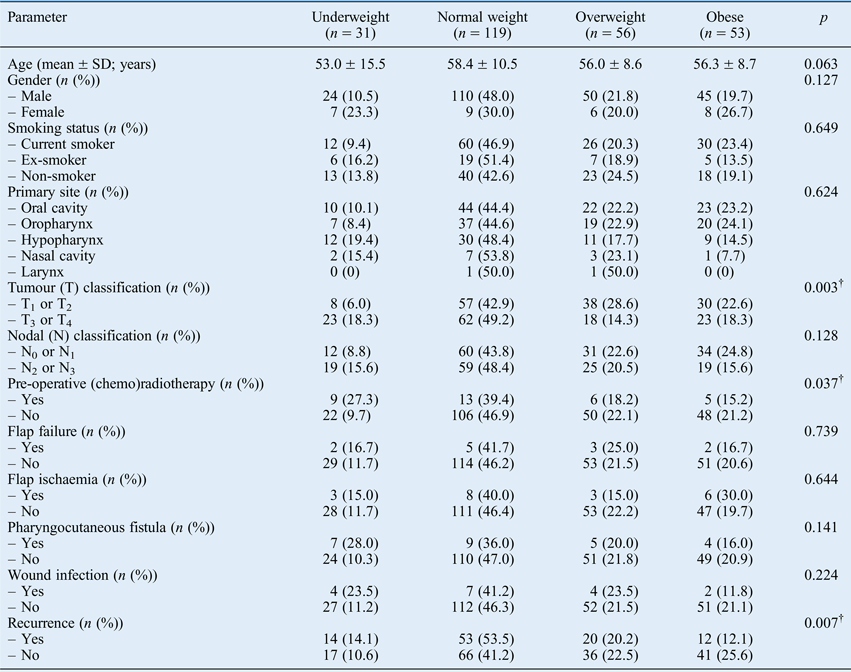
Mean BMI was 22.48 kg/m2 (range, 15.37–35.92 kg/m2). The baseline characteristics of the 259 patients are shown in Table I, based on the WHO BMI subgroups. Thirty-one patients (12.0 per cent) were underweight, 119 (45.9 per cent) had a normal BMI, 56 (21.6 per cent) were overweight and 53 (20.5 per cent) were obese. The four BMI groups showed similar demographics, such as age, gender, smoking status, primary site and N stage. Significant positive correlations were found between BMI and: T stage (p = 0.003) and pre-operative (chemo)radiotherapy (p = 0.037).
Baseline characteristics by BMI subgroup*

* Total n = 259.
† Indicates statistical significance.
SD = standard deviation
Body mass index and surgical outcomes
We examined the influence of BMI on post-operative surgical complication rates. There were no correlations between BMI: and flap failure (p = 0.739), flap ischaemia (p = 0.644), pharyngocutaneous fistula (p = 0.141) and wound infection (p = 0.224). Recurrence or metastasis occurred in 99 patients (38.2 per cent). There was an association between BMI and recurrence (p = 0.007). With regard to the primary site, a lower BMI was associated with an increased risk of recurrence only in patients with oropharyngeal cancer (p = 0.001).
The mean follow-up time was 49.5 months after treatment (range, 1–239 months). A total of 187 patients had longer than 12 months of follow up. Seven patients were lost to follow up shortly after surgery, although some information was available on four of them. At the final follow up, mortality data were available on 250 patients; of these, 99 had died.
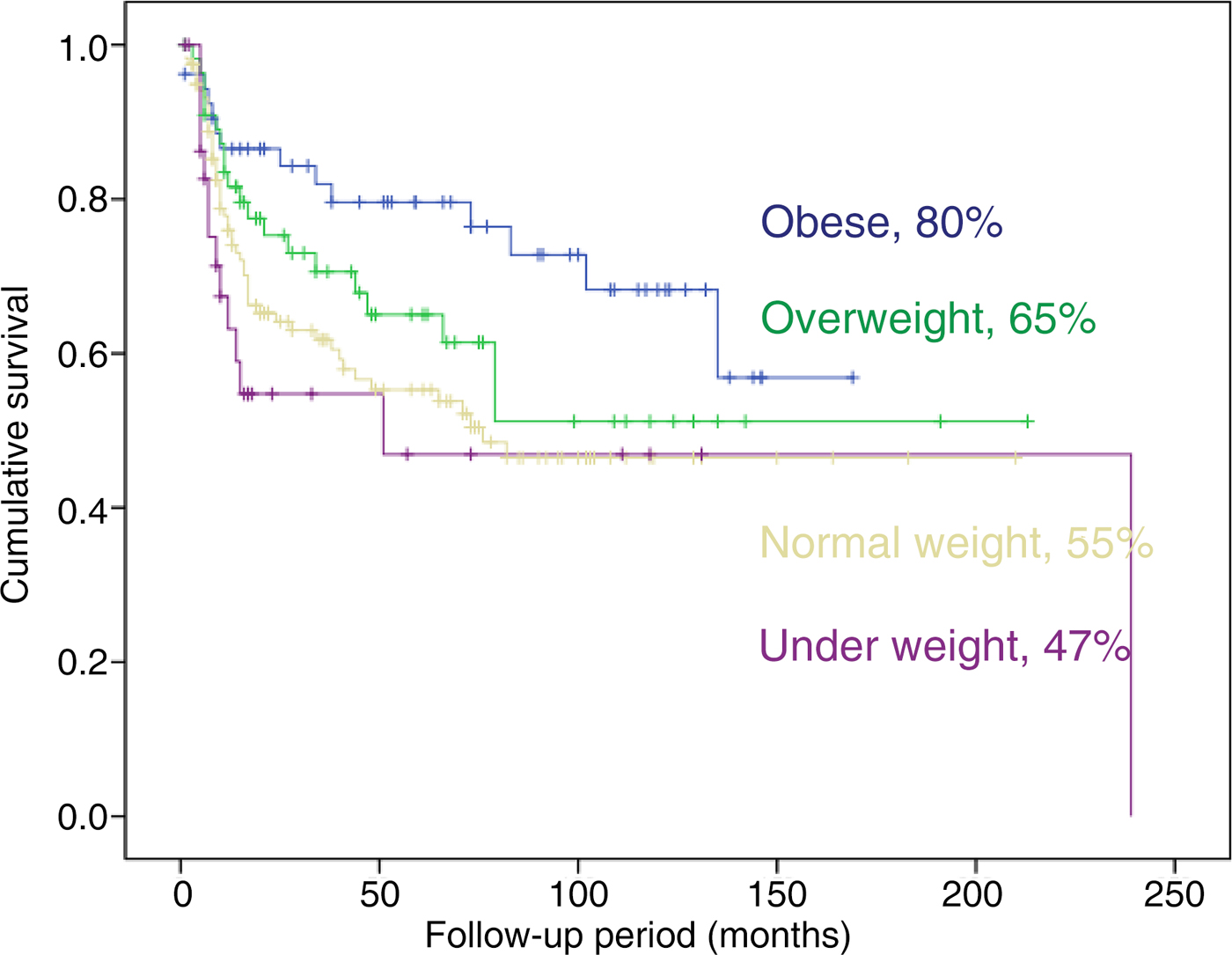
The five-year disease-specific survival rate in our cohort was 63 per cent. The five-year disease-specific survival rate was significantly correlated with pre-operative BMI, based on Kaplan–Meier survival curves (p = 0.028). As shown in Figure 1, the five-year disease-specific survival rates in underweight, normal weight, overweight and obese groups were 47 per cent, 55 per cent, 65 per cent and 80 per cent, respectively.
Kaplan–Meier disease-specific survival curve according to body mass index (BMI). There was a significant association between BMI subgroup and five-year disease-specific survival (p = 0.028).

In regard to the primary site, five-year disease-specific survival was associated with BMI in patients with nasal cavity cancer (p = 0.036) and oropharyngeal cancer (p = 0.027).
Univariate analysis also revealed that advanced age (p = 0.007), advanced pathological T stage (p = 0.028), advanced pathological N stage (p = 0.005) and pre-operative (chemo)radiotherapy (p < 0.001) were associated with five-year disease-specific survival.
Multivariate Cox regression analysis confirmed no significant association between five-year disease-specific survival and BMI subgroup. Pathological N stage (hazard ratio = 1.975; 95 per cent confidence interval (CI) = 1.340–2.909; p = 0.001) and pre-operative (chemo)radiotherapy (hazard ratio = 2.413; 95 per cent CI = 1.460–3.988; p = 0.001) were significantly correlated with five-year disease-specific survival in multivariate analysis.
Discussion
Obesity has complex effects on the body, and leads to a sharp increase in morbidity and mortality when compared with normal weight. It is well recognised that the prevalence of obesity is rising worldwide. Obesity has been found to unfavourably impact peri-operative surgical outcomes in other complex procedures, including hip arthroplasty, hepatic resection and laparoscopic colectomy.Reference Liu, Wahafu, Cheng, Cheng, Zhang and Zhang 11 , Reference McDermott, Heeney, Kelly, Steele, Carlson and Winter 12 However, the data regarding the relationships between BMI, flap failure and survival rate are sparse and conflicting.Reference de la Garza, Militsakh, Panwar, Galloway, Jorgensen and Ledgerwood 13 de la Garza et al. reported that high BMI did not predict medical or surgical complications in patients undergoing head and neck free flap surgery.Reference de la Garza, Militsakh, Panwar, Galloway, Jorgensen and Ledgerwood 13
In the present study, there was no correlation between pre-operative BMI and post-operative complications such as flap failure, flap ischaemia, pharyngocutaneous fistula and wound infection. By contrast, five-year disease-specific survival was significantly correlated with pre-operative BMI, based on Kaplan–Meier survival curves (p = 0.028). Specifically, head and neck SCC patients with high BMI had a better survival rate compared to underweight and normal weight patients.
These results are similar to previous studies in which overweight and obese head and neck cancer patients had significantly lower hazard ratios for mortality.Reference Hollander, Kampman and van Herpen 14 Takenaka et al. reported that pre-treatment BMI was positively associated with survival, independently of sex, age, tumour site, tumour stage, and smoking and alcohol consumption habits, in head and neck cancer patients.Reference Takenaka, Takemoto, Nakahara, Yamamoto, Yasui and Hanamoto 15
One explanation for this finding is the significant amount of weight lost by many head and neck cancer patients at the time of diagnosis, and overweight and obese patients might have higher nutritional reserves to get through cancer therapy. This could be very important, as these patients receive intensive chemoradiation therapy, which often leads to malnutrition and weight loss because of mucositis, dysphagia, oral pain and loss of appetite.
Weight loss during treatment is also a prognostic factor for disease-specific survival in head and neck cancer, as it is associated with poorer survival rates.Reference Hollander, Kampman and van Herpen 14 Additionally, some studies have shown that patients with lower BMI were more likely to have a more advanced stage of disease at diagnosis, which could explain the lower survival rates. This is similar to the observed obesity paradox in renal cancer: it is suggested that tumours in an obesogenic environment might be more indolent and have a growth disadvantage in an adequate nutrition milieu.Reference Hakimi, Furberg, Zabor, Jacobsen, Schultz and Ciriello 16
In previous studies, several variables, including old age, locally advanced tumours, advanced N stage and previous chemoradiotherapy history, were suggested to affect the survival of head and neck SCC patients with free flap reconstruction, resulting in an unfavourable prognosis.Reference Huang, Wang, Cao, Guo, Guo and Mo 17 Similarly, our results showed that advanced age, advanced pathological T stage, advanced pathological N stage and pre-operative (chemo)radiotherapy were associated with five-year disease-specific survival. However, as a simple index, BMI has been ignored for quite some time. Our data suggest that BMI is a simple and reliable factor that can predict the prognosis of head and neck SCC patients with free flap reconstruction. Our data indicate that BMI should be considered a prognostic factor, aiding in the selection of patients for specific treatment. A patient's pre-treatment BMI should be taken into account during clinical decision-making. This finding will prove useful for surgeons when counselling patients and assessing their clinical outcomes.
-
• This study investigated body mass index (BMI) in head and neck squamous cell carcinoma patients undergoing microvascular reconstruction
-
• Five-year disease-specific survival was correlated with BMI in these patients
-
• There was also an association between BMI and disease recurrence
-
• However, BMI was not a risk factor for surgical complications such as flap failure, flap ischaemia, pharyngocutaneous fistula, and wound infection
Some limitations of this study warrant mention. First, the study is inherently limited by its retrospective nature, and the unequal distribution of patients with head and neck SCC at different subsites and at different T stages. Second, we used only pre-treatment BMI as a parameter of nutritional status. Various nutritional parameters have been analysed in previous studies, such as weight loss, BMI, body composition, serum albumin level, haemoglobin level and lymphocyte count. Finally, patients with a higher BMI demonstrated better five-year disease-specific survival in univariate analysis, but this association was not statistically significant in multivariate analysis. There is still much to clarify regarding pre-operative BMI in patients undergoing microvascular reconstruction for head and neck SCC.
Conclusion
In this study, pre-operative BMI was not found to be a risk factor for surgical complications in patients undergoing microvascular reconstruction for head and neck cancer. However, BMI was associated with oncological outcomes in a univariate analysis. These data are valuable to surgeons managing patients who might be considered at high risk of adverse outcomes.