


%20--%3e%3c!DOCTYPE%20svg%20PUBLIC%20'-//W3C//DTD%20SVG%201.0//EN'%20'http://www.w3.org/TR/2001/REC-SVG-20010904/DTD/svg10.dtd'%3e%3csvg%20version='1.0'%20id='Layer_1'%20xmlns='http://www.w3.org/2000/svg'%20xmlns:xlink='http://www.w3.org/1999/xlink'%20x='0px'%20y='0px'%20width='64px'%20height='64px'%20viewBox='5.5%20-3.5%2064%2064'%20enable-background='new%205.5%20-3.5%2064%2064'%20xml:space='preserve'%3e%3cg%3e%3ccircle%20fill='%23FFFFFF'%20fill-opacity='0'%20cx='37.785'%20cy='28.501'%20r='28.836'/%3e%3cpath%20fill='%23595959'%20d='M37.441-3.5c8.951,0,16.572,3.125,22.857,9.372c3.008,3.009,5.295,6.448,6.857,10.314%20c1.561,3.867,2.344,7.971,2.344,12.314c0,4.381-0.773,8.486-2.314,12.313c-1.543,3.828-3.82,7.21-6.828,10.143%20c-3.123,3.085-6.666,5.448-10.629,7.086c-3.961,1.638-8.057,2.457-12.285,2.457s-8.276-0.808-12.143-2.429%20c-3.866-1.618-7.333-3.961-10.4-7.027c-3.067-3.066-5.4-6.524-7-10.372S5.5,32.767,5.5,28.5c0-4.229,0.809-8.295,2.428-12.2%20c1.619-3.905,3.972-7.4,7.057-10.486C21.08-0.394,28.565-3.5,37.441-3.5z%20M37.557,2.272c-7.314,0-13.467,2.553-18.458,7.657%20c-2.515,2.553-4.448,5.419-5.8,8.6c-1.354,3.181-2.029,6.505-2.029,9.972c0,3.429,0.675,6.734,2.029,9.913%20c1.353,3.183,3.285,6.021,5.8,8.516c2.514,2.496,5.351,4.399,8.515,5.715c3.161,1.314,6.476,1.971,9.943,1.971%20c3.428,0,6.75-0.665,9.973-1.999c3.219-1.335,6.121-3.257,8.713-5.771c4.99-4.876,7.484-10.99,7.484-18.344%20c0-3.543-0.648-6.895-1.943-10.057c-1.293-3.162-3.18-5.98-5.654-8.458C50.984,4.844,44.795,2.272,37.557,2.272z%20M37.156,23.187%20l-4.287,2.229c-0.458-0.951-1.019-1.619-1.685-2c-0.667-0.38-1.286-0.571-1.858-0.571c-2.856,0-4.286,1.885-4.286,5.657%20c0,1.714,0.362,3.084,1.085,4.113c0.724,1.029,1.791,1.544,3.201,1.544c1.867,0,3.181-0.915,3.944-2.743l3.942,2%20c-0.838,1.563-2,2.791-3.486,3.686c-1.484,0.896-3.123,1.343-4.914,1.343c-2.857,0-5.163-0.875-6.915-2.629%20c-1.752-1.752-2.628-4.19-2.628-7.313c0-3.048,0.886-5.466,2.657-7.257c1.771-1.79,4.009-2.686,6.715-2.686%20C32.604,18.558,35.441,20.101,37.156,23.187z%20M55.613,23.187l-4.229,2.229c-0.457-0.951-1.02-1.619-1.686-2%20c-0.668-0.38-1.307-0.571-1.914-0.571c-2.857,0-4.287,1.885-4.287,5.657c0,1.714,0.363,3.084,1.086,4.113%20c0.723,1.029,1.789,1.544,3.201,1.544c1.865,0,3.18-0.915,3.941-2.743l4,2c-0.875,1.563-2.057,2.791-3.541,3.686%20c-1.486,0.896-3.105,1.343-4.857,1.343c-2.896,0-5.209-0.875-6.941-2.629c-1.736-1.752-2.602-4.19-2.602-7.313%20c0-3.048,0.885-5.466,2.658-7.257c1.77-1.79,4.008-2.686,6.713-2.686C51.117,18.558,53.938,20.101,55.613,23.187z'/%3e%3c/g%3e%3c/svg%3e)
%20--%3e%3c!DOCTYPE%20svg%20PUBLIC%20'-//W3C//DTD%20SVG%201.0//EN'%20'http://www.w3.org/TR/2001/REC-SVG-20010904/DTD/svg10.dtd'%3e%3csvg%20version='1.0'%20id='Layer_1'%20xmlns='http://www.w3.org/2000/svg'%20xmlns:xlink='http://www.w3.org/1999/xlink'%20x='0px'%20y='0px'%20width='64px'%20height='64px'%20viewBox='5.5%20-3.5%2064%2064'%20enable-background='new%205.5%20-3.5%2064%2064'%20xml:space='preserve'%3e%3cg%3e%3ccircle%20fill='%23FFFFFF'%20fill-opacity='0'%20cx='37.637'%20cy='28.806'%20r='28.276'/%3e%3cg%3e%3cpath%20fill='%23595959'%20d='M37.443-3.5c8.988,0,16.57,3.085,22.742,9.257C66.393,11.967,69.5,19.548,69.5,28.5c0,8.991-3.049,16.476-9.145,22.456%20C53.879,57.319,46.242,60.5,37.443,60.5c-8.649,0-16.153-3.144-22.514-9.43C8.644,44.784,5.5,37.262,5.5,28.5%20c0-8.761,3.144-16.342,9.429-22.742C21.101-0.415,28.604-3.5,37.443-3.5z%20M37.557,2.272c-7.276,0-13.428,2.553-18.457,7.657%20c-5.22,5.334-7.829,11.525-7.829,18.572c0,7.086,2.59,13.22,7.77,18.398c5.181,5.182,11.352,7.771,18.514,7.771%20c7.123,0,13.334-2.607,18.629-7.828c5.029-4.838,7.543-10.952,7.543-18.343c0-7.276-2.553-13.465-7.656-18.571%20C50.967,4.824,44.795,2.272,37.557,2.272z%20M46.129,20.557v13.085h-3.656v15.542h-9.944V33.643h-3.656V20.557%20c0-0.572,0.2-1.057,0.599-1.457c0.401-0.399,0.887-0.6,1.457-0.6h13.144c0.533,0,1.01,0.2,1.428,0.6%20C45.918,19.5,46.129,19.986,46.129,20.557z%20M33.042,12.329c0-3.008,1.485-4.514,4.458-4.514s4.457,1.504,4.457,4.514%20c0,2.971-1.486,4.457-4.457,4.457S33.042,15.3,33.042,12.329z'/%3e%3c/g%3e%3c/g%3e%3c/svg%3e)
1. Introduction
European welfare states have for some time faced growing ‘reform pressures’ such as population ageing, international competition, unemployment, immigration, and sovereign debt. Until recently, most influential scholars tended to predict policy stability in spite of these challenges. Many emphasised mechanisms of institutional inertia, suggesting it is easier to stay on current policy paths (Pierson, Reference Pierson1993, Reference Pierson2001). Institutional entrenchment was also assumed to come with enduring popular support for the status-quo, making political actors reluctant to reform the welfare state.
More recent research, however, concludes that welfare states are increasingly changing in response to reform pressures (Beramendi et al., Reference Beramendi, Häusermann, Kitschelt and Kriesi2015; Hemerijck, Reference Hemerijck2013; Ronchi, Reference Ronchi2018, Reference Ronchi2019). Reforms are not only frequent but are multi-dimensional, as suggested by increasingly popular concepts like ‘retrenchment,’ ‘recalibration,’ ‘social investment,’ ‘activation,’ and ‘dual-earner policy.’ As a result, there is also a growing scholarly focus on the strategies that political actors employ to make reform electorally feasible (Armingeon and Giger, Reference Armingeon and Giger2008; Häusermann, Reference Häusermann2010; Kitschelt, Reference Kitschelt and Pierson2001; Levy, Reference Levy, Castles, Leibfried, Lewis, Obinger and Pierson2010; Ross, Reference Ross2000a; Tepe and Vanhuysse, Reference Tepe and Vanhuysse2010). Traditionally, any change was thought to happen through defensive ‘blame avoidance’ strategies that either conceal problems and reforms altogether or muddle the responsibility for them. But scholars are increasingly assessing offensive ‘credit claiming’ strategies, using concepts like ‘strategic reframing’ and ‘ideational leadership’ (Stiller, Reference Stiller2010). From this viewpoint, even painful and unpopular reforms – retrenchment in particular – may be successfully legitimised, such that decision-makers want to publicly take responsibility for them.
Any such explanations, however, assume that political leaders actually communicate about reform pressures and policy changes. We examine this type of communication in the context of election campaigns. In particular, we investigate whether politicians ‘couple’ pressures with the discernible policy paths now followed in mature welfare states (Kingdon, Reference Kingdon1984). We develop competing expectations about such problem–policy coupling, ranging from no public politicisation to frequent and unbiased coupling of pressures and policy. Analysing 18 election-year party congress speeches in Germany, Norway, and Sweden between 2000 and 2010, we further explore how problem–policy coupling varies across countries, time, incumbency, and the left–right political spectrum.
Our findings reveal an unfinished and biased problem–solution coupling. On the one hand, even in these affluent countries (some) reform pressures are frequently politicised both on the left and on the right. On the other hand, leaders either ‘cherry-pick’ less painful policy responses or refrain from talking about policy altogether. So, while citizens learn that the welfare state is pressured (valuable information in its own right) they are not exposed to all policies they increasingly have reason to expect after elections. We discuss in the conclusions how the information that citizens (do not) get may affect public acceptance of welfare state change.
2. Blame avoidance and the ‘new politics’ of the welfare state
Since the 1980s a prominent concept for understanding reform strategies was blame avoidance (Pierson, Reference Pierson2001; Weaver, Reference Weaver1986). Under Pierson’s (Reference Pierson2001) ‘new politics of the welfare state’ framework, several assumptions explain why reforms are modest and are restricted to certain areas and contexts. Citizens are seen as risk-averse; their fear of deterioration being stronger than their desire for improvement (Vis, Reference Vis2011). Further, while any societal gains from retrenchment (the reform type that dominates this theory) are diffuse and uncertain, the losses are visibly concentrated to self-interested and easily mobilised groups. Consequently, policy-makers must deflect responsibility and muddle debates, catering to narrow status-quo-oriented interests of electoral importance.
There is a plethora of blame-avoidance strategies (Hood, Reference Hood2002; Weaver, Reference Weaver1986). We focus on three commonly discussed ‘presentational’ strategies in public communication. Agenda control allows blame-avoiding actors to keep uncomfortable pressures and unpopular policy off the agenda altogether. In Hood’s words (Reference Hood2007: 36), this involves the ‘use of diversions to avoid the spotlight of blame and shift the public agenda onto other issues.’ A second strategy is playing the crisis card, i.e. arguing that pressure is so severe that ‘we have no choice’ but to opt for unpopular change. For instance, leaders argue that a massive economic crisis with growing budget deficits necessitates policies that neither citizens nor political leaders want (Kuipers, Reference Kuipers2006; Starke, Reference Starke2008). The third technique is cherry-picking certain policies to be promoted electorally. Here, leaders neither shy away from underlying reform pressures, nor do they argue that we are without choice. However, they take care not to promote the most unpopular policies that citizens could nonetheless expect after the election.
The need for blame avoidance may differ across the left–right spectrum. Ross (Reference Ross2000b: 162, 164) suggested a ‘Nixon goes to China’ logic, under which rightist parties are more vulnerable to blame for retrenchment than leftist parties, who ‘own’ welfare issues and enjoy greater public trust in this domain:
‘The principal psychological mechanism conditioning voters’ response to issue-associations appears to be trust – specifically the opportunities trust provides for framing retrenchment initiatives in a manner that voters find acceptable if not compelling. […] voters do not trust rightist parties to reform the welfare state whereas they assume that leftist parties will engage in genuine reform rather than indiscriminate and harsh retrenchment.’
If this logic holds we can expect rightist parties to engage more in cherry-picking, whereas leftist parties have more leeway to promote retrenchment as a reform component. More than this, while the Nixon hypothesis was formulated with retrenchment strategies in mind, we will examine empirically if it applies also to the other blame-avoidance strategies discussed above.
3. Beyond ‘new politics’: credit claiming, strategic reframing, and ideational leadership
As we have discussed elsewhere (Goerres et al., Reference Goerres, Karlsen and Kumlinforthcoming), several studies now demonstrate recurring features of reform politics that stretch beyond blame avoidance. Indeed, ‘Retrenchment is not always unsavory and conspirational. Governments can also enact spending cuts by taking their case to the public, hitching retrenchment to higher objectives […] and addressing concerns about fairness’ (Levy, Reference Levy, Castles, Leibfried, Lewis, Obinger and Pierson2010: 561). Bonoli (Reference Bonoli, Bonoli and Natali2012) discusses several examples of ‘credit claiming’ for seemingly unpopular reform, but notes that this research area is still small compared with the larger field of blame avoidance (e.g. Hood, Reference Hood2007; Lindbom, Reference Lindbom2007).
Specifically, a number of studies emphasise proactive agenda-setting of reform pressures and policy solutions. This is different from blame avoidance, where problems stay off the agenda unless the ‘no choice’ crisis card can be played or coupled with cherry-picked policy. Stiller (Reference Stiller2010: 35) develops and tests a model of ‘ideational leadership’ in which, among other things, actors are assumed to ‘link the existing situation in a policy area to themes like failure, inefficiency, crisis, welfare loss, and the like’. Thus, they publicly put reform pressures firmly on the agenda, explaining how they necessitate the consideration of policy change. Besides problem-solving, this typically allows leaders to shame opponents for cowardly ignoring obvious problems. Leaders also openly legitimise all intended reform policies using ‘cognitive’ as well as ‘normative’ arguments. Cognitive arguments explain how a proposed policy alleviates unsustainability brought on by reform pressures. Normative ones connect solutions to values like fairness and deservingness (also see Hoggett et al., Reference Hoggett, Wilkinson and Beedell2013).
Several studies of concrete reform processes broadly support these ideas. For example, in a case study of cutbacks to early retirement benefit in Denmark, Elmelund-Præstekær and Emmenegger (Reference Elmelund-Præstekær and Emmenegger2013) reveal that the centre-right government won electoral and attitudinal support for reform ‘by framing it as fair and economically reasonable’ (p.33), while it ‘did not commit electoral suicide by breaking a political taboo and opting for retrenchment of a highly popular welfare scheme shortly before an election (p.37).’ Thus, reform pressures (immediate crisis but also long-term costs) and policy response (retrenchment) were actively placed on the campaign agenda although public opinion was initially adversarial. In an example of a Norwegian pension reform, Ervik and Lindén (Reference Ervik and Lindén2015) show that significant retrenchment, but also significant debate about it, is not necessarily restricted to a context of crisis but can apply to a context of affluence. Interestingly however, the authors report big differences between behind-the-scenes discourse among elites and public debate. The former was dominated by worries over the pressure of population ageing and resulting unsustainability. Public discourse, by contrast, was filled with normative arguments about fairness or the insistence that reform was harmless. Hence, when analyzing credit claiming, ideological leadership, and similar concepts, we must be sensitive to the possibility of a biased emphasis on positive aspects and consequences, and the neglect of negative ones. Especially in affluent contexts, like those studied here, politicians might avoid ‘cognitive’ arguments about problematic reform pressures and uncomfortable solutions, and rather only stick to claims about fairness and popular consequences only. This is clearly something different from the unbiased mix of arguments found in the ideal-typical ‘ideational leadership’ discussed above (Stiller, Reference Stiller2010). Additionally, one might also contrast such leadership with the cherry-picking strategy discussed earlier. Seen from the viewpoint of newer work on ideational leadership the cherry-picking strategy becomes, at best, an unsatisfactory mix of a certain credit claiming element (proactive reform pressure agenda-setting) and a clear blame-avoidance element (cherry-picking of popular policy in response to reform pressure).
4. Our argument
Our work improves on past research in three ways. First, past studies have tended to examine cases where it was clear that dramatic reform, usually retrenchment, had actually happened (e.g. Ervik and Lindén, Reference Ervik and Lindén2015; Stiller, Reference Stiller2010). Scholars then worked their way backwards to illustrate reform arguments used both behind the scenes and in public. Our approach, rather, identifies relevant material that captures political communication between leaders and citizens to gauge how much ‘reform pressure talk’ there really is, what it is about, and how strongly it is linked to policy solutions. This strategy arguably gives a fuller and more realistic picture of public politicisation of reform pressures and policy solutions. In addition, it allows us to consider a longer menu of policy options. Welfare state reform is increasingly marked by a shift from pure retrenchment and cost containment responses and increasingly towards ‘recalibration,’ ‘social investment’ and ‘activation.’ Common to these latter trends is the idea that the welfare state is not just part of a problem to be downscaled, but that certain expansive policies can be part of the solution to resolve pressure and sustainability problems (see Morel et al., Reference Morel, Palier and Palme2012; Raffass, Reference Raffass2017; Vaalavuo, Reference Vaalavuo2013).
The multitude of new policy tracks has dramatically increased opportunities for cherry-picking. In particular, several ingredients of the social investment/activation turn – examples include dual-earner policies and education and employment incentives – are typically found to be popular, not least among growing and electorally mobile ‘new middle classes’ (Gingrich and Häusermann, Reference Gingrich and Häusermann2015). Such policies are also associated with small, partisan left–right differences compared to retrenchment (Allan and Scruggs, Reference Allan and Scruggs2004; Jakobsson and Kumlin, Reference Jakobsson and Kumlin2017; Korpi and Palme, Reference Korpi and Palme2003) or privatisation (Zehavi, Reference Zehavi2012).
A second contribution arises as much past research has investigated how economic crises trigger welfare reform (Kuipers, Reference Kuipers2005). By contrast, our design incorporates also other, more long-term and diffuse pressures, such as population ageing (also see Goerres and Vanhuysse, Reference Goerres, Vanhuysse, Vanhuysse and Goerres2012). In addition, we examine three countries – Germany, Norway, and Sweden – that are clearly in the more affluent half of Europe’s mature welfare states. This allows us to probe the contextual and substantive limits of credit claiming. But we also follow these countries over time, before and after the financial crisis of 2008, to see whether the financial crisis mattered in these respects.
Third, we provide systematic data at a ‘soundbite’ level about what politicians actually say in public to voters about welfare state change. Past research has often been somewhat impressionistic in its treatment of the public side of welfare state reform, and has tended to be presented as broad historical analyses of policy and politics during particular reform-intense phases (e.g. Bonoli, Reference Bonoli, Bonoli and Natali2012; Cox, Reference Cox2001; Schmidt, Reference Schmidt2002). This approach tends to rely on general summaries of the ideas, positions, arguments, and policies espoused by political actors, sometimes combined with anecdotal examples of public statements. Thus, it seems essential to analyse more systematically what political leaders are actually saying to voters and to the media in campaign settings.
5. Design, data, and methods
We analyse the content of party leaders’ speeches in Germany, Norway, and Sweden in the election years between 2000 and 2010. During this period, all three countries saw shifts from social-democratic-led to conservative-led governments. More generally, all three countries displayed a mix of similarities and differences that made them suited to our purposes. Importantly, they had all seen welfare reform along the multiple dimensions discussed earlier (for example, retrenchment, social investment, and recalibration). At the same time, all three are among Europe’s most economically stable welfare states and have displayed few crisis symptoms. For example, they are among the countries that weathered ‘the great recession’ best (also see statistics in Appendix A.1 and Berkmen et al., Reference Berkmen, Gelos, Rennhack and Walsh2012; Claessens et al., Reference Claessens, Dell’Ariccia, Igan and Laeven2010; Starke et al., Reference Starke, Kaasch and Van Hooren2013, Reference Starke, Kaasch and Van Hooren2014). Overall, these three countries allow us to examine whether pressures and policy solutions enter campaign agendas in stable and sustainable contexts where it should be unusually difficult to ‘play the crisis card’.
Clearly, country variation exists in economic trajectories and welfare reform. Germany, for example, with its Bismarckian social insurance system built on income and status maintenance principles, was long seen as impervious to change (e.g. Cox, Reference Cox2001). This perception, however, changed gradually throughout the 2000s with the ‘Hartz reforms’ in labour market policy and through expansion of dual-earner support (Palier, Reference Palier and Palier2010). Sweden had already undergone major retrenchment and restructuring during a severe economic crisis in the early 1990s. However, multidimensional changes in sick leave and unemployment protection followed in the more benevolent times under the centre-right government after 2006 (Lindbom, Reference Lindbom2011). Of the three countries in the study, Norway stands out economically with its unparalleled oil revenues and its many socio-economic indicators at unusually positive values. Norway also probably displays more policy stability than the other two countries, but with several significant exceptions in pension and family policy reforms in the 2000s (Bay et al., Reference Bay, Hatland, Hellevik and Koren2010).
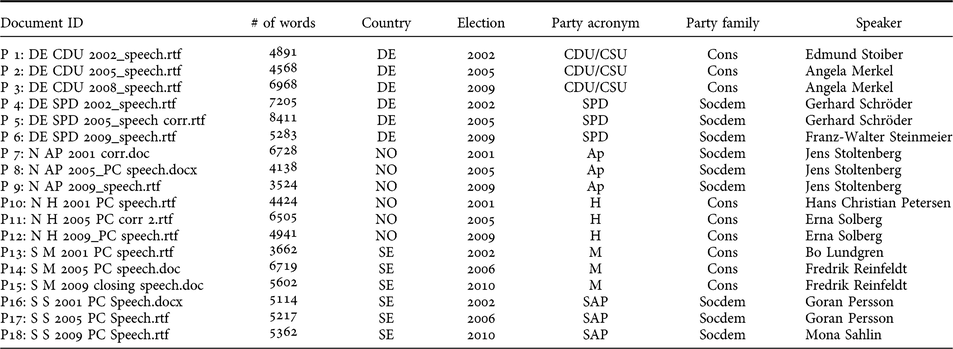
We studied speeches from the major social-democrat and the conservative/Christian-democrat parties. Specifically, the data set comprises the speeches by the prime ministerial candidates, usually the party leaders, from the 18 party congresses preceding national elections between 2000 and 2010. The speeches vary in length between ~3,500 and ~8,400 words, with a mean of ~5,500 words (see Appendix A.4), and a total of 99,200 words. These speeches are central communication material, as party congresses have become significant media events in West European politics. Excerpts with commentary routinely make it on to national TV, online and radio news, and print media.Footnote 1
Passages that dealt with the welfare state (all institutions, policies and resources intended by publicly authorised allocation to reduce socio-economic inequality and to increase social security of individuals, see Flora and Heidenheimer, Reference Flora and Heidenheimer1981) were delineated in ‘thematic units’, meaning parts of the speech that belonged to one overarching specific argument. So, the beginning and the end of each coded passage was defined by the overall argument in which the welfare state was mentioned.
We created 29 codes that in turn fell into two ‘code families’. The first code family was ‘reform pressures and opportunities’ (rpo’s). These were defined as social, economic, and political developments or patterns that affect preconditions of, create challenges for, or open windows for action, or that force outright changes in the welfare state policy domain. The second code family concerned policy responses defined as concrete political measures in the realm of welfare state politics. Details of the coding development and examples can be found in appendices A.3 and A.5.
6. Empirical analysis
First, we look at the univariate patterns in the code family of reform pressures and opportunities (rpo’s). Second, we explore bivariate associations of that code family with time, party family (left–right), incumbency, and country context. Third, we analyse the codes according to their relationships with proposed policy responses.
6.1 Describing patterns of reform pressures and opportunities
Table 1 displays the 14 thematic codes that belong to the rpo family. It reveals the absolute number of words coded and the relative proportion of these codes given the overall number of words.
Fourteen thematic codes about reform pressures and opportunities

Rpo’s are clearly salient in the speeches. Recall that our coding only pertains to passages in which the welfare state was the focus of attention. Still, 15.8% of all words could be attributed to at least one of the 14 rpo codes. In other words, about one-sixth of the speeches were associated with at least one of the welfare state reform pressures listed. This high salience of reform pressures is interesting as it does not sit well with blame avoidance, understood as ‘agenda control’, i.e. not talking about problems at all.
From the list of rpo’s in Table 1, we can discern four dominant meta themes: (1) labour market (low employment 4.4% and unemployment 4.3%); (2) the economy (lacking health 2.5% and economic internationalisation 0.6%Footnote 2 ); (3) population change (international migration 1.0%, population ageing 0.7%) with the work–family nexus at the intersection between labour market and population change (1.7%), and (4) inequalities (economic inequality 1.3% and interregional inequality 0.7%). These four themes – labour market, economy, population change, and inequalities – make up the bulk of welfare rpo’s used by the prime ministerial candidates. Among these, labour-market-related pressure is most mentioned.
6.2 Correlates of the salience of welfare state pressures
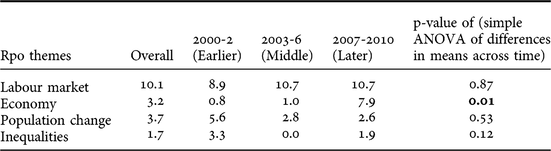
The salience of reform pressures increases somewhat over time (Table 2). The average proportion of speeches dedicated to at least one rpo was 14.1% in the earlier period (2000-2), 12.9% in the middle period (2003-6), but 19.5% in the later period (2007-10). This might be expected after the crisis of 2008. Still, the change is neither large nor significant (ANOVA p = 0.38) and pressures were clearly salient also before the crisis.
Rpo themes in % of all words across three time periods between 2000 and 2010
Rpo theme measures is a sum of the salience of constituent rpos.
Work–family nexus is used twice to calculate labour market and population change.
Analysing our four rpo themes over the three time periods, we see that labour market reform pressures were consistently high between 2000 and 2010, with no significant variation. The economy theme increases in the later period after the onset of the global financial crisis (a strongly significant change at p = 0.01), this being the single most important explanation of the overall time increase. Demographic pressures and inequalities, both relatively slow processes, varied little with no significant trend over time.
We now explore whether the salience of all 14 rpo topics co-vary with the characteristics of the speeches. First, we look at the relative salience of rpo’s across all 18 speeches. Leaders of the main conservative parties used slightly fewer words on rpo’s (14.0%) than those of the main left parties (17.0%). This small difference (not significant, t-test, p = 0.46) is found again when we look at the number of rpo topics per speech, which on average is 3.7 rpo’s in conservative speeches and 3.9 in left party speeches (p = 0.79). This result arguably does not fit well with the ‘Nixon goes to China’ scenario under which the left finds it much easier to politicise uncomfortable reform pressures.
Incumbent prime ministers speak slightly more about reform pressures (17.3%) compared with the opposition candidates (13.2%) (p = 0.32). Incumbents also address more pressures per speech on average (4.1) than the opposition parties (3.4) (p = 0.38). Arguably, this pattern does not support the blame avoidance perspective as one would expect the opposition to talk more about the problems they could not be blamed for. It is rather suggestive of a more proactive rhetoric on the part of the government than blame avoidance suggests.Footnote 3
6.3 The relationship between pressures and policy responses
We now consider the links between reform pressures and policy responses, the second part of the problem–policy ‘coupling.’ We define a policy response as the speaker’s own statements or his/her party’s actions in government or in parliament, and not as remarks about political opponents or other parties (as in a coalition). Policy responses reveal current policy preferences at the time of the speech.
Our coding exercise ended with 12 codes for policy responses that could be heuristically grouped into three levels of overall electoral popularity: low, mixed or high. Those policy response codes in the high-popularity group are policies that are commonly assumed (or empirically found) to be most welcomed by medians voters in these countries. For active labour market policies (ALMP), we went through each coding and decided individually in which group particular statements belonged. Politicians sometimes address only the opportunities that are linked to expansionary ALMPs, such as new further education programmes, which we coded as popular (13 instances). From a social investment perspective, they are sometimes called ‘enabling’ ALMPs (for a discussion see Fossati, Reference Fossati2018; Goerres et al., Reference Goerres, Karlsen and Kumlinforthcoming). At other times, actors propose greater duties for, and harsher demands on, individuals. These we coded as low popularity (four instances, called ‘demanding’ in the cited literature), leaving a residual category of ALMPs with mixed signals (four instances).
Overall, we assume that the following seven policy types belong to the group of comparatively high-popularity policies: defence of the status-quo; social investment; expansion; efficiency gain and cost containment of existing programmes, vague improvements and ALMPs with only enabling opportunities mentioned. These types of policy responses come out clearly towards the top and middle of Table 3 (ranks 1-3, 6-8 out of 13). The salience of defence of the status-quo, social investmentFootnote 4 and expansion of existing programmes have the highest salience of 5.1%, 5.0% and 4.4% respectively, followed by vague improvements (2.5%), active labour market policy – opportunities (2.4%) and cost containment (2.0%) further down. At the bottom of the table, we find retrenchment (0.5%) for which there is just one instance (Swedish Conservative speech by Fredrik Reinfeldt in 2005). The demanding version of active labour market policy is slightly more common at 1.5%. The mixed-popularity policy responses range from other organisational reforms (3.2%), privatisation and market reforms (2.8%) in the upper half of the table, to structural public sector reforms (1.1%), active labour market policy, mixed signals (1.0%) and recalibration (0.5%) towards the end of the table.
Salience of types of policy responses in the context of the welfare state

Note: A residual ‘Other’ category captured another 0.5% salience.
How are policy responses coupled with reform pressures (rpo’s)? To answer this, we check whether each rpo coding instance is linked with a policy response and if it is, we code its response type. Linkage is established when the respective codes are either directly overlapping or are in adjacent paragraphs. We do this first descriptively and then in a multivariate analysis.
Table 4 shows that there are 85 instances where at least one rpo code was used. Forty of these instances were linked with a policy response of high electoral popularity, ten with mixed popularity, and five with low popularity. Thus, almost two-thirds of all pressures (53 out of 85) are linked with a policy response, whereas about one-third can be described as active problem agenda-setting lacking a clear policy solution.
Bivariate analysis of codings of reform pressures and opportunities and their links to policy responses at different levels of electoral popularity
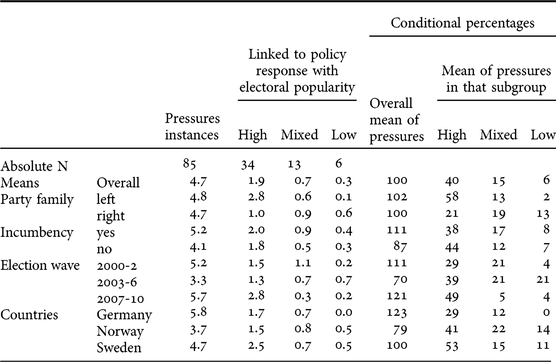
Moreover, 40% of all reform pressures are linked with a positive policy response, 15% with a mixed response, and 6% with an unpopular response. Expressed differently, we found an average of 4.7 codings of rpo’s per speech. An average of 1.9 are linked with a high-popularity policy response, 0.7 with a mixed policy response, and 0.3 with a low-popularity policy response.
Table 4 also allows us to compare different subgroups of speeches. On the left-hand side, we see the means for each subgroup defined by the row variable. For example, left parties have a mean of 4.8 instances of rpo’s in their speeches, 2.8 instances of linkage with high-popularity responses, 0.6 instances for mixed-popularity responses, and 0.1 for low-popularity responses. On the right-hand side, we see the conditional proportions as a percentage. For example, left parties have 102% of the mean for rpo’s in their speeches. Given the number of instances of rpo’s in their speeches, 58% of them are linked with high-popularity policy responses, 13% with mixed-popularity responses, and 2% with low-popularity responses. These can be easily compared with the percentages of right parties. Their mean of rpo’s is exactly the mean overall (100%), but only 21% of their rpo instances is linked with high-popularity policy responses, 19% with mixed-popularity responses, and 13% with low-popularity responses.
These examples show that whereas right and left show similar levels of reform pressure talk, left party speakers are clearly more prone to couple pressures with any sort of policy response, and in particular to high-popularity responses (pressures yes, but no painful reforms). Conservative speakers display a more balanced pattern when policy is at all mentioned. Crucially however, they are much less likely to bring up discernible policy solutions in the first place; this omission happens in roughly 50% of conservative pressure messages. So, conservatives stay more balanced but also more silent on policy.
Incumbency does not change the focus given to linking an rpo with a high-popularity policy response (38% to 44% – comparable with the overall mean of 40%). So, incumbents talk slightly more about pressures, but are not different in the policy types that the pressures are linked with (this result will be different in the multivariate analysis below).
As for the time dimension, the number of rpo instances per speech is lower in the middle period 2003-6 (70% of the overall mean) compared with the early period 2000-2 (111% of the overall mean) and the later period 2007-2010 (121% of the overall mean). However, the later period has a higher relative percentage of high-popularity policy responses (49% given the number of rpos in the speeches) with few links to other policy responses (5% mixed, 4% low). The middle period displays a more balanced coupling of high-popularity (39%), with mixed-popularity (21%), and low-popularity policy responses (21%). Recall that the poor health of the economy was the most important rpo in the later period, and we can now infer that the economic crisis led not only to a higher salience of rpo’s in general, but also to a stronger focus on coupling with high-popularity responses. Thus, crisis means more talk about pressures, but it also means more cherry-picking.
Finally, the country differences are interesting. Norway is clearly the least pressured welfare state, with the lowest number of instances of rpo talk in its speeches (79% of the overall mean). At the same time, Norwegian politicians also show the most balanced pattern in terms of linkage with policy. Given the number of rpo instances in the Norwegian speeches, only 46% of them are linked to high-popularity policy responses, but 22% are linked with mixed-popularity, and 14% with low-popularity responses. Across all speeches, we find that a stronger emphasis on reform pressure is associated with a higher connection with high-popularity policy responses (p = 0.30).
We also carried out a subsidiary multinomial regression analysis in which each of the 85 pressure instances was an observation. The dependent variable was coded 0 for no link (40%), 1 for a link to a high-popularity policy response (39%), 2 for a link to a mixed-popularity response (16%), and 3 for a link to a low-popularity response (5%). For independent variables, we used: the overall number of rpo instances in the speech, party family, incumbency, year, and country (not shown).
This analysis (see Table 5) largely corroborates the speech-level analysis above and yields a few further insights. First, recall that many instances of rpo codes in a speech are not linked with a particular policy response. Each additional rpo instance is predicted to increase the chance of it not being linked by an average 5%, and to decrease it by 4% with respect to mixed-popularity policy response. An rpo coding in a social-democratic speech is (on average) 40% more likely to be linked to a high-popularity measure than in a conservative speech, and less likely for there to be no link, or a link with mixed-popularity or low-popularity measures, although these estimates are not always significant. Rpo codings in incumbents’ speeches have an 18% lower chance of linking with something positive, and a 22% higher chance of linking with a mixed-popularity response compared with codings in a member of the opposition’s speech. This is a new finding that was not clear in the bivariate analysis.
Predicted average marginal effects in % change from multinomial regression anlysis on how rpo coding instances were linked to policy response
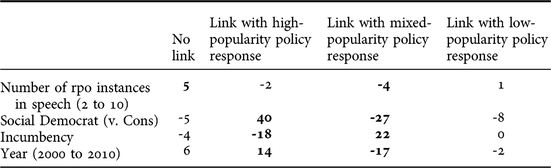
Estimates for countries not shown. Estimates in bold: p<0.10. 82 observations (Three instances are excluded because they are simultaneously linked to two responses), McFadden R2 = 0.217, standard errors clustered by speech. Each cell entry is the predicted average marginal effect change if the respective independent variable is changed from its minimum to its maximum.
Finally, the estimated effect each additional year on linking with high-popularity policy is 14% together with a decrease of talking about mixed-popularity policies of 17%. This again supports the notion of higher levels of crisis talk in recent years being associated with higher levels of cherry-picking. Estimated variations within each country are generally not significant, with only Norwegian rpo codings having a significantly greater likelihood of being linked with a negative response.
7. Conclusions
Our results reveal an incomplete and biased ‘coupling’ between welfare state reform pressures and policy responses in election campaigns. On the one hand prime ministerial candidates on both the left and the right devote a significant share of their election-year congress speeches to reform pressures. This phenomenon is present throughout the examined period (2000 to 2010) and grew only marginally after the financial crisis of 2008. Further, it is found in Germany, Norway and Sweden – clearly among Europe’s affluent welfare states – which suggests that it does not take a major crisis or unusually severe pressures to trigger debate about them. These particular findings, as far as they go, support the proactive agenda-setting of reform pressures emphasised in recent work on ‘ideational leadership’ and similar concepts. Relatedly, we see little evidence of blame avoidance strategies understood as hiding problems altogether, or using crisis as a reason for unpopular reforms.
On the other hand, the verdict on blame avoidance changes when we pay close attention to the links between pressures and polices. To begin with, about one third of all talk about pressure in the speeches is not associated with any policy. Moreover, the policies that can be discerned are mostly of the allegedly popular types, including social investment, enabling active labour market policy, defending/expanding the welfare state, or just hinting vaguely at improvements. Rarely do leaders couple pressures with retrenchment or punitive aspects of demanding active labour market policy, although these have been part of actual reforms also in these countries. Instead, leaders cherry-pick from a more complex and partly unpopular menu of ongoing reform.
There are certain differences between left and right parties. Left parties are more prone to couple pressures with policy, in particular policy we have defined as highly popular. It would thus appear that social democrats engage more in “cherry-picking.” This conclusion is permissible given that other studies show that social democrat governments are equally likely to engage in retrenchment following elections where welfare issues have been salient (Jakobsson and Kumlin, Reference Jakobsson and Kumlin2017). Right parties talk almost as much about pressures, but are more cautious about revealing policies. Whenever they link pressures with policies (still the most common outcome) they emphasise high- or medium-popularity policies. Overall, the left–right difference in our data is not about daring to politicise pressures (both sides do), nor about politicising unpopular policies (neither side does), but rather about how closely pressures are linked with policy at all (the left does this more, and in particular it links with the most popular policies). These fine nuances hardly fit a traditional left–right model, under which the right would attack the welfare state by politicising pressures and retrenchment. The left would downplay pressures while defending or expanding the welfare state. Neither do the patterns support the ‘Nixon goes to China’ logic, under which the left has greater leeway in politicising retrenchment.
Our findings beg the question of how the incomplete information provided by leaders affects the public and ultimately welfare state change. In general, recent experimental work suggests citizens do have a capacity to respond also to relatively complex information about welfare state pressures and policy (Kumlin, Reference Kumlin, Kumlin and Stadelmann2014). More specifically, juxtaposing our results with recent public opinion research yields two insights. The more upbeat one is that cherry-picked information may still prepare citizens also for unpopular change. Recent studies use natural experiments to show that reform pressures themselves reduce demands for government responsibility (Jensen and Naumann, Reference Jensen and Naumann2016) while experimental studies show that policy-free ‘pressure frames’ can trigger concerns about welfare state sustainability (Goerres et al., Reference Goerres, Karlsen and Kumlinforthcoming). These concerns in turn moderate electoral punishment for retrenchment (Giger and Nelson, Reference Giger and Nelson2013; Ronchi, Reference Ronchi2019). Together, these studies suggest that citizens are to some extent able to draw their own conclusions. They may realize that not all policy responses to problematic pressures can be pain-free, even when leaders pretend they are. The incomplete information that citizens get, then, may still generate some acceptance also for the less popular and more painful types of reform.
The second insight is less sanguine. Recent findings on attitudes towards social investment policies reveal that the allegedly most popular types of reform lose much support when citizens are confronted with simultaneous cutbacks in other welfare state programmes (Busemeyer and Garritzman, Reference Busemeyer and Garritzmann2017). Thus, the structure of welfare state support shifts when retrenchment and expansion are simultaneously salient and in competition against each other. More often than not, however, support for ‘popular’ types of reform is likely exaggerated as citizens – according to our study – are normally not invited by their leaders to ponder the totality and the trade-offs inherent in welfare state change.
Acknowledgements
We acknowledge funding from The Research Council of Norway (project 217122/H20) to Staffan Kumlin. Further funding came from seed money of the University of Duisburg-Essen. Earlier drafts were presented at a panel organised by Felix Hoerisch and Georg Wenzelburger at the ECPR General Conference in Bordeaux, France, 5-8 September 2013, at the annual conference of the Social Policy Section of the German Sociological Association, 26-27 September 2013, two internal seminars at the University of Duisburg-Essen and the Colloquium Empirical Social Research at the University of Frankfurt (Main) and the workshop on welfare state reforms at Lund University organised in 2015 by Moira Nelson and Georg Wenzelburger. We thank all participants and discussants as well as Christoffer Green-Pedersen. We thank research assistants Hedda Haakestad, Hayfat Hamidou, Atle Haugsgjerd and Hanna Bugge for much appreciated efforts.
Appendix
A.1 Economic Development and social expenditure of Germany, Norway and Sweden between 2000 and 2010
Table A1 presents the data for the development of the economy and social policy expenditure for the three countries in comparison to the OECD countries. In 2000, all three countries started in the upper half in terms of GDP per capita with all countries above the median of 33,037 US $. With regard to total expenditure, the three countries were even in the highest 25 % in terms of spending per capita with all countries spending more than the 75th percentile at 6,657 US$. When we compare the 5-year period between 2005 and 2010 (well before the crisis started and at the end of our period of investigation), we can clearly discern that all three countries were clearly in the highest 25 % of all countries with Germany and Sweden showing increases of 7.7 % and 4.2 % respectively and Norway having a relatively small decline of -1.0 %. Half of the OECD countries saw their GDP shrink by -3.5 % and 75 % by at least -1.8 %. Economically these countries did relatively well during this period. In terms of social spending per capita, the three countries saw small increases between 1.1 % (Sweden), 4.2 % (Norway) and 7.7 % (Germany). The median moved by 17.7 % for all OECD countries, meaning that half of all OECD countries witnessed an increase of their social spending by about one sixth.
Developments in the economy and social expenditure 2010 to 2010, Germany, Norway, Sweden
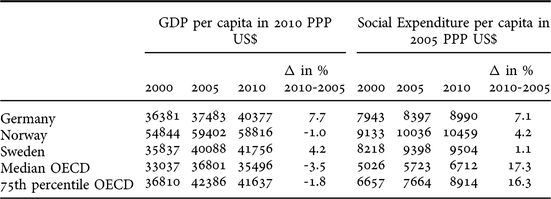
Source: OECD Database.
Overview of basic speech characteristics
A.2 Discussion of alternative communication material
We considered alternative communication material (interviews in newspapers, executive speeches and party manifestoes) before focussing on the party congress speeches: (a) interviews with the leading candidates in national newspapers are certainly very condensed statements that carry a lot of media weight, but they are very personalised as well, giving fewer cues about the party behind the candidate and about policies. Also, they are less apt for comparison across countries since the landscape of the national newspapers differ internationally. (b) Mortensen et al (Reference Mortensen, Green-Pedersen, Breeman, Chaqués-Bonafont, Jennings, John, Palau and Timmermans2011) use executive speeches to study government agendas, and John and Jennings (Reference John and Jennings2010) use the Queen’s speech to study developments in British Politics. The speeches that we look at are – to some extent – the “wishing-list siblings” of the executive speeches that are the result of negotiations and Realpolitik. Executive speeches have a similarly high level of public attention and need to be either consistent with what has been said at the party conference before, or justifications have to be made about deviations. (c) Party manifestoes do not have such a widespread echo in the electoral area, compared to the speeches and their media tenor (Rölle Reference Rölle2002). Indeed, Adams et al. (Reference Adams, Ezrow and Somer-Topcu2011) found that voters do not react ideologically to actual changes of political parties, but they do react to their perceptions of parties policy change, another hint at the importance of reception of information. In sum then, the political speeches that we study are comparable across contexts, are mediatised in national media outlets, represent a first anchoring point for policies and are produced in an electorally salient period in the run-up to the next election.
A.3 Development of codes
Our development of a codebook for the first family (rpo’s) started with a small number of preconceived and much-debated reform pressures and opportunities, i.e. objectively measurable developments that could be construed as putting pressure on existing welfare state institutions, such as ‘population change,’ or ‘economic internationalisation.’ We then elaborated on the codebook by induction.
The coding was performed by a Scandinavian and a German team, each consisting of near-native primary researcher(s) with assistants. These teams communicated throughout the iterative development of the coding scheme. Both teams first coded two documents per country, and after conferring with each other, they revised and harmonised the coding scheme. They then coded six documents using the revised scheme, conferred again, and finally coded all the documents. At each stage, they developed the code list further, creating new codes, improving code definitions, and restructuring the code hierarchy. In total, there were 12 iterations, each one yielding a slightly different codebook, with the number of changes decreasing dramatically with each iteration (Peter and Lauf Reference Peter and Lauf2002).
Due to the demanding coding exercises with a complex codebook and three languages (German, Norwegian and Swedish), and with English as the target language, we finalised each coding decision with a group decision across national teams (Krippendorff Reference Krippendorff2004: 417). More specifically, one polyglot researcher on the team served as an inter-language anchor to compare coding decisions and interpretations of the codes. Thus, each coding decision was discussed by this person and at least one other researcher, and a consensual decision was made. Any disagreements about code application were resolved. For a methodological discussion about inter-rater reliability approaches in qualitative content analysis, see Pope et al. (Reference Pope, Ziebland and Mays2000); Armstrong et al. (Reference Armstrong, Gosling, Weinman and Marteau1997).
A.4 List of speech specifics
We have identified 18 speeches that were held at the party congresses of one of the two main parties in each country in the last general conference before the election by the prime ministerial contender, who most of the time but not always was the party leader. Sometimes, the general conference took place in the calendar year before election year.
A.5 Example of a coding
An example could be the following coding taken from the 2002 speech by the then-chancellor and SPD candidate for the 2002 election Gerhard Schröder (line 238):
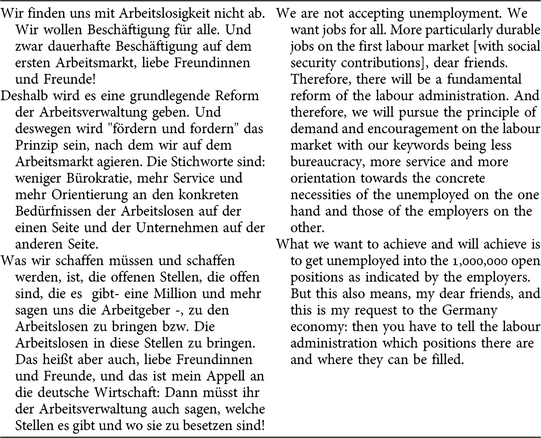
This passage is about unemployment insurance and its administration, institutional structures at the core of the welfare state. So it qualifies for coding. This passage was coded by two of the pressures codes, namely unemployment and bureaucracy. Both are clearly addressed here as a matter of concern. Furthermore, three codes from the policy response family were applied here: an organisational reform, some vague improvement and the principle of “fördern und fordern” as an active labour market policy with a mixed electoral message. We can thus see that codes not only from different code families overlap, but also same families. This second kind of overlap is due to the broad thematic unit as the main coding unit and due to the multidimensional nature of the definition of the codes.


 Open access

