Introduction
Recruiting immigrants for US jobs has been a long-standing policy issue for employers and the US economy. And in recent decades, despite more restrictive laws toward immigration and lower caps on recruiting foreign-born workers for specialized jobs, employer filings for immigrant labor certifications have only increased (Ruiz, Wilson and Choudhury Reference Ruiz, Wilson and Choudhury2012). Given employers demand immigrant workers, even when native-born unemployment rates are high (Rissing and Castilla Reference Rissing and Castilla2016), some scholars suggest that employers might simply prefer immigrants over native-born workers (Lambert et al. Reference Lambert, Basuil, Bell and Marquardt2019). Yet it remains unclear whether or why employers might prefer or penalize immigrants over native-born workers when hiring. Some evidence suggests that immigrants face a hiring penalty compared to comparably educated, co-ethnic native-born workers (Castilla Reference Castilla2008; Lu and Li Reference Lu and Li2021). But other evidence demonstrates that employers might actually prefer immigrants over native-born workers (López-Sanders Reference López-Sanders2024; Waldinger and Licher Reference Waldinger and Ira Lichter2003), particularly for their least desirable, most underpaid and exploitative positions (Asad Reference Asad2023).
However, the existing data on which these findings are based do not entirely permit us to understand whether immigrants face a hiring premium or penalty. First, most studies rely on either quantitative, survey-based data or qualitative, ethnographic, or interview-based data alone, which makes it challenging to understand the mechanisms underlying any premiums or penalties, or the generalizability across geographic or labor market contexts. In addition, existing evidence largely relies on data collected from single firms or industries, with some evidence centered in higher-wage technology or STEM jobs and other evidence collected in services, manufacturing, or trades jobs. This prohibits understanding whether any hiring premium or penalties are more accurately driven by patterns of labor market segmentation. Finally, many of these studies generate data from workers, not employers, which makes it hard to understand employers’ underlying motivations when hiring (Pager Reference Pager2003; Pager and Shepherd Reference Pager and Shepherd2008). Those studies that do use employer-level data have little to no heterogeneity by firm actor, despite the large body of organizational literature which makes it clear that employers have vastly different motivations when hiring depending on their role (Dobbin et al. Reference Dobbin, Sutton, Meyer and Scott1993; Edelman Reference Edelman1992; Edelman and Suchman Reference Edelman and Suchman1997). The ways in which real employers across labor market segments interpret nativity status when expressing their hiring intentions, especially taking into account their occupational position within firms, is important to understand how organizations mediate the role of immigration laws on immigrant integration and workplace inequality (Asad Reference Asad2023; Chavez Reference Chavez2017, Reference Chavez2020; Chavez, Weisshaar and Cabello-Hutt Reference Chavez, Weisshaar and Cabello-Hutt2022).
Given Latinos are the largest immigrant group in general and the fastest-growing immigrant group with higher education in particular, this article uses a mixed-methods approach to understand whether and why employers prefer or penalize immigrants over native-born Latino male workers with college degrees when hiring. Unlike most existing studies, I collect unique data on employers by drawing on an original national survey experiment of 1,515 employers who make hiring decisions across labor market segments and industries. I find that employers’ hiring intentions toward immigrants vary depending on their occupational role. Organizational and team leaders, including business owners, executives, and upper-level managers, intend to hire (and often prefer) immigrants over native-born Latinos, regardless of their legal status. But Human Resources (HR) professionals tend to exclude immigrants over native-born Latinos, particularly undocumented Latinos. What explains these diverging hiring intentions? Drawing on in-depth interviews with forty-seven of these employers and immigration lawyers, I find that immigration laws provide organizations with wide latitude to interpret the law (Edelman Reference Edelman2020). As such, employers’ hiring intentions vary based on their awareness of immigration law and their professional interests (Chiarello Reference Chiarello2019; Kirkland and Hyman Reference Kirkland and Hyman2021; Strauss Reference Strauss1978, Reference Strauss1982; Svensson Reference Svensson1996). Organizational and team leaders, for example, have little awareness of the detailed complexities of immigration law. In addition, they face external pressure to hire immigrants so they and their firms look good (Almeida, Fernando and Sheridan Reference Almeida, Fernando and Sheridan2012; Baron and Bielby Reference Baron and Bielby1980). HR staff, conversely, have a higher awareness of immigration law. In addition, they have more internal pressure to exclude immigrants, often perceived to be “bad hires,” who could cost them their own jobs because immigrants might be deported. HR staff reframe their exclusionary hiring intentions as legal strategies to mitigate risk and administrative burden.
This study makes several theoretical contributions. First, the results build on the immigration literature by finding that employers’ diverse motivations help explain immigrant hiring inequality, even beyond patterns of labor market segmentation (Hall and Farkas Reference Hall and Farkas2008; Hudson Reference Hudson2007; Kreisberg Reference Kreisberg2019). Second, legal endogeneity theories suggest that the law in action often differs from the law in the books because laws are ambiguous. This study emphasizes that ambiguity also leaves room for intra-organizational factors, like occupational role, to impact organizational behavior (Barley Reference Barley1986; Haveman and Rao Reference Haveman and Rao1997; Heimer Reference Heimer1999; Strauss Reference Strauss1978, Reference Strauss1982; Svensson Reference Svensson1996). And finally, in evaluating workplace inequality, many organizational studies examine factors between organizations rather than within them. Although between-firm dynamics are important mechanisms of workplace inequality, this article is important because it finds that, in the case of immigration, employers’ occupational roles inside of firms help mediate the influence of the law on immigrant inequality. In this sense, organizations may amplify immigrant hiring inequality and complicate existing legal solutions to ameliorate it (Chavez Reference Chavez2017, Reference Chavez2020; Gaddis Reference Gaddis2015; Lee and Bean Reference Lee and Bean2012; Pager Reference Pager2003; Pedulla Reference Pedulla2016, Reference Pedulla2018).
Preferences in immigrant hiring
Immigrant workers are important for the United States and the global economy. Immigrants born abroad make up almost 18 percent of the general workforce (Bureau of Labor Statistics 2024). In addition, in specialized high- and low-wage occupations, employers have made public demands for more immigrant workers, largely in the form of high-skilled H-1B visas to sponsor higher-educated workers from abroad (Luthra Reference Luthra2009). Outside of these visa demands, however, there is little systematic evidence about employers’ preferences for hiring immigrant workers, particularly compared to the evidence on hiring other historically excluded labor market groups, like women, mothers, gay men, or Black men (Chavez Reference Chavez2017, Reference Chavez2020; Elrick Reference Elrick2016; Stainback, Tomaskovic-Devey, and Skaggs Reference Stainback, Tomaskovic-Devey and Skaggs2010; Tilcsik Reference Tilcsik2011).
What studies exist on immigrant hiring offer mixed evidence as to whether employers prefer or penalize immigrants over comparably educated co-ethnic native-born workers. Existing scholarship has either noted a penalty among immigrants compared to native-born workers, or a more nuanced preference for immigrants in the most exploitable jobs.
First, some evidence suggests that immigrants may be penalized compared to comparably educated, co-ethnic native-born workers. For example, national survey-based studies using observational data show that higher-educated immigrant workers are less likely to be hired into jobs matching their training compared to comparably educated native-born workers (Castilla Reference Castilla2008). Although workers trained abroad often experience additional penalties because their foreign credentials don’t easily transfer across country contexts (Arbeit and Warren Reference Arbeit and Robert Warren2013), new evidence suggests there remains a penalty even for US-trained immigrants (Lu and Li Reference Lu and Li2021). Survey-based evidence centered on Latinos has found that immigrant Latinos are penalized in hiring compared to native-born Latinos, above and beyond any penalties associated with Latino ethno-racial identity (Bean, Leach and Lowell Reference Bean, Leach and Lindsay Lowell2004). Additional experimental evidence collected among Latino male workers suggests that employers penalize immigrants over native-born Latinos when hiring for entry-level jobs, even when both groups have college degrees (Kreisberg Reference Kreisberg2023). Even immigrant Latinos themselves feel they experience hiring discrimination in the labor market compared to their native-born co-ethnic peers (Amuedo-Dorantes and Pozo Reference Amuedo-Dorantes and Pozo2019). Although these studies are useful, they do not permit enough understanding of the mechanisms driving these penalties.
Meanwhile, other evidence posits the opposite: immigrants are actually preferred over native-born workers (Zamudio and Lichter Reference Zamudio and Lichter2008). While some ethnographic evidence finds that immigrant employees feel they are penalized within firms compared to their co-ethnic peers, other ethnographic evidence finds that employers either hire immigrants alongside native-born workers (Armenta Reference Armenta2024; Asad Reference Asad2023), or they even displace native-born workers for immigrants entirely (López-Sanders Reference López-Sanders2024). This latter finding is not entirely surprising given immigrants’ occupational segregation into the secondary labor market, where employers associate especially Latino male immigrants with stereotypes of loyalty, hard work, and exploitability (Gomberg-Muñoz Reference Gomberg-Muñoz2010; Hudson Reference Hudson2007; Kalleberg Reference Kalleberg2011; López-Sanders 2017; Waldinger and Lichter Reference Waldinger and Ira Lichter2003). And, even in the higher-wage technology industry, employers consistently advocate for more “high-skilled” immigrant H-1B visas even though they may also exploit immigrants by docking their wages (Banerjee Reference Banerjee2022; Donato and Amuedo-Dorantes Reference Donato and Amuedo-Dorantes2020). Although these studies are fruitful for parsing out the mechanisms driving immigrant preferences, this literature tends to be limited to single occupations or firms, which makes it hard to generalize any patterns across context.
In sum, neither of these sets of studies permits an understanding of whether employers prefer or penalize immigrants over native-born Latinos when hiring. First, most of these studies are entirely quantitative or entirely qualitative, which limits our knowledge of the mechanisms driving inequality on the one hand, or the generalizability across contexts on the other. Second, these studies are also often segmented by job type. The quantitative evidence is often limited to higher-wage, specialized jobs in STEM or finance, while the qualitative evidence is often limited to lower-wage jobs in manufacturing, trades, meatpacking, or services. This limitation makes it challenging to know whether employers’ hiring intentions are more accurately driven by broader patterns of labor market segmentation (Hudson Reference Hudson2007; Moss and Tilly Reference Moss and Tilly2001; Ruhs and Anderson Reference Ruhs and Anderson2010; Waldinger Reference Waldinger1994). Finally, many of these studies collect data among workers, not employers. Although worker perspectives are useful when uncovering perceptions of hiring inequality, worker perspectives do not reveal employers’ underlying motivations behind their hiring intentions. In addition, most evidence that does exist among employers lacks any heterogeneity among firm actors by their occupational role. Yet the organization’s literature recognizes that employers are not a monolith when hiring (Bills, Di Stasio and Gërxhani Reference Bills, Di Stasio and Gërxhani2017; Dobbin Reference Dobbin2009; Stainback, Tomaskovic-Devey and Skaggs Reference Stainback, Tomaskovic-Devey and Skaggs2010). Rather, firm actors in different roles, such as executives and managers or Human Resources (HR) professionals, have different motivations depending on their organizational context, the internal or external pressures attached to their roles, as well as their own individual biases (Elrick Reference Elrick2016; McTague, Stainback and Tomaskovic-Devey Reference McTague, Stainback and Tomaskovic-Devey2009; Skaggs Reference Skaggs2008; Stainback, Robinson and Tomaskovic-Devey Reference Stainback, Robinson and Tomaskovic-Devey2005). The possibility of hiring divergence between employers by their occupational role is important for uncovering a potential mechanism of immigrant inequality (Hall, Greenman and Farkas Reference Hall, Greenman and Farkas2010) and hiring discrimination more generally (Gaddis Reference Gaddis2015; Pedulla Reference Pedulla2016, Reference Pedulla2018; Quadlin Reference Quadlin2018; Tilcsik Reference Tilcsik2011).
Immigration laws, occupational role, and hiring
In this article, I argue that occupational roles may explain variations in employers’ hiring intentions. Specifically, organizational and team leaders and HR staff differ in their awareness of immigration law and their professional interests. By organizational and team leaders, I mean business owners, business executives (for example, CEOs or CFOs), and upper-level and mid-level managers. And by HR staff, I mean individuals employed in either a Human Resources department or as the sole HR staff member as part of their profession. As a result of this variation, organizations and leaders may intend to include immigrants, while HR staff may intend to exclude them. To make this argument, I first summarize the basic tenets of immigration laws as they pertain to hiring. Then I draw on theories of legal endogeneity and negotiated order in the law and medicine to explain how employers might vary in their legal awareness and professional interests.
Immigration laws and hiring
Immigration laws do not allow employers to knowingly hire undocumented immigrants, but the penalties for doing so are difficult to enforce. Immigration laws dating back to 1986 have introduced diffused screening measures to prevent hiring undocumented immigrants. The Immigrant Reform and Control Act of 1986, for example, mandated that employers would be fined for hiring undocumented immigrants without the right to work (Gleeson Reference Gleeson2010; Griffith and Gleeson Reference Griffith and Gleeson2017). In addition, anyone who is offered a formal job in the United States must fill out the “I-9” form, which verifies an applicant’s work authorization. Employers can also make use of an advanced screening technology called “E-Verify,” which was created in 1996 and cross-validates information provided in an I-9. Those employers who break immigration laws by knowingly hiring undocumented immigrants are subject to fines ranging from $375 to $16,000, audits or raids, and a compromised relationship with the state (Gleeson Reference Gleeson2010; Garip, Gleeson and Hall Reference Garip, Gleeson and Hall2019; Kreisberg Reference Kreisberg2023).
Of course, scholarship is mixed as to whether these laws encourage or discourage employers from hiring undocumented workers. Some work suggests that employers might ignore the law since they know the penalties are often not enforced (Horton and Heyman Reference Horton and Heyman2020). In addition, there are lawful strategies employers can use to avoid the I-9 process entirely, such as hiring workers as independent contractors. Undocumented workers themselves can even start their own businesses (Somashekhar Reference Somashekhar2023). However, some empirical studies find that employers have not just excluded undocumented Latinos after these laws were passed, they have excluded all immigrant Latinos for fear they are undocumented (Menjívar Reference Menjívar2011; Nisbet Reference Nisbet2018; Schwabach Reference Schwabach1991). This discriminatory interpretation of immigration law is also difficult for workers to prove or seek recourse because there are many reasons why an employer may choose to hire a worker (or not). In addition, non-citizens do not all enjoy the same hiring protections as do citizens, even if rules were created after IRCA to address potential discrimination based on national origin and citizenship status. Of course, broader discrimination protections for workers remain covered under Civil Rights legislation (Edelman Reference Edelman1992, Reference Edelman2020). In other words, violations against immigrants are a complicated regulatory arena requiring professional finesse to navigate.
Legal awareness
Given this ambiguity in how immigration laws could be interpreted and enforced, I argue that ambiguity leaves room for intra-organizational factors, like occupational role, to exert influence on how immigration laws are applied on the ground. Theories of legal endogeneity suggest that legal ambiguity often explains why the law in action differs from the law as it is written (Edelman Reference Edelman2020; Heimer Reference Heimer1999; Thornton and Ocasio Reference Thornton and Ocasio2008). For example, legal endogeneity scholars have found that ambiguities in anti-discrimination laws have allowed organizations to construct compliance with them in theory while still discriminating in practice (Dobbin Reference Dobbin2009; Dobbin, Schrage and Kalev Reference Dobbin, Schrage and Kalev2009; Edelman Reference Edelman2020, 23). Immigration laws’ equivalent ambiguity in enforcement gives organizations wide latitude to interpret the law. I build on the endogeneity literature by theorizing that legal ambiguity gives some employers more latitude than others depending on their degree of legal awareness.
Organizational and team leaders, for example, have less awareness of the complexities of the law than HR staff. There are of course exceptions, as executives governing accounting or firm finances require at least a baseline knowledge of tax law. But in the hiring setting, organizational and team leaders tend to have more substantive concerns over hiring since they usually only screen the finalists for any given position, and they have fewer concerns about following the law or other internal policies (Rivera Reference Rivera2012).
HR staff, by contrast, have more awareness of the law as part of their profession. The Equal Employment Opportunity Act enacted Human Resources Management to deter discrimination in the workplace (Dobbin Reference Dobbin2009; Dobbin et al. Reference Dobbin, Sutton, Meyer and Scott1993; Dobbin, Schrage and Kalev Reference Dobbin, Schrage and Kalev2015). This means that HR staff are responsible for responding to and implementing the law inside organizations. In addition, HR staff are often tasked with making the initial screening decisions, so they tend to have bureaucratic motivations related to following the law (Almeida et al. Reference Almeida, Fernando and Sheridan2012; Baron and Bielby Reference Baron and Bielby1980). HR staff are also highly attuned to issues of legal risk, such as fines from the state, and any administrative burden attached to their decisions (Moynihan, Herd and Harvey Reference Moynihan, Herd and Harvey2015). Immigrant hires often incur higher administrative costs through paperwork, sponsoring green cards, or visa adjudications.
Professional interests
In determining how employers might interpret immigration laws when hiring, employers may also vary depending on how hiring immigrants makes them look professionally. Organizational and team leaders, for example, have external pressures from organizations in similar industries and the broader policy environment that affect hiring, such as previous lawsuits alleging ethno-racial discrimination or competitor firms lobbying the government for more “high-skilled” immigrant visas (Elrick Reference Elrick2016; McTague et al. Reference McTague, Stainback and Tomaskovic-Devey2009; Skaggs Reference Skaggs2008; Stainback et al. Reference Stainback, Robinson and Tomaskovic-Devey2005). They also tend to have more formal decision-making authority than HR staff, and, as a result, have greater flexibility in deciding whom to hire (Almeida, Fernando and Sheridan Reference Almeida, Fernando and Sheridan2012; Baron and Bielby Reference Baron and Bielby1980). As such, organizational and team leaders may intend to hire immigrants so they can compete with other firms hiring immigrants.
HR staff, however, have more incentives to follow internal policies so they are seen as doing their jobs well and will not be fired (Rivera Reference Rivera2012). With more knowledge of the penalties of hiring an undocumented worker, and the administrative burden of hiring an immigrant more generally, they may be less likely than organizational and team leaders to take a risk on hiring immigrants to protect their own jobs. Even though they don’t have the same authority as organizational and team leaders in deciding whom to hire, they have more flexibility at the frontlines of the screening process. For instance, theories from negotiated order in the law and medicine suggest that being on the frontlines (like nurses in hospitals) grants those professionals room to interpret laws to their professional advantage (Kirkland and Hyman Reference Kirkland and Hyman2021; see also Barley Reference Barley1986; Chiarello Reference Chiarello2019; Kellogg Reference Kellogg2014; Lipsky Reference Lipsky1980; Strauss Reference Strauss1978, Reference Strauss1982). In the case of immigration, HR staff may use their informal authority on the frontlines to reframe their exclusionary intentions as legal strategies to mitigate risk and administrative burden (Moynihan, Herd and Harvey Reference Moynihan, Herd and Harvey2015). Economists may constitute these legal strategies as forms of “statistical discrimination,” wherein employers seek to minimize risk and unnecessary losses in productivity when making hiring decisions (Aigner and Cain Reference Aigner and Cain1977; Phelps Reference Phelps1972).
In sum, I argue that variation in legal awareness and professional interests will result in HR staff being a) more cautious about hiring undocumented immigrants than organizational and team leaders, and willing to statistically discriminate against all Latino immigrants with unknown documented status; and b) feeling less obligated to look good to firm competitors, but more obligated to look good to organizational superiors to protect their own jobs.
Methods
Given the previously stated limitations of evaluating employers’ hiring preferences using quantitative or qualitative data alone, this article relies on an innovative, mixed-methods research design. Other mixed-methods approaches, that combine interviews with surveys to collect data from different populations, allow researchers to “elucidate the broad reach and ramifications” of complex migration phenomena (Chung, Bloemraad and Tejada-Peña Reference Chung, Bloemraad and Ivette Tejada-Pena2013; Jacobs and Kreisberg Reference Jacobs and Nicole Kreisberg2022; Menjívar and Abrego Reference Menjívar and Abrego2012, 1396; Menjívar and Salcido Reference Menjívar and Salcido2002). I enrich this methodological literature by collecting quantitative and qualitative data from the same underlying employer sample. First, I use an original survey experiment to assess 1,515 employers’ hiring intentions of Latino native- versus foreign-born male workers. I focus on Latino men given the fact that associations between Latinos and undocumented are more pronounced for men than women (Golash-Boza and Hondagneu-Sotelo Reference Golash-Boza and Hondagneu-Sotelo2013). Experiments are valuable tools for assessing gatekeeper behavior because they avoid a common methodological problem in employer surveys of asking employers directly about whom they might or might not hire. Second, I use forty-seven in-depth interviews, first with a subset of twenty-six of these same survey experimental respondents, as well as with twenty-one immigration lawyers, to triangulate the quantitative data and ask more about their underlying motivations explaining the quantitative results. This innovative mixed-methods design allows for a rich exploration of employers’ hiring intentions, and the motivations beneath them, by occupational role.
Survey experiment data and analytical approach
Data
I first rely on an original national survey experiment of 1,515 organizational and team leaders and HR staff. I randomly assigned respondents to one of three resumes in an experimental framework. Each resume was matched in every way except for nativity and legal status. Then I asked respondents the likelihood that they would call back that single applicant for a job interview in their firm. Among the immigrant resumes, I manipulated legal status because of the difference in work rights attached: undocumented or lacking the right to work and documented, otherwise known as a lawful permanent resident (LPR).
I recruited a national sample of employers to test their hiring intentions of immigrants versus native-born Latinos with college degrees. Respondents were recruited from the Fall of 2019 through the Winter of 2020 using Qualtrics. Qualtrics is a survey research firm that recruits individuals through opt-in, online panels. Qualtrics invited individuals to participate from within their existing panels. Respondents first answered whether they lived in the United States. Then they answered whether they were employed as business owners, business executives, mid-level or direct supervisors (leaders), human resources managers, and human resources assistants or associates (HR staff). Although organizations may have other roles involved in hiring, only employers in one of those roles were eligible to take the survey, designed by me in the Qualtrics platform. But I return to the importance of other occupations in the discussion. In the survey, 1,515 respondents participated, with a response rate of 15 percent. Although this appears like a relatively low response rate, it is comparable to other surveys in organizational contexts (Pedulla Reference Pedulla2016). However, without a universal population list of all employers in the United States (as one does not exist), one scope condition of this study is that I am unable to ascertain the selectivity of employers in this sample compared to those who did not respond or to the national population of employers.
Design and variables
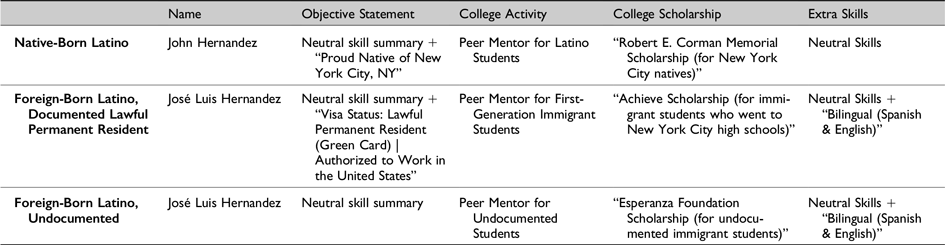
The primary treatment variable was nativity. To measure this variable, I randomly assigned every respondent one of three resumes of an upcoming male US college graduate majoring in economics, reflecting either a native-born Latino or one of two immigrant Latinos already living in the United States, and who have been in the United States since at least high school and therefore have fluent English language ability. All three candidates went to the same US college. To make sure I had enough power to detect a significant nativity difference, I first randomly assigned a respondent to either a native-born (52 percent) or immigrant (48 percent) condition. Then, among those assigned the immigrant condition, respondents were randomly assigned either a documented (25 percent) or undocumented (23 percent) resume. However, because the results were consistent regardless of documentation status, I collapsed the documented and undocumented conditions into one “foreign-born” condition.
I chose to signal US residence and a US degree explicitly because the majority of studies on immigrant hiring rely on employers’ preferences for recruiting and sponsoring immigrants with even more advanced education from abroad rather than hiring immigrants already living in the United States (González Reference González2021; Rissing and Castilla Reference Rissing and Castilla2014; Trimbach Reference Trimbach2016). Signaling nativity is challenging because it is difficult to separate foreign-born nativity from Latino ethno-racial identity. Previous research demonstrates that name alone is not a strong enough signal for individuals to correctly identify both nativity and ethno-racial identity (Gaddis, Kreisberg and Crabtree Reference Gaddis, Kreisberg and Crabtree2023; Kreisberg Reference Kreisberg2023). I therefore relied on multiple cues to signal race/ethnicity, nativity, and legal status. For example, documented and undocumented legal status were signaled both explicitly and implicitly in multiple ways, following information gleaned from several rounds of in-depth interviews with both employers and job seekers. These signals are shown in Table 1 (Kreisberg Reference Kreisberg2023). I then pre-tested these and other signals using Amazon’s Mechanical Turk platform. Results (available upon request) show high degrees of confidence in rating the candidates appropriately as Latino, native- or foreign-born, and documented or undocumented.
Treatment Signals

The dependent variable to indicate respondents’ intentions for hiring immigrant versus native-born Latinos was an intention to call back variable. Specifically, each respondent was asked at the outset of the survey to consider one resume for an entry-level position in the respondent’s own firm. Firms reflected diverse industries, with large shares of firms from the professional or business services and financial or information services, and a lower share of firms in manufacturing.Footnote 1 Although entry-level positions in these industries are undoubtedly diverse in the education required, current entry-level job openings in the industries most represented by respondents (for example, an entry-level marketing associate, sales associate, or project manager) require a college degree.
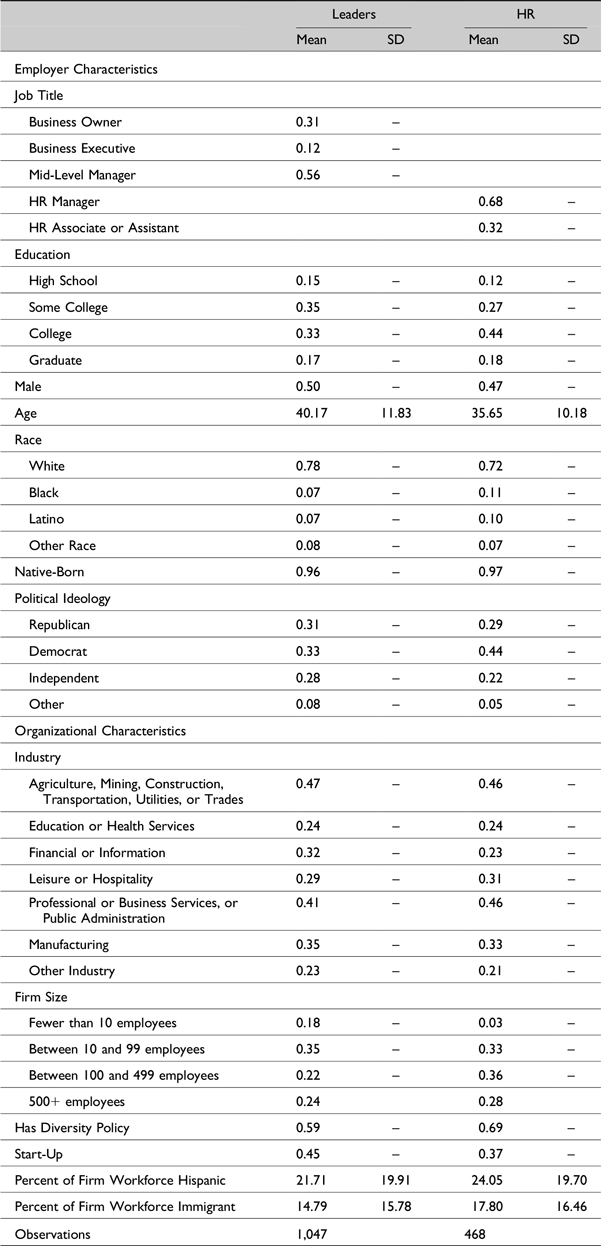
The respondents were first asked how likely they would be to call the candidate back for an interview for an entry-level position in their firm. This was measured on a Likert scale of 1–7 (where 1 equaled very likely to call back the candidate for an interview and 7 equaled not at all likely to call back the candidate for an interview). The Likert scale was then condensed into two categories; very likely to interview the candidate, and everything else, following prior survey experiments in hiring (Pedulla Reference Pedulla2018; Quadlin Reference Quadlin2018), which find this best approximates a real hiring decision.Footnote 2 However, it is important to note that this binary variable does not yield a “callback rate” akin to a field experiment, only an intention to call back applicants. A field experiment is useful for allowing researchers to test direct hiring behavior rather than just hiring intentions. Yet that method does not permit an evaluation of the mechanisms underlying those decisions in the same way the present survey experiment does. As such, respondents were finally asked a series of questions on hiring, as well as attitudinal questions about the applicants’ trustworthiness, fit and language skills, competence and work ethic, immigration status, and then questions about themselves and their firm. Other employer- and organizational-level variables included among employers are accounted for in Table 2. As Table 2 shows, the employers represented a number of industries and hired for positions in both low- and high-wage labor market segments.
Descriptive Statistics for Survey Experiment by Organizational Role

Analytical approach
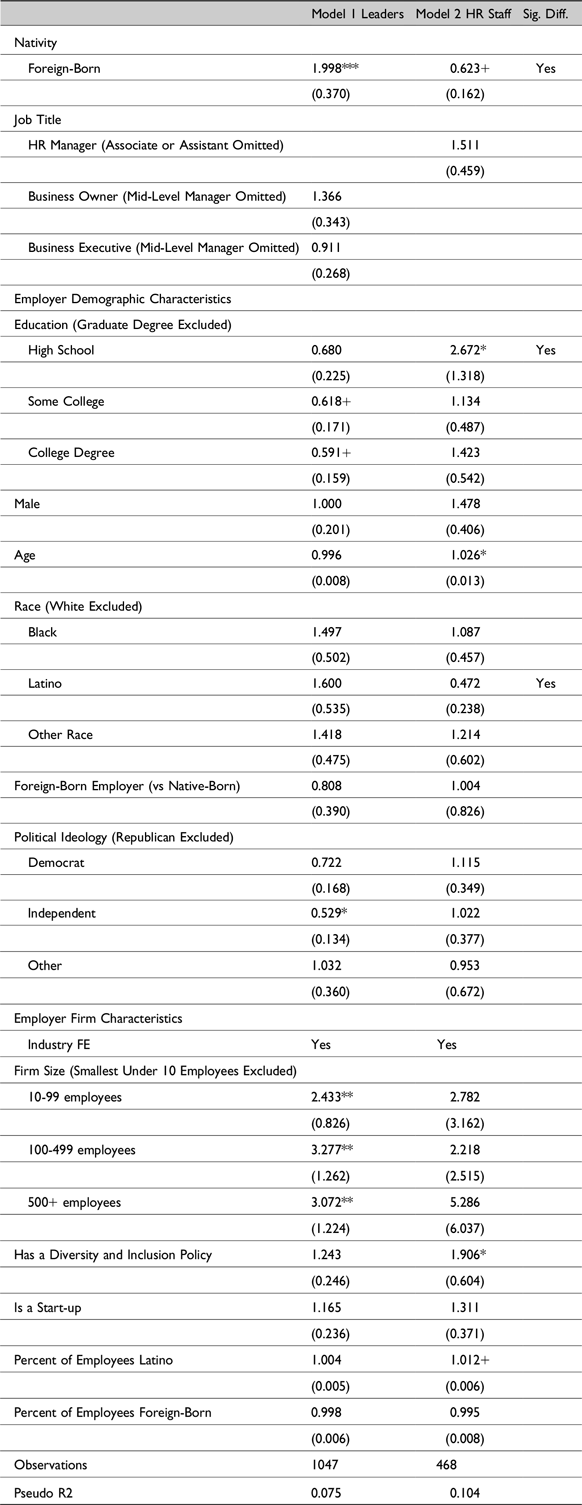
First, I evaluated the employer characteristics descriptively by their occupational role. Then, to determine the relationship between occupational role and hiring intentions, I conducted a t-test difference of means in the callback rate stratified by occupational role. Next, I employed stratified logistic regression analyses, for leaders and HR staff, where I regressed the callback rate on the applicant type, the respondent’s own demographic characteristics, and the firm-level organizational characteristics. Finally, I conducted significance tests across models by running one fully interacted model between every variable and occupational role (denoted in the table by the final column).
In-depth interview data and analytical approach
Data
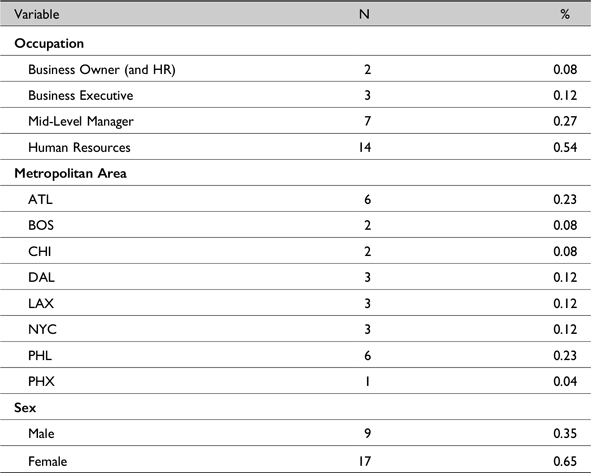
To explore why leaders and HR staff had diverging hiring intentions, I rely on forty-seven in-depth interviews: first with a subset of twenty-six of the survey experiment respondents, as well as with twenty-one immigration lawyers and immigrant service providers. I conducted in-depth interviews with twenty-six survey respondents if they lived in one of eight of the largest metros with the highest absolute numbers of Latino immigrants: New York City, NY; Boston, MA; Philadelphia, PA; Chicago, IL; Atlanta, GA; Dallas, TX; Phoenix, AZ; and Los Angeles, CA (see Table 3). I selected these eight metros because they align with opposing socio-legal contexts of reception for immigrants. New York, Boston, Philadelphia, and Los Angeles, for example, have the most progressive and immigrant-friendly policies, and they also have the lowest “E-Verify” requirements for employers to authenticate the work authorization of immigrant job applicants. Atlanta, Dallas, Phoenix, and Chicago, by contrast, have the most immigrant-hostile policies and they also require most if not all employers to use E-Verify. Considering all of these data were collected during the Trump administration, it was important to over-sample my interview respondents in immigrant-friendly versus immigrant-hostile cities. However, I conducted several additional interviews in other cities with more neutral immigrant policies (in Houston, TX, Providence, RI, and Hartford, CT), and the themes were similar.
Employer Interview Sample Characteristics (n=26)

Recruiting both the survey and interview respondents from the same sample grants me rich insight into a diverse group of employers’ intentions and underlying motivations. For example, employers who were invited to participate in the in-depth interview consented to both the survey experiment and the interview at the outset of the survey. Interview respondents were aware they participated in a survey experiment prior to the interview. In addition, respondents often openly discussed their survey experiment responses at the outset of the interview. The response rate was 15 percent. Although I do not show detailed characteristics of the qualitative sample to protect confidentiality, the composition largely resembled that of the survey experiment, assuaging concerns that the interview sample is selective based on particular characteristics.
To understand the implications of immigration laws for hiring, I also relied on expert interviews with twenty-one immigration lawyers and immigrant service providers in these same metros. Expert interviews were important to validate employer respondents’ perceptions about the law, especially given that employers had vastly different legal interpretations on the ground compared to what’s written “in the books.” In total, I conducted forty-seven interviews.
Design and variables
If any individual participated in the survey experiment and lived in one of eight metros, they were invited at the end of the survey experiment to participate in a follow-up interview with me on Zoom. All respondents but two were interviewed through Zoom audio (of the two remaining, one interview was in person and the other was over the phone). The remaining interviews were all recorded and transcribed using Zoom with respondents’ consent. The interviews lasted an average of fifty-eight minutes. Each respondent was given a $20 Amazon gift card as a token of appreciation for their time.
The lawyers and immigrant service providers were recruited from social networks from my prior employment in immigrant service provision. Others were recruited through multi-cited referral chains, a common method for recruiting professional workers (Rivera and Tilcsik Reference Rivera and Tilcsik2016). These interviews were conducted over the phone or in person, depending on the respondent’s location. Detailed notes were taken and transcribed following the interview. These interviews ranged from just under 20 minutes to just over two hours.
Analytical approach
The employer interviews relied on a semi-structured interview guide (see Appendix B) that asked them to provide information on recruitment, screening, and workplace composition of college graduates at their firms. Then I asked about the extent to which respondents recruited, screened, and employed college-educated immigrant Latinos (Holzer Reference Holzer1996; Waldinger and Lichter Reference Waldinger and Ira Lichter2003). I piloted the guide with two additional respondents. The immigration lawyer interviews asked questions about hiring laws and rights, work options for immigrants, and legal conflict.
I analyzed the transcripts for common themes in N-Vivo using an abductive approach, often used to make sense of “anomalous and surprising empirical findings against a background of multiple existing sociological theories” (Timmermans and Tavory Reference Timmermans and Tavory2012, 169). I first derived a list of codes from the organizational sociology, immigration, and law and medicine literature on organizational factors shaping discrimination, the role of immigration enforcement, bias, and stereotypes, and the role of status and authority in decision-making. Then I refined my codes further from the interviews themselves. These refined codes revolved around bureaucratic structure, including any close relationship between the individual hiring manager and the state (via Immigration Customs and Enforcement); respondents’ stake within the firm to maintain legal compliance; respondents’ workplace security; and bureaucratic checks on hiring.
Legal awareness, professional interests, and diverging hiring interests
Employers’ occupational roles helped explain their diverging hiring intentions toward Latino male immigrants. Across both the quantitative and qualitative data sources, and regardless of their individual or firm-level characteristics, leaders intended to include (and often preferred) Latino immigrants. But HR staff intended to exclude them—especially undocumented Latinos.
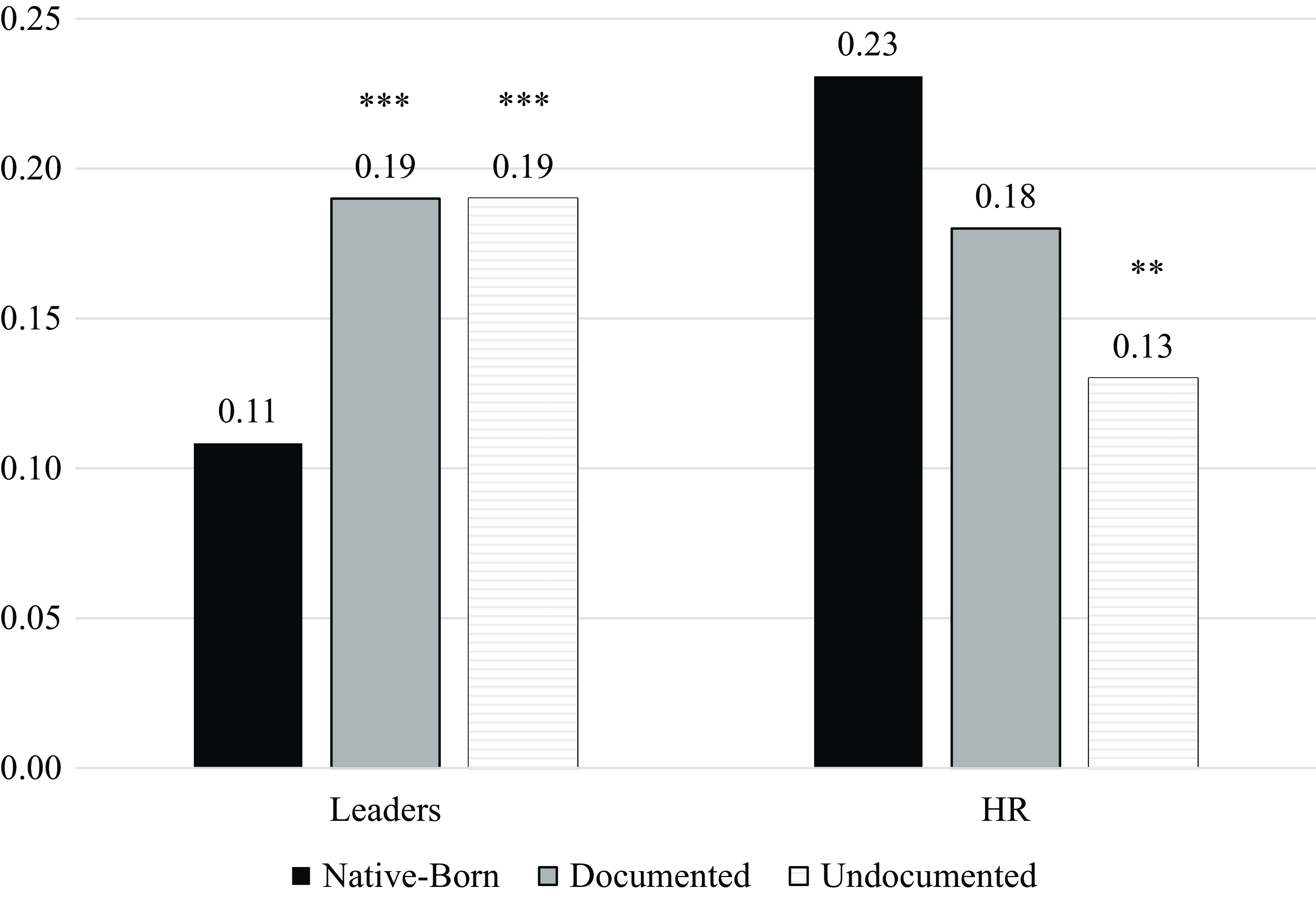
As Figure 1 and Table 4 show, among leaders, 19 percent were “very likely” to call back either Latino immigrant candidate, whereas only 11 percent were “very likely” to call back the native-born candidate (p<.001). I find that this is in part because of their low legal awareness and because their occupational role comes with external pressure to hire individuals whom they perceive to be “high-skilled.” HR staff, however, intended to exclude Latino immigrants. Figure 1 and Table 4 show, for example, that 23 percent stated they would be “very likely” to call back native-born Latinos, compared to only 15 percent who were “very likely” to call back Latino immigrants in general (p<.05). When broken down by legal status, 18 percent of HR staff were very likely to call back the documented candidate, and 13 percent of HR staff were very likely to call back the undocumented candidate (p<0.05). I find that they intend to exclude Latino immigrants in part because of their keen experience with immigration law and in part because they think that Latino immigrants—especially those associated with immigration enforcement and undocumented status—might cost them their own jobs.
Callback Rates in Survey by Respondents’ Occupational Role
Notes: + p<.10; * p<.05; ** p<.01; *** p<.001 indicate significant differences between native-born group, within occupational role.
Callback rate differences account for variables in Table 4.

Logistic Regressions Predicting Likelihood of Callback among Leaders and HR Staff (Odds Ratios)

Notes: + p<.10; * p<.05; ** p<.01; *** p<.001; Significant Differences Across HR/Leader Models at p<.05
Legal awareness
Employers first varied in their legal awareness, with leaders far less aware of the basic tenets of immigration law than HR staff. Several leaders, for example, were not aware of legal issues among their immigrant workers, admitting their ignorance could be because they were too far removed from the law. When I asked a mid-level supervisor in a large Midwest education industry, for example, about whether she experienced any legal issues from hiring a Latino immigrant applicant, she said, “No, actually.” But then she went on to say, “But maybe I was just too far away from it.” Another mid-level supervisor in a national retail firm in the Northeast told me that beyond having no knowledge about legal barriers to hiring immigrant workers, she also couldn’t assist in navigating those barriers because that is handled at headquarters—physically located in another city. And in another interview, when I asked whether her multinational financial services firm in the Southwest had to deal with any immigration issues among Latinos, a mid-level supervisor said:
Not necessarily. I mean, I’m sure that we have, but nothing that would be really rolled up into my aspects of the business. Like, that’s probably more on the recruiting side of the business…I’m sure that it has been an impact, though. Like, I know, for example, one of the things that I had an associate on my team that was he was Dreamer. And so he was here on a green card and he had to have it renewed and … I remember there was a lapse because I guess it can take a long time for those approvals to come through. So his employment technically will expire on [date] … and he literally had to sort of leave the company and then [ ] come back like three weeks later … So we do, you know, we have dealt with situations like that…but it’s literally all on HR.
This manager expressed a lack of familiarity with the complexities of immigration law. For example, she associated “Dreamer” status (or Deferred Action for Childhood Arrivals, which grants temporary, renewable work permits) with a green card, even though DACA does not currently have a path to a green card. But understanding immigration law is not in her job description. As she said throughout the conversation, that’s “literally all on HR.” And even though this anecdote relates to a temporary firing rather than a hiring, it suggests that in her role, she did not have to obtain legal knowledge or experience for her job. With less responsibility over the law, leaders expressed that addressing legal hurdles would be easy.
Unlike leaders, HR staff had a keen awareness of immigration law in general and of the risk of fines in particular. One experienced HR professional for a multinational company in New York, for example, who now owns a small business, said:
I can tell you from my point of view, I don’t care where the person is from. I don’t care what color they are, what religion they are, don’t care if they’re from Africa. I don’t care. Are you legal? That’s the one question I would ask because I certainly don’t want to get a fine, and if the person isn’t legal, unfortunately there’s nothing I can do for them.
Much like this former HR professional, every HR staff person I interviewed knew that they could be fined should they hire an immigrant who turns out to be undocumented. HR staff reported simply not wanting to take that risk directly because of the fines attached.
At the same time, many HR staff were also fearful of hiring Latino immigrants more generally because of their associations with undocumented status. For example, an HR manager in a mid-sized Northeast IT company described screening immigrants as a “delicate balancing act” to bring people on board who are going to be “responsible” on the one hand, while “not [breaking] any laws, not [being] prejudicial, and not [having] a lawsuit on our hands because we didn’t give someone an opportunity to advance themselves” on the other hand. This HR manager recognized the difficult need to not break anti-discrimination law (and risk a lawsuit from a documented candidate), while also not bringing on someone who is “irresponsible” (or potentially undocumented). The immigration lawyers I spoke with confirmed that many employers would rather not hire any immigrant Latinos to avoid hiring someone who was undocumented. Yet because this practice risks breaking anti-discrimination laws, one lawyer who works for the Immigrant and Employee Rights section of the Civil Rights Division called this issue a “legal gray area” requiring HR staff care to navigate.
HR staff felt this legal gray area was particularly pronounced for Latino male immigrants, who were often most associated with undocumented status and therefore most targeted by immigration enforcement. Three HR staff I interviewed—at one multinational firm and two regional mid-sized firms—had been subject to audits or raids by Immigration Customs and Enforcement (ICE) officers, with all three recounting the main reason they were audited was because they either employed Latino immigrants or their buildings were located in Latino immigrant neighborhoods. For example, one HR assistant of a mid-sized regional West Coast manufacturing firm believed her warehouse had been raided because it happened to be located in a building complex with predominately Latino immigrants and because the owner of the warehouse was an immigrant. She elaborated, “And the owner [of the warehouse] … has a very ethnic name. She’s born [wherever] she was. It was very ethnic … and maybe they thought, oh, maybe there might be more of an incidence of this there.” To her, she associated a more ethnic name with “foreignness,” which she also associated with an increased risk of ICE enforcement actions.
The immigration lawyers and service providers confirmed that ICE most frequently targets firms with higher shares of Latino immigrants. One policy advocate said, in fact, that “ICE just assumes Latino immigrants are all undocumented.” And, although ICE largely targets firms paying immigrants low wages in warehouses or manufacturing, every HR staff I interviewed, including those in the professional and business services, still said they feared immigration enforcement action. In sum, whereas leaders were removed from the law as part of their profession and subsequently felt that hiring immigrants would be easy, HR staff were intimately involved with the law, believing that hiring Latino immigrants placed them at a higher risk of ICE enforcement.
Professional interests
Employers next had different interpretations of the law depending on their professional interests. Leaders often associated Latino immigrants with “high-skilled” immigrants, and therefore they sought to hire such immigrants to compete with other firms. HR staff, however, often associated Latino immigrants with undocumented status and therefore felt more internal pressures to exclude immigrants to protect their own jobs. HR staff framed their intentions as legal strategies to mitigate risk and administrative burden.
First, leaders often associated Latino immigrants with “high-skilled” H-1B immigrants. And leaders noted that they often needed specialized skillsets to compete with “bigger players” in the technology and finance industries. One business executive for a mid-sized tech firm in the Northeast, for example, needs immigrants when native-born applicants lack the requisite skills—especially when other firms consistently spend lobbying dollars advocating for more H-1B visas. Yet, rather than associating H-1B visa holders with more profitability or exploitability, as is often the case among employers hiring workers under the low-wage H-2B visa, the leaders I interviewed expressed an interest in immigrant Latinos for their perception of having more advanced skills to compete with other firms.
As another example, a business executive for a multinational consulting firm on the West Coast repeatedly brought up how immigrant candidates, Latino and otherwise, were often seen in her field as “exceptional” compared to native-born candidates, and she would always hire an exceptional candidate to compete with other top consulting firms. Even when I asked about hiring someone who may have legal issues, she responded that addressing legal issues would be easy, elaborating:
When a foreign student has an issue…and a situation does come up. And let’s say that the student’s exceptional, right? If the student is exceptionally bright and he’s … going to do the best for you. And if this kind of bell rings into all the hiring managers. They’ll do anything and they will get him on board…but they will make sure everything is legal. You know what I mean. They will not put themselves at risk, but they will do everything because the person … whoever is the person. He doesn’t have a visa, but he belongs to some country.
For her, the need to be seen as exceptional (especially in the context of competing with other Fortune 500 companies recruiting “foreign students”) outweighed any risk of legal complications. Although this leader recognized that hiring would have to be “legal,” she could not see why her team would not do everything they could to hire an immigrant candidate, regardless of their legal status.
HR staff, however, often associated Latino immigrants with undocumented status and immigration enforcement, even when I asked about Latinos with Lawful Permanent Residence. Therefore, HR staff had more internal pressures to exclude them. This could explain why HR staff particularly excluded undocumented Latinos in the experiment. Most HR staff worried that if their hiring recommendation left the firm, for example, through deportation, that would threaten their own job. For example, when I asked the mid-sized HR manager in the IT industry why it was that HR staff might not want to hire even “documented” Latino immigrants, he said:
Fear is a great motivator, as they say … everybody’s worried about keeping their job today. So it’s not that they don’t want to give somebody the chance to show what they can do to prove what they can do. But if it doesn’t work out, then their head’s on the chopping block is what they feel. And I’m going to catch a whole bunch of flak, you know … because I didn’t send the right person. So fear is … playing into this equation. Whether you realize it or not. Yeah. That’s tough … if they don’t work out, you know, I’m, I’m one step closer to the door myself.
Later in the conversation, he explained that if a Latino immigrant applicant were a bad fit or experienced turnover (due to migrating or being deported), he would get punished by his superiors. And if he recommended too many of these “bad hires,” he would be fired. HR staff frequently feared that too many bad hiring recommendations would cost them their own jobs. In this HR manager’s case, he said if he could avoid hiring anyone who would “catch flack” from his bosses, he would. He was not alone. Other HR managers, from firms ranging in size and industries ranging from legal services to IT and food services to education, said that if they could avoid hiring immigrants, particularly Latino immigrants who were associated with “bad hires” from being deported, they would.
In response to this internal pressure to prevent “bad hires,” HR staff used their informal authority to interpret the law to their professional advantage. Specifically, they avoided complying with either hiring law by reframing their exclusionary intentions as legal strategies to mitigate risk and administrative burden. The same mid-sized HR manager in IT, for example, used creative ways to probe applicants about their legal status during the screening interview without asking applicants about their legal status directly:
We can put it on the application and say, “Are you a U.S. citizen?” That’s where you can get around it. If they answer no, then I can probe a little further ….
He defended his creative probing as a way to mitigate any amount of risk in a new hire, which only made him vulnerable with “someone above [him] to report to.” In the services industry, almost every HR manager I interviewed told me they found ways to use advanced screening technologies before they offered someone a job (for example, by telling applicants who seemed nervous they would later be subject to E-Verify) to prevent any risk of hiring undocumented immigrants. In many ways, these pre-screening strategies were a direct response to previous ICE audits. One multinational HR executive who had undergone several audits, for example, told me that all of her establishments put up E-Verify signs as “pre-screeners” to weed out anyone who may be undocumented (despite that constituting unlawful hiring discrimination). When asked why, she said because “there’s been negative consequences associated with being, you know, an immigrant worker … everybody just assumes you’re illegal.” The immigrant service providers confirmed it was common (even if unlawful) for employers to use E-Verify as a “pre-screening” tool toward Latino immigrants, rather than how it is intended as a post-offer work authorization tool. It is important to note that this focus on risk mitigation was especially heightened for Latino immigrants in general, who were most often associated with undocumented status and immigration enforcement.
When not couched in the language of legal risk, HR staff’s narratives revolved around reducing administrative burden. One HR manager in a multinational data analytics firm described that her decision to exclude Latino immigrants revolved around avoiding any administrative burden from the visa adjudication process, telling me:
For my team probably it’s going to be something that will definitely take note of because it’s certainly a hurdle and it adds, it adds an element of complexity to these hiring decisions that you know you might not want to invest that much time or effort into when you can maybe just as easily hire someone in a different location without those barriers. So it’s unfortunate and, you know, you don’t want to have to reduce your pool size to a certain location because of these other hurdles.
By focusing on compliance with the complexity of state hurdles, this HR manager skirts compliance with anti-discrimination or immigration laws. Another HR manager in a mid-sized educational services firm in the South expressed that the decision to hire an immigrant candidate, Latino or otherwise, is often met with “extra steps” at his firm, including submitting additional paperwork to the state. These extra requirements often come with extra responsibility—something his HR colleagues do not want. He elaborated:
They [HR] just like don’t want to deal with “all the trouble,” quote unquote, you know, right … that comes with, you know, all the extra steps and all the extra expectations and you know … just not wanting to go down that route, you know, wanting to bring that type of person into their environment ….
This individual, who himself is a second-generation Latino immigrant, frequently feels that his HR colleagues perceive the extra administrative steps to be not worth the hassle. And, although he has worked hard to support several Latino and non-Latino immigrant student hires, the bureaucratic “hoops” involved with more government paperwork often become a common rationale among his peers for excluding immigrant applicants.
I have argued that variation in legal awareness and professional interests explains employers’ diverging hiring intentions. What about instances where employers are aware of immigration law and are also leaders of their firms or instances where employers have no awareness of the law but are also under high pressure not to be fired? One of the interviews with a business owner who serves as her own HR helps shed light on this question. She has little legal awareness because she just started her small business in the Northeast retail industry, but she also feels pressure to make the right hiring decision so her start-up does not fail. As a result, she said that she would be reluctant to hire even a Lawful Permanent Resident Latino who might be deported. “I feel horrible saying that,” she says, “but I need some stability.” This is just one example of the fact that intra-organizational decision-making is a dynamic and iterative process, changing across institutional spaces and time, especially for employers who have experience in multiple roles or across diverse organizational contexts.
Discussion
This study evaluated employer preferences for hiring immigrant Latinos using original employer-level data, which is novel because most work comes from the perspective of employees. I found that there’s an organizational tension in the legal awareness and professional interests of leaders and HR staff. Leaders are motivated to hire “exceptional” immigrants who make themselves and their companies look good, while HR staff are motivated to follow legal procedures and avoid regulatory fines to protect their jobs. This research has important implications for studies of immigration, the law, and organizational sociology.
The results are first important because they emphasize that organizational characteristics are key mechanisms of immigrant hiring inequality. Immigrant Latinos comprise a growing share of college-educated workers, yet there is a mismatch between their skills and credentials on one hand and their job placements on the other (Castilla Reference Castilla2008; Lu and Li Reference Lu and Li2021). Rather than being influenced solely by immigrants’ human capital or stereotypes of compliance and exploitability, employers are also heavily influenced by their organizational environments. This environment might make it challenging for HR staff doing the frontline screening to envision the benefits of hiring immigrants on the ground. In addition, these results suggest that managerial practice in one arena of immigration law (for example, immigration enforcement) might spillover to how those employers respond in areas of the law (for example, in the case of DACA), particularly if individuals across legal status categories are racialized similarly (for example, as Latino and male).
This study second builds on existing theories of the law and organizations. In response to anti-discrimination laws, organizations rely on legal ambiguity to perpetuate discrimination. But in the case of immigration law, organizations must respond to more than ambiguity: they face inherent legal contradictions that place them at risk of breaking anti-discrimination laws if they respond too over-zealously to immigration laws (for example, by not hiring any Latino immigrant, regardless of their work rights). I emphasize that ambiguous laws grant organizations autonomy. As such, negotiated order becomes an important within-firm factor mediating the impact of the law on organizational behavior (Haveman and Rao Reference Haveman and Rao1997). Similarly, this study extends theories of legal endogeneity by emphasizing that compliance with the law may depend on how leaders farther removed from the law interact with frontline workers who are reconciling it on the ground.
The results finally contribute to a burgeoning research agenda to bring immigration to the core of research on ethno-racial discrimination and organizational sociology. To date, the organizations and discrimination literature have made great strides in understanding how societies reduce workplace inequality in hiring, including bureaucratic checks of accountability on decision makers, the ethnoracial composition of leadership, and pressures from the broader legal environment (Almeida, Fernando and Sheridan Reference Almeida, Fernando and Sheridan2012; Stainback, Tomaskovic-Devey and Skaggs Reference Stainback, Tomaskovic-Devey and Skaggs2010; Bielby Reference Bielby2000; Midtbøen Reference Midtbøen2015; Rivera Reference Rivera2012). However, the majority of studies focus on ethno-racial (and gender) inequalities in hiring. And in evaluating workplace inequality, many studies examine factors between organizations rather than within them. Although between-firm dynamics are important mechanisms of workplace inequality, this article is important because it finds that, in the case of immigration, employers’ occupational roles inside of firms help mediate the influence of the law on immigrant inequality. In addition, focusing on immigrants as a growing and increasingly insecure US workforce may help to complicate other existing organizational theories that seek to understand the unequal allocation of organizational resources along ethno-racial lines.
What about the resources organizations have at their disposal to hire immigrant workers? Organizational theories have asserted that organizations with more resources to expend toward diversifying workforces will be more successful than organizations with fewer resources (Stainback et al. Reference Stainback, Tomaskovic-Devey and Skaggs2010). Similarly, organizations have more occupational roles involved in hiring than those under study in this article—including recruiters or in-house legal teams. Although outside the scope of this article, I did find evidence that larger organizations with more resources, cross-departmental recruiting teams, a history of recruiting immigrant workers, and access to greater network ties did increase the likelihood that both leaders and HR staff would speak more favorably about their intentions to hire immigrant Latinos, regardless of legal status. This could also explain the survey experiment results which found that larger firm sizes were more likely to intend to hire all three Latino candidates. Future research should aim to build a more complete theoretical framework about the ways in which organizational resources might moderate the relationship between legal conflict, occupational role, and employers’ hiring intentions.
Although it advances theories of the law, immigration, and organizational sociology, this study has a number of caveats. First, the in-depth interviews made it clear that a multitude of legal status categories informed leaders’ and HR staff’s perceptions of immigrant hires (including the H-1B, as well as DACA or Temporary Protected Status). Because I did not explicitly test the effects of all these legal status categories on respondents’ hiring intentions in the survey experiment, I am unable to generalize my findings to immigrant Latinos across their full range of legal status categories. However, the qualitative results suggest that employers may categorize Latino immigrants not based on their real legal status but based on how immigrants are more generally conceived by the broader public. With leaders more familiar with the H-1B process tending to associate Latino immigrants with “high-skilled” immigrants, and HR staff more familiar with immigration enforcement tending to associate them with undocumented status. As a result, even if organizational leaders venerate Latino immigrants in theory, the HR staff who first screen them may still exclude Latino immigrants in practice.
Another caveat is that these results can speak only to Latino immigrant men. Without including a native-born White control candidate or other ethno-racial or gender groups, for example, I cannot compare employers’ hiring intentions across these other axes of inequality. Considering the real legal risks attached to hiring immigrant workers in the USA are similar, regardless of country of origin, I can speculate that the immigrant inclusion among leaders and exclusion among HR staff might be consistent regardless of ethno-racial identification (or gender) identity, even if most pronounced among Latino men. However, future research should aim to test this hypothesis explicitly among other ethno-racial immigrant groups in the workplace.
Ultimately, these results emphasize the importance of studying organizations for immigrant workplace inequality, and they also underscore that organizational research would benefit from moving beyond theories of ethno-racial stratification to theories of immigration and the law. Legal ambiguity and organizational structure, which dictate actors’ legal awareness and professional interests both within and across firms, are incredibly important, both for the implementation of the law in practice as well as for the unequal allocation of organizational resources in action.