INTRODUCTION
Turkish oregano (Origanum onites L.) and Greek oregano (O. vulgare L. ssp. hirtum (Link.) Ietswaart) are perennial, herbaceous plants belonging to the family Labiatae. They are widely distributed in the Mediterranean basin and are widely used as spicy herbs for thousands of years because of their aroma and flavour to enhance the taste of foods. Besides culinary usage, essential oil of both species is utilized in pharmaceutical and cosmetic industries (Bakkali et al., Reference Bakkali, Averbeck, Averbeck and Idaomar2008). Antibacterial, antifungal, antiviral, nematicidal and antioxidant properties of oregano essential oils add extra value for the crop (Arslan and Dervis, Reference Arslan and Dervis2010; Daferera, et al., Reference Daferera, Ziagos and Polissiou2003; Faleiro, et al., Reference Faleiro, Miguel, Gomies, Costa, Venancio, Teixeira, Figureiredo, Barroso and Pedro2005; Soylu et al., Reference Soylu, Soylu and Kurt2006). Vegetative parts of oregano and their extracts are commonly used in the food industry. The essential oil of Greek and Turkish oregano extracted by hydrodistillation contains up to 60–75% of volatile phenols. The chemical composition of oregano essential oils is very variable, due principally to the wide range of plant material from which it is distilled and the Origanum species of origin.
Turkey is one of the leading countries exporting Mediterranean type of oregano in the world (Olivier, Reference Olivier and Padulosi1997). The widely exported oregano species are Turkish oregano (O. onites), Greek oregano (O. vulgare), marjoram (O. majorana), wild oregano (O. minutiflorum) and mountain oregano (O. syriacum var. bevanii) (Baser et al., Reference Baser, Ozek, Tumen and Sezik1993). Although Origanum species are not often infested with pests, in some cases their yield and quality can be reduced in this manner.
The leafhopper family Cicadellidae (ca. 22,000 described species) is among the 10 largest families of insects (Hamilton, Reference Hamilton and Knight1983). Lodos and Kalkandelen (Reference Lodos and Kalkandelen1984) recorded 17 Eupteryx species in the fauna of Turkish Typhlocybini. Among the leafhoppers, Eupteryx is one of the largest of the genera. Although Eupteryx species are not economically important pests, they can be serious economic pests of various crops and cultivated herbs which are mostly medicinal and aromatic plants of family Labiatae (Hoebeke and Wheeler, Reference Hoebeke and Wheeler1983; Pollard, Reference Pollard1968; Wightman and Whitford, Reference Wightman and Whitford1984). Eupteryx species infest many plants in Labiatae family and cause leaf spot. With very few exceptions, Eupteryx species feed on the leaf mesophyll cells of their host plants penetrating from either leaf surface (Günthart and Wanner, Reference Günthart and Wanner1981; Pollard, Reference Pollard1968). Leafhoppers feed by piercing surface tissues and suck up the exuded cellular contents (Günthart and Wanner, Reference Günthart and Wanner1981). Their feeding destroys chlorophyll, transmits disease, or curls leaves. The leaf spots caused by Eupteryx species are white, sometimes grey and are usually limited by leaf nerves. White spots appear on the damaged leaf surface. As a consequence, qualitative and quantitative losses occur in the damaged plants and they become unmarketable. The known host range of Eupteryx species was sweet balm (Melissa officinalis L.), peppermint (Mentha x piperita L.), catmint (Nepeta cataria L.), Nepeta spp., basil (Ocimum basilicum L.), marjoram (Origanum majorana L.), oregano (Origanum vulgare L.), rosemary (Rosmarinus officinalis L.), sage (Salvia officinalis L.), thyme (Thymus vulgaris L) and Thymus spp. all in the family Labiatae (Maczey and Wilson, Reference Maczey and Wilson2004; Nickel and Holzinger, Reference Nickel and Holzinger2006; Stewart, Reference Stewart1988; Wightman and Whitford, Reference Wightman and Whitford1984).
The sage leafhopper is widely distributed in the world. Both nymph and adult feedings on green leaf parts cause economic damage. As far as is known, the sage leafhopper is exclusively associated with herbaceous plants, many of which are aromatic and cultivated for their culinary or medicinal properties (Le Quesne and Payne, Reference Le Quesne and Payne1981; Payne, Reference Payne1981; Stewart, Reference Stewart1988; Wightman and Whitford, Reference Wightman and Whitford1984). Sage leafhopper feeding adversely affects oregano growth and development and induces changes that affect market quality of the oregano. The magnitude of the induced changes depends on the density of the insect population. There is, however, a paucity of information on the effect of sage leafhopper damage on essential oil yield, essential oil content and herbage quality of oregano. Therefore, an experiment was conducted to determine the herbage colour, essential oil content and composition of dried oregano leaves infested by sage leafhopper.
MATERIALS AND METHODS
Experimental site
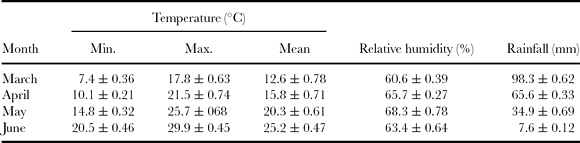
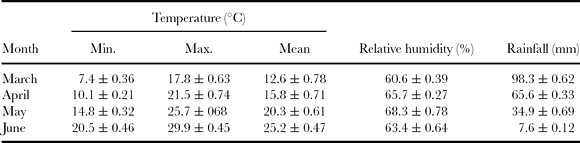
The experiment was carried out in the Mustafa Kemal University located in the eastern Mediterranean region of Turkey (36° 39′ N, 36° 40′ E; 83 m elevation). Turkish and Greek oregano seeds were planted in a seed bed in greenhouse in the first week of February, 2009. After reaching 10 cm height, the seedlings were transplanted into the experimental plots. Seedlings were transplanted in four 6 m rows with an inter-row spacing 0.65 m and inner-plant spacing of 0.25 m. The experimental design was a randomised complete block split-plot design with three replications. The main plots were oregano species and sub-plots were insect infestation. The crop was fertilised with 75 kg ha−1 of N and 75 kg ha−1 of P2O5 kg ha−1. Drip irrigation was applied during growing period. All weed competitors were mechanically removed from the experimental plots during the field experiment to reduce the biotic interactions. The soil of experimental plots was a clay silt loam with pH of 7.4, having 1.1% organic matter, 0.11% total nitrogen content and water holding capacity of 0.36 cm3. The daily climatic data were recorded by using HOBO weather station (Onset Computer Corporation, USA). Mean monthly air temperature, relative humidity and total monthly precipitation during the study are presented in Table 1. The cage-screening technique developed by Sharma et al. (Reference Sharma, Taneja, Leuschner and Nwanze1992) was modified to detect sage leafhopper damage under field conditions. The insect proof-net (52-mesh, anti-whitefly) cages were replaced on the plants grown in the insect-free plots to protect the plants from insect infestation and the rest of the plots were open for insect infestation.
Mean and standard error of monthly temperature, humidity and total rainfall during the study.
Insect sampling
All samples were done using a 15 in. diameter sweep-net, taking 20 (back-forth) sweep samples per plot. Sampling took place between 10:00—and 16:00 to account for insect movement. All samples were conducted by the same individual, utilising a straight line transect across the sample site. Samples were immediately placed into plastic bags and returned to the lab for evaluation. Each of the samples was examined under stereo microscope and all stages of leafhoppers (except their eggs) were counted. The leafhoppers were put into 70% ethanol and transferred to the laboratory and subsequently posted to Prof. Dr. Saban Guclu (Ataturk University, Erzurum-Turkey) for species identification. He identified them as Eupteryx sp. The insect specimens were separated by dissection and scrutiny of the male genitalia. According to male genitalia of Eupteryx, specimen was identified as Eupteryx melissae (Hemiptera: Cicadellidae), using the identification keys to the insects of the European USSR (Bei-Bienko, Reference Bei-Bienko1967).
Plant harvest and colour analysis
The above ground part of oregano species were harvested at the onset of the flowering in 14 May 2010. Harvested plant materials were dried under shaded, airy place for a week. The colour of dried product was quantified by using a Minolta (CR-400) Chroma Meter (Osaka, Japan). The colour meter was set to CIE Standard Illuminant C. The dried material was ground and then its colour was measured using the ground material colour measurement apparatus of the instrument. Brightness, redness and yellowness values were measured to describe three-dimensional colour space and interpreted as follows: L* is the brightness ranging from no reflection for black (L = 0) to perfect diffuse reflection for white (L = 100). The value a* is the redness ranging from negative values for green to positive values for red. The value b* is the yellowness ranging from negative values for blue and positive values for yellow. And also, the total colour difference ΔE, was calculated from the L*, a* and b* values by using the equation below and used to describe the colour change. The data were presented as mean of randomly selected 15 measurements for each treatment.

where subscript ‘o’ refers to the colour reading of fresh oregano. Non-infested oregano was used as the reference and a larger ΔE denotes greater colour change from the reference material (Maskan, Reference Maskan2000).
Gas chromatography–mass spectrometry (GC/MS) analysis
The dried oregano leaf samples (25 g) were subjected to steam distillation for 3 h using a Clevenger-type apparatus. Essential oils obtained were dried over anhydrous sodium sulphate and stored at −20 °C until GC-MS analysis. The essential oil percentage was expressed as v w−1 with respect to dry matter of the initial material.
Essential oils were analysed by gas chromatography using a Hewlett-Packard 6890 gas chromatograph interfaced with a HP 5973 mass spectrometer (Agilent Technologies, Palo Alto, CA, USA) with electron impact ionization (70 eV). A HP-5MS capillary column (30 m × 0.25 mm coated with 5% phenyl methyl silicone, 0.25 μm film thickness, Hewlett-Packard, Palo Alto, CA, USA) was used. The carrier gas was helium with a flow rate of 1.3 ml min−1. The amount of the samples injected was 0.1 μl in split mode (50:1). The oven temperature was initially 50 °C, increased at a rate of 2 °C min−1 to 90 °C, 5 °C min−1 to 210 °C and finally isothermal for 5 min. The injector and detector temperature were maintained at 250 and 280 °C, respectively. The quadruple mass spectrometer was scanned over the range of 50–550 amu at 1.53 scan s−1, with an ionizing voltage of 70 eV. The essential oil components were identified by comparison of their mass spectra with those of a computer library or with authentic compounds and confirmed by comparison of their retention indices, either with those of authentic compounds or with data published in the literature (Adams, Reference Adams1995). Mass spectra from the literature were also compared (McLafferty, Reference McLafferty1994). The retention indices (RIs) were calculated for all volatile constituents using a homologous series of n-alkanes C8-C20.
Statistical analysis
Data values were subjected to analysis of variance using the mixed models procedure SAS PROC MIXED (SAS Institute Inc., 1998) to evaluate the effects of leafhopper damage on herbage colour and essential oil content of two oregano species. Oregano species was considered a fixed effect, whereas block was considered a random effect.
RESULTS
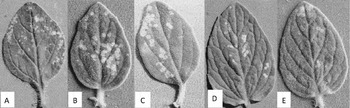
Numbers of Cicadellid collected by the sweep net were 287 and 201 for Turkish and Greek oregano, respectively. The differences in detected leafhopper numbers on the two oregano species were not statistically significant (P: 0.32, F: 1.70, d.f.: 1). The insect damage on the older leaves at the base of the two plant species was higher than the younger leaves on the top of the plants. Therefore, drying and defoliation occurred starting from the bottom of the plant. In addition to Turkish and Greek oregano, we also detected sage leafhopper damage on the leaves of mountain oregano, wild oregano and marjoram, growing in the field nursery close to the experimental site, (Figure 1). The damaged leaves had white spots on the leaf surface (Figure 1) that cause reduction in the market value of the crop.
White spots on the leaf of Greek oregano (A), mountain oregano (B), marjoram (C), Turkish oregano (D) and wild oregano (E) caused by sage leafhopper.

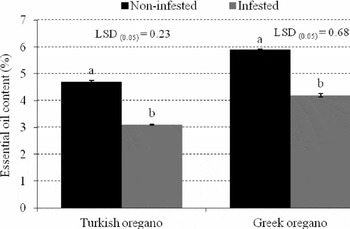
The essential oil contents of infested and non-infested Turkish oregano were 3.1 ± 0.16 and 4.7 ± 0.06 % (ml 100 g−1 dry wt), respectively (Figure 2). Leafhopper damage dramatically decreased essential oil content of Turkish oregano by 34.8%. When Greek oregano was in consideration, essential oil contents were 4.2 ± 0.05 and 5.9 ± 0.02 % for infested and non-infested plants, respectively. Leafhopper damage decreased essential oil content of Greek oregano by 28.8%.
Per cent essential oil content of sage leafhopper undamaged and damaged Turkish and Greek oregano.

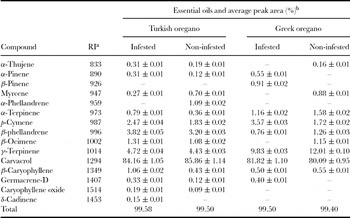
The GC-MS analysis of the essential oils extracted by steam distillation showed that 13 compounds were identified in the oil of both infested and non-infested Turkish oregano, while only 9 compounds were identified in the oil of infested and non-infested Greek oregano. Of these compounds, carvacrol (> 80 %) is the main volatile components in the essential oil of both infested and non-infested Turkish and Greek oregano, as well as γ-terpinene, β-phellandrene and p-cymene (Table 2). Little variability occurred between the rate of essential oil component of infested and non-infested Turkish and Greek oregano. Sage leafhopper damage decreased carvacrol relative concentration of Turkish oregano by 1.98% while it increased carvacrol relative concentration of Greek oregano by 2.16%.
Essential oil compositions of sage leafhopper damaged and undamaged Turkish and Greek oregano.

a The retention index (RI) was calculated using a homologous series of n-alkenes C8–C20 from electronic integration measurements using selective mass detector.
b The values (±SEM) are expressed as means of three different determinations and were obtained from electronic integration measurements using selective mass detector.
Dash indicates the compound was not found. Bold values indicate the most abundant compounds of the oils.
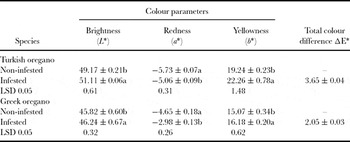
The average brightness, redness and yellowness values for infested and non-infested Turkish and Greek oregano were given in Table 3. The sage leafhopper damage had significant effect on all colour parameters (p < 0.05). Herbage of non-infested oregano species had lower brightness and yellowness values while having a higher greenness value than that of the infested plants.
Colour parameters of sage leafhopper damaged and undamaged Turkish and Greek oregano.

L* is the brightness ranging from no reflection for black (L = 0) to perfect diffuse reflection for white (L = 100).
a* is the redness ranging from negative values for green to positive values for red.
b* is the yellowness ranging from negative values for blue and positive values for yellow.
∆E* is the total colour difference between damaged and undamaged oregano.
DISCUSSION
A few insect pests were reported to damage oregano leaves (Roditakis and Roditakis, Reference Roditakis and Roditakis2006; Nickel and Holzinger, Reference Nickel and Holzinger2006). Plants containing essential oil and phenolic compounds are well-known natural biocides as potential pest-control agents due to their insecticidal, repellent and/or anti-feedant properties (Ketoh et al., Reference Ketoh, Koumaglo and Glitho2005; Lee et al., Reference Lee, Peterson and Coats2003; Papachristos and Stamopoulos, Reference Papachristos and Stamopoulos2004; Trypathy, Reference Trypathy2004; Tunc et al., Reference Tunc, Berger, Erler and Dagli2000). However, repellent effects of oregano occur when the essential oil containing tiny epidermal capsules are ruptured, the essential oils are released and the leaves become repellent. Sage leafhopper does not rupture the essential oil containing capsules; therefore, plant defensive mechanisms do not work for this insect species. Feeding site preference of sage leafhopper on the essential oil bearing plants has not been extensively studied yet. However, stylet penetration and feeding damage of sage leafhopper on sage have been described in detail (Pollard, Reference Pollard1968). In the current study, sage leafhopper was the only detected major insect pest feeding on oregano leaves. To the best of our knowledge, this is the first time that sage leafhopper is recorded as a pest of oregano in Turkey.
Sage leafhopper occurred in higher abundances in the lower part of the canopy compared to the middle and upper parts. Almost every leaf had white spots on its surface as a result of damaged mesophyll cells becoming filled with air, except for newly emerged young leaves at the top of the shoots. This can be attributed to a higher density of the glandular hairs that principally biosynthesize and secrete essential oil with a characteristic odour, mainly due to the major components of the oil, the monoterpene carvacrol. Similar result was reported for Medicago lupulina by Goertzen and Small (Reference Goertzen and Small1993) in that the density of glandular hairs decreased with leaf maturity, indicating that the young leaves had denser hair coverings. Sage leafhopper damaged oregano leaves by piercing-sucking mouth parts that destroyed chrolophyll, removed plant fluids. As a result of feeding, numerous small white spots occurred on each side of the leaves. The necrotic white spots tended to occur in clumps. The incidence of white spots increased from April to May. At the end of May 2010, severe sage leafhopper damage on mountain oregano, marjoram, and wild oregano were recorded in the oregano nurseries adjacent to the experimental site.
Following insect feeding, plants may display inducible changes in secondary metabolites to protect themselves from insect herbivores. In the current study, however, we did not observe remarkable changes in essential oil composition of both oregano species. The per cent concentration of carvacrol, a potential source of natural biocides (Duke, Reference Duke1992), is slightly varied between infested and non-infested plants. Of the detected essential components, α-phellandrene was detected only in the leaves of non-infested Turkish oregano whereas δ-cadinene was detected in the leaves of infested Turkish oregano. When Greek oregano was in consideration, α-pinene, β-pinene and germacrene-d were the compounds detected only in the infested leaves. However, myrcene and β-ocimene were the compounds detected only in the non-infested leaves of Greek oregano. Our results are in accordance with the chemical composition of essential oil of Turkish and Greek oregano reported by various authors (D'Antuono, et al., Reference D'Antuono, Galleti and Bocchini2000; Economoua et al., Reference Economoua, Panagopoulosa, Tarantilis, Kalivasc, Kotoulasa, Travlosa, Polysioub and Karamanosa2011; Kokkini et al., Reference Kokkini, Karousou, Hanlidou and Lanaras2004).
Essential oil content and herbage colour of oregano are highly considered quality criterions. According to the results of the present study, sage leafhopper infestation decreased essential oil content of Greek and Turkish oregano by 28.8 and 34.8 %, respectively. The brightness and yellowness values of infested oregano herbage increased significantly (Table 3). The redness value indicated that non-infested oregano herbage was significantly much greener than the infested oregano herbage. Green herbage colour is preferred over grey and yellow-green in the oregano market.
CONCLUSIONS
Sage leafhopper infests oregano species and causes leaf spot. The most serious effects of sage leafhopper feeding on Greek and Turkish oregano were essential oil reduction and herbage colour alteration. Unlike essential oil content, the rate of major essential oil components did not seriously varied with the sage leafhopper infestation. Oregano plant should be treated to prevent sage leafhopper feeding damage before white spots on the leaves are seen.