Fresh cancellous portions of ungulate bones contain substantial amounts of grease. Humans can obtain this grease by crushing bones with their teeth (e.g., Binford Reference Binford1978; Landt Reference Landt2004) or by breaking the bones with tools (e.g., Leechman Reference Leechman1951; Peale Reference Peale1871; Shepherd Reference Shepherd1989; Vehik Reference Vehik1977). The practice of crushing fragments and boiling them to isolate the grease is known as bone grease rendering, and it can convey valuable information on strategies of resource intensification, for example, during the demic expansion of early modern humans or the origins of agriculture (e.g., Manne et al. Reference Manne, Stiner, Bicho and Bicho2006; Morin Reference Morin2012; Munro and Bar-Oz Reference Munro and Bar-Oz2005; Soulier Reference Soulier2013; Speth Reference Speth2015; Stiner Reference Stiner2003). Upper Paleolithic hunters may have rendered bone grease (e.g., Bodu et al. Reference Bodu, Julien, Valentin and Debout2006; Nakazawa et al. Reference Nakazawa, Straus, González-Morales, Solana and Saiz2009; Stiner Reference Stiner2003), and so may have Middle Paleolithic hunters (e.g., Castel et al. Reference Castel, Discamps, Soulier, Sandgathe, Dibble, McPherron, Goldberg and Turq2016; Costamagno Reference Costamagno, Speth and Clark2013; Marean Reference Marean, d'Errico and Backwell2005; Soulier Reference Soulier2007).
The increased interest in bone grease rendering stems in large part from the energy budget associated with this activity. When obtained in traditional ways, bone grease processing is a labor-intensive activity that yields marginal returns (Abe Reference Abe2005; Binford Reference Binford1978; Brink Reference Brink1997; Church and Lyman Reference Church and Lyman2003; Janzen et al. Reference Janzen, Reid, Vasquez and Gifford-Gonzalez2014; Leechman Reference Leechman1951; Outram Reference Outram2001, Reference Outram, Mondini, Munõz and Wickler2004; Saint-Germain Reference Saint-Germain, Mulville and Outram2005), which may explain why this activity is no longer practiced by groups who have recently gained access to commercial fat (Abe Reference Abe2005; Costamagno and David Reference Costamagno and David2009; Pasda Reference Pasda2013; Pasda and Odgaard Reference Pasda and Odgaard2011). For the same reason, these low returns make bone grease extraction a productive target for the study of resource stress and its impact on human diet breadth (e.g., Brink Reference Brink1997; Broughton Reference Broughton1999; Costamagno Reference Costamagno, Speth and Clark2013; Emerson Reference Emerson1990; Manne et al. Reference Manne, Stiner, Bicho and Bicho2006; Morin Reference Morin2007, Reference Morin2012; Munro and Bar-Oz Reference Munro and Bar-Oz2005; Soulier Reference Soulier2013, Reference Soulier2014; Stiner Reference Stiner2003).
One persistent problem in archaeology is that bone grease processing can rarely be identified with confidence because its signatures can easily be confused with the effects of postdepositional breakage or they may blend with those of other human activities (Costamagno Reference Costamagno, Speth and Clark2013; Manne et al. Reference Manne, Stiner, Bicho and Bicho2006; Morin Reference Morin2012; Outram Reference Outram2001). Here, we present new experimental data that help to more firmly detect this practice in the archaeological record. These data were derived from material used in a blind test of faunal identification and quantification (Morin et al. Reference Morin, Ready, Boileau, Beauval and Coumont2016a, Reference Morin, Ready, Boileau, Beauval and Coumont2016b). Specifically, we used specimens from the Bone Grease Rendering Experiment (BGRE), in which we marrow-cracked and processed red deer (Cervus elaphus) long bones for bone grease. In this paper, we describe morphological criteria, forms of damage and micro-inclusions that are unambiguously associated with bone grease processing in the BGRE sample. Because breakage and forms of damage for long bone ends seem largely dictated by mechanical constraints, the observations that we report here should be relevant to cervid assemblages that show patterns of fragmentation similar to the BGRE.
Identifying Bone Grease Processing Activities
A review of the literature revealed some terminological inconsistencies in the description of bone grease extraction activities. We suggest the following definitions to help reduce this confusion. Bone grease processing refers to any activity in which cancellous bones are broken with a tool in order to obtain grease. More specific is bone grease rendering, which entails boiling or heating the smashed specimens to dislodge the grease from the bone pores to make, for instance, grease loaves or pemmican. This is distinguished from stewing and soup making, where grease is consumed with the liquid, generally with additional products. Less common are activities during which humans consume bone fragments raw or in soup. Associated products include bone meal, a mush of comminuted fragments and soft tissues that is ingested raw or roasted, and bone flour, which refers to comminuted greasy fragments that have been dried for storage. These definitions are adhered to throughout this paper.
Extracting bone grease using traditional means of procurement involved a varying number of steps depending on the type of bone, the need to make bone tools, and whether the fragments were destined to be boiled. The most common approach was simply to place the bones on a stone anvil and crush them into small pieces using a hammerstone or unmodified rock, or, after the introduction of industrial goods, a metal pestle, hammer, or axe (e.g., Audubon Reference Audubon and Bachman1851; Binford Reference Binford1978; Costamagno and David Reference Costamagno and David2009; Densmore Reference Densmore1929; Heine Reference Heine2007; Isham Reference Isham and Rich1949; Jarvenpa and Brumbach Reference Jarvenpa and Brumbach2006; Le Clerq Reference Le Clercq and Ganong1910 [1691]; Lejeune Reference Lejeune1635; Nicolas Reference Nicolas and Gagnon2011 [1667–1675]; Nordenskiöld Reference Nordenskiöld1882; Opler Reference Opler1941; Schoolcraft Reference Schoolcraft1851; Skinner Reference Skinner1911; Turner Reference Turner1894; Turney-High Reference Turney-High1941; Vaté Reference Vaté and Kasten2005). In the case of long bones—a class of elements commonly processed for grease—comminution was often preceded by marrow cracking, the marrow being removed with the hand or with an object such as a willow stick or bone spatula (Binford Reference Binford1978; Birket-Smith Reference Birket-Smith1929; Bonnichsen Reference Bonnichsen and Gilbert1973; Densmore Reference Densmore1929; Dorsey Reference Dorsey1884; Fletcher and La Flesche Reference Fletcher and La Flesche1911; Parry Reference Parry1824). The bone meal was either eaten as is in a pulverized form (Brugal, cited in Costamagno Reference Costamagno, Speth and Clark2013) or, more typically, boiled until the fat was freed from the bone matrix and then consumed as soup (Abe Reference Abe2005; Binford Reference Binford1978; Costamagno and David Reference Costamagno and David2009; Denys Reference Denys1908 [1672]; Georgi Reference Georgi1780; Kulchyski et al. Reference Kulchyski, McCaskill and Newhouse1999; Lejeune Reference Lejeune1635; Vaté and Beyries Reference Vaté, Beyries, Beyries and Vaté2007; Vehik Reference Vehik1977; Wilson Reference Wilson1924). Alternately, adding snow during the heating process or letting the water cool permitted the accumulation of fat at the surface, which was then scooped out (Bouchard Reference Bouchard1977; Burch Reference Burch1998; Cabot Reference Cabot1912; Comeau Reference Comeau1909; Dominique Reference Dominique1989; Karlin and Tchesnokov Reference Karlin, Tchesnokov, Beyries and Vaté2007; Kidd Reference Kidd1986; Leacock and Rothschild Reference Leacock and Rothschild1993; Leechman Reference Leechman1951; Pahin Reference Pahin1973; Peale Reference Peale1871; Stoney Reference Stoney1899; Sverdrup Reference Sverdrup1939; Uhlenbeck Reference Uhlenbeck1912; Vaté Reference Vaté and Kasten2005). If not consumed immediately, a well-documented practice was to store the grease pure or in the form of pemmican, that is, mixed with pulverized meat and dried berries (e.g., Denig Reference Denig1930; Lowie Reference Lowie1924). Grease may also have technical applications and be used as candle fuel, as food preservative, or for waterproofing skins (e.g., Binford Reference Binford1978; Liboiron and Saint-Cyr Reference Liboiron and St-Cyr1988; Malaurie Reference Malaurie1989).
The identification of bone grease processing in archaeological contexts poses significant challenges. Generally, this activity is inferred when at least some of the following characteristics are observed: (1) a high representation of long bone shaft fragments with green bone fracture, (2) a scarcity of whole long bone extremities, (3) a high incidence of small cancellous bone fragments, (4) a low abundance of burned bones, (5) a skeletal profile biased toward elements with high unsaturated fatty acid content, and (6) the presence of fire-cracked stones. Contextual information, such as the presence of hearths or concentrations of small spongy bones in pits, can strengthen inferences about bone grease extraction (Binford Reference Binford1978; Pasda Reference Pasda2013; Pavao-Zuckerman Reference Pavao-Zuckerman2011).
It is generally admitted that the above criteria provide the strongest arguments for the archaeological identification of bone grease processing. Yet, some of these criteria may, for various reasons, fail to co-occur. For example, skeletal abundances may not fit the expected pattern in terms of grease utility if transport goals were partly divorced from bone processing goals, as can be the case when there is a time lag between the two activities. Although fire-cracked stones have frequently been interpreted as compelling evidence for bone grease rendering (e.g., Audouze Reference Audouze and Soffer1987; Delpech and Rigaud Reference Delpech, Rigaud and Camps-Fabrer1974; Manne et al. Reference Manne, Stiner, Bicho and Bicho2006; Nakazawa et al. Reference Nakazawa, Straus, González-Morales, Solana and Saiz2009), their presence is not essential because boiling can be practiced through indirect heating of perishable containers (Speth Reference Speth2015). Another confounding issue is that fire-cracked stones are multifunctional and could have been used for a wide range of purposes other than bone boiling, for instance, to produce steam in sweat lodges, to delimit hearths, or as heating material for roasting pits (Driver and Massey Reference Driver and Massey1957; Vehik Reference Vehik1977).
A vexing problem is that none of the above criteria are individually diagnostic of bone grease processing. From a faunal point of view, a second difficulty is that this activity is not the only process that results in the selective destruction of cancellous bone. For instance, the differential preservation of trabecular versus compact bone (e.g., Lam et al. Reference Lam, Pearson, Marean and Chen2003), carnivore ravaging (e.g., Binford Reference Binford1981), and the use of spongy bone as fuel combined with incomplete recovery of small fragments (Costamagno et al. Reference Costamagno, Griggo and Mourre1998; Morin Reference Morin2010; Théry-Parisot et al. Reference Théry-Parisot, Costamagno, Brugal, Guilbert, Mulville and Outram2005) can similarly drastically reduce the representation of cancellous tissue and produce patterns reminiscent of bone grease extraction (Costamagno Reference Costamagno, Speth and Clark2013; Costamagno and Rigaud Reference Costamagno, Rigaud and Costamagno2014; Morin Reference Morin2012). Additional criteria are needed to circumvent these problems of equifinality. In this paper, we present quantitative and qualitative observations obtained from an experiment that provide a robust framework for the archaeological identification of bone grease processing.
Materials and Methods
To better inform the archaeological study of bone grease processing, we derived criteria of identification using specimens from a blind test (Morin et al. Reference Morin, Ready, Boileau, Beauval and Coumont2016a, Reference Morin, Ready, Boileau, Beauval and Coumont2016b). The primary goal of the blind test was to assess the robustness of counting methods commonly employed in archaeozoology, including Number of Identified Specimens (NISP) and Minimum Number of Elements (MNE). In the blind test, variation in estimates of faunal abundance was evaluated by comparing tallies between the participants (test of replicability) and by comparing the tallies with the known abundances (test of accuracy) for two control assemblages differing in degree of fragmentation. One of these control assemblages is the BGRE, an experiment focused specifically on bone grease processing described in Morin et al. (Reference Morin, Ready, Boileau, Beauval and Coumont2016a).
The BGRE Sample
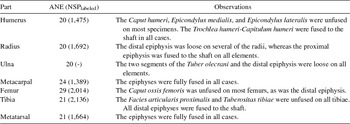
The sample from the BGRE consists of a large number of red deer long bones (Actual [or known] Number of Elements or ANE = 155, Table 1) obtained from a game farm in Québec. In the BGRE, long bones were marrow-cracked and the articular ends subsequently processed for bone grease. The goal of the marrow-cracking routine was to generate fragments that replicate those commonly observed in Paleolithic contexts of Eurasia. The comminution of the articular ends aimed at the production of epiphyseal remains of small dimensions (<2 cm, see below). Experiments have shown that fragments of this size allow for efficient extraction of grease (Church and Lyman Reference Church and Lyman2003; Janzen et al. Reference Janzen, Reid, Vasquez and Gifford-Gonzalez2014).
Long Bone Counts and State of Bone Fusion in the BGRE Sample.

Note: All data are for red deer. ANE is the Actual [or Known] Number of Elements, whereas NSPlabeled is the Number of Specimens that were labeled. The data on bone fusion are for the MCE (Marrow-Cracking Experiment, see Morin et al. Reference Morin, Ready, Boileau, Beauval and Coumont2016a) but should be applicable to the BGRE because the bones were randomly selected from the same population.
The faunal material used in the BGRE were obtained frozen or were frozen upon reception. Prior to marrow processing, long bones were thawed at room temperature and the remaining adhering bits of soft tissues removed with a knife. To breach the marrow cavity, each long bone was held over the edge of a roughly rectangular anvil of hornfels and hit with one of a series of pebble hammerstones (anvil: 34 × 26 × 11 cm, 25 kg; estimated range of weight for hammerstones: 450–800 g). The periosteum was not removed prior to marrow removal. The hammerstone generally aimed at zones that are structurally weak, such as the medial and lateral sides of the metatarsal. The locations of the zones of percussion are illustrated in Supplemental Figure 1.
After marrow cracking, isolated long bone epiphyses were placed on the anvil and fractured to obtain small fragments suitable for grease rendering. The articular ends were then comminuted one at a time using a second large block of hornfels as a hammerstone (26 × 15 × 12 cm, 7.5 kg; Supplemental Figure 1). Note that the bones were placed on their flattest side in a shallow depression of the anvil to prevent them from slipping and flying, which occurred on several occasions when the hammerstone hit at an angle that deviated from the horizontal. Comminution ended when the epiphyseal fragments formed a flat “cake” of bone fragments and soft tissue, generally after 5–8 blows. Smashing was generally ended at this point because further processing appeared to have only minor effects on bone size relative to the energy expended.
Once comminution was completed, the bone fragments were boiled separately, normally for several hours, in a large metal pot on a gas burner according to element. The fragments were then collected with a ~1-mm mesh sieve and cleaned with water using a toothbrush. Once dried, specimens were, when large enough (i.e., ~1 cm long or more), labeled with a unique identification number. For the present study, a total of 10,370 long bone remains from red deer were analyzed.
According to the farm personnel, the long bones mostly derive from 18-month-old males. A few long bones are possibly from younger individuals. The animals had already achieved a large body size despite their young age, presumably due to favorable growth conditions and selection. For the proximal humerus and distal radius, the fact that the epiphyses were rarely fused or incompletely fused (Table 1) may limit the applicability of some of our observations to samples dominated by prime adults. This issue is relevant because breakage patterns and forms of damage may differ between fused and unfused skeletal elements due to differences in bone density. In addition, we note that the porous surface of some categories of elements (e.g., proximal humerus) sometimes hindered the identification of crushing marks.
Analysis Protocol
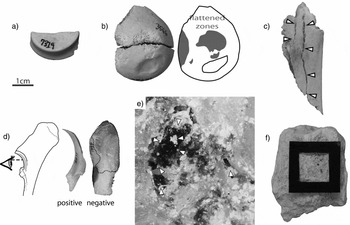
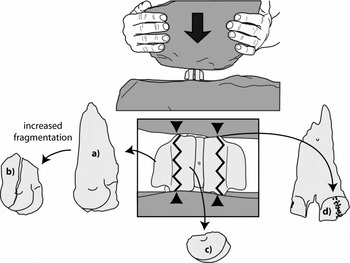
Four categories of criteria are examined in this paper. Morphological criteria emphasize patterns in the shape of the fragments (Figure 1a). Crushing marks are caused during impact and often result in exposure of the underlying cancellous tissue (Figure 1b). These marks occur because, at the center of the point of impact, compressive forces depress the bone matrix, whereas at the edges of the contact zone, tensile radial stress is responsible for the initiation of fracture (Fischer-Cripps et al. 1994). Unlike crushing marks produced by carnivores—which often take the form of “pits” and “punctures” (Binford Reference Binford1981; Delaney-Rivera et al. Reference Delaney-Rivera, Plummer, Hodgson, Forrest, Hertel and Oliver2009)—hammerstone-inflicted crushing marks tend to be diffuse, with a flattened cross-section. Flattening results from compressive forces operating on the portion of the bone that is sitting on the anvil and/or with that in contact with the hammerstone. Occasionally, crushing marks are associated with one or more incipient fractures near the point of percussion (Figure 1c). Sometimes referred to as “peeling” (White Reference White1991), tear marks (arrachement) are produced when green bone breaks off according to a subparallel plane relative to the element's cortical surface, likely as a result of excessive tensile radial stress. Our sample contains both “positive” and “negative” tear marks (Figure 1d). A positive tear mark corresponds to the fragment that was removed from the main specimen, whereas a negative tear mark is the scar left on the main specimen. Frequently, the positive fragment has paper-thin edges on one end, a pattern that is best expressed when the specimen is from an articulatory surface. Lastly, micro-inclusions are the debris of a hammerstone or anvil that became wedged in the bone matrix during comminution (Figure 1e).
Examples of (a) morphological criterion, (b) crushing marks, (c) fracture lines indicative of crushing, (d) tear marks (the rightmost specimen is shown in a cranial view), (e) micro-inclusions, (f) 1-cm2 frame used to delimit the scanning area. In (e), the white arrows show bone projections partially covering the stone debris.

During the analysis of the BGRE material, epiphyseal and near-epiphyseal specimens were examined for crush marks, tear marks, and morphological patterns. Forms of damage and morphologies that occurred at moderate to high frequencies were then described, photographed, and quantified. In the present study, a “diagnostic” criterion is one that has been identified on approximately one-third or more of the known number of elements, a figure that is admittedly arbitrary. The criteria discussed in this paper are considered diagnostic because they have not, to our knowledge, been described or observed at high frequencies in contexts other than bone grease processing, including marrow extraction.
The large number of macroscopic criteria identified in the present study called for some form of classification. We opted for a system that distinguishes criteria in terms of type (“M” for morphological criteria, “C” for crushing marks, “T” for tear marks) and element (“F” for femur, “T” for tibia, etc.). For instance, in this classification, “M2-T” means morphological criterion #2 for the tibia. In a similar fashion, “C4-F” refers to crushing mark criterion #4 for the femur, and “T1-Mc” to tear mark criterion #1 for the metacarpal.
To reduce subjectivity in the analysis of shape, we calculated the surface area of each specimen showing a diagnostic morphological criterion using the ImageJ (version 1.49 for Mac) “analyze particles” function. Surface area estimates generated from photos (see Supplemental Figure 2) include all specimens attributed to the criterion of interest. The interquartile range—a measure of data dispersion—derived from the surface area estimates was calculated in R (v. 3.2.3 for Mac). Lastly, the equality of percentage was tested after arcsine-transformation of the data using Sokal's and Rohlf's (Reference Sokal and Rohlf1969:607–610) t statistic (denoted ts ).
When damage is limited in extent, crushing marks may be confused with damage produced by abiotic processes, including weathering. For this reason, stone tool–inflicted crushing marks in the BGRE were recorded only on specimens with substantial damage and on those that do not show appreciable erosion/abrasion of the surfaces.
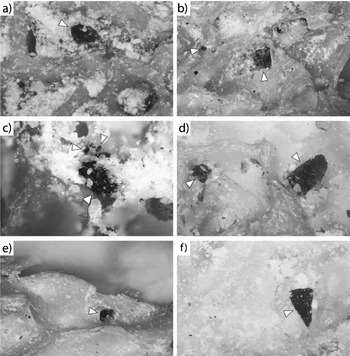
The analysis of micro-inclusions was relatively straightforward. For each category of long bones, we scanned 30 cancellous specimens (total = 180 for the six long bones) larger than 1 cm2 for the presence of micro-inclusions under a Nikon SMZ 1000 stereomicroscope at 20–80x. To standardize results between specimens and studies, we observed only the surface within a 1-cm2 frame (Figure 1f), with compact surfaces systematically avoided. We ignored stone fragments that did not appear to be embedded in the bone matrix to reduce the chance of counting lithics that represent background contamination. “Embedded” in the present case means that there is some indication that the object is wedged in the bone, as indicated, for instance, by bone encroaching on the surface of the stone debris (see white arrows in Figure 1e). We photographed diagnostic micro-inclusions at 50–200x under an incident light metallographic microscope. To obtain a picture with all surfaces in focus, we took and stacked multiple photos of the same specimen using the Helicon Focus (v. 6.5.1.) software package.
Some of the criteria that we describe here may have limited application, particularly those that focus on morphology. For instance, assemblages in which long bones were split at mid-shaft with an axe and then processed for bone grease may include shapes and, to a lesser extent, forms of damage, that differ from those observed in the BGRE. Likewise, activities that were limited to the production of coarse fragments or those associated with extremely severe fragmentation may yield patterns that only partly overlap with those observed in the BGRE. Consequently, except for micro-inclusions—which should occur in most contexts in which stone tools were used—and possibly crushing marks and tear marks, comparisons with the BGRE material are probably best carried out with assemblages that show comparable methods and levels of fragmentation.
Results
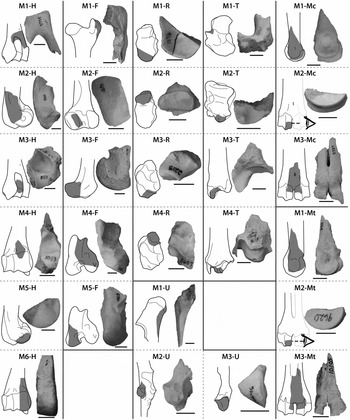
The analysis of the BGRE material led to the identification of 55 diagnostic criteria (Supplemental Text 1). In our sample, morphological criteria (n = 28; Figure 2; Supplemental Figure 2) outnumber those based on forms of damage (crushing marks: n = 18; tear marks: n = 9). A breakdown by element indicates that the humerus has the highest number of criteria (n = 11), while the radius has the fewest (n = 5).
Morphological criteria for the long bones.

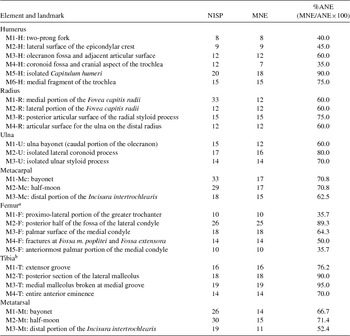
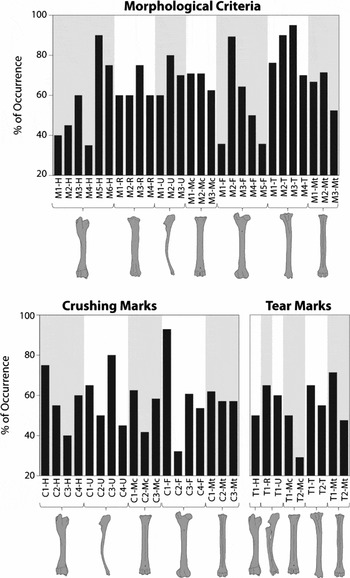
There is considerable variation in the frequency with which morphological criteria occur in the sample (Table 2). Among these, criteria M5-H, M2-U, M2-F, M2-T and M3-T are associated with very high percentages of representation (their MNE values account for 80 percent or more of the known number of bones, for ANEs ranging between 20 and 29). When the focus is on elements (Figure 3, upper plot), we note that there is much internal variation in the humerus and femur. Conversely, percentages of occurrence are usually higher and more consistent in the other bones.
Morphological Criteria in the BGRE Sample.

Note: Percentages were calculated using the ANEs listed in table 1, except when specified otherwise.
a Although the ANE for the femur is 29, values were calculated relative to an ANE of 28, as one proximal femur and one distal femur were not fractured.
b Although the ANE for the distal tibia is 21, values for this bone region were calculated relative to an ANE of 20, as one distal femur was not fractured.

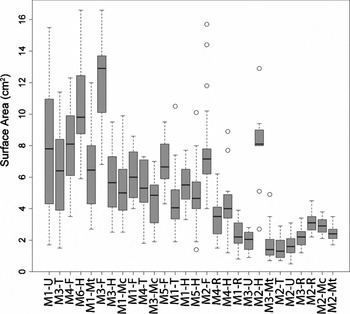
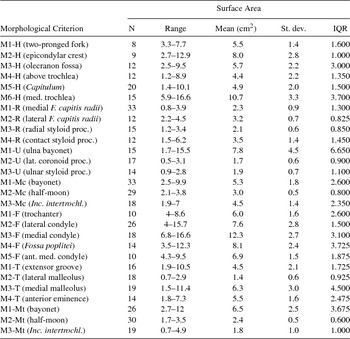
Because the identification of diagnostic shapes is somewhat subjective, it is important to quantify variation within the morphological criteria. Assuming that criteria that are poorly constrained in morphology are also poorly constrained in size, we used surface area (cm2) as a proxy of shape. Figure 4 is a boxplot distribution of the surface area for all specimens attributed to a morphological criterion. Criteria to the right of Figure 4 all show a small interquartile range (IQR, materialized by gray boxes), which means that fragments attributed to these criteria vary little in size (Table 3). These criteria include specimens that take the shape of “half-moons” (condylar fragments from metapodials: M2-Mc, M2-Mt), the lateral portion of the Fovea capitis radii (M2-R), the posterior articular surface of the radial styloid process (M3-R), the lateral coronoid process of the ulna (M2-U), the posterior section of the lateral malleolus (M2-T), and the distal portion of the metatarsal's Incisura intertrochlearis (M3-Mt). In contrast, some criteria show a wide spread of values, which means that they may not be as diagnostic as the previous ones. These include the “ulna bayonet” (M1-U), the tibia's medial malleolus (M3-T), fragments that include the surface between the Fossa m. poplitei and Fossa extensora (M4-F), and fragments that comprise the medial section of the humeral trochlea (M6-H).
Boxplot of surface areas (in cm2) for the morphological criteria. The gray squares indicate the interquartile range, whereas the dots correspond to outliers. Values were calculated using the images in the Supplemental Figure 2.

Surface Area Variation in Morphological Criteria.

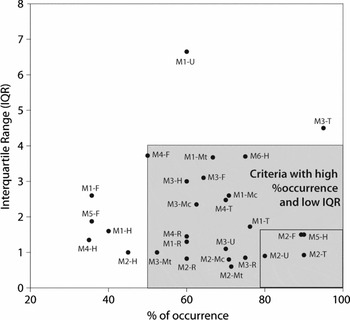
Some criteria appear to be less variable than others in terms of both shape and frequency of representation. The large shaded area in Figure 5 includes all morphological criteria observed on 50 percent or more of the known elements and with a small IQR (<4) in surface area. Criteria with exceptional scores on both accounts (see lower-right square in the plot) include the lateral malleolus of the tibia (M2-T), the isolated Capitulum of the humerus (M5-H), the posterior half of the fossa of the femur's lateral condyle (M2-F), and the lateral coronoid process of the ulna (M2-U). The high scores obtained for these four morphological criteria suggest that they are particularly useful indicators of bone grease processing in the assemblage.
Scatter plot showing the relationship between surface area (in cm2) and percentage of occurrence for the morphological criteria.

Although their scores are not as high, two sets of criteria—metapodial bayonets (M1-Mc and M1-Mt) and half-moons (M2-Mc and M2-Mt)—stood out during analysis because they were immediately recognized as distinctive and consistent in shape. Both types of fragments are produced during the comminution of the distal end of the metacarpal/metatarsal when the ridges of the condyles are impacted by the hammerstone (Figure 6). Propagation of energy through the ridges separates the distal portion of the condyles into two halves, creating a bayonet on the abaxial side (Figure 6a–b) and a half-moon on the axial one (Figure 6c). Because the flatness of the distal metacarpal/metatarsal largely conditions how these bones are likely to be struck by the percussor, bayonets and half-moons should be common shapes in contexts of bone grease processing, assuming that the degree of fragmentation is similar to that seen in the BGRE.
Diagram representing how condyle bayonets and half-moons are generated in metapodials as the energy propagates through the ridges of the condyles. Types of fragments or forms of damage characteristic of the process: (a) condyle bayonet, (b) split condyle bayonet, (c) half-moon, (d) crushing marks.

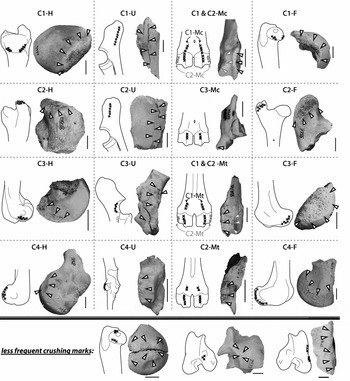
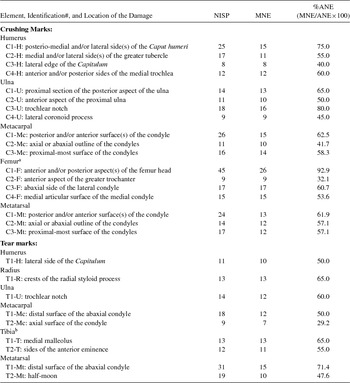
Crushing marks (Figure 7) provide firm evidence for tool-assisted bone comminution because they are a direct effect of compressive and tensile radial forces acting on the bone (Figure 6d). In the BGRE, crushing marks are particularly common on the humeral head (C1-H: 75 percent), the trochlear notch of the ulna (C3-U: 80 percent), and the femoral head (C1-F: 92.9 percent; Figure 3, lower-left plot). Percentages of occurrence for other types of crushing marks are listed in Table 4. We note that, although it may occasionally be difficult to identify the agent that produced crushing marks on individual specimens in the archaeological record, working at the assemblage level should permit excluding the intervention of carnivores or raptors as potential contributors. In the BGRE sample, specimens with crushing marks do not show pits, punctures, “grooves,” “scooping-out,” or other forms of damage (e.g., etching by gastric acids) that are considered telltale signs of carnivore or raptor ravaging (Binford Reference Binford1981; Nascou and Morin Reference Nascou and Morin2013; Robert and Vigne Reference Robert and Vigne2002).
Types of crushing marks.

Frequency of Occurrence of Crushing Marks and Tear Marks in the BGRE.

Note: Percentages were calculated using the ANEs listed in Table 1, except when specified otherwise.
a Although the ANE for the femur is 29, values were calculated relative to an ANE of 28, as one proximal femur and one distal femur were not fractured.
b Although the ANE for the distal tibia is 21, values for this bone region were calculated relative to an ANE of 20, as one distal femur was not fractured.
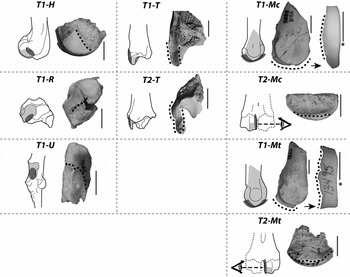
Tear marks (Figure 8), which result from dynamic loading on, or bending of, green elements, are of significance because they have not, to our knowledge, been reported in assemblages created or modified by nonhuman agents. In the BGRE, tear marks occur at moderate to high frequencies (Table 4; Figure 3, lower-right plot) on the styloid process of the radius (T1-R: 65 percent), the trochlear notch of the ulna (T1-U: 60 percent), the medial malleolus of the tibia (T1-T: 65 percent), and the condyles of the metapodials (T1-Mc: 50 percent; T1-Mt: 71.4 percent). These percentages suggest that tear marks constitute, at least for certain categories of elements, a useful line of evidence for the identification of bone grease processing.
Types of tear marks. The light shaded areas represent the fragments, whereas the dark shaded areas correspond to the areas where tear marks occur. An asterisk means that the specimen is shown in a palmar view.

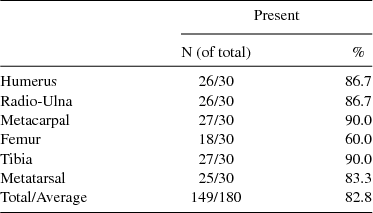
Standard archaeozoological analyses rarely include microscopic examination of random sample of bone fragments. The fact that embedded micro-inclusions were recorded on at least 80 percent of the 180 cancellous specimens examined under the microscope suggests that this approach needs to be reconsidered. Indeed, our data indicate that tiny stone shatters frequently become wedged in trabecular bone during percussion. In the majority of positive cases, one to three embedded stone fragments were observed per specimen (Figure 9), whereas some bones had more than five inclusions. The femur constitutes an exception to this trend, its percentage of inclusions (60 percent, Table 5) being significantly lower than that of the other long bones (femur vs. tibia: ts = 2.81, p < 0.01; femur vs. metatarsal: ts = 2.04, p < 0.05; femur vs. humerus: ts = 2.41, p < 0.02; femur vs. radio-ulna: ts = 2.41, p < 0.02; femur vs. metacarpal: ts = 2.81, p < 0.01). The cause for this departure remains nebulous, although it can perhaps be attributed to the presence of large pore spaces in the cancellous regions of this bone. Despite this caveat, the high percentages recorded in the BGRE indicate that embedded micro-inclusions may considerably strengthen the identification of bone grease processing in an assemblage. This is particularly true in light of the fact that micro-inclusions remained embedded on BGRE specimens, despite boiling and the use of a toothbrush during the cleaning process. The importance of this criterion is further bolstered by the fact that sources of confusion are limited, as few processes—with the possible exception of heavy trampling on rock soil—are capable of wedging stone debris in spongy bone.
Embedded micro-inclusions observed in the BGRE sample: (a) femur, (b) metacarpal, (c) radio-ulna, (d) humerus, (e) metatarsal, and (f) radio-ulna. All photographs were taken at 50x, except c) which was taken at 200x. See Supplemental Figure 3 for larger pictures in color.

Percentages of Specimens with Micro-Inclusions in the BGRE.

Note: Specimens may contain one or more micro-inclusions.
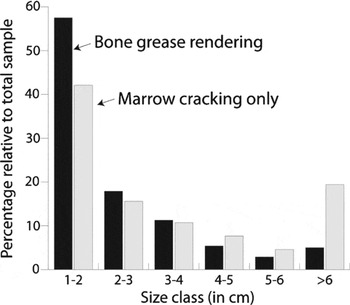
A last line of evidence concerns the size distribution of the specimens. By definition, bone grease processing creates a large number of small fragments. However, control data that can be used to determine the shape of the size distribution are few and largely qualitative (e.g., Abe Reference Abe2005; Binford Reference Binford1978; Bonnichsen Reference Bonnichsen and Gilbert1973; Delpech and Rigaud Reference Delpech, Rigaud and Camps-Fabrer1974; Leechman Reference Leechman1951). The information that we collected show that the BGRE is dominated by fragments smaller than 1 cm (83.2 percent of the total sample, including shaft fragments; Supplemental Table 1). Specimens between 1–2 cm in maximum length account for 9.7 percent of the total, whereas 7.1 percent of the fragments (many of which are shaft splinters) are larger than 2 cm. In sum, although very small specimens prevail in the BGRE sample, larger fragments do occur at appreciable frequencies. However, many of these specimens are shaft fragments that were not processed for grease.
How Representative Is the BGRE Sample?
The BGRE comprises a substantial (16.8 percent) number of fragments that are larger than 1 cm. Because these fragments are more likely to be identified and, consequently, be used as criteria than smaller ones, some of the patterns observed in the present study may not be as useful in contexts of extreme fragmentation. This is particularly true for the morphological criteria. This point raises the question: how variable is the size distribution of the specimens in bone grease extraction? If variation is significant, how does it affect the criteria defined above?
Published experimental results are relevant to this problem. Church and Lyman (Reference Church and Lyman2003) showed that, within the first hour of boiling, smaller white-tailed deer (Odocoileus virginianus) specimens render more grease than larger ones, which is consistent with received archaeozoological wisdom. The same study also indicated that fragment size does not affect total grease production for specimens ranging between 1–5 cm in maximum dimension. More recently, Janzen et al. (Reference Janzen, Reid, Vasquez and Gifford-Gonzalez2014) have demonstrated that rendering grease from small cattle (Bos taurus) fragments requires less water and, consequently, less fuel than larger specimens. This observation led them to argue that the tradeoffs in bone grease extraction consist in weighing the costs of collecting fuel and water against the costs of increasing bone comminution. Because the changing availability of these resources may affect tradeoffs over time and space, it seems reasonable to expect the degree of bone comminution to vary along these two dimensions, but also, as we will see, as a function of the type of processing activities.
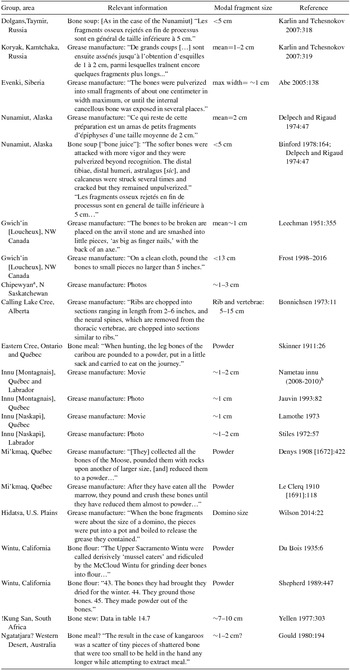
To assess whether this prediction finds resonance in the empirical world, we conducted an extensive survey of the ethnographic and ethnoarchaeological literature and consulted various Internet sources. Although several descriptions of element processing were located, precise information about fragment size distribution was generally lacking. Nonetheless, qualitative or semi-quantitative data were derived for 14 distinct small-scale societies from North America, Southern Africa, Northeast Asia, and Australia (Table 6). As predicted, there is appreciable variation in degree of specimen reduction between, and sometimes within, groups. Whether grease consumption is immediate or delayed seems particularly critical. Specimens processed for soup or stew tend to be larger than those used in grease manufacture, although there are exceptions to this trend. The fact that bones can be reused in soup (Gifford Reference Gifford1940; Karlin and Tschesnokov Reference Karlin, Tchesnokov, Beyries and Vaté2007)—sometimes as frequently as 10 times (Rogers Reference Rogers1973)—may explain why bones are often minimally fragmented when grease is rendered for consumption in liquid. Under these circumstances, efficiency in grease extraction may be considerably less important than deciding whether other ingredients (e.g., marrow, non-skeletal fat, meat and other soft tissues, vegetables, fruits) should be added to the broth and in what quantities.
Mean Bone Size in Various Contexts of Bone Fragmentation.

Note: For movies and photographs, the estimates were derived from a visual assessment of the evidence.
a http://www.nametauinnu.ca/en/nomad/detail/26/29, electronic document accessed March 17, 2016.
b The data for this group are based on photographs of bone scatters observed at a historical Chipewyan site occupied by wintering families between ca. 1940–1953 on the north shore of Cree Lake in northern Saskatchewan. Activities at the site were identified by Chipewyan consultants who revisited the site in 1979 (Jarvenpa and Brumbach, personal communication 2016).
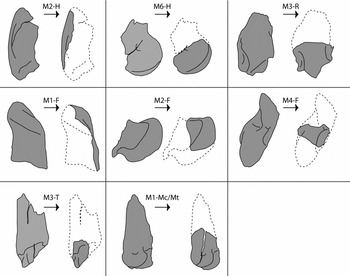
The collected information also highlights instances where bone fragmentation is very severe, as appears to be the case for the Gwich'in in Yukon (Leechman Reference Leechman1951, but see Frost 1998–Reference Frost2016), the Eastern Cree, Innu and Mi'kmaq of eastern Canada (Denys Reference Denys1908 [1672]; Lamothe Reference Lamothe1973; Leacock and Rothschild Reference Leacock and Rothschild1993; Le Clerq Reference Le Clercq and Ganong1910 [1691]; Skinner Reference Skinner1911; Stiles Reference Stiles1972) and the Wintu of California (Du Bois Reference Du Bois1935; Shepherd Reference Shepherd1989). In these groups, the intensity of specimen reduction seems to be greater than in the BGRE, which means that a dynamic model of specimen reduction is needed for criteria that are size-dependent. Figure 10 is a first attempt at creating such a model for morphological criteria. This model uses the internal variation of the BGRE (see Supplemental Figure 2) and incipient lines of fracture (see criteria M2-H, M6-H, and M3-T) to predict patterns of specimen reduction for contexts differing in level of fragmentation. For example, the bottom right figure shows how condyle bayonets may evolve into split condyle bayonets as fragmentation increases. Additional work will be needed to determine whether the proposed trends are applicable to a wide range of bone grease processing situations.
Model of fracture progression for various morphological criteria.

Comparisons with Simple Marrow Cracking
Determining whether the criteria defined above are common in other contexts, including those involving nonhuman agents, is beyond the scope of this paper. Nonetheless, it is possible to compare the material of the BGRE with that of the Marrow-Cracking Experiment (MCE, see Morin et al. Reference Morin, Ready, Boileau, Beauval and Coumont2016a). The MCE focused on red deer long bones (ANE = 162, NISP = 5,188), which were processed in the same way as those in the BGRE, except that no comminution of articular ends was conducted. The MCE assemblage is used here as a control for simple marrow extraction, a universal activity among recent foragers that seems to have been practiced since at least 2.5 million years ago (de Heinzelin et al. Reference de Heinzelin, Clark, White, Hart, Renne, WoldeGabriel, Beyene and Vrba1999).
It is generally assumed that bone grease manufacture produces smaller fragments than simple marrow extraction. A histogram comparing the BGRE with the MCE provides strong support for this view (Figure 11), as does a chi-square test of independence (χ2 = 1101.8, p <.001, size classes as in Figure 11). Note that, to be conservative, the chi-square test excludes fragments smaller than 1 cm because they are generally incompletely recovered even in carefully excavated sites (Villa et al. Reference Villa, Castel, Beauval, Bourdillat and Goldberg2004). Another reason for excluding this size class is that many of the fragments that we counted are so small that they would probably be quickly removed from the archaeological record by soil organisms and other agents. A chi-square test indicates that the MCE and BGRE have distinct size distributions, even when the smallest size class is excluded. However, this observation is of limited use when considered in isolation, given that trampling, burning, carnivore ravaging, and postdepositional processes can markedly increase fragmentation, which may cause initially distinct size distributions to merge over time. Several lines of evidence can be used to tease apart some of these agents of fragmentation. For instance, a high proportion of burned spongy remains likely indicates that skeletal parts were used as fuel rather than crushed to obtain grease. Indeed, no burn marks were observed on the bones of the BGRE, even though the specimens were boiled over several hours. Moreover, the absence or a low percentage of ravaged remains in an archaeological collection probably means that carnivores and/or large raptors had a marginal impact on the assemblage, as suggested by actualistic observations (e.g., Marean and Spencer Reference Marean and Spencer1991; Nascou and Morin Reference Nascou and Morin2013; Robert and Vigne Reference Robert and Vigne2002).
Fragment size distributions for the BGRE and MCE samples. Data from Supplemental Table 1.

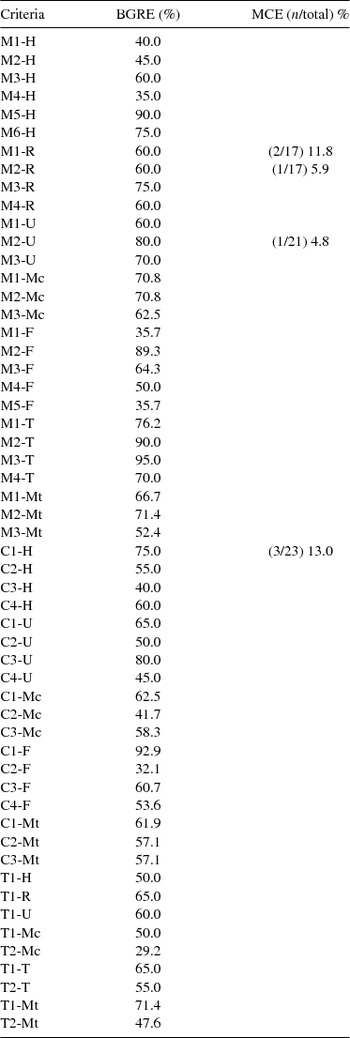
In addition to highlighting differences in fragment size distributions, contrasts between the MCE and BGRE may be used to distinguish simple marrow cracking from bone grease processing. Another important difference between the two samples is that the articular portions in the MCE are generally complete and undamaged, unlike those of the BGRE. In addition, the data in Table 7 show that the crushing marks, tear marks, and morphological criteria observed at moderate to high frequencies in the BGRE are absent or very poorly represented in the MCE. Likewise, while a high percentage (82.8 percent) of spongy fragments comprise micro-inclusions in the BGRE, this percentage is significantly lower in the MCE (15/50 or 30 percent, ts = 7.05, p <.0001). Combined with the previous observations, this result confirms that it is possible to distinguish bone grease processing from simple marrow cracking using the approach developed in the present study.
Occurrence of Criteria in the BGRE and MCE Samples.

Note: “n/total” measures the number of times a criterion was identified relative to the total ANE. Empty cells mean that the criterion was not observed in the MCE, a sample that we use as a control for simple marrow cracking.
Discussion
In the archaeological record, the presence of fire-cracked stones is commonly used as evidence for bone grease rendering, despite the fact that these objects might have been used for a wide variety of purposes in addition to bone boiling (e.g., Driver and Massey Reference Driver and Massey1957; Vehik Reference Vehik1977). Likewise, high frequencies of small unburned cancellous fragments are frequently taken to indicate that bones were comminuted for grease extraction, a type of inference that is considerably weakened by problems of equifinality. The criteria presented here should allow for more secure identification of bone grease processing. However, because patterns of bone grease processing may have varied depending on the context and time period, several of these criteria may have limited application, particularly those that are based on shape. This problem is probably of lesser concern for micro-inclusions, crushing marks, and tear marks, as they are more likely to be encountered across a broad range of fragmentation situations than morphological criteria, which are size-dependent. The dynamic model of fragmentation laid out in Figure 10 is an attempt to circumvent this last limitation.
Because they are very common in the BGRE and are unlikely to be confused with the action of nonhuman agents or abiotic processes, embedded micro-inclusions emerge as a particularly useful signature of bone grease processing. In fact, micro-inclusions possibly represent a universal marker of bone grease processing with stone objects, as shattering of small lithic debris appears—based on this and other small-scale experiments—to be a common feature of hammerstone- and anvil-assisted bone comminution. How frequent these inclusions are in archaeological situations probably depends on the type of raw material that was used and its brittleness. Although much work remains to be carried out to properly document this variation, we believe that systematic analyses of random samples of spongy specimens should become a standard practice in studies of bone fragmentation. The examination of a minimum of 30–50 specimens—a task that can be carried out within a few hours—and the use of a constant scanned surface (e.g., 1 cm2) should ensure the production of reliable data. In our experience, identifications of micro-inclusions are best achieved at 20–80x. We also note that compositional analyses (e.g., Raman spectroscopy) may prove particularly useful for confirming the mineral origin of the suspected stone debris. Efforts are currently being made to test these methods with experimental and archaeological material.
Bone grease processing is more exacting than marrow cracking because it requires moderate to extensive breakage of the specimens and involves, when the fragments are boiled, the procurement of water (or snow), fuel, and containers. Although some cultural groups depart from the trend, the available information suggests that fragment size can be used to distinguish two main types of bone grease extraction activities (Figure 12): activities in which smaller fragments are the norm (grease manufacture, preparation of bone meal and bone flour), and those in which coarser fragments prevail (stewing and soup making). This distinction is important because it seems to entail different tradeoffs. The production of grease loaves, bone meal, and bone flour focuses specifically on grease procurement. In these activities, efficiency is critical and fragmentation tends to be severe. This is particularly true of bone consumption, as smaller particle size facilitates ingestion and reduces the probability of choking. In this regard, we note that several researchers have argued for the consumption of bone meal during the Middle Palaeolithic (Castel et al. Reference Castel, Discamps, Soulier, Sandgathe, Dibble, McPherron, Goldberg and Turq2016; Costamagno Reference Costamagno, Speth and Clark2013; Costamagno and Rigaud Reference Costamagno, Rigaud and Costamagno2014; Marean Reference Marean, d'Errico and Backwell2005; Soulier Reference Soulier2007). Conversely, in stewing and soup making, bones are not intended for consumption. Moreover, pressures for efficient grease extraction seems somewhat relaxed because bone fragments can be reused in subsequent meals. The fact that additional products, including other sources of animal fats, are generally added to the mixture means that efficiency in grease production may be less critical in these activities than choosing and dosing the ingredients.
Trends in fragment size for several bone grease processing activities, as determined on the basis of ethnographic and ethnoarchaeological information.

Obviously, further research is needed to assess the impact of a wider range of variables (e.g., sex and age of the animals, cultural tradition) on bone grease processing activities. Nonetheless, assuming that the above dichotomy is valid, the fact that bone grease processing can produce faunal assemblages dominated by coarse spongy fragments has more than trivial implications for the study of human evolution. Indeed, because these fragments are too large to be swallowed, grease can be extracted from them only through some form of boiling or exposure to fire. Tracking the presence of coarse spongiosa fragments may therefore reveal much information about the expansion of human dietary niches during the Paleolithic, especially when other lines of evidence (e.g., signs of systematic marrow cracking, cutmarks, presence of hearths) are consistent with food preparation. Irrespective of procurement technique, the very act of extracting grease using an anthropogenic heat source probably qualifies as a rudimentary form of cooking technology. The criteria presented above are important in this regard, as they can support arguments for intentional breakage and tool-assisted percussion of spongy fragments.
Whether our criteria can be used to identify boiling is unclear at this point. Indeed, several physico-chemical studies have stressed the problem of identifying changes in bone structure or composition resulting from boiling, particularly when performed at low temperatures, a common feature in small-scale societies (e.g., Koon et al. Reference Koon, Nicholson and Collins2003; Solari et al. Reference Solari, Olivera, Gordillo, Bosch, Fetter, Lara and Novelo2013). In addition, some of the reported modifications can simulate diagenetic effects (Roberts et al. Reference Roberts, Smith, Millard and Collins2002) and may preserve poorly in the archaeological record (Costamagno Reference Costamagno, Speth and Clark2013; Koon et al. Reference Koon, Nicholson and Collins2003). These difficulties should not prevent us from studying boiling, given the important nutritional and economic ramifications of this activity. For instance, boiling bones not only mobilizes grease but also probably enriches the broth in terms of vitamins and elements such as nitrogen, calcium, phosphorus, and magnesium (Church and Lyman Reference Church and Lyman2003). At a broader scale, boiling likely played a key role in the dietary expansion of hominins by providing access to otherwise toxic sources of food (e.g., Speth Reference Speth2015).
Conclusion
The analysis of the BGRE, a large experimental assemblage, highlighted a number of morphological criteria and different forms of damage that can assist in the archaeological identification of bone grease processing. Among these, tear marks, crushing marks, and micro-inclusions are of considerable importance because they are probably relevant to a wider range of bone grease processing situations than morphological criteria, which vary with the intensity of bone comminution. Our results also indicate that the degree of specimen fragmentation may be used to differentiate contexts in which efficiency in grease extraction tends to be critical (e.g., bone meal, bone flour, bone grease manufacture) from those in which this factor seems of lesser importance (e.g., stewing and soup making). However, caution is required here, given that some groups do not seem to conform to this dichotomy. Further work should aim at finding criteria that are diagnostic of specific bone processing activities and at identifying ways for distinguishing bone consumption from bone boiling, two activities that have very different implications for the evolution of human diets.
Acknowledgments
Denis Ferrer from the Viandes de la Petite Nation generously provided the skeletal material for the experiments discussed in this paper. We would also like to express our gratitude to all the students who assisted in the preparation and analysis of the faunal samples, particularly Chelsee Arbour, Gabrielle Baudry, Tammy Cree, Tim Devlin, Alison MacMillan, Sophie Makarov, Erkin Ozberk and Heidy Schopf. Lastly, our gratitude goes to Robert Jarvenpa and Hetty Jo Brumbach, who kindly provided unpublished information on the Chipewyans, and to John Speth for insightful exchanges about many issues discussed in this paper. The work presented here was financially supported by the Social Sciences and Humanities Research Council of Canada.
Data Availability Statement
The BGRE and MCE material is housed in the archaeozoology lab at Trent University. This material can be examined on request.
Supplemental Materials
Supplemental materials are linked to the online version of this paper, which is accessible via the SAA member login at https://doi.org/10.1017/aaq.2016.16:
Supplemental Text. Description of the Criteria.
Supplement Table 1. Fragment Size Distribution in the Experiments.
Supplemental Figure 1. Methods of Marrow Cracking.
Supplemental Figure 2. Specimens Used in the Morphological Criteria.
Supplemental Figure 3. High-Resolution Photos of Micro-Inclusions.