


Political parties constitute the main linkage between citizens and governments in modern democracies, in which voters and parties form an important relationship of principal and agent (Bawn et al. Reference Bawn, Cohen, Karol, Masket, Noel and Zaller2012; Diamond and Gunther Reference Diamond and Gunther2001; Katz Reference Katz2014; Key [Reference Key1942] 1953; Schonfeld Reference Schonfeld1983). Yet parties regularly face voter dissatisfaction and disengagement, general dislike, or a plain lack of trust (Dalton [Reference Dalton1996] 2013; Hay Reference Hay2007; Kölln and Pedersen Reference Kölln and Pedersen2025; Van Biezen Reference van Biezen2008; Webb Reference Webb2005). This forces parties to reengage with voters in a political climate of tougher party competition, increasing polarization, and rising populism. Intraparty reforms that increase transparency and grassroots democracy for party members have often been interpreted as a direct response to such disengagement (Gauja Reference Gauja2015; Nostitz Reference Nostitz2025; Rahat and Hazan Reference Rahat, Hazan, Zittel and Fuchs2006; Scarrow, Webb, and Poguntke Reference Scarrow, Webb and Poguntke2022; Wolkenstein Reference Wolkenstein2020).
At the same time, these reforms raise an important democratic concern: empowering party members fundamentally alters the structure of democratic delegation. In principal–agent terms, intraparty democracy forces the party in public office to serve two masters (Katz Reference Katz2014), establishing a coprincipalship between party members and party voters with conflicting demands (Kosiara-Pedersen, Van Haute, and Scarrow Reference Kosiara-Pedersen, Van Haute and Scarrow2026; Polk and Kölln Reference Polk, Kölln, Demker, Heidar and Kosiara-Pedersen2019). From a normative perspective, this arrangement is also delicate. Members and voters differ markedly, and expanding members’ influence may complicate democratic equality (e.g., Wolkenstein Reference Wolkenstein2018). Thus, intraparty democracy generates a structurally ambivalent delegation arrangement that potentially has instrumental costs for voters and representative democracy writ large.
Yet we know surprisingly little about how voters view this arrangement. Existing research has mostly focused on the consequences for individual politicians, leaving the perspective of voters’ perceptions of political parties as agents largely unattended. Theoretical and empirical research from the perspectives of politicians shows that balances of power between competing principals have substantial consequences for politicians’ behavior during campaigns, legislative deliberations, and voting (Bøggild and Pedersen Reference Bøggild and Pedersen2018; Carey Reference Carey2009; Proksch and Slapin Reference Proksch and Slapin2012; Sanches and Kartalis Reference Sanches and Kartalis2024). The limited research on voters’ attitudes toward intraparty democracy—and thus coprincipalship—paints an ambivalent picture: voters prefer more intraparty democracy (Close, Kelbel, and Van Haute Reference Close, Kelbel and Van Haute2017; Dommett Reference Dommett2020; Gauja Reference Gauja, Cross and Katz2013; Schwenk Reference Schwenk2023), but they do not intend to use its participatory opportunities (Dommett Reference Dommett2020) and they do not reward parties electorally for being internally democratic (Fernandes et al. Reference Fernandes, Yakter, Shomer and Put2025; Schwenk Reference Schwenk2024; Wauters and Kern Reference Wauters and Kern2021). This ambivalence suggests that standard assumptions about voters’ desired role within parties may be misguided, which raises an important question: Why do voters accept, legitimize, or even welcome coprincipalship?
To begin answering this question, we apply exploratory research methods to focus-group data (five groups and 32 participants) from Denmark. This allows us to uncover the reasoning voters draw on when discussing intraparty authority. The focus-group discussions probed voters’ perceptions, preferences, and underlying reasons for principals to influence three important party products: candidates, leaders, and party programs. The discussions allowed participants to use their own words about a complex phenomenon that may not have been very salient among them and is often dominated by expert knowledge about what normatively good procedures are (cf. Close, Kelbel, and Van Haute Reference Close, Kelbel and Van Haute2017; Dommett Reference Dommett2020). We use qualitative, interpretive methods to analyze the data, combining inductive and deductive coding strategies to condense and document participants’ reasoning about intraparty decision making.
Our analyses show that (1) our participants did understand the role of intraparty actors in selecting candidates, electing leaders, and formulating policy programs—that is, they understood their coprincipalship; (2) they preferred party members to have a significant say in intraparty decisions, especially those regarding selection of personnel, and to have only an indirect say with regard to programs—that is, they accepted and supported their coprincipalship; and (3) their acceptance did not rest on misperceptions of representative party memberships but on a logic of party organizational autonomy and constraint—that is, party members were viewed as a legitimate and effective internal check on strategic, self-serving party leaders.
Based on these insights, we formulate an intraparty constraint hypothesis stating that voters favor intraparty democracy as a constraint mechanism for members rather than as a participatory venue. They accept, legitimize, and even welcome coprincipalship because intraparty democracy constrains the party leader’s power, and not because it gives members more say. This proposition provides a theoretical answer to the puzzle of why voters favor intraparty democracy but do not intend to use it or reward it electorally.
Our study contributes to existing research on the democratic crisis of political parties struggling to meet demands from unrepresentative and increasingly powerful party members, on one side, and from output-oriented voters at the ballot box, on the other (see Green-Pedersen Reference Green-Pedersen2019; Gunderson Reference Gunderson2024). Theoretically, it provides a solution to how such conflicting demands can be squared by delegating personnel decisions to members while maintaining policy outcome sanctions in the hands of voters. Methodologically, it sets out a path for how interpretive, qualitative methods can be used to develop theoretical propositions based on participants’ “public theories” of politics to solve long-lived puzzles.
Intraparty Democracy and the Coprincipal Problem
Existing literature prominently conceptualizes intraparty democracy as the level of inclusiveness of decision-making processes within parties, where inclusiveness is defined as “how wide the circle of decision-makers is” (Scarrow Reference Scarrow2005, 5). The wider the circle, the more inclusive the selectorate, and the more internally democratic the party. Most influential in this literature is Rahat and Hazan’s (Hazan and Rahat Reference Hazan and Rahat2010; Kenig Reference Kenig2009; Rahat and Hazan Reference Rahat and Hazan2001, 301) conceptualization of the selectorate as a continuum ranging from the party leader (most exclusive) to all voters (most inclusive). This conceptualization underpins much theoretical and empirical work on intraparty democracy (Cross and Katz Reference Cross and Katz2013; Von dem Berge and Poguntke Reference von dem Berge, Poguntke, Scarrow, Webb and Poguntke2017).
Building on this organizational perspective, theoretical work has long emphasized that intraparty democracy also complicates the representative relationship (Close, Legein, and Little Reference Close, Legein and Little2024; Katz Reference Katz2014; Müller Reference Müller2000; Scarrow Reference Scarrow2021; Tuttnauer and Rahat Reference Tuttnauer and Rahat2023; Wolkenstein Reference Wolkenstein2018). Independent of the specific organizational rules, parties generate a situation in which the party in public office serves two principals (Katz Reference Katz2014; Müller Reference Müller2000). This coprincipal arrangement alters the structure of democratic delegation. It creates competing mandates, ambiguous accountability chains, and the possibility of policy being more aligned with the preferences of intraparty actors than those of party voters, not least because these regularly diverge (Polk and Kölln Reference Polk, Kölln, Demker, Heidar and Kosiara-Pedersen2019).
The general popularity of intraparty democracy, and especially of more direct membership involvement (Brause and Poguntke Reference Brause and Poguntke2026), promotes the institutionalization of a second intraparty demos, making the possible tension between party voters’ and members’ authority over the party in public office increasingly relevant. And although intraparty democracy has been normatively defended based on arguments of justice and equality (Wolkenstein Reference Wolkenstein2018), we know surprisingly little about how voters make sense of different selectorates and what purposes they believe the internal party bodies should serve. Voters may apply a very different logic. In that case, coprincipalship may be accepted for reasons that differ sharply from normative expectations and may still create representation problems even when normatively defensible.
For individual politicians, the theoretical specification and empirical investigations of the coprincipal problem are widespread and rich. For instance, the balance between party and voter control has been argued and shown to influence the voting behavior of members of parliament (Buisseret and Prato Reference Buisseret and Prato2020; Kam Reference Kam2009), their speeches in legislatures (Proksch and Slapin Reference Proksch and Slapin2012; Sanches and Kartalis Reference Sanches and Kartalis2024), and their electoral campaign activities (e.g., Bøggild and Pedersen Reference Bøggild and Pedersen2018; Tuttnauer and Rahat Reference Tuttnauer and Rahat2025). For parties, studies show that those dominated by activists are less likely to respond to shifts in mean voter positions (Schumacher, De Vries, and Vis Reference Schumacher, De Vries and Vis2013), less likely to win policy influence from legislative coalition formation (Pedersen Reference Pedersen2010), and more likely to focus on issues they are perceived to own (Wagner and Meyer Reference Wagner and Meyer2014). These findings imply that empowered but unrepresentative party members can influence parties’ positions and strategies that possibly conflict with the preferences of voters.
On the principal side, research is sparse and more fragmented. Work on party members documents that they welcome intraparty democracy (Bolin and Kosiara-Pedersen Reference Bolin, Kosiara-Pedersen, Demker, Heidar and Kosiara-Pedersen2020; Gauja and Van Haute Reference Gauja and Van Haute2015) and react negatively to procedures that undermine their influence relative to that of voters (Nostitz Reference Nostitz2025). Corresponding knowledge about how voters think about intraparty democracy is both more limited and more ambivalent (Close, Kelbel, and Van Haute Reference Close, Kelbel and Van Haute2017; Gauja Reference Gauja2012; Schwenk Reference Schwenk2023). The few studies that probe voters’ preferences for intraparty structures show that voters echo party members’ preferences in their desire for intraparty democracy. For example, about a third of Belgian voters want party candidates to be selected by all voters, as opposed to more exclusive alternatives such as selection by members (30%), delegates (10%), or leaders (15%) (Close, Kelbel, and Van Haute Reference Close, Kelbel and Van Haute2017, 653). Dommett (Reference Dommett2020, 173–74) demonstrates a similar basic preference for more grassroots democracy in the United Kingdom, where 45% of voters want more opportunities to participate. However, she also finds that voters do not intend to use such opportunities when given to them. This ambivalent attitude is further underscored by studies showing that intraparty processes that include members have at best no effect on voters’ evaluations of the party (Fernandes et al. Reference Fernandes, Yakter, Shomer and Put2025; Wauters and Kern Reference Wauters and Kern2021) and at worst can have negative effects on voters’ ratings of candidates’ competence and experience (Schwenk Reference Schwenk2024). These patterns indicate that voters’ preferences cannot be understood solely in terms of desired influence or participatory opportunity, and they suggest a gap in our understanding of how voters conceptualize the role of parties and of who holds legitimate intraparty authority.
To address this gap, we investigate how voters reason about intraparty democracy. Our aim is to understand why voters may accept, legitimize, or even welcome an institutional arrangement that can generate representational tensions, accountability ambiguities, and policy drift.
Research Design, Data, and Methods
Answering our research question requires a research design that meets two empirical challenges. First, despite the importance of intraparty democracy for the products that parties deliver to voters (candidates, leaders, programs) and the basic idea of coprincipalship, these factors are rarely salient in public debates and represent abstract and complex concepts, involving differing rules across parties and products and sometimes even the combining of different selectorates (Bolin et al. Reference Bolin, Aylott, von dem Berge, Poguntke, Scarrow, Webb and Poguntke2017; Scarrow Reference Scarrow2021; Tuttnauer and Rahat Reference Tuttnauer and Rahat2023; Von dem Berge and Poguntke Reference von dem Berge, Poguntke, Scarrow, Webb and Poguntke2017). Consequently, it is not self-evident that voters would even understand what they are or mean, let alone have direct preferences regarding intraparty structures that could be easily probed in a survey (Close, Kelbel, and Van Haute Reference Close, Kelbel and Van Haute2017; Dommett Reference Dommett2020). Second, voters’ ambivalent reactions to more inclusive structures suggest that their motivations for more intraparty democracy are different from what the normative and theoretical literatures assume. This means that we do not even know which exact questions to ask or empirical patterns to expect.
To address both issues, we use an exploratory research design applied to focus-group data (see online appendix E for ethical considerations). Focus groups with ordinary voters are ideal for our purposes because they enable participants to generate and discuss their ideas, preferences, and motivations on a topic with minimal research treatment, even when these thoughts are not fully formed from the outset (Cyr Reference Cyr, Cyr and Goodman2024). They allow participants to express themselves and motivate their preferences in detail using their own words and as part of a conversation with peers as opposed to an interviewer (Morgan Reference Morgan1996). The social nature of the focus group can also help participants to overcome the cognitive burden associated with speaking about more abstract concepts such as ours (Cyr Reference Cyr, Cyr and Goodman2024). As a result, we can ascertain a baseline understanding of our core concepts of intraparty democracy and coprincipalship and study how voters reason about them. Voters’ reasonings are essential for understanding how they may react to intraparty reforms in terms of their trust and engagement in political parties and their evaluation of them, and for uncovering how voters understand and evaluate the role of party members, leaders, and voters within the delegation chain more broadly.
Case Selection and Group Composition
We want to maximize the diversity in voters’ potential preferences and reasonings and thus select a “diverse case” (Gerring and Seawright Reference Gerring, Seawright and Gerring2012, 89), where voters encounter parties with a broad spectrum of intraparty democratic practices. Political parties in Denmark show the largest variation in intraparty democracy among Western democracies. According to an index that measures parties’ formal levels of internal democracy on a scale from zero to one, Danish parties have a mean score of 0.57, just below the global mean of 0.63, as well as the largest range of 0.48 among the 19 countries analyzed (Bolin et al. Reference Bolin, Aylott, von dem Berge, Poguntke, Scarrow, Webb and Poguntke2017; Poguntke et al. Reference Poguntke, Scarrow, Webb, Allern, Aylott, van Biezen and Calossi2016). Among the Danish parties, the Red–Green Alliance has the highest score of 0.78, almost one standard deviation above the global mean. The party is committed to direct-democratic elements that grant its members considerable power, and it tries to avoid any kind of concentration of power by, for example, following strict rotation rules for its members of parliament (Seeberg and Kölln Reference Seeberg, Kölln, Christiansen, Elklit and Nedergaard2020). At the other end of the scale is the Social Democracy Party, which has the lowest index score of 0.3 among Danish parties and the second lowest among all 118 parties. It is more hierarchically organized and gives members very limited say in decisions regarding key party products (Christensen Reference Christensen, de Waele, Escalona and Vieira2013; Pettitt Reference Pettitt2012). This diversity, coupled with Danish parties’ mixed levels of institutionalization (cf. Chiaramonte and Emanuele Reference Chiaramonte and Emanuele2022), increases the likelihood that participants are exposed to different models of intraparty authority. Indeed, intraparty democracy is not only an issue of statutes but is also consequential for politics, as it was when members of the Socialist People’s Party elected a leader different from the one promoted by the outgoing leadership (Albæk Reference Albæk2012), when members in the Social Democratic Roskilde branch reselected their representative over a new candidate promoted by the party leadership (Christensen and Sommerand Reference Christensen and Sommerand2018), or when party delegates of the Red–Green Alliance decided to retain the party’s pledge to withdraw Denmark from NATO in its manifesto (Munksgaard and Hansen Reference Munksgaard and Hansen2022).
We selected the 32 participants for the five groups using criteria that maximized variation and diversity in views and potential knowledge about intraparty politics (Stewart and Shamdasani [Reference Stewart and Shamdasani1990] 2015). The first group discussion, with university students as participants, served as a pilot study. As we did not change much in the moderation guide afterward, we include this group in our analysis to offer as many nuances as possible. Participants for the remaining four groups were recruited with the help of Norstat, an external research company. Groups were heterogenous in terms of gender, age, and ideological leaning, which promoted different political, generational, and gender-based views and prevented groupthink (more details in online appendix A).
To maximize the generalizability of our findings, the focus-group design systematically combined participants with different levels of education and political interest—two factors that may shape whether voters accept or contest coprincipalship (see table 1 and online appendix A). These variables capture cognitive and pragmatic facets of political sophistication (Gallina Reference Gallina2023, 837). Education reflects how voters organize and interpret the world cognitively, and political interest indicates their knowledge of the political world. By varying both factors systematically across groups, the design captures meaningful differences in how voters reason about intraparty democracy and enhances the generalizability of our findings to a broader electorate.
Focus-Group Composition

Table 1 Long description
The table consists of four columns: Focus group, Number of participants, Education, and Political interest.
* Group 1: 6 participants, Long education, N / A political interest.
* Group 2: 6 participants, Short education, political interest varying between low and high.
* Group 3: 7 participants, Long education, Medium political interest.
* Group 4: 7 participants, Education varying between short and long, political interest varying between low and high.
* Group 5: 6 participants, Short education, High political interest.
Note: Short denotes primary, secondary, or one to two years of postsecondary education. Long denotes three or more years of postsecondary education.
Note: “Short” denotes primary, secondary, or one to two years of postsecondary education. “Long” denotes three or more years of postsecondary education.
Due to the risk of highly educated participants with a higher social status exerting “dominant voices” over discussions (Stubager and Harrits Reference Stubager and Harrits2022), we ran four groups with homogenous educational backgrounds and one with a mixed educational background. As documented in across-group displays in online appendix C, we did not find any systematic variation across groups. This suggests that education does not influence perceptions or preferences of intraparty politics in a deterministic fashion, which echoes earlier findings that political sophistication does not determine voters’ ability to cast meaningful votes (Dalton Reference Dalton2021).
Proceedings
The focus-group discussions took place on the campus of a large university in Denmark. The discussions lasted about two hours, and participants received a voucher for their participation. An experienced moderator led the discussions and clarified or explained whenever necessary, but otherwise stayed passive to allow for as much participant-led discussion as possible.
The discussion was organized around the three key products delivered by parties as agents of representation: candidates, leaders, and programs. Before engaging in these thematic discussions, participants were shown a poster with the logos of all the national parties and were invited to discuss what they associated with each party. This anchored a possibly abstract discussion of political parties in a known reality, and it assisted participants in thinking broadly about parties rather than fixating on specific parties. This effort worked, as participants drew references from all Danish parties—including historical (the Progress Party and the Centre Democrats) and fictive (the Vegan Party) ones—when expressing their perceptions of intraparty politics in Denmark. For each product, participants were asked, “How do you think the internal process currently works?” (a question identifying the perceived current principal); “How do you think it should ideally work?” (a question identifying the preferred principal); and “Are you happy with how it works, or do you see any problems?” (a question identifying reasons and arguments for principal preferences and revealing underlying assumptions about how parties should operate as democratic organizations).
Depending on the discussion, the order of the themes varied slightly because the moderator followed the dynamic of the group discussions, paying attention to all the themes being discussed (see the moderation guide in online appendix A). Since the discussion of the three products followed a similar structure, over time participants became more used to speaking about their perceptions, preferences, and reasons, and more efficient in doing so. Consequently, discussions about candidates usually took the longest amount of time. Throughout, participants were asked to think about parties in general rather than specific ones. Participants mentioned individual parties to exemplify perceptions of intraparty politics.
At the beginning of each discussion of a product, we offered participants prompts to stimulate their imaginations and to help us guide discussions in similar and theoretically relevant directions with a focus on decision-making actors, such as principals. The prompts repeated the discussion question and listed possible decision-making actors to consider.
In designing the possibilities, we paid particular attention to how intraparty democracy is conceptualized in the literature, distinguishing between different selectorates from the most exclusive (party leadership) to the most inclusive (party or district voters). We also added the use of lotteries, experts, and an open box to offer less traditional ways of thinking about party politics and to encourage participants to reveal their true preferences. The possibilities were as follows: party leadership, party executive branches, elected party politicians, district party members, all party members, district voters, party voters, lottery, experts, and other ideas (see online appendix A for the original prompts). Our prompts naturally and intentionally influenced the discussions and constitute a relevant backbone in our coding for systematizing the unstructured material.
Coding and Analytical Levels
A research assistant attended and transcribed all discussions, amounting to more than 94,000 words. In the transcription, all participants were anonymized, and expressions of agreement (e.g., nodding) noted during the interviews were incorporated.
The material was coded by the authors in three rounds using NVivo 15 qualitative data analysis software. First, we identified and categorized all expressions as either preferences or perceptions of intraparty decision making. This allowed us to clearly distinguish what participants wanted from their views about perceived current practices, providing insights into how informed and satisfied voters are about intraparty processes.
Second, we coded all possible principals being discussed, as the absence of or limited discussion about an actor indicated that participants did not perceive an actor to be involved, preferred the actor to be uninvolved, or simply did not consider the actor to be relevant. For this, we used the theoretically informed lists from the prompts, including the open box to also capture discussions of actors not included on the list. This covered, for instance, discussions of rotation rules regarding candidate selection or imposing requirements to have work experience outside politics. In addition, participants sometimes came up with ideas that combined and sequenced the involvement of different actors in the decision-making process. These ideas are also included in our code. The codes from this second round allowed us to structure the material further, connecting types of actors or processes with preferences and perceptions (see table B1 in online appendix B).
Third, we explored the specific arguments or reasonings behind participants’ preferences and perceptions. This coding was aimed at interpreting the material rather than organizing it. We employed an open coding process that noted every reasoning or argument, followed by an axial coding process that condensed the multiple and unstructured open codes into analytically meaningful codes, which we then used for a final coding of the material (more details below and in table B2 in online appendix B).
Both authors were involved in the coding process. The first two rounds were mainly organization coding involving limited interpretation. To identify perceptions and preferences, we needed to consider that participants sometimes expressed their preferences by evaluating what they perceived to be the current practice. In such cases the expression was coded as both perception and preference. In the coding of actors, the main cause of uncertainty was the notion of “the top” referring to an unspecified party leadership. We assigned that to the party leadership rather than the party executive, whom fewer participants referred to. The third coding step involved more interpretation because we had to identify and categorize all arguments. An intercoder reliability test (see table B3 in online appendix B) shows levels of coding agreement between 89.9% and 99.0% and Cohen’s kappa coefficients between 0.3 and 0.7. For two out of six codes (“antiestablishment” and “random or unclear factors”), the coefficients are low (< 0.5) but the percentage agreement is high (> 90%). This can be explained by the relative rarity with which they were used, resulting in strong reductions in Cohen’s kappa with only few disagreements. We consider measurement validity of the categorization of reasonings as high, because it captures the content of the stated arguments in great detail and has sufficient reliability given the fine-grained nature of the coding, resulting in relatively few codes in some of the categories.
We analyze perceptions and preferences at the level of each focus group because we aim to identify (dis)agreements. We analyze the arguments on the interaction level at which we analyzed entire parts of the conversation to connect arguments with specific preferences (cf. Cyr Reference Cyr, Cyr and Goodman2024). This allows us to identify how preferences and reasons are aligned, potentially revealing concerns regarding coprincipalship.
Analysis
Our analysis is organized into four subsections that explore (1) how participants perceived intraparty democracy to work, (2) how they would prefer it to work, (3) their reasonings for how intraparty democracy should and does work, and (4) a discussion of the findings. In the first three steps, we provide an analysis of the respective discussion and supplement it with quotations to illustrate how participants justified or contested these views. The quotations are slightly revised and truncated (as indicated by ellipses) to minimize length and maximize comprehension (see online appendix D for unabridged conversations).
Perceptions: Who Is the Principal?
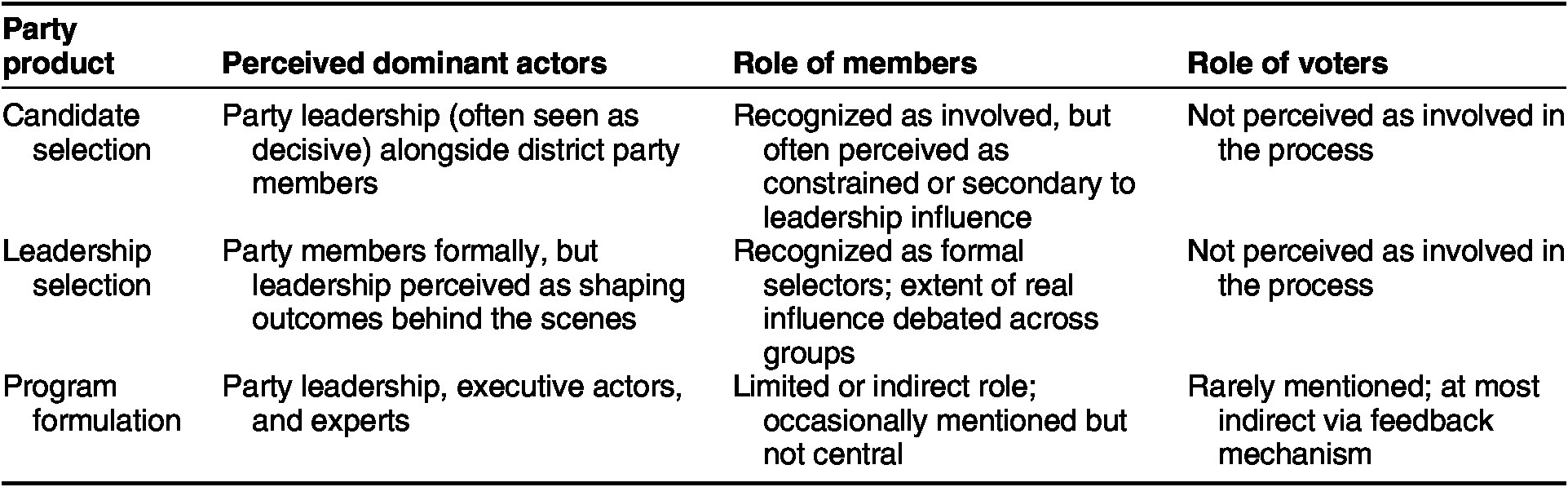
Our analysis, as summarized in table 2, suggests that participants understood that they, as voters, are not the only principal. The fact that voters were not identified as the group deciding on any of the products is the most striking evidence (this goes for all group discussions; see table C1 in online appendix C). Only in the context of party program decisions (bottom row, table 2) were voters mentioned, but not very much. These perceptions already reveal important elements of voters’ implicit understanding of party organization: in their view, intraparty decisions belong primarily to party actors rather than to voters.
Perceived Current Principals across Party Products

Table 2 Long description
The table consists of four columns and three data rows.
1. Candidate selection: Perceived dominant actors are party leadership (often seen as decisive) alongside district party members. Members are recognized as involved but often perceived as constrained or secondary to leadership influence. Voters are not perceived as involved in the process.
2. Leadership selection: Perceived dominant actors are party members formally, but leadership is perceived as shaping outcomes behind the scenes. Members are recognized as formal selectors, though the extent of real influence is debated. Voters are not perceived as involved in the process.
3. Program formulation: Perceived dominant actors are party leadership, executive actors, and experts. Members have a limited or indirect role, occasionally mentioned but not central. Voters are rarely mentioned, at most indirect via feedback mechanisms.
Note: For a detailed analysis, see table C1 in the online appendix.
Beginning with candidate selection in table 2, all groups perceived the leadership and district members to be involved but varied in how much they perceived the latter to have actual control relative to the leadership. In focus group 5, a former party member (participant E) took the role of discussion leader and explained how members in the local party organization select candidates. No one really challenged that description, but participants did question whether this was true for all parties (participant B) and whether the local party board could push specific candidates through (participant A). This suggests that they would have thought differently had participant E not been in the group and explained so forcefully about how the process works. In the remaining groups, there was a widespread notion that the party leadership actually controls or influences the process. For instance, in focus group 3, participant D stated, “I think it’s pretty top-down, but they want it to look like it’s very locally run. Because it gives, it looks like they have a representative democracy, a local democracy.” Even when a group member challenged this perception, more participants stuck to their beliefs that the party management is in control (see display D1 in online appendix D for the full conversation):
PARTICIPANT E: But do you think—sorry to interrupt—do you think that during the municipal elections, the party leadership sits at the top and decides who should be elected on all the lists across Denmark? Is that what you imagine?
PARTICIPANT B: Yes.
PARTICIPANT D: Yes.
Many groups also discussed how the procedure varies across parties depending on how grassroot-like or centralized the party organization is and described the procedure less as a selection act than as a process in which the youth party organization functions as a “career ladder” that organically brings talents forward (participant C, focus group 1). Table 2 also shows that none of the groups perceived lotteries or experts to be involved in the selection of candidates. In sum, participants broadly agreed that district members play a role (albeit not a decisive one) and ascribed no role to voters. This suggests that participants understood the primary principal to be the local party (membership), rather than voters.
Perceptions of how parties select leaders resemble those of candidate selection (see table 2 and the middle panel in table C1): participants believed that party members, but not voters, are involved, and the party leadership orchestrates the process behind the scenes. Focus group 3 was most convinced about the actual power of the party members, while focus groups 1, 2, and 4 were more convinced that the party leadership controls which and how many candidates run in the party leadership election. To bolster their perception of party membership control, focus group 3 drew on a specific case in which they believed that an outsider successfully challenged a candidate promoted by the party leadership: “Then she went in and took a, what’s that called, an opposition, and then she was actually elected. So, there it was the members, they had to fix it in a contested election, but it was the members who decided it” (participant E). In focus group 1, participants were more hesitant to believe that party members decide: “In practice, we just see that there are a lot of elections for party chairman where there is only one candidate, and then it’s like, ‘Yeah, yeah, we vote on it,’ but then something has happened behind the scenes, and someone has decided who is running” (participant D). These findings mean that in the context of leadership selection too, participants understood that they are not the principal.
Finally, the findings show that party programs were taken to be highly top-down affairs, controlled by the party leadership or executive committee with the involvement of different types of experts (see table 2; for further details, see the bottom panel of table C1). The party program was perceived as a strategic document formulated by leading politicians to maximize party success either by targeting voters with the help of communication experts or via donors such as interest groups: “Some of the things that may also be involved to a greater and greater degree, that is, where the political parties get financial support from various organizations, and how much they are obliged to take inputs from those organizations” (participant G, focus group 4). Even in group 5, where the former party member explained how they had formed a program committee consisting of local party chairs, other participants remained doubtful (see display D2 in online appendix D for the full conversation):
PARTICIPANT A: How many consultants were involved?
PARTICIPANT E [former party member]: None, it was more or less something we wrote ourselves.
PARTICIPANT A: Oh, that’s nice to hear.
…
PARTICIPANT G: I wasn’t sure there was even that much discussion. I thought it was just the party leadership deciding. I’m not really sure what the leadership is exactly, but I imagined it was some central part of the party that made the decisions.
…
PARTICIPANT G: Maybe it’s only [naming a specific party] that have that kind of discussion—I don’t know. That’s just how I thought it worked.
…
PARTICIPANT B: I have a feeling that since there’s so little party membership today—compared to the old days—it’s kind of an illusion to believe that internal party democracy is what upholds democracy. So in that sense, it might be cleaner if it’s more like a brand, a leadership, a party setting the direction—and then democracy is representative. Because that’s how people act today. They vote for a party color—they don’t join parties anymore.
This exchange of views reveals how participants—even after listening to participant E—doubted that a deliberative process takes place. They avoided questioning the truthfulness of participant E’s description by talking about other parties. The final remark by participant B explicitly questioned the value of involving party members in the formulation of party policy. For party programs, our findings thus reveal that participants did not see voters as the primary principals either. Rather, they perceived programs to be decided in a largely top-down process within the party—a process in which other actors only play an advisory role. This is not obvious because according to standard conceptions of political representation, parties’ policy proposals form the content of the contract in the principal–agent relationship between voters and their parties (see Mansbridge Reference Mansbridge2003).
In sum, across party products, most participants (23 out of 32) held sometimes detailed but varying perceptions about intraparty procedures. It is worth noting that these also correspond relatively well to the actual diversity of intraparty processes among Danish parties. Yet they largely agreed that across products, the party program is most strongly controlled by the party “top”—the party leadership, the executive committee, and experts—and candidate selection is most strongly influenced by party members, though perhaps more formally depending on perceptions of party leader involvement in filtering candidates. This suggests that participants understood that they are not the primary principal selecting which products parties present to voters. This is further underscored by the absence of references to voters in group discussions. Participants agreed in their perception that voters are not involved in any of these decisions. They thus understood voters to be excluded from influencing key party products—that is, they understood them to be secondary principals in intraparty politics. This perception forms an important backdrop for how they subsequently reasoned about coprincipalship and its legitimacy.
Preferences: Who Should Be the Principal?
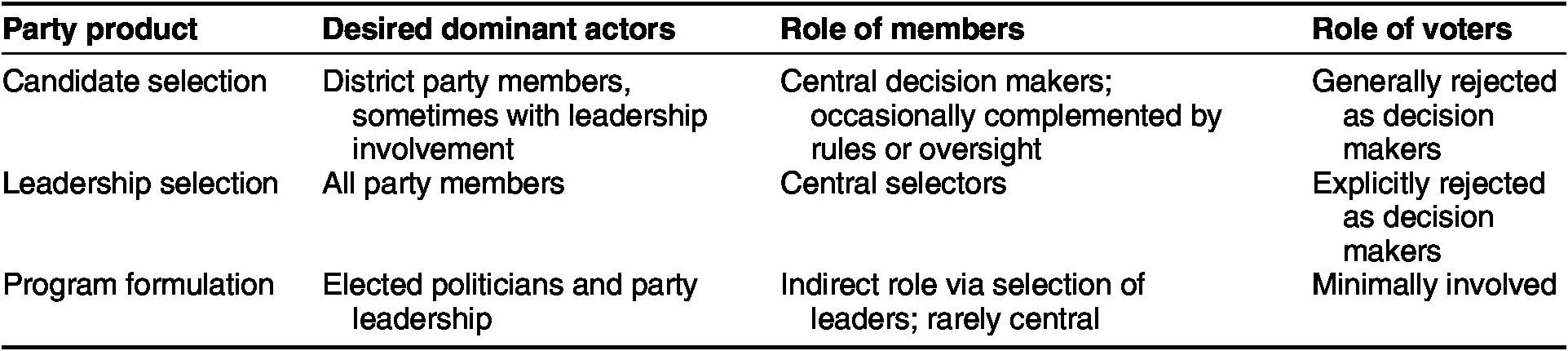
Turning to preferences, the main finding of our analysis is strikingly similar: voters were not participants’ preferred type of principal. Instead, their preference was either (district) members for personnel decisions, or higher-level figures, such as elected politicians, for party program decisions (see table 3). Patterns were similar across groups (see table C2 in the online appendix). These preferences not only reveal who participants believed should decide but also reflect their broader understanding of what different actors within a party are for.
Desired Principals across Party Products

Table 3 Long description
The table consists of four columns: Party product, Desired dominant actor(s), Role of members, and Role of voters.
* Candidate selection: Desired dominant actors are district party members, sometimes with leadership involvement. Members are central decision makers, occasionally complemented by rules or oversight. Voters are generally rejected as decision makers.
* Leadership selection: Desired dominant actors are all party members. Members are central selectors. Voters are explicitly rejected as decision makers.
* Program formulation: Desired dominant actors are elected politicians and party leadership. Members have an indirect role via selection of leaders and are rarely central. Voters are minimally involved.
Note: Notice that participants preferred local party members to decide on candidates running for election in geographical districts, while they preferred all party members to select the national party leader. For a detailed analysis, see table C2 in the online appendix.
For candidate selection (table 3; see the top panel of table C2 for more details), focus groups generally pointed toward district party members as their preferred decision-making body, thus implicitly accepting members’ role as primary principals. They qualified this preference in different ways: by limiting choices via procedural rules (rotation), by introducing qualification requirements, or by involving additional principals either within the party organization (party leadership) or outside the party organization (voters). Group 2 discussed at length the merits of rotation and work experience outside politics (see display D3 in online appendix D for the full conversation):
PARTICIPANT F: And then there should be rotation. In some ways, that might be a good idea. For some politicians at least, it might be smart—“Okay, now you need to go into the private sector, and then you can come back after four years.”
PARTICIPANT G: I also think that makes sense.
…
PARTICIPANT F: Yes, it just becomes more credible.
…
PARTICIPANT B: Yes, because some have never worked.
…
MODERATOR: Did I hear you say that you think it would be a good idea if everyone had rotation rules, or that we introduced a requirement for work experience before running for Parliament?
EVERYONE: Yes.
PARTICIPANT F: Rotation would be fine. Because then, in one way or another, you’re forced to gain experience—it kind of happens naturally.
Regarding party leader selection, preferences were similar both within and across focus groups (table 3; see the middle panel of table C2 for more details): with a few exceptions, participants preferred all party members to select the leader and only sporadically discussed alternatives. The preferences were stated promptly and unanimously, as indicated by this conversation in group 3 (see display D4 in online appendix D for the full conversation):
PARTICIPANT F: For me, it has to be the members who choose.
…
PARTICIPANT D: And then you can say there are all kinds of coffee clubs and factions within the party—and that’s fine, because that’s part of democracy. But as long as all party members have a say, it’s fine. What internal groups exist is another matter.
…
PARTICIPANT E: Agree.
PARTICIPANT A: Agree.
This suggests that for leadership decisions too, participants accepted that members are the primary principal. However, there were some objections to this dominant preference. In group 5, two participants (neither former party members) were either strongly in favor of or somewhat positive toward elected politicians choosing the party leader. In group 4, the preference was less clear but still involved some form of control: “If it’s the members, then it can be anyone, including ‘Bobo the clown.’ So, I think it might be good that there is some form of control over it” (participant D).
Finally, all groups highlighted elected politicians as important actors in formulating the party program: “Elected politicians are the most important, because this is what we elected them to do” (participant A, focus group 4). This means that participants delegated authority to elected politicians to formulate the content of the contract between voters and the party instead of wanting to do it themselves. This speaks to the idea that parties in public office should formulate policy for voters and not for members in order to avoid the risk of policy drift. However, preferences converged less here than for party leader selection (table 3; see the bottom panel of table C2 for more details). Participants expressed different preferences for who should decide, possibly because of underlying uncertainties about the purpose of party programs (cf. Eder, Jenny, and Müller Reference Eder, Jenny and Müller2017). Alternative preferences mainly involved the party leadership or executive committee, while more inclusive decision-making procedures involving party members were hardly discussed. Rather, the involvement of experts received some attention. Group 2 and some participants in group 5 disliked the involvement of experts and perceived it as strategic vote-seeking behavior: “What should we do to attract as many people as possible?” (participant D, focus group 2). However, in groups 1, 4, and 5, the involvement of experts was also discussed in more positive ways with a focus on their policy expertise, as illustrated in the following discussion from group 5 (see display D5 in online appendix D for the full conversation):
PARTICIPANT G: I’d like to say something. About the experts—it becomes kind of a technocracy, where it’s not the elected officials deciding. But I kind of like the idea behind it. The challenge is choosing the experts—because they can have political leanings. If you ask a Social Democrat think tank, you get one answer. If you ask CEPOS—a right-wing liberal think tank—you get another. The Conservatives won’t be asking the Social Democrats how to solve a problem. But I still like the idea—like with tax policy, how experts see the issue. You don’t have to follow them 100%, but they can provide input or inspiration, and you can decide whether it’s a good or bad idea. I actually like the idea.
PARTICIPANT A: I don’t like it as much—because you can find an expert who says one thing, and another who says the opposite. One says lower taxes means more production, another says people won’t work more no matter what. If I got five thousand more per month, I wouldn’t work 20 extra hours. Hopefully, they’ve vetted their … well, a lot of it is value-based politics. You can’t really have an “expert” on social equality, for instance.
…
PARTICIPANT F: I think maybe it’s a good idea to have an expert in the party. What’s important for your party to include in its political formulation? What do people expect you to address? Then, of course, party members should help decide how it’s formulated.
…
PARTICIPANT B: I think it’s a great idea to have experts in certain areas—to form an opinion about what’s best, if you’re trying to optimize society, so to speak. That’s a charged word, but you know what I mean. But if experts are used to optimize for votes, that’s negative in my view. Then it should be the elected officials who are in focus—they’re democratically elected. If the voters choose the party, and the party uses that feedback loop, it can go in strange directions. But the leadership is elected by the members, and the national board is too. So the elected should be central—because they’re chosen.
Although this suggests some preferences for technocratic solutions, the most common view among participants was that elected politicians and the party leadership—rather than party members or even voters—should be responsible for formulating the program (see table 3; see also Bertsou and Caramani Reference Bertsou and Caramani2022). This suggests that participants accepted their role as secondary principals: they did not prefer voters to make this decision but preferred to delegate this task to knowledgeable and legitimate agents over whose selection they had coprincipalship with party members.
In sum, our findings across all products reveal that participants either expressed explicit concerns regarding voters as relevant decision makers or did not consider them as such. This was held to be a path toward populism, to conflict with intraparty democracy, or to be too demanding for voters to attend to, thereby leading to unwanted randomness: “To me, it would be strange having voters decide which candidates [the party] should select, it would be too random” (participant D, focus group 3). Additionally, participants expressed awareness of the role they performed in the delegation chain when they made decisions on election day: “And in the end, it will be the party’s voters who will punish or reward the party for the policies they have chosen to develop and implement” (participant D, focus group 1). This shows that participants not only understood coprincipalship as revealed by their perceptions but also preferred or at least accepted being relegated to secondary principal. These preferences were therefore consistent with their acceptance of coprincipalship as a legitimate organizational arrangement: they wanted party members to exercise internal authority while voters retain their role as external, electoral principals.
Reasonings: Members Are the Party
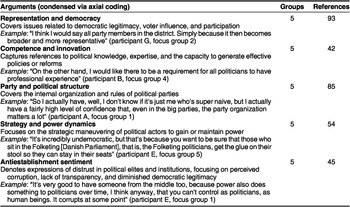
In the third part of the analysis we investigate participants’ reasonings, which reveal why they held certain preferences as well as their broader thinking about what parties are for and how authority within parties should be structured. Table 4 displays five lines of arguments used by participants when stating their preferences (see the note to table B2 in online appendix B for the open coding process): evaluations of democratic values (categorized as “representation and democracy” and “competence and innovation”), institutional structures (“party and political structure”), and specific behavioral concerns (“strategy and power dynamics”; “antiestablishment sentiment”). All arguments were present in all groups and used multiple times, as indicated by the number of references in table 4. “Antiestablishment sentiment” and “strategy and power dynamics” are related arguments, as they often refer to the perceived power of elites. However, we keep them separate for analytical purposes, as “antiestablishment sentiment” arguments cover a broader set of political actors and systemic mechanisms (e.g., trust), whereas “strategy and power dynamics” arguments are focused on the party (elite) acting in rational ways to gain or maintain power.
Identified Arguments for Motivating Preferences for Principals in Intraparty Democracy Processes

Table 4 Long description
The table consists of three columns: Arguments (condensed via axial coding), Groups, and References.
* Row 1: Representation and democracy. Covers issues related to democratic legitimacy, voter influence, and participation. Example: participant G, focus group 2. Groups: 5. References: 93.
* Row 2: Competence and innovation. Captures references to political knowledge, expertise, and policy generation. Example: participant B, focus group 4. Groups: 5. References: 42.
* Row 3: Party and political structure. Covers internal organization and rules. Example: participant A, focus group 1. Groups: 5. References: 85.
* Row 4: Strategy and power dynamics. Focuses on strategic maneuvering to maintain power. Example: participant E, focus group 5. Groups: 5. References: 54.
* Row 5: Antiestablishment sentiment. Denotes distrust in political elites, corruption, and lack of transparency. Example: participant E, focus group 1. Groups: 5. References: 45.
Figure 1 shows a heat map of how the different arguments were used in association with specific actors to argue either for or against their involvement. Arguments are presented in rows, and actors in columns. The figure highlights actors who belong to the theoretical inclusiveness–exclusiveness continuum. Shades represent the level of concurrences between types of actors and types of arguments within passages that are coded as arguments for preferences; the different products are shown in the three panels. As such, the figure allows us to explore how participants connected different actors and arguments when expressing their preferences for how party products should be determined.
Heatmap of Reasonings across Products and Principals
Note: Darker shades indicate more prevalent concurrences between reasoning and an actor on the expression level. The top row lists the possible actors.

In the context of candidate selection, discussions of district party members and party leadership primarily revolved around arguments about “representation and democracy” and “competence and innovation,” as indicated by a darker shade of the respective cells in figure 1. District party members were argued to support representation, whereas party leadership control was held to work against such ideals, moving toward more strategic decision making. For example, group 2 engaged in a long interaction that illustrates such reasoning (see display D6 in online appendix D for the full conversation):
PARTICIPANT G: I don’t really think so. I’d say it should be all party members—in the constituency where someone is to be elected. Simply to make it broader and more representative. I think it becomes more strategic if the leadership gets to choose rather than it being a broader vote.
PARTICIPANT F: Yes, or it should just be at their annual, what’s it called—
…
PARTICIPANT E: Annual meeting?
PARTICIPANT F: Yes, the annual meeting they have. Then I assume they’re represented from all parts of the country—[interrupted by participant G]
PARTICIPANT G: Right, and that’s also broader representation than if the leadership just picks someone. That would be very narrow and strategic.
PARTICIPANT B: That might be.
PARTICIPANT E: I’m also in favor of the constituency choosing among party members. And that’s probably also because—as you [participant G] said—I’m worried it becomes too strategic if the leadership makes the decision. Often they want to place specific people in certain places, and it’s not always that local constituencies agree with the national party.
This was a typical interaction about candidate selection procedures. Discussions often revolved around themes such as including local preferences (representation) or providing democratic legitimacy, which a selection by the leadership cannot deliver. At the same time, many participants saw the dangers or limits of giving sole decision-making power to (local) party members, because they may lack knowledge or expertise to “choose the right ones” and might need input from the leadership, the party organization, or the real world. This is also why the “competence and innovation” argument played a larger role when some participants reasoned about work experience as an additional requirement (“other mechanisms” in figure 1). The dominant reason was that it would lead to more “credible” candidates (see also Schwenk Reference Schwenk2024).
Discussions about leadership selection were heavily dominated by a single argument, as illustrated by the shading in the middle panel of figure 1: the acknowledgement of party structures. Participants largely agreed that party members should choose their party leaders, because it is a matter of internal representation at the grassroots level. Opening the process to all voters was seen as dangerous, because it can lead to undesirable consequences for the party. Group 3 had a longer interaction about this (see display D7 in online appendix D for the full conversation):
PARTICIPANT D: Because the voters are the party members. If you want to be a member of a party, you’re free to join, so everyone has the chance. I’m not sure it would have serious negative consequences, but actually—yes, it could. A small party with a particular cause, where the members agree on who should be the leader, could be overruled by a bunch of outside voters who disagree and pick a totally random candidate. Then the leader wouldn’t actually represent the party—and that’s their job: to represent the party. And what is the party? It’s the members—not the voters as such.
PARTICIPANT F: I agree in principle.
PARTICIPANT G: I agree too.
PARTICIPANT E: There’s an element of—if you want influence, then you have to step into the fight and take responsibility. You have to join the party [agreement in the group].
PARTICIPANT A: If you want to help decide, you have to be part of the decision making.
This exchange shows that the group also discussed and discarded the alternative of having voters decide. They motivated their preference for party members by referring to the importance and integrity of party structures. They assigned rights and responsibilities to individual members and stressed that party structures are internally representative and open for everyone’s participation.
Finally, regarding the party program, participants regularly found it more difficult to agree on the preferred principal because they could not agree on the guiding principles. Discussions on personnel were guided by one or two types of arguments, but discussions on party programs revolved around more themes (see the shading in the bottom panel of figure 1): “party structure,” “representation and democracy,” “competence and innovation,” and to some extent “antiestablishment sentiment” and “strategy and power dynamics.” The following exchange from group 3 illustrates a notion of intraparty representational delegation focusing on party structure (see display D8 in online appendix D for the full conversation):
PARTICIPANT F: The party is, in principle, the members—those who show up at the national meeting or whatever. …
PARTICIPANT D: I very much agree. I think it should come from the bottom up. Where exactly the line is drawn for who decides what the party program should look like—I don’t know. But in an ideal world, it would be the party’s members who elect the candidates, who then elect the national board, who eventually elect the leadership. And regardless of who ultimately makes policy decisions at each level, it should reflect the members’ views—because they’ve been elected by the members. …
PARTICIPANT A: Agreed.
PARTICIPANT E: I disagree. I don’t mind parties being top-down managed.
PARTICIPANT D: Neither do I. I’m just saying, hopefully, it’s the members at the bottom who’ve elected the ones above—and wherever the top of the pyramid is where decisions are made, it’s hard to say, but in the end, it should reflect the members.
PARTICIPANT B: Without support from the members, you won’t get much time to define the party’s—[interrupted by participant E]
PARTICIPANT E: And that’s my point. If members really disagree with the top-down management, they’ll kick them out, I think.
PARTICIPANT D: I agree.
PARTICIPANT B: So it’s still the members, then.
PARTICIPANT E: Well, you could say that if the policy implemented [in Parliament] or in the municipalities—if there’s a small group in [Parliament] making those decisions, I don’t actually have a problem with that. Precisely because I have such high regard for how the system works from the bottom up. If there’s a problem with the views being expressed, they’ll be overthrown.
…
PARTICIPANT E: … I think it’s better to have a politician who’s into the cases and maybe educated in the system.
PARTICIPANT D: But again, those politicians were hopefully nominated by the members—so their values are still being reflected.
Although these participants disagreed about how free politicians are to formulate the party program, they all returned to the intraparty recruitment process as the anchor for legitimacy. Other participants focused less on intraparty democracy when discussing policy formulation and instead referred to the electoral relationship with voters. In this line of reasoning, external actors such as interest groups rather than intraparty democracy were highlighted as potentially disturbing the electoral relationship. This is illustrated in the following discussion in group 4 (see display D9 in online appendix D for the full conversation):
PARTICIPANT G: One thing you haven’t mentioned that they actually use often is people who go out and ask voters—then bring back some viewpoints that could help attract more voters.
MODERATOR: Yes, so the open category could be, for example, “try asking voters what they care about.”
PARTICIPANT A: I think one of the most important actors is the party’s elected representatives. That’s what we elect them for—what we expect from them. …
…
PARTICIPANT G: Some of the things that may also be involved to a greater and greater degree, that is, where the political parties get financial support from various organizations, and how much they are obliged to take input from those organizations?
Focusing specifically on coprincipalship, participants reasoned about the legitimacy or representativeness of party members when expressing a preference for them as the principal. They saw parties as civil society associations that are open to all voters and in which membership is taken to be a low threshold for accessing decision-making processes: “If you want influence, then you have to step into the fight and take responsibility. You have to join the party” (participant E, focus group 3; the group expressed agreement). This again suggests an acceptance of, if not a preference for, coprincipalship—but a coprincipalship that is explicitly based on arguments of representation and party organizational integrity, thus echoing arguments in the normative literature on coprincipalship (Wolkenstein Reference Wolkenstein2018). This was further supported by expressions about why voters should not be directly involved. Participants argued that this turns the representative relationship into a “strange feedback loop” (participant B, focus group 5), potentially leading to populism or to limited direction or vision in political debates. Some expressed concerns about leaving it up to parties and their members on the grounds that doing so would be unrepresentative—arguments that made alternative mechanisms such as a lottery (focus group 1) or work experience requirements (focus group 4) attractive. Interestingly, participants occasionally justified their preferences for intraparty democracy by highlighting voters’ role as the ultimate principal on election day. As participant B in group 3 argued, for example, “I think that as a voter, I have the opportunity to say that I don’t support that, and then I can choose another party.”
Overall, our analysis connecting perceptions, preferences, and reasonings shows that to varying degrees participants saw some risks in coprincipalship but justified their preferences for it by referring to party autonomy and to voters’ rights to participate in parties and sanction their decisions on election day. They perceived party leadership as being at risk of power corruption (table 2) and preferred party members to keep that risk at bay (table 3). Their justificatory logics regarding coprincipalship offered an explanation as to why voters endorse coprincipalship despite its potential structural tensions: it fits their understanding of parties as internally self-governing organizations constrained by members and externally held accountable by voters.
Discussion
Our findings point to a consistent pattern in how voters understand intraparty democracy and why they welcome greater intraparty democracy even though it may not benefit them. Across party products, participants recognized that they are not the primary principals in intraparty decision making and, importantly, did not want to be either. Instead, they assigned a central role to party members while reserving for themselves the role of evaluators on election day.
Our findings suggest that intraparty democracy does not threaten voter autonomy in the way some normative theories anticipate (Wolkenstein Reference Wolkenstein2018), and that voters’ acceptance is not grounded in participatory ideals or expectations of improved representation. Rather, it reflects a particular “public theory of parties,” grounded in experiences of democratic practice, in which parties are civil society organizations that should govern themselves internally, with members acting as checks on leader dominance and voters as external principals providing electoral accountability. Based on this “public theory” we formulate an intraparty constraint hypothesis stating that voters favor intraparty democracy as a constraint mechanism rather than a participatory venue. They accept, legitimize, and even welcome coprincipalship because intraparty democracy constrains the party leader’s power, and not because it gives members more say. This hypothesis provides a plausible explanation for the detected ambiguity in voters’ strong support for intraparty democracy combined with their lack of interest in participating in parties or rewarding them for internally democratic structures.
Although our exploratory analyses are based on observations from Denmark, the argument advanced here is not tied to Denmark but is likely to apply under three specific conditions that relate to how voters perceive political parties and engage with them, and to the institutional setting. First, the constraint logic presumes that parties are understood as membership-based organizations that are, at least in principle, open to citizen participation. Under these conditions, party members can be seen as legitimate internal principals. This means that our argument should be predominantly valid for countries and parties where party membership is possible and where members enjoy at least some intraparty influence. While this is the case in most democracies, variations in degree exist too (Scarrow, Webb, and Poguntke Reference Scarrow, Webb and Poguntke2017).
Second, our argument relies on voters primarily conceiving of their role as external principals who exercise control through elections rather than through direct participation in party processes. Denmark provides some opportunities for voters to interfere with intraparty processes as most Danish parties use preference voting lists, which allow voters to prioritize among party candidates. But in systems where the involvement of voters is even more prominent, such as in systems with primaries (e.g., the United States or some Latin American cases), the condition may not be met, and our proposed hypothesis may not be supported to the same extent. In contrast, the hypothesis may find stronger support in even more party-oriented systems involving closed-list voting, such as Portugal.
Third, our proposed logic of constraint is likely strongest whenever voters are particularly concerned about unchecked party leadership. Where trust in politicians and elites is high, the demand for such a constraint may be weaker. However, even in Denmark, where levels of political trust are relatively high (OECD 2025), concerns regarding power having a corrupting effect on elites and a lack of legitimacy and representation emerge as reasons for supporting intraparty democracy as an internal constraint mechanism.
These scope conditions suggest variation across parties, and above all across party systems. In systems with relatively strong membership-based parties, such as those found in Northern and Western Europe, the constraint logic may be more likely to apply. In contrast, in more candidate-centered systems, voters may be less inclined to view party members as legitimate internal principals and may instead favor more direct forms of influence and control.
Conclusion
Political parties link government and citizens. However, this linkage is challenged by dissatisfaction, disengagement, and distrust (Dalton [Reference Dalton1996] 2013; Hay Reference Hay2007; Van Biezen Reference van Biezen2008; Webb Reference Webb2005). Parties have responded by increasing direct member involvement (Brause and Poguntke Reference Brause and Poguntke2026). While these reforms aim to strengthen internal legitimacy, they also redistribute authority within parties. In principal–agent terms, they institutionalize coprincipalship between members and voters, raising questions about delegation, accountability, and representative democracy (Katz Reference Katz2014; Wolkenstein Reference Wolkenstein2018). This study aimed at exploring why voters welcome these developments even though they do not benefit voters.
We examined voters’ perceptions, preferences, and reasonings about intraparty democracy to interrogate the broader logic that underpins their acceptance of coprincipalship. Across party products, we find that members are regarded as an effective internal constraint on strategic, self-serving party leaders. Based on these patterns, we develop the intraparty constraint hypothesis: voters support intraparty democracy not as a participatory venue, but as a mechanism to constrain party leadership.
Participants explicitly rejected involving voters in intraparty decisions either because of an assumed lack of knowledge or out of respect for party members as the true demos of intraparty democracy. This illuminates why voters simultaneously express support for intraparty democracy, show little desire to participate, and rarely reward internally democratic parties electorally. They distinguish between intra- and interparty politics: the former is valued for its capacity to constrain leaders, the latter for its role in sanctioning governments. Voters’ endorsement of coprincipalship does not eliminate the underlying structural tensions of coprincipals but rather highlights a delegation logic in which voters willingly assign a privileged role to party members while retaining ultimate electoral authority. They do not reward intraparty democracy electorally, because they judge the output rather than the throughput of political parties. They may even penalize “façade” intraparty democracy, perceiving party leaders to informally control all decisions (see also Hazan and Rahat Reference Hazan and Rahat2010; Schumacher and Giger Reference Schumacher and Giger2017).
For political parties and scholars of party politics and political representation, these findings have important implications. They suggest that expanding intraparty democracy will not boost voter engagement or electoral appeal. Instead, such reforms should be framed with appeals to organizational integrity, such as appeals to enhance representation, ensure internal accountability, and strengthen the party’s democratic credentials. Efforts to engage voters through promises of internal influence must acknowledge that many voters do not want such roles. They want organizationally strong parties, but not necessarily participatory ones. Voters care about constraints, such as rotation rules or extended requirements for candidacy, on the perceived power-seeking party elite.
While our findings reflect the perceptions, preferences, and reasonings of relatively few Danish voters, its core insight applies beyond the Danish case, particularly in contexts with strong membership-based party organizations: voters’ notions of intraparty democracy and coprincipalship are an important yet overlooked aspect of party democracy. Voters’ perspectives provide an alternative but democratically relevant understanding of political representation that highlights the power-constraining rather than the participatory function of parties. This is a recognized function of political parties in the party politics literature (e.g., Müller Reference Müller2000), but it is less salient in the public opinion and political representation literature, which potentially contributes to a rather negative story about voters’ appreciation of party organizations.
With this study, we urge future research to engage in a test of the hypothesis we have developed, taking the discussed limitations and possible scope conditions into account when developing research designs. Specifically, we see potential in cross-country survey studies developing questions targeted toward measuring preferences for party leadership constraint, open-ended questions probing the justification logics, and experiments estimating effects of intraparty constrains on trust in individual political parties as democratic institutions.
Supplementary material
To view supplementary material for this article, please visit http://doi.org/10.1017/S1537592726106057.
Acknowledgments
Earlier versions of this article were presented in the Research Section on Party Politics in the Department of Political Science at Aarhus University in March 2025, at the workshop on political parties and governance at the University of Gothenburg in October 2025, and at the Annual Meeting of the Danish Political Science Association in November 2025. We thank all participants for valuable comments and suggestions. We also wish to thank Jennifer Cyr, Kate Dommett, Morgan Le Corre Juratic, Gideon Rahat, Jana Schwenk, and Fabio Wolkenstein for reading and commenting on earlier versions of the article. We gratefully acknowledge funding from Aarhus University Research Foundation (ref. AUFF-E2017-7-13).



 Open access

