In June 2017, 28 performances of the same short play—William Huizhu Sun’s adaptation into Chinese verse of Victor Hugo’s 1862 novel, Les Misérables—were staged by students of the Wenhua Elementary School in Weifang, Shandong province. These performances served as the final exam for a required drama course. The course was taught in seven 5th- and 6th-grade classes. The 32 students in each class were divided into four groups. Each group produced a play. Sun’s 25-minute-long adaption of portions of Les Misérables, one of five, features Jean Valjean stealing Bishop Myriel’s silverware only to run into two policemen right away. Myriel, after hearing the tumult, exonerates Jean by saying that the silverware was given as a present. Myriel further explains that he deliberately gave Jean—who has bad table manners—the elegant utensils to make him learn a decent man’s way of dining and living his life. Bishop Myriel’s merciful gesture changes Valjean’s attitude toward life.
These 28 Les Misérables performances were almost exactly the same, copied from a video of professional actors of the Shanghai Theatre Academy (STA) performing in June 2015 at STA’s Affiliated Middle School. The student performances were similar to a final exam of a music class where all the students sing the same song. In the drama class not only was the script the same, but also the mise-en-scène, acting style, stage design, costumes, and sound. The presentations differed from each other only with regard to the students’ individual personalities and performing skills, which were highlighted precisely because each student group portrayed the same roles using the same text. This method of teaching drama—called “drama etudes”—is unique and experimental in China.
Can drama be a requirement in schools as music has been for decades in China? And how can you teach a class where every student is involved and benefits from the same performance practice taught during the limited classroom time of 16 periods each semester, 40 minutes per period? These were the questions I and a team of students from STA led by Sun asked ourselves. We knew that using drama etudes was different than earlier approaches to theatre education in China.
Three Other Approaches to Theatre Education in China
When I ask elementary or secondary school students what theatre is, the answer is always, “Isn’t it Chinese opera singing?” In China, most students and many adults equate theatre with various traditional opera genres (jingju, kunqu, etc.). Only a few students—mostly in Beijing and Shanghai—know huaju, Western-style spoken drama. Most students have watched comic sketches on TV, especially the annual Chinese New Year’s Eve Gala. Because theatre (xiju), opera (xiqu), and comedy (xiju) have similar pronunciations in Chinese, my lecture often veered toward differentiating these three terms. I wasn’t able to get much further.
Currently, in China there are three ways to familiarize students with theatre: professional actors performing for students; students performing in school theatre clubs or drama classes; and using some theatre elements in non-drama classes. The first approach brings plays to schools or takes students to theatre. However, in China there are few huaju theatres, children theatres, or puppet theatres; and these are mainly in big cities. By contrast, outside the metropolises, there are 360 local Chinese opera genres performed by thousands of troupes. This unique vibrant tradition makes it possible to implement theatre in schools. In August 2017, the Ministries of Culture, Education, and Finance of China’s State Council, together with the Propaganda Department of the Chinese Communist Party, jointly issued a document, “Implementation Advice on Chinese Opera Entering Schools,” requiring that by 2020 all primary and secondary school students should study Chinese opera. Encouraged by both the central and local governments, Chinese opera troupes perform in some schools. But most Chinese operas, which are ancient stories of romance or political struggles, are not suitable for primary school students. Furthermore, these performances are usually implemented irregularly—once a year, or even less. In order to accomplish the government goal of 100% participation, teachers substituted watching videos for seeing live performances.
The second approach is for students to join thespian clubs. After school, students put on plays guided by their teachers. The plays are spoken dramas, musicals, or Chinese operas. A small number of schools offer drama classes that stage plays. Often professional theatre people are invited to direct the plays. In most cases, schools expect to enter the production into a theatre competition or bring it to an arts festival organized by the local government. This can enhance the school’s reputation. For example, in July 2012, I attended a National Children’s Drama Festival in Beijing featuring 18 schools from across the country. One lvju performance, a local opera form presented by the students from the Bingchengqu Yifu Elementary School in Shandong province, was excellent. It was a comedy and the children had us laughing all through the performance, especially the student in the lead role, whose vocal and movement techniques were impressive. Later I met their teacher, Shi Lianshan, a recently retired lvju master and the artistic director of the Bingzhou Lvju Theatre Company. Shi Lianshan has taught lvju in the school since 2008, and was still teaching in 2020. I learned that the students also perform regularly at nursing homes for residents unable to go to the theatre (see Li and Ma Reference Rongxin and Yue2018). Shi Lianshan devoted himself to the students, and his efforts were rewarded with the invitation to Beijing for the festival, which earned the Bingchengqu Yifu Elementary School a national reputation.
Adapting plays from both Chinese and foreign literature is another way to bring theatre into elementary and secondary schools. In 1986, the Fujian Experimental Theatre Company, a regional theatre in South China, initiated a program of “Textbook Plays,” adaptations of Western and Chinese literature into short plays. These Textbook Plays—including The Necklace by Maupassant, The Chameleon by Chekhov, The Cop and the Anthem by O. Henry, Fan Jin Passing the Civil Exam by Wu Jingzi, and The Little Orange Lamp by Bing Xin—toured to schools and became popular across the country. There are now many Textbook Plays competitions at different levels: school, district, city, and province. Textbook Plays are mostly performed by students, only occasionally by professionals.
The third approach is to integrate drama into other subjects, especially literature, history, and foreign language classes. Sometimes even mathematics, physics, and chemistry classes have used drama. Chinese educator Tao Xingzhi (1891–1946)—a Columbia University PhD student of philosopher and educator John Dewey (1859–1952)—experimented with this in the 1940s after returning to China. For example, in November 1941, the “Dance of Chemistry”—a performance with three scenes—was performed by students in Chongqing. There was even an “arts/science/education” musical organized around 50 chemistry topics. In Reference Xinghuang2016, Chen Xinhuan wrote about this kind of work:
Of course, Gao, the chemistry teacher, was not optimistic that students could master the knowledge only through a performance. He later developed the play into 6 classes. Students learned chemistry through performing and discussing after the show. (Chen Reference Xinghuang2016:101)
No one followed up on Tao’s experiments until early in the 21st century when studies came to China from the UK and the US where it was known as “Drama in Education” (DiE), “Theatre in Education,” and “Creative Drama” (See Xu Jun Reference Jun2017:101). In 2005, STA started the first theatre education program in China, with courses modeled on the UK and US approaches. Since then, three small DiE training centers have been set up in Shanghai, Beijing, and Chengdu. There, experts from the UK, Hong Kong, and Taiwan give lectures and lead workshops. Chinese students who have graduated from DiE programs in the UK came back to work in these centers. Since then, thousands of teachers of kindergarten, elementary, and secondary schools have been trained in DiE. As more teachers practice DiE in their classes, research papers on the subject are increasing. The China National Knowledge Infrastructure (CNKI) database reports that in 2009 there were 4 papers, in 2017, there were 46, and in 2018, 40.
When theatre becomes part of the curriculum, students benefit not only from increased knowledge in the arts but in other subjects as well. The Chinese government is aware of this, but improving arts education is difficult. In 2014, the Ministry of Education issued “Advice on Implementing School Arts Education.” This document requires that arts curriculums adhere to the national standard: arts class hours should be no less than 9% of the total hours in elementary and secondary schools (Ministry of Education 2014).
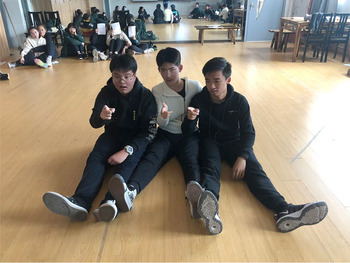
Actress’s Walk (left) and Walk in a Sneaky Way from the textbook of Drama Etudes for the Classroom: Training, Scripts. (Photos courtesy of William H. Sun)


In 2020, the “Guidelines on Strengthening and Improving Aesthetic Education in Schools in the New Era” was issued by the general offices of the Communist Party of China Central Committee and the State Council (Xinhua News Agency Reference Agency2020). The guidelines touched upon aspects of aesthetic education in schools such as education reform, facilities and faculty, curriculum design, and institutional support. The document set goals that will bring a marked improvement in aesthetic education in schools by 2022, and a diversified, modern, and high-quality system of aesthetic education established by 2035. Local governments have been urged to thoroughly implement the guidelines in accordance with their actual conditions. Arts curriculums including music, fine arts, calligraphy, dance, drama, Chinese opera, and film are the main elements of aesthetic education. In preschool, arts games are used to promote physical and mental benefits. The guidelines say that during compulsory education, that is, from K1 to K9, dance, drama, and film should be added to the curriculum, which already included music and fine arts. For high school, the guidelines require that a varied and synthesized arts curriculum be available to students.
So, it’s official: arts—including drama—must be taught before students can graduate high school. In 2017, the Ministry of Education issued a curriculum standard on drama in high schools. Currently, three kinds of high school textbooks on theatre are being compiled in Shanghai: Basic Drama Education, Theatre for High School, and Theatre Acting and Creating. Basic Drama Education focuses on reading lines from plays during limited class time. Theatre for High School introduces basic knowledge of playwriting, directing, acting, and designing. Theatre Acting and Creating has four chapters: classical theatre, creating dramas, Chinese opera acting, and producing theatre. These four books will be the first theatre textbooks authorized by the Ministry of Education. They will be used across the country. However, as a member of the compiling teams for Theatre Acting and Creating, I am not optimistic. That’s because there are few university theatre programs in China that can train qualified high school theatre teachers. Textbooks without competent teachers is not a winning strategy.
The Idea of Drama Etudes
Since 2009, STA has been searching for ways to make theatre an indispensable part of primary and secondary education. To do this, the STA team developed drama etudes, a pedagogical method for teaching theatre in the classroom in a 40-minute-long engagement. Because of the emphasis on math, Chinese, and English—crucial for their college entrance examinations—students have little time for after-school activities. By making theatre a required course, every student has time to practice in class and play a substantial role. But how can teachers with no theatre training gain the knowledge and confidence to teach what they don’t know—especially given that there is little chance for teachers in places other than Beijing and Shanghai to see live modern drama productions? Still, some teachers are interested in theatre. We were challenged to invent something that could be taught after a short period of training.
The drama etudes process was devised by William Huizhu Sun in 2009. The etudes entice all students to act in short plays staged in the classroom. At first, Sun, his colleagues, and their students worked on a series of short verse plays in Beijing opera style, Confucius’s Disciples written by Sun. These short comedies show people and situations Confucius and his three fictional disciples encounter on their way to different kingdoms where they will promote Confucian philosophy. Confucius’s Disciples was originally created as a medium of theatre education for Chinese students and as an introduction to Chinese culture for non-Chinese students. For both groups, “etude” refers to a basic set of exercises comparable to music etudes that students use to practice a set of carefully selected short pieces (Sun and Fei Reference Sun, Fei, Citron, Aronson-Lehavi and Zerbib2014:298).
The STA project attracted international students who worked on a dozen short plays during STA’s January 2013 winter semester. Then in late 2013, Sun and his team were selected by the Education Commission of Shanghai Municipality to start a long-term project to explore ways of teaching “comprehensive arts” as an expansion of Shanghai’s almost century-old music and visual arts curriculum. The team decided to use theatre as the core of their project. It was then that the term “drama etudes” was coined.
The first thing the team did was to dramatize scenes selected from novels and stories they deemed most appealing to schoolchildren—short plays with music, each about 25 minutes. These were then performed in schools by professional actors trained at STA. During the postshow discussions, students usually said they not only liked to see the plays but also would like to act in them. To do this, the STA team designed a two-semester course of 36 40-minute classes. Each etude is 20–25 minutes long and the total time span of the two-semester course is 24 hours.
The first project included five short plays in rhyme based on Les Misérables. Scenery and lighting were minimal, making each etude relatively easy to produce. Other rhyming plays included one based on Ernest Hemingway’s The Old Man and the Sea, one based on China’s foremost modern writer entitled Lu Xun’s Stories Revisited, and Sun’s Confucius’s Disciples.
The plays’ themes and values are uplifting, not too complex or deep—definitely not obscure. That is why these etudes were widely accepted by teachers, parents, and principals, as well as by students. They were designed to appeal to the largest possible number of schools and students nationwide. Because full-length classical plays—both Chinese and foreign—are too long for students to perform in classrooms, we wrote new plays.
Each etude has five to eight characters with roughly an equal amount of lines. This dramaturgical structure was determined when teachers told us that plays structured this way give every student an opportunity to play substantial characters. This had been a big problem. Teachers told the STA team that in the past whenever they cast a play, there were always more children wanting to play leading roles than were in a play. Few children wanted to play minor or lifeless roles like a tree or a rock, which often make up the majority of the roles in children’s plays. Our etudes are different. They give each student an equal opportunity to learn, practice, and perform. Also, each etude has a dramatic conflict sustaining a basic and clear narrative development with a beginning, rising action, climax, and resolution. All the characters have strong discernible actions with some characters having more complex actions.
Les Misérables was well-suited for China. It is the most universally liked Western classic in China. It was the most suitable basis for our first etude because the novel spans a long time period with countless stories, several appealing to children. Furthermore, many stage and film versions of Les Mis have made it a household name throughout China, as elsewhere. It is one of the few literary works that appeals to older people as well as the young, bridging the generation gap (Sun Reference Sun2018a).
Sun adapted five episodes from Les Mis; the first, in which Jean Valjean steals silverware, premiered on 24 June 2015. This remains the students’ favorite. Another popular episode is about Jean Valjean saving Cosette from the greedy and abusive grenadiers, whose shameless and foolish bargaining always make the audience laugh; Jean Valjean’s noble character is highlighted by contrast. At the end of this etude, Sun added a plot twist where Eponine wants to go with Cosette and her “new daddy.” Eponine’s father is willing to let her go if Jean pays a high price, but her mother cries, scolding the father and finally stopping Eponine from leaving. Students at the Hangzhou Foreign Language School, one of our training bases in Zhejiang province, performed four Les Mis episodes together as a full-length play in December 2017, developed over four semesters during which they worked on one episode per semester. The two etudes about Jean stealing silverware and Jean saving Cosette were more enthusiastically received and performed more frequently than the other episodes concerning more complicated adult issues. The silverware and Cosette etudes are the two most taught and performed to date.
I adapted four episodes from The Old Man and the Sea for the etudes program. Only the second has been produced. In this story Mother fish, while swimming with her Baby, is killed by the great Marlin. To revenge her death, the Baby fish volunteers to be the old man Santiago’s fish bait. The great Marlin eats the bait and is hooked. Finally, after a great struggle, Santiago pulls the Marlin to the side of the boat. To make the Marlin more interesting to students, I divided it into three characters: Head, Body, and Tail. These body parts talk, quarrel, complain, struggle, and of course fight together against Santiago. This way there are six characters in the play (Mother, Baby, Santiago, Head, Body, and Tail).
The unique dramaturgy of the etudes, which gives every character equal importance—no walk-ons as in many school performances involving large numbers of students—preempts the common problem of students vying for the best roles and being unwilling to play parts with no lines. Etudes offer every student a chance.
The Style of Drama Etudes
Although the style of the etudes combines Western spoken drama and Chinese opera, it is closer to Chinese opera. The narrative is Western, but the production is Chinese. As with many Chinese opera arias, the lines are rhyming verse. Indeed, the most important and original feature of the etudes is their rhyming lines. Because the stories are modern, the overall effect is of theatre somewhat between the prose language of spoken drama (huaju), typically Western imported plays, and the verse of Chinese opera. The etudes are more rhythmic and poetic than spoken drama. Not only are the rhyming verses vivid and fun for students, but they are also much easier to memorize and speak loudly. As Sun says:
One of the missions of our etude drama projects of Les Mis, etc., is to introduce to school children, inundated by prosaic literature in their daily life, some live rhyming language through watching and acting in this new genre of rhyming drama. (Sun Reference Sun2018a )
The acting style is deeply influenced by the rhythmic rhyming lines. The acting and staging of the etudes do not follow psychological realism as in modern Western drama or Chinese huaju, but rather entail a more physical staging. The movement is influenced by Chinese opera and martial arts. For example, in Les Mis the fight in the dark between Jean Valjean and the police during the etude of Jean stealing silverware borrows from the famous Beijing opera San Cha Kou (Crossroad: The Fight in the Dark). In the etude in which Jean saves Cosette, she no longer is washing dishes or house cleaning as in the novel but feeding imaginary chickens early in the morning in a scene of dance and mime borrowed from the well-known Beijing opera Shi Yu Zhuo (Picking Up the Jade Bracelet). In order to avoid the realistic sets and acting of “living room drama,” and to allow more robust physical actions, we decided at the beginning of the project to locate most of the action outdoors—thus using an empty stage as in Chinese opera. Besides making the etudes easier to stage, this stimulates the young spectators to use their imaginations. Even though there are no real chickens, all the young spectators understood the action.
In both Les Mis and The Old Man and Sea, Zhao Lei, a master of the movement and martial arts of Shanghai kunqu, was invited to choreograph the movement and coach the actors. He did not use the highly codified Chinese opera patterns but modified them as dance-like movements that were easier for students to learn. The staging was then also possible for schoolteachers to teach.
In Chinese opera only sung lyrics rhyme; spoken lines usually do not. In our drama etudes, however, all lines rhyme and can be sung if there is music. In order to make it easier for music teachers to teach drama etudes, we invited composer Ma Da to compose a few songs for Les Mis. Singing takes up about a quarter of the performance time. While students cannot sing as well as professionals, they very much enjoy it.
Encouraged by the students’ response and building on earlier efforts, Sun developed two full-length musicals, Cosette and Eponine from the Les Mis series and The Romantic Misadventures of Ah Q, based on Lu Xun’s Novel Stories Revisited. These musicals are performed by STA students for general audiences. Ah Q played in Shanghai on 1 September and 13–14 November in STA’s New Space Theatre and Duanjun Theatre, respectively, then toured to New York with five performances off-Broadway at the Kirk Theatre on 20–24 November 2019 and one performance at the New York Film Academy on 26 November. The notice in Broadway World stated: “The musical’s original songs fuse with the rhythmic clowning techniques of Chinese Gaojia Opera. Its simplicity, directness in style, and poignant theme makes it easy for all audiences to laugh with, to contemplate, and to understand the plight of Ah Q” (BWW News Desk 2019).
Training for Teachers
Because the etudes are created as part of a required course, the teachers who work on them with the students are regular schoolteachers, not invited specialists. To help them prepare for teaching the etudes, the STA team developed a training system. The first training workshop was seven days long in July 2016 with 24 teachers joining the program. Since then, there have been 10 programs, which trained a total of 489 teachers. Subsequent workshops were three days long. Four workshops took place at STA; four in the Hangzhou Foreign Language School, Hangzhou, Zhejiang Province; one in the Wenhua Elementary School, Weifang City, Shandong Province; and one in Hubei Second Normal University, Wuhan City, Hubei Province. In 2018, STA published a textbook, Drama Etudes for the Classroom: Training, Scripts, and Acting, detailing the codified physical training methods, annotated scripts, and scene blocking. Along with the textbook, teachers can obtain a video of Les Mis, costume and set designs, and production guides. Teachers can follow the guides step by step to produce the student plays.
The first four days of the original workshop in 2016 was scheduled for basic acting training plus some introductory theatre knowledge about playwriting, directing, and designing. Each day started with a 90-minute warmup session of theatre games. Many trainees questioned the value of those games because they were unrelated to the plays, which they were eager to rehearse. Later we realized that it would be more efficient if the training process used the exact etudes that they would teach in their schools. We compressed the training into three days, six to seven hours a day, the same total duration as a one-semester course. This way, trainees experience drama etudes as their students do. The trainee teachers can confidently copy exactly what we teach them.
In order to shorten the teacher training time, vocal and movement patterns were extracted from the short plays for trainees to practice collectively before beginning to rehearse in individual groups. The patterns were edited into a codified rhythmic pattern of one to eight beats and taught to the trainees to practice repeatedly as drills for about 20 minutes. Once the teachers learned, they taught their students the same way. By regularizing the collective drills and reducing individual rehearsal time, we gradually made the training very efficient to successfully fit into the three days. To let teachers without a theatre background understand, perform, and even direct drama etudes in such a short time, the training program mainly follows the model of “rehearse plus perform” (Hao Reference Tian2018:34). During the rehearsal, we often start with exercises used in modern acting classes—basic stage skills such as face the audience most of the time while onstage, remain in your role while performing, speak clearly, etc. Concentration exercises help performers see, listen, and feel while onstage. Communication exercises help actors build relationships with others onstage.
To give a clearer sense of our process, below is the three-day training schedule we used in the Hangzhou Foreign Language School in November 2017:
First Day
Morning, 180 minutes
Introduction to Drama Etudes, 10 min.
Watch etudes performance video, 20 min.
Analysis and Q/A, 15 min.
Read through plays in groups, 70 min.
Break, 10 min.
Concentration exercise, 15 min.
Voice training, 20 min.
Practice lines, 20 min.
Afternoon, 200 minutes
Warmup, 10 min.
Physical movement training, 20 min.
Stage awareness exercise, 30 min.
Break, 10 min.
Physical movement in etudes, 80 min.
Etudes rehearsal in groups, 40 min.
Group performances in turn, 10 min.
Second Day
Morning, 210 minutes
Warmup, 15 min.
Communication exercise, 20 min.
Etudes rehearsal in groups, 140 min.
Group performances in turn, 35 min.
Afternoon, 210 minutes
Warmup, 10 min.
Communication exercise, 20 min.
Etudes rehearsal in groups, 150 min.
Group performances in turn, 30 min.
Third Day
Morning, 210 minutes
Warmup, 25 min.
Communication exercise, 15 min.
Etudes rehearsal, 170 min.
Dress rehearsal, 120 min.
Final performance, 30 min.
Reflections and discussion, 60 min.
Teachers receive the script before the training, and are required to read, and even recite some lines. In the morning of the first day, after watching the video of the performance, they analyze the script, discuss the characters, and do a reading where they learn how to recite rhyming lines.
Four sessions—from the afternoon of the first to the morning of the third day—are rehearsals. The warmup exercises and physical movements are different from typical theatre games; they are directly taken from the etudes. The Drama Etudes for the Classroom textbook includes specific and clear instructions on how to walk, pounce, fight, kick, look, smell, hear, touch, hide, etc. For example, regarding walking:
There are special conventions for an actress’s walk onstage in Chinese opera: point the tip of the toe towards the ground as she picks up the foot, then put the heel on the ground first, then the sole and toe. The other foot follows this movement immediately. Repeat for each step. In drama etudes, an actress follows this convention of Chinese opera […] but her steps are much larger than they are in Chinese opera, closer to daily life. (Sun Reference Sun2018b :18)
There are also walking exercises for particular situations in drama etudes. For example, “walking in a sneaky way on tiptoe” is designed for the situation where a character has to hide, such as when in Les Mis Jean steals the silverware and runs away to avoid the police. Students could use this exercise directly in the performance.
Students from Shanghai Bei Hong Senior High School in Les Misérables, part of the Drama Etudes for the Classroom program, November 2020. (Photos courtesy of William H. Sun)


During rehearsals, trainees imitate the videotaped etude performance in detail: the expressions, gestures, body movements, and dialogue. They follow the actor training approach of outside-in, which holds that an actor can gradually sense the internal emotion of the character by repeating the right external actions, finally organically combining both into the finished performance. This outside-in method is very much like Konstantin Stanislavsky’s “method of physical actions,” which the Russian master advocated toward the end of his life. By precisely copying the etudes, the trainees gradually embody the characters, their relationships, and their conflicts. Many trainees are surprised at how efficient the process is.
On the first day participants usually doubt that they can perform after only three days. They lack confidence. But by the third day, some teachers are able to improvise a little after their strict imitation exercises; they feel the pleasure of acting. Most of the teachers understand their roles after three days of repeating the lines and movements. Often during the postshow discussion some of the teachers say that they suddenly felt enlightened about the intrinsic meaning of an action after the repetitions (Hao Reference Tian2018:10).
After the training, we hope that in a school drama class of one session per week over an 18-week semester, a single teacher can teach the basic skills to several subgroups, each of which can put on a short play. Every student is engaged with either a substantial character or as an assistant director or stage manager.
Since 2013, Lin Cunfu, a Chinese literature teacher at the Hangzhou Foreign Language School, has organized an annual drama training program for teachers in Zhejiang Province. The program, which did not include drama etudes, is supported by the government for teachers in public schools across the province. Then in 2016 Lin was deeply impressed by drama etudes when he saw it at a conference at STA and did the training with STA instructors. He said:
It is possible for a teacher with no drama background to teach after the training. Most of the teachers in the programs teach Chinese literature or English. Some are student psychological counselors. None of them has an artistic background. For example, a psychological counselor from Wenzhou City taught Les Mis after the training and his students won their first prize in a local students arts festival. (Lin Reference Cunfu2020)
Teaching Drama Etudes in Schools
STA toured drama etudes to several elementary and secondary schools in Shanghai and Beijing in 2015 and 2016. After the tours, some schools started to teach etudes as elective courses or in student drama clubs. For example, Yan’an Secondary School, which is near STA, started teaching etudes in 2016, using three episodes of Les Mis. Zhang Shufan, a teacher with no professional theatre training, taught the courses. She taught two episodes of Les Mis, one episode of The Old Man and the Sea, and one episode of Lu Xun’s Stories Revisited. Each etude was taught for 40 minutes a week, 18 weeks per semester. In the first 14 weeks, students practiced etudes in groups with every student playing a role. In the last four weeks, some students were selected to rehearse and put on a final show in front of the whole school. For the course exam, every student played a role in an etude. Zhang described her method of teaching:
The etudes course includes rehearsal, and four additional training sessions: the first session is script analysis where we discuss the whole story and the historical background of Les Mis; the second is voice training; the third is physical training where we practice the movements of Chinese opera; the fourth is theatre games which prepare the students for rehearsals. (Zhang Reference Shufan2016:15)
In 2018, Lin Cunfu taught drama etudes as a required course in Hangzhou Foreign Language School. Four classes of 30 students each joined this experiment for one year (two semesters). Les Mis was performed in the first semester and Lu Xun’s Stories Revisited in the second. Lin divided each class into three groups; each group performed in a 250-seat theatre. Because each class performed a different episode of Les Mis, a total of four episodes were staged. This added up to the equivalent of doing a full-length play with a total audience of 1,000. These experiments in different schools demonstrated that drama etudes could be effectively taught during regular course time by teachers with no professional theatre training.
The most significant accomplishment of our program came a year earlier, in 2017, when drama etudes became a required course in the new Wenhua Elementary School in Weifang, a prefecture-level city of nine million in Shandong province on China’s east coast south of Beijing. Weifang has no huaju theatres but lvju, its local opera form, is popular among older people. Lvju is one of hundreds of local Chinese opera genres in Shandong’s rural areas. Despite this, most students have no theatre experience either doing or seeing shows beyond the occasional spoken drama children’s plays called “jacket-doll plays” because the performers wear animal headgear while enacting stories about animals. The jacket-doll plays are performed by live performers who mime the actions while recorded voices speak the dialogue.
The work at the Wenhua School fulfilled the dream of Zhang Yin, the school’s principal, who believes that theatre is essential to students’ growth. As she told me, “We were very clear that we wanted a course, not just a final play. Only a required course could benefit every stu-dent” (Zhang Reference Yin2018). When researching her options for what type of theatre program to offer, Zhang chose drama etudes over lvju because “drama etudes are a universal, not local, art form. They are created by professional theatre experts, mixing traditional opera and spoken drama. Also, there are no obvious leading characters in drama etudes, so every student has a chance to play a role” (Zhang Reference Yin2018). This principle of inclusion was an important factor in Zhang’s choice of program to teach because she does not want anyone to be left behind.
There are only two theatre academies in China offering professional theatre training: STA and the Central Academy of Drama in Beijing; across the country about 10 universities offer theatre programs. With so few graduates relative to such a vast population of more than 1.4 billion, it is not likely that students with theatre degrees would teach in Weifang city, a relatively small place. It is precisely for this situation that we designed the etudes for teachers who are not professionally trained in theatre. Ren Yanzhen, the lead drama teacher at Wenhua Elementary School, graduated from a local university where he was the leader of the drama club. There he got some experience in playwriting, directing, and acting. After graduation, he attended a seminar on drama etudes at STA and became a drama teacher.
The required drama course in Wenhua School is held for one hour per week, 17 hours total for each of two semesters during the year. In the first semester, students undergo some simple actor training. They also learn how to study scripts. This part of the training is not very different from literature classes. Students analyze scripts in terms of plot and character development. They also watch the video of STA’s Les Mis. Their teacher demonstrates some of the acting techniques. The final examination is a presentation of storytelling. Ren has found the course to be very beneficial to students:
They will know what a good performance is, have a taste for theatre, and gain aesthetic judgment. It is very important for students to know what the difference is between theatre and the mass entertainments they have experienced. These are the key aspects of learning in the first semester.
In the second semester, the teaching method is quite similar to math, physics, and music. The teacher shows the whole class how to perform in a play; the teacher demonstrates the difficult aspects of acting, helping the students to learn how to avoid common mistakes. For example, students are given the difficult task of experiencing the emotion of the characters, or analyzing the internal motives of the character—motives that drive a character even during still moments. After this training, the students rehearse in a group. (Ren Reference Yanzhen2018)
Learning through Imitation
In experimenting with drama etudes, the STA team does not strive for uniqueness or originality. Instead, we want to find a way that is universally workable and manageable for hundreds of millions of Chinese school children and their teachers. That is why we chose imitation as our basic method. By keeping the instructions simple and asking untrained teachers and their students to imitate, we have been able to reach our goal of bringing theatre to China’s primary and secondary schools.
Improvisation has the advantages of developing creativity. But there are also some disadvantages. I have taught drama classes in schools for migrant children from the countryside in North China since 2007. In my classes for migrant elementary school children, I tried the method of “creative drama.” The term creative drama is used to describe the improvised drama of children from age five or six and older, but it belongs to no particular age level and may be used just as appropriately with high school students. The young adult is more likely to label it “improvisation,” which indeed it is, but the important distinction is that it has form and is therefore more structured than dramatic play (McCaslin Reference McCaslin1990:6).
Usually the students in my classes improvised for less than five minutes. Then I tried to get them to perform the improvised piece again. I spent lots of after-class time helping students write original plays. I found that they were not confident about their own scripts; they hesitated to show the plays even to their classmates. Though I assured them that the revised versions of their improvisations were much improved, they were still frustrated because they felt they could not write good plays. When I encouraged students to create their own facial and hand gestures and body movements, I found that these young migrants did not have the confidence to do so. If I pushed them too much, they became frustrated. It was much more comfortable for them to imitate my gestures and movements. I realized in hindsight that asking them to invent gestures and movements was beyond their comfort level. They were better able to learn the behavior first, to work from the outside in. That way, they could ultimately find their own creative potential.
It proved dangerous to guide the students to improvise based on their own lives in the classroom. Too easily real conflicts were acted out. This behavior risks putting the students in an unsafe situation, blurring the boundary separating theatre education from theatre therapy. Not being trained as a therapist, I did not want to cross that boundary. The psychological impact of live theatre must be taken into consideration, not only for students who will see a play but also, and perhaps more critically, for those who create and act in it. Students involve themselves emotionally in order to make the situation of a play live onstage. In the context of a classroom of underage students, a story is not only a story, nor a play just a play. The balance between safety and danger should be considered; “be safe” should be the first rule for play selection with schoolchildren.
The between-ness of story, like theatrical distance, is without actual dimensions. It takes a place wherever people feel safe enough to face the danger of putting themselves in the place imagination has cleared for them—whether this be in a play in a story, in a theatre, or by a fire-side. (Duggan and Grainger Reference Duggan and Grainger1997 :78)
Using improvisation in theatre pedagogy also blurs the line between playing a game and performing a play. In the teaching process, how shall we divide the time between playing theatrical games and practicing performance skills? I’ve found that there is a big gap between theatre games and aesthetic performances. Students are often very interested in playing games, but resist the move to using these to make a finished performance for the stage. Creating aesthetic performances requires a different, deeper level of commitment than playing theatre games.
With schoolchildren especially, imitation is a better way to acquire performance knowledge and skills, and to instill life knowledge. As Richard Schechner notes:
By means of imitation, learners acquire through practice an organic mastery of the craft that underlies every art. It is only after making various performance scores “second nature” in the sense of learning new ways of standing, walking, gesturing, speaking, and singing that the maturing artist earns the right to experiment and improvise with the vocabulary of the genre. (Schechner Reference Schechner2013 :233)
Sun also argues for imitation as a viable method for students:
All the subjects in schools are taught through imitation, at least at the beginning. This universal rule could of course be applied to arts education. Music is taught through carefully selected etudes, from the easiest to more difficult and complicated. Students master the performance skills through imitating. Drama etudes, like music etudes, make it possible for all students to practice in the classroom, divided into small groups and guided by their teacher. By playing etude plays, students can best experience and understand theatre. (Sun Reference Sun2018a )
Educators generally agree that theatre education can help develop students’ competence in creativity, leadership, cooperation, communication, and problem solving. Improvisation helps mostly in terms of developing creativity, but at the expense of quality. Imitation can help more in terms of developing students’ skills of leadership, cooperation, communication, and problem solving, maybe at the expense of some creativity. But through imitating plays of high quality students learn how to use their voices and body movements to develop characters based on their deepening understanding of sophisticated plays. This way students can also learn about the theatre traditions of their own culture and other cultures, not just their “personal self” and its limited surroundings, as often expressed in young students’ improvisations. This is the ultimate advantage of using drama etudes as a core tool in school theatre education.
Les Misérables
Excerpt from Scene 1
Adapted and with English version by William Sun Huizhu
(Midnight. Street outside the home of BISHOP MYRIEL. Empty stage. Middle-right side has a big white screen, representing BISHOP MYRIEL’s home and anything else needed. OLD COP enters, holding a lantern, with YOUNG COP, holding a beer bottle.)
YOUNG COP: Why are we patrolling these empty streets?
OLD COP: The boss told us to make the rounds tonight.
Let’s simply focus on the job, alright?
YOUNG COP: I’m so hungry for some sweet treats!
OLD COP: Well, that’s enough of your complaining!
At least it’s not freezing cold and raining.
(Suddenly, they see someone’s silhouette dart by. Scared, YOUNG COP hides behind OLD COP.)
YOUNG COP: What was that? A man or a ghost?
There he runs, beyond the lamppost!
OLD COP: Only a thief would run from the light.
Stop that man! Don’t let him leave our sight!
(The two cops run after the shadow, chasing him.)
(JEAN VALJEAN emerges from behind the screen. He quietly tiptoes out. Since it is his first time stealing, he is extremely anxious. […] The burlap sack he is carrying bangs into the door frame making a loud sound. Afraid that someone might wake up, JEAN quickly closes the door and hides, then peeps out from behind the door.)
JEAN VALJEAN: (Sings) Is this not God asking me
To go back there obediently?
And return the stolen silverware?
I sweat and labored till the 19th year.
This is worth more than tenfold of all my earning!
I’m ungrateful to Bishop Myriel, my heart is burning.
But here I am now, a blank new slate.
I need a second chance to change my fate.
I can have a better future.
Hope whispers in my ear, like a murmur.
This new life starts from here on out.
God, give me strength and shed my doubt.
Lend me your hand.
(The sound of the two policemen is getting closer.)
YOUNG COP: (Faking a macho persona, as if he is a force to be reckoned with.) Now we’re playing games? Go on and hide!
I’ll search for you everywhere, far and wide!
(JEAN, hearing the policemen coming closer, hides behind the door.)
OLD COP: Now he’s disappeared into the blue.
There’s no one else to blame but you!
YOUNG COP: But I saved us by scaring him away
[…]
(The policemen rest, eventually falling asleep. Hearing no more sound, JEAN tiptoes out, but trips over one of their legs. The contents of his bag make a loud banging.)
YOUNG COP: Stop, who goes there?
Is that the thief I hear?
(JEAN attempts to flee. YOUNG COP senses that something is moving and tries to tackle him, but fails. OLD COP quickly walks to the other side of JEAN, though neither policemen can see him. By smelling JEAN’s stinky prison clothes, the policemen figure out JEAN’s position. Even though JEAN could easily fend off the policemen, because he has a heavy conscience, he half-heartedly fights with them and is overcome. OLD COP ties him up.)
YOUNG COP: (Opens the bag.) You ruffian, causing a riffraff! ( JEAN snickers.)
Caught red-handed and you dare to laugh?
Answer me, you lowly scum!
Where did you steal these from?
(JEAN glares at the YOUNG COP who cowers and retreats.)
JEAN VALJEAN: A real robber, you can’t even catch.
Only me, a poor, shabby-clothed wretch.
(From left) Young Cop (Wang Chao), Jean Valjean (Cao Pin), Old Cop (Ren Siyuan). Drama etude Les Mis at Shanghai Theatre Academy’s affiliated high school, 2015. (Photo courtesy of William H. Sun

YOUNG COP: Look at what you wear, I know that look.
No doubt a petty thief, if not an evil crook.
[…]
(The commotion wakes up MAID; her silhouette appears on the screen.)
MAID: Who’s making a ruckus in the middle of the night?
I can’t see your faces even with my light!
YOUNG COP: Old lady, you think we’re being loud!
We’re cops doing our duty, is noise not allowed?
MAID: You arrogant lad, full of hot air!
These days robbers roam everywhere.
Go ahead, boast and be proud;
But you’ve only caught one in the crowd.
Now look at yourself and see where you stand,
Before your haughty attitude gets out of hand.
YOUNG COP: (Takes her light to look at her, and becomes frightened.) Oh, no, oh no! (Gingerly returns the lantern to her, runs to OLD COP.)
We’ve done wrong, let’s go!
OLD COP: What was all that yelling about?
What did you say that made her shout?
YOUNG COP: Do you know the master of this home?
It’s the like of great Julius Caesar of Rome,
The honorable respected Master Myriel.
If we offended him, we’d better flee!
MAID: Hey, hey! Go on, keep talking!
Finish up here before you start walking.
(Inadvertently kicks JEAN’s bag.)
Oh, what on earth is this bag doing here?
Oh, our goods have been stolen, I fear!
These are our plates, our silverware!
YOUNG COP: How the tides have changed!
I can see our promotions arranged!
By stopping this man who did steal,
We’ve helped none other than Bishop Myriel!
[…]
MAID: Jean Valjean!
The Master believed your soul to be good and true,
Yet you dare bite the hand that feeds you?
If we had known you were bad to the core,
We’d have left you on the street for sure!
OLD COP: Good. The evidence and testimony are enough!
YOUNG COP: Time for prison, we’re done with your bluff!
BISHOP MYRIEL: (From behind the screen. Then entering.)
What happened? Did I hear someone weep?
MAID: Sir, sorry to have disturbed your restful sleep!
BISHOP MYRIEL: Jean Valjean! Arrested again?
Not only has this disturbed my mood, my heart is now weeping!
To salvage his inner good, I had been yearning.
Instead, I’ve only found hardship and pain.
Is it impossible to remove such a stain?
No, no, I don’t believe that’s true.
One mistake need not remain a permanent load.
I will try again to show him the right road.
(Whispers to MAID, who exits.)
YOUNG COP: Evening Sir, I have some news!
We nearly had a thief on the loose —
But my partner and I halted the crime,
Rescuing your prized possessions just in time!
BISHOP MYRIEL: Perhaps it’s more than meets the eye.
I’ll have a word with him, hear him testify.
Mr. Jean Valjean. How are you, my good man?
JEAN VALJEAN: Sir, how low I am!
(MAID enters holding a candlestick.)
BISHOP MYRIEL: Mr. Jean Valjean, please accept these as my gift,
They are yours to enjoy, therefore forget this rift,
You have potential; a boy with an honest heart.
From this evening on, consider this your fresh start.
With these (holds up knife and fork) I’ll teach you how to eat properly.
You forgot this when you left too early!
(Puts the candlestick into the bag.)
Thank Heavens the police found you!
Where you’d disappeared to, we had no clue!
OLD COP: What is this…
BISHOP MYRIEL: We are so very fortunate and blessed.
Officers, thank you for finding our honored guest.
Everything here has been given to him.
His modesty is filled right up to the brim.
(From left) Jean Valjean (Cao Pin) with the Maid (Qin Ziran). The drama etude Les Mis at Shanghai Theatre Academy’s affiliated high school, 2015. (Photo courtesy of William H. Sun)

OLD COP: (Points suspiciously at the MAID.)
What she said about stealing made perfect sense.
YOUNG COP: Right. She didn’t sound like she was lying. Now I’m on the fence.
BISHOP MYRIEL: The Madame’s day has been too intense.
Rather early she routinely retired to bed,
Of these presents, she had not heard what I said.
OLD COP: Bishop Myriel, this situation still seems dubious.
In making observations, I’ve been studious.
YOUNG COP: Just look at this guy’s poor clothing,
What good is he to do with fine silver adorning?
BISHOP MYRIEL: Must a poor person eat with no grace?
Mr. Jean Valjean, accept these gifts and our embrace.
(JEAN bows his head, walks over and sits on a rock. BISHOP MYRIEL motions for the MAID to get two sets of eating utensils and plates: one for herself, one for JEAN. The MAID then teaches him proper table manners. He imitates what she models clumsily, but with intense focus.)
BISHOP MYRIEL: (Sings) The world has its ways of being,
Even without any logical reasoning.
There are many secrets to life,
From its happiness to its strife.
Who has done no wrong and can judge another?
My fellow man, my brother:
Let the past be in the past.
Why did you walk away so fast?
Why did you take only the eating utensils I gave you?
You wanted to focus on manners to start your life anew?
OLD COP: Thank you for this brilliant explanation!
BISHOP MYRIEL: Excellent, no need for more deliberation!
(Laughing, he motions to the MAID to escort them out. She leaves with the cops.)
JEAN VALJEAN: (Sings) What sigh is this in my ear?
Is it my conscience waiting for me to hear?
Why do I have no safe place to turn?
I am laden with too heavy a burden.
Did you think kindness would make me come around?
Saving me from a future prison compound?
Instead, only in shame am I drowned.
BISHOP MYRIEL: My child, please recognize,
People fall but must rise up, don’t agonize.
Our experience can be our most valued treasure.
Take this to heart and find your true measure.
JEAN VALJEAN: Nineteen years ago, on a cold and stormy night,
I saw someone in need and did what I believed to be right.
Breaking a shop window—but society did not agree.
A young soul was destitute—so poor and hungry.
BISHOP MYRIEL: My child, please do not forget.
JEAN VALJEAN: No, these items I will not accept.
BISHOP MYRIEL: Who has never made a mistake before?
It only matters that you get up from the floor!
JEAN VALJEAN: How will I find my place again?
BISHOP MYRIEL: Our experience can be our most valued treasure.
Take this to heart and find your true measure.
JEAN VALJEAN and BISHOP MYRIEL: Our experience can be our most valued treasure.
Life is a gift and full of pleasure!
(Repeat.)
(BISHOP MYRIEL leaves. JEAN VALJEAN sits down to rest, takes out the silverware, and practices cutting bread. He tries a few times, unsuccessfully. Frustrated, he throws the items to the ground.)