


Introduction
Electoral accountability is a vital aspect of representative democracy (Powell Reference Powell2000). We develop a framework for understanding the electoral accountability of parliamentary governments. Our framework is predicated on a core element of the standard model of retrospective electoral accountability (Cheibub and Przeworski Reference Cheibub, Przeworski, Przeworski, Stokes and Manin1999; Manin Reference Manin1997; Przeworski, Stokes, and Manin Reference Przeworski, Stokes and Manin1999), namely the electorate’s capacity to reward or sanction the incumbent government.Footnote 1 This capacity exists when changes in the incumbent government parties’ vote shares are positively related to changes in their policy-making power. The partisan composition of a parliamentary cabinet is not directly determined by voters, however, but by the parties that secured legislative representation. The electoral accountability of parliamentary governments thus rests on two minimally necessary conditions. First, decreases (increases) in votes for an incumbent government party must translate into decreases (increases) in its legislative seats. Second, decreases (increases) in seats for an incumbent government party must translate into decreases (increases) in its policy-making power. These votes-to-seats (electoral system) and seats-to-portfolios (party system) relationships constitute an accountability identity that translates votes-to-portfolios and defines parliamentary accountability to the electorate.
Using a party’s share of cabinet portfolios as a measure of its policy-making power, we illustrate the empirical puzzle at the core of this essay. In the 400 parliamentary elections across 28 countries that we study, the votes-to-seats relationship is reliably positive, whereas the seats-to-portfolios relationship exhibits far more variation. Parliamentary elections thus tend to meet the votes-to-seats requirement for accountability but not the seats-to-portfolios requirement. Accountability failures generally emerge after elections when parties translate their seats into the cabinet portfolios that control policy. Given this result, we ask how the party system interacts with the electoral system to secure or to undercut electoral accountability.
We address this question by focusing on the ideological structure of the party system. By the party system we mean the number, size, and ideological positions of the parties in a given polity at a given time (Blondel Reference Blondel1968, 183; Boix Reference Boix, Boix and Stokes2007, 501; Kitschelt Reference Kitschelt, Boix and Stokes2007, 525). In particular, we treat seriously Sartori’s (Reference Sartori1976, 132–140; 179–80) argument that the effects of electoral competition are contingent on the presence of an ideologically central party and the bipolarity of the party system. A centrally located incumbent party that is indispensable to any possible governing coalition can use its pivotal position to avoid electoral sanction. This strategy is more effective when the party system features a large number of potential coalitions, and it is limited when the party system assumes a bipolar structure, with parties grouped into two mutually exclusive blocs in the policy space. Bipolarity provides a clear alternative to the incumbent government and imposes a zero-sum character on electoral competition between the two blocs. This argument implies three hypotheses: (1) the marginal effect of changes in incumbent parties’ seats on changes in portfolios is lower for centrally located than for noncentrally located incumbent parties, (2) the set of alternative governing coalitions declines in the party system’s bipolarity, and for that reason (3) the marginal effect of changes in incumbent parties’ seats on changes in portfolios increases with the party system’s bipolarity.
Using three-stage least squares regression and the Maoz and Somer-Topcu (Reference Maoz and Somer-Topcu2010) bipolarity measure, we find that the marginal effect of changes with incumbent parties’ seats on their portfolios increases in the bipolarity of the party system. In contrast, we find no evidence that the marginal effect of changes in seats on portfolios is unconditionally lower for centrally located incumbent parties than for noncentral incumbent parties. A reduced form of our regression model shows that majoritarian systems ensure a corresponding reduction in portfolios when voters sanction an incumbent party by reducing its vote share, and this effect is independent of bipolarity. Proportional electoral (PR) systems perform just as well as their majoritarian counterparts when bipolarity is strong but attenuate the impact of vote losses on portfolio losses when bipolarity is weak.
Our analysis suggests two reasons for why the combination of non-bipolarity and PR produces weaker electoral accountability. First, in PR systems, the marginal effect of changes in seats on portfolios is contingent on both the party system’s bipolarity and the incumbent party’s centrality. In particular, noncentral incumbent parties are exposed to electoral sanctions when bipolarity is strong, but they are insulated from electoral sanctions when bipolarity is weak. These dynamics tend not to operate in majoritarian systems where cabinet participation owes more to a party’s seat share than to its ideological position in the party system. Second, bipolarity is inversely related to the number of ideologically connected coalitions in the legislature. These results are consistent with a model in which incumbent parties attempt to form alternative governing coalitions to protect their policy-making power from electoral sanctions.
We make three contributions to the literature on representative democracy and comparative politics. First, we offer a new theory of the mechanics of electoral accountability that places the party system in the crucial position of translating seat shares into governing power. The normative foundations of our argument are well known (e.g., Fiorina Reference Fiorina1981; Key Reference Key1966; Manin Reference Manin1997; Przeworski, Stokes, and Manin Reference Przeworski, Stokes and Manin1999), but our positive theory of the role of the party system in translating votes into policy-making power builds on Sartori’s (Reference Sartori1976) efforts to address a theoretical and empirical puzzle that is frequently overlooked. Second, we disentangle the contributions to accountability of the electoral and party systems. In so doing, we adjudicate between two conceptions of electoral accountability: one that sees electoral institutions as sufficient to secure accountability (e.g., Carey and Hix Reference Carey and Hix2011; Lijphart Reference Lijphart1999; Powell Reference Powell2000; Powell and Whitten Reference Powell and Whitten1993) and one that sees the force of institutions mediated, even undermined, by the party system. Third, our analysis shows that different aspects of the party system affect accountability in different ways. In particular, we show that party system fragmentation weakens accountability by weakening the seats-to-portfolios relationship but that this effect is offset by the party system’s bipolarity. Ignoring the party system obscures the link between electoral sanctions, legislative representation, and policy-making power.
Electoral Accountability and Parliamentary Government
The standard model of retrospective electoral accountability assumes that voters cast their votes to reward or sanction the incumbent government based on their assessment of the government’s policies, performance, conduct, or character (Barro Reference Barro1973; Ferejohn Reference Ferejohn1986; Fiorina Reference Fiorina1981; Key Reference Key1966; Manin Reference Manin1997; Maravall Reference Maravall, Boix and Stokes2007; Przeworski, Stokes, and Manin Reference Przeworski, Stokes and Manin1999). Because governments can anticipate this retrospective judgment, they face incentives to condition their policies and actions on their potential rejection by voters (Manin Reference Manin1997, 178; Maravall Reference Maravall, Boix and Stokes2007, 910–1). Governments that respond to this incentive are accountable, but that accountability exists only to the extent that voters can effectively reward or sanction them.
Many studies of the economic vote employ the change in the incumbent government’s vote share between elections as the dependent variable and a measure of economic performance as the key independent variable (e.g., Lewis-Beck Reference Lewis-Beck1986, Reference Lewis-Beck1988; Nannestad and Paldam Reference Nannestad and Paldam1994; Powell and Whitten Reference Powell and Whitten1993). However, this approach cannot capture two aspects of electoral accountability. First, changes in the incumbent government’s vote share indicate at most that the electorate attributes responsibility to the incumbent government, not that it can hold the government accountable. Second, there is no need to assess government performance solely in terms of economic conditions. Our view is that changes in the incumbent government’s vote share from election to election sufficiently capture the electorate’s overall judgment regarding the incumbent government. This reflects a normative stance that the basis for sanction is not limited to the incumbent government’s performance (Anderson Reference Anderson2007; Barro Reference Barro1973; Ferejohn Reference Ferejohn1986; Manin Reference Manin1997); it can also be related to its policies, conduct, or character. If voters dismiss the incumbent government to reject government corruption during a period of economic expansion, for example, an economic performance metric would fail to capture a functioning system of accountability.
Moreover, casting accountability as an all-or-nothing affair in which the incumbent government is either retained or dismissed is neither analytically necessary nor consistent with the nature of parliamentary government. There must be a limit at which the voters’ judgment results in the incumbent government’s dismissal, but to assess accountability solely on the basis of dismissal is to apply a maximal standard for electoral accountability (Samuels and Hellwig Reference Samuels and Hellwig2010, 398). It is sufficient that the incumbent government’s hold on office be sensitive to the electoral result (Cheibub and Przeworski Reference Cheibub, Przeworski, Przeworski, Stokes and Manin1999, 225). If the connection between votes and outcomes is unreliable, however, incumbents will discount elections and the anticipation of electoral sanction will lose its force (Borowiak Reference Borowiak2011, 63–4; Ferejohn Reference Ferejohn1986, 19).
Furthermore, a wholesale loss of office—as in a presidential system in which elections directly confer or withdraw executive power on a specific individual—is different from a loss of power in a parliamentary system. In the former case, accountability takes on a retain-or-dismiss character because a single executive office is not divisible. In the latter case, however, the collective nature of a parliamentary cabinet allows one to speak sensibly of a graduated reduction in an incumbent party’s policy-making power. If a decrease in incumbent party A’s vote share results in a reduction of A’s share of cabinet portfolios, we argue that it is correct to say that voters have sanctioned A and that A has lost some capacity to shape public policy as a result.Footnote 2
An Accountability Identity for Parliamentary Government
Two other aspects of parliamentary government are central to electoral accountability. First, the partisan basis of parliamentary government makes incumbent government parties the appropriate targets of electoral accountability (Samuels and Hellwig Reference Samuels and Hellwig2010, 399–400): Political parties are the fundamental elements of modern representative government (Schattschneider Reference Schattschneider1942), and electoral systems restrict voters’ ability to hold multiparty governments collectively accountable and constrain them to use their votes to sanction just one of the governing parties. Furthermore, opposition parties cannot be targets of accountability because they did not formally exercise executive power in the previous term. By implication, the party system must provide voters with a set of stable party labels that distinguish government and opposition parties from the formation of the government at t to the formation of the new government at t + 1—otherwise voters cannot identify which parties are members of the incumbent government and which are not. Second, parliamentary government is indirect by nature: voters elect the legislature, and the legislature constructs the cabinet. Voters must therefore rely on parties in the legislature to translate changes in seat shares into changes in cabinet portfolios.
Theoretically, then, a minimally necessary condition for retrospective accountability to exist is that incumbent government parties that lose (win) votes subsequently lose (gain) some degree of policy-making power. Empirically, we consider this condition to be met when there exists a positive relationship between changes in incumbent parties’ vote shares and changes in their shares of cabinet portfolios. This is requires the following:
1. the electoral system to ensure that decreases (increases) in votes for an incumbent government party (ΔV) translate into decreases (increases) in its legislative seats (ΔS) and;
2. the party system to ensure that decreases (increases) in seats for an incumbent government party (ΔS) translate into decreases (increases) in its cabinet portfolios (ΔC).
We represent the relationship between changes in votes, seats, and portfolios and electoral accountability as an accountability identity:
 $$ \frac{\varDelta C}{\varDelta V}=\frac{\varDelta S}{\varDelta V}\times \frac{\varDelta C}{\varDelta V}, $$
where C indicates an incumbent party’s share of cabinet portfolios, V, its vote share, S, its seat share, and Δ, the difference in these values between elections at t and t + 1. Incumbent parties are accountable if  $ \frac{\varDelta C}{\varDelta V}>0 $, which requires that
 $ \frac{\varDelta S}{\varDelta V}>0 $and
 $ \frac{\varDelta C}{\varDelta S}>0 $. Conversely, electoral accountability fails if the electoral system fails to translate decreases (increases) of votes into decreases (increases) of seats (i.e.,
 $ \frac{\varDelta S}{\varDelta V}\le 0 $) or the party system fails to translate decreases (increases) of seats into decreases (increases) of portfolios (i.e.,
 $ \frac{\varDelta C}{\varDelta S}\le 0 $). Our emphasis on changes, rather than level shares, is a subtle but important point to which the literature on electoral accountability has given little attention.
The role of the electoral system in defining the votes-to-seats relationship is well established (e.g., Cox Reference Cox1997; Rae Reference Rae1971; Taagepera and Shugart Reference Taagepera and Shugart1989). The party system plays an equally important role in electoral accountability, however, because it shapes the seats-to-portfolios relationship. Minority governments, for example, show that the distribution of cabinet portfolios is not captured solely by seat shares but also by parties’ policy positions (Laver and Schofield Reference Laver and Schofield1990, 81; Strøm Reference Strøm1984). Consider the 2017 German elections.The abortive coalition between the Christian Democrats (CDU/CSU), Free Democrats (FDP) and the Greens failed because of policy disagreements between the latter two parties. German voters were ultimately presented with a carbon copy of the Christian Democrat–Social Democratic Party (SPD) coalition that they had just sanctioned. Aspects of the party system—notably parties’ policy stances—thus insulated the CDU/CSU and SPD from meaningful changes in their policy-making power. This example illustrates how electoral accountability is a product of both the electoral system and the party system.
Explaining Electoral Accountability
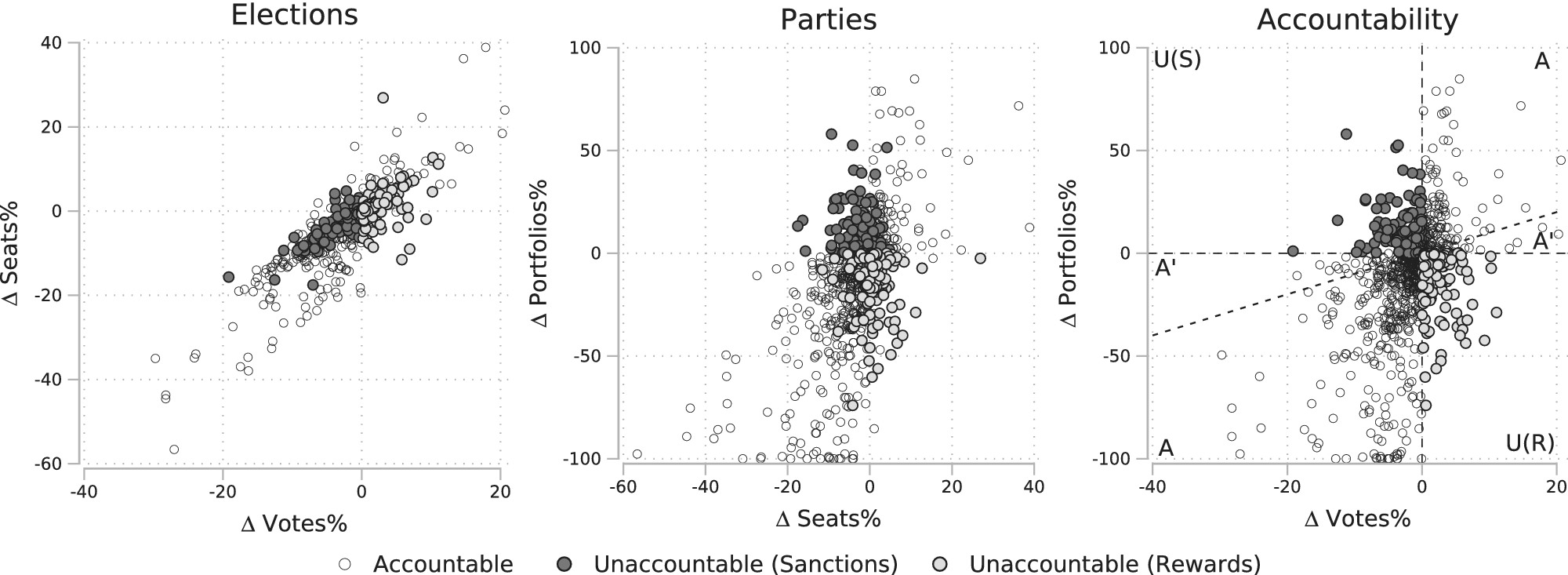
Figure 1 illustrates the accountability identity in the 400 parliamentary elections we study. The leftmost panel shows the votes-to-seats relationship between an incumbent party’s vote share and its seat share, the middle panel shows the seats-to-portfolios relationship, and the rightmost panel reflects the votes-to-portfolios relationship that ultimately defines accountability. Incumbent government parties that fall in the top-right and bottom-left quadrants (labeled A) of the rightmost panel are subject to electoral accountability: an increase (decrease) in the party’s vote share increases (decreases) cabinet participation. The off-diagonal quadrants reflect accountability failures. Incumbent parties in the bottom-right quadrant experience unaccountability in rewards, U(R), because their share of cabinet portfolios declines despite increases in their vote share. The top-left quadrant, by contrast, shows unaccountability in sanctions, U(S), where vote shares decline but portfolio shares increase.
Accountable and Unaccountable Government in Parliamentary Systems, 1948–2012

Figure 1 clarifies several aspects of electoral accountability. First, a large positive slope in the rightmost panel of Figure 1 is not necessarily better than a smaller positive slope, but flat or negative slopes are unambiguously worse because they do not reflect the rewards or sanctions put in place by voters. Outcomes where changes in votes are not fully translated into changes in portfolios (i.e.,  $ 0<\raisebox{1ex}{$\varDelta C$}\!\left/ \!\raisebox{-1ex}{$\varDelta V$}\right.<1 $, A′ in Figure 1) are also troubling because they imply that incumbents are partially insulated from the electorate’s judgment. Second, most dots in the leftmost panel lie on or near the positive diagonal. This implies that most accountability failures are not driven by electoral institutions. Third, the difference between the tight grouping around the positive diagonal in the elections (left) panel and the diffusion of election results around the diagonal in the parties (middle) panel depicts the disruptive effect of the party system on accountability. This is our puzzle: How does the party system interact with the electoral system to facilitate or disrupt electoral accountability?
The Electoral System
Because institutional rules (e.g., bicameralism) are often static over time, they are peripheral to the accountability identity in equation 1. The electoral formula is the central exception to this statement because it seeks to obviate entire components of the accountability identity. Ideally, proportionality ensures  $ \frac{\varDelta S}{\varDelta V}=1 $ so that accountability is determined solely by the party system’s influence on the seats-to-portfolios relationship. This leads scholars to focus on Gamson’s Law (1961), which states that the portfolios of coalition governments are allocated in proportion to seat shares. If legislators observe Gamson’s Law, the seats-to-portfolios relationship will tend to be positive.Footnote 3
Majoritarianism, in contrast, seeks to avoid coalitions. The votes-to-portfolios relationship ( $ \frac{\varDelta C}{\varDelta V} $) in such systems is intended to ensure that a party that secures a vote share in excess of 50% obtains all cabinet portfolios, whereas parties with vote shares below 50% receive none (Powell Reference Powell2000, 126). The normative intention (if not always the practical result) is thus for the electoral system to assume complete responsibility for accountability. Duverger’s Law explains how this is accomplished: the mechanical effects of a majoritarian electoral system steepen the seats-votes curve, the knock-on psychological effects induce all but two parties to remove themselves from competition, and voters are then able to coordinate their votes against an unpopular incumbent. In this respect, Duverger’s Law assumes “a structured party system in Sartori’s sense of the term” (Cox Reference Cox1997, 171). If these constraints fail, the opposition parties and voters may fail to coordinate their efforts, and the incumbent may escape electoral sanction (Carey and Hix Reference Carey and Hix2011; Powell Reference Powell2000, Reference Powell2004). Preferential ballots, joint lists, and run-offs offset the risk of this sort of coordination failure.
The Party System
The ideological structure of the party system is defined by the policy positions that parties adopt at elections. This is only weakly related to the electoral system. The district magnitude of the electoral system, for example, may limit the number of parties, but it does not determine their “ideological patterning” (Sartori Reference Sartori1976, 137). Theoretical constraints on the positions that parties can occupy in multidimensional policy space are mild (Laver and Schofield Reference Laver and Schofield1990; Schofield Reference Schofield1993; Schofield and Sened Reference Schofield and Sened2006), and hence the same electoral institutions can generate different configurations of party competition (Andrews and Money Reference Andrews and Money2009). Some of these configurations facilitate electoral accountability, others weaken it. Following Sartori (Reference Sartori1976), we contend that the electorate’s capacity to identify and to sanction (or reward) incumbent government parties is stronger when the party system is bipolar, with parties divided into two opposing blocs, and weaker when there exists a centrally located incumbent party that is indispensable to any potential alternative government.
Bipolarity
A party system is bipolar when the parties are arrayed in two distinct ideological blocs, one in government and the other in opposition. Both Sartori and Duverger stressed that bipolarity clarified the voters’ choice:
Opposition under a two-party system remains distinct in spite of its moderation, that is to say that public opinion can grasp with some accuracy the difference between the points of view of the majority and of the minority and so can choose with full knowledge of the facts… . The definiteness of the opposition seems to constitute an essential factor for its effectiveness as well as for the strength of the democratic regime
(Duverger Reference Duverger1954, 415, emphasis added).A two-party system is not essential for voters to have a clear choice; however, a multiparty system can achieve the same result provided that it assumes a bipolar structure (Sartori Reference Sartori1976). This is because a bipolar party system makes it possible to characterize political interactions with a unidimensional model of political competition in which a median exists and voters coordinate their choices around it (Black Reference Black1948). In such a party system, electoral accountability is contingent on whether a single party monopolizes the median or whether it is meaningfully contested. Sartori argued that bipolarity fostered contestation; it imposed a zero-sum complexion on the competition between mutually exclusive blocs for the median position, imparting a centripetal character to political competition and facilitating wholesale turnover in government. Bipolarity thus amplifies electoral sanctions and strengthens accountability.
Ideological Centrality
If moderate multiparty systems are strongly bipolar in nature, with parties arrayed in two distinct ideological blocs (Sartori Reference Sartori1976, 179–80), polarized multiparty systems feature a centrally located governing party bracketed by ideologically extreme and mutually antagonistic opponents. Sartori stressed that political interactions in such party systems were not “bipolar” but “triangular” (134), with governments exposed to merely peripheral turnover (139) because no viable alternative coalition can exclude the centrally located incumbent party. Such was the pattern of Italian postwar politics: Democrazia Cristiana (DC), surrounded on one side by proto-fascists and on the other by communists, could not be displaced from government because the opposition parties could not form an alternative coalition that excluded the DC. Only the center-left and center-right could be displaced. Triangular interactions can exist only in a policy space of two or more dimensions. In such cases, the dominance—indeed, the existence—of a center party is not assured (McKelvey and Schofield Reference McKelvey and Schofield1986; Plott Reference Plott1967; Schofield Reference Schofield1993). However, if a center party does exist in a multidimensional space, it cannot be excluded from any coalition and may be able to govern as a single-party minority (Laver and Schofield Reference Laver and Schofield1990; Laver and Shepsle Reference Laver and Shepsle1996; Schofield Reference Schofield1993).
Alternative Coalitions
The relationship between bipolarity, ideological centrality, and accountability arises because ideologically distinct blocs of government and opposition parties limit the set of alternative governing coalitions via which an incumbent party can insulate its policy-making power from electoral sanctions. A party system that contains just two connected coalitions, a government bloc and an opposition bloc, creates the conditions for high accountability because the competition for votes, seats, and portfolios takes on a zero-sum character: what one bloc wins, the other loses. Incumbent parties that lose votes thus have little prospect of forging an alternative coalition. In contrast, an incumbent party in a party system that contains a large number of potential governing coalitions may be able to form an alternative coalition to preserve its policy-making power in the face of electoral sanctions.
The contrasting positions of Fianna Fáil (FF) and the DC immediately after the Irish elections of 1981 and the Italian elections of 1983, respectively, illustrate this argument. Fianna Fáil entered the election as the incumbent government, but saw its legislative majority disappear as its vote share fell 5.4% and its seat share fell 9.8%. Fianna Fáil might have retained power as a single-party minority, but it was ideologically isolated in the Dáil and hence displaced by a center-left Fine Gael-Labour minority coalition. Like FF, the DC saw its vote and seat shares drop (by 5.4% and 5.9%, respectively). Even so, the amorphous nature of the Italian party system allowed the DC to offset its electoral losses by adding the Italian Republican Party (PRI) to its erstwhile coalition. In fact, the DC’s share of portfolios increased from 50% in the cabinet immediately prior to the elections (Fanfani V) to 53% in the first postelection cabinet (Craxi I).
To be clear, bipolarity does not alter the number of potential coalitions; that is solely a function of the number of legislative parties. Rather, bipolarity alters the composition of the set of potential coalitions. When bipolarity is low, a large fraction of potential coalitions are ideologically connected. Connected coalitions, especially if also minimum-winning, are focal points for government formation efforts; they are both viable (i.e., they command a majority) and attractive, offering partners cabinet participation with fewer policy compromises than ideologically disparate coalitions.Footnote 4 However, as the number of connected coalitions increases, so to do the opportunities for an incumbent party to form an alternative coalition and escape electoral sanction. It follows that the marginal effect of changes in seats on changes in portfolios declines as the number of connected coalitions increases. Furthermore, and following the logic set out above, we expect centrally located incumbent parties to enjoy greater access to these potential connected coalitions than outlying parties, all being else equal.
Hypotheses
The argument, then, is that incumbent parties use alternative coalitions to insulate their policy-making power from electoral sanctions. Centrally located incumbent parties that are indispensable to many possible governing coalitions are well positioned to take advantage of this strategy, but the strategy itself is also more effective when the party system features a large number of connected coalitions. Conversely, this strategy is less feasible when the party system assumes a bipolar structure. This is because a bipolar party system contains just two alternative coalitions, and the competition between those coalitions is perforce of a zero-sum nature. Three hypotheses follow from this argument:
H1 Bipolarity: The marginal effect of changes in seats on changes in portfolios of incumbent parties increases as the party system becomes more bipolar, (i.e.,
 $ \frac{\partial \varDelta C}{\partial \varDelta S}\mid \mathrm{Bipolar}>\frac{\partial \varDelta C}{\partial \varDelta S} \mid \mathrm{Non}\hbox{-} \mathrm{Bipolar} $).Footnote 5
H2 Centrality: The marginal effect of changes in seats on changes in portfolios is lower for centrally located incumbent parties than for noncentrally located incumbent parties (i.e.,
$ \frac{\partial \varDelta C}{\partial \varDelta S}\mid \mathrm{Central}>\frac{\partial \varDelta C}{\partial \varDelta S} \mid \mathrm{Non}\hbox{-} \mathrm{Central} $).H3 Bipolarity and coalitions: The fraction of potential coalitions that are connected decreases with the party system’s bipolarity.


Competing Concepts
Scholars have tended to focus on the relationship between accountability and the fragmentation (i.e., the number and size of parties) of the party system rather than its ideological structure (e.g., Anderson Reference Anderson2000; Bengtson Reference Bengtson2004; Lewis-Beck Reference Lewis-Beck1986; Tavits Reference Tavits2007).Footnote 6 Characterizing party systems solely in terms of fragmentation does not follow from our argument because the relationship between party fragmentation and accountability is ambiguous (Kitschelt Reference Kitschelt, Boix and Stokes2007, 535). On one hand, low fragmentation may clarify lines of responsibility or intensify electoral competition by encouraging voters to coordinate their votes around a viable alternative. On the other hand, the seats-to-portfolios relationship may be more sensitive to election results the more fragmented the party system (Laver and Benoit Reference Laver and Benoit2015; Laver and Schofield Reference Laver and Schofield1990, 137). Moreover, in a bipolar system, it is not clear how or why the number of parties in each bloc or in the system overall would exert an independent effect on accountability. Even so, we recognize that fragmentation is a crucial aspect of the party system, and we use a variety of measures to control for it empirically.
Data and Methods
We test our hypotheses against data from 400 parliamentary elections in 28 countries occurring between 1948 and 2012. The elections and countries are listed in Table A.1 of the Appendix. We obtain parties’ vote shares and seat shares from the ParlGov database (Döring and Manow Reference Döring and Manow2012). Our data on parties’ cabinet membership and cabinet type also come from the ParlGov database. Data on parties’ shares of cabinet portfolios are from Seki and William’s Party Government Data Set (Seki and Williams Reference Seki and Williams2014).Footnote 7
Estimation Strategy
We estimate the effects of the electoral and party systems on the electoral accountability of incumbent party i in country j for election year t by rearranging the accountability identity to express the votes-to-seats and seats-to-portfolios relationships as linear functions:
 $$ \varDelta {S}_{ijt}={\updelta}_1\varDelta {V}_{ijt}+{E}_{jt}^{\prime }{\updelta}_2+{E}_{jt}^{\prime}\varDelta {V}_{ijt}{\updelta}_3+{X}_{jt}^{\prime }{\updelta}_4+{u}_{ijt} $$
 $$ \varDelta {C}_{ijt}={\upeta}_1\varDelta {S}_{ijt}+{P}_{jt}^{\prime }{\upeta}_2+{P}_{jt}^{\prime}\varDelta {S}_{ijt}{\upeta}_3+{Z}_{jt}^{\prime }{\upeta}_4+{e}_{ijt} $$
In equation 2, ΔSijt represents the difference in incumbent party i’s seat share as a result of the election at t, and  $ {E}_{jt}^{\prime } $ is a matrix of variables that characterize the electoral formula in country j at election t. In equation 3, ΔCijt represents the difference in incumbent party i’s share of cabinet portfolios as a result of the election at t,
 $ {P}_{jt}^{\prime } $ is a matrix of variables that characterize the party system in country j at t, notably its bipolarity and a party’s centrality, and
 $ {X}_{jt}^{\prime } $ and
 $ {Z}_{jt}^{\prime } $ are matrices of control variables. We include the natural logarithm of the average district magnitude in the lowest tier of seats
 $ \left(\ln {\overline{M}}_{jt}\right) $ in
 $ {X}_{jt}^{\prime } $ and the effective number of parliamentary parties (ENPjt) (Laakso and Taagepera Reference Laakso and Taagepera1979) in
 $ {Z}_{jt}^{\prime } $. We describe the variables in
 $ {E}_{jt}^{\prime } $ and
 $ {P}_{jt}^{\prime } $ below.
Our claim is that the marginal effect of changes in votes on changes in portfolios captures the strength of voters’ accountability over an incumbent party. To understand this, we differentiate equations 2 and 3 as follows:
 $$ \frac{\partial \varDelta {S}_{ijt}}{\partial \varDelta {V}_{ijt}}={\updelta}_1+{E}_{jt}^{\prime }{\updelta}_3 $$
 $$ \frac{\partial \varDelta {C}_{ijt}}{\partial \varDelta {S}_{ijt}}={\upeta}_1+{P}_{jt}^{\prime }{\upeta}_3 $$
Substituting equations 4 and 5 into the accountability identity (equation 1), our quantity of interest can be expressed as follows:
 $$ {\displaystyle \begin{array}{c}\frac{\partial \varDelta C}{\partial \varDelta V}=\left({\updelta}_1+{E}_{jt}^{\prime }{\updelta}_3\right)\times \left({\upeta}_1+{P}_{jt}^{\prime }{\upeta}_3\right)\\ {}={\upbeta}_1+{E}_{jt}^{\prime }{\upbeta}_2+{P}_{jt}^{\prime }{\upbeta}_3+{E}^{\prime }{P}_{jt}{\upbeta}_4,\end{array}} $$
where β1 = δ1η1, β2 = δ3η1, β3 = η3δ1, and β4 = η3δ3. Equation 6 is the reduced form of a two-stage estimator, in which equation 2 is the first-stage equation and equation 3 the second stage equation. In effect, we use ΔVijt and  $ {E}_{jt}^{\prime } $ as instruments for ΔSijt.
Note, however, that equations 2 and 3 constitute a recursive system of equations. Unlike the standard instrumental variables estimator, we do not require that control variables be identical across equations. Even so, we estimate equations 2 and 3 via three-stage least squares regression, which provides the correct standard errors for the coefficients on ΔSijt (because ΔSijt is itself a predicted quantity) and allows for contemporaneous shocks across equations. We bootstrap country-clustered standard errors (1,000 replications) to address heteroskedasticity and serial correlation. The first-differences structure of equations 2 and 3 removes unobserved country-specific effects and time-invariant heterogeneity from the model. Institutional rules that do not vary over time within a given country (e.g., bicameralism) thus drop out of the model. The electoral formula, however, remains in the model because it interacts with time-varying aspects of the party system.
Incumbency and Cabinet Portfolios
Following our theoretical discussion, we confine the analysis to incumbent parties. We designate as incumbent parties the members of any non-caretaker cabinet that holds power in the constitutional inter-election period (CIEP). Membership in caretaker cabinets is not used to determine incumbency. We use a party’s time-weighted share of cabinet portfolios as our metric of a party’s control over government policy (i.e., C). By time-weighted share, we mean that we weight a party i’s share of cabinet portfolios by the proportion of the CIEP that i held those portfolios. For example, if party i held 50% of the portfolios for exactly one-half of the CIEP, C is 25%.Footnote 8 Other definitions of incumbency are possible (e.g., membership in the last cabinet of the term or the longest-serving cabinet of the term), but they distort the basis of comparison across majoritarian and proportional systems and have little effect on the results as we show in the Appendix.Footnote 9
Electoral System Characteristics
We rely on Bormann and Golder (Reference Bormann and Golder2013) to categorize electoral formulas as proportional or non-proportional.Footnote 10 We count list PR systems (open or closed), mixed dependent systems (e.g., German-style MMP), and STV as proportional systems, and all others as majoritarian. We cannot classify electoral systems on the basis of an index of disproportionality because one of our quantities of interest,  $ \frac{\varDelta S}{\varDelta V} $, is itself a metric of disproportionality. We also control for the logged average district magnitude in the lowest tier of seats
 $ \left(\ln {\overline{M}}_{jt}\right) $.
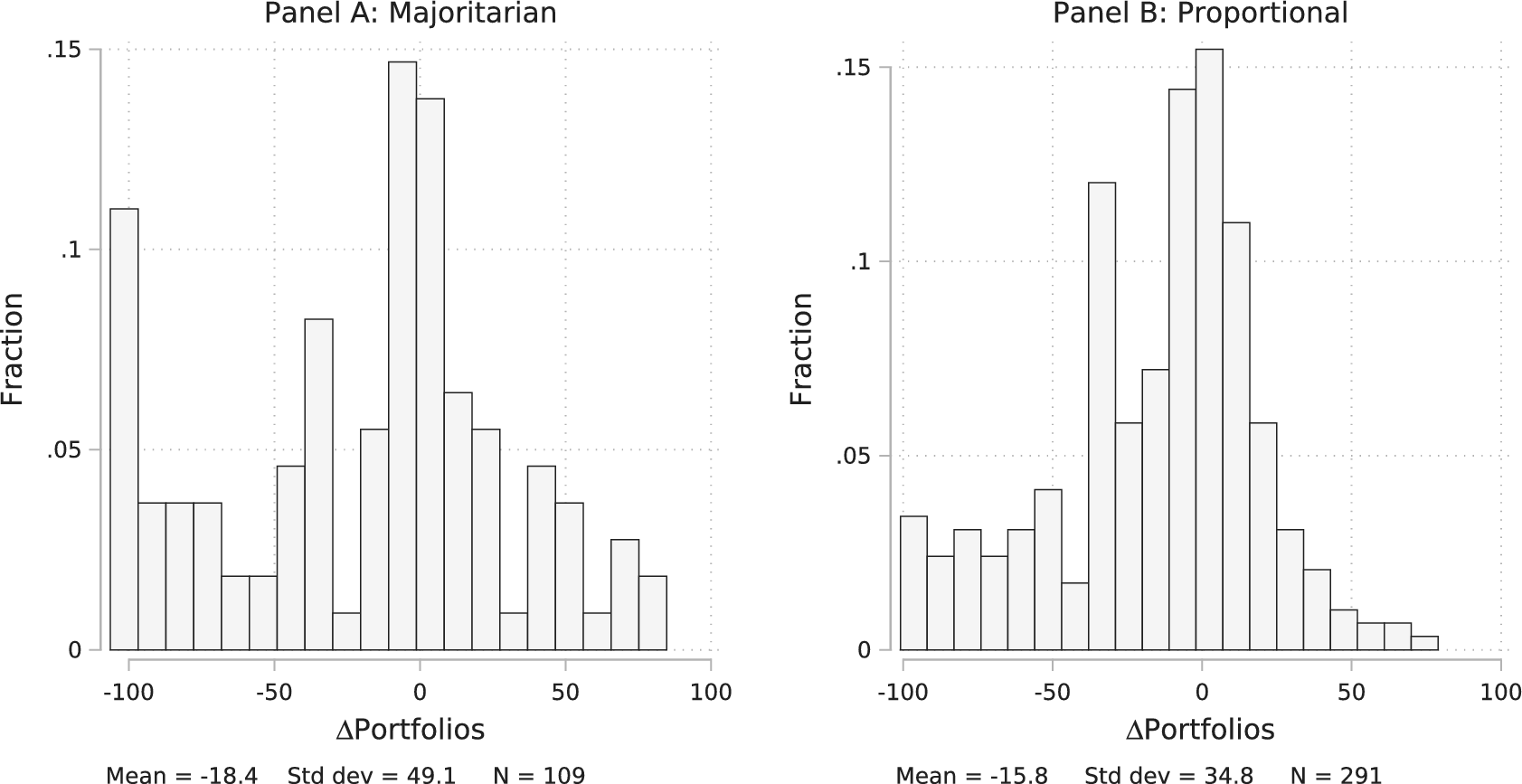
Figure 2 shows the distribution of changes in (time-weighted) portfolio shares conditional on the electoral formula. Extreme sanctions (e.g., the incumbent losing 100% of portfolios) are more common in majoritarian systems, but the average change in portfolios is nonetheless quite similar across systems: -18.4% under majoritarian formulas as compared with -15.8% under proportional formulas. Both distributions also indicate that sanctions are more common than rewards are for incumbent parties.
Distribution of Portfolio Changes by Electoral Formula

Party System Characteristics
Centrality
We measure a party’s centrality (denoted CENTRAL) in the party system as the Euclidean distance between its ideal point and the dimension-by-dimension mean of parties’ positions in the policy space. The virtue of this measure is that it is based solely on parties’ policy positions as derived from their election manifestos and hence is exogenous to the parties’ postelection seat shares.
Bipolarity
We use Maoz and Somer-Topcu’s (Reference Maoz and Somer-Topcu2010) bipolarity index (BI) to measure party system bipolarity at a given election. While full details appear in the Appendix, we discuss the intuition behind the BI here. The building block of the BI is the proto-coalition, a set of parties that are potential coalition partners. The first step in constructing the BI is to group parties into protocoalitions. We do this by first estimating parties’ policy horizons using the economic and social policy ideal points generated by Franzmann and Kaiser (Reference Franzmann and Kaiser2006) on the basis of parties’ manifestos and the method outlined in Warwick (Reference Warwick2000).Footnote 11 We then define proto-coalitions on the basis of the intersection of parties’ respective policy horizons. While one can interpret parties’ policy horizons as spatial representations of the “extent to which parties are willing to compromise on policy positions in order to participate in government” (Warwick Reference Warwick2000, 37), we employ policy horizons purely as technical devices to delimit proto-coalitions in a two-dimensional policy space.Footnote 12 Once proto-coalitions are identified, we can measure the constituent elements of the BI: the number of proto-coalitions, the weight (i.e., seat share) and ideological homogeneity of each proto-coalition, and the extent to which their memberships overlap. The BI is maximized at one when there exists (i) exactly two (ii) highly cohesive proto-coalitions of (iii) equal size that have (iv) no common members; it is minimized at zero if there exists just a single proto-coalition, that is, the grand coalition (Maoz and Somer-Topcu Reference Maoz and Somer-Topcu2010, 812).
Visualizing the Party System’s Role in Electoral Accountability
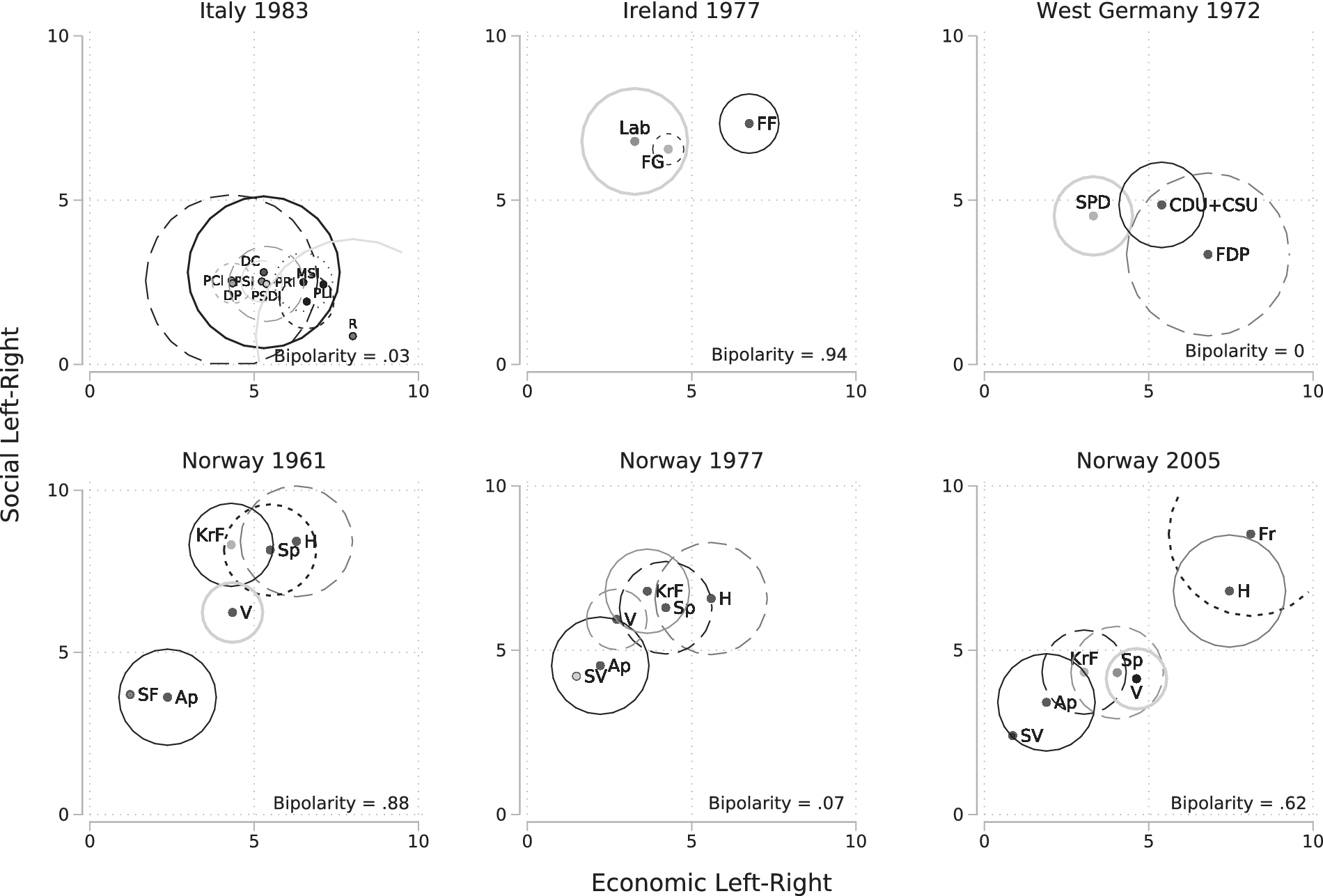
Figure 3 illustrates how bipolarity and centrality relate to accountability. The top-left panel represents the result of the Italian election of 1983 that we discussed above. The DC with its solid black policy horizon lies at the center of the policy space flanked by the Communist Party (PCI) on the left (dashed black horizon) and the Radical Party (R) on the right (solid gray horizon). Unlike Sartori’s idealized version of a polarized system, this election reflects a proliferation of parties and shows the ironic implication of the party system’s translation of seats to portfolios: as voters’ choice of parties increases, the composition of government belongs less to the voters than to the parties themselves. In contrast, the Irish elections of 1977 (top-middle) gave voters a distinct choice between a FF government and a Labour (Lab)-Fine Gael (FG) coalition. The bipolarity scores of 0.03 in the Italian case as compared with 0.94 in the Irish case reflect these different situations.
Examples of Bipolarity and Centrality

The distinct choice that Irish voters were afforded in 1977 was not due solely to the small number of parliamentary parties in the Irish party system at the time. The 1972 West German elections (top-right) also featured just three main parties, but they were positioned in a way that obscured the link between votes and government participation. The West German parties’ ideological moderation and their willingness to coalition with one another—reflected by the intersection of the parties’ horizons and a bipolarity score of zero—meant that German voters could not be sure of how their votes might work to unseat or retain the incumbent SPD-FDP government.
The Norwegian party system at the 1961 elections (bottom-left) was marked by a high degree of bipolarity (0.88) because it offered voters a clear choice between a socialist coalition headed by Labour (Ap) or a cohesive “bourgeois” coalition headed by the Conservatives (H). Members of the bourgeois bloc moderated their policy positions over the course of the 1970s and 1980s until some were closer to the Labour Party than to the Conservatives. The ideological drift of the bourgeois bloc robbed Norwegian politics of its bipolar character. At the 1977 election (bottom-middle), the bipolarity index was just 0.07. The election positioned Labour as the party system’s dimension-by-dimension median, a position that it leveraged into a single-party minority government. The emergence of the right-wing Progress Party (Fr) as a parliamentary force in the 1990s reintroduced a bipolar dynamic to Norwegian politics. The 2005 elections (bottom-right) presented Norwegian voters with a clear choice between two distinct alternative coalitions—the Labour (Ap) coalition on the left and the Progress Party (Fr) and Conservative Party (H) on the right. The renewed bipolarity of the Norwegian party system is reflected by an increased BI of 0.62. The Norwegian example shows how party entrepreneurs can reshape the party system to make democratic accountability easier or harder to achieve.
Party System Bipolarity and Fragmentation
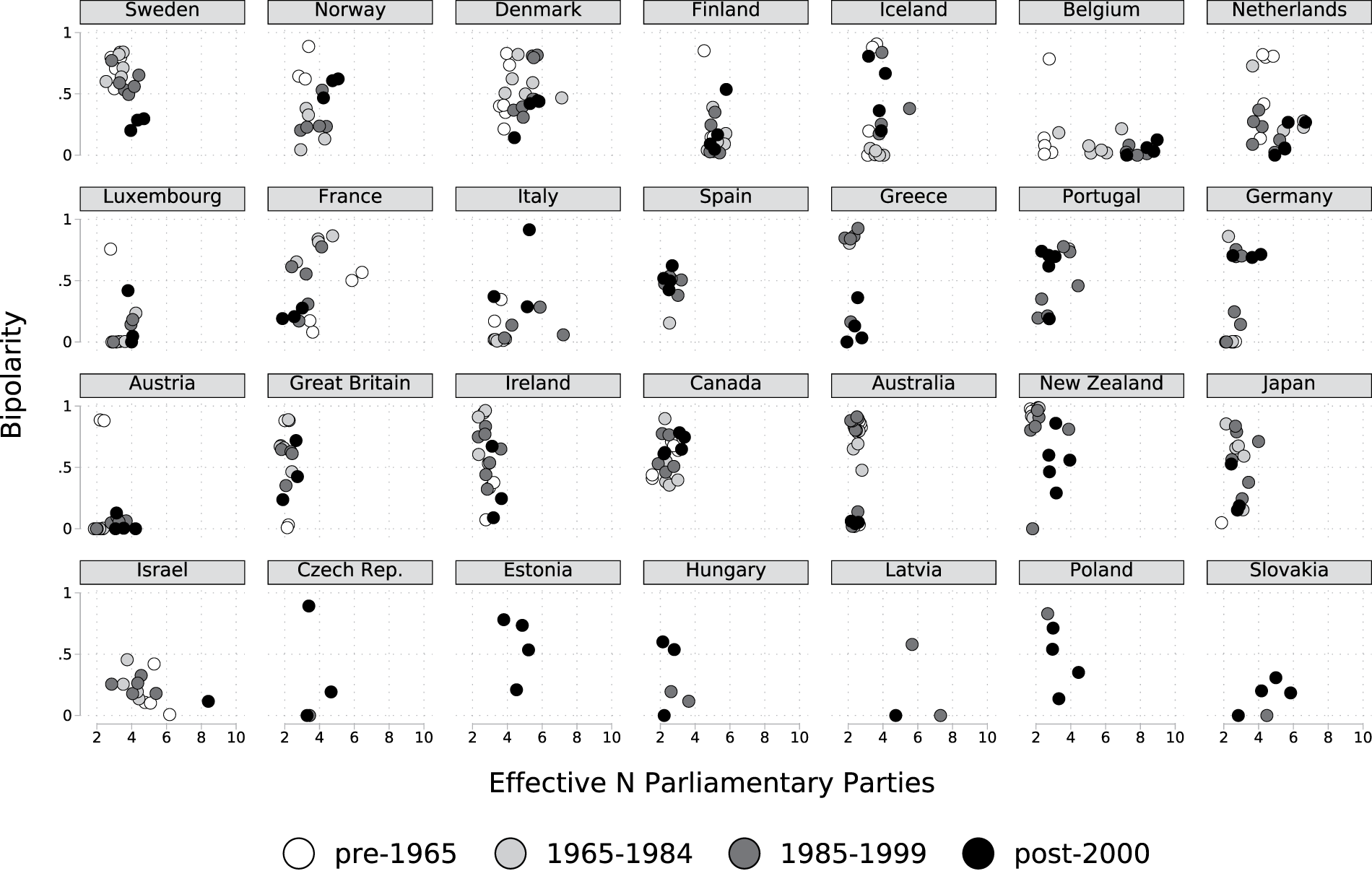
Our statistical models also include the effective number of parliamentary parties (ENPjt) (Laakso and Taagepera Reference Laakso and Taagepera1979). The former is a standard measure of party system fragmentation, and we compute it on the basis of parties’ seat shares immediately following election t in country j. To show that bipolarity is distinct from fragmentation, we plot the BI against the effective number of parliamentary parties (Figure 4) for each country in our sample over time. Figure 4 shows that bipolarity can vary substantially over time within a given country, while the effective number of parties remains relatively constant. In Iceland, Great Britain, and Greece, for example, bipolarity varies substantially while the effective number of parliamentary parties remains stable. The converse is also true. Despite a steady increase over time in the effective number of parties in Belgium, for example, the Belgian party system remains stubbornly non-bipolar.
Bipolarity and Fragmentation, 1948–2012

Results
Votes, Seats, Portfolios
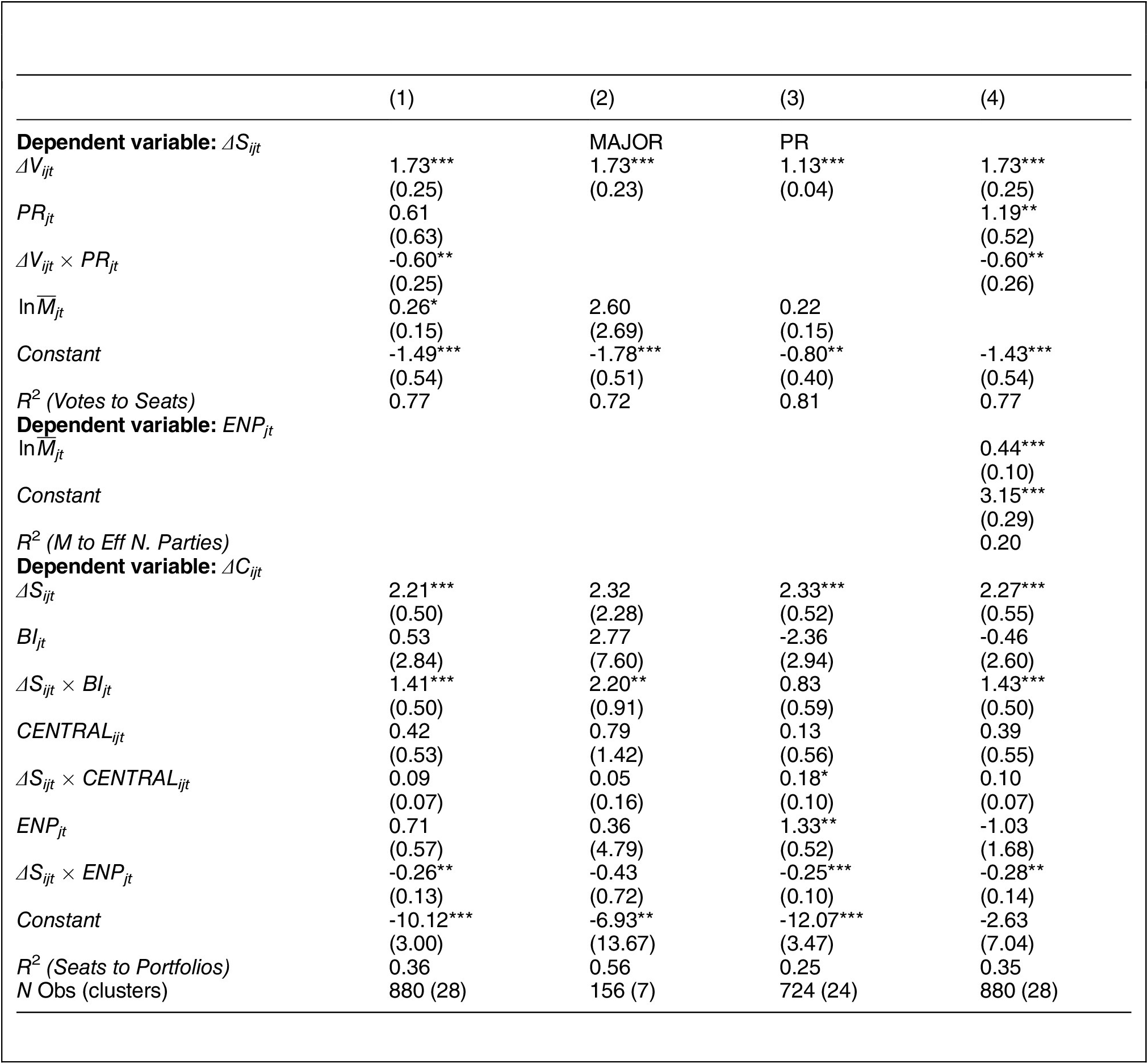
Table 1 reports the three-stage least squares regression results. The upper part of the table displays the electoral stage, the lower part, the party system stage. We hypothesize that aspects of the party system—notably bipolarity (H1) and centrality (H2)—modify the rate at which changes in parties’ vote shares translate into changes in their portfolio shares. Accordingly, we are interested mainly in the interaction terms involving parties’ vote (ΔVijt) and seat shares (ΔSijt) and electoral and party system variables.
Three-Stage Least Squares Regression Estimation of the Votes–Seats–Portfolios Relationship

Note: Bootstrapped standard errors (clustered by country) are in parentheses (1,000 replications). *p < .10; **p < .05; ***p < .01.
We offer six comments on Specification 1. First, the high R 2 value of the votes-to-seats relationship emphasizes that accountability failures are rarely electoral in nature. Second, the marginal votes-to-seats effect is greater under non-proportional (non-PR) than proportional (PR) electoral systems. A 1% increase in a party’s vote share is associated with a 1.73% increase in its seat share under non-PR systems as compared with 1.13% under PR. Even under PR, however,  $ \frac{\partial \varDelta S}{\partial \varDelta V}>1 $, indicating that incumbent parties enjoy a slight advantage in the translation from votes to seats. Third, the coefficient of 1.41 on the ΔSijt × BIjt term indicates that bipolarity of the party system substantially amplifies the marginal seats-to-portfolios effect from 2.21 to 3.62. This effect is consistent with H1. Fourth, the coefficient of 0.09 on the interaction between ΔSijt and CENTRALijt indicates that the marginal effect of seats on portfolios increases—albeit slightly—for every unit the party is from the party system’s policy median. Fifth, fragmentation works in the opposite direction to bipolarity. That is, as the effective number of parliamentary parties increases, the marginal effect of ΔSijt on ΔCijt declines. Finally, these results show that the party system’s effect on the seats-to-portfolios relationship is on par with that of the electoral system.
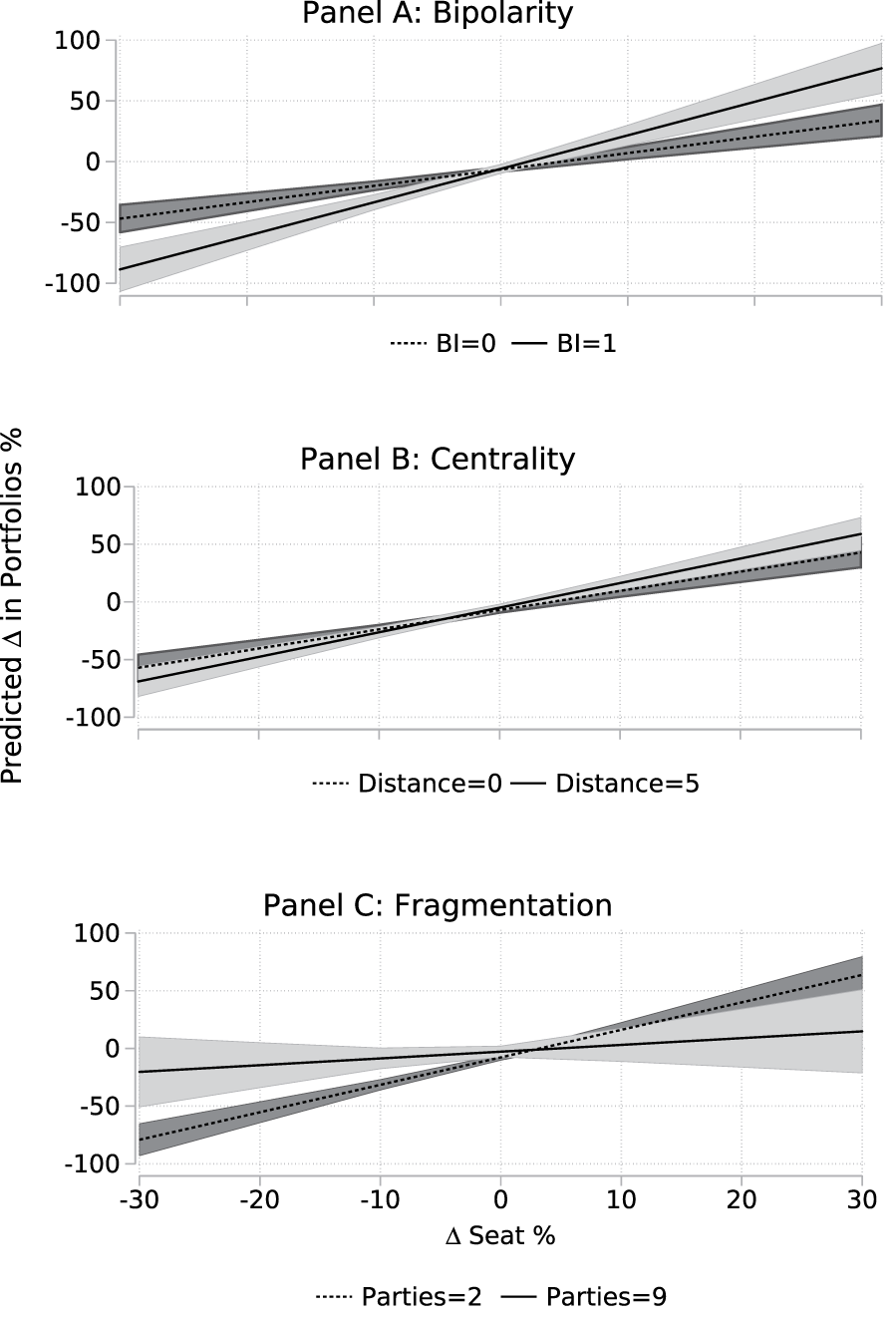
Figure 5 shows the substantive influence of variation in the party system on government power by plotting the predicted value of changes in an incumbent party’s share of cabinet portfolios (i.e.,  $ {\hat{\varDelta C}}_{ijt} $) at high and low values of the BI, centrality, and effective number of parties, respectively. The shaded areas indicate the 90% confidence intervals associated with these predictions. Panel A, for example, shows that a party that loses 10% of its seats is predicted to lose 34% of portfolios in a highly bipolar system, but only 20% in a non-bipolar system. The average cabinet in our sample contained 18 portfolios, of which the average cabinet party held seven. These figures therefore imply a loss of six portfolios and almost all policy-making power in the highly bipolar case as compared with 3.6 portfolios in the non-bipolar case.
The Effects of the Party System on the Seats–Portfolios Relationship

Panel B indicates that the effect of centrality on the seats-to-portfolios relationship is substantively much smaller than that of bipolarity, and it is statistically insignificant. A party located exactly at the dimension-by-dimension median of the policy space is predicted to lose 23% of its portfolios, all else being equal. By comparison, a party located five units from the dimension-by-dimension median of the policy space (almost the maximum of the observed range) is predicted to lose 26% of portfolios, all else being equal. The difference between these figures is equivalent to just one portfolio. Even so, the direction of the effect suggests that incumbent parties are increasingly exposed to electoral sanctions the further they are from the party system’s dimension-by-dimension median.
Panel C shows that fragmentation works in the opposite direction of bipolarity. As the effective number of parties increases, the marginal effect of ΔSijt on ΔCijt declines. The effect is statistically significant only for seat losses, with the unsettling implication that high levels of fragmentation insulate incumbent parties from declines in their seat shares. The substantive impact of this effect is meaningful. In a system of two effective parties, a party that loses 10% of its seats loses 32% of its portfolios. In a system with nine effective parties, the limit of the empirical range, the same 10% loss of seat share results in a loss of just 14% of portfolios. This result underscores that electoral accountability can exist even when the party system is fragmented provided that the party system is strongly bipolar in nature.
Specifications 2 and 3 replicate the analysis for the majoritarian and proportional electoral systems separately. The coefficients for ΔSijt × BIjt indicate that the bipolarity effect is much stronger in majoritarian systems (2.20) than in proportional systems (0.81). The converse is true of the centrality effect, where the coefficient for ΔSijt × CENTRALijt is over three times stronger in proportional systems (0.18) than in majoritarian systems (0.05). In short, the results suggest that electoral accountability in majoritarian systems hinges more on the party system’s bipolarity than on the incumbent parties’ policy positions, whereas the reverse is the case in proportional systems.
It is difficult to discern whether the effect of fragmentation on accountability is greater in a majoritarian electoral system or a proportional one. On one hand, the coefficient for ΔSijt × ENPjt is much larger in magnitude in majoritarian (-0.43) than in proportional systems (-0.25). On the other hand, the coefficient for ΔSijt × ENPjt is measured far more precisely in proportional systems, and hence we can be confident that fragmentation is associated with weaker electoral accountability in proportional systems.
Cox’s (Reference Cox1997) “M + 1” rule implies that the effective number of parties is endogenous to the district magnitude. Specification 4 accounts for this possibility by employing a separate equation to estimate the effective number of parties as a function of the logged district magnitude. Endogenizing the effective number of parties in this fashion has little effect on our results relative to Specification 1.
Reduced Form Estimates
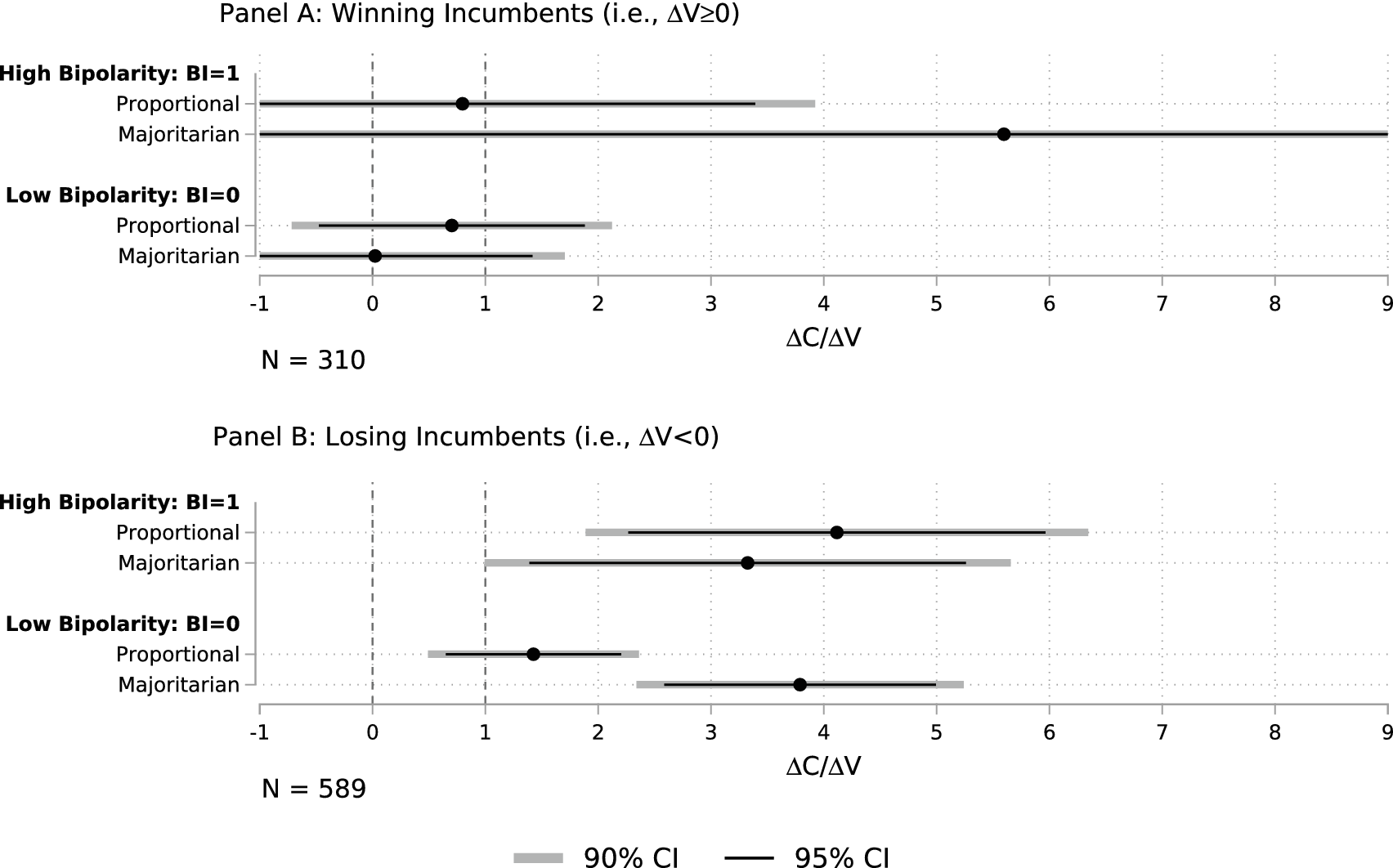
By estimating the reduced form of Specification 4, we can see how the electoral system and party system interact to strengthen or weaken electoral accountability. Figure 6 offers a graphical representation of our reduced form estimates; the complete results appear in the Appendix. The top (A) and bottom (B) panels of Figure 6 show the marginal effects of votes on portfolios (i.e.,  $ \raisebox{1ex}{$\partial \varDelta {C}_{ijt}$}\!\left/ \!\raisebox{-1ex}{$\partial \varDelta {V}_{ijt}$}\right. $) for “winning” and “losing” incumbent parties, that is, parties for which vote shares increased and decreased, respectively. Dividing our data in this way links these results to the empirical puzzle set out in Figure 1.
Marginal Effects of Changes in Votes on Changes in Portfolios

Panel A shows no relationship between votes and portfolios among winning incumbents. Ceiling effects limit voters’ capacity to reliably reward incumbent parties in majoritarian systems. A single party government, for example, already holds all portfolios; an increased vote share cannot further increase its portfolio share.Footnote 13 More commonly, voters sanction incumbent parties. Panel B indicates that majoritarian systems deliver accountability regardless of bipolarity. A proportional electoral system is as effective at delivering accountability as is a majoritarian system when the party system is bipolar, but it may insulate incumbent parties from accountability (i.e.,  $ 0<\raisebox{1ex}{$\partial \varDelta {C}_{ijt}$}\!\left/ \!\raisebox{-1ex}{$\partial \varDelta {V}_{ijt}$}\right.<1 $ is possible) when bipolarity is low.
The results in Specifications 1–3 of Table 1 throw light on why the combination of proportionality and low bipolarity weakens electoral accountability. The coefficients for ΔSijt × BIjt and ΔSijt × CENTRALjt in Specifications 1 and 3 show, first, that the bipolarity and centrality effects work in opposite directions, the marginal seats-to-portfolios effect increasing in the former and decreasing in the latter. Specifications 2 and 3 show that the bipolarity effect is much weaker, and the centrality effect much stronger, in proportional systems than in majoritarian systems. In particular, the coefficient for ΔSijt × CENTRALjt in Specification 3 indicates that under proportionality the marginal seats-to-portfolios effect increases with the incumbent party’s distance to the dimension-by-dimension median of the party system. Noncentral incumbents in proportional system are thus accountable when the party system is bipolar, but are insulated from electoral sanctions under non-bipolarity. (By comparison, centrally located incumbents in proportional systems are insulated regardless of bipolarity.) The reduced form results show that this is because the bipolarity effect dominates the centrality effect when a proportional electoral system operates under bipolarity, but the converse is true when it operates under non-bipolarity. In a majoritarian system, by contrast, the much stronger votes-to-seats effect (i.e.,  $ \raisebox{1ex}{$\partial \varDelta S$}\!\left/ \!\raisebox{-1ex}{$\partial \varDelta V$}\right. $) means that an incumbent party’s cabinet participation is more closely related to its seat share than its policy position.
The Appendix presents additional robustness tests of the results in Table 1. Our results are robust to changes in the size of parties’ policy horizons, alternative definitions of incumbency and portfolio shares, and the inclusion of country-fixed effects. Coordinating features of the electoral system, such as preferential ballots or run-offs, have little influence on the rate at which changes in votes translate into changes in seats. The modifying effect of party system bipolarity applies to both prime ministerial and non-prime ministerial incumbent parties. The effect of bipolarity on the seats-to-portfolios relationship is unaffected by the complexity of the legislative bargaining environment or by investiture rules. Finally, the modifying effects of bipolarity and fragmentation on the translation of seats to portfolios are not reducible to aspects of the electoral system.
Mechanisms
Hypothesis 3 states that the fraction of potential coalitions that are connected decreases in the party system’s bipolarity. We count a potential coalition as connected if the constituent parties’ policy horizons intersect. We then regress the number of connected coalitions in each legislature in our data on the BI while controlling for (i) the logged number of potential coalitions in the legislature (i.e.,  $ \ln {\left[{2}^p-1\right]}_{jt} $, where p is the number of parliamentary parties), (ii) a set of country indicators, and (iii) the complexity of the legislative bargaining environment, using Laver and Benoit’s (Reference Laver and Benoit2015) party system schema.Footnote 14 This results in the following negative binomial regression model which is appropriate for overdispersed count outcomes:
 $$ {\displaystyle \begin{array}{l}E\left[{CONNECTED}_{jt}\right]=\exp \left({\upbeta}_0+{\upbeta}_1{BI}_{jt}+{\upbeta}_2\ln {\left[{2}^p-1\right]}_{jt}+\sum {\lambda}_j{LB}_{jt}+\sum {\delta}_j{COUNTRY}_j+{\nu}_{jt}\right),\\ {}\kern9em {\exp}^{\nu_{jt}}\sim \mathrm{Gamma}\left(\frac{1}{\alpha },\alpha \right).\end{array}} $$
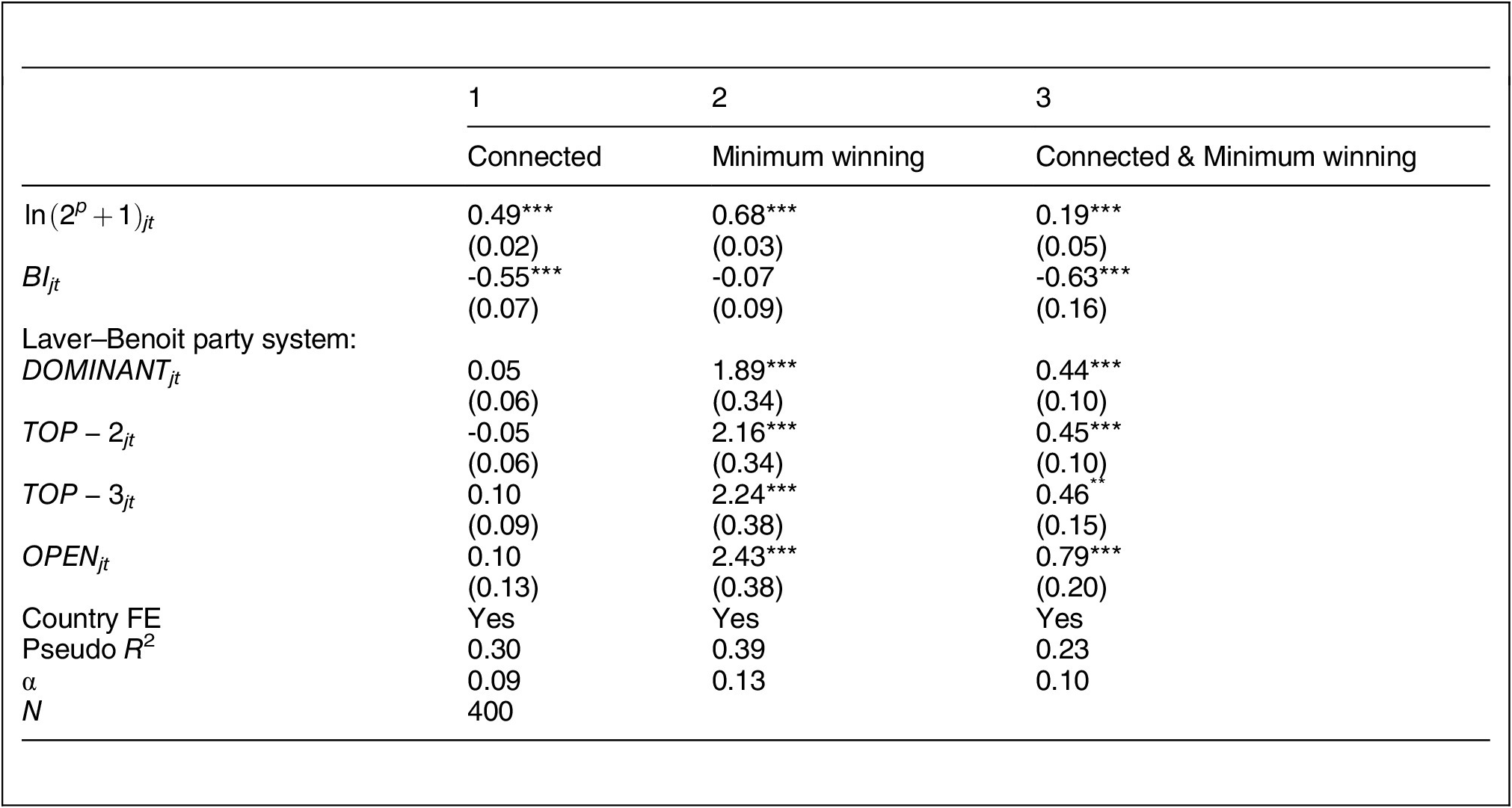
One can interpret β1 as the effect of bipolarity on the rate at which connected coalitions are encountered in the set of potential coalitions. H3 predicts β1 < 0. The results appear in Table 2.
Potential Coalitions and Bipolarity

Note: Cell entries are negative binomial regression coefficients. Robust standard errors are in parentheses. *p < .10; **p < .05; ***p < .01.
The negative coefficient for the BI in Specification 1 of Table 2 is consistent with H3. Moving from a non-bipolar to a bipolar party system, for example, is associated with a 42% (i.e.,  $ 1-\exp \left(-.55\right)=.42 $) reduction in connected coalitions. This effect is independent of the complexity of the legislative bargaining situation; the Laver-Benoit indicators are all insignificant. In contrast, the BI has no effect on number of minimum winning coalitions. This is—and can only be—a function of the number and relative strength of parties in the legislature, not their policy positions. Indeed, the coefficients on the Laver-Benoit indicator variables increase monotonically in Specification 2, indicating that the number of potential minimum winning coalitions increases as the legislative bargaining environment grows more complex. Finally, Specification 3 considers the number of potential coalitions that are both connected and minimum winning. We can expect these coalitions to be the focal points for government formation. In this instance, we observe that bipolarity and legislative complexity work in opposite directions, the former related to a decreasing number of potential connected and minimum winning coalitions, the latter, to an increasing number. For example, moving from non-bipolarity to bipolarity in the context of a dominant party system is associated with a reduction in the number of connected and minimum winning coalitions from 3.5 to 1.9. Again, we do not claim that bipolarity causes this reduction, but that parties alter the composition of the set of coalitions available to them by adopting policy positions that impart a more or less bipolar structure to the party system.
Conclusion
The accountability identity provides an important conceptual framework for understanding the electoral accountability of parliamentary governments. Its normative foundation is that incumbent parties that lose votes should participate less in policy making. Our insight is that this normative claim has two necessary conditions. First, the electoral system must ensure that losses in votes translate into losses in seats. Second, the party system must ensure that losses in seats translate into losses in cabinet portfolios. If either condition fails, so does electoral accountability.
The accountability identity allows us to theoretically define and to empirically disentangle the relative contributions to accountability of the electoral system and the party system. In particular, it generates two important insights. The first is that the electoral system and the party system interact to produce electoral accountability. The second is that electoral accountability is an intertemporal state, defined by changes in votes, seats, and portfolios from one election to the next. The effects of many institutions that are commonly seen to shape electoral accountability, but which are typically stable over time, are thus simply “differenced out.” Our theoretical argument identifies the electoral formula as the notable exception to this rule precisely because proportional and majoritarian formulas seek to eliminate the distorting effect of the electoral system or the modifying effect of the party system, respectively, on the mapping from votes to portfolios.
Our empirical results indicate that electoral systems, proportional or majoritarian, generally do a good job in ensuring a strong, positive votes-to-seats relationship. Breakdowns of electoral accountability are not prevalent, but they tend to occur because the party system fails to translate losses in seats into losses in cabinet portfolios. We adapt and deploy an innovative measure of the party system’s structure to show that the bipolarity of the party system systematically modifies the rate at which changes in an incumbent party’s seat share translate into changes in its portfolio share. When the party system is highly bipolar—with parties arrayed into mutually exclusive blocs, one in government and one in opposition—changes in an incumbent’s seat and portfolio shares are strongly and positively related. Under such conditions, the party system faithfully translates losses in votes into losses in portfolios. In contrast, a non-polar party system may insulate incumbents from declines in their vote shares. In this respect, a party system’s bipolarity is critical to accountability.
Our results show that this bipolarity effect is robust: it is not endogenous to electoral institutions, and it is independent of other aspects of the party system, notably its fragmentation. Certainly, our results indicate that high levels of party fragmentation dilute electoral accountability, but we also provide evidence that electoral accountability does not require a two-party system. Multiparty systems can exhibit high levels of electoral accountability for two reasons. First, while it is true that a two-party system is bipolar by construction, the converse does not hold. This is because our measure of bipolarity is not driven by the number of parties as much as by their policy positions. Second, the opposite of bipolarity is not a fragmented and highly polarized system, but one of non-polarity in which a grand coalition is the only potential government. In such systems, accountability fails because the mapping from votes to portfolios is obscure. This undercuts the electorate’s capacity to retrospectively sanction incumbents and reduces their capacity to select prospective alternatives.
These results vindicate Sartori’s (Reference Sartori1976) emphasis on the importance of party system bipolarity in generating functional patterns of political competition. Our results nonetheless show that Sartori’s arguments regarding the existence of a center party that is insulated from electoral sanctions require amendment. Our results suggest that proximity to the party system’s dimension-by-dimension median meaningfully reduces the marginal votes-to-portfolios effect only in proportional electoral settings, and even then, only when bipolarity is weak.
Our findings suggest possible avenues for future research. One key result shows that a PR system in which parties do not divide into two opposing blocs in the policy space is prone to accountability failures because it insulates incumbent parties from electoral sanction. We present evidence of one plausible mechanism for this, emphasizing the capacity of centrally located incumbent parties to exploit the large number of connected coalitions in non-bipolar systems to avoid electoral punishment. Other mechanisms are plausible. For example, the number of connected coalitions might affect the political costs that are associated with using alternative coalitions to stay in power. In non-bipolar systems, these costs are likely lower because evading accountability in this fashion is much less visible to voters than in highly bipolar systems. We leave it to future research to test such alternatives. Given the important role that the national institutional context plays in voters’ ability to attribute blame to incumbents (e.g., Duch and Stevenson Reference Duch and Stevenson2008; Powell and Whitten Reference Powell and Whitten1993,), future work may consider how this cross-national variation in clarity of responsibility might moderate the effect of the electoral and the party system in shaping electoral accountability beyond the influence of the party system’s bipolarity. Scholars may also extend the geographic scope to other democracies. Ideological patterning, we have shown, is crucial for understanding bipolarity, and this is likely true beyond the advanced industrialized democracies in our sample. It may be fruitful, for example, to investigate whether bipolarity influences electoral accountability in party systems where ideology plays a less important role.
We end by highlighting three important implications of our work. The first is that one cannot offer a normative assessment of the electoral accountability of a single election considered in isolation. In this respect, the representative counterpart to electoral accountability is not congruence but responsiveness in the sense conveyed by Powell (Reference Powell2000) and Best, Budge, and McDonald (Reference Best, Budge and McDonald2018). We suggest that scholars reconsider the relationship between electoral accountability and responsiveness in light of our findings. The second is that efforts to alter electoral institutions to improve accountability (as in Japan and Italy, for example) are inevitably limited by the fact that the mediating effect of the party system—notably its bipolarity—is both independent of electoral institutions and unavoidable. Finally, our work discriminates between two dimensions of party system polarization, the clustering of parties into two mutually exclusive blocs and the ideological dispersion of parties in the policy space. There are beneficial aspects to polarization along the first dimension, where increasing bipolarity clarifies voters’ choices and reduces governing alternatives, and in so doing, it strengthens electoral accountability.
Supplementary Materials
To view supplementary material for this article, please visit http://dx.doi.org/10.1017/S0003055420000143.
Replication materials can be found on Dataverse at: https://doi.org/10.7910/DVN/5QBS9A.




Comments
No Comments have been published for this article.