




No CrossRef data available.
Article contents
Cost-effectiveness analysis of a complementary health intervention: The case of smoking relapse prevention
Published online by Cambridge University Press: 01 November 2004
Abstract
Objectives: We assess the cost-effectiveness of smoking relapse prevention interventions designed to keep quitters from resuming the use of cigarettes. Because relapse prevention is complementary to smoking cessation efforts, the appropriate test of its cost-effectiveness is whether it reduces the incremental cost-effectiveness ratio (ICER) of smoking cessation. The major goal of the study is to carry out such a test.
Methods: Data from a randomized trial that ascertained the effectiveness of alternative modes of smoking relapse prevention are combined with ICER estimates of smoking cessation to assess whether relapse prevention is cost-effective.
Results: The trial produced convincing evidence that relapse prevention yields statistically significant reductions in the proportion of quitters who are smoking at 24 months postquit. The intervention effects are substantial enough to raise the denominator terms of the smoking cessation ICER and, thereby, offset the amount relapse prevention adds to cost numerator terms. In this sense, smoking relapse prevention tends to pay for itself.
Conclusions: Smoking relapse prevention is a highly cost-effective addition to current efforts to curb cigarette consumption. Complementary health interventions of this sort should be assessed by different methods than those commonly found in the cost-effectiveness literature.
Keywords
Information
- Type
- GENERAL ESSAYS
- Information
- International Journal of Technology Assessment in Health Care , Volume 20 , Issue 4 , November 2004 , pp. 475 - 480
- Copyright
- © 2004 Cambridge University Press
Cost-effectiveness analysis (CEA) typically assesses whether any one alternative among a given set of competing substitutes uses scarce resources more efficiently than the others. If the alternative dominates in the sense that its incremental costs are lower and its incremental effectiveness higher than all others in the set, the CEA results provide a prima facie case for reallocating scarce resources toward that intervention. But what if the intervention being evaluated is not necessarily a substitute in the conventional sense, but rather a complement? Can the cost-effectiveness of a complement be determined independently or must it be considered jointly with the intervention to which it is complementary? How should the net effect of the complementary intervention on the outcome of interest be apportioned or disentangled if it is considered jointly? And what if the complementary intervention has a dominantly better incremental cost-effectiveness ratio than any of the interventions that it complements. Should that accord it higher rank in CEA league tables or priority funding lists?
We confronted these questions in initiating an economic appraisal of a controlled trial of smoking relapse prevention. The trial enrolled individuals who had recently quit smoking cigarettes and randomly assigned them to four conditions or groups: a control arm and three active interventions providing different levels of contact, advice, and counsel on ways to sustain the period of abstinence over time. Although each of the active arms of the Forever Free® (FF for short) trial were low-cost in absolute terms, their cost-effectiveness could not be taken for granted. The overall protocol, thus, called for a CEA component if efficacy was demonstrated. The CEA was at first designed simply to compute the ratios of the cost of each FF condition to the projected number of quality-adjusted life-years (QALYs) attributable to that condition, and then to compare these ratios with similar cost-QALY ratios of smoking cessation interventions.
But whether this is an appropriate strategy for determining the cost-effectiveness of the FF intervention may be questioned. Smoking cessation efforts precede the relapse prevention intervention. When smoking cessation was entirely “self-quitting” or unaided in nature, this temporal sequence may not have been readily apparent. Recent years, however, have witnessed changes in the provision of more formal and costly smoking cessation interventions, ranging from brief physician advice coupled to the use of prescription (Rx) and over-the-counter (OTC) nicotine replacement therapies (NRT) to several courses of NRT and intensive individual or group counseling. With the growing availability of these closely substitutable cessation methods, smoking relapse prevention increasingly assumes the complementary role of extending the period of abstinence initiated by other means. The appropriate economic test for smoking relapse prevention, thus, is not whether it is better than other cessation methods but, rather, whether it makes those other methods better.
This suggests that the cost per QALY of smoking cessation programs should be the focus of an economic analysis of relapse prevention. In such an analysis, the incremental cost-effectiveness ratio (ICER) should be computed twice, once in the absence of the complementary relapse prevention effort and then again with the addition of that effort. The key to this logic is that the denominator term in a cessation CEA typically scales the QALY value by both the change in the marginal quit rate attributable to the intervention and the inverse of the relapse rate. If relapse is reduced, the denominator term will rise and the smoking cessation ICER will fall. Although the costs of the relapse prevention intervention must now be added to the cost numerator term, a cost-effective relapse effort may add proportionately more to the denominator than to the numerator of the cost per QALY ratio. Thus the dollar difference in the smoking cessation ICERs under these two conditions can be used to gauge the extent to which relapse prevention is cost-effective or, put somewhat differently, the extent to which it pays for itself.
The primary aim of this article is to compute and compare two smoking cessation ICERs using the data generated in the controlled trial of the FF relapse prevention intervention. The next section briefly describes the key elements of the trial as well as the data, variables, and the analytic assumptions used in determining FF's cost-effectiveness. (For specialists interested in a substantially more detailed account of the methodological aspects of the work, a CEA Technical Report is available from the authors on request.) Subsequent sections set out and discuss the empirical results.
METHODS
Trial Design
A 2×2 factorial design was used, with the independent variables being the frequency of contact (a single mailing vs. eight mailings) and the amount of content (a single booklet versus eight booklets). This design produced four experimental conditions. The Repeated Mailings condition (high contact/high content) replicated the full condition that was found to be efficacious in an earlier study (1). Subjects received a series of eight FF booklets distributed over the course of a year. The Massed Mailings condition (low contact/high content) received all eight booklets at once. The Repeated Letters condition received a single booklet (equivalent to the first in the series of eight), followed by seven brief supportive letters distributed throughout the year. For ethical reasons, the Minimal Contact comparison condition simply received a single booklet, the same one sent first to the three other groups. To the extent that this single booklet may have affected relapse-related behavior, the trial lacked a true, untreated control condition.
Subjects were recruited through advertisements and public service announcements throughout one state in the United States, Florida. The sample for the present analysis comprises the 431 subjects who returned a baseline questionnaire, indicating that they had abstained from smoking for at least 1 week, but for no more than 6 months. Follow-up questionnaires were sent to subjects at 12, 18, and 24 months after baseline. Response rates at these follow-up points were 74.9 percent, 82.6 percent, and 84.9 percent, respectively.
Cost Numerator Terms
We tallied the direct costs of each FF condition from a payer perspective to reflect the value of all scarce resources it used, including the direct expense of the materials (booklets), time-and-motion estimates of clerical input weighted by the hourly wage rate of U.S. correspondence clerks, and an estimate of other overhead expense, all net of any research-related costs of the trial. (Any cost incurred in the Minimum Contact comparison is treated, in effect, as entirely research-related.) Because the intervention was carried out over the course of only 1 year, the costs are not discounted; however, all are adjusted by means of the Consumer Price Index (CPI) to inflation-adjusted year 2000 prices. Costs are also adjusted for failure to complete the intervention; these adjustments were based on observed losses-to-follow-up in each trial arm.
We draw on FF baseline data to identify the various smoking cessation methods or aides used by study subjects in their effort to quit smoking. Responses were ultimately classified into twenty-one different combinations of such basic cessation methods/aides as OTC and Rx nicotine replacement aides, Rx pharmacotherapy, individual/group behavioral therapies, and various other products such as “aqua filters” and “Bantron®.” (For expositional purposes, the twenty-one disaggregated categories are combined into six main groups in the analysis reported below.) Each method was then costed out, using a vector of observed national discount prices, and the assumption that the prescribed or manufacture-recommended dosages were followed. Prescribed therapies also include Medicare Fee Scheduled amounts for physician time. Because behavioral interventions differ greatly, we relied heavily on protocols and input utilization described in the recent literature to ensure comparability of the cost estimates with earlier cessation studies (2). The costs of various combinations of the cessation methods are assumed to be additive. To simplify matters, the utilization rates of the various cessation methods observed in the study population were used to compute weighted sample averages of the costs of quitting. These weighted averages are used in the analysis reported below.
Effectiveness Denominator Terms
Although several outcome measures were assessed in the FF trial, the primary measure was 7-day point-prevalence abstinence. At each follow-up point, individuals who reported any smoking in the previous week were coded as having relapsed, whereas others were considered abstinent. The relapse rate at the 24-month follow-up is used as the main outcome of interest in the analysis reported here. (Like the rates computed at the other follow-up dates, the 24-month point-prevalence is self-reported. The FF trial, however, did assess self-reported abstinence by means of a breath test for carbon monoxide on a small sample of study subjects. The breath test results from this subsample suggest that participants' self-reported smoking status had satisfactory validity.) Logistic regression analyses were then conducted to gauge the effects of each condition on the outcome variable compared with the Minimum Contact condition. Because the maintained hypothesis is that each condition will reduce the relapse rate significantly more than the comparison condition, we used one-tailed tests, with alpha set at .05, to evaluate the logistic estimates. Because the Minimum Contact condition was not entirely inert, the measured difference between any of the active conditions and the comparison group constitutes a lower bound on the effectiveness of the relapse prevention effort.
We gleaned marginal quit rates of formal cessation methods from the recent literature. Quit figures were prepared for the same twenty-one detailed smoking cessation categories and then aggregated into six main groupings. In contrast to the cost estimates, the quit rates of various combinations of these therapies are not necessarily linear in their combinations; see the Technical Report noted previously. We assume that the natural quit rate is 5 percent. Because it was the initial, although not the exclusive, target group of the FF trial, we treat natural or unaided quitting as a type of “intervention.” We use the demographic (age/gender) characteristics of the FF trial to weight the total quit rate (marginal plus natural) for each of the same twenty-one combinations of cessation methods. Although the quit rate ultimately cancels out in evaluating the two ICER values, the magnitude of the quit rate influences the scale of the cost/QALY ratio. Our use of the total quit rate, in effect, establishes the lower bound on the cost/QALY ratio of smoking cessation averaged over the study population.
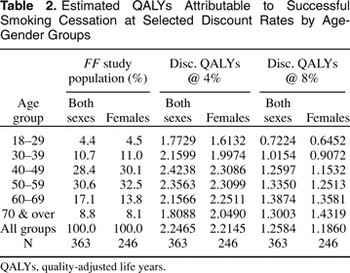
Finally, we projected the extra QALYs attributable to successful smoking cessation for various age/gender groupings. These estimates are based on life-table parameters found in the literature (3;6;7). In brief, life expectancies for smokers and quitters were evaluated at the mid-points of six age categories for men and for women 18–99 years of age, the difference between smoker and quitter survivorship gauging the extra years of life each demographic group is expected to realize by quitting. These differences assume a 20-year “phase-in” of mortality benefits arising from smoking cessation, with life-table values of quitters never quite falling to the level of “never” smokers. QALYs, which gauge morbidity as well as mortality improvements from smoking cessation, were computed by multiplying the expected life-year gains from quitting by quality-of-life index values derived from the literature (3). In effect, the index values, which ranged between 0.3 and 1.0, scale the extra life-years gained from quitting by the likelihood of being functionally capable during those extra years. Because the value of the expected QALYs will differ depending on when in time they are realized, the estimated QALY streams for each age/gender group were discounted at various rates, two of which are reported below, 4 percent and 8 percent (5). Estimates of discounted QALYs attributable to smoking cessation by each of the 12 age/gender groupings were then weighted by the FF sample proportions to summarize the added years of quality-adjusted life expected in a group of quitters with the age-gender characteristics of the study population.
RESULTS
Tables 1 and 2 set out the basic descriptive data on the smoking cessation methods, costs, and quit rates of FF study subjects. As can be seen, four-fifths of these subjects had used some type of smoking cessation aide, a plurality relying exclusively on OTC nicotine replacement patch or gum. Because of its relatively high cost and initial rate of success (quits), it is noteworthy that approximately one in twelve trial enrollees used a combination of OTC and prescription NRT/phamacotherapy. The other combinations observed in the sample either add something to NRT therapy or involve multiple combinations of methods, many relatively ineffective albeit costly ones. Overall, the average subject spent approximately $383 on the quit attempt; again, on average, this expense just about doubled the chance that the quit would be successful. If only those who actually used a cessation aide are included (that is, if natural quitters are excluded) the mean cost increases by approximately $100, but the mean quit rate rises by only approximately one percentage point.


Table 2 shows that the demographic characteristics of the study population are heavily weighted in favor of middle-aged females. The age/gender distribution of the sample clearly affects the QALY difference attributable to a successful quit. Paradoxically, the longer life spans and correspondingly longer periods of functional disablement of women means that smoking cessation has a marginally smaller impact on them at younger ages than it does for men. These QALY estimates are generally consistent with those found elsewhere in the smoking cessation literature, although because we carried the projections through age 99, the extra life years for the oldest age groups may be slightly higher than in some other studies.
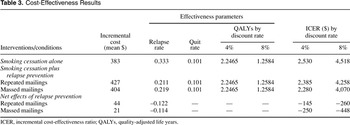
Table 3 presents the main results of the cost-effectiveness analysis based upon the FF relapse rates observed at the 24-month follow-up. The upper-most panel sets out the variables of interest for smoking cessation alone. These figures are based on the expected values of the entire FF study population, including natural quitters, and they use the relapse rate observed in the Minimum Contact comparison. For this population, the incremental cost-effectiveness ratio (incremental cost divided by the product of the quit rate, the QALY estimate, and one minus the relapse rate) is between $2,500 and $4,500, depending on whether the QALYs are discounted at 4 percent or 8 percent. Recall that these figures scale the cost/QALY ratio at the lower bound. If natural quitters are excluded and the (weighted) mean marginal quit rate is incorporated in the computation instead, the cost per QALY is approximately $5,000 ($9,100) at a 4 (8) percent discount rate.

The middle panel of Table 3 sets out the calculations for smoking cessation ICERs when a smoking relapse prevention intervention is added to the mix. We restrict our attention here to the two conditions that yielded statistically significant reductions in the relapse rate, Repeated and Massed Mailings. (The Repeated Letters condition did reduce the relapse rate at 24 months, 30.9 percent versus 33.3 percent in the comparison group; this difference, however, was not statistically significant at the confidence level established for this study). Compared with the Minimum Contact comparison, the Repeated Mailings condition added $44 to the expected cost numerator term, while significantly reducing the relapse rate by more than a third or 12.2 percentage points (p=.031). All else equal, the ICER for smoking cessation plus this relapse prevention condition is roughly $2,400 at 4 percent and $4,300 at 8 percent. The Massed Mailing alternative was marginally less effective, reducing the relapse rate by 11.4 percentage points (p=.038). However, it added only 21 dollars on average to the smoking cessation cost numerator, so its ICER is $100 ($200) lower than Repeated Mailing at 4 (8) percent.
The bottom-most panel of Table 3 shows the net effects of FF on the outcomes of interest, including the reductions in the ICERs attributable to the complementary relapse prevention intervention. Again, even though its marginal effectiveness is slightly inferior to Repeated Mailings, the lower cost of the Massed Mailing condition reduces the ICER the most. Yet, both relapse prevention alternatives reduce the ICER for smoking cessation by many multiples of the cost per person. Interestingly, the geometric effect of discounting on the ICER makes both alternatives more cost-effective when quicker results are valued more highly, that is, at higher discount rates.
IMPLICATIONS FOR POLICY AND FUTURE RESEARCH
The evidence adduced here suggests that relapse prevention pays for itself, reducing the smoking cessation ICER more than the preventive intervention itself costs. Although we do not wish to put too fine a point on the magnitude of the computed changes in the ICERs, the fact is that these ratios do fall and by some amount greater than the cost of relapse prevention. Judged in these terms, relapse prevention is cost-effective by a fairly wide margin.
Clearly, this conclusion must be interpreted in the light of several limitations of the analysis. To begin with, the outcome measure refers to relapse/abstinence at the 24-month follow-up point. Although there is evidence in the literature that abstinence at just 1 year is an extremely strong predictor of longer-term, continuing abstinence, some individuals will resume smoking (4;8). This finding means that the cost/QALY ratios are understated. But because we are comparing these ratios for smoking cessation without and with relapse prevention, it does not necessarily follow that the conclusion we draw about the cost-effectiveness of relapse prevention is biased. Indeed, the relapse prevention figures account for two additional years of abstinence than the smoking cessation alone figures. Under the extreme assumption that smoking cessation outcomes are strictly proportional to the 20-year phase-in period, the cost/QALY ratio with relapse prevention (Massed Mailing) would be still be only 60 percent of the ratio without, $54,000 versus $101,400 at a 4 percent discount rate. (Because this is just at the value margin of the oft-repeated cutoff of $50,000 per QALY, we concede that our conclusion depends somewhat on the presumption that a high proportion of those abstinent at 24 months will remain so thereafter.) A more realistic concern is that the baseline relapse rate may be contaminated by the study design, that is, selection effects in the control arm may have produced a lower relapse rate than would be observed in a truly representative sample of quitters. But unless these are offset by similar selection effects in the subjects in the other three arms, this suggests that the relapse reduction attributable to the FF intervention is understated. Thus these factors do not necessarily bias the conclusion that relapse prevention is cost-effective. Further study of the likely magnitude of the “natural” relapse rate and the degree to which it may be reduced by relapse prevention interventions, nonetheless, is still warranted.
Other limitations must also be noted. The expected values of smoking cessation costs and marginal quit rates were calculated in terms of FF study population characteristics, but of course, FF enrollees may not necessarily be representative of the population of quitters targeted by relapse prevention programs. We further assumed that natural quitters constituted a type of smoking cessation “intervention,” which had the effect of lowering the mean (expected) direct costs of other interventions and raising the quit rate used to compute the denominator term. If, for instance, the natural quitters group is omitted from the computations, the incremental cost of smoking cessation increases from $383 to $488 per person, the marginal quit rate falls to 6.4 percent, and the ICER (at 4 percent) without relapse prevention rises to $5,090 and with to approximately $4,600. Although these numbers present perhaps a more realistic estimate of the direct costs of smoking cessation, they do not change the overall conclusion of the ICER-reducing effects of relapse prevention. Future research can overcome this problem by adding estimates of the indirect costs of smoking cessation, that is, the time or opportunity costs of quitters, to direct costs. This method would value the full costs of cessation, which would serve as a more meaningful CEA cost numerator term.
Finally, the methodology for conducting CEAs of complementary interventions should be extended. This analysis used the cost/QALY ratio as the criterion variable, mostly because it is the gold standard in the general CEA and smoking cessation literatures, and because we know that smoking cessation outranks other health-related interventions in respect to this criterion. But other criterion measures might be used to take advantage of the monetary (dollar) metric that emerges in comparisons of cost/outcome ratios without and with the complementary intervention, for example, lifetime profiles of medical care expenditures of smokers and quitters might be used for this purpose. From a payer perspective, comparisons using these profiles would provide a more easily interpreted differential or dollar return on investments in relapse prevention.
This study was funded by National Cancer Institute grant R01 CA80706.
References
Brandon TH,
Collins BN,
Juliano LM,
Lazev AB.
2000
Preventing relapse among former smokers: A comparison of minimal interventions via telephone and mail.
J Consult Clin Psychol.
68:
103–
113.Google Scholar
Cinciripini PM,
McClure JB.
1998
Smoking cessation: Recent developments in behavioral and pharmacologic interventions.
Oncology.
12:
249–
259.Google Scholar
Fiscella K,
Franks P.
1996
Cost-effectiveness of the transdermal nicotine patch as an adjunct to physicians' smoking cessation counseling.
JAMA.
275:
1247–
1251.Google Scholar
Gilpin EA,
Pierce JP,
Farkas AJ.
1997
Duration of smoking abstinence and success in quitting.
J Natl Cancer Inst.
89:
572–
576.Google Scholar
Gold MR,
Siegel JE,
Russell LB,
Weinstein MC, eds.
1996.
Cost-effectiveness in health and medicine.
New York:
Oxford University Press
Oster G,
Huse DM,
Delea TE,
Colditz GA.
1986
Cost-effectiveness of nicotine gum as an adjunct to physician's advice against cigarette smoking.
JAMA.
256:
1315–
1318.Google Scholar
Rogers RG,
Powell-Griner E.
1991
Life expectancies of cigarette smokers and nonsmokers in the United States.
Soc Sci Med.
32:
1151–
1159.Google Scholar
Swan GE,
Ward MM,
Carmetti D,
Jack LM.
1993
Differential rates of relapse in subgroups of male and female smokers.
J Clin Epidemiol.
46:
1041–
1053.Google Scholar

Estimated Costs and Quit Rates by Smoking Cessation Method, FF Study Population
Estimated QALYs Attributable to Successful Smoking Cessation at Selected Discount Rates by Age-Gender Groups
Cost-Effectiveness Results
 You have
Access
- 27
- Cited by