Functional seizures (FSs) are paroxysmal events that resemble epileptic seizures but occur without the ictal electrophysiologic activity of epilepsy. Contemporary diagnosis emphasizes positive semiologic and electroclinical features rather than exclusion alone. Reference LaFrance, Baker, Duncan, Goldstein and Reuber1,Reference Aybek and Perez2 Treatment similarly emphasizes clear diagnostic communication, self-efficacy and active self-management. The recent American Academy of Neurology practice guideline recommends psychological interventions and explicitly encourages strategies that promote self-management and self-efficacy. Reference Tolchin, Goldstein and Reuber3 Established treatments include functional seizure-specific cognitive behavioral therapy and Retraining and Control Therapy, while attention redirection and movement retraining are established principles in functional motor disorder rehabilitation. Reference Goldstein, Robinson and Mellers4–Reference Nielsen, Stone and Matthews7 We explored whether an observed habitual event could itself provide an opportunity to demonstrate symptom modifiability and immediately translate that experience into a patient-directed interruption strategy.
We retrospectively describe seven consecutive patients evaluated in outpatient neurology or emergency settings for recurrent functional or clinically suspected functional seizure-like events in whom the same bedside interruption approach was attempted during an observed habitual event. Diagnostic assessment incorporated semiology, direct clinical observation and available electroencephalographic data. Because habitual events were not captured electrophysiologically in every patient, diagnostic certainty varied across the cohort. Response to the maneuver was not used to establish the diagnosis of FS.
During an ongoing event, patients who could participate were encouraged to perform alternating finger tapping while simultaneously engaging in conversation about a personally salient neutral or positive topic, such as family, work, hobbies or pets. This introduced a competing voluntary motor task while redirecting attention away from the abnormal movement. Once the event diminished or stopped, the observed modifiability was explained without suggesting voluntary symptom production. Patients were then taught to deploy alternating tapping at the earliest recognition of an event or premonitory sensation, followed by box breathing as an additional attentional and autonomic regulation strategy. Box breathing was taught to all seven patients.
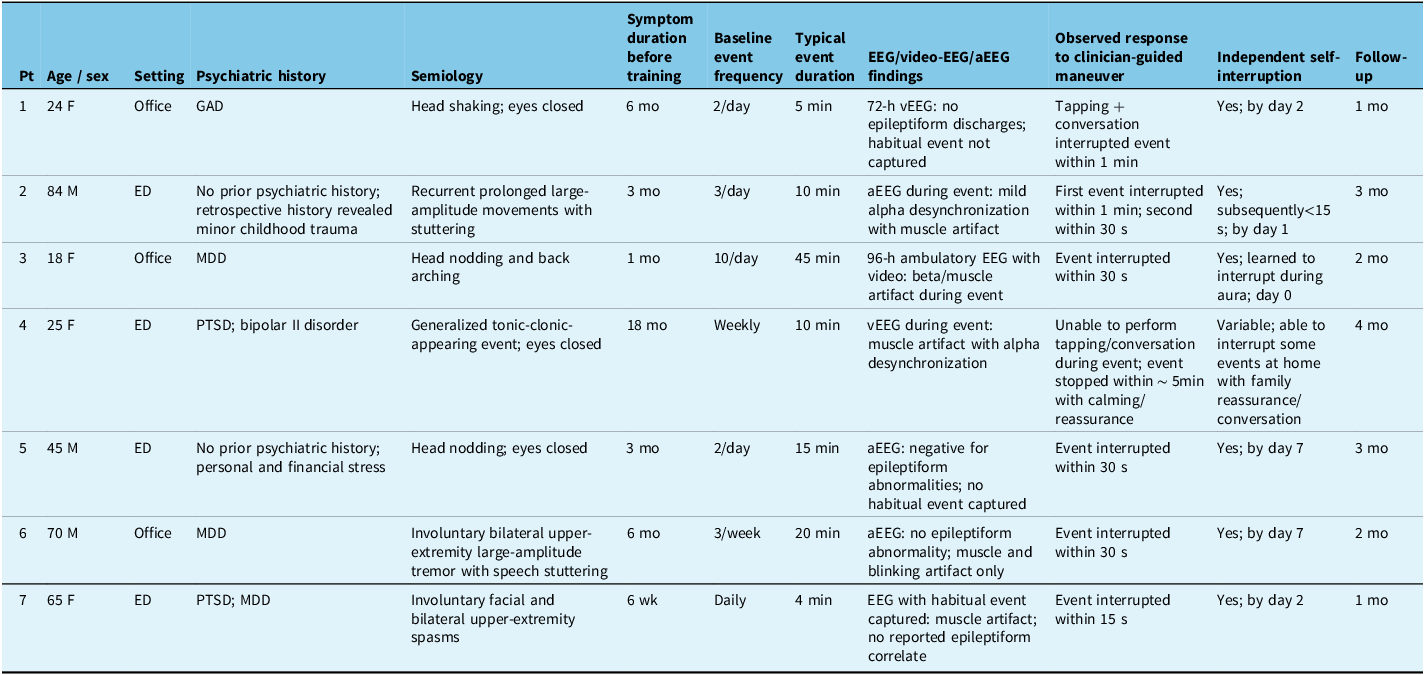
Habitual events had been present for 1–18 months and occurred from three times weekly to ten times daily (Table 1). Typical event duration was patient-reported and ranged from 4–45 minutes (mean 15.6; median 10 minutes). Semiology included head shaking or nodding, large-amplitude bilateral upper-extremity movements, back arching, stuttering, facial spasms and generalized convulsive-appearing activity. Several patients demonstrated prolonged events, eye closure, variability or responsiveness to attentional manipulation, features supportive of a functional etiology. Reference Cock and Edwards8
Clinical Characteristics, Electrodiagnostic Findings and Response to Bedside Interruption Training. Seven consecutive patients with functional or clinically suspected functional seizure-like events. Baseline frequency and duration were patient-or caregiver-reported; observed response reflects the clinician-guided maneuver during the clinical encounter. aEEG = ambulatory EEG; ED = emergency department; GAD = generalized anxiety disorder; MDD = major depressive disorder; PTSD = post-traumatic stress disorder; vEEG = video-EEG. Bedside strategy: Alternating finger tapping with conversational attentional redirection when the patient could participate, followed by instruction in box breathing. Patient 4 could not perform tapping or conversation during the observed event and improved with calming/reassurance; subsequent home response was variable

Table 1. Long description
Table 1 summarizes seven consecutive adult patients. Columns report age and sex, clinical setting, psychiatric history, event semiology, symptom duration before training, baseline event frequency, typical event duration, EEG/video-EEG/ambulatory EEG findings, observed response to the clinician-guided maneuver, independent self-interruption, and follow-up. Patient ages are 24, 84, 18, 25, 45, 70, and 65 years. Six patients were able to participate actively in alternating finger tapping with conversational attentional redirection and interrupted the observed event within approximately 15 to 60 seconds; all six subsequently reported independent self-interruption within seven days. Patient 4 could not perform tapping or conversation during the observed event; the event stopped within about five minutes with calming and reassurance, and subsequent home benefit from family reassurance/conversation was variable.
Six of seven patients were sufficiently responsive during the observed event to participate actively in the motor-attentional maneuver. In these six, interruption occurred approximately 15–60 s after initiation of the maneuver. All six subsequently reported successful patient-directed interruption of recurrent events within seven days of teaching; four achieved this within 48 hours. This occurred despite symptoms having persisted for months in most patients and despite four patients experiencing multiple events daily.
The most striking example was an 18-year-old experiencing approximately ten events daily, typically lasting 45 minutes, whose observed event was interrupted within 30 s; she subsequently began deploying the strategy during a recognizable pre-event aura. An 84-year-old with three approximately 10-minute events daily initially required about 60 s for clinician-guided interruption, about 30 s during a second attempt, and subsequently reported independent interruption within 15 s. The single patient unable to participate actively during a generalized convulsive-appearing event could not perform tapping or sustain conversation; the event gradually resolved over approximately five minutes with calming measures. She later reported variable benefit from family-assisted reassuring conversation.
Where habitual events were captured electrophysiologically, no ictal epileptiform evolution was identified; recordings demonstrated variable muscle or blinking artifact and attentional background changes. These observations supported electroclinical characterization in selected patients but were not interpreted as establishing the mechanism of interruption. Conversely, a negative ambulatory or video electroencephalogram without capture of a habitual event was not considered sufficient to exclude epilepsy. Reference LaFrance, Baker, Duncan, Goldstein and Reuber1
The principal observation is not that distraction can modify functional symptoms. Distractibility, variability, altered attention and preserved access to normal movement patterns are established features of functional neurological disorder, and attention redirection is incorporated into rehabilitation. Reference Nielsen, Stone and Matthews7,Reference Espay, Aybek and Carson9 Breathing, grounding and self-management strategies are also established components of functional seizure care. Reference Tolchin, Goldstein and Reuber3 Rather, the potentially useful observation is the immediate conversion of demonstrated symptom modifiability into an experiential self-management exercise. The patient does not merely receive an explanation that the symptom may be reversible; the patient experiences modifiability during the habitual event and is then taught to reproduce the strategy independently.
Conceptually, this sequence can be framed as positive functional sign, experienced symptom modifiability, explanation of preserved capacity, guided practice and patient-directed interruption (Figure 1). We suggest that this represents a potential therapeutic use of a positive functional sign. This framing is compatible with contemporary models emphasizing altered attention, expectation, agency and learned motor patterns in functional neurological disorder while avoiding any implication that symptoms are consciously produced. Reference Espay, Aybek and Carson9
Proposed bedside framework. Proposed framework for translating an observed positive functional phenomenon into a patient-directed event-management strategy. The model is hypothesis-generating and should not be interpreted as a diagnostic test for functional seizures or as an established therapeutic protocol.

Figure 1. Long description
Figure 1 presents a sequential bedside framework. An observed habitual event is followed by alternating finger tapping plus conversational attentional redirection. This is followed by demonstration of symptom modifiability, a nonjudgmental explanation of preserved capacity, teaching tapping plus box breathing at the earliest warning, and patient-directed event interruption. The sequence is summarized as: positive sign to experienced modifiability to self-efficacy to self-management. The framework is hypothesis-generating and is not presented as a diagnostic test or established therapeutic protocol.
The rapid transfer from clinician guidance to self-management warrants prospective study. All six participating patients reported independent interruption within seven days despite a median historical event duration of 10 minutes and substantial preceding symptom burden. However, historical event duration was patient-reported whereas interruption latency during the clinical encounter was observed, precluding a valid quantitative comparison. Spontaneous termination, expectancy effects, therapeutic attention, regression toward the mean and natural event variability cannot be separated from intervention effects.
This series is small, uncontrolled, retrospective and clinically heterogeneous. Diagnostic certainty was not uniform because habitual events were not captured on video-EEG in every patient. The intervention was clinically reproducible but not prospectively protocolized, and outcomes after the encounter were based primarily on patient or caregiver report. Follow-up ranged from one to four months, and systematic data regarding total event frequency, quality of life, functional recovery and health-care utilization were not collected. Most importantly, response to the maneuver should not be considered diagnostic of FS, and these observations establish neither diagnostic specificity nor therapeutic efficacy.
These findings instead generate a testable hypothesis: whether using an ongoing functional event to demonstrate modifiability and immediately rehearse patient-directed control accelerates acquisition of self-management skills beyond diagnostic explanation alone. A prospective study could standardize the intervention, classify diagnostic certainty, measure interruption latency prospectively, use event diaries and validated patient-reported outcomes and compare diagnostic explanation alone with explanation plus real-time interruption training. In selected patients who remain sufficiently responsive to participate, transforming a positive functional sign from something the clinician observes into something the patient learns to reproduce may provide a simple bridge between diagnosis and self-management.
Acknowledgements
The author used OpenAI ChatGPT solely for language editing and improvement of clarity and readability during manuscript preparation. ChatGPT was not used to generate the scientific content, analyses, interpretations, conclusions or references. The author reviewed and edited all changes and takes full responsibility for the final manuscript.
Author contributions
ML conceived the clinical approach, identified and evaluated the cases, interpreted the clinical and electrodiagnostic data, developed the manuscript concept and reviewed and approved the final manuscript.
Funding statement
No specific funding was received for this work.
Competing interests
The author declares no conflicts of interest.
Ethics statement
This retrospective consecutive case series was reviewed by the UnityPoint Health Institutional Review Board (IRB); an IRB protocol/determination number was not required. All patients provided verbal informed consent for inclusion of their clinical information in this case series, and written informed consent for publication was subsequently obtained from all participants. All clinical information was de-identified, and the study was conducted in accordance with applicable institutional ethical standards and the principles of the Declaration of Helsinki.