Introduction
With a total length of 1236 km and a catchment area of 189,510 km2, the River Rhine is one of Europe's largest river systems (Tittizer & Krebs, Reference Tittizer and Krebs1996). Its appearance has changed dramatically over the past 200 years due to anthropogenic influences resulting in ecological degradation. Although point-source pollution has been significantly reduced and an overall positive trend in water quality is visible (IKSR, 2003, 2004), pollution of diffuse origin has still to be reduced. Much effort is also necessary to improve the physical structure of this river system as most of the riverbanks have been structurally changed and connections to backwaters are often only possible during floods (Borcherding et al., Reference Borcherding, Bauerfeld, Hintzen and Neumann2002). A further problem is the destruction of natural biogeographical barriers through the construction of canals (Bij de Vaate et al., Reference Bij de Vaate, Jazdzewski, Gollasch and Van der Velde2002) which enable faunal exchange. As a consequence, macrozoobenthic communities are nowadays often dominated by alien species (Bernauer & Jansen, Reference Bernauer and Jansen2006).
The International Commission for the Protection of the River Rhine (ICPR), aiming at a sustainable development of the entire Rhine river ecosystem, as well enforcing the European Water Framework Directive (Directive 2000/60/EC), has led to numerous studies monitoring the ecological development of the Rhine river system over the past two decades.
Many investigations analysing fish communities (IKSR, 2002a) or macrozoobenthic communities (IKSR, 2002b; Rey & Ortlepp, Reference Rey and Ortlepp2002) have been conducted in different geographical parts of the River Rhine. However, none of these studies has paid attention to fish parasites, either at the level of the intermediate hosts or at the level of the final hosts. Only very few reports deal with fish parasites from the Rhine river system. Balling & Pfeiffer (Reference Balling and Pfeiffer1997a, Reference Balling and Pfeifferb) investigated different fish species from Lake Constance, and Sures et al. (Reference Sures, Knopf, Wurtz and Hirt1999) and Sures & Streit (Reference Sures and Streit2001) analysed the parasite fauna of the European eel in the River Rhine. Examination of parasites at the community level provides valuable information on the presence of intermediate, paratenic and definitive hosts within an ecosystem (Marcogliese & Cone, Reference Marcogliese and Cone1997). In the marine environment it is commonly accepted to use parasite species as biological tags in population studies of marine fish, mammals and invertebrates (see Mattiucci, Reference Mattiucci2006). Additionally, marine parasites are often used for the identification of fish stock (MacKenzie, Reference MacKenzie2004).
Attempts to use fish parasite communities as markers in freshwater ecosystems are of growing interest in the field of ecological parasitology. Such investigations have usually focused on community changes (effect bioindication) due to environmental pollution (see, for example, Marcogliese & Cone, Reference Marcogliese and Cone1997; Halmetoja et al., Reference Halmetoja, Valtonen and Koskenniemi2000; Schludermann et al., Reference Schludermann, Konecny, Laimgruber, Lewis, Schiemer, Chovanec and Sures2003).
However, no attempts have been made to analyse the parasite communities of freshwater fish with respect to the invasion process of neozoic species. Since the inauguration of the Main–Danube Canal in 1992, numerous invertebrate species have entered the Rhine river system and have completely altered the autochthonous crustacean community (Bij de Vaate et al., Reference Bij de Vaate, Jazdzewski, Gollasch and Van der Velde2002).
Therefore, our aims are to present new data on the diversity of the eel parasites at three different locations in the River Rhine and to compare the respective eel parasite community with the crustacean community present at the same sampling site. Additionally, our parasite data will be compared with those of former studies to address the question of whether parasite communities reflect anthropogenic changes in macrozoobenthic communities.
Material and methods
Study area and collection methods
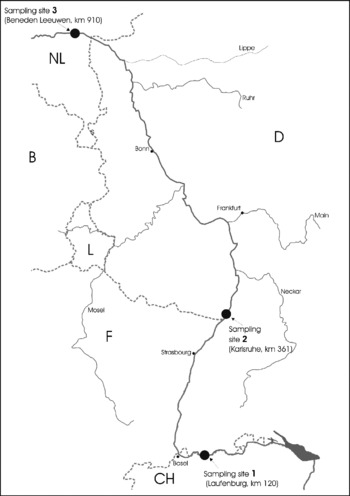
All eels analysed in this study were caught by electrofishing at three sites on the River Rhine during 2003 (fig. 1). The first site was located at 120 km from the river source, close to the city of Laufenburg (Switzerland). At this sampling site, eels were caught twice in the main river and once in a small tributary stream called the Sulzbach. The second sampling site was close to the city of Karlsruhe (Germany), 361 km from the river source. All eels from this sampling site were caught in the main river. The third sampling site was close to the city of Beneden Leeuwen (The Netherlands), 910 km from the source. Again all fish were caught in the main river.
Drainage system of the River Rhine with the three sampling sites (black dots).

The fish were brought back alive to the laboratory, killed by decapitation, measured to the nearest centimetre (total body length) and weighed to the nearest gram. The condition factor (C-factor) was calculated using the formula C = 100 × w × l 3, where w = weight (g) and l = length (cm), according to Schäperclaus (Reference Schäperclaus1990). Subsequently the eels were examined immediately for parasitic metazoans as described by Sures et al. (Reference Sures, Knopf, Wurtz and Hirt1999). All parasites in the intestine were determined to species level and counted. Furthermore, all parasites on the skin, fins, gills, swimbladder and eye were determined to species level as far as possible. The keys used were those of Bykhovskaya-Pavlovskaya et al. (Reference Bykhovskaya-Pavlovskaya, Gustev, Dubinina, Izyumova, Smirnova, Sokolovskaya, Shtein, Shul'man and Epshtein1962), Moravec (Reference Moravec1994) and Hoffmann (Reference Hoffman1999).
Data on the crustacean fauna of the River Rhine near Laufenburg and Karlsruhe derive from monitoring programmes and were provided by the Federal Agency for Environmental Measurement and Nature Conservation of Baden Württemberg (LUBW) (LfU, 2003, 2004). Further information on the crustacean fauna in the high Rhine (120 km from source) derived from Rey & Ortlepp (Reference Rey and Ortlepp2002) and for the other sampling sites from IKSR (International Commission for the Protection of the Rhine) (2002b). The terms prevalence, mean intensity and abundance were used according to Bush et al. (Reference Bush, Lafferty, Lotz and Shostak1997). The Kruskal–Wallis test and the Mann–Whitney U-test were employed to test for significant differences among the eels.
Results
Eel data
Data on the eels are presented in Table 1. A total of 100 eels were caught at the Laufenburg site (mean length: 47.0 ± 10.3 cm; mean weight: 194.6 ± 155.2 g; mean C-factor: 0.15 ± 0.05). There were no significant differences in size (chi2 = 2.94, df = 2, P = 0.228), weight (chi2 = 3.24, df = 2, P = 0.198) and C-factor (chi2 = 3.44, df = 2, P = 0.179) between the eels of the tributary and the main river (Kruskal–Wallis test). At the Karlsruhe site, 54 eels were caught during the three sample periods (mean length: 53.7 ± 11.3 cm; mean weight: 287.6 ± 208.5 g; mean C-factor: 0.16 ± 0.03) (table 1). Again there were no significant differences in weight (chi2 = 3.24, df = 2, P = 0.198), length (chi2 = 1.37, df = 2, P = 0.504) and C-factor (chi2 = 4.18, df = 2, P = 0.124) between the eels at this site (Kruskal–Wallis test). At Beneden Leeuwen, 43 eels were caught on one occasion in 2003 (mean length: 55.7 ± 4.3 cm; mean weight: 305.1 ± 82.1 g; mean C-factor: 0.17 ± 0.02) (table 1). Between the eels caught in Karlsruhe and Beneden Leeuwen no significant differences in length (chi2 = 4.66, df = 3, P = 0.199) and weight (chi2 = 4.85, df = 3, P = 0.183) could be found (Kruskal–Wallis test). However, the eels from Laufenburg turned out to be significantly smaller than those from Karlsruhe or Beneden Leeuwen (chi2 = 32.68, df = 6, P < 0.0001, Kruskal–Wallis test).
Morphometric eel data and dates of sampling in 2003.

Crustacean data
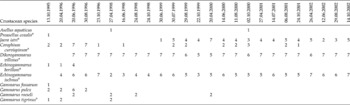
The development of the crustacean fauna at the sampling sites Laufenburg and Karlsruhe, as provided by LUBW, is shown in tables 2 and 3. Two isopod species (Asellus aquaticus and Proasellus coxalis) were detected in the high Rhine in Laufenburg (table 2). Whereas A. aquaticus was regularly present in low numbers, P. coxalis only appeared sporadically. Three amphipod species of the genus Gammarus (G. fossarum, G. pulex and G. roeseli) were present throughout the period from 1995 to 2003 in high abundances. G. fossarum is a typical species of this part of the River Rhine (Eggers & Martens, Reference Eggers and Martens2001) and can be found regularly in southwestern Germany. G. pulex and G. roeseli both belong to the native crustacean fauna of Germany (Eggers & Martens, Reference Eggers and Martens2001). Except for the rare isopod Proasellus coxalis, no neozoic species were found in this section of the river.
Abundance of different crustacean species at the Laufenburg sampling site from 1995 to 2003. Abundance classes according to Alf et al. (Reference Alf, Braukmann, Marten and Vobis1992), with 1= single finding to 7= mass occurrence.

a Neozoic species.
Abundance of different crustacean species at the Karlsruhe sampling site from 1995 to 2003. Abundance classes according to Alf et al. (Reference Alf, Braukmann, Marten and Vobis1992), with 1= single finding to 7= mass occurrence.

a Neozoic species.
A completely different composition of the crustacean fauna was found in the upper Rhine at the Karlsruhe site (table 3). Between the years 1995 and 2003, the abundance of neozoic species increased dramatically. The isopod Jaera istri and the amphipods Dikerogammarus villosus and Echinogammarus ischnus, all originating from the Black Sea area, have reached high abundances and dominate the macrozoobenthic community. In contrast, native species such as A. aquaticus, G. pulex and G. roeseli have recently disappeared in the main river. In addition, former alien species such as Corophium curvispinum and Gammarus tigrinus were also absent at the Karlsruhe site.
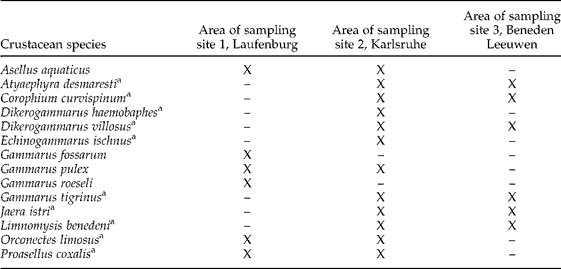
From a macrozoobenthic survey in the area of the Beneden Leeuwen site in the year 2000 (IKSR, 2002b), a crustacean species list was generated consisting solely of neozoic species (see right-hand column in table 4). Apart for G. tigrinus, a species originating in North America, all other crustaceans in this section of the river are invasive species originating from the Ponto-Caspian area. Unfortunately, there is no information on the abundance of these species in IKSR (2002b).
Presence of different crustacean species in 2000 at the three sampling sites (after IKSR, 2002b).
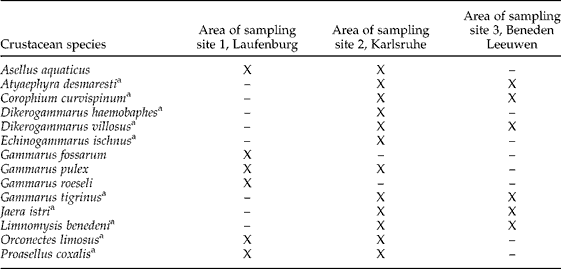
a Neozoic species.
Parasite diversity
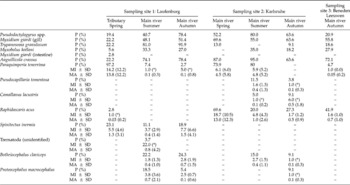
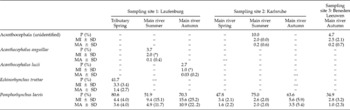
In all, 18 parasite species were detected during our survey at the three sites (table 5 and table 6). Three protozoa (Myxidium giardi, Myxobolus kotlani and Trypanosoma granulosum), five acanthocephalans (Acanthocephalus anguillae, Acanthocephalus lucii, Echinorhynchus truttae, Pomphorhynchus laevis and one unidentified acanthocephalan), six nematodes (Paraquimperia tenerrima, Pseudocapillaria tomentosa, Camallanus lacustris, Raphidascaris acus, Spinitectus inermis and Anguillicola crassus), two cestodes (Bothriocephalus claviceps and Proteocephalus macrocephalus), monogeneans (Pseudodacrylogyrus sp.) and one unidentified trematode species were found. From these species, nine are eel-specific parasites whereas seven species are generalists which also infect other fish species. The two unidentified species cannot be attributed to one of these groups.
Prevalence [P (%)], mean intensity (MI) ± standard deviation (SD), mean abundance (MA) ± SD of the parasites (except acanthocephalans) found on and in the eels at the three sampling sites.

* Numbers too small for calculation of SD to be meaningful.
Prevalence [P (%)], mean intensity (MI) ± standard deviation (SD), mean abundance (MA) ± SD of the acanthocephalans found in the eels at the three sampling sites.

* Numbers too small for calculation of SD to be meaningful.
The number of species decreased along the course of the river. In the high Rhine at Laufenburg, the eels harboured 15 parasite species, in the upper Rhine at Karlsruhe 13 parasite species were present, whereas in the lower Rhine at Beneden Leeuwen only nine parasite species were detected (table 5 and table 6). The number of species per sample ranged between 7 (spring sampling Karlsruhe) and 12 (summer sampling in Laufenburg). The only parasite species present during every sampling period were Pseudodactylogyrus sp., Anguillicola crassus, Pomphorhynchus laevis and Myxidium giardi.
Discussion
We present new data on the parasite fauna of the European eel in the Rhine river system from three different locations. Until now, only two papers (Sures et al., Reference Sures, Knopf, Wurtz and Hirt1999; Sures & Streit, Reference Sures and Streit2001) have dealt with eel parasites in this large river system. The parasite fauna of the European eel throughout Europe is well investigated and all parasite species reported here are also known from other locations in Europe (see, for example, Kennedy, Reference Kennedy1993; Sures et al., Reference Sures, Knopf, Wurtz and Hirt1999; Sures & Streit, Reference Sures and Streit2001; Norton et al., Reference Norton, Lewis and Rollinson2003; Schabuss et al., Reference Schabuss, Konecny, Schiemer, Kennedy, Grillitsch and Herzig2005), except for the unidentified acanthocephalan and trematode species. At freshwater locations, digenean trematodes are usually absent from eels, whereas in brackish water and seawater these trematodes are common parasites (Køie, Reference Køie1988). The appearance of a digenean trematode at Laufenburg in a single eel might therefore be the result of an accidental infection.
With 15 parasite species, Laufenburg had the highest parasite species diversity. The maximum number of parasites per sample at this location ranged between 10 and 12 species. Remarkable differences between the tributary and the main river were found in terms of species composition. For instance, all three protozoa, as well as the gill monogeneans and Anguillicola crassus in the swimbladder, show a higher prevalence in the main river than in the smaller stream. The most pronounced difference can be seen for the blood parasite Trypanosoma granulosum. From other studies it is known that the prevalences of T. granulosum are higher in rivers with a lower flow rate or in lakes (Zintl et al., Reference Zintl, Holland, Poole and Voorheis1997). This parasite is transmitted by different leeches (Zintl et al., Reference Zintl, Voorheis and Holland2000) and it appears likely that a larger leech community can be assumed in the main river, which had a much lower flow rate than its tributary. Similarly, A. crassus shows differences in prevalence between the tributary and the main river. As the intermediate hosts of this parasite are mainly copepods (De Charleroy et al., Reference De Charleroy, Grisez, Thomas, Belpaire and Ollevier1990), it is obvious that the main river with a low velocity contains far more zooplankton, resulting in a higher infection rate. A. crassus infections in the tributary are undoubtedly acquired by eels feeding on paratenic hosts such as fish and insect larvae (Moravec & Konecny, Reference Moravec and Konecny1994). Both eel-specific cestodes, B. claviceps and P. macrocephalus, were completely missing from the tributary stream. As for A. crassus, the infection of both cestodes occurs by feeding on infected copepods which act as intermediate hosts (Kennedy et al., Reference Kennedy, Nie, Kaspers and Paulisse1992; Scholtz, Reference Scholz1997). The acanthocephalans A. anguillae and A. lucii were only found in the Rhine but not in the tributary. The specific intermediate host, Asellus aquaticus, (Moravec, Reference Moravec2004) is present in low numbers in the main stream but is missing in the brook.
In contrast, the acanthocephalan Echinorhynchus truttae and the nematode Raphidascaris acus were only present in the stream but were missing in the river. Salmonid fish species like Salmo trutta fario or Thymallus thymallus act as final hosts for E. truttae. In addition, eels can be infected but act mainly as accidental hosts in which the worms do not mature (Moravec, Reference Moravec2004). The eel must be seen as an unsuitable host which does not contribute to the maintenance of the suprapopulation of this parasite species (Taraschewski, Reference Taraschewski2000). This also explains the lack of this parasite in the main Rhine river at Laufenburg. Although the required intermediate hosts (G. pulex and G. fossarum) were present in the Rhine, no eel infections could be found as the preferred final host does not occur in high densities (IKSR, 2002a).
The generalist nematode R. acus occurs mainly in piscivorous fish species like salmonids, and pikes, but also in eels (Moravec, Reference Moravec1994). The infection parameters of eels from the stream were rather low and, similarly to E. truttae, a suprapopulation of this parasite might occur in the trout. Therefore, no eels in the main river were infected with this parasite.
The eel specialist Paraquimperia tenerrima shows a much higher prevalence, mean intensity and mean abundance in the tributary stream compared to the Rhine. However, this might be mainly associated with seasonal changes rather than the site of sampling. Nie & Kennedy (Reference Nie and Kennedy1991) showed a clear seasonal development of P. tenerrima throughout the year. The highest prevalence in eels was observed in spring, reaching a maximum in May and June followed by a subsequent decline, with the prevalence being close to zero in November. The same development was visible at Laufenburg. In May, the prevalence reached 97% in the tributary, which is undoubtedly a maximum. The samples in the main river were collected in August and November, and thus at a time of the year when the infection rate with this parasite is supposed to be low.
Spinitectus inermis, an eel-specific parasite, was only detected at the sampling site Laufenburg and was absent at the other two sites. Experimental infections showed that this parasite uses several mayflies as intermediate hosts (Saraiva et al., Reference Saraiva, Pereira and Cruz2002a, Reference Saraiva, Moravec, Pereira and Cruzb). Although Ephemeroptera are present throughout the whole River Rhine (IKSR, 2002b), their diversity is much higher in the non-navigable part of the high Rhine (Rey & Ortlepp, Reference Rey and Ortlepp2002). Thus far, it is not known whether mayflies or other invertebrate species act as intermediate hosts for S. inermis at Laufenburg. All amphipod species at Laufenburg can act as intermediate hosts (Moravec, Reference Moravec2004) for the generalist Pomphorhynchus laevis. This parasite showed high infection parameters for all three samples from Laufenburg. The eel is, however, not the required final host and the worms do not become mature and remain smaller than in their preferred final hosts, e.g. trout, barbel or chub (Moravec & Scholtz, Reference Moravec and Scholz1991). The high abundance of this parasite is therefore a marker for the presence of at least one preferred final host (Taraschewski, Reference Taraschewski2000). Chub (Leuciscus cephalus) is one of the dominant fish species (IKSR, 2002a) in this section of the river, and barbel (Barbus barbus) can also be found in the Rhine. In the tributary, trout (Salmo trutta fario) are frequent. Thus, the high prevalence of P. laevis in eels in the high Rhine is a result of the availability of preferred intermediate and final hosts in this part of the river.
The crustacean fauna at Laufenburg is still dominated by autochthonous species (IKSR, 2002b; Rey & Ortlepp, Reference Rey and Ortlepp2002), and except for the rare occurrence of Proasellus coxalis neozoic species are missing in this part of the river, which is not used by large international cargo vessels (Rey & Ortlepp, Reference Rey and Ortlepp2002).
The second sampling site at Karlsruhe (361 km from source) is the only site for which previous data on eel parasites exist (Sures et al., Reference Sures, Knopf, Wurtz and Hirt1999; Sures & Streit, Reference Sures and Streit2001). Sures et al. (Reference Sures, Knopf, Wurtz and Hirt1999) identified 12 parasite species, in comparison to 13 in this investigation. The composition of the species has changed markedly between the studies. For example, the prevalence of the two protozoa, T. granulosum and M. kotlani was higher in 1995, whereas the infection rate with the monogeneans and M. giardi was higher in this study (Sures et al., Reference Sures, Knopf, Wurtz and Hirt1999). Prevalences of the swimbladder nematode A. crassus did not change and were still comparable with those from 1995. Striking differences could be observed in the composition of the intestinal parasite fauna. While some helminths disappeared, new ones arrived. The dominant species in the gut of the eel, was the eel-specific acanthocephalan Paratenuisentis ambiguus, in 1995 (Sures et al., Reference Sures, Knopf, Wurtz and Hirt1999) and 1999 (Sures & Streit, Reference Sures and Streit2001). This is a neozoic parasite from North America (see Taraschewski et al., Reference Taraschewski, Moravec, Lamah and Anders1987). In the previous studies this parasite reached mean intensities of up to 30–42 worms, but in our study it was completely missing. This is the result of changes in the composition of the crustacean fauna at the Karlsruhe sampling site. P. ambiguus needs as intermediate host, the introduced North American amphipod Gammarus tigrinus (Taraschewski et al., Reference Taraschewski, Moravec, Lamah and Anders1987). This amphipod species has disappeared due to the appearance of invasive amphipods from the Black Sea area (Dick & Platvoet, Reference Dick and Platvoet2000; Haas et al., Reference Haas, Brunke, Streit, Leppäkoski, Gollasch and Olenin2002; Krisp & Maier, Reference Krisp and Maier2005). The massive invasion of Ponto-Caspian amphipods into the Rhine river system started in 1992 with the opening of the Main–Danube Canal which connects the drainage system of the Rhine with that of the Danube (Bij de Vaate et al., Reference Bij de Vaate, Jazdzewski, Gollasch and Van der Velde2002). But not only former alien amphipods such as G. tigrinus and Corophium curvispinum have disappeared from this section of the Rhine (Haas et al., Reference Haas, Brunke, Streit, Leppäkoski, Gollasch and Olenin2002); native species such as G. fossarum, G. pulex, G. roeseli and A. aquaticus have also become extinct (IKSR, 2002b; LfU, 2003, 2004). Therefore, it is not surprising that the acanthocephalans A. anguillae and A. lucii, using A. aquaticus as their intermediate host, were also missing in 2003.
The dominant intestinal eel parasite changed in Karlsruhe in 2003 depending on the season of sampling. In spring, the non-host-specific nematode R. acus was the dominant intestinal worm, in summer the eel-specific nematode P. tenerrima became dominant, and in autumn P. laevis dominated the parasite community. The change between R. acus and P. tenerrima is most likely due to seasonal aspects in the life cycle of these parasites (Szalai & Dick, Reference Szalai and Dick1989; Moravec, Reference Moravec2004). However, the high prevalence of P. laevis throughout the year in Karlsruhe remains unclear as the necessary intermediate gammarid hosts (G. pulex, G. fossarum) are missing at this sampling site. Again, high prevalences of P. laevis in Karlsruhe seem to be a marker for the presence of preferred final hosts such as chub and barbel in this area. Indeed, chub and barbel are abundant in this area (IKSR, 2002a), but the question of the intermediate host remains unclear. In the literature, the amphipods Corophium voluntator, C. curvispinum and Echinogammarus stammeri (Moravec, Reference Moravec1994; Dezfuli et al., Reference Dezfuli, Rossetti, Bellettato and Maynard1999; Van Riel et al., Reference Van Riel, Van der Velde and Bij de Vaate2003) are described as intermediate host for species of the genus Pomphorhynchus. Although none of these species is continuously abundant at the Karlsruhe sampling site, it is conceivable that other gammarids might also be used as intermediate hosts for P. laevis. This remains a matter of debate as no infection studies have been conducted using gammarids other than G. pulex and G. fossarum. The specific eel parasite Paraquimperia tenerrima, the dominant eel parasite in summer 2003, was missing in the years 1995/99. According to Shears & Kennedy (Reference Shears and Kennedy2005), this parasite uses the fish species Phoxinus phoxinus as an intermediate host. However, in recent investigations on the fish fauna in the area of Karlsruhe (Weibel, Reference Weibel1991; Dußling & Berg, Reference Dußling and Berg2001), this fish species was not recorded. Accordingly, no information is available on the intermediate hosts of P. tenerrima in the Rhine river system.
With nine parasite species, the eels from Beneden Leeuwen showed the lowest parasite diversity. While the same three protozoan species, monogeneans and A. crassus were present, fewer species occurred in the intestine of the eels. Surprisingly, no tapeworms were found at this site. As zooplankton concentrations, and thus available copepod intermediate hosts, are higher at Beneden Leeuwen than at Laufenburg or Karlsruhe (IKSR, 2002c), one might also expect the presence of tapeworms. This discrepancy might be due to the fact that larger eels feed less often on zooplankton than smaller eels and are therefore less vulnerable to infection by cestodes. Furthermore, among these larger eels, some specimens might start to convert into silver eels that will soon migrate back to the sea and therefore stop feeding (Van Ginneken & Maes, Reference Van Ginneken and Maes2005). This could also explain the overall lower number of intestinal parasite species. Again, P. laevis was the dominant intestinal helminth. At least in 2000 (IKSR, 2002b), Corophium curvispinum was detected in this region and might serve as an intermediate host for P. laevis. This is supported by the findings of Van Riel et al. (Reference Van Riel, Van der Velde and Bij de Vaate2003). Similarly to Karlsruhe, the crustacean fauna at Beneden Leeuwen is dominated by alien species.
The investigation of the parasite fauna of the European eel (Anguilla anguilla) at three different sample sites in the River Rhine has provided new insights into the composition of the eel parasite fauna of this river system. At Laufenburg (120 km from the river source), the crustacean fauna is not yet dominated by neozoic species (IKSR, 2002b; Rey & Ortlepp, Reference Rey and Ortlepp2002) and therefore no influence on the eel parasite fauna seems to exist. Nevertheless, neozoic parasite species that do not rely on transmission by neozoic intermediate hosts, such as Anguillicola crassus and Pseudodactylogyrus spp., are also abundant at Laufenburg. These parasites, which originally infected the Japanese eels Anguilla japonica, were introduced by live eel transport and are distributed throughout Europe (Kirk, Reference Kirk2003). As the natural migration of eels into this part of the river is impossible due to weirs, it must be assumed that these parasites were introduced by the stocking of eels. The parasite fauna of the eels at Laufenburg reflects the local macrozoobenthic community, and the presence of parasites like A. anguillae, A. lucii, E. truttae and P. laevis confirms the presence of the respective crustaceans. The remarkable differences between the tributary stream and the main river can be explained at the level of the intermediate and final hosts for most species. In addition, these results demonstrate that there is little movement of eels between the tributary and the main river.
At the Karlsruhe sampling site, the intestinal parasite fauna reflects the development of the crustacean fauna during the past few years. In particular, the destruction of the natural biogeographic barrier between the Danube and the Rhine by the opening of the Main–Danube Canal has led to massive changes in the composition of the intestinal parasite community. Changes over time are, however, only visible if previous information on the composition of the parasite community is available. This was the case for the Karlsruhe site (see Sures et al., Reference Sures, Knopf, Wurtz and Hirt1999; Sures & Streit, Reference Sures and Streit2001), but not for Laufenburg or Beneden Leeuwen. As parasites have complex life cycles including a variety of intermediate and paratenic hosts, the presence or absence of parasite species not only provides information on the host's diet, but also on its population biology and migration activities.