INTRODUCTION
Recent exploration of north-east Atlantic cold-water reefs (hereafter named CWRs) by the Netherlands research vessel ‘Pelagia’ carried out under the multidisciplinary projects Moundforce 2004 (Mienis & De Haas, Reference Mienis and De Haas2004), BIOSYS/HERMES 2005 (Van Duyl & Duineveld, Reference Van Duyl and Duineveld2005), BIOSYS 2006 (Maier, Reference Maier2006) and BIOSYS 2007 (Maier, Reference Maier2007) included the study of the biodiversity of sponges associated with these reefs at various depths and distances from mainland coasts. Samples were taken in reefs at bathyal water depths west of Ireland, and in reefs at shelf depths off the coasts of Scotland and in the Skagerrak. Emphasis was placed on species diversity and abundance, but an eco-biogeographic component was also examined by comparing community composition along an oceanic-to-inshore transect. Sponge results of three individual cruises have already been published in a series of papers (van Soest & Lavaleye, Reference van Soest and Lavaleye2005; van Soest et al., Reference van Soest, Cleary, De Kluijver, Lavaleye, Maier and Van Duyl2007a, Reference van Soest, Van Duyl, Maier, Lavaleye, Beglinger, Tabachnick, Custódio, Lôbo-Hajdu, Hajdu and Muricyb; van Soest & Beglinger, Reference van Soest and Beglinger2009; Roberts et al., Reference Roberts, Davies, Henry, Dodds, Duineveld, Lavaleye, Maier, van Soest, Bergman, Hünerbach, Huvenne, Watmough, Long, Green and Van Haren2009), but only preliminary data are so far available on the last cruise (BIOSYS 2007, see van Soest in Maier, Reference Maier2007). Local species composition has been examined in detail, especially in Rockall Bank reef communities, which included correlation with several abiotic factors (van Soest et al., Reference van Soest, Cleary, De Kluijver, Lavaleye, Maier and Van Duyl2007a).
The first discovery of CWR sponges followed extensive deep-sea dredging expeditions during the second half of the 19th Century, by HMS ‘Lightning’ and HMS ‘Porcupine’ in waters north and west of the British Isles and Ireland, and later along the coast of southern Europe (see, e.g. Rice, 1986). By the end of the 19th Century, continuing into the first decades of the 20th Century, deep-sea explorations were extended across the whole of the North Atlantic, notably by Prince Albert I of Monaco. Important monographs and serial publications on the sponges obtained during these cruises were authored by Carter (Reference Carter1874, Reference Carter1876), Topsent (Reference Topsent1892, Reference Topsent1904, Reference Topsent1913, Reference Topsent1928), Lundbeck (Reference Lundbeck1902, Reference Lundbeck1905, Reference Lundbeck1910), and Stephens (Reference Stephens1915, Reference Stephens1921). Scandinavian CWR sponges were sampled by Sars (Reference Sars1872), Fristedt (Reference Fristedt1885) and Alander (Reference Alander1942). The researchers were aware that sponges were often found on (dead) coral substrates, but the notion of the existence of extensive discrete reef communities along the continental margins of the eastern Atlantic came up relatively recently (Reitner & Hoffmann, Reference Reitner, Hoffmann, Gradstein, Willmann and Zizka2003; Freiwald & Roberts, Reference Freiwald and Roberts2005; Hogg et al., Reference Hogg, Tendal, Conway, Pompon, van Soest, Gutt, Krautter and Roberts2011), due to technical improvement of sea bottom mapping techniques. Similarly, the discovery of such systems occurring also on the continental platforms at relatively shallow depths, e.g. west of Scotland (Roberts et al., Reference Roberts, Brown, Long and Bates2005), Sweden (Jonsson et al., Reference Jonsson, Nilsson, Floruta and Lundälv2004), and south of Norway, is of recent date. Thus, while the species occurring along the continental margins of Europe are relatively well-known and documented from frequent collections, it is only from studies made by us and several others (e.g. Longo et al., Reference Longo, Mastrototaro and Corriero2005), that the community composition and abundance of sponges in these reefs has become more adequately known. Causal explanations are being formulated for species richness, patchy distribution patterns and genetic structure of CWR sponge populations (e.g. Reitner & Hoffmann Reference Reitner, Hoffmann, Gradstein, Willmann and Zizka2003; van Soest et al., Reference van Soest, Cleary, De Kluijver, Lavaleye, Maier and Van Duyl2007a; Reveillaud et al., Reference Reveillaud, Remerie, van Soest, Erpenbeck, Cárdenas, Derycke, Xavier and Rigaux2010, Reference Reveillaud, van Soest, Derycke, Picton, Rigaux and Vanreusel2011; Goodwin et al., Reference Goodwin, Picton and van Soest2011). The present paper is intended to contribute to these purposes. This new contribution in the series of sponge data gathered by the Dutch CWR cruises mentioned above provides a synthesis of these investigations centring around the research question: how is the taxon composition of sponge communities in CWRs related to a west–east/deep–shallow gradient? Preliminary analysis (van Soest et al., Reference van Soest, Cleary, De Kluijver, Lavaleye, Maier and Van Duyl2007a) indicates that geographical distance between locations could be an important correlating factor: the closer the reefs, the more similar the sponge species composition in deep-water reefs west of Ireland. A further factor of importance is likely the prevailing current direction, connecting the reef localities, as downstream sponge populations depend on larval recruitment from upstream reefs. The prevailing surface currents in the north-east Atlantic are from the south-west to the north-east. West of the British Isles and Ireland, currents move northwards along the Rockall Bank, Porcupine Bank and Mingulay reefs, and north of Scotland dip down into the North Sea, to finally arrive at Skagerrak (Søiland, Reference Søiland2004). These theoretical considerations led to the working hypothesis that oceanic reefs west of Ireland would be similar to each other in composition; subsequently they would be expected to be most similar to shelf reefs west of Scotland, and together they would be least similar to faraway Scandinavian reefs.
MATERIALS AND METHODS
Locations
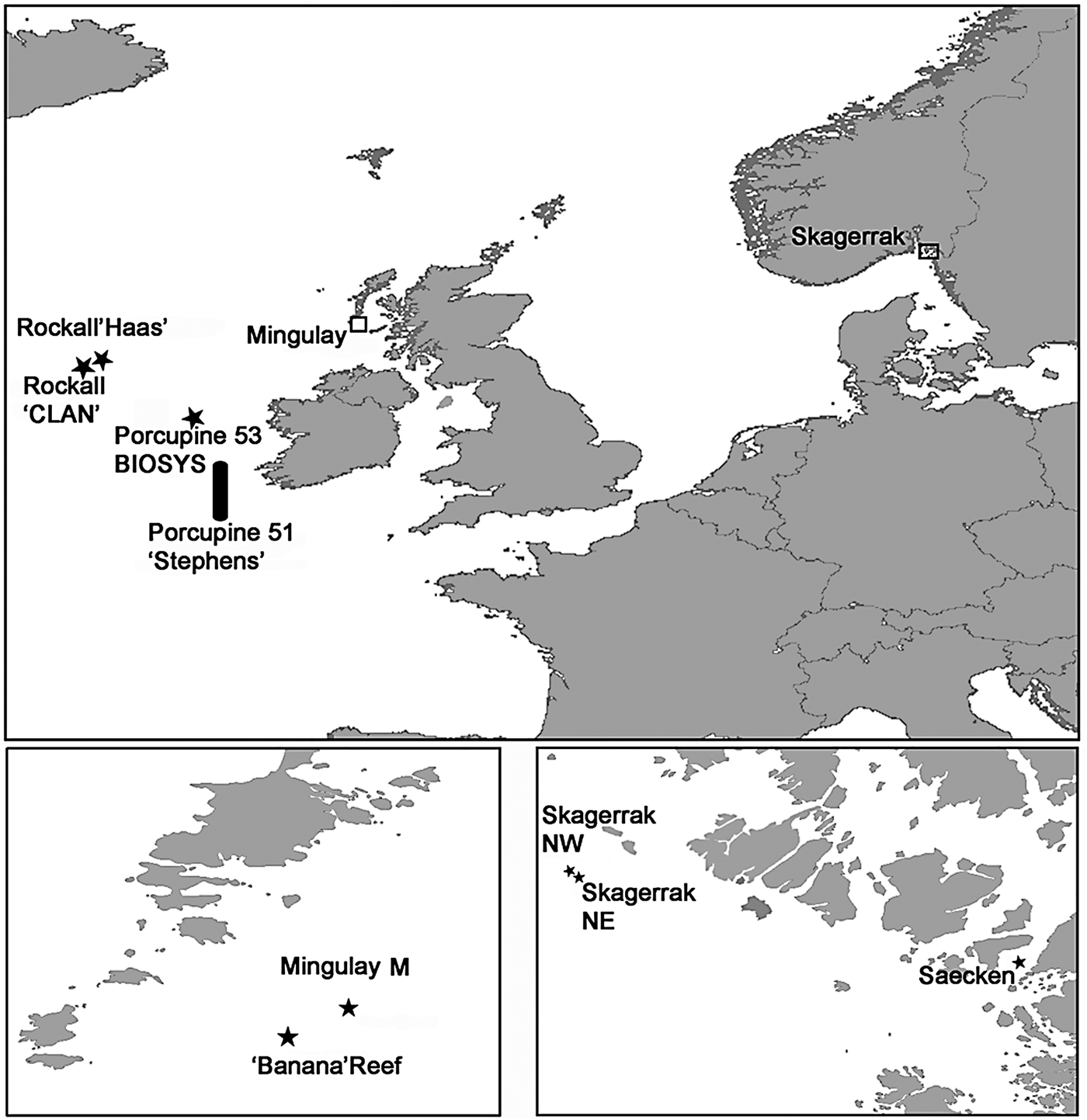
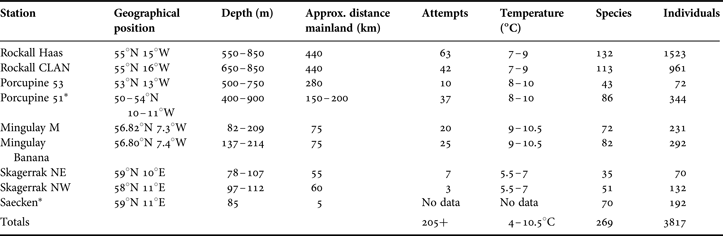
We compare the sponge diversity (species and abundance) of nine East Atlantic CWRs from four regions, two bathyal (Rockall and Porcupine Banks, west of Ireland) and two shelf regions (Mingulay in Scotland and Skagerrak on the Swedish and Norwegian borders) (cf. Figure 1). For details on the nine CWR locations see Table 1. Most of these reefs were already characterized previously (van Soest & Lavaleye, Reference van Soest and Lavaleye2005; van Soest et al., 2007; Roberts et al., Reference Roberts, Davies, Henry, Dodds, Duineveld, Lavaleye, Maier, van Soest, Bergman, Hünerbach, Huvenne, Watmough, Long, Green and Van Haren2009), with species lists included. Only the BIOSYS 2007 results on Skagerrak CWRs have not been published in a mainstream scientific journal, and until now were available only from an unpublished shipboard report (Maier et al., Reference Maier2007). Although most data are thus already available in published format, we add here a new table (Table 2) with the combined species and stations used for the comparison to provide the Skagerrak data and some improved identifications for the Irish and Scottish reefs. The latter were necessary after detailed studies of Goodwin et al. (Reference Goodwin, Picton and van Soest2011, biodiversity of Hymedesmia Bowerbank, 1862), Reveillaud et al. (Reference Reveillaud, van Soest, Derycke, Picton, Rigaux and Vanreusel2011, biodiversity of Plocamionida Topsent, 1927) and P. Cárdenas (in litteris: biodiversity of Geodia Lamarck, 1815, see also Cárdenas, Reference Cárdenas2010).
Approximate positions of the cold-water coral reefs in the north-east Atlantic of which the sponge species composition was studied. Insets show detailed positions of the Scottish (bottom left) and Skagerrak reefs (bottom right).

Localities and summary statistics of studied cold-water reef sponges. Asterisks indicate data taken from the literature (Stephens, Reference Stephens1915, Reference Stephens1921: Porcupine Bank; Alander, Reference Alander1942: Saecken reef).
*, literature data.
Matrix of stations, species and abundance of cold-water reef sponges analysed in this study. For data on the stations see Table 1. Species list follows the classification of Hooper & van Soest (Reference Hooper and van Soest2002).
Collecting strategy
Main collecting was done using NIOZ box cores (50 cm diameter). Box cores can be operated successfully in CWR localities and have several clear advantages over other collecting modes: the area sampled is fixed (1962.5 cm2), depth is exactly known (from the attached depth gauge and GPS), no contamination from different strata is possible, sediment and ambient seawater is collected as well and selection of specimens is easy and swift. Furthermore, compared to most other sampling modes there is relatively little damage to the reef community: if properly executed, the damaged area is at most 2 m2. Frequency of box core sampling differed substantially at the different localities (see Table 1), for reasons beyond our influence (combined scientific programmes). The Porcupine Bank ‘HERMES’ sampling was judged to be likely insufficient for a proper comparison with the other sampled localities, thus we supplemented the HERMES results with literature data from Stephens (Reference Stephens1915, Reference Stephens1921), who provided clear information on substrate allowing to choose only those from ‘Lophelia’ substrates, to further characterize this region. We preferred Stephens' data over the recently published—largely similar—species list of Propellor Mound (northern Porcupine Bight) of Könnecker & Freiwald (Reference Könnecker and Freiwald2005), because Stephens provided extensive descriptions of the species, allowing independent recognition of her material. At Mingulay, next to the usual box cores, several samples were obtained by ‘video-grabbing’ (see Mortensen et al., Reference Mortensen, Roberts and Sundt2000). The ‘Saecken’ or ‘Sekken’ CWR locality in the Swedish part of the Skagerrak was visited, but the two reefs are very small (less than 100 m in length, see Maier et al., Reference Maier2007) and for reasons of conservation it was decided not to sample at this locality. Instead, we used literature data provided by Alander (Reference Alander1942) on the sponges of Saecken to characterize this reef locality. At each locality sampled with box cores, several trawls and/or dredge samples were made to complement the species inventory with rarer taxa, and to allow comparison with literature data gathered by trawls and dredges of Stephens (Reference Stephens1915, Reference Stephens1921) and Alander (Reference Alander1942).
Sponge identification
We closely followed the procedures described in van Soest and Lavaleye (Reference van Soest and Lavaleye2005), and box cores and trawl samples were treated in the following way. When brought on-board all macroscopically visible specimens were taken out. All individuals were pre-identified on-board and preserved individually in 96% ethanol. Next to that, any slides that were made were mounted in Canada balsam and preserved for later confirmation of the identities. Slides usually contained only thick sections or teased fragments, but where necessary spicules were dissociated using concentrated household bleach. Additionally, from each coral reef sample, 20 coral branches were picked randomly for closer inspection (with a binocular microscope) in the laboratory on land. For each sample, the number of specimens for each species was determined and entered in a semi-quantitative matrix of stations, species and individual numbers (Table 2). All identified materials were deposited in the collections of the Zoological Museum of Amsterdam (now part of the Naturalis Biodiversity Center at Leiden), partly as individually registered specimens, partly as collective Lophelia branch samples.
Statistical treatment
The data (Table 2) were reduced to a presence/absence matrix on which we applied a Bray–Curtis similarity matrix. We assessed the faunal similarities between the areas using a cluster tree and a non-metric multidimensional scaling (nMDS). All statistical analyses were performed with the PRIMER 6.1.11. software (Clarke & Gorley, Reference Clarke and Gorley2006).
RESULTS
Species diversity
Sponge substrates formed by reef builders over the research area showed little variation (Figure 2), and other than depth the CWRs showed no obvious abiotic differences (e.g. temperature, cf. Table 1). There was a distinct dominance of Lophelia pertusa L. in all locations, with Madrepora oculata L. and Stylaster sp. locally abundant in Rockall Bank and Porcupine locations. Elsewhere the latter two were a minority substrate or entirely absent. As noted previously (van Soest & Lavaleye Reference van Soest and Lavaleye2005; van Soest et al., Reference van Soest, Cleary, De Kluijver, Lavaleye, Maier and Van Duyl2007a), sponge individuals predominantly were small and encrusting, making microscopic examination necessary. The composition of sponge material used in the present study is displayed in Table 2. From approximately 205+ sampling attempts, a total of 3817 specimens belonging to 269 species were available for this study consisting of 3281 specimens collected by us and 536 specimens ‘borrowed’ from the studies of Stephens (Reference Stephens1915, Reference Stephens1921) and Alander (Reference Alander1942). The species diversity of 269 species compares well with published total species numbers known to occur in the two marine ecoregions (‘Celtic Seas’ and ‘North Sea’ as distinguished in Spalding et al., Reference Spalding, Fox, Allen, Davidson, Ferdaña, Finlayson, Halpern, Jorge, Lombana, Lourie, Martin, McManus, Molnar, Recchia and Robertson2007) considered here: respectively, 295 and 140 (see van Soest et al., Reference van Soest, Boury-Esnault, Vacelet, Dohrmann, Erpenbeck, de Voogd, Santodomingo, Vanhoorne, Kelly and Hooper2012a, Reference van Soest, Boury-Esnault, Hooper, Rützler, de Voogd, Alvarez de Glasby, Hajdu, Pisera, Manconi, Schoenberg, Janussen, Tabachnick, Klautau, Picton, Kelly, Vacelet, Dohrmann and Díazb), from which we conclude that the overall sampling efforts covered the sponge diversity of the areas adequately, since these total numbers also include shallow water and soft bottom sponges, not considered here.
Examples of box cores taken from cold-water coral reefs in the four regions to show overall similarity of coral substrates for the sponges: (A) Rockall Bank; (B) Porcupine Bank; (C) Mingulay; (D) Skagerrak.
Numbers of samples, species and individuals differed strongly among the various investigated CWRs (Table 1), due to sampling effort and presence of microhabitats suitable for sponges (see van Soest et al., Reference van Soest, Cleary, De Kluijver, Lavaleye, Maier and Van Duyl2007a for a more detailed analysis). Within individual CWRs, abundance of species was highly variable, with the majority of species being rare, while a minority was found to be abundant (Table 2). This pattern applies to all investigated CWRs, regardless of sampling effort. Overall, approximately half the species (126) were found only once. Examples of extremely to moderately abundant species were Hexadella dedritifera Topsent, Reference Topsent1913, Cyamon spinispinosum (Topsent, Reference Topsent1904), Halicnemia verticillata (Bowerbank, 1866), Higginsia thielei Topsent, 1898, Lissodendoryx (Ectyodoryx) diversichela Lundbeck, Reference Lundbeck1905 and representatives of the subclass Calcinea in both Rockall Bank localities, Aphrocallistes beatrix Gray, 1867 and Thenea muricata (Bowerbank, 1858) in all offshore oceanic localities, Hymedesmia (Hymedesmia) paupertas (Bowerbank, 1866) and Crella (Pytheas) schottlaenderi Arndt, 1913 in both Mingulay reefs and—to a lesser extent—the Skagerrak reefs, and Iophon Gray, 1867 species in the Skagerrak reefs. This apparently inherently skewed diversity pattern induced us to do our statistical analysis on the basis of presence/absence of species, thus giving equal weight to occurrence of each species. This choice limits the analysis to an evaluation of the presence of species shared between localities. Due to the fact that some localities, e.g. Porcupine 53, were poorly sampled, no species was shared by all localities. However, if nearby CWRs are pooled (bathyal reefs of Rockall and Porcupine banks, shallow reefs at Mingulay and shallow reefs at Skagerrak), there are twelve species, which occurred in all regional pools.
Comparison of similarity
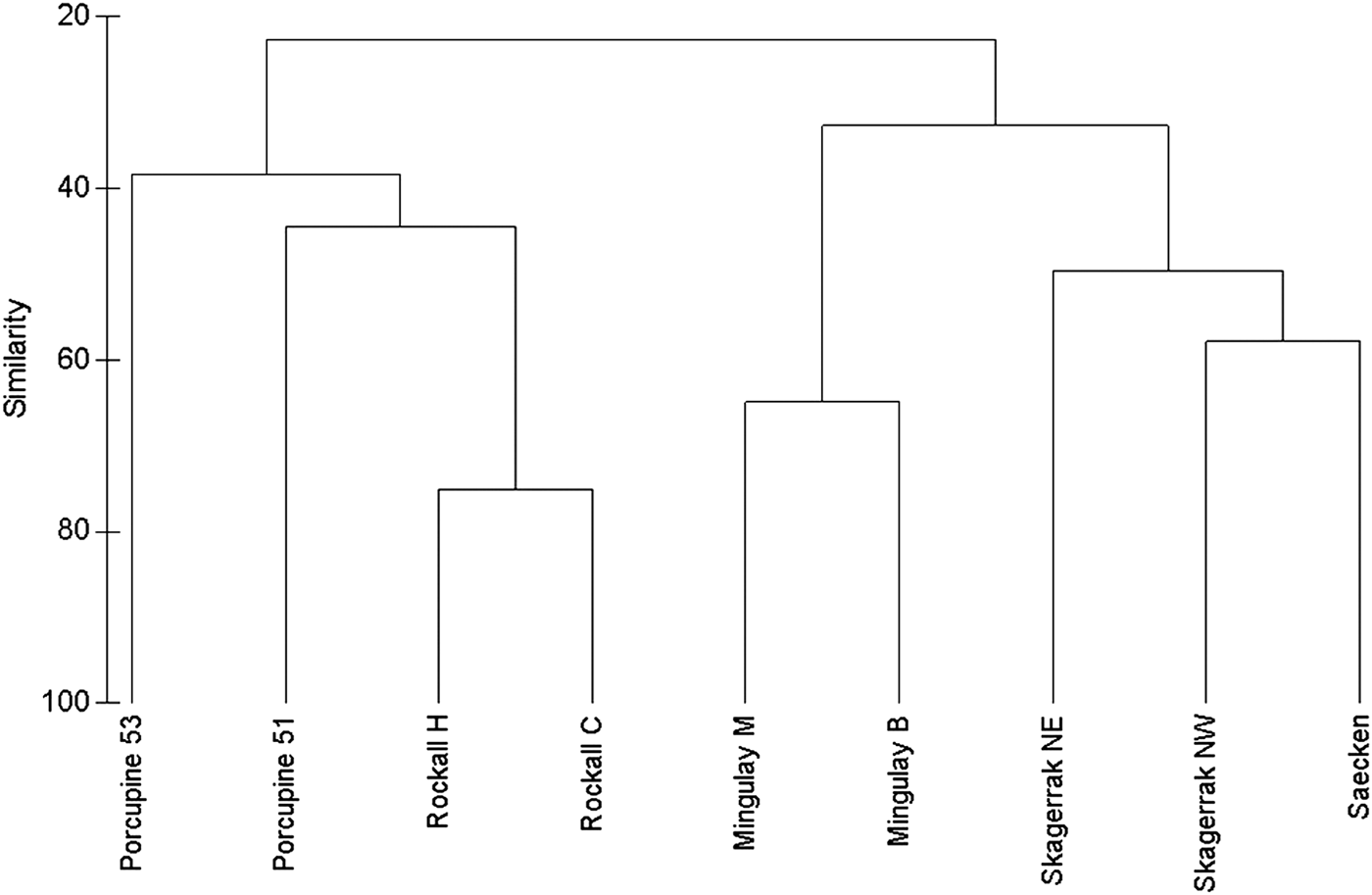
Following similar studies (e.g. Cleary & de Voogd, Reference Cleary and de Voogd2007), results of the Bray–Curtis similarity analysis are presented in the form of a cluster dendrogram (Figure 3) and MDS (Figure 4). Both analyses show the same strong outcome: local CWRs cluster together, but inter-regional similarity depends on depth. Mingulay reefs and Skagerrak reefs together are more similar than either is to the off-shore oceanic reefs. This clearly rejects the presumed correlation between similarity and geographical distance and confounds the simple notion that sponge composition of down-stream CWRs depend on upstream reef larval supply.
Group average cluster diagram of the similarity of Bray–Curtis index data obtained from presence/absence of sponge species in nine investigated cold-water coral reefs of the north-east Atlantic.
Multidimensional scaling diagram of the similarity of Bray–Curtis index data obtained from presence/absence of sponge species in nine investigated cold-water coral reefs of the north-east Atlantic.
The results show that shallow (80–200 m) Mingulay and Skagerrak reefs share more species (26) than either region does with deep (550–900 m) Rockall and Porcupine reefs. Examples of species distributions supporting this conclusion are Clathria (Microciona) strepsitoxa (Hope, 1889), Crella (Pytheas) schottlaenderi, Hymedesmia (Hymedesmia) bractea Lundbeck, Reference Lundbeck1910, Hymedesmia (Hymedesmia) paupertas, Biemna variantia (Bowerbank, 1858), Haliclona (Haliclona) urceolus (Rathke & Vahl, 1806) and Halisarca dujardinii Johnston, 1842. Conspicuously absent from these two reef clusters are Hexactinellida, while Calcinea species are rare. No cladorhizids (carnivorous sponges), no Halicnemia verticillata nor Cyamon spinispinosum, which are shared by the bathyal Rockall and Porcupine reefs, were found. In addition, frequent occurrence of Astrophorida, and Hexadella dedritifera, characterize the deep reefs against absence or rarity in the shallow Mingulay and Skagerrak reefs.
DISCUSSION
Sampling effort bias
The present analysis is somewhat flawed by the large difference in sampling efforts between the various reef localities. The design of this study was heavily influenced by the participation in multidisciplinary programmes, centring on physiological aspects of the reef corals. Geographical locations to be sampled, gear that was employed for collection, frequency of replicate sampling and samples to be shared between scientists were largely determined on the basis of priorities other than ours. Future studies would benefit from a more direct influence in the sampling programme. In spite of this, the main result of the comparison appears highly significant and little doubt over its validity remains.
Depth
Similarity between Mingulay and Skagerrak reefs, although higher than with either deep-sea reef areas, is relatively low (Figure 4), probably reflecting the large distance and the presence of largely unfavourable sandy habitats between the two regions. Mingulay reefs and the Irish deep-sea reefs are less far apart and are connected by predominantly hard substratum habitats, but an expected high similarity based on distance is lacking. Apparently, depth is a major factor affecting the occurrence of sponge species and composition of communities in otherwise very similar CWR habitats. According to a recent study by LeGoff-Vitry et al. (Reference Le-Goff-Vitry, Pybus and Rogers2004), even the reef builders themselves, i.e. Lophelia pertusa, show differentiation in offshore oceanic populations and inshore (fjord-) populations.
Possible explanations
It is generally assumed that sponge community composition is dependent on larval supply (e.g. Reveillaud et al., Reference Reveillaud, Remerie, van Soest, Erpenbeck, Cárdenas, Derycke, Xavier and Rigaux2010). With the prevailing currents in the north-east Atlantic running from south-west to north-east (e.g. Pingree, Reference Pingree1993; Søiland, Reference Søiland2004), there must be additional factors involved preventing most larvae from the deep reefs in the south-west to settle on the shallow reefs in the north-east. Depth is likely to be a proxy to more compelling differences between the Irish and Scottish–Skagerrak CWRs and two factors appear to offer possible explanations:
1. Deep-sea circulation in the North Atlantic, and more in particular of the Rockall Channel and environs, differs from the prevailing surface currents (Ellett & Martin, Reference Ellett and Martin1973, see also Figure 5, taken from Søiland, Reference Søiland2004) in being more complicated and at least partly southward directed. At depths below 600 m the Faroe–Iceland ridge forms a barrier against the northern extension of Atlantic Central Water and this barrier may conceivably be responsible for a break in the larval exchange between species occurring below 600 m and those in the upper layers. It would explain why similarity between populations in the same general area (west of the British Isles) could still be very low: larvae may be transported away from the continental shelf to the north. It would mean that our results would not reflect any particularly intensive connection between two widely distant CWR areas (Mingulay and Skagerrak), but would demonstrate merely the absence of connectivity between deep and shallow populations (Rockall–Porcupine vs Mingulay) due to the adverse current situation. An indication for the lack of larval exchange between these two regions is the distribution of Hymedesmia species reported by Goodwin et al. (Reference Goodwin, Picton and van Soest2011): of the 15 species encountered in total, only four were shared, while five were only found at Mingulay and six only at Rockall/Porcupine reefs.
2. Shallow occurrence means being exposed to seasonal temperature fluctuations and terrestrial influence, including human interference. Increased sediment accumulation and eutrophic conditions from river outflow and agricultural activity could exert an environmental stress on the inhabitants of shallow-water reefs and prevent settlement or growth of sensitive larvae. This view offers a broader, more global explanation for the absence of certain groups known to be typical deep-water specialists from shallow-water habitats (Hexactinellida, cladorhizids), regardless of the presence of coral substrates. The somewhat higher similarity (but still rather low) between the sponge populations of Mingulay and Skagerrak reefs compared to those of deep-water CWRs might then be simply caused by environmental selection.
North Atlantic deep-water current directions (arrows) (source: Søiland, Reference Søiland2004).
Examples of species occurring in both deep and shallow reefs, such as Alectona millari Carter, 1879, Protosuberites incrustans (Hansen, 1885), Iophon piceum (Vosmaer, 1885), Forcepia (Forcepia) forcipis (Bowerbank, 1866) and Mycale (Mycale) lingua (Bowerbank, 1866) are likely species that are specialized in colonizing widely different depth strata by having larvae that are capable of vertically moving between different water layers and/or with extended viability. Alternatively, such species could be complexes of cryptic species, genetically but not morphologically differentiated. Such species complexes were demonstrated on the basis of cold-water coral reef material of the genera Hexadella and Plocamionida by Reveillaud et al. (Reference Reveillaud, Remerie, van Soest, Erpenbeck, Cárdenas, Derycke, Xavier and Rigaux2010, Reference Reveillaud, van Soest, Derycke, Picton, Rigaux and Vanreusel2011).
Considerations for future investigations
Our results carry a significant message for broad-scale biogeographic studies involving sponges, namely that it is necessary to differentiate between deeper and shallower occurring sponges. Recent attempts at such studies (e.g. Xavier & van Soest, Reference Xavier and van Soest2012) were wisely limited in their depth coverage, and the present results support the decision for such a restriction. The more precise levels that need to be distinguished are not yet determined, but are likely to be sought at hundreds of metres, rather than broader depth strata. For a proper understanding of observed biodiversity patterns and degrees of endemism, knowledge of current directions at different depths is needed.
For sponge distributions, CWR habitats may be considered as being similar to seamounts, in that they provide ‘islands’ of hard substrates within larger sedimented areas unfit for settlement of most sponges. Populations occurring on seamounts are also likely to be differentiated in depth: Xavier & van Soest (Reference Xavier and van Soest2007) in their study of Gettysburg and Ormond seamounts found distinct Atlanto-Mediterranean shallow-water forms on these seamounts. So far only limited research is available and much work on deeper water occurrences of sponges is needed.
ACKNOWLEDGEMENTS
Thanks are due to Fleur van Duyl and Conny Maier (Royal Netherlands Institute for Sea Research) for inviting R.V.S. to participate in the 2005–2007 BIOSYS programme of the Dutch Science Foundation N.W.O., to Gerard Duineveld and Mark Lavaleye (Royal Netherlands Institute for Sea Research) for participation in the 2005 EU-HERMES programme, and to Henk de Haas (Royal Netherlands Institute for Sea Research) for participation in the Moundforce 2004 cruise. Andrew Davies and Murray Roberts (Scottish Association for Marine Science) assisted in the BIOSYS 2006 Mingulay cruise. Tomas Lundalv and Lisbet Jonsson (Tjarnoe Marine Laboratory) assisted in the BIOSYS 2007 Skagerrak cruise. Captains and crews of Royal RV ‘Pelagia’ are thanked for their craftsmanship. Julie Reveillaud (Woods Hole, USA), Claire Goodwin and Bernard Picton (Belfast, Northern Ireland), and Paco Cárdenas (Uppsala, Sweden) assisted with identification of sponge specimens. Elly Beglinger (Naturalis Biodiversity Center) assisted in the preservation and registration of the sponge specimens obtained during the BIOSYS programme.