IntroductionFootnote 1
The Ugandan objects which reside in museums across Europe and East Africa are extensive, diverse, and historically significant, yet also under-researched and under-displayed. Objects from Uganda began to flow into British museum collections from the late-nineteenth century with the expansion of travel, trade, and knowledge networks. On moving into the institutional space of the museum, these objects transformed into curios, trophies, and anthropological specimens of a timeless and traditional Ugandan culture. However, by the second half of the twentieth century, anthropologists had increasingly distanced themselves from the material culture of the colonial context in which their discipline had emerged. As a direct result, ethnographic museums and their collections thus experienced something of an extended “identity crisis.”Footnote 2
The emergence and development of “material culture studies” in socio-cultural anthropology and archaeology in the late-twentieth century brought museums and collections back in to academic focus. Museums have similarly pursued new methodologies, questions, dialogues, and collaborations in order to find new “ways in” to their object collections. Thanks to the increasingly interdisciplinary outlook of material culture studies and museum scholarship, a growing body of historians has also begun to integrate material culture and critical museological theory into their research with significant results. This approach views the past as a tangible space, and material cultures as representative of the changing interactions, values, identities and politics which have occurred within it. Historians are increasingly searching for different forms of agency embedded among the multiple discursive and physical layers of objects and their associated archival documentation which serve to disrupt, complicate, or add greater nuance to the conventional colonial histories and narratives that once defined them.Footnote 3 For example, research by Chris Gosden and Chantal Knowles in Papua New Guinea, Nicholas Thomas and Chris Wingfield in the Pacific, Claire Wintle in the Andaman and Nicobar Islands, and Christina Riggs in Egypt has encouraged greater recognition of how local leaders, dealers, makers, and consumers directed the practice of European ethnographic collecting in the colonies, a domain which has traditionally been attributed to white, European males.Footnote 4 In turn, this research has helped to reframe our understanding of the complex nature of power in colonial relations.
Historians of Uganda have produced rich and important work on the production of local oral and literary sources in the colonial period, but there have been significantly fewer explorations of its material dimensions outside of the work of archaeology. Andrew Reid has reflected upon the potential of historical archaeology for examining more recent periods in Ugandan history and the construction of historical memory.Footnote 5 This article situates itself among these wider discussions by arguing for a critical integration of object-based histories in the study of Uganda’s colonial past.
The colonial “gift” is an object category which appears across several museum records for Ugandan collections. As both physical objects and inter-personal acts, gifts provide an important window on the affective interactions and the strategic methods enacted by both Europeans and Ugandans in colonial relations. Items from Uganda found their way to ethnographic museums via several different routes. At one end of the spectrum, acquisition methods involved violent extraction through punitive expeditions and coercion. At the other end sat an exchange economy which involved both market relations and ostensibly altruistic sentiment. This article focuses on the latter of these categories, but does not view gift exchange in a straightforward way. While the capture and display of war loot reflected violent and cultural control by British colonizers, gift exchanges involved a quite different set of power relations between Ugandan and British elites which set the tone for future relations and mediated European access to knowledge.
Recent historical scholarship on imperial gifting in other regions emphasizes the complex agencies of both parties involved in an exchange. Natasha Eaton, for example, has found that the diplomatic gifting of portraiture in eighteenth-century India took on an important role in the colonial encounter between senior figures in the Mughal and British states. These exchanges involved intricate calculation, and objects exchanged in the form of a “gift” created a space for negotiation and identity formation.Footnote 6 Emma Martin finds that colonial gift exchange between elites in early twentieth-century Tibet was central to the projection of desired “national” identities by groups on either side of the exchange.Footnote 7 Meanwhile, Zachary Kingdon and Dmitri van den Bersselaar have studied five hundred objects in the ethnology collection of the World Museum in Liverpool which were gifted by almost eighty West African chiefs and educated elites between 1897 and 1916 via collector Arnold Ridyard (1853–1924).Footnote 8 These studies have all reconfigured the traditional museum gifting story in which non-European actors are situated as mere intermediaries.
Gift-giving was also central to the encounter between Ugandans and Europeans in the late-nineteenth century. Museum inventories and a wide variety of written accounts ranging from letters to memoirs, and even geographical reports, record the practice. Some descriptions are fleeting, while others recall the exchange of gifts in exhaustive detail. Gifting was a consistent feature of the European travel narrative, and correspondence and publications produced by Ugandans for European audiences also document the giving and receiving of gifts. Yet this has not been the focus of any sufficiently detailed analysis. As colonial gifts, these supposedly “pre-modern” objects served as important sites of “modern” political praxis in early imperial diplomacy for both colonizer and colonized. If we are to fully understand the nature of diplomatic relations, we must therefore acknowledge that the strategic deployment of the world of material things was a key feature. Gifts were central to the establishment of elite relations and identities. Gifting enabled local leaders to fashion a self-image through their own auto-ethnographies and the gifts that they amassed from European imperialists enabled them to form ethnographic collections and categorizations of their own.
The material gifts discussed in this paper were all deemed by the British to be museum-worthy. But they were situated within a much wider system of reciprocal exchange and negotiation which served to maintain relations of power in colonial Uganda. The gift-economy also involved the circulation of ammunition, livestock, foodstuffs, cloth, and land. There are files in the Uganda National Archives specifically dedicated to these forms of gift exchange between officials and “chiefs” in the early twentieth century, illustrating how deeply established the process had become to imperial political relations.Footnote 9 They also reveal the circulation and entanglement of both “commodities” and crafted goods within a gift economy which was neither simply “pre-modern” nor “modern” in the Maussian sense.Footnote 10 The gift economy between Muslim settlers and Ugandans requires further research, as do the internal gifting networks and cultures constructed between Ugandans themselves.Footnote 11 In the precolonial period, Richard Reid has demonstrated that the material basis of power was partly based upon the concept of “reciprocity,” though the Ganda were, in large “unrestricted by centralized political control.”Footnote 12 This patron-client system allowed the Kabaka (King) to exchange labor and taxation from chiefs in return for land.Footnote 13 At the other end of the spectrum were non-elite systems of gift exchange, which also require further study.
The gifts and gift-giving explored in this article occupy two sections. The first section examines some key examples of gift-giving in Uganda by Kabakas (Kings) Mwanga (1868–1903) and Muteesa (1837–1884), Katikkiro (Prime Minister) Mbaguta of Ankole, courtly princesses from the Kingdoms of Bunyoro and Buganda, and men identified as “chiefs” from Usoga, the Nile Province and Acholi. These case-studies illustrate the long history of gift exchange with Europeans: from the arrival of missionaries in the 1870s, to the early trade treaties with the Imperial British East Africa Company (IBEAC), right through to the period of imperial administration in the first half of the twentieth century. While the nature of these gifts evolved, gifting as a process remained a key feature of diplomatic relations. Although there was no single or pervasive gifting culture among all Ugandans, we can pick out similarities and patterns. Gifts reinforced the image of the dynastic and ritual authority of the Ugandan Kingdoms and their masculine material culture. The giving of similar gifts to multiple people and institutions reinforced this identity. But female members of the court were also involved in the exchange of gifts. These instances provide important insights into the lesser known rituals, regalia, and gender of the courts. We also find that some gifts impressed more than others, and that there were consequences to an inappropriate gift. At other times, gifts communicated diplomacy when language itself failed. For the historian plotting these histories, however, there is a constant tension between what truly constituted a “gift” and what did not. The fractured nature of museum records and the inevitable over-reliance on colonial sources are important methodological issues in this context.
To help remedy this issue, the second half of this article zooms in on one specific gift initiated by Katikkiro Sir Apolo Kaggwa (1864–1927) while visiting Britain in 1902. The Europeans who transferred their objects from the colonies to European museums often overshadow evidence of indigenous collectors and donors in the museum archive. Apolo Kaggwa not only gave objects to the Uganda Museum, he also traveled to Britain and gave his objects directly to various museums and individuals, documenting such events in detail. Kaggwa’s gifts therefore allow us to read the museum archive against the grain. They also speak to the spatial contingencies of gift-giving, transnational networks of power, methods of self-representation, and the cultural creation of historical memory and identity in Uganda. All of these hitherto unexplored sources and examples demonstrate the complex strategies and performances of early colonial encounters, and speak to wider historiographical efforts which seek to understand the close entanglement of culture and politics in the colonial period.Footnote 14
Early Colonial Gift Exchange in Uganda
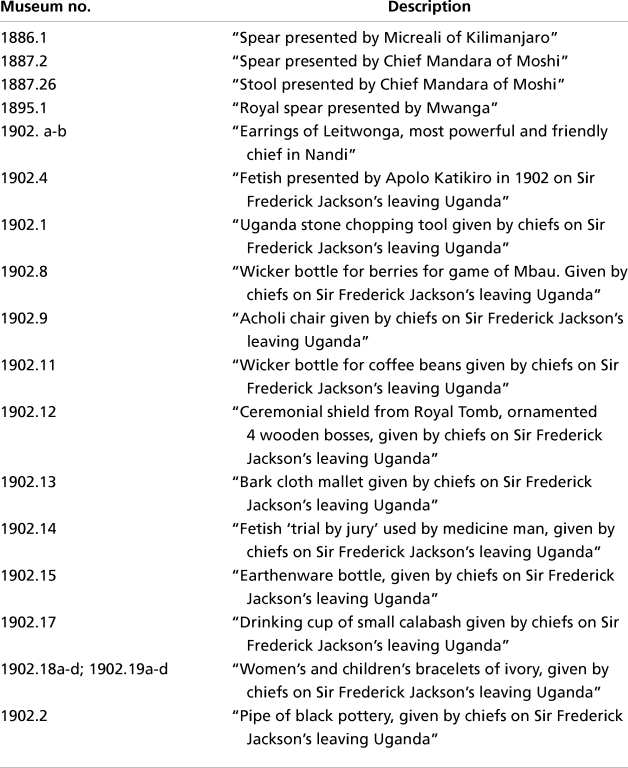
The objects listed in Table 1 are gifts that Sir Frederick Jackson received during his time working for the IBEAC and the colonial government in Uganda and British East Africa. These objects are part of larger collection of almost five-hundred objects which formed the foundations of the Nairobi National Museum in the late nineteenth century.Footnote 15 The items that are listed in the Museum inventory can be traced back to Kabaka Mwanga, Katikkiro Apolo Kaggwa, and a group loosely labelled as “Ugandan Chiefs.” We also find gifts from “Mandara of Moshi,” “Micreali of Kilimanjaro,” and “Leitongwa of the Nandi” alerting us that gifting was not a practice limited to one area, but rather, a common ritual in the encounter between Jackson and leaders across Uganda and Kenya. A published account of his time in East Africa provides rich information about other gifts given by “Chief Mbaguta, the Katikiro of Ankoli,” “Chief Wakoli of Usoga,” and leaders from the Maasai. Jackson noted in this account that gift-giving was a key feature of the formalities of visiting a place, and on the eve of his first major caravan expedition into Uganda, the IBEAC directors wrote to Jackson with instructions, emphasising that he should give gifts “immediately to chiefs” to establish good relations.Footnote 16
List of gifts acquired by Frederick Jackson from East African chiefs. Nairobi National Museum, Frederick Jackson Collection, 1886.1 – 1906.300.

Between 1886 and 1895, Jackson traveled with his IBEAC caravan from the coast into the interior of British East Africa to make treaties. In 1899, he took an unexpected detour into Uganda when he received a treaty request from Kabaka Mwanga. During these treaty expeditions, Micreali, Mandara, and Mwanga all presented him with spears. Jackson was a hunting man and would have valued these gifts. Museum records reveal that he acquired many hunting weapons during his time in East Africa. Spears were also popular European decorative devices. Photographs often depicted the careful arrangement of spears on walls as trophies. In the museum, they were specimens of “primitive” or “savage” warfare. But as Richard Reid notes, in Buganda, spears and shields were – as in West Africa – “cultural symbols, or standards of office and honour,” and to quote Speke, “the Uganda cognisance.”Footnote 17 In other places they also represented masculine power and martial prowess.
While spears appear to have been representative of treaty-making, Jackson received different objects when he left Uganda in 1902. We can presume that many of the “chiefs” listed in Jackson’s inventory were Baganda for their objects correspond with specifically Kiganda traditions. Many of these objects signify masculine power and elite identity. The Baganda had a reputation for creating the finest bark-cloth which has had a long association with coronation, healing, and funeral ceremonies of the royal family.Footnote 18 The production of bark-cloth was once widespread, but when Arab caravan traders brought increasing amounts of cotton to Buganda in the nineteenth century, bark-cloth became more commonly associated with specific social and cultural traditions. Only male artisans of the Ngonge clan used bark-cloth mallets like the one that Jackson received.Footnote 19 Venny M. Nakazibwe notes that “bark-cloth was not only used to extend and bridge social relations, but also became a major political and economic symbol of the kingdom of Buganda,” signifying its social and political function as a diplomatic gift. Footnote 20
Jackson also acquired a pipe made of black pottery and glazed with graphite. The royal court and other notables were the principal owners of black pottery.Footnote 21 The royal potters, called Bajjoona, were always men, but women controled all access to the pots during ceremonies and at royal sites.Footnote 22 The royal potters were exempt from luwaalo (tax) and received land in exchange for their pottery. In the seventeenth-century, potters were connected to public healing and political authority, and were even identified as medicine-men and protectors of the social health of the kingdom.Footnote 23 John Giblin and Kigongo Remigius note that there is a common belief among the Ganda that their pottery is immortal (in a material and metaphysical sense) and had a symbolic association with life.Footnote 24 The bark-cloth and the pipe were presumably given then, to emphasize the long-standing power and prosperity of the royal court.
Prior to its advancement as a cash crop, the coffee tree and its fruits held cultural and ritual significance. The Ganda offered coffee beans to the spirits of deceased kings.Footnote 25 They were also used in brotherhood ceremonies, offerings to guests, and in the game of mancala and were therefore likely given to Jackson with friendly intentions. The coffee beans, and indeed many of the other objects given to Jackson, resemble those that were given by Apolo Kaggwa to the British Museum and King Edward VII (1841–1910) in 1902. This suggests that the Ganda court forged a distinctive gifting identity. Kaggwa’s collection will receive closer attention in following section, but it is interesting to note that he too gave the British Museum coffee beans, a pipe, a shield, drinking vessels, fetishes, and a “chair” amongst other items, while King Edward VII and shortly after, George V (1865–1936), received a mancala board, smoking pipes, fetishes, drinking vessels, a shield, and armlets.Footnote 26
The ivory bracelets in Jackson’s collection belonged to women and children. It is unclear exactly who gave these objects to Jackson or why, but there is evidence that female members of the Kiganda and other royal courts did engage in gift exchanges with European visitors. Muteesa’s daughter gave the Protestant medical missionary, Dr. Robert William Felkin (1853–1926) a stunning ceinture (similar to a belt or girdle) which consisted of fashionable green, blue, and white beads and a large and rare opal bead at the centre.Footnote 27 He also acquired further gifts from princesses in Bunyoro, such as a tobacco pouch made of cowhide by “Princess Nakatschupi” (Kodi).Footnote 28 (Canon) John Roscoe (1861–1932) received armlets, and a coffee-berry basket used on the end of a princess’ sceptre at the Banyoro Court.Footnote 29 Ganda leaders also gave gifts to the wives of missionaries. In 1909, Hamu Mukasa (1868–1956) wrote to Miss Harriet. H. Walker, the sister of Archdeacon Walker (1857–1939), wishing her farewell from Buganda and informing her that he had sent her some “things of our country” which included a drum, a mat and two knives and insisted that she take them with her to England.Footnote 30 Though under-represented in colonial accounts, both Ugandan and British women clearly had a role in the official gifting culture of the court.
In his published work, Jackson ranked the gifts that he received. The gifts of Mbaguta, the Katikkiro of Ankole, featured particularly highly in his assessment. Like Kaggwa, Mbaguta carved a strong diplomatic reputation for himself in the 1901 Ankole Agreement which Jackson administered in his role as Acting Commissioner. Jackson described with pleasure how Mbaguta had loaded up his caravan with “curios of the finest workmanship” during a visit. Jackson compared his encounter with Mbaguta to his recent stays with both Wakoli, “Chief” of Busoga who had simply been generous with food and hospitality, and the Maasai who had not impressed with their gifts of beads.Footnote 31 Mbaguta’s generosity had appealed most greatly to Jackson “as it extended to gifts of the arts and crafts,” highlighting the value which Jackson attributed to a physical gift, particularly, anything that fell under the category of “curio”, “art” or “craft.” Mbaguta’s gift also communicated a sense of “gratitude” to Jackson. In his memoir, Jackson described his preconception of Ugandans as “lacking in affection or regard for the white man.” This image, he argued, had been constructed by linguists who claimed that “in most native languages there is no real word for gratitude.”Footnote 32 Jackson did not explain what Mbaguta was supposed to have been grateful for – presumably the dominant role which he had been accorded in the Ankole Agreement – but in this scenario, Jackson understood these gifts to have performed an important act of diplomacy which language alone could not.
Prior to the arrival of officials like Jackson, missionaries were important diplomatic envoys. Gifting also played an important role in their early encounters with Ugandan royalty. Felkin was a medical missionary and one of the first CMS (Church Missionary Society) representatives to enter Uganda in 1878. He also appears to have been the first major missionary collector of Ugandan objects. He gave his collection to the Royal Scottish Museum in Edinburgh (now National Museums of Scotland) in 1908. Felkin’s most famous patient was Kabaka Muteesa. Felkin used his medicinal knowledge – which can be considered a gift in itself – to build a diplomatic relationship with Muteesa. John Rowe argues that Muteesa’s precarious situation and Felkin’s skill offered a powerful opportunity for the CMS to demonstrate its spiritual effectiveness.Footnote 33 Muteesa declared Felkin a great “medicine man” and gave him a fine Waganda drinking tube of plaited grass – an object used only by elite figures – thus establishing his position in the Royal Court.
What were the consequences if one made an error in their gifting? On 17 February 1879, French Roman Catholic missionaries, led by Père Lourdel (1853–1890) arrived at Muteesa’s Court representing the Roman Catholic Société des Missionaires d’Afrique. Like Felkin, Lourdel also attempted to provide medical treatment to the King. But despite Felkin’s earlier successes, neither his European medicines nor Lourdel’s faith healing continued to succeed.Footnote 34 Both men decided to turn to alternative measures to win the favor of the Kabaka, and showered Muteesa and his court with gifts. The first CMS missionaries had given Muteesa a Bible amongst other small gifts, but when a new group of White Fathers arrived in the country in 1880, Lourdel organized a special gift for the Kabaka, much to the dismay of Alexander Mackay (1849–1890):
In June (…) the other four priests arrived, bringing with them a present for the King, which, though little in harmony with the spirit of Christianity, was just the kind of gift with which Rome might be expected to try and win the favour of a heathen King – five guns, four swords, three cavalry helmets, some richly embroidered generals’ uniforms lined with satin, some beautiful Arab dresses, braided with gold and silver and a cask of gunpowder.Footnote 35
In addition to this hoard of European weaponry and clothing, Lourdel also built Muteesa a European-style bedstead.Footnote 36 It is unclear how Muteesa reacted to Lourdel’s gifts, but pushed to match and better the French missionaries, Mackay adapted the British approach by offering to build a carriage.Footnote 37
In addition to these lavish crafted goods, Queen Victoria also sent gifts of international code flags to Muteesa in 1881.Footnote 38 However, Henry Morton Stanley (1841–1904) had previously promised gifts of armor and ammunition on behalf of the Queen. As Mackay explained: “[W]hen the envoys finally arrived, it was a grievous disappointment to him to find that they brought back with them merely the customary presents of courtesy, which he had previously received from such persons as the Sultan of Zanzibar, and no practical proposals of alliance.”Footnote 39 These events remind us of the fierce competition among European groups in Uganda and the variety of ways in which that competition played out on the frontiers of the Empire. They also remind us how Europeans were reliant upon the favor of the Kabaka in the early days of settlement in Uganda; for national success and for their personal and collective safety. But in their own acts of defiance, missionaries could withhold gifts as a method of punishment. During Mwanga’s reign, Jackson noted that “[i]n my office were two very large and gaudily decorated chairs that had originally been sent out by the Directors of the Imperial British East Africa Company as a present [to Muteesa], but on arrival they were not presented owing to some misdeed or malpractice on his part.”Footnote 40 A duplicate of these chairs, or “thrones,” now sits inconspicuously in a corner of the Director’s Meeting Room at the Royal Geographical Society in London.Footnote 41
In 1905, Charles Delmé-Radcliffe (1864–1937) gave a lecture to the Royal Geographical Society which detailed his own experience of gift exchange in East Africa.Footnote 42 Delmé-Radcliffe was a senior military officer and civil administrator of the Nile Province who had been ordered to produce systematic surveys of Madi, Acholi, and Lango territories in the late 1890s. During his account, he described an encounter in Patiko in the Nile Province where Samuel and Lady Baker had formerly built a fort. During this encounter, he engaged with an elderly chief called Watel Ajus. According to Delmé-Radcliffe, Ajus:
(…) took an elephant’s hair necklace from his neck and begged me to give it to [Lady Baker] when I went back. This I did and the old chief was delighted to receive a return present of photographs of Sir Samuel and Lady Baker, with an ivory-handled knife. This he acknowledged by sending back a leopard-skin to Lady Baker.Footnote 43
Ivory and leopard-skins were traditionally given to Acholi “chiefs” (rwots) as a form of precolonial tribute. Other popular tributes included iron bracelets, arrows, spear heads, and hoe blades. Ronald Atkinson explains that local people made tributes to the rwodi and that these gifts were central to the workings of chiefship and social stratification. In return, the rwodi reciprocated by redistributing other gifts.Footnote 44 The rwodi were thus “the focal point in the redistribution of goods and services within the polity.” The rwot could “use his position as the most generous giver to build up a fund of social and political good will and support,” and this “translated into real power over people.”Footnote 45 Ajus therefore engaged Delmé-Radcliffe in a traditional form of gift exchange, but with the added inclusion of photographs. The ivory-handled knife also signified an elite identity on the part of the British.
Sixty different independent rwodi “chiefdoms” existed by the time that the British arrived.Footnote 46 The British, however, sought to insert a Buganda-style council of chiefs who would cooperate with British ambitions. “Paramount Chiefs” were created and independent chiefdoms began to be amalgamated into the British system. Delmé-Radcliffe used Ajus’s gift to demonstrate the latter’s loyalty, cooperation and allegiance to Baker and the British. To develop the point about loyalty, he presented in his lecture another similar story about a man called: “Old Shooli [who] was still very flourishing, and was most useful to the administration. (…) Shooli gave me one of the scarlet shirts which had been worn by Sir Samuel’s famous ‘Forty Thieves.’ He had treasured it carefully all those years in an earthenware jar, as a sort of credential to show his connection with Baker.”Footnote 47 In doing so, “Old Shooli,” just like the European museum, put Baker into storage. In doing so, he sought to display and also preserve their connection. Bernard Cohn has observed that the gift of clothing, incorporated recipients “into the body of the donor.”Footnote 48
However, the closeness implied in Delmé-Radcliffe’s description of these gift exchanges stands in stark contrast to the descriptions that others provide of his time in northern Uganda. Unlike “Old Shooli,” many Acholi chiefdoms sought to resist British intrusion. Unhelpful and disobedient chiefs saw their traditional rights and symbols of power removed. One of the most poignant examples of this centred around the drum. The only people permitted to play their drums, were government rwodi. The British also confiscated the drums of the Pagak, Parabongo, Paomo, and Pawal.Footnote 49 Delmé-Radcliffe was ordered to disarm the increasingly militarized Acholi and to bring their rwodi in to line with the structures of British governmental organization. In the process, he acquired four Acholi drums, six from the Lango, and two “miscellaneous” drums.Footnote 50 In his speech to the Royal Geographic Society, Delmé-Radcliffe claimed that it had not been necessary to fire a single shot anywhere on the British side of the boundary.Footnote 51 However, Ogenga Otunnu has described how Delmé-Radcliffe was popularly known in Acholi as Langa-Langa, a “bulldozer” because of his unrestrained political violence. Acholi war songs also record the “terror” of the Langa-Langa.Footnote 52 He also argues that during a punitive expedition in 1894 to stop Langi support of Kabalega, Delmé-Radcliffe’s troops “unleashed terror and plundered the area.”Footnote 53 In response, groups including the Payira declared war on the colonial system. It was in the context of these events that Delmé-Radcliffe acquired a further 390 objects from the region.Footnote 54
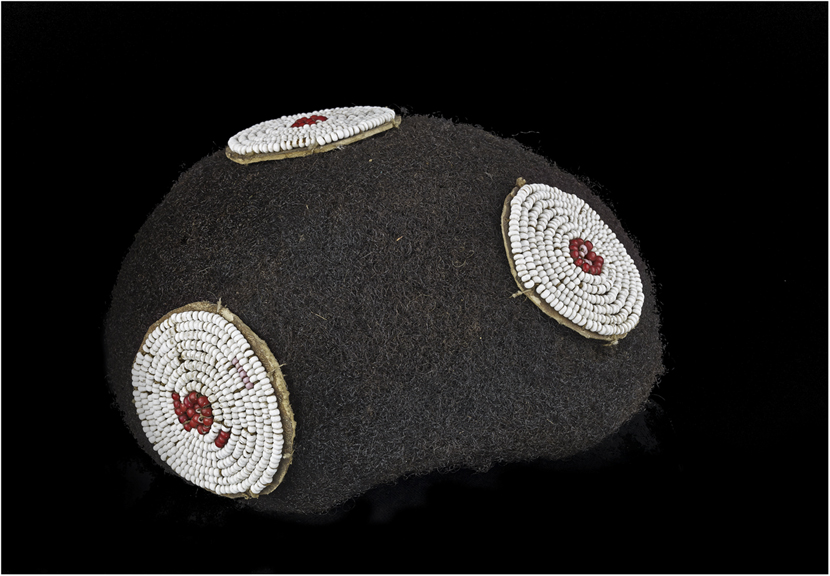
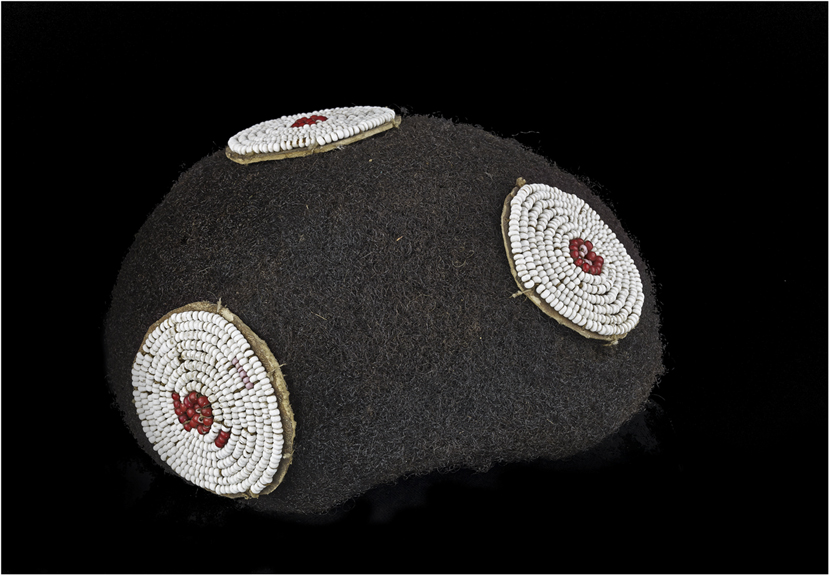
These objects did not represent a particularly violent or “primitive” people. Acholi was one of the most heavily armed districts in the Protectorate and official British narratives regularly described the violence of the Acholi. Instead, they present a group with strong cultural roots and a system of powerful leadership.Footnote 55 Other than a war horn, a sword bound in snake skin, an arrow and two shields – all objects of a former style of warfare – the collection instead represented chiefly power and culture. Objects included an ivory armlet, a headrest, bracelets and necklaces made of iron wire, a stool, belts and aprons of chiefly wives, skilfully made headwear, and musical instruments. These objects also represented a rich culture of commerce and trade. Glass beads of various colours adorned girdles, necklaces and headwear were the result of a successful but relatively short-lived slave and ivory trade and proximity to Sudan.Footnote 56 Headwear such as the piece below, were symbols of power, masculinity and identity. Like the royal drums, the Acholi only used headwear on special occasions such as clan meetings, male initiation and peace talks.Footnote 57 Research by Vanessa Bahirana Kazzora also suggests that they were “symbols of resistance and identity during the colonial and post-colonial period.”
There appear to be no records of provenance for Delmé-Radcliffe’s collection, so we cannot be sure whether these objects were gifted, just as Watel Ajus and Old Shooli had done, or plundered. Delmé-Radcliffe’s experience reminds us that while gift exchange could be a highly interpersonal act, the acquisition of objects also occurred under extremely violent circumstances.
British Museum, Af1902,0714.31, Coiffure. Acholi, Uganda. Late nineteenth century. Human hair, leather, glass beads, thread. Collected by Col. Charles Delmé-Radcliffe in 1902. © The Trustees of the British Museum.
Gifts in Motion: Apolo Kaggwa in Britain
The most active indigenous collector and donor of Ugandan material culture in the late-nineteenth and early-twentieth century was Apolo Kaggwa. Kaggwa is best remembered for his written texts. In 1901, he produced the first published record of a unilineal Kiganda history in the Luganda vernacular entitled Bassekabaka Be Buganda (The Kings of Buganda), followed in short succession by a number of other significant texts relating to Ganda customs, clans and folklore.Footnote 58 A central feature of these works was the historical development of the Kiganda dynasty. In his 1974 translation of Bassekabaka Be Buganda, Mathias Kiwanuka argued that these books served a political purpose: to unify disparate clans under a sense of “nationhood” and around the concept of a centralized monarchy through knowledge of a common founding myth, history, leader, and culture.Footnote 59 The 1901 book chronicled a history of traditions whilst serving modernising purposes, and in the process secured his own name within the annals and traditions of Uganda’s history. The Tales of Sir Apolo: Uganda Folklore and Proverbs (translated in 1934), likewise was a powerful, and largely biographical book which presented Kaggwa as a commoner who had ascended the Buganda Kingdom and penetrated the Court as a mediator of local cultural practices and an able handler of culture.Footnote 60
After Kaggwa’s efforts a rich vein of written material subsequently emerged from among Uganda’s political thinkers. The value placed upon written documents was linked to the importance of “the word” more generally in colonial Uganda. John Rowe argued that the ability to read provided the spiritual key to the Christian religion and in addition it provided political and social advancement.Footnote 61 Kaggwa’s intellectual writings have been the focus of lively and important discussion among academics. To fully appreciate Kaggwa’s efforts at knowledge and identity creation in the late-nineteenth and early-twentieth centuries, however, it must be recognized that he engaged in multiple methods to achieve them. These methods included the deployment of both texts and material culture.
While writing his historical texts, Kaggwa also set about collecting and organising a significant collection of object material associated with that past. He gave many of these objects to museums in both Uganda and Britain, demonstrating the rich triangulation in which he utilised historical narrative, object collecting, and cultural gifting for political ends. The triangulation of Kaggwa’s methods in turn demands an interdisciplinary and multi-layered analytical approach which considers textual and object sources within the same framework of analysis. Kaggwa’s historical texts have had an enduring legacy and are still key points of departure and debate for current researchers as a window on both the colonial and precolonial past. His gifted ethnographic collections, however, have remained unanalyzed in their museum settings for around a century. In bringing Kaggwa’s gifts and historical writings back into the same framework of analysis I hope to present new insights into the complex relationship between ethnography, history, and the maintenance of institutional power in colonial Uganda.
Kiwanuka suggested that in addition to Kaggwa’s written work, material objects such as regalia, royal and clan drums, weapons, and fetishes might also provide some of the best sources of information for the royal history of Uganda.Footnote 62 Royal and clan drums, he observed, were sometimes made in memory of important events, while Roland Oliver described the preserved jawbones of former Kabakas as “charters of the present dynasty” in his investigations into the royal tombs of Buganda in 1959.Footnote 63 But many important objects were destroyed in fires and the great destruction of religious civil war in the 1880s and 1890s. Others were destroyed in 1966, when central government troops stormed the Lubiri Palace of Kabaka Muteesa II (1924–1969) and set it on fire. Kiwanuka pondered whether many of the objects that did survive these events, had been “misappropriated by the colonial administration” and were “lying in European and perhaps American museums.” His suspicions were correct, though it was not only the colonial administration who had appropriated these objects, but also Kaggwa – the subject of his own study.
In July 1902, Kaggwa traveled to Britain with his Secretary, Hamu Mukasa, on an official visit for the coronation of King Edward VII. During his momentous visit, Kaggwa gifted a collection of thirty-one objects to the British Museum, sixteen to Cambridge’s Museum of Archaeology and Anthropology (formerly known as the Museum of Archaeology and Ethnology, hereafter MAA), and other objects to King Edward VII and the Royal Collection.Footnote 64 These objects have yet to receive any serious interrogation other than by Rachel Hand at the MAA, who has written about a brass necklet once worn by the King’s bodyguard.Footnote 65
Mukasa chronicled the trip in the 1904 book entitled Uganda’s Katikiro in England.Footnote 66 The book provides a wealth of contextual information behind Kaggwa’s gift, such as visits to museums and cultural institutions, the presentation of gifts during house visits and long descriptions of their general impressions of their material surroundings. D.A. Low argues that Mukasa’s account illustrates the intended awe and spectacle that the British sought to enforce upon them.Footnote 67
In his descriptions of their museum visits, Mukasa explained how he and Kaggwa learnt the workings and purposes of European museums and their collections. In these spaces, Mukasa keenly noted the arrangement of material by country, as well as the memorialization of kings and leaders. In the Crystal Palace, Mukasa observed that:
[T]hey keep only the most beautiful things. There are figures of all the kings, and many great men. (…) There are also copies of all the things made in their land; they pick out one thing and put it there to show people how things are made in different places to which they cannot go themselves… They chisel out stones and make them just like people, and put them there to remind people after years what they were like.Footnote 68
In collecting and gifting ethnographic material, Kaggwa joined a network of other influential figures in Uganda’s European colonial society for whom collecting and gifting were key elements of one’s cultural repertoire as well as tools of “soft” power, to be used in conjunction with more formal state instruments. During these visits, Kaggwa must have felt aware of his own historical position and of his material contributions to that legacy. Although Kaggwa only resided in England for a limited length of time, he ensured that his objects would remain and that their longevity would remind viewers of his reputation.
Kaggwa selected the British Museum and the University of Cambridge as recipients for his gifts knowing that such institutions would provide him with an increased public profile within imperial society. When understood in their context as “gifts” these objects illustrate a keen understanding on Kaggwa’s part about the gift economy of European museums and the political and social role of such gifts. A reputable school in Cambridge accepted Kaggwa’s son into its ranks in the years following his gift suggesting an element of reciprocity and access to elite British networks. Through Kaggwa’s gift we can also add further nuance to Low’s notion of British hegemony. Kaggwa was himself an active participant in this process and used material culture and gifting as a potent symbol of his own regal and historical authority. Kaggwa’s gift reveals new perspectives on the power of British cultural institutions, but also provides a rare opportunity to view the agency of a non-European donor who simultaneously appropriated the Museum for his own political and social ends.
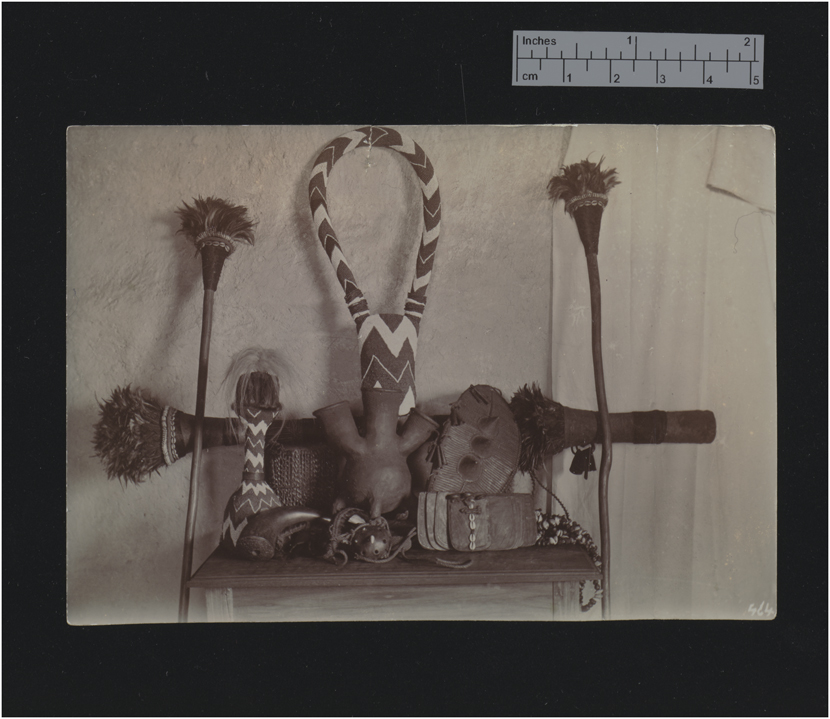
Unfortunately, as with Kaggwa’s earlier publications, Uganda’s Katikiro in England does not make any direct mention of Kaggwa’s actual collection practices, highlighting that there are whole areas of his historical interests such as collecting, which found no place in his writings.Footnote 69 However, other sources reveal the visual imagery behind the construction of the gift. Rev. Ernest Millar’s papers at the Royal Commonwealth Society Library in Cambridge contain the photograph that is pictured in Figure 2. The careful curation of the photograph informs us that Kaggwa’s gift was pre-planned and carefully considered. Published works by other collectors at this time also highlight that the transportation of goods from Uganda was not straightforward, implying that a real sense of the value and purpose was accorded to the transportation of these particular objects.Footnote 70
Cambridge University Library: Royal Commonwealth Society Library, Ernest Millar collection, RCMS 113/38/3/23, “Charms Brought to England by the Katikiro and the Rev. E. Millar. A Group of Labare (Spirit) Instruments Comprising Magic Wands, a Headdress, a Shield, Drums, Horns and Cards.” Reproduced by kind permission of the Syndics of Cambridge University Library.
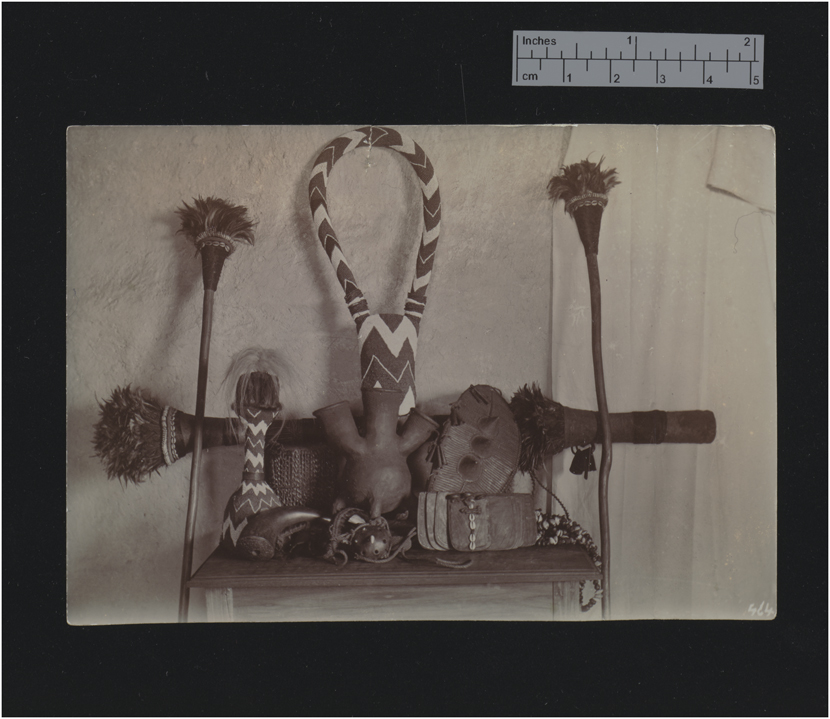
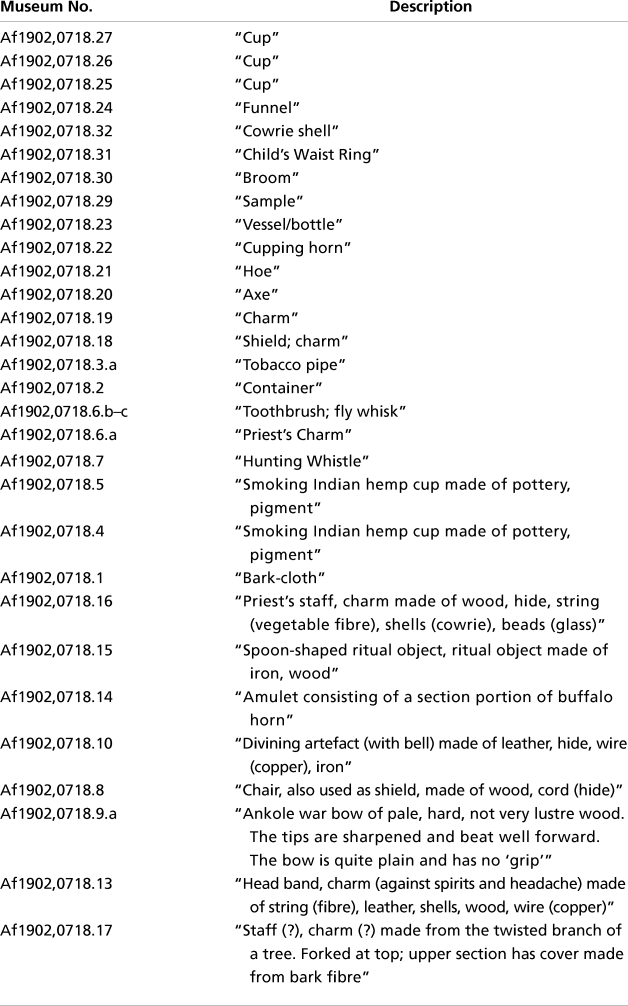
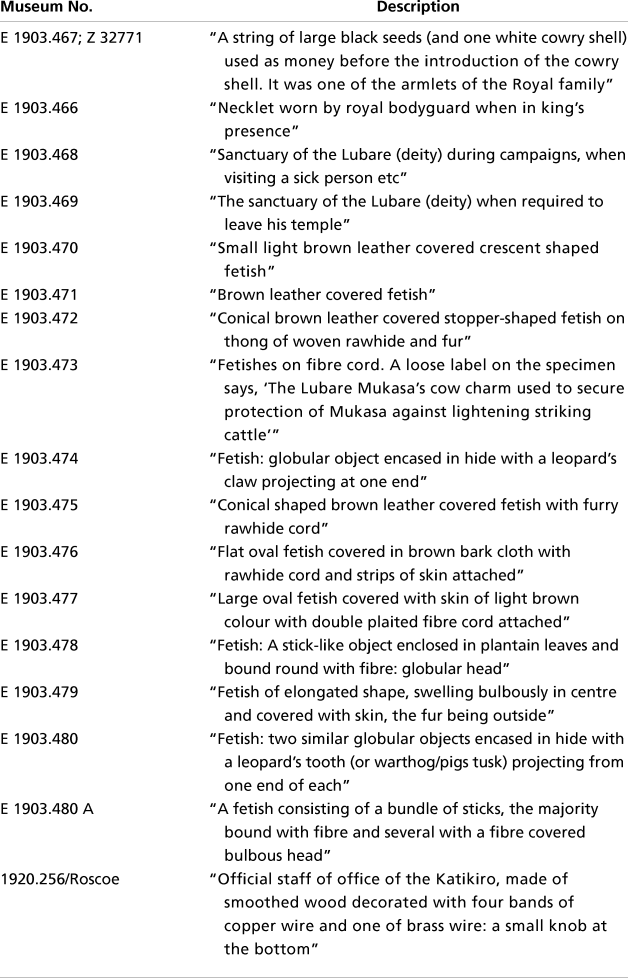
The only textual information related to this photograph comes from its caption “Charms Brought to England by the Katikiro and the Rev. E. Millar. A Group of Labare (Spirit) Instruments Comprising Magic Wands, a Headdress, a Shield, Drums, Horns and Cards.” In their newly assembled state, the reclassification of this whole group of objects as “charms” paid little attention to the distinct meanings of each individual object and focused instead upon basic European anthropological and missionary schemas of pre-colonial magic. The deliberate curation of the objects bolsters this sense of reclassification. A careful symmetry, which almost resembles a church altar, suggests that they had already been pre-curated along Christian lines, corroborating the Christian influence in Kaggwa’s writings. The inclusion of Millar’s name further confirms this. Object labels at the MAA reveal that many of these objects had belonged to members of the royal family. The looped, chevron container at very back of this image is an umbilical cord holder of a former King. The remaining items were described by the Museum as “fetishes” which had belonged to lubaale gods including Mukasa and Kibuuka. Kaggwa gave further lubaale objects including fetishes to the British Museum including an iron spoon used by “demon priests” for burning tongues, divination artefacts, charms, and amulets. The inventories of Kaggwa’s gifts, listed in tables 2–3, illustrate that fetishes and objects of the old religion formed a significant proportion of his gifts. Other objects included drinking vessels, adornment for children, a hoe, axe, shield, tobacco pipe, and bark cloth amongst other things.
Gifts presented to the British Museum by Apolo Kaggwa in July 1902.

Gifts presented to the Museum of Archaeology and Anthropology by Apolo Kaggwa in 1903.

Clearly Kaggwa’s gifts must be read with an analytical understanding that courtly and missionary research and narratives were closely entwined. His close working relationship with the Rev. John Roscoe is well known, and Roscoe facilitated Kaggwa’s gift to the MAA via his own personal links with the museum. However, Muslim leaders also sought appeasement in this period and Kaggwa gave a beer vessel in the context of wider civic debates in Uganda about the consumption of beer.Footnote 71 This latter line of enquiry regarding Kaggwa’s efforts at heritage management and contemporary debates about Islamic political and religious culture require further research. However, while Kaggwa’s motivations for the collecting and gifting of Buganda’s historical and religious past to cultural institutions are not explicit, it is clear that they were entangled in a wider material and managerial strategy which spoke to both the local and colonial politics of his time.
Objects aided the formation of a collective tangible memory, but also mobilized state sponsored narratives and public discourses about the future. Here, the past was a field of tradition which was imagined and made tangible through objects in order to create a future identity. In both Kaggwa’s writings and objects, we find a constant tension, or rather dialogue, between the past and the present. Objects were vehicles for navigating cultural memory, local and colonial power, civic debates, ideals and identity politics. Gifting added to the performance of these props and bolstered Kaggwa’s position in important networks of power.
Conclusion
The exchange of gifts played a key role in the functioning of modern imperialism on the ground, and offers a unique window on the strategic and affective aspects of early diplomatic encounters between the British and Ugandan elite. Gifts served as political envoys, and were part of the navigation of new political and social spaces. They paved the way for new relations and the exercise of agency. But gifting was a complex act which often involved intense negotiation, and the possibility of fast alterations in the balance of power for either party in the exchange. It served to create a relationship or association between individuals and groups, but also signified different things for those on either side of the exchange. These complexities remind us of the unevenness and shifting boundaries of colonial power relations, and challenge the concept of any overarching and dominant cultural hegemony exerted by colonial powers.
While European museums often flattened these aspects of their provenance once the gifts entered the institution, others objects continued to occupy key positions in historical and contemporary methods of cultural memory production. The gifts discussed in this article have had interesting and varied after-lives. Some objects remained in museum stores, while others went on display, and a small number were repatriated. Jackson’s gifts to the Nairobi National Museum were in a state of disuse until the 1960s. It was only in 1962 that Jean Brown, a curator, created acquisition cards for them. Having done so, she noted that “some of the collection is of considerable historical interest e.g. the Buganda Royal Spear presented by Mwanga in 1895.” However, she continued that “there has obviously been little systematic collection, gifts being from people concentrating on collecting spectacular objects like spears, shields and head-dresses, rather than on objects of everyday use which are of the greatest importance to any ethnographical collection. There is very little clothing in the collection, and very little to illustrate the various stages of a given technological process.”Footnote 72 The objects which were once so desired because of their links to important elite figures, had lost their appeal by the 1960s after decolonization.
In Britain, museum records reveal that Kaggwa’s objects made a significant contribution to British anthropological knowledge about Uganda at the time of their donation, perhaps more so than his texts which had not yet been translated from the Luganda vernacular. The “sacrificial beer pot” supposedly used at royal sacrificial sites, featured in a striking full-page spread in the Museum’s Handbook to the Ethnographic Collections until 1910 as a focal point for Ugandan material culture.Footnote 73 After this time, we hear almost nothing about it. The pot is now tucked away inconspicuously on a display shelf as an example of Kiganda pottery work.
Perhaps one of the most notable groups of objects to be associated with Kaggwa and the nation’s complex cultural memory, are the Kibuuka relics. Archival records at the MAA reveal that on 2 November 1961, Abubakar Mayanja, a former Cambridge student and then Ugandan Minister for Education for the King’s government, asked the Vice-chancellor of the University of Cambridge for the return of the relics.Footnote 74 They were presented to the Uganda Museum on permanent loan on the occasion of Ugandan independence and remain one of the most notable accessions in the Museum’s history.Footnote 75 Mayanja told the Museum Director:
You will appreciate that at the time, i.e. at the turn of the century when Christianity had just captured the imagination of our people making them very devout believers who were anxious to forget their pagan past, such things would have been regarded as of little value… though it is doubtful whether Sir Apolo had the right to give them away.Footnote 76
However, the relics have never been directly linked to Kaggwa. Museum records instead accorded them to Roscoe, raising important questions about the nature of colonial gifts and the ownership of material culture and heritage in the postcolonial world. The Kibuuka relics have provoked discussion and debate throughout the long course of their lives, illustrating the important sense of both physical presence and absence that was created through the act of colonial gifting. These, and the many other objects that were circulated and exchanged through the gift economy in colonial Uganda, also underline the challenges faced by contemporary institutions in curating imperial legacies.
Alison Bennett is a Collaborative Doctoral Award student in the History Department at University College London and the Africa Department at the British Museum. Her thesis examines the collections of East African objects housed in various repositories across Britain, elsewhere in Europe, and East Africa. Sitting at the intersection of imperial history, the history of collecting and East African studies, it seeks to shed new light on the cultural histories of East Africa and British imperialism during this time. E-mail: alison.bennett.14@ucl.ac.uk