

Colombia is part of a biological corridor that connects the northern and southern American subcontinents. The study of early human groups that settled this region is thus essential for understanding the peopling of South America, and the discovery of numerous Preceramic archaeological sites on the Sabana de Bogotá has contributed significantly to our knowledge of the ways of life of hunter-gatherer groups that inhabited northern South America (Ardila Reference Ardila1984; Correal-Urrego Reference Correal-Urrego1979, Reference Correal-Urrego1981, Reference Correal-Urrego1989; Correal-Urrego and van der Hammen Reference Correal-Urrego and van der Hammen1977; Correal-Urrego et al. Reference Correal-Urrego, van der Hammen and Hurt1976; Groot de Mahecha Reference Groot de Mahecha1992; Hurt et al. Reference Hurt, van der Hammen and Correal-Urrego1976; Ijzereef Reference Ijzereef1978; Pinto-Nolla Reference Pinto-Nolla2003; Rivera-Escobar Reference Rivera-Escobar1992).
One of the most important Sabana de Bogotá sites is the upland rockshelter Nemocón IV, which has a lengthy Preceramic chronology time span (ca. 9000–2500 BP), indicating human occupation from the Early Holocene (Greenlandian; Cohen et al. Reference Cohen, Finney, Gibbard and Fan2013, updated August 2018) probably until the arrival of Ceramic groups. Earlier zooarchaeological investigations reported the occasional presence of exotic faunal elements, such as Primates (monkeys), Tayassuidae (peccaries), and Ara (guacamaya, or macaw; Correal-Urrego Reference Correal-Urrego1979). The long-term occupation and presence of allochthonous, typically lowland tropical faunal elements make Nemocón IV a particularly interesting site for documenting the ways of life of early human settlers on the Sabana de Bogotá, as well as their patterns of mobility.
The identification of macaw remains at Nemocón IV is striking because the Sabana de Bogotá is not within the modern range of any extant macaw species (Asociación Bogotana de Ornitología 2000; Hilty et al. Reference Hilty and Brown1986). In addition, paleoecological investigations carried out on the Sabana de Bogotá indicate that during the last 14,500 years paleoenvironmental conditions did not correspond to the ecological niches of extant macaw species (Hilty et al. Reference Hilty and Brown1986). Hence, it is possible to state with confidence that in Preceramic times Nemocón IV was not part of the natural range of the macaw.
To date, only a photograph of the humerus and coracoid attributed to Ara sp. has been published (Correal-Urrego Reference Correal-Urrego1979:Photo 4, No. 22), but it neither specified the total number of remains nor the identifications of all osseous elements attributed to the genus. This article presents the results of detailed osteological and morphometric analyses performed on the Nemocón IV macaw remains, which confirm the previous taxonomic identification of Ara sp. Moreover, to verify the chronological framework of Nemocón IV, four Odocoileus bones and one Ara bone were radiocarbon dated, providing the oldest date for the site. We suggest possible reasons for the presence of the macaw on the Sabana de Bogotá in Preceramic times.
Geographical and Environmental Framework
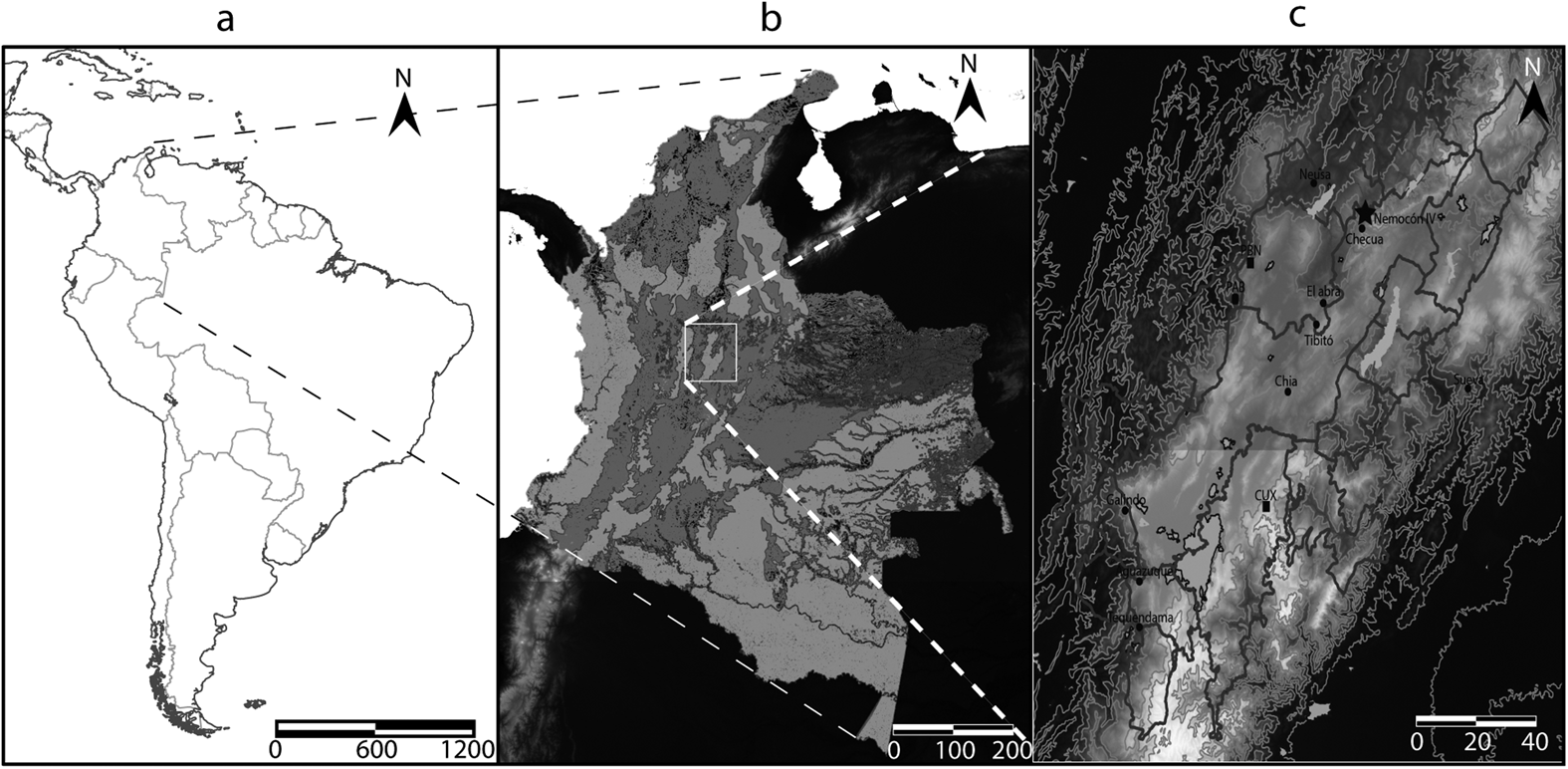
The municipality of Nemocón is located on the western edge of the Sabana de Bogotá, central Colombia, South America (Figure 1). The Sabana de Bogotá is a high plain surrounded by mountains with an average altitude of 2,560 m asl and is located to the southwest of the Cundiboyacense Plateau. The Sabana de Bogotá adjoins the tropical valley of the Magdalena River to the west and, to the east, the Eastern Cordillera mountain chain, which extends eastward toward the Eastern Plains. It was a paleolake that dried up approximately 30,000 years ago (van der Hammen Reference van der Hammen1986) and is currently drained by the Río Bogotá and its tributaries (van der Hammen and González Reference Van der Hammen and González1960). The average temperature is 13°C, but it can vary from a few degrees below zero to above 20°C in a single day. Because of its western location, Nemocón lies in the rain shadow of the adjacent mountains and exhibits xerophytic vegetation (van der Hammen and González Reference Van der Hammen and González1960:270).
Geographic location of the Sabana de Bogotá, Colombia, and the main Preceramic sites of the region. (a) Map of South America showing the geographic location of Colombia; (b) map of Colombia showing the Sabana de Bogotá (boxed); (c) relief map of the boxed area indicated in (b) with the locations of the main Preceramic sites and of the cores employed in palaeoecological studies (PPN I and PAB II).

Preceramic Period of the Sabana de Bogotá
Human settlement of the Sabana de Bogotá (Figure 1c) began at the end of the Pleistocene (van der Hammen and Correal-Urrego Reference Van der Hammen and Correal-Urrego1978). The earliest absolute (radiocarbon) date of 15,133–13,999 cal BP 2σ (GrN-5556; Hurt et al. Reference Hurt, van der Hammen and Correal-Urrego1976:5) comes from the El Abra rockshelter. However, the low density of cultural evidence (18 flakes) has not allowed concrete inferences about the ways of life of humans living in the rockshelter at that time.
Early archaeological evidence is scarce, but subsequently there is a gradual increase in the number of archaeological sites and remains (lithic tools, faunal and human remains) recovered on the Sabana de Bogotá, which is interpreted as an increase in population densities through time. Discoveries at the Tequendama (13,307–12,142 cal BP 2σ, GrN-6539; Correal-Urrego and van der Hammen Reference Correal-Urrego and van der Hammen1977:32) and Sueva rockshelters (12,020–11,308 cal BP 2σ, GrN-8111; Correal-Urrego Reference Correal-Urrego1979:157) suggest that people hunted in semi-open landscapes. From 11,939–11,221 cal BP 2σ (Tequendama, GrN-6730; Correal-Urrego and van der Hammen Reference Correal-Urrego and van der Hammen1977:32) until 7728–7586 cal BP 2σ (Nemocón IV; GrN-no published lab code; Correal-Urrego Reference Correal-Urrego1979:44), environmental changes required the inhabitants of the region either to adapt to warmer and dryer conditions or to move out of the area. In rockshelters such as Nemocón IV and Tequendama, human groups adapted to life in more forested environments (Kuhry Reference Kuhry1988), whereas in topographically higher sites such as the Neusa rockshelter (9529–9133 cal BP 2σ; Beta-21060; Rivera-Escobar Reference Rivera-Escobar1992:32), people adapted to páramo landscapes (Rivera-Escobar Reference Rivera-Escobar1992). Human occupation also occurred in some lower, open-air sites located in the Andean forest belt, such as Checua (9470–8783 cal BP 2σ; Beta-53925; Groot de Mahecha Reference Groot de Mahecha1992:22) and Galindo (10,114–9546 cal BP 2σ; GrN-16346; Pinto-Nolla Reference Pinto-Nolla2003:69).
Middle Holocene human occupations (Northgrippian; Cohen et al. Reference Cohen, Finney, Gibbard and Fan2013) are documented by finds from the open-air sites of Chía (5988–5593 cal BP 2σ; GrN-12122; Ardila Reference Ardila1984:24), Checua (no radiocarbon dates for the period; Groot de Mahecha Reference Groot de Mahecha1992), Aguazuque (5893–5660 cal BP 2σ; GrN-14477; Correal-Urrego Reference Correal-Urrego1989:27), and Ubaté (6596–6407 cal BP 2σ; Beta 398658; Archila-Montañez and Langebaek-Rueda Reference Archila-Montañez and Langebaek-Rueda2015:1). During the Middle Holocene, there was an increasing preference for open-air settlements located on topographically elevated terrain close to swampy areas. The increase in sites and the quantity of archaeological remains, characteristics of the structures observed (stone floors and elaborate human burials; Correal-Urrego Reference Correal-Urrego1989; Groot de Mahecha Reference Groot de Mahecha1992), and the appearance of domesticated taxa (Zea mais, Cavia; Mejía Reference Mejía2018; Zorro-Luján Reference Zorro-Luján2019) all suggest longer occupation times. Seasonal movements likely occurred between the upland Sabana de Bogotá and the lower valley of the Río Magdalena (Correal-Urrego Reference Correal-Urrego1989).
Nemocón IV
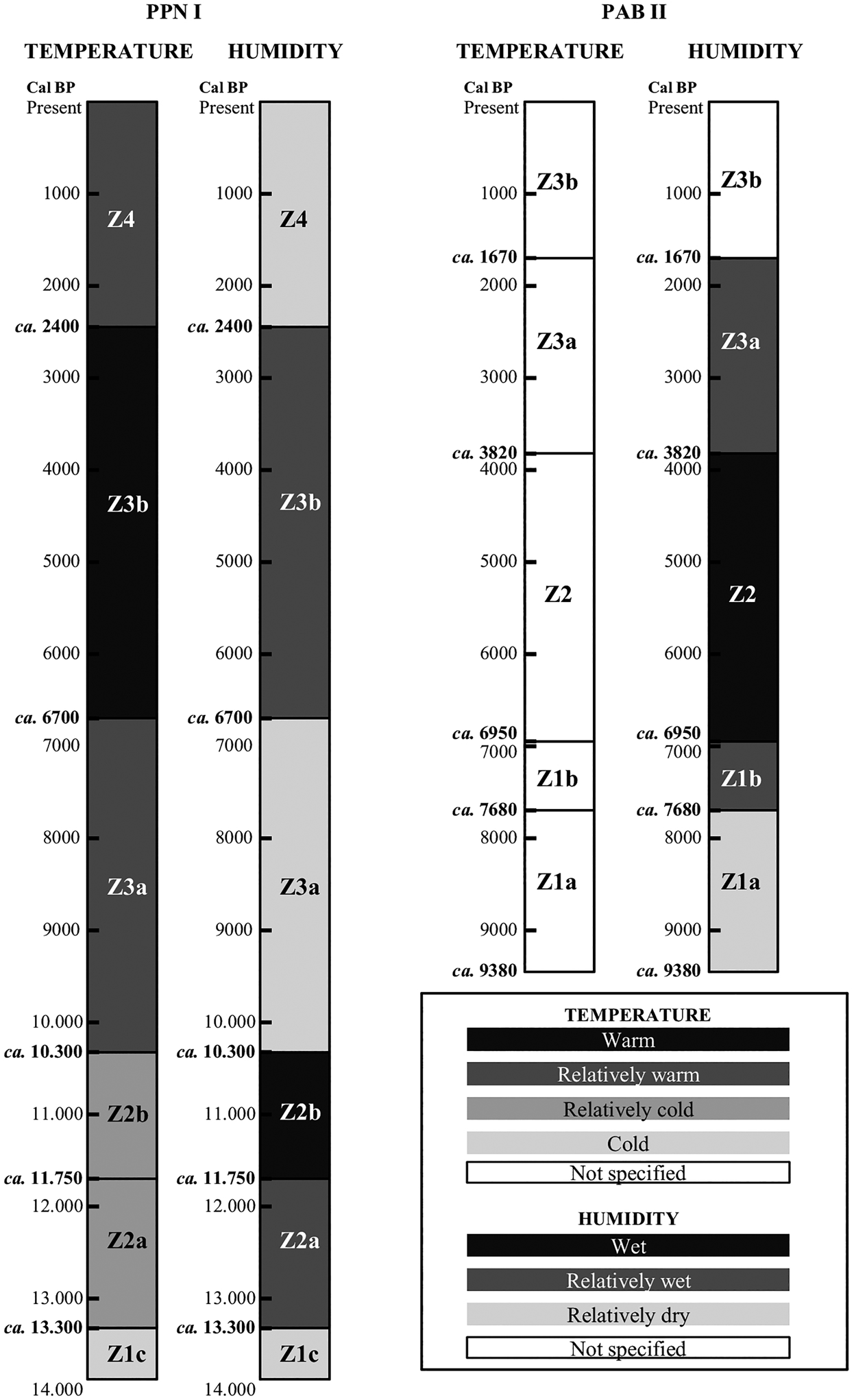
The Nemocón IV rockshelter is formed by outcrops of Upper Cretaceous sandstones that constitute the eastern limit of an elongated plateau known as the Piedecuesta, lying at an approximate altitude of 2,700 m asl (Correal-Urrego Reference Correal-Urrego1979). The site is close to the Páramo de Peña Negra (PPN I) and the Páramo de Agua Blanca (PAB II), both of which are located on the hills bordering the western edge of the Sabana de Bogotá (Kuhry Reference Kuhry1988; Figure 1c). Paleoecological studies carried out at PPN I and PAB II indicate that around 9000 cal BP (Figure 2) the surroundings of Nemocón IV were characterized by a relatively dry environment, with temperatures oscillating between 1°C above or below the present-day average. Vegetation in the area had an important xerophytic component because of its location in the rain shadow of the Andes mountain chain, as was the case in Laguna de Herrera around 5000 cal BP (van der Hammen and González Reference Van der Hammen and González1965). Drier conditions in the Sabana de Bogotá are also attested to for the period 9261–8587 cal BP 2σ (K-560: 8019 ± 120; van der Hammen and González Reference Van der Hammen and González1960:309), based on work carried out at the Ciudad Universitaria X borehole (CUX; Figure 1c), which is located at an altitude of 2,560 m asl.
Temperature and humidity data inferred from palynological records at Páramo de Peña Negra (PPN I) and Páramo de Agua Blanca II (PAB II) located to the east of Nemocón IV (Figure 1) and considered representative for the Sabana de Bogotá; Z3a in PPN I and Z1a in PAB II are equivalent in time to the age of the Nemocón IV macaw. The cal BP dates for zone (Z) boundaries for the sedimentary columns correspond to the “best age” estimates from age-depth models (Flantua et al. Reference Flantua, Blaauw and Hooghiemstra2016:Supplementary information, https://figshare.com/articles/Star_Classification_System_for_Age_Models/2069722/3).

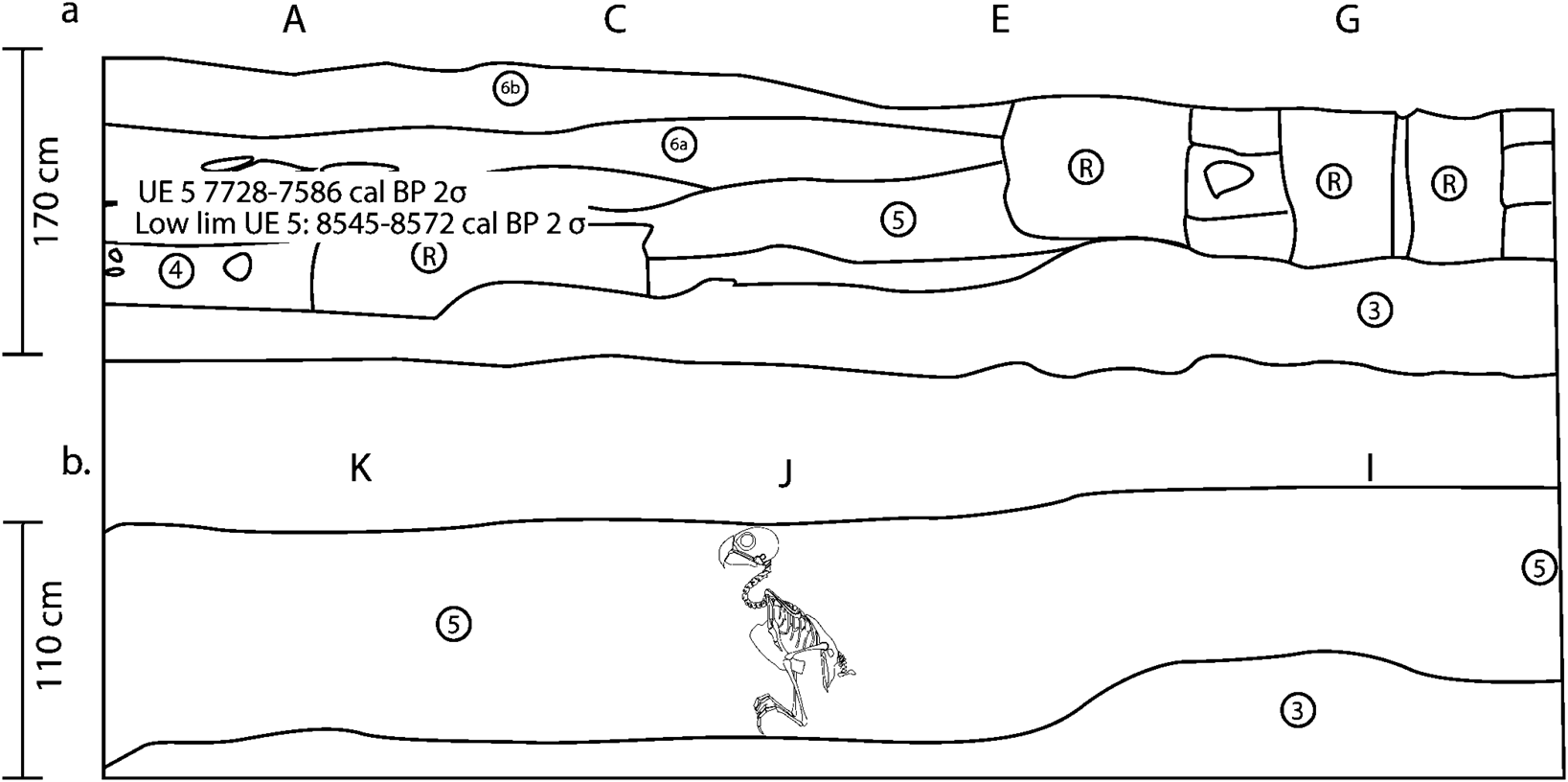
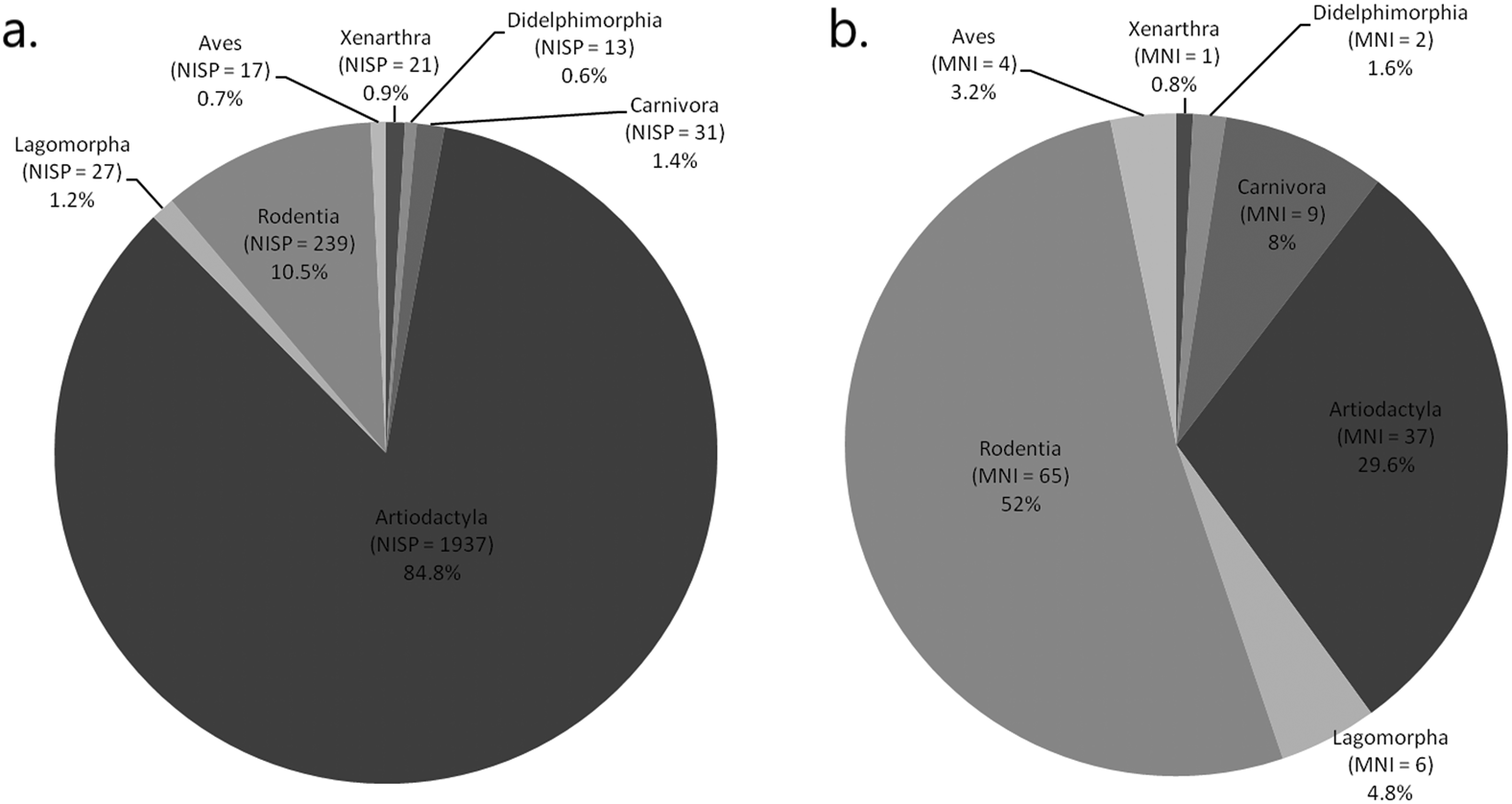
The first excavation at Nemocón IV uncovered three stratigraphic units with traces of human occupation—UE3, 5, and 6 (Correal-Urrego Reference Correal-Urrego1979); it produced a large quantity of Preceramic archaeological material that included human and animal skeletal remains, as well as lithic tools (Correal-Urrego Reference Correal-Urrego1979). UE3, the oldest unit with human occupation traces, had an age estimated between 9000 and 8000 BP, whereas unit UE5 was assigned to between 8000 and 6000 BP based on direct radiocarbon dating (7530 ± 100 BP, 8545–8072 cal BP 2σ; GrN-264, and 6825 ± 40 BP; 7728–7586 cal BP 2σ; GrN-no lab code published; Correal-Urrego Reference Correal-Urrego1979:44). The age of the youngest unit, UE6, which was greatly disrupted by recent agricultural activities, was estimated at between 6000 and 2500 BP (Figure 3; Correal-Urrego Reference Correal-Urrego1979). Zooarchaeological analyses conducted at Nemocón IV revealed a fauna dominated by Odocoileus virginianus and Cavia sp., which constituted the main sources of meat for the people who occupied the site (Correal-Urrego Reference Correal-Urrego1979; Gutiérrez-Olano Reference Gutiérrez-Olano2000; Martínez-Polanco and Peña Reference Martínez-Polanco and Peña-León2010; Pinto-Nolla et al. Reference Pinto-Nolla, Zuñiga, Torres-M and Lleras2002). Odocoileus virginianus was also an important source of raw materials for tool making. For this investigation, the first and second authors critically reviewed earlier determinations of material from Nemocón IV, originally performed by Gonzalo Correal-Urrego and Alberto Cadena (Correal-Urrego Reference Correal-Urrego1979), and reidentified the remains of 23 species: 19 mammals and 4 birds. The vast majority of the identified taxa (20 of 23 species) belonged to species native to the Sabana de Bogotá (Supplemental Table 1; Figure 4).
Stratigraphy of Nemocón IV: (a) East wall of Nemocón IV excavation showing squares A, C, E, and G (modified from Correal-Urrego Reference Correal-Urrego1979:Figure 3), with the original published radiocarbon dates here calibrated with the IntCal13 curve; (b) west wall of Nemocón IV excavation showing squares K, J, and I (modified from Correal-Urrego Reference Correal-Urrego1979:Figure 5), with the approximate location of the macaw remains reported here indicated by the macaw skeleton (modified from Guiraud Reference Guiraud2015). R, rocks; numbers in circles refer to stratigraphic units identified by Correal-Urrego (Reference Correal-Urrego1979).

Graphical representation of the percentages of taxonomic orders from Nemocón IV: (a) Number of identified specimens (NISP) total = 2,505, and (b) minimum number of individuals (MNI) total = 125. Data reanalyzed by first and second authors (after Correal-Urrego Reference Correal-Urrego1979).

The Nemocón IV Macaw Remains
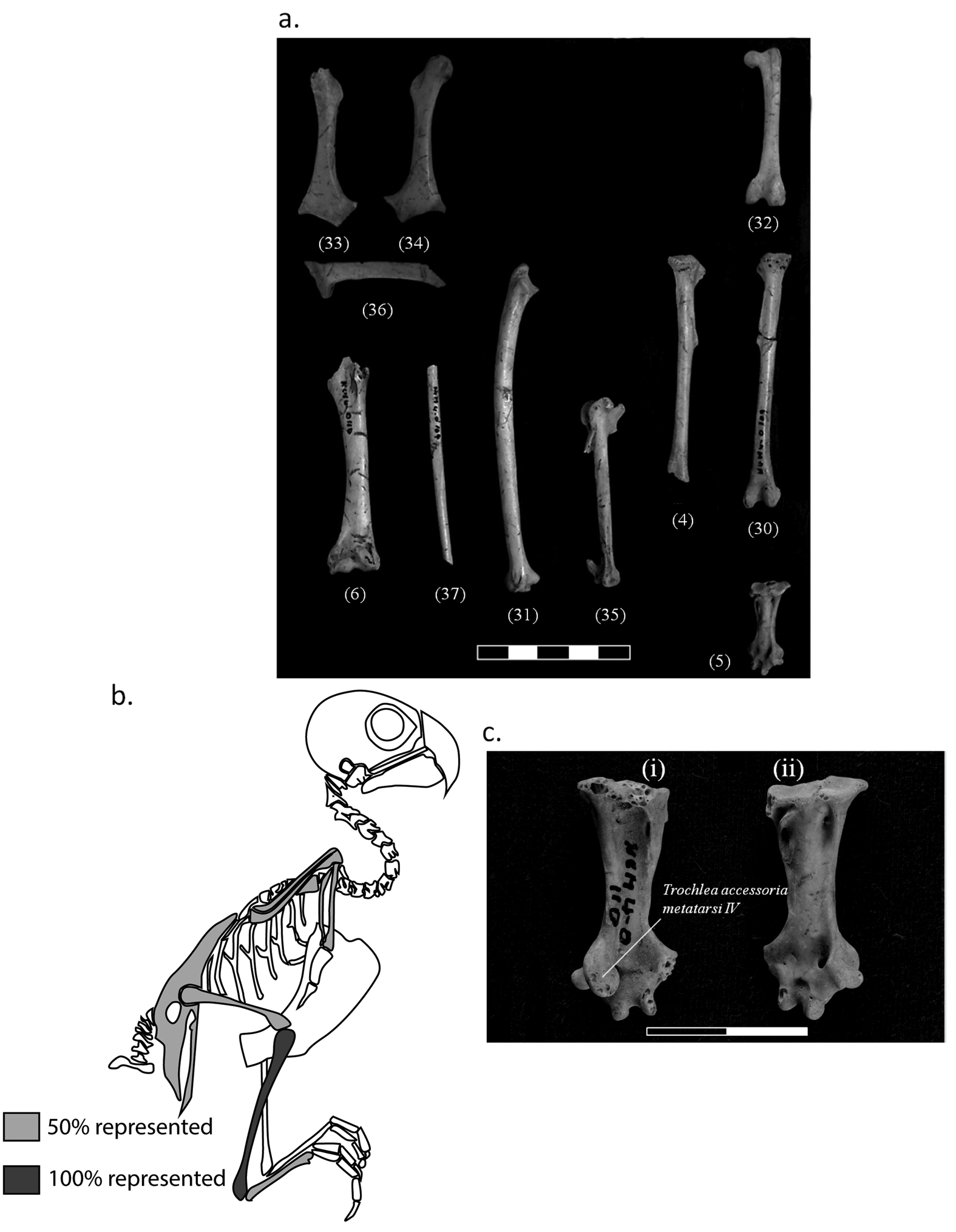
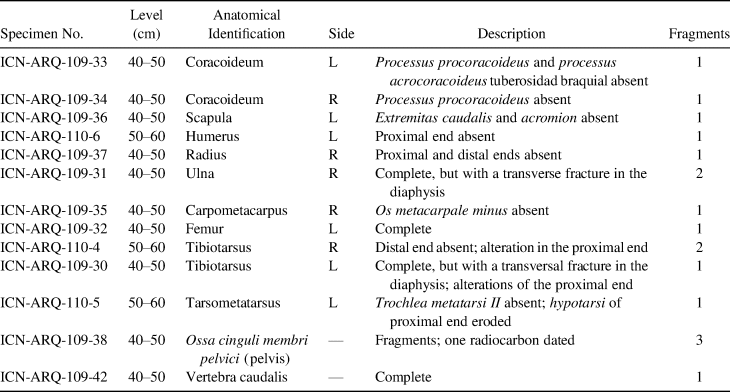
The Nemocón IV macaw material was recovered from two adjacent arbitrary excavation depths (40–50 cm and 50–60 cm) within UE5, square J, and referred to Ara sp. (Correal-Urrego Reference Correal-Urrego1979). As mentioned, although largely unpublished, the macaw consists of 13 well-preserved bones, representing a fairly complete postcranial skeleton (Table 1; Figure 5). The shoulder girdle is represented by the left and right coracoid and the left scapula; the wings are represented by the left humerus and the right radius, ulna, and carpometacarpus; the pelvic girdle is present; and the lower limbs are represented by a substantially complete left leg (femur, tibiotarsus, tarsometatarsus) and the right tibiotarsus. The only element of the axial skeleton that is preserved is a single caudal vertebra. After the original analysis (Correal-Urrego Reference Correal-Urrego1979), all skeletal remains considered nondiagnostic were apparently discarded; it is thus not possible to say whether other missing elements such as the vertebrae, ribs, and phalanges, which are typically harder to identify, were present originally. The lack of a sternum is remarkable because, when complete, this bone is as easy to identify as the pelvis, which is present in the sample. However, the sternum is a rather fragile element, and it is possible that only fragments were originally present and hence discarded. The absence of the skull and mandible is striking, because these are fairly conspicuous elements with both the premaxilla and the dentary extremely resistant to breakage and loss (Palacio Reference Palacio2012a, Reference Palacio2012b).
Skeletal elements from the Nemocón IV macaw, Ara sp. with closest affinities to Ara ararauna: (a) the anterior and posterior limbs; numbers are the last digit(s) abbreviated from specimen numbers in Table 1; scale bar, 50 mm; (b) representation of the skeleton of a macaw in which the recovered bones of the Nemocón IV macaw are shaded, indicating whether one (50%) or both (100%) paired elements are preserved (modified from Guiraud Reference Guiraud2015); (c) left metatarsal, proximal end to the top in (i) dorsal and (ii) plantar views; scale bar, 20 mm.

Details of the 13 Macaw Bones Recovered from Nemocón IV and Identified as Ara sp., but Closest to A. ararauna.

Notes: Level refers to the arbitrary excavation level within UE5 (Correal-Urrego Reference Correal-Urrego1979); L, left; R, right.
We assumed the macaw remains belong to a single individual, because there are no overlapping elements, the paired (left–right) elements are of the same size, and all elements present the same state of preservation. In addition, there is no evidence for subaerial weathering, which indicates the corpse was buried rapidly after death, and no cut marks, bite marks, or thermo-alteration of anthropic origin were observed on the bones. Together with the skeletal elements that are present, this suggests that the Nemocón IV macaw was deposited without being dismembered, except perhaps for the head, and was therefore almost certainly not used as food. Although the absence of the head may be due to taphonomic processes or misidentification, it could also be the result of an anthropogenic practice, in which the head was separated from the body.
Macaw Generic-Level Identification
The identification of diagnostic characters for the Nemocón IV macaw (Hargrave Reference Hargrave1970; Mayr Reference Mayr2002; Mayr and Göhlich Reference Mayr and Göhlich2004; Zelenkov Reference Zelenkov2016) was carried out using skeletally mature reference specimens from the bird osteological collections of the Paris National Museum of Natural History (reference numbers starting with LAC) and the bird collection of the Institute of Natural Sciences, National University of Colombia (reference numbers starting with ICN; Supplemental Table 2). For descriptive purposes, we used established anatomical nomenclature (Baumel and Witmer Reference Baumel, Witmar, Baumel, King, Breazile, Evans and Vanden Berge1993; Gilbert et al. Reference Gilbert, Martin and Savage1981; Livezey and Zusi Reference Livezey and Zusi2006).
Psittaciformes (parrots, parakeets, macaws, and cockatoos) are a successful and speciose group of birds (Mayr Reference Mayr2010a) but are relatively homogeneous in terms of their osteology (Mayr and Göhlich Reference Mayr and Göhlich2004). Modern crown Psittaciformes appeared at the Oligocene-Miocene boundary, approximately 23.03 Ma (Cohen et al. Reference Cohen, Finney, Gibbard and Fan2013; Mayr Reference Mayr2010b). The order is characterized by the presence of a broad skull and beak, adapted for the consumption of relatively hard foods, such as seeds and nuts, but also insects and fruits (del Hoyo et al. Reference del Hoyo, Elliot and Sargatal1997). All Psittaciformes are zygodactyl, and like Piciformes and Cuculiformes, they have two pedal digits (II and III) facing forward and two (I and IV) facing backward (Kaiser Reference Kaiser2007; Mayr Reference Mayr2002). One of the most distinctive characteristics for distinguishing between zygodactyl birds is the metatarsi IV: it exhibits an accessory trochlea for one of the retroverted digits, and the dorsal opening of the foramen vasculare distale is laterally joined by a bony bridge to the trochlea accessoria of metatarsi IV (Zelenkov Reference Zelenkov2016). The following characteristics differentiate the Psittaciformes from other modern zygodactyls, such as the Cuculiformes and Piciformes:
• a broader trochlea metatarsi II with a strong medial inclination (Mayr Reference Mayr2002:723; Zelenkov Reference Zelenkov2016:2)
• a trochlea metatarsi III that is wider mediolaterally than dorsoplantarly (Mayr Reference Mayr2002:723, 725)
• the presence of a furrow for the tendon of the musculus flexor perforates on digiti IV, which separates trochlea metatarsi IV and its accessory trochlea (Mayr Reference Mayr2002:723)
• the presence of a furrow between the dorsal side of the trochlea metatarsi IV and the incisura intertrochlearis lateralis (Mayr Reference Mayr2002:723, 725)
It is likely that the apomorphic morphology of the extant Psittaciformes tarsometarsus is the result of adaptations related to the way these birds feed: holding and manipulating seeds and nuts with the feet to pass them to the beak (Mayr Reference Mayr2002).
The excellent preservation of the Nemocón IV remains, in particular the left tarsometatarsus (Figure 5c), permits its certain taxonomic identification within the order Psittaciformes. Indeed, the presence of the trochlea accessoria metatarsi IV places it within the zygodactyl birds, and the trochlea metatarsi III, which is wider mediolaterally than dorsoventrally, confirms that it belongs to the Psittaciformes (Zelenkov Reference Zelenkov2016).
The taxonomic classification of Psittaciformes, based on molecular and morphological studies, includes three superfamilies: Strigopoidea, Cacatuoidea, and Psittacoidea (Provost et al. Reference Provost, Joseph and Smith2018). There are two families within Strigopoidea (Strigipidae and Nestoridae), one family in Cacatuoidea (Cacatuidae), and three families in Psittacoidea (Psittacidae, Psittrichasidae, and Psittaculidae). Pisttacidae (true parrots) includes two subfamilies: Psittacinae (African parrots) and Arinae (New World parrots). Within Arinae are four tribes (Schodde et al. Reference Schodde, van Remsen, Schirtzinger, Joseph and Wright2013; five in Provost et al. Reference Provost, Joseph and Smith2018): Forpini, Amoropsittacini, Arini, and Androglossini (with two clades in Provost et al. Reference Provost, Joseph and Smith2018).
The Nemocón IV specimen is of large size, and therefore it belongs to a large species of New World neotropical Psittaciformes. Based on size, it is possible to attribute the Nemocón IV parrot to the subfamily Arinae and to exclude it from membership in the tribes Forpini and Amoropsittacini, which are characterized by their smaller adult size (Schodde et al. Reference Schodde, van Remsen, Schirtzinger, Joseph and Wright2013:594). Parrot genera present in Colombia that include medium and large-sized birds belong to the tribes Arini (macaws, including the genera Ara, Orthopsittaca, Ognorhynchus, and Aratinga) and Androglossini (genus Amazona; Rodriguez-Mahecha et al. Reference Rodríguez-Mahecha, Rojas-Suarez, Arzuza and González-Hernandez2005), but only members of the genus Ara coincide in size with the Nemocón IV specimen. This conclusion confirms the previous identification of the Nemocón IV parrot remains as belonging to Ara sp. (Correal-Urrego Reference Correal-Urrego1979).
Identification Using Osteological Criteria
In present-day Colombia, six species of extant macaws are commonly referred to the genus Ara: Ara ambiguus (great-green macaw), Ara ararauna (blue-and-yellow macaw), Ara chloropterus (red-and-green macaw), Ara macao (scarlet macaw), Ara militaris (military macaw), and Ara severus (chestnut-fronted macaw). A seventh, closely related species formerly attributed to Ara, is Orthopsittaca manilatus (red-bellied macaw), but it is generally smaller (Hilty et al. Reference Hilty and Brown1986; Rodríguez-Mahecha et al. Reference Rodríguez-Mahecha, Rojas-Suarez, Arzuza and González-Hernandez2005). We were able to compare the Nemocón IV macaw with 10 specimens of A. ararauna, six of A. chloropterus, nine of A. macao, and three of A. militaris from the reference collections studied (Supplemental Tables 2–4).
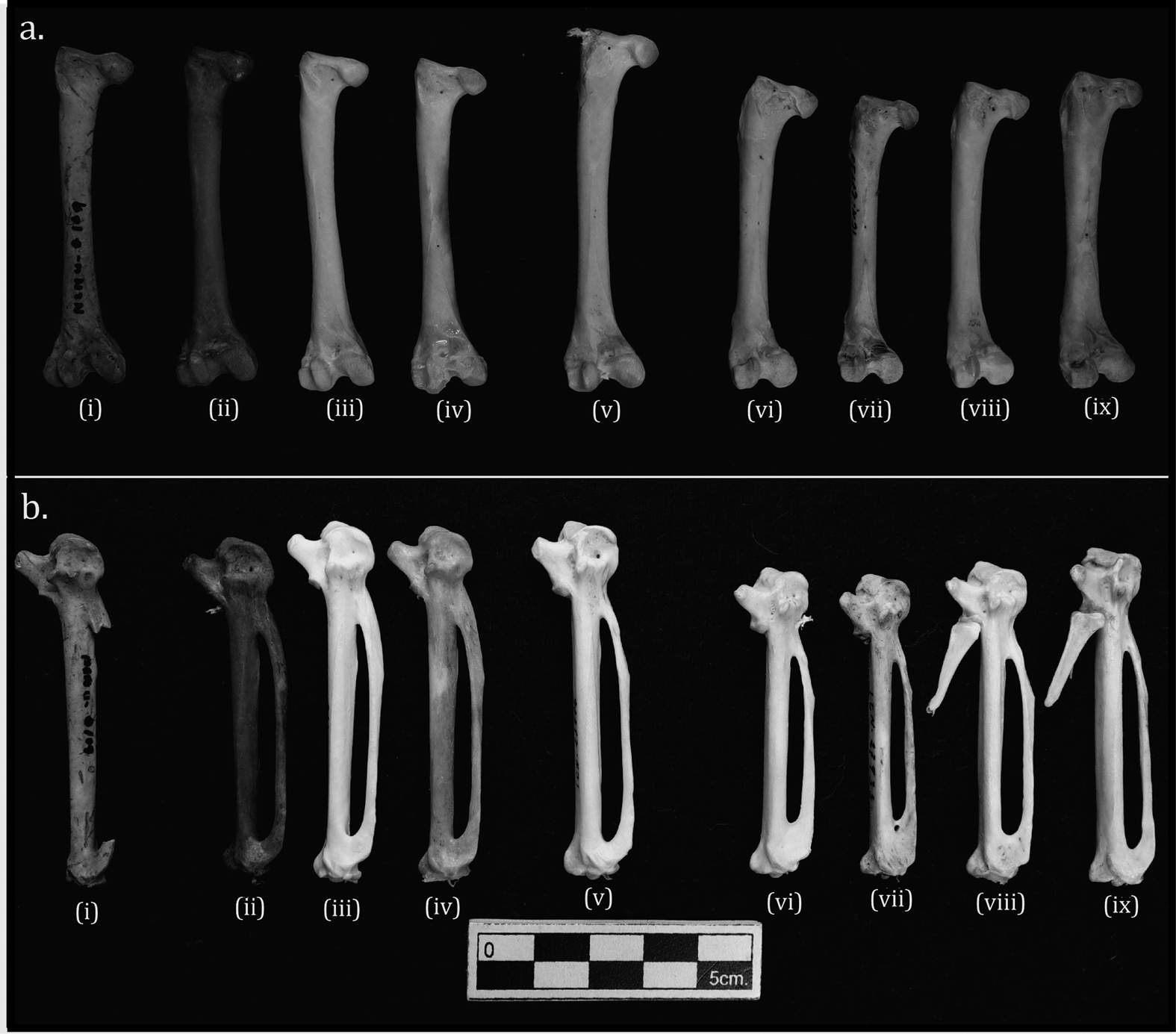
The species Ara macao and Ara ararauna showed the greatest similarity in size and morphology to the Nemocón IV macaw (Figure 6). Ara chloropterus is larger and more robust than Ara ararauna and Ara macao (Hilty et al. Reference Hilty and Brown1986) but was not excluded from the list of potential species because the adult sizes can overlap. The femur and humerus can apparently be used to distinguish these three species (Monardes-Díaz Reference Monardes-Díaz2017) but were not observed on the reference specimens studied and so we could not use them here. Although no reference specimen for Ara ambiguus was available, we did not exclude this species because it is very close in size to Ara ararauna and Ara macao.
Carpometacarpus and femur of the Nemocón IV macaw, Ara sp., compared with those of the reference specimens for the genus Ara: (a) femur in caudal views (proximal surface top) and (b) carpometacarpus in ventral views (proximal surface top). In (a) and (b) numerals indicate (i) Nemocón IV macaw and modern (ii) Ara ararauna, ICN-27995; (iii) Ara ararauna, ICN-32967; (iv) Ara ararauna, ICN-27934; (v) Ara chloroptera, ICN-27994; (vi) Ara macao, ICN-28006; (vii) Ara macao, ICN-27933; (viii) Ara macao, ICN-27930; and (ix) Ara macao, ICN-27932. Scale bar, 50 mm.

Based on their smaller sizes (about half the size of the Nemocón IV macaw), Ara severus and Orthopsittaca manilatus were excluded from consideration. It has been suggested that the humerus of Ara macao and Ara militaris can be differentiated based on the shape of the bicipital ridge (Hargrave Reference Hargrave1970:14), however, this criterion could not be applied to the Nemocón IV macaw because this ridge is not preserved.
The Ara militaris specimens compared with the Nemocón macaw present differences in the morphology of the humerus and femur:
• The femur of Ara militaris is smaller than that of the Nemocón macaw.
• The distal end of the humerus of Ara militaris is narrower than that of the Nemocón IV macaw.
• The humerus of the Nemocón specimen has a marked crest on the lateral dorsal side, which is absent in Ara militaris.
• Ara militaris has a wider neck to the femur, generating continuity between the greater trochanter and the femoral head.
• The relative size and position of the external proximal foramen of the tarsometatarsus are larger in Ara militaris than in the Nemocón macaw, and it penetrates the diaphysis, forming a right angle (Hargrave Reference Hargrave1970).
Although these differences indicate the archaeological specimen did not belong to Ara militaris, we included the species in the morphometric analysis to confirm the osteological observations because important intraspecific variation was found within the Ara group. This leaves five species to which the Nemocón IV specimen could possibly belong—Ara ambiguus, Ara ararauna, Ara chloropterus, Ara macao, and Ara militaris—and to which we applied morphometric analysis.
Morphometric Analysis
To refine the species identification, we applied traditional morphometric size and shape analysis, using two traditional morphometric approaches: the log size index (LSI; Meadow Reference Meadow, Becker, Manhart, Peters and Schibler1999) and the log shape ratio (LSR; Mosimann Reference Mosimann1970). Both metrics use linear measurements to evaluate form, which can be decomposed into isometric size and independent quantitative parameters that describe shape. Isometric changes (i.e., size sensu stricto) within a taxon are mainly derived from environmental pressures, whereas changes in shape are considered genetic characteristics related to species differences or changes in allometry (shape change during growth; Daujat Reference Daujat2013). Size and shape are independent when the geometrical average is used as the size variable if, and only if, the values of the measurements taken have a log-normal distribution (Mosimann Reference Mosimann1970). As a result of working with biological data, which cannot have negative values, distribution is considered to be log-normal (Limpert et al. Reference Limpert, Stahel and Abbt2001). To correct for the asymmetry of this distribution and to obtain a distribution that follows a normal law, a logarithmic transformation is made (Drennan Reference Drennan2009). This results in a variable of isometric size that, assuming geometric similarity, preserves the shape of individuals even when they have different sizes.
The purpose of calculating the LSI was to evaluate closeness of size of the Nemocón IV macaw to different reference specimens to facilitate taxonomic identification; hence, the archaeological specimen was used as the standard. An LSI with a positive value represents a larger organism than the standard, whereas negative LSI values are smaller. To obtain a size estimate for one bone, we calculated the LSI average from the different measurements and then used these average values to make frequency histograms. To evaluate variations in the shapes of the bones, independent of size variations, we created an LSR matrix from the conformation ratios calculated. The LSR obtained for each element was then represented graphically by means of a principal components analysis.
Measurements of the Nemocón IV and reference specimens bird bones were taken by the first two authors with a Mitutoyo Absolute Digimatic 500 series digital caliper, 150 mm in length with a precision of 0.02 mm (Supplemental Tables 3 and 4), following strict published guidelines (von den Driesh Reference Von den Driesh1976). Each measurement was taken three times, and the average from these measurements was used (Supplemental Table 5 presents the results of the descriptive statistics).
Size Analysis
The Fisher-Snedecor F-test on the LSI data provided evidence for highly significant differences between Ara ararauna and Ara macao (F = 2.21; p < 0.01) and significant differences between Ara chloroptera and Ara macao (F = 2.35; p < 0.05). In all other cases, no significant differences were found, so the null hypothesis (H0) was accepted, where H0 stated that the variances between the two compared samples do not differ significantly. Student's t-tests for unequal variances and Student's t-tests were then performed—the first where H0 was rejected for the Fisher-Snedecor F-test and the second in cases in which H0 was accepted—to evaluate the presence (or absence) of significant differences in the LSI averages for the comparative species. The Mann-Whitney U-test was used to evaluate the presence of significant differences in the median values.
The Student's t-tests showed significant differences between the species, except for Ara macao and Ara militaris (p > 0.05; t = 0.69). In the majority of cases the differences were highly significant (p < 0.01)—t A. ararauna − A. chloroptera = 4.27; t A. araruna − A.militaris = 2.85, t A. chloroptera − A. macao = 5.08, t A. chloroptera − A. militaris = 5.82—although in the case of Ara ararauna and Ara macao the differences were significant (p < 0.05; t = 1.92). The Mann Whitney U-tests were highly significant (p < 0.01) in the majority of comparisons—U A. ararauna − A. chloroptera = 461, U A. araruna −A.militaris = 416, U A. chloroptera − A macao = 289, U A. chloroptera − A. militaris = 67.5—except for between Ara ararauna and Ara macao (U = 1,234; p > 0.05) and Ara macao and Ara militaris (U = 445.5; p > 0.05). These results indicate that, in this sample, size is a valid criterion to differentiate between species, excluding Ara macao and Ara militaris.
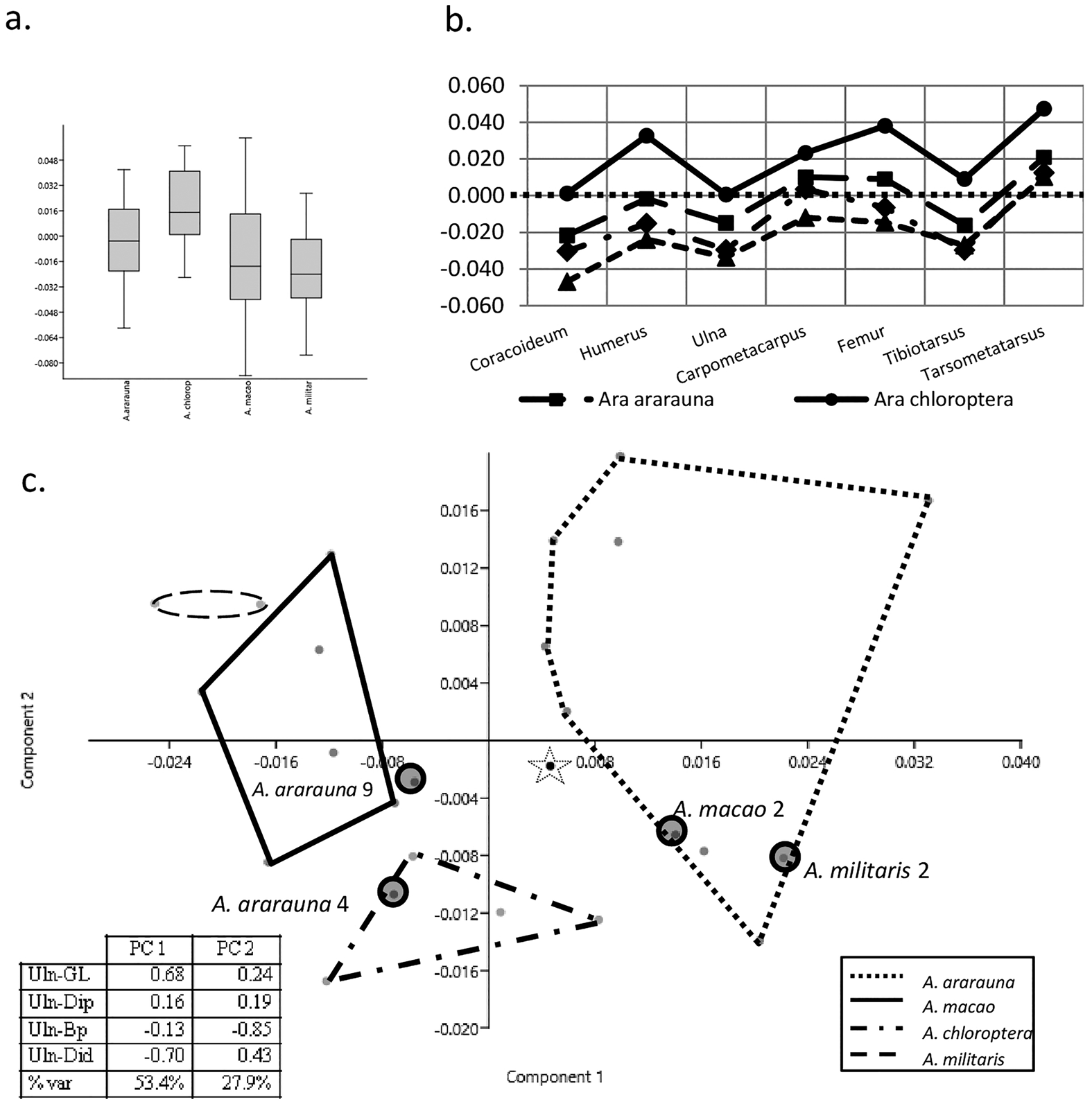
According to the calculation of the LSI (Figure 7a, b) the specimens of Ara chloroptera are larger than those from other species and the Nemocón IV macaw. The smallest specimens are from Ara militaris (average LSI = −0.021) and Ara macao (average LSI = −0.015), whereas the specimens of Ara ararauna are the closest to the Nemocón IV macaw in terms of size, presenting a very small negative (smaller) size difference: average LSI difference = −0.004 (Supplemental Table 5). Hence, based on size alone, the Nemocón IV macaw is closest to the living species Ara ararauna.
Results of the analyses of the log size index (LSI) and log shape ratio (LSR) from measurements taken from the Nemocón IV macaw and reference specimens of four modern Ara species (Ara ararauna, Ara chloroptera, Ara macao, and Ara militaris): (a) Box and whisker plots showing averages and ranges of LSI for the modern reference specimens; (b) LSI calculated for the average of each of seven bones (coracoid, humerus, ulna, carpometacarpus, femur, tibiotarsus, and tarsometatarsus) of the Ara reference specimens; abscissa represents the log of the measurements of the Nemocón IV macaw; (c) graphical representation of PC1 and PC2 of the LSR calculated from four measurements taken from the ulnae of the Nemocón IV macaw and reference specimens; PC1 and 2 explain 81.3% of the variability within the data. Specimens that interfere with the clarity of species differentiation are indicated by circles (Ara macao 2, ICN-27933; Ara militaris 2, LAC-2000-87; and Ara ararauna 4 and 9, LAC-1995-263 and LAC-1892-602, respectively); the Nemocón IV macaw is indicated by a star. Uln-GL, greatest length of the ulna; Uln-Dip, diagonal (greatest) length of the proximal end of the ulna; Uln-Bp, breadth (greatest) of the proximal end of the ulna; Uln-Did, diagonal (greatest) length of the distal end of the ulna.

Shape Analysis
Principal components (PCs) analysis was undertaken on the estimated LSRs for the coracoid, ulna, carpometacarpus, femur, and tibiotarsus. Graphing the first two PCs allowed for visual verification of the differences in shape between the species (Supplemental Figure 1, Supplemental Tables 6 and 7). Although there was no complete differentiation between the four taxa analyzed, and a few specimens departed from the norms for their species, we used the ulna as a proxy for the shape analysis, because it was the bone that best separated the four available taxa (Figure 7c).
PC1 (53.4% of the variability) separates the reference specimens of Ara militaris, Ara macao, and Ara ararauna, whereas Ara chloroptera is differentiated from most specimens of the other species by PC2 (27.9% of the variability; Figure 7c). The correlation between the four ulna measurements under PC1 shows that discrimination is mainly achieved by the greatest length (Uln-GL = 0.68; Figure 7c) and the greatest diagonal of the distal end (Uln-Did = −0.70; Figure 7c). In PC1, the ulna greatest length correlates positively, whereas the ulna greatest diagonal distal end correlates negatively. These data suggest that the ulnae of the Ara militaris and Ara macao specimens measured tend to be proportionally shorter, with more robust distal ends than those of Ara ararauna, which tend to be proportionally longer and with a graceful distal end. Correlation between the four ulna measurements for PC2 shows that discrimination occurs as a result of the greatest breadth of the proximal end (Uln-Bp = −0.85), which correlates negatively in PC2. This indicates that Ara chloroptera specimens present a proximal end of the ulna proportionally more robust than the other species. The ulna of the Nemocón IV macaw (Figure 7c, star) lies in the positive region of PC1, very close to the Ara ararauna specimens—indicating that the archaeological specimen is closest to this species: this result is consistent with the size analysis. However, despite the closeness observed between the archaeological macaw and the modern Ara ararauna specimens, we decided to retain the referral of the Nemocón IV macaw to Ara sp. (Correal-Urrego Reference Correal-Urrego1979)—both because of the uncertainty introduced by the sample size and the significant intraspecific variation that exists among modern Ara species.
Absolute Dating
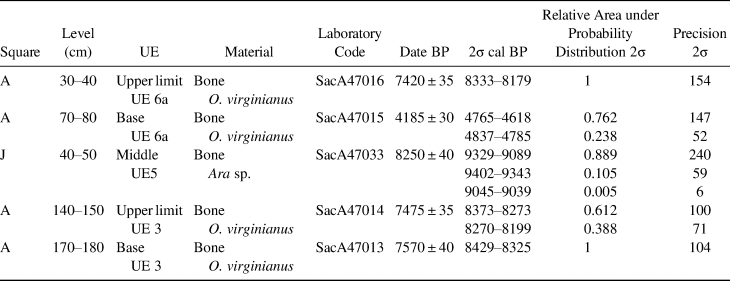
To complement the existing chronology of Nemocón IV, four deer bones from UE3 and UE6a, square A, were radiocarbon dated. To provide an accurate chronology for the Ara individual, we also dated a fragment of the pelvis recovered from the middle of UE5, square J (specimen ICN-ARQ-109–38).
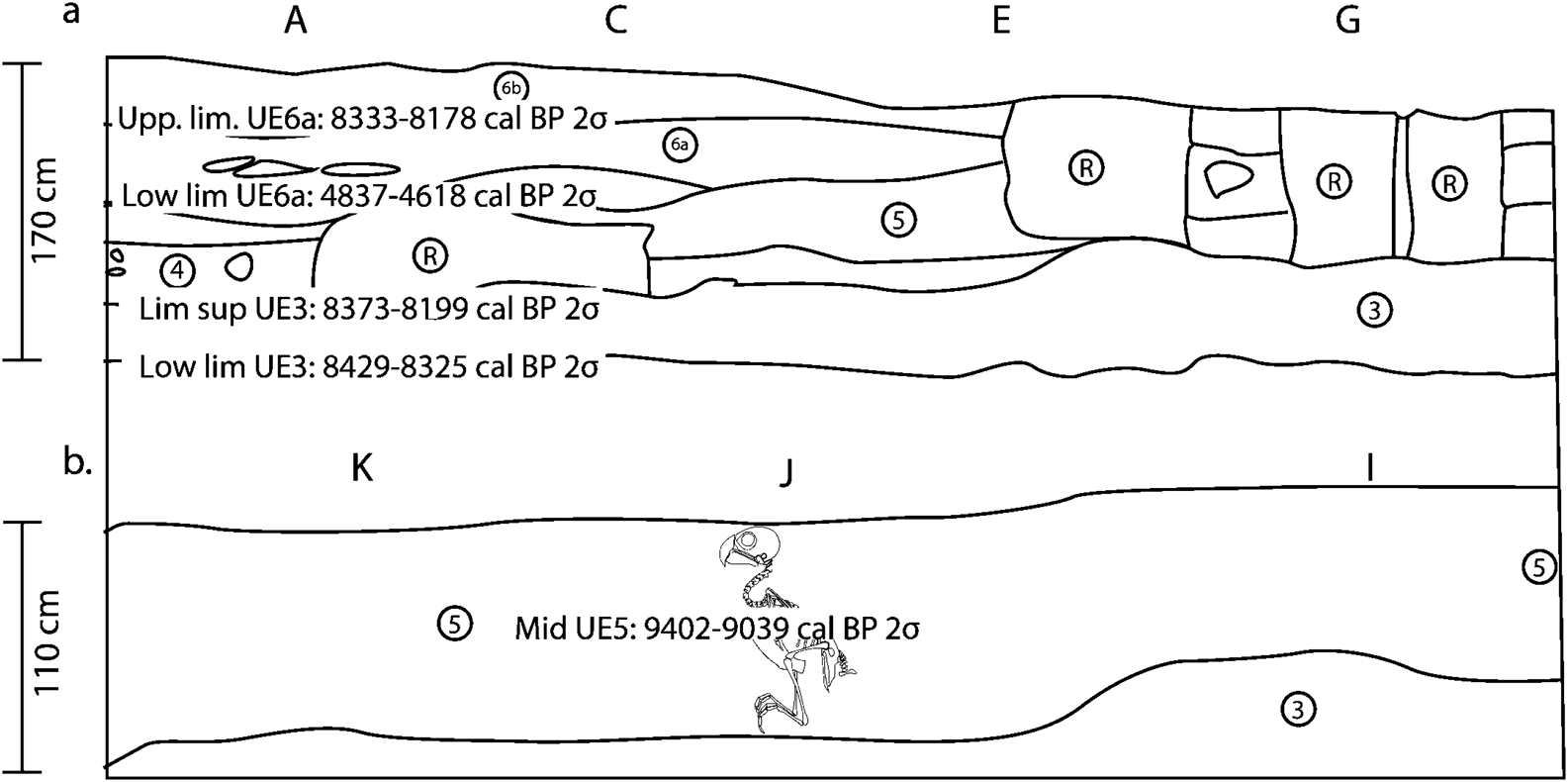
The new radiocarbon dates obtained from the Odocoileus bones from square A and the Nemocón IV macaw from square J indicate the presence of human occupation at Nemocón IV from about 9000 cal BP, confirming what had been proposed previously (Table 2; Figure 8; see Correal-Urrego Reference Correal-Urrego1979). However, the radiocarbon date obtained for the base of UE3, square A, was 8429–8325 cal BP 2σ (SacA47013), which is not as ancient as expected (around 9000 BP; Correal-Urrego Reference Correal-Urrego1979). The date obtained for the boundary between UE3 and UE5 (8373–8199 cal BP 2σ; SacA47014) does agree with the earliest published dates (Correal-Urrego Reference Correal-Urrego1979). However, for the base of UE6a, we obtained a more recent date than expected: 4837–4618 cal BP 2σ (SacA47015) instead of 6000 BP. For the upper part of UE6a, we obtained a date of 8333–8179 cal BP 2σ (SacA47016), which was very much older than the expected 3000 BP. With regard to UE6a, the new radiocarbon dates reiterate previous observations regarding the later disturbance of the level (Correal-Urrego Reference Correal-Urrego1979).
(a) Stratigraphy of the east wall Nemocón IV excavation showing squares A, C, E, and G (modified from Correal-Urrego Reference Correal-Urrego1979:Figure 3) with the radiocarbon dates carried out for this work, calibrated with the IntCal13 curve; (b) stratigraphy of the west wall of Nemocón IV excavation showing squares K, J, and I (modified from Correal-Urrego Reference Correal-Urrego1979:Figure 5), with the approximate location of the macaw remains reported here indicated by the macaw skeleton (modified from Guiraud Reference Guiraud2015) and the radiocarbon date carried out for this work, calibrated with the IntCal13 curve. R, rocks; numbers in circles refer to stratigraphic units identified by Correal-Urrego (Reference Correal-Urrego1979).

New Radiocarbon Dating Carried Out for Preceramic Levels at Nemocón IV.

Notes: The radiocarbon dates are calibrated to calendar years (IntCal13 curve) at 2σ. Lab. code, Laboratory code (Laboratoire de Mesure du Carbone 14, Saclay, France); UE, stratigraphic unit (Correal-Urrego Reference Correal-Urrego1979); level refers to the arbitrary excavation level (Correal-Urrego Reference Correal-Urrego1979).
The bone fragment from the pelvis of the Nemocón IV macaw was discovered in the middle of UE5 square J, so we expected an age close to 7728–7586 cal BP 2σ (GrN-264; Correal-Urrego Reference Correal-Urrego1979; Figure 3a). However, the new radiocarbon date was 9402–9039 cal BP 2σ (SacA47033), the oldest date thus far recorded for Nemocón IV. These dates are interesting, because they indicate that square A of Nemocón IV is in stratigraphic coherence in UE3 and UE5, but the base of UE3 is younger than expected. In addition, the unit identified as UE5 in square J does not correlate with unit UE5 of square A, being much older. Further work is required to resolve this discrepancy.
Discussion
The Nemocón IV macaw is here confirmed as belonging to Ara sp., but the analyses we performed showed it has closest affinities to Ara ararauna. In addition, the paleoenvironmental conditions for Nemocón IV during Preceramic times (around 9000 BP), when the macaw remains were deposited, do not correspond with the ecological range of any species of extant macaw. Hence, it can be stated that the Nemocón IV Ara skeletal remains belonged to a bird that did not naturally live in the Sabana de Bogotá. Its presence is therefore likely to be of anthropological origin, and this observation generates the question: Why did humans bring this bird to Nemocón? The role played by the macaw for the Preceramic human populations occupying the Nemocón IV site remains uncertain. Nevertheless, we can be fairly confident that the macaw was not used for food, because there is no evidence it was dismembered before being buried—although it seems unlikely that the body and head were buried in the same place and at the same time.
One way an archaeologist can approach understanding material remains of a past human cultural group is by making analogies that, unlike the archaeological record, provide dynamic models of human behavior (Hodder Reference Hodder1982). Although this type of approach has been questioned (Gould Reference Gould1980; Politis Reference Politis2002), the use of rational analogies has been accepted because, unlike formal analogies, they seek to establish cultural and natural relationships between different aspects of the analogy and not simply “extrapolate current information to the societies of the past” (Politis Reference Politis2002:62). Bearing this in mind, and considering the earlier taphonomic observations, it is possible to hypothesize about the relationship established between the macaw and the humans who lived in the Nemocón IV rockshelter. This line of reasoning allows us to consider reported uses for macaws by human societies from more recent times.
One possible use for the Nemocón IV macaw was as a source of feathers, which were a symbol of prestige in many precolumbian societies (Gutiérrez-Usillos Reference Gutiérrez-Usillos2009:354). Although no feathers have been found in the archaeological record of the Colombian Preceramic, ethnohistorical sources record feather use at the time of the arrival of the Spaniards in South America. In 1595 an Indian of Guachetá “tenía plumas y que estas las tiene en sus casas en público para holgarse con ellas” (had feathers and that he has them in his houses in public to show off with them; Archivo General de la Nación Vis BOY XVII f. 91v; all translations are by the first and third authors). Psittaciformes were of particular interest because they present bright colors (Gutiérrez-Usillos Reference Gutiérrez-Usillos2009). Feathers were obtained either by capturing wild birds and plucking a few feathers or by raising them in captivity, as indicated by the presence of the skeletons of macaws and parrots elsewhere in Colombia (Correal-Urrego Reference Correal-Urrego1989:80; Enciso and Therrien Reference Enciso, Therrien, Enciso and Therrien1996:44) and Ecuador (Gutiérrez and Iglesias Reference Gutiérrez-Usillos, Iglesias-Aliaga, Guinea, Bouchard and Marcos1995:412). In Colombia, as in Peru, macaws were kept captive to be plucked periodically, and the feathers were used in the manufacture of ornaments and fabrics (Milicia y Descripción de las Indias:155, in Gutiérrez-Usillos Reference Gutiérrez-Usillos2009:406). Visitor Juan de Valcarcel points out “los viejos en los santuarios ofrecían mantas y plumas de color” (the old men in the sanctuaries offered blankets and colored feathers) and “en Chita sofrecían a sus ídolos plumas de guacamayas y otros pájaros” (in Chita, they offered their idols feathers of macaws and other birds; Langebaek-Rueda Reference Langebaek-Rueda1995:204, 205). Indeed, the Spaniards are known to have called the sanctuaries plumerías or iglesias de plumerías (houses of feathers or churches of feathers; Langebaek-Rueda Reference Langebaek-Rueda1987:112).
A second alternative could be that the Nemocón IV macaw was used as a “replacement victim” (Girard Reference Girard and Jordá1983) in some practice of a symbolic nature. We learn from chroniclers' account that when the Spaniards arrived on the Sabana de Bogotá, the Muisca people “sacrificaban papagayos que traían de tierras bajas en número exorbitantes, por cientos, las enseñan a hablar en su lengua y cuando hablaban muy bien las juzgaban dignas de sacrificio” (sacrificed parrots that they brought from the lowlands in exorbitant numbers, by the hundreds, they taught them to speak in their language and when they spoke very well they were judged worthy for sacrifice; de Zamora Reference de Zamora1980:1:279). It was also reported that “los Muiscas sacrificaban los papagayos al sol, derramando su sangre por el templo y dejando sus cabezas cortadas atadas” (the Muisca sacrificed parrots to the sun, spilling their blood through the temple, and leaving their severed heads tied; Ecuador 1976 in Gutiérrez-Usillos Reference Gutiérrez-Usillos2009:46). A similar practice might possibly explain the absence of the head of the Nemocón IV macaw.
A third alternative is that the Nemocón IV macaw was a companion or pet that, in addition to being a symbol of prestige because of its colorful and exotic nature, may have served as a protection or warning. In this regard, Vargas Machuca points out that “no hay perros que mejor guarden las casas que ellas [las guacamayas], porque siempre tienen estos guacamayos sobre las casas, y en sintiendo gente de lejos, es tanta la grita y voces que dan, que forzoso han de estar avisados” (there are no dogs that better keep houses than they [the macaws], because they always have these macaws over the houses, and in sensing people from afar, they produce so many screams and voices, that they must be warned; Milicia y Descripción de las Indias:155 in Gutiérrez-Usillos Reference Gutiérrez-Usillos2009:406). Of course, it is entirely possible that the Preceramic people who kept the macaws had a complex mix of uses for them.
Almost all the identified faunal remains from Nemocón IV belong to autochthonous taxa (Supplemental Table 1). The chert used for the manufacture of most lithic toolsseems to have come from a deposit located to the north of Nemocón, toward the municipality of Tausa (Correal-Urrego Reference Correal-Urrego1979:68). Based on this information, it is possible to suggest that the humans who occupied Nemocón IV mainly used local resources to satisfy their needs, for a relatively long period of time (ca. 9225–4618 cal BP 2σ; Figure 8; Table 2). This implies that mobility of human populations was much more restricted than has been traditionally thought (Correal-Urrego Reference Correal-Urrego1979:122). In this respect, the presence of a macaw at Nemocón IV is intriguing because it shows that, despite the inferences just presented, there was contact between the high Sabana de Bogotá and the lower, more tropical regions of present-day Colombia—those regions with paleoenvironmental conditions that coincide with the natural range of the genus Ara. Whether this movement was restricted to intrepid individuals or undertaken by a greater proportion of the population (from highlands or lowlands) is beyond the scope and methods used in this research; to inquire about the motives that drove people to move would be purely speculative. With regard to the origin of the Nemocón IV macaw, the current geographical distribution of Ara species does not allow us to suggest a single source area. However, studies of strontium isotopes in the Nemocón IV macaw skeletal remains, coupled with research to generate a strontium isotope map for Colombia, would be of great utility in answering this question.
Conclusions
This work shows that humans who occupied the Nemocón IV rockshelter during the ninth millennium before the present (9402–9039 cal BP 2σ) appreciated exotic birds, such as macaws (Ara sp.). and that the bird was related to needs other than food. Study of the remains of the Nemocón IV macaw does not provide a clear picture as to the mobility patterns of the human groups that occupied the Sabana de Bogotá; however, the predominance of native taxa observed in this and other zooarchaeological studies strongly suggests that these groups did not routinely undertake large-scale migrations. This observation is consistent not only with those made in recent works on the first settlers of the American continents (Anderson and Gilliam Reference Anderson and Gilliam2000; Lanata et al. Reference Lanata, Luis Martino and Garcia-Herbst2008; Steele et al. Reference Steele, Adams and Sluckin1998) but also corroborates studies of Preceramic populations that occupied present-day Colombia; these studies have shown that the dispersal of early humans in South America did not have a specific directional orientation, but was a slow process through range expansion of human groups with relatively restricted mobility (Delgado-Burbano Reference Delgado-Burbano2012; Gnecco Reference Gnecco2003).
Acknowledgments
We thank Gary Stiles (Bird Collection, Institute of Natural Sciences, National University of Colombia) and the bird collections manager of the Laboratory of Comparative Anatomy (National Museum of Natural History of Paris); Élise Dufour, Olivier Tombret, and Denis Fiorillo for preparing samples for radiocarbon dating; Aurélie Manin for her help with the LSR analysis; Saúl Torres-Orjuela for production of figures; Mauricio Salinas-Rozo for his help with Figure 5; and Marcela Gómez-Pérez and Alejandro Zorro-Luján for proofreading. Catalina M. Zorro-Luján's research was funded by COLCIENCIAS, the Fundación de Investigaciones Arqueológicas Nacionales, Banco de la República (FIAN), the Programa Estímulos a la Investigación Thomas van der Hammen (Jardín Botánico de Bogotá), and the ARTEMIS program. Leslie F. Noè was funded by Universidad de los Andes, Bogotá, during a Semestre de Trabajo Académico Independiente and Facultad de Ciencias (Financiación de Programas de Investigación, 2018–2019), “The Paja Formation Lagerstätte of the Alto Ricaurte: Access, Palaeoenvironment and Taphonomy.” Finally, we would like to thank the anonymous reviewers who improved our work.
Data Availability Statement
The remains of the Nemocón IV macaw are stored in the Archaeological Collection, Institute of Natural Sciences of the National University of Colombia, Bogotá. The reference specimens can be consulted at the Bird Collection, Institute of Natural Sciences, National University of Colombia, and at the Collection of the Laboratory of Comparative Anatomy, National Museum of Natural History (MNHN) of Paris. The MNHN gave access to the collections in the framework of the RECOLNAT national research infrastructure.
Supplemental Material
For supplemental material accompanying this article, visit https://doi.org/10.1017/laq.2020.76.
Supplemental Table 1. Number of Identified Specimens (NISP) and Minimum Number of Individuals (MNI) per Taxon for the Nemocón IV Archaeological Site.
Supplemental Table 2. Information regarding the Nemocón IV Archaeological Specimen and Reference Specimens Used in this Work.
Supplemental Table 3. Measurements from Bones of the Forelimb of the Nemocón IV Ara sp. and of Reference Specimens Used in this Work.
Supplemental Table 4. Measurements from Bones of the Hindlimb of the Nemocón IV Ara sp. and of Reference Specimens Used in this Work.
Supplemental Table 5. Descriptive Statistics of LSI per Species.
Supplemental Table 6. Percentage of Variability Explained by PC1 and PC2 in the Principal Component Analyses (PCA) Performed on the LSR Calculated for the Coracoid, Carpometacarpus, Femur, and Tibiotarsus.
Supplemental Table 7. Correlation between the Measurements with PC1 and PC2 of the PCA Performed on the LSR Calculated for the Coracoid, Carpometacarpus, Femur, and Tibiotarsus.
Supplemental Figure 1. Graphical Representations of PC1 and PC2 of the PCA performed for the LSR of the Coracoid, Carpometacarpus, Femur, and Tibiotarsus.