Introduction
Uncompensated severe-traumatic hemorrhagic shock is associated with significant morbidity and mortality.Reference Teixeira, Inaba and Hadjizacharia 1 , Reference Cherkas 2 Timely and effective resuscitation in the Emergency Medical Services (EMS) and emergency department (ED) settings can optimize patient outcomes.Reference Reines, Bartlett and Chudy 3 , Reference Fowler and Pepe 4 A recent study on US military trauma patients from 2001 through 2011 in Afghanistan and Iraq demonstrated that 87% of trauma patients who expired did so prior to reaching a medical treatment facility, with over one-quarter of these deaths being deemed survivable.Reference Eastridge, Mabry and Seguin 5 Aggressive prehospital interventions by medical teams are associated with better long-term outcomes in these trauma patients.Reference Yeguiayan, Garrigue and Binquet 6 As such, it is vital to study and improve prehospital management of these traumatic hemorrhagic shock patients.
The initial resuscitation of trauma patients includes a baseline assessment of injury severity, airway management, control of hemorrhage, initial blood and fluid resuscitation to achieve a state of compensated shock, and timely ED disposition to surgery, when indicated.Reference Nolan 7 – Reference Kerby and Cusick 10 Although prior studies have examined these resuscitation issues separately (initial assessment, airway and fluid management, transfer to a trauma center, permissive hypotension, and the time to ED disposition),Reference Cherkas 2 , Reference Gofrit, Leibovici and Shemer 11 – Reference MacKenzie, Rivara and Jurkovich 34 few have examined all of these resuscitation practices from a single prospective trauma study conducted in multiple trauma centers. As such, it has been difficult to assess operational standards of care regarding the acute resuscitation of severely-injured hemorrhagic shock patients as they should occur in clinical practice.
The diaspirin cross-linked hemoglobin (DCLHb) clinical efficacy trial tested a human-derived hemoglobin solution as an add-on therapy for resuscitation of severely-injured hemorrhagic shock patients.Reference Sloan, Koenigsberg and Brunett 35 The objective of this present study is to assess the initial clinical status of Class III and IV traumatic hemorrhagic shock patients and to specify how airway management, fluid infusion and blood transfusion, and ED disposition to the operating room (OR) were conducted in multiple trauma centers.
Methods
Data for this secondary analysis were obtained from the DCLHb clinical efficacy trial, which was a randomized, single-blinded, normal saline procedure-controlled, efficacy and safety study of DCLHb in severe-traumatic hemorrhagic shock.Reference Sloan, Koenigsberg and Gens 36 These data describe the 98 patients among 17 trauma centers in the United States who were infused in the DCLHb clinical efficacy trial from February 1997 through January 1998 (Appendix; available online only). All patient care was provided without restriction, and DCLHb or normal saline-control infusion was used as an add-on therapy. The trial was approved by each hospital's institutional review board. An exception to informed consent was utilized in this clinical trial, when necessary.Reference Sloan, Koenigsberg and Houghton 37 The current analysis of the data was conducted with institutional review board approval from the University of Illinois at Chicago (Chicago, Illinois USA).
Upon presentation to the hospital, patients with presumed or proven hemorrhage and persistent hypoperfusion, secondary to trauma, were eligible for enrollment. Cellular hypoxia was demonstrated by vital-sign instability or a critical base deficit, as measured by systolic blood pressure (SBP) < 90 mmHg and a heart rate (HR) >120 bpm; SBP < 90 mmHg and a HR < 60 bpm (preterminal rhythm); or a base deficit >15 mEq/L. All SBP measurements are in millimeters of mercury (mmHg), all HR measurements are given in beats per minute (bpm), and all respiratory rate (RR) measurements are given in breaths per minute (breaths/min). These patients were expected to have a 40% mortality rate based on the prior experience and trauma registry data of the participating investigators. There was no restriction in the use of fluids, blood, or any other intervention prior to enrollment in this study. Patients with significant traumatic brain injury (TBI), as determined by clinical criteria (ie, posturing and blown pupils) that suggest a space-occupying lesion, were excluded. Patients whose death was thought to be imminent, suggesting a futile resuscitation effort, were also excluded, as were patients whose injury occurred more than four hours prior to infusion, minors < 18 years of age, and pregnant patients.
The Glasgow Coma Scale (GCS) score was determined prospectively at the time of the initial EMS and ED assessments. The triage revised trauma score (T-RTS) was calculated retrospectively using vital signs that were obtained at the time of this initial assessment in both EMS and ED settings. Subsequently, the revised trauma score (RTS) was calculated from the sum of the weighted T-RTS variables.Reference Champion, Sacco and Copes 38 The RTS was calculated with entry GCS, SBP, and RR, utilizing the formula RTS = 0.9368(GCS) +0.7326(SBP) + 0.2908(RR), using codified variables in the equation. Following intubation, the last GCS score obtained prior to intubation was carried forward to future time points.
Rapid sequence intubation (RSI) and airway management were assumed to be successful whenever the use of sedatives, narcotics, and/or paralytics was recorded in either the EMS or ED settings. When a range of doses was provided for these medications, the mean value of that range was utilized.
Intravenous (IV) fluid and blood product volumes were determined by assuming constant infusion rates. Infused fluid volumes recorded at the time of ED arrival were assumed to be cumulative EMS infusion volumes. Nonspecified infused fluids were assumed to be crystalloids, due to their more prevalent use, and IV fluids for which an infusion volume was missing were excluded.
An estimated injury time was recorded based upon patient, bystander, or EMS provider history. The time of the initial EMS vital signs was used as the proxy for EMS scene arrival. Hospital admission time was assumed to be ED arrival time, and the recorded time of arrival at another site within the hospital (eg, OR) became the ED disposition time.
Data were imported into Microsoft Excel 2010 (Microsoft Corporation, Redmond, Washington USA) with statistical analysis performed using IBM SPSS version 20.0 (IBM Corporation, Armonk, New York USA) and Epi Info StatCalc v3.5.1 (Centers for Disease Control and Prevention, Atlanta, Georgia USA). Chi-square and two sample t tests were used at the P < .05 significance level for statistical comparison.
Results
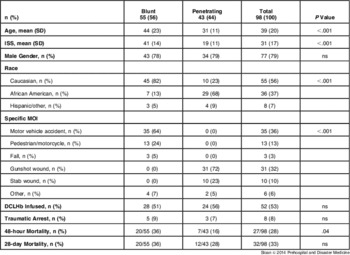
Of the 98 trauma patients, 79% were male, the mean age was 39 years (SD = 20 years), and a blunt mechanism of injury (MOI) occurred in 55 (56%) patients (Table 1). Motor vehicle accidents were the most prevalent blunt MOI (64%), while gunshot wounds were the most common penetrating trauma MOI (72%). Patient demographics did not differ except for a higher mean age in blunt trauma patients (44 vs 31, P < .001) and a higher proportion of Caucasian race within the blunt trauma patient subgroup (82% vs 23%, P < .001). Diaspirin cross-linked hemoglobin was infused in 52 (53%) patients. The mean injury severity score (ISS) was 31 (SD = 17), and it was 2.2 times higher in blunt trauma patients (41 (SD = 14) vs 19 (SD = 11), P < .001). The overall 28-day mortality was 33%, and it did not differ based on trauma MOI.
Demographic and Trauma Criteria by MOI

Abbreviations: DCLHb, diaspirin cross-linked hemoglobin; ISS, injury severity score; MOI, mechanism of injury; ns, not significant.
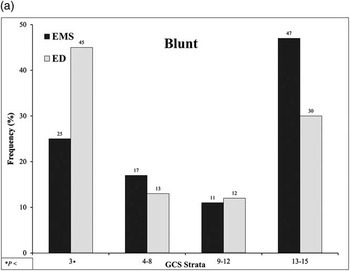
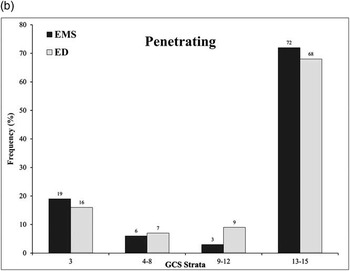
There was a nine percent decline in the GCS score between the EMS and ED settings due to a 20% decline in the GCS score of blunt trauma patients (P < .005). Similarly, there was an eight percent decline in the RTS score between the EMS and ED settings, again due to a 12% decline in RTS for blunt trauma patients as compared to a one percent decline in penetrating trauma patients (P < .001). There was a 63% increase in the number of patients with a GCS score of three in the ED setting as compared to the EMS setting (19 (23%) vs 31 (33%) patients, P < .001), due to a doubling in the number of blunt trauma patients with this GCS score of three (24 (45%) vs 12 (25%) patients, P = .03; Figure 1A). There was no similar GCS decline in penetrating trauma patients (Figure 1B).
Distribution of GCS Score from EMS to ED Setting in Blunt Injury Patients
Abbreviations: ED, emergency department; EMS, Emergency Medical Services; GCS, Glasgow Coma Scale.

Distribution of GCS Score from EMS to ED Setting in Penetrating Injury Patients
Abbreviations: ED, emergency department; EMS, Emergency Medical Services; GCS, Glasgow Coma Scale.

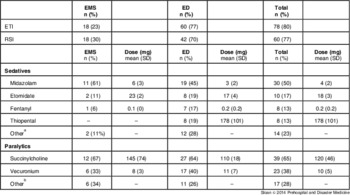
Endotracheal intubation (ETI) occurred in 78 (80%) patients, with 18 (23%) of these intubations occurring in the EMS setting (Table 2). Of the 18 (23%) intubations that occurred in the EMS setting, 16 (89%) occurred in blunt trauma patients. All 18 of the EMS intubations utilized RSI. Of the 60 (77%) intubations that occurred within the ED, 42 (70%) were with the use of RSI. Midazolam was the most commonly used RSI sedative, administered to 30 (50%) patients, at an average dose of 3.9 mg (SD = 3.1 mg). The most commonly used RSI paralytic was succinylcholine in 39 (65%) patients, at an average dose of 122 mg (SD = 48 mg). Vecuronium was the most commonly used nondepolarizing paralytic, used in 23 (38%) patients, at an average dose of 9.5 mg (SD = 5.3 mg). Use of nondepolarizing agents before succinylcholine occurred in two (3%) patients. Lidocaine was administered during RSI in 12 (20%) patients, four of whom were among the 17 (24%) patients who sustained severe TBI. Blunt trauma patients were more likely to be intubated in the prehospital setting than were penetrating trauma patients (29% vs 5%, OR = 8.4; 95% CI, 1.68-56.81, P < .005).
RSI and ETI in the EMS and ED

Abbreviations: ED, emergency department; EMS, Emergency Medical Services; ETI, endotracheal intubation; RSI, rapid sequence intubation.
aMorphine, ketamine, and isoflurane.
bPancuronium, rocuronium, and cis-atracurium.
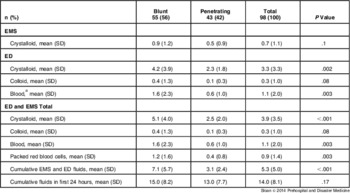
For the 56 (57%) patients in whom EMS personnel recorded the use of IV fluid in the prehospital setting, the mean prehospital crystalloid infusion was 0.7 L (SD = 1.1 L) with no difference based on trauma MOI (Table 3). The total crystalloid volume infused prior to ED disposition was 83% higher in blunt trauma patients (4.2 L vs 2.3 L, P = .002). In both blunt and trauma patients, 21% of the crystalloid volume was infused in the EMS setting. Colloids were infused in the ED in 13 (14%) patients, with a mean volume of 0.3 L (SD = 1.0 L), with no difference based on MOI. Blood products were transfused in the ED in 62 (63%) of patients, with a mean volume of 1.1 L (SD = 2.0 L). Packed red blood cells (PRBCs), were transfused in 60 (61%) patients and accounted for 79% of the total blood product volume, with three times more PRBCs being infused in blunt trauma compared to penetrating trauma patients (1.2 L vs 0.4 L, P = .003). Fresh frozen plasma was transfused in 14 (14%) patients at a mean volume of 1.3 L (SD = 1.2 L), which represented 17% of the total blood product volume.
IV Fluid and Blood Volumes (L) in the EMS and ED Settings by MOI

Abbreviations: ED, emergency department; EMS, Emergency Medical Services; IV, intravenous; MOI, mechanism of injury.
aIncludes packed red blood cells (PRBCs), fresh frozen plasma, platelets, and auto-transfusion.
The mean cumulative volume of EMS and ED IV fluids and blood was 5.3 L (SD = 5.0 L), with 87% being infused in the ED resuscitation phase (Table 3). The mean cumulative 24-hour blood and fluid infusion volume was 14.0 L (SD = 8.1 L), and 42% of this volume was infused prior to or during ED care. Blunt trauma patients were infused with 2.3 times more fluid and blood volume than penetrating trauma patients by the end of EMS and ED care (7.1 L vs 3.1 L, P < .001).
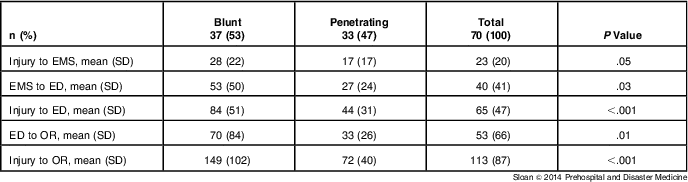
Of the 70 patients sent to the OR from the ED, only 21 (30%) entered surgery within 60 minutes of the time of injury, with a mean time between injury and ED disposition of 113 minutes (SD = 87 minutes; Table 4). A greater proportion of time that transpired prior to operative intervention occurred in the EMS setting as compared to the ED setting (65 minutes (58%) vs 53 minutes (42%)). Blunt trauma patients had a 48% longer EMS phase (84 minutes (SD = 51 minutes) vs 44 minutes (SD = 31 minutes), P < .001), a 52% longer ED phase (70 minutes vs 33 minutes, P = .01), and a 52% longer overall mean time to OR arrival (149 minutes vs 72 minutes, P < .001) as compared to those with penetrating trauma. Of the 21 patients who entered the OR within 60 minutes of injury, 15 (71%) were patients with penetrating MOI. Patients with penetrating MOI were 4.3 times more likely to enter the OR within 60 minutes of injury as compared to those patients with blunt MOI (45% vs 16%, OR = 4.31; 95% CI, 1.26-15.29, P < .02). Arrival to surgical care within the first hour did not improve the 48-hour mortality (20% vs 38%, P = .21) or 28-day mortality (31% vs 38%, P = .74).
Time Course (minutes) from Injury to Emergent Surgery by MOI

Abbreviations: ED, emergency department; EMS, Emergency Medical Services; MOI, mechanism of injury; OR, operating room.
Discussion
Trauma centers were established in the US based on data that suggest patient outcome is enhanced due to effective acute resuscitation and timely definitive surgery.Reference Cales 39 , Reference Harris, Davenport and Hurst 40 Despite the fact that trauma center personnel routinely record demographic, treatment, and outcome data of their patients, surprisingly few studies have published airway management and fluid and blood resuscitation data. As such, the description of how EMS and ED resuscitation is conducted for severe-traumatic hemorrhagic shock patients remains limited.Reference Trunkey 8 , Reference Jorden 41 – Reference Lairet, Bebarta and Burns 44 The design of the DCLHb clinical efficacy trial offered a unique opportunity to examine the acute resuscitation of severely-injured traumatic hemorrhagic shock patients in the EMS and ED settings of multiple geographically distributed trauma centers. The data from the US DCLHb clinical trial provides a means to examine the performance of initial patient assessment, airway management using RSI, fluid infusion and blood transfusion, and the time until disposition to the OR for surgical care.
Previous studies have shown assessment scores such as GCS and RTS to be valuable predictors of outcome in major trauma patients.Reference Champion, Copes and Sacco 42 Studies that have examined prehospital RSI medications in the prehospital setting have mostly involved aeromedical units,Reference Gofrit, Leibovici and Shemer 11 – Reference Wayne and Friedland 18 , Reference McQueen, Crombie and Hulme 45 , Reference Perkins, Gunning and Crilly 46 although some studies have examined use of certain agents in ground-based EMS.Reference Pace and Fuller 19 – Reference Dickinson, Cohen and Mechem 21 , Reference Rose, Anderson and Edmond 47 , Reference Ballow, Kaups and Anderson 48 Emergency department stabilization via ETI and RSI has been shown to decrease mortality and is a standard of care for trauma patients.Reference Norwood, Myers and Butler 22 , Reference Talucci, Shaikh and Schwab 23 , Reference Ballow, Kaups and Anderson 48 In severely-injured hemorrhagic shock patients, it is suggested that resuscitation not prolong definitive surgical intervention during the “Golden Hour,” a concept of great theoretical and proven importance to patient survival.Reference McNicholl 24 , Reference Meighan, Gregori and Kelly 25 , Reference Wyen, Lefering and Maegele 49 , Reference Dinh, Bein and Roncal 50 A study by Dinh et alReference Dinh, Bein and Roncal 50 demonstrated that mortality in TBI patients was associated with increasing time to patient arrival at an ED, with arrival prior to 60 minutes leading to the greatest overall odds of survival to hospital discharge.
In this study, both GCS and RTS were noted to decline by ED arrival. The decline of GCS and RTS from the EMS to ED setting may reflect continued hemorrhage, which caused patient decompensation among blunt trauma patients. The greater decline in GCS and RTS among blunt trauma patients may have been observed as a result of longer EMS times and greater injuries sustained as compared to penetrating trauma patients.Reference Sloan, Koenigsberg and Brunett 35 The drop in GCS and RTS in the DCLHb clinical trial may also have resulted from the 17% incidence of TBI in these hemorrhagic shock patients.
The proportion of patients in the DCLHb trial who were intubated via RSI in both the EMS setting and the ED is similar to a study by Oswalt et al.Reference Oswalt, Hedges and Soifer 51 For both studies, the percentage of patients intubated in the EMS setting was lower than in the ED, perhaps due to the difficulty of prehospital airway management, type of EMS service (Basic Life Support vs Advanced Life Support), or deteriorating patient condition following hospital arrival.
Midazolam and succinylcholine were the most frequently used medications, at doses similar to previously published studies.Reference Hedges, Dronen and Feero 13 , Reference Rhee and O'Malley 15 , Reference Dickinson, Cohen and Mechem 21 , Reference Cushman and Zachary Hettinger 52 Studies have indicated successful RSI with midazolam as a single agent, or in conjunction with a paralytic, in both the ED and EMS settings.Reference Wayne and Friedland 18 – Reference Dickinson, Cohen and Mechem 21 , Reference Davis, Kimbro and Vilke 53 – Reference Stollings, Diedrich and Oyen 55 Succinylcholine has remained a popular paralytic for emergent RSI, despite the reported success of nondepolarizing agents.Reference Orebaugh 56 – Reference Sakuraba, Serita and Kosugi 58 In the ED, vecuronium was utilized only in a minority of patients despite studies which indicate fewer adverse effects than those seen with succinylcholine.Reference Cushman and Zachary Hettinger 52 , Reference Fleming, Chung and Glass 59 , Reference Vijayakumar, Bosscher and Renzi 60 Nondepolarizing agents were probably used less commonly in the EMS setting due to the established use of succinylcholine as part of prehospital protocols.18,19,55] Etomidate and ketamine, which may have favorable hemodynamic profiles for hemorrhagic shock patients, were used infrequently in these trauma patients treated in the late 1990s.Reference Gofrit, Leibovici and Shemer 11 , Reference Sehdev, Symmons and Kindl 61 – Reference Scherzer, Leder and Tobias 63
There is little consensus on the amount and rate of prehospital and ED fluid resuscitation in trauma patients, with few studies reporting actual mean volumes of crystalloid and colloid fluids used.Reference Cotton, Jerome and Collier 64 Fluid volumes of 1,200 mL were infused in the EMS settings in this study, which is greater than the control group (870 mL) in the older study by Bickell et al,Reference Bickell, Wall and Pepe 65 as well as patients in the newer studies by Hampton et alReference Hampton, Fabricant and Differding 66 (700 mL) and Annane et alReference Annane, Siami and Jaber 67 (1,000 mL), but comparable to studies of prehospital fluid resuscitation by Bulger et alReference Bulger, May and Kerby 68 (1,250 mL) and Cooper et alReference Cooper, Myles and McDermott 69 (1,250 mL). In this DCLHb study, trauma patients received a mean total EMS and ED crystalloid fluid resuscitation volume of 3,900 mL, which is higher compared to other hemorrhagic shock studies by Bickell et alReference Bickell, Wall and Pepe 65 (1,608 mL) and Duke et alReference Duke, Guidry and Guice 70 (2,757 mL). Total EMS and ED fluid infusion and blood transfusion volumes of 5,300 mL in this DCLHb study was comparable to a smaller study by Rizoli et alReference Rizoli, Rhind and Shek 71 (5,520 mL), but was three times higher than the volume in the study by Bickell et alReference Bickell, Wall and Pepe 65 (1,741 mL). These two studies were the only studies that documented total EMS and ED crystalloid plus colloid volumes for comparison. Fluid and blood transfusion occurred more often and at volumes that were two times greater in blunt trauma patients compared to penetrating trauma patients, which was similar to the data reported by Hampton et al.Reference Hampton, Fabricant and Differding 66
Although no prospective study has validated the concept of the “Golden Hour,” the rapid disposition of trauma patients to surgery within 60 minutes of injury time has become an accepted resuscitation goal.Reference McNicholl 24 , Reference Meighan, Gregori and Kelly 25 , Reference Wyen, Lefering and Maegele 49 , Reference Dinh, Bein and Roncal 50 , Reference Swaroop, Straus and Agubuzu 72 In this study, approximately one-third of patients entered surgery within the “Golden Hour,” as compared to 95% of patients in the study by Sampalis et al,Reference Sampalis, Lavoie and Williams 73 80% of patients in the study by Dinh et al,Reference Dinh, Bein and Roncal 50 and 34% in the study by Rahbar et al.Reference Rahbar, Fox and del Junco 74 The majority of patients who did receive operative intervention within one hour were patients with penetrating trauma. The fact that the time to operative intervention did not alter mortality suggests the significant impact that baseline injury severity has on patient outcome. These results are congruent with those of Dinh et al,Reference Dinh, Bein and Roncal 50 who found that arrival prior to 60 minutes did not impart a significant overall survival benefit, even though arrival prior to 120 minutes did dramatically improve overall survival as compared to those patients who arrived at later times.
There were notable differences between blunt and penetrating trauma patients with regard to initial RTS and GCS, fluid and blood resuscitation, and time to operative intervention in this DCLHb clinical trial. Patients with blunt trauma had a greater ISS as measured by GCS and RTS, and received prehospital RSI with a greater frequency than those with a penetrating mechanism. By the time of ED disposition, the mean cumulative crystalloid volume infused in blunt trauma patients was greater than the volume infused among penetrating trauma patients, a finding consistent with the results from Yaghoubian et al.Reference Yaghoubian, Lewis and Putnam 75 This suggests that blunt trauma patients, due to the severe multiple-system injuries, required greater fluid and blood volumes to achieve an acceptable compensated shock state during acute resuscitation than did penetrating trauma patients.Reference Sampalis, Lavoie and Williams 73 , Reference Reah, Bodenham and Mallick 76 This also might reflect the fact that penetrating trauma patients required fewer diagnostic studies in the ED and were provided definitive hemorrhage control in the OR.
Patients who experienced a blunt MOI had longer times at all stages from injury to surgery, which may have been due to entrapment for some of the 35 motor vehicle accident patients or due to greater injury severity that required immediate resuscitation by EMS providers, including RSI. Similarly, mean lapsed ED time may have been greater among blunt MOI patients, perhaps due to the need for intubation when prehospital intubation was not successful,Reference Sampalis, Lavoie and Williams 73 , Reference Doran, Tortella and Drivet 77 longer infusions of crystalloid, blood, and colloid, and/or the need for invasive procedures and diagnostic studies prior to OR surgical care.
Limitations
One limitation to this study is the assumption that the administration of a sedative, benzodiazepine, or a narcotic implied successful intubation (RSI) within the EMS setting. Also, the infusion of DCLHb may be a confounding variable in analyzing the fluid resuscitation volumes, as previous work has demonstrated a possible pressor effect with DCLHb infusion,Reference Przybelski, Daily and Kisicki 78 even though analysis of this DCLHb clinical trial data indicated no consistent effect of DCLHb on patient blood pressures.Reference Sloan, Philbin and Koenigsberg 79 This study involved a relatively small number of severely-injured trauma patients because of the early termination of the study due to increased mortality among those who received DCLHb. Lastly, the age of the data limits generalizability to all EMS and ED settings in 2014. Despite these limitations, this trauma patient resuscitation data does provide relevant benchmarks for comparisons to current clinical practice.
Conclusion
A modest decrease in GCS and RTS score was seen at the time of ED arrival due to the deterioration of blunt trauma patients. Rapid sequence induction and ETI were provided both in the EMS and ED settings, most often with the use of midazolam and succinylcholine. On average, crystalloids were infused both in the EMS and ED settings, and blood products and colloids were used in the ED at total volumes up to five times the estimated hemorrhage volume of most patients. Blunt trauma patients were more severely injured, and as such, these patients more often received prehospital RSI and were infused with greater overall volumes of fluid and blood as compared to penetrating trauma patients. Disposition to the OR most often did not occur within 60 minutes of the estimated time of injury, especially for blunt trauma patients. The disposition of the majority of patients beyond the “Golden Hour,” however, did not adversely affect mortality in this clinical trial. More information regarding the acute resuscitation of severe hemorrhagic shock patients in the EMS and ED settings using a larger patient population of traumatic hemorrhagic shock patients from multiple trauma centers will further refine the resuscitation practices of paramedics, emergency physicians, and trauma surgeons in the US.
Acknowledgements
The authors would like to thank Adam Schlichting, MD and Stephen Eder, MD for their assistance in preparing this manuscript.
Supplementary Materials
To view supplementary material for this article, please visit http://dx.doi.org/10.1017/S1049023X14001174