On September 3, 1841, George Eliot wrote in a letter to her friend Maria Lewis:
I have been revelling in Nichol's Architecture of the heavens and Phenomena of the Solar system, and have been in imagination winging my flight from system to system, from universe to universe, trying to conceive myself in such a position and with such a visual faculty as would enable me to enjoy what Young enumerates among the novelties of the ‘stranger’ man when he burst the shell, to
‘Hospitable infinity!’ Nichol beautifully says. (Letters 106–07)Footnote 1
Here, Eliot describes an imaginary journey through the systems of the heavens and the unbounded space of the universe. The books she refers to are John Pringle Nichol's Views of the Architecture of the Heavens. In a Series of Letters to a Lady (1837), and The Phenomena and Order of the Solar System (1838). In Views of the Architecture of the Heavens, Nichol takes his readers on a tour of the universe with the aim of helping them to “henceforth look at the Heavens” with “something of the emotion which their greatness communicates to the accomplished Astronomer” (vii). Eliot's quote is from Edward Young's poem The Complaint, or Night Thoughts (1742), where the narrator describes a cosmic voyage he takes in “contemplation's rapid car” stopping at every planet asking for the Deity. From “Saturn's ring,” he takes a more fearless “bolder flight” through the stars with a “bold” comet
In Young's scenes of majestic cosmic perspective, the reader, with the narrator, discovers the vastness of space and the existence of other worlds: “On nature's Alps I stand, / And see a thousand firmaments beneath! / A thousand systems! as a thousand grains!” (277). The theme of the cosmic journey enables the reader to explore the universe, often looking back at the earth as they travel through space in their imagination and frequently in a dream. Overcoming the limits of knowledge, the immeasurable distances of the universe and its other worlds become more knowable.
In the Victorian period, the science of astronomy was revealing the vast vistas of the heavens, the deep abysses of interstellar space, and the massive distances between the earth and the other bodies of the solar system. The mind had to struggle to comprehend, to conceptualize the newly revealed infinity of the universe. The heavens, which had now expanded in the Victorian mind into infinitude and therefore beyond cognitive comprehension, needed to be brought back to within understanding. In Victorian Glassworlds (2008), Isobel Armstrong identifies the “problem of finding a cognitive language to mediate scientific knowledge.” Using the example of the discovery of Neptune in 1846, Armstrong shows how we may know of the planet's discovery “but only of it.” She argues that only through the “experience of parallax,” of measuring the distances of the bodies of the solar system from the earth could “conceptual substance” be given to abstract conceptions (30). Yet, the problem was also that those measurements revealed distances beyond human experience and therefore comprehension. These measurements were discovered by Victorian astronomers and publicised through popular print and lectures. Critics, such as Anna Henchman and Pamela Gossin, show the consequent anxieties that arose from the incomprehensibility of astronomical distance. Henchman, in The Starry Sky Within (2014), highlights the gap between the perception and conception of astronomical distance that existed for the Victorians. In her study, she notes the discrepancy between sensory perception and the theoretical claims of astronomical research: the “marked discrepancies between what one can see when one looks up at the night sky and what astronomers know about the universe's actual structure” (130). Then, as now, the universe was optically finite; we can only see and gather information about a portion of the visible universe. There was a difference between what the eyes could perceive in the heavens, due to the distances involved preventing complete knowledge of the astronomical prospect, and what astronomy and its writings were telling the observer actually existed. The problem was how to mediate astronomical knowledge, to give substance to what were essentially abstract conceptions (Henchman, “Globe” 30). Gossin, in Thomas Hardy's Novel Universe (2007), refers to the ways in which astronomical concepts and cosmological conflicts have historically fuelled “philosophical doubts and personal fears.” She argues that astronomy presented contradictory “evidence”; astronomy could either support theological doubt or magnify the Creator (81–82). Michael J. Crowe's The Extraterrestrial Life Debate 1750–1900 (1986), George Levine's Darwin and the Novelists (1988), and David Clifford's “Repopulating Heaven: Victorian Lunar Studies and the Anxiety of Loneliness” (2006), show that the possibility of life elsewhere in the universe was at the root of the rupture of traditional religious orthodoxies, which relied on the pre-eminence of the earth in God's scheme of creation. These readings have opened up a growing interest in the ways Victorian writers sought to compensate for the expanding boundaries of their known world.
Pertinent to this study is Clifford's essay, which examines how Victorian writers and readers of popular astronomy texts superimpose earth-like qualities onto the Moon, in an attempt to “reconcile evidence of empty and uninhabitable space with the traditional interpretation of heaven as a populous, watchful and ultimately protective place,” the abode of angels (172). These “imagined experiences” he sees as set against the “backdrop” of the aggressively debated notion of a plurality of worlds, and improvements in the power of telescopes (176). Clifford touches briefly on the cosmic voyage as a flight of the imagination, arguing that it was used by scientific writers to recount astronomical facts and to speculate about what was visible from the Moon's surface. The idea of creating a sense of reader familiarity with far distant worlds is also conceptually important to my study. However, Clifford's argument lacks an in-depth analysis of any popular Victorian lunar texts and the centrality of the theme of the cosmic voyage to their narrative. Thus, the place of the cosmic journey in mediating the anxieties raised by Victorian astronomical discourse remains to be fully articulated. Redressing this oversight, this essay contends that the theme of the cosmic voyage was used in popular print to negotiate Victorian anxieties about astronomical distance and the possibility of extraterrestrial life. It argues that the cosmic voyage employed a making safe of the ever-expanding astronomical prospect, and the possibility of life on other worlds. I maintain that the use of the cosmic voyage theme enabled Victorian writers to subsume the incomprehensible distances of the universe thus, as Eliot describes in her letter to Maria Lewis, rendering infinity “hospitable.” In the sections that follow, I explore the anxieties that arose because of developments in astronomical knowledge, and the discourse surrounding the extraterrestrial life debate and its dissemination in popular print. The next part focusses on Alexander von Humboldt's cosmic travel narrative Cosmos (1845–62), and the similarities between Humboldt's account and Victorian cosmic voyages to other worlds. In particular, it finds evidence in Humboldt's narrative of the importance of the imagination in mediating reality to create an expansionist effect on the reader's mind, which enables them to conceptualize the whole of the universe – near and far, the earth and distant worlds. In the final section, I focus on how Victorian writers employ the theme of the cosmic voyage to create a unity of nature, a synthesis between the earth and other worlds of the universe that makes them more knowable.
The theme of the cosmic journey has a long literary history that can be traced back as far as Antiquity, and has been well rehearsed by Marjorie Hope Nicolson, Mark R. Hillegas and Roger Lancelyn Green. Indeed, Nicolson first identified the theme and coined the term “cosmic voyages” in her seminal Voyages to the Moon (1948; 7). Victorian accounts of cosmic travel have a historical relationship, as Nicolson points out, to the genre of the imaginary voyage or extraordinary voyage defined by Geoffroy Atkinson in 1920, as designating a “fictitious narrative purporting to be the veritable account of a real voyage made by one or more Europeans to an existent but little known country – or to several such countries” (ix). However, for Nicolson cosmic voyages, whilst still imaginary journeys, differ in that they are “extraterrestrial” and involve the discovery of “a new world, usually in the moon or planets” (7). Despite their fictional travel narratives, the cosmic voyage's very relationship to contemporary astronomical discourse gives them the power to capture the reader's imagination. Albeit a fictional tale, the writer takes evidence from astronomical facts about, for example, the magnitude of the universe, and the dimensions and features of the sun, moon and planets, to produce a narrative that deals with purportedly real space travel scenarios and the characteristics of other worlds. However, these narratives are still about places that no one had ever visited. As William Eddy argues regarding imaginary voyages, they are journeys that only exist in the writer's imagination, particularly as real space-travel was yet to come (8).Footnote 2 In their analyses of Victorian cosmic voyage literature, critics have mainly focussed on familiar stories such as Edgar Allan Poe's “The Unparalleled Adventure of One Hans Pfaall” (1835), Jules Verne's From the Earth to the Moon (1865) and All Around the Moon (1870), H. G. Wells's The War of the Worlds (1898) and The First Men in the Moon (1901).Footnote 3 However, in addition to these important examples, there are other, perhaps less renowned texts that deserve greater critical attention than they receive. These include books such as Lord John Russell's Adventures in the Moon, and Other Worlds (1836), the anonymous A Fantastical Excursion into the Planets (1839), and Agnes Giberne's Among the Stars (1885). Together with articles in popular magazines, such as William Leitch's “A Journey through Space,” published in Good Words in 1861, they flooded Victorian culture with imaginary tales of space travel and life on other worlds.Footnote 4 Seemingly marginal texts such as these, I will show, highlight the ways in which the writers of cosmic voyages in Victorian popular print, sought to negotiate the epistemological anxieties raised by astronomical discoveries of the period.
“Immeasurable Worlds”
Just like many people in Victorian Britain, Eliot was interested in the science of astronomy. Her notebooks and novels such as Daniel Deronda (1876) contain many references to the science. Like most enthusiasts, Eliot's knowledge came from popular astronomical books, such as Nichol's Views of the Architecture of the Heavens and The Phenomena and Order of the Solar System that she refers to in her letter to Maria Lewis. Such was the reputation of Nichol's books that George Gilfillan hails him in A Second Gallery of Literary Portraits (Reference Gilfillan1850) as the “prose laureate of the stars” (255). The level of cultural fascination with the science is indicated in an 1858 article in Punch. It satirises the “hunt” for Comet Donati by describing amateur astronomers as being as “plentiful as partridges” (“Comet Hunt” 140). Likewise, Samuel Smiles describes the popular pastime of astronomical observation in Men of Invention and Industry (1884). Relating how his interviewees often built their own telescopes, he declares “astronomers in humble life! There seems to be no end of them. There must be a great fascination in looking up to the heavens and seeing those wondrous worlds careering in the far-off infinite” (355). Common were displays of orrery and magic lantern shows by astronomers such as Richard Anthony Proctor and Robert Stawell Ball, and on the streets of towns and cities exhibitors offered penny views through a telescope. In Henry Mayhew's social documentary London Labour and the London Poor (1861), Mr. Tregent, a London telescope exhibitor by night and tailor by day, attracts large crowds to view astronomical phenomena such as “Jupiter with all his four satellites,” once nearly losing his breeches in the scrum (81).
Whilst popular attractions included the sky watching of astronomical phenomena, the Victorians were also fascinated by the possible existence of other inhabited worlds. Eminent astronomers, including John Herschel, suggested that the existence of extraterrestrial life might be revealed by improvements in telescopic power. In Herschel's Treatise on Astronomy (1833), the planets are “habitable worlds” and the stars “effulgent centres of life and light to myriads of unseen worlds” (2). In popular print, readers were confronted with the findings of astronomical science, revelations about new worlds and the possibility of their habitation by other forms of life or organisms like themselves. No longer did the human beings on the earth seem to be alone in the universe, the sole creation of a benevolent and all powerful First Cause. A barrage of books and articles discussed the possibility of life on other worlds. They raised religious uncertainties, and provoked immense anxiety among Victorians about what life on other worlds would mean for scriptural truths about creation and the place of the earth's inhabitants in the cosmic order. The argument for and against the likelihood of extraterrestrial life was publicly played out in newspapers, periodicals and books. Thomas Chalmers's best-seller A Series of Discourses on the Christian Revelation, Viewed in Connection with Modern Astronomy (1817), known by its abbreviated title Astronomical Discourses, was popular throughout the Victorian era. Chalmers sets out his case for the existence of other inhabited worlds arguing: “To the men of other times we leave the full assurance of what we can assert with the highest probability, that yon planetary orbs are so many worlds, that they teem with life” (32).
Similar sentiments are expressed in Robert Chambers's controversial Vestiges of the Natural History of Creation (1844). Chambers presents the earth, “this little planet,” as “third of a series which is but. . .one portion of an apparently infinite globe-peopled space,” and “every one of these numberless globes is either a theatre of organic being, or in the way of becoming so” (160-61). Other Victorian titles concerned with extraterrestrial life include Thomas Collins Simon's Scientific Certainties of Planetary Life (1855), Montagu Lyon Phillips's Worlds beyond the Earth (1855), Proctor's Other Worlds than Ours (1870) and Joseph Hamilton's The Starry Hosts (1875). Many, like Robert Knight's The Plurality of Worlds (1855) and Edward Higginson's Astro-Theology (1855), specifically deal with the scriptural uncertainties raised by the assertions that life existed on other planets. They followed in the wake of the vehement argument on the subject between William Whewell and Sir David Brewster, a confrontation that emphasizes the attendant religious anxieties that accompanied the Victorian notion of extraterrestrial life. In Of the Plurality of Worlds (1853), Whewell rallies against Chalmers appealing to geological theory and astronomy to discredit the notion of other inhabited worlds. According to Whewell, other worlds were passing through the preparatory stages the world went through in its development, and were therefore in a molten state and possibly vaporous. For Whewell, the nebular hypothesis showed this to be true, and therefore they had not yet reached the stage where life could exist (203). Neither, maintains Whewell, can the earth in the eyes of the Christian “be regarded as being on a level with any other domiciles.” He argues that the earth “is the Stage of the great Drama of God's Mercy and Man's Salvation. . . .This being the character which has thus been conferred upon it, how can we assent to the assertions of Astronomers, when they tell us that it is only one among millions of similar habitations?” (44–45).
Brewster published an angry retort to Whewell in his review of Whewell's Of the Plurality of Worlds in the North British Review in May 1854. For Brewster, Whewell's argument evidences “a mind dead to feeling and shorn of reason” and “without faith” (10). In More Worlds than One (1854), he continues this heated rhetoric in favour of the plurality of inhabited worlds: “The mind rejects,” announces Brewster, “almost with indignation, the ignoble sentiment” that the other planets “are but colossal blocks of lifeless mud and clay encumbering the Earth as a drag, and mocking the creative majesty of heaven” (135). According to Brewster, Jupiter is a “planet more magnificent than ours” whose mass is “1300 times” and its radius “eleven times greater than that of the Earth” (73, 70). Brewster posits the idea of Jupiter as inhabited by “a type of reason of which the intellect of Newton is the lowest degree” which may possess “telescopes more penetrating, and microscopes more powerful than ours” (73). And what would these intelligences be like? “Is it necessary” enquires Brewster that “an immortal soul” on another “breathing” world is
united to a skeleton of bone, or imprisoned in a cage of cartilage and of skin? Must it see with two eyes, and hear with two ears, and touch with ten fingers, and rest on a duality of limbs? May it not reside in a Polyphemus with one eyeball, or in an Argus with a hundred? May it not govern in the giant forms of the Titans, and direct the hundred hands of Briareus? (70)
Rhetoric like Brewster's advanced the anxiety that not only was the earth just a small fragment in the vast universe, but also that human beings might be intellectually inferior to the strange, and by earthly standards, grotesque inhabitants of other worlds.Footnote 5
Practical methods were discussed about how best to communicate with beings on other planets. For example, Francis Galton suggested reflecting sunlight at Mars using mirrors. Likewise, Sir Joseph Norman Lockyer in “The Opposition of Mars” (1892) endorses Mr. Haweis's idea of signalling the Martian inhabitants by dimming systematically the lights of London. However, the theologian Richard Holt Hutton writing in the Spectator magazine in 1892 questions the appeal of communication with Mars. Hutton asks “Do We Need Wider Horizons?” arguing that it could be damaging to humankind's esteem, by being a reminder of their insignificance in the vastness of the universe and its systems of other worlds (Crowe 395–96). No longer were the Victorian population subjects of a bounded space, enclosed by the dome of the night-sky, what John Ruskin in Modern Painters II (1843–60) calls the “studded vault, a roof that seems to shut us in and down” (4: 81). Huge telescopes, like Lord Rosse's Leviathan with its six-foot mirror were penetrating deeper and deeper into the sky. Likewise, with the arrival of spectroscopy in 1864, similarities in the chemical construction of the stars suggested they were instead suns, “energising centres of systems of worlds adapted to be the abode of living beings” (Huggins 60). As the scientific traveller, Humboldt explains in Cosmos:
the illusion of the senses, for example, would have nailed the stars to the crystalline dome of the sky; but astronomy has assigned to space an indefinite extent; and if she has set limits to the great nebula to which our solar system belongs, it has been to shew us further and further beyond its bounds, (as our optic powers are increased,) island after island of scattered nebulæ. (20)
With the popularization of astronomy came feelings of awe and wonderment, coupled with a sense of fear at the vast distances and other possible worlds that the science was revealing. In 1838, the German astronomer Friedrich Wilhelm Bessel used a split-image telescope to measure the parallax of the star 61 Cygni.Footnote 6 His result of 0.314 arcseconds, suggested the star was about ten light years away, which is about 60 trillion miles. These measurements placed the star at a distance beyond human conception. The utter scale of the universe that surrounded the earth was revealed; it was as Nichol pronounces “inconceivably” vast (Views 7). Thomas Dick, author of some of the period's most popular books on astronomy, enlightens us to the sensational psychological effect of these revelations in The Sidereal Heaven (1840):
we discover, by optical instruments, what appears to be an amazing and boundless universe. We behold not only ten thousands, but millions of splendid suns, where not a single orb can be perceived by the unassisted eye. The distance at which these luminous globes are placed from our abode is altogether overwhelming. . .we are almost frightened at the idea of the distance of such a body as Saturn, which a cannon ball projected from the earth, and flying with its utmost velocity would not reach in 180 years. (150)
With Rosse's telescopic penetration of the shielding haze of the Great Nebula in Orion revealing the possibility of, as Thomas De Quincey writes in his essay “System of the Heavens as Revealed by Lord Rosse's Telescopes” (1846), “immeasurable worlds,” came the proof that we sit on the edge of infinity (Works 15: 408). Moreover, with the experiencing of astronomical immensities, came the question, what worlds exist beyond that edge? And who or what inhabits them? In Cosmos, Humboldt underscores the effect of astronomical observation on the mind: “when placed before one of those powerful telescopes which resolve the remoter nebulæ into stars, the imagination soars into the boundless regions of universal space” (21). Both Victorian astronomers and popularizing writers invoke the imagination to describe what existed beyond the visible universe. Indeed, Eliot recognises the play of the imagination as common to poetry and science in the opening of her novel Daniel Deronda. Here, Eliot claims that whether their concern is poetry or science, “Men can do nothing without the make-believe of a beginning” (3; bk. 1, ch. 1). One notable way Victorian writers summon the imagination is by using the literary theme of the cosmic voyage. In the sections that follow, I discuss these travel-tales of the universe. The voyages that I examine are all extraterrestrial journeys in which the travellers discover other worlds in the moon and the planets. I propose, that in all types of Victorian literary discourse and scientific texts, the imaginative cosmic journey, is a reaction to the expanding boundaries of the known visible universe.
Scientific Travel Narratives and the Cosmic Voyage
The cosmic voyage is by its very nature a journey, an exploration, an expedition into unknown realms. Are there then connections with Victorian scientific travel writing, and its accounts of travels to far-distant lands? An important part of the cosmic voyage is the discovery of other worlds. One of the most popular and influential nineteenth-century scientific travel books was Humboldt's Views of Nature, first published in German in 1808, revised and expanded in 1826 and 1849, with an English translation published in 1850. Here, Humboldt's intensively descriptive passages employ an invisible traveller through whose eyes the reader sees the landscape (Pratt 125). Humboldt dramatises this narrative technique in the edenic description of the steppes and plains of South America in the opening chapter of Views of Nature:
Scarcely is the surface of the earth moistened before the teeming Steppe becomes covered with Kyllingiӕ, with the many-panicled Paspalum, and a variety of grasses. Excited by the power of light, the herbaceous Mimosa unfolds its dormant, drooping leaves, hailing, as it were, the rising sun in chorus with the matin song of the birds and the opening flowers of aquatics. Horses and oxen, buoyant with life and enjoyment, roam over and crop the plains. The luxuriant grass hides the beautifully spotted Jaguar, who, lurking in safe concealment, and carefully measuring the extent of the leap, darts, like the Asiatic tiger, with a cat-like bound on his passing prey. (16)
This invisible traveller works in the text in the same way as the fictionalised cosmic voyager of Victorian scientific and fantasy texts. When the reader joins the protagonists on their cosmic journey they stand outside the text, yet they are aware that they are seeing the universe at one with the character that flies through the heavens. There are other similarities to Humboldt's narratives. It is notable that in The History of a Voyage to the Moon (1864), written under the pseudonyms Stephen Howard and Carl Geister, Howard, the narrator, invokes scenes of New Mexico to describe the landscape of the moon, and the inhabitants they encounter are dressed like Mexicans. Likewise, the anonymous writer of A Fantastical Excursion into the Planets compares the height of the mountains of Mercury, Venus, and Jupiter to the Ecuadorian volcano Chimborazo, which in the early nineteenth century was believed to be the highest mountain in the world. Humboldt nearly climbed to the top of Chimborazo and describes it in detail in "Geographie des Plantes Equinoxiales,” in the volume Essai sur la Geographie des Plantes (1805) written with Aimé Bonpland.Footnote 7
In Cosmos, Humboldt presents his readers with a “journey” that will take them through the “wide range of creation,” and will “be suited to enrich the intellect, to enlarge the sphere of ideas, and to nourish and vivify the imagination” (1: 34, 29). Humboldt argues that the “science of the cosmos” will widen the prospect of the “inhabitant of our globe,” to include “all the material things with which space is filled, from the remotest nebulӕ, to the climatic distribution of the thin vegetable tissues of variously coloured lichens, which clothe the surface of our rocks” (1: 55). For Humboldt, this “picture of the universe” can be made to include “perception” of the “known and near” and the “unknown and distant” (1: 73, 72). Humboldt's Cosmos is fascinating for its reversal of the traditional cosmic journey. Rather than launching from the earth, the journey begins in the heavens: “the terrestrial is treated only as a part of the whole, and in its due subordination. . .a physical cosmography, or picture of the universe, should begin, therefore, not with the earth, but with the regions of space” (1: 73). Even though the specifics of a cosmic voyage are not mentioned, the reader senses that they are travelling with the narrator. The first volume begins by placing the reader at the outermost limits of the known universe. As the narrative progresses, the reader is brought back to the earth, journeying past nebulae, sidereal systems and planets. The earth is now depicted as just a planet among many, a fragment of the vast universe. The journey then continues into the core of the earth with its “central heat,” and across its surface with its hot and cold springs, volcanoes, and oceans, revealing the abundance of its fauna and creatures including the human race, and thus the other worlds that make up the “natural whole” (1: 164, 45).
Crucially, Humboldt's Cosmos points towards the reasons why the imaginary cosmic voyage was such a popular literary theme in the Victorian period. He laments after the “seductive grace” which “could deceive the reason and occupy the imagination” (1: 70). Humboldt stresses that Victorian science writing is problematic as it reduces “all sensible phӕnomena to a small number of abstract principles, having their foundation in pure reason only” (1: 32). Whilst according to Humboldt, this delights the “earnest investigator,” the “poet of nature” and the “mind of the curious multitude” is “less satisfied” as Victorian science endorses only what is “known”: “the realm of imagination, a fairy land of cosmological, geognostical, and magnetical dreams” is no longer “uncontrollably blended with the domain of reality” (1: 70–71). In contrast, then, to the demands of empirical astronomy, the Victorian cosmic journeys in my study, as we shall see in the next section, mix the fantastical with the factual, calming the anxieties caused by astronomical distance and the discovery of other worlds. Humboldt also explains that astronomical observation presents a particular problem of conceptualization due to ocular limitation and that this is remedied by the imagination. For Humboldt, as “the most remote nebulæ. . .begin in twilight obscurity” at “inaccessible distance; and where reality threatens to elude the grasp, imagination becomes doubly incited to draw from its own fullness, and to give outline and permanence to undefined evanescent objects” (1: 79). By suggesting the role of the imagination, Humboldt expands the mind of the reader. He creates in their mind a depiction of “the fullness of creation”: “physical cosmography,” expounds Humboldt, “arises from the sublime consciousness of striving toward the infinite, and of grasping all that is revealed to us amid the boundless and inexhaustible fullness of creation, development, and being” (3: 10–11).
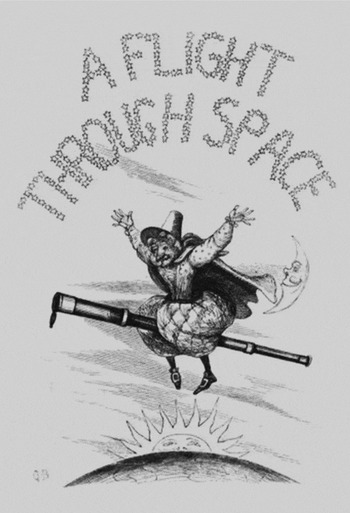
Humboldt claims his cosmic journey, Cosmos, displays “that which is known, whether regarded, in the present state of science, as certain, or as merely probable in a greater or less degree” (1: 72–73). By including the terms “merely probable,” Humboldt suggests that an element of imaginative content is permissible in scientific claims and descriptions, a characteristic that is often found in the cosmic journey. Although, some writers placed limits on their tour of the universe by keeping their descriptions within what was scientifically known and factually verifiable – as we shall see Giberne was to do in Among the Stars later in the century – many appealed to the reader's imagination to make the incompressible distances, and the worlds of the universe knowable. In John Cargill Brough's chapter “A Flight Through Space” in The Fairy Tales of Science (1859), he explains that the reader with the narrator has “winged” their “daring flight to the utmost confines of the visible heavens, to the Ultima Thule of the starry world. But beyond, into the endless realms of space, we may not soar,” as “here Almighty wisdom has fixed a barrier, sealed to the finite intellect of man.” For Brough, only “superior intelligences of higher spheres” may “stand in their turn on the confines of another immensity, into which even they may not enter – and so on in endless succession.” Brough discloses that this cosmic journey has not been “through space” but “ay, not even yet towards the threshold of space!” To Brough, the “endless realms of space” are beyond knowledge: the “Almighty” has set bounds to man's enquiries, and the reader must imagine the “endless succession” of the immensities of the universe (196). This bringing together of imagination and science is explicit in Charles H. Bennett's illustration for Brough's chapter “A Flight through Space.” Here a witch representing fantasy and the imagination rides on a telescope, a scientifically objective device, instead of the characteristic fairy-tale broomstick (Figure 4).
Charles H. Bennett, “A Flight through Space.” Illustration, from John Cargill Brough, The Fairy Tales of Science: A Book for Youth (London: Griffith, 1859), plate facing 174.

“On the Wings of Imagination”
An actual mode of transport is not always detailed in Victorian cosmic voyage literature. Some travellers almost miraculously arrive at the moon and planets of the solar system. As such, the distances between the earth and the planets are shortened or completely dissolved, bringing them back to within everyday conceptualization. For example, in Giberne's Among the Stars Eikōn (the name Ikon, the cosmic voyager, is given in the story he is told by his astronomer friend Fritz) when “hovering above the Solar System” is “able to view the wondrous sight more fully.” Fritz illuminates: “Miles were miles and distances were distances still; yet the vastness of space appeared to shrink and to come within the grasp of his mind and thought” (225–26). Lord John Russell, in the essay “A Journey to the Moon” in Adventures in the Moon, and Other Worlds, claims to have been able to “walk up into our satellite with safety,” and as “the nature of this invention is so well known, that [he] need give no description of the journey” (5). Here the lack of vehicular travel is both convenient – as no means for space travel had yet been invented – and it also entails a making safe of the vast distances between the earth and the moon. Rather than describing a method of reaching the moon, Russell's concern is more with the people he meets along the way and their purpose for travelling there, who variously are seeking to recover their youth, cure melancholy or “revoke their wrinkles” (6). Russell's is a utopian fiction, in which he constructs the moon as a better place than the earth. During his travels throughout the districts of the moon, he meets fellow moon voyagers who by drinking their “spirits” from bottles labelled with their name recover their laughter, or by drinking their “past hopes,” the expectations they have lost (22, 30). In the “House of Lost Vices” they “return to the amusement of their youth” by viewing through a kaleidoscope, also bearing their name, scenes now lost due to their contrite lives on earth. “Visions of the past,” writes Russell, “have a singular power over the owner of the kaleidoscope, reviving his former thoughts and sensations, and imparting at the moment a fancied vigour” (38).
In contrast to Russell's “A Journey to the Moon,” the cosmic expedition through the solar system presented by the anonymous writer of A Fantastical Excursion into the Planets describes the mode of travel in detail. The writer's aim is to “afford much amusement to many kind readers, who would venture on the perusal of these whimsical leaves, and thus allow themselves to be led away beyond space and time, by a fantastical goblin into such eccentric flights, in defiance and scorn of all rational guidance” (v). This “fantastical sprite” possesses “an enormous pair of beautiful papilion wings, as large and as brilliant as none but such creditable travellers as Munchausen and Co. can describe.”Footnote 8 The goblin informs the narrator of his name and task: “‘I am,’ whispered he in my ear, ‘I am thy Imagination!, and am ready, by the aid of these charming wings, to fly away with thee to yonder aerial regions; and though I cannot nurture thy mind with realities, I may yet amuse thee for some moments with illusions.’” Affording the narrator “no time either to laugh or deride, scorn or reject such a strange proposal,” the narrator feels that he is elevated into the solar system (9–10). Landing first on the planet Mercury, the narrator is surrounded by its inhabitants who are like “fairy sprites” that “skip or skim their every hour of life” with a “fleetness” of “gossamer buoyant in the air.” Revoking any sense of fear the landscape of other worlds might produce, the reader learns that the heavens “are indeed regions of pleasure and delight” (11). Venus, for instance, possesses a landscape of tall mountains “fringed with high waving forests, and edged with odoriferous groves. . .diversified, here with sunny glens, and there with shady dells, or romantic vales” (21). The ensuing pastoral nature of this description raises a sense of reassuring calmness and aesthetic satisfaction. The author creates a word-picture that reminds the reader of picturesque British landscapes, such as the mountains and glens of Scotland, familiar to them through direct experience or through landscape paintings. In such a way, the scenery of other worlds in cosmic voyage literature is made knowable, resulting in differences of distance and place being subsumed.
In Howard and Geister's The History of a Voyage to the Moon, there is also a making safe of the strange landscape of the moon. The writer diametrically opposes the factually correct strange, bleak and inhospitable surface of the moon with an earth-like vista. At first Howard, the narrator, describes the surface of the moon as virtually barren: “on the level ground in this silent ravine grew not a single tree; only, among the pieces of fallen rock and stones, struggled forth a few stunted bushes and dock-like plants.” However, almost immediately Howard turns to describing a knowable vista of “beautiful intensification of perspective” with Geister replying that the “rocks resemble granite,” the “trees look like trees” and the ground “is but ordinary soil; indeed, the whole is very earth-like.” There is nothing “startlingly novel,” about the scene and thus Geister takes this to infer that it reflects the “natural economy” of all the members of the solar system, and that only in other systems will travellers find “worlds altogether new – different in matter and design from our native Earth” (121). The effect is to create a “UNITY OF NATURE”; a result also aspired to by Humboldt and his followers such as John Herschel (“Kosmos” 170). Indeed, Humboldt's aim in Views of Nature was to reproduce for the reader the “harmony and effect of a picture” (ix). Reviewing Humboldt's Cosmos in the Edinburgh Review in 1848, John Herschel demonstrates how the universe could be shown as “unified” and how “to be in any way successful” it must be described “in the highest possible sense of the word, picturesque, nothing standing in relation to itself alone, but all to the general effect” (“Kosmos” 171). This synthesis creates harmony and subsumes the differences of other worlds from the earth. Not least, the comparison with known terrestrial features, such as the height of the South American mountain Chimborazo, as in the anonymous A Fantastical Excursion into the Planets, makes the scale of the mountains of Venus easier to conceptualize; it makes safe the new prospects and other worlds of the universe.
In The History of a Voyage to the Moon even the inhabitants are recognisable as “human beings – limbs, figure, and features the same – but of small stature; the men averaging apparently but four feet in height, while the females, as with terrestrials, were still smaller” (122). Miniaturisation enables a commanding position, and is applied not just to the inhabitants, but also to the size of the moon in relation to the earth. The earth as a planet is no longer a small futile part of the universe in comparison with its vastness – anxieties about the size of the earth in the cosmic order are addressed. As they both put on “bearskin hats, as worn by the English Grenadier Guards,” which add an air of superiority and confidence, Geister declares “We are ambassadors representing a sphere forty times the size of this: let the dignity of our personal appearance and deportment equal the importance of our native Earth in the solar system” (128). They also attain a commanding position as they view the landscape of the moon from the top of the hill where they had built a hut. They awake astonished to a “grand scene” of “the most extraordinary” that Howard “had ever beheld.” Situated at “one side of the mouth of a mountain gorge”:
Stretching away from [them] straight and vista-like it ran, each side an apparently interminable wall of lofty and almost vertical cliffs. . .preserved all along with singular regularity, although at last perspective made the two walls appear almost to meet where, at the boundary of the horizon, their further continuation was hidden from our sight by the convexity of the moon's surface. (120)
Here, Howard and Geister's commanding position and its inherent place of security, makes safe the unfamiliar landscape of the moon with its forbidding “interminable wall of lofty and almost vertical cliffs.” The “convexity of the moon's surface” has a limiting and controlling effect, hiding the vanishing point of the parallel “two walls” of cliffs that in terms of artistic drawing and technical perspective is suggestive of a point of infinity. It prevents them seeing the never-ending distance to which the walls of cliffs extend and subsequently stops the reader being disturbed by the size of the moon. Likewise, employing the idea of the commanding prospect also appeals to reader familiarity, as they would recognise the trope from descriptive landscape writing of the Romantic and Victorian periods.
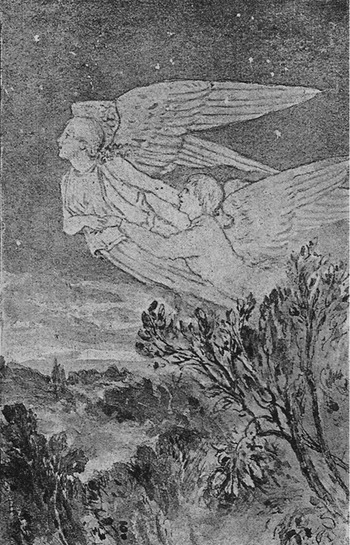
Familiarity, and thus knowability, is also achieved by the writer of the cosmic voyage recounting known astronomical facts. Giberne's Among the Stars, rather than offering fanciful descriptions of the nature of the other worlds visited, contains only what is factually known. This also projects a sense of safety to the reader, as it conforms to astronomical knowledge they may already have from other sources. Giberne's text is littered with astronomical facts concerning the distances between the earth and the planets, the motion of the earth, the position of the constellations, and the nature of comets and meteorites. Giberne takes these facts from the findings of astronomers, such as John Herschel, Nichol and William Huggins, whose researches were widely published in books and articles in learned and popular print. The story centres on Ikon, a sickly and lonely boy whose mother has died and who finds entertainment in watching the stars, a scenario that both Victorian children and adults could identify with. Supported by “Wings of Imagination” behind his shoulders, Ikon dreams that he travels towards the moon with his tutor Herr Lehrer, but he wakes before the dream is finished (24). Later in Among the Stars, Ikon is told a tale by his astronomer friend Fritz about a boy called Eikōn, who flies through the solar system to the moon and planets with a girl called Stella. Eikōn's name and the angelic quality of his wings in the accompanying depiction “A Flight to the Moon,” suggest he is an image and manifestation of perfection in his quest for knowledge about the solar system (Figure 5). For Giberne, this knowledge must be scientifically correct. Ikon is told by Herr Lehrer that “on the Wings of Imagination. . . .Wonderful journeys may thus be taken,” but also that they only “can go in imagination, just so far as the telescope has power to carry” them, as “the power of the telescope is limited” (24, 70, 72).When Fritz tells him his story, Ikon is curious as to what is to be found on the side of the moon that cannot be seen from the earth. He suggests that Fritz could have “made Eikōn go to the other side of the moon, and fancied something for them to see.” In reply, Fritz retorts: “I might have made them find Jack and the Beanstalk there, or Cinderella and her glass slipper.” However, Fritz advises that this is a story of “sense” not “nonsense” and that although people imagine air, water, grass, trees and animals there “these are mere guesses” (193-94).Footnote 9
“A Flight to the Moon.” Illustration, from Agnes Giberne, Among the Stars: or Wonderful Things in the Sky (London: Seeley, 1885), plate facing 172.

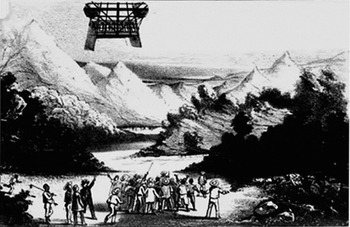
Looking back at the earth from other worlds, or whilst moving through the solar system, is an important feature of the Victorian cosmic journey. Howard and Geister in The History of a Voyage to the Moon, look back at the earth during their journey in their space vehicle called a Lunaviot. The Lunaviot, as illustrated in the frontispiece, is constructed of timber and obliquely inclined sheets of iron that allow the voyagers to control the forces of magnetism to ascend and descend (Figure 6). The vehicle also has viewing windows with shutters in the sides and floor. Travelling through the void of space, Howard and Geister feel “absolutely alone,” as they are unable to “look upon the habitations of men” (102). A particularly striking moment which, operates to make safe the vast abysses through which they are travelling, follows their announcement of fearful “solitude” (101). Howard has an accident with a window shutter in the Lunaviot, which leaves “a hole in the shutter about a foot square” that he describes as limiting the view through it because of its “small size” (102). Interestingly, the small aperture produces a partial viewing effect reminiscent of a telescopes ability to crop the view. By cropping the scene of the earth in the vast space of the universe, distance and scale are disrupted.Footnote 10 It also brings to mind the Victorian concept of anorthoscopic vision “(abnormally viewed)” where a scene or object viewed through a small slit or aperture in an opaque surface results in a partial view, and the consequent restricted visual field suggests the need to make visible the absent, essential to which is the use of the imagination (Smith 138).Footnote 11 In both cases the partial view focusses Howard and Geister's minds intensely on the phenomenon of the earth. Howard explains that both voyagers gaze “for some time with a feeling of childish awe and reverence” at the “great Earth” through the limited “aperture” (102). The earth, thus viewed, is invested with the devotional and reflectional properties of an icon. Meditating reverently on the scene of the earth, Howard and Geister's minds become fixed on their past on earth, and they remember those among the “nine hundred million” entities inhabiting the earth who had “injured” them (102). Viewing the earth from the occluded position inside the Lunaviot, divided from the view of the earth by the frame of the shutter and by distance, they now feel able to forgive these enemies, as their position is one of safety in relation to their adversaries.
Frontispiece from Stephen Howard (pseud.) and Carl Geister (pseud.), The History of a Voyage to the Moon, with an Account of the Adventurers' Subsequent Discoveries: An Exhumed Narrative, Supposed to have been Ejected from a Lunar Volcano (London: Lockwood, 1864).

Victorian scientists also employ the theme of the cosmic journey, looking back at the earth as they take their readers on a voyage through space. In the first chapter of Proctor's The Expanse of Heaven (1873) entitled “A Dream that was not all a Dream,” implying its contents merge the imaginative with the factual, he describes a visual journey through “glowing orb[s]” (4). Proctor perceives that “the small globe” he “had visited” was “the earth on which [he] lived, and the great fire-globe was the sun, while the other orbs [he] had visited were the planets and their satellites” (10). Given “a power of keener vision” in his dream, he sees “many animalcules, inconceivably minute”: “Over the dry part of this tiny globe, which I could have held (so it seemed in my dream) between my finger and thumb, were other creatures in countless myriads, though not in all parts equally numerous” (2). “Drawn down to the surface of the tiny globe” amongst “the tiny reasoning creatures,” he realizes his own insignificance is comparable with that of the “wretchedly small and weak” creatures that inhabit the earth (10, 8, 9). The Lilliputian reductions in the size of the beings that inhabit the earth are relative to Proctor's diminution of the phenomena of the solar system when he leaves the earth to approach the sun:
I left the little globe to pursue its course, and went to the large bright body. It was not quite a quarter of a mile away, I found; but. . .about 320 yards from the small globe. . . .The great glowing orb, though nine feet in diameter, was turning steadily round. (4)
Here, the “keener vision” the dreamer experiences is remarkable for the way it reduces huge distances, measurements, and the sizes of the astronomical bodies encountered, to a scale that the human mind can comprehend.
William Leitch's story “A Journey through Space,” published in the magazine Good Words, also questions the period's notion of the grandeur of the heavens as difficult to conceive. For Leitch, despite the “facts and deductions of astronomy sufficiently bring[ing] out the immensity of the universe as contrasted with our world. . .our thoughts will obstinately cling to our globe, and the images of grandeur will still be, our terrestrial seas and mountains” (516). Leitch's solution is for the reader to “attempt to escape from the narrow confines of our globe, and see it as others see it from a different standpoint.” “Let us take a nearer view of other orbs and systems, and see what impressions they produce, as compared with that received from the platform of the earth,” writes Leitch (516–17). Noting that “it was long the fond wish of man to soar above this terrestrial scene, and visit other planets,” Leitch discusses the mode of transport to be used for the “excursion.” He asks, “Must we be altogether dependent on the fairy wings of imagination, or can we derive aid from some less ethereal agencies?” For Leitch, the only possibility would be designed “on the principle of the rocket” where “the velocity would, indeed be greater in a vacuum than in the atmosphere, and should we dispense with the comfort of breathing air, we might with such a machine transcend the boundaries of our globe, and visit other orbs.” However, Leitch recommends that instead of “torturing our imagination to conceive of a rocket device, which would eclipse the performance of all flying machines,” a comet “one of nature's rockets” should provide the vehicle for the fantasy flight. Leitch makes comparisons between a comet and a rocket. He explains that a rocket with its “fiery stream directed against a strong wind, very well represents the telescopic appearance of a comet when in the neighbourhood of the sun. The luminous particles shoot out from the nucleus of the comet precisely as the sparks issue from the rocket-tube” (517).
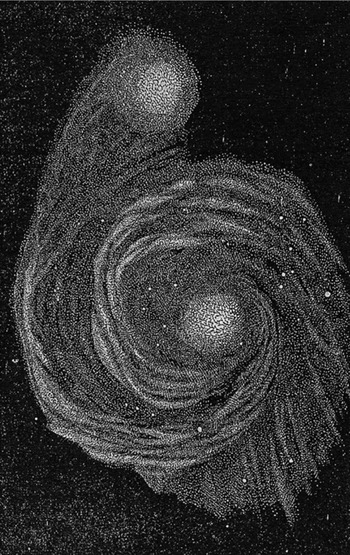
Leitch advises that a comet used as a rocket vehicle for the imagination has the advantage of giving “near, as well as extensive views of the system.” This he compares to the earth, which he claims “always keeps at the same distance, or nearly so, from all the bodies of the system, so that, although it is constantly moving onwards, we are kept at such a distance, that we see but little change in the celestial scenery.” Journeying in a comet would alter the traveller's perception of the universe. Leitch explains that comets generally “rise above the plane of the solar system” providing “a clearview of the relation of one planet to the other.” However, some comets also have the advantage that they at times move on the “same level with the planets, and it is from a comet with such an orbit, that the best view can be obtained of them individually” (517–18). Leitch is not alone in suggesting the suitability of comets as vehicles for viewing the universe. Dick in The Sidereal Heaven proposes: “some of the comets may be the abodes of greater happiness than is to be found in our sublunary world, and may be peopled with intelligences of a higher order than the race of man” (362). Dick also suggests that “in consequence of the extensive regions through which they move, and the variety of objects which will successively burst upon their view” the dwellers of comets “prospects of the scenes of the universe will be far more diversified and expansive than those of the inhabitants of the planets” (362–63). However, for Leitch the firmaments that lie beyond the solar system will take too long to reach by comet, so a faster vehicle is necessary and can, he suggests, be fulfilled by “something still more subtle and swift,” a “ray of light.” With the “ethereal vehicle of light” a voyage can be made “far beyond the solar system” to the fixed stars from which can be viewed the spiral structure of the Milky Way. According to Leitch, from the vantage point of the star Alpha Centauri, the Milky Way, as the illustration to his article shows, “lies like a bright ring before us, with perhaps a tendency to the spiral structure; the cleft in the galaxy corresponding to a coil of the spiral” (Figure 7). “With all the spiritual swiftness of light,” writes Leitch “we can reach [Alpha Centauri] only in three years and a quarter. . . .The smallest stars visible to the naked eye can probably be reached by a ray of light only in about fourteen years; and the smallest stars visible in the largest reflectors would probably require a journey of four thousand years.” Leitch elucidates the scale of the distance to the nearest fixed stars: “we are separated from the planets by an interval that may be compared to the breadth of a river; but an expanse like the Atlantic Ocean separates us from the nearest of the fixed stars” (520). By rendering the distances more knowable, Leitch enables the reader to conceptualize the vast vistas of the heavens.
The spiral structure of the Milky Way. Engraving, from William Leitch, “A Journey through Space.” Good Words 2 (1861): 516.

Today, we have more knowledge about the vastness of space, and what it contains. We know what comets are made of, and unlike the Victorians, we have actually seen the earth from space. Yet, there is still a pull towards the discovery of the unknown for us as there was for the Victorians. The Victorian writers in this study of cosmic journey literature, were part of, and were influenced by, the popular discourses of astronomical science. However, popular astronomical practices and discourses also produced the counter sensation of fear at the futility of the earth in the vast cosmic process. To the reader wrestling with abstract ideas, the theme of the cosmic voyage conceptualized the new prospects and other worlds of the cosmos. As Eliot in her letter to Maria Lewis reports Nichol as writing – “infinity” becomes “Hospitable.”