In early December 2019, a novel coronavirus (severe acute respiratory syndrome coronavirus 2, SARS-CoV-2) caused a cluster of respiratory infections (coronavirus disease 2019, COVID-19) in Wuhan, Hubei province of China. Reference Lu, Stratton and Tang1,Reference Chen, Zhou and Dong2 On January 30, 2020, the World Health Organization (WHO) declared the emergence of SARS-CoV-2 as a public health emergency of international concern. Reference Team3 As of February 10, there were more than 40,000 confirmed cases across 25 countries/regions, with 900 deaths occurring in China. Reference Li, Guan and Wu4,Reference Wang, Horby and Hayden5 Many health-care workers were infected with SARS-CoV-2 after close contact with infected patients, suggesting human-to-human transmission, and reflecting the strong infectivity and high incidence of SARS-CoV-2. Reference McMichael, Currie and Clark6,Reference Wang, Hu and Hu7
Hospitals are important settings for diagnosis and treatment of COVID-19, where the virus is more likely to be exposed to suspected or confirmed cases. Even during the COVID-19 outbreak, a majority of cancer patients have to go to the hospital to receive radiotherapy/chemotherapy or reexamination regularly, thus increasing their risk of infection. Reference Huang, Zhu and Wu8 The decreased body immunity of cancer patients and their lack of knowledge and preventive practices against COVID-19 render them more susceptible to SARS-CoV-2 infection. Reference Kamboj and Sepkowitz9–Reference van Dam, Huizing and Mestach11 In addition, emotional distress is a common phenomenon among cancer patients, Reference Linden, Vodermaier and Mackenzie12 and these patients may suffer greater psychological distress than healthy people during the COVID-19 pandemic, thus affecting their physical and mental health. Reference Wang, Duan and Ma13
To date, several studies have investigated the knowledge, preventive practices, and psychological state among the general population during the COVID-19 outbreak. Reference Kebede, Yitayih and Birhanu14–Reference Zhong, Luo and Li16 In a study by Kebede et al., Reference Kebede, Yitayih and Birhanu14 only 41.3% of community members showed adequate knowledge; the authors concluded that the status of knowledge and desirable practices were not sufficient to combat this rapidly spreading virus. According to Huang and Zhao, Reference Huang and Zhao15 the overall prevalence of generalized anxiety disorder and depressive symptoms among the Chinese public during the COVID-19 outbreak were 35.1% and 20.1%, respectively. However, the COVID-19-related knowledge and practices of cancer patients and the prevalence of anxiety and depression among these patients are not well characterized. Reference Erdem and Karaman17,Reference Guven, Sahin and Aktepe18 In addition, it has been reported that the public with lower knowledge of COVID-19 is more prone to anxiety and depression. Reference Padmanabhanunni and Pretorius19,Reference Ali, Sohaib and Iqbal20
Padmanabhanunni and Pretorius Reference Padmanabhanunni and Pretorius19 found that better knowledge of COVID-19 and engaging in protective behaviors were related to lower levels of psychological distress, whereas increased risk perception was associated with increased feelings of loneliness, anxiety, and depression. Given the particularity of cancer patients, the association between knowledge and practices related to COVID-19 and the consequent anxiety and depression in cancer patients deserve to be explored. Therefore, to carry out health education on COVID-19 for cancer patients, and strengthen the management of anti-epidemic work for cancer patients in the outpatient and inpatient departments, we surveyed cancer patients to investigate their knowledge and practices related to COVID-19. Moreover, we also assessed the anxiety and depression among these patients during the COVID-19 outbreak.
We hypothesized that knowledge and practices of cancer patients were insufficient toward COVID-19 during the early surge phase of the pandemic, and those with a lower level of education may tend to have lower knowledge and practice scores, and were more likely to suffer from anxiety and depression. We believe that the identification of the high-risk groups would be conducive to the treatment of cancer patients orderly and safely during the epidemic period.
Methods
Study Design
An online cross-sectional survey was conducted February 10-29, 2020, during the early phase of the COVID-19 outbreak, when the number of cases was rapidly surging. A convenience sample of inpatients and outpatients with cancer was recruited at our hospital. Inclusion criteria: (1) patients with definite cancer, regardless of the treatment regimen; (2) previous and current diagnosis of no combined mental illness, such as anxiety and depression; (3) volunteer to participate in this study. Patients were excluded if they had consciousness disorder, aphasia, hearing impairment, or other reasons leading to communication barriers. The online question-and-answer questionnaire (https://www.wjx.cn) was completed 1 by 1 under the guidance of trained nurses, who had protected permission to submit the results of every included patients’ answers. The study protocol was approved by the Institutional Review Board of the West China Hospital, Sichuan University. Written informed consent for participation in the study was obtained from all subjects before their inclusion. Participants were allowed to answer the questionnaire only once. All contents of the questionnaire were kept confidential. After the completion of the survey, the online survey interface showed the correct answers to each question, providing respondents with the relevant knowledge of COVID-19. The data were de-identified, and only aggregate data were used for the presentation of the results.
Measures
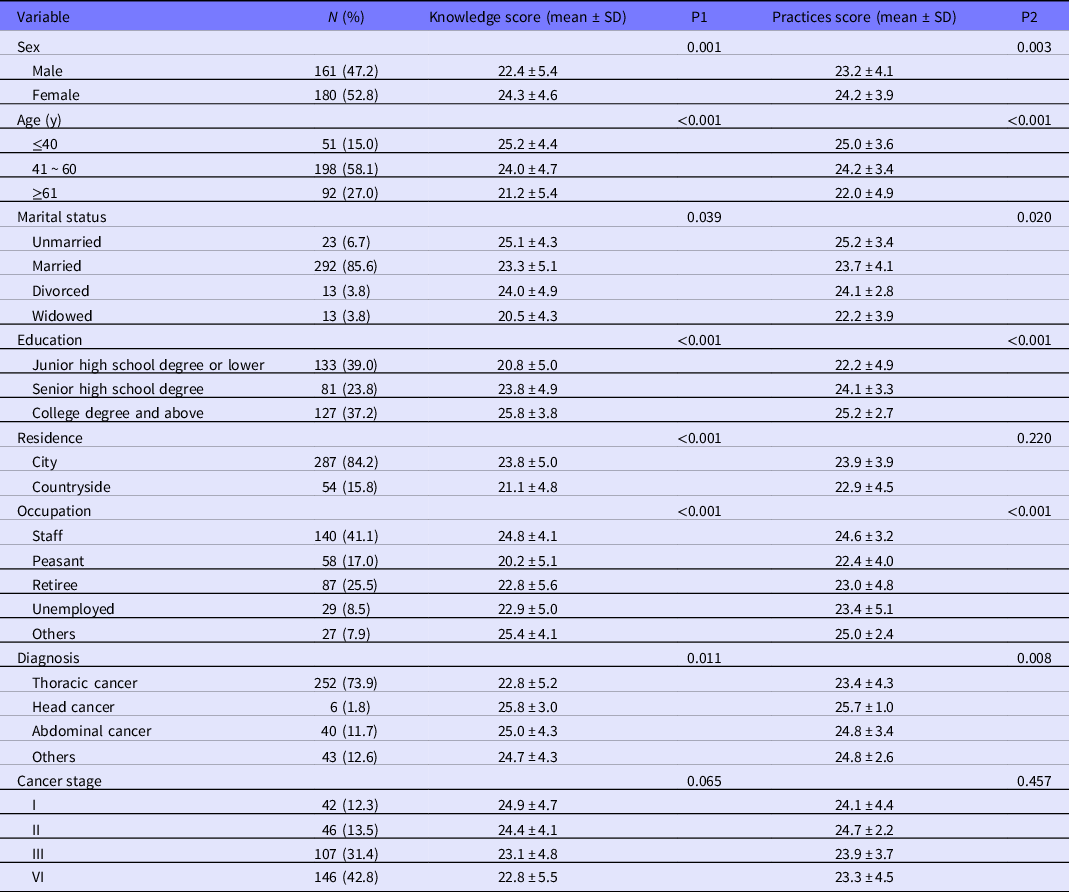
The questionnaire consisted of 3 parts, including demographics, knowledge, and practices related to COVID-19, and anxiety and depression during the COVID-19 outbreak. Demographic variables included 8 items, ie, sex (male, female), age (≤40, 41 ∼ 60, ≥61 y), marital status (unmarried, married, divorced, widowed), education (junior high school degree or lower, senior high school degree, college degree, and above), residence (city, countryside), occupation (staff, peasant, retiree, unemployed, others), diagnosis (thoracic cancer, head cancer, abdominal cancer, others), and cancer stage (I, II, III, IV) (Table 1).
Knowledge and practices scores related to COVID-19 by demographic characteristics (N = 341)

Note: P1, P-value of knowledge score in participants with different demographic characteristics; P2, P-value of practices scores in participants with different demographic characteristics.
Abbreviation: SD: standard deviation.
The questionnaire to assess the knowledge and practices related to COVID-19 was developed based on the guidelines for the diagnosis and treatment of novel coronavirus (2019-nCoV) infection by the National Health Commission of the People’s Republic of China (trial version 5). Reference Lin and Li21 To assess the knowledge, questions related to the symptoms, transmission routes, susceptible population, epidemiological characteristics, virus inactivation mode, and protective methods against COVID-19 were included in the questionnaire. There were a total of 10 questions including 31 correct options; each correct response was awarded a score of 1, while no score was awarded for an incorrect response. The total knowledge score ranged from 0 to 31, with a higher score representing better knowledge of COVID-19. Exploratory factor analysis results of the knowledge questionnaire showed that Kaiser-Meyer-Olkin (KMO) measure of sampling adequacy was 0.767 and Bartlett’s test of sphericity was <0.001. The extracted 11-factor model explained 59.97% of the total variance. The Cronbach’s alpha coefficient was 0.810, which showed satisfactory internal consistency. Scores were bounded by 80% of the total score; a score <25 was considered indicative of lower knowledge, and a score ≥25 was considered indicative of higher knowledge. Reference Kebede, Yitayih and Birhanu14
The questionnaire for assessing practices related to COVID-19 included questions about personal hygiene practices, method of wearing mask, and household preparedness (total of 10 questions and 27 correct options). Similar to the scoring method for the knowledge questionnaire, the total practice score ranged from 0 to 27; score < 22 was considered lower practices score, and a score ≥22 was considered a higher practices score. The KMO value of the practices questionnaire was 0.826 and Bartlett’s test of sphericity showed a significance of P < 0.001 and extracted an 8-factor model, which explained a total variance of 62.65%. The Cronbach’s alpha coefficient was 0.851 in our sample, indicating acceptable internal consistency.
Given the rapid spread of the COVID-19 outbreak, timely mental health care for cancer patients is urgently needed. Reference Xiang, Yang and Li22 Therefore, the Chinese version of the Hospital Anxiety and Depression Scale (HADS), Reference Yang, Huang and Liu23 which has good psychometric properties in terms of structure validity (KMO = 0.910; Bartlett’s test P < 0.001) and internal reliability with all Cronbach’s alphas >0.70, was used to assess anxiety and depression in cancer patients. HADS is a 14-item instrument, each of which is scored on a 4-point Likert scale (0-3 pts); 7 items constitute the anxiety measuring subscale, and the remaining 7 items constitute the depression measuring subscale. The scores are calculated for each subscale separately, with 0-7 being a normal score, 8-10 a borderline value, and 11-21 indicating anxiety or depressive disorder, respectively. Reference Zigmond and Snaith24
Statistical Analysis
Continuous variables are presented as mean ± standard deviation, while categorical variables are presented as frequency and percentages or ratios. Knowledge and practices scores, as well as anxiety and depression scores of different respondents, were compared according to demographic characteristics. After assessing the normality of data, variables determined to be normally distributed were compared using Student’s t-test or 1-way analysis of variance, while nonnormally distributed variables were compared using the Mann-Whitney U-test or Kruskal-Wallis H-test. All statistical tests were 2-sided, and P values < 0.05 were considered indicative of statistical significance. Following univariate analyses, significant factors were subjected to multiple stepwise linear regression analysis to identify variables (sex, age, marital status, education, residence, occupation, and diagnosis) associated with lower knowledge or practices score using P-value < 0.05 to remain in the model. Unstandardized regression coefficients (β), standard error, and 95% confidence intervals were computed. IBM SPSS version 24.0 was used for all analyses.
Results
A total of 345 questionnaires were distributed, and 341 complete questionnaires were returned (response rate: 98.8%). The demographic characteristics of the respondents are summarized in Table 1.
Sources of Information About COVID-19
A variety of sources were used to obtain information about COVID-19. The Wechat application or news media (89.7%), and television (TV, 83.9%) were the most frequently cited sources. Only 38.1% of the respondents obtained information about COVID-19 through the medical staff.
Knowledge About COVID-19
The average knowledge score of the respondents was 23.38 ± 5.05 (range: 6-31). Among these, 170 respondents had a lower knowledge score (49.9%), and 171 respondents had a higher knowledge score (50.1%). On univariate analyses, knowledge score showed a significant association with sex, age, marital status, education, residence, occupation, and diagnosis (P < 0.05) (Table 1). However, on multiple linear regression analysis, only education of junior high school degree or lower (vs college degree and above, β: −3.503; P < 0.001), education of senior high school degree (vs college degree and above, β: −1.414; P = 0.046), and diagnosis of abdominal cancer (vs thoracic cancer, β: 2.041; P = 0.011) were significantly associated with lower knowledge score (Table 2).
Multiple linear regression analysis on factors associated with lower knowledge score about COVID-19

Note: F = 6.616, P < 0.001, R2 = 0.246, adjusted R2 = 0.209; adjusted R2 indicated that the equation had a predicted accuracy of 20.9 %.
Practices Related to COVID-19
The average practices score of the respondents was 23.77 ± 4.02 (range: 8-27); 64 (18.8%) respondents exhibited lower practices score, and 277 (81.2%) exhibited higher practices score. On univariate analysis, practices score showed a significant association with sex, age, marital status, education, occupation, and diagnosis (P < 0.05) (Table 1). In the multivariable model, education of junior high school degree or lower (vs college degree and above, β: −2.210; P < 0.001) and diagnosis of abdominal cancer (vs thoracic cancer, β: 1.391; P = 0.037) were significantly associated with lower practices score (Table 3).
Multiple linear regression analysis on factors associated with lower practices score about COVID-19

Note: F = 3.964, P < 0.001, R2 = 0.155, adjusted R2 = 0.116; adjusted R2 indicated that the equation had a predicted accuracy of 11.6 %.
Anxiety and Depression During COVID-19 Outbreak
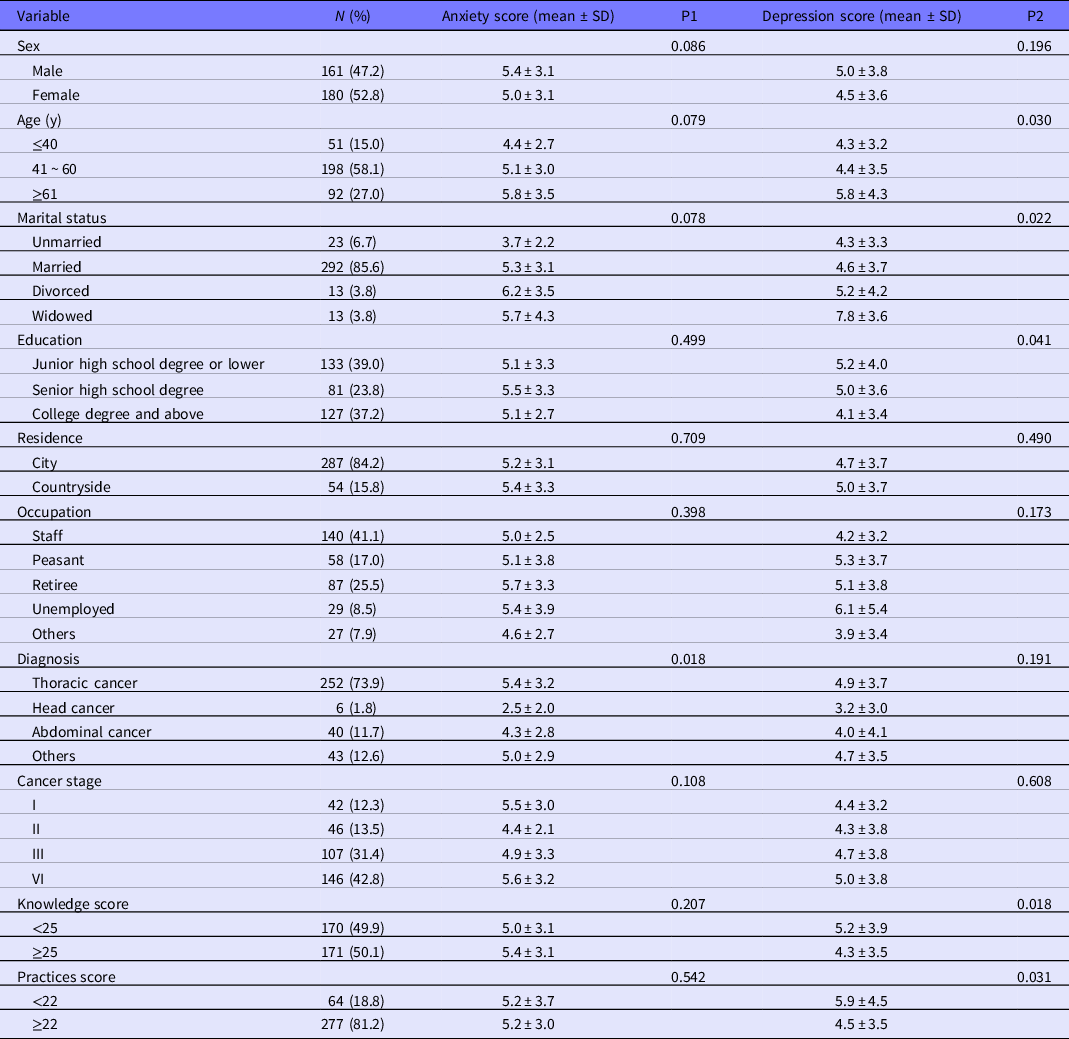
The detection rates of anxiety and depression symptoms among respondents were 17.6% and 23.2%, respectively; 13.2% of respondents had symptoms of both anxiety and depression. Thirty-nine respondents had borderline abnormal anxiety symptoms (11.4%), whereas 50 respondents had borderline abnormal depression symptoms (14.7%). The prevalence rates of abnormal anxiety and depression symptoms among respondents were 6.2% and 8.5%, respectively. On univariate analyses (Mann-Whitney U-test or Kruskal-Wallis H-test), higher depression score was associated with older age (≥61 y), marital status of widowed, and lower level of education (below college degree), knowledge score (<25), and practices score (<22) (P < 0.05 for all) (Table 4). In the multivariable model, only the marital status of widowed (vs married, β: 2.490; P = 0.020) was significantly associated with a higher depression score.
Anxiety and depression scores of COVID-19 by demographic variables (N = 341)

Note: P1, P-value of anxiety score in participants with different demographic characteristics; P2, P-value of depression score in participants with different demographic characteristics.
Abbreviation: SD, standard deviation.
Discussion
According to the National Health Commission of the People’s Republic of China and the WHO, Reference Lin and Li21 SARS-CoV-2 is mainly spread by respiratory droplets and contact, and people are generally susceptible to it. Most patients with COVID-19 have a good prognosis, while older adults and those with underlying chronic diseases have a poor prognosis and a higher risk of death. Reference Li, Guan and Wu4 A large proportion of cancer patients are older adults, with or without multiple comorbidities. Cancer patients have special nutritional requirements, and they are often immunosuppressed due to the effect of radiotherapy and chemotherapy. Reference Kamboj and Sepkowitz9 A systematic review showed that cancer patients with COVID-19 have a higher likelihood of death (odds ratio[OR] 2.54). Reference Venkatesulu, Chandrasekar and Girdhar25 Therefore, cancer patients need to pay more attention to preventive measures against COVID-19 infection. Timely assessment of knowledge and practices of cancer patients related to COVID-19 is a key imperative. Reference Tian, Hu and Niu26
To the best of our knowledge, this is the first cross-sectional survey to assess the COVID-19-related knowledge and practices of cancer patients and to assess their anxiety and depression during the early surge phase of the pandemic. In general, more than 4 of 5 respondents showed good awareness of preventive practices such as wearing of masks and washing of hands. Unfortunately, only half of the respondents exhibited a higher level of COVID-19-related knowledge, indicating the need to improve the knowledge of symptoms and epidemiological characteristics of COVID-19, especially among cancer patients with a lower level of education. In addition, a considerable proportion of respondents were affected by anxiety or depression, and poor awareness of knowledge and practices related to COVID-19 was associated with a higher risk of depression symptoms.
Knowledge about COVID-19 influences the implementation of control measures. In the current study, nearly half (49.9%) of the respondents showed inadequate knowledge of COVID-19. The knowledge level in our cohort was much lower than that in the study by Zhong et al., Reference Zhong, Luo and Li16 in which the overall correct rate of COVID-19 knowledge was 90%. This may be related to the higher education level of the sample in Zhong’s study. Kebede et al. Reference Kebede, Yitayih and Birhanu14 reported that only 41.3% of respondents had high knowledge of COVID-19 using the same calculation methods of knowledge level as our study among their medical center visitors, which indicated that the status of knowledge was not sufficient to combat this rapidly spreading virus. In a survey of 300 oncology patients conducted by Erdem and Karaman, Reference Erdem and Karaman17 66.7% of patients could not identify the 3 most common symptoms and 51.7% were not aware of the routes of transmission of SARS-CoV-2. The authors suggested that specific up-to-date and accurate health information may significantly improve the knowledge and awareness of cancer patients.
Lack of appropriate preventive practices and behaviors among cancer patients not only increases their risk of COVID-19 infection but may also spread the virus to their relatives, friends, and colleagues, increasing the COVID-19 infection rate. Reference Basch, Hillyer and Meleo-Erwin27 In our study, 18.8% of respondents showed poor awareness of preventive practices. Cancer patients with a lower degree of education, especially those with junior high school degrees or lower, showed poorer knowledge and practices related to prevention of COVID-19. The phenomenon may be attributable to the limited access to and lack of understanding of the relevant knowledge of COVID-19 in cancer patients with a low educational level, Reference Zhong, Luo and Li16 which is generally consistent with the results of previous studies among Chinese residents during the rapid rise period of the COVID-19 outbreak. Reference Zhong, Luo and Li16,Reference Yue, Zhang and Cao28 These findings indicate the need for targeting health education interventions to certain demographic groups.
In the study by Yue et al., Reference Yue, Zhang and Cao28 female sex and unmarried marital status were found to be independent predictors of COVID-19 knowledge after multiple linear regression analysis, which was not observed in our study. This discrepancy may be attributable to the high proportions of female respondents with college degree and above (57.2%) and unmarried respondents with a senior high school degree or above (97.5%) in their survey. Of interest, in our study, we found that diagnosis, rather than cancer stage, may be a related factor. Patients with abdominal cancer showed higher levels of COVID-19-related knowledge and preventive practices scores when compared with patients with thoracic cancer. This may be attributable to the higher proportion of college degree and above education among patients with abdominal cancer (52.5%) compared with patients with thoracic cancer (31.3%). This indirectly confirms the correlation between education level and knowledge and practices related to COVID-19. Reference Zhong, Luo and Li16,Reference Yue, Zhang and Cao28 Therefore, medical staff should conduct targeted COVID-19 knowledge education for cancer patients, with a special focus on those with low educational level.
The rapid spread of the COVID-19 epidemic and its impact on daily life tends to compound the negative emotions experienced by individuals. Reference Wang, Pan and Wan29 Cancer patients showed aggravation of psychological distress, especially anxiety and depression, due to disease-related symptoms and delayed cancer care. Reference Weller30 Therefore, we assessed the psychological status of cancer patients during the rapid surge phase of the pandemic using HADS. We found that 17.6% and 23.2% of respondents were affected by anxiety or depression symptoms. The prevalence of abnormal anxiety and depression symptoms in our cohort was 6.2% and 8.5%, respectively. Due to the sudden occurrence of the pandemic, we were unable to assess the psychological status of the individual patients before the outbreak. However, our findings were generally consistent with the reported prevalence of major depression (15%), minor depression (20%), and anxiety (10%) in cancer patients undergoing treatment during a nonpandemic period. Reference Mitchell, Chan and Bhatti31
In a study conducted during the initial phase of the pandemic, Wang et al. Reference Wang, Pan and Wan29 reported higher rates of moderate-severe anxiety symptoms (28.8%) and moderate-severe depression symptoms (16.5%) among the general population compared with our study. The difference may be due to the high proportion of females in their study, who are at a higher risk of anxiety and depression. Reference Wang, Di and Ye32 Another reason may be that those with mental illness including anxiety and depression were excluded in the current study, which led to lower rates of anxiety and depression symptoms in these included cancer patients than that in the general population. Reference Galindo-Vázquez, Ramírez-Orozco and Costas-Muñiz33 In addition, in a study conducted by Gallagher et al., Reference Gallagher, Bennett and Roper34 they found that cancer patients were at increased risk of developing depression during COVID-19, using data extracted from 2 waves (2017-19 and April 2020) of the Understanding Society UK dataset, and that feelings of isolation helped explain this risk. These studies suggest that medical staff should also take cognizance of patient anxiety and depression during COVID-19-related educational interventions for patients, no matter whether with an existing mental illness.
In recent studies, younger respondents (age <35 y) were found more likely to develop anxiety and depressive symptoms during the COVID-19 outbreak owing to their concerns related to the future consequences and economic challenges caused by the pandemic. Reference Huang and Zhao15 In addition, respondents with higher levels of education showed a higher prevalence of psychological symptoms, which was due to the high self-awareness about their own health. Reference Wang, Di and Ye32 Conversely, in the current study, advanced age, lower education level, widowed marital status, and lower knowledge and practices scores were found to be associated with higher depression scores. This may be explained by the higher proportion of patients with advanced age and lower education levels in our study. Lower education level is a predicting factor associated with depression in cancer patients Reference Tsaras35 ; therefore, managing stress and psychological symptoms is critical for these patients. In addition, our findings suggested that improving knowledge and taking preventive measures may have a protective effect against the adverse psychological effects during the early stage of the epidemic. This is consistent with the previous study on SARS in 2003. Reference Leung, Lam and Ho36
In the current survey, Wechat or news media and TV were the most frequently cited sources of information about COVID-19. In contrast, a low proportion of respondents obtained information from medical staff (38.1%). Similar findings were reported by Yue et al. Reference Yue, Zhang and Cao28 In a self-administered survey, cancer patients were asked about their most trusted source of information during the COVID-19 pandemic; the majority of respondents trusted the Ministry of Health (98%) and doctors (94%). Reference Tashkandi, BaAbdullah and Zeeneldin37 Therefore, medical staff should pay attention to improve awareness and health education of cancer patients during the COVID-19 pandemic through multiple channels, especially social media platforms and TV. Reference Reinholz and French38,Reference Alshamrani, AlHarbi and Alkhudair39 In our hospital, we adopted a multipronged strategy to educate cancer patients about COVID-19. The various means adopted were: (1) TV shows conducted in oncology clinics and in the wards to impart knowledge of the safeguards against contracting COVID-19 during treatment; (2) preparation and distribution of leaflets and cards containing COVID-19-related information to patients and their attendants; (3) holding special training activities, such as knowledge contests and lectures in which patients and their family members were allowed to participate; (4) dissemination of correct information through the Wechat application and news media, and publication of scientific papers.
In addition to these health education interventions, our medical oncology team formulated a strategy to regulate the management of cancer patients and their companions in the early phase of the COVID-19 outbreak. Separate channels were earmarked for the entry of patients with fever or suspected COVID-19, ordinary patients, and the medical staff into the hospital. Only 1 attendant per patient was allowed in the hospital premises. Nurses took turns in monitoring the temperature of patients and their companions every day. In addition, symptoms, medical history, travel history, or history of contact with COVID-19 patients was also collected by nurses. Patients with symptoms suggestive of COVID-19 were subjected to appropriate investigations, such as reverse transcription-polymerase chain reaction (RT-PCR) test and/or computed tomography (CT) scan. Any patient who tested positive was isolated. Reference Liu, Yue and Tchounwou40 Furthermore, a detailed psychological intervention plan was developed by collaboration between the medical oncology staff and mental health staff. The intervention consisted of the following activities: weekly monitoring of the mental state of cancer patients after admission and before discharge during the COVID-19 outbreak; setting up a psychological intervention medical team, which conducted face-to-face or online counseling of cancer patients to enable them to deal with common psychological problems. Reference Chen, Liang and Li41,Reference Ream, Hughes and Cox42 For patients with mild psychological distress, psychological self-adjustment measures included breathing relaxation training and mindfulness training are suggested. For patients with moderate to severe psychological distress, a combination of medication and psychotherapy is suggested.
Limitations
Some limitations of this study should be considered while interpreting the results. First, the survey was carried out during the early surge phase of the pandemic. Thus, the findings may largely pertain to a specific time-period. With further evolution of the pandemic, the COVID-19-related knowledge and practices of cancer patients are liable to have changed along with the associated anxiety and depression. Second, this was a single-center study that enrolled a relatively small convenience sample of cancer patients. Thus, our results may not be generalizable to all cancer patients. Third, the study population was comprised of cancer patients who were not infected with SARS-CoV-2. Investigating those who are infected may be more instructive, but less representative. Last but not the least, we used a single psychological questionnaire scale, which may not reflect the true psychological state of the patients. Therefore, future studies should use multiple scales to investigate anxiety and depression in cancer patients during the COVID-19 outbreak from a forward-looking perspective.
Conclusions
The COVID-19 outbreak presents an unprecedented challenge for medical staff and cancer patients. Our study highlights the need for concerted interventions to improve the knowledge and practices of cancer patients related to prevention of COVID-19. Medical staffs need to assess the anxiety and depression of cancer patients and empower them to face the epidemic with a positive attitude using a combination of medical and psychological interventions.
Acknowledgments
The authors sincerely acknowledge Qiu-Fen Xiang, Xiao-Yu Guo, Fu-Rong Cao, Hong Li, Jiao Luo, Li Ma, Zhi-Ying Yue, Hong-Mei Wu, and Yun-Li He in Department of Thoracic Oncology and Cancer Research Center, West China Hospital, Sichuan University, who offered assistance in the course of this study.
Author Contributions
P.H.M., Z.S.Y., Z.R.J., F.Y., L.J.Y., Y.C.H., J.Y., and H.H. participated in the conception and design of the study. P.H.M., Z.S.Y., Z.R.J., and F.Y. participated in data collection and analysis and prepared the first draft of the manuscript. The manuscript draft was further reviewed and revised by L.J.Y., Y.C.H., J.Y., and H.H. All authors have read and approved the final manuscript. Hui-Min Pi, Shao-Yun Zhang, Ru-Jun Zheng, and Yan Fu contributed equally to this work and should be considered as equal first authors.
Declaration of Conflicting Interests
The authors declare that they have no conflicts of interest.
Funding
No funding was obtained for this study.