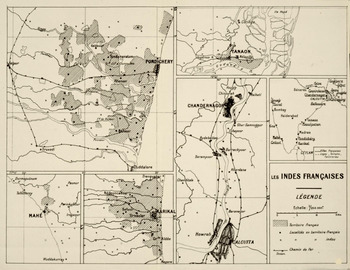
It is well known that the French lost India to the British in the eighteenth century. It is rather less well known that the French continued to rule over five small settlements (comptoirs) in India until 1954. Pondicherry, Chandernagore, Karikal, Mahé, and Yanam covered scarcely 203 square miles of territory and were scattered along the Indian coastline (see Figure 1). The geographical marginality of these settlements and their small size has rendered them invisible in Indian historiography. While there has been renewed interest in the decolonization of British India, the Partition of India, and the first decades of the post-colonial republic, very little attention has been paid to the end of the French empire in India.Footnote 1 Academic textbooks have largely ignored the history of the French settlements and, when it is mentioned, it is consigned to a mere footnote, easily cast aside in a wider narrative of British imperial decline and nationalist triumph.Footnote 2 At first sight, the disappearance of the comptoirs is of little interest: the French presence in India, much like the Portuguese, seems like an accident of history.
French settlements in India, 1949. The National Archives, MFQ 1/1144(2).

But such hasty judgements conceal a complex story. The way in which the French withdrew from India and the ‘integration’ of their colonial possessions into the newly independent Indian nation raised all sorts of questions about decolonization and nation-building. For a start, the decolonization of French India was anything but straightforward. While the Indian state held that the negotiated settlement between India and France to hand over the French territories was a vindication of its policy of ‘peace and patient perseverance’, a closer examination of the events reveals a different story.Footnote 3 The end of French rule, coming seven years after the departure of the British, needs to be understood in the light of the preoccupations of the nascent Indian state. Rather than seeing 1947 and Partition as marking a ‘natural closing date’, it is more useful, as Willem van Schendel has argued, to see it as a moment of state reconstruction.Footnote 4 Partition profoundly affected the social and political fabric of India and Pakistan, leaving a legacy of distrust and rivalry. But the refugee crisis and communal tension that came in its wake only served to highlight other problems. The most important of these was the question of ‘national integration’. India had within its boundaries more than 500 princely states. Their co-option into the India Union was not completed until 1954, the very same year that the French relinquished their possessions in India.Footnote 5 Of these, the integration of Hyderabad and Kashmir would prove particularly tricky. A further challenge came from the communist movement, especially where it drew support from peasant insurgencies, as in the case of Telangana.Footnote 6 Finally, there were nascent regionalist movements such as the demand for Dravidistan which questioned the very legitimacy of the Indian state.Footnote 7 The decolonization of French India was not, therefore, simply about putting to rest the relics of early modern imperialism; it raised fundamental questions about the legitimacy of the Indian state to speak on behalf of minority populations who did not necessarily identify with the emerging narrative of Indian unification.
France's withdrawal from the Indian subcontinent also took place in the formative years of Indian foreign policy. In his complex analysis of ‘postcolonial insecurities’, Sankaran Krishna has argued that foreign policy and nation-building were inexorably tied together in post-colonial India. The project of national integration ran parallel to that of defining and defending its frontiers.Footnote 8 As a young nation, this was expressed most importantly in India's ability to assert sovereign authority over its territories. And, as we shall see, India saw the French settlements as a natural part of India. Their integration into Indian territory thus became both a question of national pride and a defence of Indian sovereignty. As one of the first acts of international diplomacy, negotiations with France over its territories revealed how the new state intended to deal with the problems of international law and internal dissent. Indeed, one could argue that it was precisely in this kind of negotiation that the ‘idea of India’ was forged.Footnote 9 For seven years after Indian independence, the French settlements provoked an intense debate amongst Indian diplomats, civil servants, and politicians about how India should define itself in relation to foreign powers. In much the same way that the British had struggled to manage the awkward presence of a French empire amidst the vastness of British India, so the Indian state struggled to define these ‘strange’ and ‘marginal’ territories within a triumphant narrative of self-determination.Footnote 10
This argument has wider implications for our understanding of decolonization. One need not subscribe to a counterfactual model of history to see that the end of empire was as much about the paths not taken as it was about the actual course of events. This is especially true of the French empire, which did not collapse as completely as its British, Belgian, or Portuguese counterparts in the 1960s and 1970s. Despite passionate and well-organized nationalist movements, territories such as Martinique, Guadeloupe, Nouvelle-Calédonie, and Réunion opted for closer integration with metropolitan France in the 1960s and 1970s rather than the perils of separation.Footnote 11 They provide concrete examples of how the decolonizing moment could follow a different path that did not automatically lead to independence. Even in the parts of the French empire that did become independent, the story is ambiguous. Fred Cooper has shown clearly how nationalist narratives of separation and independence in West Africa ignore a range of other debates about the future of nationhood and self-determination that existed after the Second World War.Footnote 12 French India provides further support for this argument.
The ‘merger’ of the French territories with India has been presented in Indian nationalist historiography as the natural progression of history. Already in the nineteenth century, the French were seen by the British as an anachronistic nuisance. By the 1950s, the Indian state could easily maintain that the absorption of French India was inevitable. But what of those who lived in the French territories themselves? Did they see these issues as clearly as the state that purported to speak in their name? The fact that there are still over 8,000 French citizens in India today suggests that not all French Indians were willing to be subsumed in the ‘onward’ march of history.Footnote 13 And what of those political elites who argued – however briefly – that the history of French India was distinct from that of the rest of India and that it should therefore protect its independence? Were they mere opportunists seeking political leverage from their Frenchness or did they represent a separate political identity? These questions are of more than simply academic interest; they open new perspectives on the many and various political imaginations that existed in India in the late 1940s and 1950s. French India was a microcosm of the conflicting loyalties of Indians around the time of independence. Seen this way, it is easier to understand how the decolonization of French India was shaped by the interests and pressures of both post-colonial India and the post-war French empire. In between them were the aspirations of the residents of French India, few of which fitted neatly into narratives of imperial decline or post-colonial modernity.
I
We now know that the Second World War was a watershed moment in the history of empires and decolonization. The scale of the war and the involvement of the colonies profoundly affected the relationship between the European imperial powers and their colonies. In British India, the pressures of the war stretched the economy to breaking point and the very real fear of a Japanese invasion revealed the fragility of the colonial state.Footnote 14 Combined with mounting pressure from Indian nationalists, peasant rebellions, and urban unrest, the British found it hard to hold on to India. The French empire, on the other hand, had become crucially important for France following their defeat in 1940. The loss of territory at home meant that both the Vichy regime and the Free French sought their legitimacy and resources from the colonies. While Vichy nationalism served to strengthen national movements in some colonies such as Madagascar and Indochina, participation in the Free French forces in French Africa and French India raised hopes of greater equality within the French Union. In the long term, both these experiences had the effect of destabilizing the French empire.Footnote 15 In 1945, however, things were not so clear.
For France, post-war reconstruction of the nation meant a continued engagement with empire. It was understood that the latter would play an important role in the newly founded Fourth Republic (1946–58), and this was reflected in the number of colonial delegates in the Assemblée constituante, but there was no suggestion that the French would let go of their empire.Footnote 16 In the colonies themselves, the idea of greater rights and representation did not necessarily entail a separation from France. The political elite in French Africa, for instance, was equally willing to engage with metropolitan France and negotiate a role for themselves in a federation of states. They demanded more freedoms, equal rights, and autonomy but within a broad framework of a French Union. In 1946, national self-determination and the creation of post-colonial nation-states was only one of several options.Footnote 17 For the colonies, independence and freedom in this period had multiple meanings and many possible trajectories.
In French India, the post-war reordering of the French empire brought about a change in administrative language. The Ordonnance Organique of 1840, a particularly draconian law which had vested absolute powers in the hands of the governor, was abolished and the Conseil général, an elected (but purely consultative) body was transformed into an Assemblée représentative with forty-four elected representatives who would, theoretically, be the decision-makers of French India.Footnote 18 In reality, the governor, despite being renamed Commissaire de la République, continued to be the most important decision-maker.Footnote 19 Even though these changes made little difference to the way the French settlements were actually administered, they were seen to mark a shift in official policy. A prominent communist leader from French India, V. Subbiah, in his memoirs, remembered the hope and enthusiasm brought by the reforms which, for the first time, made the people of the settlements feel that they could influence the course of their history. These new possibilities encouraged greater co-operation between the various local political parties, and the communists, nationalists, and socialists, came together to form the National Democratic Front (NDF).Footnote 20 Contesting all the seats in December 1946, the NDF returned thirty-four representatives to the Assembée représentative, a resounding majority. The French Indian senators to the Conseil de la République, Subbiah and Pakkiriswamy Pillai, and their representative in the Assemblée nationale in Paris, Lambert Saravane, also belonged to the NDF.Footnote 21
Ever since the late nineteenth century, elections in French India had been notorious for being won on the basis of money and muscle power.Footnote 22 But the 1946 elections seemed to be an exception. They were carried out in an atmosphere relatively free of intimidation and in a peaceful manner, which reflected the hope generated by the new reforms and collective aspirations of the inhabitants of French India. The French historian Patrick Pitoëff has even argued that the election of Saravane and Subbiah to the National Assembly in Paris was a sign that the voice of the ‘popular classes’ was being heard for the first time.Footnote 23 This is perhaps something of an exaggeration, but it is nevertheless significant that the main agenda of the NDF, for which they won the mandate, was to demand an autonomous state within the French Union.Footnote 24 This was in keeping with similar demands being made across the French empire and suggested a possible path towards self-determination that did not automatically entail independence. The decolonization of British India, however, shifted the course of French Indian politics. The prospect of a free India bolstered the spirit of opposition. The communists in particular came out openly in favour of a merger of the French settlements with the Indian Union. For them, the departure of the British was the first step towards the decolonization of French India.Footnote 25 The month of August 1947 saw a number of strikes and demonstrations across the French settlements. At a massive political meeting in Chandernagore, the NDF threatened to launch a satyagraha (non-violent protest) if the French did not come up with a comprehensive plan for a merger with India.Footnote 26 At another meeting in Karikal, a similar demand was put forth by a group of residents of the settlement. In Mahé, the Mahajana Sabha, a nationalist political party, threatened to constitute a parallel government to that of the French.Footnote 27 Petitions and declarations, such as the one by the Municipal Council of Pondicherry refusing to unfurl any but the Indian flag after 15 August, were another form of protest.Footnote 28 In fact, F. E. Fletcher, the British consul general for French India, was of the opinion that if the French did not immediately act upon the demands for autonomy, they would have a civil disobedience movement on their hands.Footnote 29
The momentous events of 1947 clearly demanded change from the French in India. Conversations between Nehru and French representatives had begun as early as May 1947 and, on 28 August 1947, India and France issued a joint declaration agreeing to resolve the question of the settlements in an amicable and friendly manner while taking into account the ‘aspirations and interests of the people, historical and cultural links which unite them to France as well as the evolution of India’.Footnote 30 The Indian state, preoccupied with the fallout of Partition, was only too happy to agree to a peacefully negotiated transfer of French territory. For the French, prolonged negotiations offered the opportunity to postpone actual decolonization.Footnote 31 A key concern for France was the repercussion any firm decision in India might have on its other colonies. The war in Indochina, which began in December 1946, and the revolt in Madagascar in March 1947 were both driven by the demand for national self-determination.Footnote 32 In such a context, to recognize Indian claims on the French territories would amount to an acknowledgement that independence was a legitimate – and possible – political goal. Not only would this compromise France's position in the colonies but it would also set a precedent for decolonization which would become hard to deny.Footnote 33 At the same time, France was keen to maintain friendly relations with India at a time when Nehru was already beginning to voice his disapproval of French policy towards Indochina.Footnote 34 It is not surprising, then, that in June 1948, the minister for overseas France declared that the future of the French settlements would be decided by ‘a free and sincere consultation’ with its residents.Footnote 35
But, while the French and the Indians did eventually agree on the need for a referendum, their motivations and justifications were not the same. For the French, it was all about managing the contradiction between a principle of popular sovereignty and the desire to push decolonization as far into the future as possible. In his opening speech to the Assemblée représentative, on 31 March 1948, François Baron, the Commissaire de la République for French India, spoke of the historical and cultural ties between the French settlements and metropolitan France. He argued that any proposed solution would have to take into account this long history and the wishes of the people of French India.Footnote 36 A referendum was also held up as a constitutional requirement since no radical change could take place without a consultation with the local population who were for all practical purposes French citizens.Footnote 37 Patrick Pitoëff and Ajit Neogy have interpreted this insistence as part of a French strategy of prevarication designed to postpone the decision on India.Footnote 38 Yet, the French were equally afraid of holding a referendum lest it establish popular consultations as a legitimate form of resolving conflicts in the empire.
India, too, would have preferred to negotiate the terms of transfer with France rather than leave it up to a popular vote. Yet, in 1948, it was happy to accept the referendum as a condition for decolonization. At this time, the idea of a referendum was not a contentious issue for India. Having wrested independence from the British just a few months previously, the Indian government seemed fairly confident of a positive outcome. For what else would the people of ‘India’ want? The people of the princely state of Junagadh, contrary to the aspirations of its ruler, had elected to be a part of India, not Pakistan, and a plebiscite was even being put forward as a solution to the Kashmir problem.Footnote 39 Over the years of negotiations with France, however, India's confidence about referendums wavered, as did its commitment to a plebiscite in Kashmir. So, while Chandernagore had its referendum in 1949 and overwhelmingly elected to join India and the state of West Bengal, the ‘consultation’ with the other settlements was slowly watered down.
II
Unlike most instances of decolonization, which were played out between colonized subjects and a single, dominant imperial power, the decolonization of French India was negotiated between a subservient imperial power and a post-colonial nation-state. In this unusual configuration, there was nothing ‘inevitable’ about India's claim to French India. Nevertheless, India's role has usually been taken for granted in the historical literature. Weber and Pitoëff have argued, for instance, that once India was independent of the British, the dominant colonial power, it was only a matter of time before the French would have to leave too.Footnote 40 Likewise, Ajit Neogy, J. B. P. More, and Sailendra Nath Sen, following a broadly nationalist perspective, have argued for the patriotism of French Indians and their ‘natural’ desire to be part of independent India.Footnote 41 William F. S. Miles offers a more nuanced analysis of the end of French rule in India. Drawing upon nostalgic oral narratives, he is more critical of the role of the Indian state.Footnote 42 Still, the question of why India chose to intervene in the way that it did has not been adequately addressed. To understand fully India's involvement, it is necessary to examine how Indians, the Indian National Congress, and (after 1947) the Indian nation-state perceived the French settlements.
A crucial point here is that the French territories did not form a cohesive unit during the colonial period. Not only were they spread out over the Indian coastline, but they were also interspersed within British Indian territory. The lines that divided British and French territory were arbitrary and administrative. They did not break social, cultural, or economic ties with contiguous regions. Many of those living in French Chandernagore, Pondicherry, and Karikal regularly travelled to the British Indian cities of Calcutta and Madras for work and education. The textile factories of Pondicherry and Chandernagore drew labour from surrounding British and French Indian villages. Linguistically, the French settlements had more in common with their British Indian neighbours than they had with each other. Marriage alliances, governed by caste, more or less ignored imperial frontiers, which meant that there was a continuous movement of people and commodities across the border. These continuities, however, often masked the divergent colonial and political experience of French India. Over the course of the twentieth century, the French settlements acquired a reputation for providing safety for fleeing political offenders from British territory, of whom Aurobindo Ghose and Subramaniam Bharati were the most famous. Since they were beyond the remit of the government of India, the French settlements also provided avenues for smuggling arms and proscribed literature into British India, although the actual political involvement of French Indians in the major moments of the Indian struggle for independence was limited to a few sympathetic demonstrations.Footnote 43
As far as the Indian National Congress was concerned, the French colonies in India, as Nehru informed the Agence France Presse in 1946, were of ‘secondary importance’. India had many more ‘essential problems’ to resolve, namely independence from the British.Footnote 44 So, while nationalists in India expressed sympathy with political struggles in the French settlements and campaigned on their behalf, the independence of the French settlements and their merger with India did not become a question of policy within the Congress until August 1947. From this point onwards, the position of the Congress and the Indian state came to be articulated more clearly. The Jaipur Resolution of December 1948 stated that
With the establishment of independence in India the continued existence of any foreign possessions in India becomes anomalous and opposed to the conception of India's unity and freedom. Therefore it becomes necessary for these possessions to be politically incorporated in India and no other solution can be stable or lasting in conformity with the will of the people.Footnote 45
While theoretically the wishes of the local population were to be taken into account, in practice the process of decolonization revealed a very rigid conception of the future of French India. As is evident from the above quotation, and much of the pro-merger propaganda that flooded French India, an alternative to co-option was never a real possibility. For the Indian state, the French settlements were simply a part of India.
This was clearly expressed in a political pamphlet produced by Free India Publications around 1953, which opened by denying the existence of anything called French India, calling them ‘only four spots of territory, rightly called pockets, in the vast Indian Union’. It went on to explain that there was ‘nothing essentially French’ about these settlements except for the fact that they were administered by the French Colonial Office. In fact, their ‘similarity to the rest of the country’ was ‘so profound that they achieved no special individuality in all their history of nearly 300 years’. The sole point of glory for these settlements was when ‘India's famous political leaders . . . chose to make it their place of refuge from the vindictiveness of the British police.’Footnote 46 As Nehru had previously made clear, irrespective of the long history of the French in India, there was ‘only one future for these possessions, . . . that is complete integration with India’.Footnote 47 Those who were opposed to the merger of the French settlements were called unpatriotic even by critics of the Indian government.Footnote 48 This narrative established a merger with India to be the only logical conclusion.
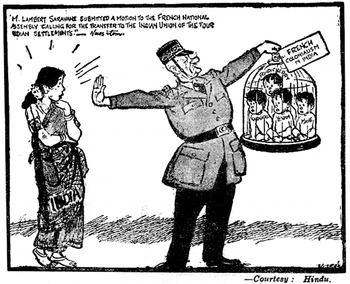
These sentiments were echoed by the Indian press. Articles in newspapers from Delhi, Calcutta, Madras, and Bombay pressed for an immediate merger of the French settlements with India. Editors and journalists argued that, by forcibly holding on to these territories, the French had failed to live up to the great revolutionary ideals of liberty, equality, and fraternity.Footnote 49 The reactions in the Indian press are best exemplified by a cartoon which first appeared in The Hindu on 15 December 1950, and was reproduced later in the pamphlet cited above (see Figure 2).Footnote 50 The context was a motion submitted by Saravane to the Assemblée nationale in Paris in December 1950, supporting the immediate transfer of the French settlements to India.Footnote 51 In the cartoon, India is represented as a mother, undoubtedly drawing upon the iconography of Mother India.Footnote 52 But, unlike her more assertive reincarnations, this India is young and innocent, emphasizing the freshness of Indian independence and the moral superiority of India's claims. Her bewildered expression establishes France's reactions as irrational and unethical. France, on the other hand, is an arrogant and self-assured general, a villainous figure, who is forcing the distance between India and her children, the French settlements. The children themselves are confined to a cage, neatly labelled ‘French colonialism in India’, and look longingly towards their mother. In presenting the colonies as babies there is a suggestion that keeping the children away from their mother might adversely affect their future. This imagery once again sought to establish the legitimacy of India's position and reinforced the assumption that the French settlements naturally belong to India. Their separation from India was not out of free will but enforced by the coercive apparatus of the colonial state.
Cartoon by Vasu published in The Hindu, 15 Dec. 1950. © The Hindu, reproduced with permission.

India's claim to the French settlements drew from the fact that these territories lay within the imagined frontiers of the nation. As Manu Goswami has argued, the idea of India as a territorially defined space, roughly coterminous with the boundaries of the colonial state, is a very modern concept. It emerged, during the second half of the nineteenth century, in conversation with both British colonialism and European nationalism.Footnote 53 Through a close reading of vernacular textbooks produced in northern India, Goswami shows how the idea of Bharat as India, with a continuous shared past and a fixed geographic space, came to acquire a strong hold over popular imagination. Its modernity notwithstanding, this idea of India sought its history, coherence, and identity in a pre-colonial, and mostly ancient, past. It is from this that Indian nationalism drew its geographic image, sense of unity, and nationhood. The cartographical apogee of this was the Bharat Mata (Mother India) temple, built in Banaras in 1936. It reaffirmed the frontiers of the nation and revered it as an object of worship, giving it both divine and secular legitimacy.Footnote 54 While this idea of India as an ancient entity gave credence to Indian nationalism, it also cast aside alternative imaginations and divisions. In the ‘nationalist’ view, the differences in colonial cultures could not have created any real difference between the Indians of the French territories and the rest of the country. Any differences in lived experience could be explained away as purely cultural and be subsumed into the narrative of a diverse but united India. That a section of French Indians might have different aspirations was as difficult to comprehend for the Indian National Congress as the demand for separate electorates for Muslims and Dalits.Footnote 55
Seen in this context, the merger negotiations and India's ambiguity towards local patriotism acquire new meaning. As we have already seen, Indian independence had prompted a number of spontaneous demonstrations and strikes in the French settlements. In Chandernagore in August 1947 and March 1948, and Mahé in October 1948, the demonstrations gave way to full-fledged rebellions which wrested control from the French administration and offered the territories to India.Footnote 56 On each occasion, however, the Indian government neither accepted nor recognized these claims to independence. When Gandhi was requested, by the French administrator of Chandernagore, to intervene in 1947, he labelled the satyagrahis of Chandernagore duragrahis (those who had engaged in an act of criminal disobedience) and stressed that ‘the Indians in the French and Portuguese settlements were bound to merge in [sic] independent India in good time’ but that they should not take the ‘law into their own hands’.Footnote 57 In 1948, when a mass demonstration compelled the Council of Administrators of Chandernagore to declare the merger of the settlement with India, the Indian government saw it as part of a communist conspiracy to destabilize the Indian state.Footnote 58 A similar argument was given to delegitimize the popular pro-merger revolt in Mahé which was brutally suppressed by the French.Footnote 59
Given India's assumptions about the natural affiliations of the French settlements, it is curious that the government was so reticent to support popular expressions of ‘nationalism’ and the desire to merge with India. The reactions of the Indian state need to be located within the context of decolonization. The Constituent Assembly was still debating the shape of post-colonial India; the question of the integration of the princely states, especially Kashmir and Hyderabad, had yet to be resolved; Partition and communal violence had thrown a deathly pall on the celebrations of freedom; and communists were leading popular uprisings in different parts of the country. Internationally, India was yet to find its feet. Under such circumstances, it was essential for the government of India to be in control of the negotiations with the French. Freedom won by an autonomous movement in the French settlements would question the legitimacy of the government of India to speak for the people of the French settlements. It would also throw up alternate voices, which in turn could undermine its centralizing tendencies. At a time when political freedom had multiple voices, it was imperative for the government of India to establish itself as the sole arbiter of the ‘idea of India’.
III
Indian nationalist historiography has inevitably emphasized the strength of the pro-merger movements in the French settlements. Undoubtedly, as the previous sections have shown, anti-colonialism had grown in the French settlements after 1947 and in many cases was articulated as an aspiration to become a part of independent India. This was reflected most notably in the revolts in Chandernagore and Mahé. Yet, a careful examination of the political debates within the French settlements reveals a greater scepticism about the union with India. Within the NDF itself, the proposal for merger proved to be a divisive question. As early as July 1947, some of its prominent members like Saravane, the French India representative in the Assemblée nationale, and Edouard Goubert, a French Indian lawyer, broke away to form the Socialist party, the main aim of which was to campaign for autonomy within the French Union.Footnote 60 Soon communists too began to qualify their support for the merger.
These shifts in opinion were reflected in the articles and letters that were published in French and Tamil newspapers in Pondicherry. The arguments against the merger often picked up on the tensions and anxieties of post-colonial India and highlighted its fragility. While ultimately unsuccessful, these voices of dissent form an equally important part of the story of French decolonization by giving us a glimpse into the anxieties of French Indians themselves. A major archival source for anti-merger articles, reports, and pamphlets are the fortnightly reports of the Indian consul general in Pondicherry. While this obviously makes the selection both limited and biased, it allows us to analyse the sensitivities of the Indian government. The criticisms levelled against India, drawn from the experience of the French settlements as well as the rest of the country, reflected the fractured process of post-colonial nation formation. They raised questions about communal tensions, the social and political divisions, and the right of the government of India to speak for its people. While it is hard to extrapolate ‘objective’ facts from ‘propaganda’, the arguments made by both the pro- and anti-Indian factions can be used to judge the contours of the local debate as well as offer an explanation for the Indian state's changing stance on the referendum as a deciding factor.
The alternative voices to the merger mirrored the different trajectories of Indian politics. To take a particularly potent example, as early as 1947 the Muslim League of French India announced that separate electorates had to be established before a fair referendum could take place to decide the fate of the French settlements. It argued that Muslims constituted one third of the population and that their voice could not be silenced.Footnote 61 They were a minority but their very existence was nonetheless a point of concern for the representatives of the Indian government in French India. Commenting in 1950 on the anti-merger propaganda in circulation, S. K. Banerji, the Indian consul general for the French settlements, raised concerns about its influence on Muslims, especially in Karikal where their numbers could influence voting patterns. He further remarked that the ‘rabid manner of the [French] Government sponsored French India Press reminds one of Pakistan and pre-merger Hyderabad’.Footnote 62 It was no surprise to the Indian consul general that the minister of information of French India, who financed pro-French papers such as République française and Etoile, was a Muslim.Footnote 63 The editor of République française, apparently a former resident of Hyderabad and formerly associated with the Muslim League, was held responsible for encouraging the ‘vivisection of India into various “Stans”’.Footnote 64 These comparisons and connections reflected the anxieties of the official mind in the years following India's independence. Gandhi had famously referred to Partition as a ‘vivisection of India’.Footnote 65 Since then, the word has been used in official correspondence to refer to issues that threaten the integrity of India and divide the nation. In a period when the integration of the princely states was not yet complete, and the problem of Kashmir loomed large, India's uncertain future found a reflection in French India.
These concerns were thrown into sharp relief with the arrival of Muslim refugees from Chandernagore after 1949. These were Muslims who had fled the communal violence of Bengal in the aftermath of Partition. The fact that they arrived in the southern settlements of Pondicherry and Karikal after Chandenagore's merger with India suggests that the French settlements were perhaps considered safe places at a time of communal disharmony. The new Indian consul general in Pondicherry, R. K. Tandon, worried that these refugees would become part of anti-Indian propaganda and reinforce the feeling that there was ‘no safety under the Indian flag’.Footnote 66 One of the consequences of Partition had been that the loyalty of Muslims to the Indian state was constantly being questioned.Footnote 67 In French India, the fact that the revision of the Karikal electoral rolls in 1950 resulted in the inclusion of 1,000 new Muslim voters was seen as an attempt by the French to strengthen their own hand in the referendum.Footnote 68 According to Tandon, most Muslims in French India harboured ‘pro-Pakistani sympathies which were being fully exploited by the French for anti-merger purposes’.Footnote 69 Once again, the Indian government's distrust of Muslims in the aftermath of Partition found an echo in the French settlements. The presumed disloyalty of Muslims towards India was transformed into a loyalty to the French.
The antagonistic relationship between the Indian state and Indian communists also found expression in the French settlements. The communists in French India had supported the merger from the very beginning. But they located their support within a broad left wing critique of both imperialism and capitalism. In a press report, the communist leader Subbiah explained:
When we say that we must vote for Indian Union we must not entertain the illusion that we are hereby voting for freedom. Voting for the Indian Union, on the one hand is for liquidating French imperialism from India and on the other, for rejoining our brother Indian working class in the Indian Union for jointly conducting our struggle against collaborationist Indian Union government and for establishing a people's democratic India.Footnote 70
This was a call for a continued struggle against the capitalist state which was the Indian Union. For the communists, the merger would not be a validation of the Indian state, but of an idea of India. A number of articles in local newspapers highlighted what they perceived to be the double standards of the Indian state and Nehru in particular. An article published in Velli, a Tamil journal from Karikal, on 13 January 1950 claimed that the same Nehru who wrote to his daughter that ‘only communism can be the panacea for the ills of the poor’ was condoning the repression of communists.Footnote 71 Another article published in the same paper in June 1950 remarked that India needed to look at its own policies before criticizing the French of being intolerant of political diversity.Footnote 72 The fact that difference of opinion was ‘not tolerated’ in India was said to be evident in its treatment of communists.Footnote 73 Such comparisons presented the post-colonial Indian state as intolerant and repressive.
Inevitably, the experience of India's princely states after independence was a constant point of comparison.Footnote 74 An article which appeared in République française in September 1949 warned India that unlike Pudukkottai and Hyderabad, which were taken by force, French Indians would resist merger until the very end.Footnote 75 Other articles published in Velli in December 1949, argued that French India should see how India dealt with the question of a plebiscite in Kashmir before committing to any concrete proposal for the referendum – a comment ear-marked by the Indian consul general as ‘pro-Pakistani’.Footnote 76 Still others expressed concerns about India's promise to maintain the special status and unity of the French settlements. In August 1949, an editorial in République française expressed doubt about India's sincerity to this promise given its treatment of minorities in India, despite the assurances given before independence.Footnote 77 The allusion here was to the communal violence following Partition and the tensions in Hyderabad and Kashmir. More generally, the integration of the princely states into the Indian Union, by a firm resolve and occasionally by force, raised concerns about cultural and political autonomy for the French settlements. It was commonly believed that the French settlements would be forced to merge with the contiguous Indian states and thus lose their unique cultural identity.Footnote 78 A report in Velli from June 1950 even argued that if India was giving up its claim on Indians in Malaya, which was still a British colony, then it should leave the affairs of French India alone and allow them to follow their own trajectory.Footnote 79 By drawing a comparison with the experience of the Indian diaspora, this particular journalist was dislocating the history of the French settlements from that of India, thereby questioning the geographically defined concept of the Indian nation and the inevitability of a merger.
Anti-India propaganda drew from the Dravidian movement in south India. This had its roots in the Self-Respect movement in Madras Presidency during the early twentieth century which aimed at winning equality and greater rights for the backward castes and untouchables. By 1944, with the formation of the Dravida Kazhagam, the Self-Respect movement had become a vehicle for Tamil nationalism, articulated in opposition to the cultural and political hegemony of the upper caste, Hindi-speaking north.Footnote 80 The demand for Dravidistan, a separate nation for the Tamils, posed yet another threat to the ‘national integration’ of the newly formed Indian state but it found a sympathetic voice in French India.Footnote 81 In response to an article published on 3 May 1949 in République française, in support of Dravidistan, the consul general remarked that the Dravida Kazhagam had been one of the ‘chief supporters of the French’.Footnote 82 In a slightly different vein, an Indian government report on anti-Indian propaganda in August 1949 referred to the formation of a ‘Free Hyderabad’ party by Hyderabadi émigrés in Singapore. The reported aim of the party was to free the Nizam from India and then ‘strengthen the “South Indian Republic” movement’, for which it sought assistance from the Portuguese, French, Pakistani, and Iranian governments.Footnote 83 Presumably, French India was to be a part of this new republic. There were traces of this language in newspaper reports as well. In the same month as the report on the ‘Free Hyderabad’ movement, an article in République française highlighted the fact that independence in 1947 had certainly not meant freedom for the people of south India, who were now compelled to deal with another northern imposition.Footnote 84 In an article published in Velli in February 1950, the language of Aryan oppression of Dravidians was used to condemn the Congress and its policies. The author of the piece maintained that Pudukottai, once a famous Tamil centre, was now entirely dominated by Brahmins, following its merger with the Indian Union, and that the Congress was ‘the sword that harasses the Dravidians in the shape of treachery and persecution’.Footnote 85
The argument about a northern imposition on the south was used to establish the foreignness of the Indian government. In an article published in Sooravalli, a Tamil journal from Karikal, the Congress was accused of not understanding the meaning of true nationalism. The writer maintained that, after the French departure, French Indians should be allowed to govern themselves and not have an order imposed on them by the government of India. He said:
Should we drive away the French who are six thousand miles away and place in power the Delhi Government which is 1000 miles away [sic]. The French speak French, a foreign language, and so do northerners Hindi – they both differ from us in culture, food, dress etc. We cannot understand their language and so both are foreigners to us.Footnote 86
This line of argument again drew parallels with the Dravida Kazhagam movement. Their criticisms of the Indian government undoubtedly fed into the anti-Indian propaganda in French India. Indeed, an article published in République française in November 1950 openly expressed its sympathy for the Dravida Kazhagam movement and went so far as to advise them to take their case against the ‘northern dominated Indian government’ to the United Nations Organization, where ‘French India would plead for them through the French representatives’.Footnote 87
Alongside issues of cultural and linguistic diversity, numerous articles in the press questioned the economic imperatives for joining the Indian Union. The main argument was that the Indian economy was much weaker than the French economy and therefore disadvantageous to the interests of the French settlements. In August 1949, République française pointed out that, in the event that the French settlements merged with India, the salaries and pensions paid to the French Indian officials by the French exchequer would stop and in return the French settlements would be taxed more to meet the demands of paying these salaries.Footnote 88 This argument was developed in other articles in République française and Velli, published in January 1950, all of which emphasized that French Indians were not heavily taxed and that the local economy was subsidized by France. The Indian economy was a nascent one and it would be a long time before it could offer the same benefits as France, especially since dwindling sterling balances from Britain had already forced India into taking a loan from the World Bank. The authors of the articles insisted that, although the people of India had believed that they would enjoy economic prosperity with freedom, they were disappointed by the present state of the Indian economy.Footnote 89 Such articles, published in local newspapers, brought to light the fears of French Indians, who were worried about being subsumed into a vast Indian nation. They picked up on the weak points and tensions of the young Indian state – about communists, Muslims, and economic stability – and in doing so questioned the very idea of the Indian nation.
In the end, these concerns were not addressed. On the contrary, they convinced Indian officials that a referendum would not necessarily be an effective political strategy. But anti-merger propaganda provides a crucial, if limited, glimpse into the myriad debates that were taking place in the public sphere. Seen from this point of view, a merger with India was not inevitable. Other imagined possibilities included autonomy within the French Union or absolute independence from both India and France. The merger of the French settlements with India has imposed one narrative on the history of their decolonization, that of inevitability. But the seven years prior to the merger were a period of flux for French Indians. For all those who lived through the decolonization of French India, it was a period of uncertainty and tentative alliances. Just as Partition refugees did not always think that frontiers and divisions would be permanent, French Indians did not know exactly what their identity would be after a merger. The ideas of citizenship and belonging that were being actively debated in the pages of French and Tamil newspapers confirm Vazila Zamindar's idea of a ‘liminal realm’ in narratives of Partition migration. Her claim that distinct national categories of ‘Indian’ and ‘Pakistani’ are inadequate to understand the experience of Partition, and that they act as ‘concealments and erasures actively generated by the national order of things’ applies equally to the French Indian case.Footnote 90 In reality, the dividing line between French India and independent India was as fractured as the border itself.
IV
In many ways, it was the referendum, or the possibility of one, that became the defining feature of French Indian politics in the years before decolonization. Irrespective of the various nuances in the positions of different political parties, the dominant debate revolved around one question: should the French settlements merge with the Indian Union? In such a polarized context, the nationalists and the Indian state defined anti-colonialism and nationalism to mean support for the merger and any opposition as anti-national and pro-French. It is a paradox, then, that the ‘referendum’ which decided the fate of French India in October 1954 was not a popular plebiscite but an indirect vote by the elected representatives of French India. In accepting this verdict, the government of India backtracked on its promise of a popular consultation and the French abandoned any vestigial commitment they had to the principle of popular sovereignty.
In order to understand this shift, it is important to examine how the idea of the referendum, and the need to control the voice of the people of Pondicherry, shaped the politics of French India. By the 1950s, the Socialist party had emerged as the staunchest opponent to the merger. From the beginning, its members had been sceptical of joining the Indian Union and, by 1949, they were arguing for immediate autonomy for French India ‘with liberty to settle future constitution[al] and political allegiance’.Footnote 91 This was very disconcerting for the government of India especially since the Socialist party had succeeded in winning a majority in the municipal elections of 1948 and, in 1951, its leader Eduard Goubert was elected as the French Indian representative in the Assemblée nationale by a margin of 90,053 to 149.Footnote 92 If this was a measure of local sentiment, then it was possible that India might not win the referendum. Even so, Indian officials in Pondicherry argued that these outcomes were not a true representation of what the people of French India felt. Instead, they were evidence of the coercive nature of the French colonial state. The Indian government accused the French administration of propping up the Socialist party and letting loose a reign of terror. Members of the Socialist party openly harassed and targeted Indian sympathizers. In Pondicherry, houses of pro-Indian supporters were burnt and destroyed and the gendarmerie (police) did nothing. In Karikal and Yanam, pro-Indian supporters were attacked and hundreds of them fled to the neighbouring Indian territories. The electoral victories of the Socialist party, Indian officials argued, were a consequence of intimidation not popular support.Footnote 93 Given the worsening situation, the Indian government felt that a referendum would no longer reflect the true desires of the local population.
To what extent were these claims true? In 1951, Victor D. Paul, the chief consular assistant of the US Consulate in Madras, conducted a survey in Pondicherry to assess the accuracy of Indian claims about manipulation of the 1951 election. The results confirmed that the French administration played an important role in determining the outcome of any election. While official figures claimed that more than 90 per cent of the local population had voted in these elections, according to the survey these figures were made up of proxy voting which, along with incidents of intimidation, seemed to be the practice in the French settlements.Footnote 94 At the same time, the survey revealed that many of those interviewed were ambivalent about joining the Indian Union. P. B. Reddy, secretary of the Government Hospital, felt that a majority of French Indians were against the merger because they enjoyed better privileges under the French. Sami, a pensioner and ex-service man, similarly argued that India, where ‘people suffered from starvation’, would not be able to guarantee their well being like the French who paid him a regular pension. Both a rickshaw puller and a banker pointed to the economic benefits of French rule; ‘everything was cheap’, there were fewer taxes and more freedoms.Footnote 95 At thirty-five interviews, the sample of this survey is too small to make broad generalizations about local opinion. But, taken together with the anti-merger propaganda, it suggests that merger was a contentious issue not just for the political elite but also the residents of French India. With growing uncertainty about the popular vote, the Indian state needed to find alternative routes to merger. And their growing concerns about the ethics of the electoral process and accusations of government-sponsored violence provided the perfect excuse to get out of the referendum.
The local French administration, on the other hand, blamed the Indian government for creating turmoil in French India by financing goondas (thugs) and nationalists in French India. In their view, the Indian government had encouraged the agitators in Mahé in 1948 and had constantly tried to rouse the population against the French government. They accused the Indian government of supporting and aiding the armed insurrections of 1954 which ‘liberated’ nine villages around Pondicherry and the settlements of Yanam and Mahé.Footnote 96 The Indian government denied these accusations although evidence suggests that, in the latter case, there was some truth to French accusations since it was reported that Yanam had been liberated by Indian policemen in civilian clothes.Footnote 97 This was a matter of some concern to Nehru who felt that India's formal involvement in any uprisings would jeopardize the negotiations between France and India.Footnote 98 Yet, Indian paramilitary forces continued to prepare for a possible direct intervention – a tactic subsequently used to annexe the Portuguese territories in 1961.Footnote 99 This generated a considerable amount of anxiety amongst the French in India. The American consul in Madras reported that the French were already preparing for such an outcome. They had quietly begun to evacuate records and ‘pro-French elements’ from the settlements, a clear indication that the French were planning to leave.Footnote 100
These local fears formed the background for the final round of talks between India and France which took place in New Delhi in September 1954. By 1954, France's relationship with its empire had changed. In May 1954, the French armies were routed at Dien Bien Phu – the first time a major colonial power had been defeated in open warfare – and even the most committed French imperial apologists could see the writing on the wall. With its forces nearly spent, France signed the Geneva Accords on 20 July 1954 and agreed to remove all its troops from Vietnam.Footnote 101 While this did not signal the end of war and conflict for Indochina, the agreement had direct repercussions on the negotiations with New Delhi. Until this point, the French had considered Pondicherry a useful transit point and supply line for Indochina, but the French defeat in south-east Asia removed even this symbolic utility of the French settlements. An exhausted Fourth Republic, humbled by defeat, was now more amenable than ever before to abandoning its Indian possessions. At the talks in New Delhi, France agreed to drop the idea of a referendum and settled for a consultation with the elected representatives of French India instead.
Local politicians, too, could see that the situation had changed irrevocably. By 1954, the elected representatives of French India, mostly members of the Socialist party, had shifted their support to India.Footnote 102 The reasons for this change of heart on the part of the Socialist party are fairly opaque. Their official narrative, published after the merger, argued that they had been pro-merger from the very beginning, although this is largely contradicted by the historical record.Footnote 103 Contemporary assessments of the Socialist party and its leader Goubert were also varied. Indian officials saw them as opportunists who were waiting to decide which solution would work best for them.Footnote 104 French commentators held similar views. Georges Chaffard, a journalist who covered the decolonization of French India, saw Goubert's turnaround as treacherous, prompted entirely by the fact that the French administration had instituted an enquiry against him on grounds of embezzlement of revenue and smuggling. This, according to Chaffard, made it the perfect time for Goubert to profess his support for a merger that would be ‘according to the wishes of the people’.Footnote 105
Whether it was self-interest or a genuine change of heart, the outcome of this turnaround was positive for all parties concerned. On 18 October 1954, the elected representatives of French India gathered in a marquee tent erected at the Indo-French border at Kizhoor, Pondicherry's furthest rural commune, to decide the fate of French India. Of the 178 delegates present at the meeting, 170 voted in favour of the merger. An agreement was signed and a formal transfer of power took place on 1 November 1954.Footnote 106 Goubert had secured for himself and his party an important role in the future of the French settlements. Having become the most significant players in the merger of French India, they were redeemed, post facto, as nationalist heroes.Footnote 107 The French could leave with a light heart and claim to have acknowledged the wishes of the people of French India. And the Indian government could re-write the history of French decolonization as a peaceful transfer. On the occasion of the de facto transfer in 1954 Nehru wrote:
A part of India long separated from the motherland is coming back to us of its own free will and this change is taking place as a result of friendly Agreement with France . . . The settlement of this problem is a justification and a vindication of the policy we have pursued in such matters. The policy is of peace and patient perseverance.Footnote 108
Ultimately, it was the interests of the French and the Indian governments which determined the pace and nature of the decolonization of the French settlements. A negotiated transfer allowed it to be presented as a peaceful transfer of power conducted in a ‘civilized’ manner. The violence, repression, and silencing of alternative voices became irrelevant.
Histories of decolonization of the French settlements have either focused on the weakness of the French or on the inevitability of the merger. In both readings, the settlements were simply a natural part of India. But this is not enough to understand what took place between 1947 and 1954. Independent India was not a natural entity. The imagination of India had been in gestation for a long time, but this did not necessarily make it easy to define the territorial and geographical boundaries of the nation. Loyalties and allegiances to the state still had to be forged from a disparate population. Seen in this light, the decolonization of French India was part of a wider process of nation-building. Absorbing and silencing alternative colonial memories was a way of imposing a singular ‘idea of India’ over dissident voices, a pattern replicated in ‘itinerant’ states like Hyderabad and Kashmir. Locating the decolonization of French India within this broad framework makes it more than an exotic story about a forgotten part of the French empire. It becomes a reflection on, and a continuation of, tensions in other parts of India. The years between Indian independence and the decolonization of French India were a moment of uncertainty when many possible futures were being debated and imagined. In the end, French India, along with the Portuguese territories, became a monument to the salience of the ‘idea of India’. The end of French rule was celebrated as the natural outcome of India's long march to freedom. The uncertainty of the seven preceding years, the multiple possibilities and alternative worlds of belonging, were quickly forgotten.