The background for the following discussion is John Bergsagel's recent edition (2010) of offices and masses for the feast days of St Knud Lavard, which includes a commentary and a facsimile reproduction of the unique thirteenth-century source: Kiel, Christian-Albrechts-Universität, Universitätsbibliothek, MS S.H.8 A.8o. This manuscript is probably a copy of what was composed for the Feast of the Translation of St Knud Lavard in Ringsted Church on 25 June 1170, including the materials for the translation feast as well as the feast of his martyrdom, 7 January.Footnote 1
In these offices one finds a very consistent theological construction of the figure of St Knud Lavard and his role as a new Danish royal saint. This comes to the fore primarily in the texts of the offices, both the readings and the chants; I shall focus on the readings and the responsories of the third Nocturns of both feasts. Here, by contrast to the first two Nocturns, the readings do not constitute a narrative account of Knud's martyrdom and canonisation, but are homilies showing more explicitly the underlying theology brought forward in the offices. Moreover, there seems to be a close correspondence between these homilies and the responsory texts that follow them. I shall argue that these responsories musically underline the main theological tenor of the texts. This requires some discussion of the musical means and their uses in this musico-liturgical context. This article focuses on the offices as a theological and political unity, something that makes sense given the politico-religious significance of the feast of the translation in 1170, a momentous celebration of a new, stable Danish monarchy within Latin Christendom after decades of violence and political turmoil. This was a moment to make manifest the Danish kingdom's re-establishment and consolidation as a Christian kingdom within the Roman Church. In order to appreciate all this, it is necessary first to give a brief account of Knud Lavard's martyrdom and canonisation.
Knud Lavard was murdered by his slightly younger cousin, Prince Magnus, son of the ruling King Niels, Knud Lavard's uncle, the day after Epiphany in January 1131. Knud's father, King Eric the Good of Denmark, had died in Cyprus during a pilgrimage to the Holy Land in 1103, after having secured the first Nordic archbishopric, which was established in Lund, thus freeing the Scandinavian countries from the ecclesiastic dominance of Hamburg-Bremen. In the decades after King Eric's death, his brothers consecutively took over the Danish throne. Meanwhile Knud Lavard grew up to become an important figure in Danish politics. Educated in Germany at the court of Duke Lothar of Saxony (later to become emperor), Knud became a successful praefectus of Schleswig in southern Denmark in 1115. He was later named knese (lord or duke) of the Slavonic Obotrites in Saxon Holstein south of the border in 1129. Prince Magnus could very well have feared that Knud was becoming too strong a pretender for the Danish throne. In any case, this is how the murder is generally understood in Danish historiography.Footnote 2
According to the main historical sources to Knud's life and death, including the saints' legend preserved in the Matins readings for his offices, after the Royal Christmas celebrations 1130–31 in Roskilde, Magnus (as it seems secretly in collaboration with other conspirators) pretended to wish a private meeting with Knud in Haraldsted forest on Zealand. Here Knud was murdered. Knud seems soon to have been considered a saint by the monks in the nearby Benedictine monastery in Ringsted, where his body was later brought, and a vita was already written during the 1130s by Robert of Ely, probably an English monk visiting the Ringsted monastery at the time.Footnote 3 Knud was, however, officially canonised in 1170 through the campaigning of his son, King Valdemar I, who in 1157 had emerged victorious after years of civil war following his father's violent death and the changing reigns of his uncles. Valdemar obtained a papal bull in November 1169. This occasion also marked a reconciliation between King Valdemar and the Danish Archbishop Eskil, who seems – at least initially – to have opposed the canonisation. In any case, the archbishop presided over the translation solemnities in Ringsted on 25 June 1170. These celebrations marked the firm establishment of King Valdemar's dynasty in a double way: his son, another Knud, only seven years of age in 1170, was crowned king of Denmark during the solemnities.Footnote 4
What probably is the office for the occasion, at least as it has been preserved in the Kiel manuscript, constructs St Knud as an ideal royal saint, an image corroborated by the other influential medieval historical narrative about Knud Lavard, that of Saxo Grammaticus in his Gesta Danorum (c.1200). Much debated in Danish historiography, the occasion of Knud's canonisation has generally been viewed as a main symbolic event in Danish medieval history. It provided King Valdemar's dynasty with a religiously based authority and also manifested how the Danish kingdom formed an integral part of Latin Christendom, comparable to England, France and the Roman–German Empire, where similar royal saints were promoted in the twelfth and later centuries.Footnote 5 Perhaps more importantly, as the Danish church historian Carsten Breengaard claimed, it
was a hallowing of those social values which the clergy had long been preaching as the fundamentals of a Christian community. The principal objective was to criminalize insurrection and the involvement of the king in feuding, which had previously been legitimate forms of assault on the throne. These interests were secured by the anointing of the royal heir and by the canonization as an ecclesiastical martyr of Knud Lavard, the first victim of the feud.Footnote 6
We shall now turn to the theological construction as it emerges from the texts of the offices and consider the extent to which musical representation underlined this theology. Although – unsurprisingly – some liturgical items were borrowed from other offices (Common of a Confessor, Common of One Martyr, and English saints' offices, as John Bergsagel outlined), large portions of the offices and the masses appear to be unique. Knud Lavard was a military leader, a dux, and is presented in the offices as a miles Christi, but his mildness and passive Christ-like suffering at the hands of his cousin, Prince Magnus, is emphasised. Although some formulations in the offices can be read to construct him as a crusader,Footnote 7 the theological tenor is one of a martyr being slaughtered without resistance. Knud's Christ-like suffering as a consequence of evil and unprovoked aggression is strongly emphasised.
Verbally but also musically, the office constitutes a very focused theological statement. This largely corroborates Carsten Breengaard's reading of the historical situation and may also express the intention to construct Denmark as a true Christian kingdom. Indeed, as Breengaard's interpretation makes clear, the emphasis on Christian social values should not be taken as a statement that St Knud Lavard's canonisation was not political. This is manifest in the office. To give an example of a direct statement concerning the political aspect of Knud Lavard's cult, the prosa belonging to the twelfth Matins responsory (the same responsory in both offices) states: [2a] ‘As guardian of the law you dwell in the world, though lacking the world's vice’ (‘Custos legis mundo, mundi carens vicio’). This refers to the role Saint Knud played in reportedly restoring justice through law and order in his dukedom, also emphasised in earlier lessons for the office of the martyrdom.Footnote 8
Accordingly, there is little war imagery to be found in the offices. This can be demonstrated textually for the complete cycles, and will here be underscored by textual as well as musical analysis of the responsories and the lessons for the two Matins offices, in passione and in translacione. The point of departure will be the last four homiletic readings from the third Nocturn in both offices, which have different readings but the same responsories. We shall also consider the sequence for the Translation Mass, Diem festum veneremur, since it is particularly revealing in its relationship between text and music.
The readings for the first and second Nocturns of both offices are historical centrepieces for the history of Knud Lavard together with other twelfth- to thirteenth-century chronicles, among them the twelfth-century Roskilde chronicle and, most famously and influentially, the Gesta Danorum. Although Knud's history has been discussed in modern scholarship, the sermons which constitute the lessons for the two third Nocturns have not received much attention, probably because they did not contribute to the historical narrative, as the early editor of Knud's legend based on the Matins readings, Martin Clarentius Gertz, stated.Footnote 9 Thomas Riis does not draw on the homiletic readings in his discussion of the ideology of the thirteenth-century offices in his excellent introduction to the historical background of the Knud Lavard Offices. He does, however, comment on the biblical passages at the base of the sermons and formulates a contemporary understanding of Knud in the light of these, as well as on the appropriation of the Common of Saints and the notion of Knud as shepherd and guide for the elect people. In particular, Riis points to a relief over the southern gate of the cathedral of Ribe in south-western Denmark which, depending on its dating, may depict King Valdemar I and his queen together with St Knud Lavard. In Riis's view, this iconography can be read to refer to Knud as an exponent for the ‘expansionist Danish policy during the decades around 1200, a policy which was often made in the name of St Knud Lavard’.Footnote 10
I do not disagree with this if it is to be understood as a statement about how the office and the cult of St Knud Lavard came to be appropriated politically in the following decades by the king and the Church. But it does not fully reflect the ideology or the theology as it comes to the fore in the offices themselves. Another side of the understanding of St Knud Lavard – which was political as well, but with very different political aims, that is, emphasising his role as shepherd and guide towards a society built on Christian social values – is much more directly expressed in the offices, as I shall demonstrate in the following.
The sermon texts mentioned above are, precisely, theological statements, not primarily political texts. They show how those who wrote or edited the office texts constructed the meaning of St Knud Lavard's martyrdom and his cult. They are interesting examples of what would seem to be monastic theology and biblical exegesis at the time. The musico-liturgical items to which they will be compared show how the musical settings underline or represent the meaning of the poetic texts, all in accordance with the basic understanding of the sermons.
Let us first consider lessons ix–xii for the Feast of the Passion (7 January), which take as their point of departure John 12:24 (‘Jesus said to his disciples: “Truly, truly I say to you, unless a grain of wheat falling on the ground shall die, it shall remain alone”’) and its continuation, along with similar parallel texts in the synoptic gospels. All were treated in accordance with the traditional manifold exegesis as carried out since the time of the early Church Fathers (not least Origines of Alexandria and in the West especially Augustine) and operative through the Middle Ages.Footnote 11 They also employ language typical of monastic theology written by learned monks, who sang the office day and night and who, as part of monastic life, also ruminated over sacred texts in which biblical phrases are not only quoted but have also become integrated into the language in ways that sometimes make it difficult to distinguish a quotation or paraphrase from a biblical fragment or notion appropriated into the author's discourse.

The basic message of this text is a very general one warning about the dangers of the ‘enemy’, the ‘impostor’ who may be understood as the Devil, but also as working through any person who commits evil deeds or fraud. In the context of the Office of Knud Lavard, the reference to Magnus is quite evident. Similarly, in the application of the continuation of the gospel text, there would seem to be an obvious reference to the death and the canonisation of Knud Lavard: the three grains discussed and their symbolical fates do not quite match what is initially formulated about the material grain, the mystical grain, and what, as a third grain, proceeds from merit. However, the threefold understanding of the metaphor ‘grain’ corresponds well to a celebration of a saint, considered as a martyr: Knud was materially killed, but in a mystical sense this was his victory as a martyr, and from his merit in accepting martyrdom (as the story of Knud is interpreted) now proceeds his sainthood as a help for the faithful participating in his cult. This thought is taken up in the responsory in Example 1.
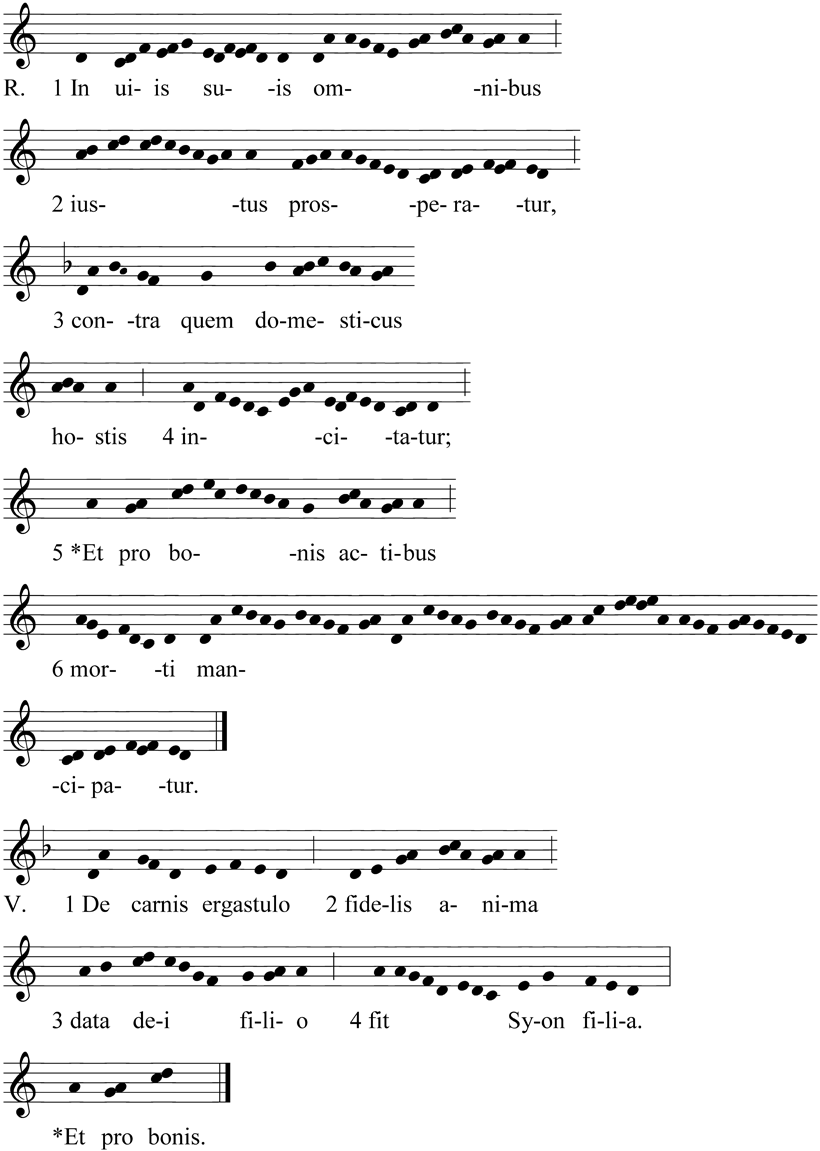
Matins responsory 9 In viis suis (Bergsagel 2010, vol. 1, f. 19v–20r; vol. 2, 19).Footnote 14
The word emphasised above all other words in this responsory, through a long melisma, is ‘mancipatur’ (‘he is sold’, phrase 6), and the highest point in the melody is reached during the short melisma on ‘bonis’ (phrase 5). The question of whether the melismatic emphasis on ‘mancipatur’, rather than expressing a relation between music and words, may be due to the stylistic convention of having long melismas in final phrases of responsories (as found from the eleventh century onwards)Footnote 15 can only be answered by pointing out that chants were generally composed as complete units of words and music. Hence it must be assumed that the wording of a responsory would be planned with an overall conception of the stylistic conventions, musically as well as verbally. Also in cases where new words are adapted to a pre-existing melody (something which is not always easy to ascertain), such a conception of the process of ‘composition’, taken in the literal meaning of the word, ‘putting together’ words and music would make sense.
If emphases of words by way of melismas and melodic high points are significant – and I shall return to this question later– then the responsory also musically underlines the thought of the saintly person, whose life is sacrificed by the foe, the evil enemy, because of the goodness of the saintly person; in other words, precisely the thought emphasised by the words. This is thoroughly in line with the way Knud Lavard is generally understood in the office, as it will become clearer still in the discussions of the following items.
Lesson x gives a brief summary of a Christian theology of redemption, how God sent his Son as a remedy against evil, and how the evil prince of the world tried to destroy him, materially succeeding, but not succeeding in the end since Christ is the Son of God. It turns into a statement recalling the prologue to the Gospel of John and also St Anselm's Prayer to Christ (c.1100) about the interchange between the divine and the human through Christ's sacrifice:Footnote 16 the incarnation of Christ, or Christ made man, led to men becoming sons of God; to those who received Christ he gave the power to be sons of God.
These thoughts, rephrasing the main message of the prologue to the Gospel of John, are taken up in the responsory in Example 2 where they are applied to saints who, as Christ, were killed physically but given victory by God to provide help to faithful mortals. For that reason the saints are remembered eternally.
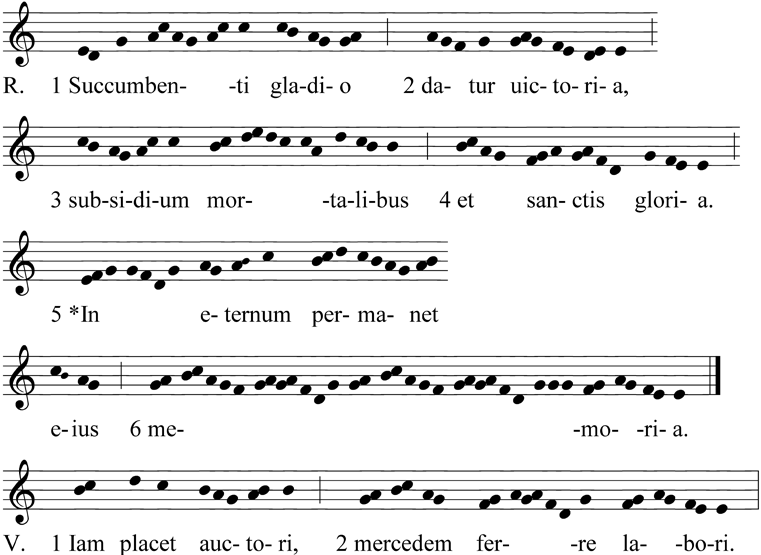
Matins responsory 10 Succumbenti gladio (Bergsagel 2010, vol. 1, f. 20v–21r, vol. 2, 20).Footnote 18
Musically, the high point is on the help to the mortals, ‘mortalibus’ which has the longest melisma in the first sentence (phrase 3); the melodic high point is also reached on this word. In the final phrase 6 we find, as was the case with In viis suis, by far the longest melisma on the first syllable of the last word of the sentence, ‘memoria’.
Altogether, Succumbenti gladio has been constructed so as to emphasise the memory of the saint and the help to the human faithful given in this way. In the context of the lesson it may seem a bit ambiguous whether memoria should be understood as the memory of Christ or St Knud Lavard. The responsory seems to turn attention to saints from its outset (‘sanctis gloria’); in any case, in the verbal construction of the item, it is done by way of analogy with the basic Christian message concerning Christ emphasised in the lesson.
In the eleventh lesson, the sermon details who the grain is supposed to be and what kind of falling into the earth is intended. It refers to the parable of the sowing of the seed (Matt. 13:3–9), applying this in a traditional way (based on Matt. 13:20–3) to the different kinds of faiths of different people. The gist is that whereas the ungodly fall and nothing comes thereof, the just man prevails through his piousness. This is expressed here by reference to the psalm verse (Ps. 118:164) which is a prime fundament referred to in chapter 16 of Benedict's Rule (and hence all monastic thought) concerning the Divine Office. When such pious men fall, it is as physical suffering, and only to be helped up again. The grain will, as in Jesus's parable, come up and bear fruit, even much fruit. And one fruit here is – again a typical monastic point – humility, expressed through biblical phrases.
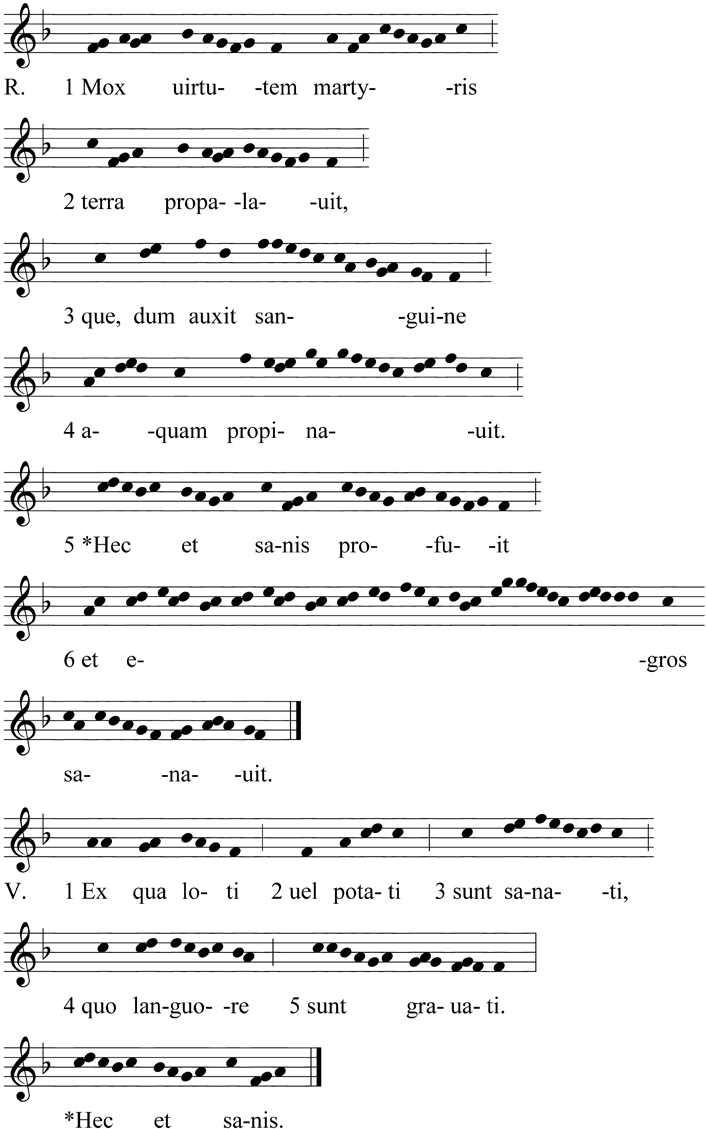
The responsory takes up the theme, applying it directly to the notion of a martyr and pointing out how, through physical fall, suffering and death, he brings salvation and help to men, thus bringing fruit in humility (Ex. 3). Musically, the most emphasised word is ‘egros’ (‘the sick’, in phrase 6) in the context of their being cured by the water, the spring coming from the martyr's blood. As reported by Saxo, a spring welled up at the place of Knud's martyrdom: ‘His blood given back to the ground provided a health-bringing fountain for mortal men's eternal use’ (‘Sanguis eius terrae redditus salutarem fontis scatebram perpetuis usibus mortalium talium administrat’).Footnote 21 Already in the letter of canonisation, Pope Alexander had referred to a spring near the grave among other miracles: ‘and also how after his death a spring suddenly appeared next to his grave’ (‘et quomodo etiam post mortem suam iuxta sepulchrum ipsius fons quidam emicuerit’).Footnote 22 This incident is not referred to in the lessons, but the responsory would seem to make up for this, pointing to the by then well-known chapel built at the spring (in the twelfth century), a pilgrimage destination during the Middle Ages, but today a ruin.Footnote 23 The upper limit of the melody is reached twice: on the third syllable of ‘propinavit’ (‘gave to drink’, phrase 4), which is also expanded in a long melisma, the longest in the first sentence; and in the long melisma on the first syllable of ‘egros’ (‘the sick’, phrase 6). Two other words receive rather strong emphases: ‘sanguine’ in the first sentence (phrase 3), placed so as to form a contrast to, as well as standing in an intimate connection with, the water given to the sick (‘aquam propinavit’); and the final word of the last sentence, ‘sanavit’ (phrase 6), supporting and directing the meaning of the word ‘egros’. As in the previous examples, it appears that the responsory has been shaped so that key words are musically underlined.
Matins responsory 11 Mox virtutem (Bergsagel 2010, vol. 1, f. 22r–v, vol. 2, 21).Footnote 20
In the twelfth and final lesson, the sermon deals with the significance of death in different contexts, emphasising how the death of the martyr, in contrast to that of the sinner, is precious in the eyes of God. Here the theological statement is explicitly applied to St Knud. The lesson concludes, not with statements which could serve to justify Danish expansion through missionary battles, but rather internalising the understanding of the saint's pious martyrdom for the individual participants in the liturgy and cult, who sound more like monks than crusaders.
Accordingly, the responsory focuses on the help given to the needy: health for the sick, help to those in difficulties. Thereby the kingdom shall flourish and be free. It concerns, as it seems, the notion of freedom associated also with bringing help to the small ones in society, formulated with allusions to the gospels (Matt. 11:5 and Luke 4:18). In the responsory text, it is unclear whether the ‘you’, grammatically implied, should be understood to be Christ, God or Knud Lavard, though the explicit exhortation in the lesson is to pray to Knud.
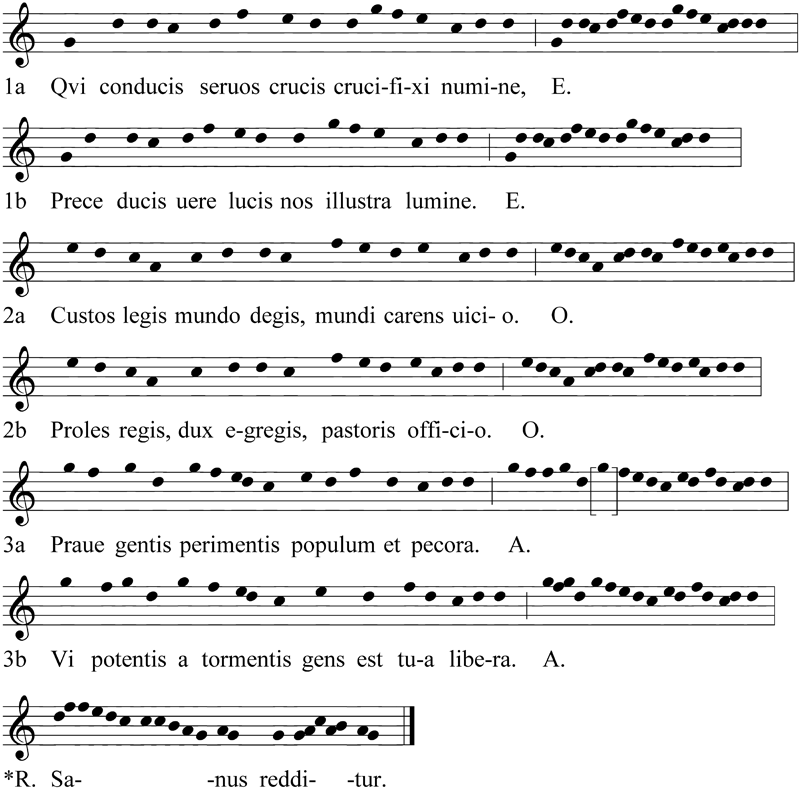
This interpretation is corroborated by words in the following prosa (see Ex. 4b) combined with the responsory: ‘prece ducis’, ‘through [your] ducal intercession’ (1b), rendered by Michael Chesnutt as ‘through your knightly intercession’. The glory spoken of here is clearly not one corresponding to a notion of grand expanding missions of the Danish kings but rather, as made particularly evident in the last sentence of the prosa, the freedom of the Danish people (‘gens tua’) through the help provided for those needy of help, whether concerning sickness or need for justice, as well as through (spiritual) illumination, as this may now be provided through Knud Lavard's intercessions.
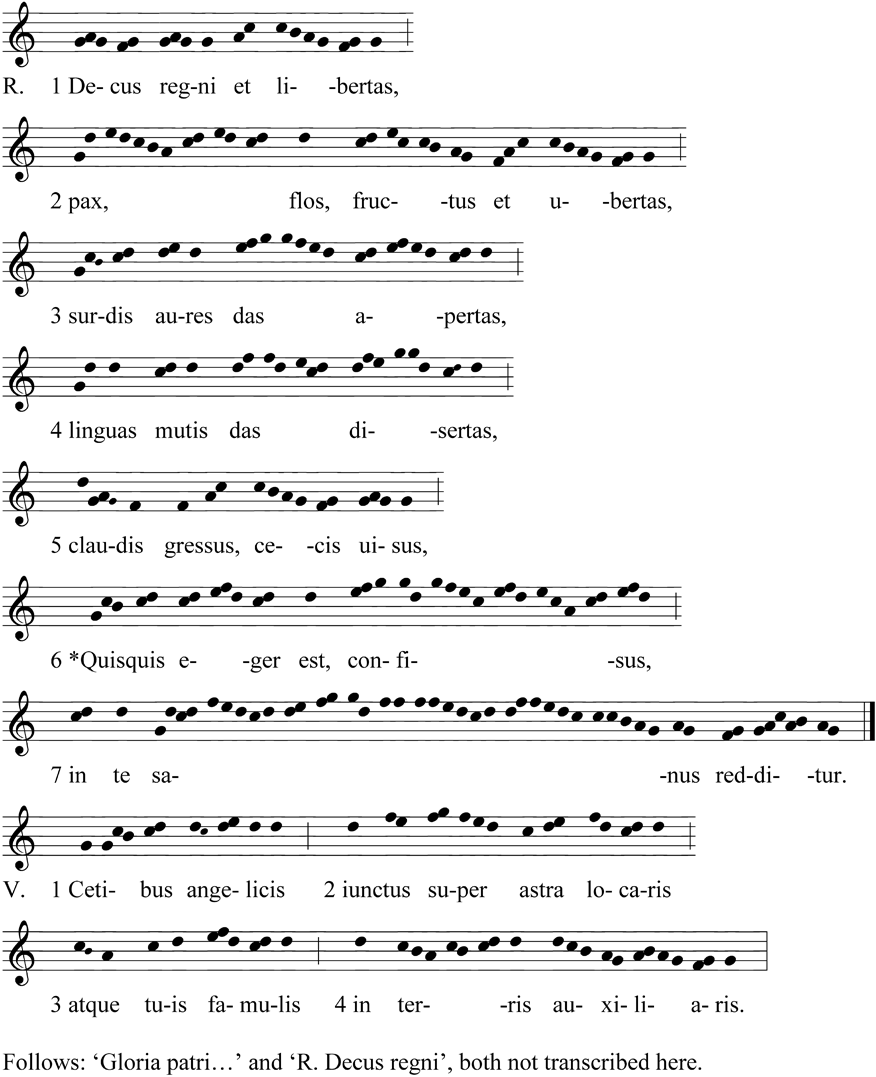
Matins responsory 12 Decus regni (Bergsagel 2010, vol. 1, f. 23v–24r, vol. 2, 22).Footnote 25
Prosa Qui conducis (Bergsagel 2010, vol. 1, f. 24v–25r, vol. 2, 23).Footnote 26
The construction of the verse, words and melody, places the first syllable of the words ‘super astra’, referring to Knud being above the stars, on the melodic high point of the first sentence (phrase 2). This peak is reached twice in the first sentence: on ‘das’, ‘you give’ openness to deaf ears (phrase 3), as well as on the first syllable of ‘disertas’, ‘eloquence’ to the dumb (phrase 4). It is also reached twice in the last sentence: on the first two syllables of ‘confisus’, those ‘trusting’ Knud (phrase 6), and then during the long melisma on the first syllable of ‘sanus’, health (phrase 7). In the following prosa, the words ‘crucifixi’ (‘of the crucified’, (1a)), ‘illustra’ (‘illuminate’, (1b)), and the first syllables of ‘prave’, ‘gentis’, and ‘perimentis’ (3a) are sung on top-notes of the ambitus. The significance of this setting comes to the fore when translating literally ‘prave gentis, perimentis populum et pecora’ in the prayer to the duke for pastoral care (‘pastoris officio’) for ‘a vicious race, destroying the people and the flock’.
The placement of the highest pitch on the three mentioned syllables is not particularly obvious, but may possibly emphasise how far Knud, following Christ's example, had gone to help his people. The same melody is repeated in the following line, ‘vi potentis, a tormentis gens est tua libera’ (3b), which may be rendered ‘through the strength of [your] power, your people [nation] is freed from torments’. Here the word ‘vi’ (‘through strength’), the second syllable of ‘potentis’ (‘of power’), and the preposition ‘a’ (‘from’), have been placed on the highest notes in the melody. A poetic text set syllabically (except for the melismas on final vowels) with a melodic sequence structure would be less flexible in terms of word and music relations, and the result is less convincing than for the prose texts of the responsories.
For the Feast of the Translation, the gospel text from Matthew 10 is used to point out how the wicked nature of Knud Lavard's murderers was brought out into the open as they no longer hid their conspiracy, but acted out their crime. As mentioned above, the Matins responsories from the office ‘de passione’ were reused for Matins in the office ‘de translatione’ (or vice versa, since the office of the translation clearly was the first needed).
As noted in the discussion of responsory ix (Ex. 1), the words that seem to have been musically underlined are ‘bonis’ (phrase 5) and ‘mancipatur’ (phrase 6), in the sentence ‘for his good deeds he is sold to death’. Such emphasis obviously stands in a meaningful relationship to the message of the lesson, which points out how the murderers, having betrayed the honest Knud through ‘pretended friendship’ (‘simulata amicicia’), in a sense sold him to death.
In the following lesson, it is made clear how Knud was brought into heaven and is venerated all over the kingdom while the persecutors are being cursed everywhere.
Responsory x, as pointed out for the office ‘de passione’ (Ex. 2), highlights the cult of saints and seems to emphasise the words ‘mortalibus’ and ‘memoria’ musically in the sentence characterising saints as giving ‘help to mortals’ (‘subsidium mortalibus’, phrase 3), the faithful as praising ‘his memory remains for ever’ (‘in eternum permanent eius memoria’, phrase 6), referring to the martyr as the ‘victim of the sword’ (phrase 1). This seems to be a very adequate response to the statement of how in the end the deed of the murderers, contrary to their intentions, supported the cause of the martyr and the memory of his saintliness.
In the eleventh lesson, the image of the sparrows from Matt. 10:29–30 (cf. Luke 12:6–7) is used as a basis for an exegesis leading the faithful to consider how Knud's flesh paid a price similar to that of Christ.
Responsory xi (Ex. 3) emphasises how Knud's death led to a cure for the sick and eternal salvation of mankind, pointing out how the saint's blood gave rise to a holy spring curing the sick. Musically, words concerning the drinking of the water, health and sick people underline to what extent Knud was seen as emulating redemption through Christ. As in the office ‘de passione’, although the lessons do not discuss the miraculous spring, the responsory with its emphasis on how Knud cures the sick is an appropriate response to the lesson, also here in the ‘de translatione’.
Finally in lesson xii, Jesus's statement ‘Whosoever shall confess me before men’ (Matt. 10:32; cf. Luke 12:8) leads to the conclusion that Knud Lavard is now confessed by Christ because of his truthful life as a faithful witness. Pope Alexander's canonisation bull prescribed Knud Lavard to be celebrated on 25 June, determining this as his dies natalis. His martyrdom and its date (7 January) are not mentioned. In Danish historiography, this has raised the (purely speculative) question whether the pope accepted Knud as a martyr since he may have worn weapons at his death, at least according to Saxo's narrative, although he did not according to the lessons of the office ‘de passione’. In the surviving thirteenth-century offices, written for celebrations on both 7 January and 25 June, however, the introit shared by both masses (‘de passione’ and ‘de translatione’) makes clear that Knud Lavard was celebrated as a martyr: the text includes the phrase, ‘diem festum celebrantes in honore Kanuti martiris’ (‘celebrating the feast day in honour of Knud martyr’).Footnote 30 Knud Lavard as a ‘faithful martyr’ is precisely what is emphasised in the last lesson for Matins ‘de translatione’:
There can be no doubt that responsory xii (Ex. 4a) corresponds well with the praise contained in the lesson. In its text and music, the responsory Decus regni, already discussed, obviously stands as a fitting conclusion, emphasing the help provided for sick and needy through St Knud's saintly care for his people.
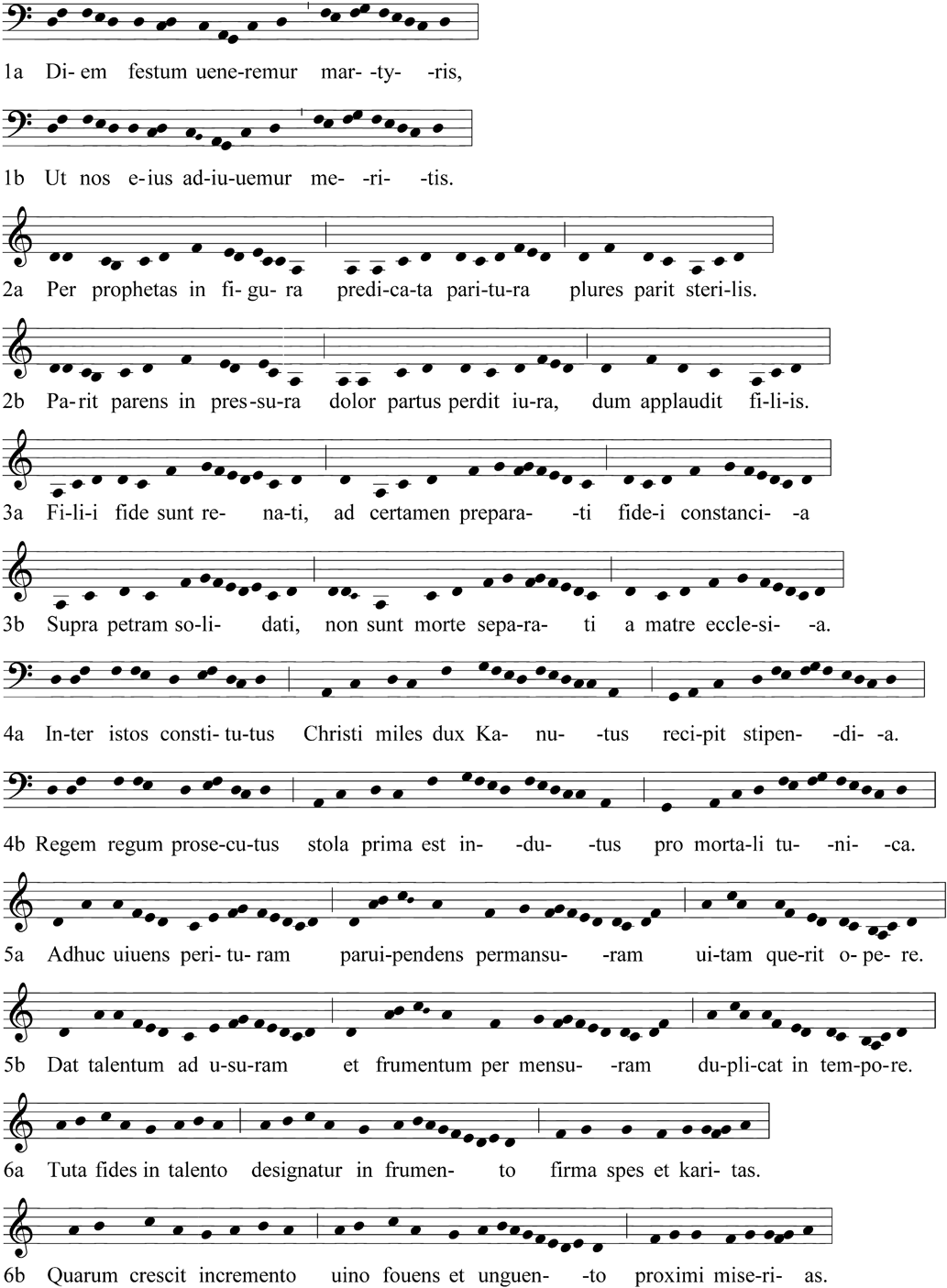
By way of conclusion, let us briefly consider one further poetic item from the mass ‘de translatione’ to supplement the observations made so far, focusing on a chant which seems undoubtedly to be an original composition for Knud Lavard, namely the sequence (‘prosa de translacione’), Diem festum veneremur martyris (Let us celebrate the Feast of the martyr) (Ex. 5). Angul Hammerich studied the sequence in 1912, pointing out that the melody was re-used at the cathedral of Lund with a different text in the sixteenth century as a Marian sequence. It is preserved in the so-called Liber schole virginis, a manuscript kept in the University Library in Lund, recently transcribed and published.Footnote 32
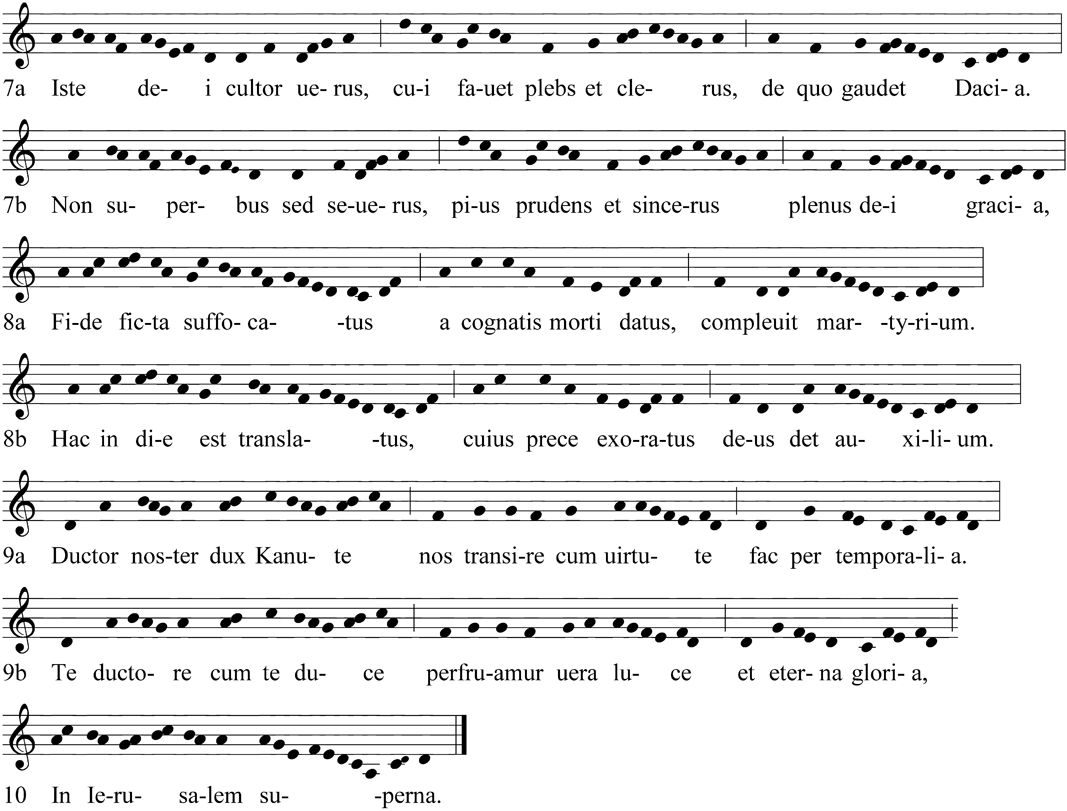
De translacione Prosa Diem festum veneremur (Bergsagel 2010, vol. 1, f. 44v–47r, vol. 2, 46–49).
continued
As uniquely preserved in the thirteenth-century mass for the translation, the sequence emphasises an image of the theological ideology of these offices in accordance with what has been presented. Hammerich, in his discussion, pointed out that the melody, in stanza 5, moved from a deep plagal compass in the first stanzas (mode II) to authentic mode I.Footnote 33 This is preserved in the following stanzas although the range in stanzas 5a and 5b also extends downwards so as to encompass modes I and II. In stanzas 6a and 6b, the melody cadences on the tenor a; in stanzas 7a and 7b, as well as 8a and 8b, the high point of the melody is extended upwards to the d an octave above the final D (see Ex. 5). In stanzas 9a and 9b, the melody settles for a high point of c. Altogether this creates a melodic design which, in combination with the compass of each individual stanza, constitutes a strong upward movement from stanza 5. This continues further up to stanza 8, and then gradually and calmly moves downward to end in the final stanza 10 with a melismatic and deep conclusion on the heavenly Jerusalem.
Textually, stanza 5 is the point at which the actual life of Knud is brought into full consideration: he is introduced as a saint and Christian soldier, ‘miles Christi’ in stanza 4. This notion does not seem to be emphasised musically; only his name, Kanutus, is expanded in a short double-melisma. The melodic high point of stanza 5a is first reached on the third syllable of ‘parvipendens’ (‘not paying attention to’ his being destroyed), and similarly in 5b on the second syllable of ‘frumentum’ (‘the crop’ which he doubles). This is explained in stanza 6, which explicitly makes his deeds clear as pious ones; the words ‘fides’, and ‘designatur’ with melodic highpoints determine the crop, further emphasised by a melisma in stanza 6a; in 6b he grows (‘crescit’) and treats (‘fouens’) – both with melodic high points – his neighbour's wounds with ointment (‘unguento’), expanded with a melisma on its second syllable.
Stanza 7 emphasises that the people and the clergy love him with a melodic high point on ‘cui’ in 7a and, similarly in 7b, highlighting that he is pious (‘pius’). Similarly, stanza 8a emphasises how he was made to die through falsity (‘ficta’) with short melismas on the third syllable of ‘suffocatus’ and the first syllable of ‘martyrium’. In 8b the very day of the translation (‘die’) receives the melodic high point, the second syllable of ‘translatus’ a short melisma, and the first syllable of ‘auxilium’ (God's ‘help’) gets the last melisma. With respect to tessitura, stanzas 7 and 8 are the brightest or the highest in the entire sequence.
Stanza 9 less strongly emphasises ‘Kanute’ (‘Knud’) and ‘te duce’ (‘you, duke’), combining the melodic high point and melismas. The sequence ends calmly in a downward movement towards the final, emphasising as it seems the heavenly Jerusalem (‘Ierusalem superna’), with the melodic high point of the stanza (c) and a melisma on the first syllable of ‘superna’.
Altogether, it is clearly not the crusader or knight that is highlighted in this sequence, but the Christ-like helper and pious guide of his people, verbally as well as musically. This can be claimed, however, only if the use of melodic high points and of melismas can reasonably be interpreted as I have done here. Even though these means seem to be the most obvious by which a melody can be made to point to something in a text, by prolonging it or making it stand out as the top of a melodic movement, it must be acknowledged that it is, indeed, impossible to know what associations such melodic movements and textual settings had for those who composed and listened to them. It must also be underlined that one cannot be certain that these means were used consistently; other factors may very likely have been in play and in many cases these interfered with a systematic use, whether or not this was applied consciously or in a more intuitive way. Still, it seems to me that these means, at least in some measure, can be interpreted as I have done here, if a case can be made through the text, that such emphases are not fortuitous, but make sense in relation to the text altogether and if it is also clear that – whether one may claim any degree of consistency or not – there are enough examples of this to establish a pattern of coincidences of important words underlining the main contents of sentences and melodic high points and melismas. As I have argued, this seems to be the case for the chants I have considered, not least supported by the relationship between the lessons and the responsories of the third Nocturns in the two offices.