

Introduction
Cashew, Anacardium occidentale Linnaeus (Sapindales: Anacardiaceae), is an important export crop in Tanzania. It earned US$54.1 million in 2006, which accounted for 10% of the total value of foreign exchange earnings (Anonymous, 2009). However, the production of cashew nut is seriously constrained by a diverse range of diseases and insect pests. The powdery mildew disease (PMD) caused by Oidium anacardii Noack (Erysiphales: Erysiphaceae) was first observed in 1979, and it has become an annual epidemic in all cashew cultivars planted in Tanzania (Martin et al., Reference Martin, Topper, Bashiru, Boma, De Waal, Harries, Kasuga, Katanila, Kikoka, Lamboll, Maddison, Majule, Masawe, Millanzi, Nathaniels, Shomari, Sijaona and Stathers1997; Sijaona et al., Reference Sijaona, Clewer, Maddison and Mansfield2001). The flowers, buds, young leaves and shoots of untreated trees are attacked by the mildew, resulting in poor harvest and inferior nut quality (Shomari, 1996; Sijaona et al., Reference Sijaona, Clewer, Maddison and Mansfield2001). The scarring of premature nut surface is usually considered as the main symptom of nut infection (Waller et al., Reference Waller, Nathaniels, Sijaona and Shomari1992).
In the early 1980s, sulphur was identified as an effective preventive fungicide against PMD (Waller et al., Reference Waller, Nathaniels, Sijaona and Shomari1992; Shomari and Kennedy, Reference Shomari and Kennedy1999). The widespread use of sulphur dust significantly contributed to the recovery of the cashew industry in Tanzania (Topper et al., Reference Topper, Grunshew, Pearce, Boma, Stathers, Anthony, Topper, Caligari, Kullaya, Shomari, Kasuga, Masawe and Mpunami1997). However, studies have shown that up to 78% of sulphur drifts away from the tree, resulting in the decrease of pH of some acidic soil types in southern Tanzania (Majule et al., Reference Majule, Topper and Nortcliff1997; Smith et al., 1997; Ngatunga et al., Reference Ngatunga, Dondeyne and Jeckers2003). As a result, the systemic fungicides triadimenol (Bayfidan®), triadimefon (Bayleton®), hexaconazole (Anvil®) and penconazole (Topas®) were adopted in the early 1990s as alternatives to sulphur dust to control PMD (Anonymous, 2002). However, according to extension officers, farmers still continue to use sulphur dust along with the above-mentioned alternative powdery mildew fungicides for the management of PMD (Anonymous, 2009).
Among the insect pests, sap-sucking insects including the mirid bugs, Helopeltis anacardii Miller and H. schoutedeni Reuter (Hemiptera: Miridae), and the coreid coconut bug, Pseudotheraptus wayi Brown (Hemiptera: Coreidae), negatively affect cashew production (Martin et al., Reference Martin, Topper, Bashiru, Boma, De Waal, Harries, Kasuga, Katanila, Kikoka, Lamboll, Maddison, Majule, Masawe, Millanzi, Nathaniels, Shomari, Sijaona and Stathers1997; Topper et al., Reference Topper, Grunshew, Pearce, Boma, Stathers, Anthony, Topper, Caligari, Kullaya, Shomari, Kasuga, Masawe and Mpunami1997; Boma et al., Reference Boma, Topper, Stathers, Topper, Caligari, Kullaya, Shomari, Kasuga, Masawe and Mpunami1998). The African weaver ant (AWA), Oecophylla longinoda Latreille (Hymenoptera: Formicidae), has been reported to be an effective biocontrol agent of H. schoutedeni, Pseudotheraptus devastans Distant (Hemiptera: Coreidae) and Anoplocnemis curvipes Fabricius (Hemiptera: Coreidae) in cashew crops in Ghana (Dwomoh et al., Reference Dwomoh, Afun, Ackonor and Agene2009) and of P. wayi in coconut trees in East Africa (Varela, 1992; Seguni, 1997; Sporleder and Rapp, Reference Sporleder and Rapp1998). A recent study carried out in Tanzania has also shown that AWA can effectively control Helopeltis spp. and P. wayi in cashew crops (Olotu et al., Reference Olotu, du Plessis, Seguni and Maniania2012).
The application of sulphur has been reported to negatively affect beneficial arthropods such as Trichogramma spp. and predatory mites (Thomson et al., Reference Thomson, Glenn and Hoffmann2000). However, there is no available information on the effects of triadimenol, triadimefon and sulphur on AWA in cashew crops (T.E. Stathers, unpublished). The aim of this study was to investigate the effects of systemic powdery mildew fungicides, i.e. triadimenol, triadimefon and sulphur dust, used for the control of PMD on AWA in cashew crops in Tanzania.
Methods
Experiments were conducted in cashew fields in Bagamoyo (S 06°49.3′, E 38°54.8′, 53.43 masl) and Mkuranga (S 07°3.5′, E 39°15′, 90.53 masl) in the Coast region of Tanzania. The average annual rainfall in the region is 1000 mm. Heavy rainfall occurs for 120 days between March and June annually and spreads throughout the region. The cashew fields were 3 and 8 ha in Mkuranga and Bagamoyo, respectively. The cashew trees in Bagamoyo were 12 years old and planted in 22 rows in a monoculture system. The trees in Mkuranga were 15 years old and were irregularly intercropped with mango, coconut and citrus trees.
The data were collected monthly for two cashew production seasons, from August to November 2011 and 2012. During the cashew production season, new shoot flushes and flowering occur, coinciding with a high incidence of insect pests and PMD (T.E. Stathers, unpublished). Two fungicides, triadimenol (Bayfidan® 250 EC) and triadimefon (Bayleton® 25WP) (manufactured by Bayer Crop Science AG, Monheim, Germany), were used in this study. Sulphur dust (manufactured by JS Techno Chem Private Ltd., Meerut, India) was added as a check. Triadimenol was applied at a rate of 10 ml/l per tree, triadimefon at a rate 15 g/l per tree and sulphur dust at a rate of 250 g per tree. In the control treatment, trees were left untreated. Fungicides were applied using a 15 litres Solo motorized mist sprayer (Yancheng Central Great Machinery Manufacturing Co., Ltd., Yancheng, China) at monthly intervals for 4 months. Each treatment was applied to five cashew trees of similar size and age in a randomized complete block design. The application of fungicides was done early in the morning when the wind was not intense to avoid the effect of spray drift. Each replicate was separated by buffer zones (i.e. two rows) of untreated cashew trees.
The abundance of AWA was determined monthly for 4 months before and a fortnight after the application of fungicides, and it is expressed as the number of AWA leaf nests per tree and number of trails on the main branches. The active leaf nests of AWA were counted, and the total number of main branches with AWA trails per tree was recorded. More than 10 AWA walking along a main branch was recorded as one AWA trail. Between one and 10 AWA walking along a main branch was recorded as 0.5 AWA trail (Peng and Christian, Reference Peng and Christian2006). The percentage of AWA colonization was calculated as follows:
 $$\begin{eqnarray} \end{eqnarray}$$
Mean AWA colonization levels based on trails per field were calculated as the average of AWA colonization.
Repeated–measures ANOVA was used to analyse the effect of fungicide treatments on the percentage of colonization and number of leaf nests over time using STATISTICA version 10 (StatSoft, 2011). The percentage of colonization and number of leaf nests before and after the application of fungicides were analysed by means of a dependant t test.
Results and Discussion
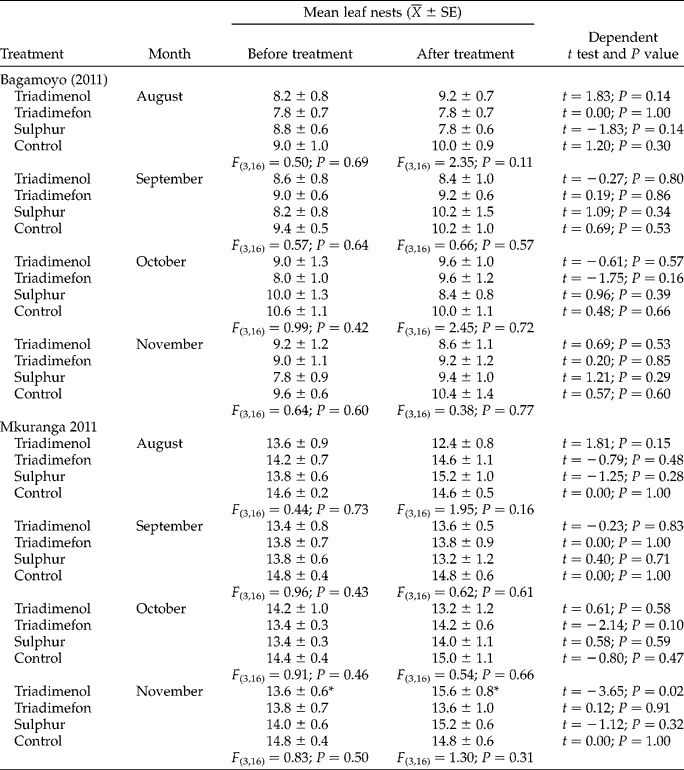
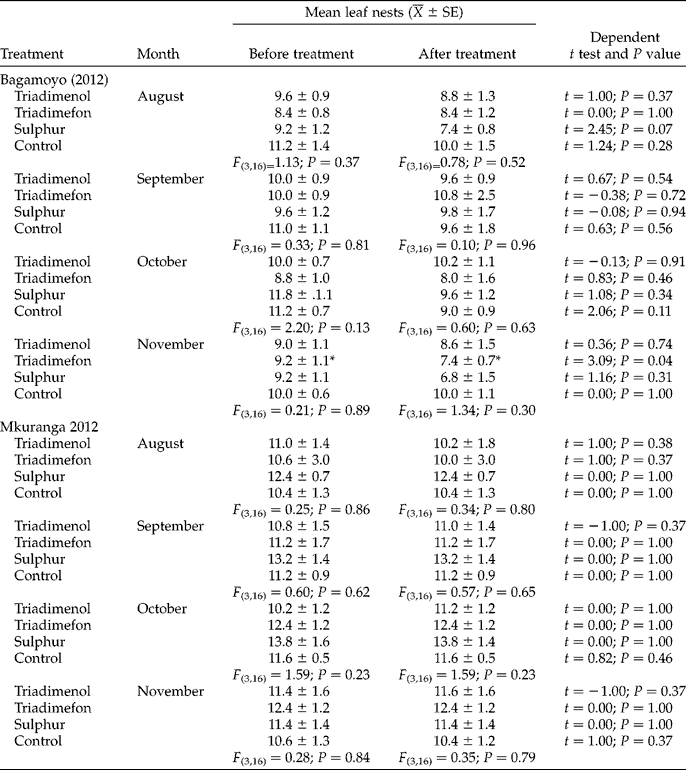
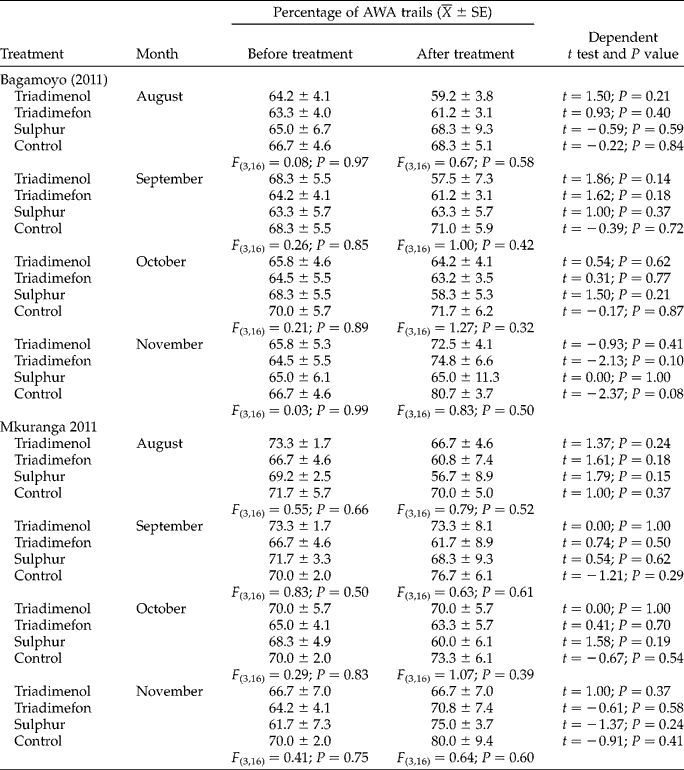
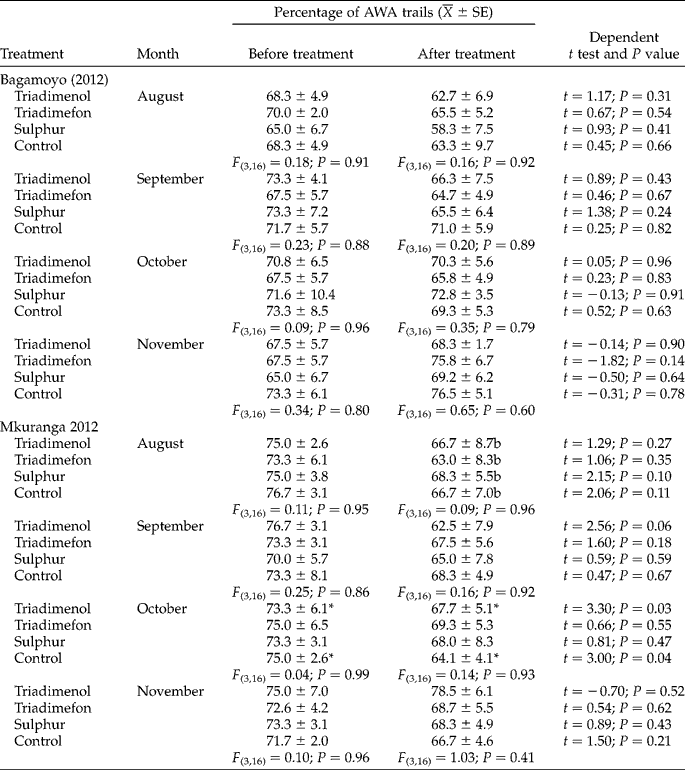
There were no significant differences in the effect that the different fungicides had on the number of leaf nests in 2011 (F (3,35)= 1.74; P= 0.18) and 2012 (F (3,35)= 0.39; P= 0.76). However, the number of leaf nests did differ between Bagamoyo and Mkuranga during 2011 (F (1,35)= 184.91; P= 0.0001) and 2012 (F (1,35)= 12.12; P= 0.001). When the different treatments (triadimenol, triadimefon, sulphur and control) were compared within a site in each month, no significant differences in the number of AWA leaf nests were observed between all the treatments at both the sites, each month in both the seasons (Tables 1 and 2). For example, in August 2011, the number of leaf nests before application ranged from 7.8 to 9.0 and from 13.6 to 14.6 in Bagamoyo and Mkuranga, respectively, while after application, it ranged from 7.8 to 10.0 and from 12.4 to 15.2 in Bagamoyo and Mkuranga, respectively (Table 1). The same trend was observed in September, October and November 2011 (Table 1). In August 2012, the number of leaf nests before application ranged from 8.4 to 11.2 and from 10.4 to 12.4 in Bagamoyo and Mkuranga, respectively, while after application, it ranged from 7.4 to 10.0 and from 10.0 to 12.4 in Bagamoyo and Mkuranga, respectively (Table 2). The only significant differences were observed after the application of triadimenol in November 2011 in Mkuranga and after that of triadimefon in November 2012 in Bagamoyo (Tables 1 and 2). There were no significant differences in the effect of the different treatments (triadimenol, triadimefon, sulphur and control) on the percentage of colonization of AWA trails (F (3,35)= 1.81; P= 0.16 and F (3,35)= 0.10; P= 0.96) in 2011 and 2012, respectively. The percentage of colonization also did not differ significantly between the sites (F (1,35)= 1.13; P= 0.30 and F (1,35)= 0.61; P= 0.44) in 2011 and 2012, respectively. Similarly, monthly applications of fungicides did not significantly affect the mean percentage of colonization expressed as AWA trails within the sites for both the seasons (Tables 3 and 4). In August 2011, for example, AWA colonization before application ranged from 63.3 to 66.7% and from 66.7 to 73.3% in Bagamoyo and Mkuranga, respectively, and after application, it ranged from 59.2 to 68.3% in Bagamoyo and from 56.7 to 70.0% in Mkuranga (Table 3). No significant difference in the mean percentage of colonization before the application of fungicides and that after application was also observed in September, October and November 2011 (Table 3). In August 2012, AWA colonization before application ranged from 65.0 to 70.0% and from 73.3 to 76.7% in Bagamoyo and Mkuranga, respectively, and after application, it ranged from 58.3 to 65.5% in Bagamoyo and from 63.0 to 68.3 in Mkuranga (Table 4). The same trend was observed in September, October and November 2012 (Table 4). The applications of powdery mildew fungicides did not, therefore, affect the abundance of AWA in the two cashew-growing areas in the Bagamoyo and Mkuranga districts. The strength of AWA colonies recorded was similar to that reported in a previous study (Olotu et al., Reference Olotu, du Plessis, Seguni and Maniania2012). Similar results have been reported for the three powdery mildew fungicides in southern Tanzania (M.E.R. Sijaona, personal communication). The application of triadimenol and sulphur fungicides for the control of PMD in grapevines in South Africa has also been reported to not affect the abundance of the predaceous mite, Amblyseius addoensis (Van der Merwe & Ryke) (Acari: Phytoseiidae) (Schwartz, Reference Schwartz1993).
Monthly mean number ( $$\overline{ X } $$±SE) of AWA leaf nests per tree before and after the application of triadimenol, triadimefon, sulphur and control in cashew fields in Bagamoyo and Mkuranga in 2011

* Means are significant at P< 0.05, t test.
Monthly mean number ($$\overline{ X } $$±SE) of AWA leaf nests per tree before and after the application of triadimenol, triadimefon, sulphur and control in cashew fields in Bagamoyo and Mkuranga in 2012
* Means are significant at P< 0.05, t test.
Monthly colonization levels ($$\overline{ X } $$±SE) of African weaver ant (AWA) trails before and after the application of triadimenol, triadimefon, sulphur and control in cashew fields in Bagamoyo and Mkuranga in 2011
Monthly colonization levels ($$\overline{ X } $$±SE) of African weaver ant (AWA) trails before and after the application of triadimenol, triadimefon, sulphur and control in the cashew fields in Bagamoyo and Mkuranga in 2012
* Means are significant at P< 0.05, t test.
Conclusion
The use of the three powdery mildew fungicides (triadimenol, triadimefon and sulphur) did not have detrimental effects on the abundance of AWA in cashew fields in the Bagamoyo and Mkuranga districts of the Coast region of Tanzania, and these fungicides can, therefore, be used together with AWA as important components of an integrated pest and disease management programme for cashew crops in Tanzania.
Acknowledgements
The authors acknowledge the Federal Ministry for Economic Cooperation and Development and the German Academic Exchange Service (DAAD), Germany, for providing financial support. They thank icipe – African Insect Science for Food and Health, the African Regional Postgraduate Programme in Insect Science of icipe and the Mikocheni Agricultural Research Institute for overall assistance during this study. They also thank Dr K. Fiaboe (icipe) and Dr T. Martin (CIRAD/icipe) for reviewing the manuscript. They are grateful to Messieurs J. Ambrosy, M. George, V. Nyange, B. Mruma and G. Mwingira for technical assistance. They are also grateful to Mr and Mrs Ponzi and M. Chimela for providing access to field sites and farm facilities.