


Introduction
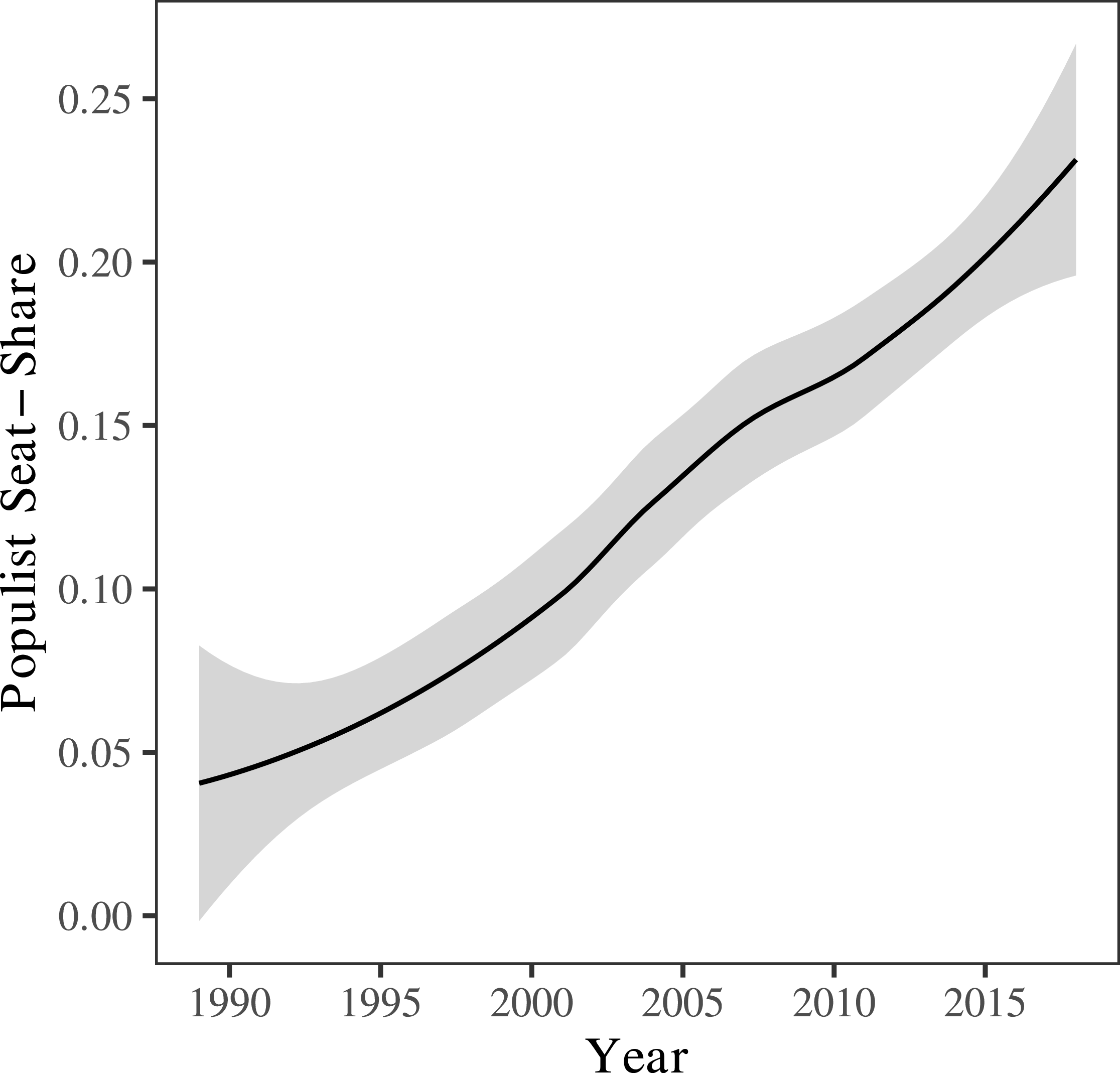
Over the past forty years, populism as a political ideology has become quite common. Support for populist candidates has surged, roughly quadrupling since 1990 (see Figure 1), while the use of populist rhetoric has quickly spread amongst politicians (e.g. Moffitt, Reference Moffitt2016). This is not simply an electoral realignment like any other—this is cause for great concern. Many scholars of democracy agree today that such rises around the globe constitute one of the greatest contemporary threats to liberal democracy (e.g. Mudde and Kaltwasser, Reference Mudde and Kaltwasser2012). It is not the case that these threats are merely hypothetical—real democratic backsliding has occurred in places like Hungary, Turkey, and Poland at the hands of populist leaders (Urbinati, Reference Urbinati2019; Sadurski, Reference Sadurski2018). At the same time we have seen populism fuel social movements like Brexit, and begin to characterize leaders of mainstream political parties like both Labour and the Conservatives in the UK,Footnote 1 and numerous other leaders of European parties as they attempt to remain competitive with these new rivals.
Populist seat-share in Europe.

Beyond remaining a threat for liberal democracy in the eyes of academics, populism has a negative connotation amongst many elites in a given country. In many cases, ‘populist’ is used as a generic insult from one politician to another with whom disagreements exist policy-wise, often as a euphemism for ‘racist’, or similar disparaging labels (Casiraghi, Reference Casiraghi2021). Further, those in the media are much more likely to utilize the term in a negative context than in a positive one (Herkman, Reference Herkman2017), though in many cases with an imprecise definition.
What remains unclear, however, is how voters perceive the label of ‘populist’ as it relates to a potential candidate in an election. Do voters hold that populist candidates pose a threat to the polity of their nation and therefore are affected by politicians’ and journalists’ usage of the term? Or, are they instead motivated to support a populist candidate who brings with them positive connotations in the eyes of the voter, such as anti-elitism and a propensity for extra-parliamentary solutions that are more likely to bring about desired policies? For example, Donovan (Reference Donovan2021) finds voters of right-populist parties often exhibit higher approval of strong, unchecked leaders who ‘bend the rules’. Finally, it is possible that voters do not associate any of these characteristics with the populist label and are simply unmoved by the portrayal of a candidate as such.
Understanding these motivations is quite important: voters provide a key check on democratic backsliding. Even while democracy may erode from the top (Bartels, Reference Bartels2023), voters are able to encumber erosion through the maintenance of liberal democratic norms (Levitsky and Ziblatt, Reference Levitsky and Ziblatt2018) and by candidate choice in elections (Graham and Svolik, Reference Graham and Svolik2020). Where democracy is truly imperiled, then, is when its defense is no longer a priority of the citizenry. Yet, it is still unclear to what degree voters recognize the potential threats of populism, and further to what degree these threats dissuade support. Studying the populist label with regard to these trends presents a particularly interesting case: the populist label is unlike most in politics as it—at least historically—was rarely ever self-applied, but rather commonly used by one group to label another (Mudde, Reference Mudde2004) often in a negative way, though as I discuss later on, this is less true today with regard to right-wing populists. This has led to the term being oft-confused, misinterpreted, and denoting quite different principles to different audiences (see for e.g. Taggart, Reference Taggart, Mény and Surel2002; Brett, Reference Brett2013). Even among academics sometimes differing definitions of the term are used, though many as of late have adopted an ideational approach akin to Mudde’s (Reference Mudde2004). While work generally has agreed that such ideology is averse to the very concept of liberal democracy (Pappas, Reference Pappas2019; Mudde, Reference Mudde2007), however, there is very little known as to how voters interpret the term, and if they perceive any of these potential democratic threats.
Overall, my expectation is that stemming from this negative treatment of populism in the media and its pessimistic outlook from politicians and academics, voters penalize populist candidates at the voting booth, view them as less devoted to protecting democracy, and perceive of them as more ideologically extreme. However, I argue results are conditional on two important features. First, the underlying ideology of the candidate (i.e. right-wing populism versus left-wing populism), and second, the voter’s own level of populist ideology. I find empirical support for each of these expectations. Namely, and perhaps most relevant to ongoing trends in contemporary politics, results suggest that left-wing voters are put-off from candidates described as populist, while right-wing voters are not. Further evidence as to why this may be suggests that right-wing voters are indeed less concerned about potential threats stemming from populism, and more likely to believe the ideology provides politicians and government with benefits. This is an especially crucial and perhaps surprising finding as most democratic threat in Europe has been from right-wing populists (Huber and Schimpf, Reference Huber and Schimpf2017; Bichay, Reference Bichay2024)—even while both forms of populism have a problematic relationship with democracy (Van Der Brug et al., Reference Van Der Brug, Popa, Hobolt and Schmitt2021). I argue, however, that for right-wing populists, the populist label has been used beneficially to aid in the mainstreaming and normalization process, stepping in to shield other, more damaging labels that keep voters from developing a negative perception of the term.
This paper presents a pre-registered, randomized experiment embedded in a nationally representative survey of the United Kingdom to understand the effect labeling a candidate as ‘populist’ has on voter support for said candidate, as well as their perceptions of the candidate’s commitment to democracy and ideological extremism. Following the experimental manipulation and outcome measurement, I utilize post-test survey questions to gain a better understanding of how voters perceive such a label, and subsequently how such labeling affects voter predispositions towards the candidate. This research contributes to our understanding of democratic backsliding, the concept of populism, and especially as to how voters react to certain labels when evaluating a political candidate’s competency to govern, and ultimately in deciding for whom to vote.
Populism, what’s in a name?
The concept of populism has received an abundance of attention as of late. Scholars have become more interested not only in its causes and consequences, but also in defining it as a concept. The term has become so popular in the last decade, Cambridge Dictionary designated it the word of the year in 2017. Simultaneously, the ambiguity surrounding the precise definition of the term has resulted in some like Taggart (Reference Taggart, Mény and Surel2002, p. 62) to refer to it as ‘one of the most widely used but poorly understood political concepts of our time’, or Brett (Reference Brett2013, p. 410) opining populism as ‘a classic example of a stretched concept, pulled out of shape by overuse and misuse’. In fact, Cambridge’s own definition in their word of the year announcement was derided by some as largely incorrect.Footnote 2 Luckily, for researchers interested more so in the causes and consequences of this rising ideology, a general consensus has largely emerged, in line with Cas Mudde’s (Reference Mudde2004, p. 543) definition defining populism in ideational terms as such:
an ideology that considers society to be ultimately separated into two homogeneous and antagonistic groups, ‘the pure people’ versus ‘the corrupt elite,’ and which argues that politics should be an expression of the volonté générale (general will) of the people.
Beyond this general definitional consensus, many in the field have come to a further agreement regarding populists: that they remain in opposition to the core tenants of liberal democracy (e.g. Mudde, Reference Mudde2004; Pappas, Reference Pappas2019; Bichay, Reference Bichay2024; Houle and Kenny, Reference Houle and Kenny2018). To be sure, there have also been arguments made as to the perceived benefits of populism (for e.g. Mouffe, Reference Mouffe2018; Stavrakakis and Katsambekis, Reference Stavrakakis and Katsambekis2014), yet the empirical evidence on the topic has decidedly supported populism as a ‘threat’ rather than ‘corrective’ for democracy once in political office—which is most theoretically relevant to this study (Ruth-Lovell and Grahn, Reference Ruth-Lovell and Grahn2023; Huber and Schimpf, Reference Huber and Schimpf2016; Juon and Bochsler, Reference Juon and Bochsler2020).
Much of this opposition to liberal democracy stems from populists’ posturing as anti-pluralists (Muller, Reference Muller2016). This entails an implication that they alone are able to competently lead government and deliver results to the nation, while other leaders—and indeed these other leaders’ supporters—are ‘illegitimate.’ An infamous example of these dynamics can be seen with Turkish President Erdogan implying in the 2017 constitutional referendum that those who voted against him were terrorists.Footnote 3 This divisive and anti-pluralistic rhetoric is in-line wholly with the populist Manichaean view of society: only some are legitimate to rule, and only some are legitimate to have their views represented in government (Hawkins and Kaltwasser, Reference Hawkins and Kaltwasser2017). The ‘other’ people can be summarily ignored in the political process.
This antagonism toward liberal democracy reaches far beyond speeches and rhetoric, however. History has shown populists eager to skirt rule-of-law to implement this illiberal ideology. There are numerous examples of populists entering power and slowly degrading liberal democracy around them, with the most pronounced contemporary cases including Turkey, Hungary, and Poland (see for e.g. Cianetti et al., Reference Cianetti, Dawson and Hanley2018; Sasmaz et al., Reference Sasmaz, Yagci and Ziblatt2022). Beyond these specific cases, cross-national evidence demonstrates these effects to be quite far reaching. Evidence from Latin America demonstrates widespread erosion of checks and balances on executive power under populist regimes (Houle and Kenny, Reference Houle and Kenny2018). Further work in Europe shows a slow but persistent undermining of civil liberties including freedom of speech, religion, and access to justice under right-wing populists (Bichay, Reference Bichay2024).
And yet despite this, populist candidates have become quite successful recently, especially in Europe. Figure 1 displays populist seat-share in European parliaments from 1990—2018.Footnote 4 In many cases they attract disenchanted voters with grave concerns regarding the economy (Algan et al., Reference Algan, Guriev, Papaioannou and Passari2017) and immigration (Van Der Brug et al., Reference Van Der Brug, Fennema and Tillie2000) who simultaneously feel ‘left-out’ of both politics and society in general (Spruyt et al., Reference Spruyt, Keppens and Van Droogenbroeck2016; Gidron and Hall, Reference Gidron and Hall2019).
It remains clear, thus, given these aforementioned fears on the part of academics, the parties’ characteristic harsh rhetorical tendencies, and the transpiring of actual democratic degradation, that a better understanding of the conceptual perceptions of populism is necessary. Before considering whether any of this aforementioned evidence has influenced voters’ perceptions of the term, we may first consider more concretely how others in the political arena perceive the notion of populism.
While a limited amount of empirical research regarding politicians’ usage of the term has been conducted, in general politicians utilize the term populism with underlying negative connotations. Though some politicians, for example Jörg Haider of Austria and Jean-Marie Le Pen of France, have on occasion referenced populism in a positive, self-referential manner (Elmgren, Reference Elmgren2018), it is largely used as an insult against political opponents. Analyses of parliamentary debates in the UK, for example, finds less than 4% of mentions of ‘populism’ to be in a positive light, while the overwhelming majority of mentions did so in a negative or pejorative manner (Casiraghi, Reference Casiraghi2021). Importantly, politicians do not always tend to use the term in its precise definition to offer concerns regarding policies or practices stemming from populist ideology or rhetoric, but rather as a generic insult against opposing-party members.
Several examples of this insulting usage are included in the aforementioned Casiraghi (Reference Casiraghi2021, p. 19) research, one of the only found to empirically analyze such usage. In one example a member of parliament decries ‘The Prime Minister clearly prefers populist gestures to the long-term interests of our nation’, or in another, ‘It takes the typical Liberal Democrats populist approach, trying to attack the tobacco industry without any evidence whatsoever’. More examples in the same vein can be found outside of the UK. In Italy M5S leader Beppe Grillo has been frequently criticized as populist in response to his often demagogic and provocative language (Bortoluzzi and Semino, Reference Bortoluzzi and Semino2016). In addition, the United States has experienced the usage of the term on occasion as a pejorative: in the run up to the 2024 Republican presidential nomination, for example, former Vice President Mike Pence dismissed opponent Vivek Ramaswamy as a ‘populist protégé’, while warning against the ideology as the future of the party.Footnote 5
Similarly, we can look to how members of the media understand the term. Media characterizations of populism may well be most relevant to public perceptions of the same given the enhanced visibility, while media coverage is often cited as a main contributor to the rise of populist politicians (e.g. Mazzoleni, Reference Mazzoleni, Mazzoleni, Stewart and Horsfield2003). Content analysis of newspaper articles in the Nordic region find that, while a plurality of coverage remains neutral, the press’ treatment of populist parties are much more likely to be negative than positive (Herkman, Reference Herkman2017). This pattern seems to hold true in both tabloid and quality media outlets alike. Further research shows that in many cases journalists can often use the term in a quite imprecise way, referring to politicians unassociated with any populist party, or policies with no bearing in populist ideology (Bale et al., Reference Bale, van Kessel and Taggart2011). Yet even in these cases, the word is typically used in a pejorative manner, and not to convey any positive attributes. More recent research has shown such negative patterns persisting over time and across geographical settings (Shchinova, Reference Shchinova2025; Shchinova et al., Reference Shchinova, Cock, Hambye, Íñigo-Mora and Lastres-López2024; Thornborrow et al., Reference Thornborrow, Ekstrom and Patrona2021). Not only is the balance of media coverage negative, but has been growing increasingly more negative over time (Hatakka and Herkman, Reference Hatakka and Herkman2022). At the same time, however, these media outlets routinely refer to the academically agreed upon ‘usual suspects’—Jörg Haider and the Freedom Party of Austria, or the Swiss People’s Party, for example—as populist.
Herein lies the disconnect. A plethora of research uncovers the inherent dangers of populism, and its overwhelming tendency of undermining democracy. Meanwhile, media coverage of populists’ political aspirations remains quite negative, while politicians’ own usage of the term is often in a derogatory context. And yet, at the same time, populists have seen a recent explosion of support. This result begs an important question: do voters not know of the negative connotations associated with populism and populist candidates, do they not care, or finally, do they not agree with the academic and media assessment of its virtues? While we have a great deal of evidence towards academic and journalistic opinions on populism, there remains no offering of how the public perceives the concept. In the next section I lay out theoretical considerations for what this perception may likely be, and importantly, how it likely may depend on the underlying ideology of the politician.
Public perceptions of populism
Candidate labels serve as a crucial heuristic for voters. Extensive research has demonstrated that voters infer policy positions and other attributes of candidates based on their party affiliation (Feldman and Conover, Reference Feldman and Conover1983). In numerous instances, voters even prioritize judging candidates based on their partisan label over considering their actual policy positions (Coffé, Reference Coffé2018). Historically, however, work on these label heuristics have been largely limited to partisanship. Some related evidence analyzing ‘alt-right’ as a candidate label finds the term leads voters to believe candidates are more right-wing ideologically than their non-alt-right counterparts (Cluverius et al., Reference Cluverius, Banda and Daly2020), and similarly that voters who share ideologies thought to be a part of the alt-right (e.g. sexism, racial resentment) exhibit increased support for the movement (Banda and Cluverius, Reference Banda and Cluverius2023). Relatedly, looking at sub-partisan cues, Gervais and Taylor (Reference Gervais and Taylor2016) find the ‘tea-party’ label increased the rightward perceptions of both democratic and republican candidates in the United States. Otherwise, the realm of non-partisan candidate labels as a heuristic for candidate support is an under-explored yet important avenue for research.
Is the populist label simply another sub-partisan cue, priming voters as to the ideological extremism of the candidate in question? I argue, given the specific characteristics and history of the term, this is likely not the case. It is important to remember the populist label is unlike these aforementioned labels. For one, it has not historically been associated only with one side of the ideological spectrum, but has applied equally to those on the ends of both the left- and right-wings. Second, populism, as a ‘thin’ ideology does not have ascribed policy preferences, but rather is associated often with a moralistic worldview (e.g. Mudde, Reference Mudde2004), and thus opens the door for more widespread connotations involving not just partisanship or ideology, but views on governance and democracy as well.
Given the very limited research on voter perceptions’ of populism, it is challenging to establish strong a priori hypotheses regarding the effect of such labels and how it may extend beyond those previously investigated. That being said, there is of course a rich literature on populism, and elites’ usage of the term. We can, thus, still look to previous research for an understanding of why and how the label of ‘populist’ may affect a voter’s evaluation of political candidates beyond merely their perceived ideology.
It is crucial to note at the outset that previous experimental work suggests voters understand what it means for candidates to be populist. Evidence from a conjoint experiment, for example, finds that voters typically recognize populist rhetoric from politicians and accurately conceive of it as ‘more populist’ when compared to more mainstream rhetoric (Casiraghi et al., Reference Casiraghi, Curini and Nai2023). Importantly, the rhetoric of the candidate seems to be the only characteristic that matters in voters accurately identifying populists, while attributes such as candidate gender and professional job history are largely inconsequential. Relatedly, the only demographic factor on the part of voters that seems to indicate how sensitive they are to detecting populism remains their own populist tendencies, with populist voters less likely to accurately identify populism amongst candidates (see discussion of my final hypothesis for more on this topic).
This evidence is especially important given previous findings that politicians and journalists sometimes use the term imprecisely. Even with these imprecise derogations in the media and amongst politicians, voters are able to accurately detect populism in its more academic usage. But even as voters may recognize what populism is, there is no real evidence as to how they feel about it conceptually—or rather, how they react to it in the voting booth. Certainly, many may be persuaded by its appeal. Their dramatic increase in support especially over the last two decades in Europe suggests there may be something quite persuasive about populist politicians. In this same vein, work has examined public perceptions of populist framing of social issues (Bos et al., Reference Bos, Schemer, Corbu, Hameleers, Andreadis, Schulz, Schmuck, Reinemann and Fawzi2020), finding that anti-elite rhetoric is indeed a useful tactic for voter persuasion. Yet at the same time, others argue the main driver of recent populist support lies in policy considerations of the politician’s platform, and not in their populist ideology (Neuner and Wratil, Reference Neuner and Wratil2022; Castanho Silva et al., Reference Castanho Silva, Fuks and Ryô Tamaki2022), further complicating our understanding of mass approval of populism.
Thus, for the majority of voters, there is likely a differing effect when being told a certain candidate, all else being equal, is a ‘populist.’ In this case, it is not that a voter is judging the politician based on their rhetorical style, or even policy preferences or framing. Rather, the main decision-making focus in a voter’s mind is this heuristic label—removed from all rhetorical and ideological context, surrounded only by connotation—which we know to be quite important in vote-choice. This, coupled with politicians’ and the media’s consistent negative treatment of populism and populists, and their discussion of populism’s anti-liberal democratic qualities, suggest a likelihood that voters overall may also be adopting a similarly negative stance on populism as a concept in the aggregate, and thus penalize candidates described as such.
In this same way, it may also be that voters do still perceive of populist candidates as more ideologically extreme than their non-populist counterparts even given similar policy profiles—much in the same way previously-discussed research finds the ‘alt-right’ label transforms perceptions of candidate ideological positioning (Cluverius et al., Reference Cluverius, Banda and Daly2020). This again, likely stems from media coverage of the term. By frequently using the term to refer to the ‘usual suspects’, who generally are leaders of radical parties (Bale et al., Reference Bale, van Kessel and Taggart2011), the term could be—in the eyes of voters—becoming associated with more radical ideologies. Therefore even when furnished with identical policy platforms, voters may perceive of those labeled as ‘populist’ as more ideologically extreme, in line with the customary connections made by the media.
Thus, my first expectation is that voters penalize populist candidates in terms of support, view them as less devoted to democracy, and perceive of them as more ideologically extreme.
The relationship between such a label and popular support of course is likely to be much more nuanced than a simple aggregate relationship. A key conditional factor that may influence any treatment effect is the ideological wing in which we contextually place the populist label. That is to say, there may well be key differences between reactions to left-wing and right-wing populism on the part of voters from their respective ideological wing. Some evidence, for example, points to the suggestion that not only do British politicians largely utilize ‘populist’ as a pejorative insult, but the term’s usage is often employed to evoke connotations of nationalism and racism (Casiraghi, Reference Casiraghi2021)—key tenets unique to right-wing populism.
In this way, the common associations made to left-wing and right-wing populism are not always the same. The right often tends to be more exclusive (Mudde and Kaltwasser, Reference Mudde and Kaltwasser2013). The United Kingdom Independence Party, for example, announced in their party manifesto that they wish to ‘End the active promotion of the doctrine of multiculturalism… [and] recognise the numerous threats to British identity and culture’ and instead promote the notion of uniculturalism (UK Independence Party, 2010). This is in contrast with left-wing populists who, while still averse to liberal democracy, espouse more inclusionary preferences condemning racism and bigotry (March, Reference March2017). Along these lines, the media’s discussion of populism with regard to left-wing politics generally associates the term with sweeping social policies, while for the right-wing is often associated with not just pro-market, pro-law and order policies, but also concepts like ‘Islamophobia’ and ‘racism’ (Bale et al., Reference Bale, van Kessel and Taggart2011). Similar work has shown ‘nationalist’ and ‘racist’ to be the most common antecedents to ‘populist’ in recent history (Casiraghi, Reference Casiraghi2021).
Thus, it would seem, on one hand, that right-wing populism may bring with it more stark negative connotations than its left-wing counterpart among voters, given most instances of populist pejoratives are directed towards right-wing populist policies. This result would be in line with the media’s treatment of the term. In the UK for example, left-leaning news publications (e.g. The Independent) are dramatically more likely to use ‘populist’ as an insult towards their ideological opposites as compared to right-leaning newspapers (e.g. The Telegraph) (Bale et al., Reference Bale, van Kessel and Taggart2011). This, further, is in line with what much of the previous literature on ‘stigmatization’ has found, for example. For one, the most negatively stigmatized parties are often radical-right populists, in addition to those with authoritarian legacies (Valentim, Reference Valentim2024). In this way, exposure to the negative stigma of a right-wing populist party can decrease one’s participation within party events and mobilization efforts (Ammassari, Reference Ammassari2025) and even in their willingness to vote for the party (Van Spanje and Azrout, Reference Van Spanje and Azrout2019).
What remains unclear, however, is the degree to which voters connect the stigma of radical-right-populist parties to their populist nature. That is, the stigma in these cases rests with the party, not with the populist ideology itself. Thus it remains unclear if the stigmatizing of such a party as ‘racist’ or ‘fascist’ has the same effect as stigmatizing the party as ‘populist.’ Van Spanje and Azrout (Reference Van Spanje and Azrout2019) specifically admit this may not be the case. It is further possible these same factors may instead be creating an opposing effect. By using the term ‘populist’ as a replacement for objectively negative terms, such as ‘racist’, the label may in fact be—while still often discussed as anti-liberal democratic—simultaneously masking other negative connotations, serving as a euphemism for more stigmatizing labels that would do these politicians even more harm in terms of public opinion. In support of this possibility, a case-study of The Guardian’s ‘The New Populism’ series finds exactly this effect (Brown and Mondon, Reference Brown and Mondon2021). A demonstration of the paper’s usage of the term over time methodically illustrates that it has (1) served to conceal more stigmatized labels such as ‘Islamophobic’, while (2) had the effect of shifting blame for any negative coverage away from the political elites themselves. Importantly, there does not appear to be any similar processes serving a euphemizing function on behalf of left-wing populist terminology—a relic of the fact that left-wing populism does not carry with it such stigmas. It may be thus that the aforementioned trend of seeing ‘populist’ used as an insult more frequently in left-leaning British press compared to their right-leaning competitors may in fact be providing left-leaning readers with a more negative view of the term.
This euphemism effect has, in recent history, potentially changed the way elites embrace the term. Contrary to previous assertions that politicians rarely employ the term ‘populist’ in a self-referential manner, this may not be as uncommon today as it has historically been. The previously mentioned prominent examples of Jörg Haider and Jean-Marie Le Pen claiming the term populism as a positive attribute are but a few examples of this new trend. Marine Le Pen, for instance, has in modern times followed in her father’s footsteps, embracing the term while simultaneously threatening legal action against those who would call her ‘extreme-right’—a dichotomy described by some as a typical example of using ‘populist’ to one’s advantage to soften the party image, while eschewing other labels which may instead do harm (Brown and Mondon, Reference Brown and Mondon2021).
As right-wing politicians adopt the term in an attempt to evade other descriptors, they help in bringing the label into the mainstream, exposing voters to a positive interpretation and thus potentially discrediting more alarmist conclusions of the label. Thus, while we really only have the aforementioned negative connotations concerning liberal democracy to consider with regard to left-wing populism, with the right-wing there are two forces to consider. One is these same negative connotations, but the other is a consideration of what this label is replacing. Given the term’s tendency to stand in for more negative terms like ‘racist’, this could serve to (1) amplify these negative connotations, or (2) work against and perhaps even cancel out these negative forces, by softening the image of right-wing populists in other arenas and driving them to increase the mainstream appeal of the descriptor. In this way, the populist label acts as a ‘reputational shield’, allowing parties to pursue anti-immigrant policies without being overtly refereed to as racist, in the same way Ivarsflaten (Reference Ivarsflaten2006) has argued parties have used their historical legacies to do the same.
While both of these potential effects have been discussed in the literature, we have yet to see evidence as to which force exerts more pressure on voters. Thus, my second expectation is that voters’ predisposition towards populist candidates is conditional on left-right ideology, with right-wing voters less repelled by the label due its characteristic masking of more demonizing stigmatic labels.Footnote 6
One additional conditional factor to consider refers to how differing levels of populist ideology within the voter pertains to their subsequent connotation of the term as applied to a populist candidate. Previous evidence suggests populist sentiments among voters largely hamper their ability to identify populism among politicians. Casiraghi et al. (Reference Casiraghi, Curini and Nai2023) suggest this could be indicative of the fact that voters may indeed understand populism to have negative connotations, and thus resist a self-association with the negatively perceived movement. On the other hand, these voters may simply not connect rhetoric they agree with to be considered within the negatively perceived domain of populism in first place. Thus, the question becomes: do voters with a high degree of populist ideology (1) know they are voting for populists, but hold no negative connotation of the term—or perhaps even overtly subscribe to the populist ideology—and thus would not penalize a candidate described as ‘populist’, or (2) never conflate their preferred politicians with the concept of populism at all—and thus would not differ from their non-populist peers in terms of negative treatment effects?
There is some evidence to suggest the first possibility may be true. In several European states voters who support right-wing populist parties have espoused a higher likelihood of holding anti-democratic opinions (Donovan, Reference Donovan2021). Specifically, Europeans who supported right-wing populists were more likely to favor strong leaders who explicitly were willing to ‘bend the rules’ and who do not ‘need to bother with parliament or elections’. Similarly, these voters were more likely to view military rule favorably and democracy unfavorably. While many of these opinions do not necessarily line up with explicit populist ideology, they do demonstrate a dramatic divergence from median voter opinions, and simultaneously demonstrate that the publicized negative connotations of populism’s anti-liberal tendencies may not do much to dissuade these voters who may share these views.
Thus, my third expectation is that voters with high levels of populist ideology do not penalize politicians described as populist.
Populism in the UK
The United Kingdom provides an ideal context to answer these questions. For one, populism has been used categorically to frame the recent social movement in their exit of the European Union, colloquially referred to as Brexit, which was simultaneously supported by one of the better-known European populist parties in the United Kingdom Independence Party (UKIP) (e.g. Inglehart and Norris, Reference Inglehart and Norris2016). The UK has further had populist parties on both ideological ends of the spectrum with similar levels of success, with UKIP on the right and the Respect Party on the left, each winning just one parliamentary seat historically—though more recently Reform UK, a spiritual successor of sorts to UKIP has seen more success, winning 5 seats in 2024. They have also seen populist parties campaign that have not taken up seats in the legislature on the left (Sinn Féin who abstains from taking up won seats) and on the right (the British National Party who have never won a riding).
Most importantly, both mainstream parties have had a wide variety of populist accusations thrown at their various leaders, especially Jeremy Corbyn of Labour and Boris Johnson of the Conservatives (see footnote 1). Indeed, the UK is often considered an ‘archetypal’ example of the populist zeitgeist due to the high propensity of populist discourse associated with both the left- and right-wing parties (March, Reference March2017), so much so that Mudde (Reference Mudde2004) refers to Britain as a quintessential example of how populism is neither reserved for the left- nor the right-wing. Although March argues that the mainstream British parties may not be practicing ‘genuine populism’, there is still a significant amount of accusations and name-calling directed towards populists within mainstream British politics. It is important to note here that the main quantity of interest is a voter’s perception of populism in the real world, and how it affects voting behavior. Thus, regardless of whether ‘genuine’ populism is being practiced, the key just the same is voters’ response to these populist allegations.
Analysis of British news publications, for example, has found ample coverage referring to both the Conservative as well as the Labour parties as populist (March, Reference March2017). This has prompted numerous arguments that the British case is indeed indicative of broader patterns of populism across the region (e.g. Bale et al., Reference Bale, van Kessel and Taggart2011). In this way, there is much evidence that voters in the UK often think about politics, both in the form of popular movements and legislative elections, in the populist context. Figure 2 shows search interest history for both the terms ‘populism’ and ‘Brexit’ among UK Google users.
Google search frequency in the UK.

It is evident, first, that peaks exist in both terms around early 2016, coinciding with the Brexit campaign and referendum. Additionally, we see large peaks—especially for ‘populism’—in mid-2017 and peaks for both terms in late 2019, in both cases corresponding with legislative elections. These trends indicate, at least to some degree, that voters in the UK are aware of populism as an important characteristic of both social movement and partisan politics in the country, and often make an effort to seek out the term in the context of a national vote. This strong relationship in terms of Google frequency of the terms ‘Brexit’ and ‘populism’ further suggest voters understand the core properties of the ideology and the common concomitants that go along with it, as previous research has suggested (Casiraghi et al., Reference Casiraghi, Curini and Nai2023).
Lastly, it is important to note that this profusion of both left- and right-wing populist name calling especially makes the UK an ideal case to investigate the differing effect the populist label may have based on underlying candidate ideology. If alternatively, only one ideological wing of the populist movement was widely known to the public, any reliable measure of differences in mass conceptualization based on ideology would prove impossible.
Research design
I investigate voter perceptions of populism by drawing on a randomized experiment embedded within a nationally representative survey of 2099 adults in the United Kingdom,Footnote 7 fielded via the public opinion firm Prolific.Footnote 8 While not a classic national random sample, Prolific employs quota matching techniques to ensure a sample representative of the entire UK population by matching demographic distributions in the employed sample with those of the country as-a-whole according to the UK Office of National Statistics. Analyses of online survey fielding has demonstrated that utilizing such sampling leads to reliable data, with participants who follow directions, pass attention checks, and accurately recall information presented to them in the survey (Douglas et al., Reference Douglas, Ewell and Brauer2023). Specific comparisons routinely show Prolific samples to be of a higher quality and suffer much less in terms of issues with respondent engagement (Albert and Smilek, Reference Albert and Smilek2023) as well as dishonesty and lack of comprehension (Peer et al., Reference Peer, Rothschild, Gordon, Evernden and Damer2022, Reference Peer, Brandimarte, Samat and Acquisti2017) as compared with other sampling firms. The survey was fielded in October of 2024.
After collecting several demographic measures, respondents were asked to place themselves ideologically on a four-point scale ranging from ‘strong left-wing’, ‘lean left-wing’, ‘lean right-wing’, or ‘strong right-wing’. There necessarily was no option for ‘moderate’ or ‘independent’ to force participants to pick which general side of the ideological spectrum they most see themselves. Based on the response to the ideological self-placement question, respondents were then blocked into one of two groups: left-wing voters and right-wing voters. Blocking is many times a more useful strategy than complete randomization, especially when unblocked variables have strong effects on the outcome (Moore, Reference Moore2012). In this case, it makes little sense to ask right-wing voters to give their evaluation of a left-wing candidate, and subsequently to try and calculate the penalty they may inherently have for populists on the ideological wing opposite their own (and the same for left-wing voters evaluating right-wing politicians). Beyond having unclear theoretical implications, such complete randomization would likely introduce bias into the measurement of the actual effect populist labels have on voters who would otherwise actually consider supporting said candidate.
Survey participants were then shown one of four candidate vignettes. Those respondents who placed themselves on the left politically were shown a vignette describing a candidate with a policy platform comprised of three representative major policy proposals from the Labour Party manifesto published prior to the 2019 election. For respondents who self-placed on the right, they instead were presented a vignette made up of representative proposals from the Conservative Party 2019 manifesto. The policies respondents were exposed to, thus, are not necessarily those one might associate with populist politicians, but rather the most common policies touted by the respective mainstream party. This is crucial as the quantity of interest is a measurement of the penalty imposed on populist-described candidates, all else being equal. Thus, a randomly selected half of the respondents across both ideological groups were also told that the candidate in question has been ‘described as a populist’, but otherwise saw an identical platform to those in the control group. See Figure 3 for the four potential vignettes a participant could be exposed to.
Candidate vignettes.

To first analyze how being labeled ‘populist’ affects voter support, I ask respondents to state on a scale of 0–10 how likely they would be to vote for the hypothetical candidate described in the randomly-assigned vignette in which they were exposed. As much of the discussion surrounding populism often relates to its potential threat to democracy, I also ask respondents to state on a scale of 0–10 how effective they think the candidate would be at protecting democracy. Finally, I ask respondents where they would place the candidate ideologically on a left-right scale, to ascertain if populist labels increase perceptions of ideological extremism, in a way similar to the ‘alt-right’ label.
To get a measure of the degree of populist ideology existing in each respondent, I ask survey participants how strongly they agree with six separate statements following the experimental manipulation. They include: (1) The politicians in Parliament need to follow the will of the people, (2) The people, and not politicians, should make our most important policy decisions, (3) Political differences between elites and the people are larger than the differences among the people, (4) I would rather be represented by a citizen than by a specialized politician, (5) Elected officials talk too much and take too little action, and (6) What people call ‘compromise’ in politics is really just selling out on one’s principles. These statements are based on previous work by Akkerman et al. (Reference Akkerman, Mudde and Zaslove2014) and have become a standard method for gauging popular populist sentiment (e.g. Casiraghi et al., Reference Casiraghi, Curini and Nai2023; Akkerman et al., Reference Akkerman, Mudde and Zaslove2014; Spruyt et al., Reference Spruyt, Keppens and Van Droogenbroeck2016). I utilize the degree of agreement each participant has with each of these statements to construct an index of individual populist ideology—simply their average 0–10 response for each of these six questions—enabling an analysis of whether personal populist sentiment influences these relationships.
Finally, I ask survey respondents a variety of questions related to their impression of populism, and specifically its relation to liberal democracy and civil liberties. I analyze responses to these questions following the main analysis in an attempt to uncover what may be driving any divergence in results based on these two theorized conditional factors. See the supplementary material for the full survey instrument.
Results
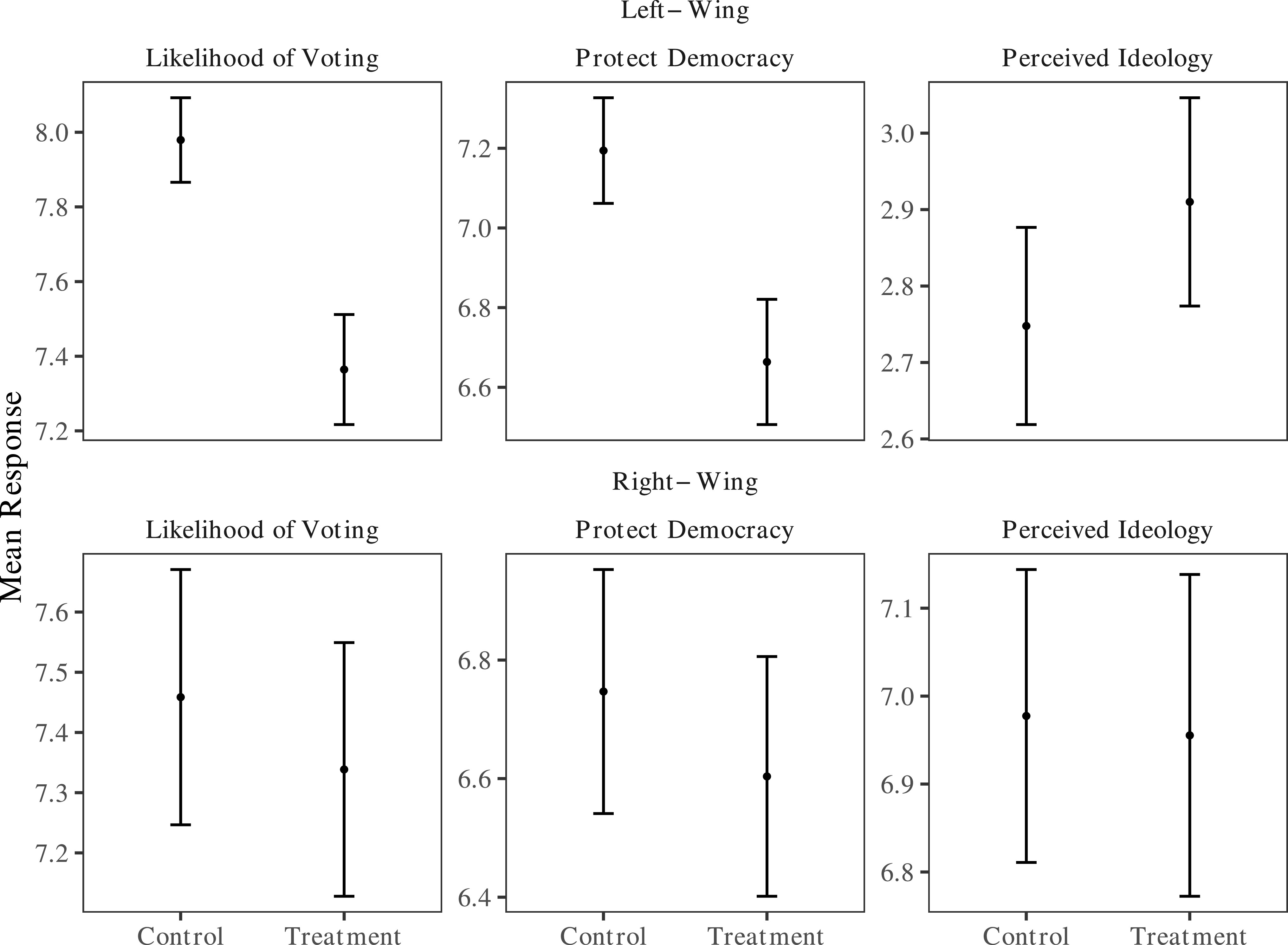
First, I calculate average treatment effects across the entire sample with regard to the effect of a populist label. Overall, the mean likelihood for both left-wing and right-wing respondents of voting for a candidate not described as a populist is 7.79 out of 10 (sd = 1.79). For those who instead received a treatment vignette that included the populist descriptor, the mean likelihood of support falls to 7.35 (sd = 1.98), a difference significant at the p < 0.001 level. The drop in perceptions of protecting democracy are of a similar magnitude and significance. There does not, however, appear to be any stark differences in perceived candidate ideology across control and treatment groups. Thus, overall, there does appear to be a slight aversion to populist candidates on the part of voters. Looking at Figure 4 however, suggests this is indeed not the whole story. I present an overview of responses to each of my three outcome questions (likelihood of voting, protecting democracy, perception of ideology), separated by ideology. These results show mean responses across four respondent groups along with 95% confidence intervals.
First differences: control vs treatment by ideology.

While the experimental manipulation had no discernible effect of respondents’ perception of the candidate’s ideology, the significance of the average effect on the first two indicators is driven entirely by left-wing respondents. Amongst left-wing participants, the average likelihood of voting for the vignette candidate falls from 7.98 to 7.36 when the populist description is included. Similarly, left-wing respondents’ in the control group gave an average response of 7.19 concerning the vignette candidate’s likely effectiveness at protecting democracy, compared to a mean value of 6.66 for those in the treatment group. In both instances the magnitude of the treatment effect is larger than what was pre-registered as constituting a difference of substantive importance, and is statistically significant at the p < 0.001 level.Footnote 9
On the other hand, we do not see similar results for self-described right-wing respondents. The mean likelihood of voting falls from 7.46 to 7.34 across control and treatment groups, while perceived effectiveness of protecting democracy similarly falls from 6.75 to 6.60. In neither case are these differences substantively meaningful (as defined by pre-registration) nor are they statistically significant at any conventional level. For each of these outcomes, I conduct null hypothesis significance tests (NHST), as well as frequentist equivalency tests (TOST). In every case, there is significant evidence to conclude no treatment effects exist among right-wing respondents, and the true mean difference between control and treatment groups is less than at least 0.40 on the 0–10 scale.
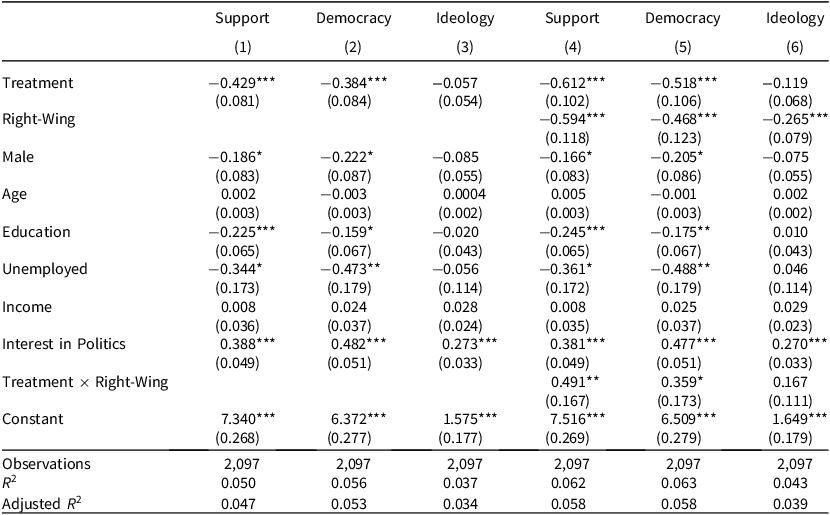
To address issues of confounding variables or potentially unbalanced samples, I specify linear regression models utilizing collected demographic variables as controls. For socio-demographic indicators, I include gender, age measured in years, level of education on a four-point scale, a dummy for whether the respondent is unemployed, and a 6-point ordinal scale of income. I also control for respondents’ self-reported interest in politics on a scale of 1–4. These models are presented in Table 1. I present pooled models in columns 1–3, and models including an ideology interaction in columns 4–6.Footnote 10 As the candidate ideology measure hypothesizes effects in different directions (that is, right-wing populists measuring higher ideology scores, and left-wing populists registering lower ideology scores), I recode the ideology variable to measure instead Euclidean distance from the middle-point of 5, where higher scores thus indicate more ideological extremism for both ideological wings.
Results of perceptions of populist candidates

Table 1. Long description
A table with six columns and eleven rows presenting regression results on perceptions of populist candidates. The columns are labeled Support, Democracy, Ideology, Support, Democracy, and Ideology. Each column contains regression coefficients with standard errors in parentheses. The rows represent different variables: Treatment, Right-Wing, Male, Age, Education, Unemployed, Income, Interest in Politics, Treatment x Right-Wing, Constant, and Observations. The table also includes R-squared and Adjusted R-squared values at the bottom. Each row provides specific regression coefficients for the variables across the different models. For example, the Treatment variable shows coefficients of -0.429, -0.384, -0.057, -0.612, -0.518, and -0.119 with respective standard errors. The Right-Wing variable shows coefficients of -0.594, -0.468, and -0.265 with respective standard errors. The table captures the impact of various demographic and political variables on the support, democracy, and ideology perceptions of populist candidates.
*P < 0.05; **P < 0.01; ***P < 0.001.
Here too we see results that mirror what has previously been discussed: labeling a candidate as populist indeed has significant effects on a voter’s likelihood to support them, and their perception of the candidates’ devotion to democracy, but only for those on the left-wing of the political ideology spectrum. Similar to the non-parametric differences, results indicate a left-wing voter is just over 6 percentage-pointsFootnote 11 less likely to vote for a populist candidate, a substantively important and statistically significant difference. Meanwhile the difference for a right-wing voter falls to roughly 1.2 percentage-points, and is not statistically significant at any level as indicated by a linear combination test. Results concerning perceived candidate’s effectiveness of protecting democracy remain similar: left-wing voters demonstrate a significant change of roughly 0.52 points on a scale of 0–10, while no statistically significant change exists for right-wing voters.
While, again, these results comprise a first-look into the reactions of voters to populism, and gaining a full understanding as to why these differences exist may largely be the duty of future research, it should be noted that this effect seems to line up quite well with the second possibility discussed in the theory. Whereas there is only one pressure potentially discouraging a populist vote amongst the left-wing, the story is not so straightforward with regard to the right. While voters face the same ‘anti-democratic’ coverage of left-wing populism, they may also be exposed to a host of right-wing politicians adopting the term as an offer of reprieve, attempting to soften the image of what would otherwise often be described in much harsher terms.
Before further delving into these left-wing vs right-wing differences, I examine whether heterogenous effects exist as a consequence of the respondent’s own adherence to populist ideology. To assess this potential effect, I re-run the above specified models but include a three-way, rather than the previous two-way, interaction.Footnote 12 That is, rather than the previously utilized interaction of treatment × right-wing ideology, I specify a model that tests an interaction of treatment × right-wing ideology × populist ideology.Footnote 13 For space, I present here the results of said tests graphically; for full model output see Table A1 of the supplementary material. Figure 5 presents the average treatment effect on likelihood of candidate support and on candidate’s perceived protection of democracy conditional on respondent’s level of populist ideology. I note first that the sub-population distribution of populist ideology scores does not materially differ between left-wing and right-wing respondents—in fact the two have identical medians of 6.8. Further, a Smirnov Two-Sample test fails to reject the null hypothesis that both distributions were drawn from the same random sample. Thus, any differences we do see cannot simply be driven by differing levels of populism between each ideology.
Average treatment effect by respondent ideology.

Figure 5. Long description
Looking first at the left-hand side of Figure 5, we see results are conditional on voters’ own attitudes. Amongst voters on the left-wing of the ideological spectrum, it is only amongst those with lower populist ideologies that we see a penalty imposed on candidates described as populist. With regard to propensity to support, respondents with very low populist ideologies had a mean support of 7.5 out of ten in the control group, compared to a 5.9 in the treatment group, indicating a drop of approximately 16 percentage-points in terms of likelihood of voting for a populist candidate, an approximately 1 standard deviation decrease. Amongst respondents with high levels of populist ideology, however, that difference vanishes to essentially 0. Similar effects exist concerning voters’ perceptions of the candidates’ effectiveness at protecting democracy. Among low-populist left-wing respondents, the populist candidate received a mean score nearly 2 points lower on the 0–10 scale, again constituting a 1 standard deviation decrease. Amongst those respondents scoring high on populist ideology, the difference falls to 0.
The right-hand panel, which presents the same results for right-wing respondents, tells a very different story. At no point do differences between low-populist and high-populist respondents significantly diverge on either measure, indicating that one’s own level of populist ideology is an important factor for a left-wing voter’s reaction to the labeling of a candidate as ‘populist’, but seems to have no discernible effect on a right-wing voter’s (lack of a) reaction. Rather, the difference seems to be entirely driven simply by differences of connotations of the label ‘populist’ amongst left- and right-wing voters.
These results, again, are especially crucial given that most threats to democracy in Europe have come from right-wing populists, but are not altogether surprising, and rather point to the success right-wing populist candidates have had embracing the term to shield them from more negative labels, simultaneously bringing the populist label into the mainstream for their voters. This begs an important substantive question: to what degree are these results truly driven by voters’ perceptions of democratic norms and their relationship with populist politicians? As some previous research suggests, these sub-partisan cues can sometimes instead be signals of partisanship or ideology (Cluverius et al., Reference Cluverius, Banda and Daly2020; Gervais and Taylor, Reference Gervais and Taylor2016). If that were the case, however, we would have similarly found significant effects for the third outcome measure of perceived candidate ideology. Given that both groups of left-wing and right-wing voters perceive of a populist vs non-populist politician as ideologically the same, yet only left-wing voters are less likely to support them or look positively to their democratic bona fides tells us something else is going on.
This insinuates that further analysis is needed to understand current trends in democratic backsliding, and the degree to which a voter’s perception of populism influences their candidate selection. Have the recent attempts of right-populist leaders to soften the image of the ideological group been successful in dispelling any critiques of populism on the part of journalists, politicians, and academics in ways not enjoyed by those on the left-wing? I provide some evidence of that dynamic here.
In Table 2 I explore mean responses to post-test questions by ideological group. Respondents were asked multiple questions pertaining to their perception of populism and its relationship with governance and democracy. In all four cases, we see evidence that supports the conclusion that left-wing voters are more pessimistic regarding populism as a concept than those on the right-wing. Left-wing voters are significantly less likely to respond that ‘populist’ is a good thing to be for politicians, that populism is good for democracy, or that government would be more efficient with more populists. At the same time, left-wing respondents were significantly more likely to agree that populism is a threat to civil liberties, though I note the substantive difference here is smaller and both groups registered mean scores below the 0–10 scale’s midpoint value.Footnote 14
Responses to post-test populism questions

Table 2. Long description
A table with four rows and three columns comparing mean responses to populism questions by ideological groups. The columns are labeled ‘Left mean’, ‘Right mean’, and ‘Difference’. The rows are labeled with statements about populism. Row 1: ‘Populism is a good thing for politicians to be’, Left mean 4.76, Right mean 5.50, Difference -0.73. Row 2: ‘Populism is good for democracy’, Left mean 4.71, Right mean 5.48, Difference -0.77. Row 3: ‘Our government would be more efficient if we elected more populists’, Left mean 4.41, Right mean 5.12, Difference -0.70. Row 4: ‘Populism is a threat to civil liberties’, Left mean 4.70, Right mean 4.32, Difference 0.38. The table shows that left-wing voters are more pessimistic regarding populism as a concept than those on the right-wing.
*P < 0.001.
Thus, we begin to see an overall picture form. Unlike other political labels, ‘populist’ does not appear to affect ones’ ideological perceptions of a candidate at all. Rather, the differential in support for populist candidates can be tied largely to a differential in voter perceptions of populism as a concept itself. It appears likely that consistent negative usage has soured left-wing voters’ connotations of populism, pushing them to remain significantly opposed to populist politicians and skeptical of the virtues of populism as an ideology. The exception here, seems to be voters with a high degree of their own populist ideology, who are no less likely to support these candidates or view them as any less protective of democracy. For right-wing voters, however, the dynamics are different. Right-wing voters do not appear to penalize a populist candidate nor are they skeptical of their pro-democratic bona fides. This may well be due to a push here by politicians to utilize ‘populist’ as a euphemism, bringing the term into the mainstream. In any case, as right-wing voters seem to be much more positive towards the concept of populism, there appears to be no large differences in connotations amongst those with higher or lower levels of populist ideology.
Voters serve as a crucial check on democratic backsliding, holding the power to counteract erosion by upholding liberal democratic norms (Levitsky and Ziblatt, Reference Levitsky and Ziblatt2018). Therefore, a key aspect of better understanding democratic backsliding lies in comprehending the conditions that render maintaining democratic norms less of a priority. As right-wing populists have overtime embraced the term, likely due to its euphemizing ability to hide more negative stigmatic labels, they have aided in the process of mainstreaming and normalizing the populist radical-right. This may further provide understanding for the reality that, in Europe, much of the contemporary trends in democratic backsliding have been driven by right-wing populism. That left-wing populists have not embraced the term and thus softened its image may be contributing to its lower level of support—outside of key exceptions Greece and Spain—and similarly its smaller role played in democratic erosion.
In the supplementary material I conduct robustness tests ensuring results are not affected by inattentive, ‘speeding’, or straight-lining respondents. Results do not appear to be influenced by any of these potential data issues.
Conclusion
This article provides a first-step in understanding how voters perceive the concept of populism, and subsequently react to politicians being described as ‘populist.’ While there is a dearth of research on the topic, there is reason to believe the term may have negative connotations. For one, it is often described as threatening to democracy by academics and journalists alike, the latter of which overwhelmingly talk about it in a negative light. Politicians, too, seem to most often use the term as an insult against opponents with whom they disagree. Thus, it would theoretically follow that, surrounded by this negativity and the connotations that follow, voters have similarly developed pessimistic views towards the ideology. This is complicated, of course, by the mere fact that politicians often described as populist have seen their support rise in recent history. Thus it becomes unclear if voters share these negative connotations of the phenomenon, or if instead connotations are limited to mere views of candidate ideology like research on other sub-partisan cues has found.
I find, specifically, that unlike other labels, ‘populist’ brings with it no significant effect on a candidate’s perceived ideology. More importantly, I do find strong evidence of a negative connotation of the ‘populist’ label, but that such effects are heavily conditional on two factors. First, is the respondent’s own level of populist ideology. Among voters who themselves seem to espouse strong populist beliefs, there is no measured difference in evaluations of a populist candidate. Among respondents who do not seem to adhere to populist ideology, however, we see significant penalties imposed against populist candidates.
Second, there is reason to believe voter reactions are heterogenous across the partisan spectrum. On one hand, it may be that populism has more stark effects on right-wing partisans, as it traditionally connotes unambiguously negative antecedents such as ‘racist’ and ‘Islamophobic.’ On the other hand, however, this may actually serve a masking role, offering a euphemism for these more negative terms, enticing politicians to adopt, normalize, and mainstream the label to soften their image. This may also explain why the usage of ‘populist’ as an insult is more common amongst left-wing media outlets (Bale et al., Reference Bale, van Kessel and Taggart2011).
I find strong evidence in favor of this second possibility. While describing a potential politician as populist imposes a large penalty amongst left-wing voters, both in terms of probability of supporting them as well as their perceived effectiveness at defending democracy, no such penalty exists for those on the right-wing. Examining responses to post-test questions suggests this may be due to the fact that left-wing voters view the term populism in a more negative and threatening light than their right-wing counterparts: they are less likely to believe populism is good for politicians, democracy, or government efficiency, while simultaneously more likely to perceive it as a threat to civil liberties. In this way, these findings present an interesting possibility. This survey was fielded in 2024. If left-wing populists also adopt a strategy of self-applying the populist label in the future to mask more potentially negative terms, or at a minimum to similarly bring it into the mainstream for their camp, can they too erase the ‘populist penalty?’ Only time will tell, but results here suggest they can. This could be especially salient as some research suggests coverage of populism is growing more negative as time goes on (Hatakka and Herkman, Reference Hatakka and Herkman2022).
Overall, the results presented here are able to provide an estimate for perceptions of populism as-a-whole, not limited to specifically populist rhetoric or policies as other studies have been. This research contributes broadly to our understanding of the role citizen preferences play in current trends of populism and democratic backsliding. Do citizens believe that populists pose a threat to democracy? Do they simply not care? The answer, it appears, relies heavily on (1) the degree to which voters identify with the thin ideology of populism, and (2) on which side of the ideological spectrum the populists are positioned.
This is an important finding, as right-wing populism specifically has constituted the larger threat to European democracy recently. The fact that right-wing voters overall seem to remain much more likely to agree that populism poses benefits for democracy and governance, while posing little threat to civil liberties is interesting on its own, but especially when considering these same dynamics do not hold for left-wing voters. Thus, continuing to understand the role voter ideology plays in such trends is crucial. This points to the need for future research on how exactly right-wing populists have been able to soften their image, and crucially, how voters go about determining the perceived bona fides of populist ideology and its relationship with liberal democracy. Further, an important future avenue for research on stigmatizing and labeling candidates more broadly, even beyond the context of populism studies, rests with the degree to which from where exactly the label comes from influences voters’ perceptions. Could, for example, right-wing voters also be less dissuaded by the populist label if they infer such label came from the media, or an academic, two sources of which right-wing populists often attack as ‘corrupt’ and ‘elite?’ While outside the scope of this paper, such evidence would greatly further our understanding of these forces.
Supplementary material
The supplementary material for this article can be found at https://doi.org/10.1017/S1755773926100678.
Data availability statement
Data are available upon request. Author declares no potential conflicts of interest with respect to the research, authorship, and/or publication of this article. Author has no funding to report. No generative AI tools were used at any stage of research, data analysis, or manuscript creation.
Acknowledgements
I thank Christian Houle, Elizabeth Brannon, Caleb Lucas, Steven Webster, and Erik Herron for helpful comments and suggestions.
Ethical standards
This study underwent an ethics review and was approved by the Institutional Review Board at Indiana University, protocol no. 21647.






 Open access

