The demography of casualties in earthquakes is unpredictable. Children, elderly, and the disabled are often reported to be most vulnerable.Reference Ramirez and Peek-Asa 1 , Reference Briggs 2 The elderly generally have the highest risk of injury and death.Reference Doocy, Daniels and Aspilcueta 3 However, several studies have found young adults to be at increased risk.Reference Alexander 4 , Reference Osaki and Minowa 5 After some events, more female than male casualties have been reported,Reference Chou, Huang and Lee 6 , Reference Tanida 7 whereas more male casualties have been reported after other events.Reference Phalkey, Reinhardt and Marx 8 - Reference Eberhart-Phillips, Saunders and Robinson 12 Understanding who was most vulnerable and why during an earthquake will help health care responders prepare for future events.
A magnitude 6.3 earthquake struck Christchurch City (New Zealand) on Tuesday February 22, 2011, at 12:51 PM local time. The earthquake was centered 10 km southeast of Christchurch’s central business district (CBD) and resulted in substantial damage to the central city and surrounding metropolitan area.Reference Ardagh, Richardson and Robinson 13 , Reference Johnston, Standring and Ronan 14 In the first 24 hours, 182 people died and 6659 people were injured.Reference Ardagh, Richardson and Robinson 13 On that day, the region’s single acute emergency department (ED) at Christchurch Hospital saw 365 patients, with 140 (38%) admitted. Of the 6659 people injured, 2032 (31%) were male and 4627 (69%) were female.Reference Ardagh, Richardson and Robinson 13 Middle-aged adults (40-49 years, 21%; 50-59 years, 20%) were most frequently injured.Reference Ardagh, Richardson and Robinson 13 , Reference Johnston, Standring and Ronan 14 Of the total injured, 5578 (83.8%) were treated for minor injuries at primary care facilities.Reference Ardagh, Richardson and Robinson 13 This is the highest number of minor injuries ever reported from an earthquake. New Zealand has a publically funded health system for injury care. Hospital care for injuries is free and primary care is heavily subsided.Reference Ardagh, Richardson and Robinson 13 , Reference Johnston, Standring and Ronan 14
We compared the demography of casualties from the Christchurch earthquake with baseline population statistics to determine if females and middle-aged adults were over-represented. Baseline population statistics were compared with sex data for scene of injury and context of injury to gain insight into the causes of injury. Clinical characteristics and injury severity scores were also evaluated to determine if there were differences between the sexes in injury characteristics.
METHODS
Data Capture
Data on the 6659 patients injured in the first 24 hours after the February 22, 2011, Christchurch earthquake were retrieved from Canterbury District Health Board’s earthquake injury database (known as the Rhise database). The database was established after the Christchurch earthquake from records of health care providers and the New Zealand Accident Compensation Corporation (ACC).Reference Ardagh, Richardson and Robinson 13 The ACC is a government-funded no-fault insurance scheme that covers health care for all New Zealand residents injured in accidents.Reference Ardagh, Richardson and Robinson 13 , Reference Johnston, Standring and Ronan 14 The scheme includes everyone (including unemployed people, children, and elderly people). Data were extracted from the database on sex, age, scene of injury, context of injury, and clinical characteristics. Data on context of injuries were initially published by Johnston et al.Reference Johnston, Standring and Ronan 14
To determine if the sex disparity identified by Ardagh et alReference Ardagh, Richardson and Robinson 13 differed from baseline statistics, we compared the sex distribution of the 6659 injured patients with that of the Christchurch City population 15 and the Christchurch City CBD working population. 16 The demography of the total injured population (in 10-year age bands) was compared with the demography of injured patients who presented to the ED for care on Tuesdays in February between 2001 and 2010.
The relationship between sex and scene of injury was examined to see if where people were at the time of the earthquake influenced the sex disparity. Data on sex and context of injuries were analyzed by using the categories of Johnston et al 2014:Reference Johnston, Standring and Ronan 14 direct (unavoidable cause of injuries) or action (movement of person causing potentially avoidable injuries), during either the primary phase (initial earthquake) or the secondary phase (aftershock or cleanup).
The sex distributions of the 5 highest-ranked clinical injury descriptions were compared to see if there were differences in clinical characteristics. The casualties hospitalized in Christchurch Hospital in the initial 24 hours after the earthquake were scored for injury severity and their sex distributions evaluated. The ICD-10 (International Classification of Diseases, 10th edition) codes and clinical notes provided enough detail for Abbreviated Injury Scale (AIS) 17 , Reference Baker, O’Neill and Haddon 18 scores to be calculated for 91 of those patients. The AIS score numerically codes the severity of an injury by assigning a number between 1 (minor) and 6 (nonsurvivable) to an injury. Six regions of the body were scored for most injuries and the highest score in each region was used. Injury Severity Scores were calculated as the sum of the square of the 3 highest AIS scores to give an overall picture of the severity of the patient’s injuries. Injury Severity Scores were grouped into 3 severity levels. Scores of 1 to 8 were classified as minor to moderate, 9 to 15 as serious, and >15 as severe.
Statistical Analysis
Chi-square analysis was used to determine the significance of the comparisons between casualty data and baseline population data (StatPac for Windows; StatPac Inc, Bloomington, MN). This test helped to determine if females were overrepresented in the earthquake-injured population.
Ethical Clearance
Ethical approval was obtained from the regional ethics committee as part of the agreement for the establishment and use of the Rhise database.
RESULTS
Baseline Population Demographics
Of the estimated total population of greater Christchurch before the earthquake, the percentages of males and females were approximately equal (Table 1). The working population of the CBD contained a significantly higher proportion of females than males. On Tuesdays in February in the 10 years leading up to the earthquake, more males than females presented to Christchurch ED with injuries; however, the sex difference was not significantly different from that of the Christchurch population.
Baseline Sex Distributions of the Populations StudiedFootnote a

a Abbreviations: CBD, central business district; ED, emergency department; NS, not significant. Christchurch data were estimated by Statistics NZ for 2010/2011. 16
b Christchurch Business District data are from 2006 census. 15
c Mean presentations to the ED on Tuesdays in February from 2001 to 2010.
d Compared with the Christchurch population.
Injury Burden and Mortality
Comparing the earthquake data with the CBD working population and Christchurch City population data, significantly more females than males were injured and killed in the earthquake (Table 2). A total of 171/182 fatalities (94%) occurred in the CDB during the initial 24 hours. The sex disparity was more significant when the Christchurch population was used as the base than when the CBD population was used. The sex distribution of the earthquake patients who were hospitalized differed significantly from that of the greater Christchurch population but not from that of the CBD population (Table 2). Whereas the disparity seemed to hold for the hospitalized patients, the subgroup size was too small for statistical confidence (Table 2). A total of 33/91 of the hospitalized patients (36.2%) were injured in the CBD.
Total Deceased, Injured, and Hospitalized Compared With Baseline PopulationsFootnote a

a Abbreviations: CBD, Christchurch central business district working population; NS, not significant. Christchurch City is the total population.
b Hospitalized is a subgroup of the total injured.
c Ardagh et al.Reference Ardagh, Richardson and Robinson 13
Age Distribution
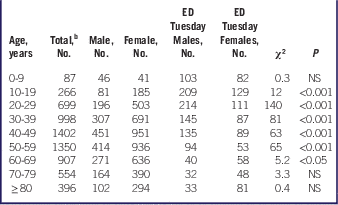
ED data for the 10 years prior to the earthquake showed that normally more males than females aged 59 years or younger presented to the ED on Tuesdays in February for treatment of accident-related injuries (Table 3). This difference was greatest between the ages of 10 and 29 years, when the accident-related injury numbers were the highest for both sexes. Above 60 years, slightly more females than males presented to the ED.
Comparison of Patients Injured on February 22, 2011, With Baseline Presentations to the Emergency DepartmentFootnote a

a Abbreviations: ED, emergency department; NS, not significant. Baseline presentations to the ED were mean presentations to the ED on Tuesdays in February from 2001 to 2010.
b Ardagh et al.Reference Ardagh, Richardson and Robinson 13
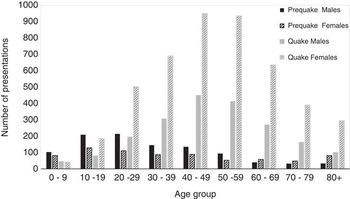
In all age groups 10 years and above, more females than males were injured in the Christchurch earthquake (Figure 1). The difference was statistically significant for all age groups, except for children under the age of 10 years and adults aged 70 years and older (Table 3). Significantly more adults over the age of 20 years were injured in the earthquake than at baseline (6306 vs 1220). The highest numbers of both sexes injured in the earthquake were aged between 40 and 59 years (865 males; 1887 females), which contrasted to the peak age ranges of 10 to 29 years (423 males; 240 females) in accidents prior to the earthquake.
Comparison of Age Group Distributions of Patients Injured in the Christchurch Earthquake With Baseline Distributions of Patients Who Presented to the Emergency Department on Tuesdays in February, 2001-2010.

Scene of Injury
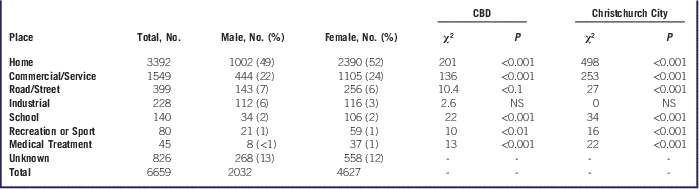
More than half of the injuries incurred by both sexes occurred at home and almost one-quarter occurred in commercial and service work places. Significantly more females than males were injured at all locations, except industrial places (Table 4).
Scene of Injury Compared With Baseline PopulationsFootnote a

a Abbreviation: CBD, Christchurch central business district working population.
Context of Injury
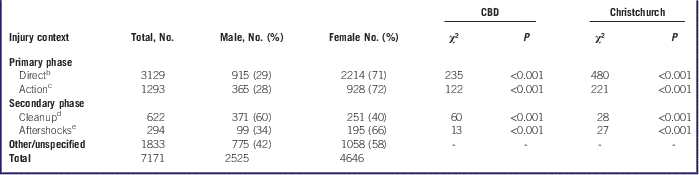
Significantly more females than males were injured during the primary and secondary shaking, either while being passive (direct) or active (Table 5). In contrast, significantly more males than females incurred injures during the cleanup of the city after the Christchurch earthquake.
Context of Injuries Compared With Baseline PopulationsFootnote a

a Abbreviation: CBD, Christchurch central business district working population. Data are for all patients injured in the Christchurch earthquake from Johnston et al.Reference Johnston, Standring and Ronan 14
b Shaking of the primary earthquake caused unavoidable injuries.
c Movement of person during the earthquake caused potentially avoidable injuries.
d Cause of injury occurred during cleanup after shaking ceased.
e Cause of injury occurred during aftershocks.
Clinical Characteristics of Injuries
Of the top 5 clinical characteristics, females incurred more sprains (1260 vs 442, respectively) and leg contusions (199 vs 61) than did males. A notable number of females suffered ankle sprains (n=153). A small number of males received shoulder and upper arm contusions (n=51) and tooth injuries (n=51).
Injury Severity Scores of Hospitalized Patients
Of the hospitalized patients who were scored for injury severity, there was an insignificant difference in the scores of both sexes for minor/moderate and severe injuries (Table 6). A significantly higher percentage of males than females scored serious injuries.
Injury Severity Scores of Hospitalized Patients Compared With the CBD Working PopulationFootnote a

a Abbreviations: CBD, Christchurch central business district; ISS, injury severity score; NS, not significant.
DISCUSSION
This study demonstrated that the sex disparity among the total deceased, injured, and hospitalized persons in the initial 24 hours after the Christchurch earthquake was statistically significant. More females than males were injured in the entire population of casualties.Reference Ardagh, Richardson and Robinson 13 Many reports on earthquake injury and mortality statistics evaluate samples of patients treated in hospitals, including field hospitals.Reference Kreiss, Merin and Peleg 19 - Reference Bozkurt, Ocguder and Turktas 22 Many focus on particular subsets of injury types or disease processes.Reference Etienne, Powell and Faux 23 - Reference Rathore, Rashid and Butt 27 These samples are not representative of the entire population of casualties. Consequently, some studies report higher injury and mortality rates for females than for males, Reference Etienne, Powell and Faux 23 , Reference Peek-Asa, Kraus and Bourque 28 - Reference Liang, Shih and Shih 33 some report that the rate is approximately equal in both sexes,Reference Sami, Ali and Zaidi 21 , Reference Bozkurt, Ocguder and Turktas 22 , Reference Mahue-Giangreco, Mack and Seligson 24 - Reference Rathore, Rashid and Butt 27 , Reference Zhang, Li and Carlton 34 - Reference Ellidokuz, Ucku and Aydin 37 and others report more injuries in males than in females. There are a number of differences between the health system in New Zealand and the contexts of these other studies, including access to care, data collection, and preparedness for disasters. These differences might contribute to the observed sex differences in injury burden, owing to influences on access, behavior, or some combination of both of these. However, these differences are likely to reflect differences in “capture” of the true injury burden, rather than differences in the actual injury burden. A free and readily accessible health care system for injury in New Zealand and a comprehensive national data collection system suggest that this study has captured a relatively accurate view of the true injury burden.
Most deceased and many hospitalized patients came from the CBD. Of the 182 people killed in the first 24 hours, 115 patients died in a single building collapse in the CBD where more women worked than men. Not only was the CBD the focal point for the earthquake,Reference Kaiser, Holden and Beaven 38 but it had the highest density of multi-unit housing and tall commercial buildings in Christchurch. Being in a multi-unit residential or commercial building greatly increases one’s injury and death risk compared with single-unit buildings.Reference Peek-Asa, Ramirez and Seligson 29 , Reference Armenian, Melkonian and Noji 30 A systematic review of earthquakes between 1980 and 2009Reference Doocy, Daniels and Packer 39 confirmed other reports stating that building collapse is the most common cause of earthquake-related death. Baird et alReference Baird, Palermo and Pampanin 40 found that although many reinforced concrete buildings lost their facades during the Christchurch earthquake, they remained structurally sound. Therefore, although internal structures were associated with fewer incidents, there were implications from the falling facades in terms of injury and death. Statistics show that more women spend time shopping than men.Reference Falk and Campbell 41 Possibly more females than males were shopping or visiting the CBD at the time of the earthquake. Doocy et alReference Doocy, Daniels and Packer 39 found extremes in age, socioeconomic status, and location of individuals at the time of an earthquake associated with risk of injury and mortality. Sex risk was found to be inconclusive because most studies that were reviewed did not report death or injury by sex.
Although most of the Christchurch earthquake deceased and hospitalized came from the CBD, thousands of people all over the city sustained minor injuries during the earthquake. The CDB included the area of Christchurch that was first settled between 1850 and 1930 when there were no building regulations to protect against earthquake damage.Reference Bennet, Dann and Johnson 42 Many of the early buildings were built of brick and partly or completely collapsed during the earthquake. Since the Hawkes Bay earthquake in 1931, 43 buildings built in New Zealand have become heavily reinforced and regulations are frequently reviewed. 44 Strict building regulations adhered to during building the Christchurch suburbs and outer industrial and commercial areas would have saved many people from serious injury and death during the Christchurch earthquake. The availability of free health care for injuries might also have encouraged many people with minor injuries to seek health care. In addition, the nature of the ACC data capture of all injuries meant that information was available for injuries no matter how minor if health care had been accessed.
Where people were when the Christchurch earthquake struck influenced their risk of injury. The proportions of men and women injured at the differing scenes possibly reflects what might be expected given differing gender roles.Reference Fothergill 45 , 46 For example, more women than men work in retail, teach at schools, and stay home caring for young children. These locations generally contain many objects that are unsecured on shelves, bookcases, and tables, which are not secured to walls. More males than females were injured during cleanup, which suggests that more men were involved in dangerous tasks such as taking chimneys down.Reference Johnston, Standring and Ronan 14 Many studies of natural disasters report that where people were and what they were doing at the time of disaster greatly influenced if they were injured or killed. 46 However, there are clearly more influences on the sex disparity than where people were during an earthquake. For example, Johnston et alReference Johnston, Standring and Ronan 14 reported that 64% of people injured in the early morning Darfield earthquake were females. That earthquake occurred at 4:35 AM on September 4, 2010, and affected the same population as the later Christchurch earthquake. At this time of day, most people would be at home in bed; therefore, both sexes would have been subject to the same risk of injury.
What happened during the shaking influenced who was injured. Johnston et alReference Johnston, Standring and Ronan 14 reported that during the Christchurch earthquake most injuries were caused by tripping or falling (26.1%) or projectiles (15.3%). Twice as many females as males were injured by these mechanisms. Footwear worn by some females may have increased their risk of tripping or falling during the shaking. Close to half of the injuries (43.6%) that occurred during the primary shaking of the Christchurch earthquake were passive or unavoidable.Reference Johnston, Standring and Ronan 14 A significant proportion of the injuries (18%) also occurred when people moved during the earthquake; these injuries were potentially avoidable. The findings of our study support those of Johnston el al,Reference Johnston, Standring and Ronan 14 but with a significant factor being where people were at the time of the quake.
The age distribution of the patients injured during the Christchurch earthquake shows that working-age adults (especially females) were more vulnerable than were children and the elderly. Johnston et alReference Johnston, Standring and Ronan 14 attributed the age distribution to the high level of reporting of minor injuries through ACC claims in New Zealand. In Christchurch, under normal circumstances, twice as many males as females present to the ED on a typical Tuesday in February. Females exceed males in the age groups ≥60 years. These results are expected, considering the sometimes reckless behavior of young to middle-aged menReference Arnett 47 , Reference Santesso and Segalowitz 48 and the increased longevity of women. 49 Human characteristics such as age, disability, and socioeconomic status have been reported to be associated with injury in earthquakes.Reference Ramirez and Peek-Asa 1 , Reference Briggs 2 Generally, children and elderly are at risk of death and injury.Reference Doocy, Daniels and Aspilcueta 3 Several studies have found young adults to have the highest risk of death.Reference Alexander 4 , Reference Osaki and Minowa 5
Women might be more susceptible to injury than men. However, an ICD-10-based classification of 1871 injured patients injured in the Wenchuan earthquake did not find a significant difference between the numbers of males and females with single and multiple injuries.Reference Lu-Ping, Rodriguez-Llanes and Qi 50 In view of that study, it seems probable that anatomical and physiological differences between males and females were not a factor influencing the sex disparity of the Christchurch earthquake casualties.
The injury severity scores of the hospitalized patients do not support the sex disparity found in the other data. However, limited interpretation can be made of the injury severity scores. First, the low numbers of patients in each category make statistical comparisons with the baseline populations difficult. Second, the AIS/injury severity score was originally developed for severity scoring of automotive injuries; therefore, the coding scheme is more relevant to cut or piercing injuries than to sprains or strains. There are also limitations with the AIS mapping program because it does not classify severities for some types of injuries that are included in the ICD-10 categories used by the New Zealand Ministry of Health. For example, the ICD-10-AM coding scheme used in New Zealand hospitals classifies concussions according to the length of time of unconsciousness, but AIS classifies all concussion injuries as severity level 2. Additionally, multiple injuries of lower leg and injuries of nerves at ankle and foot level have no AIS scores.
Limitations
This research also had several other limitations. We cannot assume that all people who were injured sought medical advice. In particular, we do not know if some men did not seek medical care for minor injuries. When natural disasters occur, hospitals are often required to triage and provide care to large numbers of patients in a short space of time; consequently, records may not have been kept for some patients. After the earthquake, many clinical records were entered retrospectively on the basis of staff recall, which may have introduced errors. To make comparisons with baseline population data, it was assumed that the CBD population on the day of the Christchurch earthquake was the same as on the day of the Statistics New Zealand 2006 census. Predictions were made taking into account migration into and out of Christchurch City when estimating the baseline population.
CONCLUSION
Females were at greater risk of injury than males during the February 22, 2011, Christchurch earthquake. Because many injuries were unavoidable and were caused during the primary shaking, where people were and what they were doing contributed to the sex disparity of the casualties. A more in-depth study of demographics and behavior during the Christchurch earthquake is needed to determine if females could do more to protect themselves from harm in future events.
Acknowledgments
We thank GNS Science for funding Sarah Standring to do a summer studentship working on this study; the Christchurch Emergency Care Foundation for funding Joanne Deely to complete data/statistical analysis and research and writing; and CDHB for funding Viki Robinson to complete the initial Rhise database establishment. We also thank Malcom Main for assisting with statistical analysis, writing, and reviewing the manuscript.