Introduction
Fruit production and export is one of the fastest growing agricultural sectors in Africa, providing income and employment. Besides export, the changing dietary patterns have led to an increase in fruit consumption (Lux et al., Reference Lux, Ekesi, Dimbi, Mohamed, Billah, Neuenschwander, Borgemeister and Langewald2003; Weinberger and Lumpkin, Reference Weinberger and Lumpkin2007; Ekesi, Reference Ekesi2010).
In Ghana, citrus is a major cultivated cash crop yielding the highest income per unit area compared with other cash crops (Ofosu-Budu et al., Reference Ofosu-Budu, Monney, Quaye, Amankwah, Mintah, Mpere-Asare and Agboka2007). In Ghana, the crop is cultivated in the semi-deciduous forest zone that covers parts of the Ashanti, Brong-Ahafo, Eastern, Western, Central and Volta regions (Ofosu-Budu et al., Reference Ofosu-Budu, Monney, Quaye, Amankwah, Mintah, Mpere-Asare and Agboka2007). About 26,000–30,000 ha of land has been cropped with citrus in both the Eastern and Ashanti regions (Ofosu-Budu et al., Reference Ofosu-Budu, Monney, Quaye, Amankwah, Mintah, Mpere-Asare and Agboka2007) with a production level estimated at over 20,000 metric tonnes annually (GEPC, 2006). Many constraints, however, hinder this important horticultural crop from realizing its full potential in Ghana as well as in other African countries. Ranking high among these constraints is serious infestation with fruit flies, especially since the introduction of the invasive species Bactrocera invadens Drew, Tsuruta & White (Diptera: Tephritidae) into Africa in 2003 (Lux et al., Reference Lux, Ekesi, Dimbi, Mohamed, Billah, Neuenschwander, Borgemeister and Langewald2003). In Ghana, tephritid fruit flies have been reported to cause yield losses ranging between 60 and 85%, depending on citrus cultivar, level of infestation and season (Billah et al., Reference Billah, Wilson, Cobblah, Lux and Tumfo2006). This led to the reduction in the fruit quality for both domestic and foreign consumption in Ghana and many other African countries. Most tropical fruits are exported to countries that regard fruit flies as a major threat (because of its quarantine pest status), thereby restricting infested fruits from international markets.
Information on the seasonal abundance and the peak of pest damage, as well as estimates of changes in pest numbers are important components of any pest management strategy (Dent, Reference Dent1992). This is because information on the timing and extent of pest outbreak can improve efficiency of control measures (Dent, Reference Dent1992). Reliable identification of the pest species is an important prerequisite for its effective subsequent management and quarantine measures especially if integrated pest management (IPM) or biological control is applied.
Until recently, damage to citrus fruits at the Agricultural Research Centre (ARC), Kade, in the Eastern Region, has always been attributed to Ceratitis capitata (Weidemann) (Diptera: Tephritidae) as the dominant species of fruit fly in citrus plantations (Afreh-Nuamah, Reference Afreh-Nuamah1985, Reference Afreh-Nuamah1999, Reference Afreh-Nuamah and Obeng-Ofori2007; Appiah et al., 2009). However, recent studies indicated that there were other fruit fly species attacking citrus in Ghana (M. K. Billah, unpublished data). Thus there is the need to determine the prevalent species in the study area since knowledge of the tephritid spectrum in any given area is a prerequisite for the development of an IPM programme to alleviate the pest problem (Mwatawala et al., Reference Mwatawala, De Meyer, Makundi and Maerere2006). The research was, therefore, undertaken to catalogue the range of fruit fly species attacking six cultivated varieties of citrus at the ARC, Kade, to determine the pest status of the different species of fruit flies and thereby confirm whether C. capitata is the fruit fly causing damage to citrus at the Research Centre.
Materials and methods
Study area
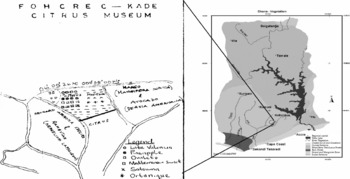
The study was conducted at the Citrus Museum of the ARC, Kade, in the Eastern Region of Ghana (Fig. 1). The Citrus Museum, which was established in 1995, is an orchard of about 18 ha with a collection of all citrus varieties grown at the Research Centre. Six plotted sites all situated in the Citrus Museum at W00°53.851′ (longitude), N06°08.599′ (latitude) and 179 masl (altitude) were selected for the study. All citrus plants of the same variety are planted in rows of ten plants within four columns making a total of 40 plants per plot. The distance between plants is evenly spaced at 6 m apart. Each of the plotted sites covers an area of about 1440 m2. Mature fruits are always present at any given time since the six citrus varieties flower and therefore mature at different times of the year. The age of the trees within the orchard was 14 years and the average height of citrus trees in the orchard was approximately 7 m.
Map of the study area showing the various citrus varieties grown and other nearby fruit fly host orchards

Trapping technique
The trapping technique used was identical to that described by Billah et al. (Reference Billah, Wilson, Cobblah, Lux and Tumfo2006) and Manrakhan (Reference Manrakhan, Ekesi and Billah2006). Improvised methyl eugenol (ME)- and trimedlure (TML)-baited traps were used to attract Bactrocera and Ceratitis species males, respectively, while improvised citrus juice (CJ)-baited traps were used to attract both male and female fruit flies. The TML (tert-butyl 4 (and 5)-chloro-2-methylcyclohexane-1-carboxylate)-baited trap (Plate 1) was a modified liquibaitor trap medfly (a new version of the McPhail trap). One strip of dichlorvos insecticide was used per TML trap. The TML-baited traps consisted of a two-piece cylinder-shaped invaginated plastic container with a diameter of 14.5 cm and a height of 18.5 cm, through which the green bait basket was incorporated at the top of the trap. The ME (4-allyl-1,2-dimethoxybenzene)-baited trap (Plate 2) and the CJ (250 ml CJ with a Brix of about 10.50°Bx and a titratable acidity (TA) of about 0.70%)-baited traps (Plate 3) consisted of a two-piece plastic container with four holes (2 cm in diameter) evenly spaced around its upper half. The ME-baited trap (8 cm in diameter and 13 cm in height) and CJ-baited trap (6.1 cm diameter × 21.6 cm height) had a small hole on the lid through which the traps were suspended on the branches at approximately 2 m from the ground. CJ lure was used for the detection of both male and female fruit flies because of its affordability and easy accessibility to the local citrus farmers. The TML-baited traps were supplied by USDA-APHIS-PRQ, USA and ME-baited traps were supplied by Agrisence Ltd, UK and Messrs Ransford Attatsi Enterprises, Ghana.
TML-baited trap

ME-baited trap
CJ-baited trap
Grease was smeared on the middle third portion of the strings that were used to hang the traps on the trees to prevent entry of ants and other predators. To ensure that the flies did not get stuck outside the traps, hand gloves were used with great care to avoid contamination of the outer parts of the traps. Two traps of ME, TML and CJ were placed in each of the six citrus plots. The distance between the traps was 30 m to prevent inter-trap interference (Ekesi and Billah, Reference Ekesi and Billah2006). Traps were inspected and emptied twice every week throughout the sampling period from September 2008 to May 2009 and the total number of tephritid flies caught in the orchard was recorded. The total number of tephritid flies trapped in a given month in a particular study site was obtained by adding the daily captures. Each ME block was replaced every 16 weeks and each TML plug was replaced every 6 weeks after careful washing of the traps. This was based on the manufacturer's recommendation and personal observation from preliminary studies in the field, when fly capture started to decline. CJ was replaced every week after careful washing of the traps.
Pest status of the different species of fruit flies
To establish the actual fruit flies causing damage to citrus fruits at the Research Centre, fruits of six different citrus varieties were collected and incubated to rear out the tephritid flies from them. Sampling of mature fruits was carried out from October 2008 to March 2009 depending on fruit availability per variety. Pineapple, Ovaleto and Satsuma fruits were collected from October to early November 2008. Mediterranean Sweet fruits were collected in the month of November 2008 while Ortanique fruits were collected in January 2009. However, to determine the fly abundance at different dates of harvesting/maturity stage, fruit collection was extended from January 2009 to March 2009 for Late Valencia to include fallen fruits at three stages of maturity (i.e. at the early stage, peak period and at the late stage). Late Valencia is considered the most preferred late-season sweet orange in the world (Davies and Albrigo, Reference Davies and Albrigo1994) and the most satisfying cultivar of sweet oranges in the tropics. In Ghana, it is also the commonest variety of citrus grown on a commercial scale (Ofosu-Budu et al., Reference Ofosu-Budu, Monney, Quaye, Amankwah, Mintah, Mpere-Asare and Agboka2007). Two hundred harvested ripe fruits were collected for each variety at the peak stage of maturity. In addition, 200 fruits each of Late Valencia were collected at the early and late stages of maturity, making a total of 1600 fruits collected.
Fruit incubation was done according to the method described by Ekesi and Billah (Reference Ekesi and Billah2006) and by personal instruction of M. K. Billah. All fruit samples were held in bulk and weighed and incubated for 2 weeks, after which each fruit was carefully dissected and the fruit fly larvae removed and incubated over sieved sterilized sand (i.e. sand sterilized by baking in an oven at 120 oC for 24 h) in plastic rearing containers (0.48 × 0.29 × 0.09 m) (Plate 4). After 2 weeks of incubation, the sand was poured onto a wire mesh to sieve and collect any pupa that had pupated in it. Any larva found in the sand after sieving was returned to the sand to continue with the developmental process. Pupae collected were counted and placed in Petri dishes over moistened white tissue paper and then put into plastic emergence cages of height 21.3 cm and diameter 19 cm (Plate 5). The emergence containers had an opening at the side and fine netting on the sides and top to ensure good ventilation.
Plastic rearing containers for larvae pupation
Plastic emergence containers
Adult flies that emerged from puparia were counted, sexed and transferred to insect cages. Flies were kept alive for at least 5 days to develop and attain full adult colouration and characteristics. Adult flies were fed with an artificial diet consisting of yeast hydrolysate powder and sugar in a ratio of 1:3. Flies were also provided with water and pure honey. Misidentifications are possible if reared specimens are not fed for a few days before being killed and observed under a microscope (White and Elson-Harris, Reference White and Elson-Harris1992). Flies were frozen to death and preserved in 80% alcohol. The flies were examined under a dissecting microscope for taxonomic details. Identification was done using morphological keys and identification keys from the African Fruit Fly Initiative, Nairobi, Kenya (M. K. Billah, unpublished data, 2003). Dr M. K. Billah sent all samples (flies and parasitoids) to the Entomological Museum at the Zoology Department (now Department of Animal Biology and Conservation Sciences), University of Ghana for further identification and confirmation.
Determination of total or titratable acidity (TA), total soluble solids (TSS) and peel thickness (PT) of selected citrus fruit varieties
The TA and the TSS were determined from fruit juices of the six varieties of citrus sampled. The juices were extracted from harvested five randomly selected ripe fruits of each variety. For each variety, juice from the five fruits was bulked together. For TA, 25 ml of the juice was taken and diluted with 250 ml of distilled water. Fifty millilitres of the diluted solution were then taken and titrated against 0.1 N NaOH solution in a pipette until a neutral solution was formed. This was determined by the volume of the 0.1 N NaOH solution that was required to change the CJ colour from orange to light pink, and the total acidity calculated as follows:

The formula is simplified as: % total acid = 0.140 × titre.
The equivalent weight of monohydrate citric acid is 70.0 g (Ruck, Reference Ruck1969).
For TSS determination, 5 ml of the pure extracted juice was placed on an absolutely dry refractometer prism, and the Brix value read directly at 20 °C. The TSS of juice extract was determined in quadruplicate (four times), and the mean value recorded. These procedures were repeated for each of the citrus varieties to determine their required TA and TSS values (K.G. Ofosu-Budu; a plant physiologist at the ARC, Kade, personal communication). The determination of citrus PT also followed the method of Ruck (Reference Ruck1969) and Dr Ofosu-Budu (personal communication). Fruits were cut into two cross-sections, and a finely graduated ruler was used to measure the PT (in mm) by placing the ruler at five different portions and working out the mean value.
Climatic factors
Daily meteorological data for four variables, relative humidity (RH) at 15.00 h GMT, maximum temperature at 09.00 h, total monthly rainfall and wind speed, were obtained from a local meteorological station at the Research Centre. Temperature and RH values were also measured with the aid of a hydrothermometer at the Entomology Laboratory of the Research Centre, where rearing of the flies took place.
Data analysis
Analysis of variance and multiple regression analysis were applied to the total number of different fruit fly species attracted by the different traps in the Citrus Museum and some climatic factors using GENSTAT packages. Correlation analysis was also done to determine the strength of the association between the monthly fly captures, pest abundance and each of the climatic factors recorded. Two-way ANOVA was used to test for differences in the effect of variety on the number of emerged fly species and means were separated using the Student–Newman–Keuls test.
Results
Fly abundance
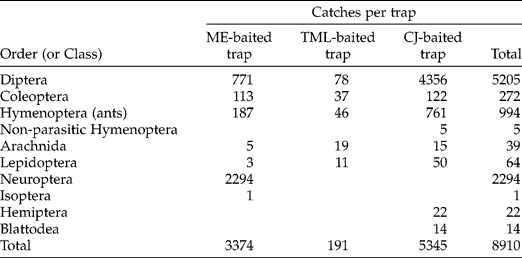
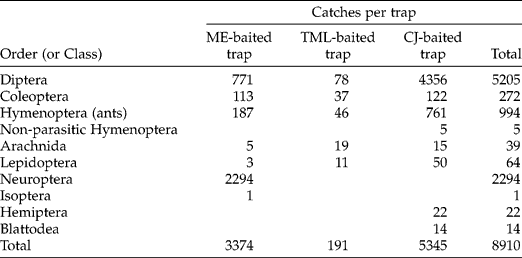
A total of 35,247 fruit flies were collected in the traps during the study period. In addition, a total of 8910 non-target specimens belonging to eight insect orders and one arachnid (class Arachnida) (Table 1) were collected in the traps. Of the total number of fruit flies trapped, 31,402 (89.1%) were captured in the ME-baited traps, followed by 3017 (8.6%) in the CJ-baited traps and 828 (2.4%) in the TML-baited traps (Table 2). To allow comparison across different localities without regard to local conditions, fly catches were expressed in the standard index of number of flies per trap per day (F/T/D; IAEA, 2003). These translated to relative density values of 10.38, 1.00 and 0.27 F/T/D for the ME-, CJ- and TML-baited traps, respectively (Table 2). Nine different species of fruit flies namely B. invadens, B. cucurbitae, Ceratitis ditissima, C. anonae, C. capitata, C. bremii, Dacus bivittatus, D. punctatifrons and Trirhithrum species belonging to four genera (Ceratitis, Bactrocera, Dacus and Trirhithrum) were recorded from the Citrus Museum during trapping. Three different species belonging to two genera (Bactrocera and Ceratitis) were captured in the ME-baited traps. Of the total number (31,402) of fruit flies captured in the ME-baited traps, 31,390 were B. invadens, nine C. ditissima and three C. bremii. Of the total number (828) of flies captured in the TML-baited traps, seven different fruit fly species belonging to four genera (Ceratitis, Bactrocera, Dacus and Trirhithrum) were identified. Five hundred and twenty-two flies of C. ditissima were recorded, followed by 290 C. anonae and only five C. capitata were captured in the traps. Of the three remaining genera, four D. bivittatus, three B. invadens and two each of D. punctatifrons and Trirhithrum sp. were recorded. Of the total number (3017) of flies captured in the CJ-baited traps, five different fruit fly species belonging to two genera (Ceratitis and Bactrocera) were recorded. Over 2901 C. ditissima, 77 B. invadens and 32 C. anonae were recorded. Only four C. capitata and three B. cucurbitae were recorded.
Non-target catches (insect orders) from the different traps
Fruit fly catches from the ME-, TML- and CJ-baited traps from the Citrus Museum

ME, methyl eugenol; TML, trimedlure; CJ, citrus juice; LSD, least significant difference.
An analysis of variance performed after log transformation of the data (trap catches) collected throughout the sampling period showed a significant difference (P ≤ 0.001) in the attractiveness of the three baited traps. The ME-baited trap was more attractive than the CJ- and TML-baited traps.
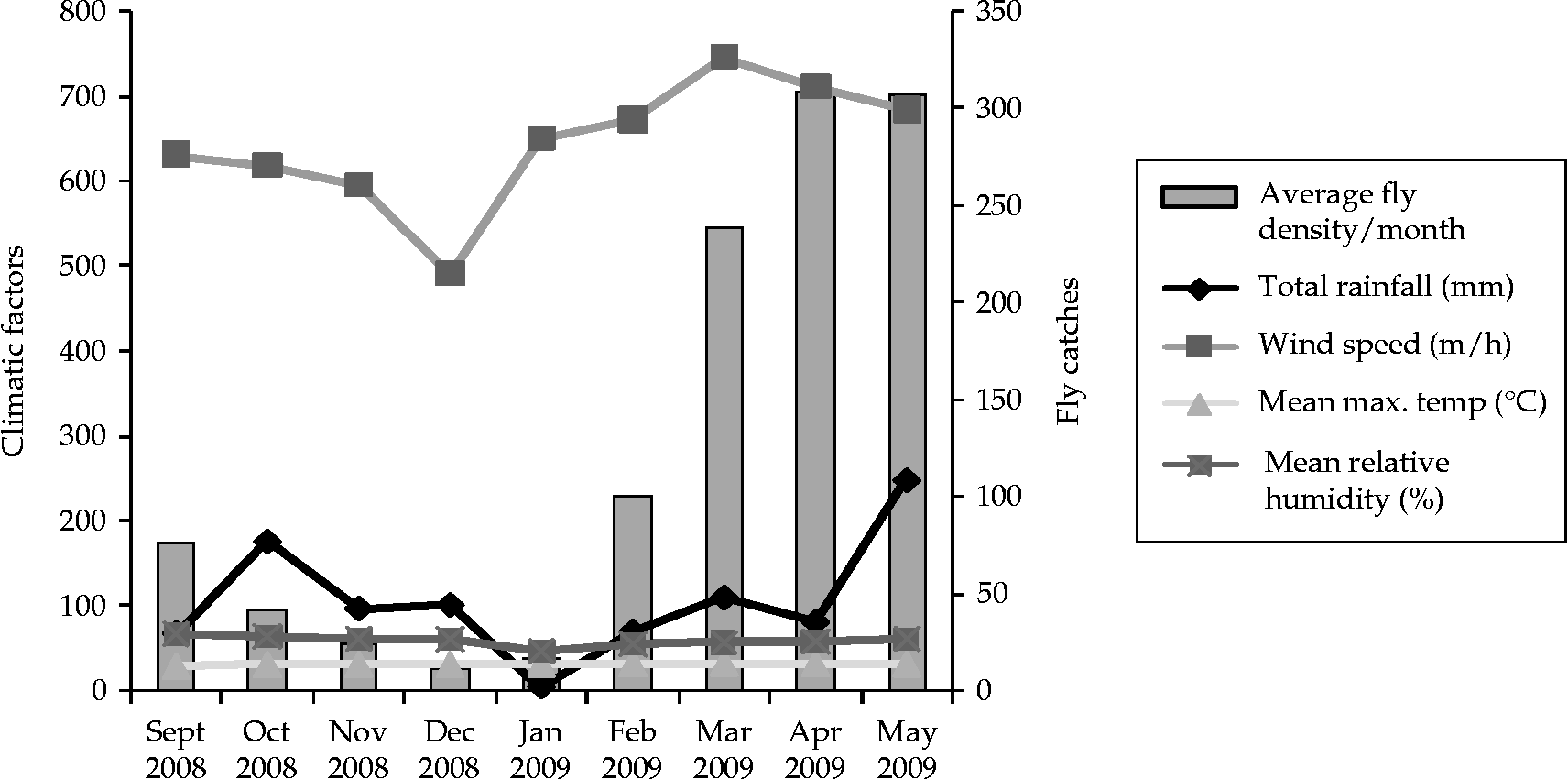
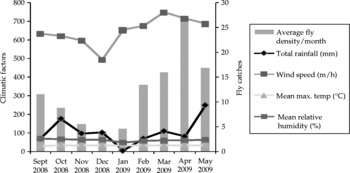
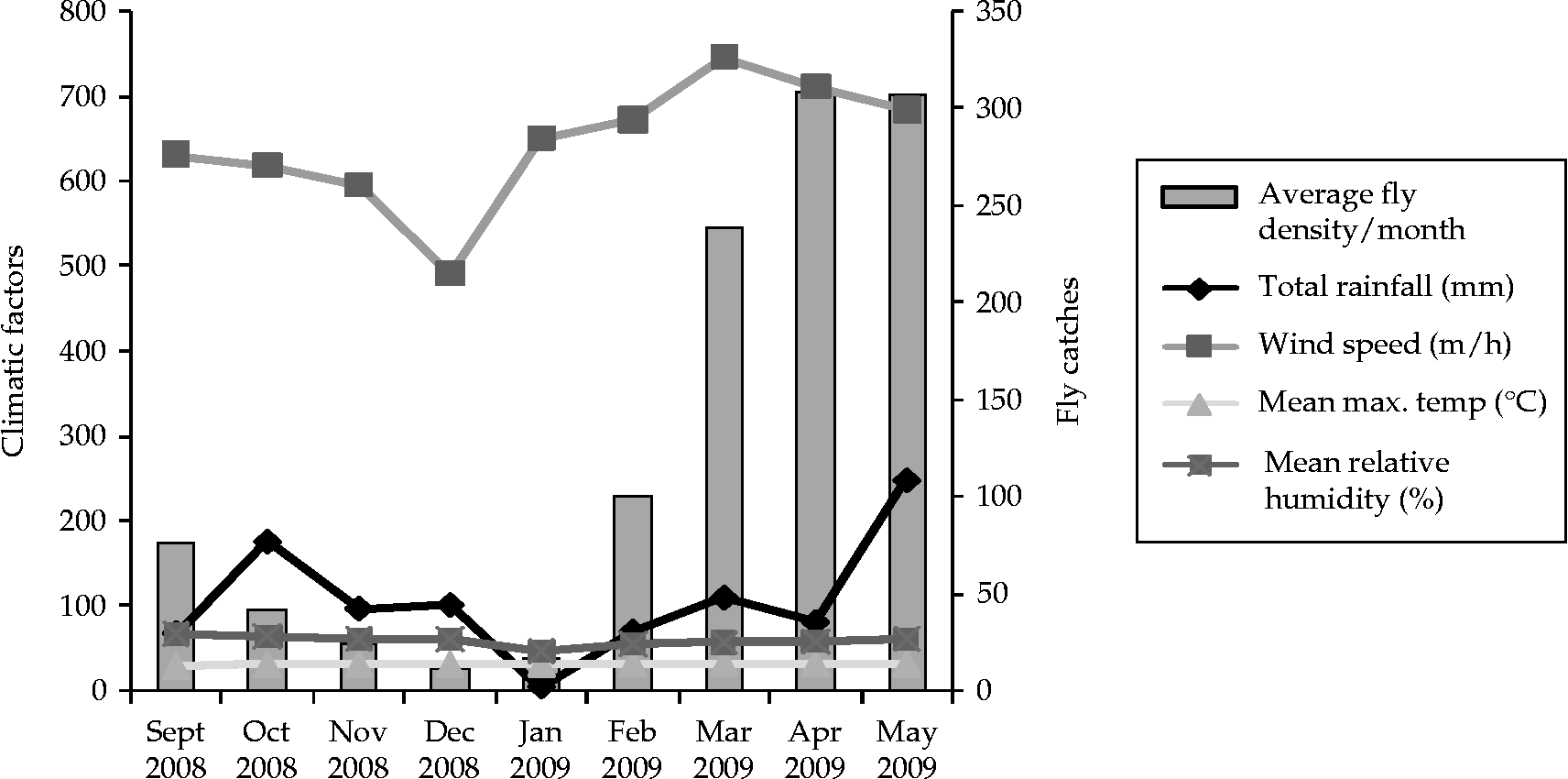
Collectively, climatic factors (mean RH at 15.00 h GMT, mean maximum monthly temperature, rainfall and wind speed) influenced the population of tephritid flies captured in the ME- and CJ-baited traps by 49% (R 2 = 0.4870) and 42% (R 2 = 0.4170), respectively. These suggest a weak correlation between overall climatic factors recorded and the population fluctuation of tephritid flies in the ME- and CJ-baited traps. Collectively, there was no correlation between the climatic factors, the attractiveness and the population density of flies captured in the three traps. However, in the TML-baited traps (Fig. 2), there was a significant effect of both wind speed (P = 0.008) and mean maximum temperature (P = 0.027) on the population of tephritid flies captured with a correlation rate of R 2 = 0.8990.
The relationship between the relative average fly density captured in the TML-baited traps and some climatic factors at ARC, Kade

The monthly average population density of tephritid flies captured in the TML-baited traps had a negative correlation with mean maximum temperature. An increase in temperature from 31 to 33 °C (September to December) resulted in a corresponding decrease in the density of tephritid flies (Fig. 2). In the same period, wind speed correlated positively with the monthly average population density of the flies captured in the TML-baited traps where a decrease in wind speed from 633 to 492 m/h showed a corresponding decrease in the pest density of the flies (Fig. 2).
The total rainfall recorded ranged from 5 to 249 mm, the mean maximum temperature from 30.8 to 33.9 °C, the mean wind speed from 492.2 to 747.73 m/h, and the mean RH from 47.7 to 67.8% during the study period. The highest and lowest rainfall values of 249.2 and 5.0 mm were recorded in the months of January and May 2009, respectively. Rainfall values less than 100 mm resulted in an increase in the number of catches while the amount of rainfall more than 100 mm (i.e. in October and December) resulted in a decrease in the number of flies captured by the three traps (Figs 2–4).
The relationship between the relative average fly density captured in the ME-baited traps and some climatic factors at ARC, Kade
The relationship between the relative average fly density captured in the CJ-baited traps and some climatic factors at ARC, Kade

Pest status of the different species of fruit flies reared from incubated fruits
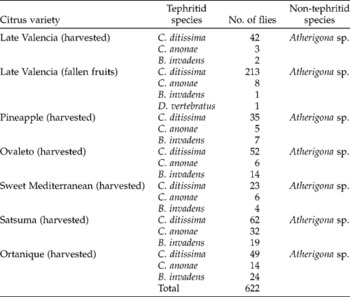
Four different species of fruit flies belonging to three genera (B. invadens, C. ditissima, C. anonae and Dacus vertebratus) were reared out from fruits of all six varieties sampled (Table 3). From a total of 1600 fruits weighing 148.3 kg collected during the study period, 622 flies were recorded from the incubated fruits, with fallen Late Valencia fruits producing 36% (223), followed by 18% (113) from Satsuma, while 14% (87), 12% (72), 8% (47) 8% (47) and 5% (33) were recorded from Ortanique, Ovaleto, harvested Late Valencia, Pineapple and Sweet Mediterranean fruits, respectively. Additionally, three (one female and two male) parasitoids identified as Fopius caudatus (Szèpligeti) were recorded on harvested Late Valencia and Ovaleto fruits.
Fruit fly species reared from the different varieties of citrus

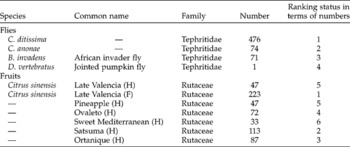
All the citrus varieties sampled showed co-habitation of three different fruit fly species in them. The species composition of the flies in the co-habitation was C. ditissima, C. anonae and B. invadens. In addition to the three species, one D. vertebratus was reared from fallen Late Valencia fruits. Five hundred and fifty (88.4%) of the fruit flies recorded belonged to the genus Ceratitis, 74 (11.4%) belonged to the genus Bactrocera and one (0.2%) belonged to the genus Dacus. Of the total number of flies recorded in the genus Ceratitis, 476 (76.5%) were C. ditissima and 74 (11.9%) were C. anonae. Flies in the genera Bactrocera and Dacus, which formed 11.4% (71) and 0.2%, were identified as B. invadens and D. vertebratus, respectively. In terms of abundance, ranking of the individual species was as follows: C. ditissima > C. anonae > B. invadens and D. vertebratus, represented by 476, 74, 71 and 1, respectively (Table 4). In all the six varieties of citrus sampled, the proportion of Ceratitis species, especially C. ditissima, reared was overwhelmingly higher, ranging from 72.4 to 95.7%.
Status of fruit flies reared from the fruits

H, harvested; F, fallen.
A two-way ANOVA showed that there were significant differences in both the number of emerging flies from the six incubated citrus varieties (P = 0.005) and the species composition of the emergent flies (P = < 0.001). Pairwise mean separation using the Student–Newman–Keuls test showed that Satsuma was the most preferred variety followed by Ortanique, while Sweet Mediterranean was the least preferred. Similar pairwise comparisons revealed that C. ditissimia was significantly the most abundant fruit fly species followed by C. anonae and B. invadens. The latter two were not statistically different from each other.
Of the total number (47) of flies reared from Late Valencia fruits harvested at different stages of maturity (i.e. early stage, peak period and at the late stage of maturity), more than 40% of the flies produced were recorded from Late Valencia fruits harvested at the peak period of maturity and the late stage of maturity. These were represented by 22 (47%) and 19 (40%), respectively, and only 6 (13%) flies were recorded from fruits harvested at the early stage of maturity.
Effect of total or TA, TSS and PT on adult fly emergence
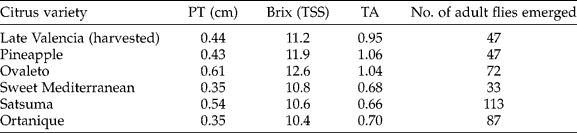
The highest number (113) of flies was recorded from incubated Satsuma fruits, with PT of 0.54 cm, TSS of 10.6 and TA of 0.66 while Sweet Mediterranean (TA = 0.68, TSS = 10.8 and PT = 0.35 cm) produced the least number (33) of flies. Late Valencia and Pineapple, which had almost the same TA and PT values of 1 and 0.4 cm, respectively, produced equal numbers of flies (47). Ovaleto, which had the highest PT and TSS values of 0.61 cm and 12.6, respectively, recorded 72 flies. Ortanique with one of the smallest peel thicknesses (0.35 cm) and second highest TA value (0.70) produced the second highest number (87) of flies (Table 5).
Effect of some fruit quality parameters on adult fly emergence
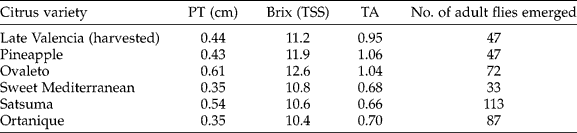
PT, peel thickness; TSS, total soluble solids; TA, titratable acidity.
Discussion
During the survey conducted from September 2008 to May 2009 to evaluate and compare the attractiveness of fruit flies to the ME-, TML- and CJ-baited traps, 35,247 tephritids were collected. Of the total number of fruit flies, 89.09% were captured in the ME-baited traps, 8.56% in the CJ-baited traps and 2.35% in the TML-baited traps. Nine species of fruit flies were identified from the trapping. These were B. invadens, B. cucurbitae, C. ditissima, C. anonae, C. capitata, C. bremii, D. bivittatus, D. punctatifrons and Trirhithrum sp., belonging to four genera (Ceratitis, Bactrocera, Dacus and Trirhithrum). These four fruit fly genera have earlier been reported to be of economic importance in equatorial Africa by several researchers (White and Elson-Harris, Reference White and Elson-Harris1992; Thompson, Reference Thompson1998; Billah et al., Reference Billah, Wilson, Cobblah, Lux and Tumfo2006; Ekesi and Billah, Reference Ekesi and Billah2006).
There were significant differences (P ≤ 0.001) in the number of tephritid flies captured in the different traps. This was probably due to the fact that the lures attracted different types of fruit flies and the attractiveness to non-target species other than the tephritid flies also varied. Methyl eugenol-baited traps attracted more of the invasive species (B. invadens) while the indigenous fly species (mostly Ceratitis species) were attracted to the TML-baited traps. However, different members of the fruit fly species complex were attracted to the CJ-baited traps.
The highest diversity of fruit flies (seven species) was captured in the TML traps. However, the total number of non-Ceratitis fruit fly species recorded in this attractant trap was less ( < 15). This confirms the findings of Manrakhan (Reference Manrakhan, Ekesi and Billah2006) that parapheromones are highly species-specific. Of the total number of 31,402 flies captured in the ME-baited traps, 31,390 (99.96%) were B. invadens. This also proved that ME is highly species-specific. The CJ-baited traps recorded higher diversity of species (five species) and were both males and females. This confirms the findings of Manrakhan (Reference Manrakhan, Ekesi and Billah2006) who documented that food baits attract both male and female fruit flies and are not species-specific.
The relative mean density of flies collected in the different traps appeared to be influenced by the availability of hosts (mango, avocado, citrus, sugar apple, rambutan, pawpaw, guava, banana and pepper) in the study area. On average, during the periods (September 2008 and April to May 2009) when most semi-ripe and ripe fruits were available, higher relative average population densities of tephritid flies were recorded. This confirms earlier studies done by Afreh-Nuamah (Reference Afreh-Nuamah1985, Reference Afreh-Nuamah1999, Reference Afreh-Nuamah and Obeng-Ofori2007), Akotsen-Mensah (Reference Akotsen-Mensah1999) and Appiah et al. (Reference Appiah, Afreh-Nuamah and Obeng-Ofori2009) on the abundance and distribution of the Mediterranean fruit fly (C. capitata) in Late Valencia citrus orchards in Ghana. Similarly, Matiola et al. (Reference Matiola, Rossi and Bueno1990) also reported that significantly higher numbers of tephritid flies were captured in pheromone traps in Brazil during the ripening period in October and February.
In the present study, however, the population of tephritid flies in terms of number remained relatively high even after harvest. This was not surprising because in a museum situation, mature fruits were always present in the orchard. Partial harvesting of citrus fruits was also carried out in the Citrus Museum during the study period. In addition, other host fruits (mango, avocado, citrus, sugar apple and rambutan) were also located around the Citrus Museum. This resulted in easy availability of hosts for the flies throughout the year. Papadopoulos et al. (Reference Papadopoulos, Katsoyannos, Carey and Kouloussis2001) and Puche et al. (Reference Puche, Midgarden, Ovalle, Kendra, Epsky, Rendon and Heath2005) showed that the availability of host fruits was one of the most important factors that affected the population fluctuations of fruit flies. It was also noticed that the large numbers of fallen ripe citrus fruits were left to rot under the trees, leading to carry-over infestation, which increased the population of flies during these periods.
Collectively, there was no strong relationship observed between climatic factors and the relative mean population density of tephritid flies captured in some of the traps (ME and CJ) used during the study. This may be due to the relative importance of microhabitat conditions rather than general conditions outside the studied field. In a closed-canopy microhabitat like that observed in the Citrus Museum, the local conditions could have been an important factor in determining when the flies moved in and out of the orchard, thereby making them available to be attracted to the traps. This observation confirmed the findings of Aluja and Birke (Reference Aluja and Birke1993), who stressed the importance of microhabitat conditions on the presence of Anastrepha obliqua (Macquart) and diurnal patterns of activity in a highly ephemeral and diversified environment.
The African invader fly, B. invadens, which is currently expanding its host range in Africa (Mwatawala et al., Reference Mwatawala, De Meyer, Makundi and Maerere2009; Goergen et al., Reference Goergen, Vayssières, Gnanvossou and Tindo2011), was recorded consistently in all the six citrus varieties sampled. Three fruit fly species namely C. ditissima, C. anonae and B. invadens were associated with all the six incubated citrus varieties sampled during the study. The dominant species was C. ditissima followed by B. invadens, which was detected in Africa in 2003. Prior to its arrival in Ghana, only C. ditissima and C. anonae were recorded in citrus (M. K. Billah, unpublished data). In certain varieties, it ranked as the second of the three species. Citrus therefore seems to be a preferred host plant. In an 8-year study of fruit flies in Nguruman in Kenya, Ekesi et al. (Reference Ekesi, Billah, Nderitu, Lux and Rwomushana2009) documented and produced evidence of competitive displacement of Ceratitis cosyra by B. invadens on mango and the mechanisms contributing to the displacement. Ceratitis cosyra has long been recognized as the most damaging tephritid fruit fly pest of mango in Africa including Kenya (Lux et al., Reference Lux, Ekesi, Dimbi, Mohamed, Billah, Neuenschwander, Borgemeister and Langewald2003). Mwatawala et al. (Reference Mwatawala, De Meyer, Makundi and Maerere2009) found eight new host plants of B. invadens, thereby bringing the host list to a total of 37 from 29. More recently, studies by Goergen et al. (Reference Goergen, Vayssières, Gnanvossou and Tindo2011) found 46 species from 23 plant families. In Ghana, work to determine and document the host range of B. invadens has just started at the University of Ghana (K. Afreh-Nuamah, personal communication, 2011). Continuous monitoring is necessary to determine whether complete displacement of C. ditissima by B. invadens is possible in citrus as is the case in mango.
The detection of D. vertebratus from Late Valencia fruits is new as no record of its attack on citrus has been documented (M. K. Billah, personal communication, 2009). Most of the Dacus species recorded in Ghana have been found on vegetable crops. However, this observation is not very surprising, as the citrus fruits from which the fly was detected were collected from the orchard floor (fallen fruits). This record may therefore be considered as exceptional or accidental introduction in the study area.
Additionally, all parasitoids recorded were identified as F. caudatus. Trostle (Reference Trostle2005) has already expressed great excitement surrounding the possibilities for F. caudatus, as its congener F. arisanus (Sonan), which is also an egg-pupal parasitoid, is widely regarded as the most successful tephritid fruit fly parasitoid used in biological control. Fopius caudatus is also currently being evaluated against B. invadens in Kenya (M. K. Billah, personal communication, 2009). It may be useful to study the potential of F. caudatus as a biological control agent against B. invadens and other tephritid flies.
Fruit flies must reproduce irrespective of the time of the season, whether fruits are available or not. One way they can achieve this is to lay their eggs in alternative host plants/fruits that will ensure continuous survival of their progenies. The flies then re-infest the preferred host plants when the fruits are in season. This may be true particularly for B. invadens, considering that they were reared from almost all the fruits.
The medfly, C. capitata, which most attention had been focused on, was not recorded from any of the six citrus varieties incubated during the study. This fly is extremely polyphagous and had been reared on over 300 commercial and wild host plants (White and Elson-Harris, Reference White and Elson-Harris1992). It is therefore surprising that C. capitata was not recorded from any of the six citrus varieties incubated. Earlier research workers (Akotsen-Mensah, Reference Akotsen-Mensah1999; Appiah, Reference Appiah2007; Appiah et al., 2009) reported C. capitata as the most destructive tephritid pest on citrus in Ghana. It is therefore possible that C. ditissima, which is the most abundant species in citrus, may have previously been misidentified as C. capitata. This seemingly controversial situation could have been resolved if voucher specimens of these studies were available for re-examination. Of all the citrus varieties incubated, Satsuma was the most preferred variety. Satsuma is a citrus variety in the group of mandarins with very loose and thin peel, and it has earlier been reported to be very susceptible to fruit fly attack in Ghana (Afreh-Nuamah, Reference Afreh-Nuamah1985).
Atherigona species (non-tephritid flies) were also recorded from all the citrus varieties sampled. According to White and Elson-Harris (Reference White and Elson-Harris1992), Atherigona species are often found in abundance in fruit crops, but they are usually thought to be secondary invaders because they are often found in decaying plant materials and sometimes are even occasionally predacious on other larvae.
Conclusion
Knowledge of the tephritid spectrum in any given area serves as an important prerequisite for the development of the sustainable IPM programme to alleviate the pest problem. This study revealed ten different species of tephritid flies from both rearing of infested incubated fruits and trapping, belonging to four important genera in the Citrus Museum orchard at the University of Ghana's ARC, Kade, in the Eastern Region of Ghana. However, of the ten different tephritid species recorded, only three species (C. ditissima, B. invadens and C. anonae) were identified to be the actual culprits attacking citrus since they were all reared from the six incubated citrus varieties sampled. It also showed that monthly fluctuation of the mean population density of tephritid flies increased when most fruits in the Citrus Museum were ripening or ripe and decreased when most fruits in the Citrus Museum were harvested or maturing. The high numbers of C. ditissima and B. invadens collected (which are known to be the dominant species in citrus and mango, respectively) suggest that these fruit flies might be competing for citrus as a preferred host. The co-habitation of fly species in all six citrus varieties sampled is an indication of the possible competitive ability of the invasive fly in those varieties. The findings of this study may be useful to start building a reliable catalogue of host records for the country, especially those of the invasive species, B. invadens. This may serve as an important bargaining tool in the import/export trade to trading partners who assume all produce from every country is attacked by all the fruit flies. It is possible that C. ditissima, which is the most abundant species in citrus, may have previously been misidentified as C. capitata since the latter was not recorded from fruits of the six incubated citrus varieties sampled during the study.
Acknowledgements
The authors wish to thank all the Research Officers and technical staff at the University of Ghana's ARC at Kade for the excellent support and encouragement given to them. The German Academic Exchange Service (DAAD) provided financial support through the African Regional Postgraduate Programme in Insect Science, University of Ghana. The University of Ghana Research and Conferences Committee also supported the study through the Project ‘Development of sustainable and integrated management strategy against fruit flies for fruit safety and environmental protection in citrus plantations in Ghana’. This work forms part of the MPhil thesis of the first author.