





Professed support for the rule of law is ubiquitous; states the world over herald their support for this ideal. As an esteemed British judge put it, ‘In a world divided by differences of nationality, race, colour, religion and wealth, [the rule of law] is one of the greatest unifying factors, perhaps the greatest, the nearest we are likely to approach a universal secular religion’ (Bingham Reference Bingham2011: 174). Tamanaha (Reference Tamanaha2004: 3) even argues that ‘[n]o other single political ideal has ever achieved global endorsement …[G]overnment officials worldwide advocate the rule of law, and none make a point of defiantly rejecting the rule of law’.
This stated commitment to the rule of law is at odds with anecdotal and empirical evidence about democratic decay. Ambitious executives are augmenting their powers, in many cases without the sort of public reprisal that many political science theories would suggest (e.g., Gross and Aoláin Reference Gross and Aoláin2006; Ginsburg and Huq Reference Ginsburg and Huq2018; Levitsky and Ziblatt Reference Levitsky and Ziblatt2018). This trend only accelerated during the early 2020s, as some governments took extraordinary – and sometimes extra-constitutional measures to protect public health in the face of the COVID-19 pandemic (Kolvani, Pillai, Edgell et al. Reference Kolvani, Pillai, Edgell, Grahn, Kaiser, Lachapelle and Lührmann2020).
How can individuals espouse support for the rule of law, while still tolerating governmental decisions that are explicitly at odds with written law? Individuals’ policy preferences may well explain this disjuncture, and exceptional circumstances can throw these trade-offs into stark relief. Crisis situations may bolster support for extraordinary government action, even if the legal basis is flimsy. In other scenarios, governments may act with a strong legal basis, only to be met with rebuttal from the public intolerance of governmental intrusion on the status quo. Despite the importance of these trade-offs, rarely do researchers have the opportunity to directly interrogate the public’s evaluation of these costs and benefits. As such, this research elucidates our understanding of the concessions people make when weighing these trade-offs.
We provide evidence that, when faced with a conflict between support for the rule of law and an unfavorable policy decision, policy preferences prevail. Even people who profess support for democratic norms will support government actions that contravene the rule of law, provided those actions further their policy goals. This implies that although individuals profess support for the rule of law in the abstract, once we account for their policy preferences, we expect stated support for this democratic norm to be revealed as mere cheap talk.
To test this argument, we introduce the noncompliance penalty, a measure of the loss of public support for an executive action that contravenes the written letter of the law. Public intolerance of noncompliance is central to our understanding of judicial power and independence, yet is rarely the object of empirical study, but instead treated as a characteristic of political regimes. We examine how this noncompliance penalty varies with individual-level support for the rule of law and policy preferences drawing upon a pair of nationally representative survey experiments fielded during the COVID-19 pandemic in the United States (U.S.) and Germany. In our experiments, participants were told about large social protests that were staged in direct violation of COVID-19 anti-congregation restrictions, with half hearing that the government allowed the protests to continue in violation of the rule of law and the other half learning that the government disbanded the protests (in strict adherence to the rule of law).Footnote 1 We model our experimental vignettes on real-world protests that took place in cities worldwide to examine individual responses to government’s decisions to disband or allow illegal protests.
We estimate the size of the noncompliance penalty and examine how it varies with individuals’ policy preferences and support for the rule of law. We present three main findings. First, in both countries, the public penalizes government actions that violate written law. However, only in the United States, does this response differ based on respondents’ professed support for the rule of law.
Second, the extent to which citizens penalize noncompliance is strongly shaped by their policy preferences. When individuals oppose a protest’s goals, they are more likely to support the government’s decision to disband it, allowing the rule of law to prevail. However, this relationship reverses when individuals support the protest’s political aims. Even when a protest clearly violates the law, and the government fails to enforce the law by allowing it to continue, those who agree with the protest’s objectives are more likely to endorse the government’s leniency. In short, governments can benefit from noncompliance among segments of the populace whose instrumental preferences coincide with their own enforcement strategy.
Finally, we show evidence that professed support for the rule of law conditions the relationship between policy preferences and support for the government’s decision, but we also uncover variation across countries and policy types. When individuals oppose the protest’s motives, their support for the government’s disbanding enforcement action increases with their support for the rule of law, just as traditional theories would predict. In this case, policy preferences and supporting the rule of law are complementary forces that work in tandem to strengthen this association. However, this relationship reverses when respondents sympathize with the political aims of the protest – and especially so with respect to anti-mask protests. Citizens who support the protest’s goals and have high levels of stated support for the rule of law are less supportive of the government action that accords with the rule of law in practice – that is, disbanding the protest. When individuals are aligned with the protesters’ goals, as their professed support for the rule of law increases, so too does their support for the anti-rule of law outcome. We conjecture that this is perhaps because aligned individuals with higher professed support for the rule of law are more likely to rationalize the protests as justifiable acts of civil disobedience, needed to counteract unjust laws. As Martin Luther King, Jr. (Reference King1963) famously described, this apparent conflict between values and preferences carries its own internal consistency: ‘[An] individual who breaks a law that conscience tells him is unjust… to arouse the conscience of the community over its injustice, is in reality expressing the highest respect for the law’. Our results provide some speculative empirical evidence where this tension – identified by Dr. King – is manifested in the public’s evaluation of governmental noncompliance (Krishnarajan Reference Krishnarajan2023).
The findings underscore the difficulties in maintaining a robust rule of law in the face of controversial policy situations, especially in the case of a polarized polity. Even though individuals may (a) profess support for rule of law values in the abstract and (b) prefer actions that accord with the rule of law, their commitment may fall apart if asked to support government actions that contravene their own policy preferences. It is easy to profess support for democratic ideals in the abstract; it is quite another to maintain those commitments when they come at a cost. Even in a hypothetical situation within a survey experiment, we find evidence that policy preferences can overrule support for the rule of law in ways that are contrary to rule of law sustaining outcomes. That we find this relationship in two consolidated democracies renowned for their robust rule of law backed by a deep well of public support is particularly telling and suggests that further cross-national testing in less consolidated environments would lend insights into this potential accelerant for democratic decay.
Our results speak to the recent wave of work on public tolerance for democratic backsliding in two ways (Ahmed Reference Ahmed2023). First, we show that policy alignment increases tolerance for illegal governmental actions. This finding is consistent with research demonstrating that citizens’ commitment to abstract democratic values fluctuates in response to elite behavior, and institutional and regime performance (Claassen Reference Claassen2020; Frederiksen Reference Frederiksen2022; Claassen, Ackermann, Bertsou et al. Reference Claassen, Ackermann, Bertsou, Borba, Carlin, Cavari, Dahlum, Gherghina, Hawkins, Lelkes, Magalhães, Mattes, Meijers, Neundorf, Oross, Oztürk, Sarsfield, Self, Stanley, Tsai, Zaslove and Zechmeister2025), and that professed commitment to these values is strongest when it aligns with individuals’ instrumental preferences (Graham and Svolik Reference Graham and Svolik2020; Frederiksen Reference Frederiksen2022; Werner, Bertsou and Marien Reference Werner, Bertsou and Marien2025).
Taken together, this research underscores the vulnerability of public support as a sole buttress of liberal democracy. Although public respect for the rule of law can play a central role, it is ultimately insufficient (Claassen, Ackermann, Bertsou et al. Reference Claassen, Ackermann, Bertsou, Borba, Carlin, Cavari, Dahlum, Gherghina, Hawkins, Lelkes, Magalhães, Mattes, Meijers, Neundorf, Oross, Oztürk, Sarsfield, Self, Stanley, Tsai, Zaslove and Zechmeister2025; Driscoll, Krehbiel and Nelson Reference Driscoll, Krehbiel and Nelson2025; Ferrer, Hernández, Prada et al. Reference Ferrer, Hernández, Prada and Tomic2025). Far from being an immutable trait or deeply socialized value system, citizens’ support for democratic principles functions as an imperfect constraint on incumbent misbehavior (Claassen Reference Claassen2020; Claassen, Ackermann, Bertsou et al. Reference Claassen, Ackermann, Bertsou, Borba, Carlin, Cavari, Dahlum, Gherghina, Hawkins, Lelkes, Magalhães, Mattes, Meijers, Neundorf, Oross, Oztürk, Sarsfield, Self, Stanley, Tsai, Zaslove and Zechmeister2025). Instead, it requires reinforcement from impartial institutions that coordinate public responses (Driscoll, Krehbiel and Nelson Reference Driscoll, Krehbiel and Nelson2025) or from elites whose strategic behavior incentivizes political restraint (Staton, Reenock and Holsinger Reference Staton, Reenock and Holsinger2022).
Second, research on democratic backsliding also examines how tolerance for undemocratic actions depends on citizens’ (sometimes diverging) understandings of democracy (Grossman, Kronick, Levendusky et al. Reference Grossman, Kronick, Levendusky and Meredith2022; Krishnarajan Reference Krishnarajan2023; Wunsch, Jacob and Derksen Reference Wunsch, Jacob and Derksen2025). If publics’ abstract support for the rule of law covaries with their heterogeneous conceptions of democracy, then our findings both support and extend this logic. In particular, we show that citizens with a higher commitment to the rule of law – one more centrally grounded in the separation and division of powers as opposed to majoritarian control – are more likely to oppose unlawful government actions. However, we also suggest that even those with fervent support for the rule of law will fail to punish government noncompliance with the written law, and especially so when such unlawful actions are in line with citizens’ policy preferences. In sum, this paper helps us better understand the complex micro-level dynamics underlying public tolerance for governmental actions that undermine the bedrock principles of liberal democracies.
Background
The rule of law implies that laws should be applied consistently, that is, the same laws apply in the same ways to all citizens. In countries with a strong rule of law tradition, the consistent application of legal principles can signal to external investors that countries have a stable business climate (e.g., North and Weingast Reference North and Weingast1989; North Reference North1990; Staats and Biglaiser Reference Staats and Biglaiser2012). Likewise, consistent application of laws can ensure that ‘no one is above the law’ and criminal conduct is sanctioned regardless of the gender, race, or social status of the offender.
Public support is fundamental to the preservation of the rule of law. As Weingast (Reference Weingast1997) argues, democratic consolidation requires a societal consensus, where citizens generally agree on the applicable scope and limits of political power. Because even written law is subject to interpretation, boundaries on political power only become self-enforceable as citizens reach agreement on what types of government actions are appropriate and what other actions are off limits. Over time, these shared agreements become political norms that structure the distribution and exercise of political power.
But beyond this general agreement about the appropriate bounds of the legal constraints, legal sanctions are not enough to ensure a country’s stable commitment to the rule of law (Tamanaha Reference Tamanaha2004). Instead, there must also be political consequences for violations of this norm. In a democracy, where continued exercise of political power is contingent upon electoral success, the most stinging political consequences are those that come at the ballot box. The public can check the will of an ambitious executive or a recalcitrant majority seeking to expand its power by electorally sanctioning those elites for actions which are inconsistent with the rule of law.
This simple expectation – that governments who violate the rule of law should face electoral consequences for their contravention – is a shaky foundation on which to build our theoretical models of the rule of law. This requires not only a professed commitment by the public that the law be applied equally to all (a commitment which is by no means automatic),Footnote 2 but that when it comes time to cast their ballot for or against an incumbent government, a critical mass of voters must prioritize this concern for the rule of law above all else – more than policy gains, issue commitments, partisanship, candidate valence, descriptive representation – or any of the many other considerations that research has shown to influence voters’ decisions on election day. This caveat about the public’s support for the rule of law requires consistency from both elites and the public: not only must elites exercise their authority without favoritism or inconsistency, but voters must also display a consistency in their punishment of elites who violate the rule of law, without regard for their ex ante preferences regarding partisanship, politicians, or policies. This proposition sets the bar high indeed.
Most studies of the rule of law seek to measure its existence and quality, based on objective measures of government institutions and/or performance (e.g., Helmke and Rosenbluth Reference Helmke and Rosenbluth2009; Carlin Reference Carlin2012; Carlin and Sarsfield Reference Carlin and Sarsfield2012; Staton Reference Staton2012) or country-year evaluations on the basis of expert or public opinions (e.g., Botero, Nelson and Pratt Reference Botero, Nelson and Pratt2011; Haggard and Tiede Reference Haggard and Tiede2011; Haggard and Tiede Reference Haggard and Tiede2014; Versteeg and Ginsburg Reference Versteeg and Ginsburg2017; World Justice Project 2020). Yet, despite its importance in the theoretical literature on democratic entrenchment, regime performance, and stability (Almond and Verba Reference Almond and Verba1963; Putnam Reference Putnam1993; Weingast Reference Weingast1997; Claassen Reference Claassen2020; Claassen, Ackermann, Bertsou et al., Reference Claassen, Ackermann, Bertsou, Borba, Carlin, Cavari, Dahlum, Gherghina, Hawkins, Lelkes, Magalhães, Mattes, Meijers, Neundorf, Oross, Oztürk, Sarsfield, Self, Stanley, Tsai, Zaslove and Zechmeister2025), there has been far less systematic research on citizens’ support for the rule of law, and much less on how concerns about the rule of law weigh in the broader portfolio of considerations that might inform political behavior. More commonly, citizens’ concerns for the rule of law are studied as part of a broader portfolio of democratic values, closely intertwined with the related concepts of polyarchy, democracy, political tolerance, support for related political institutions, etc. (e.g., Bratton and Mattes Reference Bratton and Mattes2001; Grant and Rudolph Reference Grant and Rudolph2003; Carlin and Singer Reference Carlin and Singer2011; Zechmeister and Zizumbo-Colunga Reference Zechmeister and Zizumbo-Colunga2013; Carlin, Love and Zechmeister Reference Carlin, Love and Zechmeister2014; Magalhães Reference Magalhães2014).
Scholars have traditionally viewed citizens’ regard for the rule of law as a cultural object, one which represents ‘the beliefs, expectations, values, and attitudes held by the populace of a country’ and is as part of ‘the cultural norms and values that undergird [institutions] and shape the behavior of individual citizens’ (Gibson Reference Gibson2007: 598–99). Observational research generally measures support for the rule of law through survey items asking respondents to value the rule of law when it conflicts with another principle, such as expediency, pragmatism, tolerance, and fairness. On the whole, this research suggests that support for the rule of law varies within and across countries (Gibson and Gouws Reference Gibson and Gouws1997; Gibson, Sonis and Hean Reference Gibson, Sonis and Hean2010), and it appears stable over time in at least one consolidated democracy (Gibson and Caldeira Reference Gibson and Caldeira1996; Gibson Reference Gibson2007).
Yet contemporary work underscores that public support for the rule of law is highly contextualized, and often at odds with instrumental concerns. Citizens’ evaluations of the economy and incumbent performance are some of the strongest predictors of citizens’ support for polyarchy (Carlin and Singer Reference Carlin and Singer2011; Magalhães Reference Magalhães2014), and good economic conditions have been shown to mitigate political fallout when abuses of power and corruption would otherwise undermine the leader’s public support (Zechmeister and Zizumbo-Colunga Reference Zechmeister and Zizumbo-Colunga2013). And while Bratton and Mattes (Reference Bratton and Mattes2001: 473) report that support for democracy is contingent on ‘popular approval of government achievements’, research by Carlin, Love and Zechmeister (Reference Carlin, Love and Zechmeister2014) emphasizes that support for democratic values and practices markedly decreased in the face of natural disasters, squarely outside of incumbents’ control. Consequently, it would seem that far from an entrenched, immutable or highly socialized value, support for the rule of law may well be informed by local contexts and possibly fleeting conditions (Magalhães, Reference Magalhães2014; Claassen, Reference Claassen2020).
Not only might context influence public support for the rule of law, so too might beliefs we are socialized from childhood to internalize and accept (Gibson and Nelson Reference Gibson and Nelson2014), especially when they run counter to more instrumental considerations. This problem is especially acute when upholding the rule of law comes at tangible costs, or when obstruction of the rule of law might confer distinct benefits.Footnote 3 Strict adherence to the rule of law may come at a price, and the extent to which these costs are felt likely varies greatly as a function of the costs of the alternatives, and the depth of citizens’ commitment to the abstract democratic value (Carlin and Moseley Reference Carlin and Moseley2015). For example, many Americans in the post-9/11 world reported a willingness to tolerate the curtailing of civil liberties in the name of national security (Davis and Silver Reference Davis and Silver2004; Hetherington and Suhay Reference Hetherington and Suhay2011). Likewise, Grant and Rudolph (Reference Grant and Rudolph2003) demonstrate that the public was more apt to protect the free speech rights of favored interest groups, as compared to groups for which the public held relatively low affect. Building on this research, we also aim to understand how support for the rule of law is weighed against conflicting instrumental considerations.
Yet research that centers on the public’s support for the rule of law infrequently connects citizens’ attitudes to any sort of behavioral outcomes, instead seeking to explain those values as an end unto themselves. Moreover, much of the research that centers on public support for the rule of law is strictly observational, such that causal identification proves elusive. Accordingly, we directly measure citizens’ support for the rule of law, while our experiments allow us to randomly assign respondents to true-to-life scenarios where the government either upheld or defied the law, in response to a policy that our respondents either support or oppose. Our design therefore mitigates issues of endogeneity that might arise in observational studies, wherein causal pathways are difficult to empirically disentangle.
Hypotheses
We advance several hypotheses to evaluate the relationship between an individual’s support for democratic principles (here, the rule of law), their policy preferences, and the extent to which they will tolerate noncompliance. The quantity of interest we consider here is the noncompliance penalty – the difference in support for a government action that does not adhere to the letter of the law compared to support for a government action that complies with the law. We expect that principles and preferences will inform the public’s willingness to impose a noncompliance penalty and consider how the public weighs these considerations when they come into conflict.
First, we anticipate that individuals will – all else equal – be more supportive of actions that comply with legal mandates. This may be for one of several reasons: perhaps the public is more supportive due to intrinsic support for the rule of law, or because they are unwilling to openly profess otherwise (Almond and Verba Reference Almond and Verba1963; Schedler and Sarsfield Reference Schedler and Sarsfield2007; Claassen, Ackermann, Bertsou et al., Reference Claassen, Ackermann, Bertsou, Borba, Carlin, Cavari, Dahlum, Gherghina, Hawkins, Lelkes, Magalhães, Mattes, Meijers, Neundorf, Oross, Oztürk, Sarsfield, Self, Stanley, Tsai, Zaslove and Zechmeister2025). As a result, we hypothesize that on average, decisions that accord with the rule of law will be more supported than those that do not (H1). In other words, we expect that the noncompliance penalty is, in fact, a penalty.
Hypotheses 2–4 pertain to how both principles and preferences might inform the public’s willingness to impose a noncompliance penalty. First, to the question of principles. We know that there is variation in citizens’ support for the rule of law (e.g., Gibson Reference Gibson2007); respondents differ in the extent to which they believe the law should be followed unconditionally and applied without reference to citizens’ preferences and privileges. Accordingly, we anticipate that those who more strongly support the rule of law in the abstract will be more likely to impose a penalty for government noncompliance than those who are less strongly committed to the rule of law. Respondents who are more deeply committed to the rule of law will receive greater intrinsic value from upholding these ideals, and government noncompliance with written law should illicit a stronger negative reaction from this subgroup of citizens. Thus, the size of the noncompliance penalty should increase with citizens’ stated support for the rule of law (H2).
Next, we consider how the noncompliance penalty may vary according to individual-level policy preferences. Here, existing literature suggests two possibilities. First, a ‘thick’ rule of law perspective would suggest that the public’s adherence to rule of law principles should remain stable irrespective of personal policy preferences (e.g., Holmes Reference Holmes, Maravall and Przeworski2003; Maravall Reference Maravall, Maravall and Przeworski2003; Skaaning Reference Skaaning2010; Møller and Skaaning Reference Møller and Skaaning2012). This would imply that in places and times where the rule of law is strong – where a consensus exists regarding the appropriate bounds of government authority – we should observe no variance in public attitudes regarding noncompliance as a function of policy preferences. Thus, this thick rule of law perspective would lead us to expect that policy preferences will be unrelated to the noncompliance penalty (H3).
Building instead on a well-established empirical literature that documents how instrumental considerations shape attitudes about the rule of law as well as related behavior (Grant and Rudolph Reference Grant and Rudolph2003; Davis and Silver Reference Davis and Silver2004; Carlin and Singer Reference Carlin and Singer2011; Carlin, Love and Zechmeister Reference Carlin, Love and Zechmeister2014), we entertain the possibility that individuals will vary in their approval of governmental noncompliance in ways that follow from their personal policy preferences. Put simply, individuals will be more tolerant of government noncompliance with the law when it is congruent with their own policy preferences. Much like the old adage ‘For my friends, everything; For my enemies, the law’ (Óscar Benavides, President of Peru, 1933–1939),Footnote 4 this allows for attitudes regarding government noncompliance to be informed by individuals’ instrumental concerns, such that they are willing to allow for legal leniency, so long as bending the law advances their own policy interests. This ‘thin’ rule of law perspective leads us to hypothesize that the penalty for noncompliance will diminish as support for the underlying policy increases (H4).
In a way, our first four hypotheses function as ‘checks’ on the conventional wisdom about public support for the rule of law and intolerance of noncompliance. We expect that (a) the public will prefer compliance to noncompliance, (b) that individuals with a high level of support for the rule of law will be less tolerant of noncompliance than individuals who have a low level of support for the rule of law, and that (c) policy preferences may or may not shape attitudes about government compliance with the law. However, the calculus behind (b) and (c) does not occur in a vacuum, and individuals instead may be forced to weigh their own policy preferences relative to abstract principles. Citizens who observe a government action generally have both a commitment to the rule of law (that may be strong or weak), as well as an opinion about the government’s underlying policy decision. Thus, we ask: how do preferences and principles together affect someone’s evaluation of a policy decision? Beyond our first four hypotheses, we consider the analysis to address this question as largely exploratory.
Here, we again begin by stating the hypothesis implied by a thick understanding of the rule of law, one in which citizens’ support for the rule of law surpasses individual-level policy preferences. Were this the case, agreement with the policy at stake should have no independent effect on the noncompliance penalty: even after accounting for individual-level policy preferences, the size of the noncompliance penalty should strengthen with individual-level support for the rule of law (H5). In this thick rule of law perspective, commitments to democratic principles override concerns for policy preferences. Citizens prioritize governmental adherence to the law, relative to all other considerations.
As before, this expectation strikes us as naive, and contemporary politics offers no shortage of anecdotes to inform an alternative hypothesis. Although individuals may prefer a strict adherence to the rule of law in the abstract, support for that democratic value relates to long-term concerns regarding democratic stability. On the other hand, policy ‘wins’ bring immediate benefits and may also shape the extent to which individuals will tolerate noncompliance. Indeed, we expect that one’s agreement with the policy will condition the effect of support for the rule of law on the size of the noncompliance penalty. First, for individuals for whom governmental compliance allows their own interests to advance, there is no internal conflict to resolve: a strong rule of law perspective (laws should be followed) and personal preferences (this policy is good) yield the same substantive outcome: government adherence to the written letter of the law is unequivocally the right thing to do. The lack of conflict between principles and preferences in this scenario suggests that conditional on supporting a policy outcome, the penalty imposed for noncompliance will increase with that person’s support for the rule of law (H6).
The trickier case concerns individuals whose policy preferences are in conflict with the letter of the law, whose own interests might be served by government noncompliance. Here, although the rule of law (as always) is served by compliance, strict adherence to the rules might bode poorly for an individual’s policy interests. When faced with this conflict, we entertain the possibility that the tangibility of personal policy preferences will prevail over abstract commitments to the rule of law. Thus, when an individual’s interests would be advanced by noncompliance, the size of the noncompliance penalty will remain constant – or may even decrease – as support for the rule of law increases (H7).
Although this final conjecture (H7) may appear counterintuitive, we speculate that when viewing these violations of the rule of law, such as illegal protests, through the lens of civil disobedience, it becomes more apparent (Morris Reference Morris2020; Kowalewski Reference Kowalewski2021; Della Croce and Nicole-Berva Reference Della Croce and Nicole-Berva2023). Civil disobedience is a ‘public, nonviolent conscientious yet political act contrary to law usually done with the aim of bringing about a change in the law or policies of the government’ (Rawls Reference Rawls1971: 364). Civil disobedience is distinct from ordinary law-breaking because it ‘does not violate the presumed duty to obey the law when it serves as the last resort to remedy severe injustices or democratic failures’ (Lai Reference Lai2021). Indeed, the willingness to incur punishment for the intentional contravention of the law makes these actions persuasive (Lai Reference Lai2021). This interpretation is consistent with work by Krishnarajan (Reference Krishnarajan2023), who suggests that the public can rationalize antidemocratic actions, rather than overtly rejecting the democratic principle which is under threat. From this lens, supporting acts of civil disobedience does not necessarily mean a disdain for the rule of law, but could indicate a rationalization in favor of a more virtuous, future version of the law. We note, however, that the reasoning behind this final hypothesis is speculative and interpretative, and as it is not causally identified within our research design, warrants further investigation in future research.
Research design
Our data come from nationally representative surveys in two consolidated democracies, the U.S. and Germany, fielded in partnership with YouGov. The U.S. is a presidential, two-party system, and Germany is a multi-party parliamentary democracy. Both are federal systems with considerable powers devolved to state and local governments. The German survey was fielded from October 15th to 29th, 2020 as part of the third wave of a 6-wave panel survey that tracked the attitudes of German adult citizens over the course of the first 18 months of the COVID-19 pandemic. This third wave included 3,198 completed interviews in our panel. The U.S. survey was administered by YouGov from February 18th to March 1st, 2021 and contained 1,000 respondents who were matched to a sampling frame based on their gender, age, race, and education. Technical details of these surveys are reported in online Appendix A, and descriptive statistics of the samples are presented in Appendix B.
We selected the U.S. and Germany as appropriate countries for our study, as both are known for their relatively high and enduring levels of public support for the rule of law (Gibson Reference Gibson2007; Eurobarometer 2019).Footnote 5 Indeed, according to the World Bank’s Worldwide Governance Indicators (WGI) database, rule of law estimates for Germany and the United States are consistently among the highest around the globe since 1996 (see Appendix Figure B1). Thus, in one sense, our case selection provides a relatively stringent test of our hypotheses: because support for the rule of law is relatively widespread and entrenched in both countries, the two countries provide cases where we should expect it to be difficult to find variation in the noncompliance penalty, or where individuals’ policy preferences will inform their attitudes about government noncompliance. At the same time, this imposes an important scope condition on our studies, which may not generalize far beyond the publics of the generally well-consolidated democracies of North America and Western Europe.
Our surveys were fielded in the midst of the COVID-19 pandemic.Footnote 6 At the time of the surveys, coronavirus regulations included restrictions on the size of social gatherings and widespread requirements for mask-wearing in public (Hallas, Hatibie, Koch et al. Reference Hallas, Hatibie, Koch, Majumdar, Pyarali, Wood and Hale2021). These virus mitigation strategies were highly politicized and controversial, prompting backlash and widespread protests (Allen and Hunnicutt Reference Allen and Hunnicutt2020; Deutsche Welle 2020; Morris and Glucroft Reference Morris and Glucroft2020).
Against this backdrop, social upheavals about other hot-button controversies also raged. During the summer of 2020, protests against police violence towards black people erupted in thousands of cities across the U.S. (Buchanan, Bui and Patelet Reference Buchanan, Bui and Patel2020), prompting some state governors to deploy the National Guard (Camera Reference Camera2020). Public opinion about these protests polarized along partisan lines: Democrats viewed the protests as responses to racism and longstanding racial injustice, while 47% of Republicans viewed the protest participants as troublemakers, taking advantage of the situation to engage in criminal behavior (Parker, Horowitz and Anderson Reference Parker, Horowitz and Anderson2020). Meanwhile in Germany, the public was divided over immigration policy since Chancellor Merkel allowed over a million refugees and migrants into the country in 2015, spawning both anti-immigration and rival, anti-fascist counter protests throughout the country (Barth Reference Barth2018). At the same time, there were several protests calling for the government to accept more refugees due to the poor conditions of their migrant camps (Deutsche Welle 2020; France 24 2020).
Our research design leverages these sorts of protests as challenges to the rule of law. We elect to study public support for the rule of law in the context of illegal protests during the coronavirus pandemic for several reasons. First, that these protests were common and widely publicized at the time in Germany and the U.S. – both against coronavirus restrictions and on social policy – gives our experiments a unique claim to external validity. Second, while in democratic settings, peaceful protests are normally legal, studying protests within the context of the pandemic provides an externally valid reason for their illegality – their size exceeding pandemic restrictions – which is stated explicitly in each experimental condition. Lastly, protests in general can be effective at shifting public discourse (e.g., Dunivin, Yan, Ince et al. Reference Dunivin, Yan, Ince and Rojas2022) and pressuring the government to reform its policies (e.g., Gillion Reference Gillion2013). Thus, for individuals aligned with a protest’s policy goals, protests offer the opportunity of advantageous policy gains if successful. Likewise, for individuals who oppose the protest’s goals, protests pose a potential threat to the status quo. Taken together, the experimental focus on protests amid the coronavirus pandemic makes for an ideal scenario to examine the tension between public support for the rule of law and citizens’ policy preferences.
In both countries, respondents were randomly assigned to one of four conditions as part of a 2
 $\times$
2, fully crossed experimental design. In all cases, respondents read about a 5,000-person protest taking place in a locality with a restriction on gatherings over 50 people due to the COVID-19 pandemic. The first treatment randomized the type of protest. In Germany, half of the respondents read about a protest calling for the end of the federal government’s mask policy and the other half read of a protest calling for the federal government to admit more refugees into the country. In the U.S., half of the respondents read of a protest against a mask mandate, while the other half of the respondents read about a protest calling for reduced funding for law enforcement. Second, we varied the governmental response, either ordering the protest to disband due to pandemic restrictions, or allowing the protest to continue in spite of those restrictions.Footnote
7
The full text of the treatments is available in Appendix A. As an example, the ‘Mask-Disband’ treatment in Germany read:
Recently, protesters filled the streets of a major German city to call for the end of the federal government’s mask policy. With over 5,000 people participating, it was one of the largest rallies held since the start of the pandemic. Local law only allows gatherings of 50 people. The federal government responded by ordering the protest to disband because it was in violation of pandemic restrictions.
By contrast, the ‘Defund the Police-Continue’ treatment in the U.S. read:Footnote 8
Recently, protesters filled the streets of a major American city to call for the city to reduce its police budget and shift that money to social programs. With over 5,000 people participating, it was one of the largest rallies held since the start of the pandemic. Local law only allows gatherings of 50 people. The city responded by allowing the protest to continue even though it was in violation of pandemic restrictions.
Following the vignettes, we asked the respondents two questions about their evaluation of the government’s response to the protest. First, we asked respondents to rate their approval of the government’s action (on a 4-point scale). In Germany, a majority (58%) of respondents said they ‘strongly’ or ‘somewhat’ supported the government’s action; 62% of U.S. respondents supported the decision. Second, we asked respondents whether they believed the government’s action was a legitimate exercise of power (also using a 4-point scale). In both countries, over three-fifths of respondents (62% in Germany and 64% in the U.S.) ‘somewhat’ or ‘strongly’ believed the government’s action was legitimate. These two items are highly correlated (0.78 in Germany and 0.74 in the U.S.), so we use the average response to these two items, rescaled from 0 to 1 such that higher values indicate more support for the government’s action.Footnote 9
Using the average support for the government’s action, we calculate our quantity of interest – the noncompliance penalty – as the marginal effect of allowing the protest to continue rather than forcing it to disband; that is, the estimated difference in support between the ‘noncompliant’ governmental action and the ‘compliant’ government action that follows the law. We justify our characterization of this as a penalty based on the voluminous literature in judicial politics that describes governmental noncompliance with constitutional and statutory strictures not only in negative terms, but the sort of action that will illicit a generally negative reaction from the public (Gibson and Caldeira Reference Gibson and Caldeira1995; Vanberg Reference Vanberg2001; Carlin, Pérez, Gauri et al. Reference Carlin, Pérez, Gauri, Sierra and Staton2022). We do show, however, that under certain conditions the public is more supportive of governmental action that contravenes the rule of the law (by allowing the protests to proceed), converting this ostensible penalty into a benefit for the government instead. To facilitate interpretation of the results, the plots for the parametric models include labels indicating when the estimated effect of noncompliance is negative (a ‘penalty’ for the government) and when it is positive (a ‘benefit’ for the government).
Tests of our hypotheses require measures of respondents’ support for the protest, as well as support for the rule of law. To measure the former concept, we asked respondents their pretreatment level of support for the protest’s issue area. For example, 72% of U.S. respondents at least ‘somewhat’ supported laws requiring citizens to wear masks, and 49% at least ‘somewhat’ supported efforts to reduce police budgets and shift funds to social programs. Our measure of respondents’ support for the protesters’ policy goals is their response to the issue-specific support question corresponding to their experimental treatment.Footnote 10
Second, to measure pretreatment support for the rule of law, we use a 4-item battery, one which is an updated version of measures used in previous studies (i.e., Gibson and Gouws Reference Gibson and Gouws1997). Respondents answered each item on a 5-point scale. The items formed a reliable, unidimensional scale in both countries and compare favorably to scales used in other cross-national research (Gibson Reference Gibson2007; Driscoll, Krehbiel, Nelson Reference Driscoll, Krehbiel and Nelson2025). In the U.S., the four items have an average factor loading of about 0.69 and a Cronbach’s
 $\alpha$
value of 0.78. In Germany, the average factor loading is 0.62 with an
 $\alpha$
value of 0.71. We use as our measure of support for the rule of law the scores from an unrotated factor analysis, rescaled to vary from 0 to 1 such that higher values indicate a higher level of support for the rule of law.Footnote
11
Results
Direct effects
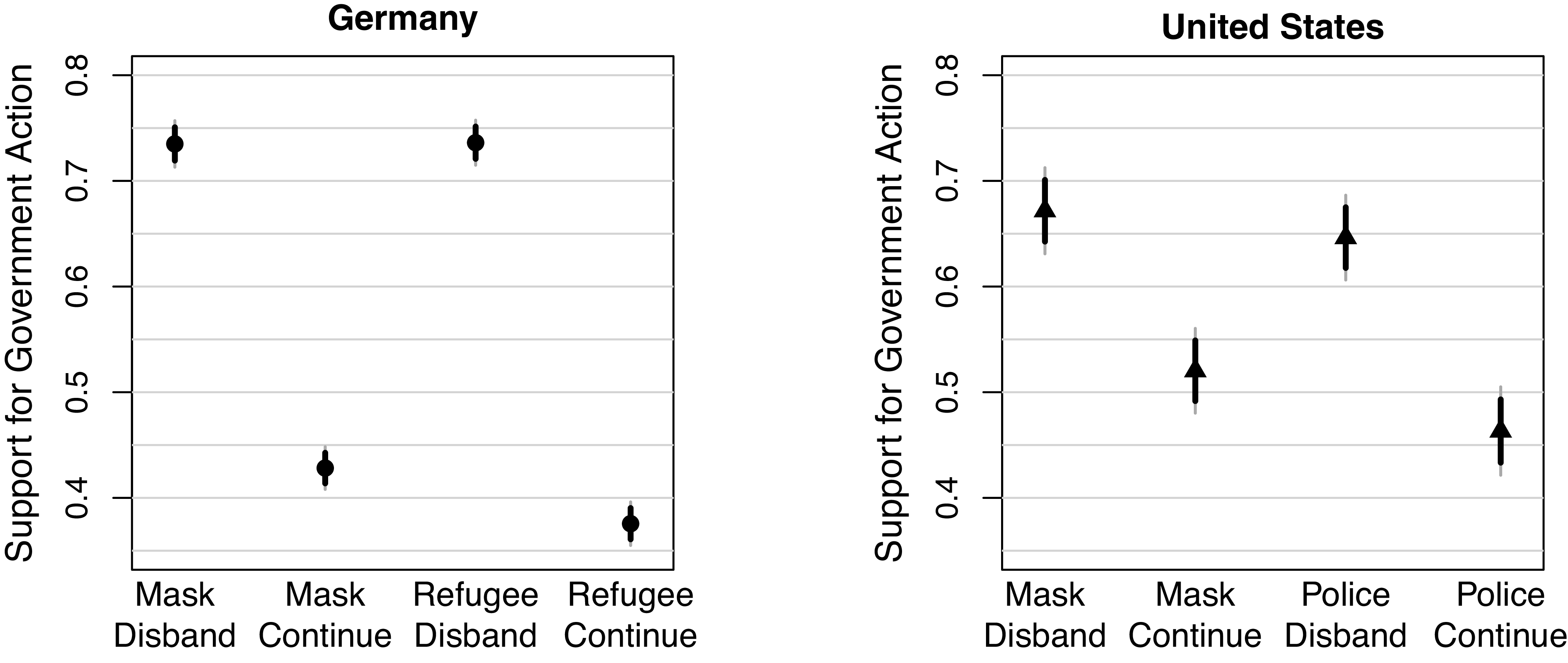
We begin by analyzing the direct effects of the experimental treatments to determine if the noncompliance penalty is, in fact, a penalty, as we hypothesized in H1. These results are shown in Figure 1, which displays the mean values of our outcome across treatment conditions and by country.Footnote
12
The figure indicates that there is indeed a penalty for the government breaking the law. In both countries, respondents were more supportive of decisions that were in accordance with the rule of law (disbanding the protest) than those that contravened the rule of law (
 $p \lt 0.01$
in both countries).Footnote
13
The difference is substantively significant: being told the government would allow the protest to continue resulted in approximately a one-standard deviation decrease in support for the government’s action.
Direct effects.
Note: Average value of the outcome variable, by condition and country. Higher values on the y-axis indicate more support for the government’s action. Thick black and thin gray lines denote 84% and 95% confidence intervals, respectively.

Respondents were least supportive of government leniency toward protests that advanced strictly political causes (police funding/refugees) relative to those relating to pandemic restrictions. The difference between these two effects is not statistically significant in the U.S. (
 $p = 0.43$
), but is statistically significant (
 $p = 0.01$
) in Germany.Footnote
14
In contrast, law abiding enforcement behavior – the disbanding of political protests that exceeded the legal threshold of 50 participants – garnered broad support from respondents in both countries, with more than 65% of respondents supporting in the U.S. and nearly 80% of respondents supporting in Germany. The major conclusion from Figure 1 is a large level of implied commitment to the rule of law in both countries: citizens support the pro-rule of law government action at much higher levels than anti-rule of law leniency, lending evidence in support of our first hypothesis.
Conditional effects, by support for rule of law
The first conditional hypothesis (H2) implied that those respondents with more fervent support for the rule of law will punish government noncompliance more severely, owing to their commitment to rule of law principles. Recall that the vignette states that ‘With over 5,000 people participating, it was one of the largest rallies held since the start of the pandemic. Local law only allows gatherings of 50 people’. Thus, the vignette made respondents aware that governmental leniency to allow the protest to continue explicitly violated the letter of the law. We test H2 by examining whether and how the noncompliance penalty changes across respondents’ support for the rule of law. Regarding the distribution of this variable, note that German respondents have a mean of 0.69, median of 0.72, and standard deviation of 0.23 on this measure; only 25% of German respondents scored below 0.50 on the measure while the top 25% of German respondents had values of 0.87 or above. In the U.S., the measure has a mean of 0.73, median of 0.75, and standard deviation of 0.22. Only one-quarter of U.S. respondents had values less than 0.58, while the top 25% of respondents scored above 0.88.Footnote 15
We fit ordinary least squares (OLS) models that regress our outcome on the treatment indicator, respondents’ support for the rule of law, and the interaction between these variables. We present the results by country and aggregated across protest types (‘Mask’ and ‘Refugee’ in Germany; ‘Mask’ and ‘Police’ in the U.S.) and report fully disaggregated analyses in Appendix E.
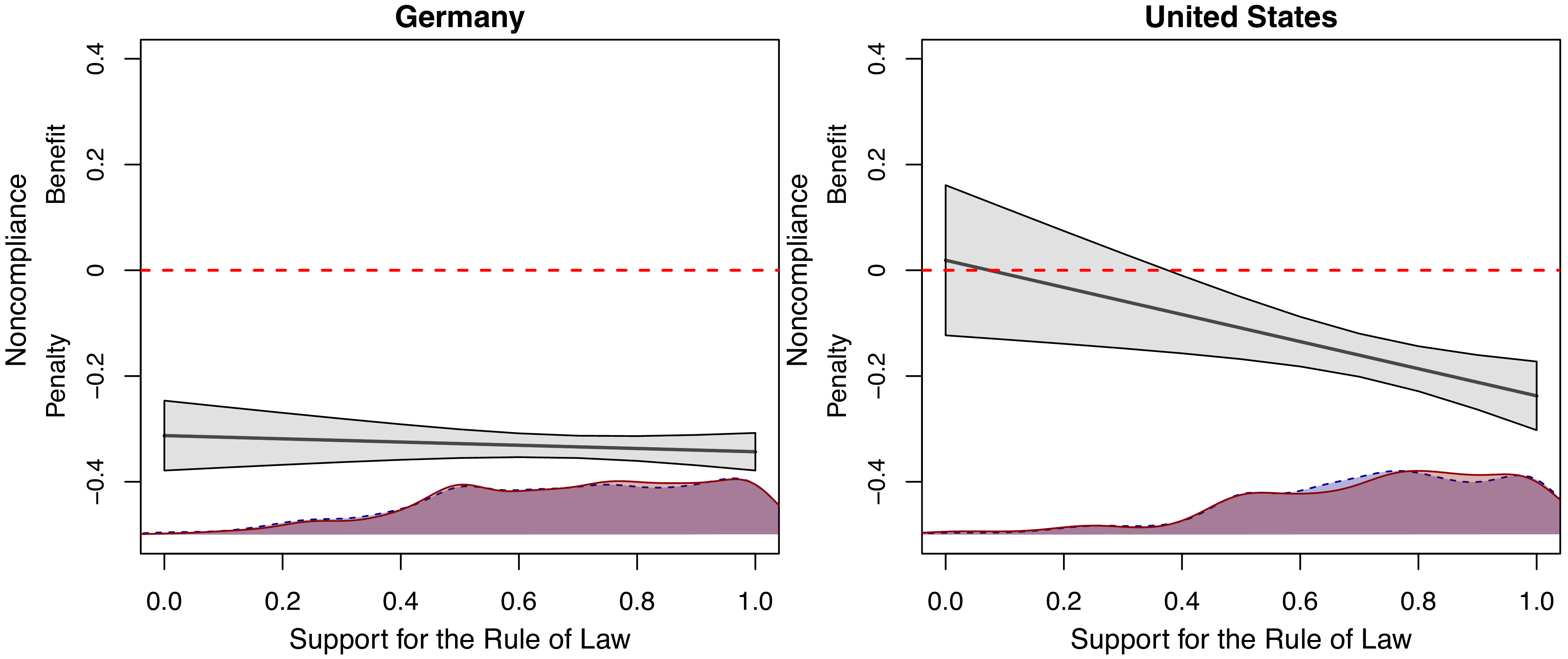
Figure 2 summarizes the results.Footnote 16 The figure displays the estimated treatment effects in both countries as respondents’ support for the rule of law ranges from its minimum to maximum value. On the vertical axis, values below zero indicate a noncompliance penalty: that is, the government’s decision to let the protest continue has negative effects on respondents’ support for the action compared to the government’s decision to disband the protest. In contrast, values greater than zero indicate that respondents express greater support for letting the protest continue, which we interpret as a noncompliance ‘benefit’ for the government. To recap, our second hypothesis would imply a negative slope between support for the rule of law and the penalty for noncompliance, such that those with higher professed commitment to the rule of law apply more stringent standards to governmental noncompliance.
Noncompliance penalty by support for the rule of law.
Note: Size of the noncompliance penalty as respondents’ support for the rule of law increases. Shaded areas are 95% confidence intervals. See Model 1 in Tables C1 and C2. The density plots at the bottom indicate the distribution of support for the rule of law among respondents who received the ‘continue’ (red, solid line) and ‘disband’ treatments (blue, dashed line).

The public response to our experiment fielded in the U.S., shown in the right-hand panel of Figure 2, comports with our second hypothesis: respondents with more expressed support for the rule of law more readily withdrew support in the face of noncompliance (i.e., the noncompliance penalty increases (
 $p = 0.01$
)). Individuals with low levels of support for the rule of law in the U.S. (values less than 0.35, about 7% of the sample) display no difference in their support for the government’s decision according to whether it accords with the rule of law. By contrast, for individuals with the highest levels of rule of law support, hearing of the governmental leniency in allowing the protest to continue results in a noncompliance penalty of roughly two standard deviations in size.Footnote
17
As the left-hand panel of Figure 2 shows, the results from Germany are different. The noncompliance penalty is statistically distinguishable from zero for all respondents, irrespective of their support for the rule of law. German respondents are always more supportive, on average, of rule of law compliant actions than they are of noncompliance, a difference which is statistically significant irrespective of their pretreatment support for the rule of law. Recall we hypothesized a negative conditional effect based on respondents’ support for the rule of law, and although this trend is negative in Germany, it is weak and not different than zero (
 $p = 0.51$
).Footnote
18
In short, the results reflect both nations’ strong historical commitment to the rule of law: most respondents are less supportive of noncompliance. Yet, it is only in the U.S. that the size of this penalty magnifies with a person’s stated commitment to the rule of law.
We acknowledge that the left-skewed distribution of support for the rule of law in both samples raises concerns about linear extrapolation. To address this issue, in Appendix J, we employ binning estimators for multiplicative interaction models (Hainmueller, Mummolo and Xu Reference Hainmueller, Mummolo and Xu2019), which relax linear interaction effect assumptions. Those analyses support our main finding in the U.S.: the noncompliance penalty is greater among respondents with higher support for the rule of law compared to those with lower commitment to the rule of law.Footnote 19
Conditional effects, by policy agreement
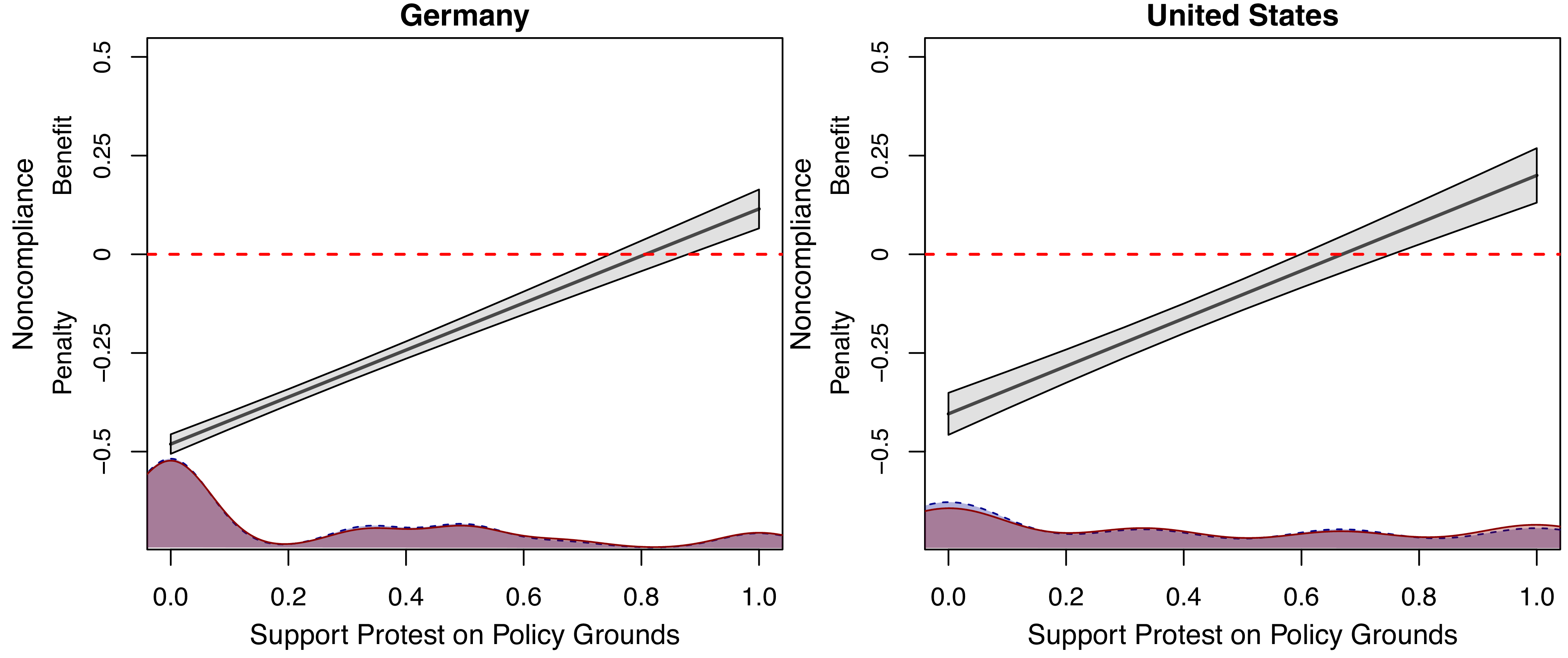
Our second pair of conditional hypotheses considers how respondents’ attitudes about government compliance might relate to their policy preferences. Recall that a thick conception of the rule of law would anticipate that policy preferences should have no bearing on these evaluations (H3), while alternative accounts suggest that the size of the noncompliance penalty may well weaken with respondents’ support for the protesters (H4). As with our previous analysis, we fit OLS models regressing the outcome on the treatment indicator, support for the protest’s policy, and the interaction between these variables. Figure 3 plots the results.Footnote 20
Noncompliance penalty by policy agreement.
Note: Size of the noncompliance penalty as respondents’ policy agreement with the protesters increases. The shaded areas denote 95% confidence intervals. See Model 2 in Tables C1 and C2. The density plots indicate the distribution of support for the protest among respondents who received the ‘continue’ (red, solid line) and ‘disband’ treatments (blue, dashed line).

Figure 3. Long description
Two line graphs compare noncompliance penalties and benefits in Germany and the United States based on support for protest on policy grounds. Panel A: The line graph for Germany shows the x-axis labeled Support Protest on Policy Grounds ranging from 0.0 to 1.0 and the y-axis labeled Noncompliance Benefit Penalty ranging from -0.5 to 0.5. The graph includes a central line with a shaded area representing uncertainty or variance. The trend shows an increasing noncompliance benefit as support for protest on policy grounds increases. Panel B: The line graph for the United States shows the x-axis labeled Support Protest on Policy Grounds ranging from 0.0 to 1.0 and the y-axis labeled Noncompliance Benefit Penalty ranging from -0.5 to 0.5. Similar to the Germany graph, it includes a central line with a shaded area representing uncertainty or variance. The trend also shows an increasing noncompliance benefit as support for protest on policy grounds increases. Both graphs have a red dashed line at y = 0, indicating the threshold between benefit and penalty.
Here, the results are clear and consistent across the two cases. The positive slope of both lines enables us to decisively reject the naive, ‘thick’ rule of law hypothesis (H3) in favor of hypothesis 4. The steeply sloping lines in both panels suggest that the size of the noncompliance penalty is greatest among respondents who oppose the protest, who are in turn more supportive of governmental efforts to disband the protest. Yet this penalty diminishes as support for the protesters’ motives increases. For individuals who are in complete agreement with the protesters, noncompliance is actually a benefit for the government, which suggests that these individuals evaluate government noncompliance more favorably than the pro-rule of law action to disband the protest.Footnote
21
This conditional relationship is statistically significant (
 $p \lt 0.01$
) in both countries. The finding that the noncompliance penalty varies across individuals’ policy preferences for the issue at stake is consistent with research suggesting that instrumental considerations shape attitudes about democratic values (Davis and Silver Reference Davis and Silver2004; Zechmeister and Zizumbo-Colunga Reference Zechmeister and Zizumbo-Colunga2013; Carlin, Love and Zechmeister Reference Carlin, Love and Zechmeister2014).
The confluence of principles and preferences
The crux of our analysis is an attempt to understand how individuals’ support for rule of law principles and their preferences regarding protesters’ goals together inform the size of the noncompliance penalty. Recall that we hypothesized that individual-level policy preferences would condition the size of the noncompliance penalty as individuals’ support for the rule of law varied. Although it is possible that the public’s preferences have no bearing on these attitudes (H5), we entertain the possibility that for those who do not support the protest’s objective, preferences and principles are not in conflict; compliance coincides with a respondent’s own preferences. In this case, we expect the size of the noncompliance penalty to grow with one’s support for the rule of law (H6). Yet, for those who support the protesters’ aim, compliance is at odds with one’s policy preferences. For these individuals, we expected that the size of the noncompliance penalty would remain stable – or even decrease – with support for the rule of law (H7).
To examine these expectations, we fit OLS models that regress the outcome on the treatment indicators, respondents’ support for the rule of law, support for the protest’s policy, and the triple interaction between these variables.Footnote 22 Figure 4 plots the size of the noncompliance penalty with 95% confidence intervals as support for the rule of law varies across the x-axis.Footnote 23 In the figure, respondents who support the aims of the protesters are depicted using a dashed line, and those who oppose the protesters are plotted with a solid line. In Figure 4, estimates that are statistically distinguishable from the horizontal zero line are evidence of a difference between a respondent’s support for a compliant versus noncompliant government action, given a particular level of support for the rule of law and the protesters’ policy goals. Specifically, negative effects indicate a noncompliance penalty, whereas positive estimates suggest instead a noncompliance benefit for the government.
Noncompliance penalty by support for the rule of law and policy agreement.
Note: Size of the noncompliance penalty for high and low levels of agreement with the protesters and as support for the rule of law varies. Higher values of the x-axis indicate more support for the rule of law. Shaded areas denote 95% confidence intervals. See Model 3 in Tables C1 and C2. The density plots at the bottom indicate the distribution of support for the rule of law among respondents who support the protest on policy grounds (red, dashed line) and do not support the protest on policy grounds (blue, solid line).

Importantly, in both countries, the heterogeneous effects across the horizontal axis differ for respondents who support the protesters’ policy goals and those who do not, which suggests evidence against H5. For respondents who oppose the protest (solid darker line), the noncompliance penalty for letting an illegal protest continue increases as they are more committed to the rule of law. Put differently, so long as the government’s action runs counter to their own policy preferences, greater support for the rule of law translates into a magnified penalty for governments who flout the law by refusing to disband the protests. This pattern of evidence is consistent with H6.Footnote 24
Yet, for those respondents who are sympathetic to the protests (dashed lighter line), increased support for the rule of law displays the directly opposite association. In both samples, the slopes are positive and significant (
 $p \lt 0.01$
), which suggests that as these aligned respondents express greater commitment to the rule of law, the noncompliance penalty decreases in size. While the treatment effects are statistically zero for respondents with low support for the rule of law, noncompliance is actually a benefit for the government among respondents who have at least a moderate commitment to the rule of law – so long as noncompliance is congruent with the respondents’ policy goals.
Put differently, citizens deeply dedicated to the rule of law, but who also support the protesters’ policy goals, tend to reward governmental noncompliance (allowing the protest to continue) over the alternative, ‘rule of law-abiding’ state action. This result indicates that professed support for the rule of law actually yields increased support for governmental disregard for the law, provided said noncompliance is in service of a favored policy.Footnote 25
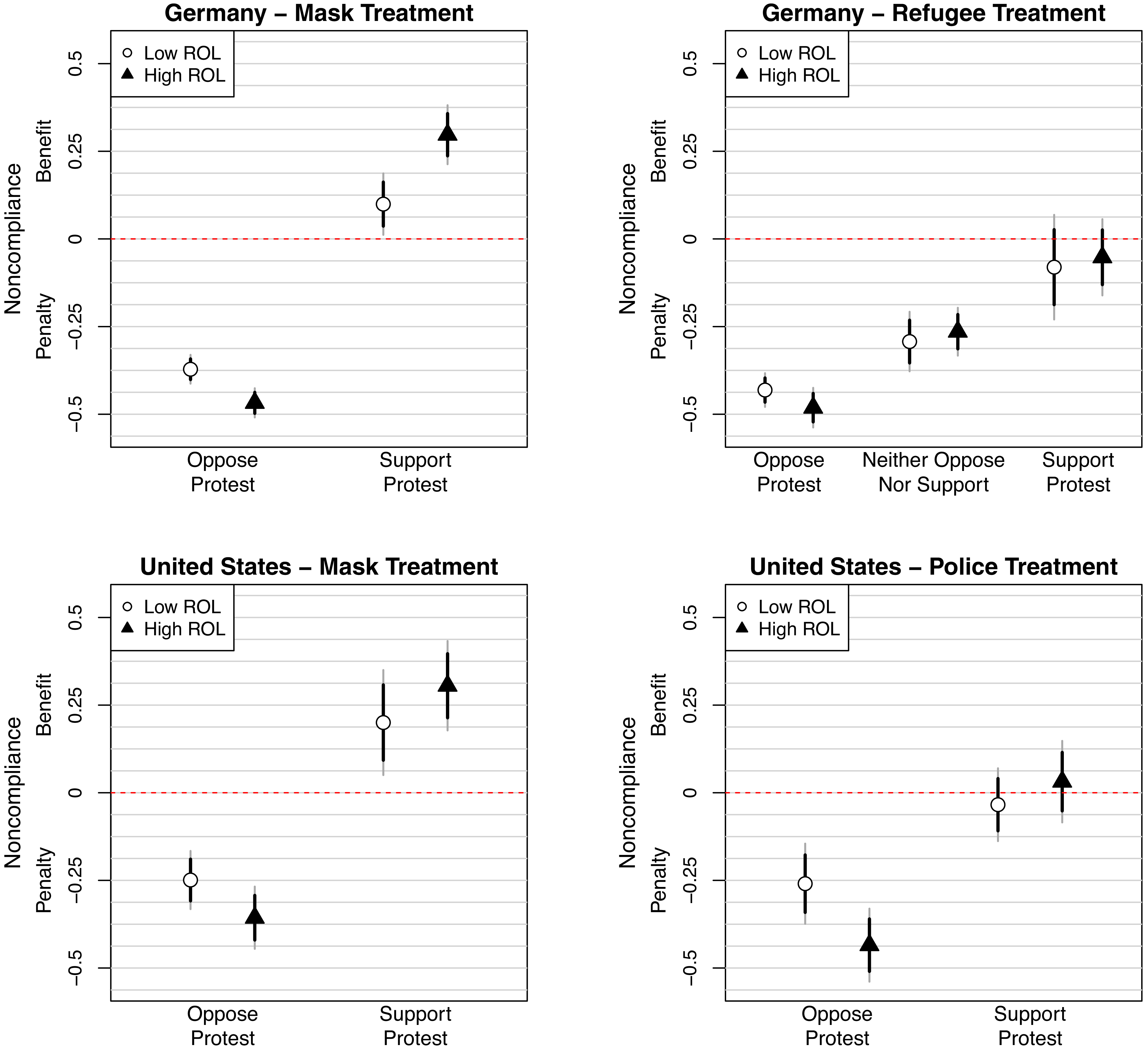
The pooled treatment effects shown in Figure 4 might mask heterogeneity across protest types. We investigate potential differences in the size of the noncompliance penalty by protest type and country. We fit separate OLS models and, for ease of interpretation, we dichotomize support for the rule of law (‘low’ or ‘high’).Footnote 26 Figure 5 plots the results and reveals several insights.Footnote 27 First, even after conditioning on support for the rule of law, the noncompliance penalty is greater for respondents who oppose the protest and smaller (or even becomes a benefit) among respondents who support the protesters’ policy goals. Yet, there are differences across protests. In the ‘Mask’ treatments, respondents who support the protest’s goals reward governmental noncompliance; however, this effect is negative in the ‘Refugee’ treatment (Germany) and indistinguishable from zero in the ‘Defund the Police’ treatment (U.S.). Second, the panels confirm the heterogeneous effects shown in Figure 4. Among respondents who oppose the protest’s goals, those with high support for the rule of law impose a larger noncompliance penalty than those with low support for the rule of law. However, these differences are only statistically significant at conventional levels for the ‘Mask’ treatment in Germany and the ‘Police’ treatment in the United States. In contrast, among respondents who support the protest, those with a stronger commitment to the rule of law are more rewarding of governmental noncompliance. Yet, this estimate is only statistically significant in the ‘Mask’ treatment in Germany.
Noncompliance penalty by support for the rule of law and agreement with the protest’s policy goals – first differences.
Note: Each panel shows the size of the noncompliance penalty by low and high support for the rule of law and across respondents’ agreement with the protest’s policy. The results are disaggregated by protest type (that is, each of our four treatment arms). The thick black and thin gray lines denote 84% and 95% confidence intervals, respectively (see also Appendix I).

Figure 5. Long description
Panel A: Germany Mask Treatment. A scatter plot shows the relationship between support for the rule of law and agreement with protest policy goals regarding mask treatment. The y-axis ranges from -0.5 to 0.5, representing noncompliance penalty to benefit. The x-axis shows categories: Oppose Protest and Support Protest. Data points are marked with circles for low rule of law (ROL) and triangles for high ROL, with error bars indicating variability. Panel B: Germany Refugee Treatment. A scatter plot shows the relationship between support for the rule of law and agreement with protest policy goals regarding refugee treatment. The y-axis ranges from -0.5 to 0.5, representing noncompliance penalty to benefit. The x-axis shows categories: Oppose Protest, Neither Oppose Nor Support, and Support Protest. Data points are marked with circles for low ROL and triangles for high ROL, with error bars indicating variability. Panel C: United States Mask Treatment. A scatter plot shows the relationship between support for the rule of law and agreement with protest policy goals regarding mask treatment. The y-axis ranges from -0.5 to 0.5, representing noncompliance penalty to benefit. The x-axis shows categories: Oppose Protest and Support Protest. Data points are marked with circles for low ROL and triangles for high ROL, with error bars indicating variability. Panel D: United States Police Treatment. A scatter plot shows the relationship between support for the rule of law and agreement with protest policy goals regarding police treatment. The y-axis ranges from -0.5 to 0.5, representing noncompliance penalty to benefit. The x-axis shows categories: Oppose Protest and Support Protest. Data points are marked with circles for low ROL and triangles for high ROL, with error bars indicating variability.
One possible explanation for the differences across protest types is that unique to the anti-mask protest, the protest’s policy goals and the law forbidding large protests are both pieces of the same general issue: pandemic restrictions. Indeed, pretreatment support for gathering size restrictions is strongly, negatively correlated with opposition to mask mandates in both countries (Appendix Table H3). In contrast, support for both pandemic restrictions is correlated with support for admitting more refugees in Germany and defunding the police in the U.S., although the correlation is stronger in the U.S. (Appendix Tables H1 and H4).
In sum, the results provide mixed support for our expectations. Overall, we find robust evidence against H5: the size of the noncompliance penalty does not always increase with respondents’ support for the rule of law – individual-level policy preferences shape this relationship. We find some support for H6, particularly in the context of protests against mask mandates and those in favor of defunding the police: higher commitment to the rule of law is associated with a greater noncompliance penalty among respondents who oppose the protests. Finally, when respondents support a protest that goes against the written law, we observe little to no differences in the noncompliance penalty between those more or less committed to the rule of law – which provides some evidence for H7.
Together, the results suggest that abstract support for the rule of law provides only a weak constraint on governments who would prefer to make policy decisions that are illegal but popular. It is not just that the level of backlash these governments would face among individuals who support the policy is low. Instead, governments may benefit from noncompliance so long as that noncompliance is popular. And, rather than constraining the government’s action, the benefit governments receive from noncompliance can actually increase as respondents are more committed to the rule of law under some circumstances. For those citizens most committed to the rule of law, its contravention may only elicit strong retribution when noncompliance runs contrary to their own political preferences.
Discussion
A key question is whether governments face real consequences for breaking the written law. This study introduces the concept of the noncompliance penalty – the public’s reaction to government lawbreaking – using survey experiments in the U.S. and Germany. Although legal compliance is central to theories of the rule of law and judicial power – and public expectations are often cited as a key reason governments adhere to judicial decisions and to the law – public reactions to governmental noncompliance are rarely the direct focus of empirical study (c.f. Driscoll, Krehbiel, Nelson et al. Reference Driscoll, Krehbiel, Nelson and Samarath2023).
Our results show that citizens generally prefer decisions that adhere to the law and support drops when governments do not comply. This penalty grows when citizens oppose the policy goal in question and (in the U.S.) when they express stronger support for the rule of law.
Neither political preferences nor the rule of the law exists in isolation. Our most surprising findings came from our exploratory analysis where we examined the size of the noncompliance penalty as both quantities varied simultaneously. Here, we showed that policy agreement conditions the relationship between one’s support for the rule of law and the size of the noncompliance penalty. When compliance would serve a person’s policy interest, the size of the noncompliance penalty increases with citizens’ support for the rule of law. Yet, when noncompliance serves an individual’s policy interest, this relationship reverses: noncompliance benefits the government, and – under some circumstances – the size of this benefit may increase with a citizen’s support for the rule of law.
This finding has striking implications. That the government can sometimes benefit from noncompliance with popular policies suggests that, insofar as the actions these leaders take comport with popular sentiment, these leaders may be able to increase their support through breaking the law. The temptation to tolerate violations of the rule of law for political gain could be detrimental to democracy (Levitsky and Ziblatt Reference Levitsky and Ziblatt2018). Our results suggest an even more worrisome implication for democratic backsliding. Not only can potentially undemocratic leaders avoid backlash from citizens who benefit from the policies pursued through unlawful means, but tolerance for law-breaking politicians can come from even those individuals who express higher support for the rule of law – at least in the abstract. Our findings thus raise further questions about the extent to which public support for democratic principles, such as the rule of law, can prevent the erosion of democracy (Weingast Reference Weingast1997; Wunsch, Jacob and Derksen Reference Wunsch, Jacob and Derksen2025).
We join a growing body of research arguing that public commitment to democratic values alone is an insufficient constraint on would-be autocrats seeking to undermine the rule of law (Claassen, Reference Claassen2020; Frederiksen Reference Frederiksen2022; Krishnarajan Reference Krishnarajan2023; Wunsch, Jacob and Derksen Reference Wunsch, Jacob and Derksen2025). Far from being steadfast and immutable, public support for abstract democratic principles is context dependent, and shifts in response to elite behavior, institutional performance, motivated reasoning, and instrumental considerations (Magalhães Reference Magalhães2014; Claassen Reference Claassen2020; Frederiksen Reference Frederiksen2022; Claassen, Ackermann, Bertsou et al. Reference Claassen, Ackermann, Bertsou, Borba, Carlin, Cavari, Dahlum, Gherghina, Hawkins, Lelkes, Magalhães, Mattes, Meijers, Neundorf, Oross, Oztürk, Sarsfield, Self, Stanley, Tsai, Zaslove and Zechmeister2025). At the same time, other research shows that these values can still function as a meaningful constraint on government overreach when they operate in tandem with self-restraining incumbents (Staton, Reenock and Holsinger Reference Staton, Reenock and Holsinger2022) or with independent institutions capable of coordinating public responses (Driscoll, Krehbiel and Nelson Reference Driscoll, Krehbiel and Nelson2025). We thus implore future research to continue to consider these viable extensions to the work presented here.
Of course, caveats abound. We acknowledge several limitations to external validity. First, knowledge about the law is not universal and is likely to be higher among specific groups. Second, individuals likely have attitudes about protests in general outside of our experimental focus on support for the rule of law. While we acknowledge that these may limit the generalizability of the results, we also note that our experiment’s random assignment eliminates any differences in knowledge or attitudes between the control and treated respondents. Third, the issues included in this study were incredibly salient and polarizing during an unprecedented public health crisis. Some respondents may have interpreted restrictions on social gatherings as temporary emergency measures rather than as fundamental violations of the rule of law. Moreover, peaceful protest and protected speech are legal and common under normal conditions in both countries we study. Future research should therefore examine whether these findings generalize to noncrisis contexts, less polarized issues, and other forms of governmental noncompliance with the law.
Our results leave us with many residual puzzles to explore. An interesting extension of this study would be to investigate whether partisan information processing (e.g., Lebo and Cassino Reference Lebo and Cassino2007; Jerit and Barabas Reference Jerit and Barabas2012) affects individuals’ approval of (non)compliance. Our results imply that this is likely to be the case. Should individuals rationalize (Krishnarajan Reference Krishnarajan2023) based on party, we would expect that copartisans would be more likely to excuse governmental actions that break with the written law. Understanding these tensions alongside individuals’ policy preferences and support for the rule of law would be a fruitful avenue for future research. Another interesting extension would be to explore the noncompliance penalty under different types of governmental actions. For example, is shutting down a legal protest a more egregious violation of the rule of law than tacitly allowing an illegal protest to continue? Further, future research should explore who the (in)sincere democrats are to further our understanding of the implications of violations of the rule of law on our understanding of democratic backsliding. We also invite future research to explore the extent to which these findings replicate across other issue areas or salience. Indeed, our results average across two different types of protests, one related to a highly charged policy area (immigration in Germany and racial unrest in the U.S.) and the other related to the coronavirus pandemic. So, too, we acknowledge a limitation that both of our cases are highly consolidated democracies: in less consolidated democracies, the ambiguity surrounding the bounds of power may make accountability more difficult. That we observe increasing benefits for noncompliance among popular policies as support for the rule of law grows in highly consolidated democracies suggests that these effects may only be more substantial in less developed democracies. Here, future research is imperative.
Supplementary material
The supplementary material for this article can be found at https://doi.org/10.1017/S1475676526101534
Data availability statement
All replication materials are available on Harvard Dataverse at https://doi.org/10.7910/DVN/0NBUJE.
Financial support
This material is based upon work supported by the National Science Foundation under Grant Nos. SES-2027653, SES-2027671, and SES-2027664. Any opinions, findings, and conclusions or recommendations expressed in this material are those of the author(s) and do not necessarily reflect the views of the National Science Foundation.
Competing interests
The authors declared no potential conflicts of interest with respect to the research, authorship, and/or publication of this article.
Ethical standards
The Germany experiment was cleared by the West Virginia University Institutional Review Board for compliance with Human Subjects protocol, the U.S. data were cleared by the Florida State University Institutional Review Board. The study was performed in accordance with the ethical standards as laid down in the APSA guidelines on ethical standards. All participants in our studies provided their informed consent.
Permission to reproduce material from other sources
Not applicable.





 Open access

