Urban-rural divides are a prominent feature of American politics. While the salience of this topic has increased substantially in the wake of the 2016 presidential election, the centrality of place is a long-standing theme regarding the study of political behavior (Key Reference Key1949; Campbell Reference Campbell2006; Pacheco Reference Pacheco2008), representation (Mickey Reference Mickey2015; Ogorzalek Reference Ogorzalek2018), polarization (Gimpel and Schuknecht Reference Gimpel and Schuknecht2003; Frank Reference Frank2004), and public opinion (Citrin and Green Reference Citrin, Green and Long1990; Bartels Reference Bartels2008). In particular, scholars have questioned why so many rural Americans appear to vote against their own interests by supporting the Republican Party (Citrin and Green Reference Citrin, Green and Long1990) even though they would benefit from the redistributive and environmental policies of the Democratic Party (Cramer Reference Cramer2016, 4-5; Hochschild Reference Hochschild2018). A burgeoning literature suggests that factors beyond one’s pocketbook play a role in political decision-making in rural America, including mobilization strategies employed by political parties (Frank Reference Frank2004), limited knowledge regarding economic issues (Bartels Reference Bartels2008), and “feeling like a stranger” within one’s own country (Hochschild Reference Hochschild2018). However, others suggest that rural consciousness must be understood as a distinct psychological construct that shapes rural behavior, crucially defining one aspect of American politics (Cramer Reference Cramer2012, Reference Cramer2016; see also Stedman Reference Stedman2002).
The definitive statement about rural consciousness comes from Cramer (Reference Cramer2012, Reference Cramer2016), who defines it as a social-identity based worldview—harbored by rural people—in which rural deprivation is attributable to “the decision making of (urban) political elites, who disregard and disrespect rural residents and rural lifestyles” (Cramer Reference Cramer2012, 517). The concept of rural consciousness has gained significant traction over the past several years, as evidenced by hundreds of citations and its inclusion within the 2019 pilot of the American National Election Study (ANES 2020). Though race frequently plays a central role in discussions of geographic political divides (Key Reference Key1949; Oliver Reference Oliver2010), its role within conceptions of rural consciousness is comparatively ambiguous. As an example, Cramer suggests that “racism is an inescapable part” of the conversations she observed in rural Wisconsin but that she is “reluctant to explain the work of rural consciousness as simply the work of racism” (Reference Cramer2016, 165-166; see also Hochschild Reference Hochschild2018). This has led to multiple representations of Cramer’s work that have contributed to both valid critiques and unfair mischaracterizations of her discussion of race. Our aim is to help clarify this ambiguity by shedding light on the extent to which race colors the resentment white rural Wisconsinites harbor towards those who live in the state’s major cities: Milwaukee and Madison.
In so doing, we build upon those who question whether links between race and white rural identity might become more salient if researchers ask their respondents to think explicitly about race (Davis Reference Davis2017). For example, Cramer’s observation protocol does not include questions addressing race or racism (Cramer Reference Cramer2016, 233-238). Others suggest that rural consciousness must be more rigorously tested in order to understand whether the concept “has real explanatory power distinctive from its constitutive parts” (e.g., race, class, place, values, etc.; Parker Reference Parker2017, 601). Given that racial resentment has been shown to be a powerful predictor of white public opinion on a number of policy issues (Kinder and Sanders Reference Kinder and Sanders1996; Mendelberg Reference Mendelberg2001; Valentino, Hutchings, and White Reference Valentino, Hutchings and White2002; Gilens Reference Gilens2009; Jardina Reference Jardina2019), we theorize that rural Wisconsinites are actually imagining Black people when they talk about urbanites in certain cities. In short, rural consciousness may be directly tied to racial resentment.
We tested this theory, first, using a survey study distributed to Wisconsinites living in a number of rural and urban communities. We found that participants living in rural areas of Wisconsin—compared to participants living in urban areas of Wisconsin—harbored more negative and more racialized impressions of city-dwelling Wisconsinites. By “more racialized,” we mean to say that the contrast between how white impressions of Madisonians were and how Black impressions of Milwaukeeans were more stark in the minds of rural respondents than in the minds of urban respondents. Moreover, we consistently found that impressions of Milwaukeeans were “Blacker” in the minds of rural participants than they were in the minds of urban participants. In other words, respondents were not simply making accurate assumptions about the relative racial diversity of cities (Conn Reference Conn2014); where they lived significantly shaped just how drastically they perceived this diversity to be. Finally, these effects were especially pronounced among rural respondents who scored high (versus low) in rural consciousness. These findings confirm that rural consciousness is simultaneously capturing resentment towards “urban elites” and “undeserving beneficiaries,” as existing research suggests (Cramer Reference Cramer2012, Reference Cramer2016; Hochschild Reference Hochschild2018). However, these findings demonstrate that rural consciousness is also capturing racial stereotypes that are projected onto people living within cities. Thus, while the concept of rural consciousness may not be reducible to racism, it certainly plays a central role.
The second way we tested our theory was by turning our attention to the ANES 2019 Pilot Study. Using ANES data, we examined whether rural consciousness is appreciably distinct from racial resentment. In particular, we examined whether rural consciousness continues to predict political preferences (e.g., approval for Donald Trump, aversion to redistributive economic policies) after controlling for racial resentment. Generally speaking, we found strong support for the idea that rural consciousness and racial resentment are overlapping constructs. In all cases, rural consciousness became a weaker predictor of political preferences once its overlap with racism was removed from the equation. In other words, much of the ability of rural consciousness to predict political preferences may be due to its association with racial resentment.
Theorizing a Link Between Race and (White) Rural Consciousness Footnote 1
Racism can be studied in both overt and covert forms. Overt racism refers to blatant discrimination towards people of color (e.g., using a racial slur). In contrast, covert racism refers to the ways in which racism manifests in disguised or more subtle ways (Kinder and Sanders Reference Kinder and Sanders1996; Mendelberg Reference Mendelberg2001; Valentino, Hutchings, and White Reference Valentino, Hutchings and White2002; Bonilla-Silva Reference Bonilla-Silva2006; Huddy and Feldman Reference Huddy and Feldman2009; Gilens Reference Gilens2009; Quillian Reference Quillian2006). Much of the contemporary research on rural identity in the United States utilizes definitions of overt racism.
In Wisconsin, Cramer suggests that she heard little overt racism in rural communities, defining it as “blatant discrimination against people of color” (Cramer Reference Cramer2016, 166). Thus, she concludes that she “is reluctant to explain the work of rural consciousness as simply the work of racism” (Reference Cramer2016, 166). Hochschild’s analysis of the Louisiana Bayou also relies upon a definition of overt racism, defining it as “a belief in a natural hierarchy that places blacks at the bottom, and the tendency of whites to judge their own worth by distance from that bottom” (Hochschild Reference Hochschild2018, 254). Employing definitions of racism of this kind is surprising to us, given that contemporary race scholarship has noted that even more “subtle” measures of racial prejudices such as the racial resentment scale may be commonly understood as blatantly racist in contemporary American politics (DeSante and Watts Smith Reference DeSante and Smith2020, 978). Thus, we argue that it is essential to systematically assess whether more covert forms of racism are at play before dismissing the centrality of racial resentment within place-based social identities such as rural consciousness.
Indeed, covert racism is quite evident in work addressing rural identity. Cramer suggests that rural Wisconsinites harbor high levels of distrust toward urban elites who “too often [aim to] cover the cost of social welfare benefits for lazy, undeserving people” at the expense of “hard working Americans” (Reference Cramer2012, 526; emphasis added). Similarly, the participants in Hochschild’s analysis in rural Louisiana saw the Confederate flag as a symbol of “regional pride” and viewed white Americans as “more law-abiding” and “harder working” than Black Americans (Reference Hochschild2018, 255-256; see also Acharya, Blackwell, and Sen Reference Acharya, Blackwell and Sen2016). This builds upon a large psychological literature that accentuates the role of covert racism in policy framing (Kinder and Sanders Reference Kinder and Sanders1996; Gilens Reference Gilens2009; Mendelberg Reference Mendelberg2001; Henry and Sears Reference Henry and Sears2002; Sears and Henry Reference Sears and Henry2003; Alesina and Glaeser Reference Alesina and Glaesar2004; Weaver Reference Weaver2007). Relevant to the current discussion, this literature reveals that people in the United States tend to stereotype “welfare recipients” not as race-neutral, but as Black in particular (Brown-Iannuzzi et al. Reference Brown-Iannuzzi, Dotsch, Cooley and Payne2017).Footnote 2 Thus, characterizations of urban residents as welfare recipients may not be devoid of racial content. Instead, these characterizations may be covert references to race itself, and in this context, to prejudiced portrayals of Blackness specifically.
To be clear, race is not absent within discussions of rural consciousness, but it is not critically assessed either. For example, Cramer acknowledges that racism may contribute to resentment toward urban areas. She notes that redistributive policies are typically viewed through a racialized lens (Reference Cramer2016, 16) and suggests that race is “embedded into arguments” about the unfair distribution of resources between rural areas and cities (179). However, she also suggests that “writing off rural consciousness as just about race” “implies that urban life is less racist than rural life” and “prevents us from confronting the complexity and intractability of the racism that did emerge in these conversations” (Reference Cramer2012, 525). Similarly, Hochschild describes race as “an essential part of the story,” but argues that residents of both the North and South are racist (Reference Hochschild2018, 146-147). While we agree that racism manifests across geographical contexts and see great value in analyzing the ways in which racism emerges in conversations about politics, we take issue with this explanation for two reasons. First, if rural consciousness is to be invoked as a transferable concept, it must be able to withstand counterfactual arguments. Namely, it is unclear from existing work whether rural consciousness operates separately from other factors, including racial resentment and anti-elitism. Second, by sidestepping the ways in which racial attitudes might explain affinities (and animosities) towards certain places, we risk minimizing the pervasiveness of white racial resentment across geographical contexts. White racial attitudes are a prominent theme within discussions of America’s cities (Enos Reference Enos2016; Oliver Reference Oliver2010) and we believe that this same expectation should apply to other geographical contexts as well.
As it relates to Wisconsin, rural consciousness emphasizes negative attitudes toward both the elite status of (predominantly white) government officials and university professors, on the one hand, as well as toward the “lazy, undeserving people” who reap the benefits of social welfare policy at the expense of “hard-working taxpayers,” on the other hand (Cramer Reference Cramer2012, 526). Like Cramer, we anticipate that there are two distinct kinds of urbanites who might be resented in the minds of rural respondents: those who live in places like Madison, WI, which is overwhelmingly white (78%) and where university professors and government officials are well represented relative to the city’s population; and those who live in places like Milwaukee, WI, which is plurality Black (34%) and which tends to be described by rural residents as a hub for “lazy, undeserving welfare recipients.” In particular, we hypothesize the following about how rural versus urban participants will stereotype and mentally represent people who live in Wisconsin’s cities:
H1 Rural participants will harbor more negative impressions of urbanites than will urban participants.
H2 Rural participants will harbor more racialized impressions of urbanites than will urban participants.Footnote 3
H3 Rural participants will harbor “Blacker” impressions of Milwaukeeans, specifically, than will urban participants.
H4 The tendency for rural participants to harbor more racialized representations of urbanites in general (H2), and to harbor “Blacker” representations of Milwaukeeans specifically (H3), will be exaggerated when rural participants score high (vs. low) in rural consciousness.
Confirmation of these hypotheses would demonstrate that race plays a critical role in shaping the ways in which white rural Wisconsinites in particular think about city dwellers. Moreover, confirmation of these hypotheses may help strengthen some of Cramer’s claims. Namely, “Blackness” may not be an attribute that colors rural Wisconsinites’ stereotypes of all city dwellers, but may instead be an attribute that is specifically associated with those city dwellers whom rural participants characterize as “lazy” and “undeserving” (e.g., those who live in racially diverse locations, like Milwaukee). Finally, confirmation of H4 would suggest that patterns of racialized thinking are not divorced from rural consciousness, but rather, that they depend on it—that the higher the level of rural consciousness, the greater the tendency to project racialized attributes onto those who live in cities. Support for these hypotheses will be examined next, in our discussion of the survey study that we ran in Wisconsin. Afterward, we will examine data from the 2019 ANES Pilot study to determine whether there is any support for our thinking in a larger, much more diverse sample of U.S. respondents.
Survey Methodology and Participants
To examine the hypotheses above, we conducted a two-phase survey study. In Phase 1, we recruited participants from both rural and urban settings in Wisconsin. Regardless of where they came from, participants in Phase 1 completed a reverse-correlation task—which follows—that enabled us to estimate their mental representations of either “Milwaukeeans” or “Madisonians,” and freely listed the attributes (e.g., stereotypes) that came to mind most readily when thinking Milwaukeeans and Madisonians, respectively. New participants in Phase 2 then rated the mental representations and free response entries generated from Phase 1 on how negative they seemed and on how stereotypically Black versus white they seemed. Data files, R scripts, and materials associated with this project are available on the Open Science Framework website (OSF: https://osf.io/zxruw/). For ease of data presentation, we report only the fundamental aspects of our survey design, methods, and results in this manuscript. For a more complete report of all that we did (and found), please refer to our supplemental materials.
Phase 1: Collecting Data from Rural and Urban Samples of Participants
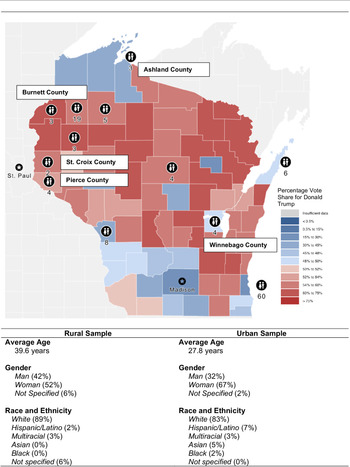
In total, 122 participants completed Phase 1, of whom sixty-two were from rural parts of Wisconsin, and of whom sixty were from urban parts of Wisconsin. As demonstrated by figure 1 (which also lists sampling demographics), participants in the rural sample lived in counties with varying ideological leanings. For example, Hillary Clinton received nearly 53% of the vote in Ashland County as compared to Burnett County, where 62% of voters cast a ballot for Donald Trump. Like Cramer, we also selected study locations that fell within different regions of the state and possessed varying demographic characteristics in terms of race and ethnicity, median household income, and total population (Cramer Reference Cramer2016; 29-31, 230-233; see also Miles and Huberman Reference Miles and Huberman1994, 28). We also ensured that over half of the participants in the rural sample lived north of Highway 8, a geographical boundary that figures prominently within Cramer’s work. Sixty-three percent of the rural sample resided in towns of less than 9,000 people in rural counties—those that do not fall within a Metropolitan Statistical Area (United States Department of Agriculture Reference Cramern.d.). Consistent with Cramer’s work (Reference Cramer2016, 230-232), we also included some individuals who lived in small towns located in countries that do include either a metropolitan or micropolitan statistical area. For example, 9% of the rural participants lived in towns of less than 10,000 people within Pierce and St. Croix Counties, both of which fall within the Minneapolis–St. Paul Metropolitan Statistical Area. Similarly, 6% of the sample resided within small towns located in Winnebago County, which falls within the Oshkosh Metropolitan Statistical Area. While these small towns were certainly less isolated than those located north of Highway 8, there would be no mistaking these places for either urban areas or small suburban communities. Participants in the urban sample all lived in the metropolitan area of Milwaukee, the largest city in the State of Wisconsin. Cramer also observed several community meetings in Milwaukee and the surrounding suburbs (Cramer Reference Cramer2016, 230-233).
Sample characteristics by geography

In taking this approach, it is important to discuss limitations regarding the representativeness of the sample, a concern that we partially address later on with the help of the 2019 ANES Pilot Study. There is no consistent approach for defining which locales are considered rural versus urban, nor is there an established set of criteria that defines who is considered an average “rural American'' or even a “rural Wisconsinite.” For example, the Office of Management and Budget defines “rural” as any county that does not fall within a Metropolitan Statistical Area while the U.S. Census Bureau does not utilize a definition for rural (United States Department of Agriculture Reference Cramern.d.). Moreover, because Cramer understandably protected the identities of the individuals she spoke with in Wisconsin, we are also unable to conduct demographic comparisons between our sample and hers.
Despite these challenges, we believe our sample provides a strong footing to explore the questions presented in this paper for two reasons. First, our rural sample was actually more liberal and Democrat-leaning than we might expect given the 2016 vote share for Donald Trump in the counties we visited. For example, Donald Trump managed to obtain nearly 60% of the vote in Washburn County, the location of nearly one-third of our rural participants, while only 49% of our rural participants identified as Republican. Given the strong relationship between conservatism and increased rates of racial resentment (Kinder and Sanders Reference Kinder and Sanders1996), we believe the results from our survey study actually represent a conservative test of our hypotheses. Secondly, while our sampling approach was designed to target predominantly white counties and neighborhoods within Milwaukee, there were a handful of people of color included within both the rural and urban samples. We did not seek to assume an individual’s racial/ethnic identity during the recruitment process, nor did we seek to deny individuals from participating in the study who identify as people of color. While this inevitably introduced a degree of error into our sampling, we believe this actually allows for a conservative test our hypotheses given that we would expect rates of racial resentment to be lower among people of color (refer to the online appendix analyses for more on this issue). Again, since our aim is to assess the role of racial resentment within existing conceptions of rural consciousness, we prioritized obtaining a sample from places that appeared similar to those discussed within Cramer’s work.
Much like Cramer, we recruited individuals to participate in this study by inviting ourselves into their lives (Reference Cramer2016, 11), striking up conversations in public markets, cafés, and diners throughout the state. Participants from the rural sample were recruited primarily in diners and cafés that agreed to allow us to chat with their customers. In most instances, the researcher would have a lengthy conversation with individuals before asking them to participate in a 25-minute study in exchange for a $10 gift card. These informal conversations frequently touched upon themes described by Cramer such as frustrations towards university employees and tourists who frequent certain areas of the state during the summer months. While we are unable to confirm that these locations were also visited by Cramer since she kept them anonymous, these conversations helped to confirm that we were recruiting individuals in the right spots.Footnote 4
Participants from the urban sample were recruited primarily from a public market in downtown Milwaukee. Recruiting participants from Milwaukee allowed for a rigorous test of our hypotheses due to its racial and ethnic diversity. Consistent with existing work addressing the interconnectedness of racial tension and the diversification of metropolitan areas (Oliver Reference Oliver2010, Enos Reference Enos2016), Cramer suggests that overt references to race and undeserving social welfare recipients were most pronounced in cities and suburbs (Reference Cramer2016, 166). Thus, we would expect white Milwaukeeans to be more overtly racist than Madisonians due to the relative racial diversity. Against this backdrop, support for Hypothesis 2, for example, would be especially impressive. This is because support for this hypothesis—that rural participants will harbor more racialized representations of urbanites than will urban participants—requires that rural respondents’ mental representations be even more racialized than those of a group that is already implicated in racialized thinking.
The most typical case of recruitment involved the researcher asking Milwaukeeans who were taking a break from shopping whether they would be willing to complete a 25-minute study in exchange for a $10 gift card. Soliciting agreement from participants in Milwaukee also required building rapport with participants, as in the case of the rural sample, which was typically done by engaging in small talk prior to inviting participants to complete the survey. Other participants in the urban sample were recruited via snowball sampling in which a particular participant nominated a friend or family member to complete the survey as well. All participants completed an IRB-approved consent form prior to participation, and all participants were likewise compensated with a gift card at the conclusion of their session.
The survey itself—which was programmed into a tablet computer—began by assessing participants’ freely generated beliefs about the “typical attributes” of Madisonians and Milwaukeeans, respectively (the presentation order of these two groups was randomized across participants). Specifically, Phase 1 participants were given the following prompt:
In the spaces below, please list the five attributes that come to mind most quickly when thinking of people who live in Madison [Milwaukee], Wisconsin. What are people from Madison [Milwaukee] like?
Below this prompt were five empty spaces where participants could nominate whatever attributes came to their minds most readily (procedure adapted from Petsko and Bodenhausen Reference Petsko and Bodenhausen2019).
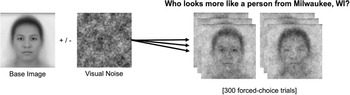
After assessing participants’ freely generated beliefs (e.g., stereotypes) about Milwaukeeans and Madisonians, they were then randomly assigned one of two conditions in what is called a reverse correlation task. These tasks, which are common in social and cognitive psychology (e.g., Dotsch and Todorov, Reference Dotsch and Todorov2012, Petsko et al., Reference Petsko, Lei, Kunst, Bruneau and Kteily2020), are specifically designed to allow researchers to create images that approximate participants’ mental representations of target groups. In our reverse-correlation task, participants were either assigned to a condition in which they called to mind their mental representation of a person from Madison, or they were instead assigned to a condition in which they called to mind their mental representation of a person from Milwaukee. In both conditions, participants were shown 300 pairs of blurry, black-and-white facial images. Every pair of images was created from the same base image (a race- and gender-ambiguous person’s face; Gallagher and Bodenhausen Reference Gallagher and Bodenhausen2021). In each pair, one image was the result of adding a random visual noise pattern to the base image, and the other image was the result of subtracting that same random visual noise pattern from the same base image (see figure 2). Depending on the experimental condition, participants either answered the question “Who looks more like a person from Madison, WI?” for every pair of faces, or the question, “Who looks more like a person from Milwaukee, WI?” for every pair of faces. After the task concluded, we created composite images—indexes of participants’ mental representations of Milwaukeeans and Madisonians—by averaging together the faces that participants chose in each condition. For example, rural respondents’ mental representation of Milwaukeeans was computed by averaging together every face that every rural participant in the “Milwaukee” condition chose during the reverse-correlation procedure.
Illustration of how the reverse-correlation procedure works
Note: Pairs of facial images (right) are generated by imbuing a race- and gender-ambiguous base image (left) with random visual noise. Participants’ task is to choose from each of 300 pairs of images which face looks more like a person from Milwaukee or Madison, WI, depending upon experimental condition.

After participants completed the reverse-correlation task, they completed a demographic questionnaire and a three-item measure of rural consciousness that was similar to what was included in the 2019 ANES Pilot Study (example item: “How many people who live in cities look down on those who live in small towns?”, from 1 = none to 5 = all; α = .60).
Phase 2: Rating the Content that Rural and Urban Participants Provided
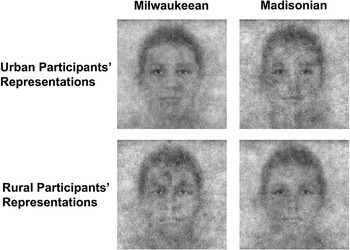
Participants in Phase 2 were responsible for providing ratings of the mental representations and the free-response entries that we acquired in Phase 1. In total, 301 raters completed Phase 2. Raters were evenly divided into three groups: 1) an image-rating group; 2) a free-response rating group that provided ratings of free-response negativity; or 3) a free-response rating group that provided ratings of free-response Afrocentrism. Raters in the image-rating group were shown four composite images, which were created from Phase 1’s reverse-correlation data. These four images index the rural and urban participants’ mental representations of “Milwaukeeans” and “Madisonians,” respectively (depicted in figure 3). Raters in the image-rating group saw all four images in a random order, and indicated, first, to what extent each image looked stereotypically Black (from 0 = Very White to 6 = Very Black), and second, how positive vs. negative the images appeared (from 0 = cold/unfavorable and 100 = warm/favorable).
Results from the reverse-correlation task administered in Phase 1
Note: Images correspond to the mental representations of Milwaukeeans (left) and Madisonians (right), from the perspective of urban participants (top row) and rural participants (bottom row), respectively.

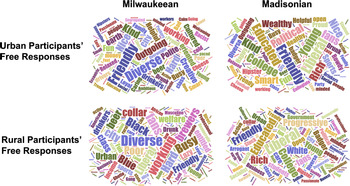
Raters in the free-response rating groups each saw forty randomly selected sets of free-response entries that had been collected in Phase 1. Of these, raters saw even numbers that represented what rural and urban participants, respectively, had listed when thinking about Milwaukeeans and Madisonians, respectively. Some raters provided ratings of how stereotypically Black each set of free-response entries seemed (on the same seven-point scale described earlier); other raters provided ratings of how positive versus negative each set of free-response entries seemed (on the same feeling thermometer measure described earlier). For illustrative purposes, word clouds of the kinds of traits Phase 1 participants listed in the free-response task are presented in figure 4. To provide a quick example, a set of free-response attributes (generated by a rural Wisconsinite in Phase 1) that was rated as highly Afrocentric (e.g., stereotypically Black) contained the following five descriptors: poor, angry, violent, less educated, and lower class. In contrast, an example set of free-response attributes (also generated by a rural Wisconsinite in Phase 1) that was rated as highly Eurocentric (e.g., stereotypically white) contained the following descriptors, instead: elitist, liberal, rich, stuck up, and don’t care about people in small towns.
Resulting word clouds from the free-response task administered in Phase 1
Note: Word clouds of the traits participants listed when describing Milwaukeeans (left) and Madisonians (right), respectively, as a function of whether the participants themselves were from urban (top row) vs. rural (bottom row) Wisconsin.

Who Harbors More Negative Impressions of Urbanites?
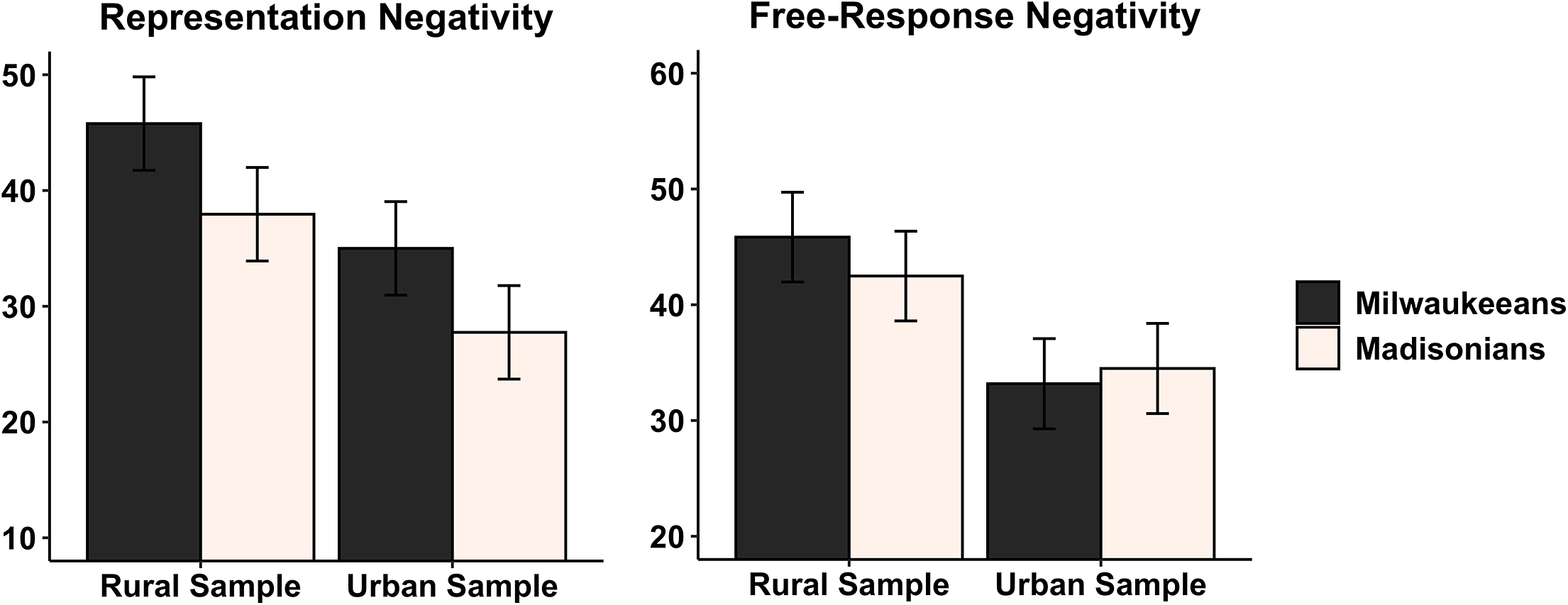
Our first hypothesis (H1) was simply that rural participants would harbor more negative impressions of city dwellers than would urban participants. Results from Phase 2’s rating studies provided strong support for this hypothesis. Rural participants’ composite images—that is, their mental representations of city dwellers (acquired from Phase 1)—were rated as more negative-looking, on average, than those of urban participants: β = 0.49, p < .001 (see figure 5, the left side). On top of that, rural participants’ free-response entries (also acquired in Phase 1) were likewise rated as seeming more negative than those of urban participants: β = 0.39, p < .001 (see figure 5, the right side). Thus, across the board, we found strong support for H1. Rural participants mentally represented and stereotyped city dwellers as seeming “more negative” than the way that urban participants mentally represented and stereotyped city dwellers.
Ratings of representation and free-response negativity
Note: How negative mental representations (left-hand panel) and free-response entries (right-hand panel) of ‘Milwaukeeans’ and ‘Madisonians’ were rated to be as a function of whether they were generated by rural or urban participants. Negativity ratings were collected on 100-point feeling thermometers, which were then reverse-scored such that higher numbers indicate colder / more unfavorable impressions. Means are encompassed by 95% confidence intervals.

Who Harbors More Racialized Impressions of Urbanites?
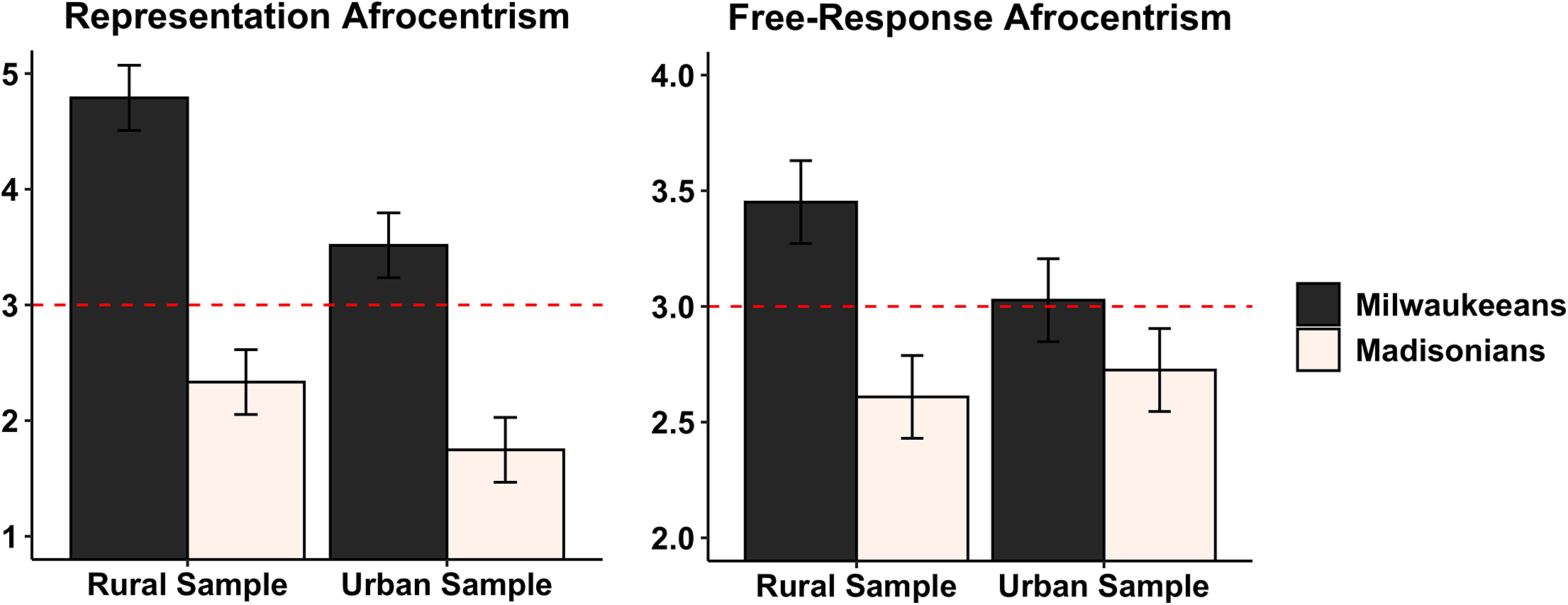
Our second hypothesis (H2) was that rural participants would harbor “more racialized’ “impressions of city dwellers than would urban participants. What we meant by more racialized is that the contrast between the stereotypic Blackness of Milwaukeeans and the stereotypic whiteness of Madisonians would be starker in the minds of rural participants than in the minds of urban participants. Did we find any evidence that this was the case? Indeed, we did. In general, composite images of Milwaukeeans tended to be rated as “Blacker” than those of Madisonians (β = 1.15, p < .001), but this effect was significantly bigger when the mental representations in question had been generated by rural participants (β = 1.33, p < .001) as opposed to when they had been generated by urban participants (β = 0.96, p < .001): interaction, p = .006 (see figure 6, the left side). Because composite images are indexes of Phase 1 participants’ mental representations, this suggests that mental representations of urbanites are indeed more racialized in the minds of rural participants than in the minds of urban participants. Moreover, ratings of free-response entries replicated this pattern. Specifically, the free-response entries about Milwaukeeans tended to be rated as seeming stereotypically Blacker than those about Madisonians (β = 0.39, p < .001), and this effect, too, was significantly larger when the free-response entries had been generated by rural participants (β = 0.57, p < .001) as opposed to when the free-response entries had been generated by urban participants (β = 0.20, p < .001): interaction, p < .001 (see figure 6, the right side). In other words, we found consistent support for H2 regardless of which dependent measure we examined. The tendency to think of city dwellers in racialized terms—to think of Milwaukeeans as “Black” and Madisonians as “white”—was more exaggerated in the minds of rural participants than in the minds of urban participants.
Ratings of representation and free-response Afrocentrism
Note: How Afrocentric mental representations (left-hand panel) and free-response entries (right-hand panel) of ‘Milwaukeeans’ and ‘Madisonians’ were rated to be as a function of whether they were generated by rural or urban participants. The dotted red lines in each panel correspond to the race-neutral midpoint of the Afrocentrism rating scale (anchored at 0 = Very White / Eurocentric and 6 = Very Black / Afrocentric). Means are encompassed by 95% confidence intervals.

Our third hypothesis (H3) was that rural participants would harbor “Blacker” impressions of Milwaukeeans, specifically, than would urban participants. Did the results from Phase 2’s rating studies support this possibility? Yes, they did. Composite images of Milwaukeeans were rated as looking stereotypically Blacker when they had been generated by rural participants compared with when they had been generated by urban participants: β = 0.69, p < .001. Moreover, free-response ratings replicated this pattern. The free-response entries that (Phase 1) participants listed when describing Milwaukeeans were rated as seeming more stereotypically Black when they had been generated by rural participants than when they had been generated by urban participants: β = 0.29, p < .001. Thus, we found very strong support for H3. Rural respondents—more than urban respondents—tended to harbor impressions of Milwaukeeans, specifically, that were rated as seeming stereotypically Black.
Does Rural Consciousness Play a Role in Shaping Racialized Impressions of Urbanites?
Our final hypothesis (H4) was that the tendency for rural participants to harbor more racialized impressions of city dwellers in general, and to harbor “Blacker” impressions of Milwaukeeans specifically, would be exaggerated when rural participants score high (versus low) in rural consciousness. Was there any evidence that this hypothesis was borne out? According to ratings of the free-response data, there was. Rural participants’ tendency to racialize city dwellers—to think of Milwaukeeans as “Black” and Madisonians as “white”—was significantly moderated by how highly they scored on rural consciousness (interaction: p = .002). For example, when rural respondents scored one standard deviation above the sample mean, the tendency described earlier was significantly larger (β = 0.69, p < .001) than it was when they scored one standard deviation below (β = 0.42, p < .001). Thus, there was evidence that rural residents’ tendency to racialize city dwellers was more pronounced among those higher in rural consciousness. In addition, the amount by which rural residents (versus urban residents) characterized Milwaukeeans by stereotypically Black attributes was also moderated by participants’ rural consciousness levels (interaction: p = .002). That is, this tendency was exacerbated among participants who scored one standard deviation above the mean on rural consciousness: β = 0.49, p < .001. However, this tendency was absent among participants who scored one standard deviation below the mean on rural consciousness: β = 0.11, p = .20. In other words, rural (versus urban) respondents’ tendency to associate Milwaukeeans with “Blackness” was contingent on respondents’ levels of rural consciousness—so much so that this bias was exacerbated when rural respondents scored high in rural consciousness, but no longer detectable when rural respondents scored low on this measure.
Does Rural Consciousness Overlap with Racial Resentment in the United States as a Whole?
The results from our survey study, as striking as they are, are based on data from an admittedly small sample of participants. Although the sample we used was large enough to obtain reliable estimates of participants’ mental representations (Dotsch and Todorov, Reference Dotsch and Todorov2012), this sample was by no means large enough to warrant generalization to the United States as a whole. However, as noted previously, a four-item measure of rural consciousness was included in the ANES 2019 Pilot Study (example item: “Do people living in small towns and rural areas get too much respect, too little respect, or about the right amount of respect from others?”, from 1 = much too much to 7 = much too little; α = .60).Footnote 5 Thus, we were able to use ANES 2019 Pilot data—as a supplement to our own data—to examine whether rural consciousness indeed predicts the political preferences it is purported to predict (e.g., an aversion to redistributive economic policies), whether rural consciousness is correlated with racial resentment, and whether rural consciousness continues to predict political preferences after controlling for racial resentment. If rural consciousness overlaps with racialized thinking, as we have been arguing, then rural consciousness should predict outcomes of interest less strongly when controlling for racial resentment than when not.
Was it the case that rural consciousness correlated with other variables in theoretically reasonable ways? Indeed, it was. As one might expect, those living (r = .17, p < .001) and growing up (r = .15, p < .001) in more rural areas reported higher levels of rural consciousness than those living and growing up in more urban areas. In addition, rural consciousness correlated with higher levels of anti-elitism (r = .11, p < .001), high levels of populism (r = .28, p < .001), and decreased faith in experts (e.g., scientists: r = –.15, p < .001). In addition, those scoring higher on rural consciousness also reported higher approval ratings for Donald Trump (r = .18, p < .001), and they reported less favorable attitudes toward redistributive economic policies. For example, those scoring higher on rural consciousness reported more negative attitudes toward laws promoting guaranteed tuition for all admitted students at public colleges and universities (r = –.22, p < .001). Moreover, they reported more negative attitudes toward laws that would reduce income differences between rich people and poor people (r = –.20, p < .001). The bulk of the evidence, therefore, suggests that people who were more rurally consciousness were indeed more rural, more distrustful of political elites and experts, and more averse to redistributive economic policies.
Did rural consciousness also correlate with racism? It appears so, yes. Those higher in rural consciousness tended to report higher levels of racial resentment, which captures negative attitudes toward Black Americans (r = .21, p < .001). In addition, racial resentment was itself correlated with some of the very outcomes that rural consciousness is purported to explain. Like rural consciousness, racial resentment correlated positively with approval for Donald Trump (r = .69, p < .001), and racial resentment also correlated negatively with support for guaranteed college tuition (r = –.59, p < .001) and with reducing income differences between rich and poor people (r = –.57, p < .001). Correlational patterns like these raise an interesting question: If rural consciousness correlates with racial resentment, and if racial resentment in turn correlates with political preferences, might it be possible that the predictive power of rural consciousness is attributable to its overlap with racial resentment? In order to examine this question, we conducted a series of simultaneous regressions (see table 1). In these simultaneous regressions, we predicted each of three outcomes—approval for Donald Trump, attitudes toward free college tuition, and attitudes toward reducing inequality between the rich and poor—by rural consciousness by itself, and by rural consciousness controlling for racial resentment. These analyses revealed that across the board, rural consciousness became a weaker predictor of political preferences when racial resentment was included as a covariate. For example, the associative strength between rural consciousness and approval for Donald Trump decreased by 78% after controlling for its association with racial resentment. In other words, much of what rural consciousness can predict in political preferences may be due to its overlap with racial resentment.
ANES 2019 Pilot Data: Political Preferences as a Function of Rural Consciousness (Before and After Controlling for Racial Resentment)

Note. RC = Rural consciousness. Free College = participants’ attitude toward guaranteed tuition at public colleges and universities for all who are admitted. Reduced Income Inequality = participants’ attitude toward officials passing laws that reduce income differences between rich people and poor people. Simultaneous regressions reported here also control for the ANES 2019 Pilot variable “weight,” which ANES recommends if researchers wish to generalize their findings to the U.S. population.
Conclusion
The research presented here suggests that white rural consciousness, as currently defined, cannot sidestep the centrality of race. This is especially pronounced when more subtle forms of racism are centered in the analysis—the words rural Americans use to describe city dwellers as well as the mental representations they call to mind seriously challenge the idea that rural consciousness exists independently from racial resentment. While rural consciousness may not be reducible to simply racism as scholars of rural America suggest (Cramer Reference Cramer2016; Hochschild Reference Hochschild2018), it appears—at least in these data—to play a central role.
Using both free-response data and results from a reverse-correlation procedure—a social-cognitive procedure designed to capture participants’ mental representations of target groups—the present analysis supports four conclusions. First, rural participants stereotype (i.e., list attributes about) and mentally represent city dwellers in more negative ways than do urban participants. This pattern of findings very much aligns with what one would expect based on existing scholarship (Frank Reference Frank2004; Cramer Reference Cramer2012, Reference Cramer2016; Hochschild Reference Hochschild2018). Second, rural participants stereotype and mentally represent city dwellers in ways that are more racialized—more polarized on the dimension of whiteness versus Blackness—than do urban participants. Third, Milwaukeeans in particular are stereotyped and mentally represented as seeming Blacker in the minds of rural participants than in the minds of urban participants. In other words, respondents were not simply making accurate assumptions about the relative racial diversity of cities (Conn Reference Conn2014); where they lived significantly shaped just how drastically they perceived this diversity to be. Finally, we were able to show that these effects were particularly pronounced among those who registered high (versus low) in rural consciousness. These latter findings are difficult to explain from the perspective that rural consciousness has little to do with race. Instead, these findings support the possibility that white rural consciousness—a social-identity based worldview harbored by white rural people in the United States—is an identity in which race figures prominently.
Notably, our general claim that race figures prominently in the minds of white people who are rurally conscious was also supported by the correlational patterns we observed in the 2019 ANES Pilot Study. There, we found that rural consciousness did indeed predict political preferences, such as approval for Donald Trump and an aversion to redistributive economic policies. However, we found that the ability of rural consciousness to predict these outcomes declined dramatically once racial resentment was covaried out of our models. As a quick example, the magnitude by which rural consciousness could predict an aversion to free tuition at public universities decreased by 55% once participants’ racial resentment was included as a covariate. This is to say that much of what rural consciousness can explain in one’s political preferences may be attributable to its overlap with racial resentment.
Thus, while we agree with those who emphasize that racism manifests across geographical contexts, these results demonstrate that the negative and racialized images of urbanites may be especially pronounced among rural participants. A conclusion of all this is that those interested in the study of rural social identities in predominantly white communities must take the role of racism seriously, regardless of their methodological approach. This might include asking white rural Americans to think about race more explicitly while also exploring the ways in which more covert forms of racism manifest in their characterizations of out-group members. In short, social scientists should not view the absence of overt racism as an indication that race is not a driving force behind individual political preferences in rural America.
Of course, in making these claims, we are not suggesting that white urbanites are innocent bystanders in discussions of racial prejudice and place-based political divides. Indeed, existing research demonstrates that more work must be done to address racism within America’s cities as well (Enos Reference Enos2016, Oliver Reference Oliver2010). Moreover, one might also expect that urbanites hold animosities towards rural Americans that contribute to the stark, place-based political divides evident within American politics. We do not deny that these challenges exist and welcome research that addresses these questions as well.
We see great value in the incredibly empathetic accounts of rural America that have emerged in recent years (Cramer Reference Cramer2016; Hochschild Reference Hochschild2018), something we hope is evident in our own place-based methodological approach. Indeed, understanding the ways in which public opinion forms across geographical contexts and how place-based affinities shape how people think about politics is critical for democracy, perhaps now more than ever. However, our results reaffirm the centrality of race and racism in accounts of American politics and provide a note of caution for those—whether in academia or government—who view rural consciousness as a way of sidestepping this reality.
Supplementary Materials
Complete Methods and Results for Survey Study in Wisconsin.
Complete Methods and Results for 2019 ANES Pilot Study Analyses.
To view supplementary material for this article, please visit http://dx.doi.org/10.1017/S1537592721001948.