Introduction
The genus Macronectes comprises two species of giant petrels, restricted to the southern oceans. These large scavenging and predatory seabirds heavily rely on rookeries of pinnipeds and penguins for food. However, greater availability of carrion from expanding populations of fur seals and increased waste from commercial fisheries are thought to be driving the current global trend of increasing northern giant petrel (NGP, Macronectes halli (Mathews)) populations (Patterson et al. Reference Patterson, Woehler, Croxall, Cooper, Poncet, Peter, Hunter and Fraser2008). In the southern Indian Ocean, NGPs breed on islands south of the Sub-Antarctic Front (SAF) (Patterson et al. Reference Patterson, Woehler, Croxall, Cooper, Poncet, Peter, Hunter and Fraser2008; Fig. S1 in the supplemental material found at http://dx.doi.org/10.1017/S0954102014000182). To date no NGP breeding attempt has been reported north of the SAF in this region despite common sightings of NGPs from the two islands at these lower latitudes (Amsterdam and Saint Paul, 37°46'S, 77°32'E, Fig. 1; Roux & Martinez Reference Roux and Martinez1987), which have large populations of sub-Antarctic fur seals Arctocephalus tropicalis Gray, recovering from near-extirpation after sealing (Roux Reference Roux1987), and large penguin colonies on these islands (Jouventin Reference Jouventin1994). Furthermore, the congeneric M. giganteus (Gmelin) is known to breed at such low latitudes in the southern Atlantic Ocean (Tristan da Cunha Island; Patterson et al. Reference Patterson, Woehler, Croxall, Cooper, Poncet, Peter, Hunter and Fraser2008).
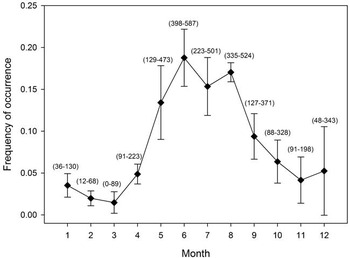
Frequency of observations of giant petrels (c. 95% northern giant petrels) from the coast at Ile Amsterdam in 2003, 2006, 2007 and 2008. Minimum and maximum number of observations are indicated for each month.

Here we report the first record, to our knowledge, of a Macronectes species nesting on Ile Amsterdam.
Observations
The nest was discovered on 17 September 2012 at La Chaussée des Otaries, on the north-west shore of the island (Fig. S1). The nest was c. 20 m from the littoral boulders belt on a flat meadow area (Fig. S2). Following its discovery, the nest content was surveyed seven times over three months in order to monitor breeding chronology and fate. To avoid disturbance of the birds, observations were carried out c. 30 m away from the nest and the birds were not handled. Adult birds were identified by the combination of red bill tip and whitish plumage around the beak and on the throat (Fig. S2; Hunter Reference Hunter1984).
Between 17 September and 22 October, one adult was observed incubating a single egg (Table S1). On the morning of 23 October, a wet chick was brooded by an adult, with the still wet membrane of the eggshell apparent inside the nest. The incubation period in this species is c. 60 days, thus we can assume that the egg was laid around 24 August, more than a month earlier than reports from more southerly locations (Hunter Reference Hunter1984). The difference in phenology may be related to milder climatic conditions on Ile Amsterdam. On 23 October, a dry carcass of an adult NGP was found c. 20 m from the nest, although it was not confirmed whether this dead bird belonged to the breeding pair. On 12 November, the chick was alone on the nest (Fig. S3) reacting to the presence of two brown skuas Stercorarius lonnbergi Mathews that were standing close to it. The nest was found empty on 21 December. Despite an extensive search of the surrounding area, the remains of chick were not found. Typically, NGP chicks fledge at c. 106–120 days old (Hunter Reference Hunter1984), therefore this breeding attempt doubtlessly failed before the chick had fledged.
Inspection of the area was undertaken during the following breeding season, a few adult NGPs were observed displaying courtship but no breeding event was reported (Centre d’Etudes Biologiques de Chizé, unpublished data).
Discussion
Despite the failure of the nest at the chick stage, our record expands NGPs breeding range by c. 6° northward (c. 650 km). The previous northern-most known breeding site was Chatham Island in the Pacific Ocean, 43.9°S (Patterson et al. Reference Patterson, Woehler, Croxall, Cooper, Poncet, Peter, Hunter and Fraser2008).
Observations recorded since the 18th century at Ile Amsterdam suggest that giant petrels are normally visitors around the island (Roux & Martinez Reference Roux and Martinez1987), with the highest numbers being observed from May to August (Fig. 1). This period matches the non-breeding season of adults and the post-fledging dispersal season of juvenile NGPs, suggesting that the birds were visiting Ile Amsterdam after breeding elsewhere and/or were non-breeders. Giant petrels are not mentioned among the sub-fossil avifauna of Ile Amsterdam (Worthy & Jouventin Reference Worthy and Jouventin1999), although this does not preclude isolated breeding events in the past. There has been no record of giant petrels nesting on Ile Amsterdam since the beginning of our long-term seabird monitoring programme in 1983.
Several recent ecological changes may favour nesting of NGPs at Ile Amsterdam. First, the global trend of increasing NGP breeding numbers (Patterson et al. Reference Patterson, Woehler, Croxall, Cooper, Poncet, Peter, Hunter and Fraser2008), which is potentially favourable for the establishment of individuals outside their known breeding range. Second, the ongoing dramatic rise in fur seal numbers at Ile Amsterdam (Roux Reference Roux1987). Coincidentally, the nest was built at one of the three sites on the island where a few fur seals survived sealing and from which the local recolonization process occurred, with the highest birth rate measured on the island in 1982 (Roux Reference Roux1987). Third, this nesting event occurred during the year following eradication of feral cattle on Ile Amsterdam. Although previous regulation campaigns would have produced scraps beneficial to NGPs (Micol & Jouventin Reference Micol and Jouventin1995), it is probable that the presence of herds of mega-herbivores on the island lowlands might have prevented local breeding opportunities for giant petrels. Finally, industrial fishing pressure has dramatically changed over the last 30 years, particularly in the Ile Amsterdam region. Fishing in the French Economic Exclusive Zone around Ile Amsterdam is now strictly managed and restricted to only one vessel. However, recent development of pelagic longlining in the subtropical high seas, and especially the Taiwanese fleet offshore from Ile Amsterdam, may produce considerable offal for giant petrels in this region.
In conclusion, ongoing monitoring is required to confirm whether our record is an isolated case or reflects settlement of these large scavengers at Ile Amsterdam, where dramatic ecological changes have occurred over a short period.
Acknowledgements
The present work was supported financially and logistically by the Institut Polaire Français Paul-Emile Victor (IPEV, program no. 109: resp. H. Weimerskirch), the Terres Australes et Antarctiques Françaises (TAAF) and the Zone Atelier Antarctique (CNRS-INEE). We are grateful to Hugues Fertin, Priscilla Conrad, and all the members of the 63rd and 64th missions on Ile Amsterdam for helping in the field. We thank the reviewers for their comments.