Implications
This study is part of a broad series of digestibility trials that aimed to evaluate the apparent digestibility of a wide range of different feedstuffs and to compare two assessment methods, namely, the total collection of feces and the internal markers method. The results of this study provide further data to update the digestion coefficients of raw materials and forages, which are usually part of the rations of horses, and that have not yet been referred to in the scientific literature. These results could help improve the current, scientifically based rationing of horses, and could enable companies to produce more suitable compound feeds, according to the particular features of each ingredient.
Introduction
The digestion coefficient of horse feeds and diets can be determined using different techniques such as calculation based on the chemical composition of feeds, in vivo or in vitro methods.
Currently, the total collection of feces method (Martin-Rosset et al., Reference Martin-Rosset, Andrieu, Vermorel and Dulphy1984 and Reference Martin-Rosset, Vermorel, Doreau, Tisserand and Andrieu1994; Vermorel and Martin-Rosset, Reference Vermorel and Martin-Rosset1997), which is applied in the French Horse Net Energy System, is the most widespread method in Europe. The extensive use of the total collection of feces is related to the high quantity of feedstuff tested until now using this method and to the use of a significant number of horses in these trials. Nevertheless, this method is time consuming and costly and it involves some practical problems, mainly related to the difficulty of using working horses and mature animals (Parkins et al., Reference Parkins, Snow and Adams1982).
Measurement of the concentration of markers found in both the diet and in the feces eliminates the need for the compulsory use of the total collection of feces, and thereby facilitates digestibility studies in the field. This method relies on the principle that higher concentrations of marker will be found in the feces of animals fed diets with high digestion coefficients. In this context, the internal markers method has often been used in digestibility trials in recent years, in particular using naturally occurring markers that do not cause any modification of the normal diet. These markers are substances such as n-alkanes (Peiretti et al., Reference Peiretti, Meineri, Miraglia, Mucciarelli and Bergero2006), acid-insoluble ash (AIA; Miraglia et al., Reference Miraglia, Bergero, Bassano, Tarantola and Ladetto1999a and Reference Miraglia, Bergero, Polidori, Gagliardi and Tarantola1999b, Almeida et al., Reference Almeida, Lopez Donzeles, Leao and Cecon2001) and ADL (Miraglia et al., Reference Miraglia, Bergero, Bassano, Tarantola and Ladetto1999a and Reference Miraglia, Bergero, Polidori, Gagliardi and Tarantola1999b), which are naturally present in feeds. Other substances used as markers are added to diets and among these the most commonly used marker in horses is Cr2O3 (chromic oxide; Parkins et al., Reference Parkins, Snow and Adams1982; Cuddeford and Hughes, Reference Cuddeford and Hughes1990). The main advantages of the AIA method, compared with other markers, are the easiness of the analysis and the lack of necessity of special equipment (Bergero et al., Reference Bergero, Préfontaine, Miraglia and Peiretti2009).
The aim of this study was to determine the apparent digestibility of extruded flax, which is not a ‘common feed’ in horse diets, and of wheat bran, and to assess the relationship between the in vivo digestion coefficients of dry matter (DM), organic matter (OM), crude protein (CP) and gross energy (GE) obtained using the methods based on the total collection of feces and on the AIA marker. This would facilitate updation of feedstuff digestibility databases on raw materials treated using new technologies.
Material and methods
Animals, diets and experimental design
The study was conducted over the period of July to October at the ‘International Horse Center’ Foundation located in ‘La Mandria Park’ near Druento (Turin, Italy). Three in vivo digestibility trials were performed on six adult geldings aged between 3 and 11 years, with the average weight reported in Table 1. The horses were individually stabled in 4 × 3 m2 boxes with shavings as litter and with free access to water.
Live weight of horses fed experimental diets and intake level (mean ± s.d.)

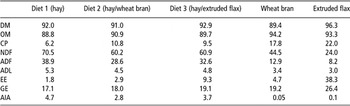
An anti-waste corner feeder (120 cm long and 70 cm deep) was used and solid partitions were installed to prevent the horses from sharing the feed or transferring the feed from one partition to another. The feeding level was 1.2 times the maintenance level in all the trials, because the horses performed light exercises involving 20 min of lunging daily. The horses were fed diets composed (on a DM basis) of 100% hay in the first trial, 60% hay and 40% wheat bran in the second trial and 80% hay and 20% extruded flax in the third trial. In all the trials, the hay was a flatland first-cut meadow hay harvested at a later stage of maturity than the forages usually reserved for hay in North Italy. The concentrates were offered in a horse-water bucket, and no refusal presence was verified. The chemical composition of the feedstuff used in this study is summarized in Table 2. The experimental period lasted 20 days for each trial: 14 days of adaptation to the diet, followed by 6 days of total collection of feces, according to Martin-Rosset et al. (Reference Martin-Rosset, Andrieu, Vermorel and Dulphy1984). The body weight of the horses was recorded at the start and at the end of each trial.
Chemical composition (% DM) and GE content (MJ/kg DM) of the diets and concentrates

GE = gross energy; DM = dry matter; OM = organic matter; EE = ether extract; AIA = acid-insoluble ash.
Sampling and analytical determinations
Ten large prismatic bales (∼350 kg each) from the same permanent meadow were used for all the trials. The horses were supplied with half of the rations at 0900 h and the remaining half at 1700 h. The hay and concentrates were sampled daily during the feeding trials immediately before they were fed to the horses and then pooled to obtain representative samples. Individual diet quantities were weighed and sampled daily during the 6-day collection period.
The total collection of feces was carried out daily at 0800 h and at 1600 h using a suitable permanent device (horse diaper), which allows feces to be collected separately from urine. The use of a horse diaper prevents forced reclusion of the animals in digestibility stalls and thus allows the horses to walk and roam around freely. The total individual daily feces were weighed, mixed and a 10% daily aliquot was sampled and kept at −30°C until analysis. The feces samples of each horse were dried and then 6-day cumulative samples were pooled by mixing daily samples.
The fecal samples of each horse were dried for 2 days in a forced-draft oven at 65°C to a constant weight. The feed and fecal samples were dried for 8 h at 105°C to determine the DM content. All the dried samples were ground in a 1-mm screen Cyclotec mill.
The feces and feed samples were analyzed for CP and ash, according to the Association of Official Analytical Chemists (AOAC, 2004). The CP content was calculated using Kjeldahl nitrogen, and the OM content was calculated using the sample ash content. The AIA concentrations were determined according to Van Keulen and Young (Reference Van Keulen and Young1977). The GE was measured using an adiabatic calorimeter bomb (IKA C7000, Stafen, Germany). The NDF, ADF and ADL were determined according to Van Soest et al. (Reference Van Soest, Robertson and Lewis1991). The ether extract (EE) content was analyzed using Soxhlet extraction according to AOAC (2004).
Calculations and statistical analyses
The digestion coefficients of the hay, concentrates and total rations were calculated for DM, OM, GE, CP and NDF on the basis of the total collection and using AIA as the marker. The apparent digestibility of the hay and rations was calculated using the total collection of feces for each horse and for each diet according to Martin-Rosset et al. (Reference Martin-Rosset, Andrieu, Vermorel and Dulphy1984):

The apparent digestibility of the wheat bran or extruded flax alone was calculated from the digestion coefficients of the hay and the rations according to Martin-Rosset et al. (Reference Martin-Rosset, Andrieu, Vermorel and Dulphy1984):

where dC is the concentrate digestibility, dR is the ration digestibility, dF is the hay digestibility (previously determined), f is the percentage of forage (hay) in the ration and c stands for the percentage of the concentrate in the ration.
The calculation of the DM digestibility using the AIA technique was carried out as follows:

in which A and B represent the AIA concentrations in the feed and feces, respectively. The digestibility of OM, GE, CP and NDF was calculated as follows:

in which XA and XB represent the OM, GE, CP or NDF concentrations in the feed and feces, respectively.
The apparent digestion coefficients of the diets and concentrates were analyzed using the Student t-test for paired samples to underline the differences between the two methods, using the SPSS statistics package (version 11.5; SPSS Inc., Chicago, Illinois, USA). The individual horse was considered as the experimental unit, and the method used to determine digestibility was considered as the factor of influence. The data are presented as the mean and s.d. Differences were considered statistically significant for P-values < 0.05.
Results
The intake levels of the trials are reported in Table 1. The lowest and the highest intakes were found in the horses fed the diet with extruded flax and hay alone, respectively. No refusal was observed during the trials.
The hay used in the diets was considered to be of medium to low quality, because of frequent rain that occurred during harvesting. Nevertheless, the hay quality was representative of the kind of forage that is normally used in horse feeding in Northern Italy. The chemical composition of the wheat bran and extruded flax was characterized by a CP content of 17.8% and 22.0%, respectively, and an EE content of 4.7% and 38.3%, respectively (Table 2).
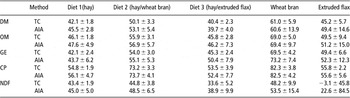
The digestion coefficients of the diets, obtained from both the total collection and the AIA methods, and those of the concentrates, obtained through calculations, are reported in Table 3. No significant difference was found between the two methods in each trial for the measured digestion coefficients; this highlights the suitability of both methods to study the apparent digestibility of horse diets. The digestion coefficients calculated for the concentrates did not show any significant difference between the methods.
Digestibility coefficients (%) obtained from the TC of feces and internal marker (AIA) analysis (mean ± s.d.)

TC = total collection; AIA = acid-insoluble ash; DM = dry matter; OM = organic matter; GE = gross energy.
The DM apparent digestion coefficients of the complete diet ranged from 40.4% to 50.1% when the total collection of feces method was used and from 39.7% to 53.1% when the AIA method was used. Assuming no associative effects, the calculated digestibility of the wheat bran and extruded flax was 61.0% and 45.2%, respectively, when the total collection of feces was used, and 60.6% and 49.4% for the AIA method.
The OM digestion coefficients of the diets ranged from 45.8% to 55.9% for the total collection of feces method and from 46.2% to 56.9% for the AIA method. The OM digestion coefficients of the two concentrates ranged from 49.5% to 69.0% for the total collection of feces and from 49.5% to 69.4% when the AIA method was applied.
The GE and CP digestion coefficients showed higher values in the hay plus wheat bran diet than those found in the other two experimental diets. This is because of the higher digestibility of wheat bran compared with hay alone or hay plus extruded flax. Moreover, the NDF digestion coefficient of hay plus extruded flax diet was lower than those of hay alone and hay plus wheat bran diets.
Discussion
In previous studies, we assessed the digestibility of feeds on several occasions by comparing the internal markers method and the total collection method. In particular, we studied the digestion coefficients of various types of hay (Corino et al., Reference Corino and Miraglia1996; Bergero et al., Reference Bergero, Miraglia, Abba and Polidori2004), haylages (Bergero et al., Reference Bergero, Peiretti and Cola2002; Bergero and Peiretti, Reference Bergero and Peiretti2009) and a large number of concentrates, which mainly provided energy (cereals and their by-products; Miraglia et al., Reference Miraglia, Bergero, Bassano, Tarantola and Ladetto1999a, Reference Miraglia, Bergero, Polidori, Peiretti and Ladetto2006a and Reference Miraglia, Costantini, Polidori, Bergero, Meineri and Peiretti2006b; Peiretti et al., Reference Peiretti, Meineri, Miraglia, Mucciarelli and Bergero2006).
The coefficients obtained using the AIA method were comparable with those obtained from the total collection of feces method, and the former method could therefore be used instead of the total collection method. In addition, studies carried out in the past showed that the results obtained using AIA as a marker for digestion coefficients did not differ from those obtained through the total collection of feces (Orton et al., Reference Orton, Hume and Leng1985; Miraglia et al., Reference Miraglia, Bergero, Bassano, Tarantola and Ladetto1999a), whereas other authors obtained results with minimal differences between the two techniques (Bergero et al., Reference Bergero, Miraglia, Abba and Polidori2004). Nevertheless, some issues emerged while analyzing the individual results on apparent digestion coefficients. First, there was a greater variability of the coefficients obtained when the AIA method was adopted, probably because of technical difficulties in the feeds sampling, which were related to an uneven distribution of AIA in the feeds. Similar problems were encountered in another work using AIA-rich hay (Bergero et al., Reference Bergero, Miraglia, Abba and Polidori2004).
No associative effects were observed in horses by Martin-Rosset and Dulphy (Reference Martin-Rosset and Dulphy1987) and Vermorel et al. (Reference Vermorel, Martin-Rosset and Vernet1991) between dietary components and diet digestibility, whereas Palmgren Karlsson et al. (Reference Palmgren Karlsson, Lindberg and Rundgren2000) found a negative associative effect on digestibility in horses fed different ratios of grass hay and whole oats. Peiretti et al. (Reference Peiretti, Miraglia, Meineri, Costantini and Bergero2009) showed that the addition of crushed or flaked barley to first-cut meadow hay improves the digestibility of the ration in horse and flaked barley was found to be more digestible than crushed barley.
The digestion coefficients of the hay in this experiment are in agreement with previous experiments carried out on similar forages produced in Italy (Miraglia et al., Reference Miraglia, Polidori, Bergero, Meineri and Peiretti2008; Bergero et al., Reference Bergero, Miraglia, Abba and Polidori2004).
Smolders et al. (Reference Smolders, Steg and Hindle1990) were successful in determining a consistent digestion coefficient of protein concentrate using a higher percentage of concentrate in the diet, and found similar OM digestion coefficients for wheat bran. Tagaki et al. (Reference Tagaki, Hashimoto, Yonemochi, Asai, Yoshida, Ohta, Ishibashi and Watanabe2002) suggested that horses had a better ability to utilize the dietary CP of wheat bran with flour, but the ability of horses to utilize dietary energy was not any better than that of pigs or beef cattle.
A second issue concerns the results obtained when using extruded flaxseed. This concentrate showed a lower digestibility than flaxseed meal fed to thoroughbreds in Japan (Tagaki et al., Reference Tagaki, Hashimoto, Yonemochi, Asai, Yoshida, Ohta, Ishibashi and Watanabe2002). The hay plus extruded flax diet showed a lower CP digestion coefficient than that found in growing horses fed a diet supplemented with 15% of flaxseed meal (Hintz et al., Reference Hintz, Schryver and Lowe1971). Reitnour and Salsbury (Reference Reitnour and Salsbury1972) found that the cecal administration of linseed meal increased the digestibility of total protein and increased nitrogen retention, but DM digestion was significantly decreased when linseed meal was infused. Smolders et al. (Reference Smolders, Steg and Hindle1990) determined OM digestibility of many compound feeds for horse rations and found higher values for a compound feed containing linseed expeller plus other more digestible ingredients supplying the whole compound feed at 70% (it could be calculated that ∼16% of the diet was linseed expeller). Comparisons of the two situations are difficult because of the different linseed sources used and differences in the general ration design, but the idea that expeller is more digestible than whole seed could be studied in further trials.
The lower digestibility of diet 3 and the negative result reported in our study for the NDF digestion coefficient of extruded flaxseed have been confirmed in previous researches, where similar results were found for other concentrates (Miraglia et al., Reference Miraglia, Bergero, Polidori, Peiretti and Ladetto2006a, Reference Miraglia, Costantini, Polidori, Bergero, Meineri and Peiretti2006b and Reference Miraglia, Polidori, Bergero, Meineri and Peiretti2008). This is a general problem of total digestibility trials in horses, and it is probably because of the interaction between hay and concentrates. The problem of interaction has already been pointed out by Martin-Rosset and Dulphy (Reference Martin-Rosset and Dulphy1987), and it requires further research, in particular for new concentrates that are rich in fiber.
In conclusion, the use of AIA as an internal marker in digestibility trials leads, on average, to values similar to those obtained with the total collection of feces, and can therefore be a less-expensive method to determine apparent digestion coefficients. Nevertheless, the total collection of feces should still be considered the best choice to determine the digestibility of some specific feedstuffs and namely to design a reference feeds table.