

In 1933, John Maynard Keynes pondered the virtues of ‘National self-sufficiency’ compared with the pursuit of an international division of labour and the benefits of comparative advantage. Prior to the First World War, he was a staunch adherent of the world of Richard Cobden: peace and prosperity rested on ‘the interdependence and connexion of material well-being throughout the world’; economic nationalism would only lead to ‘jealousy and hostility’ and hence to war. As Keynes remarked in 1933, he had been brought up to see free trade not only as an economic policy but ‘almost as a part of the moral law’.
Keynes still adhered to free trade and comparative advantage after the First World War as a defence against poverty and as a ‘principle of international morals’, though now separated from laissez faire. But Keynes started to move from cosmopolitan to ‘insular capitalism’. The insular turn started with A Tract on Monetary Reform in 1923, where he argued that British prices and wages should not be forced to adjust to the dictates of the exchange rate. Rather, the exchange rate should be dictated by domestic considerations. In 1924, he developed his thoughts further by questioning the value of foreign investments which he argued arose from institutional biases in the City rather than an efficient use of resources. A default by a foreign borrower left Britain with nothing; a default on a domestic loan still left the asset. He felt that investment should be directed to domestic capital construction in order to create employment – not least through a programme of public works in housing, roads and electrification. What was the point of redeeming the national debt if the funds so released were invested overseas? He denied the common assumption that investment abroad led to demand for British goods and was therefore just as beneficial as investment at home.
By 1930, he was less convinced of the virtues of free trade. It implied flexibility in wages which no longer existed, and ‘well-adjusted tariffs’ might now reduce unemployment. Britain no longer had such advantages in manufacturing as in the past, and had relatively high wages. He still hesitated on moral grounds, and saw tariffs more as a means of addressing current difficulties than a long-term policy. But in 1933, he departed still further from his earlier Cobdenism. Free movement of goods and capital might actually provoke war rather than guarantee peace by placing countries ‘at the mercy of world forces’, and preventing the pursuit of domestic economic recovery through investment at home:
It does not now seem obvious that a great concentration of national effort on the capture of foreign trade, that the penetration of a country's economic structure by the resources and influence of foreign capitalists, that a close dependence of our economic life on the fluctuating economic policies of foreign countries, are safeguards and assurances of international peace. It is easier, in the light of experience and foresight, to argue quite the contrary.
The economy had changed, he argued, so that he was not persuaded that ‘the economic advantages of the international division of labour today are at all comparable with what they were’. Most countries could now undertake mass production with virtually the same level of efficiency, and as prosperity increased so a larger proportion of consumption was on services which could not be traded internationally. Hence the economic costs of self-sufficiency did not ‘outweigh the other advantages of gradually bringing the producer and the consumer within the ambit of the same national, economic and financial organisation’.
Not only the economic but also the moral benefits of comparative advantage were in abeyance. Far from leading to peace, free trade and capital mobility were more likely to produce conflict, leading to resentment against foreign ownership of assets. Indeed, it was preferable to ‘minimise rather than . . . maximise economic entanglement between nations. Ideas, knowledge, art, hospitality, travel – these are the things which should of their nature be international. But let goods be homespun whenever it is reasonably and conveniently possible; and above all let finance be primarily national.’ As he argued in 1932, comparative advantage would destroy the identities and cultures of the different parts of Britain which were dedicated to different trades and crafts. Merely counting costs turned the world into an accountants’ nightmare, in which beauty and nature had no value and therefore did not matter. Cobdenism was replaced by something closer to John Ruskin's denunciation of the pursuit of material advantage as destructive of all that was best in life.Footnote 1
Keynes had moved far away from the liberal, cosmopolitan economic order which dominated in the half century before the First World War, of free trade, capital mobility and the gold standard. Not everyone was entirely convinced by Keynes's rejection of Cobden and the tradition of Adam Smith. Perhaps, suggested one sceptical writer in the New Statesman, the high table at King's College would in future grow witty by consuming Empire wines. More seriously, Lionel Robbins defended the classic case for the comparative advantages of free trade, and J. A. Hobson argued for internationalism as a resolution of the problems of the economy.Footnote 2 But it was Keynes who was more representative of changes in the economic culture of interwar liberalism. Even in the opinion of its honorary secretary, Wedgwood Benn, the Cobden Club – the home of true believers in free trade and liberal economics – was an irrelevance. George Paish, the adviser to Lloyd George as chancellor of the Exchequer before 1914 and a leading member of the Club, was dismissed as ‘a bit of a laughing stock’.Footnote 3
Keynes's loss of his Cobdenite faith led to a new trade-off between the constituent elements of the ‘inconsistent trinity’ which I discussed in the previous address. As we saw, it is possible to have two but not three of fixed exchange rates; capital movements; and an active domestic monetary policy. Prior to the First World War, the British government – in line with most other advanced economies – was firmly committed to a fixed exchange rate on the gold standard. It followed that if the value of the pound started to appreciate (say in response to a strong balance of payments or an inflow of funds), interest rates would be reduced in order to make the London money market less attractive and so hold down the value of the pound. The lower cost of borrowing might stimulate the domestic economy by boosting demand and investment – but in the absence of controls on capital mobility, investors were likely to seek outlets overseas. Conversely, if the value of the pound started to depreciate, interest rates would be raised in order to attract funds into London. Higher domestic interest rates would retain funds in Britain, but the additional cost might well depress the domestic economy. As a result of the need to protect the exchange rate, and the lack of any controls on capital movements, the government could do little to stimulate the British economy through an active domestic monetary policy. This particular trade-off in the ‘inconsistent trinity’ was complemented by a commitment to free trade up to 1914.Footnote 4
Between the wars, the policy trade-off changed in two phases. The first phase covered post-war preparations for the return to gold in 1925 up to its abandonment in 1931. The aim was to restore the pre-war trade-off, a strategy which faced greater difficulties. The British government was committed to returning to fixed exchanges at the pre-war parity and prepared the ground by adjusting British prices to the dictates of £1 = $4.86. At the same time, capital mobility was desired but the level of overseas investment was now considerably lower and constrained by a variety of considerations. The logic of the international economy could no longer be pursued to its conclusion at the expense of domestic considerations which now started to play a larger, though still subordinate, role. Finally, free trade was the norm but was coming under greater pressure. In other words, the late Victorian and Edwardian policy mix was still pursued within a new set of constraints and limitations which rendered it less stable, with greater difficulties in sacrificing domestic considerations to international issues.
The second phase ran from the economic crisis of 1931 to the outbreak of the Second World War. Fixed exchanges were abandoned and the pound could now be managed with a modest under-valuation in order to encourage exports and limit imports. Capital mobility fell to low levels with much tighter controls on the market, and Britain became a net importer of capital. It followed that an active domestic monetary policy could now be pursued to hold down the value of the pound, to permit a reduction in the cost of servicing the national debt and to stimulate the housing market. At the same time, free trade was abandoned and imperial preference introduced. The result was a move from globalisation to ‘insular capitalism’, the abandonment of international considerations for a greater concern for domestic stability. Economic adjustment was now externalised (devaluation and protection) rather than internalised (deflation to reduce costs).
Why did the trade-off change so radically from the globalised economy of the period prior to the First World War? The international economy before 1914 certainly experienced tensions, with a growing demand for trade protection and limits on migration by those who were suffering from globalisation. In the late nineteenth century, the level of per capita income in the Atlantic economies converged as labour left some parts of Europe (so forcing up wages) and moved to the new world (so moderating the impact of scarcity). The movement of labour also had distributional consequences within each area of the Atlantic economy, with a rise in income inequality in the rich, labour-scarce countries of the new world (Argentina, USA, Canada) as immigration eroded the bargaining position of workers, and a fall in inequality in poor, labour-abundant countries of the old world (Italy, Ireland) as the bargaining position of workers improved. These outcomes produced a nationalist backlash against globalisation: workers in the new world resented the inflow of migrants and demanded restriction on immigration; farmers and landowners in the old world resented the influx of cheap grain from across the Atlantic and demanded tariffs. Thus the inequalities created by globalisation were leading to a backlash even before the war in order to defend the poor in the labour-scarce countries, and to protect both the landed poor and the landed rich in much of Europe. Britain was somewhere between these two groups of countries which helps to explain the muted resistance to globalisation before 1914: emigration increased the bargaining power of workers; and farmers and landowners who lost from competition with imports from the new world had much less political clout than their counterparts in France or Germany. The backlash was therefore weak compared with other countries where, as O'Rourke and Williamson argue, globalisation planted the seeds of its own destruction in the 1870s which sprouted in the 1880s, grew at the turn of the century and reached maturity after the First World War.Footnote 5
As Harold James points out, globalisation both depended on the nation state and provoked nationalism – an uneasy relationship. The nation state was a response to threats from outside, seeking ‘to externalize the costs of economic adjustment . . . on those outside the national community. The state's duty lay in protecting its citizens and in ensuring that the inhabitants of other national communities suffered as much as possible.’ Globalisation would be threatened if politicians in nation states succumbed to domestic political pressures and were not constrained by commitment mechanisms and international organisations. The post-war institutions were too weak and the forces of nationalism too strong.Footnote 6
Why did the forces of economic nationalism prove so powerful? Eichengreen points to three factors. First, those who stood to suffer from the pursuit of fixed exchanges now gained voice with the coming of manhood suffrage. He argues that the credibility of the commitment to gold before 1914 ‘depended on a unique constellation of political and economic factors’ which insulated central bankers and governments from pressures to adopt other policies, both because ‘the connections between monetary policy and unemployment were only vaguely understood’ and because ‘those most concerned about the domestic consequences of international monetary policies had as yet acquired only limited political influence’. Between the wars, this insulation was breached as groups and interests affected by restrictive monetary policies gained voice. Second, central bank cooperation was now much weaker and less able to handle tensions in the international financial system, for central bankers were constrained by rules designed to prevent a repeat of hyperinflation and instability after the war, so removing their flexibility to offer mutual support in times of crisis and making for more instability. At the same time, the post-war settlement failed to create new institutions which could offer a different approach to international cooperation and make commitment to fixed exchanges credible. The so-called ‘Geneva consensus’ failed to prevent the pursuit of nationalistic interest, for international conferences and institutions such as the Bank of International Settlements were permeated with the tensions of reparations and debts, and weakened by the isolationism of the United States. Thirdly, Eichengreen suggests that the ‘self-equilibrating tendencies of the market’ did not come into operation after the initial shock of 1929 and the restrictive monetary policy of the Federal Reserve. Many observers argued that wages were more ‘sticky’ between the wars, and Eichengreen suggests that the same problem arose with respect to other variables so that costs did not fall in order to moderate the reduction in sales and employment. He points out that mortgages and rents were set in nominal terms for long periods, and that bonds similarly offered fixed payments. The problem, he argues, was that each recipient of income – rentiers, capitalists and workers – would have accepted a cut if everyone else did the same. However, ‘without a mechanism to coordinate their actions, no one group was prepared to be the first to offer concessions’.Footnote 7
The implication of last year's address is that the first two points were not crucial. Before 1914, the gold standard was widely seen as beneficial so that the key change was not that workers gained voice to express an existing, disregarded hostility; rather, hostility to the gold standard developed anew. Furthermore, cooperation of central banks was not crucial to the maintenance of the gold standard before the First World War; rather, adherence to the gold standard and its norms rested on an assessment of self-interest. After the war, the issue was not so much a weakness of international rules and regulations as a reassessment of self-interest which meant they became less willing or able to pursue internationalism.Footnote 8 What exactly changed to alter the pre-1914 trade-off so that the attempt to return to the apparently golden age of Edwardian Britain was no longer feasible? I will suggest that the answer lies, in the first place, in significant changes in the performance of the economy which affected calculations of self-interest by a number of major actors.
I
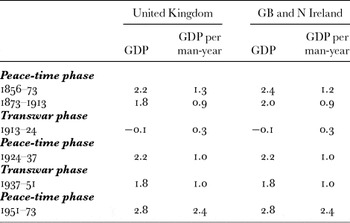
A major shift in the performance of the British economy led to an objective change in the welfare benefits of the pre-war trade-off for workers, industrialists, bankers and the state. Although economic historians have spent much time and effort in debating the timing of the so-called ‘climacteric’ in economic growth in the later nineteenth century, the most striking feature in the statistics is the low growth rate of the transwar period (see Table 1). The shock of war pushed the economy from equilibrium, and in the words of Matthews, Feinstein and Odling-Smee ‘the absolute fall in GDP across the war, not made good until the late 1920s, is one of the most spectacular features of recent British economic history’. The explanation for this poor growth performance was in part a drop in labour input and hours of work: growth of labour input (adjusted for quality) fell from 1.7 per cent per annum in the period 1873–1913 to −0.4 per cent per annum between 1913 and 1924 before rising to 2.1 per cent per annum between 1924 and 1937. At the end of the war, hours of work fell from fifty-four to forty-seven per week or a drop of 13 per cent without a cut in wages. During the final stages of the war and the post-war boom, wages rose as a result of the increased bargaining power of labour which led to a surge of union membership, increased militancy and a spate of strikes. Wage-push inflation, as well as the pressures of war finance and the heavy reliance on loans, resulted in high levels of inflation during the war and post-war boom compared with the USA.Footnote 9
Growth of GDP and GDP per man-year in the United Kingdom and Great Britain and Northern Ireland, 1856–1951, annual percentage growth rates
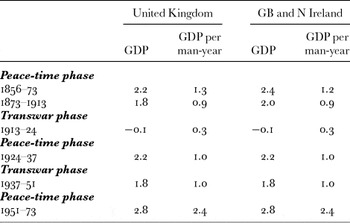
Source: Matthews, Feinstein and Odling-Smee, British Economic Growth, table 2.1, 22.
These trends had very serious consequences for the British economy after the war. The increased price of British goods meant that overseas markets were lost, so exacerbating the erosion of markets as a result of the imperative of the war effort; the emergence of competition from India, Japan and the USA in Latin America and Asia; and the shift from coal to oil which hit the export trade from south Wales and the north-east of England. Furthermore, foreign firms entered British markets in 1920–2 when their goods were particularly cheap; and once they created distribution networks and established a reputation, they were not easily displaced until the development of protection in the 1930s. The import ratio increased in the early 1920s and remained high for the rest of the decade.Footnote 10 The loss of overseas markets led to high unemployment in the staple export industries of cotton, coal, shipbuilding and heavy engineering, and the slack was not taken up by the domestic market.
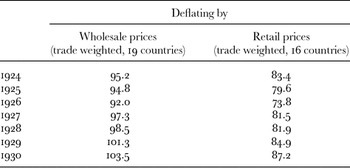
As a result of British inflation, the pre-war parity of the pound sterling was too high at the end of the war, and the decision to return to the gold standard exacerbated the problems in export markets. Keynes claimed that the pound was over-valued by 10 per cent against the dollar at the time of the return to gold, and his estimate has been disputed and refined by a number of scholars. Of course, Britain traded with many other countries than the United States, so that the best measure of over-valuation is to weight the exchange rate by trade with various partners. On this measure, sterling was overvalued by at least 5 and possibly as much as 20 per cent in 1925 compared with 1913 (see Table 2). Of course, British prices were reduced in preparation for the return to gold, so that the over-valuation of sterling was still greater before 1925.Footnote 11 Although historians have focused on the impact of the return to gold in 1925 and the conflict over cost-cutting which resulted in the miners’ lock-out and general strike in 1926, these policies had their greatest impact before 1925 when the British government adopted deflationary monetary policy and high real interest rates in the early 1920s which hit the domestic economy. In the words of Stephen Broadberry, ‘It was the unfortunate combination of the scale of the hours reduction, the maintenance of the weekly wage, and the appreciation of the exchange rate which was so devastating for British industry in the aftermath of World War I.’Footnote 12
Multilateral real effective exchange rate for £ (1913 = 100)
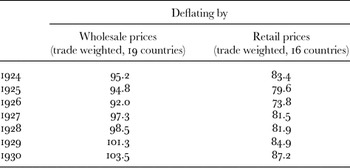
Below 100 for overvaluation, above 100 for under-valuation.
Source: Redmond, ‘Sterling Overvaluation’, table 3, 529.
The deflationary policies of the government are well known, but the problems of the British economy were further exacerbated by the behaviour of businessmen. During the post-war boom, firms in a number of leading export sectors – above all cotton, shipping and steel – incurred high debts for what soon turned out to be inappropriate ventures or flotations at excessive prices. The boom was transitory, reflecting the need to build up stocks on the return to peace rather than a high level of demand in normal conditions. Ships were under-utilised as a result of the convoy system, and at the end of the war needed to relocate to meet the demand for restocking. In this interlude, freight rates were very high, and both second-hand and new ships changed hands or were constructed at inflated prices. In reality, there was a glut of tonnage, and freight rates and shipping prices soon fell, so leaving ship-owners heavily burdened with debt and British shipyards without orders. The ship-owners had to focus on writing down their loans and capital rather than investing in new, efficient ships using new technology, and they fell behind their competitors. In the past, British ship-owners were able to compete by purchasing new, efficient vessels with low running and maintenance costs so offsetting their higher labour costs; now, their competitors were able to buy new ships with low maintenance costs as well as benefiting from low wages. The outcome was similar in cotton and steel, and contributed to the difficulties of these leading export industries.Footnote 13
As a result, the debt–income ratio in Britain rose from 1.6 in 1913 to 2.8 in 1929: British industrialists were burdened with a higher cost of servicing loans out of narrower profit margins. By contrast, the debt ratio in France fell from 2.8 to 2.1. Of course, a lower debt ratio was not always desirable, for Germany's low debt–income ratio was a result of hyperinflation which weakened the financial system.Footnote 14 Although Britain avoided such a harmful and destructive outcome, the high level of debt created dangers for British banks which had lent unwisely to industry, and contributed to a shift in the policies of the Bank of England: domestic considerations were now much more relevant, for a collapse of British businesses would threaten the stability of the banking sector. These new circumstances contributed to a reassessment in the trade-off between domestic and international concerns. Of course, the industries most seriously affected were in export trades, so international considerations remained important, but in a more complex way, mediated by a concern for the industrial structure and performance.
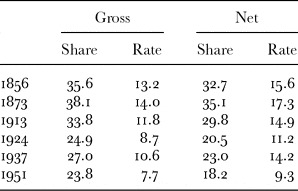
Above all, changes in the interest rate had a serious impact on industry. The cost of servicing loans was particularly onerous because profit margins were squeezed over the transwar period. An excess profits tax was introduced in 1915 to tax increases in profits above a prescribed level, and it was continued after the war as part of a trade-off with other interests in response to the political difficulty of dealing with ‘profiteers’ and rentiers. However, taxation and inflation meant that the real return to equity capital fell from 10.0 per cent in 1910–14 to 8.7 per cent in 1915–20 and 3.1 per cent in 1920–4. The share of net profits in trading income fell from 29.8 per cent in 1913 to 20.5 per cent in 1924 (see Table 3).Footnote 15 Not surprisingly, industrialists were aggrieved and complained that their competitors in other countries were less burdened by the costs of the war as a result of a different fiscal regime, as well as the use of post-war inflation to reduce the burden of national and corporate debt. The British government was aware of the issue but leading officials at the Treasury and Inland Revenue argued that higher taxes would redeem the national debt and so benefit industry by returning money to bondholders for investment in productive enterprise. As we will see, the government's concern with the politics of the national debt marked a major change in its approach to interest rates.Footnote 16
Profits’ share in trading income and rate
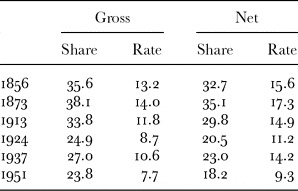
Source: Matthews, Feinstein and Odling-Smee, British Economic Growth, tables 6.12 and 6.13, 186.
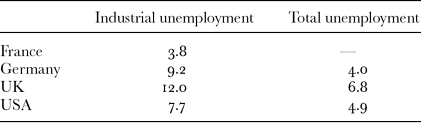
The economic shock of the war was arguably worse in Britain than in other countries, with a long-term impact on equilibrium (see Table 4). Before 1914, unemployment was around 4.5 per cent and casual under-employment was in decline; after the war, the level of unemployment was never less than 10 per cent, and countries such as Britain that returned to gold at 1913 parities did worse than those which devalued.Footnote 17 The changed attitude to the gold standard and its need for higher interest rates was less the result of workers securing voice for a pre-existing and long-standing grievance than a change in economic conditions which created an objective justification for growing hostility to the previous trade-off between international and domestic policies. The link between fixed exchange rates and unemployment and the need to defend wage rates was much more apparent than it had been before 1914.
Average unemployment rates (%) in major industrial economies, 1921–9
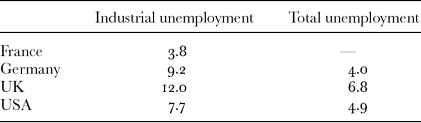
Source: Solomou, Themes, 55.
II
The war not only led to increased costs and a loss of competitiveness; it also increased the national debt and the costs of servicing it. The politics of debt collided with the imperative of the return to gold and the need to preserve the exchange rate through high interest rates. But there were reasons why the state could not pursue this policy as far as might be needed. The explanation was not only the political repercussions of high interest rates on different groups of the electorate, though that was undoubtedly a consideration. The state also had its own reasons to be wary, for servicing the post-war debt was a crucial political issue: in 1920/1, it took 22.4 per cent of budget receipts, and in 1925/6 36.4 per cent. The scale of the national debt at the end of the war, and the need to issue new long-term loans to replace short-term or floating debt, meant that high interest rates would increase the costs of debt service and hence the tax burden. The short-term bills reached a peak of £1,570m in 1919 and needed to be funded or paid off; otherwise, as Basil Blackett of the Treasury pointed out, there would be a vicious circle of new credit created by the government, followed by rises in prices and wages. By 1920, he was very concerned that ‘the vicious circle will go on spinning and the crash will come’.
The treatment of the national debt was a central theme in post-war politics. Labour was pressing for a one-off capital levy on personal wealth to redeem the debt – a proposal that alienated property owners as the thin end of a wedge leading to further assaults on private capital. But a sales tax, on the lines adopted in France, would alienate workers as a blatant attack on distribution, a means of reducing taxes on rentiers and profiteers which might only strengthen support for the capital levy. Although some bankers argued for a higher income tax in order to reduce the debt as a threat to economic stability, the Treasury was more realistic in its assessment, fearing that it would alienate the middle class who had suffered from an erosion of their standard of living during the war, and so play into the hands of the critics of ‘waste’. Of course, there were also dangers in responding to the attack on ‘waste’ by cutting welfare, so once again strengthening Labour support for the capital levy as a means of funding social spending rather than debt redemption. In the end, the best option was to retain a tax on industry on the grounds that it was the only interest with the capacity to pay. As the Treasury argued, it would probably bear the incidence of higher taxes. If a tax were imposed on sales, workers would demand higher wages: if they succeeded, industry would pay; if they failed, there would be strikes and disputes which would also increase costs. Would it not be better for industry to accept a tax which was only paid after a profit was earned? Furthermore, by repaying the debt, money would be returned to lenders who could then invest in industry.Footnote 18
An increase in interest rates was closely connected with this debate over the redemption of the post-war debt. In considering taxation, one important strand in the Treasury's thinking was the need for neutrality between interests – and similar sentiments were held on interest rates which affected the relationships between debtors and creditors. Any increase in interest rates would intensify the political problems of handling the debt and resolving the dispute over the relative treatment of rentiers and taxpayers. At the Treasury, Winston Churchill, chancellor of the Exchequer from 1924 to 1929, believed that the debt should be paid off as soon as possible, for large payments of interest ‘will not be allowed to continue indefinitely in a country based on an adult suffrage’. But debt redemption also meant high taxes, and he worried about their impact on production alongside the post-war policy of deflation. What was the merit of strengthening the exchange rate to support the gold standard at the expense of ‘bad trade, hard times, an immense increase in unemployment’? As prices fell, so the real burden of debts rose, and taxes and the rentier class ‘lie like a vast wet blanket across the whole process of creating new wealth by new enterprise’. He feared that he would be criticised for favouring the City and rentiers over production. At the end of 1924, he accordingly asked the Treasury to consider conversion of the national debt to a lower interest rate or to suspend the sinking fund. The Treasury had no objection to conversion which had been done before (most recently by George Goschen in 1888), and was compatible with fiscal orthodoxy. But how to do it? Otto Niemeyer, controller of finance at the Treasury, advised against dramatic measures to induce bondholders to convert; rather, he recommended occasional conversions in the market which would be made possible by following a cautious policy of balanced budgets, sinking funds and stable spending. Indeed, Niemeyer proposed a larger sinking fund paid for by a tax on rentiers with the right to bonds paying lower interest which would be free of this additional tax. Nothing came of the proposal and the government maintained its policy of steady redemption through sinking funds and controls over spending. But Churchill remained aware of the dangers and used all of his creative imagination to rebalance the fiscal system in favour of active producers against ‘inert’ rentiers.Footnote 19
Between 1919 and 1931, the government had to balance the role of interest rates in preparing for or maintaining the gold standard and the impact on its own finances and on the politics of debt redemption. When gold was abandoned in 1931, interest rates could obviously be used in a much more active way to hold down the exchange rate, to simulate domestic recovery and to convert the national debt to a lower interest rate. The maintenance of low interest rates in the 1930s and 1940s was to be crucial to holding down the costs of debt service remaining from the First World War and to prevent a repeat of the experience in the Second World War, so ensuring that the politics of debt were much more muted after 1945.Footnote 20
III
The level of interest and the politics of the national debt also connected with capital exports which now became a much more significant feature of policy debate than before the First World War when, as argued in the previous address, criticism was ‘surprisingly muted’.Footnote 21 There were some criticisms. Tariff reformers complained that Britain was becoming a rentier state, a ‘nation of bankers and commission agents, supporting armies of unemployed loafers’, a rentier state such as Holland.Footnote 22 They preferred to see Britain be a productive state through replacing free trade by imperial preference. Some Liberals were also dubious. J. A. Hobson argued that imperialism was a result of over-saving and under-consumption – but he did not argue this position consistently and was often supportive of capital exports. More pertinently, Lloyd George, guided by George Paish, clung to capital exports right up to 1914, arguing that like free trade it led to cheaper food and prosperous markets.Footnote 23 Change was apparent after the war. The Bank of England was much more concerned with the plight of the domestic economy as a result of the loans made to industry at the end of the war which created the potential for financial disaster if businesses failed and brought down the banks with them. In seeking to support industry, the Bank could not pursue international considerations so clearly as before the war. In order to raise the value of the pound before 1925 and then to maintain it, the Bank had two options: to raise interest rates or to control capital flows. The first option was politically difficult, and the obvious answer was to restrict capital mobility in order to limit pressure on domestic monetary policy.
A United Nations’ survey of interwar capital movements estimated that UK net capital exports between 1911 and 1913 were $1,042m; during the First World War, something like $4,000m of foreign investments were sold. After the war, capital exports at first seemed to return to the earlier pattern, reaching $881m in 1921. But the recovery was temporary, with exports in 1922–8 amounting to only $407m. In the 1930s, the UK became a net importer of capital, amounting to $313m in 1931 and $269m in 1938, or an annual average of -$74m in 1931–5 and -$212m in 1936–8.Footnote 24 Before 1914, capital exports were not controlled with the single exception of the Colonial Stocks Acts of 1877–1900 which gave a preference to colonial governments by allowing their bonds to be purchased by trustees. During the war, controls were imposed. In 1915 fresh capital could not be issued without approval of the Capital Issues Committee; in November 1917 the purchase of securities issued abroad was forbidden. These controls were relaxed in 1919, but the CIC was instructed by the Treasury to take into account ‘the extent to which the proceeds of the issue will be expended in the United Kingdom, and the assistance which the issue may be expected to give to British trade. Preference should be given ceteris paribus to those cases in which the proceeds of the issue are to be applied in the British Dominions overseas.’ In November 1919, explicit controls on overseas issues were removed but as the Treasury withdrew, so the Bank used its moral influence in the City to enforce a voluntary ‘embargo’ on loans through persuasion rather than regulation, in consultation with the Treasury which had no formal role so that it could deny the existence of government control. In 1921, the embargo on imperial borrowers was removed, but limits remained on foreign public authority loans and large fixed interest issues by foreign companies until 1924.Footnote 25
Between 1919 and 1924, the motivation for controlling capital exports was primarily domestic. In 1920, the Bank urged a limit on overseas issues to allow local authorities to borrow for council housing schemes, and established a queue of domestic borrowers followed by dominions and colonies, with foreigners bringing up the rear. This consideration was followed by a desire to exclude foreigners until large government loans were issued in order to convert the short debt into longer-term funded debt and to replace maturing debt. There was less concern about the diversion of capital into domestic industry, which was assumed to have sufficient funds, and protection of the foreign exchanges was a secondary matter.Footnote 26
The embargo came under pressure from merchant banks which were anxious to make loans to foreign governments, and some relaxation was sensible to prevent a collapse of the Bank's moral influence. In 1924, the embargo was withdrawn, but with the prospective return to gold an outflow of capital could no longer be permitted to affect the exchange rate. From this point, the key motive of capital controls was the need to protect the pound. This is not to say that international considerations were dominant: controls over capital movements offered a much more domestically acceptable alternative to the use of the bank rate to protect the exchanges, which was no longer politically feasible. One element of the global economy – capital mobility – was now sacrificed to maintain another – the gold standard. At the end of November 1924, an embargo was reintroduced on foreign loans and was soon extended to dominion and colonial loans.Footnote 27
The embargos led to an extensive debate within the government and City. Did loans stimulate the domestic economy by creating export demand for British goods? At the Treasury, Niemeyer argued in May 1925 that Britain was over-lending given its weaker balance of payments and should reduce both foreign and colonial loans. He accepted that foreign or colonial loans offered some benefits: they paid an immediate commission; they offered a future flow of income; and the development of works abroad would provide future customers; and some loans would secure orders in Britain. These were, he remarked ‘substantial advantages, if we can afford to acquire them, i.e. if our surplus savings, and more particularly our surplus foreign balances are sufficient to meet the loans we make’. If this were not the case, there were serious disadvantages: if loans were spent in Britain, exports were in effect given away for nothing, since Britain provided the funds; and if loans were spent outside Britain, there was not even a temporary benefit of employment at home and instead gold was exported or the exchange deteriorated. In Neimeyer's opinion, ‘we should clearly do what we can to discourage borrowers generally, for we do not want bank rate to be put up’. But he felt that there was little to be done beyond the present voluntary constraint: the Colonial Stock Act could not be repealed; and it was not possible for the colonial secretary to hint to the dominions that they should reduce their borrowings. ‘I am inclined to believe that we must trust to such persuasion as the Governor can use in the City and to the repercussions of that persuasion on brokers and issuing houses.’Footnote 28
In fact, the Treasury did draft a telegram for Churchill to send to the governor generals of Australia, New Zealand and Canada asking them to urge their premiers to reduce their borrowing in London – an action firmly rejected by Leo Amery, the colonial secretary who threatened to make it a Cabinet matter. F. W. Leith-Ross, the deputy controller of finance at the Treasury, was concerned by Amery's attitude:
This attitude is somewhat unreasonable. We don't want to stop Colonial borrowings if we can avoid it. But if their amount cannot be restricted by agreement and consent, the restriction will come about automatically through rise in Bank Rate, which, I should imagine, will raise more serious political (not to speak of economic) difficulties than a slowing-down of Dominion Loans.Footnote 29
Norman at the Bank also informed Churchill that Britain was lending more than its current savings or ‘savings fund’, and he was particularly concerned about demand from the dominions which would endanger the exchanges. Norman pointed to four ways of dealing with the situation. First, the bank rate could be raised; second, the amount available to the dominions and colonies could be reduced by agreement with the prime ministers; third, the New York market could provide funds; and finally, joint issues could be made in London and New York. He urged the chancellor to consider the problem so as to avoid a higher bank rate.Footnote 30
For their part, the dominions complained about their difficulties in borrowing in London and they threatened to look to New York. The agent general for New South Wales warned Amery that the embargo would harm development work designed to place settlers on land and would end assisted emigration; it would affect Australian exchanges and hence trade with Britain; and would hit purchases of British goods. The agent general of Western Australia concurred: ‘gradually, imperceptibly, but none the less surely, we may be removed from the economic ambit of this country into the economic ambit of the United States of America’. Amery was extremely worried, pressing for the end of the embargo on the dominions: ‘we are pledged up to the hilt to a policy of Empire preference and Empire development and yet, whenever we come up against any opportunity of showing that we mean something by our declarations, we are told by the pundits that no differentiation is possible’. Churchill's attitude to Amery and the embargo was pragmatic: ‘A rise in the Bank rate – chilling the trade revival – is not a prospect which should be needlessly courted.’ The Colonial Office had no option except to explain the predicament to the dominions and hope for their understanding. Footnote 31
Neither was the City entirely happy about the embargo on foreign loans, fearing that ‘this branch of the business would be completely atrophied’, and complaining at ‘the inconsistency of saying we are “anchored to reality” through the Gold Standard when, as a matter of fact, we refused by all sorts of devices to allow a free market’. One possible solution was rationing to keep open each channel of investment. Niemeyer was not impressed by the complaints or by the proposed solution. Rationing was not possible, for he pointed out that
You can let all in or keep all out; but how are you going to discriminate e.g. for Japan and against Czecho Slovakia. Such discrimination, apart from political troubles, would very probably do more harm to the London market than a temporary exclusion. And you would have further trouble if you excluded some Dominions in order to let in some foreigners.Footnote 32
Industrialists were no more content. In 1925, the Federation of British Industries pointed to ‘the important role that the large annual investment of British capital abroad has in the past played in developing exports’. Engineering concerns feared the loss of orders which were now financed by American firms. As one representative of engineering remarked,
This seems to me a very short-sighted policy for two reasons. First, the whole of the material, plant and stores required for such Works instead of coming from this country comes from America, and, in the next place, the securities which are issued in New York find their way here in very large amounts to the British investors.Footnote 33
The strongest case against the embargo was made by George Paish who continued the same line of reasoning as his pre-war advice to Lloyd George as chancellor to continue capital exports. He argued that the increase in unemployment was not due to the recovery of the pound to par but the stoppage of foreign and colonial capital issues in London. The solution to the problem of unemployment was evident to Paish: ‘to reopen the London money market to new issues of capital for Colonial and Foreign Countries’. The result would be additional demand for British goods which would increase employment and keep up wages, but Paish argued that the export of capital would mean that wages elsewhere would rise which would have the same practical effect as a wage cut – a much easier task than reducing domestic wages. His argument attracted a succinct Treasury reply: ‘tommy rot’. Niemeyer accepted that foreign lending might well increase exports which would be welcomed by some interests, but he argued that it was not necessarily for the benefit of the country as a whole. Niemeyer argued that Paish failed to notice a major difference from the situation before 1914 when there were large surplus savings for overseas investment. This was no longer the case:
If, as before the war we have a surplus of savings over internal needs, it pays us to use them to acquire claims on future foreign remittances.
If we have no such surplus, we cannot afford to deal in futures, and we must not be misled by the appearance of an addition in our export figures into thinking that our balance of payments has improved.
If, having no such balance of savings, we yet make loans we give the foreign borrower a claim on London which he takes in goods. But those goods we are for the moment giving away for nothing. We are consequently making our balance of payment less favourable, not more favourable; and to remedy this we shall be forced to apply the recognised methods of correcting an unfavourable exchange position (i.e. export goods and increase money rates in London to deter borrowers and attract lenders). Higher money rates will then react not only on our external trade but also on our whole internal trade.Footnote 34
Whilst these debates were proceeding, the Cabinet set up a secret Overseas Loans Committee in June 1925 to consider ‘the question of the capacity of this country to meet the demands for capital at home and abroad, with particular regard to the requirements of Empire development and to the maintenance of our export trade’. When the committee reported later in the year it argued that the removal of the embargo might lead to an export of capital beyond the capacity of the country, but admitted that it was being evaded by purchases of securities in New York. Churchill ended the embargo in November 1925, but it was clear that policy towards capital mobility had now changed from passive acceptance prior to 1914 to a careful estimation of the benefits for the economy as a whole, and an assessment of its political ramifications.Footnote 35
By the late 1920s, the Treasury was more sympathetic to capital export as a means of stimulating trade, and was wary of Liberal plans of diverting investment to domestic public works. As Leith-Ross pointed out in 1928, ‘what we invest in foreign loans must, sooner or later, be exported; and insofar as it is sunk in development schemes for the Empire, it is probably exported almost at once in the form of capital goods’. Additional spending at home on bridges and similar public works was a ‘poor substitute’ for building entire railways overseas. The Treasury contribution to the White Paper on the Liberal plan of public works accordingly stressed the dangers of diverting funds to domestic public works:
On the ordinary view there is an intimate relation between the export of capital and of goods. If the plan were successful in diverting money from investment abroad that change would be accompanied by a great decrease in our exports or increase in imports, either of these things being highly prejudicial to important branches of industry.
However, opposition to Liberal schemes for public works did not mean that the Treasury supported Conservative proposals for imperial development in 1929. In estimating the impact of development loans on domestic employment, the Treasury concluded that rather more than half the money went on colonial land, labour and materials (so turning exchanges against Britain) and only part was spent on British goods with very modest benefits for exports. As P. F. Clarke argues, the Treasury remained committed to overseas investment on theoretical grounds but adjusted its views for pragmatic reasons and was more concerned to block state expenditure wherever it came from – Liberal domestic public works or Conservative Empire development.Footnote 36
Although Niemeyer informed the Macmillan Committee in 1931 that ‘I believe, in spite of recent criticism, that the vast majority of foreign borrowing does bring orders to industry in this country’, the Treasury was willing to abandon capital exports in order to hold down domestic interest rates, and the benefits were assessed against the political and economic costs at home and in the colonies.Footnote 37 The Board of Trade was more cautious or realistic, arguing that overseas lending had no effect either way on total employment: high levels would boost employment in exports; low levels would stimulate employment for domestic consumption. The important point was the impact on industrial structure: capital exports in the past influenced the structure of industry and a cut now would harm employment in these sectors. ‘The serious thing is the shock of a sudden change.’ Henry Clay, an economist at the University of Manchester who became an increasingly influential adviser to the Bank of England, made a similar point, arguing that unemployment was concentrated in industries specialising in exports, and that the spending that had to be stimulated was export demand:
To relieve unemployment, therefore, by stimulating the complete spending of income, either on commodities or investments, it is necessary to ensure that the allocation of expenditure will not diverge too much from the allocation to which industry is adjusted. Any sudden or large transfers of means of payment from home to foreign account, or vice versa, or from one class of purchasers to another, is likely to dislocate employment, and cause, not a general increase in employment, but overtime and rapid expansion in one part of the industrial field balanced by increased unemployment in another part.Footnote 38
Despite these concerns of the Treasury and Board of Trade, the embargo on foreign loans was reintroduced in 1929. Certainly, the emphasis changed in the 1930s. Although the embargo was relaxed for a short time in 1930, it was re-imposed later in the year and extended to the Empire in 1931. The embargo helped create liquidity for conversion of government stock to a lower rate of interest in 1932. The establishment of the sterling area in 1934 meant that controls were reduced for member countries in order to support the stability of their exchange rates; and loans were also tied to the purchase of goods in order to create domestic employment. In 1936 a special committee was appointed to advise the chancellor on the general principles of lending as well as to consider specific loans. The war led to stricter controls, and the return to peace did nothing to remove the constraints which were embedded in the Exchange Control Act, 1947.Footnote 39
IV
In the absence of variation in the exchange rate, international competitiveness and maintenance of the balance of payments was only possible by adjusting costs. The successful operation of the gold standard therefore depended on flexibility in costs and above all wages. The issue was much debated by contemporary economists who generally assumed that wages were more sticky after the war, and that this failure of adjustment contributed to higher costs, unemployment and the collapse of the gold standard.
The distinction between pre- and post-war experience may be exaggerated, for as we noted in the previous lecture, wages were sticky before 1914 and did not follow prices down between 1873 and 1896 to the extent assumed by post-war commentators. But it was certainly believed by most economists that wages before the First World War could not rise higher than the market could bear. As Alfred Marshall remarked, ‘the power of Unions to raise general wages by direct means is never great; it is never sufficient to contend successfully with the general economic forces of the age, when their drift is against a rise in wages’.Footnote 40 However, the situation was different in the 1920s, for wages had risen in the final stages of the war and during the post-war inflation above the ability of the market to sustain, and the success of gold would require a greater degree of flexibility in order to restore competitiveness at pre-war parities.
At the time of the return to gold in 1925, Keynes warned of the consequences of attempting to adjust wages and costs to the international situation. He pointed to a clash between two theories of economic society:
The one theory maintains that wages should be fixed by reference to what is ‘fair’ and ‘reasonable’ as between classes. The other theory – the theory of the economic juggernaut – is . . . that our vast machine should crash along, with regard only to its equilibrium as a whole, and without attention to the chance consequences of the journey to individual groups.
Under this second theory,
the object of credit restriction . . . is to withdraw from employers the financial means to employ labour at the existing level of prices and wages. The policy can only attain its end by intensifying unemployment without limit, until the workers are ready to accept the necessary reduction of money wages under the pressure of hard facts.
But why should they accept these ‘hard facts’? ‘The gold standard, with its dependence on pure chance, its faith in “automatic adjustments”, and its general regardlessness of social detail’, argued Keynes,
is an essential emblem and idol of those who sit in the top tier of the machine. I think that they are immensely rash in their regardlessness, in their vague optimism and comfortable belief that nothing really serious ever happens. Nine times out of ten, nothing really serious does happen – merely a little distress to individuals or to groups. But we run a risk of the tenth time (and are stupid into the bargain), if we continue to apply the principles of an economics which was worked out on the hypotheses of laissez-faire and free competition to a society which is rapidly abandoning these hypotheses.Footnote 41
Keynes's answer was simple: ‘in modern conditions wages in this country are, for various reasons, so rigid over short periods, that it is impracticable to adjust them to the ebb and flow of international gold-credit, and I would deliberately utilize fluctuations in the exchange as the shock-absorber’.Footnote 42 Not all economists accepted Keynes's policy conclusion but most accepted that wages were now more sticky. As A. C. Pigou argued in 1927:
Before the Great War there can be little doubt that wage-rates in Great Britain were adjusted in a broad way to the conditions of supply and demand . . . It was nowhere suggested that the general body of wage-rates had been forced up too high relatively to the openings for employment . . . In the post-war period, however, there is strong reason to believe that an important change has taken place in this respect . . . wage-rates have, over a wide area, been set at a level which is too high in the above sense.Footnote 43
Why were wages sticky both at the end of the post-war boom and in response to the crisis of 1931? Eichengreen points out that the initial deflationary shock of monetary contraction in the depression would soon come to an end and ‘at this point the self-equilibrating tendencies of the market would come into play. Wages and other costs should have fallen along with prices to limit the rise in unemployment and the decline in sales. They did so only modestly.’Footnote 44 Empirical studies of ten industrial countries in 1935 by Eichengreen and Sachs and of twenty-two countries in 1931–6 by Bernanke and Carey both indicate that wages were sticky despite the monetary shock. In the words of Bernanke and Carey, ‘the inverse relationship of output and real wages reflects largely the effects of incomplete nominal wage adjustment in the presence of aggregate demand shock’. Bernanke and Carey are puzzled by the slowness of adjustment in the 1930s, for they argue that the forces that might be expected to lead to stickness were weak: union membership had declined since the peak at the end of the war; the government's role in the economy was limited; price declines were too large to lead to monetary illusion; and there were many unemployed workers. As they say, ‘the solution to the aggregate supply puzzle of the Depression remains very much an open issue’.Footnote 45
Various reasons were proposed at the time and by historians more recently. Eichengreen suggests that there was a coordination problem. He points out that certain variables were fixed in nominal terms for some time – mortgages, rents, bonds – and
claimants to these sources of income – rentiers, capitalists, and workers – each would have accepted a reduction in their incomes had they been assured that others were prepared to do the same. Without a mechanism to coordinate their actions, no one group was prepared to be the first to offer concession.Footnote 46
But is he entirely correct? Any attempt to make rents and mortgages more flexible was difficult as a result of restrictions imposed in 1915 in response to political unrest. The issue was not how to create flexibility in a downwards direction; it was how to permit rents to rise to a remunerative level.Footnote 47 For their part, bondholders did accept a reduction in their interest in the conversion of 1932 – a change which was only possible because interest rates in general were held down, which was in turn only possible as a result of abandoning the gold standard. In other words, a degree of flexibility was possible after 1931 because fixed exchange rates were dropped.
The inflexibility of wages is often blamed on welfare benefits, both at the time and since. Lionel Robbins remarked in 1934 that ‘the post-war rigidity of wages is a by-product of Unemployment Insurance’.Footnote 48 His view was reaffirmed more recently by Benjamin and Kochin.Footnote 49 However, the case against welfare benefits is somewhat implausible, as suggested by data from the New Survey of London Life and Labour. Male heads of household were not likely to opt for benefits in preference to work; the old were more likely to leave the labour market, but the overall effect was modest.Footnote 50 More realistically, the nature of production institutions limited flexibility. To reduce wages would be to call into question the institutions of collective bargaining underwritten by the state since the 1870s and especially 1906. In 1926, the Conservative government preferred to maintain these institutions rather than creating flexibility.
Clay estimated that 2.4m working people were covered by collective agreements in 1910, and probably around 8m in 1929 out of a workforce (excluding domestic service) of 14m – and he argued that the influence of the agreements extended beyond those formally covered so that ‘we may safely conclude that there are few important gaps left in the provision for the settlement of wages by collective bargaining in Great Britain’. The adjustment of wages to changes in prices or prosperity no longer rested on the individual action of employers, for ‘the process of general wage-changes has . . . been constitutionalised’. Clay expressed some concerns about the outcome. Was it really the case that collective bargaining led to efficiency (as was strongly argued by the Webbs), given productivity gains in America in the absence of powerful unions, and given the possibility that higher wages might be at the expense of unemployment? The extension of collective bargaining, he argued, had destroyed ‘plasticity’ of wages in the light of opportunities of employment. Collective agreements prevented ‘nibbling’ at wages by ‘hard-pressed or unscrupulous employers’ and set rates by the larger and better organised firms. Above all, non-economic factors intruded:
The mere fact of publicity, or organised discussion, invites appeal to social and ethical standards of ‘fair’ and ‘living’ wages, to pseudo-principles such as the sanctity of pre-war real wages, to the unpopularity of reducing rates of wages to lower-paid workers, none of which have any bearing on the capacity of industry to pay wages and provide employment.
As he pointed out, economists could argue for lower wages in private, ‘but directors of large companies, who may be candidates for Parliament, will not commit themselves publicly to such unpopular opinions’. Further, wage-earners were more inclined to resist reductions than before the war when they realised that the result would be unemployment; now, relief meant that unemployment did not cause the same level of distress. In Clay's opinion, the influence of unemployment relief was not a direct refusal of work which was policed by the Labour Exchanges; it was indirect in making union leaders less inclined to take account of unemployment – a much more significant change than the spread of collective bargaining. Pigou concurred: if the unemployed were supported by the union's fund, the costs of unemployment would check demand for higher real wages; a state system removed this constraint.Footnote 51
Consequently, a number of economists argued that the statistical relationship between wage movements and unemployment had been reversed. Before the war, the movement of wage rates was closely connected with unemployment; after the war, unemployment ceased to influence wage negotiations which Clay argued was ‘the principal and direct explanation of the loss of plasticity in wage-rates’. The French economist Jacques Rueff produced data to show that real wages and unemployment were negatively correlated before the war, and positively after the war. Josiah Stamp calculated that the correlation was as high as +0.95. Pigou himself was sceptical of Rueff's statistical techniques and worried whether correlation was the same as causation, but warned that ‘if it be true that wage-rates are set at a level involving a permanent addition of 5 per cent to the numbers of the unemployed, the position is a grave one’.Footnote 52
Clay found that other influences worked in the same direction. The depth of depression meant that unions argued that no reduction in wages would help. Further, wages were a lower proportion of total costs: loan charges, taxes and social insurance contributions were heavier, and any reduction in wages would be seen less as a way of reviving trade than benefiting these other interests. Clay concluded that an open reduction of wages was not possible, and a reduction by inflation undesirable. He had two recommendations. First, the problem of the ‘loss of plasticity’ in wages required a change in bargaining processes, away from sectional considerations and individual trades to consider industry as a whole – a somewhat difficult task, as he admitted. Second, he urged rationalisation. Clay assumed that new sectors could not expand to take up labour: motor cars, for example, were close to saturation. He accepted that redistribution might take place by 2000 or even 1950, ‘but the people engaged in industry to-day, unlike economists, are not able to look at economic problems sub specie aeternitatis’. Transfer of labour no longer worked as before 1914, less because of unemployment relief than because wages were sticky. Further, Clay stressed
the heavy direct taxation of profits, out of which expansion and new enterprise are financed. The growth of industry before the war, which carried with it the redistribution of labour, was effected mainly by successful firms expanding out of profits, and the increased rate of taxation of profits is one of the most obvious and largest economic changes that distinguish the post-war from the pre-war period. It is difficult to see how new openings, at equal or higher rates of pay, can be created for displaced labour as rapidly as they were created before the war.Footnote 53
Clay minimised the possibilities of industrial transformation and instead argued for policies to operate within the existing structure – a somewhat fatalistic view.
Pigou was more sanguine, arguing that there was no need to reverse the shift from capital to labour or to reduce real wages: the problem would solve itself if wages did not rise every time there was an increase in demand for labour.Footnote 54 His position was close to Keynes in The General Theory where he stressed that nominal wage stickiness depended on the protection of relative wages: ‘Any individual or group of individuals, who consent to a reduction in money wages relative to others, will suffer a relative reduction in real wages, which is a sufficient justification for them to resist it.’ However, a reduction caused by inflation could not be resisted for it affected everyone. Keynes also argued that real wages were not necessarily responsive to employment. Cutting money wages would not affect the real wage: in a competitive economy, the price of a commodity equalled its cost of production; a cut in money wages would therefore reduce the marginal cost and hence the price; and cuts in wages would reduce demand, so reducing prices and leaving the real wage unchanged.Footnote 55 By contrast to Clay's stress on rigidity of the industrial structure, Keynes assumed flexibility.
Edwin Cannan took a third position: ‘The true remedy for long-term unemployment always applied throughout history, and always effectual, is neither rationalisation nor reduction of wages, but redistribution of labour-force between the different occupations.’ Cannan believed that rationalisation was futile as a cure for unemployment in the export industries. Although he doubted the impossibility of wage cuts, he emphasised ‘the utter undesirability of a reduction’. Lower wages would only mean more output and hence lower prices. Cannan argued that it was possible to develop different export industries – and even if not possible, no reason for ‘obstinate adherence’ to exports which ceased to provide as good a living as domestic trades. ‘There is, in fact, no reason whatever for supposing that transference of labour from the depressed trades cannot take place’: it would take time, but was not impossible and would not necessarily create unemployment in other trades.Footnote 56 Unlike Keynes, he did not simply assume flexibility of the industrial structure: it was something to encourage rather than take for granted.
These economists, for all their divergences, accepted two things: wages were more rigid than before the war, for reasons which they analysed; and they should not be forced down in response to the dictates of the gold standard. However, the Treasury was not convinced that wages were so rigid, believing that adjustment was possible and that the return to gold would provide the basis for recovery. At first, they seemed justified in their case. At the time of the return to gold, the official figure of unemployment stood at 10.9 per cent, rising to 12 per cent and then falling back to 9.1 per cent in April 1926. Despite a rise during the general strike, the level of unemployment was down to 8.7 per cent in May 1927. But in 1928 and 1929, the level fluctuated around 10 and 11 per cent, and the economy seemed to be ‘jammed’. Initially, the Treasury denied Keynes's contention that wage stickiness prevented the necessary adjustment of costs to the gold standard. In 1928, Leith-Ross pondered the problem. Although his colleague at the Treasury, R. G. Hawtrey, the director of financial enquiries, pointed out that the wage data of A. L. Bowley supported Keynes's contention that wages were indeed sticky, Leith-Ross was not convinced. He accepted that political pressures had increased the ‘natural resistance of wages to falling prices’ but felt that Keynes exaggerated ‘stickiness’ and that Ministry of Labour data indicated that ‘the average wage rates showed a substantial decline during the past 4 years’. The economic problem facing Britain was therefore not sticky wages so much as industrial organisation which could be solved by ‘a bold industrial concentration policy’.Footnote 57
In 1929, Leith-Ross shifted his position. Keynes was arguing that, given sticky wages, the solution was public works and tariffs to restore economic prosperity. As we have seen, such proposals alarmed the Treasury which preferred to argue that the solution was to make the gold standard work by restoring flexibility to wage rates. Leith-Ross now accepted that Ministry of Labour data on wage rates confirmed Bowley's claims, and that Keynes and Hawtrey were right. What was the solution? As Leith-Ross said, it was to reduce costs by improvements in the organisation and efficiency of industry, a task that would be made much easier if wages could be cut:
The remedy is easy enough to find. If our workmen were prepared to accept a reduction of 10 per cent in their wages or increase their efficiency by 10 per cent, a large proportion of our present unemployment could be overcome. But in fact organized labour is so attached to the maintenance of the present standard of wages and hours of labour that they would prefer that a million workers should remain in idleness and be maintained permanently out of the Employment Fund, than accept any sacrifice. The result is to throw on to the capital and managerial side of industry a larger reorganization than would otherwise be necessary: and until labour is prepared to contribute in larger measure to the process of reconstruction, there will inevitably be unemployment.
Leith-Ross's brutal assessment was toned down by the Treasury's memorandum of May 1929 that was written for public consumption. This memorandum pointed out that the time had passed when a reduction in costs could be taken as synonymous with a reduction in wages: what was needed was better organisation, efficiency and rationalisation. The Treasury position was, then, that British costs had failed to respond to the adoption of the gold standard and that they should be made to adjust, if not by cutting wages then by industrial efficiency.Footnote 58
Attempts to make wages less sticky were severely curtailed, and best avoided in public statements: the implications of the gold standard were now politically dangerous. Most economists devoted their energy to explaining why ‘plasticity’ had been lost without suggesting how it could be regained. The real question was: what policies should follow from the existence of stickiness and how successful could they be?
V
In the previous lecture, we saw that the gold standard and free trade were integral parts of political culture, linked with notions of peace, prosperity, civilisation and progress which extended far beyond technical matters of monetary and trade policy. The tariff reformers’ outright attack on free trade rallied Liberals and Labour to support the principles of Cobden in Edwardian Britain, but in securing victory they also started to divide. Opposition to a shared enemy of protection was not the same as shared beliefs, for free trade was redefined by Labour and new Liberals in order to support regulation of the economy and redistribution of income and wealth. When the Labour party debated imperial preference in 1904, it condemned Chamberlain yet at the same time questioned the benefits of free trade to workers. As Keir Hardie remarked in 1903, ‘production is far outstripping effective demand. The wages paid to the worker do not enable him to purchase what the labour of his hands has produced.’ Free trade no longer offered an unproblematic balance between production and consumption. The mere pursuit of free trade was not necessarily an agent of civilisation: it might lead to sweated labour at home and abroad.Footnote 59 The emphasis shifted from free trade as the guardian of consumption to concern for the circumstances of production and the conditions shaping purchasing power. An individual should not have the freedom to buy in the cheapest market if it meant poverty for others; and the distribution of income should be rectified to ensure that workers received their fair reward.
The result was a shift from free trade as a guardian of consumers to a stress on the circumstances of production and the distribution of purchasing power. Labour support for free trade was therefore linked with redistribution and regulation. As Trentmann argues, the rhetoric of consumption and the consumer was separated from free trade. An open market for the benefit of the consumer was no longer desirable when policies were needed to protect employment and to prevent ‘dumping’. The cooperative movement, for example, demanded a ban on sweated imports and the adoption of controls over resources to balance the needs of producing and consuming countries. Cheap food was no longer an unmitigated blessing if it meant a collapse in export markets and unemployment in the export industries of Lancashire or south Wales, where the cooperative movement was so strong. The emphasis shifted from free trade to organised consumer councils and the socialisation of food trades to weaken the hold of traders and profiteers. The needs of the consumer were to be guaranteed by high wages and welfare benefits, secured by redistributive taxation and nationalisation. The iconic feature moved from Lloyd George's cheap loaf to pure milk, with welfare no longer protected by removing import duties but rather by state regulation.Footnote 60
Did free trade mean peace? The progressive Rainbow Circle expressed doubts in 1915, worrying that ‘the peaceful influence of trade is perhaps something of a delusion and . . . trade has in fact been one cause of the present war’. Arthur Greenwood concurred, arguing that the ‘policy of non-intervention cuts at the very roots of freedom, because . . . [it] is nothing more than a policy of short-sighted selfishness. It places the weak at the mercy of the strong.’ As Trentmann points out, Cobden's internationalism was now seen as a piece with his social laissez faire (rather than detached from it as around 1900). The pursuit of Cobdenite pacifism shifted from free trade and the blessings of comparative advantage to what Hobson called ‘organised economic internationalism’. Although protectionism remained a sign of hostility and conflict over the scarce resources of the world, the mere imposition of free trade was not enough. A world of peace and prosperity could only be achieved through positive action, by regulation and international cooperation.Footnote 61
The war also marked a shift in attitudes towards trade policy by industrial organisations. Before the war, industrial support for tariffs was largely based on reciprocity or retaliation to force other countries to reduce their duties. Problems were seen as arising from ‘unfair’ competition rather than any need for internal reform of the structure of industry. This approach changed in the 1920s, when tariffs were designed to ‘modernise’ or rationalise British industry, encouraging a shift to larger and more efficient units. However, industrialists were not interested in direct state involvement in their affairs or in corporatism: the state should provide tariffs and then leave industry to resolve its own problems. The approach changed in the 1930s with a shift to ‘productivism’: the invisible hand of the market was no longer sufficient for efficiency and rational business structures were needed.Footnote 62
At the same time, expert opinion moved towards protection. In October 1930, the majority of the Committee of Economists of the Economic Advisory Committee decided in favour of protection. They argued that since wages were ‘sticky’ and could only be reduced at considerable social cost, it was difficult to correct the balance of trade by cutting money costs. The obvious answer was tariffs. Keynes argued that tariffs would increase prices and so reduce the real wage more easily than by cutting money wages; the result would be higher profits.Footnote 63 Not everyone was convinced: Lionel Robbins and other economists at the LSE questioned whether a reduction in real wages would help exporters who were more concerned with the level of money wages and costs.Footnote 64 But in the circumstances of the early 1930s, protection made sense to many politicians and economists. The political culture of free trade dissolved.
Support for gold was closely linked with the political culture of free trade with a common assumption that it was automatic, leading to peace and freedom from special interests. After the war, the attack on gold as a fetish became more assertive in the face of the imminent return to the gold standard. There was a growing feeling that gold was in fact a special interest, linked with deflation that benefited rentiers and harmed producers. Critics of the gold standard no longer saw it as a sign of civilisation: on the contrary, in the opinion of G. D. H. Cole in 1924, it was nothing but superstitious idol worship:
There is a Great God named Par who is worshipped daily at the Treasury and in the magnificent temples the big five [banks] are erecting on every street. Par likes unemployment; it is his form of human sacrifice. And on Par's altars the Treasury daily burns incense in the form of currency and credit. Par is a great God and the Treasury is his Prophet.Footnote 65
Keynes took the same line, that ‘the gold standard is clearly a barbaric relic’.Footnote 66
Of course, these complaints did not prevent a return to gold in 1925 but support was by no means enthusiastic, even in the temples of the big five clearing banks. L. J. Hume has shown that there was ‘persistent criticism’ of the gold standard or at least of the use of deflation to prepare for its re-adoption. Both the Economist and the Federation of British Industries expressed concern about the impact on the domestic economy, but the most serious criticism came from the chairmen of some of the leading domestic banks. Their doubts went back to the Edwardian period. In 1901, Felix Schuster of the Union Bank complained of frequent and severe changes in the bank rate, and argued for ‘a return to that condition when our money market was the cheapest in the world’. The problem, it seemed to him, was the smallness of the Bank's gold reserve and (to a much lesser extent) the rigidity of the Bank Charter Act of 1844. Above all, the issue was taken up by Edward Holden (of the London City and Midland Bank) and concern was intensified by the financial crisis of 1907, when the banks argued that the Americans lacked a lender of last resort and that the Bank's reserve was too small. An interest rate of 6 per cent was, they felt, not desirable for domestic reasons and only needed to protect the gold reserve. Subsequently, a number of clearing bankers set up a Gold Reserve Committee to create their own reserves, and in 1914 Holden demanded a Royal Commission to consider the matter. The Bank was not impressed – and neither was the Treasury.Footnote 67
After the war, Holden, Schuster and other bankers continued to argue the case against the Cunliffe Committee's report, stressing that the Bank Charter Act needed more radical reform. As Holden complained, the committee ‘have stated in effect that they cannot recommend anything better than the old system. They simply put us back to the old machine which has broken down before and which may break down again.’ The need for large and frequent changes in the bank rate was now even more harmful, and for reform even more urgent at a time ‘when the country is reconstructing its trade and industry, and when manufacturers and others are requiring increased accommodation’. Holden died in 1920, and his mantle was taken by F. C. Goodenough of Barclays Bank who urged a loosening of the Cunliffe Committee's recommendations on the rigid gold backing of currency. Rather than the Bank Charter Act driving out speculation and imposing prudence (as intended in 1844), it now seemed rigid and harmful. The return to gold was therefore accepted in the context of ‘persistent criticism’ rather than outright enthusiasm.Footnote 68
The inconsistent trinity or quartet was highly unstable from 1925 to 1931 and fell apart in 1931. The outcome was a managed exchange rate with a degree of under-valuation; a low level of capital mobility with Britain now a net importer; interest rates fixed for domestic reasons to reduce the burden of debt and stimulate the economy; and protectionism. The consequences were later seen as deeply harmful, leading to beggar-my-neighbour policies and contributing to war. The outbreak of the Second World War led Keynes and others to reflect on the harm caused by national self-sufficiency and the pursuit of beggar-my-neighbour policies of protectionism and competitive devaluations. His task, culminating in the Bretton Woods agreement of 1944, was to resolve the tensions between economic nationalism and internationalism that had fallen apart between the wars. In the next address, I will consider how the task was attempted, and with what success.