Introduction
In this article, cohesion is considered as a social condition. This concept is seen as going beyond the idea of ethnic minority integration, and proposes a role for civil society organisations as promoters, rather than achievers, of cohesion. While some authors conceive of civil society as a framework for associations of different kinds, in this article the term is used to describe a space for all types of citizens’ activities, where associations and citizens, via the realisation of democratic rights, ensure sustainable social relations. As a social condition, cohesion in an urban context is dependent on consensus and coordination by the public institutions, as well as redistribution based on reciprocity and inclusion. This entails supporting the promotion of cohesion made by civil society organisations as citizen advocates and as providers of social protection.
In Britain, during the New Labour government (1997–2010), the investment welfare state shifted part of its social provision responsibilities to the family, the market and civil society organisations. To consolidate this new model of provision, the state created (1) programmes to achieve social cohesion by influencing individual and institutional behaviour, and (2) incentives and structures to improve the performance of welfare institutions (Jenson and Saint-Martin, Reference Jenson and Saint-Martin2003: 78–9; Zetter et al., Reference Zetter, Griffiths and Sigona2006: 4).
When the Conservative–Liberal Democrat coalition took power in 2010, fundamental differences began to emerge between the new and the former government's approach to social cohesion. Rather than continue to consolidate the existing welfare system, the new government reduced policy targets and mainstream welfare provision, and transferred more social responsibilities to local government and communities. Consequently, since 2011, local authorities and engaged residents have had greater autonomy and responsibility in promoting cohesive neighbourhoods.
This article elaborates on how policy intervenes in the performance of organisations as providers of welfare and as citizen advocates. The individuals who can benefit from the actions of these organisations are people exposed to poverty and exclusion, and who are increasingly vulnerable to social stigmatisation (Taylor Gooby, Reference Taylor-Gooby2013). Among these disadvantaged groups are the young, older people, lone parents, the working poor, and black and ethnic minorities, among them, unskilled new migrant workers.
The empirical information provided is an illustration to support the argument put forward, and should not be read as a case study. The article focuses on new unskilled migrant workers and the illustrations are accounts compiled within the London Borough of Camden.
The guiding question posed in this article is: How does public policy influence an organisation's promotion of cohesion in relation to migrant participation in communal activities and their representation in the public sphere?
Structure and methodology
The article begins by describing the traditional idea of cohesion. The objective is to clarify the welfare state's role in promoting cohesion and citizen participation, as well as to outline how social structural factors impact on this. This is followed by an account of the new version of cohesion adopted by the investment welfare state. The rationale is to facilitate an understanding of state policies and the role expected from civil society organisations. The article then offers a brief conjecture linking cohesion to participation and representation in the public sphere. This provides an empirical understanding of the factors that enable or encumber participation and the organisations that should represent it.
The illustrations offered are (1) selected comments made during semi-structured interviews conducted between 2010 and 2012 with practitioners from 10 local organisations. The criteria for selection of the responses are based on the size and function of the organisations, and the best answers that can portray the dialogic relation with the public institutions, (2) official documents presented by registered organisations to the Charity Commission, and to the public in general, that describe the agreements, arrangements and effects of policy on organisations, (3) quantitative data provided by the National Survey of Charities and Social Enterprises (NSCSE) (2010). In Camden, the NSCSE compiled the views of 34 per cent of a total of 2,478 groups in 2008 and 27 per cent of 2,338 groups in 2010. The survey was conducted by Ipsos Mori on behalf of the Office for Civil Society, and respondents included charities, voluntary organisations and social enterprises. Paper questionnaires were mailed to all selected organisations, and these responded online or on paper throughout the fieldwork period. In this article, the information is used selectively in areas concerning the groups’ self-definition of activities and their work with ethnic minorities.
Social cohesion and the public sphere
Social cohesion is interpreted here as a social condition dependent on wider social consensus and coordination of social solidarity by strong public institutions. Cohesion is achieved via the provision of mechanisms and well-being that integrate individuals in society. This idea conceives society as a complex system, whose parts, engaged in different roles, work together to promote solidarity and stability. The outcome of this is the creation of a full sense of belonging. When these mechanisms are in place, cohesion is reinforced by the individual's engagement in civil society. This is prompted by social identification within a geographical space, shared values and the recognition of a common normative order. For an interesting study adopting this perspective, see Portes and Vickstrom (Reference Portes and Vickstrom2011).
The neoliberal globalisation of the 1980s brought with it the first changes and adjustments required to adapt societies to economic flexibility. These changes were questioned by policy communities who were concerned about the impact on social cohesion. These communities began to foresee the need to remodel the welfare state's role as provider of social protection into a body which invests in human capital to enhance participation in economic and social life. Accordingly, state intervention should direct efforts to integrate individuals with the market, rather than protecting them from it (Jenson and Saint Martin, Reference Jenson and Saint-Martin2003: 83; Zetter et al., Reference Zetter, Griffiths and Sigona2006: 4). For the neoliberal paradigm, inequality becomes unavoidable, as it is inherent in markets and is necessary to motivate economic agents (Safarti, Reference Sarfati2013: 350). This has a distinctive implication for the role of the welfare state as the universal provider of social protection; that is, the shift towards a system that seeks to build guarantees against the concentration of inequality within particular social segments exposed to new social risks, such as poverty and exclusion (Esping-Andersen, Reference Esping-Andersen and Esping-Andersen1996: 25). These guarantees are latent in the state's responsibility for the coordination of socio-economic development that, among other things, ensures that cost-effective and more individualised services are provided by the welfare mix institutions (Flint and Robinson, Reference Flint and Robinson2008: 20).
Welfare reforms have caused the state to allocate a more prominent role to civil society organisations as welfare provider institutions. This new role was enhanced by a policy discourse on the independence and autonomy of the individual within civil society, and further underpinned by the notion that cohesion can be achieved by bottom-up actions initiated by civil society (Taylor-Gooby, Reference Taylor-Gooby2012: 360–70).
Communitarian and social capital ideas were central to the conceptualisation of how cohesion can be achieved by bottom-up civil society actions, rather than top-down state policy implementation. Communitarians believe that a common understanding of morality can be the engine of a cohesive society. Etzioni (Reference Etzioni1993: 247) defines the communitarian crusade that he is part of as a social movement whose objectives are renewing social bonds and reforming public life. For this author, civil society organisations serve to maintain the social dimension of human life while assisting to preserve individual liberties.
For Putman, civil society is populated by civic organisations formed by citizens engaged in collective actions which are embedded in reciprocity, trust and shared values. Cohesive communities of organised citizens can help to break links between economic disadvantage and unsocial behaviour, they are better equipped to confront an unexpected crisis and can connect ethnically different people (Putman, Reference Putnam2000: 317, 349, 362).
Kearns and Forrest (Reference Kearns and Forrest2000: 995–1017) created a framework for dealing with the conceptual tension between the traditional notion of social cohesion as a condition coordinated by a strong institution, and the social cohesion achieved by bottom-up civil society actions. In their exploration of how urban dynamics and governance fit into the cohesion debate, the authors approach cohesion through a multidimensional idea based on five elements: (1) common values and civic culture; (2) social order and control; (3) social networks and social capital; (4) social solidarity and reduced wealth disparities; and (5) territorial belonging and identity. These elements can interact with, or contradict, each other and can function on different levels simultaneously, for example on different administrative, societal or geographical levels. Most of the elements are addressed at the national/inter-urban, city/region and neighbourhood level. The exceptions are social order and control, which are addressed at the regional and neighbourhood level, and social solidarity and wealth disparities, which are addressed via social policy at the national and regional level.
According to the above, the state's cohesive role in the reduction of wealth disparities conflicts with that of an investment state, which, in principle, admits that inequality is an unavoidable feature and selectively acts to reduce social risks to certain groups. While the state invests in services and benefits for certain social groups exposed to risks, it places conditions for access on others. For instance, one of the most iconic ideas proposed by Third Way policy makers is that social rights have to be balanced with responsibilities. In Britain, the idea permeates in two ways: firstly, through active labour market policies and the introduction of benefit conditions; and, secondly, through its contribution to agreements between civil society organisations and the state. Below, this article elucidates on the ideal ground where civil society organisations can play a prominent role in promoting cohesion.
Civil society organisations and the public sphere
Theoretically, the public sphere is the locus for citizen engagement. The contemporary perception of the public sphere developed by Habermas (Reference Habermas1989) and Fraser (Reference Fraser1990) contains a concept of equality that transcends socio-economic and cultural barriers between participants. The civil society habitat is the public sphere, or space, of non-domination populated by formal and informal organisations where all types of civic participation takes place. Within this, individuals and their organisations share views of justice that are in some way influenced by free market and social protection world views. The role of the organisations is to (1) advocate on behalf of citizens in policy debates by aggregating citizens’ preferences, (2) create a space for individuals to communicate opinions, and (3) engage, and encourage others to engage, in civic participation and practical solidarity. The quality of a democratic public sphere depends on the diversity of its actors, and, in our case, should represent all types of citizen interests. When this occurs, civil society organisations provide the institutional structure for citizens to communicate their individual and communal needs and opinions to political institutions. The organisations are legitimised when the opinions and needs of citizens within them are heard. The role of the organisation can then be viewed as a contribution to social justice. The public sphere is not a space for state bureaucracies, economic markets or political parties. The function of civil society organisations is to represent the citizen vis-a-vis the economic and political institutions. Additionally, current welfare reforms engage many civil society organisations as providers of social services. In the author's opinion, the latter situation creates confusion when appraising the role of civil society groups. These groups are often perceived as arms of the state and/or the markets, and this jeopardises the appreciation of their mediator role in the public sphere.
The present analysis attempts to distinguish between the role of civil society organisations as mediators and promoters of cohesion and their initiatives to supplement the role of the state and the markets. In both cases, state approaches to promoting social cohesion affect the manner in which civil society organisations collaborate with vulnerable groups. Social policy could incentivise and strengthen an organisation's advocacy role, thereby promoting cohesion. Conversely, it could make the organisation a net service provider and alienate it from its function in the public sphere.
In this article, the function of the above ideas is analysed by using Fraser et al.'s (Reference Fraser, Dahl, Stoltz and Willig2004) trivalent interpretation of social justice, which depends on representation, redistribution and recognition. In this context, representation is defined as the role played by civil society groups as promoters of cohesion.
Recognition addresses cultural injustice rooted in social patterns of representation and interpretation. Redistribution addresses social injustices rooted in the socio-economic structure of society and, therefore, must also involve the redistribution of rights. Citizen participation in the public sphere is contingent on the state fulfilling its role of redistributing rights. This is the most effective way to promote cohesion. Portes and Vickstrom's (Reference Portes and Vickstrom2011) study identifies control factors that interfere with cohesion. These include economic inequality, levels of education and racial composition within a population. In this article, Camden is the site selected to empirically validate the argument. The borough is characterised by prominent social inequality (The State of the London Boroughs, 2007: 24–7) and is home to an unknown number of migrants. Although likely to be living in poverty, it is unlikely that many of these migrants will be included in the official figures (Trust for London and New Policy Institute, 2013: 16). While Portes and Vickstrom (Reference Portes and Vickstrom2011) recognise the importance of civil society organisations in promoting cohesion, they assert that cohesion is primarily dependent on the irreplaceable role of strong coordinating institutions that guarantee social equity. Taylor-Gooby (2012: 382) identifies that organisations are not substitutes for top-down interventions and service provision. The role of organisations is best pursued as promoters of redistributive state welfare. In this article, new migrant workers are the vulnerable group chosen in order to analyse the role of the organisations in the promotion of cohesion. The impact on new migrants is, to date, unreported. It should be pointed out that conditions imposed on new migrants by the investment state are reflected in their over-representation within the informal and insecure/temporary labour markets (Gidley and Jayaweera, Reference Gidley and Jayaweera2010).
The frequent exclusion of migrants from housing benefits forces them into overcrowded tenancies and poor quality housing (Poppleton et al., Reference Poppleton, Hitchcock, Lymperopoulou, Simmons and Gillespie2013: 36–7). Access by migrants to the health system is poor for a number of reasons, including the language barrier and, often, lack of national insurance cover (Rutter, Reference Rutter2011; Gidley and Javaweera, Reference Gidley and Jayaweera2010). Below is an appraisal of the process by which civil society organisations become part of the welfare regime. This is followed by an account of how Labour and Coalition policies have influenced the role of organisations in the public sphere.
British welfare reforms and the evolving relationship between state and civil society organisations from 1979 to 2010
The Wolfenden Report, entitled The Future of Voluntary Organisations (Wolfenden Committee, 1978), influenced the consideration by future governments of the formal role of civil society organisations as commissioners of social provision on grounds of cost effectiveness, innovation and flexibility. The report influenced the formulation of social policies, programmes and later debates on community cohesion. Although the report supported the continuation of the state's key functions, it criticised the size, complexity, cost, remoteness and unresponsiveness of social provision. The report valued the usefulness of civil society organisations in enabling participation, as there were limited possibilities for people to propose changes to the social institutions of the time. The report viewed civil society organisations as a medium through which individuals engage and create strategies to meet their own needs or those of others. Additionally, volunteering in such organisations could send signals to the statutory system about shifts in public interest and needs (Wolfenden Committee, 1978: 29–30; Hatch, Reference Hatch and Baldwin1980: 101–13). The authors of the report emphasised the independence, responsibility and effectiveness of the organisations and observed that a civil society organisation's independence from the state relies on its fundraising appeal to the general public. The Wolfenden Report is relevant to this article because it facilitates an understanding of how civil society organisations functioned alongside the first welfare reforms in the 1980s. It saw their contribution to social provision as independent, free from third party control, institutionally autonomous and economically self-reliant.
The influence of New Labour policies on local relations
The Wolfenden Report recommendations were fully implemented by New Labour. Since then, civil society organisations providing social provision in collaboration with the state became known as the ‘Third Sector’, and citizens as ‘stakeholders’. The Third Sector grew and began to participate in policy debate, planning and implementation, particularly at the local level (National Council for Voluntary Organisations, 2009; Alcock, Reference Alcock2012: 222–3). In England, relations between the Third Sector and the state were formalised in 1998 with the launch of a Compact agreement which set out principles and guidelines for the organisations’ involvement in policy development and resource allocation for the delivery of welfare provision. This was facilitated through the development of local Compacts, which were underwritten by five codes of practice: funding, consultation, policy appraisal, volunteering, ethnic minorities and community groups (Plowden, Reference Plowden2003: 423).
An example of the bureaucratic relationship between the groups and the state can be seen in the thirty-one page ‘Jargon Buster’ distributed by the Camden Empowerment Network (Camden Empowerment Network, 2008). The booklet clarifies technical jargon and reflects efforts made by local groups to guide communities within a specific technical culture that is incompatible with the spontaneity and accessibility associated with community groups.
The relationship between the local authority in Camden and civil society organisations during New Labour was described by one practitioner as being authority controlled:
I do not miss [the public programmes] where the organisations were forced into that bureaucratic operation that, for us, was a bloody box ticking . . . but the current climate [the Big Society agenda] is not very conducive either.
During this period, the commencement of service provision contracts transformed the profile of key organisations with a London-wide remit into service providers for smaller migrant communities, as stated by a local worker:
This organisation is not the same you knew in the early 90s when the migrants were in the management committee and doing what they wanted in the organisation . . . now we are managed by a board of trustees. The volunteers are assisting in the services provision, they are well educated people and the experiences help a lot in job search and with their studies.
In this organisation's experience, volunteering schemes came about through funding support from the central state in the 1990s as unpaid work increased in importance within the welfare provision economy (Day and Devlin, Reference Day and Devlin1998; Hackl et al., Reference Hackl, Halla and Pruckner2007: 77, 2012). Subsequently, the administrative demands made by the state as commissioner of services conditioned organisational activities to fit in with state requirements. This migrant and refugee organisation, along with many others, continues to represent migrant needs and opinions in the public sphere. Nonetheless, the opinion of the respondent is that their relationship with the state occasionally leads to conflicts of interest regarding organisational priorities versus governmental policy agenda.
Under New Labour, the role of civil society organisations as representatives of citizen claims for social justice is illustrated by the experience of the Camden Black and Ethnic Minority Alliance (BME). This umbrella organisation was a beneficiary of the Cohesion Fund. Its function was to ensure that community needs and interests were heard by the authority and that they influenced planning and service delivery. In its advocacy role, the organisation reported to the authorities on the low quality housing conditions for black and ethnic communities compared to those of the white community. They also reported on the lack of black and ethnic minority representation in tenants associations, and on concerns from groups working with black and ethnic older people, regarding the need for culturally appropriate services (Camden BME Alliance, 2008).
The effect of Coalition policies on local relations since 2010
Social expenditure cuts introduced by the Coalition are reported to have had a disproportionate impact on black and ethnic communities (Beasor, Reference Beasor2011). Recently, civil society organisations have been affected by public cuts, decreasing donations and the new tendering process, where small organisations have to compete on the open market for public service delivery commissions. Along with these factors, there is a reported increased demand for social welfare services. Within this scenario, some organisations feel they are unable to pursue the government's Big Society agenda (Jones et al., Reference Jones, Stewart, Travers and Oyarce2011: 7–10; Charities Aid Foundation, 2012; Etherington, Reference Etherington2012), whereas others see the Coalition policy as a window of opportunity.
A voluntary sector practitioner described the opportunity as follows:
Successive governments, of whatever colour, realise that they can no longer raise the funds to run the services. Instead of being a manager, the Government will become an administrator, commissioning independent organisations and directing them to where they are needed. And this gives . . . an opportunity to get involved and engaged in life . . . to go out and create that wondrous thing called ‘community’. (Chalke, Reference Chalke2012)
Since 2010 Camden Council has worked with community organisations in an institutional environment affected by:
(1) The impact of substantial financial cuts on the local authority which has led to reduced support for organisations. The Coalition has reduced the Third Sector's national budget by a quarter of what it was when New Labour was in power (Chanan and Miller, Reference Chanan and Miller2011: 11). According to the National Council for Voluntary Organisations (2012), in 2011 employment within formal organisations in England fell by nearly 9 per cent. Concurrently, during 2011, Camden Council announced its investment-led approach to providing support via grants and subsidies. Community centres would be able to act as ‘anchors’ in the delivery of service provision and facilities for community groups, and they would offer discretionary rates for groups working for the interests of Camden residents (Camden, 2010b).
In the last three months a number of small groups in Camden have closed down. The organisations are not able to compete with the commissioning culture; they are lacking resources. It is difficult for generic service provider organisations to understand the needs of the refugee communities. For these organisations, some [migrant and refugee] communities’ needs are invisible.
(2) Greater powers in local planning and decision-making for individuals and local groups. From 2011, local authorities have more power to set up policy and financial priorities. Formal civil society organisations can enter into open competition for service provision and have new rights to apply to councils to carry out services which were traditionally provided by the council. Community groups and voluntary organisations can bid for or take over council assets. Local residents are encouraged to participate in planning decisions, and to set priorities for public services to drive down costs and challenge local council decisions. The Localism Act (2011) intends to boost the role of neighbourhood groups in local decision-making. It gives local residents new rights to participate in planning and housing decisions. In Camden, local areas are expected to develop their own approach to managing the cuts. For example, consultation with groups has begun on the use of public premises and the take-over of public amenities formerly run by the council (LBC, 2011). The Localism Act gives local authorities new powers to decide how to reduce service delivery costs (Department for Communities and Local Government, 2010).
[With the localist agenda] The relationship has changed, but it is about how the council can work with the sector for the delivery services . . . the relation is more fluid and equal but not the resources. This is also an environment which serves self-interest.
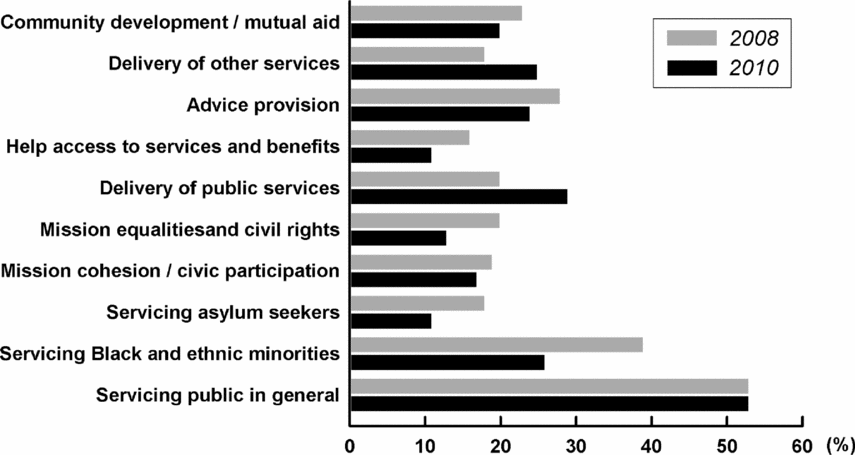
Camden civil society groups: self-definition of users, mission and main role by percentage of organisation responses Source: National Survey of Charities and Social Enterprises, 2010 (data compiled by the author).

In 2011, Camden Council established two pilot projects to create a precedent for good practice for resident involvement. Despite evidence of the presence of migrant families, particularly in one of the pilot project neighbourhoods (Camden 2007; Camden Labour, 2011), this study was informed that new migrants are absent from the two projects’ planning initiatives. Potential reasons for this could be the social demonisation of migrants,Footnote 1 jointly with those claiming welfare disability benefits and with young people who are not in training or education. Later studies indicate that the crisis is influencing public opinion negatively regarding state redistribution of income and strategies for tackling poverty (Taylor-Gooby, Reference Taylor-Gooby2013: 33). Reeskens and van Oorschot (Reference Reeskens and van Oorschot2012: 132) point out that these public preferences indicate stronger symbolic boundaries that define outsiders as less entitled to social welfare.
(3) Expectations for organisations and the private sector to fill gaps in provision left by the state withdrawal. For service providers, the simplification of new service provision specifications and contracts has created a tendering process with greater focus on direct market competition (Ainsworth, Reference Ainsworth2010). The government envisages formal civil society organisations as potential participants in joint ventures with state employees in the mutualisation of public services and as competitors with the private sector in the privatisation of social provision (Ainsworth, Reference Ainsworth2010). The hypothesis is that a division is taking place between larger and smaller civil society organisations. Larger organisations are more able to win open market contracts, and may fail to engage with those organisations with little or no public support, thereby creating a rift between the groups (Alcock, Reference Alcock2012).
Camden Council acknowledge that, in the current austere environment, there is a need to understand the value being delivered by providers. The authority defines its relationship with civil society organisations as a decoupling between:
• service provider organisations (who compete with the markets for the provision of welfare),
• tenant organisations (who act as gatekeepers, ensuring facilities and services provided by the council are fit for purpose and meet their social needs), and
• community organisations supported by volunteers (who play the ‘civic role in promoting cohesion, and helping people to access the service they need’) (Camden, 2010a).
The figure above suggests a link between the decrease of organisations defining their mission as equality-rights and participation, and the decline of organisations working with Blacks, ethnic minorities and asylum seekers. Indeed, it hints that the increase in services provision is made at the expense of helping people access to services and benefits, and initiatives for community development. The survey was conducted in December 2010, soon after the Coalition came to power, after the launch of the Big Society/Localism agenda. The change of focus appears to be linked to a shift in the type of public funding available, rather than a positive development related to the welfare of disadvantaged communities.Footnote 2 For instance, the Camden BME Alliance, whose advocacy work is mentioned above, closed down in September 2012. The Camden Somali Cultural Centre (2012) annual report states:
We hope to be able to secure core funding, but have begun the planning for our funding to end December 2011 and then having to make choices which will result in either our survival or the end of our service as we know it.
Discussion and conclusion
The illustrations offered in this article indicate how two different policy agendas influence an organisation's performance relating to the presence of vulnerable groups within their activities. Participation in and representation by civil society organisations is an important manifestation of sharing values, civic culture, feelings of social belonging. This type of engagement is dependent on redistribution, recognition and representation, as Fraser proposes. These conditions are not totally mirrored in the approach to inequality by the welfare investment state. The Camden illustrations presented in this article suggest that the unequal distribution of resources incentivises the public institution's lack of recognition of the demands made by representatives of vulnerable groups. The indication is that these representatives are losing ground within the public sphere. The recognition of diversity, which allowed civil society groups to engage in outreach and to advocate for social justice under New Labour, is fading. At that time, while recognition was encouraged by policy makers, the tendency to impose conditions on access to social provision systems for vulnerable groups, such as migrants, evolved.
Theoretically, the role of civil society organisations in the promotion of cohesion is that of facilitating the renewal of horizontal social bonds that allow the breaking of social disadvantages. In practice, groups were, and continue to be, under the Coalition government, unable to reverse policies which place conditions on access to social provision for certain citizens, as is the case for new migrants.
All along, the independence of the organisations, and their role as citizen advocates, has been endangered by their increasing contractual relationship with the state. Groups assisting the vulnerable have become entangled by contracts that have changed their traditional culture of socialisation and work within the organisation. The hybridisation of groups, and the bureaucratic demands made on civil society organisations by their counterparts in the political and market spheres, suggest a general alienation between disadvantaged citizens and organisations, a situation that contributes little to cohesion. The Camden ‘Jargon Buster’ mentioned earlier illustrates the degree of sophisticated communication required in the public sphere. Migrants often speak limited English and lack the spare time needed to learn administrative jargon. Being treated as a client and assisted with services by organisations does not help to establish informal bonds, or the socialisation that allows comfortable communication for expressing needs and opinions.
The social cohesion debate continues, as do past structural factors that worked against cohesion. Since 2010, reduced social expenditure has given less importance to social cohesion. Although further research is needed, in the case of Camden the suggestion is that there has been a decline in organisations representing disadvantaged populations such as migrants. Active groups collaborating with the Council seem to have a reduced interest in working with new migrants and disadvantaged groups, and open market competition appears to take service provider groups away from their other roles as civil society organisations and advocates.
The article concludes by suggesting that the demotion of cohesion is initiated by policy rules that establish a differential access to social protection and by state promotion of certain types of service provision that disentangle the functions of civil society organisations in their claim for social justice. Consequently, policy affects the inclusion of the vulnerable in the dialogic activities organised within the public sphere. To correct these problems, the promotion of cohesion by the organisations has to be intrinsically linked to a renewed strong welfare state that counts with the appropriate policy instruments to guarantee universal rights to access, to a minimum standard of life and to democratic participation.