Introduction
Mental health care often qualifies as the Cinderella service. Reforms have taken longer to materialise due to the low priority devoted to mental health compared to other areas of welfare policy. We argue that this is the result of mental health seldom garnering significant attention in political debates, though evidence of some progressive change in attitude can be seen through the increased attention devoted to mental health policy across the European Union (EU) during the last decade. Much of this attitudinal change can be traced back to the publication of a World Health Report in 2001 (WHO, 2001) that focused specially on mental health. It has been estimated that about three quarters of legislation in the area of mental health provision in Europe was introduced after 1990 (European Commission, 2005). Today there is widespread acceptance of the impacts of poor mental health (McDaid, Reference McDaid2008); unipolar depressive disorders alone are projected to be the leading cause of years lived with disability by 2030 in the WHO European region (WHO, 2005). More than one in four of the European population can expect to experience a mental health problem in any one year (Wittchen and Jacobi, Reference Wittchen and Jacobi2005). The European Parliament resolution of 19 February 2009 recently highlighted the risks of poor physical health associated with poor mental health (European Parliament, 2009). For example, the risks for diabetes and cardiovascular disease are two to three times greater than those observed in the general population. Poor mental health is also acknowledged to have substantial impact beyond the health system; the adverse consequences for employment opportunities, housing, contact with the criminal justice system and personal relationships are substantial (McDaid, Reference McDaid2005).
Another interpretation of this phenomenon reflects that understandings and/or social constructions of mental illness have been evolving over time. This has had an impact on the extent to which there is an acknowledged need for both social and medical responses (Rose, Reference Rose, Garland and Sparks2000; Rogers and Pilgrim, Reference Rogers and Pilgrim2003). Moreover, it in part explains the nature of reforms over the least three decades. Community intervention leads to a process of deinstitutionalisation and integration of mental health in the wider health system in the 1970s (Shorter, Reference Shorter1997). Another viewpoint is that although deinstitutionalisation may have been thought initially to be economically attractive; the closure of long-stay institutions in some countries has not always been accompanied by investment in alternative community-based services (Goodwin, Reference Goodwin1997). One aspect of reform, in particular since the 1980s onwards, has been the increased emphasis on the use of psychiatric drug treatments (Rose, Reference Rose, Knapp, McDaid, Mossialos and Thornicroft2007); the commercial market for pharmaceutical mental health treatments has consequently grown, covering not just serious mental disorders such as psychosis but a wide range of anxiety and depressive disorders. In contrast to the growth in importance of drug therapy, limited attention has been given to preventive mental health actions. However, the mechanisms that underpin reform of neglected policy programmes are still largely to be researched.
Policy reforms have exhibited significant developments in southern Europe due to its traditionally limited level of government intervention. At a national level, Italy has long been highlighted as a pioneer of mental health reform, initiating moves away from a reliance on long-stay institutional care in the late 1970s (Tansella and Williams, Reference Tansella and Williams1987). Such reforms began in Spain in the late 1980s; but, unlike reform in Greece, the catalyst for reform was not international criticism of their mental health system (Madianos et al., Reference Madianos, Zacharakis, Tsitsa and Stefanis1999). Furthermore, Spain can also be contrasted with Portugal, where major reforms only took place in the last decade (Oliveira and Pinto, Reference Oliveira and Pinto2005). However, Spain is of particular interest because mental health care reform has occurred at a time of devolution of central governmental responsibility for health care. Reform in regionally specific health systems has enabled the integration of a relatively fragmented network of statutory, church and other third sector mental-health-related services into an increasingly unified package. This has been in part the immediate consequence of the completion of reforms in other areas of health and social welfare, as well as increased awareness of the external impacts of poor mental health – both of which are consistent with lower-cost regional level experimentation to foster policy innovation. As we argue in this paper, devolved governance, by improving the chances of participation of both mental health service user and specialist groups in the decision-making process, has acted as a catalyst for greater awareness. Hence, we claim that there is some room for reform in the institutional structure of health systems to encourage investment in neglected areas such as mental health.
Historically, entitlement to mental health services had lacked transparency; vague definitions of entitlements were always provided by laws and regulations. These were further complicated by the shifting boundaries between health and social care (Salvador-Carulla et al., Reference Salvador-Carulla, Garrido, McDaid and Haro2006). Across many countries, Spain being no exception, there have been moves to have much more evidence-informed policy, including greater use of cost effectiveness criteria. Moves towards devolution in Spain have occurred during a time when the case for investment in mental health care has been considerably strengthened by the growth of the evidence-based medicine, indicating a range of performance effective and cost effective interventions to both prevent and treat mental health problems and help individuals maintain and/or regain their individual autonomy (Knapp and McDaid, Reference Knapp and McDaid2009; Chisholm, Reference Chisholm2005). The case has become even stronger when we include impacts outside the health sector.
The proliferation of evidence-based decision making does help to explain why mental health care has expanded. However, in Spain devolution, we contend, has also been essential in securing the information and the support for mental health care reform based on evidence. Health technology agencies, some of which considered the cost effectiveness of certain mental health treatments, were developed in different autonomous communities and have looked at mental health programmes. This also may have helped speed up mental health innovation in different parts of the country. Some regions have also invested in promoting mental health policy and practice at a European level: major international events on mental health have been co-sponsored and hosted by the governments of the Basque Country and Catalonia during the last decade. Parallels to the Spanish case can now be seen in the UK following devolution, with Scotland in particular developing its own distinct mental health policy and also being visible on the European stage. One obvious downside of devolution and decentralisation is, however, that the reform proceeds at different speeds across the whole of the country, potentially leading to widening temporal differences in access to services between different autonomous communities in Spain.
This article therefore attempts to examine the institutional mechanisms that explain the increasing attention given to mental health care in Spain at a time when there has been the development of a devolved system of health care governance.Footnote 1 We draw upon the process of mental health care reform to highlight pertinent evidence on how different reforms came to pass, and their associated consequences, both intended and unintended. Policy makers, like many others in society, traditionally wished mental health care to be low profile and ‘out of sight, out of mind’. However, the increased participation of stakeholders, including civil society organisations, not only at national but primarily at regional level, appears also to have contributed to the scaling up of mental health care reform on the welfare reform agenda.
We look explicitly at the extent to which political decentralisation or devolution, in place since the early 1980s, in conjunction with the emergence of mental health policy at a European level, have both acted as catalysts for reform.Footnote 2 Spain, like most European countries, has experienced a rapid societal transformation with limited cultural adaptation, although institutional reforms running parallel to rapid economic and political change over the last two decades. The country has shifted from being an autocratic society in the 1970s to resemble more to a liberal democracy in the early years of the twenty-first century. The inception of a parliamentary democracy in the late seventies accompanied by the creation of regional health administrations arising from the decentralisation of the National Health System (NHS) stand as key tenets of a stable political system. Paradoxically, rather than vetoing reform, devolution may have triggered the development of a consolidated health and social welfare system (Costa-Font, Reference Cost-Font2010), which in turn impacts on the principles underpinning mental health care.
We then examine the underpinning policy processes behind the scaling up and consolidation of what remains a highly fragmented and privatised mental health network. As in many other western European countries, Spain has markedly moved away from a heavy reliance on long-stay institutional (asylum) care, where policy aimed at protecting society from potential ‘harm’, to the development of a network of mental health centres which provide services in the community and have as one of their aims the prevention of social exclusion. Furthermore, and particularly in respect of southern European Union (EU) member states, EU membership has led to a form of cognitive Europeanisation (Guillen and Alvarez, Reference Guillen and Álvarez2004), which explains the role of the EU as a learning platform leading to cross border policy spillovers. It is a channel for a process of rapid diffusion of certain health policy practices and an increase in epidemiological evidence. We discuss the process of integration and coordination of mental health care services and the effect of decentralisation, as well as steps to increase awareness and utilisation of services. Furthermore, given that the understandings of mental illness are culturally nuanced, the institutional reform of mental health care services should be adapted to the existing regional heterogeneity.
Background
Devolution and policy reform
The regional devolution of welfare state responsibilities is theoretically an institutional device to accommodate heterogeneous preferences and needs (Oates, Reference Oates1993). Generally, it opens the way to the development of different social policies, and therefore for experimentation in exchange for departing from the principle of uniformity in the provision of care. Models of devolution differ in the institutional legacies that affect the distribution of political and fiscal powers. Thus, the distribution of fiscal resources can be inspired by principles of fiscal equivalence (Olson, 1969) whereby governments’ fiscal capacity should adjust to the characteristics of each jurisdiction to provide incentives to perform efficiently. Similarly, these principles are to be balanced out with the need for regional cohesion.
One of the main concerns resulting from devolution lies in its potential effects in curtailing welfare development in the form of a ‘race to the bottom’. However, evidence suggests that when decentralisation of spending authority is not accompanied by similar levels of decentralisation of revenue authority, but funded through revenue-sharing and intergovernmental grant schemes, overall spending is more likely to expand (Rodden, Reference Rodden2003, Costa-Font and Rico, Reference Costa-Font and Rico2006). However, the answer to another, possibly more significant, question for social policy analysts – how a devolved form of welfare governance translates into policy reform initiative – is unknown. Particularly relevant is reform of neglected packages, where support or capacity might be region specific.
We contend that policy reform builds on the identification of opportunities and instruments to overcome formal and informal constraints that might frustrate policy proposals. Formal constraints to reform include autocratic procedures as well as legislative and decision-making processes which can slow down reform and even veto policies that don't command a country-wide majority. Similarly, informal constraints to welfare development include stigma associated with some policy areas, including mental health. Other constraints can involve cost-containment pressures and social movements, such as the anti-psychiatry movement in some European countries. Finally, the fragmentation of service provision also acted as a constraint on policy development in comparison with other welfare packages. The third sectorFootnote 3 has long played a major role in mental health practice, but has not been well integrated with public services. One consequence had been spectacular institutional fragmentation, especially when regulation was in the hands of underfunded and uncoordinated local authorities (Ferrara, Reference Ferrara1996).
Against these constraints, devolution is arguably one device at hand to water down policy reform constraints by tempering the requirements for majority support where opportunities for reform arise at a regional level. Increasing awareness of mental health as an issue is acknowledged regionally, which creates the preconditions for institutions to further develop policy and practice.
Context: health care devolution in Spain
Emerging from a fragmented, though mandatory social security system, the 1986 General Health Care Act re-founded the Spanish National Health System (NHS) along the lines of a tax funded and politically decentralised model of health care provision. The objectives of the health system were driven towards both health promotion and illness prevention. Entitlement to health care was extended to all residents, with equality of access and a reduction in social and geographical variations, along with defining more implicitly its efficiency goals. Access to health care was defined to be free at the point of use for all residents (including undocumented migrants), with user co-payments restricted to pharmaceuticals primarily. The health care package has been defined as ‘comprehensive’ by analysts (Lopez-Casasnovas et al., Reference Lopez-Casasnovas, Costa-Font and Planas2005) although, in addition to mental health, coverage for some services, such as long-term care and dental services, remains limited and still varies according to region-specific demands (due to differences in policy priorities). Simultaneously, health and social care have, alongside education, been key packages of a process of welfare state decentralisation (Costa-Font and Pons-Novell, Reference Costa-Font and Pons-Novell2007; Lopez-Casanovas et al., Reference Lopez-Casasnovas, Costa-Font and Planas2005).
The regional devolution of health care responsibilities took place in two waves. A first wave ranged from 1980 to 2001 and granted health care responsibilities to seven region states (autonomous communities). Then a second wave after 2001 extended the same responsibilities to all remaining ten regions. Each regional government has a specific statutory law that covers the provision of publicly financed health and social care. Both regional governments and local authorities are financed by tax revenues that are vertically assigned through block grants allocated on an unadjusted capitation system. Regional health and social care services are subject to (unenforced) cooperation and coordination through the Inter-territorial Council of Regional Ministries of Health and Social Care. The budget retained by the national Ministry of Health is restricted mainly to quality control, surveillance and safety, alongside health promotion and consumer protection. All in all, welfare devolution was introduced in less than two decades, so that, whilst in 1981 only 13 per cent of public expenditures were sub-central, by 1999 this had increased to 49 per cent – although tax revenues were kept centralised and devolved tax revenues barely accounted for 11 per cent of total revenues in 2003.
Mental health reform
Prior to the mid 1980s, a substantial proportion of mental health care was provided outside the National Health System, by the private sector albeit with some funding from local and provincial authorities (Vasquez-Barquero and Garcia, Reference Vasquez-Barquero and Garcia1999). Public mental health services when available were highly fragmented, dominated by residential care (Salvador-Carulla et al., Reference Salvador-Carulla, Garrido, McDaid and Haro2006) often organise in collaboration with non-governmental organisations (NGOs) and religious groups. Service coordination was limited.
The first steps to mental health care reform were taken in 1983 with the establishment of a Ministerial Commission on mental health. Reforms intended to modernise the mental health care network were announced by this Commission in 1985 (Ministerio de Sanidad y Consumo, 1985), and implemented alongside general health system reform in the General Health Act of 1986. These reforms had a number objectives, both explicit and implicit: (a) guaranteeing that support for people with mental health problems would be provided within the general network of health care services and specifically within primary care; (b) redefining the therapeutic meaning of psychiatric hospitalisation, which thus lost its pre-eminence in psychiatry; (c) providing adequate community services and social support to make it possible to rehabilitate and resettle long-stay psychiatric residents in the community; (d) bringing about changes in the community to prevent the marginalisation of these individuals; and (e) guaranteeing the civil rights of people with mental health problems.
Mental health care was better integrated within the national health system and within primary care; service charges other than for psychoanalysis and hypnosis were reimbursed within the general health care package. For instance, in 1986 in the newly created Andalusian health care service, primary care began to serve as a gate-keeping system for specialist care. Mental health needs were also better integrated with other specialist services provided by the Andalusian health service. Subsequently, this process was replicated in some other regions and eventually extended countrywide. A specific set of Diagnosis Related Groups (DRG) tariffs for mental disorders was also added to the national DRG system, which was used to help reimburse health care facilities for the services provided.
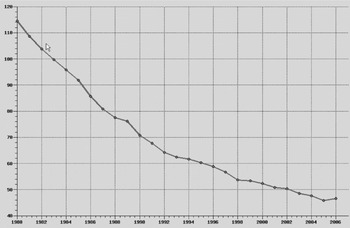
Among the consequences of this mental health care reform process was further impetus for de-institutionalisation. This implied a shift from a system based on old asylums to one centred on care in the community, as in some other western countries. As illustrated in Figure 1, the number of beds in psychiatric hospitals has continued to steadily decline. By 2006, there were 46.59 psychiatric beds per 100,000 population (WHO, 2009), one of the lower rates in the European Union. There has also been a shift away from specialist psychiatric long-stay units to psychiatric wards located in general hospitals.
Psychiatric beds per 100,000 population Spain 1980–2006
Source: WHO Europe, Health for All Database, January 2009.

One reason for this reduction in long-stay beds has been the mainstreaming of mental health within general health and social care systems, which have long relied on a mixture of out-patient, in-patient and residential facilities, as well as multidisciplinary teams of health and social care professionals. Workforce regulation and accreditation criteria were completely reformed, and a cadre of new social care professionals created, including social workers who progressively became entitled to the same level of professional standing as health care workers. Another consequence of mental health reform was the creation of a national training programme for psychiatrists, along with the development of a network of mental health units to provide out-patient services upon GP referral, covering the same Health Areas envisaged for general health care, serving between 200,000 and 250,000 inhabitants. By 1994, about 550 mental health centres had been set up and they have continued to progressively expand; this has contributed to the relatively high rates of consultation that are found today in Spain.
These reforms also help explain the expansion in the number of psychiatrists, from 3.9 per 100,000 in 1982 to 5.12 per 100,000 by 1994; in addition, a network of new mental health care professionals began to emerge, including psychiatric nurses, neurologists and psychologists. The early reforms of the 1980s really only addressed the needs of a small number of people with severe mental health problems, namely those with psychosis who had been hospitalised, rather than tackling the broader exclusion of people living with mental health problems (Salvador-Carulla et al. Reference Salvador-Carulla, Tibaldi, Johnson, Scala, Romero and Munizza2005). Therefore, wider reforms were needed, which required public support.
A subsequent wave of reforms took place in 1995 (Royal Decree 63/1995). Significant developments included defining diagnostic and follow-up treatments, namely drug treatment and group or family psychotherapy, as well as the conditions for hospitalisation. A national therapeutic essential drug catalogue, including drugs for mental disorders, was published.
Much more recently, in 2006, a law on the ‘Promotion of Personal Autonomy and the Assistance for Dependent People’ defined social care as a personal right for people with severe disabilities, including mental illness. In parallel, some regional governments have passed similar social care regulations; this process has been complemented by the development of new coordination and financing mechanisms for health and social care at the regional level.
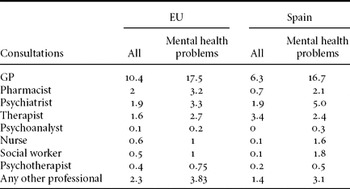
What impact have these reforms had? One way of evaluating success is to look at data from the 2006 Eurobarometer survey of the general public on service utilisation in Spain and the EU overall. Table 1 reveals that, whilst Spaniards on average used relatively less general practitioner (GP) services for mental disorders than other Europeans, their use was roughly the same when the sample was restricted to those with a mental disorder. Whilst they were on average less likely to use a pharmacist's advice, they appeared to be more likely to visit a psychiatrist. Rates of contact with therapists and psychoanalysts were similar to those in other countries; however, there were lower rates of psychotherapy and higher rates of nursing care. Clearly, greater contact with mental health care reflects increasing activity, though it does not say much on the effects on efficiency and productivity in tackling need.
Percentage of mental health care use in Spain compared to EU average (2006)

Question: In the last twelve months did you seek help from a professional in respect to a psychological or emotional health problem?
Source: Eurobarometer, 64.4 2006.
Finally, and consistent with other European countries, reforms have increased the use of pharmaceutical interventions within the mental health system. Indeed, the use of antidepressants in Spain, such as paroxetine, doubled in only eight years from 1997 to 2004, while sales of all antidepressants almost tripled from €169 to €447 million in the same period (Girona-Brumos et al., Reference Girona-Brumós, Ribera-Montaña, Juárez-Giménez and Laluela-Broto2006). Therefore, up to a certain point, reforms in mental health care have opened up opportunities for greater influence by the pharmaceutical industry in the way countries tackle mental neglect (Rose, Reference Rose, Knapp, McDaid, Mossialos and Thornicroft2007).
Prejudices
As we argue in this paper, the regional devolution of health care responsibilities, rather than being a dilutant, has in fact triggered an escalating awareness of the need for reform. Differences in the priorities attached to mental health across Spain reflected in differences in social values and views as to whether mental health should be largely an individual or family responsibility. Those regions that had already made mental health reform a priority no longer had to wait for countrywide agreement and were able to proceed with change. The downside, of course, was that traditionally less progressive regions were then more likely to lag behind in reform. Thus, the implementation of reforms has been geographically uneven, and generally has taken place in regions that have embraced health care responsibilities as compared to those regions were health care has remained as a centralised responsibility.
In the health system generally, due to cross regional learning and voluntary cooperation, geographical inequalities in services appear to have levelled out (Lopez-Casanovas, Reference Lopez-Casasnovas, Costa-Font and Planas2005). In the case of mental health, however, significant differences between the autonomous communities in expenditures on mental health remain: estimates for specific autonomous communities range from just 1.5 per cent in Extremadura to 9.4 per cent in Catalonia (Gisbert et al., Reference Gisbert, Brosa and Bohigas2007; Salvador-Carulla, Reference Salvador-Carulla2008). Whether those regions that have prioritised mental health will act as catalysts for others to follow, as in other areas of health, remains to be seen. However, empirical evidence reveals that devolution has acted as a catalyst for mental health policy development in Andalucia, the Basque Country, Catalonia, Galicia and recently in Madrid, Castilla Leon, Murcia and especially in Extremadura once health care responsibilities were finally devolved after 2002. These regions have been at the forefront of policy developments, which in turn have begun to spill over to other parts of the country. All have developed regional health plans after devolution specifying mental health targets. However, this development comes at the cost of less central command and the expectation that greater cooperation and policy learning will instead take place.
Another key concern with devolution is in its effects on the mixed economy of care. As already noted, mental health care services exhibit a higher reliance on both private inputs and informal care by families, who effectively are the main social care providers for people living in the community. However, reform has integrated both private and community support in the mental health package. The mental care package was updated in 2006 (Royal Decree 1030/2006) to include both primary and specialised care, including both treatment and preventive services, and to formalise the consolidation of a communitarian model of mental health care. This was a first step towards integration, given the coordination between levels of care (primary and specialist), alongside health and social care dimensions.Footnote 5 However, an explicit definition of the limits of mental health care provision has yet to be agreed. This has to do not only with the heterogeneity of social care needs, but principally with other more structural features that constrain reform, mainly the still limited political visibility of reform which decentralisation helps to curb. Yet, still to date the percentage of individuals that use primary mental health care is lower than in most European countries (Sicras Mainar et al., Reference Sicras Mainar, Rejas Guitierrez, Navarro Artieda, Serrat Tarrés, Blanca Tamayo and Díazs Crespo2007).
Integration and coordination
One of the additional questions that devolution poses is on its impact on the integration and mainstreaming of mental health within the general health system and the coordination of services to support people with mental health needs across different areas of social welfare, such as housing and employment. With regard to integration, following devolution each autonomous community developed its own mental health strategy, with specific regional priorities (Montero et al., Reference Montero, Aparicio, Gomez-Beneyto, Moreno-Küstner, Reneses, Usall and Vazque-Barquero2004). This led to different approaches for the better integration of mental health within the general health system, and has contributed to a reduction in the use of long-stay care beds, with a greater proportion of beds provided in general rather than specialist psychiatric hospitals over the last two decades.
Three regions, Navarre, Andalusia and Asturias,Footnote 6 closed all of their psychiatric hospitals, while other regions retained some psychiatric hospitals at the same time as investing in the development of intermediate and specialist services (e.g. Basque Country, Catalonia, Madrid).
Coordination between services provided within the health care system and other sectors has improved after devolution although remains poor compared to European standards. Social care services were devolved to the autonomous communities in 1997, but the devolution of health was not completed until 2002. Hence, even in regions where there was a reduction in the use of institutional care, essential alternative community-based services, which often are the responsibility of social care rather than health, have not always been in place (Salvador-Carulla et al., Reference Salvador-Carulla, Tibaldi, Johnson, Scala, Romero and Munizza2005). Although limited coordination between social and health care is a common problem worldwide, in Spain this is aggravated by superimposed provincial structures which have not been removed after the creation of regional states. The assymetry of entitlement implies that social care services, unlike health services, are still subject both to means testing and the use of co-payments. At a national level, a clarification of entitlements to mental health services, regardless of whether they are provided within the health or social care systems, is merited to help promote continuity in care.
Devolution has led to the creation of intersectorial agencies to promote coordination between health and social care, as in Andalucia or Catalonia. However, its effects are marked in other regions too. The clearest example is that of Extremadura, the poorest autonomous community in the south-west of the country, has fully integrated health and social care responsibilities within one administrative structure. Thus, while challenges remain regarding the coordination of health and social care, decentralisation does appear to provide scope for regional experimentation and policy diffusion. Experiences of coordination at the regional level are not incompatible with country-wide coordination in institutional design, particularly following the creation in 2008 of the joint Ministry of Health and Social Policies.
Awareness and utilisation
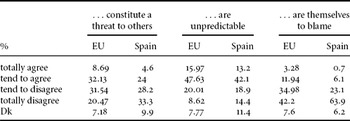
How has mental health reform shifted institutional paradigms and attitudes towards mental health and the use of services? The evidence points to significant change, at least in regions that have chosen to prioritise mental health reform. Table 2 suggests that attitudes towards mental health in Spain appear to exhibit awareness, although we lack longitudinal data to sustain any time pattern claims. Compared to the EU average, we find that fewer people see poor mental health as being a threat to others, and instead it is seen as something to be treated (Eurobarometer, 2005). Although 13 per cent of respondents stated that people with mental disorders are unpredictable, only a minority blame individuals for their mental disorders; this is a significantly lower percentage than the EU average. Reforms were certainly helped through positive change in public attitudes towards people with mental health problems and the emergence of service user groups over the period of reform (Vasquez-Barquero and Garcia, Reference Vasquez-Barquero and Garcia1999). Both service user groups and the antipsychiatry movement were active in calling for a reduction in the use of institutional care. The latter movement however, which opposed the medicalisation of psychsocial problems by the psychiatric system, ultimately had little influence on Spanish reforms, mainly because of a lack of resources (Biglia and Gordo-Lopez, Reference Biglia and Gordo López2006).
Perceptions of people with emotional health problems

Question: People with psychological or emotional problems . . .
Source: Eurobarometer, 64.4, 2006.
Evidence of modernisation can be found in Table 3, suggesting an increasing use of mental health care in the total population as compared to the EU as a whole which explains today's higher reliance on formal care. A major problem is appropriateness of care, as about 13 per cent of visits to mental health care services in a one year period occurred among people who did not appear to meet the conditions for any common mental disorder (Alonso et al., Reference Alonso, Codony and Kovess2007). Paradoxically, though, Alonso et al. (Reference Alonso, Codony and Kovess2007) suggest that Spain appears among those European countries exhibiting the lowest consultation rates among those without mental disorder, indicating low prevention efforts.
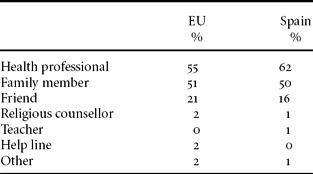
Sources of support for mental health
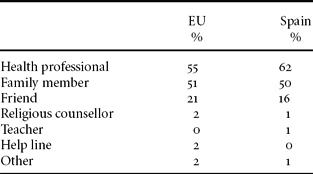
Question: If you were feeling bad, where would you seek more support first?
Source: Eurobarometer, 64.4, 2006.
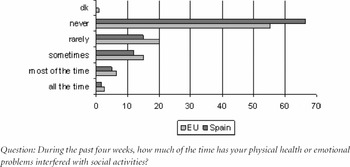
As may be expected following a process of regional devolution, evidence on the existing mix of mental health services exhibits regional variability in care practices (Aizpuru et al., Reference Aizpuru, Latorre, Ibáñez, Pérez de Arriba, Mosquera and Bernal-Delgado2008). The number of psychiatric beds for people with severe mental health problems ranges from five to 23 per 100,000 population (median 10), for non-severe problems between zero and 59 per 100,000 (median 27), and psychiatrists between one and eight per 100,000 population (median 4). Figure 2 reveals that for 30–40 per cent of the population, mental health has influenced their social activities, although this is still below the EU average. However, it is difficult to tell whether this evidence indicates a lower prevalence or a higher underreporting of mental disorders due to stigma or other underlying social motivations, which may be spatially correlated.
Self-reported effects of mental or emotional disorders
Source: Eurobarometer, 64.4, 2006.

Discussion
This article has sought to argue that mental health care has been a traditionally neglected component of the welfare policy agenda, and that reforms have been driven by (a) an increasing awareness of the economic and social impact of poor mental health, which has helped to transform perceptions of mental health (Rogers and Pilgrim, Reference Rogers and Pilgrim1996, Reference Rogers and Pilgrim2003), coupled with (b) increasingly robust evidence-based actions to reduce these impacts. Regional devolution of health and social care responsibilities has been key in providing an opportunity for policy and institutional innovation, has enhanced coordination within and external to the health care sector it is found to assist evidence-based decision making through the action of health technology agencies. Moreover, devolution has also helped to curb the long-standing shifting of services to means-tested social care (Salvador-Carulla et al., Reference Salvador-Carulla, Garrido, McDaid and Haro2006).
As mental health has risen up the European Union agenda, it has also been an issue whereby devolved administrations across Europe, such as Scotland or the Basque country, have been relatively more active compared to the rest of the country, for instance providing co-financing for European work on mental health reform and sending delegations to the WHO Ministerial Conference on mental health in Helsinki in 2005. Attitudes and reactions to people with mental health problems reveal evidence of increasing awareness, which in turn is helping to engender a climate amenable to reform. Paradoxically though, the development of mental health centres has shaped behavioural responses demystifying the issue and increasing its priority within health and social care provision. Finally, mental health reform should be examined in the light of a wider social change, which in Spain, in common with many other European countries, is induced by a new structure of working life, with a much greater reliance on work done in high pressure service and high technology sectors rather than in manufacturing and agriculture (Parent-Thirion et al., Reference Parent–Thirion, Fernández Macías, Hurley and Vermeylen2007).
The thriving mixed economy of mental health care provision can be explained by a larger price sensitivity compared to other health care services (Frank and McGuire, Reference Frank, McGuire, Culyer and Newhouse2000),Footnote 7 coupled with the historical fragmentation of services and the lack of clarity over the boundaries between health and social care. That is to say, the state and the various independent sectors have all been active, although with varying degrees of coordination, in service delivery and funding, alongside substantial contributions of family carers and volunteers. This is not to say that removal of financial barriers to mental health care would automatically equalise utilisation and capacity to benefit, as other social barriers remain (Costa-Font and Gil, Reference Costa-Font and Gil2009), such as stigma and imperfect information. To tackle the latter by improving coordination, recent reforms call for integration of the health and social care packages, improve prevention and abandonment of the traditional social-assistance model for one where mental health care is a specialised area of health care subject to similar principles.
This paper has sought to argue that the prioritisation of mental health problems in the health care reform agenda depends heavily on the institutional organisation of the system, and primarily on the set up of welfare devolution along with cost containment pressures and evidence-based policy making. Although mental health care can be highly expensive to provide (Kovess-Masterfety et al., Reference Kovess-Masfety, Alonso and Brugha2007), it is not obvious how mental health programmes are traded off with other health-related programmes.
In further developing mental health services, it is important to ensure that there is an appropriate balance of care, including help with housing and in returning to open employment, which are also elements of a balanced mental health system (Thornicroft and Tansella, Reference Thornicroft and Tansella2004). However, as we argue in this paper, one catalyst for mental health reform is greater awareness of the impacts of poor mental health and the recognition that many of these impacts are avoidable; more positive public attitudes can also help to facilitate change. As we show in this study, triggers for mental health care reform in Spain have shown to be more readily engendered through initiatives fostered at a sub-national level.