


Introduction
Most individuals initially presenting for psychotherapeutic treatment are motivated to engage in change processes (Drieschner et al. Reference Drieschner, Lammers and Van Der Staak2004). However, due to organizational and logistic reasons, they are usually put on a waiting list before treatment actually starts (Helbig et al. Reference Helbig, Hähnel, Weigel and Hoyer2004). Although it is improbable that these persons do not at least try to cope with their problems, the related processes are clearly under-researched.
Research in solution-focused therapy shows that about 50% of patients report symptom-related changes prior to commencement of therapy (Lawson, Reference Lawson1994; Johnson et al. Reference Johnson, Nelson and Allgood1998), and that such changes positively relate to attendance. As demographic and clinical variables are not predictive for pre-treatment changes, patient behaviours might be responsible for these differences.
In this regard, some authors promote a systematic use of waiting lists for therapy preparation (e.g. Walitzer et al. Reference Walitzer, Dermen and Connors1999; Westbrook, Reference Westbrook1995). Several studies examined the effects of waiting-list interventions for preparing the patient for treatment but yielded rather mixed results. Westbrook (Reference Westbrook1995) found no effect of two preparatory sessions on therapy outcome or treatment satisfaction. Hardy et al. (Reference Hardy, O'Brien and Furlong2001) were able to show that pre-treatment attrition actually decreased by sending new patients an information pack about the treatment. Stone & Klein (Reference Stone and Klein1999) examined the effects of an open waiting-list group. Although attendance did not improve, treatment applicants participating in that group were more willing to enter group therapy, indicating possible changes in treatment motivation and expectancies. Other studies applying bibliotherapeutic interventions were able to show effects on clients’ expectations but rarely on outcome or symptoms (Deane et al. Reference Deane, Spicer and Leathem1992; Shuman & Shapiro, Reference Shuman and Shapiro2002). Whitfield et al. (Reference Whitfield, Williams and Shapiro2001) provided a self-help room with psychoeducational information about depression and anxiety for clients of an outpatient clinic. Clients, who used this facility, improved their knowledge on anxiety and depression and showed a significant decrease in symptom measures after 6 weeks of therapy. Unfortunately, no comparison group was reported in this study.
These rather disappointing results in regard to outcome are somewhat surprising given the positive effects of bibliotherapy and self-help materials for different kinds of problems (see meta-analysis by Gould & Clum, Reference Gould and Clum1993). It might be questioned whether patients participating in controlled studies display a greater sense of responsibility for therapeutic change than patients in routine care. It might also be questioned whether demographic or clinical patient characteristics moderate the effects of self-help and treatment preparation.
In a recent study, a minimal intervention offered to patients on a waiting list yielded differential effects in specific patient groups (Helbig & Hoyer, Reference Helbig and Hoyer2007). Interestingly, a substantial amount of persons initiated self-help activities on their own while waiting. Currently, there is a lack of systematic information on frequency and kinds of activities instigated. It is also unknown whether such engagement is linked to certain patient characteristics, or therapeutic outcome. A better understanding of processes that directly precede treatment might help to enhance the effectiveness of therapy preparation strategies designed to increase self-efficacy beliefs, to reduce general distress, and to keep attrition low. Moreover, knowledge on patient characteristics linked to self-help engagement might allow for tailoring preparation strategies to the needs of individual persons. Such information is an important premise for the improved delivery of mental health care as well as for making treatment overall more effective.
We explored self-help and coping behaviours of individuals who were placed on a waiting list for CBT in a university outpatient treatment centre. The main research questions were:
(1) To what degree do persons on a CBT waiting list initiate self-help and problem-related coping behaviours, and what kind of self-help and coping behaviours are instigated?
(2) Are there systematic differences in demographic or clinical variables between persons engaging versus not engaging in self-help and coping behaviours?
In order to investigate the relationship between engagement in self-help and improvement during treatment outcome, a subsample of patients with available outcome data was examined. We postulated a positive relationship, indicating that:
(3) Active self-help behaviours significantly contribute to better therapy outcomes than merely waiting or passive coping.
Methods
Treatment and procedures
The survey was conducted during 2005/2006 in a university outpatient psychotherapy centre under routine conditions. The facility routinely offers manualized and non-manualized CBT treatment for various kinds of psychiatric disorders. Treatment is delivered according to the German health-care system in up to 25 or up to 45 sessions. Therapists are either experienced CBT therapists or psychology postgraduates with at least 1 year of CBT training, who work under the supervision of experienced therapists. Most people applying for treatment are self-referred.
Individuals applying for treatment undergo an extensive intake assessment including a standardized diagnostic interview and a set of questionnaire measures (see below). People are informed about the results by an experienced clinician, who also decides whether and which treatment is offered or whether the person has to be referred to other services. Persons accepted for treatment are placed on a waiting list until a therapist is available.
While the survey was conducted, 1231 individuals expressed interest in therapy; 938 were diagnostically assessed and 859 were placed on the waiting list. As soon as a therapist was available, individuals were contacted. At this stage, 11.9% (n = 93) of persons declined the treatment offer.
Assessment
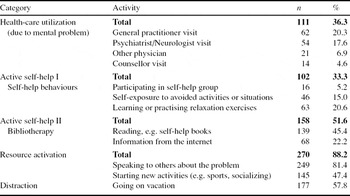
We developed a questionnaire retrospectively assessing problem-focused self-help and coping strategies carried out between first attendance and actual therapy start. Questionnaire development comprised two steps. We asked experienced clinicians about frequent self-help and coping behaviours of their patients, and assigned those behaviours in a second step to theory-driven categories that seemed relevant to processes of change (Grawe, Reference Grawe1998), e.g. activation of resources, problem activation and problem solving. The questionnaire accordingly covered (1) additional health-care utilization due to the mental health problem (e.g. consulting a general practitioner or a psychiatrist), (2) active self-help (e.g. engagement in self-help group, self-exposure), including bibliotherapy (leaflets, books, information on the internet), (3) activation of resources (e.g. discussing the problem, initiating new contacts or activities), and (4) engaging in activities meant to distract oneself from problems or avoid problems (see also Table 1). The questionnaire provided example behaviours for all categories that could be marked, and it additionally contained an open answering option for all categories. These open answers were post-hoc categorized to one of the above-mentioned categories.
Sample characteristics

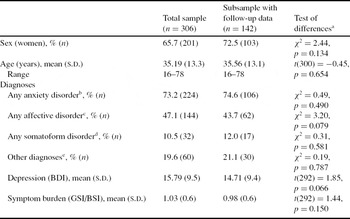
BDI, Beck Depression Inventory; BSI, Brief Symptom Inventory; GSI, Global Severity Index.
a Patients with follow-up data available compared to those without follow-up data.
b Including panic disorder with and without agoraphobia, agoraphobia, social phobia, specific phobia, generalized anxiety disorder, obsessive–compulsive disorder, post-traumatic stress disorder.
c Including major depression, recurrent depressive disorder, dysthymia.
d Including pain disorder, somatization, dissociative disorder.
e Including bipolar disorder, eating disorders, substance-related disorders, adjustment disorder, personality disorder.
Patient characteristics were analysed using data from the routine diagnostic assessment. Demographic information was taken from the intake questionnaire; diagnoses and comorbidity were assessed with a standardized clinical diagnostic interview, the German version of the Composite International Diagnostic Interview (M-CIDI/DIA-X; Wittchen & Pfister, Reference Wittchen and Pfister1997). Validity and reliability of the interview have been demonstrated by several studies (Wittchen, Reference Wittchen1994; Wittchen et al. Reference Wittchen, Lachner, Wunderlich and Pfister1998) and the computerized version is well accepted by patients (Hoyer et al. Reference Hoyer, Ruhl, Scholz and Wittchen2006). The diagnostic interview was conducted by trained diagnostic staff.
Additional self-ratings included the Beck Depression Inventory (BDI; Beck & Steer, Reference Beck and Steer1987) and, for evaluating the general level of distress, the composite score (Global Severity Index; GSI) of the Brief Symptom Inventory (BSI; Derogatis, Reference Derogatis1993). Both instruments were administered at the intake assessment and after session 20 or, respectively, at treatment completion (follow-up evaluation).
Sample
Persons who had waited 2 weeks or more for treatment were informed about the study by their therapists at their first session and were asked to participate. Provided that an informed consent was given, the questionnaire was handed out at the first therapeutic session. For 320 persons, no data on self-help and coping strategies during the waiting time were eligible, since the therapists did not hand out the questionnaire, or patients were unwilling to participate. Patients, who did not participate in the survey, did not systematically differ from respondents in regard to clinical or demographic variables. Seventy people were excluded from the study, as they were not placed on the regular waiting list for different reasons (urgency of treatment, suicidality), or they had waited less than 2 weeks, yielding a total sample of 306 consecutive participants. The mean waiting time for participants was 68.73 days (s.d. = 42.21). As the questionnaire was handed over in the first therapy session, persons dropping out before therapy started were not assessed.
Participants were aged 16–78 years, mostly women (63%) and presented a wide range of psychiatric diagnoses. Fifty-six per cent of participants were diagnosed as comorbid with 1–4 additional diagnoses. At the time of the analyses, about half of the respondents had not completed treatment; thus, outcome data were available for 142 patients, who had already completed treatment or had at least 20 therapeutic sessions. In order to ensure generalizability, we compared demographic and clinical characteristics of patients with and without outcome data. Patients with follow-up data available tended to have an affective disorder less often and concordantly reported lower BDI intake scores; however, these differences were not statistically significant. There were no significant differences regarding all other variables. Sample characteristics (including the subsample) are given in Table 1.
Statistical analyses
Data distribution was checked with one-sample Kolmogorov–Smirnov tests. As expected, most variables were not normally distributed; consequently, χ 2 tests and Mann–Whitney U tests as non-parametric tests were used to analyse differences between patient groups in regard to self-help behaviours.
In order to investigate effects of different self-help and coping behaviours on treatment outcome, we first calculated (bivariate) correlation analyses [Spearman's rho (r s)] to check for significant associations between outcome and self-help as well as other patient variables. Differences between intake and follow-up scores of the BDI and the BSI distress scales (GSI) were defined as outcome measures. Variables with significant associations to outcome indicators were then entered in multiple stepwise regression analyses controlling for pre-scores of the outcome variables. All statistical analyses were performed with SPSS 14.0 software (SPSS Inc., Chicago, IL, USA).
Results
Patient-instigated coping and self-help behaviours
Only a few persons (4.9%, n = 15) reported doing nothing about their problem while waiting for therapy. On the contrary, more than half of all individuals (57.5%, n = 176); reported at least three different types of coping and self-help behaviours.
As shown in Table 2, activities related to resource activation were most frequently reported (88.2%, n = 270), while additional health-care utilization was less frequently endorsed with about one third of patients visiting a physician or a counsellor due to their mental problem (11.3% reported multiple utilization). A majority of 199 persons (65.0%) instigated activities that were considered to be active self-help, including 61 people (19.9%) that engaged both in active self-help behaviours and bibliotherapy.
Frequencies of pre-treatment coping and self-help activities due to the presented mental problem (multiple answers possible, n = 306)

Cumulated frequencies are in bold.
Differences in regard to patient characteristics
We inspected number and kind of patient-instigated self-help behaviours in regard to gender, age, diagnostic groups and symptom severity (overall and depression) as variables potentially linked to attitudes towards treatment and self-efficacy.
With respect to number of self-help and coping behaviours, only a few associations were found. A higher number of self-help behaviours was significantly linked to higher symptom severity at commencement of therapy both for depression (BDI; r s = 0.265, p < 0.01) and for general symptom distress (BSI GSI; r s = 0.292, p < 0.01). All other variables showed no association to number of self-help behaviours instigated.
In order to clarify if patient characteristics were linked to certain kinds of self-help, we compared the use of self-help strategies in different sample groups. Additional health-care utilization was present more often in persons with a higher symptom severity (BDI score: Z = −4.657, p < 0.01; BSI GSI: Z = −4.861, p < 0.01) as well as in older persons (Z = −2.546, p < 0.05). Persons reporting additional health-care utilization were also more likely to have a diagnosis of a depressive disorder [χ 2(1, n = 278) = 6.03, p < 0.05].
Similar results were obtained for distraction and resource activation. Patients reporting these strategies also reported higher levels of depression (distraction: Z = −2.426, p < 0.05; resource activation: Z = −2.026, p < 0.05) and general symptom distress (distraction: Z = −3.456, p < 0.01; resource activation: Z = −2.399, p < 0.05). Resource activation was also more often reported by women than men [χ 2(1, n = 295) = 9.20, p < 0.01], which was mostly due to the category ‘speaking with someone about the problem’.
Interestingly, we found no differences for active self-help strategies such as engaging in self-help groups or bibliotherapy – these strategies could not be linked to certain client characteristics.
Self-help behaviours contributing to outcome
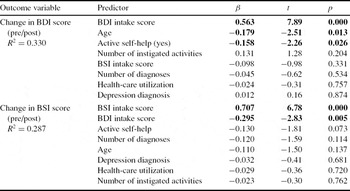
Variables significantly linked to both outcome indicators were: age (BDI: rs = 0.293, p < 0.001; GSI: rs = 0.210, p < 0.05), health-care utilization (yes/no) (BDI: rs = 0.288, p = 0.001; GSI: rs = 0.269, p = 0.001), active self-help (BDI: rs = 0.185, p < 0.01; GSI: rs = 0.232, p < 0.05), number of self-help activities (BDI: rs = 0.235, p < 0.001; GSI: rs = 0.272, p < 0.001), number of comorbid diagnoses (BDI: rs = 0.174, p < 0.05; GSI: rs = 0.225, p < 0.01) as well as a diagnosis of a depressive disorder (BDI: rs = 0.202, p < 0.05; GSI: rs = 0.278, p < 0.001). Resource activation and distraction were not associated to outcome indicators. Table 3 gives results of both multiple regression analyses, in which the above-mentioned predictors were entered, as well as the amount of variance the models account for.
Outcome prediction with multiple stepwise regression analyses

BDI, Beck Depression Inventory; BSI, Brief Symptom Inventory.
Predictors with F score probability <0.05 are in bold.
In sum, regression analyses demonstrated only a small incremental contribution of self-help and coping behaviours to the explanation of variance in therapeutic outcome. Contrary to our hypotheses, active self-help strategies were not associated with better outcome but were instead significantly negatively correlated with symptom reduction in depressive symptoms (BDI). For the BSI, there was a statistical tendency (p = 0.07) in the same direction.
Discussion
This is the first study exploring self-help and coping behaviours of individuals on a waiting list for outpatient CBT. Results show that problem-focused coping behaviours are highly frequent. Although unspecific coping strategies such as ‘talking to someone about the problem’ were reported most often, more than half of all persons also actively informed themselves about their problem; active self-help (e.g. visiting a self-help group) was instigated by about one third of persons. Interestingly, these active self-help behaviours could not be related to any demographic or clinical characteristics. In contrast, passive coping strategies (e.g. distraction) and increased health-care utilization were clearly linked to a higher symptom load and to depression. Lester & Harris (Reference Lester and Harris2007) recently reported additional health-seeking behaviours during waiting times to be associated with attendance. In relation to our findings, this might indicate the moderating effect of a high symptom strain on attendance. Unsurprisingly, women more often reported resource-orientated activities than men.
Contrary to our hypothesis, self-help activities prior to therapy did not positively contribute to treatment outcome. Data even showed a small but significant effect in the opposite direction. Self-help, therefore, rather appears to be an indicator of a high motivation to fight symptoms than of a good prognosis. One possible explanation might be that perceived failure to actively cope with symptoms contributes to a less positive attitude towards psychotherapy or even to pre-treatment attrition, and thus, individuals who actively (but ineffectively) cope, might have lower rates of self-efficacy and outcome expectancies. As we did not assess the perceived success of self-help while waiting, this remains an assumption that needs further investigation. Another more speculative interpretation could be that persons, who have difficulties accepting their mental problems (in terms of depression), are more likely to engage in self-help but are also more likely to see their (remaining) symptoms in a negative light.
Overall, it can be concluded that most persons on a CBT waiting list feel motivated to engage in problem-focused coping behaviours and that they begin to do so. This is not surprising according to common conceptualizations of psychotherapeutic change. Regardless of whether patients on waiting lists are better described as being in the ‘demoralization phase’ (Howard et al. Reference Howard, Lueger, Maling and Martinovitch1993) or in the ‘preparation stage’ (Prochaska et al. Reference Prochaska, DiClemente and Norcross1992), they are obviously open to new behaviours or, at least, information.
However, it should be borne in mind that those efforts might not necessarily be adaptive and worth continuing; they can also be superfluous or even counterproductive. On an individual level, self-help efforts may have positive as well as paradoxical (negative) functional consequences. Therapists should accordingly be well informed about their patients’ coping attempts and should integrate this information in their case conceptualization. This also indicates that therapeutic strategies designed for therapy preparation (e.g. adequate bibliotherapeutic information about treatment) are very likely to be well accepted. Persons with severe problems, in particular, might benefit from such offers as they show higher needs for support. Waiting-list interventions, thus, might also reduce health-care costs due to high service utilization. However, it should be considered that these offers should be tailored to patient groups in order go gain more favourable results than spontaneous attempts to cope (see also Helbig & Hoyer, Reference Helbig and Hoyer2007).
Although the results clearly indicate patient-instigated self-help and coping behaviours as being typically seen before therapy, methodological limitations of our study have to be outlined. First, data are only observational in nature, and no comparison group was used. The open study design does not impede systematic sampling effects. It remains open whether the high rate of problem-related activities is typical only for CBT waiting lists or whether problem-related activities are also frequent in other circumstances, e.g. in people who do not intend to seek treatment. Furthermore, the sample is not representative for all CBT settings since the survey was conducted in a university setting. Patients attending treatment there might be more active than others who would prefer a private practice unrelated to the university.
We could not find a clear relationship between pre-treatment engagement and treatment outcome. It should be noted that these preliminarily analyses were rather exploratory and that potential effects on process variables such as therapy compliance and motivation were not analysed. It might be promising to relate such variables to pre-treatment self-help behaviours in future studies. It might also be important to control for prior experiences with psychotherapy. Therapy experience might moderate appropriateness of self-help behaviours – patients, who underwent psychotherapy before, might already have developed coping strategies that work, while persons without such experiences need to search for such strategies first.
It can be concluded that more systematic self-help offers are likely to be well accepted and might be a fruitful way of helping people bridging the time gap between first attendance and actual treatment start. A systematic use of waiting lists is a subject worth considering both in clinical practice as well as under a research perspective, as therapy preparation might be one possibility of enhancing overall CBT effectiveness. Further studies should pay attention to patient ratings of perceived usefulness and actual effects of instigated self-help behaviours as well as the extent to which self-help behaviours are performed. Information about self-help and coping strategies of people dropping out prior to therapy start would provide a clearer perspective on the importance and effects of such behaviours.
Suggestions for follow-up reading
This paper highlights the increasing problem of waiting lists in outpatient mental health care. Given that most people, who apply for therapy, initiate any kind of coping or self-help behaviour, it is suggested that specific therapeutic self-help offers during waiting might help to integrate pre-treatment activities in the treatment rationale. For further reading we suggest the review by Walitzer et al. (Reference Walitzer, Dermen and Connors1999) who present and discuss possible strategies for treatment preparation using waiting lists. The importance of patients’ expectations of treatment course and outcome is highlighted by Greenberg et al. (Reference Greenberg, Constantino and Bruce2006). Norcross (Reference Norcross2006) provides practical suggestions how to incorporate self-help and patients’ self-help experiences into psychotherapy.
Declaration of Interest
None.
Learning objectives
• Considering waiting times in treatment.
• Patient instigated attempts to cope.
• Guided self-help.



Comments
No Comments have been published for this article.