Introduction
In recent years we have seen an increasing interest in studying the daily contexts where musical activity in early childhood takes place. The reasons for this interest are the fact that these contexts are meaningful milieus where children participate in a variety of musical experiences (Addessi, Reference ADDESSI2009; Young & Gillen, Reference YOUNG, GILLEN, Gillen and Cameron2010) and the benefits conferred by music education that begins in the early years (for example Bilhartz, Bruhn & Olson, Reference BILHARTZ, BRUHN and OLSON1999; Campbell & Scott–Kassner, Reference CAMPBELL and SCOTT–KASSNER2005; Barret, Reference BARRET2009).
Nowadays, the evidence coming from different disciplines, such as neurology, developmental and educational psychology, education and anthropology, lead us to firmly state that we all have an inner musicality. For example, the exposure to the mother's heartbeat, her breathing pace and other vital signs during prenatal life explain the reaction to rhythmic stimuli once we are born (Trevarthen, Delafield–Butt & Schögler, Reference TREVARTHEN, DELAFIELD–BUTT, SCHÖGLER, Gritten and King2011). These automatic reactions and the spontaneous music making of young children have attracted the attention of many music education researchers who are proposing models that incorporate new findings from these related disciplines in order to explain how this musical development takes place.
One of the proposed models comes from the ‘Sounds of Intent in the Early Years’ project, the main purpose of which is to explain how young children develop musically. It proposes a circle model based on 5 levels of development, from the inborn stage to the capacity to sing whole songs in time and tune, and three domains: 1) reactive, that consists in listening and responding to sound and music; 2) proactive, when the child make sounds and music alone; and 3) interactive, when making sounds and music with others. The combination of levels and domains gives 12 segments that are in turn divided into labels (for more information see Voyajolu & Ockelford, Reference VOYAJOLU and OCKELFORD2016).
‘Spheres of musical understanding’ is a fluid, situational and context specific model (as defined by its authors, Rutkowski & Kooistra, Reference RUTKOWSKI and KOOISTRA2016) that wants to move forward from the linear or sequential progressions of learning and development and strongly positions in favour of the influence of the situation and context. Rutkowski and Kooistra base their model in observable behaviours, that is the abilities children demonstrate in specific time and place. Nevertheless, they point out that depth of musical understanding may not necessarily be reflected in observable behaviour. It can happen when, for example, a child listens for the very first time to her grandmother singing a new song, her teacher performing a nursery rhyme or a friend playing the trumpet in front of her. This model proposes two primary ways to engage with music 1) covert: characterised by inaction, and 2) overt: were responsive and/or initiative actions can be observed. Reflection – noticing something is different, as explained by the authors – is what causes the movement across the six spheres of musical understanding (from intuitive at the centre of the circle, to non-related at the far end, see Rutkowski & Kooistra, Reference RUTKOWSKI and KOOISTRA2016, for a detailed description).
Presented with this panorama, this paper wants to contribute to this current debate on the field by studying the musical activities that take place in the daily life of a group of two-year-olds in a preschool setting, with the aim of shedding light on the different ways children participate in musical activities.
Music education in the early years: a didactic framework
One of the main challenges we face, as adults who favour learning, is to enable children to take part in the culture they are living in. Given that music is a living part of each culture (Blacking, Reference BLACKING1973; Campbell, Reference CAMPBELL1998) and at the same time part of ourselves, it is important for the enculturation process, i.e. learning the rules, values and particular components of a culture. This happens without any conscious awareness, just by belonging to that culture (Vilar, Reference VILAR2004). Thus, in order to make enculturation possible, we should provide children with opportunities to participate in their musical culture and to observe how more experienced members do so. All things considered, this participation in real situations, making music with others and being involved in social relationships, is the natural way learning – especially in the early years – takes place.
According to Vygotsky (Reference VYGOTSKY, Cole, John–Steiner, Scribner and Souberman1978) the construction of knowledge is related to the Zone of Proximal Development, defined as the difference between the actual zone of development – where the child can solve problems autonomously – and that potential zone characterised by the collaborative solving of problems with more experienced members. Before they are able to use verbal language, typically developing children use symbols (objects or gestures) to facilitate social interactions. Vallotton and Ayoub (Reference VALLOTTON and AYOUB2010) state that symbols have two functions: communication and representation. Vygotsky (1934/1986, in Vallotton & Ayoub, Reference VALLOTTON and AYOUB2010, p. 604) affirms that these symbols ‘are learned within a social context, and once internalised, can be used not only to share meaning with others, but also as mental tools to construct an understanding of the world’. Consequently, we can say that objects, gestures and movements are learning indicators (Justo, Reference JUSTO2000; Retra Reference RETRA, Daubney, Longhi, Lamont and Hargreaves2008). On the same lines, DeNora (Reference DENORA2000) talks about prosthetic technologies, emphasizing how certain materials enable and empower the capacities of their actors: ‘With such technologies, actors can do things that cannot be done independently; they are capacitated in and through their ability to appropriate what such technologies afford.’ (DeNora, Reference DENORA2000, p. 103) We will come back to this idea later on.
Contexts of musical activity
One possible path to musical enculturation is to take our cultural heritage as the source of the greater part of the musical material needed to bring us closer to young children, something human communities have been doing for generations. In that heritage, we find some of the building blocks, as stated by Molina (Reference MOLINA1997), that allow us to interact with young children and show them the environment in which they play a part. There are a large number of songs – especially but not only lullabies – that promote first contact with babies. It is well known that infant-directed speech, consisting basically of a mixture of language and music, is the common way in which adults interact with babies, trying to make communicative sense, as explained by Trevarthen and Malloch (Reference TREVARTHEN and MALLOCH2002), and Pound and Harrison (Reference POUND and HARRISON2003). Some authors, such as Orff (in Comeau, Reference COMEAU1995), mention nursery rhymes and poems, other resources that we consider important. In view of the small gap between language and music in the early stages of development, these brief but attractive texts can, together with music, serve as significant material for small children to play with.
Other important building blocks are pieces of music. As the studies of Lecaunet (Reference LECAUNET, Deliège and Sloboda1996) show, the auditory system is well formed between the sixth and seventh months of pregnancy. Hearing being one of newborn children's best developed senses, we can nurture them with rich and varied auditory experiences. We believe that, as part of our culture, it is very important to introduce young children to the music that makes up our musical heritage, listening to great composers such as Bach, Mozart, Stravinsky and so on, but also giving them opportunities to listen to music from all over the world. In our opinion, it does not really matter what the genre is. What is essential is that the pieces of music are the right length, good quality and significant for the adult guiding the activity (Pérez, Reference PÉREZ2011). A varied repertoire should be provided during the zero to three-year-old educational stage.
Another basic form of participation in any culture is through musical productions, executed by playing instruments, playing with sonorous objects or using the voice for a purpose different to singing a pre-defined/existing song. As yet, very little is known about the musical uses of objects and instruments with under-three-year-olds (see Delalande, Reference DELALANDE, Addessi and Young2009; Young, Reference YOUNG2004; Filippa, Reference FILIPPA, Adessi and Young2009). Discussion of creative processes in an educational context usually refers to older children (see for example Gluschankof, Reference GLUSCHANKOF, Gluschankof and Adessi2017, and Viladot, Reference VILADOT2012).
Context of the research
The present research emerged during the third year of a teacher-training and innovation project implemented in a kindergarten (escola bressol 1 EB) in Catalonia, Spain. After two years spent disseminating and enriching music education in a network of nine centres for under-three-year-olds, the project team decided to focus on one of the EB following a request from their staff that they wanted to build an educational project having music education as the backbone.
The challenge at this EB2 was to develop a suitable syllabus that, in a natural but organised way, could help the teachers to fulfil the aim of the project: to nourish the musical lives of the children who attend it (for more information about the project see Malagarriga & Pérez, Reference MALAGARRIGA and PÉREZ2007; Reference MALAGARRIGA and PÉREZ2008; Pérez, Reference PÉREZ2008; Pérez & Malagarriga, Reference PÉREZ and MALAGARRIGA2010). In order to do so, a researcher from the team stayed at the school at least three days a week to do the observations that would become the starting point of the planning. In regular meetings with the rest of the project team, the actions to be taken were discussed. The field researcher was responsible for designing activity packs for each age group in the EB and to implement some of these activities to train the teachers.
A regular activity pack, planned to last approximately a month and a half, usually contains (see Malagarriga et al., Reference MALAGARRIGA, PÉREZ, BALLBER and ROCA2011 for examples of activities):
- 1 piece of music, as a guided listening activity. There is always a noticeable music element that we will emphasize. This can be reinforced using a puppet, a scarf, images, etc.
- 1 nursery rhyme/poem to which the teacher has previously added sounds (usually using instruments or sonorous objects) to accompany the words and sense of the text.
- 3–4 songs that have different educative potentialities and are presented using different resources such as gestures, images or objects, musical accompaniment, games, etc.
- a little percussion instrument with which children can make music whenever they want. It is placed at the music corner and a new one is added every month.
First, the teacher usually demonstrates the activities to show with precision the actions required to carry them out (i.e. shows a puppet each time we listen to the human voice in ‘Deh, vieni alla finestra, Don Giovanni’ Mozart). As soon as the adult observes that there is a child who is interested and ready to take part, she helps them to the extent they need her help to correctly perform the activity, while closely observing them. To encourage child-initiated activities, the materials used are left in an accessible place, always within the children's reach. We usually set aside a specific part of the classroom to keep all materials together and create a specialised area, the music corner.
At the same time, the teacher has two musical lists she can use when she thinks is necessary, one to accompany children when they need to rest, and another to potentiate the environment to spontaneously move with the music and dance. Also, during the project, the researcher and a group of teachers organise spaces where the children were able to freely experiment with sound, including a place for sharing and testing sound with their families (Rozalén, Reference ROZALÉN2009; Pérez, Reference PÉREZ2011).
Methodology
As mentioned before, we began making observations with the aim of systematising a suitable syllabus for each age group (zero to one, one to two, and two to three-year-olds) as part of one of the aims of the project. The focus was on one class in each age group in order to design appropriate didactic proposals. We soon noticed the volume of interesting musical activity taking place in the groups of children, especially in one of the two-year-olds. Then, we decided to systematically study this group of 13 children (average age of 22 months and 28 days during the month of exhaustive data collection) that we had been observing from the beginning of the third year of the project at the pilot centre. To let the families know about our intentions in doing systematic research with their children, we organised a meeting to explain its aims and the ethical considerations that it implied. The consent forms were appropriately filled and the parents showed their preference to use the real first names of the children for the dissemination of the study. Data protection issues were also agreed.
In order to prevent overlooking any meaningful aspects of this scenario it was decided to follow an emergent research process, as suggested by Guba and Lincoln (Reference GUBA, LINCOLN, Denzin and Lincoln1994) and Rossman and Rallis (Reference ROSSMAN and RALLIS1998), among others. This consists of developing the research using data obtained ‘on the go’, a method that Tójar (Reference TÓJAR2001) considers open and flexible. This approach allowed the inclusion of interesting questions that emerged during the course of the research.
Ultimately, the principal aim of the whole ethnographic study emerged from our interest in the actions performed by the children while carrying out any kind of musical activity. It consisted of identifying and analysing the musical activities in this group of two-year-olds, with the specific goal of identifying and classifying different kinds of musical activity that take place during one school day.
As stated by Clarke, Dibben and Pitts (Reference CLARKE, DIBBEN and PITTS2010, p. 133):
‘Observing children's musical behaviour in ‘real-world’ settings [. . .] can provide different perspectives on the extent to which children have assimilated musical conventions from their everyday exposure, although the information may be harder to interpret in comparison to that gathered through the systematic test. It is difficult to achieve a balance between isolating musical elements for systematic study and observing the complexities of everyday musical behaviour [ . . . ]’
The best way for observing children's behaviour is to become part of their real world, in this case, their musical world. As suggested by Young and Gillen (Reference YOUNG and GILLEN2000), Custodero (Reference CUSTODERO2005) and Young (Reference YOUNG, Miel, MacDonald and Hargreaves2005), we conducted participant observations on a daily basis for one month, and once a fortnight for four more months. The researcher became an extra teacher in the group, a teacher dedicated to music and always ready to take part at the children's request (for example, some took instruments from the music corner and brought them to her to play, toys to sing to, some pointed at parts of their bodies to be caressed following the music).
To capture this reality in its most dynamic essence, tools were needed to facilitate reflection on the data and also decision-taking on the go. Video recordings were used as the main data collection tool because they track the flow of the interactions in all their dimensions and display the multimodal reality (Flewitt, Reference FLEWITT2006).
After considering different possibilities to video record the daily activity the team of teachers and the researcher decided to install a fixed camera in the classroom. It was placed just in front of the music corner, almost behind the entrance door. The reason was twofold: it was the point with the widest vision angle of the classroom, and it was the safest and least conspicuous place to set up the tripod. The children soon familiarised themselves with the camera as it was introduced at the beginning of the project. Other tools were used to complement data collection: field notes in a daily log, weekly interviews with the teacher and exchange of impressions and reflections via email.
Organising the data and analysing it: the vertical perspective
The collected data was organised initially using an emergent reading process: watching the more than 40 hours of video recordings and noting down what was happening in general in a preliminary table. For this, we followed the instructions of Ruhleder and Jordan (1997, in Viladot Reference VILADOT2009) about not spending more than five minutes in the same point of the video-recording in order to avoid bias.
To tackle the aim of the study we considered two complementary approaches to analysis: on the one hand, a horizontal analysis that would contribute with data to explain how one activity developed during the observation period (see the works of Pérez, Reference PÉREZ2011, Reference PÉREZ2013); and, on the other hand, a vertical analysis that would enable us to study what happened during one school day in musical terms. As mentioned above, the goal of this paper is to identify and to classify different kinds of musical activity that took place during a school day in a group of one to two-year-olds, which corresponds to this vertical analysis.
From this vertical perspective, the day chosen for analysis had to meet certain criteria. First and foremost, it had to lie at some point during the third or fourth weeks of observations in order to ensure all the children were at ease with the researcher. Secondly, since we were looking at a regular school day it was important that the maximum number of children possible in the group attended school that day. And lastly, in order to observe musical activity, the core activity during the day in question had to be preferably related to music.
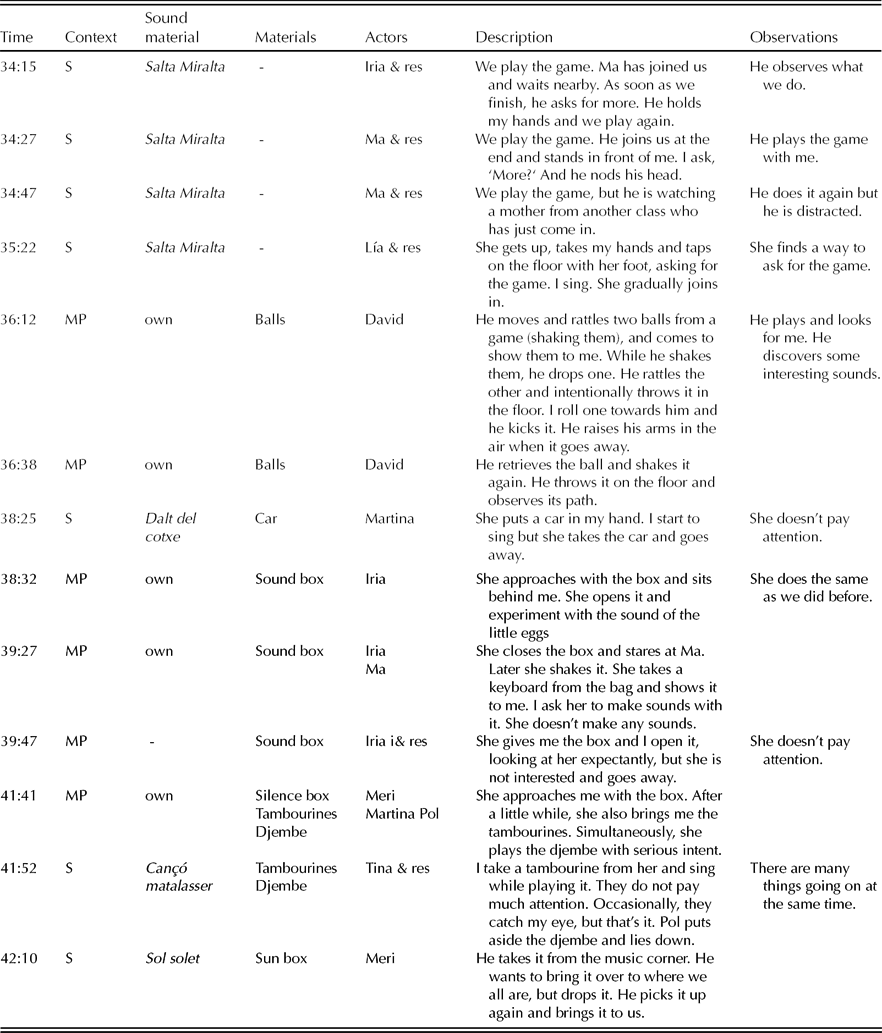
Once the school day had been selected for study, we looked at these videos again and filled in the analysis table validated by the PhD supervisors and the teachers. In this table, we registered the exact time in the video where the activity had taken place. Also, using the didactic framework of musical contexts presented previously, we classified these musical activities as songs, nursery rhymes, pieces of music or musical productions. We specified the sound material they used (name of the song/piece of music), the material objects, the participants of each activity and a description of the tasks carried out. An extra column was provided for observations (see Table 1 for an example of this analysis). As may be deduced, the data was treated manually.
Analysis table

Key: S: Song; MP: Musical Production; & res: Researcher
To validate the findings the musical activities listed in the table were contrasted with the data from the field notes and interviews with the teacher.
Results
Our analysis has served to verify two situations. In the first place, we found that music went on continuously during the whole day. Going through the analysis table, we associated each type of registered activity with a specific colour (an extract of this table, before adding colour, can be seen in Table 1). We also calculated the starting and ending times of each activity. This process allowed us to see that, during the study day, 28% of the time was dedicated to singing, 21% to music production, 9% to listening to music to ‘chill out’, 12% to heuristic music play, and 30% to non-musical activities (such as story time, hygiene habits and other routines).
Secondly, we confirm that there was a wide range of levels of engagement among the children taking part in these musical activities. For example, we could observe a child who was starting to sing the song we had sung two days before, another who perfectly did the hand movement associated to it, a group of children asking the researcher to sing the song again, and also intermediate states of development of the activity, all these happening at the same time. This variety of situations were registered in all of the data collection tools, and frequently discussed in the interviews and daily email exchanges with the teacher. In these discussions, the teacher was particularly surprised by the fact that the children showed different abilities according to the context of the activity. As an example, the little girl who always was the first one singing the new songs sung by the researcher, did not show interest in playing instruments, or did poorer performances than another child who was at the same time very good at reproducing the movement of the puppet in a suggested piece of music, but still did not talk.
These formats of participation that resulted from this study are common to all the contexts of activity. That is, we could observe this range of possibilities related to songs, poems or nursery rhymes, pieces of music and musical productions. We assert that the different ways of engagement of the children are key to defining musical activities that put the children in the spotlight. This is why, although the aim of this study initially refers to identifying and classifying musical activities, we find more appropriate to respond with the ways children engage in these activities.
This study identified two main, mutually exclusive roles of participation. Children either play an ‘active audience’ role in an activity or they are ‘performers’. As it will be explained, this second role includes divisions that refer to other related formats of participation. Next, we will explain each of these roles following the same structure: we start with a significant vignette of the studied children's group extracted either from the field notes of the researcher or transcribed from the video recordings. After that, we follow with an explanation of this format of engagement in the activities. The letters and numbers that accompany the labels of the formats of participation are assigned to delineate its hierarchic position.
A. Active audience role
‘Sitting on the floor with a pile of jackets near me, I make eye contact with the children who are next to me, sitting quietly on the mattress. They look at the teacher, and also at me because of the pile of jackets on the floor (they would normally be hanging up). I start to recite the rhyme, making the gestures and picking up the jackets. The silence is broken by laughter after the final sneeze.’ (Field notes, 12 February)
As can be seen in this description of a rhyme activity, this role appears when an adult or a child perform an activity while the other children, the audience, actively observe and listen to the actions and music. Although some authors consider that listening to music is a passive approach to music engagement (see for example the discussion in Williams et al., Reference WILLIAMS, BARRETT, WELCH, ABAD and BROUGHTON2015), for us it implies equally active engagement in the activity, although by its very nature it requires no explicit action. By observing their facial expressions and body language we can determine whether they are participating in the activity in this role. They make visual contact with the players and are quiet and connected.
B. Performer role
In other cases, the children develop the activity or some parts of it. In other words, the children do observable actions that demonstrate their participation in the activity. Depending on the extent of these observable actions, we can identify different formats of participation of this kind, given that there are some variations.
B.1. Performer pointer
The pointer role occurs when there is an observable behaviour that can be interpreted as partial performance of the activity. As has been said, to carry out the activities we use different resources: body movements and/or visual materials and we place them at children's disposal in the music corner. Sometimes a child may be observed tapping their nose while playing, just as they do when we sing the corresponding song, or opening and rocking the sun box, as happens during another singing activity. See this example from a piece of music context to illustrate this role:
‘While Mar is tidying up the toys, by chance she finds the two dolls we use while we listen to Kavalevsky's ‘Who will win the argument’. She holds one in each hand and moves her wrists while raising one arm. She watches her actions.’ (Field notes, 24 February)
B.2. Performer proof
The variation of this performer role consists in playing explicit actions. In other words, children perform in such a way that we can firmly say that they are doing this specific activity. We refer to this performer role as ‘proof’, because there is observable behaviour that confirms the performance of the activity. This engagement format can, in turn, present two specific formats according to the degree of autonomy of the child when developing the activity. In line with Bruner's ‘Scaffolding theory’ (see for example Bruner and Watson, Reference BRUNER and WATSON1983), we propose a nomenclature that takes into account whether an expert intervenes or not.
B.2.1. Performer proof with an expert
Those musical activities that develop with the participation of the child and a more experienced member are therefore classified as ‘proof with an expert'. Take this example from a song activity:
‘Meritxell takes the lid off the ‘La lluna, la pruna’ box. I start to sing. When I finish the first verse, she puts it back on again. I go on singing and after a few seconds she takes it off again. She closes the box after I finish.’ (Video recording B, 18 February, 01:29)
B.2.2. Performer proof without an expert
Finally, there is a role that corresponds to complete autonomy: when children do the whole activity on their own. This is referred to as ‘proof without an expert’. See the following description of a musical production:
‘David takes a mobile made of canes in each hand and shakes them to express his happiness. He performs with them, he looks at the mobiles, and stops to listen to the silence’ (Video recording B, 18 February, 03:56)
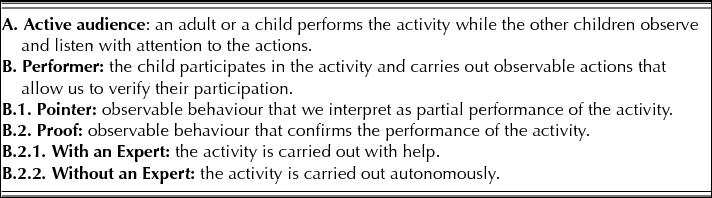
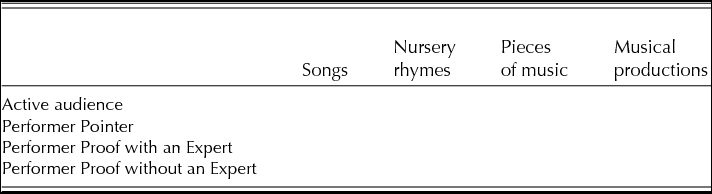
In Table 2 we present a summary of the formats of participation in music activities that emerged during this study and that have been described above, to better visualise the relationship among them. The label given to each format is accompanied by its definition. In addition, we propose a table for observing young children's roles in music making in the different contexts of musical activities as described in the proposed didactic framework (see Table 3). This is intended as a tool to help educators and adults involved in the musical education of children to quickly monitor the musical behaviour of children, providing a guide to observe them. This table can have many applications, for example in staff meetings, interviews with parents and preparation of classes.
Description of young children's roles in music making

Observing young children's roles in music making

Discussion
This research highlights the fact that music is part of children's daily lives. Although the school day we analysed did not have any kind of musical session scheduled, the results show that there was quite a lot of spontaneous musical activity. Music situations were identified while the children were playing freely in the classroom, when they were getting ready to go to the playground or while the children were having a snack. Even the central activity of the day, heuristic play, was read with musical lenses by the team of teachers: the interest of the children was in the sounds they could make with the given objects (empty milk powder tins, Chinese food sticks and local tree fruits) instead of the motor actions. It confirms, as pointed out by Addessi (Reference ADDESSI2009), and Young and Gillen (Reference YOUNG, GILLEN, Gillen and Cameron2010), that daily activities are meaningful milieus where children participate in a variety of musical experiences. Hence the interest on Rutkowski and Kooistra's model (Reference RUTKOWSKI and KOOISTRA2016), which is now in testing phase, that takes into account this variety of situations and contexts to study children's music development.
The present research identifies different roles of children's music engagement. The results are more in line with the ones from the model proposed by Rutkowski and Kooistra (Reference RUTKOWSKI and KOOISTRA2016) than with Voyajolu and Ockelford (Reference VOYAJOLU and OCKELFORD2016) in the sense that we both base our proposals in two central formats of participation. Their ‘covert’ and ‘overt’ apparently opposed ways to engage in music activity coincide with our ‘active audience’ and ‘performer’ roles. Both proposals are based in observable behaviours and, at the same time, interpret this basic stage of fascination and captivation as an active and important engagement format in music without the need of showing any kind of action, as seems to be included in Voyajolu and Ockelford's ‘reactive’ domain. Nevertheless, from our point of view, the term used by Rutkowski and Kooistra for this last way of participation in music activities does not help to build a correct idea of what happens. This enchantment, this magical attraction has nothing to do with the idea one can take from the word ‘covert’ whereas ‘active audience’ gives this sense of consciousness and presence but indicating this lack of action that characterise this role.
Probably the most salient difference between the ‘Spheres of musical understanding’ model and the formats of music engagement this study proposes lies in the relationship the person who does the observations has with the children. Whereas in Rutkowski and Kooistra's one can make occasional checks of this development, in our proposal it is necessary to follow these children, share time with them and to know what goes on musically in their lives. In other words, the first model can be used by external observers while ours is useful for teachers, educators and adults who are part of children's environment. This being said, the fact that allows us to point to this difference is the treatment of roles of this action stage, named ‘covert’ by them and ‘performer role’ here. As presented in the introduction, ‘covert’ divides into two formats: ‘responsive’ or ‘initiative actions’. Our observations also lead us to make two initial distinctions of this role but with nuances in one of them. The ‘performer pointer’ could be equitable with ‘responsive’ although in our classification very little action can be shown in this format of participation. It is the adults’ task to interpret this action as related to any of the musical activities carried out. Again, their ‘responsive’ way of engagement could include our ‘performer proof’ role in the sense that both require the action of the child. In this study, we distinguish whether this response comes with or without the help of an expert.
In spite of these differences, both models highlight the fact that the proposed ways of musical engagement are not to be taken as a linear or progressive music development path. The aim is to help us to observe and understand the musical behaviours of children and to value each action, regardless of its concretion, as musical.
With this formats of music engagement we can map out participation in relation to a specific musical context (songs, nursery rhymes, pieces of music and musical productions) and prompt consideration of certain actions as indicators of musical activity. This knowledge is very important specially to help early years’ teachers who are not musically trained to appreciate the amount of music that spontaneously develops in their classroom and, at the same time, to give importance to the activities they propose since they would be reproduced by the children.
To achieve an effective degree of conscious engagement in musical activities by teachers and also, to make this engagement flow through daily activities and actions that come from the children, one of the aspects that needs a change is the ratio of adults per group of children, which needs to be increased. The studied situation could not have arisen with the standard Catalan ratio (see a note in ‘context of the research’). Teachers who have to deal with such practical matters as changing nappies, getting water, blowing noses and attending parents, to name just a few responsibilities, cannot devote all their time to playing and proposing suitable, joyful and quality music activities with the children. An extra adult per group is needed and, as pointed out by Williams et al. (Reference WILLIAMS, BARRETT, WELCH, ABAD and BROUGHTON2015), this should be someone with a musical background and who is able to engage in shared and quality music experiences with children. Given that these days, children attend these school settings from a very early age and for so many hours, it is important that teachers and educators be aware of their role of musically enculturate babies and toddlers.
As stated above, to identify correctly what is going on in musical terms it is important to keep a musical eye on daily activity and to know, from direct experience, what has been done previously. As pointed out by Young and Gillen (Reference YOUNG and GILLEN2000), Custodero (Reference CUSTODERO2005) and Young (Reference YOUNG, Miel, MacDonald and Hargreaves2005), this is one of the reasons why we need to be part of their musical world when studying what goes on during daily activities. In this sense, we would like to highlight the fact that if we can talk about the ‘performer pointer role’ it is because we have been involved in the activity and know what actions make it up. In this engagement role materials and gestures play a key role as mediums of the activity. They function as symbols (Vallotton & Ayoub, Reference VALLOTTON and AYOUB2010) that can be associated with specific activities and indicate when an activity is in progress. This finding underscores the need to place the materials used to make music at children's disposal. Otherwise, these types of behaviour go unnoticed. We are aware that there is a gap between exploring a material, in general terms, and attempting to do a specific activity presented previously. Further research is needed in this direction.
We hope this study will provide a guide that supports the proper observation of the musical activity, particularly in pre-school and school settings, and that it helps us to be more aware of the sound and music in children's daily activities, value them and give them the appropriate musical meaning. This is the way to enrich children's environment and at the same time to encourage teachers and educators to use as much music in their classrooms as possible.
Acknowledgements
I would like to thank the supervisors of my thesis, Dr. Malagarriga and Dr. Molina, and the team of teachers from the EBM Elna.