The unique features of neonatal Ebstein’s anomaly of the tricuspid valve are the presence of anatomic or functional pulmonary atresia, the patency of the arterial duct, and the variability of pulmonary vascular resistance. Reference Da Fonseca Da Silva, Devine, Alsaied, Yeh, Lin and Da Silva1 Promoting early ductal closure after ruling out or relieving anatomic pulmonary obstruction has been promoted to improve neonatal survival. Reference Da Fonseca Da Silva, Devine, Alsaied, Yeh, Lin and Da Silva1–Reference Wald, Adatia, Van Arsdell and Hornberger3 There is no opportunity to determine the timing and the occurrence of spontaneous closure or diminution in the size of the patent arterial duct. Reference Hoffman4,Reference Slaughter, Cua and Notestine5 Transcatheter ductal closure is an interesting option with several advantages but can be technically challenging in low birth weight neonates with large and tortuous arterial ducts due to the limited available sizes of low-profile approved devices. Reference Ewert6–Reference Deniwar, Brown and Balaguru9 Herein, we report on two consecutive term neonates with Ebstein’s anomaly and large arterial ducts in whom mechanical ductal stimulus during failed attempts of transcatheter closure led to subsequent early and definitive closure with good clinical outcomes.
Cases presentation
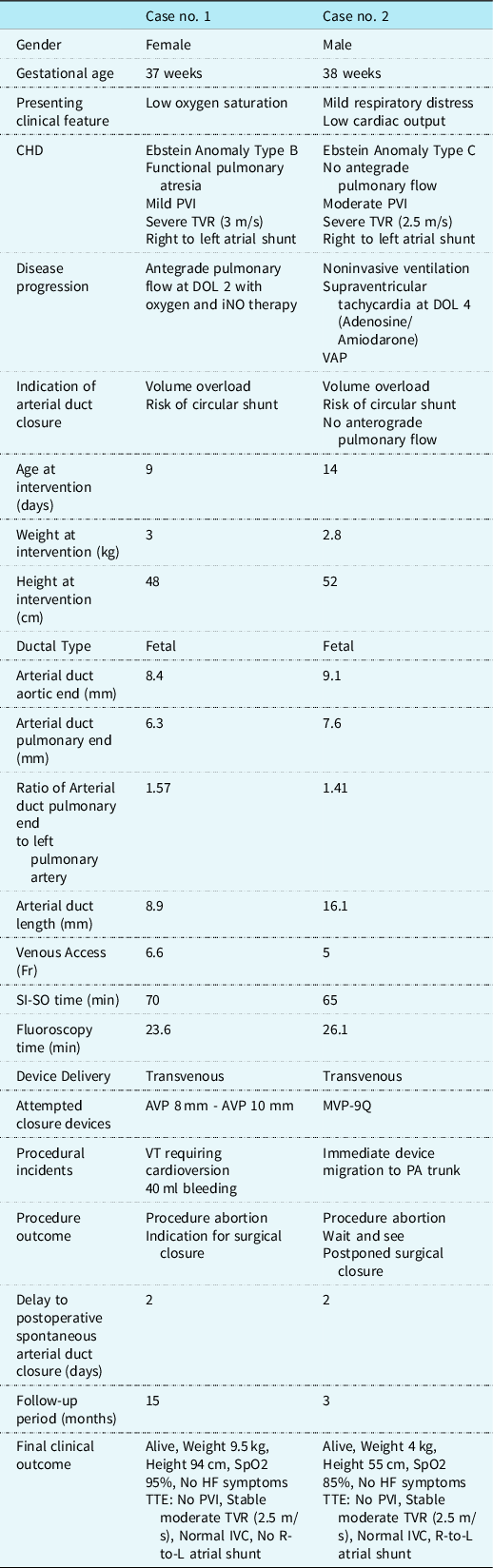
After ruling out anatomic pulmonary obstruction, two consecutive neonates with Ebstein’s anomaly were approached transvenously from the femoral vein at our institution in an attempt to close a haemodynamically significant arterial duct. Procedures were performed under general anaesthesia, heparinisation, prophylactic antibiotics, and fluoroscopic control. Baseline aortography was first performed to delineate the ductal anatomy. The tricuspid valve was carefully crossed using a 2.7 Fr Progreat® microcatheter (Terumo Corp. Japan) in combination with a 0.014-inch HI-TORQUE PILOT™ 50 guidewire (Abbott, USA) that were both used as a tutor for the delivery catheter. The clinical and procedural characteristics of both patients are detailed in Table 1.
Patients’ clinical, procedural, and follow-up data.

AVP: Amplatzer vascular plug; CHD: congenital heart disease; DOL: day of life; HF: heart failure, iNO: inhaled nitric oxide; IVC, inferior vena cava; MVP: microvascular plug; PA: pulmonary artery; PVI: pulmonary valve insufficiency, SI-SO: sheath in sheath out; TTE: transthoracic ultrasound; TVR: tricuspid valve regurgitation; VAP: ventilator-associated pneumonia; VT: ventricular tachycardia.
Case No. 1
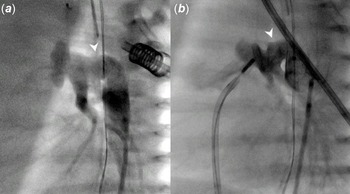
An 8 mm Amplatzer™ Vascular Plug II (AVP II) (Abbott, USA) was selected to close the arterial duct (pulmonary end: 6.3 mm, length 8.9 mm) of a 9-day-old patient (3 kg) that was delivered through a 5-Fr JR 3.0 Launcher™ coronary guide catheter (Medtronic Inc., USA). The device was removed before release for an important residual shunt and device instability (Fig 1). The catheter was upgraded to 6-Fr during which the patient experienced two episodes of ventricular tachycardia requiring cardioversion. The delivery attempt of 10 mm AVP II into position was very laborious, and the procedure was aborted after important access-related bleeding.
Case. 1. Lateral angiography showing a large arterial duct ( a ). Failure to close a using 8 mm Amplatzer™ Vascular Plug II with a significant para-device residual leak ( b ).

Case No. 2
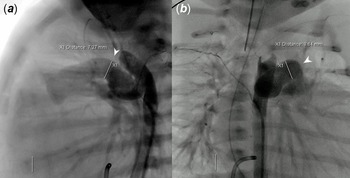
A microvascular plug-9Q (MVP-9Q) (Medtronic Inc., USA) was selected to close the arterial duct (pulmonary end: 7.6 mm, length 16.1 mm) (Fig 2) of a 14-day-old patient (2.8 kg) that was delivered through a 5-Fr JR coronary catheter (Cordis Corp., USA). The device immediately migrated to the pulmonary artery trunk after deployment. The unreleased device was judged too small and thereby was re-sheathed and removed. The procedure was aborted in the absence of a larger low-profile occlusion device in the armamentarium.
Case. 2. Lateral ( a ) and right anterior oblique ( b ) angiographies showing a very large arterial duct in 2.8 kg term newborn with Ebstein’s anomaly.

Both patients were sent back to the neonatal ICU for surveillance and a re-discussion of the management strategy. However, follow-up ultrasound showed a spontaneous and progressive diminution in size until complete ductal closure two days after the procedure with good immediate and follow-up outcomes (Table 1).
Discussion
The spiral of clinical deterioration observed in some neonates with Ebstein’s anomaly has been attributed to ductal patency and circular shunts. Reference Da Fonseca Da Silva, Devine, Alsaied, Yeh, Lin and Da Silva1–Reference Wald, Adatia, Van Arsdell and Hornberger3 In the absence of anatomic pulmonary obstruction or after relief of outflow obstructions, early limitation of ductal patency ductal was paired with improved survival in neonates with Ebstein’s anomaly. Reference Wald, Adatia, Van Arsdell and Hornberger3 Functional pulmonary atresia happens because the pulmonary blood pressure exceeds the pressure that the small and ineffective functional right ventricle can generate, and the leaflets of the pulmonary valve are unable to open. Therefore, as long as the pulmonary vascular resistance remains high and pulmonary insufficiency remains minimal, systemic oxygenation is maintained through the opened arterial duct and little systemic steal occurs. Yet, when the pulmonary vascular resistance drops, a large arterial duct will jeopardize the diagnosis of functional pulmonary atresia. A large arterial duct will also increase the pulmonary artery pressures, impedes the opening of the pulmonary valve leaflets, and increases the systemic steal. Medically induced pulmonary vasodilation may not always result in the excursion of the pulmonary valve leaflets and the diagnosis will be delayed. In addition, the evaluation of the accurate functional capacity of the right ventricle is very challenging in the presence of systemic pulmonary artery pressures mediated by a large arterial duct. On the other side, in neonates with pulmonary valve insufficiency, ductal patency mediates dangerous circular shunts, leading to intolerable ventricular volume load, significant systemic steal, and haemodynamic instability. In addition, a large left-to-right ductal shunt may compromise cardiac output as increased left atrial pressures limit the right-to-left atrial flow and right-sided decompression.
In all these scenarios, the limitation of ductal patency appears clinically reasonable and beneficial. Transcatheter ductal closure is an appealing minimally invasive straightforward alternative when compared to medical therapy in term neonates or surgical ligation. Reference Kuntz, Staffa and Graham10 However, this percutaneous approach and manipulation can be technically difficult in low birth weight neonates. The relative mismatch of currently available introducers, plugs, or occluders to the small anatomic dimensions makes the effective closure of very large ducts very challenging. The implantation of multiple coils or occlusion devices is risky and can be associated with a higher risk of device embolization. Reference Slaughter, Cua and Notestine5 Others and we have reported spontaneous ductal closure after unsuccessful attempts at transcatheter device closure of arterial ducts in preterm infants. Reference Sathanandam, Gutfinger and O'Brien7–Reference Deniwar, Brown and Balaguru9 Here, we report, for the first time, the same event in two consecutive term newborns with Ebstein’s anomaly. Congenital interventionists are also familiar with different degrees of temporary ductal spasms secondary to mechanical stimulation during cardiac catheterizations. Reference Batlivala, Glatz, Gillespie, Dori and Rome11,Reference De Decker, Comitis, Thomas, van der Merwe and Lawrenson12 However, in these two term newborns, we did not observe ductal spasms or changes in the ductal size whether during manipulation or at the end of the procedure and the postoperative ductal closure was permanent without any evidence of recanalization during follow-up. It appears that mechanical stimulation of the ductal inner wall from transcatheter wire/device manipulation and/or the acute stretch provoked by the occluder deployment within the lumen may initiate the process of spontaneous ductal closure even in term neonates. Therefore, a watchful observation for a minimum of 48 hours after a failed closure procedure might avoid surgical ligation of the arterial duct and related morbidity and complications. Reference Méot, Haddad and Patkai8,Reference Deniwar, Brown and Balaguru9
Conclusion
Spontaneous and stable closure of large arterial ducts was seen in two consecutive term neonates with Ebstein’s anomaly two days after mechanical stimulation during failed transcatheter attempts. We conclude that transcatheter closure should be attempted in similar cases requiring early ductal closure. Surgical ligation can be postponed a couple of days after failed transcatheter interventions when clinically possible. Further well-conducted studies seem interesting to evaluate whether mechanical stimulation of the ductal wall can be a useful alternative to initiate spontaneous ductal closure in preterm and term neonates.
Acknowledgements
None.
Author contributions
RH collected clinical data, designed illustrative material, and took the lead in writing and revising the entire manuscript. All authors have read and approved the final version of the manuscript.
Financial support
This research received no specific grant from any funding agency, commercial, or not-for-profit sectors.
Conflicts of interest
None.
Ethical standards
The authors assert that all procedures contributing to this work comply with the ethical standards of the relevant national guidelines on human experimentation and with the Helsinki Declaration of 1975, as revised in 2008. The patient’s legal guardians signed informed consent for the reported procedures and this publication.