


Research on the relationship between domestic politics and war has produced a large literature contrasting the conflict behavior of democracies and autocracies. Studies have documented the many ways in which democracies exhibit distinctive patterns of behavior in terms of when, how, and with whom they fight their wars (Maoz and Abdolali Reference Maoz and Abdolali1989; Reiter and Stam Reference Reiter and Stam1998; Valentino, Huth, and Croco Reference Valentino, Huth and Croco2010), and scholars have engaged in a vigorous debate over whether norms or institutions best account for those patterns (Bueno de Mesquita et al. Reference Bueno de Mesquita, Morrow, Siverson and Smith1999; Dixon Reference Dixon1994; Maoz and Russett Reference Maoz and Russett1993). Few studies have questioned the wisdom of treating democracies as a homogenous group in spite of the fact that there is substantial variation among them. Most notably, some democracies are highly pacific in their external relations while others regularly initiate military conflicts. What explains these differences in democratic belligerence?
Answering this question has become increasingly important as democracy has spread around the globe. From its origins as a rare and radical political experiment, democracy is, by some standard measures, the most common form of government in the world today (Pinker Reference Pinker2011). As democratic institutions have traveled farther away from their birthplace in the West, the group of countries that we label as democracies has grown more diverse, making a compelling account of their differences essential to understanding the patterns of conflict in the international system as a whole.
Those studies that do address variation in conflict initiation by democracies have focused on institutions as the source of that variation (Auerswald Reference Auerswald1999; Boehmer Reference Boehmer2008; Clark and Nordstrom Reference Clark and Nordstrom2005; Leblang and Chan Reference Leblang and Chan2003; Morgan and Campbell Reference Morgan and Campbell1991; Reiter and Tillman Reference Reiter and Tillman2002). However, institutional differences have proved to be weak predictors of democratic belligerence. In contrast, the institutional approach has been much more productive in explaining the conflict behavior of autocracies (Kinne and Marinov Reference Kinne and Marinov2013; Lai and Slater Reference Lai and Slater2006; Peceny and Butler Reference Peceny and Butler2004; Pickering and Kisangani Reference Pickering and Kisangani2010; Way and Weeks Reference Way and Weeks2014; Weeks Reference Weeks2008, Reference Weeks2012). I argue that institutional variance has limited explanatory power for democracies because democratic institutions are far less diverse than autocratic institutions, whereas public opinion represents a significant and unexplored source of variation in democratic conflict initiation.
In democracies of all stripes, free and fair elections make leaders accountable to the mass public, giving them an incentive to take public opinion into account when making decisions (Baum Reference Baum2004; Sobel Reference Sobel2001). Any leader who strays too far from what the public wants runs the risk of losing political capital, control of the political agenda, and even the next election (Aldrich, Sullivan, and Borgida Reference Aldrich, Sullivan and Borgida1989; Bueno de Mesquita and Siverson Reference Bueno de Mesquita and Siverson1995; Krosnick and Kinder Reference Krosnick and Kinder1990). However, when it comes to the use of military force, what the public wants is not the same for all democracies. Attitudes towards war have their roots in individuals’ core values (Feldman Reference Feldman1988; Hurwitz and Peffley Reference Hurwitz and Peffley1987; Jacoby Reference Jacoby2006), and particularly in their beliefs about revenge (Liberman Reference Liberman2006, Reference Liberman2013; Liberman and Skitka Reference Liberman and Skitka2008; Pagano and Huo Reference Pagano and Huo2007; Stein Reference Stein2011), which I show vary significantly across countries.
Synthesizing insights about the role of core values and issue framing from the literature on public opinion formation (Chong and Druckman Reference Chong and Druckman2007; Druckman Reference Druckman2001; Chong Reference Chong2000; Western Reference Western2005) with research on the relationship between revenge and violence (Carlsmith Reference Carlsmith2006; Chagnon Reference Chagnon1988; Ellsworth and Ross Reference Ellsworth and Ross1983; Elster Reference Elster1990; Glaeser and Sacerdote Reference Glaeser and Sacerdote2000; Nisbett and Cohen Reference Nisbett and Cohen1996), I hypothesize that leaders with more vengeful populations will be more likely to initiate conflicts because they can generate public support for war more effectively. Empirical analysis using the Militarized Interstate Disputes (MID) dataset provides strong support for this hypothesis. Using retention of capital punishment as an indicator of broad public endorsement of revenge, I find that democracies that have retained the death penalty for longer periods of time are significantly more likely to initiate conflicts. These results show that taking public opinion into account both theoretically and empirically sheds new light on the conditions under which democratically elected leaders will choose to go to war rather than remain at peace.
INSTITUTIONAL EXPLANATIONS FOR VARIATION IN DEMOCRATIC BELLIGERENCE
While established democracies rarely, if ever, fight major wars with one another, this pacifism does not extend to their interactions with other states (Chan Reference Chan1997), and there is substantial variation in their propensity to initiate military conflicts. To account for this variation, the existing literature has focused on institutions, arguing that democratic institutions assume a diversity of forms that provide varying degrees of constraint on leaders’ ability to take their nations to war. Studies in this vein have examined the relationship between initiation and the type of electoral system, the timing of elections, political competitiveness, the extent of political participation, and the strength of legislative constraints on the executive (Auerswald Reference Auerswald1999; Boehmer Reference Boehmer2008; Clark and Nordstrom Reference Clark and Nordstrom2005; Leblang and Chan Reference Leblang and Chan2003; Morgan and Campbell Reference Morgan and Campbell1991; Reiter and Tillman Reference Reiter and Tillman2002). However, taken together, this body of research has produced few consistent theoretical or empirical insights.
These studies have typically grounded themselves in the long-running debate between norms and institutions as additional tests of the thesis that institutions are paramount. However, beyond this point there is little agreement about what the theoretically relevant dimensions of institutional variation are or how they should be measured, leading to a profusion of independent variables and empirical results that are often inconsistent across studies. For example, several studies have tested whether conflict initiation is more likely in presidential or parliamentary democracies. Auerswald (Reference Auerswald1999) finds that presidential democracies are more likely to use force, while Reiter and Tillman (Reference Reiter and Tillman2002) find that certain types of presidential systems are actually less likely to initiate conflicts, and both Leblang and Chan (Reference Leblang and Chan2003) and Clark and Nordstrom (Reference Clark and Nordstrom2005) find no difference between the two systems. Mixed results such as these are common in this literature and have made it difficult to draw any firm conclusions about the substantive effects of different institutional types or to adjudicate between alternative theoretical claims about the specific sources of constraint, and scholarly interest in moving beyond the democracy-autocracy dichotomy has shifted to focus on autocracies.
In the case of autocracies, a number of recent studies have found that institutional differences among autocracies have clear and substantial effects on various aspects of conflict behavior including dispute initiation (Lai and Slater Reference Lai and Slater2006; Peceny and Butler Reference Peceny and Butler2004; Weeks Reference Weeks2012), audience costs and the ability to signal resolve in a crisis (Kinne and Marinov Reference Kinne and Marinov2013; Weeks Reference Weeks2008), the use of force for diversionary purposes (Pickering and Kisangani Reference Pickering and Kisangani2010), and nuclear proliferation (Way and Weeks Reference Way and Weeks2014). Why has the institutional approach been so productive for understanding the conflict behavior of autocracies but not democracies?
I argue that the answer lies in the fact that institutional differences among autocracies are far more profound than those that exist among democracies. This is particularly true when it comes to accountability, which scholars have long recognized as a key source of constraint on the behavior of leaders (Reiter and Tillman Reference Reiter and Tillman2002). Institutions determine the size and composition of the group, or groups, whose support is necessary for leaders to take or retain power (Bueno de Mesquita et al. Reference Bueno de Mesquita, Smith, Siverson and Morrow2003), and there is wide variation among autocracies on these dimensions (Geddes Reference Geddes2003; Lai and Slater Reference Lai and Slater2006; Weeks Reference Weeks2012). Nonpersonalist dictators, for example, can be held accountable by regime insiders, while personalist dictators face no such domestic audience that can restrict their policy choices (Weeks Reference Weeks2012).
In contrast, leaders in all types of democracies win and lose office through the mechanism of regular elections, making them accountable to the mass public. While some institutional features, such as the extent of political participation, may affect the strength of this accountability, their effects operate only at the margins. Regardless of the specific institutional context in which they operate, democratically elected leaders make their decisions in the shadow of the next election, knowing that if they lose the support of too many of their citizens, their ability to govern will be compromised and their hold on power will be jeopardized (Aldrich, Sullivan and Borgida Reference Aldrich, Sullivan and Borgida1989; Baum Reference Baum2004; Bueno de Mesquita and Siverson Reference Bueno de Mesquita and Siverson1995; Krosnick and Kinder Reference Krosnick and Kinder1990; Sobel Reference Sobel2001). Thus, to understand why some democracies are more belligerent than others, it is necessary to look beyond the institutions themselves and examine the attitudes and opinions of the people who are enfranchised by those institutions.
The degree to which democratic leaders are constrained by their accountability to the public will depend on whether the public favors or opposes war. When public opinion is averse to war, accountability will provide a check on the use of military force. The potential political cost of an unpopular war creates an incentive for leaders to choose nonmilitary options. However, when the public supports going to war, the risk is reduced and initiation becomes a relatively more attractive option. Similar democratic institutions can thus produce very different patterns of conflict behavior depending on prevailing public attitudes towards war. A few studies have hinted at the importance of public opinion in determining whether democratic institutions are a force for peace or a force for war (Clark and Nordstrom Reference Clark and Nordstrom2005; Morgan and Campbell Reference Morgan and Campbell1991), but these speculations have thus far remained undeveloped and untested.
RHETORIC AND REVENGE: BRINGING PUBLIC OPINION BACK IN
To develop a theory of cross-national variation in mass attitudes towards war, I begin with what we know about how those attitudes are formed. A significant body of research on public opinion formation has identified core values as a fundamental source of political attitudes (Feldman Reference Feldman1988; Hurwitz and Peffley Reference Hurwitz and Peffley1987; Jacoby Reference Jacoby2006). Core values refer to an individual's deeply held beliefs about what is good, right, and important in life (Rokeach Reference Rokeach1973), and in the realm of politics, these beliefs serve as shortcuts for forming opinions about issues that are often forbiddingly complex and highly uncertain (Goren Reference Goren2000; Sniderman et al. Reference Sniderman, Brody and Tetlock1993). This is particularly true in the realm of foreign affairs, which is often remote from everyday life and shrouded in official secrecy. Lack of experience and information make it difficult for ordinary citizens to form their opinions about a policy by weighing its costs and benefits, leading them to rely instead on assessments of whether that policy accords with their core values (Hurwitz & Peffley Reference Hurwitz and Peffley1987; Meernik and Ault Reference Meernik and Ault2001).
A growing body of evidence points to the importance of revenge as a determinant of individuals’ support for the use of military force (Liberman Reference Liberman2006, Reference Liberman2013; Liberman and Skitka Reference Liberman and Skitka2008; Pagano and Huo Reference Pagano and Huo2007; Stein Reference Stein2011).Footnote 1 By revenge, I am referring to the belief that wrongdoers deserve to be repaid for their crimes. In this view, taking “an eye for an eye” is a moral good in and of itself, regardless of its impact on future outcomes. The relationship between endorsement of revenge and support for war at the individual level relates to differences in support for war across countries because the prevalence of revenge beliefs exhibits strong cross-cultural variation.
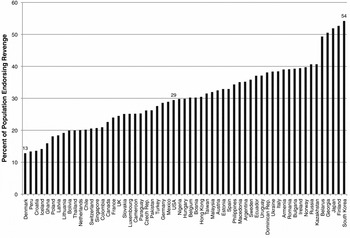
Numerous studies have documented cultural differences in beliefs about revenge and linked this variation to the frequency of lethal violence (Boehm Reference Boehm1984; Chagnon Reference Chagnon1988; Elster Reference Elster1990; Hinton Reference Hinton1998; Nisbett and Cohen Reference Nisbett and Cohen1996). The only multicountry survey to ask directly about revenge also shows substantial cross-national differences. In Gallup International's Voice of the People Millennium (VPM) Survey, which was conducted in the year 2000 in 59 countries,Footnote 2 respondents were asked what they thought the main aim of imprisonment should be and I classified as vengeful those who said “to make those who have done wrong pay for it.”Footnote 3 Figure 1 reports the percentage of people in each country who chose that response option, ranging from a low of 13% in Denmark to a high of 54% in South Korea, with the United States falling at the average of 30%.Footnote 4 These data demonstrate that even in a highly globalized world, the prevalence of revenge as a core belief varies substantially across national populations.
Variation in Endorsement of Revenge in the VPM Survey

This variation is consequential for the behavior of democratic leaders because in countries where vengefulness is widespread, leaders can build popular support for war more easily, making conflict initiation a less risky prospect. Although early research cast doubt on the structure and stability of mass attitudes towards foreign policy and concluded that leaders had little incentive to attend to public opinion on international issues, there is now substantial evidence demonstrating that this pessimism was unwarranted (Holsti Reference Holsti1996). Numerous studies have demonstrated that individuals have stable and coherent opinions about foreign policy (Hurwitz and Peffley Reference Hurwitz and Peffley1987; Wittkopf Reference Wittkopf1990), that they consider their leaders’ foreign policy records when making their vote choice (Aldrich, Sullivan and Borgida Reference Aldrich, Sullivan and Borgida1989; Krosnick and Kinder Reference Krosnick and Kinder1990), and that in turn, leaders take public opinion into account when making decisions about the use of force abroad (Baum Reference Baum2004; Sobel Reference Sobel2001).
However, the public's foreign policy views are not set in stone and elected leaders do not behave as though they are (Canes-Wrone Reference Canes-Wrone2010; Rottinghaus Reference Rottinghaus2009). Instead, recognizing the importance of securing public support for war, leaders devote serious effort to using the advantages of the bully pulpit to sway public opinion in their favor (Jacobs and Shapiro Reference Jacobs and Shapiro2000; Rosenblatt Reference Rosenblatt1998). The more effective these efforts are, the less leaders will fear the consequences of an unpopular war and the more likely they will be to decide that the benefits of initiating a conflict outweigh the costs. A vengeful populace enhances a leader's ability to generate public support for war because it allows him to take advantage of a versatile and powerful rhetorical strategy: framing the use of military force as a punishment that evildoers deserve to suffer.
Framing is one of the most powerful tools that leaders use to influence public opinion, and its effects have been consistently demonstrated for both domestic and foreign policy issues (Chong and Druckman Reference Chong and Druckman2007; Western Reference Western2005). Broadly speaking, framing refers to the way in which an issue or event is described in communication. Framing influences individuals’ attitudes by changing the concerns that they have in mind when forming their opinion, and frames that resonate with deeply held values are particularly effective (Chong Reference Chong2000; Druckman Reference Druckman2001). Framing war as a punishment involves portraying the use of military force as repayment for some act of wrongdoing on the part of the adversary. Because vengeance is conditional—the crime must come first in order for the punishment to be deserved—leaders must provide their citizens with a narrative that has all the necessary raw materials: a victim, a perpetrator, and a punisher. These pieces must be in place in order to trigger the logic of revenge.Footnote 5 This argument is supported by studies that find individuals who endorse revenge are more likely to support the use of military force only when it is framed as a punishment for a clear act of wrongdoing. In the absence of that framing, their attitudes are not distinguishable from those of nonvengeful individuals (Liberman Reference Liberman2006; Stein Reference Stein2011).
Thus, it is not the case that a highly vengeful public will seize upon the slightest provocation to demand war from a reluctant leader. Rather, broad public endorsement of revenge is a latent source of support for war that leaders can activate by deploying strategically crafted rhetoric (Jacobs and Shapiro Reference Jacobs and Shapiro2000). I also assume that leaders do not initiate conflicts solely for reasons of personal or national revenge.Footnote 6 The rationales that leaders offer to their citizens are not necessarily the same as the reasons they decide to go to war, and the theory presented here concerns only the former. Other literatures have dealt with the issues that give rise to conflicts of interest between states (e.g., Levy and Thompson Reference Levy and Thompson2009) and the reasons why they may fail to find a peaceful bargain that both sides prefer to war (e.g., Fearon Reference Fearon1995), and I do not challenge their claims about these proximate causes of war. However, when conflicts of interest do arise between states, democratic leaders who can increase public support for war by tapping into their citizens’ desire for revenge will be less constrained from using force to resolve those conflicts.Footnote 7
The claim that democratic leaders’ decisions about conflict initiation are influenced by the vengefulness of their populations does not require that leaders have access to perfect information about their citizens’ beliefs about revenge, that any and all potential conflicts can be shaped into a victim-perpetrator-punisher narrative, or that leaders always use this frame when it would be advantageous. The use of force can be framed in a variety of ways, and the framing that leaders choose may also be influenced by other factors such as their own beliefs about the nature of international threats (Saunders Reference Saunders2009) or the prevailing norms surrounding the use of force (Finnemore Reference Finnemore2003). Certainly, given the current normative climate, leaders have an incentive not to appear aggressive even when making the first move. A punishment frame is one way to achieve this aim, but this does not mean that most or all conflicts are framed in this way (Western Reference Western2005).Footnote 8 A humanitarian intervention frame, for example, can serve this purpose as well (Wheeler Reference Wheeler2000). Furthermore, for leaders in very low vengefulness countries, there may also be costs to employing a punishment frame, since their populations may react negatively to the specter of revenge in order to affirm their own alternative values.
This argument is also not meant to suggest that framing the use of force as a punishment is the only strategy that leaders use to sway public opinion. Punishment framing is best thought of as one item in the toolbox of strategies that can be employed alone or in combination (Edwards Reference Finnemore2009). My argument is that leaders with more vengeful publics will utilize a punishment framing strategy more often and with greater effect than leaders with less vengeful publics, and that on average, this advantage will result in a greater propensity to initiate conflict. Thus, I hypothesize that democracies with highly vengeful publics will be more likely to initiate the use of military force than democracies with less vengeful publics.
This is a story about conflict initiation rather than reciprocation or escalation because the advantage enjoyed by leaders with highly vengeful populations is largely eliminated once the adversary makes the first move. Consider a situation in which state A has initiated a dispute against state B. The leader of state B can now make the case for going to war on the basis of self-defense. Given the widespread legitimacy of self-defense as a justification for both interpersonal and interstate violence (Alexandrov Reference Alexandrov1996; Ramirez Reference Ramirez2007), this is a potent argument that will often generate enough public support to overcome leader B's reticence about waging an unpopular war, regardless of the vengefulness of his constituents. However, if state A has not yet made the first move, then the self-defense argument becomes much more difficult to sustain and leader B's ability to appeal to the public's desire for revenge becomes much more important in generating a sufficient level of public support. If leader B faces a highly vengeful population, he can generate support for initiation against state A by framing the use of force as a punishment for acts of wrongdoing that state A has committed against state B in the past, against a third state, or against its own people. Having this tool in his tool kit means that leader B has greater liberty to take military action against state A compared to a leader who must wait for a plausible case for self-defense to emerge in order to surmount public opposition.Footnote 9
I do not expect the same logic to apply to autocratic leaders. While recent research has argued that autocratic leaders do in fact face a need to maintain support among their “selectorate,” or the group of people who have a say in leadership selection, that selectorate tends to be both smaller and less diverse in terms of interests than the selectorate in democracies (Bueno de Mesquita et al. Reference Bueno de Mesquita, Smith, Siverson and Morrow2003; Weeks Reference Weeks2008). Weeks (Reference Weeks2008) argues that for most autocratic leaders, the relevant selectorate is composed of regime insiders, individuals who hold power within the institutions of government, rather than the mass public, as is the case for democracies.
There are several reasons to believe that in autocracies, leaders’ willingness to initiate the use of military force is not conditional on the prevalence of vengeful attitudes in their selectorate. First, with a small selectorate, autocratic leaders can afford to maintain support by doling out rewards and punishments (Bueno de Mesquita et al. Reference Bueno de Mesquita, Smith, Siverson and Morrow2003). An autocratic leader facing a less vengeful selectorate has the ability to build sufficient support for war by paying off those who back him and eliminating those who do not, and he is therefore not at a disadvantage compared to an autocratic leader facing a more vengeful selectorate. In contrast, the reward and punishment strategy is too expensive for democratic leaders with large selectorates, and as a result, they must rely on cheaper but less certain methods of ensuring support, such as rhetorical persuasion.Footnote 10
Second, given their status as political elites, regime insiders will rely less on their core values when evaluating the wisdom of going to war than the average citizen. In general, these individuals should have access to higher quality information about foreign policy than is available to the general public, combined with the experience and knowledge required to process that information and determine which policy is in their best interest. Thus, even without the payoffs and punishments provided by autocratic leaders, vengefulness should play no more than a minor role in shaping the opinions of well-informed regime insiders.
DATA AND MEASUREMENT
To test my hypothesis, I use the Correlates of War Project's data on militarized interstate disputes (Ghosn et al. Reference Ghosn, Palmer and Bremer2004), which are defined as threats, displays, or actual uses of military force that are both overt and government sanctioned. In this study, I examine MIDs that took place between 1945 and 2001. The unit of analysis is the directed dyad-year. Directed dyads are ordered pairs of states in which state A is the potential initiator and state B is the potential target. To eliminate dyads that have no opportunity for conflict, I restrict my analysis to “politically relevant” dyads (Lemke and Reed Reference Lemke and Reed2001), defined as pairs of states that are contiguous and/or include at least one major power. Out of over one million total directed dyad-years between 1945 and 2001, this restriction leaves 116,174 observations.
Dependent Variable: MID Initiation
My dependent variable is the initiation of a militarized dispute. In the MIDs data, the initiator is defined as the state that made the first move by threatening, displaying, or using force. Initiation is a dichotomous variable equal to one if state A initiated a MID with state B in a given year. Between 1945 and 2001, there were 1,246 instances of initiation. In order to exclude relatively minor incidents that have little or no chance of ever coming to the attention of the mass public, I look only at high hostility level MIDs, which are those that involve an actual use of force or full-scale war. This leaves 710 instances of initiation in the data.
To identify democratic initiators, I use the combined Polity score from the Polity IV dataset, which ranges from zero (most strongly autocratic) to 20 (most strongly democratic). I code the initiating state as a democracy in a given year if its combined Polity score is greater than 16. In the analyses that follow, I subset the data on this variable in order to examine democratic and autocratic initiators separately.
Measuring Vengefulness
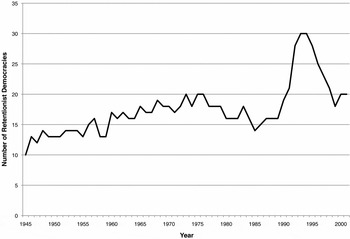
My main independent variable is the vengefulness of the initiating state's population. A rigorous test of my hypothesis that controls for other factors known to affect the likelihood of initiation requires a measure of vengefulness that is widely available both across countries and over time. Ideally, I would use a direct measure of attitudes towards revenge based on public opinion surveys, but there is not sufficient data to take this approach. Instead, I use the legal status of capital punishment as an indicator for whether revenge is broadly endorsed by a country's population. This measure can be coded consistently for all countries in the international system without any missing data or issues of cross-national comparability. I collected data on the legal status of capital punishment worldwide from Amnesty International. Based on this information, I created the dichotomous variable Initiator death penalty, which is equal to 1 in a given year if the initiating state retains the death penalty for ordinary crimes. In the 1945–2001 period, a total of 66 countries have been democratic and retentionist in at least one year, and 41% had a duration of at least 10 consecutive years. Overall, democracies with the death penalty make up 51.2% of all dyad-years with a democratic initiator in my data.Footnote 11 Figure 2 plots the number of retentionist democracies in each year from 1945 to 2001, showing that they have been a constant presence in the international system since 1945, although their number has fluctuated between 10 (in 1945) and 30 (in 1993 and 1994).Footnote 12
Number of Retentionist Democracies in the International System, 1945–2001

Using law as a proxy for public opinion in democracies is a viable strategy for a number of reasons. First, numerous studies have linked cross-cultural variation in beliefs and values to national-level policy differences among democracies across a variety of issue areas (e.g., Cohen Reference Cohen1996; Inglehart Reference Inglehart1990; Kasser Reference Kasser2011), suggesting that policy often reveals information about values. Second, the global trend in the 20th century has been towards the abolition of capital punishment, with an especially strong wave following World War II (Simmons Reference Simmons2009). As a result, governments that retain capital punishment in the post-1945 era do so as a deliberate choice and against the prevailing tide of international opinion. In democracies, this decision rests on leaders’ assessments of how their political fortunes will be affected by a move to abolish the death penalty. They are unlikely to take the risk if support for capital punishment is high and they expect a strong public backlash (Newburn and Jones Reference Newburn and Jones2005). Finally, research on individual attitudes towards the death penalty has converged on the conclusion that, at the individual level, attitudes towards capital punishment are symbolic rather than instrumental (Ellsworth and Gross Reference Ellsworth and Gross1994; Tyler and Weber Reference Tyler and Weber1982) and that support is driven primarily by a desire for revenge, rather than by utilitarian concerns (Bohm Reference Bohm1992; Carlsmith et al. Reference Carlsmith, Darley and Robinson2002; Cotton Reference Cotton2000; Ellsworth and Ross Reference Ellsworth and Ross1983; McKee and Feather Reference McKee and Feather2008).
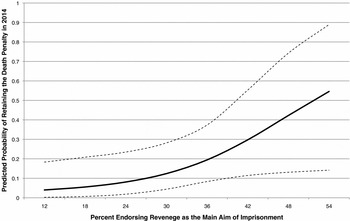
All this suggests that retentionist democracies are places where revenge is likely to enjoy more widespread endorsement.Footnote 13 The available cross-national public opinion data on revenge support this contention. Using the data from the 2000 VPM survey, I coded the variable Percent vengeful, which is the percentage of people in each democracy in the survey (N = 43) who endorsed revenge as the main justification for imprisonment. I then regressed the present day legal status of capital punishment (equal to 1 if the country retains the death penalty in 2014) on Percent vengeful and find that it is positive and significant predictor of retention. Figure 3 illustrates the substantive effect of Percent vengeful by graphing the predicted probability that a democracy will retain the death penalty as Percent vengeful varies over its range. Figure 3 shows that the probability that a democracy will retain the death penalty rises from 4% to 54% as Percent vengeful increases, a difference that is statistically significant (Δ = 50 [4.1, 87.9]). From the same question on the VPM survey, I also coded variables for the percentage of people who chose deterrence as the main aim of imprisonment and the percentage who chose public safety. Both deterrence and public safety are commonly articulated justifications for capital punishment, but neither variable has a significant relationship with the likelihood that a democracy will retain the death penalty.Footnote 14
The Effect of Endorsement of Revenge on Death Penalty Retention in Democracies

I cannot use the data from the VPM to test my hypothesis because it only covers 43 democracies in a single year, but this analysis should increase our confidence that the legal status of the death penalty is a valid indicator of the prevalence of revenge in national populations.Footnote 15 It shows that retention of the death penalty is positively correlated with popular endorsement of revenge and that it is not correlated with cross-national variation in beliefs about the efficacy of punishment, thereby ameliorating the concern that the legal status of capital punishment might be proxying for the latter rather than the former. An additional concern has to do with other national attributes that may be correlated with both retention and the propensity to initiate conflict. I address this issue below.
Control Variables
I include two sets of control variables in my analysis. The first is a standard set of MIDs predictors based on existing studies of conflict initiation. I include these variables both to account for the influence of factors like proximity, shared interests, and military capabilities on the baseline risk of conflict, and to compare the effect of Initiator death penalty to the impact of these well-established predictors of initiation.
State power affects both the opportunity for conflict and the expected value of going to war, and I include a set of variables to capture both the absolute and relative power of the states in each dyad. These variables include Initiator capabilities score (measures the initiator's material capabilities compared to all other states in the system), Target capabilities score Footnote 16 (measures the target's material capabilities compared to all other states in the system), Balance of capabilities Footnote 17 (measures how evenly matched the two states are in terms of their material capabilities), Initiator share of capabilities Footnote 18 (measures the strength of the initiator relative to the target), Initiator major power (an indicator of the initiator's major power status), and Target major power Footnote 19 (an indicator of the target's major power status).
To capture the effect of geographical proximity on opportunity for conflict (Gleditsch Reference Gleditsch1995), I include Land contiguity, which is a dichotomous variable equal to 1 if the states in a dyad share a land border. By contrast, states that are allied or that have similar strategic interests should have fewer opportunities for conflict (Gowa Reference Gowa2011). The former is measured by Defensive pact (a dichotomous variable equal to 1 if the states in the dyad have a formal agreement to aid one another militarily in the event of an attack), while the latter is measured by Alliance portfolio similarity (a measure of the extent to which states in a dyad are allied with similar countries).Footnote 20 In addition to these variables, I also include the regime type of the target state to capture any effect of the democratic peace. Target democracy is a dichotomous variable equal to 1 if target state's combined Polity score is greater than 16.
The second set of control variables addresses the problem of omitted variable bias. Having the death penalty is not itself a cause of conflict, rather it is a proxy for popular endorsement of revenge. Other factors will also influence retention, and thus we must carefully consider how retentionist democracies differ from abolitionist democracies and whether those differences are plausibly related to the likelihood of conflict initiation. There is a small literature on the determinants of cross-national death penalty retention, and these studies suggests a number of predictors of retention that are also cited as causes of conflict or that are correlated with conflict generating processes.Footnote 21
Ethnic fractionalization
Countries with greater ethnic fractionalization are more likely to retain the death penalty (Ruddell and Urbina Reference Ruddell and Urbina2004; Simmons Reference Simmons2009). States that are more ethnically heterogeneous are also more likely to be home to a trans-border ethnic group, which may be a risk factor for interstate conflict (Woodwell Reference Woodwell2004). I measure Ethnic fractionalization using data from Fearon and Laitin (Reference Fearon and Laitin2003). This variable ranges from 0 to 1 with higher values indicating a greater degree of fractionalization (i.e., the probability that two randomly selected individuals are from different ethnic groups).
Income inequality
Greater income inequality is positively correlated with retention (Jacobs and Carmichael Reference Jacobs and Carmichael2002; Kent Reference Kent2010). More unequal countries also tend to have stronger nationalism (Solt Reference Solt2011), which is frequently cited as a cause of international conflict (Van Evera Reference Van Evera1994). Unequal democracies also tend to build capital-intensive militaries, which lowers the cost of war for the median voter and decreases the political risk of initiation (Caverley Reference Caverley2014). I measure Income inequality as a Gini coefficient based on household market (pretax, pretransfer) income, which ranges from 0 to 100. These data are available for 153 countries starting in 1960 (Solt Reference Solt2009).
Civil war
Simmons (Reference Simmons2009) finds that countries with a history of civil war are more likely to retain the death penalty, and civil wars can lead to conflicts between states through security spillovers or diversion (Gleditsch et al. Reference Gleditsch, Salehyan and Schultz2008). These effects should be greatest during and in the years immediately following the civil conflict. I used Fearon and Laitin's (Reference Fearon and Laitin2003) data to code indicator variables for Ongoing civil war, Five years post-civil war, and Ten years post-civil war.
Executive ideology
Right wing governments are less likely to abolish capital punishment (Neumayer Reference Neumayer2008) and there is some evidence to indicate that they are more likely to initiate military conflicts (Arena and Palmer Reference Arena and Palmer2009). I used data from the World Bank's Database of Political Institutions (1975–2001) to create an indicator for Right wing executive, which is equal to 1 if the chief executive's party is coded as right wing (Beck et al. Reference Beck, Clarke, Groff, Keefer and Walsh2001).
Independence post-1990
Countries that gained independence after 1990 are more likely to have abolished capital punishment (Ruddell and Urbina Reference Ruddell and Urbina2004), and the frequency of international armed conflict has also declined since the collapse of the Soviet Union (Pinker Reference Pinker2011). Thus, states born after 1990 may have encountered fewer opportunities to initiate conflict due to this structural change. I therefore coded an indicator for Independence post-1990.
The literature on conflict initiation also suggests two more potential confounders. While these variables have not been tested as predictors of retention, there is a strong theoretical case for including them. First, states that routinely abuse their citizens’ human rights appear more likely to engage in international conflict (Caprioli and Trumbore Reference Caprioli and Trumbore2006; Sobek, Abouharb, and Ingram Reference Sobek, Abouharb and Ingram2006), and retention of the death penalty may reflect this lack of respect for human rights rather than popular attitudes towards revenge. To control for states’ human rights records, I use the Political Terror Scale (PTS), which is available for the years 1976–2001 (Wood and Gibney Reference Wood and Gibney2010). The PTS uses a five-point scale to measure the scope and severity of violations of physical or personal integrity rights carried out by a state.Footnote 22 I include Initiator PTS score, Target PTS score, and their interaction in my analysis to control for the pacifying effect of joint respect for human rights found by Sobek, Abouharb, and Ingram (Reference Sobek, Abouharb and Ingram2006).
Second, research has shown that the period following a transition to democracy can be particularly conflict prone (Mansfield and Snyder Reference Mansfield and Snyder2005), and capital punishment is also more commonly found in new democracies, which often inherit it from the previous autocratic regime. As a result, democratic age may be positively related to both abolition and increasingly pacific behavior. To account for this possibility in my analysis, I created the variable Democratic duration, which counts the number of consecutive years that a state has maintained a combined Polity score greater than 16.
RESULTS AND DISCUSSION
The MIDs data have a time series cross-sectional structure with observations clustered on the directed-dyad. Initiator death penalty and many of the control variables I employ in my analysis vary on average between dyads and over time within dyads, which creates the potential for cluster confounding (Bartels Reference Bartels and Franzese2015; Ray Reference Ray2003; Zorn Reference Zorn2001). The issue is that these variables may have distinct within- and between-cluster effects, while a pooled model (one that estimates a single coefficient for each predictor) assumes that these effects are equal. If this assumption is incorrect, then confounding the within- and between-cluster effects can lead to incorrect interpretation of model coefficients and erroneous conclusions about the validity of hypotheses.
To address the problem of cluster confounding, I use the method recommended by Bartels (Reference Bartels and Franzese2015) and based on prior work by Zorn (Reference Zorn2001) and Skrondal and Rabe-Hesketh (Reference Skrondal and Rabe-Hesketh2004). This involves transforming each time-varying independent variable into two separate components, one that captures the within-cluster variation and one that captures the between-cluster variation. The between-cluster transformation is calculated as the cluster-specific mean, while the within-cluster transformation is calculated as the deviation from the cluster-specific mean in any given year.Footnote 23 These two components are completely uncorrelated, making it possible to assess whether a unit change in a given variable predicts differences across clusters, within clusters, or both.
Thus, in the models presented below, I report two coefficients for each time-varying variable. For example, the between-dyad component of Initiator death penalty is the proportion of dyad-years that the initiating state retained the death penalty (ranging from 0 to 1), while the within-dyad component subtracts this quantity from the observed value in a given year. In terms of the theory, we can interpret the former as the initiator's average level of vengefulness compared to other countries and the latter as longitudinal change in the initiator's level of vengefulness.
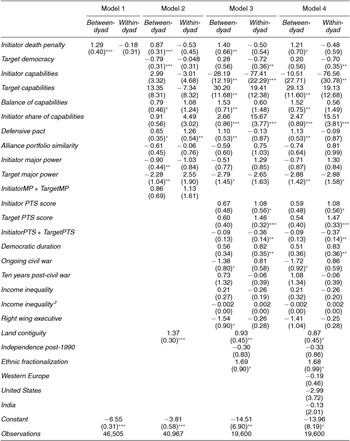
In Table 1, I present a series of logistic regression models for democratic initiators. Standard errors are clustered on the directed dyad and cubic splines of the number of years since the last MID in the dyad are included to account for temporal dependence (Carter and Signorino Reference Carter and Signorino2010). Model 1 shows the bivariate relationship between Initiator death penalty and the likelihood of initiation. Model 2 adds the standard predictors of MIDs, and Model 3 adds the omitted variable controls. Model 4 checks the robustness of the results to the inclusion of dummy variables for the United States, India, and Western Europe. The United States and India are both retentionist democracies that have initiated a disproportionate number of MIDs in the 1945–2001 period,Footnote 24 while the nations of Western Europe have initiated disproportionately few MIDs while moving towards abolition more quickly and completely than any other region. It is therefore important to check that these outliers are not driving the results.
Between-dyad and Within-dyad Effects of Death Penalty Retention for Democratic Initiators

Notes: The number of observations significantly decreases in Model 3 and Model 4 due to data availability (Income inequality starting in 1960, Right wing executive starting in 1975, and PTS scores starting in 1976). The Initiator MP * Target MP interaction was dropped because of perfect prediction, as was Five years post-civil war (Ten years post-civil war is included instead). Democratic duration is logged. Cubic splines of time since last MID are included in the model but not reported. A single coefficient is reported for Land contiguity, Independence post-1990, Ethnic fractionalization, Western Europe, United States and India because these variables are not time-varying. Standard errors are reported in parentheses. Significance: * p < 0.1, ** p < 0.05, *** p < 0.01.
The results in Table 1 show that Initiator death penalty is a positive and significant predictor of initiation across all model specifications. They also show that Initiator death penalty has distinct within-dyad and between-dyad effects. Change in the legal status of the death penalty within dyads over time appears to have no statistically significant effect on the likelihood that a democracy will initiate a militarized dispute. In contrast, the between-dyad variation in Initiator death penalty has a significant positive effect on the likelihood of initiation. In other words, the greater the proportion of dyad-years that a democracy has retained the death penalty, the more likely it is to initiate a militarized dispute with another state, even when controlling for respect for human rights, the age of the democracy, ongoing and recent civil war experience, income inequality, executive ideology, independence post-1990, and ethnic fractionalization. Model 4 shows that this effect is not driven by the United States, India, or Western Europe. These variables are all negative and statistically insignificant, and their inclusion does not substantially alter the size of coefficient on Initiator death penalty.Footnote 25
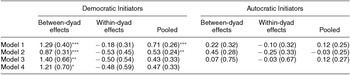
In Table 2, I compare the cluster corrected model to a pooled model (i.e., one that estimates a single coefficient for the time-varying predictors) for both democratic and autocratic initiators. The four model specifications are the same as those used in Table 1. Here, I report only the coefficient and standard error on Initiator death penalty, but full results are available in the Supplemental Appendix. Results for democratic initiators are given in columns 1–3, with the first and second columns reporting the between- and within-dyad effects of Initiator death penalty from Table 1. In the pooled models for democracies, Initiator death penalty has a smaller but statistically significant effect in Model 1 and Model 2, but not in the other specifications, which add the omitted variable controls (Model 3) and dummy variables for the United States, India, and Western Europe (Model 4).
Comparing Pooled and Cluster Corrected Models
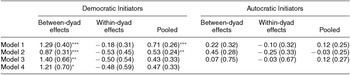
Note: For autocratic initiators, Democratic duration is eliminated from Model 3 and Model 4 is not reported because the U.S., India, and Western Europe do not contribute any observations to this group. Significance: * p < 0.1, ** p < 0.05, ** p < 0.01.
This comparison shows that without accounting for cluster confounding, we would erroneously conclude that the effect of Initiator death penalty is not robust to the inclusion of controls for omitted variables, when in fact the between-dyad effect remains large and statistically significant. Many of the control variables in my analysis also exhibit distinct between-dyad and within-dyad effects, which suggests that longitudinal changes in conflict behavior within dyads may not have the same causes as average differences in conflict behavior across dyads, a phenomenon that deserves greater attention, both theoretically and empirically, in studies of interstate conflict (see also Ray (Reference Ray2003) and Zorn (Reference Zorn2001)).
I include results for autocracies in Table 2 because a significant coefficient on Initiator death penalty among autocracies would indicate the presence of a problem, either with the theory (i.e., vengefulness affects conflict initiation through some mechanism common to democracies and autocracies) or with the measure (i.e., Initiator death penalty is measuring something other than vengefulness that is common to autocracies). The absence of an effect does not guarantee the absence of such problems, but the presence of an effect would be informative. Results for autocratic initiators are given in columns 4–6, and as expected, I find no significant effect of Initiator death penalty for autocracies in any specification, regardless of whether the model is pooled or cluster-corrected.
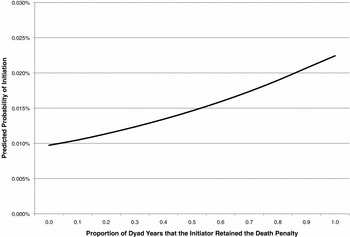
To illustrate the substantive significance of the between-dyad effect of Initiator death penalty, Figure 4 plots the predicted probability of initiation as the proportion of dyad years that the initiator has retained the death penalty increases.Footnote 26 While the overall probabilities are small, reflecting the fact that MID initiation is a rare event, there is a substantial increase in the likelihood initiation over the range of the between-dyad variation in retention.
The Marginal Effect of Between-Dyad Variation in Death Penalty Retention

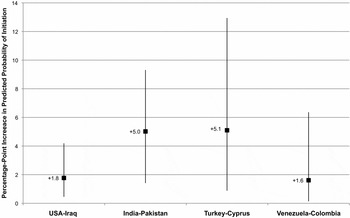
To make this effect more concrete, I calculated the predicted probability of initiation using the values of the control variables for four conflict-prone dyads with democratic initiators: United States-Iraq, India-Pakistan, Turkey-Cyprus, and Venezuela-Colombia. Specifically, for each dyad, I compare the predicted probability of initiation with Initiator death penalty equal to 1 in all dyad-years to the predicted probability of initiation with Initiator death penalty equal to 0 in all dyad-years. This difference illustrates the effect of changing each initiator from fully abolitionist to fully retentionist while holding all other attributes of the dyad constant. Figure 5 depicts the results graphically.
Marginal Effects of a Switch from Full Abolition to Full Retention in Four Dyads

Figure 5 shows meaningful changes in the likelihood of initiation in all four dyads. Switching the United States from fully abolitionist to fully retentionist increases the predicted probability of initiation by 1.8%, which more than doubles the overall chances of initiation (1.4% compared to 3.2%). Similarly, initiation is more than twice as likely for a fully retentionist India (9.3% compared to 4.3%), Turkey (9.1% compared to 4.0%) and Venezuela (2.9% compared to 1.3%). This effect is similar in magnitude to the between-dyad effect of the target's major power status, which significant and negative across all models indicating that initiation is less likely when the target is a long-lasting major power. Taking the values of the covariates for the United States-Iraq dyad, changing Iraq to a major power decreases the predicted probability of initiation by 59%. In comparison, changing the United States from fully retentionist to fully abolitionist produces a 55% decrease in the likelihood of conflict.
The absence of a within-dyad effect for Initiator death penalty requires some explanation. If the population of a democracy becomes less vengeful over time, we should observe a decrease in the likelihood of initiation as it becomes more difficult for leaders to generate popular support for war. However, this change is likely to be a gradual process. Studies suggest that core values exhibit a great deal of stickiness, and are often embedded in social structures and processes that inhibit rapid transformations (Alesina et al. Reference Alesina, Giuliano and Nunn2013; Nisbett and Cohen Reference Nisbett and Cohen1996; Voigtlander and Voth Reference Voigtländer and Voth2012). The behavior of leaders may also lag in responding to shifting values. Leaders cannot directly observe the values of their citizens, but must instead learn from observation and experience which rhetorical strategies resonate and which do not, and since militarized disputes are rare occurrences, such learning opportunities will also be rare. As a result, a dichotomous measure like Initiator death penalty is likely too blunt to capture long-term, incremental change in attitudes towards revenge, making it difficult to detect any within-dyad effects that might be present
Overall, the results of this analysis provide strong support for my theory, while the separation of the within-dyad and between-dyad effects adds nuance to the interpretation. Although we cannot draw any conclusions from these data about the effect of longitudinal change in vengefulness, the significant within-dyad effect of Initiator death penalty indicates that democracies with a higher average level of vengefulness are generally more likely to engage in belligerent behavior.
CONCLUSION
This research draws attention to the need for studies of domestic politics and war to disaggregate the category of democracies. In contrast to the existing literature's focus on variation in democratic institutions, my work suggests a new approach that highlights the role of public opinion. It begins with the premise that all democracies share a basic institutional feature: regular elections that make leaders accountable to the mass public. This accountability constrains the behavior of leaders by imposing political costs on those who disregard public opinion, but in order to predict how that constraint will affect leaders’ choices, we need to understand the beliefs and preferences of the people to whom they are accountable. Attitudes towards war are not the same in all democracies, and the evidence presented here demonstrates the explanatory power that can be gained by incorporating variation in those attitudes both theoretically and empirically.
Recognizing that attitudes towards war vary across countries has implications for a number of important theories of democracy and war that link the constraining effect of accountability to normatively desirable outcomes, such as shorter, lower casualty wars (e.g., Reiter and Stam Reference Reiter and Stam1998; Valentino, Huth, and Croco Reference Valentino, Huth and Croco2010). The logic behind these arguments is that long and bloody wars are likely to be unpopular and democratic leaders will therefore act strategically to avoid those outcomes. However, leaders who are better at creating and maintaining public support for war will feel less pressure to make the kinds of careful choices that avoid protracted and costly conflict. Taking into account variation in public attitudes towards war may also help to explain some of the more troubling aspects of democratic conflict behavior, such as the wars of colonization and conquest fought in the 19th and 20th centuries (Ravlo, Gleditsch, and Dorussen Reference Ravlo, Gleditsch and Dorussen2003). Where the public can be convinced to support these goals, democratic leaders will face few obstacles to engaging in predatory behavior.
This research also has implications for work on the democratic peace. A recent article by Tomz and Weeks (Reference Tomz2013) uses a survey experiment, conducted in the United States and the United Kingdom, to show that people are less likely to support going to war against another democracy, and that morality is one of the main causal mechanisms underlying this result. Their research suggests that democratic leaders may be constrained in their relations with one another by their citizens’ reluctance to use force against a fellow democracy. This is a significant advance in our understanding of the causes of the democratic peace, but it also raises additional questions. Specifically, the U.S. and the UK are both long-established democracies and that share many cultural similarities. Would citizens of Brazil or India be equally reluctant to go to war with another democracy? Would we expect the same attitudes to hold in a democratic Iran or China? Moral values vary significantly across cultures (Henrich, Heine, and Norenzayan Reference Henrich, Heine and Norenzayan2010; Schwartz Reference Schwartz1999), and given the key role of morality in their findings, future research should investigate whether cross-cultural variation in moral values affects democratic citizens’ attitudes towards war with other democracies. If this is the case, we must consider the possibility that the democratic peace could weaken as democracies become more culturally diverse.
Beyond the question of conflict initiation addressed in this study, the cross-sectional variation in vengefulness that I have identified may have important implications for other aspects of the conduct of war. Some research indicates that not only does revenge increase support for the use of violence, it also reduces the impact of concerns about costs and procedural justice (Skitka and Mullen Reference Skitka and Mullen2002). As such, vengeful individuals may be more likely to tolerate high cost conflicts and to disregard the standards of international law in order to give evildoers their just deserts. This suggests a productive avenue for future research investigating whether democracies with more vengeful populations are more likely to go to war without international authorization, fight long and bloody conflicts, and to violate the laws of war in pursuit of their aims.
Further research on the role of revenge in interstate conflict would join this article in contributing to a growing interdisciplinary literature on revenge as a root cause of many types of violence in human societies, including homicides, assaults, blood feuds, tribal warfare, mass shootings, bombings, riots, terrorism, and genocide (e.g., Daly and Wilson Reference Daly and Wilson1988; Hinton Reference Hinton1998; McCullough et al. Reference McCullough, Kurzban, Tabak, Mikulincer and Shaver2010; Pinker Reference Pinker2011). Much of this research has been done in other fields, but some recent studies in political science have explored revenge as a motive for violence in civil conflicts (Balcells Reference Balcells2010; Condra et al. Reference Condra, Felter, Iyengar and Shapiro2010). These studies, however, do not investigate cross-national variation in attitudes about revenge and instead treat revenge as a characteristic of individuals only, either as a psychological mechanism that motivates the resort to violence or else as a mobilization tool used by elites to recruit participants for violence.
A few previous efforts to incorporate revenge into theories of international conflict have run into the challenge of how to deal with the state as the unit of analysis, resulting in unconvincing arguments that personify the state as the locus of the desire for revenge (Harkavy Reference Harkavy2000; Löwenheim and Heimann Reference Löwenheim and Heimann2008). This study suggests an alternative model for connecting revenge to state behavior that continues to view the desire for revenge as an individual attribute, which national leaders can activate and direct towards support for certain types of policies, namely those that can be framed as delivering punishment to perpetrators of evil. Thus, revenge need not be a motive of the anthropomorphized state or even of individual leaders in order to shape state behavior. Instead its effect can arise out of the interaction between elected leaders, who behave strategically in order to secure support for their policies and maintain their position in power, and ordinary citizens who rely on their core values to form their opinions about complex foreign policy questions.
This study is not the first to propose the idea that domestic culture and values shape the behavior of states in the international system. This is the core claim of the normative strand of the democratic peace literature (Maoz and Russett Reference Maoz and Russett1993), and it has also been advanced by several studies that examine the relationship between domestic repression or inequality and international conflict (Caprioli and Trumbore Reference Caprioli and Trumbore2006; Hudson et al. Reference Hudson2009). However, both these literatures have largely failed to articulate a clear mechanism through which domestic values are externalized, and neither has addressed differences among democracies specifically.Footnote 27 In the democratic peace literature, domestic norms of peaceful conflict resolution are considered to be the defining feature of democracies, not something that distinguishes democracies from one another. In the literature on domestic repression and inequality, regime type is used as a control variable in order to identify the independent effect of domestic values rather than considering how those values interact with the political institutions of the state. Here, I build an explicit theory of that interaction by drawing on the rich literatures on core values, framing, and attitude formation (Chong Reference Chong2000; Chong and Druckman Reference Chong and Druckman2007; Druckman Reference Druckman2001; Western Reference Western2005).
Finally, this article provides a note of caution for both scholars and policy makers when making optimistic predictions about the conflict behavior of new democracies. Much of the existing literature encourages such optimism by highlighting the ways in which democracy makes war less frequent, shorter, and less deadly. These effects may hold on average, but they also obscure significant variation among democracies. Moreover, until quite recently, the group of states defined as democracies was dominated by Western countries with a great deal of shared cultural heritage. It remains to be seen whether the same patterns of behavior that characterized this group will hold as democracy continues to spread to new places.
The findings presented here suggest that this depends, at least in part, on the attitudes towards revenge that prevail in these countries. A number of former Soviet states, for example, are characterized by relatively high levels of vengefulness according to the survey data reported in Figure 2 (e.g., Russia, Kazakhstan, Ukraine, Georgia), suggesting that successful democratization in these places is no guarantee of peaceful relations. In fact, the combination vengefulness with long-standing historical grievances and unresolved conflicts of interest between these states and their neighbors may prove to be a particularly dangerous combination, providing leaders with ample opportunities to use force to purse their state's interests and the fodder to construct a compelling case for avenging the wrongs of the past. While my theory cannot predict the timing of such conflicts, it does highlight the importance of paying close attention to rhetoric. Democratic leaders with vengeful populations who employ a punishment frame frequently and intensively may be well on their way to successfully traversing the road from peace to war.
SUPPLEMENTARY MATERIAL
To view supplementary material for this article, please visit http://dx.doi.org/10.1017/S0003055415000301




Comments
No Comments have been published for this article.