Local protectionism has been seen as a key obstacle to the successful enforcement of China's environmental laws. There is a general agreement in the English and Chinese literature that local governments protect local industry from strong environmental enforcement.Footnote 1 China's dual leadership matrix structure, under which local environmental protection bureaus respond more to the horizontal authority (kuai) of the local government than to the vertical authority (tiao) of a higher-level environmental protection bureau, has enabled such local protectionism. When enforcing environmental law risks restricting local economic growth, local employment and tax revenue, local governments have used their powers over environmental enforcement to protect local industry.
There is scattered evidence in the literature of how local protectionism affects local-level environmental governance and enforcement. Lo and Fryxell have, for instance, empirically shown through systematic surveys of enforcement agents that local governments affect enforcement effectiveness.Footnote 2 Van Rooij's local-level fieldwork carried out between 2000 and 2004Footnote 3 showed that local-level Environmental Protection Bureaus (EPBs) in South-Western China will generally only seek payment of 33 per cent of the fines they are allowed to issue, not wanting to upset local industry. Kostka shows that local leaders appoint EPB directors who will act at the behest of the overall local interest rather than on the more narrow environmental interest.Footnote 4 Lorentzen, Landry and Yasuda show that cities with large industrial firms have even lagged behind simply in implementing environmental transparency rules, especially those with highly polluting firms.Footnote 5 He et al. show that even rural enterprises are protected and that “parallel (economic) interests of and intricate ties and collaboration between the local government and local industry management enabled the companies to continue business as usual.”Footnote 6
Sometimes, local protectionist influence on environmental enforcement may have some justification as central-level rules simply do not fit the local context, and local adaptation takes place resulting in local-level rules that are less stringent and thus are an underenforcement of the national rules.Footnote 7 Furthermore, local protectionism does not occur in a local vacuum but is spurred by central-level incentive structures that, according to Ran, provide “more incentive for local governments’ non-implementation or poor implementation of its environmental policies than it provides for full implementation.”Footnote 8 The de facto discretion has at times led to local experimentationFootnote 9 with better enforcement, such as, for instance, in Zhejiang where in 2002 a system of rewards for pollution complaints was used to enhance the inspection power.Footnote 10
Over the last decade or so, and in some areas even longer, there have been some trends that may reduce or even oppose the local protectionist influence on environmental enforcement. These trends include, for example, the introduction of stronger national environmental laws, the introduction of hard environmental targets for local leaders, the organizing of nationwide enforcement campaigns strictly guided from top to bottom, and the rise of societal actors seeking to pressure polluting firms and environmental regulators. The question is whether these trends will help to reduce or overcome the persistent obstacle local protectionism forms for environmental law enforcement.
This article has two aims. First, it seeks to introduce the trends away from local protectionism and explain what their potential impact and limits are. Second, the article seeks to analyse variation in environmental enforcement practices, looking at changes over time and cross-nationally. When explaining the variation found, the article seeks to understand what such variation tells us about both the continued prominence of local protectionism as well as the influence of the trends against it. To study variation, the article draws on governmental statistics regarding national- and provincial-level enforcement. We have opted to use such data as it is the only way to be able to see changes over time and across the country. However, we should note that such data may well suffer from reporting and publication biases and distortions by governments at the local and central level seeking to portray favourable performance. Such biases are especially problematic for anyone trying to get a picture of how well enforcement is executed in a particular place and time, and maybe less so for our purposes of understanding trends over more than a decade and across the country.
The remainder of the article will first discuss the trends against local protectionism. Then it will discuss variation in enforcement over time and regionally. And finally it will discuss what such variation tells us about local protectionism and the trends that run against it.
Trends against Local Protectionism
Over the last decade or more there have been several trends that may well restrict the local protectionist influence on enforcement. A first trend is that the central-level lawmakers have started to limit legal discretion in environmental law. Especially important for enforcement is the introduction of ever higher minimum sanction amounts. Since the 2000 Air Pollution Prevention and Control Law (APPCL) amendment, all major pollution laws have introduced minimum punishments for violations, regardless of the circumstances. Such minimum sanctions may well help to overcome local protectionism, as local EPBs are forced by law to come to a minimum level of enforcement once certain violations occur. However, in practice, unless there is sufficient oversight to ensure that EPBs actually follow such minimum sanctions there is no way to guarantee that they do so. There is legal oversight through administrative reconsideration (xingzheng fuyi 行政复议) or administrative litigation (xingzheng susong 行政诉讼). However, these do not function as a clear check towards compliance with stricter standards. First of all, most cases will likely be initiated by polluters against sanctions they deem unjust or too high. And second, the deterrent effect of such procedures is very low: national data from 1999–2010 show that EPBs are only rarely held accountable under these procedures (0.4 per cent of cases get reconsideration on average, and 0.6 per cent litigation) and even when they do, they often win (65 per cent of reconsideration and an amazing 95 per cent in litigation). Apart from the legal checks there is a system of bureaucratic checks of higher EPBs overseeing enforcement work at lower levels. Here higher EPBs suffer from an information asymmetry as they do not know exactly what happens in day-to-day enforcement practices at subordinate EPBs.Footnote 11 In practice, we see that sometimes the limiting of discretion can backfire. In some cases local governments have simply promulgated local-level rules that provide sanction levels well below those of the national legal standards, and these are what count as the law in everyday legal practice.Footnote 12
China has also centralized environmental enforcement through its enforcement campaigns. Since 1996 the central level has continually organized politically driven rounds of concentrated and prioritized enforcement. In these campaigns central-level defined priorities are to be enforced at the local level. The first campaign, for instance, focused on closing down small heavily polluting industries with outdated technology. This resulted in the closure of over 60,000 of such enterprises in the course of three months.Footnote 13 In 2000, a national multi-year campaign ended that forced companies to update their environmental technology to meet key standards or else be forced to close down.Footnote 14 Ever since, there have been annual national campaigns to enforce pollution law and a so-called campaign enforcement style has developed.Footnote 15 Campaigns have had mixed effects. On the positive side they have been able to overcome local protectionism for a short period of time, and have also been able to generate public participation and allow for nationwide experimentation with locally adopted enforcement methods.Footnote 16 On the downside, the campaigns have had more trouble generating long-term effects and because of their ad hoc nature they disrupt the development of routine enforcement, at times breach due process, and undermine the consistency and procedural justice necessary to create sustainable compliance.Footnote 17 In addition, the campaigns do nothing to change either the central–local conflicts of interest that exist between national environmental law and local jobs, income and relationships, nor the de facto power local governments still have.
There have also been attempts to centralize through the bureaucratic structure itself. In 2006, China's national State Environmental Protection Agency (SEPA) established five branches overseeing environmental law enforcement work and six branches overseeing nuclear pollution law regulation in each of several provinces, all directly funded by and controlled from the centre.Footnote 18 This approach looks promising since it creates a direct vertical line of control from the centre towards the lower level where enforcement takes place. Unfortunately, we still lack an in-depth study about how the offices both at central level and at branch level have fared in law enforcement. We can learn some lessons from other attempts at recentralization through earlier vertical management reforms in other sectors. First, we see that after recentralization the power of local governments remains and can continue to obstruct the now-recentralized enforcement authorities.Footnote 19 Moreover, adding a recentralized layer on top of a localized system adds to coordination problems and can create departmental protectionism from both the local institution and the branch of the central institution.Footnote 20 Additionally, recentralized bureaus are in danger of being even more pressed for resources than local unitsFootnote 21 and may have to partly rely on local governments.Footnote 22 When, as a result of a lack of resources, salaries of centralized staff are low, of course this raises concerns regarding corruption. This is especially so when agents are placed in field offices far away from their direct managers and local people's congresses do not have the authority to supervise such branch-level units.Footnote 23
The centre has also sought to deal with the local protectionism problem by changing the incentive structures for local leaders. According to Ran, central-level incentive structures have stimulated poor and weak enforcement rather than stronger enforcement.Footnote 24 For years GDP growth, social stability and population control were chief indicators, so-called “veto targets,” with failure resulting automatically in punishment, while environmental protection was at best a “soft guidance target” without clear consequences for substandard performance. With the 11th Five-Year Plan (2006–2011), the centre introduced hard targets for emission reductions, such as 10 per cent reduction of sulphur dioxide and chemical oxygen demand emissions.Footnote 25 The 11th Five-Year Plan also shifted the burden of responsibility to meet environmental targets away from regulatory agency leaders and to the most powerful local level and even to industry leaders.Footnote 26 These targets have been further expanded since the Fifth Five-Year Plan (2012–2017), adding reductions in fine particulate matter and heavy chemicals to the target systems.Footnote 27 The inclusion of environmental targets in leadership evaluation may, of course, help to decrease local protectionism and its negative influence on environmental law enforcement. Whether it actually does so remains to be seen. First of all, the hard environmental targets may clash directly with equally hard economic growth and employment targets. Second, and maybe more fundamentally problematic, is that local governments may be able to conceal or doctor data used to evaluate their environmental performance.Footnote 28 Wang details this problem, stating that “assertions of success can only be accepted largely on faith.”Footnote 29 Wang details that with the new targets, new methods for verification of local data were also introduced that relied less on local monitoring data and more on estimates calculated from emission factors, such as GDP levels, urbanization rates and coal consumption rates, as well as the amount of new pollution control equipment and closed-down industrial equipment. Even with the new indirect method of verification, problems remain. Installation of pollution equipment does not necessarily mean that it gets used, as China has clearly had problems of so-called toupai (偷拍) – secret discharges from facilities that have the pollution control equipment but, to cut costs, only use it when they fear inspections.Footnote 30 Additionally, redundant industrial facilities might be reported and calculated as a reduction while production can continue later nonetheless.Footnote 31 Wang further argues that technological solutions to the data verification, such as through continuous monitoring equipment, remain susceptible to tampering. Lin illustrates this problem at the firm level by showing how firms that receive more inspections report more pollution, as they no longer falsify their data.Footnote 32 The problem Chinese central-level regulators face is a fundamental game of cat and mouse, with each new improvement in central verification being thwarted by local control of data and the shrouding of factual realities.Footnote 33
Apart from these clearly directed forms of centralization against local protectionism, there are also more indirect forms. First, we can look at the role of society. There has been a rise in the role citizens and civil organizations play in implementing environmental law and providing for regulatory oversight not only on polluting firms but also on local EPBs failing to do a proper job enforcing environmental law. Citizens have become more active in issuing complaints about pollution to EPBs, putting pressure on them to enforce the law more strongly. At times such citizen pressure is welcomed by local EPBs who have used it to bolster support for environmental protection work from their local government.Footnote 34 Furthermore, there have been several highly publicized cases where local collective action organized by citizens sought to counter local-level support for highly polluting projects, such as those in Xiamen, Chengdu and Shanghai.Footnote 35 Also, we see that environmental NGOs have started to engage in regulatory action against polluters who were able to pollute with local impunity. They did so, for instance, by leveraging international pressure targeted at brand sub-suppliers, as for instance Greenpeace did in its Detox campaign against polluting textiles industries.Footnote 36 There are also instances where NGOs or quasi-NGOs have sought to aid pollution victims in environmental litigation or sue polluters themselves through public interest suits.Footnote 37 Finally we see that the media can play a role as well, especially in unearthing local protectionist practices. Investigative journalists, in particular, have over the years increasingly reported on continuing illegal pollution, the role of local governments and the plight of pollution victims. In 2015 all of this culminated in a full-length documentary Under the Dome, which documented several clear instances of local protectionism and weak enforcement, while also making a strong case for why environmental protection is so important and how the overall structure undermines it. The documentary received over 100 million views before Chinese authorities blocked it after a week. Societal actors have the potential to overcome the negative consequences of local protectionism. However, citizens still face formidable obstacles. Since the mid-2000s, the Chinese Party-state has introduced clear limits on petitioning, collective action, and collective lawsuits.Footnote 38 This makes it more difficult for citizens to play a regulatory role. In addition, because of internal stability maintenance standards that incentivize local governments to keep activism at the local level, local governments seek to quell complaints against their action in order to prevent them moving upwards.Footnote 39 Citizens, meanwhile, learn that activism is risky and will only succeed if they can create sufficient escalation to force the local government's hand, creating unrest rather than a sustainable form of regulation and oversight on pollution.Footnote 40 Also, we see that there are continuing impediments to societal action through limits of freedom of association and free press, making it hard to form and fund NGOsFootnote 41 and hard to publish sensitive reports, such as the Under the Dome documentary. This has kept the overall number of NGOs playing any regulatory role to a very small number, precluding a broader check on local protectionism and weak enforcement. Moreover, depending on society to keep environmental regulation in check might create an uneven form of regulation. It is clear that richer citizens in urban areas are more likely to complain about pollution, and in line with the current uneven trend. Moreover, citizens generally complain more about noise than they do about air, solid waste, and especially water pollution (Van Rooij and Lo Reference Van Rooij and Lo2010). As such, their oversight may be misdirected at the most noticeable rather than at the most harmful forms of pollution.
Finally, an overall centralizing recent trend is Xi Jinping's ongoing anti-corruption campaign.Footnote 42 Since his elevation to the most powerful Party-state position, Xi has waged a strong campaign against corrupt officials. This campaign can be seen as a way to reassert central-level oversight into local Party-state structures. The campaign circumvents normal policy oversight and policy delivery channels, and, rather, depends on the disciplinary inspection apparatus's vertical reach into the Party-state. Moreover, the campaign also plants temporary anti-corruption cells across national and local parts of the Party-state bureaucracy and state-owned industries. This directly inserts central-level power into many formerly quite autonomous political and economic units. Through this, coupled with the massive wave of arrests and prosecutions, the centre can directly keep an eye on local practices and deal with leaders that do not toe the line. The question, of course, is will Xi use this centralization, if truly that is what it is, towards also achieving better policy implementation in the domain of environmental protection? This is not yet clear. Another view is that the anti-corruption effort may “break” bad leadership in large polluting state-owned enterprises (SOE), as an increasing number of such leaders have been sentenced on pollution-related charges.Footnote 43 Of course here the question is also whether corruption sentences of SOE leaders can serve as a form of pollution deterrent and thus replace defunct pollution enforcement. As yet it is not at all clear that it will.
Environmental Enforcement Variation in PracticeFootnote 44
To start to evaluate the potential and limits of these trends against local protectionism on environmental enforcement, this section will first describe the variation in such enforcement. To do so, the article uses governmental data about how enforcement has worked in China's different provinces. This allows us an understanding of actual enforcement practices across China and over a longer period of time (between 1999 and 2013). We shall first discuss national trends over time, and then look at provincial variation during the whole time period, before relating these to the recent moves towards centralization as well as continuing practices of local protectionism.
National changes over time
Table 1 below outlines national-level frequencies of sanctions against polluting firms. In the first row are administrative sanctions, which chiefly consist of fines issued by EPBs. We clearly see a steady rise in the frequency of such fines between 1999 and 2013, with some peaks and some declines.
Development of Administrative Sanctions, Fines, Fines per Case, and Relocations and Closures of Polluting Firms in China 1999–2013 (China's Annual Environmental Statistic Yearbooks (1999–2013))

The second row covers the level of the fines overall, and the third row the average fine for each case. We only have such data for the period between 2001 and 2006. Here we see that in both rows there is a large rise. Overall fines have gone up from 333.8 million yuan in 2001 to 1,255.4 million yuan in 2006. And the average fine per case has gone from 4,685 yuan in 2001 to 13,586 yuan in 2006.
In the fourth row we see forced relocations and closures, recording polluting firms that have relocated, suspended production temporarily, or that have been closed down. Decisions on such relocations and closures are under the jurisdiction of the local governments, and not the EPBs. Moreover, these decisions are not always made because of pollution, but they may also concern economic policy considerations. It is not clear from the data what number of cases concern pollution sanctions or economic decisions or what number concern closures or relocations. The data are important, though, as these concern the strongest form of governmental interventions, whether for economic or environmental reasons, in the operation of polluting firms. Economic reasons include strategic decisions about updating outdated industry and the forced closure of near-bankrupt enterprises. Because these interventions have the effect of changing pollution, we shall here discuss them as a form of enforcement. Of course, part of the data concerns closures and relocations for economic reasons and not to enforce pollution law per se. This should be remembered when reading the remainder of this article. The table shows that there is a clear rise in the frequency of such relocations and closures, from 9,175 in 1999 to 22,488 in 2008 (the last year this type of data was published). So for all three data points on enforcement we see a trend that is similar to the existing survey and case study-based literature, showing stronger enforcement.Footnote 45
The rise in enforcement in itself is a positive trend. The question, though, is whether such rise in enforcement is also helping to reduce pollution. We conducted statistical testing to understand whether the growth in enforcement affects pollution. We focus on two sets of data sourced from the “Annual Statistics Reports on Environment in China.” Our first set of variables is the enforcement variables, which include frequency of administrative sanctions, fine amount and frequency of relocations and closures. These variables are likely less biased than the reported pollution data. We investigate separately the effect of the three enforcement variables on pollution. Our second set of variables is the pollution data sourced from government reports, as above. We developed a composite measure of pollution from six main pollution indicators covering industrial air, water, and solid-waste pollution in these reports.Footnote 46 These are all the main pollution indicators that the Chinese government has consistently published. We unfortunately do not have access to other important indicators, for instance the PM2.5 fine particulate emissions which have for years not been made public. With these six measures we do get a picture of air, water and solid waste pollution. And by putting them together we can get an average picture of pollution that will be less susceptible to provincial extremes in either one of them separately. Government-reported data on pollution may contain a bias towards underreporting. However, as our main focus is the time series and regional differences in environmental regulation enforcement rather than absolute level of pollution, we argue that this data is still useful in helping to understand the issue as long as biases are consistent across regions and time. In addition, by putting together all six main pollution indicators we have data from, we at least reduce biases from reporting of a singular type of pollution.
We first conduct fixed-effect regressions with composite pollution as the dependent variable. We include both the current-year value of enforcement variables and the one-year lagged value of those variables in the regressions to investigate the causal relation between enforcement and pollution. Province fixed effect is included to account for cross-province variations in pollution, so that our main focus here is the effect of enforcement over time. We include the three major types of GDP output (agriculture, industry and service) as control variables to account for the correlation between pollution and output.
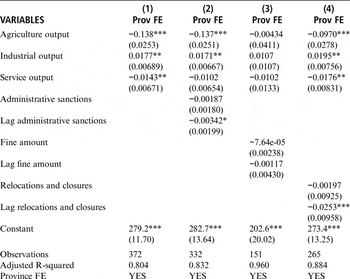
The results in Table 2 show uneven effects of different enforcement measures. On the one hand, we see that lagged relocations and closures significantly reduce pollution, and that the frequency of sanctions is linked to reduced pollution, but less significantly so. On the other hand, neither current nor lagged amount of fines can predict pollution. So it seems that the trend towards higher fines has not helped reduce pollution. One explanation can be that the height of fines is simply still too low. The other explanation can be that even with higher fines, the certainty of punishment is too low, and such certainty we know from the general criminological literature is a more important driver of behaviour than the severity of punishment (Nagin Reference Nagin2013). Our calculations based on these regressions further show that administrative sanctions and forced relocations or closures can only predict a small amount of the variation in the pollution within the sample of data. Administrative sanction frequency predicts 4.9 per cent and forced relocations and closure frequency predict 5.8 per cent in the variation of pollution. The more frequent the administrative fines and relocations and closures, the less the pollution. The explanatory power of enforcement on pollution, however, is not very big. Most of the variation in pollution can be explained by cross-province differences and differences in components of GDP output (see column 1). We see that higher industrial output is positively correlated with more pollution while higher agricultural and service output is negatively correlated with pollution.
Fixed-effect Regression with Pollution as Dependent Variable and GDP Output and Enforcement as Independent Variables Using Data from Each Province from the Following Years: Administrative Sanctions (1999–2011), Average Fines per Case (2001–2006) and Forced Relocations and Closures of Polluting Firms (1999–2008). (Annual Statistic Reports on the Environment in China (1999–2011))
Dependent Variable: Pollution

Note:
Standard errors in parentheses *** p < 0.01, ** p < 0.05, * p < 0.1.
As such, we can conclude that the strong growth of enforcement has some, but only minor, impact on pollution. A very plausible reason for this is that the strength of most administrative sanctions simply remains too weak. The absolute level of fines has remained very low – at least until 2006, the last year for which we have data – at about 13,000 yuan.
Regional trends
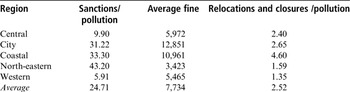
There is not just variation over time in China's environmental enforcement. There is also much regional variation, fitting China's size and geographical differences. Our data set covers environmental enforcement in all provinces in China and allows us to understand regional differences in the frequency of sanctions, the average fine per case, and the amount of relocations and closures. In order to make meaningful comparison, we scale administrative sanctions and relocations and closures by our composite pollution measure. This allows us to compare the level of enforcement in each region relative to local pollution. Average Fine per Sanction (total fines divided by number of administrative sanction cases) is left unadjusted since it is on a per case basis and therefore comparable across regions. Moreover, to understand regional differences we divide the provincial-level data into five regions with coastal provinces (Guangdong, Fujian, Zhejiang, Jiangsu and Shandong), central provinces (Hebei, Henan, Hubei, Hunan, Anhui, Shanxi, Jiangxi), city-level provinces (Beijing, Shanghai, Tianjin, Chongqing), Northeast (Jilin, Heilongjiang and Liaoning), and Western provinces (Ningxia, Inner Mongolia, Xinjiang, Yunnan, Guizhou, Sichuan, Guangxi, Shaanxi, Gansu).Footnote 47 Table 3 below outlines the data.
Regional Variation in Sanction/Pollution (1999–2011), Average Fines per Case (2001–2006) and Forced Relocations and Closures per Pollution (1999–2008). (Annual Statistic Reports on the Environment in China (1999–2011))
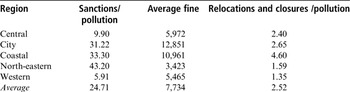
The data show large variation. We see that the most frequent sanctions relative to pollution (over the total period from 1999–2011) is in city-level and coastal provinces, especially in the north-eastern regions. Central and Western China are clear outliers in having far fewer sanctions relative to pollution than the average. In terms of fines, city and coastal areas have the highest average fines, while Western and Central China, and especially North-eastern China, have fines lower than average. In terms of closures and forced relocations, city and especially coastal regions score above average, with central and especially western and north-eastern regions scoring well below average.
Thus we see that China has developed a form of uneven enforcement. In richer regions of the coastal or city provinces we see more frequent as well as more stringent enforcement in terms of fines and relocations and closures. In Western and Central China enforcement is less frequent and less stringent. Finally, in North-eastern China we have an interesting combination of frequent yet non-stringent enforcement. Such uneven enforcement complements our picture of overall enforcement trends: enforcement has become stricter while also developing an imbalance, with stricter and more frequent enforcement in coastal and city-level provinces, and weaker enforcement elsewhere. Together with the fact that enforcement largely does not match pollution and industrial development, this can explain why the trend towards stronger enforcement found in other studies need not translate into more effective results in terms of compliance and pollution control.
Understanding Enforcement Variation and Central–Local Relations
Let us now look in some more depth at what the data about temporal and regional variation in environmental enforcement can tell us about local protectionism and the centralizing trends that may reduce it.
A first finding we see from the data discussed above is that enforcement has become more frequent and, speaking overall, also stricter. At first blush this seems to show that over time, local-level enforcement is less obstructed and it may indicate a lesser amount of influence of local protectionism. Maybe the centralizing trends are at play here. Central-level legal changes increasing minimum and maximum fine limits for pollution may well explain the rise of fine levels. Moreover, campaigns seem to have coincided with peaks in enforcement frequencies. The 2000 campaign against large pollution enterprises might, for instance, explain the peak in relocation and closures in 2000 we discussed above.
The linkage between centralizing trends and more frequent and stricter enforcement is complex, though. For example, the central-level changes in environmental targets during the 11th and 12th Five-Year Plan periods are only partly linked to the enforcement trends studied here. The 11th Five-Year Plan targets may be linked to a spike in 2007 relocations and closures concurring with the start of the introduction of the new hard environmental targets. However, by 2008 we see a strong drop in closures, probably due to the global financial crisis that started to unfold. The data on administrative sanctions show a similar story, with a small peak in 2007 when the targets were just introduced, followed by a severe drop in 2008 and 2009 as the crisis unfolded, after which there was a very high peak in sanctions in 2010 coinciding with former premier Wen Jiabao's issuing of a robust message about meeting the 11th Five-Year pollution targets (Wang 2013).
Extra central-level investment in environmental protection has helped increase local-level EPB staff numbers, and with such extra staff local-level EPBs may be better equipped to carry out enforcement work (Table 4). In the period for which we have data we see that indeed there has been a steady rise in EPB staff numbers across the nation, from about 120,000 in 1999 to 212,000 in 2013. Extra central-level investment in environmental protection most likely helped pay for at least a part of such growth in EPB human resources.
Number of EPB Staff 1999–2013 (China's Annual Environmental Statistic Yearbooks (1999–2013))

The question, though, is whether adding staff actually helps enforcement and helps overcome local protectionism. To test this, we carried out another series of fixed-effect regressions to understand what variables predict variation in the three types of law enforcement (administrative fine frequencies, fine amounts and relocations and closures) relative to pollution.
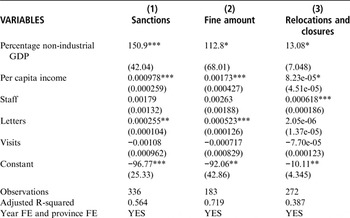
The regressions, reported in Table 5, show that once controlling for pollution, GDP growth, and complaints, adding staff itself is not significantly correlated with a higher frequency of administrative sanctions, nor with a higher level of fines. Staffing level is positively and significantly correlated with relocations and closures. One explanation for this may be that the preparation of severe sanction decisions, such as forcing a firm to relocate or close, may require extra staff rather than simply increasing the frequency and stringency of fines.
Fixed-effect Regression with Three Enforcement Measures as Dependent Variables and Non-Industrial GDP, Per Capita Income, Staff, Letters, Visits as Independent Variables Using Data from Each Province from the Following Years: Administrative Sanctions (1999–2011), Average Fines per Case (2001–2006) and Forced Relocations and Closures of Polluting Firms (1999–2008). (Annual Statistic Reports on the Environment in China (1999–2011))
Dependent Variable: Enforcement intensity (enforcement/pollution)

Note:
Standard errors in parentheses *** p < 0.01, ** p < 0.05, * p < 0.1.
The enforcement data also offer some insight into whether citizens have been able to overcome local protectionism and help aid stronger enforcement. We have data about citizen complaints about pollution (both written and in person) covering the period 1999–2006 and from 2008–2010. In 2007 and from 2011 onwards a different data accounting method was used and therefore data cannot be directly compared with other years. Table 6 sketches the development of such complaints petitions.
Number of Environmental Complaint (Letters and Visits), Total Complaints per Main Six Types of Pollutants, and Total Complaints per Industrial GDP 1999–2010 (China's Annual Environmental Statistic Yearbooks (1999–2010))

The first row in the table shows that over time there has been a rapid rise in letters of complaint and visits, from 268,592 in 1999 to 735,756 by 2010. The rise has been continual in each year. The second row shows that complaints have also risen rapidly when scaled by the amount of pollution.
As reported above in Table 5, regression analysis shows, however, that when we control for pollution, staff and industrial output, overall complaints have only a limited effect on enforcement. Only written letters affect the frequency of administrative sanctions and the size of fines, with more letters leading to more sanctions and higher fines. We do not find, however, any significant effect of complaints, whether written or in person, on the frequency of closures and relocations. As such, the rise in citizen complaints does not have much effect on the enforcement that seems to be most effective in reducing pollution, relocations and closures.
In sum, enforcement has become stricter and more frequent, and this is to some extent linked to the centralizing trends of limiting legal discretion, enforcement campaigns, extra investment in environmental protection, and a greater citizen participation. However, none of these trends explains the rise in frequency and strictness of enforcement sufficiently clearly.
Actually, our data also provide some indication that local protectionism still continues. As we saw, the rise in enforcement only seems to play a minor role in reducing pollution. Pollution is still mostly determined by the growth of industrial output. The data thus indicate a continued form of protectionism, where the economy trumps pollution. This may point on the one hand to the centralizing trends’ limits in overcoming local protectionism. As indicated above, each form of centralization has its own limits and the data examined here may show how over the period studied these trends have not been effective in overcoming resistance. Another, and perhaps concurrent, conclusion could be that centralization itself does not overcome the fundamental conflict of interest between pollution control and economic growth that also plays out at the central level, and that central-level policy itself may suffer from balancing economic growth with strong environmental enforcement.
The data analysed here do not only show a trend towards stricter enforcement, but also one with great regional variation. The continuing regional variation is a strong indication that the centralizing trends have not had the effect of creating more even or unitary enforcement. Rather, what we see is a form of uneven enforcement where some areas, especially those with large urban centres and located near the coast, having stronger enforcement, and those more inland having weaker enforcement.
To understand the uneven enforcement, we can point generally towards the role of local governments. In many of the richer coastal and urban provinces local governmentsFootnote 48 have become more committed to the environment, investing more in environmental protection and providing stronger support for local EPBs. The chief examples are the “State Environmental Protection Model Cities,” such as the coastal cities of Dalian, Zhuhai and Xiamen, whose governments boast strong environmental reputations matched with environmental spending and supportFootnote 49 and are who are introducing pro-environment rhetoric in their general policy plans. The governmental enforcement data, however, do not allow us to look at such local government commitment directly.
Our data do nonetheless allow us to look at other potential influences to understand why enforcement has been stronger in some provinces and weaker in others. The regression results we report in Table 5 above show clearly that the percentage of non-industrial GDP is associated with more and stricter enforcement, even after controlling for year and province fixed effects. In other words, provinces that rely more on industrial output in GDP have less frequent and less strict enforcement. These results indicate that stronger enforcement is more likely in areas where it fits the local economy and where it will not hamper economic growth as much.
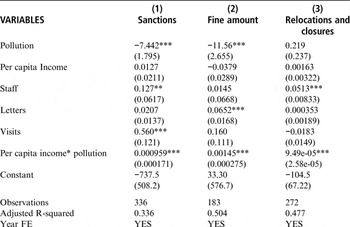
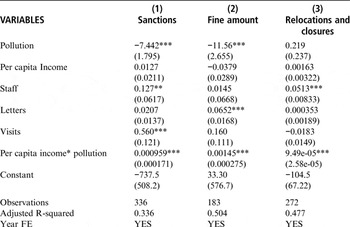
Table 5 also shows that the higher the per capita income of the province the more frequent and stricter enforcement will be. To further our analysis, we use an interaction model with enforcement as the dependent variable and controlling for year fixed effect (see Table 7). Therefore our focus is on the effect of interaction between income and pollution on enforcement intensity in the cross-section. The coefficient estimates on Per Capita Income Pollution is significantly positive, indicating that for high-income provinces, higher pollution leads to higher enforcement intensity. But this is not generally true for low-income provinces, since the point estimate on pollution itself is negative for regressions of sanctions and fine amount.
Interaction Per Capita Income and Pollution Fixed-Effect Regression with Three Enforcement Measures as Dependent Variables and Non-Industrial GDP, Per Capita Income, Staff, Letters, Visits, and Interaction between Per Capita Income and Pollution as Independent Variables Using Data from Each Province from the Following Years: Administrative Sanctions (1999–2011), Average Dependent variable: Enforcement Intensity
Note:
Standard errors in parentheses *** p < 0.01, ** p < 0.05, * p < 0.1.
From these analyses we can conclude that enforcement depends on wealth creation. Poorer provinces, especially those that have a high percentage of industrial output but low service industry, will have less enforcement. In addition, Table 5 shows, as we already reported above, that when there are more complaints there are likely to be more frequent and higher fines.
Taken all together, an uneven level in enforcement intensity may gradually be occurring between richer and poorer provinces. The richer provinces will have populations who are increasingly averse to pollution and more vocal in their complaints. Also, these provinces will have more opportunities to diversify their economies away from polluting industry. As a result, their governments are more likely to favour stronger pollution enforcement and may try and move industry away and towards poorer inland areas. Poorer provinces will still come to depend largely on these new sources of polluting income, and their poorer and less-educated populations may for some time be less vocal against the pollution and thus create less pressure for their local government to take robust action.
The resultant uneven form of enforcement complicates our view of how central–local relations affect enforcement. It is clear that there is geographical variation in the way enforcement plays out within China's central–local relations. In some localities it seems that local economic interests are more aligned with environmental protection, either economically, politically or socially, and thus we see stronger enforcement, while in others a conflict of interest maintains a continuing weak enforcement. Uneven enforcement exists even with the centralizing trends. This means either that such centralizing trends have not been able to overcome local autonomy to create a more level playing field; alternatively, such uneven enforcement might also be partially encouraged by central-level policies, such as, for example, the “Go West” policy that stimulated economic development in poorer western provinces.Footnote 50
Conclusion
Over the last decade or so there have been several trends in law, administration and society that move away or even against the local protectionism that has hampered environmental law enforcement in China for such a long time. Each of these trends has both potential and limits. When analysed in the light of available environmental enforcement data we get a mixed picture. On the one hand the centralizing trends may well have helped make enforcement stricter and more frequent. On the other, the trends have not enabled law enforcement to become highly effective in reducing pollution.Footnote 51 There continues to be a dominant influence on environmental enforcement from economic conditions, including the dependence on polluting sources of industrial income and overall wealth. Provinces with lower GDP per capita and more industry will simply enforce less and pollute more, regardless of the centralizing trends that we have analysed. As such, environmental enforcement continues to have an economic logic that is determined by economic structure and economic development. And this very likely is but the tip of the iceberg we have data for, as probably other determinants of the strength of enforcement and its effect on pollution include the type of ownership structures, the type of industry and industrial sector, and the number and size of polluting firms in a given jurisdiction.
The analysis here also shows that enforcement has become uneven.Footnote 52 On the positive side, we find provinces, chiefly city-level and coastal provinces, that have been able to go through rapid economic growth and have developed diversified economies that are starting to develop service sectors, and where enforcement can become stricter. On the negative side, we find inland provinces that are now starting to industrialize and rely on polluting sources of income, while the per capita incomes remain low. In these provinces enforcement is lagging and pollution reduction is challenging. Such uneven enforcement exists, it seems, in part due to the continued local autonomy and influence of local governments on enforcement, and in part because the centre has been unable – and maybe also unwilling – to alter such a trend and create a more even and equal form of enforcement. Such uneven enforcement might in the short run not be a problem and even be wholly rational. It allows poorer provinces to develop industry and local economies while richer provinces diversify their economy into cleaner production and service industry, matching the needs of richer citizens for a cleaner environment. However, one could also argue that such uneven enforcement simply spreads pollution from the developed parts to the originally cleaner inland areas. Moreover, in the longer run it can create a situation of environmental injustice, where the poorer people, in particular, suffer most directly from pollution from sources based in their localities.
As with any study, the present one has severe limitations. Although we have had unique data that cover more than a decade of enforcement decisions and relevant variables from most provinces, the dataset is far from perfect. First of all, we do not have data for all years. Second, for one of the forms of law enforcement, the forced closures and relocations, even though these are the most invasive governmental interventions in polluting firms, we do not know for sure which ones are carried out for pollution reasons and which ones for economic reasons. The findings about such closures and relocations should be understood to be of potential concern for either of these reasons. And third, all of the data analysed here are self-reported governmental data that may have a bias, both expected (of overreporting enforcement success and underreporting pollution) and unexpected. We hope that further study can both verify and broaden our initial analysis here.
Biographical notes
Benjamin van Rooij is the John S. and Marilyn Long Professor of US–China Business and Law at the University of California, Irvine, School of Law. His work focuses on access to justice, compliance and enforcement, studying China in comparison.
Qiaoqiao Zhu is a lecturer in Finance in the College of Business and Economics, Australia National University. His research, besides financial market issues, focuses on how laws and regulations affect economic activities, especially in emerging markets.
Li Na is a lecturer in the Law School, Yunnan University, China. Her researcher focuses on regulation and compliance studies in comparative perspective.
Wang Qiliang is a professor in the Law School, Yunnan University, China. His research focuses on implementation of law, legal anthropology and sociology studies in China.