Mesophilic lactic acid bacteria (LAB) have been widely used in traditional fermented milks, industrial fermentation processes and as starter cultures in the dairy industries (Wood, Reference Wood1997; Savadogo et al. Reference Savadogo, cheik Ouattara, paul Savadogo, Barro, Ouattara and Traore2004). Apart from the production of lactic acid, flavouring compounds and bacteriocin-like substances, several strains are able to secrete exopolysaccharides (EPS) (Sutherland, Reference Sutherland1972; Cerning, Reference Cerning1995). EPS comprises capsular polysaccharides (CPS) that are tightly associated with bacterial cell surface and/or liberated into medium as ropy/slime polysaccharides (Cerning et al. Reference Cerning, Bouillanne, Landon and Desmazeaud1992). Both capsular and ropy polysaccharides increase the viscosity of fermented milks but slime polysaccharides produce a stretchable structure unlike capsular polysaccharides (Hassan et al. Reference Hassan, Frank, Schmidt and Shalabi1996).
EPS produced by LAB have received much attention in recent years because of their contribution to the rheology and texture properties of food products (Cerning & Marshall, Reference Cerning and Marshall1999; Ruas-Madiedo & Reyes-Gavilan, Reference Ricciardi and Clementi2005). The amounts of EPS produced by lactococcal cultures vary considerably between LAB strains. The quantities reportedly ranged from 45 to 350 mg/l when bacteria are grown under non-optimized culture conditions whereas optimized culture conditions resulted in polysaccharide yield from 150 to 600 mg/l (Cerning, Reference Cerning1995; Cerning & Marshall, Reference Cerning and Marshall1999; Ricciardi & Clementi, Reference Ricciardi and Clementi2000). Although, some authors suppose a direct correlation between EPS concentrations and viscosity of product, no clear relation has been demonstrated (Wacher-Rodarte et al. Reference Wacher-Rodarte, Galvan, Farres, Gallardo, Marshall and Garcia-Garibay1993; Sebastiani & Zelger, Reference Sebastiani and Zelger1998), except that if a given strain produces more EPS the viscosity of the fermented milk will increase (Sebastiani & Zelger, Reference Sebastiani and Zelger1998). Other factors such as the molecular mass of the EPS and type of linkages especially, β-(1–4), present in the polysaccharide chain play important role in the ability of the polymer to increase viscocity (Tuinier et al. Reference Tuinier, Zoon, Cohen Stuart, Fleer and Kruif1999a, Reference Tuinier, Zoon, Olieman, Cohen-Stuart, Fleer and de Kruifb).
Dahi is a popular fermented milk product of India consumed in almost every household (Prajapati & Nair, Reference Prajapati, Nair, Edwards and Farnworth2003). It is prepared from buffalo milk (6–8% fat), cow milk (3·5–4·5% fat) or standardized milk (4·5% fat). Annual production of cultured dairy products in India has been estimated to be more than 60,000 MT with an annual growth rate of 20%. (Singh, Reference Singh2007). Dahi accounts for around 90% of the total cultured milk products produced in India. Generally, Dahi comprises mesophilic (lactococci) and thermophilic (Streptococcus thermophilus, Lactobacillus delbrueckii, Lb. helveticus etc.) species of LAB, but lactococci are most commonly used (Behare & Prajapati, Reference Behare and Prajapati2007). Health awareness among consumers generated more demands for fat-free Dahi in the Indian dairy market. However, milk fat contributes to the flavour, body and texture development of the dairy products, removal leads to flavour and textural defects (Haque & Ji, Reference Haque and Ji2003; Guven et al. Reference Guven, Yasar, Karaca and Hayaloglu2005). Well known technological approaches to improve the quality of product comprise an increase in milk solids (Rohm & Schimid, Reference Rohm and Schimid1993) and addition of stabilizers. However, these approaches do not address increasing consumer demand for product with low cost and as few food additives as possible (Duboc & Mollet, 2000). In this context, EPS producing LAB as ‘biothickeners’ can offer natural and more acceptable solution and can only be the preferred approach to many additives (Chistiansen et al. Reference Chistiansen, Madeira and Edelstein1999; De Vuyst et al. Reference De Vuyst, Zamfir, Mozzi, Adriany, Marshall, Degeest and Vaningelgem2003). These cultures meet the consumer requirement for products with low levels of chemical additives (De Vuyst et al. Reference De Vuyst, de Vin, Vaningelgem and Degeest2001; Jolly et al. Reference Jolly, Stingele, Vincent, Duboc and Neeser2002), reduce the amount of total solids required without affecting the textural attributes (Wacher-Rodarte et al. Reference Wacher-Rodarte, Galvan, Farres, Gallardo, Marshall and Garcia-Garibay1993; De Vuyst et al. Reference De Vuyst, Zamfir, Mozzi, Adriany, Marshall, Degeest and Vaningelgem2003) and improves sensory properties (Folkenberg et al. Reference Folkenberg, Dejmek, Skriver and Guldager2006).
The present study aimed at isolation and screening of EPS producing mesophilic LAB strains, characterizing EPS from selected cultures and utilizing these strains to improve textural and sensory properties of fat-free Dahi.
Materials and Methods
The study was carried out in Dairy Microbiology Division at National Dairy Research Institute, Karnal, Haryana, India.
Isolation of EPS-producing mesophilic LAB
A total number of 94 Dahi and raw milk (allowed for natural souring at 30°C) samples were collected from villages and Karnal city of India. Isolation of bacterial cultures was performed by plating appropriate dilutions of sample on milk agar (Mozzi et al. Reference Mozzi, Torino, de Valdez, Spencer and de Spencer2001) supplemented with glucose (10 g/l) and yeast extracts (3·5 g/l) and incubating the plates at 30°C for 72 h. Mucoid colonies formed on milk agar medium were randomly picked by sterile tooth pick and transferred to sterilized skim milk. Tubes in which clean lactic fermentations were observed were retained while those with undesirable fermentation (gassiness, hydrolysis of casein, separation of water) were discarded.
Identification of genera and screening for technological attributes
The EPS-producing LAB isolates were characterized by morphological and biochemical tests comprising catalase activity, growth at different temperatures, growth in 6·5% NaCl, arginine hydrolysis and growth on rogosa agar (Holzapfel & Schillinger, Reference Holzapfel, Schillinger, Barlows and Truper1992; Cogan & Accolas, Reference Cogan and Accolas1995) and screened for technological attributes such as titratable acidity, viscosity, ropiness, flavour and body and texture in 10% reconstituted skim milk.
Identification of species by biochemical and PCR methods
Based on technological properties promising EPS-producing cultures were selected and identified by testing for growth at 10, 15 and 45°C, salt tolerance (2, 4, and 6·5%), growth at pH 9·2 and 9·6, sucrose and maltose fermentation. The taxonomic identity was further confirmed by species-specific PCR using primers for gad B gene (Nomura et al. Reference Nomura, Kobayashi and Takashi2002).
Capsule staining
Capsule formation by the cultures was examined by the method of Anthony (Reference Anthony1931). Smear was prepared from skim milk culture followed by air drying without heat fixing. Few drops of crystal violet were added, kept for 2 mins and rinsed with 2·0% copper sulphate. The slides were air dried and examined under oil immersion, the capsules could be observed as unstained layer around the cell surface.
EPS production, isolation and purification
Selected EPS-producing isolates were cultured in deproteinized whey (DPW) for EPS production (Rimada & Abraham, Reference Rimada and Abraham2003). EPS from the fermented DPW was isolated by repetitive ethanol precipitation (Van Geel-Schuten et al. Reference Van Geel-Schuten, Flesch, Brink, Smith and Dijkhuizen1998). The crude EPS was purified by DEAE-cellulose ion exchange chromatography and fractions collected were analysed for sugar content by the anthrone method (Southgate, Reference Southgate and Southgate1991) and protein content by Lowry's method (Lowry et al. Reference Lowry, Rosebrough, Farr and Randal1951).
Characterization of EPS
Purified EPS was hydrolyzed with HCl by adding 500 μl EPS fraction and an equal volume of 2 m-HCl in a glass ampoule which was then sealed and heated at 100°C for 4 h. Hydrolyzed material was neutralized with 2 m-NaOH (500 μl). Determination of monosaccharide composition was performed by HPLC with sugar Pak I (300×6·5 mm) column and a refractive index detector using 100% water (HPLC grade) as mobile phase.
Molecular weight of the EPS was determined by gel filtration using Seralose-4B (Manca de Nadra et al. Reference Manca de Nadra, Strasser de Saad, Pesce de Ruiz Holgado and Oliver1985). The column was calibrated using dextrans of known molecular weights (40,000, 70,000 & 500,000 Da) at a concentration of 5 mg/ml. The molecular weight of purified EPS was determined by graphic plot of the log molecular weight of the dextran against elution volume.
Preparation of fat-free Dahi
Two selected EPS producing lactococcal isolates and non-EPS producing (mixed Dahi culture NCDC 167 obtained from National Collection of Dairy Cultures, Karnal, India) cultures were used to ferment milk. Fat-free Dahi was prepared from reconstituted (12%) skimmed milk heat treated at 90°C for 10 min, cooled to 30°C, inoculated with 2% starter culture and incubated at optimum growth temperature of the cultures. After setting of Dahi, containers were stored at 5°C for 12 h.
Physico-chemical analysis
Titratable acidity of Dahi was determined by titration method (IS:1479, partI, 1960). Whey separation was determined by the method of Wacher-Rodarte et al. (Reference Wacher-Rodarte, Galvan, Farres, Gallardo, Marshall and Garcia-Garibay1993). Thirty gram of Dahi was centrifuged at 1535 g for 20 min and the expelled whey was measured. Whey separation (%) was expressed as weight (g) of expelled whey per 100 g Dahi.
Rheological analysis
Viscosity measurement An arbitrary procedure was adopted to provide uniform samples for viscosity measurement. The gel was broken by stirring with a glass rod (10 times clockwise; 10 times anticlockwise). Rotational viscosity measurements were made using a Contraves Rheomat 108 E/R Coaxial Cylinder Viscometer (Metler-Toledo, Switzerland) with a suitable shear rate of 200/S and spindle (2‘2‘) immersed to about one third of the spindle length.
Texture profile analysis (TPA) analysis was carried out by the method described by Kumar & Mishra (Reference Kumar and Mishra2003) using a TAXT2 i Texture Analyzer (Texture Technologies corp., UK, Model TA. XT2 i, version 05.16 equipped with 5 kg load cell). Experiments were performed by compression tests that generated plot of force (grams) vs time (S). A 25 mm diameter perplex cylindrical probe (P 25) was used to measure textural profile of set Dahi samples prepared in a 100 ml beaker at the temperature of 25±1°C, performing three repetitions.
Sensory Analysis
A panel of seven trained judges performed the sensory evaluation. Dahi samples were served in 100 ml glass containers. Sensory parameters such as flavour, body and texture, colour and appearance as well as acidity were rated on a 9-point hedonic scale (like extremely 9; dislike extremely 1).
Statistical analysis
The data were analysed using SYSTAT software (version 6). The mean and standard error of the values were determined and one-way analysis of variance was used to test significance between the cultures.
Results
Isolation and identification of EPS-producing mesophilic LAB genera
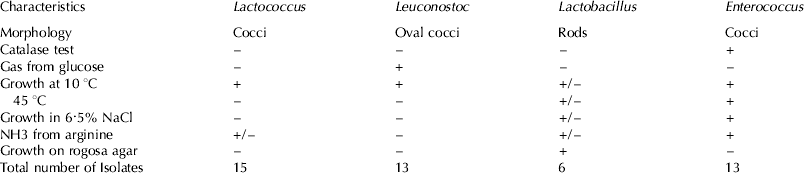
Forty seven mesophilic LAB isolates were obtained from different Dahi and raw milk samples. Based on morphological and biochemical tests, the isolates were identified as Lactococcus sp., Leuconostoc sp., Lactobacillus sp. and Enterococcus sp. (Table 1).
Characteristics of mesophilic LAB† genera
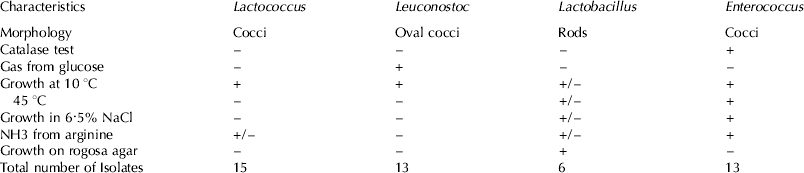
‘+’ positive reaction; ‘−’ negative reaction; +/− positive or negative reaction; † LAB were isolated from dahi and raw milk
Screening of isolates for technological attributes and species identification
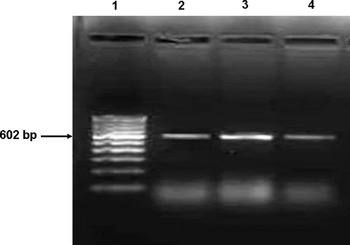
The cultures screened for technological parameters, revealed that only two isolates from Lactococcus sp. namely B-6 and KT-24, showed optimal acid production as per Bureau of Indian Standards (0·8–1·0% lactic acid), high viscosity, least ropiness, low whey separation (observed visually), pleasant flavour and good body and texture (Table 2). Biochemical tests identified B-6 and KT-24 as Lc. lactis subsp. lactis. Both the isolates yielded a PCR amplicon of 602 bp with species specific primers for Lc. lactis subsp. lactis (Fig. 1).
PCR Products of B-6 and KT-24 cultures using species-specific primers for Lc. lactis subsp lactis 1. Ladder 100 bp; 2.Lc. lactis subsp lactis B-6; 3.Lc. lactis subsp lactis KT-24; 4.Lc. lactis subsp. lactis NCDC 91 (Reference strain).

Technological properties of two selected EPS-producing Lc. lactis subsp. lactis strains and EPS-negative NCDC 167 mixed Dahi culture in 10% skim milk

Values are average of three trials
EPS production and characterization
Lc. lactis subsp. lactis B-6 and KT-24 were able to show capsules by copper sulphate staining (Fig. 2a & 2b). KT-24 produced significantly (P<0·05) higher amounts of EPS in comparison with B-6 (Table 3) and also showed large thick capsule surrounding the cell surface. Repetitive ethanol precipitation steps followed for isolation of lactococcal EPS from DPW gave better yield of carbohydrates. Purification by DEAE-cellulose ion exchange led to pure EPS with greater than 99·5% carbohydrate with negligible amount of protein content (Table 3).
Capsule formation by Lc. lactis subsp. lactis B-6 as shown by negative staining using copper sulphate.

Capsule formation by Lc. lactis subsp. lactis KT-24.

Amount, recovery, molecular weight and monosaccharide composition of EPS from Lc. lactis subsp. lactis strains
Values are means±se for n=3

a,b values with different superscripts in a column differs significantly (P<0·05); Glc- glucose; Man- Mannose; Rha- Rhamnose
The exopolysaccharide produced by Lc. lactis subsp. lactis B-6 was heteropolysaccharide composed of glucose and mannose in a ratio of 1:7·4. On the other hand, Lc. lactis subsp. lactis KT-24 produced homopolysaccharide containing only rhamnose (Table 3).
Gel filtration analysis revealed that the approximate molecular weight of EPS from B-6 was comparatively lower than the molecular weight of KT-24 (Table 3).
Effect of EPS-producing cultures on fat-free Dahi
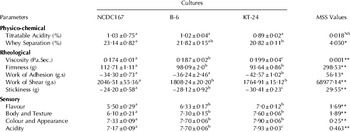
Physico-chemical characteristics The EPS producing cultures showed similar acidification profile to the control as titratable acidity of Dahi did not differ significantly between EPS+ (EPS producer) and EPS− (Non-EPS producer) cultures (Table 4). EPS production by the cultures had no bearing on titratable acidity. Susceptibility to whey separation decreased with use of EPS-producing cultures. Dahi made by Lc. lactis subsp. lactis KT-24 showed lesser whey separation. Whey separation for Lc. lactis subsp. lactis B-6 did not differ significantly from (and was midway between) EPS− NCDC 167 and EPS+ KT-24, which may be attributed to the comparatively lower EPS production by B-6.
Effect of EPS-producing Lc. lactis subsp. lactis strains on physico-chemical, rheological and sensory properties of fat-free Dahi
Values are Mean±se for n=3

** Significant at 1%; *Significant at 5%; NSNon-significant
a,b,c values with different superscripts in rows differs significantly (P<0·05)
MSS- Mean sum square
Rheological characteristics
EPS+ B-6 and KT-24 exhibited significantly higher viscosity (P<0·05) than EPS– NCDC 167 (Table 4). EPS+ B-6 and KT-24 exhibited significantly higher viscosity (P<0·05) than EPS– NCDC 167. KT-24 showed highest viscosity of Dahi. Firmness of Dahi represents the strength of the coagulum and shows an inverse relation with EPS production. Dahi prepared from B-6 and KT-24 cultures showed lower firmness values. EPS producing strains made Dahi more adhesive, which would indicate a contribution of EPS to the tendency of the product to adhere to the surface of other materials. Shear force required for Dahi prepared using EPS– NCDC 167 cultures was significantly higher (P<0·05) than Dahi with EPS+ cultures. EPS-producing cultures also increased stickiness of Dahi which further increased for higher EPS producing culture KT-24.
Sensory characteristics
Sensory scores differed significantly (P<0·05) between EPS+ and EPS– cultures (Table 4). Flavour, body and texture, colour and appearance, as well as acidity scores of Dahi were increased for B-6 and KT-24 compared with NCDC 167. The scores for these attributes related directly to the ability of culture to produce more EPS.
Discussion
The carbon sources added to the screening media play an important role in the detection of EPS phenotypes in LAB and total amount of polysaccharides produced is strongly influenced by the sugar available in the medium (Ruas-Madiedo & Reyes-Gavilan, Reference Ruas-Madiedo and de los Reyes-Gavilan2005). In the past, EPS-producing LAB have been isolated from dairy and non-dairy environments using different media; EPS Selection Medium, MRS, M17, Milk Indicator Agar and Milk Agar (Van Geel-Schuten et al. Reference Van Geel-Schuten, Flesch, Brink, Smith and Dijkhuizen1998; Smitinont et al. Reference Smitinont, Tansakul, Tanasupawat, Keeratipibul, Navarini, Bosco and Cescutti1999; Sanni et al. Reference Sanni, Onilude, Ogunbanwo, Fadahunsi and Afolabi2002; Savadogo et al. Reference Savadogo, cheik Ouattara, paul Savadogo, Barro, Ouattara and Traore2004). These media contain high concentrations of sugar that facilitates easy differentiation of EPS strains from non-EPS by allowing them to form mucoid colonies on agar plates (Vescovo et al. Reference Vescovo, Scolari and Bottazzi1989; Dierksen et al. Reference Dierksen, Sandine and Trempy1997). In our study, we used milk agar supplemented with glucose to increase the probability of EPS producing phenotypes. However, limited numbers of EPS-producing mesophilic phenotypes could be obtained after screening a large number of Dahi and raw milk samples, which indicates low frequency of isolation of these cultures in agreement with other studies (Smitinont et al. Reference Smitinont, Tansakul, Tanasupawat, Keeratipibul, Navarini, Bosco and Cescutti1999; Sanni et al. Reference Sanni, Onilude, Ogunbanwo, Fadahunsi and Afolabi2002).
Primary screening of EPS+ LAB strains for technological attributes is important because not all EPS cultures produce product with desirable characteristics (De Vuyst et al. Reference De Vuyst, Zamfir, Mozzi, Adriany, Marshall, Degeest and Vaningelgem2003). We selected only two Lc. lactis strains because most cultures showed poor flavour, weak curd and developed ropiness. Excessive ropiness produced in Dahi is undesirable. The ability to synthesize capsular polysaccharides (CPS) or produce ropy (R+) polysaccharide by LAB is strain dependent and very few reports indicate LAB strains that produce both CPS and ropy polysaccharide (Knoshaug et al. Reference Knoshaug, Ahlgren and Trempy2000; Ruas-Madiedo et al. Reference Ruas-Madiedo, Tuinier, Kanning and Zoon2002; Hassan et al. Reference Hassan, Frank, Farmer, Schmidt and Shalabi1995). Mozzi et al. (Reference Mozzi, Vaningelgem, Hebert, VanderMeulen, Moreno, Font de Valdez and De Vuyst2006) reported that out of 201 EPS-producing LAB, only two thermophilic strains showed both CPS+ and R+ character, whereas six mesophilic LAB produced both capsular as well as ropy polysaccharides.
Analysis of monosaccharide composition revealed that the polymer of B-6 comprised glucose and mannose while that of KT-24 contained only rhamnose. The monosaccharides occurring most frequently in the various exopolysaccharides from mesophilic lactic acid bacteria are glucose (Cerning, Reference Cerning1995; Marshall et al. Reference Marshall, Cowie and Moreton1995), rhamnose (Nakajima et al. Reference Nakajima, Toyoda, Toba, Itoh, Mukai, Kitazawa and Adachi1990; Mozzi et al. Reference Mozzi, Vaningelgem, Hebert, VanderMeulen, Moreno, Font de Valdez and De Vuyst2006) and mannose (Cerning et al. Reference Cerning, Bouillanne, Landon and Desmazeaud1992; Savadogo et al. Reference Savadogo, cheik Ouattara, paul Savadogo, Barro, Ouattara and Traore2004). To our knowledge, this is the first report of a rhamnose homopolysaccharide produced by Lc. lactis subsp. lactis. Few lactobacilli and streptococci have been reported earlier to produce EPS containing rhamnose along with some other sugars, glucose or galactose (De Vuyst et al. Reference De Vuyst, Zamfir, Mozzi, Adriany, Marshall, Degeest and Vaningelgem2003; Dolyeres et al. Reference Dolyeres, Schaub and Lacroix2005, Savadogo et al. Reference Savadogo, cheik Ouattara, paul Savadogo, Barro, Ouattara and Traore2004).
The polysaccharide produced by KT-24 had a molecular weight of 4·5×104 Da compared with 3×10⁴ Da molecular weight of EPS produced by B-6. The molecular weight of a given polymer is related to the thickening effect of an EPS in aqueous solution (Tuinier et al. 1999a, b; Ruas-Madiedo et al. Reference Ruas-Madiedo, Tuinier, Kanning and Zoon2002).
Results of technological parameters for fat-free Dahi demonstrate that, EPS producing lactococcal cultures had significant effect on physico-chemical, rheological and sensory properties. Whey separation was reduced in Dahi made by in situ EPS producing cultures due to the ability of EPS to bind significant amount of water. Previous studies also report the water binding ability of EPS in yoghurt (Wacher-Rodarte et al. Reference Wacher-Rodarte, Galvan, Farres, Gallardo, Marshall and Garcia-Garibay1993; Marshall & Rawson, Reference Marshall and Rawson1999; Doleyres et al. Reference Dolyeres, Schaub and Lacroix2005).
Viscosity, adhesiveness and stickiness of fat-free Dahi increased when EPS-producing cultures were used indicating that EPS contributed to the rheological properties (Rawson & Marshall, Reference Rawson and Marshall1997; Marshall & Rawson, Reference Marshall and Rawson1999; Dolyeres et al. Reference Dolyeres, Schaub and Lacroix2005; Folkenberg et al. Reference Folkenberg, Dejmek, Skriver and Ipsen2005). Adhesiveness is an important factor for the description of mouth feel for a given food material. Dahi made from EPS negative culture was firmer and required higher shearing force, due to the formation of strong protein-protein interactions as a result of the fermentation process (Hassan et al. Reference Hassan, Frank, Schmidt and Shalabi1996; Bouzar et al. Reference Bouzar, Cerning and Desmazeaud1997; Marshall & Rawson, Reference Marshall and Rawson1999). The contribution of the EPS producing strains to the textural properties is said to be a result of the secretion of extracellular polysaccharides and the ability of the polysaccharide to form strands which connect the bacteria to the casein micelles (Tamime et al. Reference Tamime, Kaloh and Davies1984).
Sensory scores such as flavour, body and texture, colour and appearance and acidity of Dahi were also improved by use of EPS-producing cultures. Folkenberg et al. (Reference Folkenberg, Dejmek, Skriver and Ipsen2005) reported that yoghurt fermented with EPS-producing cultures showed increased mouth thickness, shininess and tended to be creamier than yoghurt without these cultures.
The water holding capacity, viscosity, adhesiveness and stickiness of Dahi increased, when culture produced more EPS and high molecular weight EPS. However, it was difficult to say whether it was the effect of more EPS or high molecular weight because KT-24 showed higher EPS production as well as produced high molecular weight compound than B-6.
To conclude, two new EPS producing Lc. lactis subsp. lactis strains have been isolated and these cultures improved rheological and sensory properties of fat-free Dahi; showed lower susceptibility to whey separation, higher viscosity, adhesiveness, stickiness and sensory attributes.
We express our gratitude to the Director General, Indian Council of Agricultural Research (ICAR) and Director, National Dairy Research Institute (NDRI) Karnal, for providing financial assistance and necessary facilities to carry out this study.