INTRODUCTION
The Atlantic spotted dolphin, Stenella frontalis (G. Cuvier, 1829) (Rice, Reference Rice1998) is a tropical and warm temperature small cetacean endemic to the Atlantic Ocean (Perrin, Reference Perrin2002). The current distribution of the species is described from southern Brazil to the north-east coast of the United States, including the Caribbean and Gulf of Mexico; Africa, in the eastern portion of the Atlantic; and Madeira and Azores Islands in the North Atlantic (Perrin, Reference Perrin2002). The species is more common in shallow waters around the 200 m curve, although some sightings up to 961 m of depth have been recorded (Jefferson & Schiro, Reference Jefferson and Schiro1997; Zerbini et al., Reference Zerbini, Secchi, Bassoi, Dalla-Rosa, Higa, Sousa, Moreno, Moller and Caon2004; Moreno et al., Reference Moreno, Zerbini, Danilewicz, Santos, Simões-Lopes, Lailson-Brito and Azevedo2005). It was suggested that the species has a large more spotted form inhabiting the continental shelf and a smaller and less spotted pelagic offshore form (Perrin et al., Reference Perrin, Mitchell, Mead, Caldwell, Caldwell, van Bree and Dawbin1987).
In a recent review, Stenella frontalis records were concentrated in two regions of the south-west (SW) Atlantic Ocean: a southern population restricted to the warm-temperate waters of the south and south-eastern coasts of Brazil (21° to 33°S) and a northern population occurring in more tropical waters (north of 6°S) (Moreno et al., Reference Moreno, Zerbini, Danilewicz, Santos, Simões-Lopes, Lailson-Brito and Azevedo2005). Between these two populations, there is a gap of records for this species (Moreno et al., Reference Moreno, Zerbini, Danilewicz, Santos, Simões-Lopes, Lailson-Brito and Azevedo2005; Danilewicz et al., Reference Danilewicz, Ott, Secchi, Andriolo and Zerbini2013). Recently Caballero et al. (Reference Caballero, Santos, Sanches, Antonio and Mignucci-Giannoni2013) compared molecular data of different areas of distribution of Stenella frontalis and the Brazilian south-eastern population differed from the Caribbean population, supporting this discontinuity. The southern limit of the distribution of this population is located in a region of confluence of the warm Brazil Current and the cold Malvinas/Falkland Current (Campos et al., Reference Campos, Miller, Müller and Peterson1995), referred to as Subtropical Convergence. This paper reports a sighting of Stenella frontalis which expands the southern limit of distribution of this species to the waters of Uruguay.
MATERIALS AND METHODS
The sighting occurred during a geophysical seismic survey in shelf and slope waters of Uruguay. The vessel used was 80 m long and covered predetermined lines over 100 km at an average speed of five knots. A dedicated marine mammal observer was present during daylight hours. Observations were made from the control bridge wings in advantage points about 17 m height from sea level using 7 × 50 binoculars and naked eye. Hourly coordinates, water depth, sea state (Beaufort scale) and presence of seabirds were recorded. Information recorded regarding each cetacean group observed were species, group size, age-class and behaviour.
RESULTS AND DISCUSSION
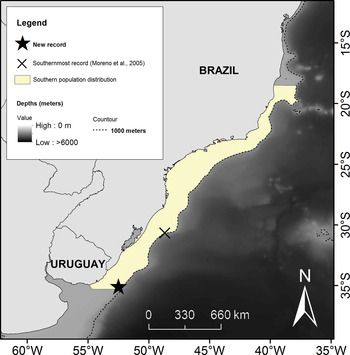
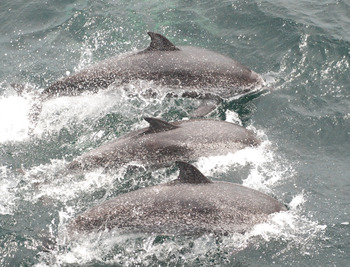
On 2 February 2013, a large group of Stenella frontalis was sighted within the continental shelf of Uruguay at 14:40 (35°04′51″S and 52°29′32″W) (Figure 1), north from the mouth of Rio de la Plata. The observation conditions were good and the sea state was 4 according to the Beaufort scale. The temperature of the water measured in loco at 12 m of depth was 24.4°C. The sea-surface temperature of the sighting area was 23.6°C, measured through a three-day composite image of the MODIS sensor (AQUA satellite). The species could be identified by careful examination of photographs observing external characteristics such as the body shape, prolonged snout and typical colour pattern. The unique combination of dorsal spotting and the presence of the spinal blaze in adult individuals was clearly visible (see Perrin et al., Reference Perrin, Mitchell, Mead, Caldwell, Caldwell, van Bree and Dawbin1987) (Figure 2). Younger individuals lack or had few spots, but a faint spinal blaze could be observed in some individuals.
Sighting location of Stenella frontalis off Uruguay.

Bow-riding of Stenella frontalis dolphins off Uruguay: note the distinctive heavily spotted, dorsal cape and spinal blaze coloration of the dolphins.

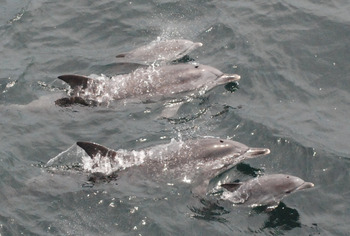
The group was first sighted travelling towards the vessel. We observed the dolphins for approximately one hour at a depth of 132 m and 140 km from the coast. Some animals approached the vessel for bow riding (10–50 m from the vessel) while a larger aggregation was further away (200–500 m from the vessel). We observed behavioural events such as porpoising and breaching. The direction of travel was variable as the group moved cohesively and sometimes in line formation. Great shearwaters (Puffinus gravis) and white-chinned petrels (Procellaria aequinoctialis) from the family Procellariidae, were flying over and diving near the group of dolphins, resembling a feeding association. There were about 20–30 dolphins in the bow riding sub-group, while the size of the larger aggregation was estimated to range between 150 and 200 dolphins. Adults and calves were present (Figure 3).
Stenella frontalis dolphins with calves near the vessel.

Group size of this species is relatively small compared with other Stenella species, usually smaller than 50 individuals in the continental shelf (Perrin et al., Reference Perrin, Mitchell, Mead, Caldwell, Caldwell, van Bree and Dawbin1987) but groups of hundreds have also been observed (Moreno et al., Reference Moreno, Zerbini, Danilewicz, Santos, Simões-Lopes, Lailson-Brito and Azevedo2005). The group observed in this paper is similar to the largest aggregations observed for the species (Perrin et al., Reference Perrin, Mitchell, Mead, Caldwell, Caldwell, van Bree and Dawbin1987; Moreno et al., Reference Moreno, Zerbini, Danilewicz, Santos, Simões-Lopes, Lailson-Brito and Azevedo2005), and this may result from being in the boundaries of their distribution, where ecological and environmental pressures may favour larger aggregations. One of such pressures is the risk of predation by the killer whale (Orcinus orca). The density of killer whales increases in high latitudes (Forney & Wade, Reference Forney, Wade, Estes, DeMaster, Doak, Williams and Brownell2006), and there are many records of the species in Argentina, Uruguay and southern Brazil (Iñíguez, Reference Iñíguez2001; Pinedo et al., Reference Pinedo, Polacheck, Barreto and Lammardo2002; Iriarte, Reference Iriarte2006; Passadore et al., in press).
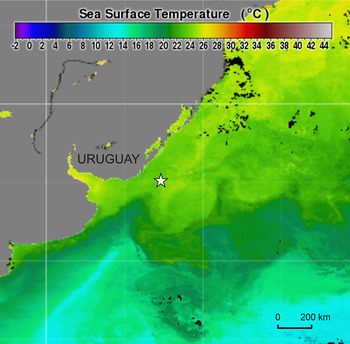
A literature review (both peer-reviewed and grey) revealed that so far no stranding of the species was recorded in Uruguay. The linear distance between this sighting and the southernmost sighting reviewed by Moreno et al. (Reference Moreno, Zerbini, Danilewicz, Santos, Simões-Lopes, Lailson-Brito and Azevedo2005) is approximately 600 km, further expanding the range of the species to the Uruguayan waters (35°S). Animals were probably feeding and, judging by the presence of newborn calves they also could breed in these waters. The record was in the austral summer and the movement of Atlantic spotted dolphins to Uruguay, within the Subtropical Convergence, suggests that dolphins reach the southernmost portion of their range during the expansion and influence of the warm Brazil Current in the summer as stated by Moreno et al. (Reference Moreno, Zerbini, Danilewicz, Santos, Simões-Lopes, Lailson-Brito and Azevedo2005). During our sighting, the large group of dolphins was approximately 100 km north of a thermal front of the Malvinas/Falkland Current, on the shelf off the mouth of Rio de la Plata. This thermal front was clearly visible from images of the sea-surface temperature of the MODIS sensor (AQUA satellite) (Figure 4). In the winter the species probably move up north when the transport of the Brazil Current decreases and the cold Malvinas/Falkland Current exerts influence in the region (see Matano et al., Reference Matano, Schlax and Chelton1993).
Eight-day composite image of the sensor MODIS of the AQUA satellite showing the sea-surface temperature of the study area from the 2 to 9 February 2013 (source: US National Oceanographic and Atmospheric Administration—NOAA (2014)). Star indicates the sighting location of Stenella frontalis.

Other alternative explanations for the occurrence of the species off Uruguay include temporary oceanographic events or climate change. Temporary oceanographic events or anomalies may cause mass strandings or out-of-range wanderings of cetaceans (see Pinedo et al., Reference Pinedo, Lammardo and Barreto2001; Moreno et al., Reference Moreno, Danilewicz, Borges-Martins, Ott, Caon and Oliveira2003). Nevertheless, El Niño or La Niña were not observed before or during the record presented here (see the Southern Oscillation Index from NOAA (2014)). Another alternative explanation is a range expansion due to climate change and warming of the waters of the SW Atlantic (see Burrows et al., Reference Burrows, Schoeman, Buckley, Moore, Poloczanska, Brander, Brown, Bruno, Duarte, Halpern, Holding, Kappel, Kiessling, O'Connor, Pandolfi, Parmesan, Schwing, Sydeman and Richardson2011). In the last decades the Malvinas/Falkland Current got colder and the Brazilian current got warmer, and this may cause distribution shifts of certain species such as the Atlantic spotted dolphin. Since there are no evidences of unusual climatic events and the oceanographic conditions during our sighting were within the thermal niche of the species, the absence of sightings off Uruguay is most likely due to the lack of observation effort. To date, this is the southernmost record of the Atlantic spotted dolphin in the SW Atlantic Ocean.
ACKNOWLEDGEMENTS
We (Paro A.D. and Rojas E.) thank RPS Group Plc for the opportunity to embark in their programme for marine mammal mitigation during seismic operations. Andressa D'Agostini provided helpful advice about AQUA-MODIS satellite images. The comments of Dr Paulo Simões-Lopes and two anonymous referees greatly improved this manuscript.