


%20--%3e%3c!DOCTYPE%20svg%20PUBLIC%20'-//W3C//DTD%20SVG%201.0//EN'%20'http://www.w3.org/TR/2001/REC-SVG-20010904/DTD/svg10.dtd'%3e%3csvg%20version='1.0'%20id='Layer_1'%20xmlns='http://www.w3.org/2000/svg'%20xmlns:xlink='http://www.w3.org/1999/xlink'%20x='0px'%20y='0px'%20width='64px'%20height='64px'%20viewBox='5.5%20-3.5%2064%2064'%20enable-background='new%205.5%20-3.5%2064%2064'%20xml:space='preserve'%3e%3cg%3e%3ccircle%20fill='%23FFFFFF'%20fill-opacity='0'%20cx='37.785'%20cy='28.501'%20r='28.836'/%3e%3cpath%20fill='%23595959'%20d='M37.441-3.5c8.951,0,16.572,3.125,22.857,9.372c3.008,3.009,5.295,6.448,6.857,10.314%20c1.561,3.867,2.344,7.971,2.344,12.314c0,4.381-0.773,8.486-2.314,12.313c-1.543,3.828-3.82,7.21-6.828,10.143%20c-3.123,3.085-6.666,5.448-10.629,7.086c-3.961,1.638-8.057,2.457-12.285,2.457s-8.276-0.808-12.143-2.429%20c-3.866-1.618-7.333-3.961-10.4-7.027c-3.067-3.066-5.4-6.524-7-10.372S5.5,32.767,5.5,28.5c0-4.229,0.809-8.295,2.428-12.2%20c1.619-3.905,3.972-7.4,7.057-10.486C21.08-0.394,28.565-3.5,37.441-3.5z%20M37.557,2.272c-7.314,0-13.467,2.553-18.458,7.657%20c-2.515,2.553-4.448,5.419-5.8,8.6c-1.354,3.181-2.029,6.505-2.029,9.972c0,3.429,0.675,6.734,2.029,9.913%20c1.353,3.183,3.285,6.021,5.8,8.516c2.514,2.496,5.351,4.399,8.515,5.715c3.161,1.314,6.476,1.971,9.943,1.971%20c3.428,0,6.75-0.665,9.973-1.999c3.219-1.335,6.121-3.257,8.713-5.771c4.99-4.876,7.484-10.99,7.484-18.344%20c0-3.543-0.648-6.895-1.943-10.057c-1.293-3.162-3.18-5.98-5.654-8.458C50.984,4.844,44.795,2.272,37.557,2.272z%20M37.156,23.187%20l-4.287,2.229c-0.458-0.951-1.019-1.619-1.685-2c-0.667-0.38-1.286-0.571-1.858-0.571c-2.856,0-4.286,1.885-4.286,5.657%20c0,1.714,0.362,3.084,1.085,4.113c0.724,1.029,1.791,1.544,3.201,1.544c1.867,0,3.181-0.915,3.944-2.743l3.942,2%20c-0.838,1.563-2,2.791-3.486,3.686c-1.484,0.896-3.123,1.343-4.914,1.343c-2.857,0-5.163-0.875-6.915-2.629%20c-1.752-1.752-2.628-4.19-2.628-7.313c0-3.048,0.886-5.466,2.657-7.257c1.771-1.79,4.009-2.686,6.715-2.686%20C32.604,18.558,35.441,20.101,37.156,23.187z%20M55.613,23.187l-4.229,2.229c-0.457-0.951-1.02-1.619-1.686-2%20c-0.668-0.38-1.307-0.571-1.914-0.571c-2.857,0-4.287,1.885-4.287,5.657c0,1.714,0.363,3.084,1.086,4.113%20c0.723,1.029,1.789,1.544,3.201,1.544c1.865,0,3.18-0.915,3.941-2.743l4,2c-0.875,1.563-2.057,2.791-3.541,3.686%20c-1.486,0.896-3.105,1.343-4.857,1.343c-2.896,0-5.209-0.875-6.941-2.629c-1.736-1.752-2.602-4.19-2.602-7.313%20c0-3.048,0.885-5.466,2.658-7.257c1.77-1.79,4.008-2.686,6.713-2.686C51.117,18.558,53.938,20.101,55.613,23.187z'/%3e%3c/g%3e%3c/svg%3e)
%20--%3e%3c!DOCTYPE%20svg%20PUBLIC%20'-//W3C//DTD%20SVG%201.0//EN'%20'http://www.w3.org/TR/2001/REC-SVG-20010904/DTD/svg10.dtd'%3e%3csvg%20version='1.0'%20id='Layer_1'%20xmlns='http://www.w3.org/2000/svg'%20xmlns:xlink='http://www.w3.org/1999/xlink'%20x='0px'%20y='0px'%20width='64px'%20height='64px'%20viewBox='5.5%20-3.5%2064%2064'%20enable-background='new%205.5%20-3.5%2064%2064'%20xml:space='preserve'%3e%3cg%3e%3ccircle%20fill='%23FFFFFF'%20fill-opacity='0'%20cx='37.637'%20cy='28.806'%20r='28.276'/%3e%3cg%3e%3cpath%20fill='%23595959'%20d='M37.443-3.5c8.988,0,16.57,3.085,22.742,9.257C66.393,11.967,69.5,19.548,69.5,28.5c0,8.991-3.049,16.476-9.145,22.456%20C53.879,57.319,46.242,60.5,37.443,60.5c-8.649,0-16.153-3.144-22.514-9.43C8.644,44.784,5.5,37.262,5.5,28.5%20c0-8.761,3.144-16.342,9.429-22.742C21.101-0.415,28.604-3.5,37.443-3.5z%20M37.557,2.272c-7.276,0-13.428,2.553-18.457,7.657%20c-5.22,5.334-7.829,11.525-7.829,18.572c0,7.086,2.59,13.22,7.77,18.398c5.181,5.182,11.352,7.771,18.514,7.771%20c7.123,0,13.334-2.607,18.629-7.828c5.029-4.838,7.543-10.952,7.543-18.343c0-7.276-2.553-13.465-7.656-18.571%20C50.967,4.824,44.795,2.272,37.557,2.272z%20M46.129,20.557v13.085h-3.656v15.542h-9.944V33.643h-3.656V20.557%20c0-0.572,0.2-1.057,0.599-1.457c0.401-0.399,0.887-0.6,1.457-0.6h13.144c0.533,0,1.01,0.2,1.428,0.6%20C45.918,19.5,46.129,19.986,46.129,20.557z%20M33.042,12.329c0-3.008,1.485-4.514,4.458-4.514s4.457,1.504,4.457,4.514%20c0,2.971-1.486,4.457-4.457,4.457S33.042,15.3,33.042,12.329z'/%3e%3c/g%3e%3c/g%3e%3c/svg%3e)

Introduction
From the late seventh century AD, silver was the primary material used for coin production in northern and western Europe (Naismith Reference Naismith and Butcher2020: 195–96). Recent studies on the origins of this silver have suggested it was sourced from recycled Byzantine silver plate or the mines at Melle (France) (Loveluck et al. Reference Loveluck2018; Kershaw et al. Reference Kershaw2024). Fluctuations in the silver content of coins, whether by design or circumstance, were not unknown but even the severest debasements did not normally result in the complete removal of silver. The only western European exception to this is found in ninth-century Northumbria, a kingdom broadly defined as extending from the River Humber, South Yorkshire and Lancashire north to the Firths of Forth and Clyde, and from the Irish Sea in the west to the North Sea in the east (Figure 1; Petts & Turner Reference Petts, Turner and Turner2011: 1–2). In Northumbria, periodic debasement ultimately resulted in a low-value copper-alloy coinage, commonly called the styca, “the first independently evolved base-metal currency in post-Roman western Europe” (Naismith Reference Naismith2023: 313). Northumbria’s ninth-century coins, regulated by kings and archbishops, contained up to 40 per cent silver until the later part of Eanred’s reign (c. 830–840/1), when the figure dropped to a maximum of 10 per cent, later dropping again during the second reign of Aethelred II (844–848/9), when all silver was removed (Naismith Reference Naismith2017: 120–21) (Figure 2). Although the name styca is now commonly used to describe the debased ninth-century coins, the term did not come into use until the late seventeenth century and the actual name of the coins is unknown (Naismith Reference Naismith2017: 115).
Map showing the area of the UK covered by this study (figure by author).

Copper-alloy coin of Aethelred II (second reign) (PAS YORYM-889249): diameter 12.4mm; scale bars removed from original image (© York Museums Trust, CC BY 4.0, https://finds.org.uk/pas/recorded-find/YORYM-889249).

Outside of the Byzantine, Islamic and Mediterranean worlds, the production of copper or copper-alloy coins was virtually unknown in medieval western Europe, thirteenth-century Hungary being the only other example prior to the fifteenth century (Spufford Reference Spufford1988: 10). In the Byzantine, Islamic and Mediterranean worlds, base-metal and precious-metal coins circulated together. Contemporaneous Northumbrian precious-metal coins were produced, as evidenced by a silver penny of Eanred from the Trewhiddle hoard (Cornwall) and a gold solidus of Archbishop Wigmund of York (c. 837–854), but these single specimens, the latter of which had been pierced, were likely to have been special issues and not for general circulation.
Ninth-century Northumbria, therefore, represented an exceptional case in early medieval Europe. Unlike other monetary systems based solely or partly on precious metals, Northumbria’s system was based entirely on a fiduciary coin, whose use depended on trust rather than any intrinsic value. Nevertheless, studying debasement in Northumbria can shed light on wider events, such as Viking raids, debasements elsewhere in Europe and the development and use of coins in early medieval Europe. While the increased circulation of debased coins in Northumbria suggests debasement as a means to increase the quantity of coins, without addressing the precious-metals evidence such interpretations are incomplete. Investigating the availability of silver is the key step, allowing us to infer whether debasement was a forced move, and assessing the availability of gold can offer further insights into the economic climate of ninth-century Northumbria.
Ninth-century Northumbria and its coinage: decline or revival
The circumstances behind debasement in Northumbria have been debated and two broad interpretations have emerged that see the new coinage as indicative of either the kingdom’s decline or, conversely, its vitality.
In the first interpretation, Northumbria was an impoverished kingdom suffering from Viking raids and uniquely violent internal political conflicts (Hodgkin Reference Hodgkin1952: 405–408; Higham Reference Higham1993: 145–46); at times described as backward (Hodgkin Reference Hodgkin1952: 405), bankrupt (Dolley Reference Dolley1958: 16) and degenerate (Smyth Reference Smyth1975: 54); its decline was particularly evident in the transition from silver to copper-alloy coins, which are widely condemned (Dolley Reference Dolley1958: 38; Smyth Reference Smyth1975: 54; Rollason Reference Rollason2003: 224), “a testimony to the weakness of the dying Northumbrian kingdom” (Griffiths Reference Griffiths and Davies2003: 80). The silver pennies of Northumbria’s contemporaries and the later Viking rulers of York, on the other hand, are highly praised (Dolley Reference Dolley1958: 38; Smyth Reference Smyth1975: 47; Rollason Reference Rollason2003: 224) and held as the standard to which Northumbria had been unable to conform (Higham Reference Higham1993: 203). The move from silver to copper-alloy coins is seen as reflecting a severe silver shortage caused by tribute payments to Mercia, the hoarding of silver by tax-exempt churches and Viking raids (the first recorded raid on Northumbria was on Lindisfarne in 793; Dolley Reference Dolley and Wilson1976: 355; Higham Reference Higham1993: 166–67). These raids are suggested to have disrupted international trade so that Northumbria suffered “a drastic economic collapse” (Booth Reference Booth and Metcalf1987: 73), with the sophisticated system of silver coinage largely disintegrating and minting diminishing substantially during the reign of Eardwulf (traditionally dated 796–806 & 808–810; Booth Reference Booth and Metcalf1987: 58, 73–76, Reference Booth, Geake and Kenny2000: 87–88). The base-metal coinage that followed this decline left Northumbria isolated from its contemporaries (Kirby Reference Kirby1991: 196; Booth Reference Booth, Geake and Kenny2000: 88).
Yet, ninth-century Northumbria has also been viewed more positively. In this alternative interpretation, the paucity of contemporaneous texts, coupled with the fall of Northumbria to the Vikings in 867, gives a misleading picture of a kingdom dangerously close to disintegrating (Yorke Reference Yorke2003: 97). Politically, the final decades of Northumbria (805–866) witnessed fewer usurpations and assassinations compared to a similar period of time in the eighth century (736–796) (Kirby Reference Kirby and Metcalf1987: 18). While Northumbria did suffer from political infighting, and powerful non-royal individuals held power, these situations were neither unique to the kingdom nor did they make it perilously unstable (Naismith Reference Naismith2017: 125). Kingship was dominated by a powerful dynastic line (Yorke Reference Yorke2003: 97) and Northumbria maintained a vibrant monastic culture (Kirby Reference Kirby and Metcalf1987: 14–15).
Continued minting into the ninth century evidenced a system under strong royal control, resilient enough to come through threats in a relatively robust state (Pirie Reference Pirie1995: 25). Metallurgical analysis of coins also suggests a stable and controlled minting system (Metcalf & Northover Reference Metcalf and Northover1987: 212–14). Alloys were produced by a workforce adept at manipulating the metals to achieve maximum efficiency (Smith Reference Smith2002: 70–72). Large quantities of tin and brass (a copper-zinc alloy) were increasingly added to the coinage (Naismith Reference Naismith2023: 313). The copper needed for brass was available in Northumbria but zinc was not and neither was tin, indicating an extensive metal trade (Naismith Reference Naismith2023: 313).
The iconography of the coins remained the same. Almost all the base-metal coins bear the name of the issuing authority on the obverse and the moneyer on the reverse. This design pre-dates debasement, being first adopted on silver coins minted in the late 780s (Naismith Reference Naismith2017: 118, 122). As well as design, the debased ninth-century coins used the same small, thick flan as the late eighth-century silver coins, further emphasising continuity in the coinage (Naismith Reference Naismith2017: 115).
The rate of debasement in Northumbria was no greater than that seen in first- to third-century AD Rome (Naismith Reference Naismith and Butcher2020: 198). The greatest period of debasement came during a time of political stability when Eanred handed over the reins of power to his son Aethelred II (Naismith Reference Naismith2017: 125, Reference Naismith2023: 313). It is possible that this metallurgical shift could have been caused by a lack of precious metal to sustain an orthodox currency. To test this, the entire assemblage of ninth-century gold and silver objects found in Northumbria are analysed in this article. Gold, though not directly related to debasement, can provide insights into the state of the economy. Precious-metal artefacts such as strap-ends have been used to highlight that Northumbria was not significantly less able to obtain these resources than other kingdoms (Thomas Reference Thomas and Bork2005: 43). The high-status items in the Poppleton hoard (York), for example, rival those created south of the Humber (Thomas Reference Thomas2006: 159), suggesting that silver was available and that the ongoing debasement reflected an increasingly monetised society (Thomas Reference Thomas and Bork2005: 43). The gold solidus depicting Archbishop Wigmund also indicates the wealth that existed at the time (Pirie Reference Pirie, Cook and Williams2006: 216). By bringing together the analysis of all this evidence, a greater appreciation of the circumstances behind the production of this unique coinage is made possible.
Materials and methods
A detailed database of gold and silver finds has been constructed by carrying out a comprehensive search of the relevant literature and sources (see online supplementary material (OSM) 1 & 2 for the database, information on how it was constructed and guidance notes). Different objects from the same site are counted as different finds. Hoards are counted as single finds, though their contents are discussed individually. Over half the finds studied here were recorded by the Portable Antiquities Scheme (PAS), which records archaeological artefacts found by the public in England and Wales and makes them accessible through an online database (https://finds.org.uk/database).
The finds vary in the quantities of precious metals present and in their period of production. As such, the data are filtered and organised to show, as far as possible, the ninth-century precious-metal finds. To facilitate this, the dataset is split into three categories labelled ‘certain’, ‘likely’ and ‘possible’. Certain finds are those made of, or decorated with, precious metals that date to the ninth century. Likely finds are precious-metal or precious-metal decorated objects that may date from more than one century but most likely date from the ninth century (e.g. 800–925). Possible finds are those that are potentially relevant but have issues regarding date (e.g. 50% chance of dating from the ninth century) and/or the presence of precious metals (e.g. possible decoration).
The possible category also contains hoards and burial assemblages, with, or potentially with, Viking associations. These contain Anglo-Saxon precious-metal or precious-metal decorated objects that are certain or likely to date from the ninth century. While the material and date would make these objects relevant, some of the contexts are later. The location of these hoards and burials in Northumbria, as well as stylistic features on some objects, may indicate that they are Northumbrian (for strap-ends, for instance, there is some evidence of production in Northumbria in the form of a mould from Carlisle, Cumbria; Taylor & Webster Reference Taylor and Webster1984), but the Vikings’ propensity to move portable wealth across political borders means that for some objects an origin outside the kingdom is also possible. Viking movement also raises the issue of when and for how long the objects were in Northumbria in the ninth century. As a result, these objects are listed in the possible category. Given the uncertainties surrounding possible finds, conclusions about the availability of gold and silver are largely based on the certain and likely finds, though the impact of the possible finds on these conclusions is noted.
The filtered data had to be quantified for analysis. Two issues prevent quantification by weight. First, some of the objects consist of non-precious metals as well as precious metals; as these cannot be separated into their constituent parts, the amount of gold or silver used cannot be weighed. Second, the composition of the precious metals used is not always known and therefore it is not possible to quantify gold and silver by weight.
Due to these issues, other methods were used to quantify gold and silver. Initially, the availability was quantified by the number of finds. This provides the simplest way of assessing whether gold and silver were available and on what scale. Combining this raw availability with other information about the finds, derived from assessing them individually, can shed further light on the matter. This information includes the type of object, its size, whether the object was made entirely of precious metal or if this was restricted to the decoration, the extent of decoration and, where available, its composition. Together, these measures provide reliable indicators of the extent to which gold and silver were available.
Results
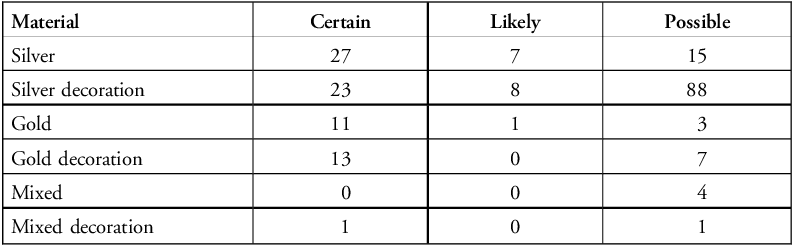
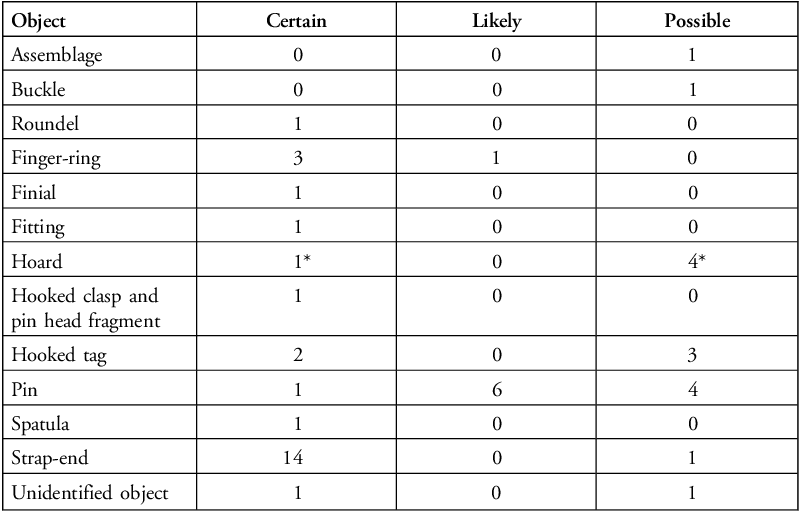
The high number of finds (27 certain & seven likely) show that silver was plentiful in ninth-century Northumbria (Tables 1 & 2) (Figure 3). One of the finds, the Poppleton hoard (York), contained eight ninth-century silver strap-ends, all of which are larger than examples found south of the Humber (four significantly so), as well as a silver disc-brooch of mid-eighth- to late-ninth-century date (Thomas Reference Thomas2006: 147–59).
Number of finds made from, or decorated with, precious metals.

Table 1 Long description
A table with six rows and four columns comparing the number of finds made from or decorated with precious metals. The columns are labeled Material, Certain, Likely, and Possible. The rows are labeled Silver, Silver decoration, Gold, Gold decoration, Mixed, and Mixed decoration. Row 1: Silver, Certain 27, Likely 7, Possible 15. Row 2: Silver decoration, Certain 23, Likely 8, Possible 88. Row 3: Gold, Certain 11, Likely 1, Possible 3. Row 4: Gold decoration, Certain 13, Likely 0, Possible 7. Row 5: Mixed, Certain 0, Likely 0, Possible 4. Row 6: Mixed decoration, Certain 1, Likely 0, Possible 1.
Different objects from the same site are counted as different finds. Hoards are counted as single finds, though their contents are discussed individually in the main text. For clarity, finds are categorised solely by their primary material (e.g. silver with gold decoration is just listed under silver), other materials are discussed in the relevant sections of this article.
Breakdown of the silver evidence by object type.

Table 2 Long description
The table categorises the silver assemblage objects by their certainty of identification in terms of material and date: Certain, Likely, and Possible. It contains 13 rows and 4 columns. The objects listed include Assemblage, Buckle, Roundel, Finger-ring, Finial, Fitting, Hoard, Hooked clasp and pin head fragment, Hooked tag, Pin, Spatula, Strap-end, and Unidentified object. Each row shows the count of objects in each certainty category. For example, the Finger-ring has 3 certain, 1 likely, and 0 possible identifications. The Strap-end has the highest count with 14 certain identifications.
* The Poppleton hoard contains objects that can be identified with confidence (‘certain’) and one that is less clear (‘possible’); it is therefore included in both columns.
Silver strap-end (PAS YORYM-46D9CC): length 68.1mm, width 26.6mm and thickness 1.5mm; scale bars removed from original image (© York Museums Trust, CC BY 4.0, https://finds.org.uk/pas/recorded-find/YORYM-46D9CC).

The silver/possible category would potentially add another 15 finds, reinforcing the impression that silver was available in the ninth century (Tables 1 & 2). The possible finds from hoards consist of a silver ornament from Kirkoswald (Cumbria) (Wilson Reference Wilson1964: 17–19), a silver strap-end, mount, plaited arm-ring and coin-brooch from Cuerdale (Lancashire) (Graham-Campbell Reference Graham-Campbell2011: 128), four strap-ends from near Wigton (Cumbria) (PAS LANCUM-45C589) and the above-mentioned disc-brooch. A strap-end from Nunnington (North Yorkshire), in the silver/possible category, is the only relevant find from an assemblage of metal-detected early medieval silver and lead-alloy objects (PAS YORYM-EF9C8C).
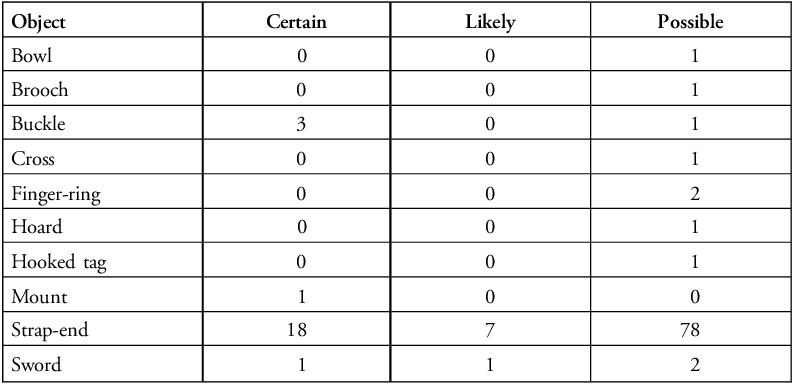
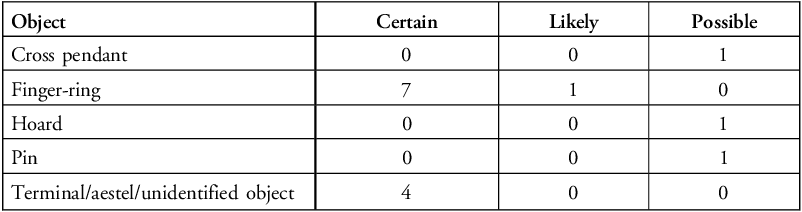
Twenty-three finds are classified as silver decoration/certain and eight as silver decoration/likely (Tables 1 & 3). Most decoration takes the form of silver inlay, silver-wire inlay or silver plating, with some objects also being decorated with niello (a black alloy that can include silver). Four finds are decorated with silver rivets. Two sword pommels, from Gilling West (North Yorkshire) (Webster & Backhouse Reference Webster and Backhouse1991: 277) and York (Tweddle et al. Reference Tweddle1999: 288) have considerable silver decoration. The large number of silver decoration/possible finds (n = 88; Tables 1 & 3) would not substantially affect interpretations of the availability of silver, as most finds are decorated with small amounts of silver in the form of niello or silver inlay. Three finds have greater levels of silver decoration: a pair of strap-ends from Bamburgh (Northumberland) may have silver rivets (Webster & Backhouse Reference Webster and Backhouse1991: 234–35), while the Ormside bowl (Cumbria) has silver clamps (Webster & Backhouse Reference Webster and Backhouse1991: 173) and the sword from Wensley (North Yorkshire) (Wilson Reference Wilson1965: 41–42) has a pommel with considerable silver decoration. Two, possibly three, gold/certain finds, all finger-rings, have niello decoration, while the Leeds district hoard contains a gold/possible find (Table 4), a finger-ring also decorated with niello (Marzinzik Reference Marzinzik2014: 262).
Breakdown of the silver decoration evidence by object type.

Table 3 Long description
The table categorises the silver decoration assemblage objects by their certainty of identification in terms of material and date. The table has 10 rows and 4 columns. The columns are labeled Certain, Likely, and Possible. The rows are labeled with different object types: Bowl, Brooch, Buckle, Cross, Finger-ring, Hoard, Hooked tag, Mount, Strap-end, and Sword. Each cell contains a numerical value indicating the count of objects for each certainty level. Notable entries include Buckle with 3 certain, 0 likely, and 1 possible; Strap-end with 18 certain, 7 likely, and 78 possible; and Sword with 1 certain, 1 likely, and 2 possible.
Breakdown of the gold evidence by object type.

Table 4 Long description
The table categorises the gold assemblage objects by their certainty of identification in terms of material and date, with columns labeled Certain, Likely, and Possible. It includes five rows labeled Cross pendant, Finger-ring, Hoard, Pin, and Terminal/aestel/unidentified object. The values in the table are as follows: Row 1: Cross pendant, Certain 0, Likely 0, Possible 1. Row 2: Finger-ring, Certain 7, Likely 1, Possible 0. Row 3: Hoard, Certain 0, Likely 0, Possible 1. Row 4: Pin, Certain 0, Likely 0, Possible 1. Row 5: Terminal/aestel/unidentified object, Certain 4, Likely 0, Possible 0.
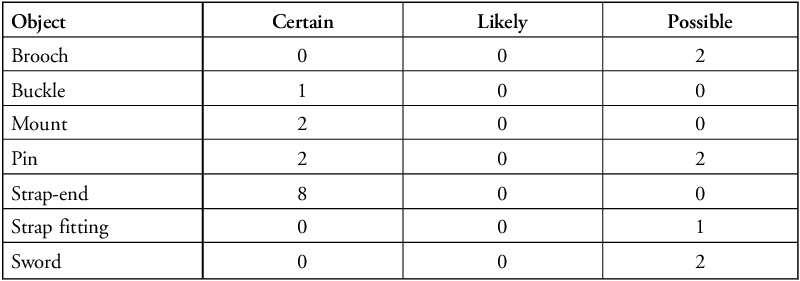
The ninth-century gold assemblage consists of 12 finds (11 certain, one likely) (Tables 1 & 4). Though smaller than that of silver, the gold assemblage is not insignificant and the use of gold for ornamental and functional purposes does not give the impression of an impoverished kingdom (Figure 4). The three finds in the gold/possible category (Table 4) would result in a relatively small increase in the size of the assemblage.
Gold object of uncertain function (possibly a terminal or aestel) (PAS YORYM-3F57C3): length 22.5mm (© York Museums Trust, CC BY-SA 4.0, https://finds.org.uk/pas/recorded-find/YORYM-3F57C3).

The gold-decorated objects in the certain and likely categories (Table 5) contribute a small amount of gold, with all gold decoration being in the form of gilding. One object in the silver/certain category (Table 2), a finial, also has gilding (PAS YORYM-EB8B61). Finds in the gold decoration/possible category (Table 5) would not substantially increase the size of the gold assemblage. While the sword from the Bedale area hoard (North Yorkshire) does have significant gold decoration (PAS YORYM-CEE620), all other gold-decorated objects are gilt. A silver/possible find (Table 2), an unidentified object, is also gilt (PAS YORYM-9070D2).
Breakdown of the gold decoration evidence by object type.

Table 5 Long description
The table categorises the gold decoration assemblage objects by their certainty of identification in terms of material and date, with columns labeled Certain, Likely, and Possible. It includes rows for different object types: Brooch, Buckle, Mount, Pin, Strap-end, Strap fitting, and Sword. Each cell contains a numerical value indicating the count of objects in that category. Notable entries include Strap-end with 8 in the Certain column and 0 in the Likely and Possible columns, and Pin with 2 in both the Certain and Possible columns. The table provides a detailed breakdown of gold decoration evidence by object type.
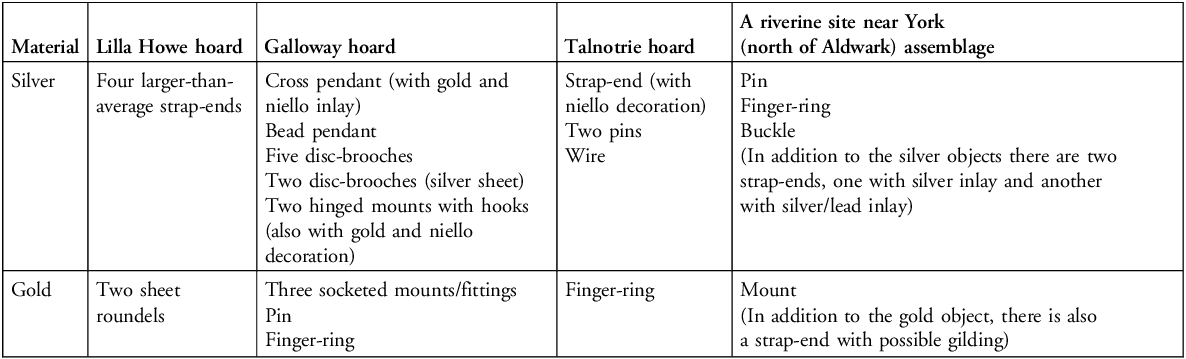
The mixed finds, which involve finds with substantial elements of both precious metals, form the mixed/possible category, as all are from hoards or sites that either do or could have Viking associations. These finds include a large number of precious-metal objects (Table 6) and their inclusion would increase the size of the ninth-century gold and silver assemblages. This would reinforce the interpretation, based on the certain and likely categories, that gold and silver were freely available in ninth-century Northumbria. The mixed decoration/certain category (Table 7) contains a single find, a sword pommel decorated with a silver band with inlaid gold and niello panels from Ingleton (North Yorkshire) (Wilson Reference Wilson1964: 163–66), resulting in a relatively small increase in the size of the assemblages. Inclusion of the single mixed decoration/possible find, a mount (Table 7), would have little impact as the find involves small amounts of precious metals in the form of gilding, silver sheet and niello decoration (PAS YORYM-E6B674).
Relevant contents of the mixed-possible finds (based on Webster & Backhouse Reference Webster and Backhouse1991: 273, 275–76; Graham-Campbell Reference Graham-Campbell, Pedersen and Sindbæk2020; Hall et al. Reference Hall and Williams2020; Goldberg & Davis Reference Goldberg and Davis2021 and PAS YORYM-FB1AE2).

Table 6 Long description
The table compares the relevant contents of precious metal finds (the mixed/possible category) from four different hoards and sites: Lilla Howe hoard, Galloway hoard, Talnotrie hoard, and a riverine site near York. It is organized into four columns, each representing a different hoard or site, and two rows categorizing the materials into silver and gold. The table lists specific items found in each hoard or site, such as strap-ends, pendants, brooches, and mounts. For example, the Lilla Howe hoard includes four larger-than-average strap-ends in silver and two sheet roundels in gold. The Galloway hoard contains items like a cross pendant and disc-brooches in silver, and socketed mounts and a finger-ring in gold. The Talnotrie hoard lists a strap-end, wire and two pins in silver, and a finger-ring in gold. The riverine site near York includes a pin, finger-ring, and buckle in silver, and a mount in gold. The table provides a detailed inventory of the relevant precious metal objects found at each location.
Breakdown of the mixed decoration evidence by object type.

Table 7 Long description
The table categorises the mixed decoration assemblage objects by their certainty of identification in terms of material and date. The table has two rows and four columns. The columns are labeled Certain, Likely, and Possible. The rows are labeled Mount and Sword. Row 1: Mount, Certain 0, Likely 0, Possible 1. Row 2: Sword, Certain 1, Likely 0, Possible 0.
Overall, the certain and likely finds indicate that both silver and gold were widely available in ninth-century Northumbria. Inclusion of the possible finds only reinforces this interpretation. In considering the locations of the finds, the ninth-century precious-metal assemblage can be seen to be unevenly distributed within Northumbria (see OSM 3: Figures S1–S5), with most finds coming from the south-eastern part of the kingdom, in particular what is modern-day North and East Yorkshire. Yet, the use of particular types of material culture varied across the kingdom throughout its history (Carson Reference Carson2022: 440–41); economic differences did exist but the distribution of ninth-century precious-metal objects may be a continuation of earlier trends rather than a localised resurgence.
Discussion
Compilation of available artefacts shows that silver was not absent from ninth-century Northumbria, so the kingdom was not forced by impoverishment into the use of base-metal coins. When considered in combination, the precious metals and numismatic evidence raise various possibilities about what motivated this monetary change.
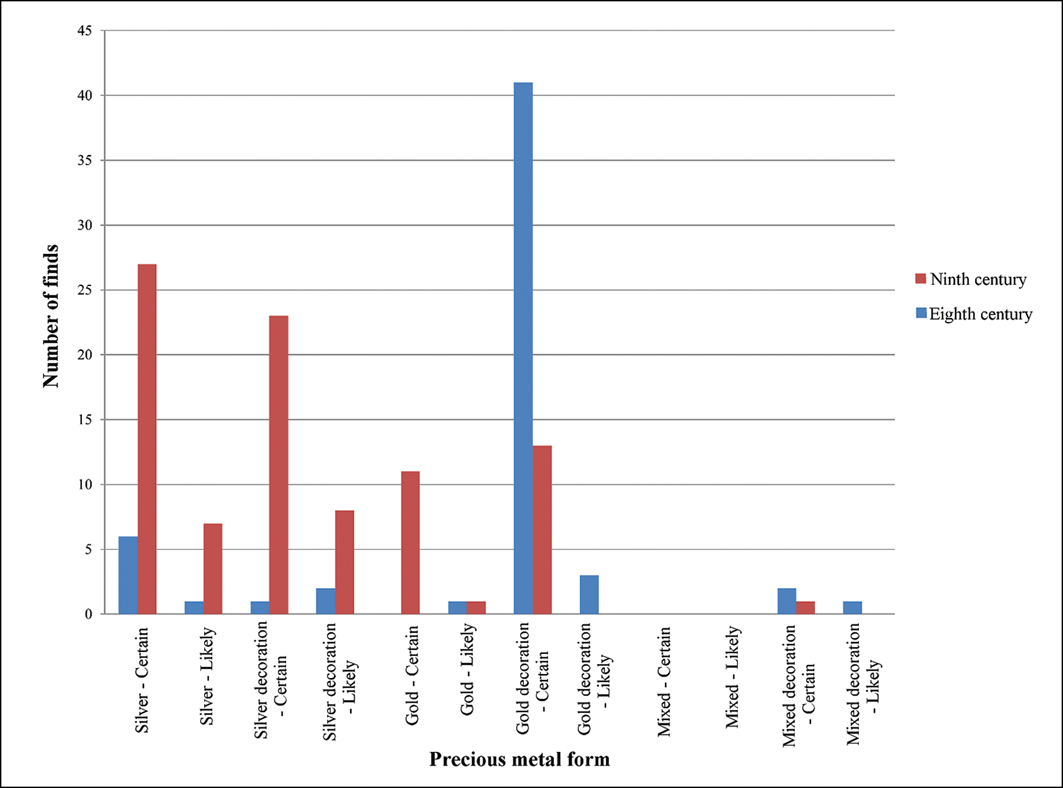
The substantial nature of the silver assemblage indicates that ninth-century Northumbria was economically vibrant. This is reinforced by the smaller, but still significant, gold assemblage. Thomas’s (Reference Thomas and Bork2005: 34–44) comparison of select high-status ninth-century metalwork in Northumbria and other Anglo-Saxon kingdoms helps to contextualise Northumbria’s economic status. Examples from Northumbria include the gold- and silver-decorated sword pommel from Ingleton (North Yorkshire), the Poppleton silver strap-ends and the Selkirk gold finger-ring (Selkirkshire). The exceptional quality and high level of craftsmanship and artistry displayed on these, and other similar Northumbrian objects, mirrors that seen in the luxury metalwork from other Anglo-Saxon kingdoms (e.g. the gold finger-ring of Aethelswith, Queen of Mercia and sister of King Alfred (Hinton Reference Hinton2005: 108)). The demand for, and presence of, such similar metalwork suggests that Northumbria was not an impoverished kingdom. The ninth century was a prosperous period in its own right; comparison with evidence from the preceding century indicates a period of economic revival, when both precious metals were more available (Figure 5). Silver coins were minted in eighth-century Northumbria and some were produced in large numbers, notably those of Eadberht (737–758) and to a lesser extent Aethelred I (774–779 & 790–796); however, based on the absence of surviving specimens for some rulers and the very low numbers for others, coin production in Northumbria appears to have been either non-existent or limited for much of the eighth century. The ninth century, therefore, represents a period of increased availability of silver in non-monetary form.
Comparison of the eighth- and ninth-century precious-metals evidence (based on Carson Reference Carson2022: figs. 104 & 105, updated March 2025). All the eighth-century silver objects have gilding. The eighth-century gold-decorated finds are all gilt, except one that is gold leaf, and therefore do not suggest a substantial gold assemblage. There are no certain gold finds and only one likely gold. The ninth century, with substantially more gold finds, therefore appears as a time of greater access to this material.

The debased ninth-century coinage circulated in greater quantities than most of the previous issues and had a wider geographical distribution, particularly during the reigns of Eanred and Aethelred II, indicating economic changes across Northumbria (Carson Reference Carson2022: 193–262). In particular, copper-alloy coins now circulated in the northern and western parts of the kingdom in significant quantities, in a way that the earlier precious-metal coinages had never done.
An important outcome of debasement, therefore, was the creation of a lower-value coin that, coupled with increased output, was appropriate for everyday use by a greater portion of the Northumbrian populace (Pirie Reference Pirie, Cook and Williams2006: 222; Naylor Reference Naylor2007: 58–60; Abramson Reference Abramson2018: 31). This, however, may not have been the initial motive for the debasement. Most debasements in the early medieval period are believed to have resulted from the ruler’s desire to profit from the coinage (a way of increasing mint activity, which could be taxed) and this may have been the case, in the short term, in Northumbria (Naismith Reference Naismith and Butcher2020: 198). During this process, however, the economic benefits the Northumbrian populace derived from a lower-value coin may have been recognised (Pirie Reference Pirie, Cook and Williams2006: 222).
Social benefits may also have been recognised. The different material and exchange basis of the new coin, coupled with frequent use by more of the population, perhaps helped to foster social cohesion and a unique, shared identity (Webb Reference Webb2021: 254–56). Precious-metal coins largely circulated in south-eastern Northumbria in the seventh and eighth centuries and would likely have done so in the ninth, if produced. Yet, despite the availability of precious metals, coin production was restricted to a low-value copper-alloy coin that all Northumbrians could use but that differed substantially from the precious-metal coins of their contemporaries in other kingdoms. This may suggest an attempt to overcome internal divisions and cultivate a shared sense of identity across the kingdom, providing the Northumbrian population with a more economically flexible coinage that came to be a motivation, in itself, for debasement.
Comparison with other instances of debasement in early medieval Europe can help to clarify the possible motivation(s) in Northumbria. Particularly relevant is eleventh-century Byzantium. Here, severe debasement of gold coinage has been interpreted as a way to help the state finance its spending (fiscal) (Kaplanis Reference Kaplanis2003) or increase the money supply (monetary) (Morrisson Reference Morrisson1976; Butcher Reference Butcher and Butcher2020: 15). Where coins are the only evidence, both fiscal and monetary interpretations remain possibilities (Butcher Reference Butcher and Butcher2020: 15). In Northumbria, the addition of silver evidence shows that debasement was a purposeful move but it does not provide conclusive evidence for either a fiscal or monetary interpretation and it is possible both motivations played a role in the ninth-century debasement.
The monetary motive raises important questions about who supported the moneyers and how the resources needed for the new coinage were acquired. As outlined earlier, the production of Northumbria’s new coinage required large quantities of imported tin (likely from Cornwall) and zinc (likely from the Aachen area (Germany)) (Naismith Reference Naismith2023: 313). Political support and organisation were likely needed to acquire these resources. Recent research has shown that Charlemagne’s 793 reform of the coinage resulted in the wider use of Melle silver (Kershaw et al. Reference Kershaw2024). This was a purposeful move on the part of the Carolingian state, reflecting its control over coin production including the supply and distribution of metals (Kershaw et al. Reference Kershaw2024: 514–15). This example raises the possibility that, like Charlemagne, the Northumbrian kings may have been heavily involved in the supply and distribution of metals.
Lead industry in the North Pennines produced large quantities of this heavy metal for internal and external consumption: evidence from Coppergate (York) indicates the exploitation of lead in the North Pennines from the mid-ninth century onwards, while earlier origins of the industry are suggested by objects made of North Pennines lead found at Kaupang (Norway) that are stratigraphically and typologically dated to the first half of the ninth century (Kershaw & Merkel Reference Kershaw and Merkel2023: 275). However, the exploited lead ores likely did not produce much silver. Investigation of the origins of the silver used in twelfth-century coins from northern English and Scottish mints (from sites that would have been in Northumbria) shows that even though the North Pennines mines were being exploited during this period, the silver yield was probably limited as the silver is found in only a small minority of tested coins (Savage et al. Reference Savage2024: 97). This limited later contribution suggests that mining in Northumbria may have only played a small role in supplying the ninth-century kingdom’s silver. The connections between these movements of metals are unclear presently.
Conclusion
The picture that emerges from the assessment of available ninth-century gold and silver evidence is of an economically resurgent Northumbria. Precious metals appear to have been more available than in the preceding century, though the silver is unlikely to have come from mining in Northumbria. The debasement of Northumbria’s coinage in the ninth century was, therefore, probably not forced by a shortage of silver, which was otherwise widely available, indicating that the unique copper-alloy coinage was the product of a kingdom that actively debased its own currency. The new debased coinage circulated more widely, geographically and socially, and in greater quantities than previous coinages. Initially, the desire to profit from the coinage may have been the primary motivator for debasement; however, during the debasement process, the economic flexibility offered by the lower-value coin could have been recognised and, in time, this benefit may have come to act as a motivation in itself. The new coin could also have brought increased social cohesion. Yet, the production of the new coin required the large-scale importation of tin and zinc, which may indicate significant Northumbrian royal involvement in the process. Ultimately, this copper-alloy coin, unique in early medieval western Europe, was the product of a rich and vibrant ninth-century Northumbria, not an impoverished kingdom.
Acknowledgements
I am grateful to Professor David Petts (Durham University) for reading and commenting on the manuscript. I would also like to thank the two reviewers for their helpful comments. Any errors remain my own.
Funding statement
This research received no specific grant from any funding agency or from commercial and not-for-profit sectors.
Online supplementary material (OSM)
To view supplementary material for this article, please visit https://doi.org/10.15184/aqy.2026.10454 and select the supplementary materials tab.







 Open access

