Infants growing up bilingual are immersed in a unique linguistic environment. They navigate a world that contains two sets of sounds, two vocabularies, and two grammars. Does exposure to such a complex language environment change how children acquire language? Studies of language outcomes indicate many similarities between monolingual and bilingual development (Holowka, Brosseau-Lapré & Petitto, Reference Holowka, Brosseau-Lapré and Petitto2002; Pearson, Fernández & Oller, Reference Pearson, Fernández and Oller1993; see also Hoff, Core, Place, Rumiche, Señor & Parra, Reference Hoff, Core, Place, Rumiche, Señor and Parra2012; Place & Hoff, Reference Place and Hoff2011), while experimental work has variously demonstrated that bilinguals’ performance on experimental tasks is sometimes equivalent, sometimes advantaged, and sometimes delayed relative to monolinguals’ performance (for recent reviews see Sebastián-Gallés, Bosch & Pons, Reference Sebastián-Gallés, Bosch, Pons, Haith and Benson2008; Werker & Byers-Heinlein, Reference Werker and Byers-Heinlein2008; Werker, Byers-Heinlein & Fennell, Reference Werker, Byers-Heinlein and Fennell2009). To synthesize these diverse findings, recent theoretical work has begun to more precisely describe the relationship between early monolingual and bilingual development (Curtin, Byers-Heinlein & Werker, Reference Curtin, Byers-Heinlein and Werker2011; Place & Hoff, Reference Place and Hoff2011; Sebastián-Gallés, Reference Sebastián-Gallés2010; Werker et al., Reference Werker, Byers-Heinlein and Fennell2009). One central assertion is that monolinguals and bilinguals are equipped with the same proclivities and learning mechanisms to support language acquisition, and that these develop on the same schedule. For example, monolinguals and bilinguals both use an early-emerging mechanism to support language discrimination (Bosch & Sebastián-Gallés, Reference Bosch and Sebastián-Gallés2001; Byers-Heinlein, Burns & Werker, Reference Byers-Heinlein, Burns and Werker2010; Weikum, Vouloumanos, Navarra, Soto-Faraco, Sebastián-Gallés & Werker, Reference Weikum, Vouloumanos, Navarra, Soto-Faraco, Sebastián-Gallés and Werker2007). Differences in performance in experimental tasks are proposed to arise from how the two groups approach the same apparent task in different ways (e.g., Bosch & Sebastián-Gallés, Reference Bosch and Sebastián-Gallés1997), and because bilinguals’ language exposure is split between two languages (Werker, Reference Werker2012).
One mechanism thought to enable early vocabulary acquisition in both monolinguals and bilinguals is associative word learning, the linking of a word to a physical object. Associative word learning is an early-emerging skill that works in tandem with infants’ ability to categorize objects, to segment words from the speech stream, and to recognize word forms even when they stand alone (e.g., Golinkoff & Hirsh-Pasek, Reference Golinkoff and Hirsh-Pasek2006; Hollich, Hirsh-Pasek, Golinkoff, Brand, Brown, Chung, Hennon & Rocroi, Reference Hollich, Hirsh-Pasek, Golinkoff, Brand, Brown, Chung, Hennon and Rocroi2000; Oviatt, Reference Oviatt1980; Werker, Cohen, Lloyd, Casasola & Stager, Reference Werker, Cohen, Lloyd, Casasola and Stager1998). Some theorists argue that associative information is the primary means by which the novice word learner establishes word–referent links (e.g., Smith, Jones, Yoshida & Colunga, Reference Smith, Jones, Yoshida and Colunga2003), and that associative regularities could give rise to word-learning constraints (Mayor & Plunkett, Reference Mayor and Plunkett2010; Rakison & Lupyan, Reference Rakison and Lupyan2008; Smith, Jones, Landau, Gershkoff-Stowe & Samuelson, Reference Smith, Jones, Landau, Gershkoff-Stowe and Samuelson2002). Others argue that associative word learning cannot on its own lead to the kind of abstract conceptual representation required for referential word understanding (Booth & Waxman, Reference Booth and Waxman2003; Golinkoff & Hirsh-Pasek, Reference Golinkoff and Hirsh-Pasek2006; Waxman & Gelman, Reference Waxman and Gelman2009; Woodward, Reference Woodward, Hall and Waxman2004). However, these theorists still acknowledge the role of associations, in tandem with the role of reference, in the establishment of the early lexicon (Waxman & Gelman, Reference Waxman and Gelman2009). Thus, while its exact role is debated, the vast majority of word-learning theories include the mechanism of associative learning. Yet, little research to date has investigated how monolinguals and bilinguals compare on the development of this key word-learning competence. If theories of bilingual acquisition are correct and the basic mechanisms of language acquisition develop on the same schedule in monolingual and bilingual infants, then the development of associative word learning should happen on a similar timeframe in both groups.
There is, however, considerable empirical work that supports an alternate prediction, namely that bilinguals develop associative word learning later than monolinguals. Indeed, in several studies using word learning and word recognition tasks, bilinguals succeed at a later age than monolinguals. For example, in studies of word learning (Fennell, Byers-Heinlein & Werker, Reference Fennell, Byers-Heinlein and Werker2007) and word recognition (Ramon-Casas, Swingley, Sebastián-Gallés & Bosch, Reference Ramon-Casas, Swingley, Sebastián-Gallés and Bosch2009) that involved minimal-pair stimuli (i.e., two words that differ by a single phoneme), bilinguals showed a later age of success than monolinguals. Electrophysiological word recognition studies indicate that bilinguals’ brain responses to familiar words are less mature than those of same-aged monolinguals (Conboy & Mills, Reference Conboy and Mills2006; but see Vihman, Thierry, Lum, Keren-Portnoy & Martin, Reference Vihman, Thierry, Lum, Keren-Portnoy and Martin2007), perhaps because bilinguals have less frequent exposure to each language than monolinguals have to their single language. Similarly, the mutual exclusivity word-learning heuristic, an assumption that a novel word refers to a novel rather than a familiar referent, develops later and is used less reliably by multilinguals than by monolinguals (Byers-Heinlein & Werker, Reference Byers-Heinlein and Werker2009; Davidson, Jergovic, Imami & Theodos, Reference Davidson, Jergovic, Imami and Theodos1997; Davidson & Tell, Reference Davidson and Tell2005; Houston-Price, Caloghiris & Raviglione, Reference Houston-Price, Caloghiris and Raviglione2010; but see Frank & Poulin-Dubois, Reference Frank and Poulin-Dubois2002). It is thought that bilinguals’ experience with translation equivalents (cross-language synonyms) affects how they reason about the meanings of novel words, thus influencing their willingness to associate novel labels with particular referents. Essentially, bilinguals could be more “lenient in their use of word-learning heuristics” (Sebastián-Gallés, Reference Sebastián-Gallés2010, p. 252). This “leniency” and the general pattern of a later age of success on word-related tasks by bilingual infants hints that the same pattern might also be seen in a task that specifically tests associative word learning.
On the other hand, other empirical work gives the opposite prediction: that bilinguals will outperform monolinguals in a basic associative word-learning task. Bilingual children and adults show an advantage over monolinguals in many executive functioning tasks, including planning, inhibition, selective attention, and cognitive flexibility (for recent reviews see Barac & Bialystok, Reference Barac and Bialystok2011; Bialystok & Craik, Reference Bialystok and Craik2010). This advantage is hypothesized to arise from bilinguals’ need to regularly switch between their two languages, and to inhibit the irrelevant language when using only one of their languages. Recent reports indicate that bilingual infants as young as seven months show precocious cognitive development relative to monolinguals (Kovács & Mehler, Reference Kovács and Mehler2009a, Reference Kovács and Mehlerb; Poulin-Dubois, Blaye, Coutya & Bialystok, Reference Poulin-Dubois, Blaye, Coutya and Bialystok2011). In a study particularly relevant to the current discussion, 12-month-old bilinguals were able to successfully learn two associative rules between syllable strings and target locations, while in the same paradigm monolinguals were only able to learn one (Kovács & Mehler, Reference Kovács and Mehler2009a). This study demonstrates that monolingual and bilingual infants differ in their ability to form associations, a difference that could also extend to word learning. Specifically, the enhanced inhibitory control and flexible learning seen in bilingual infants could aid them in attending to and encoding the weaker associative regularities between referents and words in their environment. Indeed, bilingual infants’ ultimate success in word learning is demonstrated by their early knowledge of translation equivalents (cross-language synonyms; see De Houwer, Bornstein & De Coster, Reference De Houwer, Bornstein and De Coster2006 for a study of translation equivalents in 13-month-olds), demonstrating their skill at the potentially challenging task of associating two words to one referent. This raises the possibility that bilinguals will show an advantage over monolinguals on an associative word-learning task.
To date, there have only been two studies comparing monolingual and bilingual infants on a task that necessitates associative word learning (Fennell et al., Reference Fennell, Byers-Heinlein and Werker2007; Mattock, Polka, Rvachew & Krehm, Reference Mattock, Polka, Rvachew and Krehm2010). Both used a minimal-pair version of the Switch task (Stager & Werker, Reference Stager and Werker1997; Werker et al. Reference Werker, Cohen, Lloyd, Casasola and Stager1998), in which infants were habituated to two word–object associative pairings, and then tested for their ability to detect a similar sounding violation of the previously taught pairings. Fennell et al. (Reference Fennell, Byers-Heinlein and Werker2007) tested infants’ ability to learn the minimal pair bih and dih, and found that bilinguals succeeded at a later age than monolinguals. Mattock et al. (Reference Mattock, Polka, Rvachew and Krehm2010) taught infants the minimal pairs bos and gos, and found that monolinguals and bilinguals could succeed at the same age, albeit with slightly different versions of the stimuli. While of interest, neither of these two studies can directly inform the current work, as infants’ associative word-learning ability was tested in conjunction with their encoding and use of minimal-pair words (see also Curtin et al., Reference Curtin2011; Werker et al., Reference Werker, Byers-Heinlein and Fennell2009, for a discussion of the link between phonological development and word learning in bilinguals). Thus, these studies cannot speak to whether monolingual and bilingual infants differ in their associative word-learning abilities more generally, or whether the results they obtained are specific to tasks that also tap into infants’ fine phonetic sensitivities. Both groups might have identical word–object associative skills, but behave dissimilarly on similar sounding words due to divergent phonological inventories or differing interpretations of what constitutes an important phonological change (e.g., bilinguals may be more willing to accept such changes due to the presence of cognates in their lexical store; Sebastián-Gallés, Reference Sebastián-Gallés2010; Werker et al., Reference Werker, Byers-Heinlein and Fennell2009).
To directly test the hypothesis that monolinguals and bilinguals develop associative word learning on the same schedule, the current study presented infants with dissimilar-sounding words in the Switch task. Previous studies investigating basic associative word learning found that monolinguals succeed in the Switch task from as young as 12 months (Curtin, Reference Curtin2011; MacKenzie, Graham & Curtin, Reference Curtin2011), although an earlier series of studies found that monolinguals only begin succeeding at 14 months (Werker et al., Reference Werker, Cohen, Lloyd, Casasola and Stager1998). These sets of studies differed in their auditory stimuli and the familiarity of the objects, which may account for the differences in performance. Thus, the current study tested both monolingual and bilingual infants on basic associative word learning at 12- and 14-months, in order to encompass the ages of known success in monolinguals.
Method
Participants
Ninety-eight infants completed the study. There were four groups (12 females per group) based on age and language background: 12-month-old monolinguals (N = 25), 12-month-old bilinguals (N = 24), 14-month-old monolinguals (N = 25), and 14-month-old bilinguals (N = 24). Twelve-month-olds had a mean age of 12m17d (range: from 11m22d to 13m8d), and 14-month-olds had a mean age of 14m17d (range: from 13m27d to 15m8d). An additional 36 infants were excluded because of crying/fussiness (23), technical error (7), and parental interference (6).
Monolinguals came from English-speaking homes, and had not been regularly exposed to a non-English language. Bilinguals came from homes where English as well as another language had been spoken regularly since birth. These languages included Cantonese (N = 12), Japanese (4), Punjabi (4), Farsi (3), French (3), Italian (3), Spanish (3), Dutch (2), German (2), Russian (2), and 1 each of Arabic, Catalan, Czech, Danish, Hebrew, Portuguese, Romanian, Tagalog, Tigrigna, and Yoruba. Bilinguals heard each language between 25% and 75% of the time (Pearson, Fernández, Lewedeg & Oller, Reference Pearson, Fernández, Lewedeg and Oller1997), measured via the Language Exposure Questionnaire (Bosch & Sebastián-Gallés, Reference Bosch and Sebastián-Gallés1997). On average, bilinguals heard English 47% of the time (range: 26%–73%), and their non-English language 52% of the time (range: 28%– 74%). Three infants also had some exposure to a third language (13%, 16% and 23%, respectively).Footnote 1
An estimate of the socio-economic status of each group was determined by examining the median income in the neighbourhoods where each participant lived, defined by their postal code (BC Stats, 2007). Postal codes were unavailable for four participants. Infants lived almost exclusively in middle-class neighbourhoods. On average, incomes in bilinguals’ neighbourhoods were 14% lower than incomes in monolinguals’ neighbourhoods, which was statistically significant, t(92) = 2.65, p = .009.
Stimuli
Auditory stimuli were recorded by a female native English speaker who produced seven tokens each of three nonsense words, lif, neem, and pok, in infant-directed speech. These were chosen for two reasons: they are highly phonetically distinct with no vowel or consonant overlap, and they have been used in past research (Werker et al., Reference Werker, Cohen, Lloyd, Casasola and Stager1998).
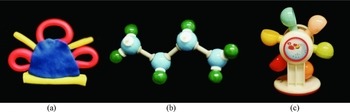
Visual stimuli used during habituation were colourful images of a crown-shaped object (Figure 1a) and a molecule-shaped object (Figure 1b), filmed moving across a black background. A spinning waterwheel was used during the pretest and posttest (Figure 1c). These visual stimuli have been used in several previous studies (e.g., Fennell et al., Reference Fennell, Byers-Heinlein and Werker2007; MacKenzie et al., Reference MacKenzie, Graham and Curtin2011; Werker, Fennell, Corcoran & Stager, Reference Werker, Fennell, Corcoran and Stager2002).
Objects used for visual stimuli. (a) Crown-shaped object labeled lif. (b) Molecule-shaped object labeled neem. (c) Waterwheel object used for pretest and posttest labeled pok.

Audio and visual stimuli were combined to create 20-second trials. Audio tokens were presented approximately two seconds apart. Because there were seven unique tokens of each word, the first three tokens were replayed so that infants heard a total of 10 tokens per trial. Visual stimuli were displayed simultaneously, although not synchronously, with the audio.
Apparatus
Testing took place in a dimly-lit, sound-attenuated room. A television monitor displayed the visual stimuli, and adjacent hidden speakers played the sound at 68 dB SPL +/–5. A digital video camera recorded infants’ response for later offline coding. In an adjacent room, the experimenter controlled the study with a computer running Habit 2000 (Cohen, Atkinson & Chaput, Reference Cohen, Atkinson and Chaput2000), and monitored infants’ looking behavior online via a closed-circuit television.
Procedure
Infants were tested using the Switch procedure (Werker et al., Reference Werker, Cohen, Lloyd, Casasola and Stager1998). Infants sat on their parents’ laps throughout the study, while parents listened to masking music over headphones. All infants were first presented a pretest trial: the waterwheel paired with pok. Next, infants were habituated to two word–object pairings: the crown-shaped object with lif, and the molecule-shaped object with neem. Trials were presented in blocks of four; each pairing was presented twice per block, yielding six combinations (e.g., ABBA, AABB) presented in a quasi-random order. Infants experienced these pairings until they habituated, such that their looking time over the most recent trial block was 65% of that during the block wherein they looked the most. Consistent with numerous previous studies using the Switch task (e.g., Fennell et al., Reference Fennell, Byers-Heinlein and Werker2007; Werker et al., Reference Werker, Fennell, Corcoran and Stager2002), infants who did not habituate within 24 trials proceeded directly to the test phase.
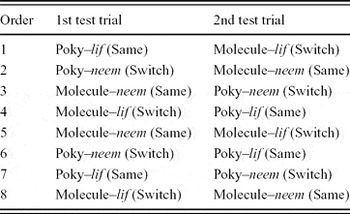
After habituation, infants were given two test trials presented in one of eight possible test orders, counterbalancing which trial type occurred first (Same, Switch) and word–object pairings (see Table 1 for a complete list of test trial orders). The Same test trial comprised a familiar pairing (e.g., molecule–neem). The Switch test trial comprised an unfamiliar pairing (e.g., molecule–lif). If infants are able to associate the word and object, then the Switch trial will be novel and should attract longer look time. However, if infants learn the audio and video stimuli without associating them, then both trial types will be equally familiar. A posttest, the waterwheel–pok pairing was presented again to ensure that, as a group, infants had not lost interest in the task.
Test trial orders. Test trial type is indicated in parentheses.

Videotapes were digitized and test trials were re-coded offline by a highly trained coder who examined infants’ looking frame-by-frame, with high reliability (r = .97). All analyses of test trials were conducted with offline-coded data.
Results
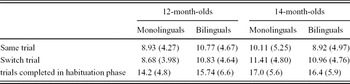
Infants completed the habituation phase in 16 trials on average (see Table 2 for details of the number of trials infants took to reach habituation in each group). Seventeen infants did not reach habituation within 24 trials, eight 12-month-olds (3 monolinguals, 5 bilinguals) and nine 14-month-olds (6 monolinguals, 3 bilinguals). A 2 (language background: monolingual, bilingual) × 2 (age: 12 months, 14 months) ANOVA was performed to investigate whether these factors influenced the number of habituation trials completed. The number of habituation trials did not differ as a function of language background, F(1,94) = 0.099, p = .75, ηp2 < .01, or as a function of age, F(1,94) = 1.81, p = .18, ηp2 = .019, and there was no significant interaction between the two factors F(1,94) = 1.62, p = .21, ηp2 = .017. A t-test comparing looking time during the first four-trial block to looking time in the final four-trial block confirmed that the infants had habituated as a group, t(97) = 15.14, p < .0005, d = 1.53. A second t-test showed that infants’ looking time recovered during the posttest as compared to the final four habituation trials, t(97) = 22.40, p < .001, d = 2.27. Thus, infants had not generally lost interest in the task.
Means and (in parentheses) standard deviations for looking during test trials, and number of trials completed in the habituation phase as a function of language group and age.

The main question of interest was whether infants showed differential looking across the test trials, and whether their performance differed as a function of language background. Accordingly, the main analyses consisted of 2 (trial type: Same, Switch) × 2 (language background: monolingual, bilingual) mixed ANOVAs, which were performed separately for each age group. Before proceeding, outliers were identified by calculating a difference score for each infant (looking during the Switch trial minus looking during the Same trial), and excluding infants whose scores were more than 2.5 standard deviations from the overall mean. Three outliers were excluded from further analyses: one 14-month-old monolingual, one 14-month-old bilingual, and one 12-month-old bilingual. Gender, socio-economic status, test trial order, and whether infants reached the 65% habituation criterion were not included as factors, as preliminary analyses showed no significant effects.
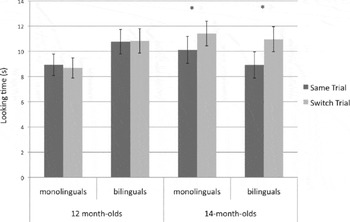
For 12-month-olds, there was no significant effect of trial type, F(1,46) = 0.024, p = .88, ηp2 < .01. This showed that the 12-month-old infants displayed similar looking during Same and Switch test trials. Further, trial type did not interact with language background, F(1,46) = 0.068, p = .80, ηp2 < .01, indicating equivalent performance for monolinguals and bilinguals. However, there was a marginally significant main effect of language background, F(1,46) = 3.19, p = .081, ηp2 = .065, reflecting that 12-month-old bilinguals tended to look longer across both types of test trials than did monolinguals (see Table 2 and Figure 2 for means and standard deviations).
Looking time to Same and Switch test trials for 12- and 14-month-old monolinguals and bilinguals. Error bars represent standard error of the mean.

Fourteen-month-olds looked significantly longer to the Switch than to the Same trial, F(1,45) = 6.38, p = .015, ηp2 = .12. There was no significant main effect of language background, F(1,45) = 0.41, p = .53, ηp2 < .01, nor interaction between trial type and language background, F(1,45) = 0.32, p = .58, ηp2 < .01. Indeed, a similar pattern of looking was demonstrated by monolinguals and bilinguals (see Table 2 and Figure 2 for means and standard deviations). One-tailed paired-samples t-tests on the 14-month-olds’ data confirmed that both bilinguals, t(22) = 1.81, p = .042, d = 0.38, and monolinguals, t(23) = 1.82, p = .041, d = 0.37, looked significantly longer to the Switch trial than to the Same trial.
Follow-up analyses were performed to examine whether the success of the 14-month-old bilinguals might be carried by those infants with the most exposure to English, given that English stimuli were used. Performance was gauged using a difference score of infants’ looking to the Switch trial minus their looking to the Same trial, such that a higher score indicated better performance. No significant correlation was found between performance and infants’ percent exposure to English, r(21) = .14, p = .53. Similarly, an analysis based on dominance showed that infants who heard English 50% of the time or more (N = 8) did not perform differently from those who heard English less than 50% of the time (N = 15), t(21) = .142, p = .89, d = 0.065.
Discussion
The current study investigated monolinguals’ and bilinguals’ ability to associate a novel word with a novel object at 12 and 14 months. At 12 months of age, neither monolingual nor bilingual infants were successful in associating two English nonce words with two different objects. Each group showed equal interest at test in a familiar word–object pairing as in a novel pairing. This finding differs from two recent reports of successful performance by 12-month-olds in the same task using different auditory stimuli (Curtin, Reference Curtin2011; MacKenzie et al., Reference MacKenzie, Graham and Curtin2011). At the same time, the current failure of 12-month-olds in this task replicates earlier work that used the same auditory stimuli (Werker et al., Reference Werker, Cohen, Lloyd, Casasola and Stager1998). Previous work has shown that laboratory-based word learning in 12-month-olds is fragile (Hennon, Chung & Brown, Reference Hennon, Chung and Brown2000; Hollich et al., Reference Hollich, Hirsh-Pasek, Golinkoff, Brand, Brown, Chung, Hennon and Rocroi2000), and thus it is not surprising that small differences in stimuli and procedure across studies could influence infants’ word-learning success. For example, 12-month-olds’ previous successes in associative word-learning tasks could be traced to the use of multisyllabic stimuli (Curtin, Reference Curtin2011), or the specific phonetic characteristics of the auditory stimuli, such as the use of salient bursts (i.e., stop consonants; MacKenzie et al., Reference MacKenzie, Graham and Curtin2011). Future research will be needed to more precisely explore the conditions under which 12-month-olds succeed and fail in basic associative word-learning tasks. Nonetheless, our results demonstrate that 12-month-old monolinguals and bilinguals showed similar failure to learn the words in the current task.
Our key finding was that, like their monolingual peers, 14-month-old bilinguals learned the two word–object pairings, demonstrated by longer looking in the Switch trial than in the Same trial. This replicates previous results showing that monolinguals can succeed at the Switch task by 14 months (Werker et al., Reference Werker, Cohen, Lloyd, Casasola and Stager1998). These results show that bilingualism neither impedes nor facilitates the development of associative word learning, and thus they support the theoretical position that the basic mechanisms that enable language acquisition develop on a similar timetable for monolinguals and bilinguals (Curtin et al., Reference Curtin2011; Werker et al., Reference Werker, Byers-Heinlein and Fennell2009). Like monolinguals, 14-month-old bilinguals wield associative word learning as a tool in their cognitive repertoire, contributing to acquisition of their languages without delay. This finding helps explain the observation that bilinguals have receptive (Thordardottir, Rothenberg, Rivard & Naves, Reference Thordardottir, Rothenberg, Rivard and Naves2006) and expressive (Junker & Stockman, Reference Junker and Stockman2002; Pearson et al., Reference Pearson, Fernández and Oller1993; but see Thordardottir et al., Reference Thordardottir, Rothenberg, Rivard and Naves2006) vocabularies that are of similar size or are larger than those of monolinguals when words from both languages are taken into account (see also Bialystok, Luk, Peets & Yang, Reference Bialystok, Luk, Peets and Yang2010, for a discussion of bilingual children's receptive vocabulary size in a single language).
Given our finding that monolinguals and bilinguals succeed at a basic associative word-learning task from the same age, future studies can compare monolinguals and bilinguals on more complex word-learning tasks, for example manipulating speaker accent (e.g., Schmale, Hollich & Seidl, Reference Schmale, Hollich and Seidle2011) or phonemic context (e.g., Thiessen & Yee, Reference Thiessen and Yee2010). Future work could also investigate variability in word learning among bilingual infants. For example, do variables such as whether infants’ exposure is balanced versus unbalanced, the degree of similarity between the infants’ two languages, and the contexts in which infants learn each of their languages affect how and when bilinguals apply their word-learning skills? Finally, as discussed in the introduction, the Switch paradigm is a stripped-down word–object associative task that does not necessitate full referential word learning (Werker et al., Reference Werker, Cohen, Lloyd, Casasola and Stager1998). Adding referential cues, such as a syntactic frame and the use of familiar naming phrases enhances monolinguals’ performance in laboratory-based word-learning tasks (Fennell & Waxman, Reference Fennell and Waxman2010). Thus, it might be that an increase in the referential nature of the task would amplify any potential differences between bilinguals and monolinguals, or further confirm the similarity of their basic word-learning abilities.
Considered more broadly, our results showing similar development of associative word learning among monolinguals and bilinguals add to the consensus that at the macro level, the fact of growing up with more than one language does not alter the basic ability to acquire a vocabulary. Yet, as noted in the introduction, the application of this fundamental ability does differ in monolingual and bilingual infants. When required to learn phonetically similar words, bilinguals face a different kind of challenge than do monolinguals because only bilinguals have to keep track of two different phonetic environments (Curtin et al., Reference Curtin2011; Fennell et al., Reference Fennell, Byers-Heinlein and Werker2007; Mattock et al., Reference Mattock, Polka, Rvachew and Krehm2010). Thus, it is not surprising that bilinguals face more difficulty in minimal-pair associative word learning (Fennell et al., Reference Fennell, Byers-Heinlein and Werker2007) and in the detection of mispronunciations (Ramon-Casas et al., Reference Ramon-Casas, Swingley, Sebastián-Gallés and Bosch2009), unless stimuli closely match the normal phonetic environment (Mattock et al., Reference Mattock, Polka, Rvachew and Krehm2010) or the language to be used is somehow specified in the task (Fennell & Byers-Heinlein, Reference Fennell and Byers-Heinlein2011). Similarly, it is not surprising that toddlers who are acquiring multiple languages are more willing to accept a second basic-level label for an object than are monolingual infants (Byers-Heinlein & Werker, Reference Byers-Heinlein and Werker2009; Houston-Price et al., Reference Houston-Price, Caloghiris and Raviglione2010), as they have experience learning translation equivalents. Finally, it is revealing that even in the initial stages of language learning, bilingual infants utilize at least some unique brain systems in representing words in their dominant vs. non-dominant language (Conboy & Mills, Reference Conboy and Mills2006), and that they more rapidly recognize words in the dominant language (Marchman, Fernald & Hurtado, Reference Marchman, Fernald and Hurtado2009). These differences, in light of the similarities seen in the use of associative word learning, provide a far deeper and more nuanced understanding of bilingual acquisition. Basic language learning mechanisms are the same, but the application and consequences of those mechanisms in a dual language environment result in measureable differences.
Our results also help to clarify and contextualize the now multiply replicated finding that children growing up bilingual, even infants, show cognitive advantages in some tasks. Here again it is instructive to consider the tasks in which advantages are seen. To date, the most robust evidence of advantages is seen in those tasks that require keeping track of two sets of rules, or changing fluidly from one set of rules or one lexical entry to another – both of which can be seen to result from switching between two languages or inhibiting one language while using the other. Our results confirm that being bilingual does not, however, impact the basic skills that are required to first establish native language knowledge.