Predatory publishing is exploitative and does not meet the minimum standards of research integrity. Predatory publishers are “counterfeit scholarly publishers that aim to trick honest researchers into thinking they are legitimate” (Beall Reference Beall2017). They are “entities that prioritize self-interest characterized by false or misleading information, deviation from best editorial and publication practices, a lack of transparency, and/or the use of aggressive and indiscriminate solicitation practices” (Grudniewicz et al. Reference Grudniewicz, Moher, Cobey, Bryson, Cukier, Allen, Ardern, Balcom, Barros, Berger and Ciro2019, 211). To solicit manuscripts, predatory journals scrape departmental websites, conference programs, and other public information sites to identify potential authors and then use spam email to contact would-be authors with publication offers that sound too good to be true. Predatory journals do not follow best publication practices, they have little to no editorial oversight, and they do not adhere to ethical standards.
The proliferation of predatory journals with their aggressive targeting of individual scholars and the potential career perils of publishing in the “wrong” type of journal means that the publishing landscape is increasingly beset with peril—and not only for early-career scholars. This article asks, How can we identify a predatory journal? Scholars in the hard sciences such as science, technology, engineering, and math (STEM), as well as in the medical field, began to identify predatory journals using systematic processes at an early stage amid concerns about the dissemination of “trash science” (Patwardhan Reference Patwardhan2019).Footnote 1 As a discipline, social science has been slow to address the pitfalls of predatory publishing. Scholarly associations have begun to discuss these matters (International Political Science Association World Congress 2025) but few publications exist that specifically address predatory publishing in the social sciences (Beall and DuBois Reference Beall and DuBois2016). Moreover, most of the literature on predatory journals is focused squarely on the hard sciences and biomedical research in particular.
This article makes a case for enhanced attention to publication literacy for students and scholars at all levels and in all fields of the academy. Specifically, we present a predation index in political science based on a clear operational definition and coding, thereby providing a tool that every scholar can use to protect the integrity of the publishing process and their own work.
…we present a predation index in political science based on a clear operational definition and coding, thereby providing a tool that every scholar can use to protect the integrity of the publishing process and their own work.
PREDATORY PUBLISHING: CAUSES AND CONSEQUENCES
Navigating the world of academic publishing is an increasingly challenging process. “Publish or perish” has become a widespread mantra. International university rankings, university promotion and financial incentives, international funding-agency requirements, and national higher-education policies increase the pressure to publish. Supported by the digital transformation during recent decades, the market has responded with concomitant growth in the publishing industry. Established journals have migrated online, and few continue to provide print editions of their collections. In parallel with changes to the production model for journal publishing, the financial model has also changed. Academic publishing, like most other forms of publishing, was built on a “pay-to-read” structure throughout the twentieth century. Scholars accessed journal articles through direct subscription to a journal, often via professional association membership, or through university libraries that paid the journal subscription fees. Outside of universities and research institutions, anyone who wanted to access a journal article or issue had to pay a (usually substantial) fee.
The open-access movement, which emerged about 25 years ago, changed the funding model. The movement’s premise is that research produced at publicly funded institutions and through taxpayer-funded research programs is a public good and should be available free at the point of use and not maintained behind expensive paywalls. Essentially, no one should have to pay twice to read a research article. The combination of the increasing fees charged by publishers for journals and the pressure on funding in higher education worked in tandem to accelerate support for open-access publishing. A new financial model emerged (Plan S Reference Plan2021) and “pay to publish” started to replace “pay to read.” Article processing charges (APCs) have begun to gradually replace subscription fees for journals.
The transition to the pay-to-publish model led to the emergence of new journals across all disciplines. The open-access movement brought the publication world closer to the ideal of establishing a creative commons for proliferating global scientific knowledge. However, at the same time, a new, more dishonest type of journal emerged that was motivated by the triple benefit of ever-increasing pressure to publish among academics, growth in direct payments to publishers for each article, and a substantial decrease in the costs of delivering the publishing model. Predatory journals became an unintended by-product of open access. Because they do not adhere to best publishing practices, such journals are a “global threat” (Grudniewicz et al. Reference Grudniewicz, Moher, Cobey, Bryson, Cukier, Allen, Ardern, Balcom, Barros, Berger and Ciro2019). Patwardhan (Reference Patwardhan2019) described them as characterized by low quality, purely for profit, with no rigorous peer review. Flaws, misrepresentations, and outright fraud also make their way onto the printed page. Because those articles are published as open access without a paywall, the majority of those who do not have the scientific literacy skills to identify the flaws can easily access them.Footnote 2
Despite the perils, scholars continue to submit manuscripts to predatory journals. The reasons are rooted in the demand and supply of the publishing process. On the supply side, the experience of writing and submitting journal manuscripts can be dispiriting. Scholars often experience slow publication cycles and low acceptance rates. In addition, structural barriers are omnipresent in the publishing world, including language skills but also access to research funds, equipment, and networks. All of these barriers impede access to major publication outlets, particularly for traditionally marginalized groups in academia such as people of color and women (Koivu and Hinze Reference Koivu and Hinze2017). On the demand side, the pressure to accumulate long lists of publications is intense. Especially for anxious early-career scholars seeking tenure or promotion, predatory journals may provide an unwitting solution (Mills and Inouye Reference Mills and Inouye2021). In many instances, the promise of quick publication and misleading information on journal websites lure scholars into predatory publishing (Bagues, Sylos-Labini, and Zinovyeva Reference Bagues, Sylos-Labini and Zinovyeva2019; Stockemer and Reidy Reference Stockemer and Reidy2024). However, not all academics who publish in predatory journals are gullible victims who have been duped or ensnared. Some might consciously choose to publish in a journal with lower-quality criteria—especially after previous negative experiences with traditional academic journals including rejection, slow publication turnaround times, and issues of English-language proficiency (Mills and Inouye Reference Mills and Inouye2021).Footnote 3
All of these factors make junior scholars more vulnerable to predatory journals, especially graduate students and early-career academics (Mathew, Patel, and Low Reference Mathew, Patel and Low2022) but also scholars from lower-resourced academic backgrounds, particularly in the Global South (Xia et al. Reference Xia, Harmon, Connolly, Donnelly, Anderson and Howard2015). Those scholars who face pressure to publish but do not have access to proper mentorship or are generally inexperienced (Laine et al. Reference Laine, Babski, Bachelet, Bärninghausen, Baethge, Bibbins-Domingo and Frizelle2025) are particularly vulnerable prey for predatory journals. In other words, there is no one single factor that leads scholars to publish in predatory journals but rather a combination of factors ranging from job-market pressures and lack of resources to inexperience and simple frustration.
…there is no one single factor that leads scholars to publish in predatory journals but rather a combination of factors ranging from job-market pressures and lack of resources to inexperience and simple frustration.
Predatory journals are aggressive in their advertising tactics, often promising a turnaround time of a few weeks. This type of timeline makes it virtually impossible to ensure a double-blind peer-review process; however, it is highly attractive to junior scholars who are expected to have a high research output in a relatively short period. The peer-review process of articles for traditional journals takes months, and reviewer fatigue since the COVID-19 pandemic has increased the length of the process for many journals and editors (Petrescu and Krishen Reference Petrescu and Krishen2022). However, it is not only early-career scholars who must develop their publishing literacy. Many senior scholars also need support in their role of evaluating grant submissions, job and tenure applications, and award presentations. Furthermore, in conducting literature searches for research and teaching, all scholars are likely to encounter poor-quality predatory materials. Increased use of AI tools will only amplify this challenge. Across the social sciences, there is a structural need to build awareness about the complexities of the publishing environment.
PREDATORY LISTS
Identifying the “best” journals in most disciplines is relatively straightforward. Most scholars easily identify important outlets in their area of specialization through a combination of impact factors, track records of publishing important research, connection with significant disciplinary figures, subdiscipline relevance, and general prestige. To a lesser degree, the same applies to middle-tier journals that often may have a regional or national focus. However, at the lowest level, there is a proliferation of publications that most people do not know: the so-called predatory journals. Unfortunately, identifying them is not straightforward and therein lies the challenge that this study seeks to address. Several important efforts have established lists of potential predatory publishing houses and predatory journals. “Beall’s List” was the first and most important of these, in operation from 2010 to 2017 (Beall Reference Beall2016). The list focused on quality standards in publishing and, when it closed, almost 1,000 publishers were included. In Reference Vakil2019, Vakil estimated that there were approximately 10,000 predatory journals, with likely hundreds in political science publishing thousands of articles. The Economist (2020) reported that there were 13,000 predatory journals in 2020. Cabell’s Scholarly Analytics listed 17,000 journals by the end of 2024. The growth rate for predatory journals is immense. Some subdisciplines (e.g., STEM) have created their own lists to establish strategies for identifying predatory operators (Clark Reference Clark2015; Eriksson and Helgesson Reference Eriksson and Helgesson2017).
The main problem with these predatory lists is their stasis. As scholars become more aware of the existence of predatory journals and these journals become the topic of publications, conference panels, and informal discussions among academics, predatory publishers adjust their methods or simply change the name of their journals to evade detection. Journals also evolve: they are bought and sold and their positioning may develop over time. Legal actions also have been used to deter scholars who have sought to establish publicly available resources. A predation index, conversely, is dynamic precisely because it does not focus on a set list of publications and it has the ability—based on user feedback—to evolve and adjust over time. It therefore can be a useful instrument to support authors in their decision making.
Creating a definitive tool to identify predatory journals is a complex challenge, even more so considering that they have made it onto white lists (i.e., lists of preapproved entities or resources deemed safe or acceptable) such as the Directory of Open Access Journals (DOAJ) and Scopus.Footnote 4 Individual lists are not infallible; can become quickly outdated; and on their own do not fully protect scholars, which underscores the two objectives of this article: (1) to increase publishing literacy; and (2) to create a tool to identify such predatory journals.
METHODOLOGY
Our goal was to identify predatory journals and create a tool that would allow political scientists to do so. To achieve this, we first consulted the 20 most-cited articles on operationalizing predation across fields using the Scinapse website (www.Scinapse.io), which ranks articles based on their h-index (i.e., a metric used to assess the impact and productivity of a researcher’s published work). We then extracted the criteria they used in their respective predation indexes. From this exhaustive list, which included more than 25 criteria, we filtered those criteria into our own predation index. Three guidelines helped us to construct it: (1) scholars must be able to apply the indicators for predation before the submission of an article; (2) all indicators must be clearly identifiable on a journal’s website; and (3) users of our predation tool should be able to determine whether a journal is predatory in less than 20 minutes.
The rigorous application of these three criteria reduced our list to 16 indicators. We then organized these criteria under broader categories, including “editor and staff,” “business management,” “integrity,” and “general.” We reviewed these criteria again, tightened the categories, deleted repetition, and made all categories mutually exclusive. We conducted this task by running our indicators against highly ranked journals in political science to determine whether they were appropriate for our purposes. We also included only clear criteria for predation. For example, we excluded measures for geographical diversity and gender balance. Although these measures pinpoint inequalities in a discipline, they are not a measure of predation. We also did not include criteria regarding the peer-review process or the quality of the copyediting process because they are difficult for authors to evaluate at the beginning of the submission process. A final factor in our selection process was how quickly each single criterion could be identified. Ultimately, we narrowed our scale to 10 indicators and three categories: (1) editor and staff, (2) business management, and (3) general. We believe that users can code each criterion within 2 to 3 minutes. For each indicator, we suggest dichotomous coding. Due to the influential nature of Beall’s List, more than half of the journal articles we examined for their operationalization on predation used its criteria.
Category: Editor and Staff
-
1. The publisher is the editor OR the editor is not a discipline/subject expert OR there is no editor listed.
-
2. There is no editorial board or partial/fake editorial board. Users of the predation index can verify this criterion by checking whether the editorial board members are found easily on their respective university website and whether they can be considered an expert in their field (i.e., through verification of their publications). Another easily identifiable question that users could ask is: Do the listed editorial board members have actual university email addresses (instead of Hotmail or Gmail accounts)? Prominent scholars may be listed on editorial boards of predatory journals without their knowledge; therefore, as a last resort, researchers may consider contacting them directly to inquire about the journal whose editorial board on which they are listed as a member.
Category: Business Management
-
3. There is no clear information on content conservation. Does the journal’s website have a log of older issues and volumes? Can these be accessed by researchers? Is the journal’s publishing history and peer-review status readily available? Is the journal accessible through major databases?
-
4. The option to prepay APCs for future articles is offered AND/OR the amount of the APC is not listed or unclear.
-
5. The publisher displays prominent statements that promise rapid publication and/or unusually quick peer review (i.e., less than four weeks). A turnaround time that is too short implies that the time frame allocated for peer review is unrealistic for implementing a robust process or that there may be no peer review at all.
-
6. The journal provides no information about publication ethics.
Category: General
-
7. The journal contains fake information or uses boastful language about its impact factor, location, and press. To verify a journal’s impact factor, users can check reputable websites (e.g., Scopus and Web of Science). Discrepancies between a journal’s claims about its impact factor and a reputable website should raise suspicion.
-
8. The journal publishes across different disjointed, unrelated fields AND/OR articles with no connection to its mission (e.g., a political science journal that publishes on medical topics should raise suspicion).
-
9. The English quality of the website AND/OR articles is poor.
-
10. The journal does not use identifiers (e.g., DOI and ISSN) or uses incorrect identifiers (e.g., DOIs).
To make the application of the predation index user friendly, we created an easily accessible tool on the International Political Science Association website. We invite scholars to use this tool to evaluate the predatory nature of any journal (www.ipsa.org/publications/predatory-publishing).
APPLYING AND VALIDATING THE PREDATION INDEX
The 10-item predation index is applicable to any journal simply by checking the journal’s website and assigning either a 1 (criterion applies) or a 0 (criterion does not apply). The result would allow researchers to categorize the journal on a sliding scale of scores from 0 (high-quality academic journal) to 1–3 (a legitimate academic journal) to 4–6 (a journal with some predatory qualities) to 7–10 (a clearly predatory journal).
We tested and validated our predation index using a two-step process. First, all three coauthors independently applied the index to 10 journals: five journals were randomly selected by a number drawn from among the top 20 highly political science journals as ranked by Scinapse (i.e., British Journal of Political Science, West European Politics, Conflict Management and Peace Science, Political Psychology, and New Political Economy). Five additional journals were selected among the predatory journals on Beall’s List that included “social science,” “politics,” or “policy” in their names: International Research Organization of Sciences and Social Sciences (IROSSS), Novelty Journals/Social Science Journals, American Research Institute for Policy Development, Research Publish Journals/Social Science Journals, and Asian Economic and Social Society. All three coders used the same journals and coded them based on the 10 criteria in our predation index.
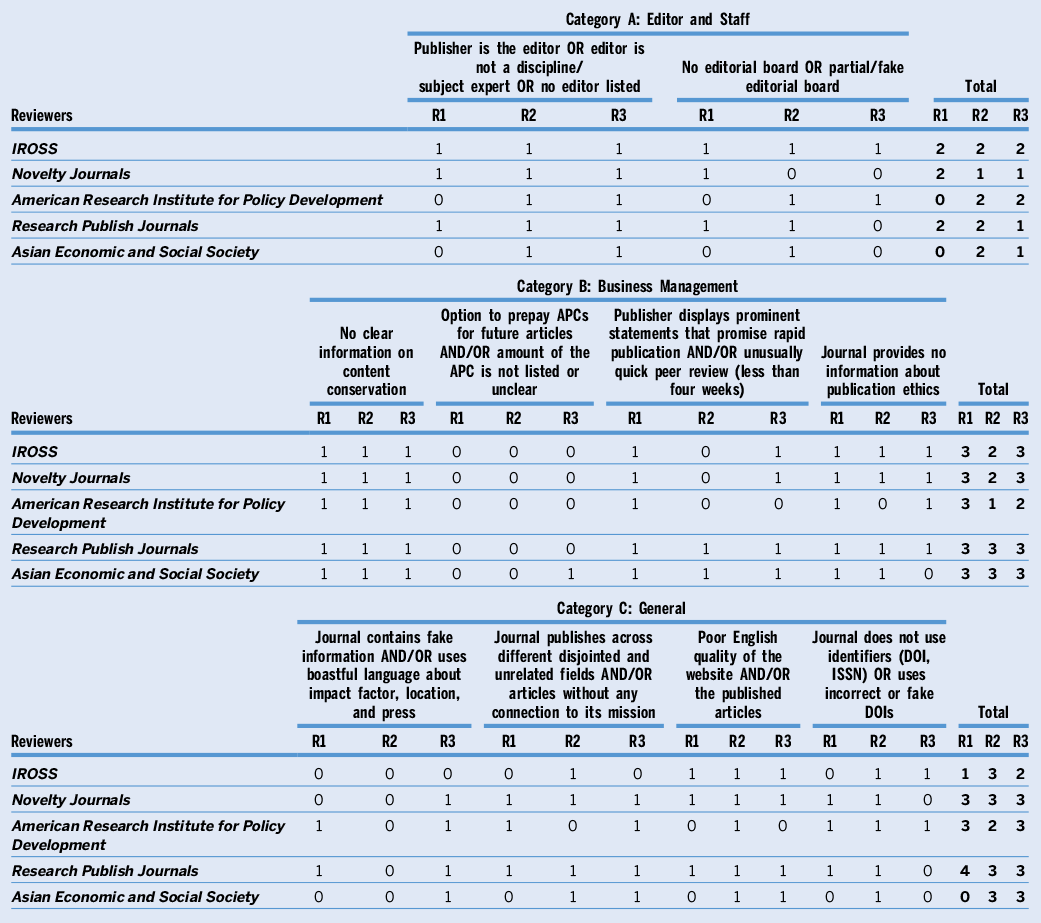
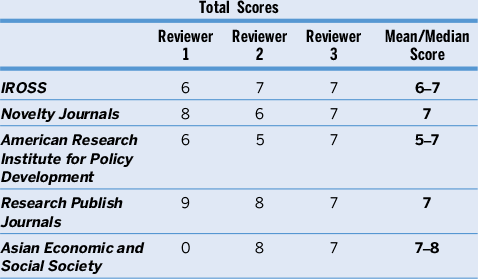
Table 1 displays the coding by the three individual coauthors in each category for the predatory journals. All non-predatory journals scored a 0 in all categories by all three coauthors. A 0 denotes that the category is not applicable and a 1 denotes that the category applies. Although there were slight variations, the three reviewers found at least some indicators of predation in all three journals. Table 2 lists the total score in each category for each predatory journal. Of 10 categories, each coauthor scored the sample journals from Beall’s List positive (1) on our predation index in at least five of our 10 categories—and often more. There was variation within the different categories coded. In discussion after the coding process was finished, all three coauthors identified the lack of transparent layout and/or organization of the Beall’s List journals as the main reason for the coding discrepancies. It was not fully possible to identify all of the relevant information on the websites of the five journals identified as predatory by Beall’s List. If this happens to users of our predation index, we suggest coding non-identifiable information as predatory, considering that any legitimate journal would have a self-interest to be as transparent as possible.
Applying the Predation Index to Five Journals from Beall’s List

Overall Score of Beall’s List Journals

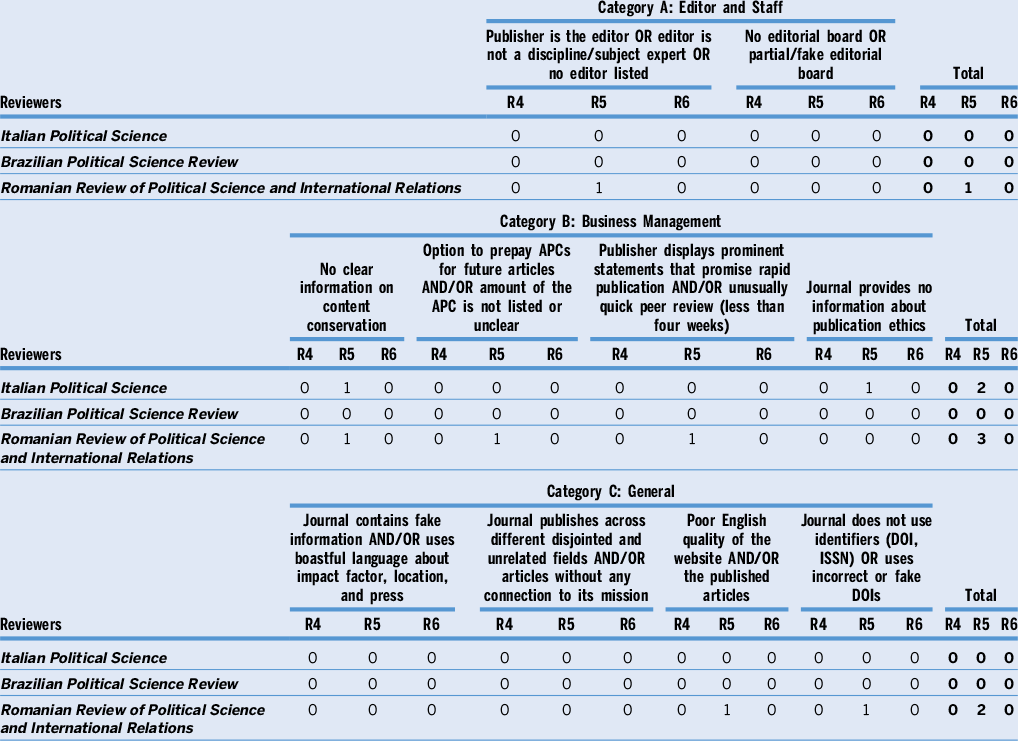
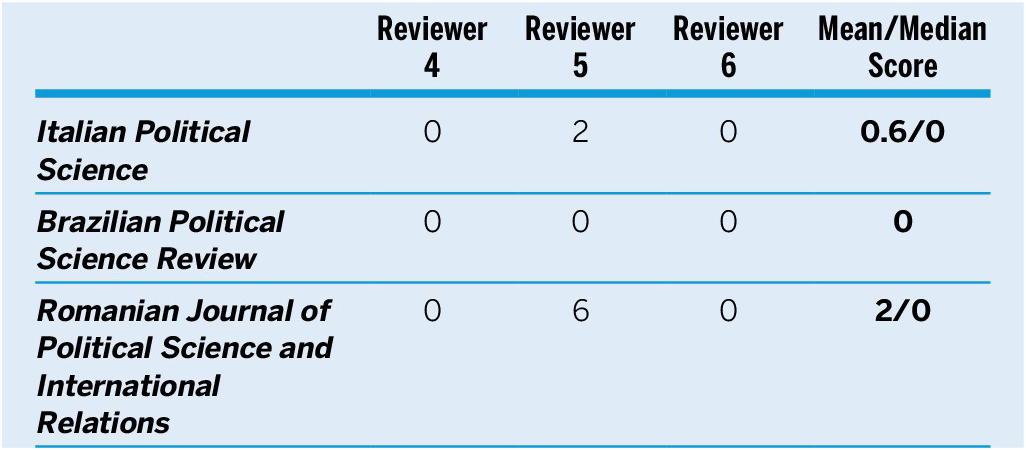
Given the differences among the three coders for our random selection of social science journals on Beall’s List, we decided to apply an additional test to our predation tool. We applied it to journals outside of Beall’s List and outside of the top journals in the discipline. Thus, we randomly selected three additional journals from the DOAJ. To obtain a different and unbiased assessment, we approached three colleagues—all of whom were trained political scientists who were not involved in the project—and asked them to code these journals using our tool. The purpose of this additional test was to ensure intercoder reliability. We told them only that the journals were randomly selected for a research project and that the selection was not meant to imply that they were predatory. Table 3 presents the calculations of these three political scientists (i.e., R4, R5, and R6) who had no additional information about our research.
Applying the Predation Index to Three Journals from the DOAJ

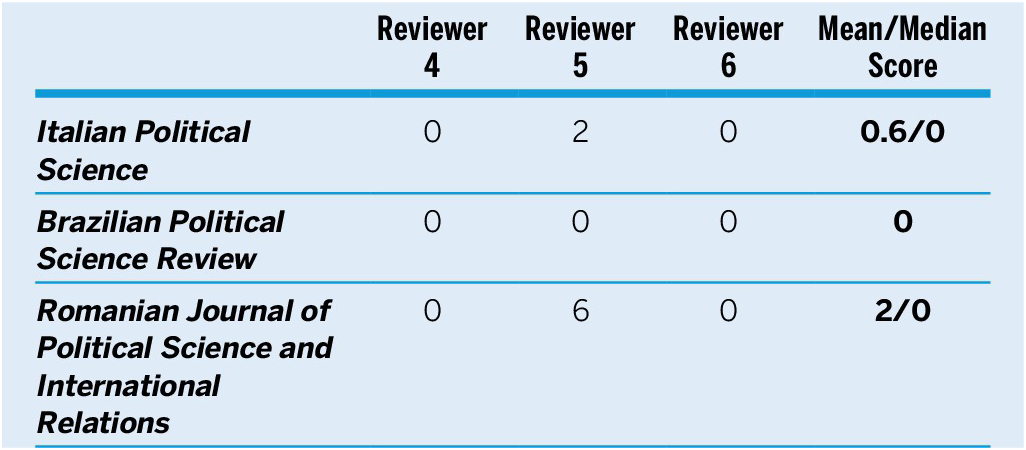
As the coding in tables 3 and 4 reveals, the three journals sampled from the DOAJ were broadly categorized as non-predatory by reviewers 4, 5, and 6. However, reviewer 5 did observe minor issues with two of the three journals selected for our analysis. Based on the overall coding of all three coders, we coded these journals as non-predatory. However, it also is important to note that our tool is malleable to individual differences, perceptions, and benchmarks. That is, the predation index is sensitive to the individual benchmarks of its users. For example, if reviewer 5 had a stricter interpretation of the criteria than reviewers 4 and 6, their benchmark for predation consequently might be somewhat higher.
Overall Score of DOAJ
CONCLUSION AND DISCUSSION
More than scholars in many disciplines, political scientists have identified the perils of widespread dissemination of disinformation and misinformation (Tucker et al. Reference Tucker, Guess, Barberá, Vaccari, Siegel, Sanovich, Stukal and Nyhan2018). However, so far they have not created any universally applicable tool to identify predatory publishing; we developed and tested such a tool. No tool is perfect, of course, and even a well-tested tool cannot account for the different approaches that coders may take, their different perceptions of journals, and how they may navigate journal websites. Therefore, even with our tool—which was used independently by six political scientists to ensure intercoder reliability—there are gray areas in how academic journals are presented and organized, as well as how they navigate the publishing process. These findings were to be expected—even necessary.
The results from using our research tool for assessing journals suggest that identifying predatory journals is not a straightforward process (Habibie and Fazel Reference Habibie, Fazel, Habibie and Fazel2024). Therefore, we recommend not identifying predation simply by answering “yes” to all of the items in our different categories. Rather, if a journal scores more than 5 points—that is, more than five items (i.e., more than half of the total) from our tool are applicable—it is more likely to be predatory in nature. If a journal scores more than 7 points, indicating that more than seven items from our tool are applicable, the likelihood of predation becomes very high.
In a crowded academic market, in which junior scholars in particular are under tremendous pressure to “publish or perish,” we hope that our tool can be of use to them for identifying predatory journals and carefully choosing outlets for their research. The predation index also could help scholars to identify predatory journals to avoid citing articles that may not have undergone a rigorous peer-review process. It may be valuable in teaching and, ultimately, an important tool to assist in service work and major decisions about research grants, awards, and promotions. Our analysis shows that scoring the individual categories is somewhat subjective; results may vary depending on the coder. Therefore, we recommend a sliding scale for identifying possible predation and a careful, well-researched interpretation of any results. We acknowledge that our tool must be honed over time as more researchers use it. A larger group of users may better identify gaps in our framework or changes in the publishing market, which will happen over time. Therefore, it is our hope that this tool will be used dynamically and that feedback from the scholarly community will help us to adjust it over time.
…it is our hope that this tool will be used dynamically and that feedback from the scholarly community will help us to adjust it over time.
SUPPLEMENTARY MATERIAL
To view supplementary material for this article, please visit http://doi.org/10.1017/S1049096525101145.
ACKNOWLEDGMENTS
We thank the three anonymous reviewers for their valuable comments, which significantly improved our article. We also are deeply grateful to our three colleagues—Ida Bastiaens, Gregory Holyk, and Sarah Lockhart—who served as additional coders to ensure intercoder reliability.
CONFLICTS OF INTEREST
The authors declare that there are no ethical issues or conflicts of interest in this analysis.