


Introduction
In many Western democracies, citizens lack trust in politicians. A common view is that politicians are self-serving and primarily promote their own electoral and economic interests rather than the interests of the collective (Hibbing and Theiss-Morse Reference Hibbing and Theiss-Morse2001; Mutz Reference Mutz2015). The consequences of this widespread distrust are significant. Political distrust erodes traditional forms of political participation, social capital, and citizens’ compliance with policies, leading to tax fraud and other illegal behavior (Marien and Hooghe Reference Marien and Hooghe2011; Sønderskov and Dinesen Reference Sønderskov and Dinesen2016).
In understanding the sources of political distrust, several literatures have converged on the argument that the behavior of various elite actors—especially the media and politicians themselves—is key. For example, past research shows that an emphasis on self-serving politicians “is a pervasive and dominant frame for reporting not only political campaigns but also routine politics and policy debates” (de Vreese Reference de Vreese2004, 192; see also, e.g., Cappella and Jamieson Reference Cappella and Jamieson1997; Druckman Reference Druckman2004; Dunaway and Lawrence Reference Dunaway and Lawrence2015; Patterson Reference Patterson2011). Furthermore, exposure to such news frames has been shown to be associated with increased political cynicism and distrust (Cappella and Jamieson Reference Cappella and Jamieson1997; Bøggild Reference Bøggild2016; de Vreese Reference de Vreese2004; Valentino, Beckmann, and Buhr Reference Valentino, Beckmann and Buhr2001), lower levels of political efficacy (Pedersen Reference Pedersen2012), and reduced voting intention and increased alienation (Valentino, Beckmann, and Buhr Reference Valentino, Beckmann and Buhr2001). In addition to the mainstream media’s framing of politicians as self-interested actors, political candidates themselves wage negative campaigns focusing on the moral transgressions of opponents (Lau, Sigelman, and Rovner Reference Lau, Sigelman and Rovner2007), and, at the extreme, fringe media and foreign governments distribute conspiracy theories and fake news about candidates (Dutch Government Reference Government2017; US National Intelligence Council 2017).
It is thus not surprising if citizens develop a cynical view of politics after exposure to these forms of elite information. At the same time, we believe an elite-centered perspective is likely to miss central, more psychological processes behind the emergence of public distrust. Many people do not get their news directly from elite sources. Over 40% of Americans report that they daily receive information from conversations with their colleagues and friends (Carlson Reference Carlson2019, 3; see also Druckman, Levendusky, and McLain Reference Druckman, Levendusky and McLain2018), suggesting that secondhand exposure to news via individuals in one’s social networks is a central source for learning about politics. While classical research theorized this two-step nature of information dissemination (Campbell et al. 1960; Katz and Lazarsfeld Reference Katz and Lazarsfeld1966), most empirical research on the effects of information about self-serving politicians has focused on the first step and considered citizens passive consumers of such information.
This manuscript considers the active role of citizens in spreading information about politicians’ self-serving behavior and, in turn, how citizens themselves contribute to low public trust in politicians. Theoretically, we draw on recent research from cognitive science to develop a psychological theory of fundamental biases in interpersonal communication of political information. We theorize that interpersonal communication of political information will be shaped by basic psychological mechanisms for detecting and counteracting antisocial, self-interested behavior. These mechanisms provide enhanced (i) abilities for encoding information about others’ self-interested, antisocial behavior and (ii) motivations for broadcasting such information to mobilize outrage against anyone posing a threat to group cooperation (e.g., Bell and Buchner Reference Bell and Buchner2009; Dunbar Reference Dunbar2004; Hibbing and Alford Reference Hibbing and Alford2004; Mesoudi, Whiten, and Dunbar Reference Martino, Benedetto and Dolan2006; Tooby and Cosmides Reference Tooby, Cosmides, Barkow, Cosmides and Tooby1992). News stories about politicians’ self-serving motives have a strong resonance with these psychological biases. Therefore, we predict that these psychological mechanisms create an interpersonal transmission bias in favor of political information that emphasizes self-serving politicians. Prior research has emphasized how both the direct effects of news frames and their effects through interpersonal communication quickly deteriorate (Carlson Reference Carlson2019; de Vreese Reference de Vreese2004; Druckman and Nelson Reference Druckman and Nelson2003; Katz and Lazarsfeld Reference Katz and Lazarsfeld1966). However, our focus on citizens’ psychological biases entails that information about self-serving politicians, specifically, will spread and persist in interpersonal communication, facilitating distrust in politicians and policy disapproval.
Methodologically, we rely on a unique experimental design from cognitive psychology—the chain transmission design (e.g., Aarøe and Petersen Reference Aarøe and Petersen2018; Carlson Reference Carlson2019; Mesoudi, Whiten, and Dunbar Reference Mesoudi, Whiten and Dunbar2006)—to provide a test that is optimally geared to identify the effect of psychological biases on abilities for encoding and motivations for transmitting information about self-serving politicians in interpersonal communication. As our case, we focus on the interpersonal transmission of strategy-framed media stories relative to their natural counterpart—that is, issue- or substance-framed stories. Self-serving, instrumental actions of politicians are “at the core of the strategy frame” (Aalberg, Strömbäck, and de Vreese Reference Aalberg, Strömbäck and de Vreese2012, 168), and the strategy frame is used extensively by mainstream media outlets. This case thus captures the most typical—yet not the most extreme—form of information about self-serving politicians available to citizens (Cappella and Jamieson Reference Cappella and Jamieson1997; de Vreese Reference de Vreese2004; Druckman Reference Druckman2004; Dunaway and Lawrence Reference Dunaway and Lawrence2015).
Empirically, we demonstrate, first, that individuals transmit strategy-framed news content more frequently, more elaborately, and with less information decay than issue-framed content focusing on political substance, thereby leading to an overrepresentation of political information on self-serving politicians in interpersonal communication. Second, we demonstrate that this transmission bias exists even when controlling for fundamental biases such as the negativity bias (e.g., Kahneman and Tversky Reference Kahneman and Tversky1979), and the novelty bias (e.g., Vosoughi, Roy, and Aral Reference Vosoughi, Roy and Aral2018), and controlling for the emotionality of the news content. Third, we demonstrate the democratic implications of the transmission bias for political trust and policy support. We demonstrate that strategy frames drive down trust in politicians and policy approval not only among the direct receivers of the news frame but also among individuals who receive it secondhand through interpersonal transmission.
Overall, our findings show that citizens play an active role in driving down public trust in politicians. Even if elite actors did not overreport information on self-serving politicians, an overrepresentation of such information would still emerge in the social transmission between citizens. While elites might be responsible for the origin of information that portrays politicians as self-serving, citizens are complicit in disseminating such information and generating ripple effects on political trust and policy approval.
Public Distrust in Politicians and Elites As Culprits
Trust in politicians is low across many countries, even in contexts where government performance is high and scandals are absent (Bøggild Reference Bøggild2020; Hibbing and Theiss-Morse Reference Hibbing and Theiss-Morse2001). This general, cross-national trend has led scholars to look beyond government performance and scandals for more generic and stable explanations for public distrust in politicians.
A main class of such explanations stresses the dissemination of information about self-serving politicians by elite actors. In particular, the mainstream media’s coverage of politics is considered important in decreasing public trust in politicians. Journalistic tendencies to emphasize conflict, power, and sensationalism in political news coverage often entail an overrepresentation of information on politicians’ self-interested attempts to obtain votes, office, and material benefits at the expense of political substance (Capella and Jamieson Reference Cappella and Jamieson1997; Patterson Reference Patterson2011).
A focus on self-interested politicians is particularly strong in a type of news that is part of the generic repertoire of almost all media outlets: strategy frames (Cappella and Jamieson Reference Cappella and Jamieson1997; Druckman Reference Druckman2004; Dunaway and Lawrence Reference Dunaway and Lawrence2015). Strategy frames portray politicians as self-interested actors motivated by winning votes and office rather than the common good and downplay the focus on substantive policy issues. Specifically, strategy frames emphasize “the strategies and tactics or campaigning necessary to position a candidate to get ahead or stay ahead” (Cappella and Jamieson Reference Cappella and Jamieson1997, 33) and thus portray politicians “as players in a contest that is mainly about their own power and popularity” (Aalberg, Strömbäck, and de Vreese Reference Aalberg, Strömbäck and de Vreese2012, 168).Footnote 1 This frame is frequently contrasted with the issue frame (also referred to as the substance frame), which focuses on politicians’ policy proposals, the problems they try to solve, and the societal outcomes they favor. Political communication studies demonstrate that the strategy frame is a pervasive and dominant frame in the media’s coverage of campaigns as well as routine policy making (de Vreese Reference de Vreese2004, 192; Druckman Reference Druckman2004) and that exposure to strategy frames is associated with increased political cynicism and distrust in politicians (Cappella and Jamieson Reference Cappella and Jamieson1997; de Vreese Reference de Vreese2004).
This media-centered explanation points to the role of the motivations and efforts of elite actors in disseminating information about self-serving politicians. At the same time, it is well recognized that in order for this information to reach citizens broadly, citizens themselves need to become involved in the dissemination process. Interpersonal communication between citizens is thus a key channel through which media stories and other types of elite information get broadly disseminated (Druckman, Levendusky, and McLain Reference Druckman, Levendusky and McLain2018; Katz and Lazarsfeld Reference Katz and Lazarsfeld1966). Classical research on communication referred to this as the “two-step flow of information” (e.g., Katz and Lazarsfeld Reference Katz and Lazarsfeld1966), and recent research underlines the importance of a full consideration of both steps: “rather than simply studying media exposure in isolation, our results underline how vital it is to study it within the context of group discussion and conversation… . any study of communication must consider interpersonal discussion as part of the process” (Druckman, Levendusky, and McLain Reference Druckman, Levendusky and McLain2018, 110).
Complicit Citizens: An Interpersonal Transmission Bias Favoring Information about Self-Interested Politicians
At first glance, interpersonal transmission of information might seem like a trivial extension of elite transmission. Citizens will simply recall what they saw or read and pass this on. Because of citizens’ well-documented lack of knowledge about politics and public affairs (e.g., Zaller Reference Zaller1992), they are bound to forget some elements and misunderstand others and, hence, the quality of the information will quickly deteriorate. Indeed, Carlson (Reference Carlson2018; Reference Carlson2019) showed that the details of news media stories quickly became lost when transmitted between citizens.
Yet, psychologically speaking, the move from elite to interpersonal transmission is far from trivial and the differences have important consequences. The idea that citizens simply, with some error, copy news stories from elites is an instantiation of what Zaller (Reference Zaller1992) called a “file-drawer model” of the human mind: that we store information as though it were in a file drawer, ready to be pulled out. Yet decades of cognitive psychology have demonstrated that information storage and retrieval are constructive processes wherein information is disassembled and reassembled rather than directly copied (Boyer Reference Boyer2001; Sperber Reference Sperber1996).
Cognitive psychologists have worked hard to identify the psychological mechanisms that make information transmission possible. A large number of different perspectives converge on the argument that this is made possible by the existence of a priori expectations or predictions about the content of information (Boyer Reference Boyer2001; De Martino et al. Reference Martino, Benedetto and Dolan2006; Sperber Reference Sperber1996; Tooby and Cosmides Reference Tooby, Cosmides, Barkow, Cosmides and Tooby1992). Political scientists would be most familiar with the version of this argument referring to these expectations as being based on psychological biases—that is, built-in predispositions or heuristics that direct how people filter, encode, and retrieve information, as well as how they produce inferences from the information (e.g., Tversky and Kahneman Reference Tversky and Kahneman1974).Footnote 2
Due to the complexity of interpersonal communication, is it inevitable that information will decay as it is transmitted between individuals. But, in contrast to a “file-drawer” view, these insights from cognitive psychology imply that not all interpersonal transmission will be equally error prone. Political information that fits psychological biases should be transmitted more reliably and persuasively than information lacking such fit (Aarøe and Petersen Reference Aarøe and Petersen2018). Hence, reliable transmission of information does not always hinge on a few well-informed “opinion leaders” as in the classical model of the two-step flow of information (Katz and Lazarsfeld Reference Katz and Lazarsfeld1966).
This perspective, we argue, is of key importance in understanding the spread of news stories about self-interested elites. There are solid reasons to expect that this is a domain where a powerful psychological bias applies. Studies in psychology and political science have proposed that to maintain cooperation in social groups despite risks of defection from antisocial, self-interested individuals, the human mind is equipped with a set of mechanisms that allow group members to counteract and control such individuals (e.g., Dunbar Reference Dunbar2004; Petersen Reference Petersen2012; Tooby and Cosmides Reference Tooby, Cosmides, Barkow, Cosmides and Tooby1992). The existence of such mechanisms has often been explained with reference to human evolutionary history. For several hundred thousand years, human ancestors lived in environments where they were dependent on cooperating with others for survival (e.g., hunting, foraging, and protection from predators). To navigate these environments, their minds—and, by extension, our minds—evolved psychological mechanisms for controlling and counteracting self-interested, antisocial individuals who posed a threat to group cooperation (Tooby and Cosmides Reference Tooby, Cosmides, Barkow, Cosmides and Tooby1992). The literature has largely uncovered two distinct mechanisms: (1) the ability to encode and retrieve information about self-interested individuals and (2) the motivation to broadcast such information to other group members.
First, studies on attention and memory show that the ability to encode and retrieve information is particularly strong for—or biased in favor of—information about individuals who violate expectations and norms of social, cooperative behavior (for a comprehensive meta study, see Stangor and McMillan Reference Stangor and McMillan1992). For example, people can better remember and recall the names and faces of other individuals when such individuals are presented along with descriptions of “self-interested” or “untrustworthy” rather than “trustworthy” or “neutral” behavior (e.g., Bell and Buchner Reference Bell and Buchner2009). This bias also extends to the processing of political information: Rumors about political candidates’ morally corrupt behavior (i.e., taking campaign contributions from criminal organizations) tend to persist in people’s memory, even after such rumors are credibly refuted (Thorson Reference Thorson2016).
Second, studies also provide evidence that people hold a strong motivation to broadcast information on self-interested individuals to other group members. Studies of information transmission between individuals have, for example, demonstrated a strong motivation in favor of transmitting or sharing social information that can be characterized as “gossip,” often focusing on the antisocial behavior of others (Dunbar Reference Dunbar2004; Mesoudi, Whiten, and Dunbar Reference Mesoudi, Whiten and Dunbar2006). Previous work has also found that a motivation toward transmitting social information extends to political contexts. Specifically, Aarøe and Petersen (Reference Aarøe and Petersen2018) found that episodic content of news stories about social welfare (i.e., content about specific welfare recipients) was communicated in greater detail than thematic content (i.e., generalized, statistical facts about welfare recipients). More generally, evidence from economic games shows that gossiping about the self-interested actions of others is key for upholding cooperation and obtaining optimal outcomes in social groups (Gross and Dreu Reference Gross and De Dreu2019). From this perspective, the inclination to gossip evolved specifically to expose and counteract self-interested individuals and keep up cooperation in social groups (Dunbar Reference Dunbar2004).
We contend that these mechanisms are of relevance for social transmission of information about politicians in interpersonal communication. Threats to group cooperation from antisocial, self-interested individuals not only emerge from rank-and-file citizens but also from leaders. Leaders can violate norms and expectations for cooperative behavior by forcing policies or decisions upon citizens that advance personal rather than group interests (Hibbing and Alford Reference Hibbing and Alford2004; Marien and Hooghe Reference Marien and Hooghe2011). Anthropological studies suggest that such threats to group cooperation were also imminent in ancestral environments (von Rueden et al. Reference von Rueden, Gurven, Kaplan and Stieglitz2014), implying that evolution may have designed the psychological mechanisms available for counteracting self-interested individuals to be sensitive to behavior from leaders as well (Hibbing and Alford Reference Hibbing and Alford2004). In small-scale groups, the diffusion of information on self-interested, norm-violating behavior from leaders through gossiping can serve as an effective “leveling mechanism” that allows followers to mobilize against and counteract attempts of dominance and exploitation (Bøggild and Petersen Reference Bøggild, Petersen, Shackelford and Hansen2016; von Rueden et al. Reference von Rueden, Gurven, Kaplan and Stieglitz2014).
We expect that much information available to citizens about self-interested politicians should fit the input conditions of these psychological mechanisms and, in turn, be transmitted with more elaboration and higher frequency than information that does not fit these mechanisms. Conspiracy theories, by definition, carry information about the self-serving motivations of powerful elites in conspiring against the broader public (Uscinski and Parent Reference Uscinski and Parent2014, 13). Similarly, much information in negative campaigns aims to convince voters of the self-serving or corrupt dispositions of opponent candidates (Lau, Sigelman, and Rovner Reference Lau, Sigelman and Rovner2007). Lastly, media stories relying on the strategy frame portray politicians as motivated by power and their own careers over public interests (de Vreese Reference de Vreese2004; Druckman Reference Druckman2004; Dunaway and Lawrence Reference Dunaway and Lawrence2015).
Case and Predictions
As a case, this article focuses on citizens’ dissemination of strategy-framed political information. First, this constitutes the most prevalent form of information about self-interested politicians available to citizens: strategy-framed news is the dominant type of news frame in election campaigns and is a routine journalistic angle in the coverage of everyday policy making (de Vreese Reference de Vreese2004; Druckman Reference Druckman2004; Dunaway and Lawrence Reference Dunaway and Lawrence2015). Second, strategy-framed content is not the most extreme form of information about self-interested politicians (compared with, for example, conspiracy theories or corruption allegations in negative campaigns). Hence, if we establish a transmission bias in favor of strategy-framed information, we also expect this bias to emerge for more extreme forms of communication.
We test three sets of observable implications of our theory. First, based on the psychological match between the fundamental predispositions in the human mind and the type of information in strategy-framed news, we predict that strategically framed news content will be encoded and transmitted to a greater extent than issue-based content in interpersonal communication. The transmission bias should lead people to transmit strategy-framed news in greater length or quantity and with higher frequency than issue-framed news (H1).
Second, we turn to the content of socially transmitted information to further investigate the underlying psychological motivation that should facilitate the transmission bias. If fast-and-frugal processes for encoding of self-interested, norm-violating behavior underlie the transmission bias, the recollected information should specifically emphasize self-interested politicians and not just, more generally, negative, emotional, or novel information about politicians (H2), as would be the case if the effects were driven by other well-known biases such as the negativity bias (Kahneman and Tversky Reference Kahneman and Tversky1979) or the novelty bias (Vosoughi, Roy, and Aral Reference Vosoughi, Roy and Aral2018). Such biases have been shown to shape how citizens select and process political information in other contexts and, hence, constitute important alternative explanations (e.g., Ryan Reference Ryan2012; Ryan and Brader Reference Ryan and Brader2017; Valentino et al. Reference Valentino, Banks, Hutchings and Davis2009).
Third, we explore the broader implications of the transmission bias for political trust and policy attitudes. Extant studies show that when transmitted socially, information that does not fit underlying psychological biases tends to lose the ability to influence attitudes (Carlson Reference Carlson2019; Aarøe and Petersen Reference Aarøe and Petersen2018). If the human mind contains a psychological bias for encoding, retrieving, and building inferences about self-interested individuals who violate norms of cooperation, such information should induce distrust and policy opposition. Importantly these effects should be observed among the direct consumers of the news frame and also as “ripple effects” among individuals who receive the information second hand through interpersonal communication. Thus, socially transmitted strategy-based content should drive down trust in politicians and policy approval (H3).
Test 1: Establishing the Transmission Bias
If people have a transmission bias favoring information about the self-interested motives of others as predicted by H1, we should observe that (1a) strategy-related content is transmitted in greater amounts and (1b) with higher frequency in interpersonal communication, (1c) that recollections of strategy-related news focus exactly on this type of information and, by implication of 1a–1c, that there is less decay in the transmission of strategy related content in interpersonal communication than issue-related content (1d). In Test 1, we test these four observable implications of H1.
To establish the transmission bias predicted by H1, we employ a highly controlled experimental design that directly allows us to peek into psychological processes as they unfold at the level of citizens. Specifically, we adopt and extend an experimental chain transmission design from social psychology in which information is passed through a chain of subjects, hence emulating the children’s game “Telephone” (e.g., Bangerter Reference Bangerter2000; Mesoudi, Whiten, and Dunbar Reference Mesoudi, Whiten and Dunbar2006). In this design, the first participant in a chain reads a text (e.g., a news frame) and recollects it. This recollection is passed on to the next participant in the chain, who recollects the first participant’s recollection to the next participant, and so on (cf. Mesoudi, Whiten, and Dunbar Reference Mesoudi, Whiten and Dunbar2006). Thus, the design is “uniquely effective in revealing cumulative and systematic bias in the encoding and transmission of information” (Mesoudi, Whiten, and Dunbar Reference Mesoudi, Whiten and Dunbar2006, 406). Specifically, as explained by Mesoudi and Whiten (Reference Alex and Andrew2008, 3491), “by comparing the rates at which different kinds of material degrades, the researcher can infer the operation of systematic biases.” Hence, by randomly assigning participants to strategy- and issue- frame conditions and by using the chain transmission design, we can ensure high internal validity while observing differences in the decay of strategy-framed and issue-framed content in social transmission.
Research Design
We designed two chain transmission experiments. They were both fielded in two consecutive online web surveys to US respondents recruited through the Amazon Mechanical Turk (MTurk) platform. Existing work (Coppock Reference Coppock2018) has found that MTurk samples generate experimental treatment effects largely indistinguishable from nation-based stratified samples despite an overrepresentation of liberal and Democratic subjects. Survey 1 (1st transmission) was collected September 19–20, 2015 (n = 782), and Survey 2 (2nd transmission) was collected October 20–22, 2015 (n = 773).Footnote 3 Respondents from Survey 1 were ineligible to participate in Survey 2.
Procedure
In the first survey (1st transmission), all respondents answered a set of background questions and were then randomly assigned to either the quantity experiment or the frequency experiment.
The quantity experiment had a standard chain transmission design (e.g., Bangerter Reference Bangerter2000, Mesoudi, Whiten, and Dunbar Reference Mesoudi, Whiten and Dunbar2006). It was designed to test whether the amount or quantity of information people are able to recollect and transmit from a news story is higher when it adopts a strategy frame relative to an issue frame. Therefore, the respondents were randomly assigned to read a political news article adopting either a strategy or an issue frame and then asked about their opinions on what they read (for the specific opinion measures, see Test 3). Finally, the respondents were asked to recollect the news article to a new participant in the study. They were instructed to write as accurately and clearly as they could and include as many details as possible (see Online Appendix A1.1 for instruction details).
Yet, as outlined above, we not only expect the transmission bias to manifest itself in an enhanced ability to encode and recollect information about self-serving politicians; we also expected it to result in an enhanced propensity to broadcast such information over other types of political information. The frequency experiment was designed to test this. In the frequency experiment, respondents were asked to read two news articles. All respondents read the same nonpolitical news article (a movie review) and were randomly assigned to read either a strategy-framed article or an issue-framed article (the same articles as in the quantity experiment). Afterwards, they were asked the same opinion questions as in the quantity experiment. Finally, the respondents were instructed to choose whether they preferred to recollect the movie review or the political news article to a new participant in the study. Thus, the frequency experiment tests whether political strategy-framed news stories are transmitted more frequently compared with political issue-framed news stories.Footnote 4
Survey 2 (2nd transmission) was fielded to a new sample of respondents and followed the same procedure as Survey 1 (1st transmission) except that the respondents were randomly assigned to read recollections written by participants in Survey 1 rather than the original news articles.Footnote 5 Hence, in Survey 2, respondents in the quantity experiment were randomly assigned to read a recollection of the original strategy- or issue-framed article written by a respondent in the quantity experiment in Survey 1. Likewise, respondents assigned to the frequency experiment in Survey 2 were randomly assigned to read a recollection of the movie review and a recollection of either the strategy or the issue frame written by participants in the frequency experiment in Survey 1.Footnote 6 The inclusion of Survey 2 (2nd transmission) in the research design allows us to observe whether a systematic bias in the transmission of strategy- versus issue-framed news also exists in the second transmission—that is, when people are exposed to news secondhand via recollections.
The transmission chain design is unusual compared with most communication experiments in political science because, as the experiment unfolds, all participants will read different texts. This design feature is the source of the strength of the design. Specifically, as recollections are passed on, information will deteriorate and idiosyncrasies will be added to each recollection. The logic of the design is to leverage this to identify what types of information are better retained as noise accumulates: what is retained is what fits the mechanisms of the human mind (Bangerter Reference Bangerter2000; Mesoudi and Whiten Reference Alex and Andrew2008). Importantly, even as idiosyncratic noise accumulates, full experimental control is kept. Thus, we do not analyze the effects of the idiosyncratic features of each recollection but the effects of the experimental condition from which the recollection originates. Furthermore, because of random assignment to conditions, idiosyncrasy is equally distributed across conditions.
Experimental Stimuli
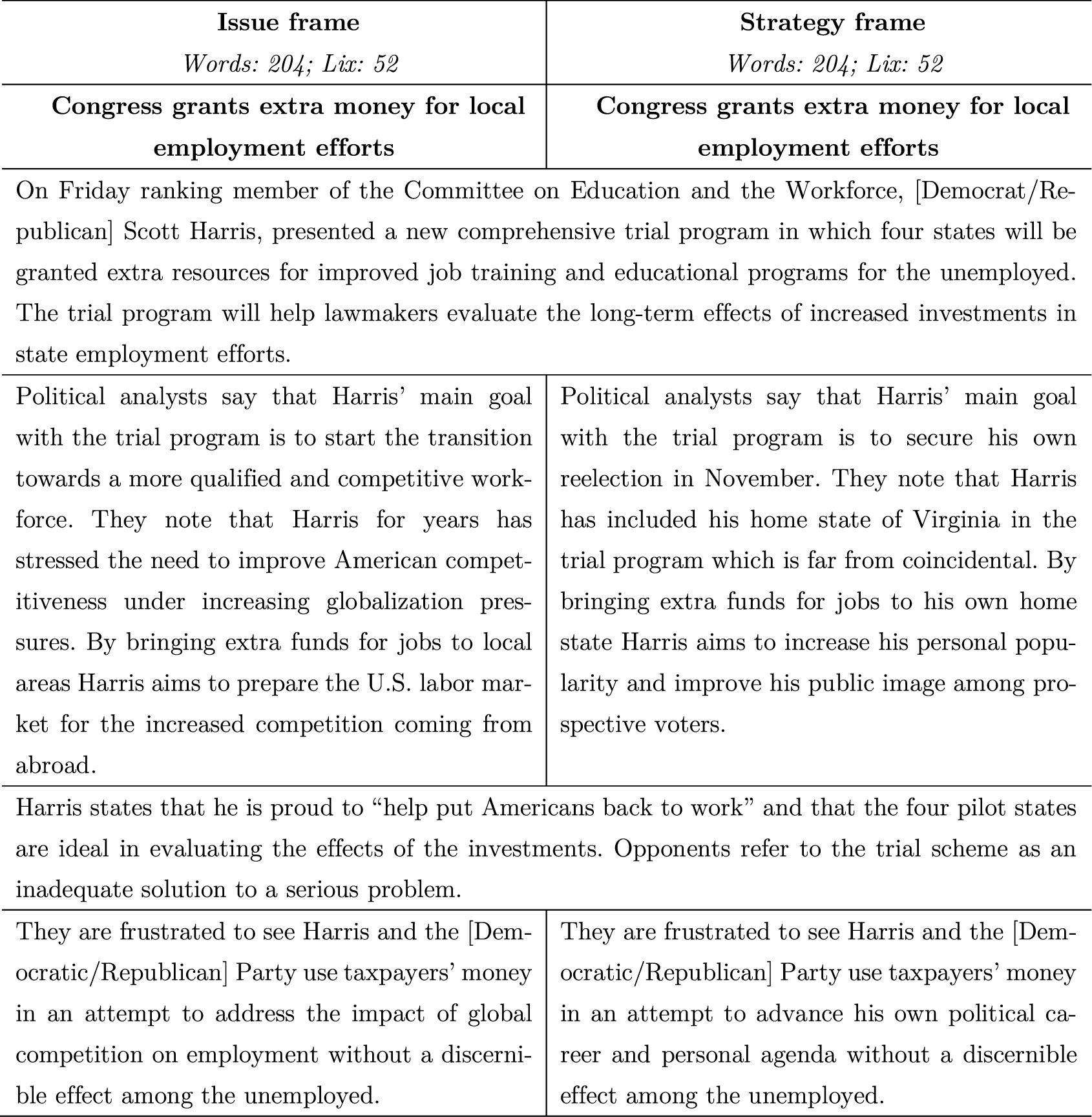
As experimental stimuli, we constructed a strategy-framed and an issue-framed political news article and a nonpolitical story (a movie review). Both political news articles, displayed in Figure 1, were about a new policy enacted by Congress at the initiative of a committee ranking member, Congressman Scott Harris. In line with existing work on strategy framing and issue framing (e.g., Cappella and Jamieson Reference Cappella and Jamieson1997; de Vreese Reference de Vreese2004), we varied whether the policy was motivated by the politician’s strategic concerns about winning votes by benefitting his home state (strategy frame) or by issue-related concerns (issue frame). Finally, to increase experimental realism and explore whether the transmission bias was moderated by shared partisanship with the politician (portrayed in square brackets), we manipulated experimentally whether Harris was described as a Democrat or a Republican in the articles (i.e., a 2 × 2 design).
Strategy- and Issue-Framed News Articles

The third article represented a typical nonpolitical news article, specifically a movie review focusing on the upcoming movie “All Things Must Pass” (used only in the frequency experiment). The full article is available in Online Appendix A1.2.
Importantly, to avoid the risk of confounding factors, the strategy- and the issue-framed articles were matched on length, structure, and readability.Footnote 7 Both articles had an identical length of 204 words and a lix score (readability measure) of 52. We ran a separate experimental pretest conducted on MTurk with US subjects (n = 74), which confirmed that the strategy- and issue-framed articles differed only in their focus on strategic versus issue-related content and not in, for example, readability, fluency, coherence, structure, perceived relevance, or thematic content (See Online Appendix A1.3 for all pretest results).
Dependent Measures
To measure whether people were more motivated to recollect the strategy-related content and transmitted it with higher frequency than issue content, we use the frequency experiment and calculate the percentage of respondents who chose to transmit the political news story (over the movie review) across the strategy-framed condition and the issue-framed condition.
To obtain a first indicator of the quantitative amount of information transmitted, we turn to the quantity experiment and use the raw count of words in the recollections.Footnote 8 This dependent measure is a simple, objective proxy of the amount of information transmitted, as the initial political news articles were randomly assigned and only varied in their framing, whereas length, lix, etc. were the same.
Still, the raw word count is only an indirect, first indicator of the amount of transmitted information. To gauge the direct content of the transmitted information, we implemented two additional measures: First, we used the data from the quantity experiment and conducted an automated content analysis using lasso regression to identify the transmitted words that uniquely predict each frame condition. If a transmission bias exists, it should be exactly the information about the politician’s self-interested motives that the respondents transmit from the strategy frame. Second, we conducted a deductive, large-scale human crowd coding of the content of the recollections from the quantity experiment. Specifically, we recruited 2,196 US respondents through Amazon Mechanical Turk to each code either a recollection or one of the original news articles from the quantity experiment. A total of 718 recollections were coded. Crowd coding allows for highly replicable, reproducible, and fully blinded coding, which reduces coder bias and increases measurement validity (e.g., Benoit et al. Reference Benoit, Conway, Lauderdale, Laver and Mikhaylov2016; Lind, Gruber, and Boomgaarden Reference Lind, Gruber and Boomgaarden2017; see Online Appendix A2.2 for further discussion). All respondents were asked to categorize the content of the news article or recollection they were presented with by indicating whether it contained prespecified elements from the issue frame and from the strategy frame (see Online Appendix A2.2 for details and intercoder agreement tests).
Results
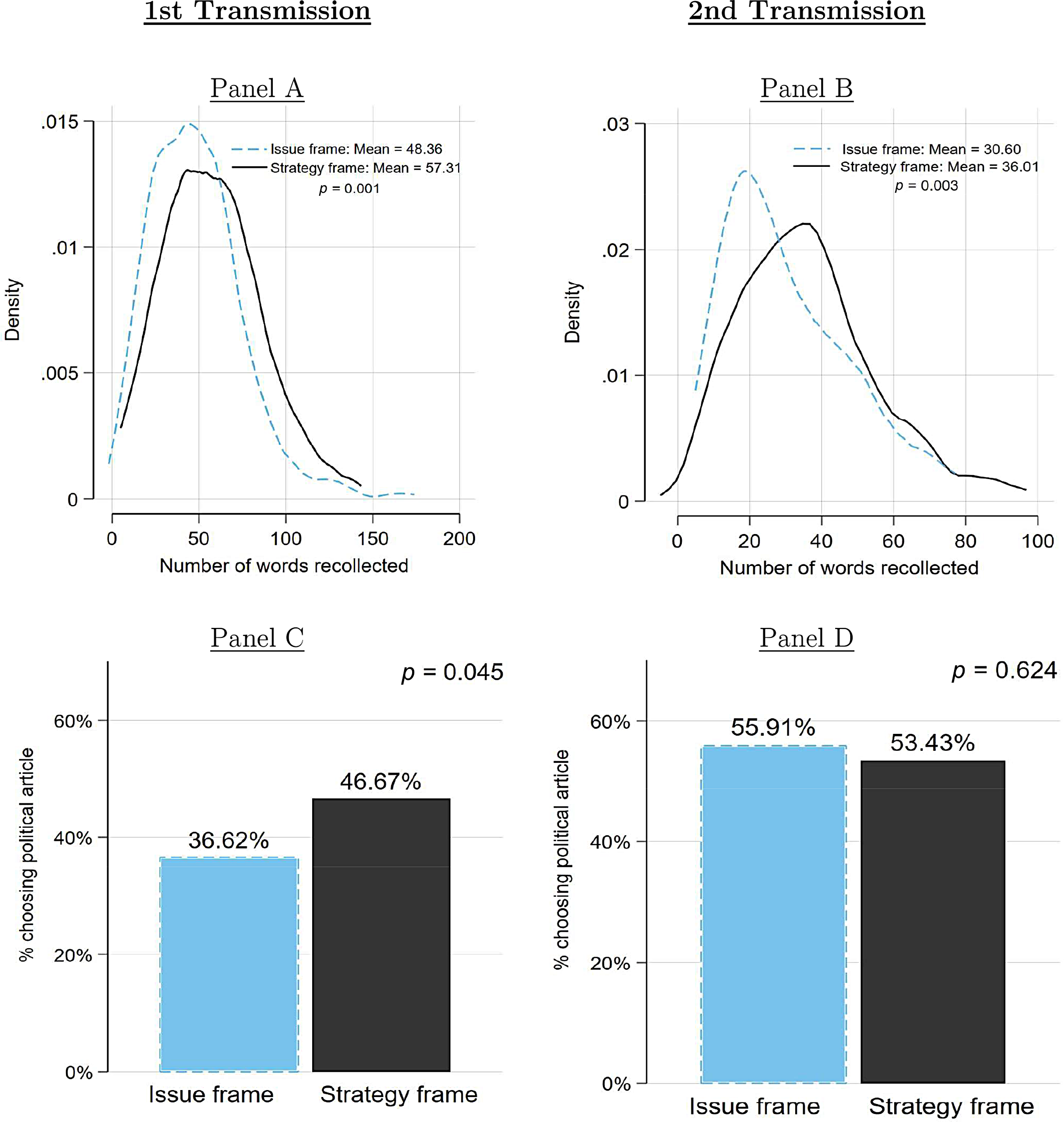
Is a greater amount of strategy-framed news transmitted compared with issue-framed news (1a)? To provide an initial test of the transmission bias, Figure 2, Panel A reports the mean number of words transmitted from the strategy frame and the issue frame in the first transmission round of the quantity experiment. In line with H1, respondents in the strategy condition on average transmitted 57.31 words. This is significantly higher than the 48.36 words transmitted by respondents in the issue condition (t = -3.255, p = 0.001). In substantive terms, this means that respondents on average pass on 19% more words from the strategy frame than the issue frame.
Number of Words Transmitted (Panels A–B) and Percentage Transmitting Political Article (Panels C–D) by Frame Condition and Transmission Round

In the second round, we observe the same pattern, as displayed in Figure 2, Panel B. Respondents assigned to read recollections of the strategy frame on average transmitted 36.01 words. In support of H1, this is also significantly higher than the 30.6 words transmitted by respondents in the issue-framed condition (t = -2.973, p = 0.003). That is, respondents on average transmitted 18% more words from the strategy frame than the issue frame.
To ensure that these results were not driven by simple filler words, we conducted an analysis of robustness in which we removed all filler words using the list of English stop words in the Quanteda R package. The results show that the findings replicate when filler words are removed (see Online Appendix A2.1 for supplemental details).
Are strategy-framed news stories transmitted more frequently compared with issue-framed stories (1b)? Figure 2, Panel C reports the percentage of respondents choosing to transmit the political news story (over the movie review) in the strategy and the issue condition in the first transmission round of the frequency experiment. A total of 46.67% of the respondents assigned to read the strategy-framed article chose to retell this news story over the movie review. This is significantly higher than the 36.62% of the respondents assigned to the issue-framed article who chose to retell this news story (t = -2.015, p = 0.045). Consistent with H1, the strategy frame increases motivation to transmit the political news story by 10.05 percentage points compared with the issue frame. However, Panel D shows no significant difference in the percentage of respondents in the strategy-framed and the issue-framed condition who chose to transmit the political news article over the movie review in the second transmission round (p = 0.624). This suggests that the transmission bias is most robust when citizens receive news stories in full from either elites or other citizens.
It is interesting to note across Panels A–D that the effect sizes seem larger in the first transmission than in the second transmission. A possible explanation, consistent with past research (e.g., Carlson Reference Carlson2019), is that the first transmission results in a massive overall loss of information implying that (a) the issue information that survives this first intense filtering in interpersonal communication has been adopted to fit other cognitive biases, which makes it more resilient in subsequent transmission, and (b) that the strategy frame is partly diluted by the overall information loss. Together, these processes may account for the gradual dilution of the transmission bias across multiple rounds of interpersonal communication.
It is also interesting to note that in Panels C and D we observe a significant increase from Round 1 to Round 2 in the percentage of respondents choosing to transmit the issue-framed political news article over the movie review (mean difference = 0.19, p < 0.001) and also a descriptive but statistically nonsignificant increase in the proportion choosing to transmit the strategy-framed news article over the movie review (mean difference = 0.07, p = 0.186). In line with the argument above, this pattern may reflect that the recollections of the issue frame conform better to the psychological biases of the mind once the information has gone through the first intense filtering in Round 1.
Importantly, overall, the general pattern of results in Panels A–D supports H1 and the notion that strategy frames are more likely to be transmitted and “survive” in the competition with other types of news coverage through interpersonal communication. Still, the results in Figure 2 do not document systematic differences in the content of the recollections and whether such differences are consistent with the transmission bias. To investigate this, we test 1c and 1d using more substantively oriented measures of the content of the recollections to increase measurement validity.
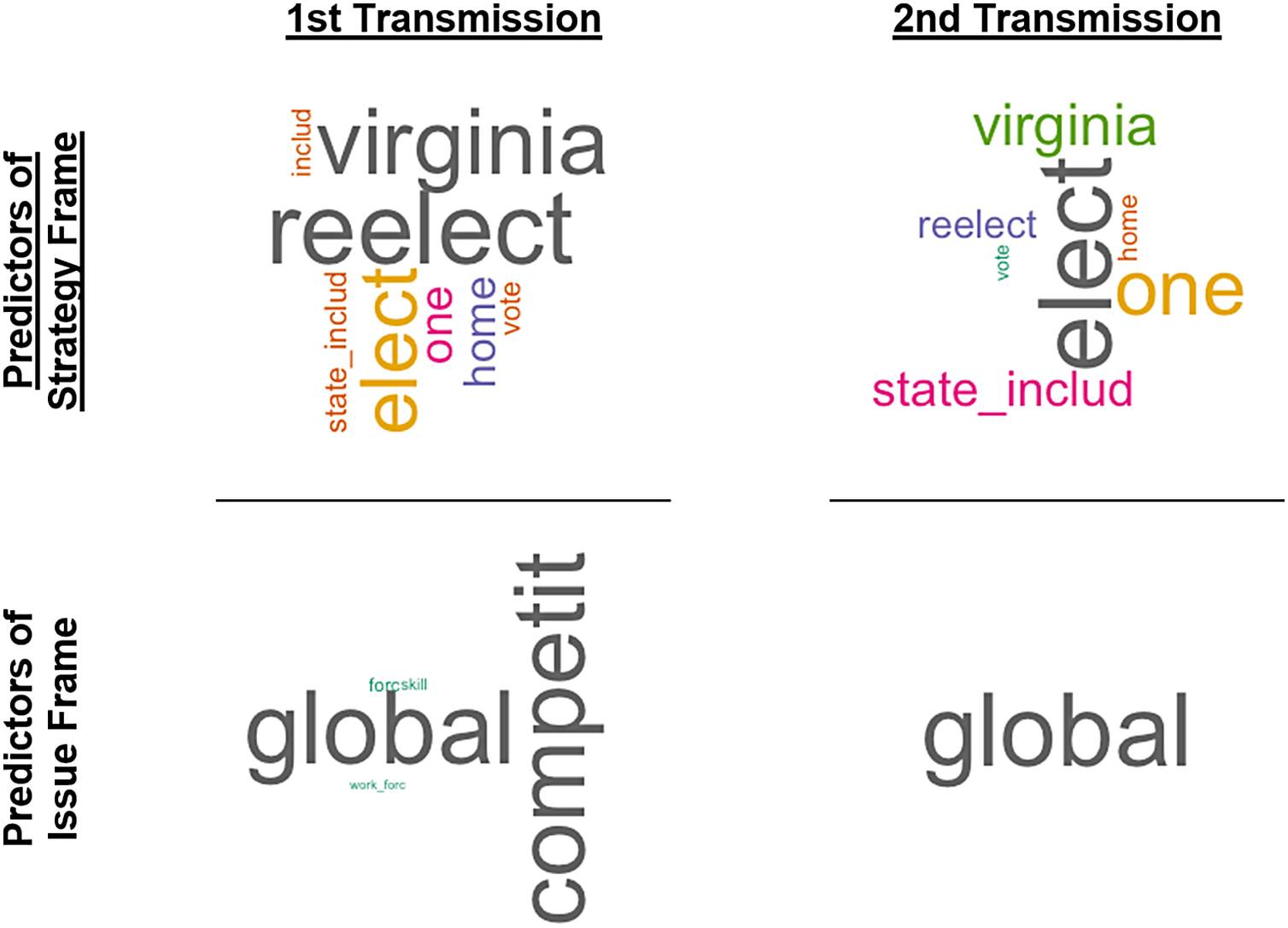
Do recollections of strategy-framed news articles focus on strategy-related information (1c)? Figure 3 reports uni- and bigrams identified by a lasso regression to predict the condition of the recollection. Consistent with H1, the results support that the recollections of the strategy-framed news articles focused on Harris’ self-serving motives and actions—especially his motives for reelection and vote-seeking and his attempt to benefit his own home state of Virginia with his policy proposal. The results also support that recollections of the issue frame focused on the substantive aspects of the policy proposal to fight unemployment due to global competition. Interestingly, the results suggest that the respondents transmit a richer set of strategy-related elements from the strategy frame than issue-related elements from the issue frame. This pattern is consistent with the notion of a transmission bias that makes people better able to encode and transmit information about self-interested politicians.
Uni- and Bigrams Identified in Lasso Regression to Predict Recollection Condition

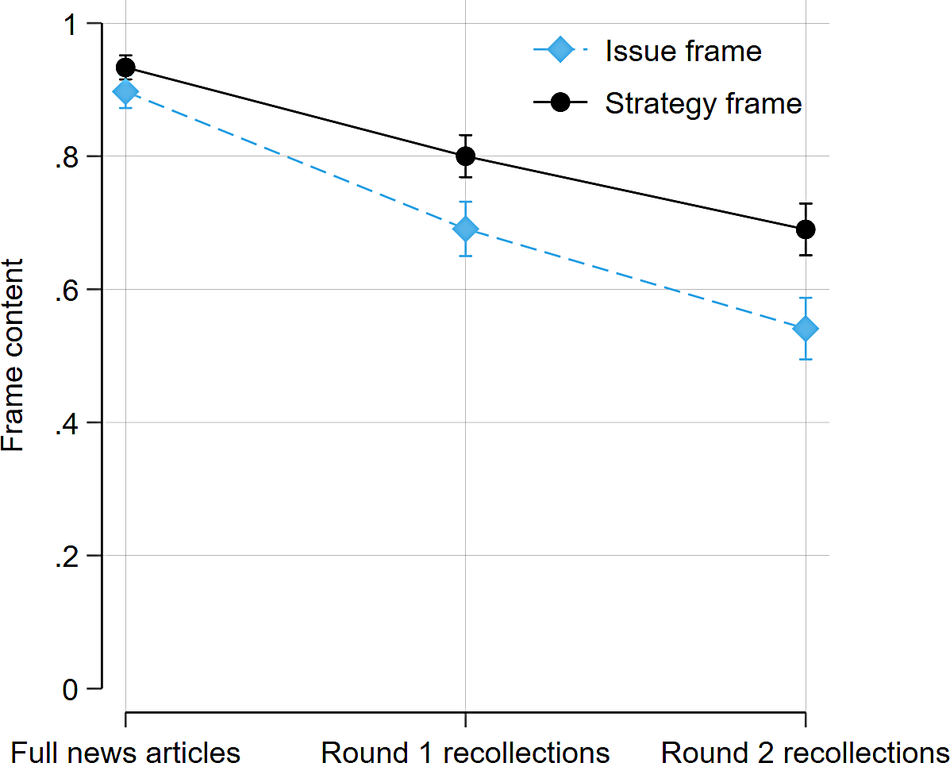
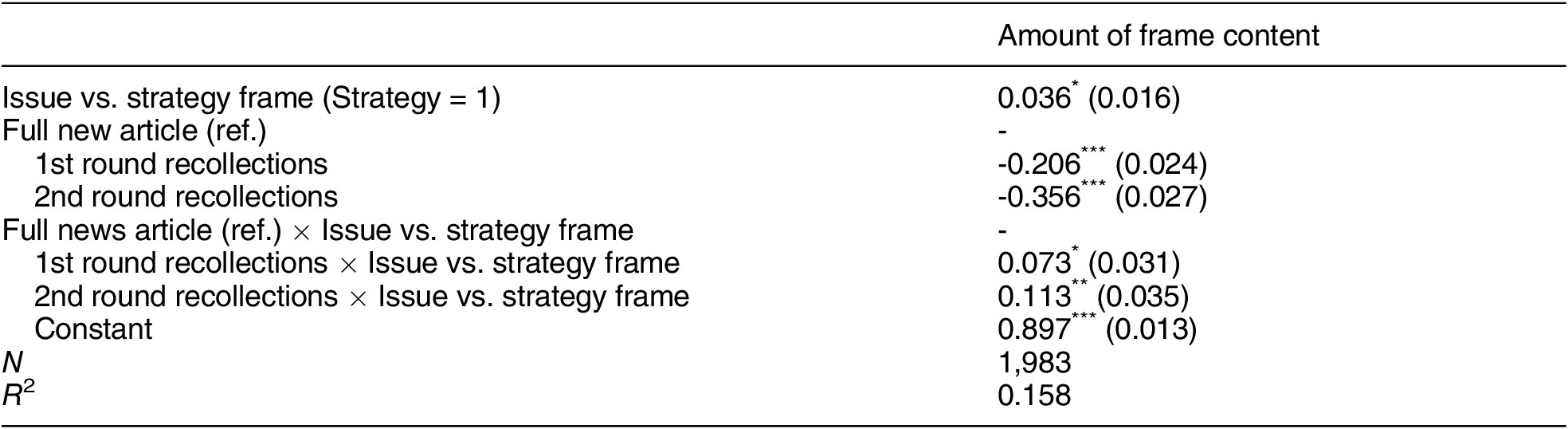
Finally, we test whether there is less decay in information from the strategy frame relative to the issue frame when they are transmitted through interpersonal communication (1d). Here, we turn to the qualitative crowd coding of the articles and recollections. Figure 4 shows the amount of strategy-related content identified in the original strategy-framed news article and in the recollections of the article in Rounds 1 and 2 as well as the amount of issue-related content identified in the original issue-framed news article and in the recollections of the article in Rounds 1 and 2. In support of H1, Figure 4 shows that the strategy-related information from the original strategy-framed article decays at a lower rate through interpersonal communication than the issue-related information transmitted from the issue frame. Table 1 shows the OLS regression results that are illustrated in Figure 4.
Amount of Frame Content in Full Articles and First- and Second-Round Recollections by Frame Condition

Effect of Frame Condition and Transmission Round on the Amount of Frame Content

Note: Entries are unstandardized OLS regression coefficients with standard errors in parentheses. *p < 0.05, **p < 0.01, ***p < 0.001.
The interaction effects show that the information loss between the full article and the first round of recollections is 7.3 percentage points larger for the issue-framed relative to the strategy-framed article (p = 0.017) and 11.3 percentage points larger between the full article and the second round of recollections (p = 0.001). These results, based on the human crowd-coded content measures, support that the transmission bias results in more strategy-related information being transmitted from the strategy-framed news article than issue-related information from the issue-framed news article.
Triangulating across raw word count indicators, measures derived from automated content analysis with machine learning, and classical human coding, the tests of 1a–d overall provide consistent evidence for H1 and the predicted transmission bias for information about self-serving politicians.Footnote 9
Test 2: Probing the Psychological Motivation Underlying the Transmission Bias
Test 2 further investigates the psychological motivation driving the transmission bias by examining the underlying mechanisms. Test 1 showed that the transmission bias for information about self-interested politicians was not significantly moderated by individual differences in political sophistication, memory- versus online-based information processing, or processes related to partisan-motivated reasoning (see footnote 9). Still, a concern could be that the findings in Test 1 are driven by other well-established psychological biases such as the negativity bias (Kahneman and Tversky Reference Kahneman and Tversky1979), the novelty bias (e.g., Vosoughi, Roy, and Aral Reference Vosoughi, Roy and Aral2018), or mediational effects of emotions (see also Ryan Reference Ryan2012; Ryan and Brader Reference Ryan and Brader2017; Valentino et al. Reference Valentino, Banks, Hutchings and Davis2009). In Test 2, we therefore directly test H2, holding that the transmission bias specifically facilitates the transmission of information on self-interested politicians rather than negative, novel, or emotionally charged content more generally. To support this, we should observe that (2a) the amount of information recollected from strategy frames (or their recollections) increases with the relative focus on such information in the frame/recollection and (2b) the degree to which the recollections focus on politicians’ strategic self-serving motives forms a pathway mediating the effect of the frame manipulation (i.e., issue vs. strategy) on the number of words recollected, controlling for the negativity and the typicality of the recollection and for the degree to which the recollection reflected emotions of anger, anxiety, and enthusiasm.
Research Design and Measures
To investigate H2, we conducted an additional crowd-coding study. The study was conducted on MTurk on October 31, 2017, and 1,296 US coders rated a total of 718 recollections from the quantity experiment. Specifically, the coders recorded how large a proportion of the recollection portrayed the politician’s attempt to serve his own interests, his attempt to serve society, and other information. Answers to the three items were required to sum to 100%. This provides measures of the relative focus on strategy and issue content in the recollections. Importantly, to obtain measures to control for the effect of other biases, the coders also rated the extent to which the information in the recollections was negative and typical of political news coverage.Footnote 10 Furthermore, they rated the degree to which the recollection reflected emotions of anger, anxiety, and enthusiasm to enable us to test for the broader mediational effects of emotions (see also Ryan Reference Ryan2012; Ryan and Brader Reference Ryan and Brader2017; Valentino et al. Reference Valentino, Banks, Hutchings and Davis2009) (see Online Appendix A3 for the full wording of the coding instructions). Intercoder agreement tests show percentage agreement ranging from 88.52% to 91.35%. Gwet’s AC1 was between 0.49 and 0.70, which indicates moderate to substantial intercoder agreement (see Online Appendix A4.1 for full results and discussion). Yet in line with prior crowd-coding studies, the coefficients are lower than in traditional human coding conducted with research assistants (e.g., Lind, Gruber, and Boomgaarden Reference Lind, Gruber and Boomgaarden2017).
Results
Does focus on strategic self-interested motivations predict how much information is transmitted from the strategy frame (2a)? To test this, we investigate how the focus on strategy and issue content, respectively, in the recollections is related to their length (for full regression models, see Online Appendix A4.2). In the strategy-frame condition, we find a strong correlation between the proportion of information focusing on the politician’s attempt to serve his own interests in the recollections and their length: a recollection focusing entirely (100%) on the politician’s attempt to serve his own interests is on average 37 words longer in Round 1 (p = 0.033) and 15 words longer in Round 2 (p = 0.054) than a recollection with no focus on attempts to serve personal interests (0%). Furthermore, the proportion of information portraying “the politician’s attempt to serve society” and “other information” does not predict the length of the recollections in either the issue or the strategy frame (p = 0.147–0.310). Consistent with H2, these results support that it is people’s focus on politicians’ self-serving motivations in particular that increases their transmission of strategy frames in interpersonal communication.
Does focus on the politician’s strategic self-serving motives mediate the effect of the frame manipulation on the number of words transmitted (2b)? This constitutes the most direct test of H2 and the notion that the transmission bias reflects a specific attention to information on self-interested politicians. Based on the average causal mediation effect approach (Imai et al. 2011), Table 2 demonstrates that the proportion of information focusing on Harris’ strategic self-interested motivations significantly mediated the effect of the frame manipulation and accounted for 38% of the total effect (p < 0.001). Importantly, this effect remained strong and significant after controlling for (1) the negativity of the tone of the recollection; (2) the perceived typicality of the information in the recollection; and (3) the degree to which the recollection reflected emotions of anger, anxiety, and enthusiasm.Footnote 11 Additionally, and in support of H2, the results showed that these alternative mediators only accounted for small percentages of the total effect and that their mediational effect consistently became nonsignificant after controlling for information about the politician’s self-interest in the recollections (see Online Appendix A4.3 and A4.4 for full models). In sum, these results support the claim that psychological motivations for encoding and transmitting social information about the self-serving behavior of others underlie the transmission bias favoring strategic news frames.
Information Describing Politician’s Own Interests As Pathway Linking Frame Conditions and Number of Words Transmitted Using the ACME Approach

Note: ACME = average causal mediation effect. Numbers in brackets represent 95% confidence intervals. *p < 0.05, **p < 0.01, ***p < 0.001.
Test 3: Implications for Citizens’ Trust in Politicians and Policy Approval
Test 3 explores broader democratic implications of the transmission bias for political trust and policy attitudes. Our theory of the transmission bias predicts an active role for citizens in contributing to low trust in politicians via ripple effects generated by dissemination of information about self-interested politicians in interpersonal communication. Specifically, the transmission bias implies that interpersonally transmitted strategy-based content drives down trust in politicians (3a) and policy approval (3b). We investigate these predicted democratic implications of the transmission bias in Test 3. Finally, we explore the generalizability of the results across the same three individual difference moderators as in Test 1.
Research Design and Measures
To investigate 3a–b, we rely on data from the quantity and the frequency experiment that were collected on MTurk for Test 1. In both experiments, respondents were asked to indicate their trust in politicians like Scott Harris and their attitudes toward the trial program after they had read either the news story (Round 1) or the recollection (Round 2). Trust in politicians like Scott Harris was measured using the following two items: “To what extent do you trust a politician like Scott Harris?” and “To what extent do you perceive a politician like Scott Harris as trustworthy?” Answers were obtained on 11-point scales and summed into an additive index (r = 0.94) that we rescaled 0 to 1 to ease interpretation (M = 0.45; SD = 0.23). Policy support was measured using two questions: “To what extent do you agree or disagree with Scott Harris’s decision about a trial program?” and “How positively or negatively do you feel about Scott Harris’ decision about a trial program?” Answers were obtained on 11-point scales (r = 0.87) and summed into an additive index ranging from 0 to 1 (M = 0.58; SD = 0.22).
To increase external validity, we also fielded a nationally representative sample through the YouGov survey agency on March 13–April 8, 2018, matching the population on age, gender, education, and geographical placement (n = 1,798). Half of the YouGov respondents were randomly assigned to each read one of the four original news articles about the trial program from Test 1. The other half of the respondents were randomly assigned to each read a recollection of one of these articles written by a participant in the first round of the quantity experiment from Test 1. After the respondents had read the news article or the recollection, we measured their general trust in Congress using the following item: “Based on the article [recollection], how much trust do you have in members of Congress?” (see e.g., Harbridge and Malhotra Reference Harbridge and Malhotra2011; 11-point scale ranging from low to high trust, which was rescaled 0–1, M = 0.36; SD = 0.27).
Results
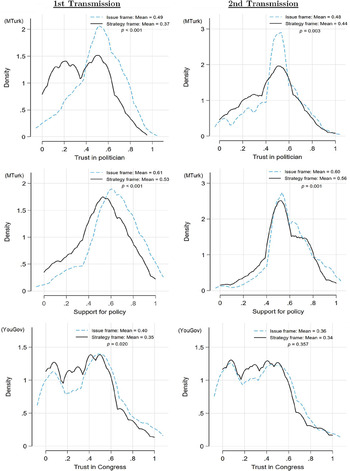
Does transmitted strategy-based political information drive down trust in politicians (3a) and support for their policies (3b)? The three panels to the left in Figure 5 show that exposure to the full strategy-framed news article (compared with the full issue-framed article) has significant negative effects on trust in the political decision maker (12 percentage points, p < 0.001, upper panel), support for the political decision (8 percentage points, p < 0.001, middle panel), and trust in Congress (5 percentage points, p = 0.020, lower panel). To our knowledge, these findings are the first to demonstrate a main effect of direct exposure to strategic frames on support for public policy and general trust in Congress (see de Vreese Reference de Vreese2004 on how strategy frames can activate negative associations with an issue). The results in Test 1 showed that strategy-framed news articles are shared with higher frequency than issue-framed news articles. Consistent with H3, the results in the left-hand panels in Figure 5 show that this bias towards sharing full-length strategy-framed news stories over issue content has important indirect effects—or ripple effects—on political trust and policy evaluations in people’s social networks.
Trust in Politician (Upper Panel), Policy Support (Middle Panel), and Trust in Congress (Lower Panel) by Frame Condition and Transmission Round.

In further support of H3, the three right-hand panels of Figure 5 show that strategy-framed content has important, albeit weaker, effects when transmitted as recollections rather than full-length articles. Recollections from the strategy-framed relative to the issue-framed article had a significant negative effect on trust in the political decision maker (four percentage points, p = 0.003, upper panel), a significant negative effect on support for the political decision (four percentage points, p = 0.001, middle panel), and a smaller, nonsignificant effect on general trust in Congress (two percentage points, p = 0.357, lower panel). These findings imply that news stories, through secondhand exposure via recollections of strategy-framed news stories, can also have adverse effects on trust in specific politicians and their policies. Yet, interestingly, and consistent with the findings in Test 1, the effects of the strategy frame on trust in Harris and policy support are smaller in Round 2, where the respondents read recollections, than in Round 1, where they read the full-length news articles.Footnote 12 We also see that trust in Harris and policy support in the strategy condition is descriptively higher in Round 2 than Round 1. Only trust in Congress is not descriptively higher in Round 2, but this was also where the descriptively smallest effect size was observed in Round 1.
As discussed in Test 1, the decay in the effect sizes is likely caused by the overall information loss in the first transmission, which reduces the overall amount of information in the frames (as also shown in Test 1, Figures 2 and 4). This overall information loss likely dilutes the negative effects of indirect exposure to the strategy frame, implying that the effect of the transmission bias might become negligible or disappear altogether when citizens receive information through a third or fourth transmission round.
Overall, the pattern in Figure 5 supports that the transmission bias for strategically framed information magnifies the reach of such information and generates ripple effects on public trust in politicians and support for public policy, especially when the information is shared as full-length original news articles but also—albeit to a seemingly lesser extent—when shared via recollections in interpersonal communication.Footnote 13
Discussion
Citizens’ distrust in politicians is often attributed to elite actors such as the news media, campaigning candidates, or foreign governments who communicate information about politicians being motivated by self-serving concerns with reelection, power, or economic interests (e.g., Cappella and Jamieson Reference Cappella and Jamieson1997; de Vreese Reference de Vreese2004; Lau, Sigelman, and Rovner Reference Lau, Sigelman and Rovner2007). This article turns to the mass level and analyzes the role of citizens in disseminating information about self-interested politicians through interpersonal communication and, in turn, contributing to low public trust in politicians. To this end, we built a general theory of how psychological biases shape the transmission of news stories between citizens in their interpersonal communication. This theory argues against the view that such transmission is based on simple error-prone copying. Rather, it emphasizes citizens’ active construction of information on the basis of their psychological biases. Here, we discuss in three steps how our findings add to the current understanding of the causes of public distrust in politicians and, in turn, lead us to rethink our understanding and interpretation of the issue itself as well as its potential solutions.
First, the results underline that distrust in politicians is not merely a product of elites overrepresenting cynical information about self-serving politicians in their communication with citizens. While elites may indeed play an important role in producing and disseminating such information, biased interpersonal transmission of this information reinforces its prevalence and effects. Hence, even if the way elites portrayed politicians were entirely balanced, the transmission bias would cause information on self-interested politicians to be overrepresented and drive down political trust among citizens. In this article, our empirical focus has been on the transmission of strategy-framed political information—the most prevalent, yet not most extreme, type of information about self-interested politicians. Still, we believe that the transmission bias also applies to the dissemination of other, more extreme types of information about self-interested politicians such as conspiracy theories in both in-person conversations and on social media. The core of conspiracies—the existence of self-serving elites—seems to match our deep-seated psychological attentiveness to self-interested individuals. With that said, one limitation of our results warrants mentioning: Although we believe that our research designs focusing on stylized communications in experimentally controlled settings are well suited for establishing the transmission bias and its effects on political opinions, we acknowledge that our conclusions may be subject to important scope conditions. One can consider multiple contextual features regarding the political issue being discussed (e.g., salience, partisan polarization) or the receiver of the communication (e.g., online strangers, friends), which may enhance or diminish the transmission bias. Despite these scope conditions, an additional experimental study embedded in a nationally representative sample collected by YouGov (n = 1,798) provides preliminary evidence that the transmission bias leads to an overrepresentation of strategy-framed information also in real-life social sharing environments. We assigned respondents to read the news articles and recollections used in the studies reported above and found that those randomly assigned to read the full strategy-framed article or a recollection (relative to those reading issue-framed content) consistently rated this information as more typical of the political content they encounter on social media; in contrast, strategy-framed information was not rated more typical of information received through traditional media such as television or newspapers where interpersonal information sharing is not possible (see Online Appendix A5.3). Still, we hope that future work will further analyze the transmission bias with field experiments and observational research designs in real-life social sharing environments and probe additional possible moderators.
Second, our findings prompt us to take a step back and reconsider our understanding and interpretation of political distrust more generally. While much research starts with the premise that political distrust is a discouraging symptom of a public becoming repelled and disengaged from political discussion and democratic activities more generally (e.g., Capella and Jamieson Reference Cappella and Jamieson1997; Hibbing and Theiss-Morse Reference Hibbing and Theiss-Morse2001), our findings offer a different perspective: Political distrust reflects, in part, a public that actively communicates political information to expose and displace self-interested politicians through interpersonal communication. In line with this notion, our data show that socially transmitted information consistently decreases vote preferences for self-interested politicians (see Online Appendix A5.4). As such, distrust in politicians may, in part, reflect a citizenry that watches and actively mobilizes support against self-serving political elites (see also de Vreese Reference de Vreese2004). Following the evolutionary perspective, the transmission bias reflects a basic defense mechanism that allows groups of cooperating individuals to expose and counteract attempts of exploitation from self-interested others. On the negative side, it is important to stress that the transmission bias—in possible conjunction with the rise of social media—may make citizens vulnerable to manipulation through fabricated conspiracy theories and other types of misinformation.
Third, the results provide new insights into how reformists and practitioners may combat political distrust. Because the existing literature mainly considers elites to be responsible for public distrust in politicians, current initiatives focus almost exclusively on regulating elite behavior through institutional reforms of, for example, the media, parties, or government procedures (Hibbing and Theiss-Morse Reference Hibbing and Theiss-Morse2001). Although elites undoubtedly play a role, our findings suggest that such initiatives must also take into account the active role of citizens in sharing, in particular, extreme and fabricated information about the self-interested behavior of politicians. This will require further research into effective intervention strategies that may decrease or debias the sharing and effects of fabricated political information (but see Clayton et al. Reference Clayton, Blair, Busam, Forstner, Glance, Green and Kawata2019). Cognitive scientists emphasize that human psychology contains mechanisms for open vigilance that reduce gullibility (Mercier Reference Mercier2020). Yet, so far, scholars have had limited and short-lived success with correcting other deep-seated psychological biases (e.g., Lai et al. Reference Lai, Skinner, Cooley, Murrar, Brauer, Devos and Calanchini2016). For better or worse, we may expect similar outcomes of efforts to debias the social transmission of political information between citizens. In Hibbing and Alford’s (Reference Hibbing and Alford2004) words, citizens are “wary cooperators” who are naturally disposed to be skeptical of anyone willing to invest the amount of time and effort it takes for modern politicians to reach political office.
Supplementary Materials
To view supplementary material for this article, please visit http://dx.doi.org/10.1017/S0003055420000805.
Replication materials can be found on Dataverse at: https://doi.org/10.7910/DVN/19FLXV.





Comments
No Comments have been published for this article.