




No CrossRef data available.
Article contents
Is there a benefit of bilingualism for executive functioning?*
Published online by Cambridge University Press: 22 October 2014
Extract
Scholars and educators were once concerned that encouraging children to learn more than one language might have adverse cognitive consequences (Darcy, 1953). And for some linguistic capacities (e.g., fluency, vocabulary) this is often true (Bialystok, Craik & Luk, 2012). Unfortunately, such individual costs might discourage governmental policies that are aimed at fostering multi-lingualism, despite its widely acknowledged societal benefits. Peal & Lambert (1962) helped overcome this concern and through her “myth-dispelling” efforts and prodigious empirical output, Bialystok has pushed the pendulum of opinion in the opposite direction.
Information
- Type
- Peer Commentaries
- Information
- Copyright
- Copyright © Cambridge University Press 2014
Footnotes
1 See Bialystock's citation for the 2011 Donald O. Hebb Distinguished Contribution Award at https://www.csbbcs.org/awards/distinguished-contribution/24-awards-main/hebb/26-hebb-award-2011
2 The personal perspective of this commentary is stimulated, in part, by Kroll and Bialystok's (2013) misguided (see Paap, Reference Paap2014, p. 246) assertion that Hilchey & Klein (Reference Hilchey and Klein2011) used their “documentation of the failures of the inhibition hypothesis. . .to discredit the entire body of work. . .”.
3 This paper was the second most frequently cited paper in a search using “bilingualism” as the subject.
4 At a 2008 symposium (later published in Acta Psychologica, Klein & Ivanoff, 2011) honoring Dick Simon (for whom the Simon effect was named) and in the language chapter of my Canadianization of Ashcraft's Cognitive Psychology (Ashcraft & Klein, 2010).
5 In elderly participants some bilingual advantages were compromised either by an unusually small number of trials (Bialystok et al, 2004, studies 1 and 2) or by the difference being rooted in a monolingual advantage on compatible trials (Bialystok, Craik & Luk, 2008) – hence we resisted a BICA interpretation.
6 Reviewing the literature on aging and the Simon effect, Proctor, Vu & Pick (2005, Table 2) found that the Simon effect for elderly participants ranged from 21 to 48 ms. The Simon effects of Bialystok et al.'s (2004) older monolinguals were between 100 and 1000 ms greater than those for older bilinguals (see 2004 data from BICA panel of Figure 1). This is strikingly anomolous when Simon effects for the elderly are typically less than 50 ms.
References
Bialystock, E., Craik, F. I. M., Klein, R. M., & Viswanathan, M. (2004) Bilingualism, aging, and cognitive control: Evidence from the Simon task. Psychology and Aging, 19, 290–303
Google Scholar
Bialystok, E., Craik, F.I.M., & Luk, G. (2012). Bilingualism: consequences for mind and brain. Trends in Cognitive Sciences, 16, 240–250. doi: 10.1016/j.tics.2012.03.001
Google Scholar
Darcy, N. J. (1953). A review of the literature on the effects of bilingualism upon the measurement of intelligence. The Journal of Genetic Psychology, 82, 21–57.Google Scholar
Hebb, D. O. (1949). The organization of behavior: A neuropsychological theory. New York: Wiley.Google Scholar
Hilchey, M. D. & Klein, R. M. (2011). Are there bilingual advantages on non-linguistic interference tasks? Implications for plasticity of executive control processes, Psychonomic Bulletin & Review, 18, 625–658.Google Scholar
Hilchey, M. D., Saint-Aubin, J. & Klein, R. M. (in press). Does bilingual exercise enhance cognitive fitness in traditional non-linguistic executive processing tasks? In Schwieter, J. (Ed.) The Cambridge Handbook of Bilingual Processing. Cambridge: Cambridge University Press.Google Scholar
Klein, R. M. (1999). The Hebb legacy. Canadian Journal of Experimental Psychology, 53:1, 1–3
Google Scholar
Klein, R. M. & Taylor, , T. (1994). Categories of cognitive inhibition with reference to attention. In Dagenbach, D. & Carr, T. (Eds.) Inhibitory processes in attention, memory & language. Academic Press. (p. 113–150)Google Scholar
Meyer, M. N., & Chabris, C. (2014, July 31). Why psychologists’ food fight matters. Slate. Retrieved from http://www.slate.com/articles/health_and_science/science/2014/07/replication_controversy_in_psychology_bullying_file_drawer_effect_blog_posts.single.html
Google Scholar
Mindt, M. R., Arentoft, A. & Germano, K. K. (2008). Neuropsychological, cognitive and theoretical considerations for evaluation of bilingual individuals. Neuropsychology Review, 18, 255–268.Google Scholar
Paap, K. R. (2014). The role of componential analysis, categorical hypothesising, replicability and confirmation bias in testing for bilingual advantages in executive functioning, Journal of Cognitive Psychology, 26:3, 242–255, DOI: 10.1080/20445911.2014.891597
Google Scholar
Peal, E., & Lambert, W. E. (1962). The relation of bilingualism to intelligence. Psychological Monographs: General and Applied, 76
1–23.CrossRefGoogle Scholar
Proctor, R. W., Vu, K. P. L., & Pick, D. F. (2005). Aging and response selection in spatial choice tasks. Human Factors: The Journal of the Human Factors and Ergonomics Society, 47
(2), 250–270.Google Scholar
Valian, V. (2014). Bilingualism and cognition. Bilingualism: Language and Cognition, doi:10.1017/S1366728914000522.Google Scholar
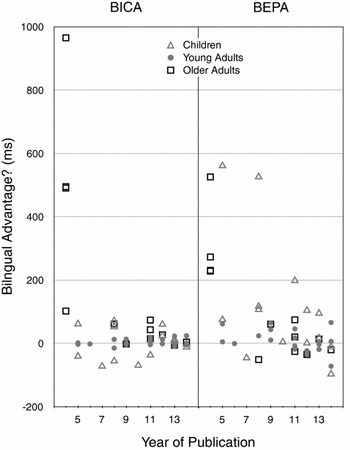
Figure 1. The BICA and BEPA effects from all the studies reviewed by Hilchey & Klein (2011) and Hilchey, Saint-Aubin & Klein (in press) are presented here as a function of year of publication from 2004–2014. BICA = interference score for monolinguals minus that for bilinguals (interference = incongruent minus congruent). BEPA = congruent RT for monolinguals minus that for bilinguals. For every study in which the same participants were tested more than once (e.g. with 2- and 4-alternative tasks) or one group of monolinguals were compared to 2 groups of bilinguals, the data from the two tasks and two groups of bilinguals (respectively) have been combined. Grey triangles (children aged <14); grey disks (young adults aged 15 to 30); black squares (older adults aged > 30).
 You have
Access
- 16
- Cited by
Scholars and educators were once concerned that encouraging children to learn more than one language might have adverse cognitive consequences (Darcy, Reference Darcy1953). And for some linguistic capacities (e.g., fluency, vocabulary) this is often true (Bialystok, Craik & Luk, Reference Bialystok, Craik and Luk2012). Unfortunately, such individual costs might discourage governmental policies that are aimed at fostering multi-lingualism, despite its widely acknowledged societal benefits. Peal & Lambert (Reference Peal and Lambert1962) helped overcome this concern and through her “myth-dispelling” efforts and prodigious empirical output, BialystokFootnote 1 has pushed the pendulum of opinion in the opposite direction.
Valian (Valian), like many other scholars, wants to believe that the answer to the question that is my commentary's title is: “yes.” So do IFootnote 2 . There is an exciting narrative here that meshes nicely with adages from both popular culture – “use it or lose it”, “practice makes perfect” – and contemporary cognitive neuroscience – “neurons that fire together wire together,” derived from Hebb's cell-assembly theory (Hebb, Reference Hebb1949; Klein, Reference Klein1999). I became engaged in this narrative during my 2000–2001 sabbatical spent partly at the Rotman Research Institute where my office was next to that of Ellen Bialystok who was also on sabbatical. I attended lab meetings with Ellen, her Rotman colleague, Gus Craik and her students and, because of my interest and expertise in attention, the Simon effect and cognitive inhibition (e.g., Klein & Taylor, Reference Klein, Taylor, Dagenbach and Carr1994), became a collaborator and co-author on the empirical paper (Bialystok, Craik, Klein & Viswanathan, Reference Bialystock, Craik, Klein and Viswanathan2004) that has become seminal for the literature exploring the theme of this special issueFootnote 3 .
In 2010 when he was a first year graduate student in my seminar Human information processing: in the real world, I encouraged Matt Hilchey to write his term paper on “Costs & Benefits of Bilingualism” because, while I had had several opportunities to highlight the “exciting” Bialystok et al. (Reference Bialystock, Craik, Klein and Viswanathan2004) findings on the “benefits of bilingualism for executive processing”Footnote 4 , I had not closely followed the literature spawned by that paper.
Hilchey's outstanding term paper was refined and transformed into a major, comprehensive review of the literature on bilingualism and executive control (Hilchey & Klein, Reference Hilchey and Klein2011) which revealed scant evidence for a bilingual inhibitory control advantage (BICAFootnote 5 ) but robust evidence, across the lifespan, for a global advantage (bilingual executive processing advantage, BEPA) – measured using performance on congruent trials – so long as the task itself entailed a sufficient level of response conflict.
Recently, when invited to write a chapter for the Cambridge University Press's Handbook of Bilingualism (Hilchey, Saint-Aubin & Klein, in press), we used the opportunity to place the question into a broader historical context and to update our 2011 review by focussing on the many studies that had appeared since that review was written. As in our earlier paper, our graphic meta-analyses focus on two non-linguistic effects, Simon (including spatial Stroop) and flanker, that entail conflict resolution. These tasks are not the only ones that have been conducted to answer the key question and in both papers we discuss findings from other non-linguistic tasks that might also assess executive functioning. Importantly, however, Simon and flanker tasks have been used frequently enough in published papers to support confident empirical generalizations.
As can be seen in Figure 1, although the more recent literature considered as a whole continued to disconfirm BICA, support for BEPA had surprisingly more or less evaporated.
The BICA and BEPA effects from all the studies reviewed by Hilchey & Klein (Reference Hilchey and Klein2011) and Hilchey, Saint-Aubin & Klein (in press) are presented here as a function of year of publication from 2004–2014. BICA = interference score for monolinguals minus that for bilinguals (interference = incongruent minus congruent). BEPA = congruent RT for monolinguals minus that for bilinguals. For every study in which the same participants were tested more than once (e.g. with 2- and 4-alternative tasks) or one group of monolinguals were compared to 2 groups of bilinguals, the data from the two tasks and two groups of bilinguals (respectively) have been combined. Grey triangles (children aged <14); grey disks (young adults aged 15 to 30); black squares (older adults aged > 30).
Presenting the data by year of publication highlights how anomalous were the results from the seminal paperFootnote 6 and reinforces the suggestion (see Paap, Reference Paap2014) that the early (pre-2011) evidence in favour of a BEPA may have been generated by a dual-edged publication bias: for papers whose narrative is consistent with that of an exciting series of studies by a world-famous expert and against papers reporting null results. A recent on-line article about the “replication crisis” in (social) Psychology rings true for the present discussion:
“As Carl Sagan famously warned, and as students are now taught, extraordinary claims require extraordinary evidence. This means that original findings that are surprising, that feature large effects, or that seem to conflict with other established findings should be subject to greater scrutiny—including replication.” (Meyer & Chabris, Reference Meyer and Chabris2014)
Indeed, in the keynote article (Valian, Reference Valian2014), after reviewing a wide range of tasks assessing various components of executive function, Valian concludes:
“Studies of children with large samples have tended to show weaker effects, or no effects, compared to studies with small samples” (p. 20); “Especially when young adults are tested, effects have been inconsistent” (p. 23); “The data overall, although mixed, suggest a benefit in older adults for being bilingual on tasks of executive function” (p. 30)
These descriptions of the extant corpus of data on the question, Is there a benefit of bilingualism for executive functioning?, reinforce the conclusions drawn by Hilchey and colleagues (Hilchey & Klein, Reference Hilchey and Klein2011; Hilchey et al., in press) which are highlighted in Figure 1. Mindful of Sagan's cautionary note, and in light of the data reviewed here and by Valian (Reference Valian2014), it is recommended that the pendulum of scientific opinion on this question be put into neutral.