INTRODUCTION
Trophic interactions between reef fishes and benthic organisms are important for the structure and functioning of marine ecosystems such as coral reefs and rocky shores (e.g. Lewis, Reference Lewis1986; Hay, Reference Hay1997; Pawlik, Reference Pawlik1998; Ruzicka & Gleason, Reference Ruzicka and Gleason2009). Angelfishes of the genera Holacanthus Lacépède and Pomacanthus Lacépède (Perciformes: Pomacanthidae) are among the most conspicuous benthic-feeding reef fishes in the tropics (Bellwood et al., Reference Bellwood, Herwerden and Konow2004). As their diet is composed mainly of sponges, they are usually called ‘spongivorous' (Randall & Hartman, Reference Randall and Hartman1968; Wulff, Reference Wulff, van Soest, van Kempen and Braekman1994; Chanas & Pawlik, Reference Chanas and Pawlik1995; Andréa et al., Reference Andréa, Batista, Sampaio, Muricy, Custódio, Lôbo-Hajdu, Hajdu and Muricy2007). Their intra-mandibular joint projects forward, facilitating predation on hard and hidden prey such as sponges and tunicates (Bellwood et al., Reference Bellwood, Herwerden and Konow2004). Spongivorous fishes are usually less numerous than herbivorous fishes in reef communities, but they can represent keystone guilds with both direct and indirect effects in community structure (Hill, Reference Hill1998).
In St Thomas (US Virgin Islands, Caribbean Sea) and in Salvador (Bahia, Brazil), sponges represent over 90% of the gut contents of the queen angelfish Holacanthus ciliaris Linnaeus. Considering the number of species eaten, H. ciliaris has a diversified diet both in St Thomas, where the stomach contents of 26 specimens analysed showed 40 different species of sponges, and in Salvador, where 15 sponge species were found in the contents of six juveniles examined (Randall & Hartman, Reference Randall and Hartman1968; Andréa et al., Reference Andréa, Batista, Sampaio, Muricy, Custódio, Lôbo-Hajdu, Hajdu and Muricy2007). Diet diversification could be a strategy to prevent poisoning by the consumption of high levels of some specific toxin (‘smorgasbord feeding': Randall & Hartman, Reference Randall and Hartman1968; Wullf, Reference Wulff, van Soest, van Kempen and Braekman1994; Pawlik, Reference Pawlik1998). On the other hand, empirical evidence based on video monitoring of spongivorous fish indicates an active choice of prey by angelfish instead of a ‘smorgasbord' feeding habit (Dunlap & Pawlik, Reference Dunlap and Pawlik1996). Most studies of food selection of coral reef fishes have focused on other families such as Chaetodontidae and Scaridae (Ralston, Reference Ralston1981; Bruggemann et al., Reference Bruggemann, van Oppen and Breeman1994; Berumen et al., Reference Berumen, Pratchett and Mccormick2005; Pratchett, Reference Pratchett2007; Pratchett & Berumen, Reference Pratchett and Berumen2008). Several studies showed the influence of predatory fishes on the distribution of sponges (Wulff, Reference Wulff, van Soest, van Kempen and Braekman1994, Reference Wulff2000; Loh & Pawlik, Reference Loh and Pawlik2009; Ruzicka & Gleason, Reference Ruzicka and Gleason2009). Although the diet of some species of angelfishes is relatively well known (Randall & Hartman, Reference Randall and Hartman1968; Pérez-España & Abitia-Cárdenas, Reference Pérez-España and Abitia-Cárdenas1996), to date no study has focused on the relationship between diet composition of Holacanthus ciliaris and prey availability.
The distribution patterns of pomacanthids in Brazilian oceanic islands can be strongly influenced by food availability (Floeter et al., Reference Floeter, Guimarães, Rocha, Ferreira, Rangel and Gasparini2001), but there are no data available on the diet composition of angelfishes in any of these islands. A better knowledge about prey availability and feeding preferences of pomacanthids is necessary to understand both their abundance patterns (Ferreira et al., Reference Ferreira, Floeter, Gasparini, Ferreira and Joyeux2004) and their impact on benthic communities. São Pedro e São Paulo Archipelago (also known as St Paul's Rocks, heretofore abbreviated as SPSPA) is one of the smallest and most isolated sets of islands in the world (Edwards & Lubbock, Reference Edwards and Lubbock1983). It provides an opportunity for studies on feeding preferences of the queen angelfish due to its reduced size, relatively well known benthic and nektonic communities (e.g. Feitoza et al., Reference Feitoza, Rocha, Luiz-Júnior, Floeter and Gasparini2003; Moraes et al., Reference Moraes, Ventura, Klautau, Hajdu, Muricy, Alves and Castro2006; Villaça et al., Reference Villaça, Pedrini, Pereira, Figueiredo, Alves and Castro2006; Ferreira et al., Reference Ferreira, Luiz-Júnior, Feitoza, Ferreira, Noguchi, Gasparini, Joyeux, Godoy, Rangel, Rocha, Floeter, Carvalho-Filho, Viana, Hazin and Souza2009; Viana et al., Reference Viana, Hazin and Souza2009), and the presence of a unique, endangered population of H. ciliaris, with seven chromatic variations that testify its genetic isolation and inbreeding (Edwards & Lubbock, Reference Edwards and Lubbock1983; Feitoza et al., Reference Feitoza, Rocha, Luiz-Júnior, Floeter and Gasparini2003; see video in Online Resource 1).
The goals of this study were to determine the quantitative composition of the diet of H. ciliaris in SPSPA and to relate it to the abundance of benthic organisms in the area. In particular, we investigated if H. ciliaris simply feeds on the more abundant species or chooses less abundant but perhaps more edible preys. The results help to understand the trophic interactions between angelfishes and benthic organisms and provide useful data for modelling of the local food web in this isolated archipelago in the Central Atlantic.
MATERIALS AND METHODS
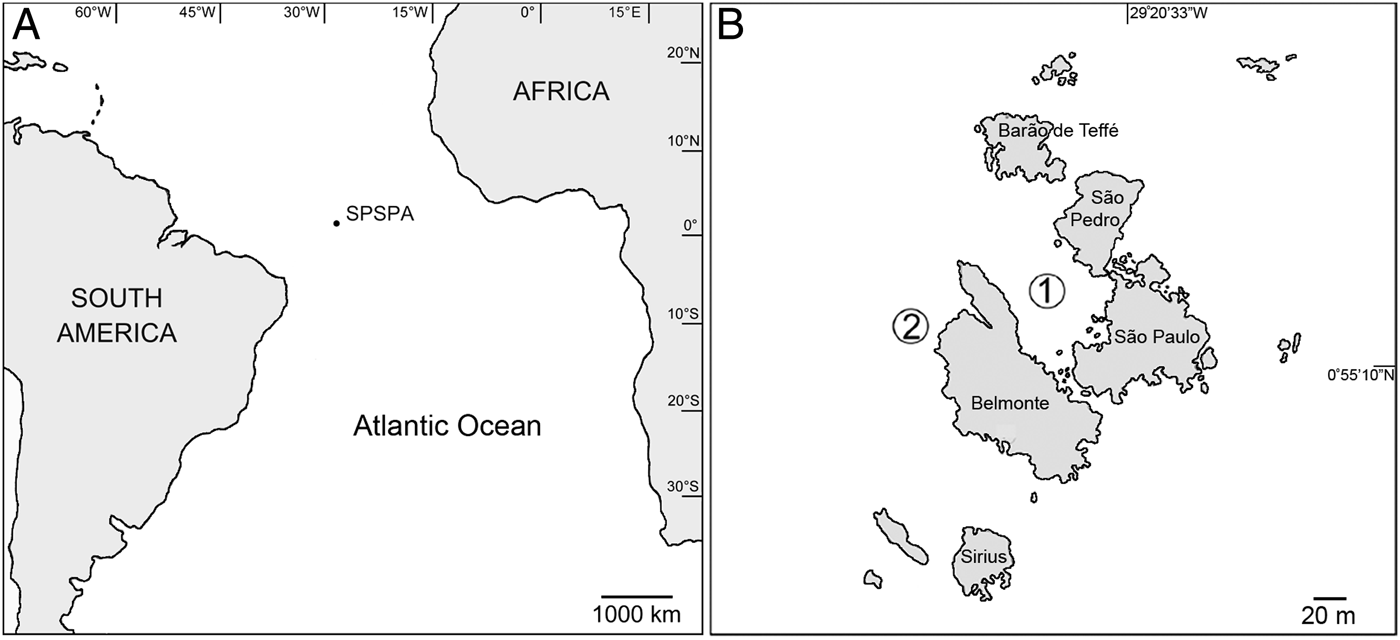
São Pedro e São Paulo Archipelago (SPSPA) is located in the São Paulo Fracture Zone (0°55′N–29°21′W), distant 1010 km north-east from the city of Natal, Rio Grande do Norte State, Brazil (Figure 1A). Its total land area comprises only 1.7 ha and the maximum length is 420 m (Campos et al., Reference Campos, Petta, Theye, Sichel, Simões, Srivastava, Motoki, Neto, Andrade, Viana, Hazin and Souza2009).
Study area: (A) location of São Pedro e São Paulo Archipelago (SPSPA); (B) map of the archipelago showing the location of the sampling sites: cove (1) and vertical wall of Belmonte islet (2).

Five adult specimens of the common yellow-orange morphotype of Holacanthus ciliaris (30–41 cm total length) were collected in September 2007 in the cove and Belmonte islet at SPSPA (Figure 1B) by spearfishing from 5–13 m depth, always during the afternoon (14:30 to 16:15 h; see video in Online Resource 2). Their digestive tracts were removed right after the collection and were preserved in 70% ethanol. The fish were frozen in the field and fixed in formaldehyde when deposited in the Ichthyology Collection of Museu Nacional, Universidade Federal do Rio de Janeiro, under the register numbers MNRJ 31471–31475. The number of fish studied was limited by the small size and protected status of the population of H. ciliaris in SPSPA. A species accumulation curve plotting the cumulative number of species eaten against the number of fish studied was used to evaluate how representative was our sample size (Ugland et al., Reference Ugland, Gray and Ellingsen2003).
Stomach contents were screened under a stereomicroscope and the different morphotypes were separated according to shape, colour, consistency and surface ornamentation. The fragments were dried under a lamp bulb for five minutes and weighed (precision 0.01 mg) to calculate the abundance (in mg of dry weight) and relative proportion (in % of gut contents) of each species in total gut contents of H. ciliaris. The morphotypes were then identified to the lowest possible taxonomic level with the help of experts when necessary. All pieces of each prey species were weighed and summed up in each stomach to calculate their abundance in the diet, irrespectively of whether the pieces came from a single or from several prey individuals. The frequency of occurrence was calculated as the percentage of stomachs in which the items were found (out of five stomachs). Frequency was used only to indicate which items were eaten by most of the fish; it was not used for further statistical calculations, which were based on abundance data.
Photographs of the quadrats were taken with a Canon Powershot S45 digital camera with a Sea & Sea 16 mm lens and waterproof case. The abundance of benthic organisms in the field was estimated by tracing their contours in Photoshop and assigning them a proportion of space occupancy in the frames of 27 50 × 50 cm photo-quadrats taken in three depth zones (5, 10 and 20 m depth). The availability of each prey species was thus represented by its total cover area in 27 quadrats, irrespective of the size and number of individuals. We complemented the sampling with direct counts of cryptic species, especially sponges, in the same quadrats. Ten quadrats randomly distributed were examined in each depth-zone except at 20 m depth, where only seven quadrats were analysed. The abundance of benthic species in the field (in % of cover area) was compared to the abundance of items in gut contents (in dry weight) through Kendall's tau rank correlation coefficient (WESSA, 2008). Feeding preferences were analysed through the Manly resource selection function W = %Diet/%Field, where W is the selectivity of the predator, %Diet is the proportion of the total gut contents represented by the weight of each species and %Field is their availability in the benthic community of the study area (Manly et al., Reference Manly, Mcdonald and Thomas1993; Berumen et al., Reference Berumen, Pratchett and Mccormick2005). A species was considered avoided by the fish when W<0.8, neutral when either 0.8 ≤W≤ 1.2 or W = 0 but abundance values both in the field and in the diet were very low (<0.1%), and preferred when W>1.2 or %Field = 0 and %Diet > 0.1%.
RESULTS
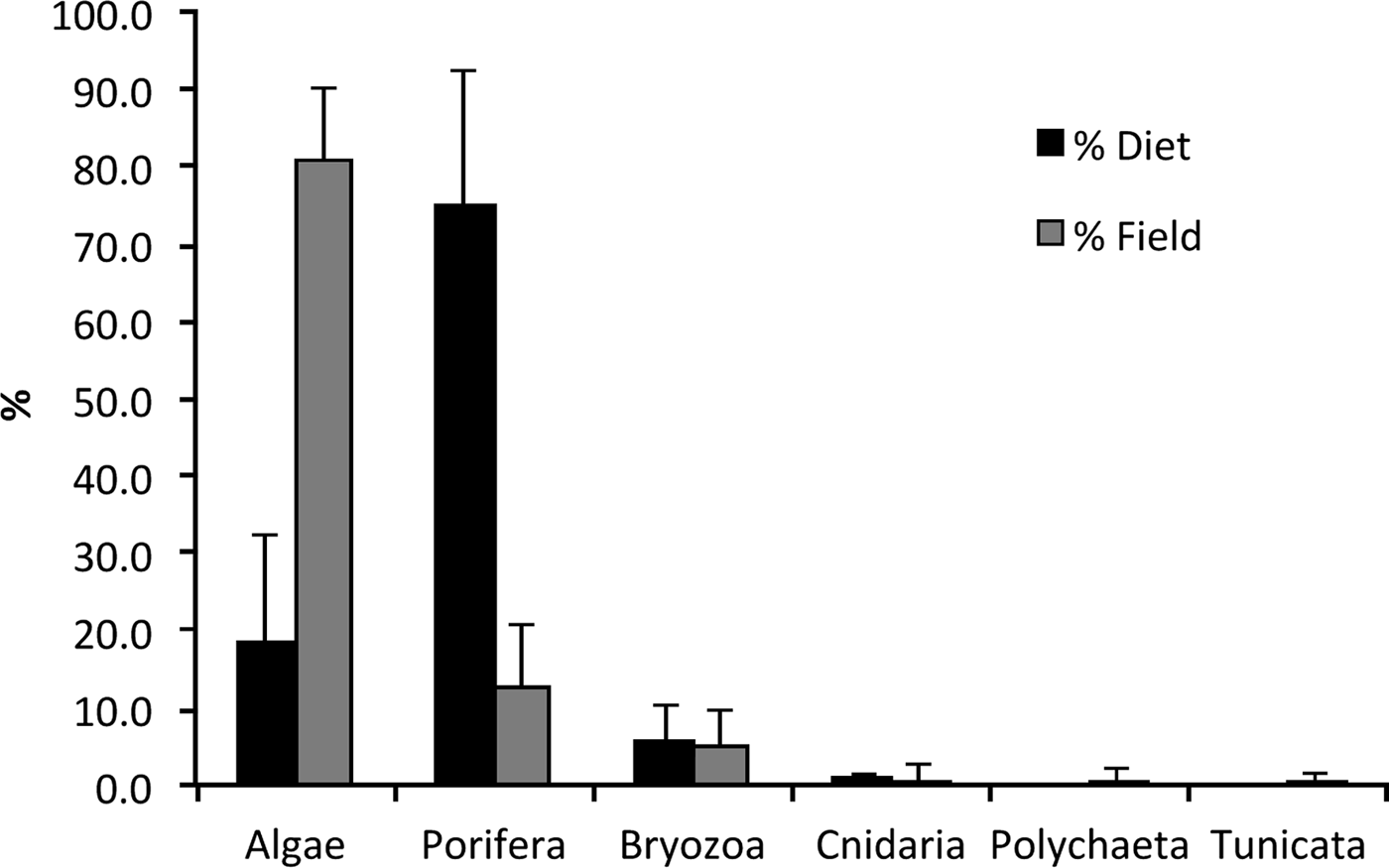
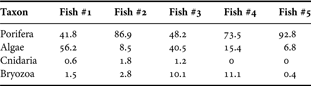
The diet of Holacanthus ciliaris in SPSPA was composed mainly of sponges (average ± standard deviation (SD): 68.6 ± 22.8% of total dry weight) and followed by algae (25.5 ± 21.8%), bryozoans (5.2 ± 5.0%) and hydrozoans (0.7 ± 0.8%; Figure 2). Sponges were the most abundant items in the guts of four out of five specimens of H. ciliaris, and algae comprised up to 56% of the gut contents in one specimen (Table 1).
Proportion in the diet of Holacanthus ciliaris (in % of total dry weight of gut contents; black bars) and availability in the benthic community (in % of total cover; grey bars) of major taxonomic groups in São Pedro e São Paulo Archipelago. Error bars are standard deviations.

Percentage of higher taxa in the total weight of gut contents of five specimens of Holacanthus ciliaris from São Pedro e São Paulo Archipelago.

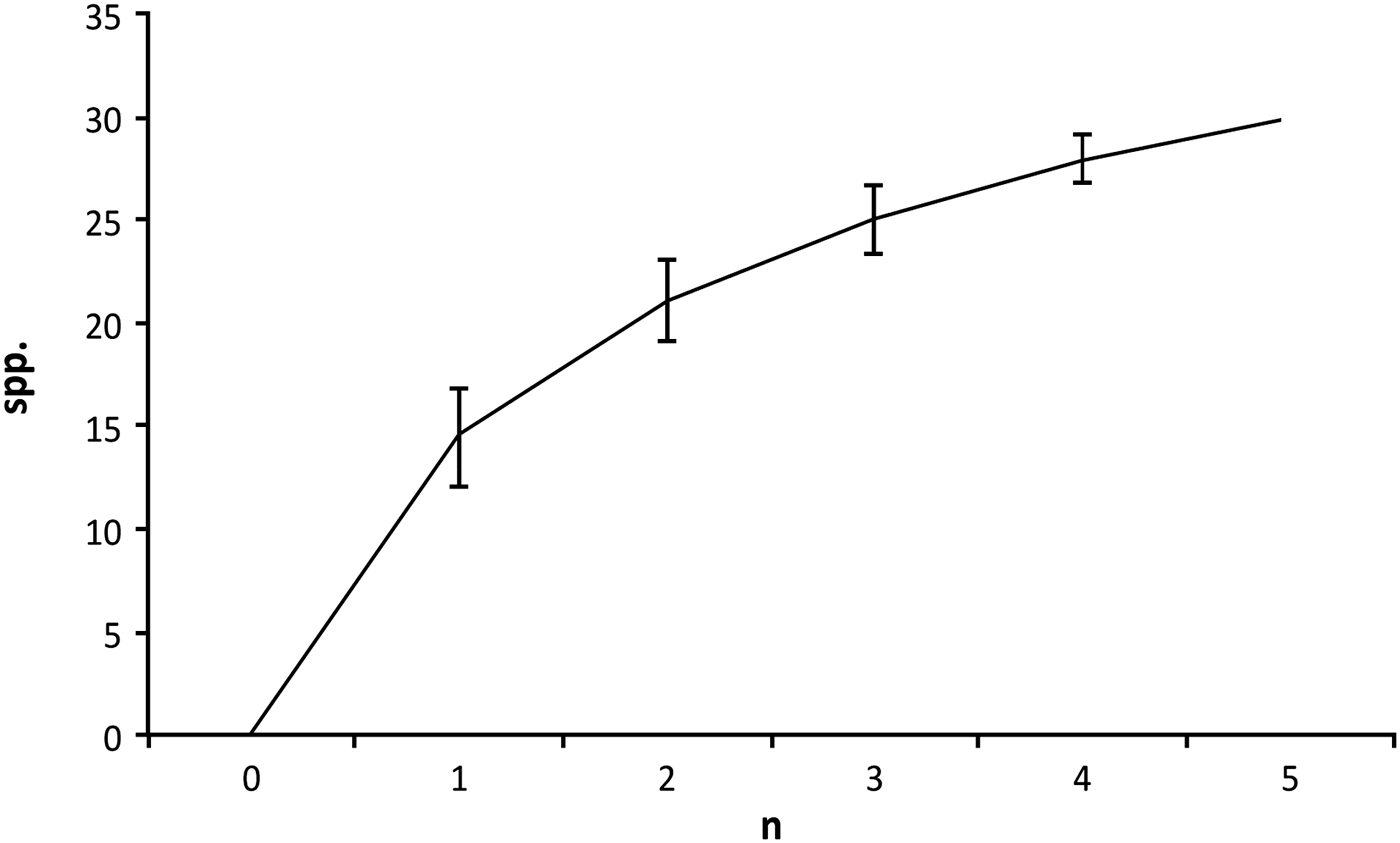
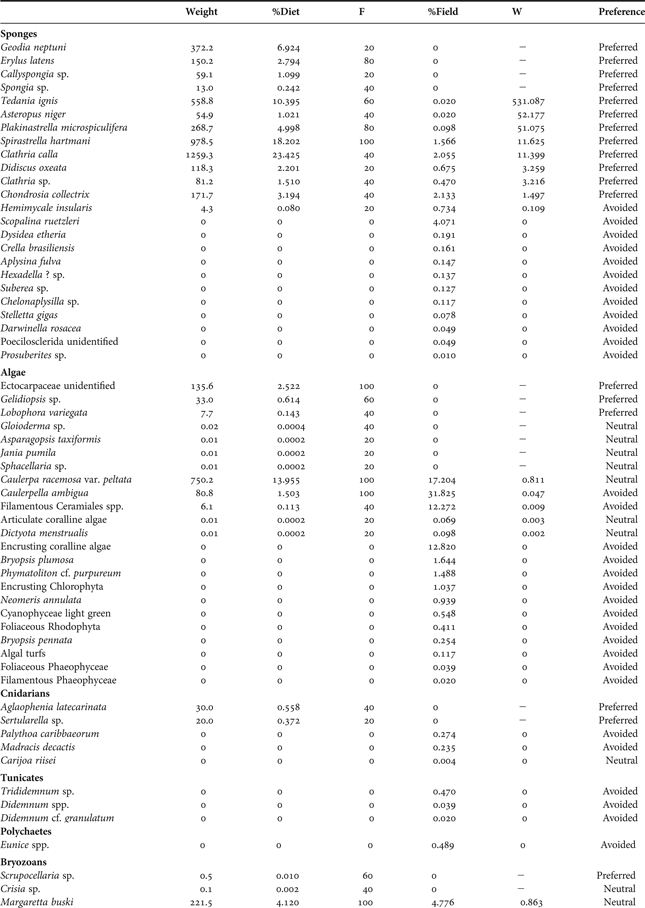
A total of 30 species of benthic preys (12 algae, 13 sponges, three bryozoans and two hydrozoans) was found in the diet of H. ciliaris in SPSPA. The species accumulation curve showed that, although the total number of species in the diet is close to reaching a plateau at N = 5, it is still likely to increase with further collections (Figure 3). Five prey species were eaten by all fish analysed (frequency = 100%): the sponge Spirastrella hartmani Boury-Esnault et al., the algae ‘Ectocarpaceae unidentified', Caulerpella ambigua (Okamura) Prud'homme van Reine & Lokhorst and Caulerpa racemosa var. peltata (J.V. Lamouroux) Eubank, and the bryozoan Margaretta buski Harmer (Table 2). Together with the sponges Plakinastrella microspiculifera Moraes & Muricy and Erylus latens Moraes & Muricy, both with 80% frequency, they were the preys eaten by most individuals of H. ciliaris in SPSPA. The most abundant items of the diet (in mg dry weight) were the sponges Clathria calla (de Laubenfels), Spirastrella hartmani, Tedania ignis (Duchassaing & Michelotti), Geodia neptuni (Sollas) and P. microspiculifera, and the green algae Caulerpa racemosa var. peltata.
Species accumulation curve of the gut contents of five specimens of Holacanthus ciliaris studied. Error bars are standard deviations.

Analysis of species from gut contents and field survey. Weight, abundance in the gut contents (in mg of dry matter); % Diet, proportion in the diet (in % of the total gut contents of Holacanthus ciliaris); F, frequency of occurrence (in % of presence in stomachs in five fish examined); % Field, availability in the community (in % of the total cover of the benthic community); W, Manly resource selection function (W = %Diet /%Field); -, not calculable (division by zero). A species was considered avoided by the fish when W < 0.8, neutral when either 0.8 ≤ W ≤ 1.2 or W = 0 but abundance values both in the field and in the diet were very low (<0.1%), and preferred when W > 1.2, or %Field = 0 and %Diet > 0.1%.

In contrast to the gut contents, the benthic community was composed mainly of algae (16 species, 80.8 ± 9.2% of total cover (average ± SD)) and followed by sponges (20 spp., 12.8 ± 7.8%), bryozoans (1 species, 4.8 ± 5.0%), cnidarians (3 spp., 0.5 ± 2.0%), polychaetes (1 species, 0.5 ± 1.7%) and tunicates (3 spp., 0.5 ± 1.1%; Figure 2). The most common species in the benthic community were the algae Caulerpella ambigua, Caulerpa racemosa var. peltata, encrusting coralline and filamentous Ceramiales; the bryozoan Margaretta buski; and the sponges Scopalina ruetzleri (Wiedenmayer), Chondrosia collectrix (Schmidt) and Clathria calla (Table 2).
Kendall's tau rank correlation coefficient was non-significant (τ = −0.114; P = 0.251), indicating that there was no correlation between the quantitative composition of the diet and that of the benthic community. At the species level, the Manly resource selection function showed that 18 species were eaten in proportions higher than expected from their abundance in the field and were therefore considered as preferred by the fish, especially the sponges Geodia neptuni, Erylus latens, Clathria calla, Asteropus niger Hajdu & van Soest, P. microspiculifera, S. hartmani, C. collectrix, Didiscus oxeata Hechtel, Clathria sp. and Tedania ignis (Table 2). Some of the most important preys (>2% of gut contents) did not appear in the quantitative sampling (e.g. the sponges G. neptuni and E. latens and an unidentified Ectocarpaceae).
On the other hand, 31 species were either eaten by H. ciliaris in lower quantities than expected from their abundance in the field (e.g. Hemimycale insularis Moraes, Filamentous Ceramiales, Caulerpella ambigua) or were completely avoided by the fish (e.g. Scopalina ruetzleri Wiedenmayer, Dysidea etheria de Laubenfels, Aplysina fulva (Pallas), Crella brasiliensis Moraes, encrusting coralline algae, Bryopsis plumosa (Hudson) C. Agardh, and Neomeris annulata Dickie). Corals, anemones, ascidians and polychaetes were not found in the diet of H. ciliaris in SPSPA, although they were relatively common in the benthic community (Table 2).
Of the 10 species that were neither avoided nor preferred (‘neutral'), only two had values of W of approximately 1.0, suggesting a proportionality between the quantities eaten and the availability in the field: the bryozoan Margaretta buski and the green alga C. racemosa var. peltata. The other eight neutral species were simply too rare (<0.01%) both in the field and in the diet of H. ciliaris to allow meaningful calculations.
DISCUSSION
Methodological constraints
The results of this study must be interpreted with caution, as the methods used here have important limitations. The density of the Holacanthus ciliaris population in SPSPA is very low (0.0123 ind.m−2: Carlos E.L. Ferreira, personal communication, 2011). Together with its protected status, this low density limited the number of fish sampled, increasing the probability that the five fish examined had happened to feed on those particular species by chance alone. The diets of each fish had relatively low similarity at the prey species level (data not shown), but were very similar at higher taxonomic levels (Table 1). The statistical differences between the abundances of the two major groups (sponges and algae) were highly significant, despite the low sample size. The species accumulation curve (Figure 3) begins to approach a plateau at N = 5, showing that most prey items of H. ciliaris diet were represented in our samples. An increase in the number of fish sampled would probably add approximately 10–20% more prey species. Any increase in sample size, however, could make serious damages to this unique, isolated, and threatened population of H. ciliaris, and should be avoided (Feitoza et al., Reference Feitoza, Rocha, Luiz-Júnior, Floeter and Gasparini2003; Gasparini et al., Reference Gasparini, Floeter, Ferreira and Sazima2005; Ferreira et al., Reference Ferreira, Luiz-Júnior, Feitoza, Ferreira, Noguchi, Gasparini, Joyeux, Godoy, Rangel, Rocha, Floeter, Carvalho-Filho, Viana, Hazin and Souza2009). Taking into account these limitations, our results provide significant new information on the trophic ecology of H. ciliaris, as detailed below.
How generalist is Holacanthus ciliaris in SPSPA?
Holacanthus ciliaris in SPSPA has a diversified diet composed mainly of sponges, but also of algae, bryozoans and hydrozoans. The hydrozoans may have been eaten accidentally while the fish predated a sponge, as spicules were found attached to the hydrorhizae of Aglaophenia latecarinata Allman and hydroids were observed on top of several sponges in SPSPA. In the US Virgin Islands H. ciliaris feeds on the same taxonomic groups plus tunicates (Randall & Hartman, Reference Randall and Hartman1968) suggesting that the higher taxa composition of its diet may be quite homogeneous throughout its geographical distribution. Holacanthus ciliaris feeds on at least 30 prey species in SPSPA, including 13 sponges. It has similar habits in north-east Brazil (at least 15 sponge species: Andréa et al., Reference Andréa, Batista, Sampaio, Muricy, Custódio, Lôbo-Hajdu, Hajdu and Muricy2007) and in St Thomas, US Virgin Islands (40 sponge species: Randall & Hartman, Reference Randall and Hartman1968), further indicating the homogeneity of the trophic ecology of H. ciliaris along its distribution. Therefore, H. ciliaris can be considered as a specialist on sponges at the phylum level, but it is much more generalist at the species level.
Is Holacanthus ciliaris spongivorous?
The percentage of sponges in the diet of H. ciliaris (68.4 ± 23.1%) is lower in SPSPA than in the US Virgin Islands and Salvador, where it represents more than 90% of the gut contents. On the other hand, the proportion of algae in the diet is higher in SPSPA (25.7 ± 22.2%) than in the Caribbean and Salvador (1.4% and <10%, respectively: Randall & Hartman, Reference Randall and Hartman1968; Andréa et al., Reference Andréa, Batista, Sampaio, Muricy, Custódio, Lôbo-Hajdu, Hajdu and Muricy2007). This difference may be due to a greater proportion of algae in the rocky shores of SPSPA compared to St Thomas and Salvador, and could indicate that prey availability is important to determine the composition of H. ciliaris diet at high taxonomic levels. Supporting this hypothesis, sponges and corals are known to compose most of the biomass in Caribbean reefs, including the US Virgin Islands (e.g. Rogers & Miller, Reference Rogers and Miller2001; Armstrong et al., Reference Armstrong, Singh, Torres, Nemeth, Can, Roman, Eustice, Riggs and Garcia-Moliner2006), whereas algae are by far the most common group in the shallow rocky coasts in SPSPA. There are no comparable quantitative data available on the abundance of sponges and algae in Salvador. Our results, however, suggest that the diet of H. ciliaris is largely independent of prey abundance at both species and higher taxa levels (see below). The higher taxa composition of the diet of H. ciliaris varies quantitatively in different areas, but sponges are always the main component. The queen angelfish can therefore be classified as spongivorous, but with a diet complemented by algae and benthic invertebrates.
How high is the degree of prey selection of Holacanthus ciliaris
The proportion of sponges in the diet of H. ciliaris in SPSPA was higher than that of algae, contrarily to their proportion in the benthic community. At the species level, the weight of prey species in the diet of H. ciliaris was not correlated with their total cover area in the field in SPSPA. Holacanthus ciliaris avoided eight of the 12 most common benthic species in SPSPA (>1% cover area) and preferred only three of these species. Out of 59 species found in this study, approximately half (52.5%) were avoided to some degree by H. ciliaris, 30.5% were preferred, and 13.6% were too rare both in the benthic community and in the gut contents of H. ciliaris to allow meaningful calculations. Only two relatively common species (3.4%) were eaten proportionally to their abundance in SPSPA. The lack of correlation between the abundance of benthic species in the field and in the diet indicates that H. ciliaris actively chooses its preys among those available in each locality, independently of prey abundance.
High degree of prey selection has been reported in other reef fishes in the Caribbean, such as Holacanthus bermudensis Goode, H. tricolor (Bloch), Pomacanthus arcuatus (Linnaeus), Acanthostracion quadricornis (Linnaeus), Cantherhines pullus (Ranzani), Sparisoma aurofrenatum (Valenciennes), S. chrysopterum (Bloch & Schneider) and Chaetodon capistratus Linnaeus (e.g. Birkeland & Neudecker, Reference Birkeland and Neudecker1981; Dunlap & Pawlik, Reference Dunlap and Pawlik1996). This feeding behaviour is therefore not unique to H. ciliaris, and the general trends shown here might apply to many other benthic-feeding reef fishes as well.
At the species level, the sponges found in the gut contents of H. ciliaris in SPSPA were very different from those in Salvador and in the Caribbean. Out of nine species identified in the gut contents in SPSPA, only Tedania ignis was also consumed in the US Virgin Islands, and in a much lower proportion (0.7%: Randall & Hartman, Reference Randall and Hartman1968). The low similarity between the diet of H. ciliaris in SPSPA, Salvador and the US Virgin Islands indicates that the queen angelfish is able to adapt its diet according to the composition of the benthic community in different localities. The fish is thus not limited by the distribution of any single prey species, and can have a wider distribution than any of its preys. Geographical variation in diet contents was also observed in other benthic-feeding reef fishes, such as the Chaetodontidae, which is considered the sister group of Pomacanthidae (Ralston, Reference Ralston1981; Bruggemann et al., Reference Bruggemann, van Oppen and Breeman1994; Berumen et al., Reference Berumen, Pratchett and Mccormick2005; Pratchett, Reference Pratchett2007; Pratchett & Berumen, Reference Pratchett and Berumen2008). Intraspecific variation in feeding habits of chaetodontids is often related to the availability of the preferred prey, which varies both spatially and temporally.
How does Holacanthus ciliaris choose its prey?
The queen angelfish may use different characteristics other than abundance to select its preferred prey among those available in a given locality, including chemical and physical defences, nutritional value and habitat. As for generalist predatory reef fishes and amphipods (Chanas & Pawlik, Reference Chanas and Pawlik1995; Cruz-Rivera & Hay, Reference Cruz-Rivera and Hay2003), the nutritional value of the prey may interact with chemical and mechanical defences to determine the food choice of H. ciliaris. However, the data on the nutritional value of benthic species of SPSPA needed to test this hypothesis are currently unavailable. All the algae and most sponge species preyed upon by H. ciliaris in SPSPA grow fully exposed to fish predators. Some species, however, occur in cryptic habitats such as deep crevices and in the base of C. racemosa var. peltata mats (e.g. A. niger, G. neptuni, E. latens and T. ignis). Others are camouflaged under a thick cover of algae, hydroids and tunicates (e.g. E. latens and G. neptuni). These data further support the hypothesis that H. ciliaris actively chooses its preys, independently of their habitat being cryptic or exposed. Their laterally flattened body and projecting intra-mandibular joint facilitate the access of angelfishes to cryptic preys (Bellwood et al., Reference Bellwood, Herwerden and Konow2004).
There are no data available on the palatability of benthic species from SPSPA. However, some of the benthic species avoided by H. ciliaris in SPSPA are known to be chemically defended in the Caribbean, including the sponges Scopalina ruetzleri, Dysidea etheria and Aplysina fulva (e.g. Pawlik et al., Reference Pawlik, Chanas, Toonen and Fenical1995) and the green alga Neomeris annulata (e.g. Lumbang & Paul, Reference Lumbang and Paul1996; Cruz-Rivera & Hay, Reference Cruz-Rivera and Hay2003). A rigid calcareous skeleton protects encrusting coralline algae from predation by angelfishes. Among the preferred preys, literature data on fish predation and chemical defence are available for only two species of sponges and three of algae. Tedania ignis and G. neptuni were eaten in Florida by other angelfishes, and both have relatively palatable crude extracts (Pawlik et al., Reference Pawlik, Chanas, Toonen and Fenical1995; Dunlap & Pawlik, Reference Dunlap and Pawlik1996). However, T. ignis produces toxic chemicals that cause dermatitis in humans (e.g. Yaffee & Stargardter, Reference Yaffee and Stargardter1963) and the spicules of G. neptuni deterred feeding by the Red Sea generalist fish Thalassoma klunzingeri (Fowler & Steintitz)—although they have no effects on its Western Atlantic counterpart T. bifasciatum (Bloch) or on a natural assembly of predators (Chanas & Pawlik, Reference Chanas and Pawlik1995, Reference Chanas and Pawlik1996; Burns & Ilan, Reference Burns and Ilan2003). The green alga C. racemosa has no chemical defences (Wylie & Paul, Reference Wylie and Paul1988; Paul et al., Reference Paul, Nelson and Sanger1990), but the variety peltata found in SPSPA has not yet been tested for anti-feeding properties. Other algae consumed by H. ciliaris in SPSPA, such as Bryopsis pennata J.V. Lamouroux, Asparagopsis taxiformis (Delile) Trevisan de Saint-Léon and Lobophora variegata (J.V. Lamouroux) Womersley ex E.C. Oliveira, are considered undefended (Paul et al., Reference Paul, Nelson and Sanger1990; Steinberg & Paul, Reference Steinberg and Paul1990). Therefore, our data suggest that H. ciliaris prefers less defended prey than unpalatable or physically defended species in SPSPA, although further experimental evidence is required to support this conclusion. If predation intensity in SPSPA is lower than in the Caribbean (what appears to be the case due to the low density of H. ciliaris at SPSPA), there may be a concomitant decrease in sponge chemical defence (e.g. Ruzicka & Gleason, Reference Ruzicka and Gleason2008). It is also possible that H. ciliaris eats more chemically defended sponges in SPSPA, an isolated archipelago with relatively few sponge species, due to absence of more palatable prey that are available in species-richer areas like Salvador and the US Virgin Islands. These hypotheses need experimental evaluation, but it is clear that H. ciliaris in SPSPA is a spongivore with a relatively diversified diet and a probably high degree of prey selectivity.
ACKNOWLEDGEMENTS
We thank the following taxonomists for help with species identification: Tito M.C. Lotufo (DEP-UFC, tunicates), Paulo C. Paiva (IB-UFRJ, polychaetes), Laís Vieira Ramalho (MN-UFRJ, bryozoans) and Alvaro E. Migotto (CEBIMAR-USP, hydrozoans). We thank Diogo Pagnoncelli for some of the underwater video images, and Carlos E.L. Ferreira (IB-UFF) for information on the abundance of Holacanthus ciliaris at SPSPA. Financial support was provided by Conselho Nacional de Desenvolvimento Científico e Tecnológico (CNPq), Fundação Carlos Chagas Filho de Amparo à Pesquisa do Estado do Rio de Janeiro (FAPERJ) and Petrobras. The Brazilian Navy and Águas Claras dive shop in Fernando de Noronha provided logistical support.
Supplementary materials and methods
The supplementary material referred to in this paper can be found online at journals.cambridge.org/mbi.