

1. INTRODUCTION
Female family headship in the United States has risen sharply over the past few decades. In 1970, only 11.5% of U.S. families were headed by females. Now, more than 25% of U.S. families are characterized as such. It is critical to examine this upward trend in female family headship because of the implications for poverty.
By 2014, almost 47 million Americans lived in poverty, corresponding to an overall poverty rate of nearly 15% [U.S. Census Bureau, Current Population Survey (2015) Annual Social and Economic Supplements, Historical Poverty Tables]. What is especially noteworthy is that poverty tends to be a distinctive characteristic of female-headed households. As early as 1959, the poverty rate for female-headed families with children was 60%, four times higher than the poverty rate for all families (U.S. Census Bureau, Current Population Survey (1960–2015), Current Population Survey Annual Social and Economic Supplements, Historical Poverty Tables). By 2011, the poverty rate for female-headed families was 40.9%, which is almost 30 percentage points higher than the poverty rate for all families [Gould (Reference Gould2012); U.S. Census Bureau, Current Population Survey (2015) Annual Social and Economic Supplements].
In addition to the poverty crisis, the racial divide is another significant aspect of female headship. In 2011, female-headed households comprised 55% of all black families, while only 22% of white families were female-headed. Consequently, our study aims to improve our understanding of the persistence of female family headship problem as well as why such stark racial differences exist.
To date, much of the female family headship literature has focused on the role of welfare benefits. Scholars argue that the implementation of Aid to Families with Dependent Children (AFDC) reduced women's economic incentives to marry, while increasing their incentives to bear children outside of wedlock [Lichter et al. (Reference Lichter, LeClere and McLaughlin1991), Lloyd and South (Reference Lloyd and South1996), Moynihan (Reference Moynihan, Rainwater and Yancey1967), Garfinkel et al. (Reference Garfinkel, Chien-Chung, McLanahan and Gaylin2003), Teitler et al. (Reference Teitler, Reichman, Nepomnyaschy and Garfinkel2009), Willis (Reference Willis1999)].
The AFDC was later reformed under the 1988 Family Support Act and under the 1996 Personal Responsibility and Work Opportunity Reconciliation Act (PRWORA). With lower benefits under each reform, the question of whether welfare encourages female headship is still unsettled. Several studies find evidence of the welfare-incentive effect [e.g., Moffitt (Reference Moffitt1992), Moffitt (Reference Moffitt1994), Lichter et al. (Reference Lichter, McLaughlin and Ribar1997), Rosenzweig (Reference Rosenzweig1999), Hoffman and Foster (Reference Hoffman and Foster2000)], while others conclude that the effect is non-existent or negligible at best [e.g., Darity and Myers (Reference Darity and Myers1984), Moffit (Reference Moffitt1994), Darity and Myers (Reference Darity, Myers, Tucker and Mitchell-Kernan1995), Hoynes (Reference Hoynes1997), Blau et al. (Reference Blau, Kahn and Waldfogel2004)].
To shed new light on the preponderance of female headship, our study investigates the role of scarcity of marriageable males. Male scarcity has long been identified as a key determinant of family formation [e.g., Cox (Reference Cox1940), Jackson (Reference Jackson1972), Guttentag and Secord (Reference Guttentag and Secord1983), South and Lloyd (Reference South and Lloyd1992), Kiecolt and Fossett (Reference Kiecolt, Fossett, Tucker and Mitchell-Kernan1995), Cready, Fossett and Kiecolt (Reference Fossett and Kiecolt1991), Willis (Reference Willis1999), Harknett and McLahanan (Reference Harknett and McLanahan2004), Neal (Reference Neal2004), Harknett (Reference Harknett2008)]. However, male marriageability (or the economic attractiveness of males as potential marriage partners) is also relevant to understand the family formation process [e.g., Wilson and Neckerman (Reference Wilson, Neckerman, Danziger and Wienberg1986), Lichter et al. (Reference Lichter, Mclaughlin, Kephart and Landry1992), Darity and Myers (Reference Darity, Myers, Tucker and Mitchell-Kernan1995), Wood (Reference Wood1995), Raley (Reference Raley1996)). But in contrast to this literature, our study attempts to make causal inferences about this relationship.
More specifically, our study examines the role of male marriageability in explaining female family headship. It focuses on never-married female headship because this family structure is steadily increasing among both blacks and whites. The study also explores the racial divide that persists among female-headed families by illustrating that the effect of male marriageability is distinctly different for blacks and whites. Using state-level variation in sentencing reforms to instrument for male marriageability, the empirical findings indicate that the decline in the relative supply of marriageable males raises the incidence of never-married female headship significantly for blacks but not for whites.
Hereafter, the paper is organized as follows: a Background section discussing the prevalence and determinants of never-married female family headship, the Data and Methods, the Results, and the Conclusion.
2. BACKGROUND
2.1. Prevalence of Female Family Headship
Today, female headship remains high at over 25% of all families. Since female-headed families (and never-married female-headed families, in particular) are prone to poverty [McLanahan and Booth (Reference McLanahan and Booth1989), Fitzgerald and Ribar (Reference Fitzgerald and Ribar2004)], children raised in these households are susceptible to socio-economic disadvantages that eventually lead to unfavorable adult outcomes. It is also important to note that the prevalence of female headship differs significantly between blacks and whites, maintaining a large racial divide in patterns of family structure.
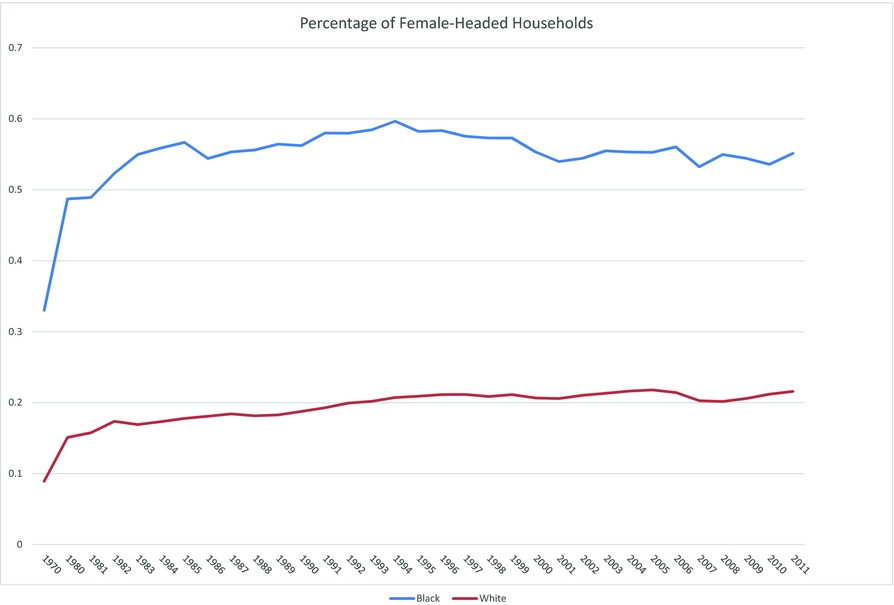
Figure 1 displays racial differences in the fraction of female-headed households from 1970 to 2011. The percentage of black female-headed households ranged from 33% to 60%, while the percentage of white female-headed households ranged from about 9% to 22% during this same period. However, the steepest increase in female headship for blacks and whites occurred after 1970 and continued into the 1980s. Subsequent to 1990, female headship increased by a much smaller magnitude; yet, a vast and relatively stable racial disparity persists among female-headed households.
Fraction of female-headed households by race. Notes: U.S. Census Bureau (2000).

2.2. Welfare and Female Economic Status
Becker's theory of marriage [Becker (Reference Becker1973, Reference Becker1974, Reference Becker1981)] posits that a woman will only marry if the economic benefits gained from marriage exceed those gained outside of marriage. This theory boosted the argument that welfare benefits were chiefly responsible for the rise in female family headship. With poor economic prospects traditionally facing black men, the U.S. welfare system was criticized as promoting non-marital childbearing and female headship within the black community [(Moynihan (Reference Moynihan, Rainwater and Yancey1967), Lichter et al. (Reference Lichter, LeClere and McLaughlin1991), Lloyd and South (Reference Lloyd and South1996), Garfinkel et al. (Reference Garfinkel, Chien-Chung, McLanahan and Gaylin2003), Teitler et al. (Reference Teitler, Reichman, Nepomnyaschy and Garfinkel2009), Willis (Reference Willis1999)].
Under AFDC in particular, scholars argue that the economic incentives of non-marital fertility and female headship are positively linked to this welfare regime [e.g., Moffitt (Reference Moffitt1992), Murray (Reference Murray1984), Moffitt (Reference Moffitt1994), Lichter et al. (Reference Lichter, McLaughlin and Ribar1997), Rosenzweig (Reference Rosenzweig1999), Hoffman and Foster (Reference Hoffman and Foster2000)]. This is because the AFDC made it much more difficult to obtain benefits when married or living in extended family arrangements [Lichter et al. (Reference Lichter, McLaughlin and Ribar1997), Blau et al. (Reference Blau, Kahn and Waldfogel2004)].
Still, others discredit the welfare-incentive theory (particularly any claims of race-specific effects), citing the rising trend of female-headship among households at all economic strata in the United States [Lichter et al. (Reference Lichter, McLaughlin and Ribar1997)], the role of structural and socio-economic disadvantages [Darity and Myers (Reference Darity and Myers1984), Murray (Reference Murray1984), Darity and Myers (Reference Darity, Myers, Tucker and Mitchell-Kernan1995), Darity et al. (Reference Darity, Myers and Chung1998), Darity (Reference Darity2011)], and the decline in real welfare benefits over time [Darity and Myers (Reference Darity and Myers1984, Reference Darity, Myers, Tucker and Mitchell-Kernan1995)]. It is also important to acknowledge that the evidence for the welfare-incentive effect on female family headship may have been conflated by technical statistical issues, including omitted variable bias and reverse causality. Studies that addressed these issues either found weak support for the welfare-incentive effect [Moffit (Reference Moffitt1994, 1998), Blau et al. (Reference Blau, Kahn and Waldfogel2004)] or no welfare-incentive effect [Darity and Myers (Reference Darity and Myers1984, Reference Darity, Myers, Tucker and Mitchell-Kernan1995), Hoynes (Reference Hoynes1997)].
The passage of PRWORA in 1996 and the new regime, Temporary Assistance for Needy Families (TANF), stipulated new reforms (such as time limits and work provisions), aimed at improving the employment situation of participants, while providing bonuses to states that lowered non-marital fertility without raising abortion rates [Blank (Reference Blank2002)]. Despite these changes, there still is little evidence to support the hypothesis that welfare benefits incentivize female headship [Fitzgerald and Ribar (Reference Fitzgerald and Ribar2004)].
Female economic status may also play a crucial role in understanding the rise in female headship. Becker (1981) argues that the relative improvement in female economic status may erode traditional gender roles of the family, as well as the need for marriage. Based on this hypothesis, female economic status is expected to increase the incidence of female headship.
On the other hand, female economic status may work to reduce female headship. Previous studies find that female economic status raises women's attractiveness as potential spouses [Willis (Reference Willis1999), Sweeney and Cancian (Reference Sweeney and Cancian2004)] because males are likely to engage in relationship hypergamy or the “marry-up” phenomenon [Mare and Winship (Reference Mare, Winship, Jencks and Peterson1991), Lichter et al. (Reference Lichter, Mclaughlin, Kephart and Landry1992)].
2.3. Marriage Market Conditions
Beyond welfare and female economic status, prior works illustrate that the mere scarcity of males lowers marriage rates and depresses the timing of marriage, even as it raises non-marital childbearing [Cox (Reference Cox1940), Jackson (Reference Jackson1972), Darity and Myers (Reference Darity and Myers1983), Guttentag and Secord (Reference Guttentag and Secord1983), Darity and Myers (Reference Darity and Myers1984), Lichter et al. (Reference Lichter, LeClere and McLaughlin1991, Reference Lichter, Mclaughlin, Kephart and Landry1992), South and Lloyd (Reference South and Lloyd1992), Darity and Myers (Reference Darity, Myers, Tucker and Mitchell-Kernan1995), Kiecolt and Fossett (Reference Kiecolt, Fossett, Tucker and Mitchell-Kernan1995), South (Reference South1996), Brien (Reference Brien1997), Cready et al. (Reference Cready, Fossett and Kiecolt1997), Willis (Reference Willis1999), Angrist (Reference Angrist2002), Harknett and McLahanan (Reference Harknett and McLanahan2004), Neal (Reference Neal2004), Harknett (Reference Harknett2008)]. This evidence is underscored by the theory that male scarcity diminishes marriage opportunities for women. Consequently, relative male bargaining power within the marriage market rises [Becker (1981), Guttentag and Secord (Reference Guttentag and Secord1983)], such that men can achieve marital benefits even outside of marriage [Cready et al. (Reference Cready, Fossett and Kiecolt1997)].
The “quality” of males may be even more important than the quantity of males in understanding the prevalence and racial divide in female headship. The attractiveness of males as marriage prospects is highly correlated with the ability to be strong economic providers or breadwinners in the household [e.g., Wilson (Reference Wilson1987), Lichter et al. (Reference Lichter, LeClere and McLaughlin1991), Testa and Krogh (Reference Testa, Krogh, Tucker and Mitchell-Kernan1995), South (Reference South1996), Koball (Reference Koball1998), Watson and McLanahan (Reference Watson and McLanahan2010), Schneider (Reference Schneider2011)]. For black males, however, high levels of unemployment stifle their economic potential and subsequently their attractiveness as prospective husbands [Lichter et al. (Reference Lichter, LeClere and McLaughlin1991), Fossett and Kiecolt (Reference Fossett and Kiecolt1991), Darity and Myers (Reference Darity, Myers, Tucker and Mitchell-Kernan1995), Darity et al. (Reference Darity, Myers and Chung1998), Koball (Reference Koball1998), Western and Wildeman (Reference Western and Wildeman2009), Watson and McLanahan (Reference Watson and McLanahan2010), Schneider (Reference Schneider2011)]. In 1990, the black male unemployment rate was 10.3% while the unemployment rate for all males was 4.7%. By 2011, the black male unemployment rate had risen to 16.8% and remained more than 5 percentage points higher than the average male unemployment rate (U.S. Bureau of Labor Statistics).
Mass incarceration also limits the economic attractiveness of males as viable marriage partners [Darity and Myers (Reference Darity, Myers, Tucker and Mitchell-Kernan1995), Western and Wildeman (Reference Western and Wildeman2009), Charles and Luoh (Reference Charles and Luoh2010)]. While some have argued that there are positive externalities produced from male incarceration [South and Lloyd (Reference South and Lloyd1992), South (Reference South1996), Charles and Luoh (Reference Charles and Luoh2010), Mechoulan (Reference Mechoulan2011)], the costs to economic outcomes (including the erosion of human capital, collateral consequences, and criminal recidivism) are likely to outweigh these putative benefits.
Since the 1970s, the number of individuals incarcerated in the United States has risen by more than 500%, exceeding two million persons by 2011 [Raphael and Stoll (Reference Raphael and Stoll2013)]. Moreover, male incarceration rates are disproportionately higher for blacks [Pettit and Western (Reference Pettit and Western2004), Western (Reference Western2006), Western and Wildeman (Reference Western and Wildeman2009)], suggesting that black women are more critically disadvantaged in terms of their marital prospects [Darity and Myers (Reference Darity, Myers, Tucker and Mitchell-Kernan1995), Cready et al. (Reference Cready, Fossett and Kiecolt1997), Darity et al. (Reference Darity, Myers and Chung1998), Koball (Reference Koball1998), Western (Reference Western2006), Western and Wildeman (Reference Western and Wildeman2009), Charles and Luoh (Reference Charles and Luoh2010)].
Wilson and Neckerman (Reference Wilson, Neckerman, Danziger and Wienberg1986) were the first to explore the relationship between male marriageability and marriage, finding a strong inverse relationship between employed males and marriage rates. Other studies confirm the adverse effect of the relative supply of employed males on marriage rates [Lichter et al. (Reference Lichter, Mclaughlin, Kephart and Landry1992), Wood (Reference Wood1995), Raley (Reference Raley1996)]. However, the effects detected in these later studies are marginal by comparison. By contrast, Darity and Myers (Reference Darity, Myers, Tucker and Mitchell-Kernan1995) concurred with Wilson and Neckerman (Reference Wilson, Neckerman, Danziger and Wienberg1986). This study illustrates that the overall incidence of female headship from 1976 to 1985 increased in response to the decline in male marriageability. The study also showed that the male marriageability problem was even more severe than previously thought.
Although these studies explore the relationship between male marriageability and family formation, none have been able to produce causal inferences concerning this relationship [Wilson and Neckerman (Reference Wilson, Neckerman, Danziger and Wienberg1986), Lichter et al. (Reference Lichter, Mclaughlin, Kephart and Landry1992), Darity and Myers (Reference Darity, Myers, Tucker and Mitchell-Kernan1995), Wood (Reference Wood1995), Raley (Reference Raley1996)]. Our study adds to the literature by using novel instrumental variables (IV) and instrumental variables-probit (IVProbit) strategies to identify the race-specific effects of male marriageability on female headship from 1980 to 2010.
3. DATA AND EMPIRICAL METHODS
3.1. Data
The data for this study are obtained from the Integrated Public Use Microdata Series – USA (IPUMS-USA) from 1980 to 2010 [Ruggles et al. (Reference Ruggles, Alexander, Genadek, Goeken, Schroeder and Sobek2010)]. The IPUMS-USA provides data for the total U.S. population, and not just the non-institutionalized population characteristic of other national datasets. The analysis sample is restricted to black and white females who are 18 years or older, since they are unlikely to assume head of household responsibilities prior to that time.
To measure the relative supply of marriageable males, we use the ratio of unmarried males in the labor force or in school to unmarried females [Darity and Myers (Reference Darity, Myers, Tucker and Mitchell-Kernan1995)]. Darity and Myers (Reference Darity, Myers, Tucker and Mitchell-Kernan1995) also provided a detailed analysis of various sex-ratio measures and found this to be the most comprehensive measure of the relative supply of marriageable malesFootnote 1. Male marriageability studies that only utilize the number of employed males [Wilson and Neckerman (Reference Wilson, Neckerman, Danziger and Wienberg1986), Lichter et al. (Reference Lichter, Mclaughlin, Kephart and Landry1992), Wood (Reference Wood1995), Raley (Reference Raley1996)] exclude a sizeable male population that is currently in school, and is also economically attractive.Footnote 2
The study also focuses on racially homogenous marriage markets because black–white inter-racial marriage rates are relatively low in general, especially for black women [Taylor et al. (Reference Taylor, Passel, Wang, Kiley, Velasco and Dockterman2010)]. Additionally, we focus on the heterosexual marriage market given that our period of analysis ranges from 1980 to 2010 and state approval of homosexual marriages did not begin until the turn of this century. While cohabiting relationships are a nontrivial and growing type of family structure in the United States, the data do not allow for identification of these families.
The level of geographic aggregation that defines a marriage market has been frequently scrutinized in the marriage market literature. This is because it hinges upon a critical assumption about the size and scope of the geographical area that the individual uses to search for a potential mate. Brien (Reference Brien1997) argued that defining a marriage market area that is too large (such as at the state-level), may confound significantly within-area variations in local marriage markets. On the other hand, if the marriage market area is defined too narrowly (such as at the city or county level), data may not be available for all racial-ethnic groups (especially blacks), leading to major challenges in constructing consistent marriage markets.
Therefore, using a marriage market somewhere between the two extremes would be preferred. Our study defines the marriage market as the labor market area/commuting zone (LMACZ) in which the individual resides. LMACZs are geographical boundaries, with at least 100,000 individuals, that closely represent the local economy where individuals both work and resideFootnote 3. This is arguably a stronger representation of local marriage markets relative to counties (which may be too small) and states (which may be too large). LMACZs are also more extensive than metropolitan statistical areas (MSAs) that only identify highly populated areas.
3.2. Empirical Methods
To examine the relationship between male marriageability and never-married female family headship, the following binary choice model is specified:
 $$\begin{eqnarray}
P\left( {{\rm{F}}{{\rm{H}}_{i,l,t}} = 1|.} \right) &=& {\beta _0} + {\beta _1}{\rm{M}}{{\rm{M}}_{r,a,l,t}} + {X_{i,t}}{\beta _2} + {W_{i,s,t}}{\beta _3}\nonumber\\
&& +\, {\beta _4}{\rm{In}}{{\rm{c}}_{r,s,t}} + {\lambda _l} + {\varsigma _s} + t + {\varepsilon _{i,l,t}}
\end{eqnarray}$$
where i represents individuals in the sample, r denotes race (black or white), a denotes age, l denotes LMACZs, and t represents the survey-years (1980, 1990, 2000, and 2010). FH is a binary indicator equal to 1 for never-married mothers who are heads of household and 0 otherwise. MM denotes the race-, age-, LMACZ-, and year-specific ratio of unmarried males employed or in school to unmarried females. To capture individual-level characteristics (X), the specification accounts for individual-specific age, education, and number of children. To evaluate welfare and female economic status (W), the model controls for state- and year-specific real maximum welfare benefits for a family of three (expressed in 2010$)Footnote 4 as well as race-, state-, and year-specific median female earnings (expressed in 2010$). Inc denotes the race-, state-, and year-specific male incarceration rate (per 100,000 persons). The model also includes LMACZ-specific (λl), state-specific (ςs), and general (t) time trends.
We utilize linear probability and probit regression framework to estimate equation (1) separately for blacks and whites. This is consistent with our aim of assessing how racially homogenous marriage market conditions influence race-specific never-married female headship from 1980 to 2010.
One limitation of the OLS and probit models however, is that the relative supply of marriageable males may be correlated with unobserved characteristics (e.g., marital preferences and family values) also linked to never-married female headship. If these characteristics work to reduce the ratio of unmarried males (employed or in school) to unmarried females while increasing the odds of female headship, OLS, and probit estimates are likely to be biased away from zero. However, the aggregate measure of the relative supply of marriageable males also may be susceptible to measurement error, thereby attenuating estimates toward zero. To address these issues, the study implements IV and Newey's two-step IVProbit Footnote 5 models using state-level variation from six main sentencing reforms that began in the late 1970s.
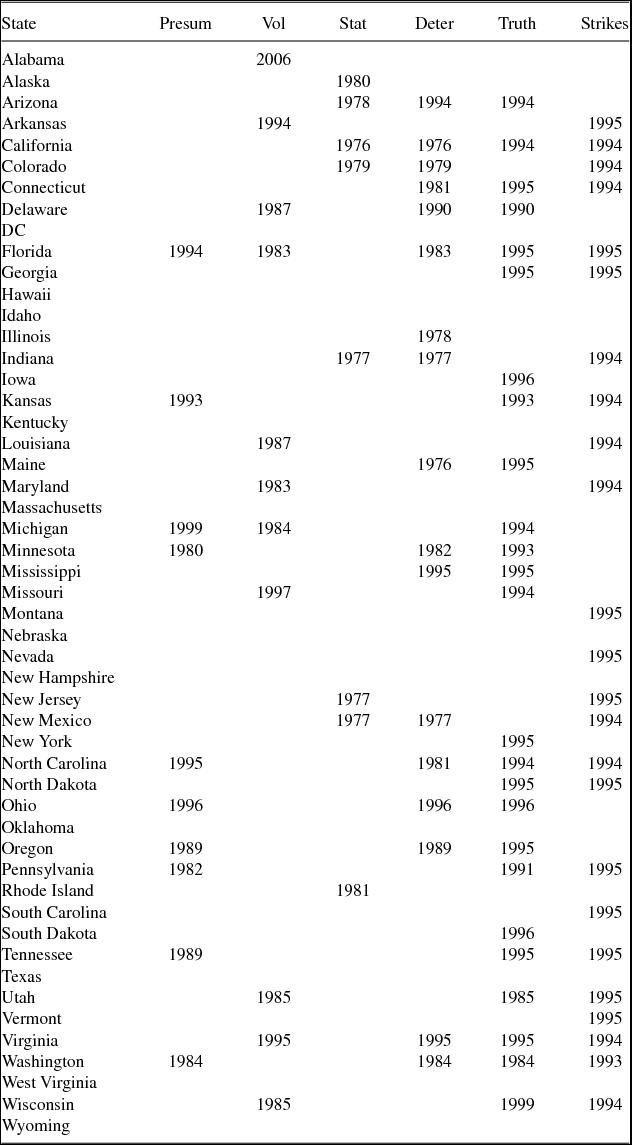
These sentencing reforms are sentencing guidelines (presumptive and voluntary), statutory presumptive sentencing, determinate sentencing, truth in sentencing, and three strike laws [Harmon (Reference Harmon2015)]. Presumptive sentencing guidelines are defined by a range of sentences based on the severity of an offense and prior criminal records. Voluntary sentencing guidelines on the other hand, are viewed as formal recommendations rather than legal mandates for judicial disposition. Statutory presumptive guidelines serve as a sentencing rubric by indicating the typical sentence for a particular offense. Determinate sentencing operates without discretionary parole boards, whereas truth in sentencing (according to the 1994 Omnibus Crime Bill) mandates that at least 85% of an original sentence must be served by an offender. Finally, three strikes laws recommend more stringent sentencing after the third felony offense.
Table A.1 presents the years in which these sentencing reforms were implemented in each state [adapted from Harmon (Reference Harmon2015)]. The table indicates that there are 40 states that adopted sentencing reforms, 29 of these adopted at least two. Reforms in sentencing began as a response to the “law and order” movement of the 1960s and continued into the 1990s as a part of the widespread “tough on crime” philosophy. Over these three decades, the United States waged a dual war on crime and drugs that called for more stringent sanctions to fuel criminal deterrence [Harmon (Reference Harmon2015)].
With the imprisonment boom that began in the 1980s however, some argue that the onset of sentencing reform not only worked to spur mass incarceration in the United States [e.g., Marvell (Reference Marvell1995), Steffensmeier and Demuth (Reference Steffensmeier and Demuth2006), Stemen et al. Reference Stemen, Rengifo and Wilson2006)], but also racial inequities in sentencing [e.g., Tonry (Reference Tonry1995), Marvell (Reference Marvell1995), Steffensmeier and Demuth (Reference Steffensmeier and Demuth2006), Stemen et al. (Reference Stemen, Rengifo and Wilson2006), Harmon (Reference Harmon2011)].
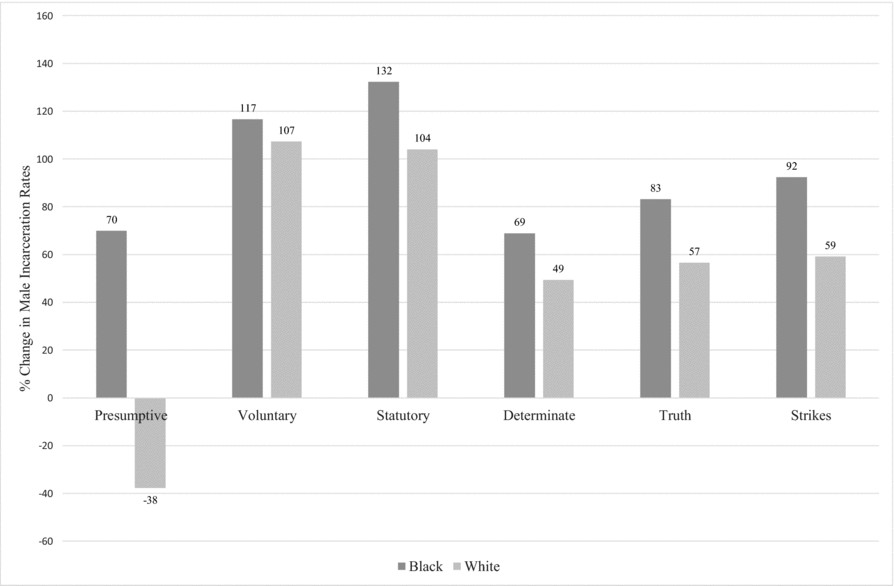
Using incarceration data from the National Prisoner Statistics USDOJ (2015) and state variation in sentencing reforms, the study illustrates how black and white male incarceration rates change after the implementation of sentencing reforms. Figure 2 shows that black and white male incarceration rates changed markedly after each sentencing reform was implemented, albeit more dramatically for black males. For instance, male incarceration rates in states that implemented presumptive sentencing increased by about 70% for blacks but declined by 38% for whites. Voluntary and statutory presumptive sentencing increased black and white male incarceration rates by well over 100%, but the rise was significantly higher for blacks.
Percentage change in male incarceration rates post-sentencing reforms. Data: National prisoner statistics, IPUMS-USA (1980–2010). Notes: All percentage changes are statistically different from zero.

Determinate, truth, and three strikes sentencing laws raised black male incarceration rates by 69%, 83%, and 92%, respectively. To a lesser extent, white male incarceration rates rose by 49%, 57%, and 59%, respectively. These trends underscore that sentencing reforms not only contributed to the imprisonment boom, but also worked to widen the racial disparities in incarceration rates [Tonry (Reference Tonry1995), Harmon (Reference Harmon2011)]. Thus, the disparate impact of sentencing reforms may help explain racial differences in the relative supply of marriageable males, and consequently never-married female headship.
4. RESULTS
4.1. Descriptive Statistics
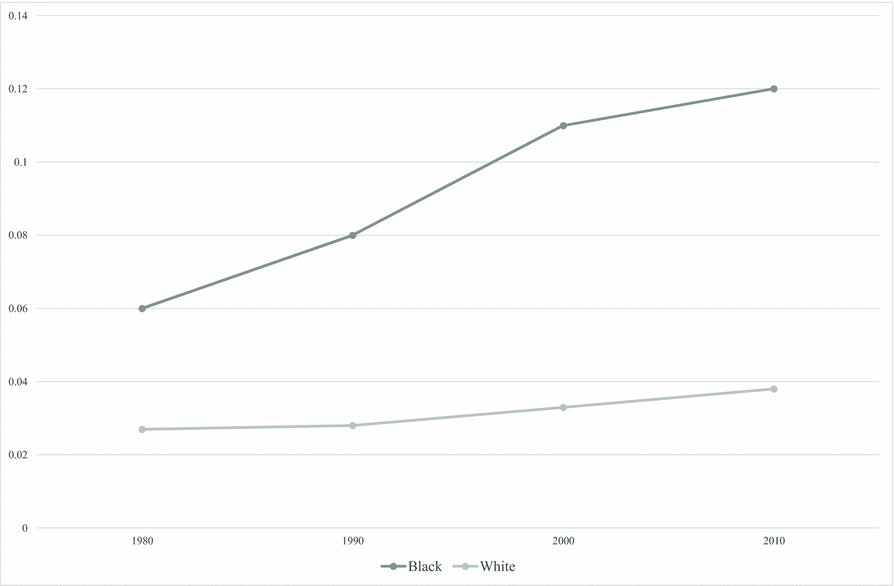
Figure 3 illustrates the trend in never-married female headship by race from 1980 to 2010. Although overall female headship changed negligibly from 1990 to 2011 (Figure 1), never-married female headship rose steadily for both blacks and whites from 1980 to 2010. In 1980, 6% of all black households were headed by never-married black women compared to 3% of white counterparts. By 2010, never-married female headed households accounted for 12% of all black households relative to approximately 4% of all white households. Therefore, never-married female headship doubled among black households and increased by 33% among white households.
Trends in never-married female family headship by race (1980–2010). Data: IPUMS-USA (1980–2010).

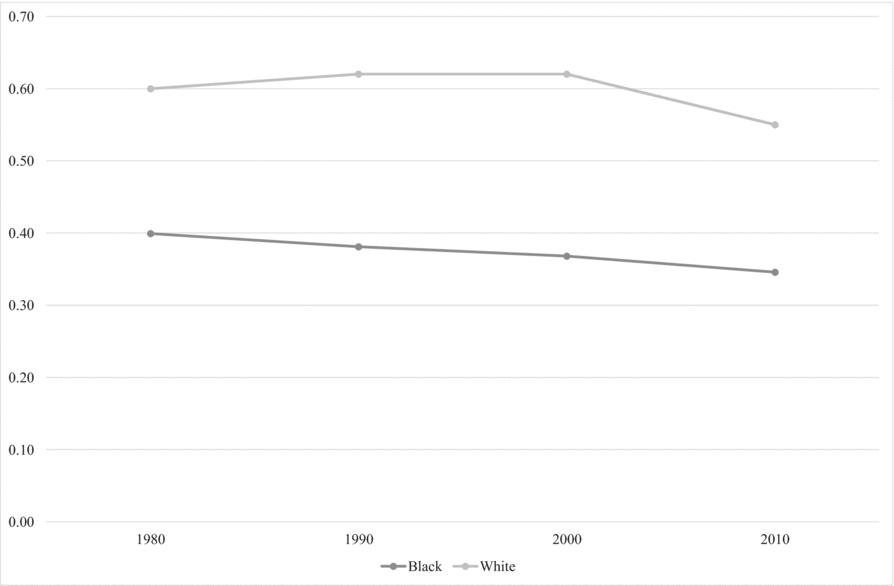
Over the same four-decade period, a large racial disparity in the relative supply of marriageable males is also evident. The relative supply of marriageable males is defined as the race-, age-, LMACZ-, and year-specific ratio of unmarried males employed or in school to unmarried females. Figure 4 indicates that the dearth of marriageable males is significantly more severe for blacks than whites. In 1980, the relative supply of marriageable males was 40% for blacks and 60% for whites. By 2010, this measure declined to 35% for blacks and 55% for whites. This suggests that black women face a considerably less favorable marriage market pool relative to white women. It may also explain the striking growth and racial disparity in never-married female headship illustrated in Figure 3.
Relative supply of marriageable males (1980–2010). Data: IPUMS-USA (1980–2010).

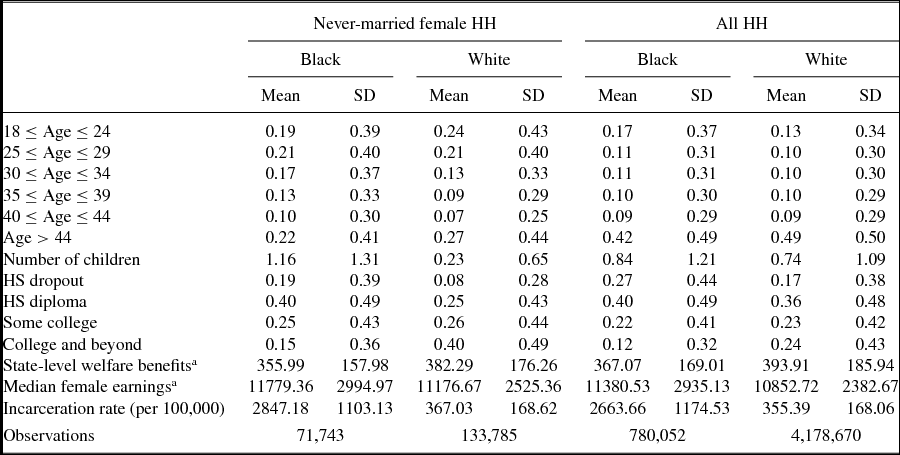
Table 1 shows key differences in characteristics of black and white female-heads of household. Black female-heads of household have on average one more child than white female-heads of households. In addition, about 60% of never-married black female heads have high school diplomas or less, this is only characteristic of a little over 30% of never-married white female heads. There is a higher percentage of black female heads in their 30s relative to white female heads. However, there is a higher percentage of white female heads are younger than 25 and older than 44. Welfare benefits and median female earnings are statistically similar for black and white female heads as these measures are not constructed along racial lines. On the other hand, male incarceration rates differ significantly by race – black male incarceration rates are about eight times as large as white male incarceration rates.
Summary statistics for never-married female-headed and all households

Data Source: IPUMS-USA (1980–2010).
a Adjusted for inflation.
For all households, there are fewer racial differences in these characteristics. For instance, both black and white households have approximately one child. The age distribution as well as earnings are also statistically similar. Some racial disparities persist, nonetheless. Specifically, black male incarceration rates are significantly higher than white male incarceration rates. In addition, 67% of black households have high school diplomas or less compared to 53% of white households.
4.2. Main Regression Findings
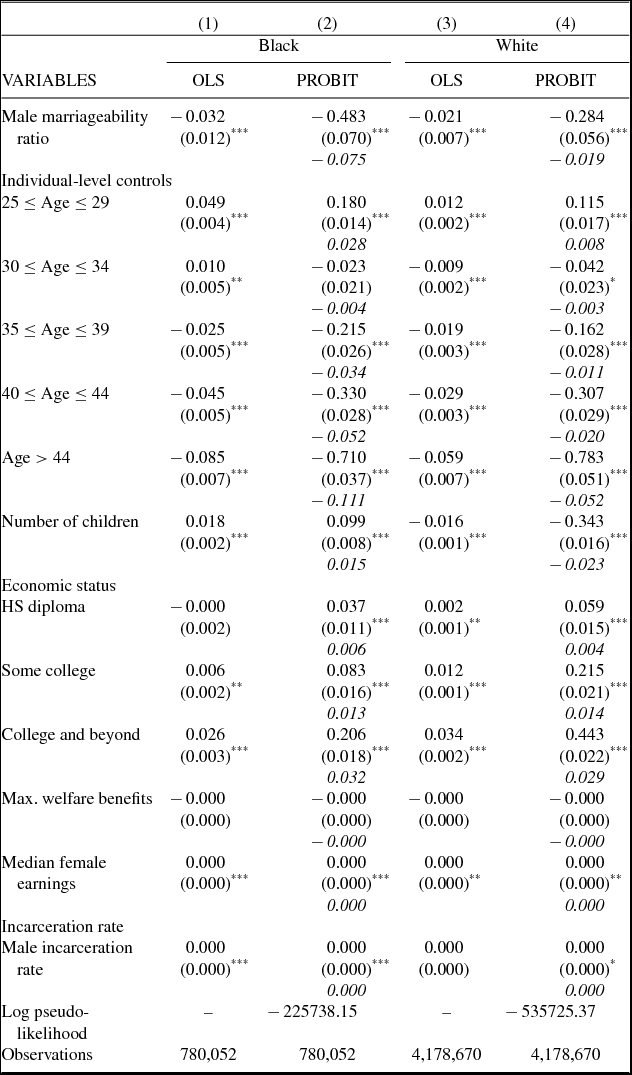
Table 2 shows OLS and probit marginal effects on never-married female headship for blacks and whites, respectively. The results from Table 2 suggest that the decline in the relative supply of marriageable males substantially raises female headship for both blacks and whites. The results indicate that a one-unit decline in the relative supply of marriage males raises the odds of never-married female headship by 3.2–7.5 percentage points (p < 0.01) for blacks and about 2 percentage points (p < 0.01) for whites.
OLS and PROBIT results (Dependent variable: Never-married female headship)

Standard errors clustered at the LMACZ-level in parentheses.
Probit marginal effects are italicized.
***p < 0.001, **p < 0.01, *p < 0.05.
Notes: All regressions control for state-specific, labor market areas/commuting-zones-specific, and general trend variables. The reference category for age is 18–24 years old. The reference category for education is high school dropout. State-level maximum welfare benefits and median female earnings are adjusted for inflation.
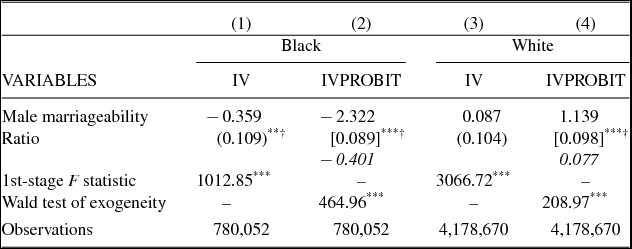
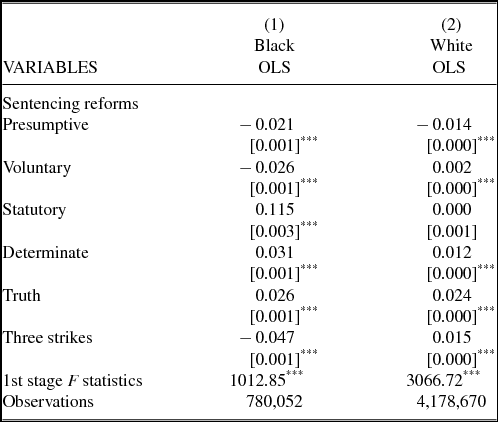
Despite these robust findings, potential bias from latent heterogeneity and measurement error must be addressed. Table 3 presents IV and IVProbit estimates on the relative supply of marriageable males by using binary indicators equal to one for states with sentencing reforms currently in effect. To the extent that these IV are both exogenous and strongly correlated with the relative supply of marriageable males, IV and IVProbit estimation allow for causal inferences on the effect of the relative supply of marriageable males on never-married female headship from 1980 to 2010. The first-stage F statistics indicate that sentencing reforms are strongly correlated with the relative supply of marriageable males for both blacks and whites (see Appendix B for first-stage results).
IV and IVProbit results (Dependent outcome: Never-married female headship)

Standard errors clustered at the LMACZ level in parentheses.
IVProbit marginal effects are italicized.
Standard errors in brackets.
***p < 0.001, **p < 0.01, *p < 0.05.
Notes: †Statistically different from naïve estimates.
Regressions account for individual characteristics such as age and education; state-level welfare benefits, median female earnings, and male incarceration rates; state-specific, labor market areas/commuting-zones-specific, and general trend variables.
Instrumental Variables: Sentencing reform indicators.
Instrumented: Relative supply of marriageable males.
Therefore, to the extent that sentencing reforms are exogenously determined in the female headship model, the IV and IVProbit results show that the decline in the relative supply of marriageable males increase the odds of never-married female headship among blacks. A one-unit decline in the relative supply of marriageable males raises the odds of never-married female headship by 35.9–40.1 percentage points (p < 0.01). Even with a first-stage F statistic that is larger than that of blacks, IV and IVProbit estimates bear positive signs for whites. Moreover, the IV estimate is not statistically different from zero.
It is important to note that IV and IVProbit marginal effects are substantially larger than corresponding OLS and Probit marginal effects. This is because IV specifications provide estimates that are local average treatment effects (LATE): estimates are derived from the portion of the variation in the endogenous variable that is strongly correlated with the outcome variable but exogenous to the error term.
In summary, it is apparent that the effect of male marriageability on never-married female headship differs markedly by race. In general, never-married female headship is negatively associated with the relative supply of marriageable black males in naïve, IV, and IVProbit models. However, this inverse relationship is not observed for whites once biases from latent heterogeneity and measurement error are mitigated.
OLS and probit models provide other interesting findings. Fertility or the number of children is positively linked to never-married female headship among blacks, while the opposite is true for whites. Having one more child raises the odds of never-married female headship by about two percentage points (p < 0.01) for blacks but lowers the odds by about two percentage points for whites (p < 0.01). Relative to 18–24-year olds, women 25–29 years old are more likely to become never-married female heads by about 3 percentage points for blacks and 1 percentage point for whites (p < 0.01). After 30 years old, however, women are significantly less likely to become never-married female heads. This is especially evident at ages 45 and older, where the likelihood of never-married female headship increases by up to 11.1 percentage points (p < 0.01) for blacks and 5.2 percentage points for whites (p < 0.01). These results suggest that never married female headship plagues women under 30 years old regardless of race.
For both blacks and whites, average female earnings and college education are positively associated with never-married female headship. While male incarceration rates increase the odds of never-married female headship among blacks, this relationship is not statistically significant for whites.
In contrast to the previous literature [Murray (Reference Murray1984), Moffitt (Reference Moffitt1994), Lichter et al. (Reference Lichter, McLaughlin and Ribar1997), Moffitt (1998), Rosenzweig (Reference Rosenzweig1999), Hoffman and Foster (Reference Hoffman and Foster2000)], the study does confirm welfare incentives for never-married female headship. However, the study uses a state-level measure of welfare benefits. The individual-level measure would be more suitable for identifying welfare-incentive effects,this goes beyond the scope of this study.
4.3. Sensitivity Checks
While prior evidence from Darity and Myers (Reference Darity, Myers, Tucker and Mitchell-Kernan1995) shows that our measure of the relative supply of marriageable males (i.e., the ratio of unmarried males employed or in school to unmarried females) strongly explains female headship among both blacks and whites (relative to the other measures analyzed), this measure does have limitations. As stated in the Data section, the male marriageability measure is restricted to heterosexual and racially homogenous marriage markets. Individuals who identify as gay, lesbian, or bisexual account for less than 5% of the population [Gates (Reference Gates2006)] and may therefore be a reasonable assumption in this model. On the other hand, inter-racial relationships are increasing over time, especially among whites.
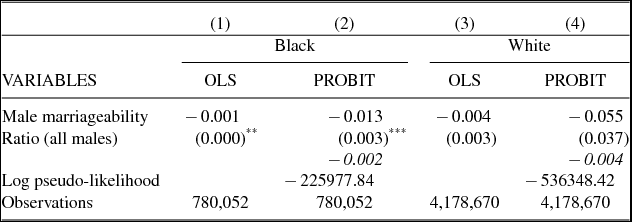
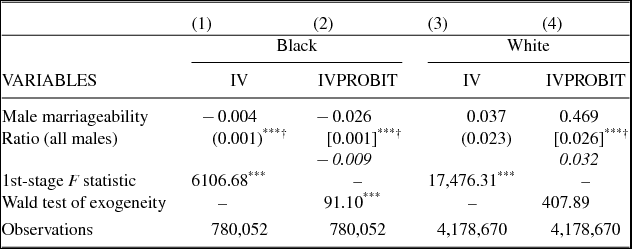
The study tests the sensitivity of the results to a new measure of male marriageability that is no longer restricted to racially homogenous marriage markets. Tables 4 and 5 present results for the ratio of all unmarried males who are employed or in school to unmarried females. The IV and IVProbit results indicate that the relative supply of marriageable males is negatively associated with never-married female family headship among blacks but not for whites.
OLS and PROBIT results (Dependent outcome: Never-married female headship)

Standard errors clustered at the LMACZ level in parentheses.
Probit marginal effects are italicized.
Standard errors in brackets.
***p < 0.001, **p < 0.01, *p < 0.05.
IV and IVProbit results (Dependent outcome: Never-married female headship)

Standard errors clustered at the LMACZ level in parentheses.
IVProbit marginal effects are italicized.
Standard errors in brackets.
***p < 0.001, **p < 0.01, *p < 0.05.
Notes:
Regressions account for individual characteristics such as age and education; state-level welfare benefits, median female earnings, and male incarceration rates; state-specific, labor market areas/commuting-zones-specific, and general trend variables.
Instrumental Variables: Sentencing reform indicators.
Instrumented: Relative supply of marriageable males (all males).
It is important to highlight that for blacks, estimates are lower when the relative supply of marriageable males is defined over racially homogenous marriage markets. This is likely because black women have low interracial marriage rates and using this alternative measure signals a much larger marriage pool than is realistically available to black female heads of household. Hence, this new measure is subject to attenuation bias and accounts for the much smaller estimate in Table 5 than in Table 3.
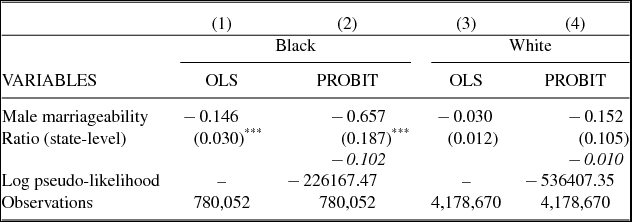
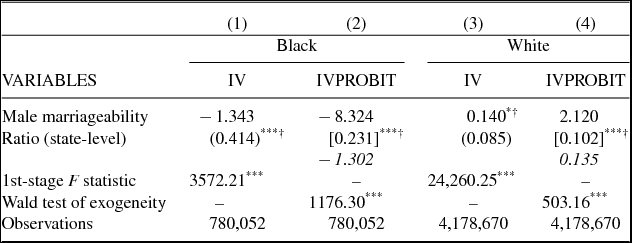
Another potential limitation of the male marriageability measure is that our geographic definition of the marriage market as an LMACZ may be viewed as restrictive for some individuals. Therefore, we define a new measure that is state-specific rather than LMACZ-specific. Naïve and IV results are presented in Tables 6 and 7, respectively. Still, IV and IVProbit results in Table 7 reinforce the general findings in Table 3.
OLS and PROBIT results (Dependent outcome: Never-married female headship)

Standard errors clustered at the state level in parentheses.
Probit Marginal Effects are italicized.
Standard errors in brackets.
***p < 0.001, **p < 0.01, *p < 0.05.
IV and IVProbit results (Dependent outcome: Never-married female headship)

Standard errors clustered at the state-level in parentheses.
IVProbit Marginal Effects are italicized.
Standard errors in brackets.
***p < 0.001, **p < 0.01, *p < 0.05.
Notes: †Statistically different from naïve estimates
Regressions account for individual characteristics such as age and education; state-level welfare benefits, median female earnings, and male incarceration rates; state-specific, labor market areas/commuting-zones-specific, and general trend variables.
Instrumental Variables: Sentencing reform indicators.
Instrumented: Relative supply of marriageable males (state-level measure).
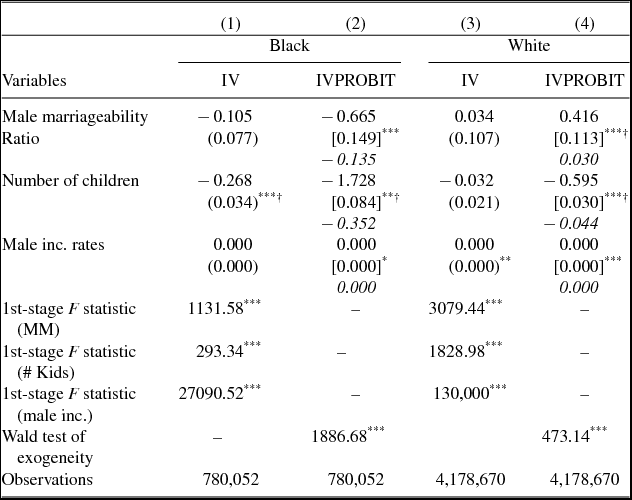
The main empirical specification also makes assumptions about the exogeneity of the additional control variables. Our specification implicitly assumes that the individual- and state-specific covariates are not correlated with the error term when LMACZ-specific, state-specific, and general time trends are accounted for. However, black and white women in never-married female-headed households differ significantly in their fertility patterns. As Table 1 shows, black women have higher levels of fertility than white women on average. Male incarceration rates also differ conspicuously by race. Therefore, number of children and male incarceration rates as a covariates in IV and IVProbit specifications may be problematic if these variables are correlated with unobserved characteristics in the error term.
Table 8 presents new specifications that use sentencing reforms to instrument for the relative supply of marriageable males, number of children, and male incarceration rates. This is based on the argument that sentencing reforms increase male incarceration as well as limit fertility. The first-stage F statistics confirm that sentencing reforms are strongly correlated with the relative supply of marriageable males as well as fertility and male incarceration rates. Nevertheless, IV and IVProbit results confirm that the relative supply of marriageable males is inversely linked to never-married female headship for blacks, but not for whites.
IV and IVProbit results (Dependent outcome: Never-married female headship)

Standard errors clustered at the LMACZ level in parentheses.
IVProbit marginal effects are italicized.
Standard errors in brackets.
***p < 0.001, **p < 0.01, *p < 0.05.
Notes: †Statistically different from naïve estimates.
Regressions account for individual characteristics such as age and education; state-level welfare benefits, median female earnings; state-specific, labor market areas/commuting-zones-specific, and general trend variables.
Instrumental Variables: Sentencing reform indicators.
Instrumented: Relative supply of marriageable males, number of children, and male incarceration rates.
5. CONCLUSION
The black–white disparity in never-married female-headed households has remained a stubborn condition over the past few decades. This has provoked inquiry as to why it has not receded even in the face of welfare reforms and secular improvements in economic opportunities for women. Using data from IPUMS-USA (1980–2010), our study investigates how the relative supply of marriageable males – measured as the ratio of unmarried males in the labor force or in school to unmarried females – influences never-married female family headship from 1980 to 2010 for blacks and whites.
The empirical findings from our study reinforce evidence of an inverse relationship between male marriageability and female headship among never-married women [Darity and Myers (Reference Darity, Myers, Tucker and Mitchell-Kernan1995), South (Reference South1996), Neal (Reference Neal2004)]. This relationship, however, varies substantially by race. Using state-level variation in sentencing reforms – to mitigate omitted variable bias and measurement error – IV and IVProbit both indicate that the decline in the relative supply of marriageable black males contributes to the transition of black women into never-married female headship. However, this relationship could not be confirmed for whites.
The absence of the inverse relationship between male marriageability and female family headship among whites should not be surprising, since they face more favorable marriage market and economic conditions. There is a near 3:5 ratio of marriageable males to unmarried females for whites, this ratio is 2:5 for blacks. Therefore, an attempt to increase the relative supply of marriageable males may not reduce never-married white female headship by much, if at all.
We can infer from our findings that the prevalence of female family headship is possibly driven by different mechanisms for blacks and whites. To the extent that the sentencing reforms are exogenously determined in the model, the dearth of marriageable males may help explain female headship among blacks. The scarcity of marriageable black males works to reduce marriage opportunities for black women while simultaneously raising male bargaining power in the marriage market. Consequently, black men can reap marital rewards outside of marriage [Cready et al. (Reference Cready, Fossett and Kiecolt1997), Willis (Reference Willis1999)], boosting both nonmarital fertility and female headship.
For whites, however, there is no statistically conclusive evidence that the dearth of marriageable males is responsible for the persistence of never-married female headship. Our study reveals that white female heads of household are more highly educated with fewer children than black counterparts. As such, education and fertility may explain the never-married female headship structure among whites (rather than the relative supply of marriageable males).
This study is not without its limitations. It focuses on heterosexual marriage markets, since state approval of same-sex marriages did not begin until the turn of this century. Cohabiting relationships may also conflate female-headed households since they could not be differentiated in the data. Finally, the study focuses on racially homogenous marriage markets that are defined by LMACZs. However, sensitivity analysis that relaxes this assumption arrives at similar conclusions.
Despite these limitations, the study presents salient evidence for understanding the racial divide in never-married female-headed households. In contrast to much prior literature [e.g., Moffitt (Reference Moffitt1992), Murray (Reference Murray1984), Moffitt (Reference Moffitt1994); Lichter et al. (Reference Lichter, McLaughlin and Ribar1997), Rosenzweig (Reference Rosenzweig1999), Hoffman and Foster (Reference Hoffman and Foster2000)], the study does not confirm a substantive relationship between female family headship and welfare generosity. Our study does not measure welfare participation at the individual level, which may account for the difference in findings. Therefore, future research should investigate other factors that explicate the female family headship phenomenon more comprehensively, especially for whites.
APPENDIX A
Sentencing reforms by state

APPENDIX B
First stage OLS estimates